Saturday, April 27, 2024

Edmonton Queer History: How a yearbook quote made national news back in 1985

CBC
Sat, April 27, 2024

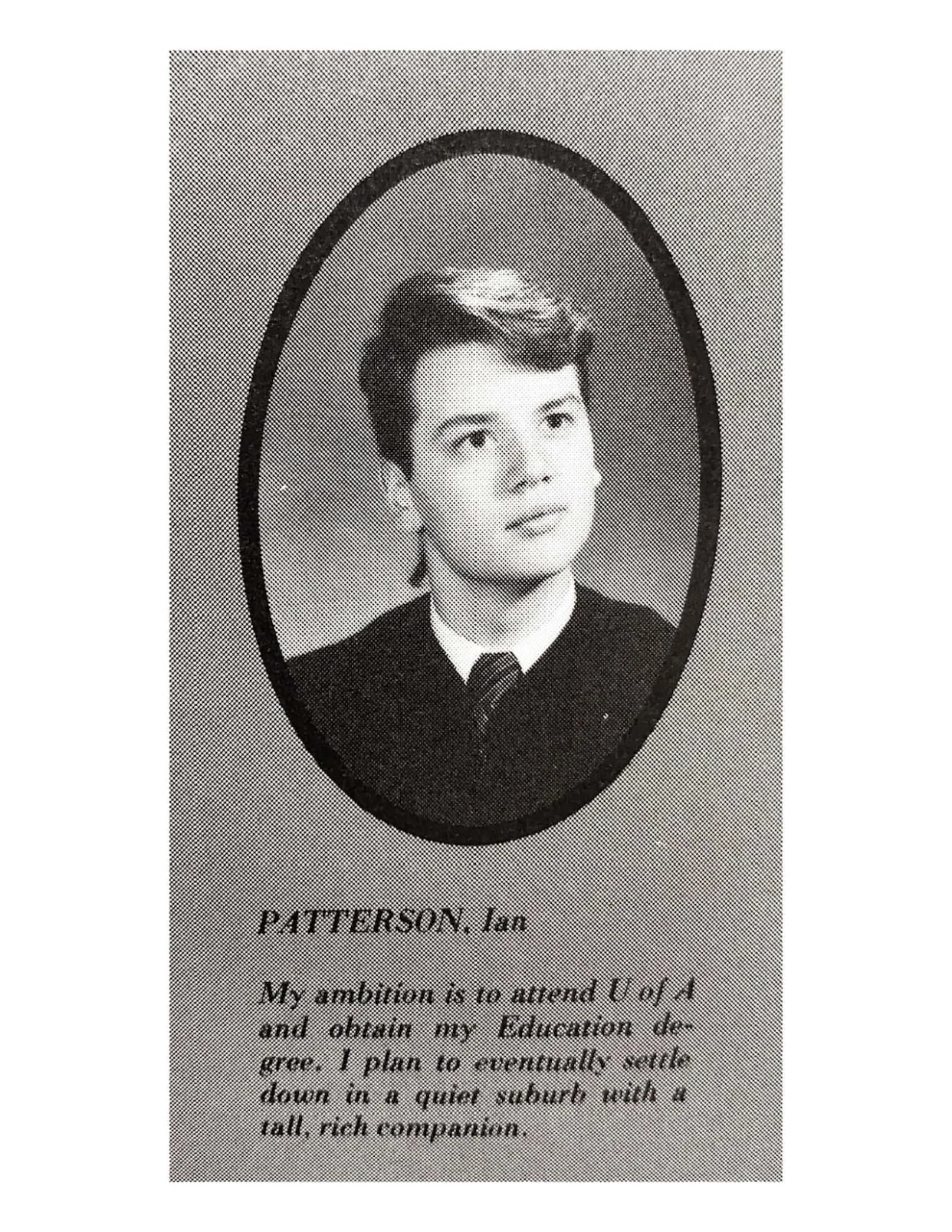
Ian Paterson's yearbook photo. The quote underneath states that, 'My ambition is to attend U of A and obtain my education degree. I plan to eventually settle down in a quiet suburb with a tall, rich companion.

Ian Paterson wanted to pen down a simple dream in his yearbook quote, to "eventually settle down in a quiet suburb with a tall, rich, hunky man with a bushy moustache."

It seems simple now, but in 1985, when 2SLGBTQ+ rights were not what they are today and AIDS hysteria was at its peak, this statement from a high school student was so controversial that it made the news.

38 years later, the story — printed in a small segment of a newspaper — is discovered by Remi Baker, a research assistant with the Edmonton Queer History Project while digging through the City of Edmonton Archives.

"The story really piqued my interest," Baker told CBC's Edmonton AM on Monday.

"So I made sure to grab a picture and then I brought it to Kris (Wells) and was like, 'We need to find out more about this. This is awesome.'"

The Edmonton Queer History Project launched in 2015 is a community collaboration project with MacEwan University to find and document queer stories in Edmonton over the past 50-plus years.

Kristopher Wells, Canada research chair for the public understanding of sexual and gender minority youth at MacEwan University, said they reached out to Harry Ainlay High School, the school Paterson had attended and discovered the story of an openly-gay boy and his will to be himself.

"What struck me was just the immense courage he had," Wells said.

"This was a time long before gay-straight alliances were even a dream in schools, you know, it was quite incredible.


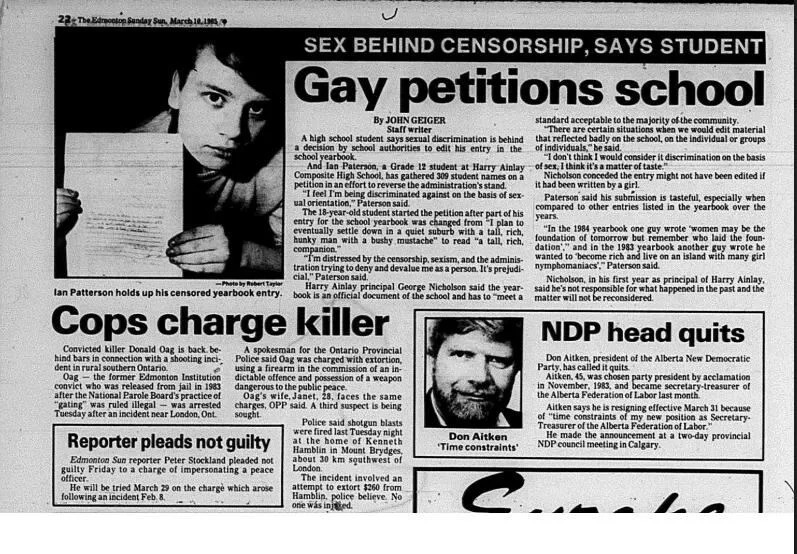
A clipping of the Edmonton Sun newspaper shows the article about Ian Paterson's petition to allow him to keep his original quote about him wanting a future with a man.

A clipping of the Edmonton Sun newspaper shows the article about Ian Paterson's petition to allow him to keep his original quote about him wanting a future with a man. (Edmonton City Archives)

Paterson had come out to his entire school in a poem he published in the school's literary magazine.

After his quote was rejected for the yearbook, he launched a petition that garnered from than 300 signatures to reinstate his original quote and called out the school for its discrimination. The story made the news in the form of newspaper articles and a segment on CTV's current affairs and documentary show, W5.

Wells said while many students supported him, there were many who didn't want Paterson at the school.

"It was a real controversy at the time," he said.

Wells said it was stories like Paterson's that give people hope that queer people have always existed.

"When people try to censor our stories or our lives, we persist," he said.

But the quote never made it into the yearbook. The school ended up publishing "tall, rich companion"' instead of "man with the moustache," Baker said.

To find more information on Paterson, they created a TikTok video asking for people who knew him to reach out. People replied the same day

People who knew Paterson in high school did reach out and told them that he had moved to Vancouver after graduating high school and passed away a few years ago. They described Paterson as "outgoing, flamboyant, and unapologetically Ian."

"The friend did say that eventually he did find his hunky man with a bushy moustache," Baker said.

The world’s 100 worst polluted cities are in Asia — and 83 of them are in just one country

Helen Regan, CNN
Fri, April 26, 2024 


All but one of the 100 cities with the world’s worst air pollution last year were in Asia, according to a new report, with the climate crisis playing a pivotal role in bad air quality that is risking the health of billions of people worldwide.

The vast majority of these cities — 83 — were in India and all exceeded the World Health Organization’s air quality guidelines by more than 10 times, according to the report by IQAir, which tracks air quality worldwide.

The study looked specifically at fine particulate matter, or PM2.5, which is the tiniest pollutant but also the most dangerous. Only 9% of more than 7,800 cities analyzed globally recorded air quality that met WHO’s standard, which says average annual levels of PM2.5 should not exceed 5 micrograms per cubic meter.


“We see that in every part of our lives that air pollution has an impact,” said IQAir Global CEO Frank Hammes. “And it typically, in some of the most polluted countries, is likely shaving off anywhere between three to six years of people’s lives. And then before that will lead to many years of suffering that are entirely preventable if there’s better air quality.”

When inhaled, PM2.5 travels deep into lung tissue where it can enter the bloodstream. It comes from sources like the combustion of fossil fuels, dust storms and wildfires, and has been linked to asthma, heart and lung disease, cancer, and other respiratory illnesses, as well as cognitive impairment in children.

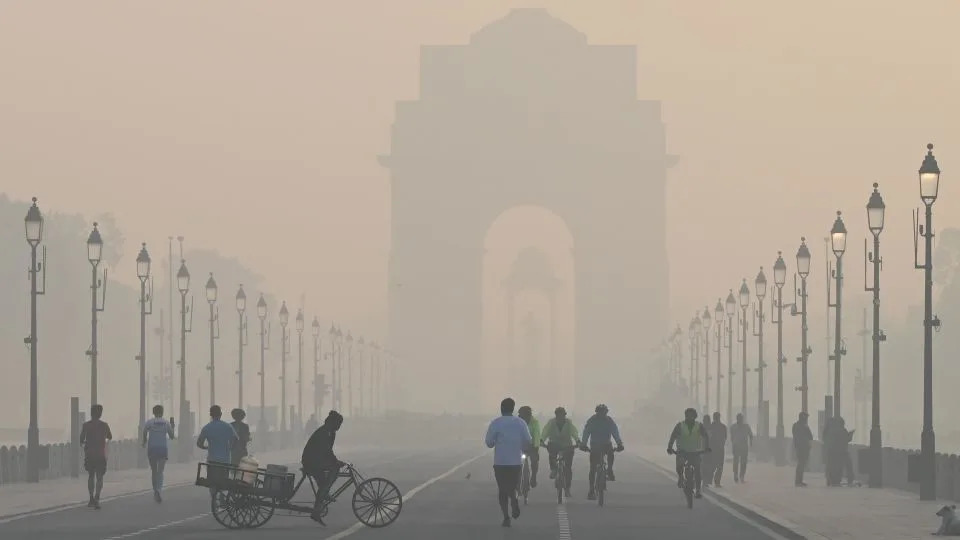
Begusarai, a city of half a million people in northern India’s Bihar state, was the world’s most polluted city last year with an average annual PM2.5 concentration of 118.9 — 23 times the WHO guidelines. It was followed in the IQAir rankings by the Indian cities of Guwahati, Assam; Delhi; and Mullanpur, Punjab.

Across India, 1.3 billion people, or 96% of the population, live with air quality seven times higher than WHO guidelines, according to the report.

Central and South Asia were the worst performing regions globally, home to all four of the most polluted countries last year: Bangladesh, Pakistan, India and Tajikistan.

South Asia is of particular concern, with 29 of the 30 most polluted cities in India, Pakistan or Bangladesh. The report ranked the major population centers of Lahore in 5th, New Delhi in 6th and Dhaka in 24th place.

Hammes said no significant improvement in pollution levels in the region is likely without “major changes in terms of the energy infrastructure and agricultural practices.”

“What’s also worrisome in many parts of the world is that the things that are causing outdoor air pollution are also sometimes the things that are causing indoor air pollution,” he added. “So cooking with dirty fuel will create indoor exposures that could be many times what you’re seeing outdoors.”
A global problem

IQAir found that 92.5% of the 7,812 locations in 134 countries, regions, and territories where it analyzed average air quality last year exceeded WHO’s PM2.5 guidelines.

Only 10 countries and territories had “healthy” air quality: Finland, Estonia, Puerto Rico, Australia, New Zealand, Bermuda, Grenada, Iceland, Mauritius and French Polynesia.

Millions of people die each year from air pollution-related health issues. Air pollution from fossil fuels is killing 5.1 million people worldwide every year, according to a study published in the BMJ in November. Meanwhile, WHO says 6.7 million people die annually from the combined effects of ambient and household air pollution.

The human-caused climate crisis, driven by the burning of fossil fuels, plays a “pivotal” role in influencing air pollution levels, the IQAir report said.

The climate crisis is altering weather patterns, leading to changes in wind and rainfall, which affects the dispersion of pollutants. Climate change will only make pollution worse as extreme heat becomes more severe and frequent, it said.

The climate crisis is also leading to more severe wildfires in many regions and longer and more intense pollen seasons, both of which exacerbate health issues linked to air pollution.

“We have such a strong overlap of what’s causing our climate crisis and what’s causing air pollution,” Hammes said. “Anything that we can do to reduce air pollution will be tremendously impactful in the long term also for improving our climate gas emissions, and vice versa.”
Regional rankings

North America was badly affected by wildfires that raged in Canada from May to October last year. In May, the monthly average of air pollution in Alberta was nine times greater than the same month in 2022, the report found.

And for the first time, Canada surpassed the United States in the regional pollution rankings.

The wildfires also affected US cities such as Minneapolis and Detroit, where annual pollution averages rose by 30% to 50% compared to the previous year. The most polluted major US city in 2023 was Columbus, Ohio for the second year running. But major cities like Portland, Seattle and Los Angeles experienced significant drops in annual average pollution levels, the report said.

In Asia, however, pollution levels rebounded across much of the region.

China reversed a five-year trend of declining levels of pollution, the report found. Chinese cities used to dominate global rankings of the world’s worst air quality but a raft of clean air policies over the past decade has transformed things for the better.

A study last year had found the campaign meant the average Chinese citizen’s lifespan is now 2.2 years longer. But thick smog returned to Beijing last year, where citizens experienced a 14% increase in the annual average PM2.5 concentration, according to the IQAir report. China’s most polluted city, Hotan, was listed at 14 in the IQAir ranking.

In Southeast Asia, only the Philippines saw a drop in annual pollution levels compared to the previous year, the report found.

Indonesia was the most polluted country in the region, with a 20% increase compared to 2022. Indonesia, Vietnam and Thailand all had cities that exceeded WHO PM2.5 guidelines by more than 10 times, according to the report.

Last month, Thai authorities ordered government employees to work from home due to unhealthy levels of pollution in the capital Bangkok and surrounding areas, according to Reuters. On Friday, tourism hot spot Chiang Mai was the world’s most polluted city as toxic smog brought by seasonal agricultural burning blanketed the northern city.
Inequality… and one bright spot

The report also highlighted a worrying inequality: the lack of monitoring stations in countries in Africa, South America and the Middle East, which results in a dearth of air quality data in those regions.

Although Africa saw an improvement in the number of countries included in this year’s report compared with previous years the continent largely remains the most underrepresented. According to IQAir, only 24 of 54 African countries had sufficient data available from their monitoring stations.

Seven African countries were among the new locations included in the 2023 rankings, including Burkina Faso, the world’s fifth most polluted country, and Rwanda, in 15th.

Several countries that ranked high on the most polluted list last year were not included for 2023 due to a lack of available data. They include Chad, which was the most polluted country in 2022.

“There is so much hidden air pollution still on the planet,” said Hammes.

One bright spot is increasing pressure and civic engagement from communities, NGOs, companies, and scientists to monitor air quality.

“Ultimately that’s great because it really shows governments that people do care,” Hammes said.


20 Most Air Polluted Cities in Asia
Meerub Anjum
Fri, April 26, 2024


In this article, we will look into the 20 most air polluted cities in Asia. If you want to skip our detailed analysis, you can go directly to the 5 Most Air Polluted Cities in Asia.
Air Pollution in Asia

99 out of the 100 most air polluted cities in the world are from Asia. The UNEP reports that nearly 6.5 million people die due to poor air quality every year, out of which 70% of the deaths occur in Asia and the Pacific. According to the 2023 Air Quality Life Index report, countries such as Bangladesh, Nepal, Pakistan, and India account for more than 50% of the life years lost due to air pollution. South Asia is the most polluted subregion in Asia, where the average lifespan declined by 5.1 years. Bangladesh is the most air polluted country in Asia. Life expectancy declined by 6.8 years in Bangladesh, as of 2023.

In 2023, Asia dominated the countries with the worst air pollution in the world. According to the 2023 World Air Quality Report, East Asia showed a diverse outlook, with some countries experiencing an increase in PM2.5 concentration in 2023 while others facing a decline. Countries such as Japan, Taiwan, South Korea, and Hong Kong SAR surpassed the WHO's target 2 of 15 μg/m³. Mongolia continued its downward trend in PM2.5 concentration and recorded a 25% decrease in its PM2.5 concentration. Hotan, China stands out as the most air polluted city in 2023, with an annual average particulate matter concentration of more than 87 µg/m3. Whereas, Ibigawa, Japan is the least polluted city in the region, as of 2023.

The air quality in Southeast Asia deteriorated, due to many countries in the region experiencing a rise in PM2.5 concentration. Indonesia appeared as the most air polluted country in the subregion. While Phillippines saw improvement in air quality in 2023, recording a 10% drop in its particulate matter concentration. Cambodia's air quality worsened, with its PM2.5 concentration tripling in 2023. The top 4 countries with the worst air pollution in the world in 2023 are from Central and South Asia. The region also has the most number of air polluted cities, with the top 10 most air polluted cities from India and Pakistan. 31% of the region's cities had 10 times higher particulate matter concertation, compared to the WHO limit.
Green Tech and Clean Energy Solutions for India's Air Pollution Crisis

The third most air polluted country in Asia, India, has the most number of cities out of the 100 air polluted cities in the world in 2023. The country's annual PM 2.5 concentration increased to 54.4 μg/m³ in 2023. Delhi, the National Capital Territory of India, witnessed a 10% increase in its PM 2.5 concentration, with a peak monthly average of 255 μg/m³. 66% of the country's cities report annual averages higher than 35 μg/m³.

A startup in India, called Takachar, is working towards reducing the air pollution associated with stubble and crop residue burning. It develops small-scale and portable equipment that converts crop residue into bio-products, such as fertilizers, fuel, or activated carbons. Takachar claims that up to 100 million tons of carbon dioxide can be reduced every year, by providing price-competitive renewable biobased active carbon, as an alternative to fossil-based activated carbon. Stubble burning is one of the major causes of smog and air pollution in the country, especially in rural areas. The company provides processing of a diverse variety of crop and forest residues and converts them into bioproducts with a wide range of agricultural applications

Another major reason for air pollution is the emissions and PM2.5 released from the burning of fossil fuels for conventional energy production. Many corporations in India are providing clean energy solutions. Some of the prominent names in the market include Adani Green Energy Ltd (NSE:ADANIGREEN) and Suzlon Energy Ltd (NSE:SUZLON). Let's discuss them below in detail.

Adani Green Energy Ltd (NSE:ADANIGREEN) is a leading renewable energy company in India. It develops and operates utility-scale grid-connected wind, solar, and hybrid renewable energy power generation plants. On April 3, the company announced that it has become the first corporation in India to have surpassed 10,000 MW of operational capacity. Its portfolio consists of 1,401 MW wind, 7,393 MW solar, and 2,140 hybrid capacity. The total operational portfolio of Adani Green Energy Ltd (NSE:ADANIGREEN) will be able to provide energy to over 5.8 million homes and avoid nearly 21 megatonnes of carbon dioxide emissions annually.

Suzlon Energy Ltd (NSE:SUZLON) is another major name in the renewable energy market in India. The company has a wind energy capacity of nearly 20.5 GW across 17 countries, with 14.5 GW of wind energy assets in India. On March 7, the company announced that it has won an order for developing a 72.45 MW wind power project for a Delhi-based independent renewable energy provider, Juniper Green Energy Private Limited. Suzlon Energy Ltd (NSE:SUZLON) will deploy 23 wind turbine generators with a hybrid lattice tubular (HLT) tower, along with a rated capacity of 3.15 MW each at Juniper's site in Dwarka district, Gujrat.

Air pollution continues to affect millions of lives globally. Green technology initiatives are emerging as a strategic path to reduce GHG emissions and control air pollution. With this context, let's have a look at the 20 most air polluted cities in Asia. You can also look at


20 Most Air Polluted Cities in Asia

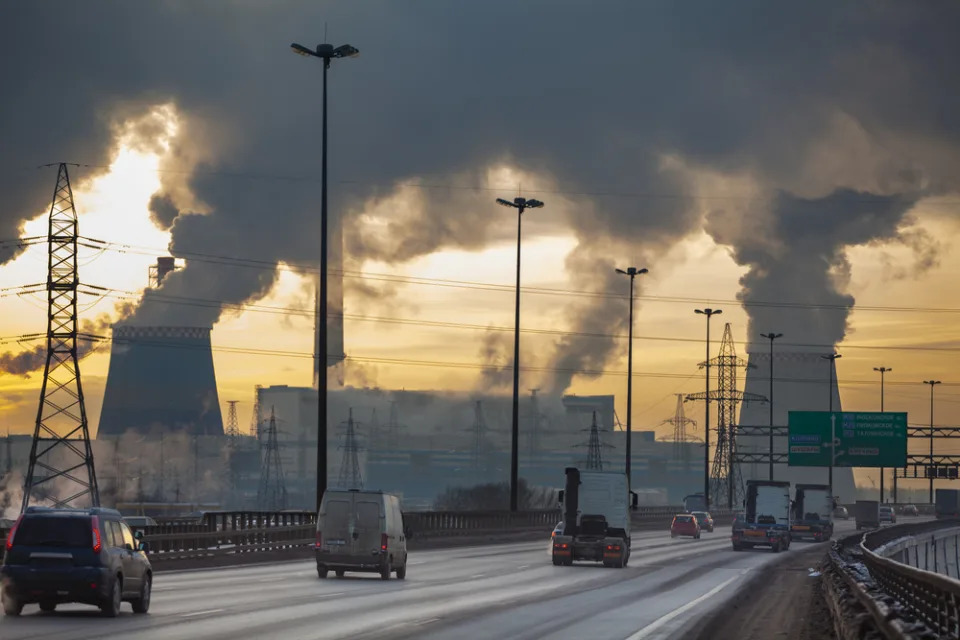
Kekyalyaynen / Shutterstock.com

Methodology

To compile our list of the 20 most air polluted cities in Asia, we consulted the IQ Air's Air Quality Index (AQI) live ranking. We have ranked the cities in ascending order of their Air Quality Index, as of April 22. We have also mentioned the PM2.5 and other pollutant concentrations of the cities, where available. For cities with the same AQI, we have used their PM2.5 concentration to break the tie.
20 Most Air Polluted Cities in Asia
20. Shanghai, China

Live Air Quality Index (2024): 83

Shanghai is ranked among the 20 most air polluted cities in Asia. As of April 22, the city has an AQI index of 83. The PM2.5 concentration in the city is 27.5 μg/m³.
19. Dubai, United Arab Emirates

Live Air Quality Index (April 20, 2024): 84

Dubai ranks 19th on our list. The major air pollutant in the city is PM10. Its PM2.5 and PM10 concentrations are 29 μg/m³ and 132.9 μg/m³, respectively.
18. Yangon, Myanmar

Live Air Quality Index (2024): 86

Yangon is one of the most air polluted cities in Asia. The city has a particulate matter concentration of 35.9 μg/m³, which is 7.9 times higher than the WHO standard.
17. Tashkent, Uzbekistan

Live Air Quality Index (2024): 88

Tashkent is the capital of Uzbekistan. As of April 22, the city has an air quality index of 88. Its PM2.5 concentration is 29 μg/m³. It is ranked 17th on our list.
16. Karachi, Pakistan

Live Air Quality Index (2024): 94

Karachi is the largest city in Pakistan. The city has an air quality index of 94, as of April 22. The PM2.5 concentration in Karachi is 29.5 μg/m³, which is 5.9 times higher than the air quality standards set by the WHO.
15. Kolkata, India

Live Air Quality Index (2024): 95

Kolkata is one of the most air polluted cities in Asia. The city has a PM2.5 concentration of 33 μg/m³ and an AQI of 95, as of April 22.
14. Astana, Kazakhstan

Live Air Quality Index (2024): 99

The capital of Kazakhstan, Astana is ranked 14th on our list. It has a particulate matter concentration of 33 μg/m³. Its air quality index is 99, as of April 22.
13. Kuwait City, Kuwait

Live Air Quality Index (2024): 102

Kuwait City is ranked 13th on our list of the most air polluted cities in Asia. The PM2.5 concentration in the city is 36 μg/m³, which is over 7 times higher than the WHO PM2.5 guideline.
12. Manama, Bahrain

Live Air Quality Index (2024): 102

Manama is the capital and one of the largest cities in Bahrain. As of April 22, the city has an AQI index of 102 and a PM2.5 concentration of 36 μg/m³. It is ranked 12th on our list.
11. Bangkok, Thailand

Live Air Quality Index (2024): 104

Bangkok ranks among the most polluted cities for air quality in Asia. As of April 22, the city has an AQI of 104. Its PM2.5 concentration is 34 μg/m³, which is 6.8 times higher than the WHO standard of 5 μg/m³ PM2.5 in the air.
10. Chengdu, China

Live Air Quality Index (2024): 107

Chengdu is ranked 10th on our list. The city has a PM2.5 concentration of 38 μg/m³ and a PM10 concentration of 73 μg/m³.
9. Doha, Qatar

Live Air Quality Index (2024): 112

Doha is the capital of Qatar. As of April 22, the city has an air quality index of 112. Its PM2.5 concentration is 50 μg/m³. It is one of the most air polluted cities in Asia.
8. Medan, Indonesia

Live Air Quality Index (2024): 114

Medan is the capital of North Sumatra, Indonesia. It has a PM2.5 concentration of 41 μg/m³, which is over 8 times higher than the air quality standards.
7. Dhaka, Bangladesh

Live Air Quality Index (2024): 118

Dhaka is ranked 7th on our list. As of April 22, the city has an air quality index of 118. Its particulate matter concentration is 46.7 μg/m³.
6. Delhi, India

Live Air Quality Index (2024): 134

Delhi is ranked 6th on our list of the most air polluted cities in Asia. The major air pollutant in the city is PM10. The concentration of PM2.5 and PM10 in Delhi is 43 μg/m³ and 210 μg/m³, respectively.

Where has the dirtiest air in the US? Report ranks cities with best and worst air quality
.

Eduardo Cuevas and Krystal Nurse, USA TODAY
Sat, April 27, 2024 


A new report revealed concerning findings about America's air, but some cities are doing better than others.

As part of the report, the American Lung Association ranked the 10 best and worst metropolitan areas for air pollution. While the best cities are scattered all over the U.S., the West Coast saw some of the worst rankings.

The report looked at daily and annual fine particulate matter averages and ozone pollution regulated under the Clear Air Act. Nearly 2 in 5 Americans live in areas that had a failing grade for at least one air pollution measure, the report stated.

Read more: Report says U.S. air pollution worst in 25 years as new environmental regulations finalized

“We're seeing the most days and the ‘very unhealthy’ or ‘hazardous’ air quality level due to spikes in particle pollution,” Paul Billings, ALA’s senior vice president of public policy, told USA TODAY.
'No safe level to particle pollution'

The below rankings focus on fine particulate matter, or PM 2.5, which created when things are burned. It can cause asthma attacks, strokes and a litany of long term health problems.

“There is no safe level to particle pollution,” Dr. Kari Nadeau, the John Rock professor of climate and population studies at the Harvard T.H. Chan School of Public Health, told USA TODAY. “We were not meant to breathe this in as humans.”

The pollutants increase the risk of cardiovascular problems such as heart failure and arrhythmia, as well as respiratory ailments such as asthma and chronic obstructive pulmonary disease. Breathing in high levels of particulate matter in the long term has been linked to brain damage that puts people at higher risk of Parkinson’s disease, Alzheimer’s disease and other related dementias.
Top ten US metro areas with worst air pollution: West Coast air gets bad marks

The western U.S. experienced the bulk of its pollution from roadways, agriculture, oil and gas industries and seemingly endless wildfires.

Bakersfield, Fresno and Visalia – hubs for agricultural production, shipping and warehouses where the population is predominantly Latino – make up the top five cities in each of the report’s measures for 24-hour particle pollution, year-round particle pollution and ground-level ozone pollution.

Other metro areas included are: Eugene-Springfield, Oregon; Los Angeles-Long Beach; Sacramento-Roseville; Medford-Grants Pass, Oregon; Phoenix-Mesa, Arizona; and Fairbanks, Alaska.

Dangerous smoke: Where is wildfire smoke and air quality at its worst? Here's a map of the entire US.
Top ten US metro areas with least air pollution: Residents skew white

Some of the communities with the best air quality included Bangor, Maine; Wilmington, North Carolina; and Honolulu. Except for Honolulu, most of the cities with the best air quality were majority white.

Areas with the least amount of particulate matter pollution include: Casper, Wyoming, Kahului-Wailuku-Lahaina, Hawaii; Cheyenne, Wyoming; Duluth, Minnesota-Wisconsin; Colorado Springs, Colorado; Anchorage, Alaska; and St. George, Utah.

This article originally appeared on USA TODAY: Best and worst air in the US: Report ranks pollution in cities, metros
Red gold: Climate change plays role as saffron cultivation comes to Nova Scotia


The Canadian Press
Fri, April 26, 2024 


When Matthew Roy moved from New Hampshire in 2020 to start a farm in southwestern Nova Scotia, one of the new crops he zeroed in on was saffron.

A spice so expensive that it has been dubbed red gold, saffron is traditionally grown in Iran, India, Afghanistan, Spain and a handful of other countries.

"We decided that we would bring two new crops to Nova Scotia, specifically because of the changing climate," Roy said recently from his four-year-old Coastal Grove Farm in Upper Port La Tour, N.S. (The other new crop was tea.)

"We knew that it is going to be getting warmer here," he said.

Roy said the saffron gamble paid off with yields that surprised him. In 2021, he harvested 172 grams of the prized spice, and in 2022 it rose to 342 grams. He said extreme rainfall last summer and fall hurt the yield, which fell to 66 grams. On the Coastal Grove website, a one-gram container of certified organic Nova Scotian saffron sells for $49.99.

Margaret Skinner, a research professor at the University of Vermont, studies the plant and has been working with Roy on his farm, which also grows vegetables and herbs. While warming temperatures make Nova Scotia more hospitable for saffron, other climate effects such as drought and flooding could be harmful.

"It's not just 'Oh, it's warmer in the winter or hotter or drier or wetter in the summer,'" Skinner said. "It's more that we're having extreme weather events. When we have a drought, it is really dry for a long time. When it gets hot, it gets really hot for us. When it rains, it is often a deluge."

Navin Ramankutty, Canada Research Chair in data science for sustainable global food systems at the University of British Columbia, agreed with Skinner.

He highlighted similar problems in Canada, especially the recent heat dome and floods that affected British Columbia over the past couple of years.

"Farmers are adapting to that change," he said. "Maybe the crops that we currently grow in these places, we can't keep growing them. Maybe farmers will switch to growing different crops, crops that are more suited to warmer climates."

A 2022 study published in the Canadian Journal of Plant Science found that the cultivation of saffron in cold climates faces challenges because low soil temperatures hinder flowering, but it said the right farming techniques could improve results.

"Although there are indications that saffron yield is higher in climate with warm summers, rain in autumn and cool winters, typical of the Mediterranean basin, saffron production in the colder climate of Quebec, Canada, and adjacent New England has been ongoing for the past five to 10 years," it said.

Usually harvested from mid-October to mid-November, the purple crocus flowers are picked by hand. The petals are separated — also by hand — and the three tiny, delicate stigmas are carefully isolated, then dried in the sun, becoming one of the world's most expensive and sought-after spices.

Saffron is used in products including food, medicine and cosmetics. A kilogram requires the stigmas of about 150,000 flowers and sells for up to $6,000.

Bashir Ahmad Allie, head of advanced research for saffron and seed spices at Sher-e-Kashmir University of Agricultural Sciences and Technology, is not surprised that parts of Canada are able to cultivate the sensitive spice, considering how climate is changing across the globe.

He said he would like to collaborate with farmers here to understand how climate change is affecting the area and saffron growth. In Canada, the spice is now grown in parts of Nova Scotia, Quebec, Ontario and British Columbia.

While saffron farming in Jammu and Kashmir is handed down from one generation to the next, climate change is turning some of the young people away, Allie said. The warming and unpredictable temperatures cause farmers to spend more time, money and effort with no guarantee of yield, he noted.

In the 1990s, Allie said the region saw a "uniform pattern" of rain from May to October, but over the past few years has seen unseasonal snow, hail, floods and drought.

"Climate change is a reality. It is creating havoc for saffron," he said. "And that shocks us."

This report by The Canadian Press was first published April 26, 2024.

— With files from The Associated Press

Hina Alam, The Canadian Press

Animal Rights groups are urging tourists not to visit Wyoming after a man hit a wolf then took it to a bar

The Canadian Press
Fri, April 26, 2024


CHEYENNE, Wyo. (AP) — As Yellowstone National Park in Wyoming opens for the busy summer season, wildlife advocates are leading a call for a boycott of the conservative ranching state over laws that give people wide leeway to kill gray wolves with little oversight.

The social media accounts of Wyoming's tourism agency are being flooded with comments urging people to steer clear of the Cowboy State amid accusations that a man struck a wolf with a snowmobile, taped its mouth shut and showed off the injured animal at a Sublette County bar before killing it.

While critics contend that Wyoming has enabled such animal cruelty, a leader of the state’s stock growers association said it's an isolated incident and unrelated to the state's wolf management laws. The laws that have been in place for more than a decade are designed to prevent the predators from proliferating out of the mountainous Yellowstone region and into other areas where ranchers run cattle and sheep.

"This was an abusive action. None of us condone it. It never should never have been done,” said Jim Magagna, executive vice president of the Wyoming Stock Growers Association and a Sublette County rancher who has lost sheep to wolves. “It’s gotten a lot of media attention but it’s not exemplary of how we manage wolves to deal with livestock issues or anything.”

Wolves are federally protected as an endangered or threatened species in most of the U.S. but not the Northern Rockies. Wyoming, Idaho and Montana allow wolves to be hunted and trapped, after their numbers rebounded following their reintroduction to Yellowstone and central Idaho almost 30 years ago. Before their reintroduction, wolves had been annihilated in the lower 48 states through government-sponsored poisoning, trapping and bounty hunting into the mid-1900s.

Today, Wyoming has the least restrictive policies for killing wolves. There are limits on hunting and trapping in the northwestern corner of the state and killing them is prohibited in Yellowstone and neighboring Grand Teton National Park, where they are a major attraction for millions of tourists. But outside the Yellowstone region, in the 85% of the state known as the “predator zone,” they can be freely killed.

The wolf allegedly was run down, shown off and killed within the predator zone.

Wolves roam hundreds of miles and often kill cattle and sheep. Gray wolves attacked livestock hundreds of times in 2022 across 10 states including Wyoming, according to an Associated Press review of depredation data from state and federal agencies, the most recent data available. Other times livestock succumb to other predators, disease or exposure or simply go missing.

Losses to wolves can be devastating to individual ranchers, yet wolves' industry-wide impact is negligible: The number of cattle killed or injured in documented cases equals 0.002% of herds in the affected states, according to a comparison of depredation data with state livestock inventories.

The predator zone resulted from negotiations between U.S. and Wyoming officials who traded away federal compensation for livestock killed by wolves in exchange for allowing free killing of wolves in that area.

Saharai Salazar is among out-of-staters changing their travel plans based on what allegedly happened Feb. 29 near Daniel, a western Wyoming town of about 150 people.

The Santa Rosa, California, dog trainer posted on the state’s tourism Instagram account that she would not get married in Wyoming next year as planned. The post was among hundreds of similar comments, many with a #boycottwyoming hashtag on social media in recent weeks.

“We have to change the legislation, rewrite the laws so we can offer more protection, so they can’t be interpreted in ways that will allow for such atrocities,” Salazar said in an interview.

Wyoming’s rules have long invited controversy but are unlikely to harm the overall population because most of the animals in the state live in the Yellowstone region, said wolf expert and former U.S. Fish and Wildlife Service wolf biologist Ed Bangs.

Bangs said the incident of the wolf brought into the bar was a “sideshow” to the species' successful recovery. The predator zone is made up largely of open landscapes that generally don't support wolves, he said.

Wyoming’s rules, including the predator zone, have withstood multiple court challenges that have put wolves on and off the endangered species list since they were first delisted in 2008. Wolves haven't been on the list in the region since a 2017 court order and their current Wyoming population of more than 300 is similar to their number in 2010.

Though state law doesn’t specify how wolves in the predator zone can be killed and doesn’t specifically prohibit running them over, the Humane Society and others argue the state’s animal cruelty law applies in this case.

Widely circulating photos show the man posing with the wolf with its mouth bound. Video clips show the same animal lying on a floor, alive but barely moving.

The Sublette County Sheriff’s Office said it has been investigating the anonymous reports of the man’s actions but has struggled to get witnesses to come forward.

“We’ve had the tip line open for two weeks hoping for witnesses or something helpful,” sheriff’s spokesperson Sgt. Travis Bingham said. “I know there’s some hesitation for people to come forward.”

The only punishment for the man so far is having to pay a $250 ticket for illegal possession of wildlife.

The suspect has not commented publicly and did not answer calls to his business. Calls to the bar went unanswered.

___

Matthew Brown in Billings, Montana, contributed to this report.

Mead Gruver, The Associated Press

UK

Former Conservative Health Minister Defects to Labour: Observer

(Bloomberg) -- Conservative Member of Parliament Dan Poulter is defecting to Labour, the Observer reported, citing an interview with the former health minister.

Poulter, the MP for Central Suffolk and North Ipswich who also works part-time as a mental health doctor in an NHS hospital, said he won’t seek re-election and would be taking the Labour whip until the next election. 

“The Conservative government has been failing on the thing I care about most, which is the NHS and its patients,” he told the Sunday newspaper.

More than 60 Tory MPs have said that they won’t run again at a general election that has to take place within the next 10 months. 

SIR KEIR'S LABOUR ARE RED TORIES


Feds need 'nuanced' approach to ensure public sector doesn't lose tech talent: Anand

Treasury Board President Anita Anand says Canada has to take a "nuanced" approach to shrinking its public service in order to protect some of its tech worker ranks.

Anand says she does not want to see the number of cyber or procurement experts decrease in an era when their skills are crucial.

The remarks come roughly a week after the federal government's budget revealed natural rates of attrition will see the public service's size decline by 5,000 full-time roles over the next four years.

The public service sat at about 368,000 members at the end of March, but Anand said last week that no government ministry and agency would be left out of the process of cutting.

Anand appeared virtually at a Microsoft event in Toronto, where she discussed the $2.4 billion in AI investments in the government's budget.

Anand also used her appearance at the event to tease a summit in Ottawa next month with think tanks and other stakeholders to help the government develop an AI strategy for the federal public sector.

This report by The Canadian Press was first published April 24, 2024.

Canada's retail sales flatlined in the first quarter of 2024


CONSUMERS ARE WORKERS SPENDING THEIR WAGES

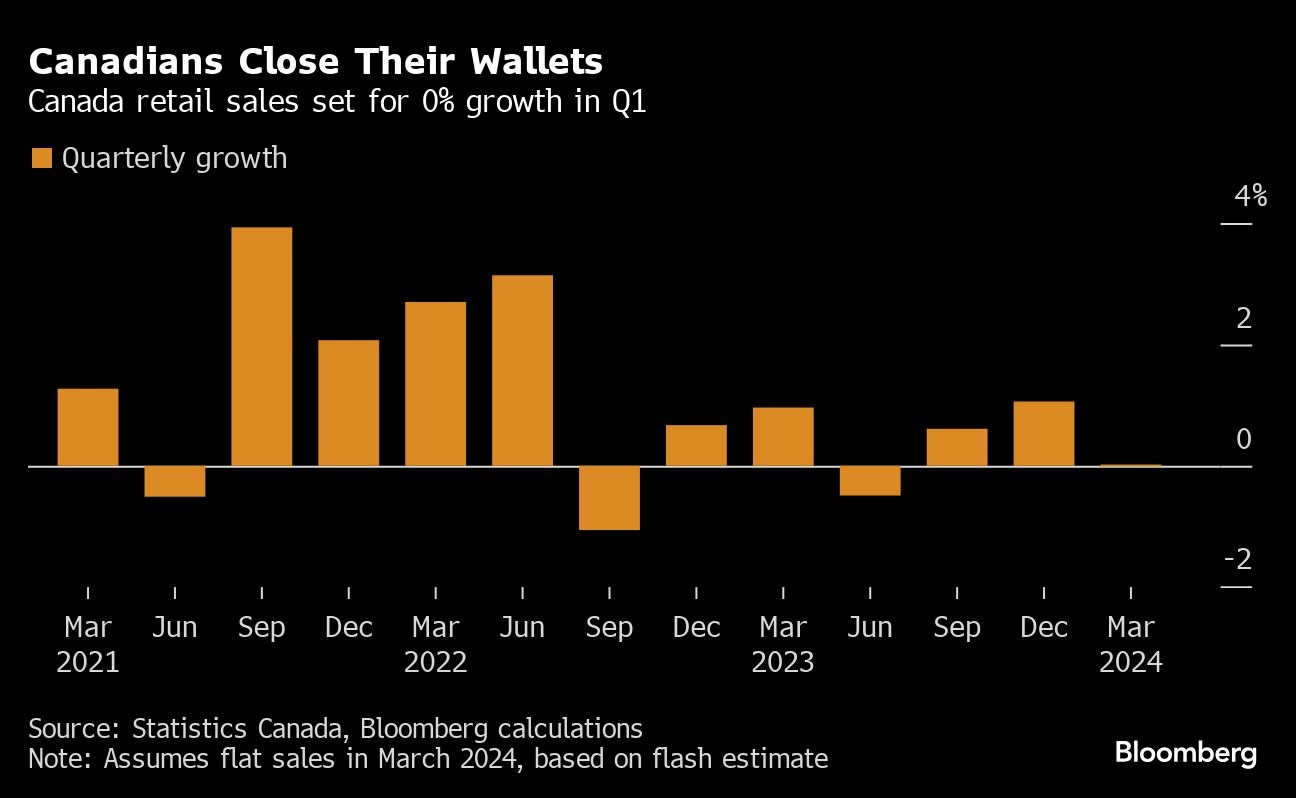
Canadian consumers haven’t tightened their belts this much in nearly a year, and there are no signs of spending growth since the start of 2024.

Receipts for retailers were unchanged in March, according to an advance estimate from Statistics Canada released Wednesday. That followed a 0.1 per cent drop in February, missing expectations for a 0.1 per cent gain in a Bloomberg survey.

Taken together with the 0.3 per cent plunge in January sales, the figures point to a flat reading in the first three months of the year, the weakest pace since the second quarter of 2023.

After the release, yields on two-year Canadian government bonds fell about three basis points to 4.25 per cent, while the loonie weakened about 0.3 per cent to $1.372 per U.S. dollar as of 9:08 a.m. Ottawa time.

February’s decline was led by lower sales at gas stations, while car sales rose. Excluding these two subsectors, core retail sales were unchanged. All in, the report shows consumers cutting back on discretionary products including clothing and accessories as well as sporting goods.

In volume terms, retail sales decreased 0.3 per cent in February. Excluding autos, retail sales fell 0.3 per cent, lower than expectations for a 0.1 per cent increase, while the previous month’s growth was revised down to 0.4 per cent.

February’s decline was more widespread than weakness seen in January, underscoring the challenges facing consumers amid rising costs of living and financing, Maria Solovieva, economist at Toronto Dominion Bank, said in an email.

“Despite the overall softness, auto sales emerged as a bright spot, demonstrating their usual roly-poly resilience by bouncing from previous declines,” she said, adding that the bank’s internal data points to solid spending in March.

Tiago Figueiredo, macro strategist at Desjardins Financial Group, said he expects retail sales to struggle given the mortgage renewal cycle, slowing population growth and rising business insolvencies, which are pushing the unemployment rate higher.

The data reinforces that a Bank of Canada interest-rate cut is likely at the next meeting in June, Olivia Cross of Capital Economics said in a report to investors.

Regionally, sales were down in seven provinces in February, with the largest declines in Alberta, led by lower car sales. Canada’s two most populous provinces — Ontario and Quebec — as well as its three biggest cities — Toronto, Montreal and Vancouver — all saw receipts for retailers decrease.

The statistics agency didn’t provide details on the March estimate, which was based on responses from 61.9 per cent of companies surveyed. The average final response rate to the survey over the previous 12 months was 90.7 per cent.

February’s retail sales growth fell below the range of estimates in the Bloomberg survey, which spanned 0.0 per cent to 0.8 per cent.

CRIMINAL CAPITALI$M

Former SNC-Lavalin executive sentenced to prison term in bridge bribery case

A former SNC-Lavalin executive has been sentenced to three and a half years in prison in connection with a bribery scheme for a bridge repair contract in Montreal, the RCMP say.

Normand Morin, once a high-ranking vice-president at the engineering firm, received the sentence Tuesday after his conviction for corruption and fraud last month.

A police investigation revealed that SNC-Lavalin executives paid bribes of roughly $2.3 million in order to secure a $128-million contract to repair the Jacques Cartier Bridge deck in the early 2000s.mer CEO of the Federal Bridge Corp., admitted to receiving the bribes through Swiss bank accounts between 1997 and 2004.

Fournier, who served as chief of staff to Jean Chrétien when he was Opposition leader in the early 1990s, was sentenced to five and a half years in prison and has since received full parole.

Ex-SNC vice-president Kamal Francis was also hit with forgery and fraud charges in 2021. Court proceedings are ongoing, the RCMP said.  

SNC-Lavalin — now known as AtkinsRéalis — agreed in 2022 to pay Quebec nearly $30 million over three years to settle criminal bribery charges stemming from work on the bridge that spans the St. Lawrence River between Montreal and Longueuil, Que.

The deal, a so-called deferred prosecution agreement, allowed the company to continue doing business with the governments of Quebec and Canada as well as abroad.

The RCMP said the charges resulted from a complex investigation dubbed Project Agrafe (“Staple”) that started in 2013. It was carried out by the Sensitive and International Investigations division of the force, mandated to investigate criminal activity that poses a threat to Canada’s government institutions, public officials or the integrity of the Crown.

SNC-Lavalin was previously charged with bribery and fraud in relation to its past work in Libya, which became the focal point of the high-profile 2019 battle between Prime Minister Justin Trudeau and then-attorney general Jody Wilson-Raybould.

In December 2019, the company reached an agreement that saw its construction division plead guilty to a single count of fraud, accompanied by a $280-million fine, while other charges related to acts committed in Libya between 2001 and 2011 were set aside. The company retained the right to bid on federal government contracts.

The same month, former SNC-Lavalin vice-president Sami Babawi was found guilty of bribing foreign officials and pocketing millions of dollars. He was sentenced to eight and a half years in prison in January 2020 after a jury found him guilty of five fraud and corruption charges.

He has until early 2025 to pay back $24.69 million that he earned from his crimes.


Capital gains tax changes will impact financial corporations the most: economists

Economists say the impact of Ottawa’s move to raise the inclusion rate on capital gains taxes will impact financial corporations most of all. 

Florence Jean-Jacobs, a principal economist at Desjardins, and Randall Bartlett, a senior director of Canadian economics at Desjardins, said in a report Thursday that the impact of the new measures will be felt differently across industries. Last week Canada’s federal government tabled its 2024 budget, which included intentions to raise the inclusion rate on capital gains taxes from one-half to two-thirds for all gains realized by corporations and trusts. The new rate would only impact individuals with gains above $250,000. 

“In the absence of public data on capital gains by sector, the greater the assets (especially financial assets), the greater the risk that some of these industries could be affected by the changed inclusion rate for capital gains,” the report said. 

“This is especially the case for financial corporations, which derive a not insignificant share of their profit from capital gains.” 

The economists highlighted that generally, non-financial private corporations have a “fairly diverse asset base” with around 55 per cent coming from financial assets, while financial corporation assets are 99 per cent liquid. 


“We can therefore assume that the financial sector is likely to be the most impacted by the new measure. This would include the major asset holders in that industry: banks and quasi-banks (37 per cent of assets), mutual funds (16 per cent), and captive financial institutions and money lenders (15 per cent),” the report said. 

The report said around 300,000 corporations in Canada declare capital gains, or around 12.6 per cent of businesses. Additionally, the tax changes are believed to generate around $19.4 billion in revenue over the next five years. 

According to the economists, the impact across individual financial corporations will depend on the type of assets held and specific exemptions in certain sectors. 

“Assets whose capital value can fluctuate, thus potentially yielding capital gains, are more likely to be impacted (debt securities, equity and investment fund shares, for instance),” the report said. 

“This contrasts with loans, whose capital value is fixed. Furthermore, pension plans and insurance companies may be subject to certain exceptions, given the nature of the tax treatment of investment income as laid out in the Income Tax Act.” 

The economists also questioned the timing of the tax changes, saying it is “hardly the time” to bring in new measures that will hinder business investment in the country. While revenues are likely to increase due to the new tax measures, the report highlighted that it could “come at an economic cost.” 

“Canada has a productivity problem, and it’s unclear how reducing Canada’s relative tax advantage will reverse this slide, as investment in innovation is urgently needed,” the economists said.


Will the capital gains tax changes really jeopardize doctors' retirement?

The Canadian Medical Association asserts the Liberals' proposed changes to capital gains taxation will put doctors' retirement savings in jeopardy, but some financial experts insist incorporated professionals are not as doomed as they say they are. 

Prime Minister Justin Trudeau's government presented a federal budget last week that proposes making two-thirds rather than one-half of capital gains — or profit made on the sale of assets — taxable.

The increase in the so-called inclusion rate would apply to capital gains above $250,000 for individuals, and all capital gains realized by corporations.

Since doctors typically incorporate their medical practices and invest for retirement inside their corporations, the association points out its members will now face a higher inclusion rate on all capital gains they earn, including on retirement investments. 

It remains unclear, however, just how much of an impact Canadian physicians are facing.

Jean-Pierre Laporte, CEO of Integris Pension Management Corp., argues physicians can fully shield their retirement savings from capital gains taxation.

Laporte says incorporated professionals like doctors can sell off investments and open a registered pension plan. Contributions to the plan would be tax deductible, which means the individual would not pay any tax on the capital gains they earn.

"If a medical professional corporation is concerned about increasing corporate taxes because of this change to the budget, a solution that's been around for years ... is to have the corporation set up a registered pension plan," Laporte said.

Physicians would still have to pay income taxes on the money they receive in the form of a pension, as is the case with other Canadians who have a pension. 

There are also limits on how much someone can contribute to a pension plan, which means physicians will still end up paying more taxes on personal investments. 

"Eventually, they will be impacted by these measures. But nowhere near to the extent that is made out in the news," Laporte said.

Nicole Ewing, director of tax and estate planning at TD Wealth, says whether opening a pension plan makes sense depends on an individual's circumstances.

"It's not a one-time decision. There are ongoing compliance and administrative requirements. And there are restrictions on how you can get out of that in the future. So, making sure that you go into something like that with eyes wide open is really important to understand," Ewing said. 

As to how much the new capital gains tax rules will affect doctors, Ewing said it's too soon to tell. 

"I think that it's premature at this stage to make any conclusions about what the impact would be," Ewing said. 

In a statement, the Canadian Medical Association echoed Ewing's comments, noting that opening a pension plan may make sense for some people.

"While certain individuals may benefit from an (individual pension plan), there are numerous variables to consider," the CMA said, noting there are limitations to contributions that can be made. 

The Liberal government has argued that the proposed changes to capital gains taxation are about fairness and levelling the playing field between those who earn their income via capital gains versus other sources, such as employment. 

Physicians who incorporate their practices have historically benefited from lower tax rates that made it easier to save money in the first place. 

Experts who help manage their financial affairs say many doctors take full advantage of registered retirement savings plans and tax-free savings accounts, which are not affected by capital gains taxation.

They also note that by incorporating their practices, they benefit from a lower tax rate — in Ontario, that's just 12 per cent on the first $500,000 of taxable income.

Trudeau and Finance Minister Chrystia Freeland have dismissed the doctors' plea to reconsider the capital gains tax changes, arguing the revenue the tax change generates is needed to fund things like housing and health care for all.

"I think Canada's health-care professionals recognize, maybe more than anyone else, how important these investments are," Freeland said Tuesday.

"They are massive and I think it's entirely appropriate, it's really fair to ask those who are doing the best in our society to pay a little bit more to fund them."

The government estimates only 0.13 per cent of Canadians in any given year will have to pay more in capital gains taxes as a result of the changes. 

The federal government expects the increase to the inclusion rate to generate $19.4 billion in revenue over five years. 

This report by The Canadian Press was first published April 25, 2024. 

The Canadian Medical Association funds a fellowship that supports journalism positions at The Canadian Press. CP is wholly responsible for the editorial content created under the initiative.