Sunday, December 01, 2024

Social Democrats lead Romania vote but far-right parties post big gains

Romania's ruling Social Democrats (PSD) looked set to win the most votes in a parliamentary election on Sunday, ahead of a resurgent far-right movement challenging the country's pro-Western orientation, an exit poll showed.


Issued on: 01/12/2024 - 
By: NEWS WIRES

01:34
Romania has been gripped by chaos after a top court ordered a recount of the first round of the presidential ballot. © Daniel Mihailescu, AFP


Romania's ruling Social Democrats (PSD) were leading in Sunday's parliamentary elections, but the far right secured big gains, exit polling found, deepening uncertainty in a country rocked by political chaos.

Shortly after the end of voting at 9:00 pm (1900 GMT), the PSD was credited with 26 percent of the vote, ahead of the other parties, according to the poll published by local media.

However, all the far-right parties combined stood at about 30 percent.

If confirmed by official results expected later in the evening, it would indicate a fragmented parliament as well as difficult negotiations to form a government.


The parliamentary vote comes at a time of political turmoil sparked when a top court ordered a recount of the first round of Romania's November 24 presidential election.

Last week's first-round presidential ballot was won by Calin Georgescu, a little-known far-right admirer of Russian President Vladimir Putin. A run-off is slated for December 8.

The far right's surprise success has raised fears in the West that it could potentially herald a shift in the foreign policy of the NATO country and EU member, which borders Ukraine.

"It is an important signal that Romanians have sent to the political class," said Social Democrat Prime Minister Marcel Ciolacu after the exit poll was published, adding that the country should continue on its European path, while "protecting our identity, national values and faith".

Earlier on Sunday, several voters like Dorina Burcea voiced concern that Romania might turn away from its pro-European path.

"As someone who lived a little bit under communism and still remembers it – and at the same time could enjoy all this openness of the European Union, to be able to go to other countries – I can't imagine how we could have another option than the EU and NATO," the 41-year-old told AFP.

Voter turnout stood at 52 percent after polls closed, a record high in 20 years.
'New era'

Romania's far-right parties – which oppose sending aid to Ukraine – welcomed the results of the exit poll.

"Today the Romanian people voted for the pro-sovereignty forces," said far-right AUR leader George Simion, who had won nearly 14 percent of the presidential vote.

"It is the beginning of a new era in which the Romanian people reclaim the right to decide their destiny," he added.
The far-right AUR party, whose leader George Simion is a fan of Donald Trump, topped the most recent polls. © Daniel Mihailescu, AFP

The extreme-right SOS Romania party, led by firebrand Diana Sosoaca, and the recently founded Party of Young People (POT), were each credited with more than five percent of the vote and are expected to enter parliament.

Since the fall of Communism in 1989, the country of 19 million people has never seen such a breakthrough by the far right. But anger over soaring inflation and fears of being dragged into Russia's war in neighbouring Ukraine have mounted.

For George Sorin, a 45-year-old economist in Bucharest, the current parliament had mostly served the interests of Ukraine by sending aid and had prioritised the European Union over "national interests".

In the opposing pro-EU camp, the centrist USR party, led by Elena Lasconi – who placed second in the presidential ballot – secured 15 percent of the vote, just like the liberals.
Russian interference

The parliamentary election took place at a delicate time, with the top court's order to recount the ballots of the first round of the presidential election causing widespread confusion.

After casting his vote in the city of Focsani, AUR leader Simion alleged that some people were "trying to repeat the (presidential) election to get the outcome they desire".

"Last Sunday, the Romanian people spoke," he said, insisting the result of the presidential vote should be respected.

"No decision made during this crucial period should limit the right of Romanians to vote freely nor further put at risk the credibility of the election process," said the US Embassy in Romania.

According to Septimius Parvu of the Expert Forum think tank, the recount order by Romania's Constitutional Court had "many negative effects", including undermining confidence in Romanian institutions.

"We've already recounted votes in Romania in the past, but not millions of votes, with parliamentary elections in the middle of it all," Parvu said.

(AFP)


Romania’s economic troubles fuel far-right rise


By AFP
November 30, 2024

A vendor fills a bag with carrots at Piata Obor marketplace in Bucharest - Copyright AFP CHANDAN KHANNA

Fulya OZERKAN and Octavian COMAN

In a working class neighborhood of Bucharest, pensioners like Ana Sandu wait for the afternoon to buy food when prices are lower, as inflation dampens hopes of a better life in the EU state heading into key elections.

Traditionally loyal to the Social Democrats, the 65-year-old Sandu has little faith that any government will offer a remedy. She hinted at favouring far-right contender Calin Georgescu in a presidential runoff vote on December 8.

Living on a monthly pension of about $400, suffering from diabetes and with a husband suffering from Parkinson’s disease, Sandu depends on money sent by her son working abroad.

Romania is one of Europe’s poorest countries and she spends more than 300 lei ($60) just on medicine and at least $150 on electricity, water and other utilities.

“I don’t even think about buying meat. I buy vegetables,” she said.

“I come to the bazaar in the afternoon because it’s cheaper,” she said showing a bag of grapes that cost just 6 lei ($1).

While Romania’s inflation has fallen from 10 percent last year, it remains high with consumer prices at an annual rate of 5.1 percent in October, according to the EU statistics office.

Far-right politicians are banking on voter anger about the economy amid the political uncertainity after Georgescu’s shock win in the first-round of the presidential election.

Romania is bracing for a legislative election on Sunday plus the run-off vote between Georgescu, an admirer of Russian President Vladimir Putin, and a pro-European centrist contender.

Romania’s constitutional court could still cancel the December 8 vote.


-‘Need more time’-


“All these elections are very important for the future and for solving one of the key economic problems of Romania these days, that is inflation,” Cristian Valeriu Paun, professor of international finance at the University of Economic Studies in Bucharest, told AFP.

He said inflation was deeply linked to Romania’s excessive deficit. The debt to GDP ratio is close to 55 percent now and worsening day by day.

There are solutions like clamping down the limitation of tax evasion and the acceleration of reforms as well as market liberalisation and privatisation of state-owned companies, he said.

“Unfortunately, all these logical solutions need more time than Romania has and a very determined government and parliament that could implement them with determination.”

Radu Burnete, executive director at the Concordia confederation of private companies in Romania, said Romania’s budget deficit must be dealt with “urgently” but added “no candidate spoke openly about this elephant in the room”.

-‘Hoping for better’-

For Burnete, Georgescu’s first-round win was driven by economic woes and factors ranging from the poor quality of public services, to the weak bureaucracy and poor management of state-owned companies.

“As frustration mounted and mainstream candidates failed to convince, a new face became appealing to a large segment of the population, despite the complete lack of economic sense in their political platform,” he said.

He said Romania’s future lies in the EU and NATO but it must also better handle its economy.

“Romania urgently needs reforms that require political will and commitment to navigate the current economic challenges,” he told AFP.

Back in the market, Adrian Dragnea, married with a three-year-old son, also wanted a better life.

“We are not on the edge of survival but certainly this is not what we want out of life,” he said.

The 39-year-old said he understood that Romania’s economic problems would not be solved overnight.

“We will go through a rough patch … People expect everything will be rosy in one day but that’s a long-term thing,” he said.

“It’s certainly not easy to see others living from one day to the next in a precarious situation, but you can’t really help other than going to the polls and hoping for better.”

For Georgia’s opposition, protest is the cure for melancholy

By AFP
December 1, 2024

The government has stoked outrage by delaying EU membership talks - Copyright AFP Giorgi ARJEVANIDZE

Léa DAUPLE

Like many supporters of Georgia’s political opposition, 32-year-old Ani Bakhturidze worries the government is leading her country away from Europe and “towards Russia”.

Since the ruling Georgian Dream party claimed victory in October elections which the opposition said were fraudulent, the government has stoked outrage by delaying EU membership talks.

“We voted for European Union, we voted for freedom, we voted for human rights, and what is our government doing? It’s doing everything against it, and that’s why we’re out,” said Bakhturidze, shouting to make herself heard among thousands of demonstrators gathered in the capital Tbilisi on Saturday.

They came for the third night running to protest the decision by Georgian Dream, which they accuse of seeking closer ties with Moscow.

Wrapped in a heavy coat against the cold, Bakhturidze said she thought the opposition would win the parliamentary elections.

But Georgian Dream, which has been in power since 2012, came out on top according to results the pro-European opposition has rejected.

The outcome made Bakhturidze feel “desperate”, she said, adding that some people she knows have started talking about leaving the country.

But she plans to stay and resist, along with the thousands who have taken to the streets in the capital and elsewhere in the Black Sea country.

“We somehow find strength in ourselves”, she said, adding that otherwise, “everybody will forget about us and not speak about Georgia”.


– ‘Devastated’ –


The former Soviet republic has been rocked by waves of protests since the spring. But each time, the demonstrations have run out of steam, with no real victory for the opposition.

In April, large-scale rallies were held to protest a “foreign influence” law that opponents said mirrored repressive Russian legislation — but it was passed anyway.

Since then, further legislation restricting the rights of LGBTQ people has been enacted.

“Whenever I hear something new that they (the government) announced, I feel devastated”, said Ketevan Bakhturidze, a student who was also at the protest.

“But when I come here, I find people that think like me, that act like me, and it’s easier to cope and to fight, and it gives me strength,” she said.

Protests have also become a place to socialise for her generation, she explained, adding that she has met many of her friends while demonstrating.

“It would be really funny sometimes, if it wasn’t so sad.”


– ‘Hope’ –


On Saturday, police cracked down violently on the demonstrators, using water cannon and tear gas to disperse them.

“Even if they beat me up, even if they arrest me, I don’t care. There’s nothing else I can do right now, and I have to come here,” said 21-year-old Bakhturidze.

Nikolozi Chargeishvili, also 21 and a landscaper, stood a few metres from a police cordon wearing a long leather coat and a colourful gas mask around his neck.

He said he feels “so strong” standing among the gathered protesters and that he thinks the authorities stand “no chance”.

Nino Barliani, 29, said she knows the rallies are unlikely to topple the government but that the opposition will eventually win.

“Hope is why I stand here today. We believe in the future,” she said.

Zack Chkheidze, a 40-year-old art professor, has been taking part in demonstrations for more than a decade.

“I don’t need hope, it’s my country. If I don’t fight, no one will.”

Thousands gather in Georgia for fresh pro-EU protests


By AFP
November 30, 2024

Critics accuse Georgian Dream of moving the country away from Europe and closer to Russia - Copyright AFP Giorgi ARJEVANIDZE


Léa DAUPLE, Irakli METREVELI

Thousands of people gathered in Georgia’s capital Tbilisi on Saturday for a third night of protests against the government’s decision to postpone European Union membership talks until 2028.

The Black Sea nation has been rocked by turmoil since the ruling Georgian Dream party claimed victory in an October 26 parliamentary election that the pro-European opposition said was fraudulent.

Outside the parliament building in central Tbilisi, crowds of protesters chanted and waved EU and Georgian flags.

“My future depends on what Georgia will do right now,” 22-year-old protester Anna Kaulachvili told AFP.

More than 100 people were arrested during violent clashes between law enforcement and protesters the night before, with police firing a water cannon and tear gas at demonstrators.

Prime Minister Irakli Kobakhidze’s announcement on Thursday that Georgia would not seek accession talks with the EU until 2028 ignited a furious reaction from the opposition.

Critics accuse Georgian Dream — in power for more than a decade — of having steered the country away from the bloc in recent years and of moving closer to Russia, an accusation it denies.

Hundreds of public servants, including from the ministries of foreign affairs, defence and education, as well as a number of judges, issued joint statements protesting Kobakhidze’s decision.

Some 160 Georgian diplomats criticised the move as contradicting the constitution and leading the country “into international isolation”.


– ‘Resistance movement’ –


On Friday, AFP reporters saw riot police fire water cannon and tear gas at pro-EU protesters gathered outside parliament, who tossed eggs and fireworks.

Clashes broke out later between protesters and police, who moved in to clear the area, beating demonstrators, some of whom threw objects.

“I extend my gratitude to the minister of internal affairs and every police officer who yesterday defended Georgia’s constitutional order and safeguarded the nation’s sovereignty and independence,” Kobakhidze told a news conference on Saturday.

Georgia’s special investigation service said it had opened a probe into “allegations of abuse of official authority through violence by law enforcement officers against protesters and media representatives”.

Independent TV station Pirveli said one of its journalists was hospitalised with serious injuries.

Protests were also held in other cities across Georgia on Friday, independent TV station Mtavari reported.

“I am afraid — I won’t hide it — that many people will get injured, but I am not afraid to stand here,” 39-year-old Tamar Gelashvili told AFP near the parliament building earlier.

More than a hundred schools and universities suspended academic activities in protest.

Pro-Western opposition parties are boycotting the new parliament, while President Salome Zurabishvili — who is at loggerheads with Georgian Dream — has sought to annul the election results through the country’s constitutional court.

“The resistance movement has begun… I stand in solidarity with it,” she said in a televised address on Friday evening.


– ‘Deep concern’ –


After the October vote, a group of Georgia’s leading election monitors said they had evidence of a complex scheme of large-scale electoral fraud.

Brussels has demanded an investigation into what it said were “serious” irregularities reported by election monitors.

Georgian Dream MPs voted unanimously Thursday for Kobakhidze to continue as prime minister, even as the opposition boycotted parliament, deepening a serious legitimacy crisis at the legislature.

“Police actions in Tbilisi mark another punitive attack on the right to peaceful assembly,” said Amnesty International.

France, Britain, Ukraine, Poland, Sweden and Lithuania were among the countries to voice concern.

The human rights office of the Organisation for Security and Cooperation in Europe (OSCE) said: “The action of law enforcement officials while policing peaceful protests in Georgia is of deep concern and a serious breach of the right to freedom of peaceful assembly.”

“The disproportionate and indiscriminate use of force impacted a large number of protestors and journalists during protests in which the overwhelming majority of demonstrators were peaceful.”

Georgia police arrest dozens in clashes with pro-EU protesters


By AFP
November 29, 2024

Thousands have taken to the streets to protest the government's decision
 - Copyright AFP Atta KENARE

Police in Georgia arrested dozens of people overnight and early Friday in a violent crackdown on protests against the government’s decision to delay EU membership talks.

The Black Sea nation has been rocked by turmoil since the ruling party declared victory in October parliamentary elections that the pro-EU opposition decried as falsified.

On Thursday night and Friday morning, riot police fired rubber bullets, tear gas and water cannons to disperse gatherings outside parliament in Tbilisi, beating peaceful protesters and journalists, an AFP reporter witnessed.

The interior ministry said 32 of its staff were injured and “43 individuals were detained by law enforcement for disobeying lawful police orders and for petty hooliganism”.

Thousands of people took to the streets after Prime Minister Irakli Kobakhidze of the ruling Georgian Dream party shelved plans to pursue membership of the European Union until 2028.

The opposition has accused Georgian Dream of steering Tbilisi away from its long-held dream of joining the bloc and gravitating towards Russia.

Two politicians from the opposition Coalition for Change, Elene Khoshtaria and Nana Malashkhia, were reportedly injured during the protests.

Khoshtaria sustained a broken arm, while Malashkhia suffered a broken nose, the coalition said.

Prominent poet Zviad Ratiani was among those arrested, the PEN writers’ association in Georgia said, demanding his immediate release.

The Council of Europe condemned what it described as the “brutal repression” of protesters, urging Georgia to remain “faithful to European values”.

Ukraine and Poland said Friday they were “disappointed” by Tbilisi’s decision to pause EU accession talks, with Kyiv accusing the Georgian government of trying to “please Moscow”.


– Post-election crisis –


Opposition lawmakers are boycotting the new parliament, while Georgia’s pro-EU president, Salome Zurabishvili, has sought to annul the election results through the country’s constitutional court.

The prime minister’s announcement to delay EU accession came hours after the European Parliament adopted a non-binding resolution rejecting the results of Georgia’s October 26 elections, alleging “significant irregularities”.

The resolution called for a new vote within a year under international supervision and for sanctions to be imposed on top Georgian officials, including Kobakhidze.

Accusing the European Parliament of “blackmail”, Kobakhidze said: “We have decided not to bring up the issue of joining the European Union on the agenda until the end of 2028.”

But he pledged to continue implementing reforms, adding: “By 2028, Georgia will be more prepared than any other candidate country to open accession talks with Brussels and become a member state in 2030.”

On Thursday, Georgian Dream MPs voted unanimously for Kobakhidze to continue as prime minister.

But constitutional law experts say any decisions made by the new parliament are invalid, because it is still awaiting a court ruling on Zurabishvili’s bid to annul the election results.

On Wednesday, the ruling party nominated far-right politician and former international footballer Mikheil Kavelashvili for the largely ceremonial post of president, further ratcheting up tensions.

The former Soviet country officially gained EU candidate status in December 2023, an aspiration that is supported by 80 percent of the population, according to polling.

But earlier this year Brussels froze Georgia’s accession process, citing the need for Tbilisi to address what it says is democratic backsliding.


Afghanistan must participate in future climate talks: Taliban

ONLY AFGHAN WOMEN


By AFP
December 1, 2024

Matiul Haq Khalis, head of Afghanistan's National Environmental Protection Agency, says the country must be allowed to participate in future climate talks - Copyright AFP Ahmad Sahel Arman

An Afghan environment official on Sunday said the country must be allowed to participate in future global climate talks, after returning from COP29 in Baku where Taliban officials attended for the first time.

The Afghan delegation were invited as “guests” of the Azerbaijani hosts, not as a party directly involved in the negotiations.

It was the first time that an Afghan delegation had attended since the Taliban swept to power in August 2021, having failed to get an invite to the past two COPs (Conference of the Parties) held in Egypt and the United Arab Emirates.

“Afghanistan must participate in such conferences in the future,” said Matiul Haq Khalis, the director general of Afghanistan’s National Environmental Protection Agency, at a press conference on Sunday.

He described Afghanistan’s attendance last month at the talks as a “big achievement”.

“We participated in the conference this year so that we could raise the voice of the nation about the issues we are facing, what the needs of the people are, we must share these things with the world.”

He said the Afghan delegation had meetings with “19 different organisations and governments”, including with delegations from Russia, Qatar, Azerbaijan and Bangladesh.

Afghanistan is among the countries most vulnerable to global warming, despite minimal emissions, and the Taliban government have argued that their political isolation should not bar them from international climate talks.

The government has imposed an austere version of sharia Islamic law since taking power, severely restricting women’s participation in public life in what the United Nations has called a “gender apartheid”.

Among the poorest countries in the world after decades of war, Afghanistan is particularly exposed to the effects of climate change, which scientists say is spurring extreme weather including prolonged drought, frequent floods, and declining agricultural productivity.

The United Nations has also called for action to help Afghanistan build resilience and for the country’s participation in international talks.

Developed countries have committed to providing $100 billion per year in climate finance through 2025 to help developing nations prepare for worsening climate impacts and wean their economies off fossil fuels.

Salary details of 46 million people in the U.S. leaked over 20 years

ByDr. Tim Sandle
DIGITAL JOURNAL
November 29, 2024

Image: — © AFP

A personal data breach means a breach of security leading to the accidental or unlawful destruction, loss, alteration, unauthorised disclosure of, or access to, personal data. Getting hold of such data is a gift to cybercriminals. But how widespread is leaked personal data?

Among the most leaked data points in the U.S., salary, eye colour, height, and other unexpected personal data stands relatively high. This has become apparent from Surfshark’s global data breach monitoring tool.

Current data indicates the U.S. has had a total of 17.5 billion personal records exposed since 2004. On average, each email address is leaked with 4 additional data points.

Furthermore, some 2.3 billion passwords were leaked together with U.S. accounts, putting more than half of the breached users in danger of account takeover that might lead to identity theft, extortion, or other cybercrimes.

The top 15 breached data points in the U.S. have been identified as:

• Password 2.3 billion
• First name 1.4 billion
• City 1.4 billion
• Last name 1.3 billion
• Zip (postal) code 1.2 billion
• Address 1.2 billion
• State of residence 1 billion
• Username 856.7 million
• Gender 787.7 million
• Country 781.5 million
• Phone 780.9 million
• IP address 627.1 million
• Password hash 611.4 million
• Name 604.9 million
• Date of birth 388.9 million

The above is taken from an assessment of 4 billion compromised Internet accounts. Of these, 896 million were identified as possessing unique email addresses, which means an average user email was breached more than four times since 2004. As a result, some data points may be duplicated.

“Information typically gets leaked by users willingly providing personal details to legitimate websites which then get stolen by malicious actors. If your data is breached, it’s important to act quickly by changing your passwords and being alert for phishing attacks,” Sarunas Sereika, Senior Product Manager at Surfshark tells Digital Journal.

Sereika continues: “To identify phishing attempts, always ask if the message was expected. Look for red flags like poor grammar, unusual content, or a suspicious sender’s email. If you’re unsure, avoid clicking on links. Remember, if it seems too good to be true, it probably is. Verify any suspicious communications through other channels before responding.”

Ideas for reducing electric vehicle charging costs

By Dr. Tim Sandle
November 30, 2024
DIGITAL JOURNAL

A Togg electric car rolling off the assembly line in Gemlik near Bursa in western Turkey - Copyright AFP MOHD RASFAN

Customers of UK energy firms who drive electric vehicles are facing higher electricity costs to recharge their cars. This follows the latest rise in the energy price cap by the regulator Ofgem.

Marc Dal Cin, energy expert at EV Charger Installation, has told Digital Journal that charging an electric vehicle at home increases the home electricity bill, since the overall energy consumption goes up.

The average UK energy tariff is around 32p per kWh for home charging. A full charge for a popular model like the Nissan Leaf 3.ZERO e+ will cost approximately £17, while a larger vehicle such as the Mercedes-Benz EQE will cost £24.50. Over the course of a year, this could add up to around £884 for weekly charges, following the energy price cap increase.

Cin advises that charging at home is remains more economical than using public charging stations, which average 48p per kWh. Cin offers several tips for EV drivers looking to reduce their charging costs:

Switch to a Time-of-Use Tariff

Cin explains: “Many energy providers offer tariffs with cheaper rates during off-peak hours, usually at night. By scheduling your EV charging during these hours, you can significantly lower your costs.”

Use Smart Charging

Cin states: “Investing in a smart charger allows you to set charging times and optimise energy use. This helps avoid peak energy prices, and some systems even adapt to use renewable energy when it’s most available.”

Monitor Your Charging Habits

Cin adds: “Only charge your EV when necessary and avoid overcharging the battery. Charging too frequently or unnecessarily can lead to higher electricity bills.”

Compare Energy Tariffs

Cin outlines: “Regularly review your energy provider and compare tariffs to ensure you’re on the best deal. With prices fluctuating, switching providers can lead to significant savings.”

By following these steps, Cin expects electric vehicle drivers to be able to mitigate the impact of rising electricity prices and ensure they continue to enjoy the savings associated with driving electric vehicles.
AMERIKA HAS POTUS X 2
Trudeau in Florida to meet Trump as tariff threats loom: media


By AFP
November 30, 2024

Canadian Prime Minister Justin Trudeau previously visited Donald Trump in the White House during the president-elect's first term in office - Copyright AFP/File JIM WATSON

Canadian Prime Minister Justin Trudeau arrived in Palm Beach, Florida, on Friday for what Canadian and American media said was a meeting with US President-elect Donald Trump at his Mar-a-Lago luxury estate.

Flight trackers first spotted a jet broadcasting the prime minister’s callsign en route to the southern US state, in a visit that comes days after Trump threatened the United States’ northern neighbor with import tariffs once he takes office.

According to the website Flightradar, the Canadian leader’s plane landed at Palm Beach International Airport late in the afternoon.

Canadian public broadcaster CBC said Trudeau would be dining with Trump, and that his public safety minister, Dominic LeBlanc was accompanying him on the trip.

The prime minister’s office did not immediately confirm the unannounced trip.

Trump sent shockwaves across Canada when he announced pending import tariffs against neighbors Canada and Mexico and also rival China in social media posts on Monday.

More than three-quarters of Canadian exports, or Can$592.7 billion ($423 billion), went to the United States last year, and nearly two million Canadian jobs are dependent on trade.

A government source told AFP that Canada is considering possible retaliatory tariffs against the United States.

Some have suggested Trump’s tariff threat may be bluster, or an opening salvo in future trade negotiations. But Trudeau rejected those views when he spoke with reporters earlier in Prince Edward Island province.

“Donald Trump, when he makes statements like that, he plans on carrying them out,” Trudeau said. “There’s no question about it.”

'Too much death and hardship!' Trump provides new details about Trudeau meeting

Travis Gettys
November 30, 2024 
RAW STORY

Donald Trump posted a statement on his meeting with Canadian prime minister Justin Trudeau ahead of a possible trade war.

The prime minister flew Friday to Mar-a-Lago to discuss sweeping tariffs threatened by the former president against CanadaMexico and China, and Trump provided additional details the following day on his Truth Social account on their three-hour meeting over dinner at his private resort.

"I just had a very productive meeting with Prime Minister Justin Trudeau of Canada, where we discussed many important topics that will require both Countries to work together to address, like the Fentanyl and Drug Crisis that has decimated so many lives as a result of Illegal Immigration, Fair Trade Deals that do not jeopardize American Workers, and the massive Trade Deficit the U.S. has with Canada," Trump posted.

The president-elect has threatened to impose 25 percent tariffs on products coming from Canada and Mexico if the North American neighbors don't stop what he calls the flow of drugs and migrants into the U.S.

"I made it very clear that the United States will no longer sit idly by as our Citizens become victims to the scourge of this Drug Epidemic, caused mainly by the Drug Cartels, and Fentanyl pouring in from China," Trump posted. "Too much death and hardship! Prime Minister Trudeau has made a commitment to work with us to end this terrible devastation of U.S. Families. We also spoke about many other important topics like Energy, Trade, and the Arctic. All are vital issues that I will be addressing on my first days back in Office, and before."

Trump and Trudeau were joined at the dinner by commerce nominee Howard Lutnick, interior nominee Doug Burgum and national security adviser nominee Mike Waltz, along with Canada’s public safety minister Dominic LeBlanc and Trudeau chief of staff Katie Telford.

“It is important to understand that Donald Trump, when he makes statements like that, he plans on carrying them out. There’s no question about it,” Trudeau said before his visit to Florida. “Our responsibility is to point out that he would not just be harming Canadians, who work so well with the United States, but he would actually be raising prices for Americans citizens as well and hurting American industry and business."

Trudeau, Trump Discuss Trade, Border at Crucial Mar-a-Lago Meeting


(Bloomberg) -- Canadian Prime Minister Justin Trudeau met with President-elect Donald Trump on Friday as the two leaders discussed trade, the border and fentanyl, subjects of the incoming US leader’s tariff threat on its neighbor.

Trudeau and Trump spoke on a wide range of issues over dinner at Mar-a-Lago that lasted roughly three hours, two officials familiar with the meeting said. They included defense, NATO, Ukraine and China, the people said, declining to be identified as the information isn’t public.

The two leaders also discussed several pipeline projects, including the Keystone XL line the Biden administration killed, and icebreakers, the people said. Trudeau landed in West Palm Beach, Florida, earlier Friday evening.

The meeting was attended by top Trump officials, including his incoming National Security Adviser Mike Waltz; Howard Lutnick, his pick for commerce secretary; Doug Burgum, his pick for interior secretary; and David McCormick and Dina Powell, respectively the newly elected senator for Pennsylvania and a senior Trump aide from his first term, the people said.

Trump earlier this week vowed to hit Canada and Mexico as well as China with additional tariffs, casting the levies as necessary to secure US borders, a top concern of voters in November’s presidential election. The president-elect said he would impose additional 10% tariffs on goods from China and 25% tariffs on all products from Mexico and Canada if they failed to act.


The two leaders were also joined at dinner by Canadian Public Safety Minister Dominic LeBlanc — whose portfolio includes border security — as well as Trudeau’s chief of staff, Katie Telford, a person familiar with the matter said earlier.

Representatives for both sides did not immediately respond to a request for a public comment outside of regular business hours.

Trump’s first specific vow to curb global trade flows since his election has roiled markets. His threats, which he made on his Truth Social network, sent the Canadian dollar falling. That evening, Trudeau contacted the president-elect in a phone call to discuss border security and trade, according to a government official with knowledge of the matter.

The prime minister pointed out that the number of migrants who cross the country’s border into the US is minuscule compared to those who make their way from Mexico, said the official, who spoke on condition of anonymity. Canadian officials in recent days have also been quick to insist that they are working closely with the US to combat the flow of fentanyl — a deadly synthetic opioid that has sparked a public health crisis in the US.

The volume of fentanyl seized at the Mexican border since the beginning of 2022 is about 1,000 times greater than what has been captured at the Canadian border, according to US Customs and Border Protection data.

Earlier: Trump’s Opening Salvo on Tariffs Revisits First-Term Playbook

Still, Trudeau is under pressure at home to step up border security and defense spending to assuage Trump’s concerns. Ontario’s Doug Ford, the leader of Canada’s most populous province, said after a meeting of the premiers and prime minister that he has been pushing Trudeau for months to show that Canada will work to address US economic and security worries.

Trudeau was the first Group of Seven leader to have a face-to-face meeting with Trump since the US election.

“The symbolism of Trudeau going down to Palm Beach on bended knee to say ‘Please don’t’ is very, very powerful,” said Fen Hampson, professor of international affairs at Carleton University in Ottawa.

“The stakes are enormously high and Trudeau has to deliver on this,” Hampson said. “Otherwise, it’s going to be seen by Canadians as a failed mission, because we all know why he’s going down there and it’s not to baste the turkey for Trump.”

Canada and the US have one of the world’s largest bilateral trading relationships, worth more than $900 billion a year, and it’s the largest external supplier of crude oil to the US, pumping millions of barrels a day to refineries in the Midwest and elsewhere. Economists see Mexico and Canada taking the biggest economic hit if Trump follows through on his pledge for broad tariffs against US imports.


Trump has made tariffs a centerpiece of his economic agenda, vowing to use them across the board against both US allies and adversaries to extract concessions and force businesses to reshore manufacturing jobs. Mainstream economists have warned that the levies threaten to raise prices for consumers, would fail to raise the revenue he is predicting and are poised to reduce or redirect trade flows.

Tariffs on Mexico and Canada also threaten to reignite a trade feud from Trump’s first term in office, when he forced the renegotiation of the North American Free Trade Agreement.

The rebranded trade pact, dubbed the United States-Mexico-Canada Agreement, allows for duty-free trade across a wide range of sectors, while changing the regulations for a variety of industries including auto manufacturing.

--With assistance from Derek Decloet, Randy Thanthong-Knight, Thomas Seal and Laura Dhillon Kane.


©2024 Bloomberg 


Trump tariffs could lead to ‘zero economic growth in Canada’: economist
November 26, 2024
BNNBLOOMBERG


One economist says Donald Trump’s new proposed tariffs on Canada and other nations could bring economic growth to a halt in Canada if implemented, though he thinks the comments follow Trump’s typical strategy for negotiations.

Bloomberg News reported Monday that the U.S. president-elect pledged new tariffs on Canada, along with Mexico and China. On his Truth Social network, Trump said he would introduce 25 per cent tariffs on all products from Canada and Mexico as well as an additional 10 per cent on all goods from China. According to CTV News, Prime Minister Justin Trudeau and his government are expected to face questions about the proposed new tariffs from the premiers at a meeting Wednesday.

“We ran some numbers this morning and what it looks like is that if 25 per cent tariffs come on Canada on (a) blanket scale, and we don’t have retaliation, then we’re effectively going to get just zero economic growth in Canada with higher inflation,” James Orlando, a director and senior economist at TD Economics, said in an interview Monday.

Under that scenario, he noted, the Bank of Canada would have to bring interest rates lower than its current path in order to support the economy. On Tuesday, Reuters reported that the Bank of Canada said that if tariffs were implemented it would incorporate that into its economic forecasts.

“Now, if there’s retaliation, I haven’t run that scenario, but that just pushes you down even further into negative territory. So before, we weren’t looking at risk of recession, but now there’s going to be greater threat of that happening if there is retaliation on the 25 per cent tariffs,” Orlando said.


Before the U.S. presidential election, an analysis from TD Economics said that a 10 per cent across-the-board tariff could lead to drop in real gross domestic product (GDP) of 2.4 percentage points over two years compared to baseline projections, assuming retaliatory efforts from Canada.
Currency market impact

Currency markets responded to the news with the Canadian dollar trading at a four-year low on Tuesday morning, at around 71 cents U.S., with Bloomberg News reporting broad advances in the U.S. dollar.

Before Trump’s announcement, Orlando said the Canadian dollar was facing weakness as the Canadian economy was underpromoting the U.S. economy, causing the Bank of Canada to lower interest rates at a faster pace than the U.S. Federal Reserve.

“Immediately when everyone got their messages saying that President Trump’s looking to impose (a) 25 per cent tariff on Canada, that just adds to the risk to the Canadian economy,” he said.

He added that if Canada retaliates to the hypothetical 25 per cent tariff, it could result in negative economic growth, putting more pressure on the Canadian dollar.

“So, we said before, if this really escalates, we’re looking at the Canadian dollar breaking below the 70-cent threshold into the 60s,” Orlando said.

He added that if the rhetoric around trade disputes continues to move in the current direction, it will put further pressure on the Canadian dollar.
Industry impact

Orlando highlighted that a 25 per cent tariff could have significant impacts across several key sectors.

“Canada exports around 77 per cent of our exports to the United States. And energy is obviously the biggest one… in terms of volume for Canada shipping to United States,” he said.


However, Canada ships a number of other products to the U.S., including autos, steel and aluminum, which Orlando said were hot-button issues with the previous Trump administration.

He noted that all of those industries are “on the table,” but also that Canada has increased its volume of exports to the U.S. since the United States-Mexico-Canada Agreement (USMCA) was put in place.

“These sectors that we’re talking about, not only were they exposed previously, but they’re exposed to a greater extent than they were before, because the trade ties have increased over the last few years, which are good trade ties, but based on what’s happening right now, it does point to greater risk exposure for those industries,” Orlando said.
Negotiation strategy

In the run up to the U.S. presidential election, Orlando said, there was more rhetoric toward the U.S. trade relations with Mexico and China, while Canada was less of a topic of discussion. Since then, he said, Canada appears to have become a higher priority for the incoming U.S. administration.

“I think when it comes to the way President Trump goes about negotiations, this is a very typical strategy. You threaten tariffs as a means to potentially get other concessions,” Orlando said.

He noted that U.S.-Canada trade represents a lot of important relationships, and he foresees a lot of upcoming negotiations.

“I don’t think that it’s necessarily set in stone that a blanket 25 per cent tariff would be implemented across all industries in Canada. I don’t think that’s necessarily going to be the outcome, but it’s definitely a starting point I would say for greater negotiations and getting things ready for renegotiations on USMCA,” Orlando said.

USMCA is scheduled to be renegotiated in 2026.

Trump also typically negotiates on a sector-by-sector or policy-by-policy basis, according to Orlando, who added that negotiations could be centred around things like the digital service tax or on the dairy lobby.

“It’ll be interesting to see where the focus ends up going as things progress,” he said.

Related Stories


Daniel Johnson

Journalist, BNNBloomberg.ca


How Dems Can Take Advantage of Trump’s Tariffs to Reverse the Reagan Revolution

As he shatters the neoliberal tariff consensus, Democrats should rise to the occasion and argue for rational, targeted, and gradual tariffs, taking the party back to its pre-1980s positions on trade.


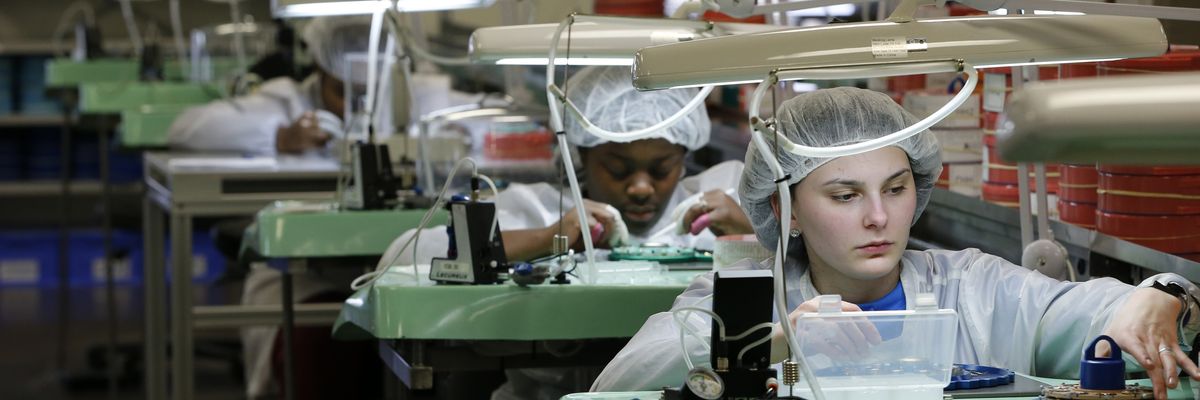
Khokeyma Reed assembles a watch at the Shinola Watch factory on January 4, 2017 in Detroit, Michigan.
(Photo: Jeff Kowalsky/AFP via Getty Images)

Thom Hartmann
Nov 28, 2024
Common Dreams

The stürm und drang all over the media this week is about U.S. President-elect Donald Trump, on Monday, doubling down on his tariffs saying that he’d impose across-the-board 25% tariffs on all goods from China, Mexico, and Canada until there’s no more fentanyl or undocumented immigrants and asylum seekers coming into the U.S.

That’s a substantial lift, and if he follows through with the threat (which seems likely, although I’d bet money that he’ll drill lots of holes in those tariffs to satisfy corporate donors) it’ll cause a considerable disruption in American commerce. Those three countries, after all, account for more than 40% of all American trade.

Weirdly, Trump may be doing the Democrats a favor by taking this position, and I don’t mean the possibility that he’ll wreck the economy and thus his party’s chances in 2026 and 2028 (although that’s real, too).

Tariffs can be a good thing for a country, if done right.

Tariff-free trade was a central cornerstone of former President Ronald Reagan’s neoliberal agenda; he and George H.W. Bush wrote the NAFTA agreement that Bill Clinton later signed, for example. I lay this out in considerable detail in The Hidden History of Neoliberalism: How Reaganism Gutted America. Tragically, Bill Clinton and his Larry Sommers/Robert Rubin crew embraced neoliberalism with gusto, putting the final nail in the meaningful use of tariffs to protect American manufacturing and the jobs associated with it.

Democrats like Sens. Bernie Sanders (I-Vt.) and Elizabeth Warren (D-Mass.) have been working for years to pull the Democratic Party back from the neoliberal free trade brink, and if Trump pushes through his tariffs in a big way it may help shatter what’s left of the neoliberal consensus (at least with regard to trade) in the Democratic Party. That would be a Very Good Thing, both for the Party and for the nation.

Tariffs can be a good thing for a country, if done right. People who grew up in the Midwest (like me) know all about tariffs; we learned about them as children (I remember 5th Grade civics!).

Trump, however, did them so badly last time that they backfired, cost us a fortune, and forced the federal government to subsidize Midwestern farmers. Odds are, if he keeps to his current rhetoric, he’ll do the same, and Democrats should be ready with reasonable talking points; this could end up working tremendously to their advantage if they’re willing to embrace reasonable tariffs and other trade protections to bring manufacturing back to the U.S.

So, let’s reexamine how tariffs can work when done right, their role in American history, and why we should be discussing them now without hysterics.

Tariffs are taxes paid to the federal government on imported goods. And, like all taxes, they have two purposes: to raise revenue and to alter behavior. In the case of import tariffs, the second purpose (changing behavior, in this case encouraging entrepreneurs to start manufacturing companies aka factories here in America) is far more important than the first.

It all began here in America when General Henry Knox rode up to Mount Vernon in the late summer of 1789 to tell George Washington that Congress had just elected him as the first president of the United States. Washington took the news, and had two requests for his old friend.

First, he asked Knox to let folks know he’d be delayed by a few days because he wanted to say goodbye to his mother, who was elderly and ailing (turned out, it was the last time he saw her alive).

Second, Washington asked General Knox to ride all the way up to Connecticut to visit Daniel Hinsdale, a man who’d been secretly manufacturing black-market American-made fine men’s clothing in defiance of British law for decades. Knox took Washington’s measurements and then, a month later, brought to New York (where the swearing-in took place on what is now Wall Street) a fine American-made suit, which Washington proudly wore. (The suit was brown; the black suit of his later, famous painting was British formal wear.)

This incident highlighted the manufacturing crisis facing our new nation, and Washington was acutely aware of it.

The British, for two centuries, had been extracting wealth from the American colonies by forbidding us from manufacturing everything from fine clothing (thus Hinsdale’s illegal business) to weaponry to sophisticated machinery: All such items had to be imported from British manufacturers. We sold England cheap raw cotton, for example, and they forced us to buy back expensive fine cotton clothing manufactured on the looms of British cities. (Homespun was still legal in the colonies.)

They also forced us to buy tea—then the primary American beverage—from the East India Company, an outrage that led directly to the Boston Tea Party of 1773, which arguably kicked off the American Revolution. Thus, when Washington came into office, the first challenge he faced was how to build an American manufacturing base that wasn’t dependent on British imports.

Thirteen years before Washington’s inauguration, British economist Adam Smith had made worldwide headlines with his bestselling 1776 book An Inquiry into the Nature and Causes of the Wealth of Nations, proposing that the main thing that made a country rich was independence in manufacturing.

The process of converting raw materials of little value into finished products with a high value (manufacturing) was, to Smith’s mind, the best and only practical way a nation could grow wealthy without overseas conquest and plunder.

A tree limb laying on the forest floor, for example, had no monetary value, but when labor and the tool of a knife were applied to it and it was turned into an axe-handle—a process called manufacturing—it now had a value that could be passed down through generations.

Smith called that wealth. That axe-handle became part of the aggregate wealth of the entire nation, and even if it was sold overseas that wealth would still remain here because its value was simply converted into currency which stayed in America.

This understanding led President Washington to commission his Treasury Secretary, Alexander Hamilton, to propose to Congress in 1791 an 11-step Report on the Subject of Manufactures, also known as The American Plan.

At the core of Hamilton’s plan were protective tariffs on goods that were then being imported but could be easily made in the USA. The tariffs would increase the price of the imported goods so much that they’d encourage American entrepreneurs to start factories to make the same things here.

(Hamilton’s plan also included government subsidies for companies that wanted to move manufacturing to the U.S., federal subsidies for the development of new technologies, a massive investment in infrastructure [particularly roads and water-power systems] to support industry, and a requirement that the U.S. government purchase only American-made products whenever possible.)

Within two decades, Congress and the Washington, Adams, and Jefferson administrations had put nearly all of Hamilton’s plan into effect, and major parts of it stood all the way up until Reagan’s neoliberal revolution kicked off in 1981.

Today, you’ll search for hours to find a single made-in-America product in most big-box stores.

Hamilton’s plan was such a successful and important part of how America became the wealthiest nation on Earth, and produced so much revenue, that virtually 100% of the cost of operating our federal government—from our founding until the Civil War—came from tariffs. The salary of every president from George Washington to Abraham Lincoln was paid by tariffs (some were domestic interstate tariffs, like on alcohol), as was the salary of every federal official and the cost of everything else the federal government did.

Fully two-thirds of federal government revenue came from tariffs from the end of the Civil War until the World War I era and the 1913 passage of the 16th Amendment (the income tax); a third of federal government revenue came from tariffs between WWI and WWII.

Today, however, it is under 2%.

Prior to Reagan, American manufacturing—kept on this continent by the force of tariffs—was at the core of the American Dream, with good union manufacturing jobs offering stability and prosperity to a growing American middle class from the 19th century until the 1990s. Tariffs also made America the technological leader of the entire planet.

The concept was simple: If a product could be made for $70 with cheap Chinese labor, but cost $100 to make with U.S. labor, we’d put a $30 tariff on it to equalize the labor costs. Ditto if overseas manufacturing was subsidized by governments or by a lack of expensive pollution controls or worker safety protections: we’d match those cost advantages with tariffs.

There was still a heck of a lot of trade going on in the world when tariffs were common. As late as 1975, our imports and exports were pretty much in balance (we had a $12 billion surplus).

And then came the neoliberal sales pitch of the 1980s, as I lay out in detail in The Hidden History of Neoliberalism: How Reaganism Gutted America.

If only we could get rid of those nasty tariffs—we had over 20,000 categories of products with specified tariffs—by reducing them to zero or very, very low numbers, Reagan, Bush, and Clinton told us, then American consumers would benefit because big retailers like Walmart could buy products made with cheap labor from overseas instead of from higher-paid American workers. Prices, in other words, would be lower for consumers.

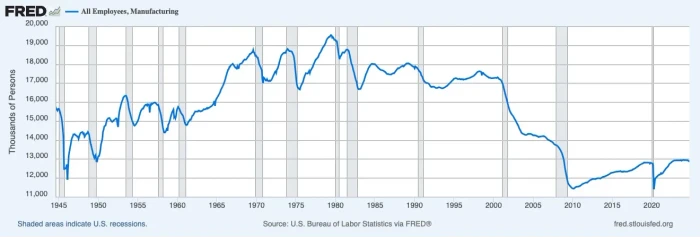
The result has been the shuttering of over 70,000 U.S. factories and the loss of around 8 million good often-unionized manufacturing jobs. It typically takes companies between one and two decades to shift manufacturing overseas, given how large a logistical operation it involves, and reversing the process will probably also take a decade or two.


Entire regions of America were wiped out, producing a swath of our country now referred to as the “rust belt.” The situation was compounded by the Bush administration’s and the Supreme Court’s hostility to union rights.

Since Reagan’s “free trade” we’ve had nothing but annual trade deficits, each representing trillions in American worker’s wealth that’s been shifted to overseas manufacturing countries.

Sam Walton’s autobiography, titled Made in America, epitomized the situation prior to Reaganism when Walmart stores had big “100% Made In America” banners hanging over their front doors. Today, you’ll search for hours to find a single made-in-America product in most big-box stores.

How do we bring back tariffs and how do we avoid a trade war disaster like Trump caused during his first presidency?

Around that same time, another rationale for corporations seeking cheap labor and easy pollution regulations overseas began to take hold in the minds of the neoliberal intelligentsia: “Free trade,” they said, was so magical it could even bring about world peace!

The argument was simple, the neoliberals told us: History showed, they said, that countries that traded heavily with each other rarely went to war with each other. The example most often cited was that no two countries with MacDonald’s burger outlets had ever, at that time, gone to war (although they have since: see Russia and Ukraine).

Thomas Friedman jumped into the act at the end of the 20th century, promoting the MacDonalds’ Peace Theory and the transfer of American manufacturing overseas with his now-discredited 1999 book The Lexus and the Olive Tree.

Its impact, along with major campaigns encouraging “free trade” funded by American industrial and retail giants and their billionaire owners, echoed across American manufacturing and foreign policy for the next 20 years, as America continued to hemorrhage jobs along with the middle class “American Dream” wealth that accompanied them.

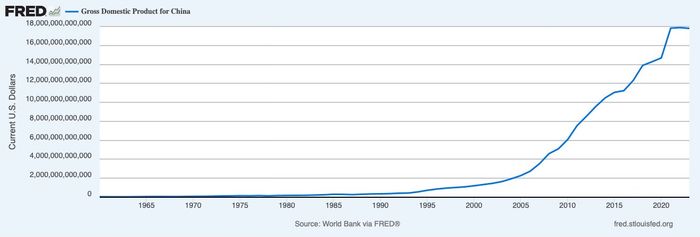
As a vast proportion of American manufacturing shifted to China, that nation—just like Hamilton predicted and proved with the U.S.—underwent the most rapid transformation from Third World poverty to First World affluence in the history of the world.


All because the “wealth” of America was transferred to China every time a cash-register rang at Walmart, an Apple Store, or in pretty much any other American retail outlet. And continues to this day.

So, how do we bring back tariffs and how do we avoid a trade war disaster like Trump caused during his first presidency?

The main goal of an import tariff is to encourage Americans to buy the products of domestic—rather than foreign—manufacturing. For that to work, companies that may consider investing billions in factories here in the U.S. need to know that the tariffs aren’t just a whim or election stunt like they were with Trump, but will be around for the coming years or even decades necessary to recover their initial billion-dollar investments in new manufacturing facilities.

Just because Trump was conceptually right about tariffs (but terribly wrong in how he executed them) doesn’t mean Democrats should freak out at any mention of them.

Tariffs also need to be brought in on an item-by-item basis, organically, with each imported item that we want to put a tariff onto examined for the tariff’s impact, both on domestic inflation and international relations.

We really have no need to put a tariff on, for example, imported artwork from Mexico or moose-skin jackets from Canada; there’s no competing domestic industry here. It’s why Trump’s proposed “across-the-board” tariffs are so stupid.

But the manufacture of cars, steel, chips, computers, toys, clothes, pharmaceuticals, and hundreds of other products and categories of goods can be brought back to the U.S. by appropriate tariffs, introduced gradually and predictably, done in a way that allows both foreign companies and U.S. entrepreneurs to adjust without major disruptions.

There’s also a national security aspect to this. Right now, it’s nearly impossible for the U.S. to manufacture a battleship or advanced aircraft without parts from overseas. Because tariffs had kept virtually all manufacturing here in the U.S. prior to WWII, shifting to a war-based manufacturing economy in the 1940s, before Reagan’s neoliberal “reforms,” was easy. Today it would be extremely difficult.

On top of that, we no longer make most therapeutic drugs here in America. China makes many of the raw ingredients for the drugs we use here, and most pharmaceuticals used in America are manufactured there and in India.

One result is that often drugs we take are contaminated because they’re made in plants outside the U.S.; an old friend got cancer from taking a drug contaminated by a toxic chemical, and my father got bladder cancer from taking a drug contaminated in India with N-nitrosodimethylamine (NDMA).

Also alarming, if we got into a serious conflict with China (for example) and they cut us off from all their manufactured goods, our economy would collapse overnight and we’d find it very, very difficult to manufacture some of our most important weaponry and telecommunications equipment. Not to mention the crisis of a massive drug shortage.

Thus, tariffs have to be put into place intelligently; after all, we’re reversing a neoliberal free trade process that took 44 years to get as bad as it is today.

We don’t want to start trade wars—like Trump did the first time with his tariff stunt and is threatening to do again in January—or wipe out people in poor countries (like Bangladesh or Malaysia, where much of our clothing is made), but we do want the “wealth of [our] nation” to be built and kept here.

We do this by having Congress openly discuss and debate tariffs, apply them gradually, and accompany them with supports for the poorer parts of the world that may be harmed by them, assisting them in developing sustainable domestic industries to replace their export losses.

This is not a radical idea.

China uses tariffs (and dozens of other trade restrictions) to protect its domestic industries. The European Union imposes tariffs on agricultural products to protect its farmers (averaging around 11.4%) as well as industrial goods (averaging around 4.1%). Some industries, like dairy products (38.4% E.U. tariffs) and confectionery products (24.6%), have asked for and gotten even higher E.U. tariffs to keep them viable domestically.

And, of course, that’s how America became the richest country in the world, and the loss of tariffs is a major part of why our standard of living has slipped so badly over these past 44 years of our neoliberal Reaganism experiment. Our wealth, along with our manufacturing and jobs, was simply shipped overseas—and now we must begin the process of bringing it back home.

Democrats know this, even if they’re unwilling to talk about it. The Biden administration took some good steps in this direction by imposing or maintaining multiple tariffs, and they’re already increased American prosperity, particularly for working people.

President Joe Biden increased tariffs on steel and aluminum products from 7.5% to 25% this year; tariffs on semiconductors will rise to 50% by 2025; tariffs on electric vehicles (EVs) hit 100% this year; tariffs on lithium-ion EV batteries and magnets for EV motors will go up by 25% by 2026. After the Covid-19 crisis, the Biden administration put a 50% tariff on syringes and needles to jump-start domestic production, and personal protective equipment (PPE) tariffs went up 25%.

This is not a black-and-white issue. Yes, tariffs are a tax and, until domestic manufacturing replaces foreign imports, they’re a tax that’s mostly passed along to consumers, resulting in higher prices for goods.

But when done right and gradually, those higher prices open the door for American companies to again become competitive, to manufacture goods here—and thus keep our jobs and our “wealth” here—while raising the wages and standard of living of American workers and people around the world.

Just because Trump was conceptually right about tariffs (but terribly wrong in how he executed them) doesn’t mean Democrats should freak out at any mention of them. They’re an important part—as Alexander Hamilton and George Washington taught us—of creating and maintaining wealth and independence for our nation.

And voters in the Rust Belt states know all this already.

As Trump behaves like a bull in a china shop, ready to slap punitive and politically-motivated tariffs on our top trading partners, expect considerable market and overall economic dislocation; a recession is a probable outcome.

But as he shatters the neoliberal tariff consensus, Democrats should rise to the occasion and argue for rational, targeted, and gradual tariffs, taking the Party back to its pre-1980s positions on trade.

And then they’ll be well positioned to both exploit the issue and rescue the American economy in 2026 and 2028 after Trump’s done his worst.


Our work is licensed under Creative Commons (CC BY-NC-ND 3.0). Feel free to republish and share widely.


Thom Hartmann is a talk-show host and the author of "The Hidden History of Monopolies: How Big Business Destroyed the American Dream" (2020); "The Hidden History of the Supreme Court and the Betrayal of America" (2019); and more than 25 other books in print.
Full Bio >
'Quickly rot from within': Expert sees 3 traits the U.S. is sharing with declining empires


Carl Gibson, AlterNet
November 30, 2024 


The United States is currently displaying several characteristics that have historically been seen by empires in decline, according to one social scientist.

Peter Turchin is one of the pioneers of "cliodynamics," which is the field of study concerning statistical analysis of historical dynamics of societies around the world. In a recent essay for the Guardian, Turchin wrote that he and his fellow researchers have noticed the U.S. having three key traits in common with past global hegemons just before a period of decline. Those three factors are "popular immiseration, elite overproduction and state breakdown."

Turchin wrote that "popular immiseration" describes a breakdown of the social contract between workers, the private sector and the public sector, which he said began after the Republican assault in the New Deal that happened around the time former President Ronald Reagan took power.

He noted that as "the power of unions was undermined," taxes on the richest Americans were "cut back," which was followed by stagnating wages and a decline in life expectancy.

READ MORE: 'Not good enough anymore': Union leader explains why Dems lost economic argument to Trump

"With the incomes of workers effectively stuck, the fruits of economic growth were reaped by the elites instead. A perverse 'wealth pump' came into being, siphoning money from the poor and channelling it to the rich," he wrote. "In many ways, the last four decades call to mind what happened in the United States between 1870 and 1900 – the time of railroad fortunes and robber barons. If the postwar period was a golden age of broad-based prosperity, after 1980 we could be said to have entered a Second Gilded Age."

The second trait, which Turchin called "elite overproduction," involves a growing population of the "uber-rich," (which he defined as "those with fortunes greater than $10 million") and their influence in the public sphere. He noted that when adjusting for inflation, this population grew by tenfold over the last four decades. This has led to rich elites either running for office, like President-elect Donald Trump, or funding candidates for office, like many billionaires have done in recent cycles. He also pointed out that "counter-elites" will emerge who oppose the existing political establishment.

"The more members of this elite class there are, the more aspirants for political power a society contains," he wrote. "By the 2010s the social pyramid in the US had grown exceptionally top-heavy: there were too many wannabe leaders and moguls competing for a fixed number of positions in the upper echelons of politics and business."

"As battles between the ruling elites and counter-elites heat up, the norms governing public discourse unravel and trust in institutions declines," he continued. "The result is a loss of civic cohesiveness and sense of national cooperation – without which states quickly rot from within."

Finally, Turchin opined that "state breakdown" will inevitably follow popular immiseration and elite overproduction. He argued that Democrats' loss in the November election "represents one battle in an ongoing revolutionary war," but that the goal of the new order is "far from assured" given that "opponents are pretty well entrenched in the bureaucracy and can effectively resist change."

"Popular discontent in the US has been building up for more than four decades. Many years of real prosperity would be needed to persuade the public that the country is back on the right track," he wrote. "So, for now, we can expect a lasting age of discord. Let’s hope that it won’t spill over into a hot civil war."


Click here to read Turchin's full essay in the Guardian.

Brazil's Bolsonaro aims to ride Trump wave back to office: WSJ
BIRDS OF A FEATHER...(VULTURES)

Agence France-Presse
November 29, 2024 

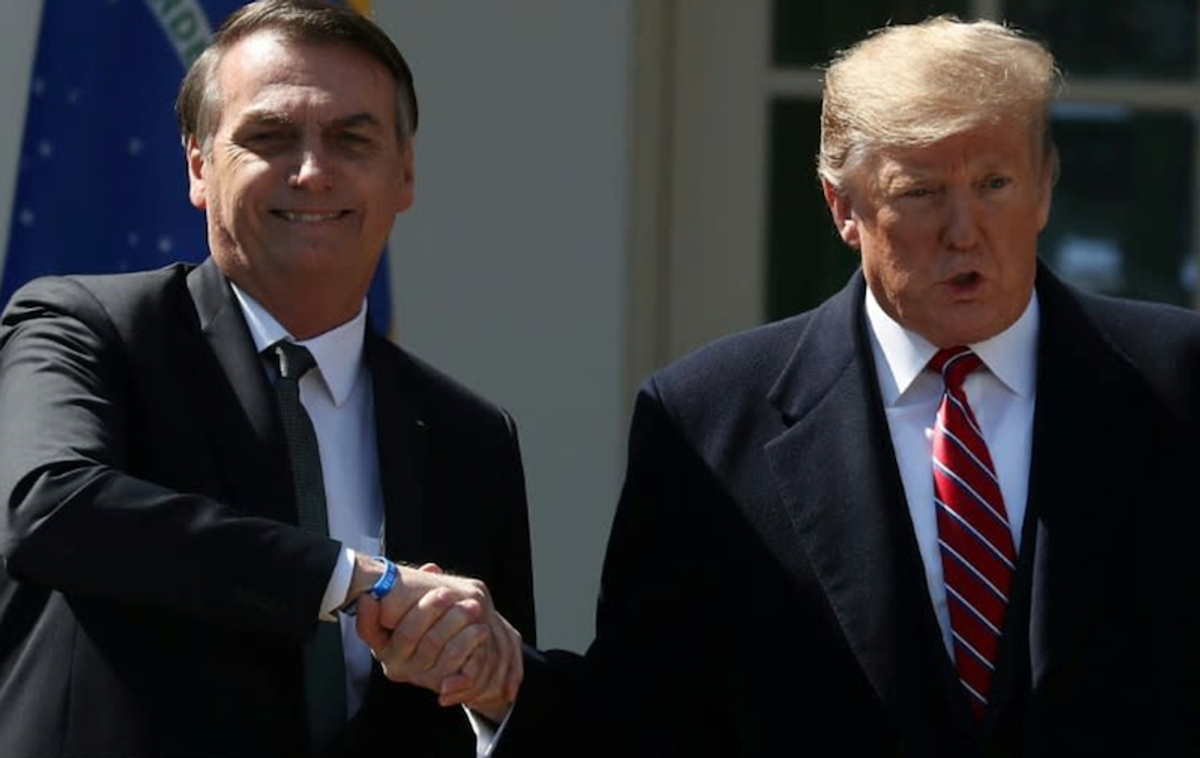
Brazilian ex-president Jair Bolsonaro (left) says he was rooting for Donald Trump in the U.S. election (MARK WILSON/AFP)

Brazil's ex-president Jair Bolsonaro believes incoming U.S. leader Donald Trump's return will boost his own comeback ambitions, despite being banned from seeking office until 2030 and investigated for allegedly plotting a coup.

The Wall Street Journal reported on Thursday that Bolsonaro, 69, is banking on Trump pressuring Brazilian judges to delay enforcing the ban, which he earned for baselessly trashing Brazil's voting system ahead of his 2022 defeat.

"Trump is back, and it's a sign we'll be back too," Bolsonaro told the newspaper in an interview from his party headquarters in the capital, Brasilia, confirming that he planned to run again in 2026.

Trump's office did not respond immediately to a request for comment but the Journal reported that Bolsonaro and Trump had been in close contact since the US election in early November.

"I was up the whole night rooting for the big orange guy," Bolsonaro said, using a Portuguese term of affection for Trump, "Laranjao."

Bolsonaro -- a hard-right populist widely dubbed the "Trump of the Tropics" during his 2019-2023 term -- has remained politically active since leaving office, recently campaigning for the right-wing Liberal Party ahead of October municipal elections.

Like Trump, Bolsonaro claims his legal issues amount to political persecution.

Brazilian police have accused him of participating in a 2022 plot to prevent President Luiz Inacio Lula da Silva from taking office, and of being aware of an alleged plan to assassinate the incumbent.

He is accused alongside 36 other people named as co-conspirators in a police report made public this week. Brazil's attorney general is examining the allegations to see if the evidence supports criminal charges.

The document details alleged collusion between Bolsonaro and some of his officials, including members of his military brass, to claim fraud in Lula's victory and to use decrees to sideline the Supreme Court.

Bolsonaro -- whose supporters violently attacked government buildings in 2023, echoing the assault by a pro-Trump mob on the US Capitol in 2021 -- has denied the coup allegation and says he is the victim of "persecution."

"It's time for MAAGA -- Make All Americas Great Again," said Bolsonaro, making a play on Trump's signature MAGA slogan, according to the Journal.


© Agence France-Presse