Sunday, December 01, 2024

Senegal ceremony marks 80 years since French colonial massacre at Thiaroye

Senegal on Sunday commemorated the 80th anniversary of a massacre of African soldiers who fought for France during World War Two, and were gunned down by French troops in 1944 for demanding fair treatment and payment on their return..


Issued on: 01/12/2024 
By: NEWS WIRES
Video by: Caitlin KELLY


Senegal on Sunday commemorated 80 years since the killing of scores of African troops by French forces that the former colonial master acknowledged this week had been a "massacre".

Heads of state from Mauritania, the Comoros, Gabon, the Gambia and Guinea-Bissau, and France's Foreign Minister Jean-Noël Barrot joined Senegal's President Bassirou Diomaye Faye who has used the anniversary to call for a new relationship with France.

All laid wreaths at the scene of the killings at the former Thiaroye military camp, just outside Dakar, which have long been a stain on relations between Senegal and France.

Around 1,600 soldiers from West Africa who had been captured by Germany while fighting for France were sent back to Dakar in November 1944.


After arriving at the Thiaroye military camp, discontent mounted over unpaid wages and demands to be treated on a par with white soldiers. Some protesters refused to return to their home countries without their due.

French forces opened fire on December 1, killing at least 35 people, French authorities said at the time. Historians say the real death toll could be as high as 400 as some of the victims' graves have yet to be disclosed.

Read moreThiaroye 44: Investigating a colonial-era massacre in Senegal

The 202 graves at Thiaroye cemetery are anonymous and it is not known how many are victims of the 1944 killings.

"Defenceless African heroes, armed with courage, dignity and African solidarity were killed in cold blood. It was a massacre," said Faye.

"The scale of this crime remains minimised and often even denied by some elements of the heirs of those who committed it," he added.

Elected this year on a promise to reclaim national sovereignty, Faye said there had been 80 years of "omerta", or official silence, on the deaths by Senegal's leaders.

05:09FOCUS © FRANCE 24

France's President Emmanuel Macron sent a letter to Faye this week calling the event a "massacre", according to the Senegalese leader.

Barrot said at the ceremony that the Thiaroye killings were "a gaping wound in our common history".

Faye announced the letter in an interview with AFP in which he also said that France should close its military base in the West African state as part of a resetting of relations.

In the interview, Faye said that China was now Senegal's largest trading partner and investor.

"Does China have a military presence in Senegal? No. Does that mean our relations are cut? No."

France, faced with growing opposition to its military presence in several African countries, has said it will cut its troop numbers as part of a review.

Faye told Sunday's ceremony that it was important to pay tribute to the dead soldiers of 1944 "and establish a new relationship with ourselves, our history and the descendents of the perpetrators of this tragedy".

He praised Macron's "moral courage" for finally acknowledging that it was a "massacre" and said it would be taught in schools and streets, and public squares would be named after Thiaroye and the soldiers killed there.

Faye said the soldiers had to become part of our "collective conscience" and that telling children was not intended to arouse "resentment, anger or hatred" but to ensure the truth was revealed and remembered.

(AFP)


Senegal’s leader says France should close all army bases in country

Senegalese President Bassirou Diomaye Faye on Thursday said that France should close all its army bases in the country, noting that it was “incompatible” with Senegal’s national sovereignty. Faye swept to power in the March elections.


Issued on: 29/11/2024 - 
By: NEWS WIRES
Video by: FRANCE 24

01:49
Senegal’s President Bassirou Diomaye Faye poses for a portrait inside the Presidential Palace in Dakar on November 28, 2024. © John Wessels, AFP


Senegal’s President Bassirou Diomaye Faye told AFP Thursday that France should close its military bases in the West African state as it prepared to mark the 80th anniversary of a notorious colonial slaughter.

Faye said that France’s President Emmanuel Macron had admitted that his country’s troops were responsible for a “massacre” of Senegalese soldiers in 1944.

Faye hailed the acknowledgement but said that allowing French bases in the country was incompatible with national sovereignty.

“Senegal is an independent country, it is a sovereign country and sovereignty does not accept the presence of military bases in a sovereign country,” Faye said in an interview at the presidential palace.

Faye swept to power in March’s elections promising to assert Senegal’s sovereignty and an end to dependence on foreign powers.

He however maintained that the act did not constitute a break with France, like those seen elsewhere in west Africa in recent years.

“Today, China is our largest trading partner in terms of investment and trade. Does China have a military presence in Senegal? No. Does that mean our relations are cut? No,” he said.

‘Making amends’


Several other francophone countries in west and central Africa, including Mali, Burkina Faso and Niger, have been taken over by military juntas that have expelled French forces and turned to Russia for security aid instead.

Two French government sources told AFP this year that the country was looking to cut its military presence in Africa—from 350 troops to 100 in Senegal and Gabon and to 300 in Chad from 1,000 and 100 in Ivory Coast from 600.

“France remains an important partner for Senegal for the investment for Senegal and the presence of French companies and even French citizens who are in Senegal,” said Faye.

Senegal’s president said he had received a letter from Macron admitting French culpability for a World War II-era massacre at Thiaroye on December 1, 1944.

The atrocity has long been a bone of contention between Paris and Dakar.

In November 1944, around 1,600 African soldiers who had fought for France and been made prisoners of war by Germany, were sent back to Dakar, according to French historian Armelle Mabon.

Soon after arriving at the Thiaroye camp, just outside Dakar, they protested against pay delays, with some refusing to return to their home countries without their dues.

French forces opened fire on the protesters, killing at least 35, though historians say the toll could be much higher.

“I received today a letter from President Emmanuel Macron in which he acknowledges that it was a massacre, very clearly, unambiguously on the terms,” Faye said.

He praised “a great step” taken by the French leader, who Faye said apologised for not being able to make the commemoration of the massacre’s 80th anniversary.

Faye said he was considering demanding an apology from France.

“To recognise that a massacre has been committed must obviously have the effect of making amends.... we think that naturally this is what must follow. »

(AFP)

Book Bans Overwhelmingly Target Children’s Books by People  WOMEN of Color, Study Finds


A new peer-reviewed study finds that books by women of color, often featuring diverse characters, are frequent targets.

By Katherine Spoon & Isabelle Langrock
December 1, 2024
Several books from a proposed list of ban books from Carroll County, Maryland, Public Schools libraries.Kevin 
Richardson/Baltimore Sun / Tribune News Service via Getty Images


Truthout is a vital news source and a living history of political struggle. If you think our work is valuable, support us with a donation of any size.

Book bans in U.S. schools and libraries during the 2021-22 school year disproportionately targeted children’s books written by people of color — especially women of color — according to a peer-reviewed study we published. They also tended to feature characters of color.

In addition, we found book bans were more common in right-leaning counties that were becoming less conservative over time.

These findings were based on a comprehensive review of a then-record 2,532 bans that took effect in 32 states during the 2021-22 school year and compiled by PEN America, a nonprofit that defends the freedom of expression. The bans involved 1,643 unique book titles. We combined this with data on counties, sales of restricted books and author demographics.

While much has been written about the rise in book bans, there has been little empirical work done on their content, causes and consequences.

In our review, we found that 59% of banned books were children’s books featuring diverse characters or nonfiction books about historical figures and social movements. The top banned books were “Gender Queer: A Memoir,” by Maia Kobabe, which was banned by 41 school districts; “All Boys Aren’t Blue,” by George M. Johnson, with 29 bans; and “Out of Darkness,” by Ashley Hope Pérez, with 24 bans.

Related Story

Florida Book Bans Are Lower This Year Compared to 2023 — Why Is a Mystery
Although book ban attempts have lessened, dozens of titles still faced scrutiny across the state over the past year.
By Chris Walker , TruthoutOctober 16, 2024


What’s more, authors of color — particularly women of color — were far more likely to be banned compared with white authors. Authors of color wrote 39% of the banned books in our study. Women of color alone penned almost a quarter of them. That’s even though authors of color make up just 10% of U.S. authors and write less than 5% of the most popular books in the U.S.

We also found that while most book bans occurred in counties with a Republican majority, they were even more likely to occur in counties where that majority had decreased over the previous two decades. Districts where the majority had increased or grown stronger since 2000 were less likely to ban books.
Why It Matters

The number of book bans has only increased since the data from our study came out.

In the 2022-23 school year, PEN America reported 3,362 book bans, affecting 1,557 unique titles. And its latest data, released Nov. 1, 2024, shows that the number of book bans soared in the 2023-24 school year to more than 10,000, with Florida and Iowa accounting for over 8,000 of them.

While those pushing book bans often claim they are doing so to protect children, there is little evidence to suggest that book bans actually shield them from harmful content.

The costs can be high. They’re causing conflict and tension in the local communities where they are occurring, and some estimates put the monetary cost of implementing book bans in the millions of dollars for some states. But because the focus of these bans tends to be on titles featuring characters of color or LGBTQ+ themes, there’s a risk that diverse characters will become even more underrepresented in children’s literature.

This could negatively affect children’s sense of belonging and learning outcomes, even in schools not directly affected by these bans.

Book bans — often initiated by school boards, legislators and prison authorities — are one of the most symbolic forms of censorship, but our findings also suggest they are being used as a form of political activism. This means that in addition to the traditional questions around censorship, such as what information children have or don’t have access to, there are questions about the political actions behind book bans and how they might attract or dampen a community’s civic participation.

And given our finding about where these bans are most often occurring and that we found little impact on state and national levels of interest in the targeted books, as measured by Google searches and book sales, it seems that many of these bans amount to symbolic political gestures aimed at galvanizing a shrinking electoral base.
What Still Isn’t Known

Research on book bans is just emerging. Our study is one of the first, in part because of a lack of data about the publishing industry overall. We encourage future work to bring data together about books — to facilitate this, we made much of the data we used public.

This article is republished from The Conversation under a Creative Commons license. Read the original article.


Katherine Spoon  is a fifth-year Ph.D. candidate and NSF Graduate Research Fellow in computer science at the University of Colorado at Boulder. She is also pursuing a master degree’s in education policy. Her research uses data science to investigate social inequalities at scale — in scientific careers, education, politics and healthcare. She is currently a data science fellow at the U.S. Census Bureau. Previously, she worked as a research engineer at IBM Research, and studied computer science at Indiana University, where she developed an early-warning system to detect dyslexia.

Isabelle Langrock is currently a postdoctoral researcher at Le Centre de Recherche sur les Inégalités Sociales (The Center for Research on Social Inequalities) at Sciences Po in Paris, France. She works with Dr. Jen Schradie and studies the different information environments of the U.S. and France.

She received her Ph.D. from the Annenberg School for Communication at the University of Pennsylvania in May 2023. Her Dissertation, “The Irony of Openness: Gender Inequality in Self-Governed Knowledge Systems” built a framework for investigating gender gaps across different forms of open knowledge production, including Wikipedia and Open Source Software. Her work speaks to the inter-disciplinary domains of digital governance and organization, information environments, and social activism.
AMERIKAN EXCEPTIONALISM; 
Parents Are Being Asked to Pay the Cost of Delivering Their Babies in Advance
FOR PROFIT HEALTHCARE
Childbirth is already unaffordable for many. Now some are being asked to pay the bill before they even go into labor.
December 1, 2024
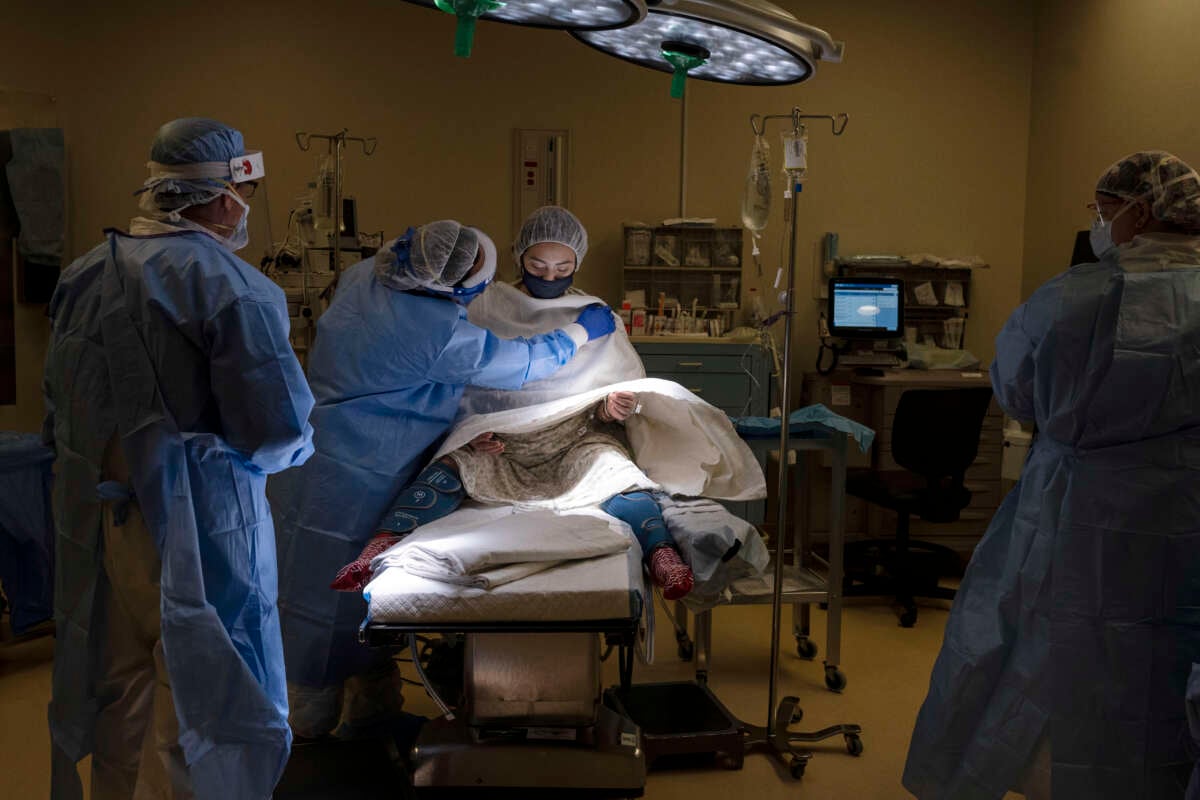
A young mother is supported by nurses as she is prepped by the anesthesiologist for an epidural before a cesarian section to deliver twins at the Women's Hospital at the the Doctors Hospital at Renaissance in McAllen, Texas, on July 7, 2020.
Lynsey Addario / Getty Images 

In April, just 12 weeks into her pregnancy, Kathleen Clark was standing at the receptionist window of her OB-GYN’s office when she was asked to pay $960, the total the office estimated she would owe after she delivered.

Clark, 39, was shocked that she was asked to pay that amount during this second prenatal visit. Normally, patients receive the bill after insurance has paid its part, and for pregnant women that’s usually only when the pregnancy ends. It would be months before the office filed the claim with her health insurer.

Clark said she felt stuck. The Cleveland, Tennessee, obstetrics practice was affiliated with a birthing center where she wanted to deliver. Plus, she and her husband had been wanting to have a baby for a long time. And Clark was emotional, because just weeks earlier her mother had died.

“You’re standing there at the window, and there’s people all around, and you’re trying to be really nice,” recalled Clark, through tears. “So, I paid it.”

On online baby message boards and other social media forums, pregnant women say they are being asked by their providers to pay out-of-pocket fees earlier than expected. The practice is legal, but patient advocacy groups call it unethical. Medical providers argue that asking for payment up front ensures they get compensated for their services.

Related Story

Georgia Maternal Mortality Board Dissolved Over Report on Abortion Ban Deaths
One critic described the move as an “attempt to conceal the deadly consequences” of Georgia’s abortion ban.
By Chris Walker , TruthoutNovember 25, 2024

How frequently this happens is hard to track because it is considered a private transaction between the provider and the patient. Therefore, the payments are not recorded in insurance claims data and are not studied by researchers.

Patients, medical billing experts, and patient advocates say the billing practice causes unexpected anxiety at a time of already heightened stress and financial pressure. Estimates can sometimes be higher than what a patient might ultimately owe and force people to fight for refunds if they miscarry or the amount paid was higher than the final bill.

Up-front payments also create hurdles for women who may want to switch providers if they are unhappy with their care. In some cases, they may cause women to forgo prenatal care altogether, especially in places where few other maternity care options exist.

It’s “holding their treatment hostage,” said Caitlin Donovan, a senior director at the Patient Advocate Foundation.

Medical billing and women’s health experts believe OB-GYN offices adopted the practice to manage the high cost of maternity care and the way it is billed for in the U.S.

When a pregnancy ends, OB-GYNs typically file a single insurance claim for routine prenatal care, labor, delivery, and, often, postpartum care. That practice of bundling all maternity care into one billing code began three decades ago, said Lisa Satterfield, senior director of health and payment policy at the American College of Obstetricians and Gynecologists. But such bundled billing has become outdated, she said.

Previously, pregnant patients had been subject to copayments for each prenatal visit, which might lead them to skip crucial appointments to save money. But the Affordable Care Act now requires all commercial insurers to fully cover certain prenatal services. Plus, it’s become more common for pregnant women to switch providers, or have different providers handle prenatal care, labor, and delivery — especially in rural areas where patient transfers are common.

Some providers say prepayments allow them to spread out one-time payments over the course of the pregnancy to ensure that they are compensated for the care they do provide, even if they don’t ultimately deliver the baby.

“You have people who, unfortunately, are not getting paid for the work that they do,” said Pamela Boatner, who works as a midwife in a Georgia hospital.

While she believes women should receive pregnancy care regardless of their ability to pay, she also understands that some providers want to make sure their bill isn’t ignored after the baby is delivered. New parents might be overloaded with hospital bills and the costs of caring for a new child, and they may lack income if a parent isn’t working, Boatner said.

In the U.S., having a baby can be expensive. People who obtain health insurance through large employers pay an average of nearly $3,000 out-of-pocket for pregnancy, childbirth, and postpartum care, according to the Peterson-KFF Health System Tracker. In addition, many people are opting for high-deductible health insurance plans, leaving them to shoulder a larger share of the costs. Of the 100 million U.S. people with health care debt, 12% attribute at least some of it to maternity care, according to a 2022 KFF poll.

Families need time to save money for the high costs of pregnancy, childbirth, and child care, especially if they lack paid maternity leave, said Joy Burkhard, CEO of the Policy Center for Maternal Mental Health, a Los Angeles-based policy think tank. Asking them to prepay “is another gut punch,” she said. “What if you don’t have the money? Do you put it on credit cards and hope your credit card goes through?”

Calculating the final costs of childbirth depends on multiple factors, such as the timing of the pregnancy, plan benefits, and health complications, said Erin Duffy, a health policy researcher at the University of Southern California’s Schaeffer Center for Health Policy and Economics. The final bill for the patient is unclear until a health plan decides how much of the claim it will cover, she said.

But sometimes the option to wait for the insurer is taken away.

During Jamie Daw’s first pregnancy in 2020, her OB-GYN accepted her refusal to pay in advance because Daw wanted to see the final bill. But in 2023, during her second pregnancy, a private midwifery practice in New York told her that since she had a high-deductible plan, it was mandatory to pay $2,000 spread out with monthly payments.

Daw, a health policy researcher at Columbia University, delivered in September 2023 and got a refund check that November for $640 to cover the difference between the estimate and the final bill.

“I study health insurance,” she said. “But, as most of us know, it’s so complicated when you’re really living it.”

While the Affordable Care Act requires insurers to cover some prenatal services, it doesn’t prohibit providers from sending their final bill to patients early. It would be a challenge politically and practically for state and federal governments to attempt to regulate the timing of the payment request, said Sabrina Corlette, a co-director of the Center on Health Insurance Reforms at Georgetown University. Medical lobbying groups are powerful and contracts between insurers and medical providers are proprietary.

Because of the legal gray area, Lacy Marshall, an insurance broker at Rapha Health and Life in Texas, advises clients to ask their insurer if they can refuse to prepay their deductible. Some insurance plans prohibit providers in their network from requiring payment up front.

If the insurer says they can refuse to pay up front, Marshall said, she tells clients to get established with a practice before declining to pay, so that the provider can’t refuse treatment.

Clark said she met her insurance deductible after paying for genetic testing, extra ultrasounds, and other services out of her health care flexible spending account. Then she called her OB-GYN’s office and asked for a refund.

“I got my spine back,” said Clark, who had previously worked at a health insurer and a medical office. She got an initial check for about half the $960 she originally paid.

In August, Clark was sent to the hospital after her blood pressure spiked. A high-risk pregnancy specialist — not her original OB-GYN practice — delivered her son, Peter, prematurely via emergency cesarean section at 30 weeks.

It was only after she resolved most of the bills from the delivery that she received the rest of her refund from the other OB-GYN practice.

This final check came in October, just days after Clark brought Peter home from the hospital, and after multiple calls to the office. She said it all added stress to an already stressful period.

“Why am I having to pay the price as a patient?” she said. “I’m just trying to have a baby.”


KFF Health News is a national newsroom that produces in-depth journalism about health issues and is one of the core operating programs at KFF — an independent source of health policy research, polling, and journalism. Learn more about KFF

Renuka Rayasam is a senior correspondent at Kaiser Health News.


Berkeley Free Speech Movement Forged an Organizing Blueprint That’s Relevant Now

As campus repression worsens, what can today’s student organizers learn from the struggle that took place in the 1960s?
November 30, 2024
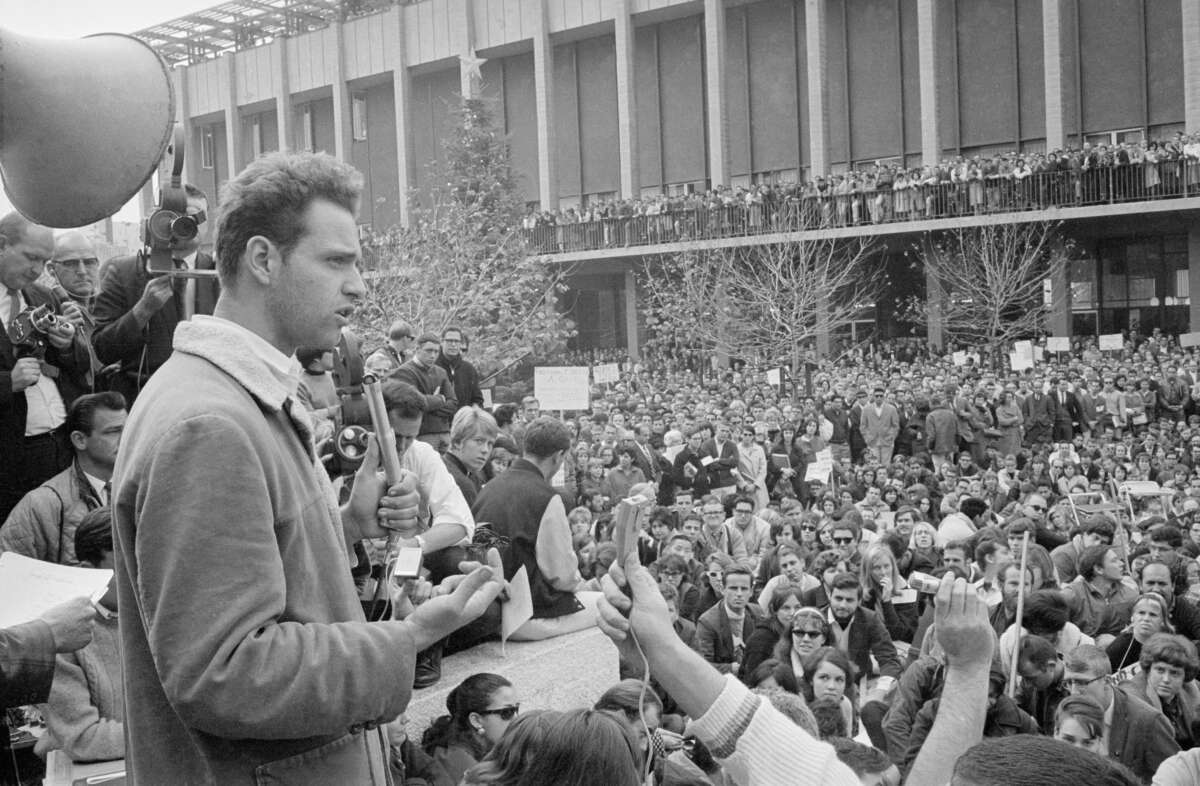
Mario Savio, one of the leaders of the Free Speech Movement at the University of California, tells 5,000 persons at a rally that the group will continue efforts to expand political freedom on the campus.
Bettman via Getty Images


Truthout is a vital news source and a living history of political struggle. If you think our work is valuable, support us with a donation of any size.

U.S. universities have always been sites of contestation and political struggle. Today, their governing bodies are dominated by representatives of corporate power. Issues like the student debt crisis and military research are bound up with universities. The right wing, often joined by establishment Democrats, attacks college curricula and scapegoats students to score political points.

Student activists today are challenging university ties to everything from fossil fuels to racist policing — and, of course, to the genocide in Palestine. They demand divestment and stage protests and encampments. In response, government officials and big donors are accelerating the machinery of repression against students and faculty.

This tradition — of student struggle for justice at universities, of the deep politicization of university spaces — is far from new. A key turning point in its birth occurred 60 years ago, with the Berkeley Free Speech Movement in late 1964.

On its surface, the Free Speech Movement was a two-and-a-half-month struggle at the University of California Berkeley for free speech rights on campus. But more deeply, it represented a mass emergence of the university as an openly political space and students as political actors. It warmed the chill of 1950s McCarthyism on campus and helped usher in the wave of student protest that came to be associated with the 1960s era (The Sixties).

All this generated a strong backlash from conservatives and business interests. In the 1970s and 1980s, the right began forging billionaire-backed counterinstitutions to reclaim dominance in higher education. Right-wing politicians from Ronald Reagan to J.D. Vance rode to power, in part, by denouncing universities and their students.

Related Story

As DNC Kicks Off, Palestine Solidarity Activists Look to 1964 for Inspiration
60 years ago, the Mississippi Freedom Democratic Party forced the Democrats to confront Jim Crow within their own party.
By Derek Seidman , TruthoutAugust 19, 2024


Ellen Schrecker, the renowned historian of anti-communism and U.S. universities in the 1960s, says current attacks on higher education may be even worse than the days of McCarthyism. “It’s much more serious today,” Schrecker told Truthout, “because the whole system of higher education has been the target of a massive campaign of political repression that began with a backlash against the student movement of the 1960s.” With an incoming Trump administration floating harsh attacks that range from federal prosecution of campus demonstrators to deporting international student protesters, this repression stands to intensify.
Berkeley and the Cold War University

The United States emerged from World War II as a global hegemon. Postwar universities became a vital arm of U.S. empire during the Cold War, with the ascending military-industrial complex resting, in part, on university weapons research. An inextricable link between universities and militarization was born, a “connection that continues to this day,” says Schrecker.


Billionaire donors, especially from the Koch donor network, constructed a movement to reassert conservative hegemony in higher education.

All this, combined with a booming postwar economy and policies like the GI Bill, drove a vast expansion of higher education in the U.S. The numbers of colleges and universities, and the students and faculty who populated them, skyrocketed in the 1950s and 1960s. Much of this growth was concentrated at huge bureaucratic state universities that were closely interlocked with corporate and military power.

Berkeley, the flagship university of the fastest-growing state in the nation, was a pinnacle example of this. “Berkeley was considered the number one public university in the United States,” said Schrecker, and, as a major site in the development of the atomic bomb, “it was very tied to the military-industrial complex.”

The 1950s Cold War U.S. also saw a wave of McCarthyist repression that stretched into universities, with many professors forced to take loyalty oaths. “What that meant,” said Schrecker, “was that a kind of chill pervaded the campuses.” Amid the political quiescence, pockets of student and faculty dissent existed, but they were few in number. UC Berkeley was no exception. “It was probably the most politically repressive of the nation’s major universities,” said Schrecker, noting that the Bay Area power elite who had influence over the campus were extremely right-wing and anti-communist.

But going into the 1960s, the facade of conformity was starting to crack. More than anything, the civil rights movement broke the political dormancy. In early 1960, Black student activists kicked off a national wave of sit-ins that directly challenged segregation. Young people flocked to groups like the Student Nonviolent Coordinating Committee and its ethos of direct action and bottom-up organizing.

“Everything got absolutely galvanized by the civil rights movement,” Schrecker told Truthout.


There are dire signs that the ongoing repression against college students, particularly for speaking up for Palestine, will increase under Trump.

Berkeley students in the early 1960s cut their teeth protesting anti-communist hearings and organizing to desegregate Bay Area businesses. Key leaders of the Free Speech Movement, including Mario Savio, participated in the 1964 Mississippi Freedom Summer before heading to Berkeley that fall. New groups like Students for a Democratic Society were lambasting bureaucratic universities and casting students as political agents who should live their values and practice participatory democracy.

The “Sixties” were coming, and the stage was being set for the Free Speech Movement.
The 1964 Berkeley Free Speech Movement

There was a strip of land on the border of the Berkeley campus where students tabled for their causes. In late September 1964, University of California administrators, perhaps anxious over rising civil rights protests, banned political activity there. It was a big mistake.

Students immediately defied the ban and eight of them were suspended. In protest, hundreds of students congregated outside the administration’s office on September 30 demanding they also be charged. A new sense of solidarity and collectively was being born.

On October 1, Berkeley student and civil rights activist Jack Weinberg was arrested for refusing to remove his fundraising table for the Congress of Racial Equality civil rights group. But the police car holding Weinberg was soon surrounded by hundreds, then thousands, of students, demanding his release.

The car didn’t move for 36 hours. Speaker after speaker hopped on its roof. It was a collective political awakening. “That thirty-six-hour siege marked a critical moment in my life,” wrote Bettina Aptheker later. “I had a sense of belonging to something, being on the inside of a community of my own making, on my own terms.”

The Free Speech Movement was born. “Two-and-half months of crisis began,” said Schrecker, marked by marches, meetings and rallies against an intransigent administration. Students were demanding, simply, the right to engage in political activity on campus. The battle at Berkeley dominated headlines around the nation.


“Where do we go from here? The only answer I see is collective action.”

Berkeley Chancellor Clark Kerr dismissed student demands, feeding a dialectic that only emboldened further protests. The impasse continued until the end of November, when several protest leaders were suspended. On December 2, students marched to Sproul Hall, a key hub of the Berkeley campus, and peacefully occupied it.

It was here that the most iconic moment of the Berkeley Free Movement transpired when Mario Savio, the movement’s leading voice, and who was soon monitored by the FBI, gave his iconic, fiery “Bodies Upon the Gears” speech on the steps of Sproul Hall.

“There’s a time when the operation of the machine becomes so odious, makes you so sick at heart, that you can’t take part! You can’t even passively take part!” screamed Savio. “And you’ve got to put your bodies upon the gears and upon the wheels, upon the levers, upon all the apparatus — and you’ve got to make it stop! And you’ve got to indicate to the people who run it, to the people who own it — that unless you’re free, the machine will be prevented from working at all!”

The festive occupation of Sproul Hall stretched into the night, when the administration made the fateful decision to send in hundreds of police. Cops swarmed the building, cracking heads and dragging out students. Nearly 800 people were arrested in just a few hours.

In 1964, this was a shocking spectacle to see at a major U.S. university. It was also the final straw. Graduate students serving as teaching assistants went on strike in response to the repression. Faculty swung to the side of the students. The crisis spread across the entire campus.

Finally, on December 8, 1964, Berkeley faculty voted 824 to 115 in favor of a resolution declaring that “the content of speech or advocacy shall not be restricted by the university,” the core demand of the Free Speech Movement. This was a signal that the administration could not ignore. “At this moment many of us, faculty and students alike, understood that the days of the loyalty oaths and speakers’ bans and anti-Communist witch hunts were finally over,” wrote Aptheker.
“The Only Answer I See Is Collective Action”

By mid-December, the fight at Berkeley was over, with student demands for free speech recognized on campus. But the movement symbolized the beginning of something bigger. “It was a moment in which the ‘1960s movement’ was born,” said Schrecker.

The Free Speech Movement recast college students as political actors and reframed universities as political spaces tied to the larger power structure as well as sites of domination in themselves. It forged a nascent blueprint for campus organizing. In the years to come, thousands of student organizers would draw and build upon the analysis, language and tactics from Berkeley as campus activism against the Vietnam War ripped across the nation.

The Free Speech Movement also laid the ground for a growing critique of the corporate university over the following decade. The student movement soon developed an analysis of higher education as a key pillar of the military-industrial complex and capitalist system. This legacy continues today, as students challenge fossil fuel and war profiteers at their institutions. Campus activism born out of the 1960s also expanded democratic governance at universities and democratized curricula.

But 1960s campus activism also triggered a right-wing backlash that has continued to this day.

Ronald Reagan ascended to the governorship of California in 1967 in part by depicting campuses like Berkeley as sites of chaos and demonizing students as rowdy ingrates. The attack on universities as bastions of liberal elitism became a mainstay in the right-wing playbook in the ensuing decades. Accompanying this, billionaire donors, especially from the Koch donor network, constructed a movement to reassert conservative hegemony in higher education. States like North Carolina and Florida have recently seen particularly repressive attacks on universities and, especially, their most marginalized students.

“This is a very well-funded campaign to change American political culture and undermine the universities as a source of expertise,” said Schrecker. “The right-wing network saw universities as dangerously radical and so they created think tanks and other organizations to supplant them.”

Schrecker says administrators today have joined in the repression of Palestinian solidarity activists on campus. “They are very much caving into pressures, especially from massively well-funded Zionist groups,” she said. “Universities have taken sides and are repressing people who are openly sympathetic to the Palestinian cause.”

As a recent report from the American Association of University Professors shows, attempts to “manufacture backlash” against universities are bankrolled by billionaire donors. These efforts largely focus on “critical race theory” and “diversity, equity, and inclusion” — covers for attacks on hard-fought gains won at universities by historically oppressed groups.

At the same time, there are signs of hope — and counter-sources of progressive power at universities. Grad workers are unionizing en masse and there are inspiring examples of faculty labor militancy pushing back against austerity on campus and resisting the replacement of full-time professors with low-paid, precarious adjunct faculty. Students are politicized and emboldened around Palestine, and grad unions are often some of the leading voices on this. Free higher education is an incredibly popular demand.

But there are dire signs that the ongoing repression against college students, particularly for speaking up for Palestine, will increase under Trump. This raises the question of how students today, 60 years after the Berkeley Free Speech Movement, should respond.

“Where do we go from here? The only answer I see is collective action,” Schrecker told Truthout. “We need to mobilize students and faculty members and create a counter movement. We have the numbers. We are the only people who can stop the repression.”This article is licensed under Creative Commons (CC BY-NC-ND 4.0), and you are free to share and republish under the terms of the license.


Derek Seidma is a writer, researcher and historian living in Buffalo, New York. He is a regular contributor for Truthout and a contributing writer for LittleSis.


China’s Ties With Israel Are Hindering the Palestinian Struggle for Freedom

China is pushing a flawed peace process while deepening economic ties with Israel.

December 1, 2024

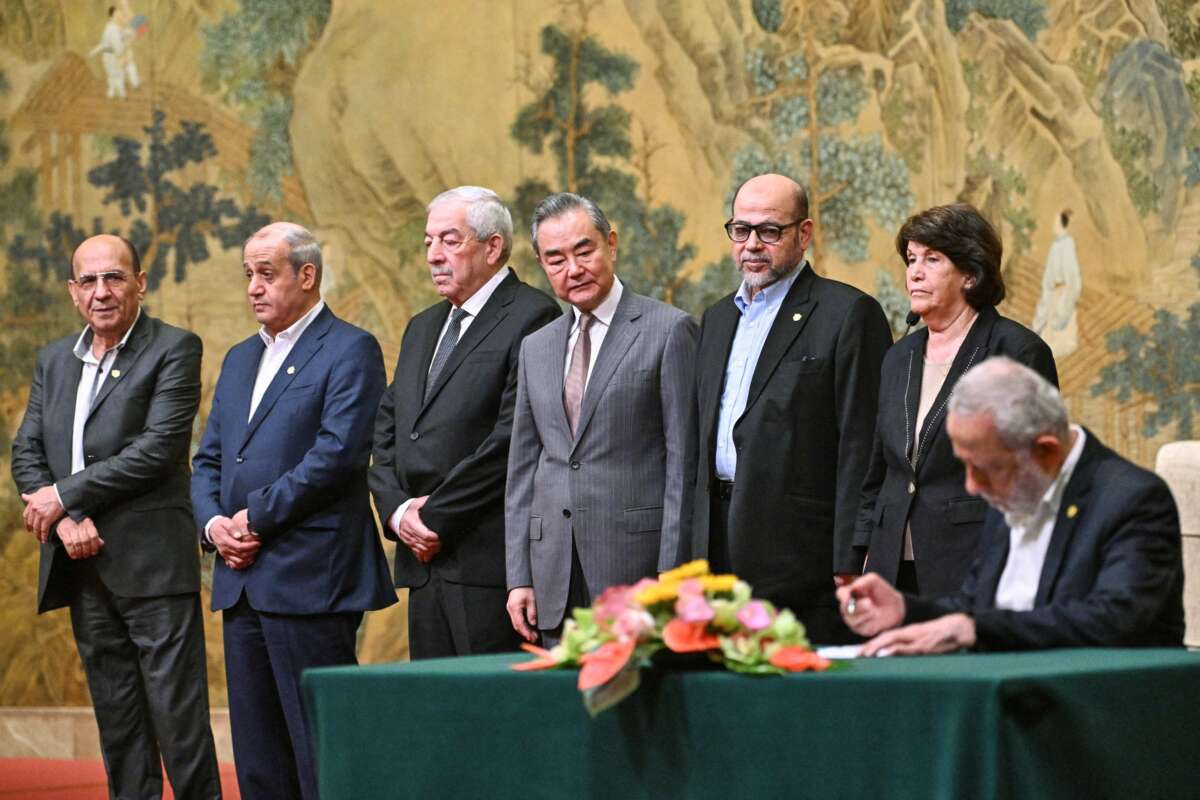
China's Foreign Minister Wang Yi looks on during the signing of the "Beijing declaration," an agreement by 14 Palestinian factions to set up an "interim national reconciliation government" to govern Gaza after the war, at the Diaoyutai State Guesthouse in Beijing, China, on July 23, 2024.
PEDRO PARDO / POOL / AFP via Getty Images

China is pushing a flawed peace process while deepening economic ties with Israel.
By Shireen Akram-Boshar , TruthoutPublishedDecember 1, 2024
Over the past year, analysts and writers in the mainstream press as well as in some left-wing media have argued that China has upended its relationship with Israel in its defense of Palestine in the wake of October 7. But China’s relationship with Palestine is not so clear-cut: While it has offered moderate rhetorical criticism of Israel’s genocide in Gaza, China has maintained investments in Israel and cooperation with Israeli companies, and has attempted to increase its influence as a world power in the Middle East region at the expense of Palestinians.

Throughout the past year of Israel’s war on Gaza, China has repeatedly called for a return to the peace process and the implementation of the long-discussed two-state solution. But this rhetoric is far from signaling opposition to and defiance of Israel. Such calls are hardly very radical: They seek a return to a U.S.-led peace process and a two-state solution traditionally championed by the U.S. Both the peace process and the two-state solution have been sharply criticized by Palestinians and the Palestine solidarity movement globally as mechanisms that preclude the Palestinian right to return and take as their starting point the theft of the majority of Palestinian land. Nonetheless, China’s moderated criticism of Israel has not been matched by any efforts to advance such a flawed process.

Eli Friedman, a Cornell University professor who focuses on labor and development in China, explained some of the dynamics between China and Palestine in a recent webinar. It must be understood, he said, that “China is not responsible for the genocide” in Gaza; responsibility lies with Israel and the U.S., followed by other European powers. “The idea, though, that China is interested in the liberation of Palestine is also extremely problematic,” he added. “China is Israel’s second biggest trading partner after the United States, and actually not too far behind.” In particular, Israel and China cooperate extensively in technology and military sectors. “When the U.S. after 1989 in Tiananmen Square was saying, we can’t sell military equipment to China, Israel kept selling [them] military equipment — Israel is kind of a back door, and they’ve had a lot of cooperation in that respect.”

“China wants economic influence in the region,” he continued. “They want the system to continue to function smoothly.” Israel is a key player in the region that China wants to be able to relate to, therefore China “want[s] Israel to be able to continue to persist more or less as it is. Now, they also want an end to the occupation. China’s official stated position on Israel is a two-state solution … but they’re not going to do anything to fundamentally disrupt” economic relations with Israel.

Friedman explained that this is because China has much to lose economically if it does so.

“Chinese state-owned companies operate the port of Haifa, and they’re leading a big expansion of the port in Ashdod, which is just to the north of Gaza. They’re building an expansion of the Tel Aviv light rail system. So Chinese state capital is heavily invested in the literal infrastructure of genocide. If tomorrow, the Chinese companies said, ‘We’re going to shut down the port of Haifa and we’re not going to allow any weapons or materials to support the genocide,’ that would have an enormous impact on the development of things in Gaza. And they are not doing that. I think it’s important to note that, because there’s not a genuine, solidaristic interest in the liberation of Palestine.”

Indeed, the Chinese state has prohibited basic demonstrations of solidarity with Palestine, confiscating Palestinian flags displayed publicly and preventing mobilizations in support of Gaza.

Some have pointed to a decline in trade between China and Israel in 2023 as evidence that the relationship between the two has hit a turning point, if not a breaking point. But while the dip in 2023 was real, and likely due to a variety of factors, it is unlikely to mark a rupture in the relationship, which has been steadily growing. China’s collaboration with Israel in fields like technology, AI and energy have drastically expanded in recent decades. In 2020, China became Israel’s second largest trading partner globally, and its largest in Asia. Recently, Chinese-Israeli trade hit a record of $20 billion dollars per year. Chinese and Indian companies have privatized Israel’s Haifa port — which Netanyahu allowed against the wishes of the U.S. China’s Belt and Road Initiative (BRI), begun in 2013, encouraged more Chinese companies to invest in Israel or set up research and development centers in Israel. In 2014, Tel Aviv University and Tsinghua University of Beijing set up a $300 million-dollar research center. In 2015, Peking University and Tel Aviv University signed a memorandum of understanding to establish a joint research institute. That same year, Shantou University and Israel’s Technion Institute of Technology established the Guangdong-Technion Institute of Technology. As Chinese activists in solidarity with Palestine explained, “These collaborations are some examples of Chinese university students engaging with Israeli institutions as if they were neutral, without recognizing that Israeli universities are complicit in the ongoing genocide, occupation, and oppression of the Palestinian people.”

These same activists have outlined some of the collaborations between Israel and China on surveillance technology. In particular, the Chinese state-backed company, Hikvision, is complicit in policing and surveillance in Palestine, China and even the U.S. Israel uses Hikvision technology to surveil Palestinians in the occupied West Bank, logging the information in a database monitoring Palestinians in the West Bank specifically; Hikvision also provides technology to surveil and police the Uyghur Muslim population in the Xinjiang region of China; and Hikvision cameras are used in numerous other countries including the U.S. — by the NYPD, among others — despite federal bans of the technology in the U.S.

As Friedman pointed out, China is interested in playing a larger role in the Middle East region. It has been working to increasingly insert itself in the region following the Abraham Accords, and has maneuvered to take advantage of Israel’s genocide in Gaza to increase its influence.

China benefited from the normalization process that began in 2020, allowing it to further its influence and investments in the Middle East. With Israel integrated into economic cooperation more openly across the region, China became increasingly able to expand projects that encompassed both Israel and the Gulf region. The normalization process has opened up possibilities for the extension of China’s BRI project into the region, for example. And since the start of normalization, China, the UAE and Israel have all increased their collaboration in tech sectors including in AI research — bringing together, for example, China’s Beijing Genomics Institute and Abu Dhabi’s G42, both of which are also building labs and offices in Israel — as well as in energy and development. The normalization process and the thawing of Israel’s relationship with the UAE offers more economic openings for China, which has in recent years deepened its relationships with reactionary actors across the region including Saudi Arabia, the UAE and most recently Sudan’s army general. Clearly, the priority is stability for business, rather than justice for Palestinians or any beleaguered group in the region.

But China is also cognizant that, across the Middle East region, general opinion of the U.S. is extremely poor since it is — rightly — understood as responsible for the continuance of the genocide in Gaza. China hopes to use this crisis as an opportunity to portray itself as an alternative to the U.S., one more trustworthy to the Arab states and to countries in the Global South more broadly. In July, China brought various Palestinian factions together in Beijing to move towards “national unity” and to hash out differences between Fatah and Hamas. While it may have been largely symbolic, the event was part of China’s attempt to increase its status and role in the region. Many have praised China for facilitating this convening, but little has come as a result of it. Even before October 7, China established a “strategic partnership” with the Palestinian Authority (PA) and its president, Mahmoud Abbas, with whom it had been nurturing a relationship for years. The Palestinian Authority is also widely criticized by the Palestinian left and others across Palestinian society for its security coordination and collaboration with the Israeli occupation. China’s currying of favor with the PA also points to its goal of increasing its influence in the region rather than a sincere desire for justice for Palestinians.

In a similar vein, China mediated normalization between Saudi Arabia and Iran in early 2023, demonstrating its interest in both economic stability for its own gain across the region as well as an increased desire to hold the reigns in political negotiations — and perhaps to take the place of the U.S. in doing so. China clearly sees itself as a key player in a new, post-2011 status quo across the Middle East region, with more emboldened reactionary states looking to better interstate relationships for their economic benefit at the expense of the wider populations.

China’s position on Palestine is, in many ways, representative of much of the BRICS+ organization member countries. BRICS+ — representing Brazil, Russia, India, China, South Africa, Iran, Egypt, the UAE, and other states — claims to represent an alternative possibility, a bulwark against the U.S., and a defense of countries throughout the Global South. However, as in the case of China, BRICS+ countries often rhetorically support Palestinians and champion the two-state solution, while simultaneously furthering their investments and collaborations with Israel. This is most obvious in the case of India, the fifth largest trading partner with Israel globally, and which has actively supported Israel in its genocide on Gaza with arms sales and increased its partnerships with Israeli universities complicit in the genocide, after decades of nurturing close ties with Israel — going back at least to the 1980s and ‘90s — and championing similarly right-wing, violent Islamophobia. Russia, too, has strong economic relations with Israel, and has continued to provide coal to Israel throughout the duration of the genocide. Brazil and even South Africa — the country that brought Israel to the International Court of Justice — have refused to stop their coal and oil sales to Israel. To be clear, this approach is contrary to that advocated by the Boycott, Divestment, Sanctions movement. By cooperating with Israel rather than isolating it amid a genocide, these states — and their state-backed corporations and tech companies — are an obstacle to Palestinian liberation, rather than part of the solution.


This article is licensed under Creative Commons (CC BY-NC-ND 4.0), and you are free to share and republish under the terms of the license.


Shireen Akram-Boshar is a socialist writer, editor and Middle East/North Africa solidarity activist.
Researchers analyse DNA from dung to save Laos elephants


By AFP
November 29, 2024

Elephants bathe in a pond at the Elephant Conservation Center in Laos' Sainyabuli province - Copyright AFP TANG CHHIN Sothy

Stuart GRAHAM

Slow and silent, former logging elephant Mae Khoun Nung emerges from a forest in northern Laos and follows her guide to an animal hospital for a check-up.

Once abundant in the forests of Laos, Asian elephants like her have been decimated by habitat destruction, gruelling labour in the logging industry, poaching and scarce breeding opportunities.

But conservationists are hoping DNA analysis of elephants’ dung will help them track both captive and wild tuskers, so they can secure a healthy genetic pool and craft an effective breeding plan to protect the species.

Laos — once proudly known as “Lane Xang” or “Land of a Million Elephants” — has between 500 and 1,000 of the animals left, just one-third of the population two decades ago, according to conservation group WWF-Laos.

Around 10 elephants die each year for every one to two born, a rate that puts the animals at risk of dying out completely in the Southeast Asian nation.

“The ultimate goal would be to secure a healthy population of captive elephants to act as a genetic reservoir if the wild population collapses,” wildlife biologist Anabel Lopez Perez told AFP at her laboratory at the Elephant Conservation Center (ECC) in Sainyabuli province.

Once researchers learn how many individual elephants are in the country — by testing DNA-containing cells in dung — Perez said a breeding plan will help them manage genetic diversity, prevent inbreeding and produce healthier calves that could be introduced into the wild to bolster the declining population.


– Elephant hospital –


At the hospital of the ECC, which shelters 28 elephants at its 500-hectare (1,200-acre) sanctuary, Mae Khoun Nung backs into a tall metal scaffolding structure, designed specially for check-ups on the animals.

Sounthone Phitsamone, who manages the centre’s elephant keepers and acts as an assistant vet, taps the animal’s leg and she calmly raises her foot for him to check.

Using a knife, he slices out the cracks and gaps in her hard, mud-baked nail.

Mae Khoun Nung spent her adult life in logging operations until she was given to the ECC by her owner in 2014 after work dried up and it became increasingly difficult to support her.

Elephants like her once roamed across much of Asia, but are now restricted to less than a fifth of their original range, according to WWF.

Their numbers in the wild have fallen by about half since the early 1900s, with only 40,000 to 50,000 left, the organisation says.

In the Nam Poui National Protected Area, researchers are now traversing the rugged hills and forests, collecting DNA from faecal samples of the area’s 50 to 60 remaining wild elephants.

WWF-Laos, which is collaborating with the ECC and the Smithsonian Institution on the project, said the DNA analysis from dung would allow researchers to identify individual elephants, determine their sex, track their movements and understand familial relationships within herds.

“Although Nam Poui NPA represents a significant habitat for one of the few large wild elephant populations remaining in Laos, we lack precise data about its composition,” WWF-Laos said in a statement to AFP.


— Decreasing numbers —


In 2018, a government ban on illegal logging — an industry that used elephants to haul timber out of forests — resulted in the animals being sent to work in the tourism sector, while others were sold off to zoos, circuses and breeders.

The ECC tries to buy and shelter captive elephants when they are put up for sale, but since 2010, just six pregnancies with three calves have resulted.

Many of the elephants at the centre are of an advanced age and in poor shape from years of arduous labour, Phitsamone told AFP.

Mae Khoun Nung is 45 herself. On the bank of a reservoir, a short walk from the elephant hospital, she stops near the water’s edge.

A small herd is diving under the surface and using their trunks to spray their backs, but she grew up isolated from other elephants and has had difficulty socialising.

Bathing is something she prefers to do alone.

Instead, she turns to a pile of banana plants left out for the herd and crunches on a snack.

Phitsamone has worked at the elephant centre for more than a decade and has no illusions about how difficult it will be to save his country’s gentle giants.

“If we compare Laos with other countries, the number of elephants in the database is small and is decreasing,” he said.

“I don’t know if it will be OK in 20 or 30 years — who knows.”


Philippine Eagle hatchling dies in conservation setback


By AFP
November 30, 2024

Habitat loss and ruthless hunting have caused a rapid decline in the number of Philippine Eagles - Copyright PHILIPPINE EAGLE FOUNDATION (PEF)/AFP/File Handout

A Philippine Eagle chick hatched via artificial insemination has died, an avian conservation foundation has announced, in a fresh setback for one of the world’s largest and most critically endangered raptors.

Habitat loss and ruthless hunting have caused a rapid decline in the number of Philippine Eagles, the national bird of the archipelago country.

The hatching of “Chick Number 30” last month briefly stirred hope that science and conservation could save the forest-dwelling raptor species, but expectations were soon cruelly dashed.

“This heartbreaking loss is a solemn reminder of how delicate chick-rearing can be and how critically endangered species are particularly vulnerable,” the Philippine Eagle Foundation said in an undated statement on its website.

A product of artificiraptorsal insemination, the 17-day-old male chick, which died on Friday, had been the first successful hatchling in the new facility.

Complications from a condition known as “yolk sac retention” were the possible cause of death, the statement said.

The condition, common in poultry farms, indicates the entry of bacteria through incubating eggshells, or chick exposure to bacteria after hatching.

Philippine Eagles, known for their sumptuous head plumage and a 2-metre (seven-foot) wingspan, are difficult to mate, with some even killing unwanted suitors.

There are only 392 pairs of the eagles remaining in the wild, with just 30 born in captivity, the foundation estimates.

The organisation’s ultimate goal is to release the eagles back into the wild, but it has not once succeeded in its 37 years of operation.

Many Philippine Eagles have died after being shot or electrocuted while perched on power lines.

Each pair needs at least 4,000 hectares (about 10,000 acres) of forest, a rapidly-disappearing ecosystem in the Philippines, to hunt flying lemurs, palm civets, flying squirrels and monkeys.

While underweight, the latest chick had initially displayed normal behaviour and feeding patterns until November 26, when it began to exhibit laboured breathing and sneezing, the foundation said.

“Of all the chicks that they’ve successfully hatched and raised, this is the first time that the (foundation) breeding team had a case of yolk sac retention, which is usually linked to infection or other causes,” Bayani Vandenbroeck, who conducted the necropsy, was quoted as saying.

“Strict hygiene and management protocols were followed, so we did not expect this at all, but we will probe where else we can improve,” he added.

Vietnam to build $67 bn high-speed railway

BUT WE CAN'T IN CANADA?!


By AFP
November 30, 2024

Vietnam's transport infrastructure is considered relatively weak, with a road network struggling to keep up with demand and an underdeveloped rail system - Copyright AFP Nhac NGUYEN

Tran Thi Minh Ha

Vietnam said Saturday that it will build a $67 billion high-speed railway from Hanoi to Ho Chi Minh City, in a much-needed boost to infrastructure that is expected to drive growth and enhance its reputation among foreign investors.

The railway, which will stretch more than 1,500 kilometres (930 miles) from the capital in the north to the country’s business hub in the south, will reduce the current journey time by rail from 30 hours to around five.

“The national assembly voted to approve… a resolution on investment policies for the high-speed railway project on the North-South axis,” said a statement on Vietnam parliament’s website.

Vietnam’s transport infrastructure is considered relatively weak, with a road network struggling to keep up with demand and an underdeveloped rail system.

The expressway density is one of the lowest in the region, although Vietnam is pushing to expand it, while road transport costs are among the highest.

The country is an increasingly favoured destination for foreign businesses looking for an alternative to China, but low-quality infrastructure is seen as holding back surging investment.

Dan Martin, International Business Advisor of Dezan Shira & Associates, said the project would “supercharge the Vietnamese economy”.

Making it easier for crucial components to reach manufacturing hubs and expediting the delivery of finished goods, the railway will “boost production, reduce lead times, and solidify Vietnam’s role in global supply chains”, Martin told AFP.

– ‘A breakthrough’ –

Deputy Minister of Planning and Investment Tran Quoc Phuong earlier called the new line “a breakthrough” in the country’s infrastructure that would boost the country’s GDP by an average of 0.97 percentage points annually.

“It is the wish of the people and the determination of the political system to have an international-standard high-speed railway,” he said prior to the approval.

The National Assembly had in 2010 scrapped this same project, then estimated at $56 billion, over fears it was too costly.

But the project’s potential impact has changed dramatically, Martin said, adding that there was “growing momentum” behind high-speed rail projects across Southeast Asia, where Laos and Indonesia have both completed rail lines in recent years.

“For Vietnam… it’s about becoming an even stronger player in a region that’s rapidly embracing high-speed rail,” he said.

The new rail line will stop at 23 stations in 20 different cities and provinces, boosting connectivity between the regions and giving locals more travel options.

“The high-speed railway… will make it more convenient for many people to travel”, said university student Pham Dang Quang, speaking onboard a train between Hanoi and the port city of Hai Phong on Saturday.

He said he was looking forward to the day he could “take the train between Hanoi and Ho Chi Minh City in the morning and get back home in the evening”.

The project is scheduled to take just eight years — beginning in 2027 and aiming for completion in 2035 — although the country has a history of overruns when it comes to major infrastructure projects.

Hanoi’s second metro line opened this year after nearly a decade’s delay while Ho Chi Minh City’s first metro route was originally supposed to start operations in 2018. It has still not opened.

According to the Global Quality Infrastructure Index 2023, Vietnam ranks 52nd out of 185 economies, far below several countries in the ASEAN region.

WORLD AIDS DAY DEC. 1

Alarm over high rate of HIV infections among young women, girls


By AFP
November 29, 2024

Children aged 0-14 account for only 3 percent of those living with HIV, but accounted for 12 per cent (76,000) of AIDS-related deaths in 2023 - Copyright AFP/File GIANLUIGI GUERCIA

The UN’s children’s fund raised the alarm on Friday over the high rate of new HIV infections among young women and girls, warning they lacked access to prevention and treatment.

In a report ahead of world AIDS day on Saturday, UNICEF said that 96,000 girls and 41,000 boys aged 15-19 were newly infected with HIV in 2023, meaning seven out of 10 new adolescent infections were among girls.

In sub-Saharan Africa, nine out of 10 new HIV infections among 15-19 year-olds were among girls in the most recent period for which data is available.

“Children and adolescents are not fully reaping the benefits of scaled up access to treatment and prevention services,” said UNICEF associate director of HIV/AIDS Anurita Bains.

“Yet children living with HIV must be prioritized when it comes to investing resources and efforts to scale up treatment for all, this includes the expansion of innovative testing technologies.”

As many as 77 percent of adults living with HIV have access to anti-retroviral therapy, but just 57 percent of children 14 and younger, and 65 percent of teenagers aged 15-19, can obtain lifesaving medicine.

Children 14 and younger account for only three percent of those living with HIV, but accounted for 12 per cent — 76,000 — of AIDS-related deaths in 2023.

Around 1.3 million people contracted the disease in 2023, according to a report from the UNAIDS agency.

That is still more than three times higher than needed to reach the UN’s goal of ending AIDS as a public health threat by 2030.

Around 630,000 people died from AIDS-related illnesses last year, the lowest level since a peak of 2.1 million in 2004, the report said ahead of World AIDS Day on Sunday.

Much of the progress was attributed to antiretroviral treatments that can reduce the amount of the virus in the blood of patients.


Out of the nearly 40 million people living with HIV around the world, some 9.3 million are not receiving treatment, the report warned.


Antiretroviral drugs for treatment and prevention of HIV in adults: 2024 recommendations of the International Antiviral Society–USA Panel


JAMA Network


About The Article: This narrative review from the International Antiviral Society–USA provides updated 2024 recommendations for HIV treatment and clinical management and HIV prevention. New approaches for treating and preventing HIV offer additional tools to help end the HIV epidemic, but achieving this goal depends on addressing disparities and inequities in access to care. 

Corresponding Author: To contact the corresponding author, Rajesh T. Gandhi, MD email RGANDHI@mgh.harvard.edu.

To access the embargoed study: Visit our For The Media website at this link https://media.jamanetwork.com/

(doi:10.1001/jama.2024.24543)

Editor’s Note: Please see the article for additional information, including other authors, author contributions and affiliations, conflict of interest and financial disclosures, and funding and support.

Embed this link to provide your readers free access to the full-text article This link will be live at the embargo time https://jamanetwork.com/journals/jama/fullarticle/10.1001/jama.2024.24543?guestAccessKey=d894a41c-50a3-4496-b825-56fee9b1e191&utm_source=For_The_Media&utm_medium=referral&utm_campaign=ftm_links&utm_content=tfl&utm_term=120124


Glittering dreams: India’s big push for solar power

By AFP
November 30, 2024

India is building what it boasts will be the world's largest renewable power plant - Copyright AFP/File Money SHARMA

Philippe ALFROY

Vast lines of solar panels reflect the blazing sun in India’s western deserts, a dazzling ocean broken only by bristling wind turbines.

India, along its desolate border with Pakistan, is building what it boasts will be the world’s largest renewable power plant, an emblem of a determined push to boost solar energy.

The Khavda plant in Gujarat state consists of some 60 million solar panels and 770 wind turbines spread over 538 square kilometres (208 square miles) — almost the size of the sprawling megacity Mumbai.

In front of a wall of screens, a handful of operators monitor the machines under the slogan: “Adani Group: Growth with Goodness”.

“Today, we can produce up to 11 gigawatts of electricity,” said Maninder Singh Pental, vice-president of Adani Green Energy, the subsidiary of Indian conglomerate Adani Group, and in which France’s TotalEnergies holds a 20 percent stake.

“In 2029, we will be able to produce up to 30 GW,” he added proudly.

At that point, India will break another record, with Khavda overtaking China’s 18 GW Three Gorges hydroelectric dam to become the most powerful electricity production site in the world.

The power is sorely needed in the world’s most populous nation, where demand has doubled since 2000, driven by demographic expansion, economic growth and rapid urbanisation.

India vows to be carbon neutral by 2070 and as part of that, New Delhi wants its renewable energy capacity to rise from 200 GW — half of its current energy mix — to 500 GW by 2030. It hopes 300 GW will come from solar power alone.

The International Energy Agency, in a report this year, said India is “expected to almost triple its 2022 renewable capacity by 2030”, maintaining its third place position among the largest renewable energy producers.

– Adani bombshell –

As Prime Minister Narendra Modi speaks of a “solar revolution” panels are popping up across India, from power plants to rooftops.

But Adani Green Energy CEO Sagar Adani said what matters is the scale of production as it is easier and quicker to ramp up the country’s baseload with bigger units than smaller ones.

“The country needs a large amount of large concentrated big locations,” he said. “You can have 200 projects of 50 megawatts each, nothing is going to happen to India with that.”

Adani has vowed to commit $35 billion to renewables by 2030.

However, a bombshell US indictment last week has caused complications, with TotalEnergies freezing all new investments in the conglomerate after tycoon founder Gautam Adani and multiple subordinates were accused of fraud — charges fiercely denied.

But observers suggest the solar power push will continue.

“It will not impact honest players,” a market analyst said, but warned it will “affect Adani’s ability to raise funds”.

Billionaire Mukesh Ambani’s Reliance group has also promised to invest $10 billion in green energy, including a 10GW solar farm in Andhra Pradesh state.

Critically, the cost of solar energy has dropped to become competitive to coal-fired plants, which produce 70 percent of India’s electricity.

“It’s a good thing,” said Ajay Mathur, director of the International Solar Alliance (ISA).

He noted that while “the initial investment is double”, power prices per kilowatt hour for solar are now the same or less than from coal plants.

Tejpreet Chopra, from major renewable energy generation giant Bharat Light and Power, said it was “super exciting” to be part of the transition, while accepting there were major hurdles.

“When the cost of energy has come down, the financial return is more and more difficult,” he said. “How do you attract capital, investments and technology?”

– Rising power demands –

Government financial incentives are encouraging people to make the switch — including a factory in the suburbs of New Delhi.

Jubilant Food Works factory employs 500 employees, producing pizzas and pastries for US brands. On its 4,400-square-metre roof, nearly 800 solar panels provide 14 percent of its electricity far cheaper than the grid.

Praveen Kumay from SunSource Energy said his teams installed and maintain the infrastructure.

“For each unit… we are billing them 4.3 rupees, whereas the grid cost is seven rupees,” Kumay said.

Factory manager Anil Chandel said it was a “good deal” they aimed to expand to supply 50 percent of power needs.

“We don’t have any headache of maintaining it,” he said.

The government has also promised to support panels for 10 million homes.

But power demands are rising fast and expected to surge a further 50 percent by 2030.

The existing carbon-hungry system will remain key.

“We need power, and for India, it means coal,” said Tejpreet Chopra. “That’s the reality of the grid.”

Chetan Solanki, of the Energy Swaraj Foundation — meaning “self-restraint” — said solar panels come with their own cost of production, in terms of power and chemicals.

“Solar energy is better than coal, but you can’t use it blindly,” he said, adding that people must also rein in power demand. “We also have to minimise energy consumption.”

The farm fires helping to fuel India’s deadly air

By AFP
November 30, 2024

Burning straw stubble, a common but illegal practice in India, sends acrid smoke drifting over the country's densely populated north - Copyright AFP/File Patrick T. Fallon


Arunabh SAIKIA

Blazing flames light the sky as Indian farmer Ali Sher burns his fields to clear them for new crops, a common but illegal practice that is fuelling deadly pollution killing millions.

Burning strips the fertility of fields, has a ruinous impact on India’s economy and sends plumes of acrid smoke packed with dangerous cancer-causing particles drifting over a densely-populated belt of northern India, including capital New Delhi’s 30 million people.

But it is cheap — for farmers at least — to carry out.

Small-scale growers like Sher with less than two hectares (five acres) of land — who make up 86 percent of Indian farms, according to the World Economic Forum — say alternatives to burning simply do not allow them to make the profit they need to survive.

The 55-year-old farmer is just one of the many thousands who torch the stubble left after their rice harvest to prepare the fields to plant a winter crop of wheat.

“I am scared of the authorities finding out, but I can’t help it,” said Sher, from Haryana’s Jind district, as black plumes rose from his fields some 115 kilometres (70 miles) from the capital.

He faces a hefty fine and loss of critical government farming subsidies if caught.

But he said that burning provided the only way to clear the land in time to ensure wheat seeds are planted in the narrow weather window.

“If I don’t plant the wheat now, it will be too late,” he said.

Several studies indicate that farm fires turn the air in Delhi — a city already choked by too many polluting vehicles and regularly ranked as the worst capital city in the world for air quality –- even more lethal.


– Toxic smog –


Those fires form a key part of the toxic smog impacting the health of millions, which, along with vehicle and factory emissions, create choking air that surges to more than 50 times the World Health Organization recommended limit of hazardous PM2.5 pollutants.

A study in the Lancet medical journal attributed 1.67 million premature deaths in India to air pollution in 2019.

India’s federal government has pumped in millions of dollars of subsidies to encourage modern machinery to stop the burning.

That includes baling machines that gather the straw into blocks, as well as combined ploughing and planting tools, which return the stubble back into the soil while sowing the next crop.

It makes economic sense on paper for the longterm, but the wider cost of burning is vast.

One study by global consultancy firm Dalberg estimates air pollution overall drives losses to the tune of $95 billion annually, or roughly three percent of the country’s GDP.

Burning fields also “reduces water retention and soil fertility by 25 to 30 percent”, according to the UN Environment Programme, thus requiring farmers to pay more in expensive fertilisers and irrigation systems.

But small-scale farmers say the numbers do not add up for them.

They cannot afford to buy the tractors needed, so they must rely on costly contractors to clear their fields.

Rice and wheat farmer Ajay Saini said that slices into his already limited profits.

“We spend money from our pockets in paying the contractor,” he said, adding that the straw bales collected had tumbled in value too.

In a farming economy shifting from animal husbandry to tractors, straw bales once used for animal bedding and winter fodder are needed far less.

“A small farmer burns his field out of necessity,” he said.

Saini said he waited for two weeks for a contractor to clear his land, but they focused on big farms, and he could not afford to delay planting.

“I called several times, but he just would not come to a small farm like mine,” he said. “If the moisture in the field is all gone, how will the wheat grow?”


– ‘Land will become barren’ –


Some farmers are slowly shifting to better practices.

Farm fires have reduced by as much as half since 2017, according to some government estimates.

Naresh, a farmer in his 60s who uses only one name, said he had stopped burning his fields.

“It will only hurt us,” he said. “The microorganisms in the soil die, and our land will become barren.”

The switch was aided by the Spanish rice exporting company Ebro, which buys his rice.

In a bid to reduce its carbon footprint, Ebro supported several farmers in Naresh’s village to form a cooperative, providing them with a free seeder machine.

Farmers had to promise not to set fire to their fields, and instead spray stubble with a natural fungal spray speeding up decomposition, developed by the Indian Agricultural Research Institute.

That also reduces the need for fertilisers as it “recycles nutrients back into the soil”, said Ebro official Surendra Pal, working to ensure the company’s rice meets tougher European standards.

But for now, many farmers say burning is the only real option.

“We know that it is bad for our fields,” said farmer Balkar Singh, from Haryana’s Panipat district. “We only do it because we have no other choice.”