Tuesday, December 03, 2024


Source: N+1 Magazine

Orisanmi Burton. Tip of the Spear: Black Radicalism, Prison Repression, and the Long Attica Revolt. University of California Press, 2023.

Jocelyn Simonson. Radical Acts of Justice: How Ordinary People Are Dismantling Mass Incarceration. The New Press, 2023.

In 1969, a writer who styled his name as raúlrsalinas wrote an ode to the places he called home and an indictment of the forces that oppressed him. “You live on, captive, in the lonely / cellblocks of my mind,” runs the opening stanza of “A Trip Through the Mind Jail,” surveying the neighborhoods of Salinas’s youth. By the end, he visits California, Texas, New Mexico, Colorado, and “all / Chicano neighborhoods that now exist and once / existed; somewhere . . . . . , someone remembers . . . . .” More than fifty years on, the poem has been widely anthologized as a singular expression of Chicanismo across the American Southwest.

“A Trip Through the Mind Jail” first appeared in the inaugural issue of Aztlán de Leavenworth, a Chicano newspaper produced at a federal penitentiary in Leavenworth, Kansas, where Salinas was incarcerated on a felony drug charge. Prison was where Salinas became a poet. It was also where he became a revolutionary, thanks in part to the people he met at Leavenworth, including Puerto Rican nationalists Oscar Collazo and Rafael Cancel Miranda, whose respective attacks on President Truman in 1950 and inside the US Capitol in 1954 had called attention to the US colonization of Puerto Rico. “We immersed ourselves in the Puerto Rican history and united our struggles,” Salinas later said of the Chicano prisoners at Leavenworth. But this organizing was more than an expression of pan-Latinx unity: “Through that connection and the Black Muslims that were coming in, and the Republic of New Africa, and the Black Liberation Army people, we began to talk.”

They did more than talk. On September 16, 1971, militants incarcerated at Leavenworth went on strike to protest their working conditions in the prison’s brush, furniture, and clothing factories. There was more to the strike than that: rebels were also protesting the murders of imprisoned comrades, including Black Panther Field Marshal George Jackson in San Quentin on August 21 and the twenty-nine prisoners killed by state troopers at Attica Correctional Facility on September 13, where an uprising had been violently suppressed. For days afterward, hundreds of surviving dissidents at Attica were tortured by New York State Police and prison guards. The Leavenworth rebels joined a wave of incarcerated militants around the country who were rising up in revolt. 

Participants in these protests, including rebels from Leavenworth, would soon become the inaugural cohort of a new experiment in human caging: the control unit, a special wing of the prison that combined isolation with a kind of psychological warfare officials called “behavior modification.” In 1972, prison officials from across the US transferred some of their most rebellious and troublesome charges to a single federal prison in Marion, Illinois. Shortly after their arrival, these charges formed the Political Prisoners Liberation Front. “The convicts of this institution of Marion prison have in the past experienced many difficulties which were resolved by a collective effort,” the group wrote in a July 1972 statement announcing a strike after the beating of a Chicano prisoner. “And this collectivism is being called upon for still another serious problem confronting us today that must be resolved by whatever means necessary.” Yet the control unit would require new forms of resistance. To reorganize the men’s minds, the “behavior modification” program at Marion imposed prolonged isolation (culminating in a 23/7 lockdown), coerced psychotropic drugging, and brute force. Edgar Schein, the MIT psychologist who helped create the unit, drew on the brainwashing techniques used by China and North Korea against US prisoners of war in the early 1950s. As chronicled by the scholar Alan Eladio Gómez, these practices included isolation, “spying on prisoners and reporting back private material, tricking men into writing statements then shown to other inmates, exploiting informers and opportunists, [and] the disorganization of all group standards among prisoners.” Prisons, Schein and his colleagues recognized, were war zones: they were in the business not of “rehabilitation” but of vanquishing enemies. As Marion’s warden declared, “the purpose of the . . . Unit is to control revolutionary attitudes in the prison system and in the society at large.”

Abolition operates on a different timeline. Its unshakable demand for immediate freedom starts from the impossible conditions of the dystopian here and now.

Tweet

That declaration could serve as a mission statement for mass incarceration itself. More than just an unprecedented physical expansion of the US prison system since 1973, mass incarceration has also long been a form of counterinsurgent warfare aimed at those who would upend the order of things. Buoyed by participation in Black and associated radical movements, cadres of militants in the early 1970s inspired broader groups of incarcerated people to make the US prison system ungovernable, through uprisings, strikes, lawsuits, unionization drives, and other means. The organized revolt and accompanying polemics — from a mix of dedicated revolutionaries, newly politicized bandits, and people who simply seized any opportunity to resist their captivity — put the question of prison abolition squarely on the table. But the control unit and similar efforts answered revolutionary challenges to authority with brutality. Policies of isolation and behavior modification built today’s American prison system, and Marion was part of an epochal turn in carceral governance that abandoned even the pretense of reform. The result not only sent massively more people to prison, but kept them in more atomized and austere conditions.

After nearly a half century, a new wave of antagonists rose to challenge the American carceral state amid the volatile political economy of the 2010s: Black Lives Matter, Idle No More,  antideportation campaigns led by undocumented people, and a rolling series of prisoner-labor and hunger strikes. Such efforts began to shatter the illusion of invincible police power in the 2010s, leading to the George Floyd uprisings in 2020. These movements were the outcome of a fifty-year fight over human caging that began in the cells of places like Attica, Leavenworth, and San Quentin. As in all struggles between liberation and oppression, the battles have occurred on ideological and material fronts: as movements work to close prisons and free their captives, they call into question a society rooted in punishment. The grim conditions of incarceration have always lit sparks of solidarity, but the past half century of escalating state violence in the forms of prisons and police has revived the abolitionist spirit — both in prison and on the streets — in greater numbers than ever. And while the tactical terrain shifts as more nonincarcerated people join the fight against an expanding punitive state, the strategic imperative and moral urgency remain. Much as an earlier generation said the future offered two paths, “socialism or barbarism,” the closing decades of the 20th century and the start of the 21st have presented a choice: abolition or authoritarianism.


Two new books examine revolutionary challenges to different phases of the US carceral order, linked in purpose but separated by over four decades. Orisanmi Burton’s Tip of the Spear studies the prison uprisings of the 1970s that reached their apex in what Burton, an anthropologist at American University, calls the “Long Attica Revolt.” In Radical Acts of Justice, legal scholar Jocelyn Simonson surveys the past decade of grassroots urban resistance to police and the courts. Despite their different temporal and institutional areas of focus, both books examine abolition as an epistemology and a praxis, and both understand the organic intellectualism of antiprison movements: the way these movements ask us to think differently about justice, safety, and politics. Reading them together helps connect two eras of insurgent organizing against the prison state. Each text recognizes, as do their protagonists, that the carceral system makes manifest the logic of patriarchal racial capitalism in its most violent extremes, which is what makes antiprison organizing so perilous, but also so rife with potential. “Amid conditions of extreme duress,” Burton writes, “the dregs of the capitalist order began to fashion themselves anew.”

That self-fashioning exceeds the limited framework typically applied in evaluations of protest movements, especially those led by incarcerated people. Burton rejects the conventional focus among activists, journalists, historians, and others on what he calls the “minimum demands” prisoners make to improve prison conditions, drawing from Black studies thinkers such as Sylvia Wynter to consider the more profound political struggle in which prisoners have engaged. Denigrated as poor and racialized as disposable, these incarcerated radicals challenged a larger conception of human value. Tip of the Spear restores attention to prisoners’ own self-understanding and political objectives, and the overarching ideals of freedom to which they aspired. Burton calls these “maximum demands,” the holistic view formed through an accumulating process of struggle: at their most expansive, they are “communal, internationalist, and autonomous practices . . . presag[ing] a new social order, a new ethics, and new forms of human sociality.” Their visionary scope is integral to Burton’s project to “decarcerate the revolutionary meaning and significance of Attica” — to break from the “mind jail” that would see Attica only as a tragedy of state violence rather than a site of revolutionary possibility.

Burton achieves this larger view by extending the revolt beyond the four-day uprising in New York in September 1971. For Burton, “Attica” begins with a series of rebellions that convulsed the New York City jails in the summer and fall of 1970, more than a year before the uprising at Attica Correctional Facility. Many of the latter’s defining features were already evident in the crisis in the jails, where members of the Black Panthers and the Young Lords spearheaded a frontal assault on an overcrowded and abusive jail system. 

Amid a moral panic about rising crime, the New York City jail population had nearly doubled between 1967 and 1970, and this rapid expansion meant that many people, too poor to post bail pending trial, ended up spending months or even years in jail. After more than a dozen members of the Black Panther Party were arrested as part of a sweeping COINTELPRO-generated conspiracy — among them Kuwasi Balagoon, Lumumba Shakur, and Kwando Kinshasa — the Panthers lost no time and began organizing throughout the city’s jails in concert with Muslim and Puerto Rican militants. Burton quotes Victor Martinez of the Young Lords, who told the Black Panther newspaper about the founding of the Inmates Liberation Front at the Tombs jail in Lower Manhattan: it “began as a committee of two people, which grew to four and then kept multiplying until we were able to organize the complete ninth floor.” The uprising spread until prisoners had seized most of the facility. Then, Burton writes, “they swarmed throughout the jail assaulting the physical expression of their degradation: they set fire to bedding, destroyed their medical records, smashed windows, and threw handwritten messages, burning trash, and dead rats onto the downtown Manhattan streets.” Even after they released the prison guards they’d taken hostage, the captive militants continued to plot their next moves. Their rebellious spirit soon spread from New York’s city jails to its state prisons — partly because the government transferred people upon conviction, and partly because state prisoners took inspiration from the sight of fellow captives challenging the institutions that controlled their lives.

“Prisons are war,” Burton writes. “They are state strategies of race war, class war, colonization, and counterinsurgency.” As Tip of the Spear makes clear, however, the prisoner is not a helpless victim of war but a disadvantaged combatant within it. “Against carceral siege, revolting captives waged a people’s war, a counter-war.” Reframing the carceral context as one of war helps Burton take seriously both prisoners’ politics and their tactics. While the political thought of incarcerated people has recently received more attention in histories, memoirs, and journalistic accounts, serious analysis of their tactical choices — which in the 1970s included the taking of hostages and armed revolt — remains lacking. Incarcerated militants challenged the state’s monopoly of force with particular flair in that decade, opening a new front in struggles that in many cases preceded their incarceration. Black revolutionaries, sometimes joined by Puerto Rican, Chicano, and Indigenous comrades, seized guards as hostages in bold attempts to win their and their comrades’ freedom. These measures succeeded, at least at first: in the New York City jail rebellion of 1970, hostage taking led to an impromptu bail hearing that resulted in the release of thirteen people, many of whom had been held without trial for more than a year. The taking of hostages continued to accompany strikes at the prisons where some of the city-jail rebels — including Herbert X. Blyden, who would be elected as a spokesman for the Attica Brothers — were later sent: first Auburn, then Attica.

By the time the revolt reached Attica, many of the participants were battle-tested and ready to fight. And fight they did. Burton emphasizes the revolutionary convictions of the rebellion’s leading participants. Some were members of the Black Liberation Army (BLA), the clandestine offshoot of the Black Panther Party, which found new recruits among the prisoner ranks and whose outlook defined the public statements issued by the Attica rebels. Others, including a figure interviewed by Burton whom he dubs Bugs, saw themselves as “gangsters” who put their self-taught skills to use. (Bugs, for his part, helped blow up the prison’s chapel.) In fact the rebellion fused the revolutionary and the gangster, the propagandist and the saboteur, in a shared project that Burton describes as a “commune . . . of ecstasy, joy, love, intimacy, pleasure, and collective Black radical becoming.” Beyond the tactical drama, it is this process of self-actualization amid state repression that makes the rebellion’s image and memory endure. As Burton writes in the book’s conclusion, “more than fifty years later, Attica remains a living example that collectively, ordinary people can be more than the sum of their parts.”

To those in power, from the police to the governor, the scene of incarcerated people asserting their political will as part of a third-worldist revolutionary project was a crisis to be crushed by any means necessary. The Long Attica Revolt was killed in what Burton describes as a “war on Black revolutionary minds,” part of a coordinated program of “pacification.” In the book’s grim second half, he traces this pacification across three related domains: racist sexual terrorism against participants in the revolt; reformist counterinsurgency to defuse the revolt’s incipient sense of possibility; and new forms of captivity (including programs like the control unit) to preempt any future revolt. This tripartite regime of physical violence, co-optation, and renewed social control built the system we now call mass incarceration and soon spread nationwide, led by states with large prison systems — New York, as well as California and Texas — after they experienced their own episodes of revolutionary unrest. Prison officials looked to obstruct organizing through isolation and atomization, and used collective punishment to keep prisoners divided and demoralized.


Mao Zedong famously declared that the relationship between guerrillas and the people is that of fish to water. America’s policing apparatus worked to capture the fish and drain the sea. While the FBI targeted leftist leaders and organizations with particular intensity in the 1960s and 1970s, federal and state governments hardened penalties and expanded the bureaucracy of punishment beginning in the ’70s. The ensuing decades of get-tough criminal policy not only made it harder to be a revolutionary, but also undermined the communities that had nurtured such organizations and supplied their militant members. These policies targeted not just the fish but the water.

Yet following the 2008 financial crisis, as states looked to cut expenses and costly prisons were bursting at the seams, it became harder to sustain the illusion that safety was perpetually just one more jail cell away; the profound human (and fiscal) cost of pervasive incarceration came to seem too high. The attempt to solve political-economic crisis through punishment generated its own crises, and the past decade has shown once again that, in the words of Assata Shakur, “a wall is just a wall.” Long-standing organizing against the prison industrial complex by groups like Critical Resistance and the Prison Moratorium Project, as well as campaigns in support of political prisoners, reached new recognition in the 21st century as the concept of mass incarceration entered the popular lexicon. Against unchecked police power and the biggest prison system the world has ever known, the past fifteen years have seen a new anticarceral upsurge. The current revolt has many sources, including incarcerated people themselves, who have organized a wave of prison strikes, from Georgia and Alabama to California to Guantánamo Bay, that have taken on everything from labor exploitation to long-term solitary confinement to medical neglect. Formerly incarcerated people and their family members have waged campaigns against prison censorship, sexual violence, and death-by-incarceration sentences. And every day the pedagogy of the police officer’s truncheon continues to mobilize new generations of activists against the violence of austerity that cops uphold. These new militants, Jocelyn Simonson writes in Radical Acts of Justice, “redefine the concept of justice itself: perhaps justice is when the state provides communities with what they need to support each other and keep each other safe. Perhaps safety means freedom, not incarceration.”

Focused on bail funds, court watching, participatory defense (which “combine[s] collective advocacy in individual cases with the building of power to change public conversations and policies”), and solidarity budgeting (collective organizing to “demand that . . . governments play a part in supporting forms of justice and safety that don’t include punishment”), Radical Acts of Justice is a compact history of recent grassroots decarceral organizing that gestures toward the deeper roots of these strategies, each of which is the subject of a chapter in the book. Throughout this lively, hopeful, and well-reported work, Simonson shows how specific campaigns have won material changes in the lives of criminalized people and helped shift collective understanding of safety, justice, and “the people.” One story follows Tracy McCarter, the New York City nurse who was arrested for killing her abusive ex-husband in 2020. Members of the local feminist anticarceral organization Survived & Punished took up McCarter’s case, supporting her in court while pressuring the district attorney to drop the charges. At public events and on social media, they used her case to illuminate the linkages between state and interpersonal violence, highlighting the injustice of a city that would rather incarcerate survivors of domestic violence than provide for their needs. After more than two years, they won: McCarter went free and joined Survived & Punished. “They thought they were building me a cage,” McCarter wrote upon her release. “Instead they were building me a pulpit.” 

Where Burton focuses on people’s attempts to overthrow or break out of prisons in Tip of the Spear, Simonson’s attention in Radical Acts of Justice remains on external efforts to get people out, or keep them from going in at all. Revolutionary vigor looks different in a world reshaped by the pacification programs used to crush the prisoner revolts of an earlier generation. On the surface, the hostage-taking, chapel-burning rebels of the early ’70s have little in common with, for example, contemporary court watchers — community volunteers who “sit in the audience section of criminal courtrooms to demonstrate support for the accused,” observe the proceedings, and publicize the actions of judges and attorneys. But court watching similarly defies authorities who are unaccustomed to being challenged, and at the point of their greatest power. Likewise, when opponents of mass incarceration reject prosecutors’ legal claim to represent “the people,” they continue the kind of political self-fashioning that Burton ascribes to the Long Attica Revolt. The tactics have shifted, but the purpose remains constant: to push the state to live up to its putative democratic values in the short term, and to delegitimize the state’s monopoly on violence in the long term. The insurgent forms Burton discusses had their parallels in clandestine revolutionary organizations of the ’70s like the BLA, which also operated in prison, much as contemporary prisons house the type of community organizers Simonson profiles — such as those of the Green Haven Think Tank, the in-prison study group that Simonson credits with developing a now common approach to studying incarceration rates in tandem with urban divestment. Though much of the United States has been organized to stymie the revolutionary challenges of the early 1970s, Burton’s and Simonson’s books voice a resounding echo between past and present. They also highlight the necessity of a certain kind of “inside-out” strategy that challenges the prison state from within while also working to block its tributaries.

Though much of the United States has been organized to stymie the revolutionary challenges of the early 1970s, Burton’s and Simonson’s books voice a resounding echo between past and present.

Tweet

The carceral system is vastly larger and more pervasive now than it was a half century ago. When the revolt began, the United States incarcerated approximately two hundred thousand people; today it imprisons almost two million. This expansion in turn presents contemporary abolitionists with different challenges. Simonson outlines a multipronged movement strategy of people working within, alongside, and against the criminal legal system. She offers no electoral solutions to end mass incarceration and is critical of the move to elect “progressive prosecutors,” whom, because they seek to apply the levers of the existing system more equitably, she sees as already captured by the system. Instead, her focus is on the ways collective organizing outside and against the system remakes our sense — and the very infrastructure — of justice itself. She acknowledges that bailing people out of jail, observing a criminal trial, or influencing city budget priorities also necessarily engage with the system as it is — but they do so in order, one hopes, to limit, change, or even eradicate it altogether. And as the prosecutorial targeting of bail funds shows, working to subvert the system from within can make people a target of the legal apparatus they wish to diminish.

Resisting jail and prison expansion also refashions questions of safety and social priorities. Restorative and transformative justice organizations implement collective and reparative models of accountability without punishment that, as one of Simonson’s respondents put it, “look backward” to move forward. “When movement actors come together to bail someone out, to observe courtroom proceedings, or to create a video for their sentencing hearing, they enter the carceral space of the courtroom as a collective, as the community,” Simonson writes. “The public becomes a concrete presence” in spaces normally organized around individualizing and isolating punishment. In turn, activists from groups like Court Watch Baton Rouge, Philadelphia Bail Fund, or California’s Faith in the Valley participatory-defense hub “inevitably understand what they see and do from a collective perspective.” The same could be said of incarcerated organizers, highlighted only briefly in Simonson’s book but central to Tip of the Spear: their resistance collectivizes justice, seizing power from a system accustomed to treating justice as a bludgeon against the disenfranchised.


A few years before the uptick in anticarceral organizing that Simonson chronicles, I went to visit a former BLA member at a federal prison in the Catskill Mountains. The bucolic drive up a windswept road culminated in a medium-security facility whose hilltop location obscured much of the surrounding natural beauty. The person I was there to visit had already spent forty-five years in various prisons. Through our mail correspondence, I had accompanied him for a dozen of those years as he was shipped from one federal prison to another. He was now in his seventies and I was concerned about his health; one of his BLA comrades had recently died in prison. I did not want him to suffer the same fate.

“How do we get you out?” I asked him on that visit.

“Time was,” he smiled, nodding toward a small patio outside the window of the visiting room, “I would have said a helicopter on that yard.”

I smiled back. Long before reading Burton’s book, I had heard tell of the many daring, almost cinematic prison-escape attempts of the 1970s: the time BLA members tried to bust out their imprisoned comrades with acetylene torches, or when a long-planned escape effort was foiled by a rival group of prisoners who were caught attempting their own comparatively haphazard escape. The ’70s were not short on bold efforts. But three decades later, the carceral state had vanquished armed struggle. We both knew there would be no helicopter. But we would not accept the grim condemnation passed down by the state decades earlier, either.

In the next few years, an intergenerational group of organizers worked tirelessly for my friend’s release and that of several other political prisoners who had spent decades in some of the nation’s worst prisons. They did so through the kinds of strategies highlighted in Radical Acts of Justice. They launched public campaigns targeting the cruelty of “death by incarceration.” They protested the police capture of parole boards. They wrote letters and made visits and kept prisoners at the heart of organized communities. “WE ARE ONE PEOPLE,” reads a political statement from the New York jail rebellion that initiated the Long Attica Revolt. By the 2010s, abolitionists had put this message into practice as a form of solidarity between inside and outside. Cumulatively, their efforts led to the release of more than a dozen aging revolutionaries, my friend among them. Many of them had been serving life sentences.

Such hard-won freedom was once unthinkable — not only to the state, but to the pundit-brain logic that measures political efficacy purely in polls and ballots. These were people who were meant to be buried under the prison. Abolition operates on a different timeline. Its unshakable demand for immediate freedom starts from the impossible conditions of the dystopian here and now. Free them allabolition nowdefund the police: the concepts dismissed as political immaturity bestow a sense of possibility. “We cannot underestimate the movement visions that emerge from these experiences,” Simonson notes toward the end of her book, “if for no other reason than because these visions are possible. They are the fuel for everything.” Yesterday’s tactics are unlikely to secure tomorrow’s victories. The past offers an orientation, not an instruction manual, and successful struggle often requires an improvisational response to the moment. But abolition continues to promise an escape from the mind jail that Salinas named decades ago. And in making or even attempting that escape, we can know freedom. 

To Die, Survive, Or Thrive

December 1, 2024
Source: Originally published by Z. Feel free to share widely.

Credit: Dall-E

Are you like me? Has getting out of bed become a serious challenge? Has getting back in bed become a beckoning distraction? Do you intermittently see a mountain on one side and a cliff that plummets to hell on the other side?

To borrow from Dylan, do your eyes “collide with stuffed graveyards?” Are you ill that “Maggie’s Farm,” which itself deserved revolutionary transformation, is now instead morphing into Trump’s concentration camp? With four more years of Trump being Trump, do you fear that everything now worthwhile will die? Is your succinct summary of Trump’s 900-page Project 2025, “kill, destroy, eradicate all that Trump targets?” So, do you, like me, feel that surrender is a luxury we cannot afford? Okay, but what does no surrender mean? What are we to do?

I re-read the above and I think to myself, what are these apocalyptic words that I offer without detailed data? Shouldn’t I talk tariffs, deportations, enfeebled health care, books banned, and education eradicated? Isn’t to react to circumstances without offering details emotional but not informative? Shouldn’t I analyze every last data point?

But then I think, why should I do all that? Facts are now piled high in hundreds of places. Analyses are abundant. Endless lies and their manipulations obscure truth, sure, but many truths and their explanations are nonetheless readily available. Hell, liberals, sometimes even conservatives, are warning of Fascism.

I suppose I could mull over the dynamics of tariffs to come up with some seeming slant or subtlety that someone, somewhere might not have already heard and could not easily find to read with a five minute search. But is to repeat what is already known, even with a tiny twist, a contribution? Would that help anyone find ways to resist?

Okay, here is an observation that might not be widespread and might help a little. The ignorance of Trump’s voters about what is bearing down on them is sort of like how you or I reflexively dismiss conspiracy theories. Relevant conspiracy information is everywhere. It takes minutes to search it out. We could become aware and even expert in conspiracists’ claims but we find giving time to conspiracies an infuriating, fruitless pursuit. We therefore reflexively reject conspiracist’s claims.

I believe millions of Trump’s voters see our claims about Trump’s policies like we see conspiracy claims. Our information is easy to find and consider. But millions believe that our anti-Trump claims are rantings of crazy, malevolent, duped people who hate whoever disagrees with them, so they reflexively reject our truths. For them, lies dominate. Truth is not even in their basement. And so an anti-vax Cabinet prepares to cleanse hospitals. A racist Cabinet prepares to deport immigrants. A moneybags Cabinet prepares to tariff imports and derivatively the whole economy, even as it transfers funds from poor to rich on every front. A fascist Cabinet prepares to reconfigure the government to Trump’s specifications. Yet half the country believes everything is going to get better. They believe Trump is on their side.

This isn’t even Alice in Wonderland absurdity. Kafka wouldn’t believe it. Give Trump free rein and here comes hell. And not just for America but for the whole world since our biggest export is cultural lies and delusions, distorted hate and greed, and yes, if you don’t welcome all that, extortion and bombs.

Give it all a name. How about Fascism? Its foundation is profit plus lies, hate, and fear. So, sure, Trump himself might thrive, though even that is dubious. Repression,

denial, denigration, and especially high water and hard rain everywhere, each steadily escalating, will not facilitate thriving for many. So what now? Back to bed? More Netflix? School daze? Or perhaps we must face some easily demonstrable facts.

Fact 1: Whatever else we believe in, desire, and pursue, Trumpist fascistic social and environmental collapse must be stopped. Yes, I know that it is ridiculous that this disgusting degenerate blowhard occupies such a world-spanning position as to absolutely require endless attention, but like it or not that is our situation. To ignore him, with head in the ground denial won’t help.

Fact 2: Perhaps it is not an exhaustive list but there are at least three possibilities for how to stop Trump. First, Trump destroys himself and his own agenda, or he at least helps us to do so by his overreach, hubris, insanity, and we can only hope total and complete personal physical and mental dissolution. Second, Trump and his minions lose the Senate and House of Representatives and then the White House in two and four years respectively. And third, Trump is removed from office by corporate monsters in gray flannel suits barely more moral than himself but who for their own selfish reasons dump him—soon.

Those three possibilities are all that my mind conjures because as much as I would give anything to help it happen, in the next four years I don’t foresee a well organized fifty or more million strong revolutionary movement taking over government and workplaces to then implement compelling, workable, shared and participatory plans ironically called Participatory Project 2029.

Fact 3: Regarding the three possible paths away from Trumpism becoming full-on Fascism, I offer three observations together as one third fact. First, there is nothing much that we can do about the devolution possibility. Maybe Trump will be dumber and wilder than would be wise for him to fulfill his agenda—or maybe not. Either way, he must be stopped.

Second, the election possibility will be pursued by many but how does the possibility of election losses for Trump actualize? If we assume contested fair elections which is not a hundred percent certain, either Trump and his Republican agents lose many supporters and attract few replacements or whoever runs against Trumpism attracts many new voters and loses few that offset those gains. But even if this electoral path works, note that while Trump would be gone we would arrive back at the status quo before Trump with the Democratic Party victors celebrating their tremendous accomplishment even though their preferred status quo had earlier helped produce Trumpism, and given sufficient time would likely do so again.

The third “you’re fired” possibility arises from a whole different direction and causal calculus. At some point, and the sooner the better, a few corporate emissaries visit Donald, and inform him that it is time to hand in his papers and retire to one of his waiting mansions. He can blame health or whatever else he might like as his explanation, but he must vacate.

So what can a serious leftist who rejects the whole damn system and who wants fundamentally new political, economic, and social institutions and relations do? Since we have agreed that surrender is not an option, it seems we have to work on option one, two, or three.

How do we decide, and then how do we act on our decision? I don’t see how we leftists can induce Trump to blow himself up. We could of course work on the electoral option, but not wanting to go right back to the status quo before Trump we would presumably prefer an agenda that makes Trump-removing electoral results more likely, but that also aims to attain better than prior business as usual. For that, perhaps there is a better option than subordinating to Democratic Party plans. And what about getting the slightly less despicable monsters to remove Trump? At this point, to propose a possible decision, I need to move from facts to conjecture, but I think to a rather sensible conjecture.

Hypothesis: If Trump implements step after step of his agenda even just a bit at a time much less in massive doses, and if he claims contrary to evidence that his wins are wonderful for the public and horrible for the public’s enemies, and claims that all the simultaneous pains are products of enemies he hasn’t yet but will deal with, and if media behaves subserviently or even just non dismissively, then Trump’s support will actually grow as he appears validated and unstoppable. Get on the train or get run over by it. And each new Trump-celebrated step will accelerate further larger steps. He will seem to many an omniscient servant of God. To others, a genius.

Yes, I know it is a horrifying hypothesis, but, it is also, I think, a quite reasonable hypothesis. Stopping a repeatedly triumphalist Trump would become steadily more difficult. On the other hand, if Trump-2’s early plans are disrupted and blocked and if media is successfully pressed to report even somewhat accurately and fully, Trump’s support will diminish.

Conclusion: Early effective opposition will impede Trump’s plans, diminish the damage he inflicts, and derivatively diminish his support. In those ways it will make every path to Trump’s elimination more likely. So it turns out that not signing up to electoral campaigns that are two and four years down the road but instead opening fronts of activist resistance to Trump’s early policy efforts at deportations, tariffs, and departmental cuts can not only aid future election prospects but also, looking further down the road, retain independence from the Democratic Party and even develop organizational tools and popular desires to pursue aims beyond prior business as usual.

So I find myself believing a simple argument that leads to a simple proposition. To best stop Trump and thereby best reduce Trumpian damage while we also propel electoral prospects against him but avoid Democratic Party diversions and prepare the way for movements against the next Democratic Congress and administration, leftist resistance should reach out to ever wider constituencies to actively block Trumpian policies with whatever methods immediately work—for example, teach-ins, talks, sanctuaries, encampments, marches, demonstrations, strikes, occupations, and diverse civil disobedience—all directed both at Trump’s policies and structural plans and, when need be, at media pr other complicit institutions to pressure them as well.

But what about the morally decrepit grey flannel corporate invaders who we hope fire Donald along the way? Why might they do that? When the UAW strikes against auto companies, and actually when any movement seeks any demand, how do they win? It is not rocket science. They do not win by convincing elites that the moral thing to do is to make the changes. That is like trying to convince a tree to fly. Movements win, instead, by creating a social situation that protested elites so fear that they decide to defensively give in to prevent the movements’ further growth.

So in the current case, the resistance to Trumpism and fascism wants first to make Trump back off various policies, and then to make corrupt immoral corporate power fire Trump. To do so elites need to see the resistance continually growing, diversifying, and ultimately threatening not just what it nominally focusses on, Trump’s policies, but also the elites and their favored institutions more broadly. So if Trump soon tries to implement deportations, tariffs, and some other initial aims, the resistance focuses on all that to stop Trump from having wins to celebrate, even as we also seek to develop in a way that says we are going to keep growing. Repression and not implementing our demands won’t beat us but will instead grow and intensify us. That is how a movement to stop Trumpist policies wins, even as it also prepares to continue beyond Trump.

Who composes this threatening resistance? It will have to welcome and retain not just seasoned activists but also many many Harris and even Trump voters, frightened and angered so much by Trump’s actuality, that they want to and become connected to ways to fight back.

So the bottom line is we now face the horror of Israeli and Eastern European warfare, the suicidal pursuit of militarist war production and fossil fuel use, the danger of world wide economic chaos, the harm and mayhem of anti immigrant madness, and the possible complete dissolution of even partially democratic structures and the parallel further centralization and regimentation of mass and even independent media. In short we face knife-edge times. The worst threatens all of us. To vigorously collectively pursue the best that can emerge is our only alternative.

So no surrender. No submission. Business as usual, school as usual, even personal life as usual aren’t sensible options. To ignore encroaching fascism for months or a year, will forfeit everything usual, much less better, for many many subsequent years. This would be a world-bendingly poor choice for friends, family, and others. Whatever form of resistance available to you that may suit you, however modest or profound it may be, do it as best you can.

Does this sound over dramatic? Am I urging too much? I think not, but if these words are a little too dramatic, that seems better to me than to foster any doubts about what’s now at stake.

Free Palestine. Free ourselves. Free the planet.


ZNetwork is funded solely through the generosity of its readers.  Donate


Michael Albert
Michael Albert`s radicalization occurred during the 1960s. His political involvements, starting then and continuing to the present, have ranged from local, regional, and national organizing projects and campaigns to co-founding South End Press, Z Magazine, the Z Media Institute, and ZNet, and to working on all these projects, writing for various publications and publishers, giving public talks, etc. His personal interests, outside the political realm, focus on general science reading (with an emphasis on physics, math, and matters of evolution and cognitive science), computers, mystery and thriller/adventure novels, sea kayaking, and the more sedentary but no less challenging game of GO. Albert is the author of 21 books which include: No Bosses: A New Economy for a Better World; Fanfare for the Future; Remembering Tomorrow; Realizing Hope; and Parecon: Life After Capitalism. Michael is currently host of the podcast Revolution Z and is a Friend of ZNetwork.
In Belgium, The PTB Wants To “Awaken Class Consciousness”

For the Marxist Belgian Workers’ Party (PTB), electoral success doesn’t come at the expense but because of building strong organisation.
December 2, 2024
Source: Progressive International


While the PTB’s electoral performance has been encouraging, the party refuses to rest on its laurels and play politics according to the polls.

A few metres from the North Sea, in the Flemish town of Ostend, the Belgian Workers’ Party (PTB) celebrated its political comeback last September with a major Manifiesta attended by 15,000 people. The programme included a number of international guests, including British MP Jeremy Corbyn, American trade unionist Shawn Fain and French journalist Serge Halimi, as well as political, cultural and sports workshops for party supporters. Throughout all the debates, there was one common thread: reclaiming the heritage of Marxism and working to rebuild it.

In this way, the PTB aims to be more offensive than the French Communist Party (PCF), which has faltered and received weak electoral results. Time after time, the radical left party has demonstrated its growing capacity to organise the working class in various bodies, on the model of the mass parties of the 20th century. Beyond electoral campaigns, which are seen as just another way of politicising people, the party’s president, Raoul Hedebouw, gave a clear reminder of the PTB’s objectives: to “awaken class consciousness” and to enable “the people to structure themselves, against atomisation” in order to “materialise counter-power”.
A Party That Cannot Be Ignored

While the PTB has become a major party in Belgian politics, there is still much to be done. In the elections on 9 June — when Belgians elected their national, regional and European MPs — the PTB made new progress. It sent a second member to the European Parliament, went from 12 to 15 seats nationally and considerably improved its representation in the Brussels region and in Flanders, going from 11 to 16 and from 4 to 9 elected members respectively. For the first time, the party was even consulted by the King of Belgium with a view to joining the government, although this was quickly ruled out by all the other parties.

As such, the PTB had good reason to celebrate this successful campaign. Its grassroots mobilisation in Flanders undoubtedly helped to divert part of the working class from voting for the far right, which had been predicted as the winner in this part of the country for several months. While the Vlaams Belang (Flemish pro-independence far-right) has long been established, the PTB (known as the PVDA in Flanders) has succeeded, at the cost of a great deal of investment by and into its militants, in embodying an alternative for voters angry at the status quo. By placing second in Antwerp, the major port city in the north, the party even surprised in a city often described as a bastion of the right.

The only fly in the ointment was a slight setback in Wallonia, where the left as a whole lost votes as a consequence of a successful campaign led by the Mouvement Réformateur (right) and its ambitious president Georges-Louis Bouchez. Admittedly, the PTB had focused particularly on Flanders this year in order to rebalance its forces across the country, which was essential for it as the only party defending Belgian unity. However, major mobilisation efforts will be needed to regain a foothold in Wallonia, which, although it does not have a far-right party, has been seduced by the rhetoric of an increasingly conservative MR that has skilfully reappropriated the ‘value of work’ by pitting workers against the unemployed. According to the Right, the Socialist Party is deliberately keeping these people on welfare, thereby securing an electoral clientele.
The Social War ‘On Pause’

While the PTB’s electoral performance has been encouraging, the party refuses to rest on its laurels and play politics according to the polls, as Raoul Hedebouw told us in an interview with LVSL. At Manifiesta, the party’s various leaders strongly emphasised the need to attack the rhetoric that seeks to divide the people, by pitting them against foreigners or the supposedly ‘assisted’. This is all the more necessary given that the future coalition government, known as ‘Arizona’ (for the combination of coulors similar to the flag of the US state), is planning an extremely violent anti-social programme: raising VAT on essential goods from 6% to 9%, getting rid of a law that indexes wages to inflation, easing regulations for work on Sundays and public holidays, ending the 38-hour week, attacking the rights of union representatives, cutting pensions, etc.

This programme of social war envisaged by a broad alliance, comprising the Flemish Socialists of Vooruit, the French-speaking right-wing MR, the N-VA (Flemish right), the CD&V (Christian conservatives) and Les Engagés (centre), has admittedly been muted of late. For one simple reason, according to Raoul Hedebouw: “They pressed the pause button until the elections on 13 October. And they thought that people were too stupid to understand what they were doing.” That day, Belgians voted to renew their local councils for the next six years. Fearing defeat at the ballot box, the parties in the Arizona alliance preferred to wait until after the vote before launching their offensive.
‘Municipal Communism’ As A Source Of Inspiration

Victories are possible, but to what end? One of the PTB’s priorities is to halt the surge in housing prices by imposing a simple rule on developers: one-third social housing, one-third affordable housing, and one-third at market prices. When it comes to transport, the party certainly promotes the development of public transport, but is firmly opposed to anti-social policies against the car where no alternative exists. This is particularly aimed at workers who are dependent on the car because of their working hours or the distance they have to travel to work as a result of property speculation. The party also wants to rebalance local taxation, by taxing large companies more to lower taxes on local businesses, as has been done in Zelzate and Borgerhout, two small Flemish municipalities where the PVDA is part of the outgoing majority. Finally, in a more classic left-wing fashion, he promises major investment in public services such as childcare centres and community policing, as well as in the non-profit sector.

Speaking to Manifiesta, Raoul Hedebouw describes this programme as a first step towards the “municipal communism” that he cites as a source of inspiration. This tradition of social progress on a municipal scale has a long history, through the construction of public housing, the development of a range of cultural activities and holiday camps for the poorest, and social assistance schemes such as the CCAS, mutual aid societies, family planning centres and food cooperatives. Throughout Western Europe, communist and workers’ parties have long succeeded in turning their strongholds into examples. As well as immediately improving living conditions for local residents, the aim was also to show what future communist life could be like. This is a legacy that has largely been lost over the last half-century, but is still alive and well in Austria, where the KPÖ communist party runs Graz (the country’s second-largest city), and in Chile, where the communist Daniel Jadue leads avant-garde policies in a Santiago suburb.

In comparison, the PTB’s programme seems more reformist, which is explained by the need to govern with more moderate allies, namely the Socialist Party and Ecolos, or even Vooruit. While these parties have always rejected the PTB’s offers to form progressive coalitions, as David Pestieau, the party’s political secretary, points out, the situation may be changing: these parties are losing ground, excluded from national negotiations and competing with the PTB on their left. Like Pedro Sanchez’s PSOE, they could therefore abandon their strategy of avoidance and try to reach majorities with the PTB in order to rebuild their political credibility. For the Marxist party, such a situation would be double-edged: on the one hand, it could break out of its political isolation and dispel the argument that it is still an opposition party, incapable of governing. On the other side, it could be held accountable for bad decisions and lose some of the credibility it has won over the last fifteen years.
Organising Workers: The PTB’s Watchword

To avoid this scenario, the party will have to make skilful use of its blocking capabilities in those areas where its votes will be decisive in obtaining a majority, and also rely on its presence outside the institutions. This last point is a major difference with other radical left parties, such as Podemos, which has shown itself to be subtle in terms of parliamentary tactics vis-à-vis the PSOE, but has abandoned the terrain of trade unions and social movements. On the other hand, the PTB continues to invest in company sections, the ‘first bastion’ of workers’ organisation, and gives concrete support to workers in decisive battles against their management. The most recent mobilisation was in support of Audi workers in Brussels (VW Forest), threatened by the closure of their plant, which is the leading production site for electric vehicles in Belgium and employs nearly 3,000 people. Invited by the chairman of the Economic Affairs Committee, Roberto d’Amico, a former FGTB trade unionist and current PTB MP, to explain its position before the Belgian Parliament, Audi’s management did not respond, but was nevertheless forced to open the doors of its plant to members of parliament from all parties in order to clarify its intentions.

This was a first victory in the face of the closed-door meeting which was initially intended to settle the fate of the Audi workers and confirm the unviability of the various takeover plans. Robin Tonniau, PTB federal deputy, explains: “Audi has made strategic mistakes that affect thousands of workers, and we should take their word for it that none of the 24 scenarios studied is profitable? We are demanding total transparency from Audi, as the unions are demanding. (…) How can it be that there is no financial interest, according to management, in maintaining a car manufacturing business?” The question is all the more poignant because it was asked by a former worker at the site. Robin Tonniau, who was elected to the Flemish Parliament in 2019 and to the House in 2024, spent 16 years working in the automotive industry. It’s a trajectory in line with the one the PTB is trying to promote in order to transform elected positions into positions of tribune, where the echo of a genuine ‘popular spokesperson’ can be heard,capable of addressing all the country’s workers. According to some of the PTB activists we met at Manifiesta, it is by reminding people that sectoral mobilisations are also national causes that PTB MPs manage to “awaken class consciousness”.

If there is one watchword that explains the PTB’s progress over the last few years, it is certainly that of organisation, which goes far beyond campaigning in election periods. When we normalise “gaseous movements”, we justify “an organisational delay”, Raoul Hedebouw argued in a debate with Serge Halimi, former director of Le Monde Diplomatique, on the subject of the rise of the far right. In his view, nationalist parties are taking advantage of this lag, rebuilding an ‘us’ in place of the ‘we’ historically built up by the workers’ movement. To reverse this trend, the PTB President believes that we need to return to a workers’ left, not a left of values. Admittedly, the opposition is not binary, but it must make certain analyses: do we consider far-right voters to be lost to the cause or, on the contrary, capable of emancipating themselves from the ‘political and ideological chaos’ that the ruling class deliberately maintains? In Belgium, there is no debate about the answer: all voters are first and foremost workers and, as such, are not beyond redemption. This contrasts with the prevarication of the left-wing forces across the border, who are still wondering how — and why — to win back the working classes.

This is an abridged version of the original article published by LVSL on 13 October.
Bernie Sanders: We Need More Working-Class Candidates to Challenge Both Parties

The senator says in this exclusive interview that challengers to status quo politics can run in Democratic primaries or as independents.
December 2, 2024
Source: The Nation


‘The Labor Movement’ by Fredrick Douglass (Source: Ricardo Levins Morales Art Studio)


Bernie Sanders caused a stir last week, when the independent senator from Vermont and two-time contender for the Democratic presidential nomination sent a postelection e-mail to his progressive supporters across the country. In it, he argued that the Democrats suffered politically in 2024 at least in part because they ran a campaign that focused on “protecting the status quo and tinkering around the edges.” In contrast, said Sanders, “Trump and the Republicans campaigned on change and on smashing the existing order.” Yes, he explained, “the ‘change’ that Republicans will bring about will make a bad situation worse, and a society of gross inequality even more unequal, more unjust and more bigoted.”

Despite that the reality of the threat they posed, Trump and the Republicans still won a narrow popular-vote victory for the presidency, along with control of the US House. That result has inspired an intense debate over the future direction not just of the Democratic Party but of the country. And the senator from Vermont is in the thick of it.

In his e-mail, Sanders, a member of the Senate Democratic Caucus who campaigned in states across the country this fall for Vice President Kamala Harris and the Democratic ticket, asked a blunt question: “Will the Democratic leadership learn the lessons of their defeat and create a party that stands with the working class and is prepared to take on the enormously powerful special interests that dominate our economy, our media and our political life?”

His answer: “Highly unlikely. They are much too wedded to the billionaires and corporate interests that fund their campaigns.”

In the face of that stark circumstance, Sanders speculated about how activists can “build a multi-racial, multi-generational working-class movement” in these times. Among the prospects he put on the table was that of challenging corporate-aligned candidates of both major parties. “Should we be supporting Independent candidates who are prepared to take on both parties?”

Sanders’s question was rooted in his own experience as a candidate who won his first campaign for mayor of Burlington, Vermont, in 1981, as an independent challenger to a five-term Democratic mayor, and who has run winning campaigns for the US House and Senate as an independent progressive. It was also influenced by the campaign of former union leader Dan Osborn, who ran this fall as a working-class independent in the deep-red state of Nebraska.

Against an entrenched Republican incumbent, and without big money backing or party support, Osborn shocked pundits by winning 47 percent of the vote. Sanders and other progressives might not have agreed with Osborn’s approach to every issue, but they recognized the success of an independent candidate who, as Dustin Guastella, a research associate at the Center for Working Class Politics and the director of operations for Teamsters Local 623, and Bhaskar Sunkara, president of The Nation, noted in a recent Guardian article, “outperformed Kamala Harris in Nebraska by 14 percentage points while running an assertively anti-establishment, pro-union platform.”

Amid much speculation about just what Sanders meant with his advocacy for independent candidates who take on both major parties, I spoke with the senator about his e-mail, which he acknowledged had “struck a nerve.” Here’s a lightly edited portion of a longer conversation we had about the future of working-class politics in America.

—John Nichols

John Nichols: Dan Osborn overperformed the Democratic ticket by a higher percentage than other challengers to Republicans in key Senate races. Why do you think that was the case?

Bernie Sanders: I think that what Dan Osborn did should be looked at as a model for the future. He took on both political parties. He took on the corporate world. He ran as a strong trade unionist. Without party support, getting heavily outspent, he got through to working-class people all over Nebraska. It was an extraordinary campaign, and it tells me that the American people are sick and tired of seeing the rich getting richer. They think billionaires dominate both political parties. They want real change, and Dan’s campaign raised those issues in a very significant way.

Nichols: In your post-election e-mail Saturday, you suggested that activists should explore backing at least some independent candidates—especially in red states where the Democratic brand looks to be a tough sell. You’re not talking about creating a third party, or creating a new political grouping, are you?

Sanders: Not right now, no. What I am saying is that, building off of Osborn’s campaign, first of all, we need strong working-class candidates who are prepared to run on working-class issues. That’s number one. Number two, where people can run in the Democratic primary and win, that’s fine. Where it is more advantageous to run as an independent, outside of the Democratic primary process, we should do that, as well.

At the end of the day, in a three-way race, it takes 35 percent of the vote to win. So, if you have a strong progressive candidate, running on economic issues, do I think that in certain circumstances that that candidate can defeat establishment Democrats and Republicans? The answer is, “yes.”

Nichols: You’re comfortable with challenges that take on both parties?

Sanders: Absolutely.

Nichols: Even if there are people in the Democratic Party leadership, in the consultant class, who will not approve of that approach?

Sanders: Of course. The Democratic Party is, increasingly, a party dominated by billionaires, run by well-paid consultants whose ideology is to tinker around the edges of a grossly unjust and unfair oligarchic system. If we are ever going to bring about real change in this country, we have got to significantly grow class consciousness in America.

The questions that have to be asked [by activists who are serious about developing a powerful alterative to the Republicans] are: “Why in the wealthiest country in the history of the world are 60 percent of our people living paycheck to paycheck? Why do 60,000 people a year die because they don’t get to a doctor on time? Why can’t young people afford higher education?” Those are the issues that have got to be talked about, that have got to be carried into the political sphere. And the Democratic Party—with few exceptions—is by and large not interested in doing that.

Nichols: That’s a sharp criticism of the approach the Democratic Party has taken in recent years.

Sanders: There was a time in history—under FDR, even [under] Harry Truman, all the way up to Kennedy—where the Democratic Party was the party of the working class. I don’t think very many people believe that is the case today. In fact, what this last campaign was about was the Democrats doing much better among upper-income people, while the Republicans did much better in working-class communities.

Unfortunately, Trump had an appeal to working-class people. But his “solutions” will make a bad situation even worse.

So, we need candidates who say, “Yes, the system is broken. Yes, we need fundamental change, but it’s not Trump-type change. It’s a change that takes big money out of politics and creates an economy that works for all—and not just the few.

Nichols: You ran your House and Senate campaigns as an independent. So, it is clearly possible, in at least certain circumstances, and in certain states, to change the political calculus.

Sanders: Absolutely. Yes, absolutely. My own history, as you’ll recall, is that we have one seat in the US House in Vermont. In 1988, I ran for that seat. It was a three-way race, and I came in a close second behind a Republican. A third candidate, a Democrat, got 19 percent of the vote. The next time around, it turned out that the Democrat did not run and I won by 16 or so points.

We just cannot sit back and accept candidates who are not prepared to stand up to Big Money interests and fight for the working class. We cannot continue to do that. So, in one way or another, we have got to bring forth candidates who [will stand up to Big Money].

I think you can [in many circumstances] do it in Democratic primaries. The very first demand has got to be to get super PACS—AIPAC[-aligned groups] and other super PACS—out of Democratic primaries. And if the Democratic leadership is not prepared to do that, if it is not prepared to take steps to assure that billionaires do not dominate the Democratic primary process, you know where they are coming from. And that is not acceptable.

Nichols: In your e-mail, you ask, “How do we create a 50-state movement, not politics based on the electoral college and ‘battleground’ states?” In states such as Wisconsin and Nebraska, we’re seeing Democratic parties being revitalized. But there are many states where that does not appear to be happening now.

Sanders: Absolutely. What has gone on in recent years is, instead of saying, “How do we grow a grassroots movement in every state in the country to take on the incredible power of the billionaire class?, Democratic politics [have] been about, “How do we win elections tomorrow, and focus on the battleground states and pour enormous amounts of money into those states?”

So, there are probably 10, 15 states where the Democratic Party virtually doesn’t exist—despite the fact that there are great progressives activists out there, great working-class activists out there, great trade unionists out there, people who are fighting for justice in every state in this country. And they largely have been ignored [by Democratic Party donors and leaders].

[The work of rebuilding political infrastructure in the states] speaks to long-term politics—to winning elections in Nebraskas, in West Virginias.

But even shorter term, the fact that there was a decline in the Democratic turnout [at the presidential level in the vast majority of states in 2024], that impacted House races, obviously, which allowed Republicans to retain control over the House.

So, it goes without saying that anyone who is serious about transforming America has got to develop a 50-state strategy and put money and resources and people into those states [that have been neglected by the Democratic Party].

Nichols: And you believe that a big part of that is recruiting working-class candidates?

Sanders: They’re out there. I’ve met them all over the country—great working-class people starting to run for office and taking on the powerful special interests who have so much power today.

John Nichols, The Nation’s national affairs correspondent, has covered Bernie Sanders for many decades. Together, they wrote the New York Times bestseller, It’s O.K. to be Angry About Capitalism. Nichols is also the author of the book, The Fight for the Soul of the Democratic Party.


Bernie Sanders (born September 8, 1941) is an American politician, presidential candidate, and activist who has served as a United States senator for Vermont since 2007, and as the state’s congressman from 1991 to 2007. Before his election to Congress, he was mayor of Burlington, Vermont. Sanders is the longest-serving independent in U.S. congressional history. He has a close relationship with the Democratic Party, having caucused with House and Senate Democrats for most of his congressional career. Sanders self-identifies as a democratic socialist and has been credited with influencing a leftward shift in the Democratic Party after his 2016 presidential campaign. An advocate of social democratic and progressive policies, he is known for his opposition to economic inequality and neoliberalism.
Source: Institute for Policy Studies

The Need to Scale-Up International Climate Finance

The world is rapidly approaching the limits of acceptable warming set by the international community. With emissions on the rise, we are at risk of increasing instability, conflict, and human suffering at a massive scale. Current U.S. investment policies represent business as usual, creating a perfect storm for instability and conflict by funding international weapons sales even as we let climate needs go unmet. To meet the real needs of Global South countries, climate aid must be sufficient in amount, but it also must not exacerbate debt loads for those countries — especially given the fact that they account for just 8% of historical excess emissions. Security demands that we flip the script, investing more in global climate resilience and less in conflict. 

The Fight for the Green Climate Fund

The Green Climate Fund (GCF) offers the best existing avenue for channeling  public and private funding from the global north to climate action in the Global South.[1] Established by the UN’s climate secretariat, the GCF became operational in 2014 and is the leading mechanism for leveraging public investment in international climate finance to the most climate-vulnerable countries. While a number of multilateral funds exist, the GCF is uniquely effective at administering and mobilizing funds where they are needed most.

Pursuant to U.S. national obligations under the Paris Agreement, President Obama and Biden both included funding for the GCF in their annual overall international climate finance budget requests.

However, Congress has repeatedly zeroed out the GCF budget line in final appropriations bills. Due to this roadblock, the Obama and Biden administrations each redirected $1 billion from the State Department to the GCF, totaling $2 billion in collective U.S. disbursements between 2016-2023. Despite being the world’s largest economy, the U.S. ranks fifth overall in global contributions to the GCF.

U.S. Green Climate Fund Pledges vs. Dispersed Funding

Since 2014, the U.S. has pledged a total of $6 billion to the GCF but has only delivered $2 billion. Congress has never authorized a budget that includes funding for the GCF. 

  • Obama Administration: The U.S. made its first national GCF pledge of $3 billion under Obama, but only $1 billion was ultimately delivered during his tenure via the State Department’s  Economic Support Fund.
  • Trump Administration: Trump withdrew the U.S. from the Paris Agreement and  withheld requests for the GCF in his federal budgets, fulfilling his campaign promise.
  • Biden Administration: In 2021, Biden resigned the Paris Agreement and included a $1.6 billion  budget for the GCF in his FY2022 presidential budget request. After funding was blocked by Congress, Biden directed $1 billion in funding from the Economic Support Fund to the GCF. In 2023, Biden pledged the U.S. will deliver an additional $3 billion to the GCF between 2025-2028, though it is unlikely the next Trump administration and Republican-dominated Congress will fulfill this promise.

International Climate Finance vs. Finance for Weapons

Congress has consistently cut budget requests for international climate finance, approving minuscule amounts of funding.[2] In contrast, significant amounts of taxpayer dollars have been funneled into  Foreign Military Financing (FMF), or grants the U.S. provides to foreign countries exclusively to purchase U.S.-made weapons

While funding has lagged behind national pledges on international climate finance (and far short of the real need), members of Congress on both sides of the aisle continue to increase public spending on the Pentagon and police to unprecedented levels:

  • The U.S. has the largest military budget in the world, spending more than the next nine countries combined.
  • In FY 2023 alone, nearly two-thirds of the federal discretionary budget funded the military-industrial complex and militarized spending, dwarfing public investment in climate action.
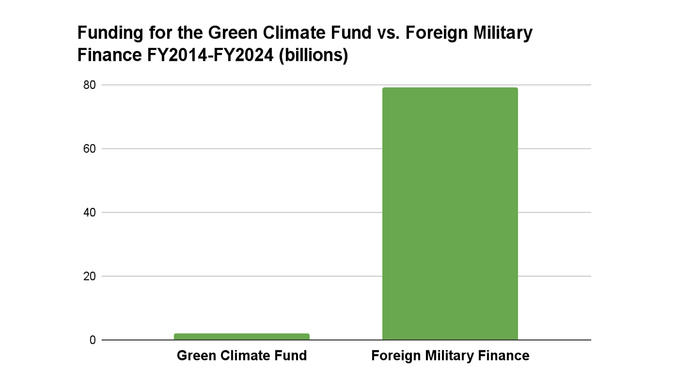
  • For years 2014-2024, U.S. funding to the GCF totaled $2 billion. In the same period, Congress approved at least  $79 billion — 40 times more funding — in FMF to foreign countries to finance the purchase of U.S.-made weapons.[3]
A chart showing foreign military financing dwarfing Green Climate Fund contributions.

Notes:

[1] Between FY2022-FY2024 Congress also enacted roughly $3 billion in bilateral and multilateral international climate finance, but the GCF remains the best dedicated and most equitable vehicle for international climate finance. Sources: Congressional Research Service ‘U.S. International Climate Finance in Focus’ (factsheets) FY 2023FY 2024FY 2025.

[2]  Public U.S. international climate assistance is grouped with other forms of international development aid, meaning contributions often have “climate-related” components but tend to support multiple developmental/environmental goals. Most of the entities do not streamline funding to initiatives in climate-vulnerable countries like  the GCF, which is exclusively dedicated to climate change and has specific safeguards. There is no standard method for defining or measuring climate finance, consequently reports by donor countries can have discrepancies and result in unclear climate impacts.

[3]  FMF data sources: White House Supplemental Budget Materials; Public Budget Database subfunction 152, account codes 1085,1082. The enacted FY2024 FMF total includes $7.1 billion in additional FMF authorized through H.R.815.


LA REVUE GAUCHE - Left Comment: Search results for PERMANENT ARMS ECONOMY