Thursday, December 05, 2024

 SPACE/COSMOS


Trump names billionaire private astronaut as next NASA chief


By AFP
December 4, 2024

US fintech billionaire Jared Isaacman (EV1) peeks out to space from a hatch structure called "Skywalker," during the first private spacewalk performed by the crew of the SpaceX Polaris Dawn mission - Copyright Polaris Program/AFP/File -

US President-elect Donald Trump on Wednesday nominated Jared Isaacman, the online payments billionaire and the first private astronaut to ever perform a spacewalk, as the next head of NASA.

The nod could spark questions about potential conflicts of interest, given Isaacman’s extensive financial ties to Elon Musk, who is set to co-chair a government efficiency commission and is one of Trump’s closest advisors.

Isaacman, 41, the founder and CEO of Shift4 Payments, has emerged as a leading figure in commercial spaceflight through his high-profile collaborations with Musk’s SpaceX.

His achievements include stepping out of a Crew Dragon to gaze at Earth from the void of space, while clutching the spacecraft’s exterior, back in September.

“I am delighted to nominate Jared Isaacman, an accomplished business leader, philanthropist, pilot and astronaut, as Administrator of the National Aeronautics and Space Administration (NASA),” Trump wrote on Truth Social.

“Jared will drive NASA’s mission of discovery and inspiration, paving the way for groundbreaking achievements in Space science, technology, and exploration.”

The historic spacewalk took place under the Polaris program, a collaboration between Isaacman and SpaceX that is set to include three missions in total.

Financial terms of the partnership remain under wraps but Isaacman reportedly poured $200 million of his own money into leading the 2021 all-civilian SpaceX Inspiration4 orbital mission, his first foray into space.

He is also a vocal supporter of SpaceX and Musk, frequently praising the company and its vision on the platform X.

“There will inevitably be a thriving space economy — one that will create opportunities for countless people to live and work in space,” Isaacman said in a post after Trump’s announcement.

“At NASA, we will passionately pursue these possibilities.”

Isaacman, a Pennsylvania native, founded the business that became Shift4 Payments from his family’s basement at just 16.

A skilled aviator, he is qualified to fly military aircraft, has performed in airshows, and set a world record for an around-the-world flight.


A mission design for servicing telescopes in space


University of Illinois Grainger College of Engineering
Gaia Spacecraft 

image: 

CAD model of the Gaia spacecraft with service vehicle, post-docking configuration.

view more 

Credit: The Grainger College of Engineering at the University of Illinois Urbana-Champaign


The fate of telescopes in space is looking better now that they are being designed to be serviceable. Researchers developed a servicing plan that can be applied to future space observatories based on current missions such as the James Webb Space Telescope and the European Space Agency’s Gaia.

“Although the next generation of large space telescopes are being designed with serviceability in mind, there are enormous challenges with implementation,” said Siegfried Eggl, professor of aerospace engineering in The Grainger College of Engineering, University of Illinois Urbana-Champaign.

One issue is distance. Modern space telescopes are stationed at the Sun-Earth Lagrange Point L2, which is about a million miles away from the Earth. It's moving with the Earth, which makes it easier to reach, but still very far away making the transport time consuming and expensive. The relatively quiet, low interference environment at Lagrange Point L2 means missions like Gaia have an enormous impact on astronomy and planetary science, but according to Eggl, it’s worth the trek.

Eggl said, “Gaia is like a rotating cylinder with a solar panel. it is encapsulated, so it hasn’t been damaged, but after a decade out there it’s running low on fuel. Ruthvik Bommena designed a novel concept to add a sort of spider-looking attachment that can extend its life without impeding its data collection. Gaia will be decommissioned soon, so there isn’t enough time to reach it, but the James Webb might still be a possibility because it will be operating for several more years and they may decide to prolong its mission.”

He explained that the James Webb telescope has unshielded, segmented mirrors, some of which have already been damaged when struck by micrometeorites. The entire mirror surface of JWST is six meters in diameter. The next large telescope will be about twice that size.

“We’re trying to stay a step ahead so there is a plan to replace broken mirrors, for example. If we don’t, it’s like buying an expensive sports car, then like throwing it away when it runs out of gas.”

Another aspect Bommena is working is safe proximity operations.

“A spacecraft sent to repair or refuel a telescope needs to brake when it reaches it,” Bommena said. “Using the thrusters to slow down would be like pointing a blowtorch at the telescope. You don’t want to do that to a delicate structure like a telescopic mirror. How do we get there without torching the whole thing?”

Robyn Woollands, who is also professor of aerospace engineering at U of I said one of the main goals they achieved with this work was finding a trajectory to get there cheaply without reliance on large, cost-prohibitive rockets.

“Fortunately, getting there is doable because of some hidden highways in our solar system. We have a trajectory that is optimal for the size of spacecraft needed to repair the JWST,” she said.

Ph.D. student Alex Pascarella developed a novel technique for quick sampling of the solution space that can shorten the computation time.

“The novelty is in how we brought together two separate approaches to trajectory design: dynamical systems theory and optimal control theory,” Pascarella said.

Pascarella said the traditional approach for trajectory design in multibody systems such as the Sun-Earth system, relies on computing the invariant manifolds of an orbit—manifolds are pathways in space that naturally lead the spacecraft to the given orbit. This is a great approach that has been successfully used for decades, both in academic research and real-life applications.

“It becomes a bit challenging when you are trying to rendezvous with a target spacecraft at a specific location in space/time instead of reaching a target orbit and you are dealing with a low-thrust spacecraft whose engine operates for long stretches of time as opposed to a spacecraft with more powerful thrusters that operate for very shorts bursts.

“Our technique is based on a slightly different idea. We first investigate the solution space by propagating a sample of solutions—either without any thrust or with a very simple thrust control law—and we take note of how close they pass to our desired destination,” Pascarella said.

He added that because the type of orbit they are trying to reach spawns manifolds, they know at least some of their initial guesses will come close to the desired orbit.

“After we create a map of initial solutions, we use optimal control theory to generate optimal end-to-end trajectories,” Pascarella said. “Optimal control allows us to find trajectories that depart near Earth, and rendezvous with our space telescope in the least amount of time. The initial sampling of the solution space is fundamental—optimal control problems are notoriously difficult to solve, so we need a decent initial guess to work with.”

Eggl said the plan to repair/refuel Gaia is a complete design that can be implemented. For the James Webb telescope, more engineering is needed.

The study, “Mission design for space telescope servicing at Sun–Earth L2,” by Alex Pascarella, Ruthvik Bommena, Siegfried Eggl and Robyn Woollands, is published in the journal Acta Astronautica. DOI: 10.1016/j.actaastro.2024.08.031

This work was supported by NASA and the Aerospace Corporation.


South Korea: After President Yoon’s failed self-coup

Published 
MastodonFacebookTwitterEmail
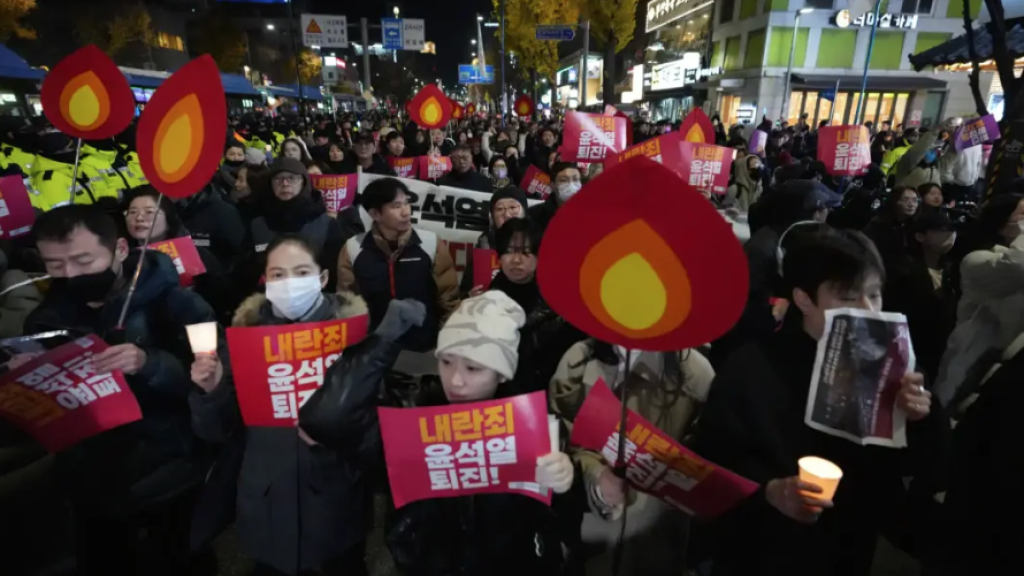
President Yoon Suk Yeol’s declaration of martial law has sparked outrage in the streets and concern among South Korea’s international allies.

President Yoon Suk Yeol’s self-coup failed within 153 minutes. Though the situation remains volatile, people are safe from the threat of military confrontation or repression.

What happened?

At 10.29pm on December 3, Yoon declared he was imposing martial law, formed a military command and sent armed special force troops to occupy parliament and arrest key politicians.

But the coup attempt failed.

As parliamentary officials and opposition party staff fought back against the coup-plotting soldiers inside parliament, activists and trade unionists gathered outside.

By 1.02am on December 4, 190 MPs — including the entire opposition and some government MPs — managed to convene an emergency plenary session and unanimously vote to repeal martial law.

A few hours later, Yoon accepted defeat and said he would respect parliament’s decision. But the question of whether Yoon should resign or be impeached remains unresolved.

Still a mystery

Why did Yoon attempt a self-coup? The president said his intention was to remove a “cancer”, namely supposedly pro-North Korean anti-government forces. But this is a farcical excuse.

What we know is that most of the key military and civilian figures involved in the coup attempt were Yoon’s colleagues in high school. Moreover, the number of soldiers involved was very small, less than 280.

The poorly written martial law decree revealed how little thought out the conspirators’ plan was.

Yoon’s secretaries and ministers quickly resigned, as did his defense minister who, having participated in the coup plot, tried to claim responsibility for defeating it.

We also know that Yoon and his wife, Kim Keon-hee, have previously exhibited bizarre behaviour. In many ways, their marriage resembles a black comedy and gossip TV series.

For most of her life, Kim has been a surreal figure, having been involved in several financial scams, many orchestrated by her mother, herself a large-scale behind the scenes scammer.

Perhaps responsibility for the coup plot lies completely with the couple. The reality is that few Koreans understand either of them.

What is more, Yoon is a very poor communicator. In early November, the president delivered a speech to the nation in which he was supposed to apologise for his wife’s involvement in several scandals. His speech was so vague that nobody understood what he was apologising for.

It will take more time to figure out the real motives behind the coup. No doubt more information will come out during the trial and punishment of the coup plotters.

Division within the ruling party

With the president seemingly refusing to step down, opposition parties are seeking to impeach him.

Back in 2018, South Koreans forced parliament to impeach then-president Park Geun-hye after 134 days of consecutive candlelight protests that together mobilised more than 15 million people. Park belonged to a predecessor party that later helped form Yoon’s People Power Party (PPP) in 2020.

The ruling right-wing PPP faces a deep crisis. It suffered a huge defeat in the April general elections, which left it a minority bloc in parliament.

Despite Yoon hand-picking his close friend Han Dong-hoon to lead the party, the PPP is today divided between Yoon and Han supporters.

Yoon’s coup attempt took party leaders by shock, leading Han and 18 other government MPs to join with the opposition in repealing martial law.

At first, it also appeared they would support impeachment. But after much debate, Han’s faction failed to persuade Yoon’s backers to support impeaching the president.

While there was no way the pro-Yoon faction could justify the coup, impeachment was a step too far. Many felt impeaching a second president would spell political death for the party.

The ruling party’s decision placed the opposition Democratic Party in a delicate situation as they required the votes of at least some government MPs to obtain the two-thirds majority required for impeachment.

But with public opinion turning on the failed coup leader, the PPP may soon pay a very heavy political price for its continuing support of Yoon.

A December 4 survey of 504 respondents found 73.6% supported impeachment, with only 24% opposed.

Asked whether Yoon had committed the crime of treason by declaring martial law, 68.5% answered yes; only 24.9% said no.

The real battle is in the streets

Given impeachment seems to be blocked, it is now up to the people to step in where politicians failed.

Given the self-coup ended quite swiftly, popular mobilisation against it was fairly limited. Protests were held inside and outside parliament, as well as in Gwanghwamun Square, a symbolic protest site during the 2018 candlelight protests.

A huge protest to demand Yoon’s resignation is planned for Seoul this weekend.

The PPP will no doubt become a target of people’s ire should it choose to continue supporting Yoon. The ruling right-wing conservatives face an existential choice of discarding Yoon or going down in flames with him as a political force.

Whatever his intention, Yoon failed to recognise the deep-seated nature of people’s decades-long popular resistance to military and civilian dictatorships. South Koreans refuse to accept the sight of tanks and troops occupying the heart of Seoul.

Yoon’s failed coup has shown that South Korea still has some way to go to achieve genuine democracy — and that obtaining this will require further democratic revolutions.

Won Youngsu is an activist, Marxist and labour studies researcher. He is the Director of Pnyx – Institute of Marxist Studies in Korea.


South Korea’s 6-Hour Martial Law


Yoon does not want to lose power, writes Kiji Noh, but more importantly the U.S. cannot allow Yoon to lose power. He is key to the Asian force posture against China.
December 4, 2024
Source: Consortium News

South Korea’s President Yoon Suk Yeol visits the Navy Special Warfare Flotilla in Jinhae, Gyeongsangnam-do Province, on March 10, 2023. (Republic of Korea, Flickr, CC BY-NC-SA 2.0)


South Korean President Yoon Suk Yeol on Tuesday declared martial law, suspended the South Korean legislature and banned elected representatives from accessing the National Assembly building using massive police presence.

And then six hours later he rescinded the order.

President Yoon had declared in a public address to the Korean people that the move was to protect a “liberal South Korea from the threats posed by North Korea’s communist forces and to eliminate anti-state elements.” He said:


“I will restore the country to normalcy by getting rid of anti-state forces as soon as possible.”

But all the members of South Korea’s National Assembly, which Yoon had shut down, voted to reverse Yoon’s edict Tuesday and he then heeded the call.

The action and rhetoric had evoked the days of the country’s military dictatorships; the language and justification was exactly the same.

There had been repeated signals that Yoon could declare martial law because the public momentum to impeach him in South Korea was gaining ground.

Yoon is despised by South Koreans for his abuse of power, his wife’s corruption and his vitiation of South Korea’s sovereignty and economic wellbeing to serve U.S. geopolitical interests.

Particularly triggering and enraging for South Koreans has been his enmeshing of South Korea’s military with that of its former colonizer, Japan, through a formal military alliance designed to wage war against China. This has also entailed engaging in radical historical revisionism and erasure to facilitate this extraordinary coalition.

Last week 100,000 citizens protested in the streets demanding his immediate resignation — something that received absolutely zero coverage in Western media. There was still little mention of this in current mainstream Western coverage as a factor for the short-lived declaration of martial law.

Yoon does not want to lose power, but more importantly the U.S. cannot allow Yoon to lose power: He is essential to shore up alliances, agreements, and an Asian force posture to wage war against China
.
President Joe Biden delivers remarks during Yoon’s arrival ceremony in Washington, April 2023. (White House, Erin Scott)

If Yoon goes, the forcefield breaks. This is because South Korea is the key proxy, the proxy with the largest military force in the area (500,000 active troops plus 3.1 million reservists). This massive military manpower falls immediately under U.S. operational control, the moment the U.S. decides it wants to wage war.

Yoon, who was elected with the narrowest electoral victory in Korean history (0.7 percent), is a U.S. client, supported precisely for making promises of implementing a South Korean “Indo-Pacific strategy,” a clone of the U.S. Indo-Pacific strategy, a belligerent, escalatory, military-hybrid strategy to encircle and take down China.

When Yoon was elected, champagne corks flew in Washington. If Yoon had chosen to perpetuate rule through martial law, the U.S. would have likely closed their eyes to it, as they did for decades under Park Chung Hee and Chun Doo Hwan. The stakes are very high.

However, unlike his Conservative Party predecessors Park Chung Hee, Chun Doo Hwan and Roh Tae Woo, Yoon is not a former general. In fact, he is a draft dodger, something that usually destroys political careers.

The fact that he was able to rise to the highest office signals that extraordinarily powerful forces (like the U.S. national security state) were instrumental in his ascension to power.

Certainly, they gave him prime time coverage, including access to the most influential media platform in the world: a cover article in Foreign Affairs magazine where he professed his allegiance to U.S. doctrine.

Dangerous and dark times still lie ahead, especially if Koreans rise up (as they always have) and President Yoon responds with massive military and police repression.


K.J. Noh is a political analyst, educator and journalist focusing on the geopolitics and political economy of the Asia-Pacific. He has written for Dissident Voice, Black Agenda Report, Asia Times, Counterpunch, LA Progressive, MR Online. He also does frequent commentary and analysis on various news programs, including The Critical Hour, The Backstory, and Breakthrough News.


Was Yoon’s Martial Law Gambit an Unexpected Gift for Korean Peace?


Tuesday night, while the vast majority of South Koreans slept blissfully unaware, President Yoon Seok-yeol declared martial law. Though shocking, it was ultimately a hapless scheme that may end his political career and quite possibly lift the wet blanket smothering the dormant Korean peace process.

With plummeting approval ratings and embattled by scandal after scandal, Yoon cast his die around midnight, announcing that he would “eradicate pro-North Korean forces and protect the constitutional democratic order” from the opposition faction of “shameless pro-North Korean anti-state forces who are plundering the freedom and happiness of our citizens.” (President Yoon was seeing Reds everywhere but, given his proclivity for soju, maybe he was just drunk.)

Standoff in Parliament

Following the declaration, lawmakers attempted to access parliament while South Korean police and military personnel surrounded the facility and reportedly moved to prevent its members from entering. A legend is already growing about opposition leader Lee Jae-myung scaling the fence around parliament to take part in the vote (he even broadcast his infiltration live on YouTube).

The forces surrounding parliament were reportedly “completely armed” and included the 1st Airborne Special Forces Brigade once involved in the infamous 1979 coup, among other units specializing in counter-terrorism operations. By 11 pm., troops began to enter the main office of the National Assembly while assembly staff and aides attempted to block access by setting up barricades and spraying fire extinguishers so lawmakers could finish casting their votes.

A majority of lawmakers, 190 in total, still managed to assemble and summarily reject the declaration. While it seems clear that the troops involved did not yield maximum force, they were reportedly reluctant to withdraw after the vote and only did so once the President accepted parliamentary censure and lifted martial law around 4:30 am, a mere six hours after its declaration.

A full account of the events Tuesday night will come in due time. What is clear is that, while the images of police and troops surrounding parliament invokes dark memories of the coup by Chun Doo-hwan on December 12, 1979 (a day of infamy in South Korean history brilliantly captured in the film 12.12: The Day), this was ultimately a flaccid, desperate – and seemingly final – act by the President.

The aftereffects of his gambit, however, will not be so short-lived.

Just Give Me a Reason

The Democratic Party opposition, which holds a majority in congress with 170 of the 300 seats, has finally been given its “golden ticket” for proceeding with impeachment after a long line of scandals surrounding President Yoon that came close, but didn’t quite fit the bill. His career is likely over, but nothing is certain until the votes are cast.

A motion for impeachment has already been tabled and can take place as early as Friday at noon. Together with the 22 independent members in the assembly, it would require eight of the 108 lawmakers form President Yoon’s People Power Party (PPP) to pass. The PPP has officially ruled out going along with impeachment, but – perhaps crucially – the vote will be anonymous, so toeing the party line may not necessarily be a concern. As per Reuters, if the motion passes, the President must step aside and the current Prime Minister serve in his stead until the Constitutional Court makes a ruling, which can take up to six months.

Adding to the chaos factor here is that the court currently only has the minimum six sitting members required. Three posts are empty, the appointments put off due to political division within parliament. By law, the court must have at least seven members to rule on cases. Though it waived this requirement previously, it is “not clear if it would take up the impeachment motion without the full nine justices.”

The Stakes

While nothing is guaranteed, there will be great incentive to pass the impeachment motion to avoid the mass demonstrations that led to the downfall of former President Park Geun-hye. Yoon’s presidency was already deeply unpopular, and the events of Tuesday evening have been shocking to the collective conscience of South Koreans and harmful to their image abroad – something Koreans typically care about deeply.

His declaration of martial law came amid an ongoing campaign by the opposition Democratic Party, who hold the majority in parliament, to impeach the state-appointed prosecutors doggedly attempting to make one accusation or another stick to Democratic Party leader Lee Jae-myung. Mr. Lee, who lost a historically tight race to President Yoon in the last election by a 0.7 percent margin, has spent more than two years handcuffed by legal proceedings and is forced to appear in court on an almost daily basis. He even survived a serious assassination attempt likely inspired by this lawfare campaign (including an absurd charge of orchestrating remittances to North Korea against national security law).

If the impeachment fails, it is unclear how the public will react or, indeed, how the hawkish President Yoon might proceed with what would seemingly be carte blanche to do virtually anything without political consequence moving forward. If, however, the proceedings go through (which this author considers more likely, especially given the anonymity of the vote), the election date will have been sped up by as much as two years and the legal pressure on opposition leader Lee will likely be lifted, ensuring his ability to run for office – and virtually guaranteeing his victory. This will be a very good thing for the peace process.

An Unexpected Gift for Peace?

During Mr. Yoon’s presidency, South Korea has adopted a stark anti-diplomacy stance toward North Korea and strengthened its trilateral military partnership with the United States and (more controversially) Japan – an arrangement that is destructive for peace in the region. South Korea has also advanced increasingly provocative military drills that were suspended during the previous Moon Jae-in presidency when peace talks were at their peak. The US in turn has docked nuclear submarines in South Korea for the first time since 1981 among other provocative acts. In response, North Korea has gone so far as to label South Korea a “principal enemy” and has disavowed peace talks.

However, North Korea has generally been willing to talk when the other side is serious, whether it be the United States or South Korea. The problem for South Korea has been a lack of political will and courage. History may forget, but it was originally the South Korean President Moon Jae-in who initiated the diplomatic efforts between the US and North Korea by unilaterally meeting with North Korean leader Kim Jong-un to bring down boiling tensions during the first Trump administration. His activism forced the US to the table. It was only after South Korea stood back and adopted a passive approach that diplomacy between North Korea and the US failed, thwarted by the hawks in the Trump administration (and John Bolton in particular), who favored maximum pressure over concession.

Lee Jae-myung, however, is widely considered to be a “firebrand” with a far different approach to politics than his mild-mannered predecessor, former President Moon. There is little question that South Korea will become more open to diplomatic initiatives with respect to North Korea if impeachment goes through and he eventually comes to office.

Incoming US President Donald Trump has stated a willingness to resume talks with North Korea. Whether he is – or ever was – serious about North Korean diplomacy is certainly up for debate, but with war in the Middle East and Ukraine front-burner issues, peace talks with the DPRK are never going to be a priority for the US unless South Korean leadership forces the issue – something impossible to imagine under President Yoon. Now that his 2027 expiry date has potentially been sped up significantly due to his foiled plot​, peace in Korea may once again be on the table.

Yet, even if Lee Jae-myung is eventually able to take power, the question, as always, will be “what are the preconditions for diplomacy?” To that end, Mr. Lee recently stated, “We desperately need practical diplomacy that prioritizes national interests, not ambiguous… diplomacy.” He also expressed optimism that the incoming Trump administration would resume peace negotiations.

While diplomatic initiatives are not likely to go far if denuclearization remains the core issue, a “pragmatic” and activist approach from South Korea might have a chance to finally start a serious Korean peace initiative. This would never have happened with President Yoon in office. In that sense, his foolish, desperate power grab may have been an unexpected gift for the Korean peace movement.

Stuart Smallwood is a freelance Korean-English translator currently located in Jeonju, South Korea. His previous works have also appeared at Antiwar.com and he can be reached at stusmallwood[at]protonmail.com.


The troubled history of South Korean presidents


By AFP
December 5, 2024

People take part in a protest calling for the resignation of South Korean President Yoon Suk Yeol in Seoul - Copyright AFP Anthony WALLACE

South Korean President Yoon Suk Yeol is now facing impeachment after a shock bid to suspend civilian rule.

But he is far from the first South Korean president to see his rule descend into acrimony and scandal.

Here is a recap of the downfalls of previous South Korean leaders.


– 2016: Park impeached, jailed –


In December 2016, Park Geun-hye, president since 2013, was impeached by Parliament in a decision confirmed in March 2017 by the Constitutional Court, leading to her indictment and imprisonment.

The daughter of the former dictator Park Chung-hee, she was the first woman president of South Korea and had presented herself as incorruptible.

But she was accused of receiving or requesting tens of millions of dollars from conglomerates, including Samsung.

Additional accusations included sharing classified documents, putting artists critical of her policies on a “blacklist”, and dismissing officials who opposed her.

Park was sentenced in 2021 to 20 years in prison and slapped with heavy fines.

But at the end of that year she was pardoned by her successor, Moon Jae-in.

Yoon, the current president, was a Seoul prosecutor at the time and played a key role in her dismissal and subsequent incarceration.


– Lee Myung-bak: 15 years in prison –


In power from 2008 to 2013, Park’s conservative predecessor Lee Myung-bak was sentenced in October 2018 to 15 years in prison for corruption.

Most notably, he was found guilty of having received bribes from Samsung in exchange for favours to the conglomerate’s then chairman, Lee Kun-hee, who had been convicted of tax evasion.

The former leader was pardoned by President Yoon in December 2022.


– Roh Moo-hyun: suicide –


President from 2003 to 2008 and a strong supporter of rapprochement with North Korea, liberal Roh Moo-hyun killed himself by throwing himself off a cliff in May 2009.

He had found himself the target of an investigation into the payment by a wealthy shoe manufacturer of one million dollars to his wife and five million to the husband of one of his nieces.


– 1987: autocrat Chun retires –


Military strongman Chun Doo-hwan, known as the “Butcher of Gwangju” for ordering his troops to put down an uprising against his rule in the southwestern city, agreed to step down in 1987 in the face of mass demonstrations.

He handed over power to his protege Roh Tae-woo.

Roh and Chun had been close for decades, first meeting as classmates at military academy during the Korean War.

In 1996 both men were convicted of treason over the 1979 coup that brought Chun to power, the Gwangju uprising in 1980, corruption and other offences.

Roh was sentenced to 22.5 years in jail, reduced to 17, while Chun was condemned to death, commuted to life in prison.

They were later granted amnesty in 1998 having spent just two years behind bars.


– 1979: dictator Park assassinated –


Park Chung-hee was assassinated in October 1979 by his own spy chief during a private dinner.

The events of that night have been long a subject of heated debate in South Korea, particularly over whether the murder was premeditated.

Chun Doo-hwan and Roh Tae-woo were army generals at the time and took advantage of the political confusion to plot a coup in December 1979.


– 1961: Yun overthrown in a coup –


President Yun Po-sun was overthrown in 1961 by a coup led by army officer Park Chung-hee.

Park kept Yun in his post but effectively took control of the government, and then replaced him after winning an election in 1963.


– 1960: exile of first president –


South Korea’s first president, Syngman Rhee, elected in 1948, was forced to resign by a popular student-led uprising in 1960, after attempting to extend his term through rigged elections.

Rhee was forced into exile in Hawaii, where he died in 1965.


The Gibbes Museum of Art honours Spike Lee

By Dr. Tim Sandle
December 4, 2024
DIGITAL JOURNAL

Spike Lee jumped the gun on the announcement. — © AFP

The Gibbes Museum of Art, located in the American South since 1858, recently honoured acclaimed director Spike Lee at the Museum’s 2024 Distinguished Lecture Series annual event. The Museum provided free live-streaming of the event for students from across the U.S. and has subsequently made the video accessible to all viewers.

In the video, Spike Lee speaks about the important role of Black artists in the American South. He also discussed the dangers of AI.

Lee has received five Academy Award nominations, winning the Oscar for Best Adapted Screenplay and an Honorary Academy Award for Lifetime Achievement.
Other awards include: Primetime Emmy Awards, British Academy Film Awards, Peabody Award, Golden Globe Award nominations, Grammy Award nomination, the Board of Governor’s Award from the American Society of Cinematographers, a Gala Tribute from the Film Society of Lincoln Center, and the Dorothy and Lillian Gish Prize, among his many accolades.

Lee’s movies include She’s Gotta Have It, Do the Right Thing, and Malcolm X. Of these movies, Malcolm X is regarded by many (including myself) as a masterpiece.

The conversation took place at the Charleston Music Hall. The venue was filled to capacity and moderated by Pauline Forlenza, Director and CEO of the American Federation of Arts and co-presented with Angela Mack, President and CEO of the Gibbes Museum of Art. The conversation revealed new insights into the art world’s continued recognition of Spike Lee’s cultural impact. Lee’s legacy as a visionary icon worldwide is anchored by his longstanding commitment to authenticity and social justice.

During the conversation, Lee highlighted artworks from his collection by African American southern artists that influenced his work, including: William H. Johnson (born in South Carolina); Romare Bearden (born in North Carolina); Deborah Roberts (Texas); Radcliffe Bailey (Georgia); and Michael Ray Charles (Louisiana). In addition, Lee discussed how these artists have always been creative sources of artistic expression for his film work, and for his ongoing creativity in arts and entertainment.

Later in the conversation, Lee and Forlenza pointed out how many of the characters and themes from Lee’s films of the 1980s and 1990s foretold issues we are currently living through today, including: gentrification, global warming, and racial tensions.

“History is repeating itself now,” says Spike Lee in the video of the lecture.
“Looking back at these beloved characters, and the struggles they faced in these films, we can see how they forecasted back then (40 and 30 years ago) what’s happening now. The stuff you run away from follows you,” adds Lee.

During Lee’s presentation for the Gibbes Museum of Art Distinguished Lecture Series event at the Charleston Music Hall, Lee also spoke about the dangers of AI on arts and culture, social media, news, and the entertainment industry.

“I think that sometimes technology can go too far,” said Spike Lee.
“I’m scared of what people can use AI to do and pass off as the real thing.”
“Some of the things AI portrays people as saying is the opposite of what those people are all about.”

“Especially with the Writers Guild trying to get the studios and networks to agree not to have these computers writing scripts. It’s scary, you don’t know what’s what.”

When asked about his advice for young artists and filmmakers, including how art addresses current social issues, Lee said —

“I tell my students they have to be committed and put the work in.”
“Artists have to choose their own path.”
“Artists have to do what their hearts and souls tell them to do.”

Billionaires’ wealth more than doubles in 10 years: UBS


By AFP
December 5, 2024


Billionaires have seen their combined wealth shoot up 121 percent over the past decade to $14 trillion, Swiss bank UBS said Thursday, with tech billionaires’ coffers filling the fastest.

Switzerland’s biggest bank, which is among the world’s largest wealth managers, said the number of dollar billionaires increased from 1,757 to 2,682 over the past 10 years, peaking in 2021 with 2,686.

The 10th edition of UBS’s annual Billionaire Ambitions report, which tracks the wealth of the world’s richest people, found that billionaires have comfortably outperformed global equity markets over the past decade.

The report documents “the growth and investment of great wealth, as well as how it’s being preserved for future generations and used to have a positive effect on society”, said Benjamin Cavalli, head of strategic clients at UBS global wealth management.

Between 2015 and 2024, total billionaire wealth increased by 121 percent from $6.3 trillion to $14.0 trillion — while the MSCI AC World Index of global equities rose 73 percent.

– Tech wealth –

The wealth of tech billionaires increased the fastest, followed by that of industrialists.

Worldwide, tech billionaires’ wealth tripled from $788.9 billion in 2015 to $2.4 trillion in 2024.

“In earlier years, the new billionaires commercialised e-commerce, social media and digital payments; more recently they engineered the generative AI boom, while also developing cyber-security, fintech, 3D printing and robotics,” UBS said.

The report found that since 2020, the global growth trend had slowed due to declines among China’s billionaires.

From 2015 to 2020, billionaire wealth grew globally at an annual rate of 10 percent, but growth has plunged to one percent since 2020.

Chinese billionaire wealth more than doubled from 2015 to 2020, rising from $887.3 billion to $2.1 trillion, but has since fallen back to $1.8 trillion.

However, North American billionaire wealth has risen 58.5 percent to $6.1 trillion since 2020, “led by industrials and tech billionaires”.

Meanwhile billionaires are relocating more frequently, with 176 having moved country since 2020, with Switzerland, the United Arab Emirates, Singapore and the United States being popular destinations.

– 268 new billionaires in 2024 –

In 2024, some 268 people became billionaires for the first time, with 60 percent of them entrepreneurs.

“The year’s new billionaires were mainly self-made,” said UBS.

The report said US billionaires accrued the greatest gains in 2024, reinforcing the country’s place as the world’s main centre for billionaire entrepreneurs.

Their wealth rose 27.6 percent to $5.8 trillion, or more than 40 percent of billionaire wealth worldwide.

Billionaires’ wealth from mainland China and Hong Kong fell 16.8 percent to $1.8 trillion, with the number of billionaires dropping from 588 to 501.

Indian billionaires’ wealth increased 42.1 percent to $905.6 billion, while their number grew from 153 to 185.

Western Europe’s total billionaire wealth rose 16.0 percent to $2.7 trillion — partly due to a 24 percent increase in Swiss billionaires.

UAE billionaires’ aggregate wealth rose 39.5 percent to $138.7 billion.


– Next 10 years –

UBS said billionaires faced an “uncertain world” over the next 10 years, due to high geopolitical tensions, trade barriers and governments with mounting spending requirements.

Billionaires will therefore need to rely on their previous distinctive traits: “smart risk-taking, business focus and determination”.

“Risk-taking billionaires are likely to be at the forefront of creating two technology-related industries of the future already taking shape: generative AI and renewables/electrification,” UBS predicted.

And more flexible wealth planning will be needed as billionaire families move country and spread around the world.

The heirs and philanthropic causes of baby boom billionaires are set to inherit an estimated $6.3 trillion over the next 15 years, UBS said.


From Canada, professor tries to keep Gaza university ‘alive’


By AFP
December 5, 2024


Palestinian professor Ahmed Abu Shaban, here giving a lecture at York University in Toronto, still tries to deliver remote learning to students stuck in Gaza
 - Copyright AFP Jorge Uzon


Ben Simon

University professor Ahmed Abu Shaban often gets up at 3:00 am in Toronto to remotely teach his students in Gaza — motivated by loyalty to his trapped pupils, and a deep sense of guilt.

Shaban, an academic who fled Gaza days after October 7, 2023, said he has an obligation to students in the Palestinian Territory desperate to study in defiance of unimaginable challenges.

He also said he has a responsibility to help preserve higher education in Gaza, while the world is focused on the humanitarian emergency.

But the 50-year-old conceded that guilt also weighs on him.

“Guilty for leaving Gaza,” he told AFP. “Like we just abandoned our country, our people, our institution.”

Shaban is still the dean of the Faculty of Agriculture and Veterinary Medicine at Al-Azhar University, which was destroyed — along with most university buildings — by Israeli air strikes.

Shaban crossed to Egypt shortly after the war began, anticipating Israel’s response to the Hamas attack would be “massive,” he said.

Canadian contacts arranged a posting at Toronto’s York University, where he is a visiting professor in the Faculty of Environmental and Urban Change.

In a campus office with empty book shelves and mostly bare walls, Shaban explained that he felt compelled to help make Al-Azhar operational in some form.

He wanted “to give the very clear message for the whole world: Yes, they just destroyed our infrastructure. Yes, they destroyed our buildings… but we are still alive and we will just continue,” he said.

“This is actually a responsibility for our students, for our nation, and for our independent state in the future.”


– Hunger to study –


Shaban, who is on Al-Azhar’s board, said its pre-war enrolment was 14,000 students.

When registration opened for online courses earlier this year he expected 1,000 students to join.

“We got 10,000,” he said.

“It was really, for me, shocking because, just imagine: you live in a tent, you have no electricity, you have no internet. You have nothing at all.

“But you still have the hope to go to sign up for online courses and to walk for five (kilometres) to get internet connection and even to communicate, to sit and study. And sometimes you risk your life even while you are searching for internet.”

Shaban conceded his personal schedule is “stressful,” as he tries to work in two time zones.

One day last month, he was up at 3:00 am to join a workshop on Gaza’s food system, before an Al-Azhar board meeting at 6:00 am. He then headed to his Toronto office to prepare a guest lecture on the Gaza war.

On evenings and weekends he records and uploads lectures for his Palestinian students.

Shaban said the study program is flexible, given the challenges of internet access. Students watch lectures and complete assigments when they can get online.


– Star student killed –


He said students in Gaza can be “angry” and “pushy”: they want to know, for example, when they will able to do lab work, even though all the labs have been destroyed.

Shaban said he understands their frustrations.

“Sometimes you feel the students are looking at us like we can do things that actually are not doable,” he said. “I have to be responsive in a gentle way.”

As agitated student messages pour in, Shaban said he reminds himself that he is living comfortably in a city with electricity and grocery stores stocked with food.

“(I) try just to provide them with whatever support that I can. There are many things that I cannot do,” he said.

Students who have died are always front of mind.

He recalled five engineering students killed as they gathered by an internet source to work on an assignment.

Shaban said he will never forget his “star student” Bilal al Aish, who, days before the war started, was trying to decide whether to pursue a scholarship in Germany or the American Fulbright.

“I saw the hope in his eyes, not only for his own future, but also the future of our institutions.”

Shaban said Aish was killed by an Israeli strike early in the war.

“I got the feeling they are killing the future,” the professor said. “That was really painful for me.”
BRING WARMTH TO GAZA


When I think of warmth, I remember the little things I have in my life—my father wrapping me up in a hug, my best friend sending a kind word when I needed it most, or my grandma tucking me into a blanket on a cold evening.

Warmth often comes from a simple gesture of kindness.

Today, I’m asking you to make one for Gaza.

For families like Aysha’s, winter in Gaza means icy rain, floods, and no proper shelter. Aysha shares, “We desperately need blankets, mattresses, and shoes for both children and adults. What we have now barely lasts us a month or two.”

Watch Aysha’s message to you:


With your help, we can provide:

Blankets and mattresses to shield families from the cold.

Shoes and clothes to keep children dry and warm.

Tarps and tents to protect shelters from the storm.

Imagine the comfort your kindness could bring—a child slipping into warm shoes, a mother tucking her child into a soft blanket. These small gestures have a big impact. They can bring warmth and hope to Aysha and countless others, as families like hers rely on UNRWA—their lifeline through the harshest of days.

Your gift keeps this lifeline alive, bringing comfort to Gaza this winter.


Thank you for making this winter a little less cold for families in Gaza.

With immense gratitude,

Marta