Saturday, January 04, 2025

IT WAS NOT MONOPOLY

What America’s first board game can teach us about the aspirations of a young nation


‘The Travellers’ Tour Through the United States’ is the earliest known board game to depict a map of North America. Library of Congress

The ConversationDecember 29, 2024


In 2023 alone, the board game industry topped US$16.8 billion and is projected to reach $40.1 billion by 2032.


Classics like “Scrabble” are being refreshed and transformed, while newer inventions such as “Pandemic” and “Wingspan” have garnered millions of devotees.

This growing cardboard empire was on my mind when I visited the American Antiquarian Society in August 2023 to research its collection of early games.

As I sat in that archive, which houses such treasures as the 1640 Bay Psalm Book, the first book printed in British America, I beheld another first in American printing: a board game called “The Travellers’ Tour Through the United States.”

This forgotten game, printed the year after Missouri became a state, has a lot to say about America’s nascent board game industry, as well as how a young country saw itself.
An archival find

Produced by the New York cartography firm of F. & R. Lockwood, “The Travellers’ Tour Through the United States” was an imitation of earlier European geography games, a genre of educational game. Geography games generally used a map for a board, and the rules involved players reciting geographic facts as they race toward the finish.

“The Travellers’ Tour” first appeared in 1822, making it the earliest known board game printed in the U.S.

But for almost a century another game held that honor.

In 1894, the game manufacturer Parker Brothers acquired the rights to “The Mansion of Happiness,” an English game first produced in the U.S. in 1843. In its promotional materials, the company declared it “The first board game ever published in America.”

That distinction ended in 1991 when a game collector found t
he copy of “The Travellers’ Tour” in the archives of the American Antiquarian Society.

The title and printer’s address for the game. The copyright notice of July 12, 1822, appears in small type at the bottom. Library of Congress


A new game for the new year


By 1822 the American market for board games was already becoming established, and middle- and upper-class parents would buy games for their families to enjoy around the parlor table.

At that time, New Year’s – not Christmas – was the holiday for gift giving. Many booksellers, who earned money from the sale of books, playing cards and other paper goods throughout the year, would sell special wares to give as presents.

These items included holiday-themed books, puzzles – then called “dissected maps” – and paper dolls, as well as games imported from England such as “The New Game of Human Life” and “The Royal And Entertaining Game of Goose.”

Since “The Travellers’ Tour” was the first board game to employ a map of the U.S., it might have been an especially interesting gift to American consumers.

It’s difficult, however, to gauge just how popular “The Travellers’ Tour” was in its time. No sales records are known to exist, and since so few copies remain, it likely wasn’t a big seller.

A global database of library holdings shows only five copies of “The Travellers’ Tour” in institutions around the U.S. And while a handful of additional copies are housed in museums and private archives, the game is certainly a rarity.
Teetotums and travelers

Announcing itself as a “pleasing and instructive pastime,” “The Travellers’ Tour” consists of a hand-colored map of the then-24 states and a numbered list of 139 towns and cities, ranging from New York City to New Madrid, Missouri. Beside each number is the name and description of the corresponding town.


The ‘stop’ at Bennington, Vt., highlights the town’s Revolutionary War history, while Philadelphia’s entry points to the city’s educational institutions. Library of Congress
Using a variant spelling for the device, the instructions stipulate the game should be “performed with a Tetotum.” Small top-like devices with numbers around their sides called teetotums functioned as alternatives to dice, which were associated with immoral games of chance.

Once spun, the teetotum lands with a random side up, revealing a number. The player looks ahead that number of spaces on the map.

If they can recite from memory the name of the town or city, they move their token, or traveler, to that space. Whoever gets to New Orleans first, wins.
‘New-Orleans’ is the game’s ‘finish line.’ Library of Congress


An idealized portrait of a young country

Though not necessary to play “The Travellers’ Tour,” the descriptions provided for each location tell historians a lot about America’s national aspirations.

These accounts coalesce into a flattering portrait of the nation’s agricultural, commercial, historical and cultural character.


Teetotums were used in an era when dice were associated with vice. Museum Rotterdam/Wikimedia Commons, CC BY-SA

Promoting the value of education, the game highlights institutions of learning. For example, Philadelphia’s “literary and benevolent institutions are numerous and respectable.” Providence boasts “Brown University, a respectable literary institution.” And Boston’s “citizens … are enterprising and liberal in the support of religious and literary institutions.”

As the game pieces meander toward New Orleans, players learn about Richmond’s “fertile backcountry” and about the “polished manners and unaffected hospitality” of the citizens of Charleston. Savannah “contains many splendid edifices” and Columbia’s “South Carolina College bids fair to be a valuable institution.”

Absent from any corresponding descriptions, however, is any mention of what John C. Calhoun called America’s “peculiar institution” of slavery and its role in the fabric of the nation.

And while four entries briefly reference American Indians, no mention is made of the ongoing dispossession and genocide of millions of Indigenous people.

Though it promotes an American identity based on a sanitized version of the nation’s economic might and intellectual rigor, “The Travellers’ Tour” nonetheless represents an important step toward what has become a burgeoning American board game industry.

Two centuries later, board game culture has matured to the point that new titles such as “Freedom: The Underground Railroad” and “Votes for Women” push the genre to new heights, using the joy of play to teach the history of the era that spawned America’s first board game.

Matthew Wynn Sivils, Professor of American Literature, Iowa State University

This article is republished from The Conversation under a Creative Commons license. Read the original article.
What brought the decline of the eastern Roman Empire – and what can we learn from it?


An anachronistic depiction of the Battle of Nineveh between the eastern Romans and the Persians in 627, painted in 1452 by Pierro della Francesca. 
December 29, 2024

Why empires fall is a question that fascinates many. But in the search for an answer, imagination can run wild. Suggestions have emerged in recent decades that attribute the rise and fall of ancient empires such as the Roman Empire to climate change and disease. This has prompted discussions over whether “536 was the worst year to be alive”.

That year, a volcanic eruption created a dust veil that blocked the sun in certain regions of the world. This, combined with a series of volcanic eruptions in the following decade, is claimed to have caused a decrease in the global temperature. Between 541 and 544, there was also the first and most severe documented occurrence of the Justinianic plague in the eastern Roman Empire (also referred to as the Byzantine Empire), in which millions of people died.

Studies show that there is no textual evidence for the effects of the dust veil in the eastern Mediterranean, and there is an extensive debate over the extent and length of the Justinianic plague. But, despite this, there are still many in academia who claim that changes to the climate and the outbreak of plague were catastrophic for the eastern Roman Empire.

Our research, which was published in November, shows that these claims are incorrect. They were derived from using isolated finds and small case studies that were projected onto the entire Roman Empire.

The use of large datasets from vast territories previously ruled by the Roman Empire presents a different scenario. Our findings reveal that there was no decline in the 6th century, but rather a new record in population and trade in the eastern Mediterranean.

We used both micro and large-scale data from various countries and regions. Micro-scale data included examining small regions and showing when the decline in this region or site occurred. Case studies, such as the site of the ancient city of Elusa in the north-western Negev desert in today’s Israel, were reexamined.

Previous research claimed that this site declined in the middle of the 6th century. A reanalysis of the carbon 14, a method for checking the age of an object made of organic material, and ceramic data used to date the site showed that this conclusion was incorrect. The decline only started in the 7th century.


Large-scale data included new databases compiled using archaeological survey, excavation and shipwreck finds. The survey and excavation databases, which were made up of tens of thousands of sites, were used to map the general changes in the size and number of sites for each historical period.

The shipwreck database showed the number of shipwrecks for each half century. This was used to highlight the shift in the volume of naval commerce.

Changes to naval commerce (150–750)

Our results showed that there was a high correlation in the archaeological record for numerous regions, covering modern-day Israel, Tunisia, Jordan, Cyprus, Turkey, Egypt and Greece. There was also a strong correlation between the different types of data.

Both the smaller case studies, and the larger datasets, showed there was no decrease in population or economy in the 6th century eastern Roman Empire. In fact, there seems to have been an increase in prosperity and demography. The decline occurred in the 7th century, and so cannot be connected to sudden climate change or the plague which happened more than half a century before.

It seems the Roman Empire entered the 7th century at the peak of its power. But Roman miscalculations, and their failure against their Persian opponents, brought the entire area into a downward spiral. This left the two empires weak and allowed Islam to rise.

This is not to say that there was no change in the climate during this period in some regions of the world. For example, there was a visible change in material culture and a general decline and abandonment of sites throughout Scandinavia in the middle of the 6th century, where this change in the climate was more extensive.

And today’s climate crisis is on course to bring much greater changes than those seen in the past. The sharp departure from historical environmental fluctuations has the power to irreversibly change the world as we know it.

Lev Cosijns, PhD Candidate in the School of Archaeology, University of Oxford and Haggai Olshanetsky, Assistant Professor in the Department of History, University of Warsaw

This article is republished from The Conversation under a Creative Commons license. Read the original article.

CRIMINAL CAPITALI$M

U$ Insurers continue to rely on doctors whose judgments have been criticized by courts

FOR PROFIT HEALTHCARE


Photo by JC Gellidon on Unsplash

LONG READ


December 30, 2024
ALTERNET


Reporting Highlights

Company Doctors: Insurance company doctors make crucial recommendations on mental health treatment.

Court Rulings: Judges have repeatedly criticized some insurance companies, and their doctors, for denying this coverage.

Business as Usual: Companies continue using the same psychiatrists in spite of the harsh rulings.

These highlights were written by the reporters and editors who worked on this story.


In a New Orleans courtroom one afternoon this April, three federal appeals court judges questioned a lawyer for the country’s largest health insurance company.

They wanted to know why United Healthcare had denied coverage for a 15-year-old girl named Emily Dwyer, whose anorexia had taken such a toll on her body that she had arrived at a residential treatment facility wearing her 8-year-old sister’s jeans.

The company’s lawyer explained that United’s denial came after three separate psychiatrists working on behalf of the insurer concluded that Dwyer was no longer engaging in concerning behaviors — not over-exercising and not struggling as much at meals. As a result, United’s doctors agreed that, after five months, she didn’t need the additional treatment at the facility that her own doctors said was essential.

The judges on the 5th U.S. Circuit Court of Appeals didn’t appear to buy it. Judge Andrew Oldham said he didn’t understand how the insurance company’s lawyer could stand by a defense that “seems to be not true.”

“The record is teeming, teeming with concerning behaviors,” a frustrated Oldham said.

Oldham, according to a recording of the hearing, ticked off a list. Dwyer, he said, compulsively checked her body. She altered her gait so that her thighs didn’t touch as she walked. And during a three-day weekend meant to see how she would do away from the facility, she lost a couple of the hard-earned pounds she had gained while in treatment.

“How in the world can you say, ‘Oh, well, that’s not a problem’?” Oldham, who had been named to the appeals court by President Donald Trump, asked at the hearing. United’s approach, the judge said, essentially boiled down to “We’ll just gamble with her life.”

Many Americans have faced the denial of mental health treatment by their insurance companies — at times despite vivid evidence of the risk such decisions pose. In most cases, patients don’t appeal. But in a tiny percentage, patients and their families decide to fight the denials in federal court, setting up a David-versus-Goliath battle where insurers frequently have the upper hand.

The cases, ProPublica found, expose in blunt terms how insurance companies can put their clients’ health in jeopardy, in ways that some judges have ruled “arbitrary and capricious.” To do so, court records reveal, the insurers have turned to a coterie of psychiatrists and have continued relying on them even after one or more of their decisions have been criticized or overturned in court.

In their rulings, judges have found that insurers, in part through their psychiatrists, have acted in ways that are “puzzling,” “disingenuous” and even “dishonest.” The companies have engaged in “selective readings” of the medical evidence, “shut their eyes” to medical opinions that opposed their conclusions and made “baseless arguments” in court. Doctors reviewing the same cases have even repeated nearly identical language in denial letters, casting “significant doubt” on whether they’re independent.

Some doctors made critical errors, contradicted by the very records they claimed they reviewed, according to thousands of pages of court documents, interviews and insurance records. Ruling after ruling reveals how they failed to meaningfully engage with patients’ families or medical providers or to adequately explain their decisions.

And when insurers have faced pushback over why they’re denying treatment, they have sometimes abandoned one rationale and shifted to other grounds to deny coverage.

In dozens of court cases, ProPublica found, judges ruled that insurance companies had violated a federal law meant to protect people who get health insurance through their jobs. The companies in several cases also broke a provision in the law designed to end discrimination between coverage of mental health and medical claims. As a federal judge wrote of one company last year, the insurer was “applying separate and unequal treatment limitations” to mental health patients.

The U.S. Department of Labor, which regulates health insurance plans for about 136 million Americans, is responsible for making sure that insurance companies are loyal to the patients, not just to the company’s bottom line.

Grant Vaught, a spokesperson for the federal agency, said it has opened “some investigations into the conduct of the individual doctors and psychiatrists employed by insurers,” but declined to specify an exact number. One case resulted in the removal of a doctor and the review organization they worked for. Vaught did not elaborate on whether physicians in any other cases faced professional repercussions. Agency officials said they don’t have the budget or staff to adequately police insurers. Despite repeatedrequests to Congress for more funding and stronger enforcement tools, the agency has not received much of what it asked for.

ProPublica reached out to six insurance companies that court records show have continued to rely on doctors who, judges found, wrongly recommended denying mental health coverage. The doctors aren’t named as parties in the lawsuits, but their decisions are included in complaints, exhibits and judgments. None of the insurers responded to questions about whether they take those repeated cases into account — by, say, refraining from using those doctors — or whether there’s a need for reform.

Optum — the United unit responsible for mental health — and the other insurance companies said they employ licensed physicians to conduct reviews. An Optum spokesperson said the company requires its doctors to undergo testing each year to make sure they are issuing appropriate coverage decisions, and the company conducts regular audits of doctors’ decisions.

“Our priority is ensuring the people we serve receive safe and effective care for their individual needs,” the spokesperson said.

These denials, which frequently come when patients are in the thick of treatment, can have grave consequences. Patients have relapsed into alcohol or drug use, become violent or died after prematurely leaving mental health facilities.

To keep Emily in treatment, the Dwyers would have to burn through their savings and refinance the mortgage on their home in Austin, Texas. They also wrote to the insurance company, hoping to persuade it to continue paying, but United wouldn’t budge.

Her parents came to suspect that the company had broken the law. But if they wanted to prove it, they’d have to go to court.
A “Striking Lack of Care”

Taking on United wasn’t going to be easy.

Dwyer’s first denial had come in June 2015, after her treatment team couldn’t convince a United staff psychiatrist that she was critically ill. At the time, Dwyer’s body image was distorted and she constantly shook her legs to burn calories. Her red blood count, hemoglobin levels and blood pressure were all low.

Dwyer still suffered from many of the same symptoms when, about one month later, United tapped another company doctor for an additional review, as insurers often do. By then, her family had already reluctantly agreed to move her down from residential treatment to partial hospitalization, but had to pay about $350 a day for costs the insurance company would not cover.

Then, the insurer denied even partial hospitalization.

The Dwyers didn’t give up, and the facility filed an appeal. For that review, United turned to Prest & Associates, a firm that health insurers hire to review cases like Dwyer’s. The firm referred the case to psychiatrist Dr. Barbara Center.

Dwyer’s psychologist, her primary care provider and the Austin doctor who diagnosed her eating disorder got on the phone with Center and described the disastrous weekend away from the facility, according to court records. During that weekend, while Dwyer was shopping with her mom, she broke down in tears when she saw her reflection in a dressing room mirror. Her doctors pleaded with United to continue covering her treatment.

But Center recommended that United uphold the denial.

Center specialized in child and adolescent psychiatry after graduating from medical school. She joined Prest & Associates as a reviewer in 2000 and within five years was promoted to chief medical officer of the company, according to her resume. She is licensed as a doctor in at least 20 states. In some cases, her reviews took place early on in the process and were a jumping-off point for other doctors; in others, she served as the final word. In a 2016 sworn deposition, Center said that she earned a base salary, plus additional pay contingent on productivity, or the time it takes her to review a case.

In the 15 years before the Dwyers’ April hearing in the federal appeals court, Center’s recommendations were referenced in at least 12 lawsuits around the country that alleged insurers had wrongly denied insurance coverage to patients who needed intensive mental health care. Four of those lawsuits ended in rulings in favor of the insurer, in which judges found that Center’s denial “was not deficient,” as alleged; the insurers’ “decisions were reasonable and appropriate”; and the plan “correctly denied benefits.”

Out of the other eight cases ProPublica identified, four ended in confidential settlements with no admission of wrongdoing by the insurers, one in a partial judgment in favor of the insurer and a partial settlement, and three in judgments finding the insurance company had improperly denied coverage, one of which was appealed and then settled.

The most critical of those rulings came in 2014, the year before Center reviewed Dwyer’s appeal. Center was assigned to assess the case of a 43-year-old woman with an eating disorder, severe depression and suicidal thoughts. A United doctor had already recommended denying a request for the woman to remain at a California hospital.

Center wrote that the woman was not suicidal when, her medical records showed, she was actively planning to either overdose or starve herself to death. Center also incorrectly listed her weight, a key detail given her anorexia. And she undercounted the number of laxatives the woman was taking, saying she took 75 to 100 a day when the treatment notes repeatedly said 130.

The case made it all the way up to the 9th U.S. Circuit Court of Appeals, where, in a unanimous opinion, the judges wrote that “Center’s ‘independent’ evaluation and coverage decision were based on obvious factual errors.” The court wrote that a third doctor quoted nearly verbatim from Center’s erroneous report. The judges concluded there was a “striking lack of care” by all three psychiatrists.

The Labor Department filed a friend-of-the-court brief in the case, one of only 15 it filed that year related to the federal employee benefits law, that said Center’s case summary “contained errors on practically every aspect” of the woman’s condition and treatment.

Timothy Hauser, then an associate solicitor at the Labor Department, was one of the attorneys who signed the brief. In an interview with ProPublica, he called the facts of the 9th Circuit case “quite disturbing.” He said the agency has tried to address the issue of doctors whose denials repeatedly appear in lawsuits by filing amicus briefs and updating regulations. The agency spokesperson said the department cannot comment on specific investigations into doctors, including Center.

But with just a few hundred investigators and nearly 4 million benefit plans, Hauser said the agency is “necessarily selective in opening investigations” that could lead to fines or penalties. The department also has no legal authority over insurers’ hiring or personnel decisions. Insurers, he stressed, have a responsibility when it comes to the doctors they hire.

Lisa Kantor, the lawyer who represented the hospital in the 9th Circuit case, said that after reading the appeals court’s ruling, she assumed insurance companies would stop working with Center.

“I really thought after that decision, which was quite a while ago, I’d never see her name again,” Kantor said. But less than a year later, a new client sent her a denial letter citing Center’s review.

Over the next decade, United and other insurance companies across the country hired Center even as her recommendations to deny continued tobesingled outin court cases.

When Center sat for the sworn deposition in 2016, she acknowledged that she had not reviewed the patient’s full medical records when deciding to deny coverage. Center said she generally reviews only the information sent to her by the insurance company that hires her; in this case, she said the insurer had not sent her the patient’s complete records.

Determining a doctor’s denial rate is difficult because it’s not publicly tracked. ProPublica obtained data from a company representing more than 100 facilities in their appeals with insurance companies. While the data is not necessarily representative of the thousands of other mental health facilities across the country, it provides a small window into Center’s work. According to an analysis of this data, Center’s rate for recommending denials over the last three years was about 90%, compared with an overall rate of about 55%.

Center declined to comment. But in a statement, a Prest & Associates spokesperson said that Center is committed to providing the highest standards of service. The spokesperson added that the firm “reviews complex, nuanced behavioral health cases” at the request of insurance providers using “standardized guidelines identified by the insurance provider.” The reviewers consider medical records, case notes and, when requested by the insurers, interviews with patient providers, but a patient’s full records are not typically made available to them.

The firm, the spokesperson said, provides advisory opinions on whether treatment is medically necessary but does not usually decide whether to terminate coverage. In the vast majority of cases, that’s done by the insurer.

“Prest and its licensed healthcare professionals have not been sued in relation to their medical necessity review work,” the spokesperson said. “No Prest reviewer — including Dr. Center — has been sued for wrongfully denying coverage, as Prest is not responsible for benefit determinations.” And as a contractor, the spokesperson said, the company isn’t “privy to information related to litigation involving cases reviewed by Prest.”

The spokesperson for United’s mental health arm, Optum, did not respond to specific questions about Dwyer’s lawsuit or Center.
Not Considered the Practice of Medicine

Having the weight of an MD behind a decision can be powerful, but lawyers and judges who’ve handled these sorts of cases say it can be misleading. Although doctors ultimately determine whether to cut off insurance coverage for a particular treatment, those decisions are generally not considered the practice of medicine and therefore cannot be challenged in a malpractice lawsuit. The doctors advising insurance companies can’t be individually sued on medical grounds, even if something goes wrong after the denial. As a result, their names are cited in lawsuits filed against the insurers, but they are not defendants in suits brought by people denied insurance.

Four lawyers who spoke to ProPublica said seeing the same insurance company doctors come up in case after case signaled that they may be improperly denying coverage, though the lawyers stressed that the doctors work within a system designed by the insurers. They said each case must be examined individually to assess whether, or to what degree, a psychiatrist erred.

“There are certain lists of doctors that are repeat players. We see them over and over,” said Brian King, a Utah attorney who sues insurers for wrongfully denying mental health claims. “When we see those reviewers, it makes us more skeptical about whether a full and fair review has been provided.”

King said many of his cases end in settlements — with confidentiality clauses that prevent the parties from disclosing the terms — in large part because families want to avoid the uncertainty of going to court and a process that often lasts several years. Residential treatment can cost families well into six figures; based on his experience, King said families who settle can expect to recover at least half of what they paid.

For lawyers as well as families, identifying doctors and their denial histories is challenging given a lack of public information. That leaves lawsuits as one of the few windows into their work records.

“That information is probably the best we have, but it’s patently inadequate,” said D. Brian Hufford, a New York lawyer who focuses on health insurance class-action suits.

In addition, multiple doctors typically weigh in on the same case during its different stages. Some denial letters don’t even list the doctors’ names.

To identify some doctors whose denials are repeatedly cited, ProPublica examined insurance letters and interviewed dozens of lawyers, mental health providers and reviewers. A national company that conducts appeals on behalf of mental health facilities also shared internal data tracking appeal calls with insurers. ProPublica then ran the doctors’ names through legal databases and reviewed each lawsuit.

One of those doctors was Cigna’s Dr. Mohsin Qayyum, whose coverage recommendations have been cited in at least 17 lawsuits that allege wrongful denial of coverage by the insurer. Eleven of the 17 ended in settlements, in which Cigna denied allegations of wrongdoing. Judges ruled in Cigna’s favor in four cases, though two of those were appealed and then settled. One case was partially ruled in favor of Cigna and partially settled. And one ended in a judgment against Cigna.

In one of the two cases where judges ruled in Cigna’s favor without a settlement, a judge wrote that the reviewing physicians — including Qayyum — “acted reasonably and in good faith.” In the other, the judge wrote that while the record paints a picture of the patient as “troubled and in need of mental health treatment,” the court could not say that Cigna’s decision not to cover treatment was unreasonable “given the deferential standard this Court must apply.”

In the case where a judge ruled against Cigna, Qayyum had upheld the denial of coverage for a teenage boy with depression, substance use disorder and high anxiety. The judge wrote that the company’s denials failed to engage with the information and assessments that the patient’s providers had submitted. She also found that the denial letter misstated the level of care the patient was actually seeking. As a result, the company acted “arbitrarily and capriciously,” a key legal threshold in these cases.

In an email, Qayyum wrote that he is not a named party in any of the 17 lawsuits and stressed that settlements do not mean he or Cigna improperly denied a requested service. He said his approval rates are “in line” with his peers’, though he would not say what those rates are. “As a board-certified psychiatrist for 26 years, I am proud of the work I do every day, as both a clinician in my private practice, and a medical director at Cigna,” Qayyum wrote.

A Cigna spokesperson said its doctors “are committed to improving the health of patients.” If a denial is ultimately overturned, the spokesperson said that the company’s clinical leaders “use it as a learning opportunity” and meet with the doctor to review cases. The spokesperson said the company provides mentorship and coaching opportunities, requires its doctors to attend case studies and expects them to “perform a thorough and independent review of the services being requested.”

The spokesperson added that the company is concerned that ProPublica’s reporting on lawsuits, “some dating back nearly a decade … is designed to paint a deeply biased picture of medical directors in our industry.” The spokesperson also said the company’s “approach to behavioral health access and treatment has evolved substantially as the landscape and the clinical evidence has evolved.”

Insurers have tried to defend against lawsuits by pointing out that multiple doctors all reached the decision to deny coverage. But judges have criticized doctors for rubber-stamping denials and for “multiple levels of deficient arbitrary and capricious determinations.” Just last year, a judge wrote that “three deficient denials considered together does not amount to substantial evidence to save any one of them.”

In interviews with ProPublica, federal judges criticized a system that fails to address problems that arise in court case after court case. They faulted the Employee Retirement Income Security Act, which governs many insurance claims in court, for not allowing for punitive damages, the sort that can rise into the millions of dollars and deter companies from bad conduct.

To one federal judge, who like others spoke about cases on condition of anonymity, doctors and the insurance companies they work for essentially get off scot-free. “They might have to pay 10 claims,” the judge said, “but if they can avoid paying a thousand claims, then why would they change anything?”

In the summer of 2023, United’s decision-making led one federal judge in Utah to quote Alice from the famed “Through the Looking-Glass.” The insurer had reversed course on why it was denying coverage for a 13-year-old boy with autism. United first said that the facility where the boy was being treated wasn’t a licensed residential treatment center. It was. Then the company said the facility primarily offered educational services. It didn’t.

United’s argument, Judge Bruce Jenkins wrote, called to mind Alice asking “whether you can make words mean so many different things.”

He went on to write that it sometimes appears the insurer’s only duty is to “preserve the plan’s financial assets rather than offering aid to the plan’s human assets (its members and beneficiaries).”
An Uphill Battle

For years, Emily Dwyer hid her eating disorder from her family. She found ways to flush food down the toilet or convince her parents that she was going for a walk when she was actually retrieving sneakers she had stashed in the neighbor’s hedges and exhausting herself on hourlong runs.

At 5’2”, she was not to be underestimated. The oldest of four girls, she excelled at almost everything. Straight A’s in her liberal arts and science magnet school. A lively friend group. Medals in cross-country. Experts have found that many anorexia patients are high achievers who set nearly impossible standards for themselves. That was the case for Dwyer, who said her extreme drive included succeeding at her eating disorder.

By January 2015, her parents pulled her out of school. They could finally see through the lies she was telling them about having already eaten at school or needing to stay through dinner to work on a project. If she ate at all, it would take her hours to get through a meal. When her family was sleeping, she would wake up at 3 a.m. to secretly exercise in her bedroom.

They took her to Dr. Ed Tyson, who specializes in eating disorders and who diagnosed Dwyer with anorexia. He told her parents she was in danger and desperately needed residential treatment. He made it clear that the treatment would be successful only if she completed it.

In February, when the Dwyers made the trip from Austin to an eating disorder treatment center near the mountains of Utah, Emily weighed 75 pounds. Records show her body mass index, which compares someone’s weight relative to their height, was dangerously low at 13.9. She was lethargic and hollow-eyed.

As her father, Kelly, drove from the airport to the facility, he caught sight of his daughter in the rearview mirror with her head in her mother Allison’s lap. He knew that she wouldn’t survive without the treatment.

The team at the facility placed Dwyer on a 4,000-calorie-a-day diet and 24-hour monitoring. In addition to the anorexia, her doctors diagnosed her with anxiety, depression and severe malnutrition. She refused to engage with her therapists.

“I was not willing to think deeply or be reflective of anything,” Dwyer said in a recent interview. “I was very angry.”

When United issued its denial after five months, saying she was ready for intensive outpatient treatment, her parents knew she wasn’t. They consulted Tyson, who emphasized that releasing their daughter prematurely would increase the likelihood of her needing residential treatment again and could put her health at grave risk.

“Emily was still struggling, so it would be difficult to get all the food that she would need,” Tyson said in an interview with ProPublica. “Pretty soon the other physical parameters would start to go south. The red blood cells, the white blood cells. The heart muscle gets smaller. The muscle itself becomes weaker, so when it pumps, it can’t pump as hard.”

For Kelly Dwyer, a lawyer who counsels clients on mergers and acquisitions, facing the prospect of releasing her too early was too much to bear. He couldn’t imagine putting Emily back in a facility if she relapsed. The first time, when she clung to him in those final moments, it was the hardest thing he’d ever had to do.

“I never, ever wanted to do it again,” he said.

Without so much as a whisper to their daughter, they filled out the paperwork to refinance their mortgage.

In 2017, nearly two years after the initial denial, the Dwyers sued United for wrongfully denying coverage. In 2019, a federal district judge held a trial that lasted about 90 minutes, but it took him nearly four years to issue a decision. He ruled in favor of United. The Dwyers appealed.

“Talk about delayed justice,” said the Dwyers’ lawyer, Elizabeth Green, who previously worked at Kantor’s firm, which took the case on contingency, meaning without any guarantees that it would get paid. Most lawyers in these kinds of cases take them on a contingency basis.

The federal appeals court — just one level below the U.S. Supreme Court — didn’t take nearly so long to issue a ruling. In September, about five months after hearing the case, the three-judge panel of the 5th U.S. Circuit Court of Appeals reversed that decision and ruled unanimously in favor of the Dwyers. The judges, led by Oldham, dissected the denial letters issued by the three doctors and found they were “not supported by the underlying medical evidence.” In fact, the judges wrote, they were “contradicted by the record.”

When United denied Emily Dwyer’s coverage, the judges wrote, “she was still very ill.”

Judges have repeatedly warned insurance companies that they cannot ignore the opinions of the doctors who are actually treating the patients. What’s more, they must explain how they engaged with them. As in many cases examined by ProPublica, the psychiatrists reviewing Dwyer’s treatment used boilerplate language in their denial letters and failed to provide or offer a sufficient explanation.

“We therefore join a growing number of decisions rejecting similar denial letters issued by United across the country,” Oldham and his fellow judges wrote.

The Dwyers recognize the privilege that allowed them to pay for their daughter’s continued treatment without knowing if or when they’d get their money back. They also understood how to navigate the legal system. Their goal, in addition to getting reimbursed, was to make it harder for insurance companies to kick children out of treatment when they need it.

For their daughter, the extra seven weeks made all the difference. That time, Emily said in an interview, forced her to confront her eating disorder and get comfortable in her new body. She had gained more than half of what she weighed when she arrived in Utah, but she made a point of avoiding knowing her weight. She developed deep connections with the other girls in the program and witnessed them battle the same compulsions.

Toward the end of her time there, she even mentored new patients and earned a key to the bathroom, one of the final steps before going home.

No insurance company doctor, Dwyer said, could understand her situation in a quick call to her doctors — even if she had reached her target weight.

“You can’t just make this decision, wipe your hands and leave work for the day,” she said. “Your actions have real consequences.”

When the Dwyers learned from ProPublica that Center had rejected their appeal about a year after a judge had issued the blistering opinion against her in a different case, her denial stung even more. It was maddening to hear that she has been involved in multiple lawsuits that have been settled or where a judge found the insurer wrongfully denied coverage.

“There is no accountability,” Allison Dwyer said.

A New Beginning

Of all the girls Emily Dwyer met while in treatment, most relapsed or needed to be readmitted to a residential facility.

“The treatment definitely saved my life,” said Dwyer, who is now 24. “I have no doubt that if I left in July, I would have relapsed.”

Afraid that her high school would buzz about the anorexic girl who was so sick she had to spend months at a facility out of state, she transferred schools. Her first year back was filled with doctor and therapy appointments. She had sprouted 2 inches during and after treatment, which meant she was still significantly shorter than the rest of the family, but at least she was growing again. She was so determined to prove that she was better that she once hid 23 batteries in her pockets during a weigh-in.

When she moved away for college, she still struggled. But in her junior year, Kyle, a boy she met at freshman orientation, became more than a friend. He thought she was the most beautiful person in the world, on the inside and out, and for the first time since she got sick, she began to see herself in that way.

This summer, they married on a clear September day in a redwood grove in California, her brown hair swept up in a loose braid that fell onto her shoulders.

Three weeks after her wedding, she started her second year at Stanford Law School. She has traded in her running shoes for a yoga mat and is working to perfect her stew recipe. Most mornings, she and Kyle eat breakfast together before he heads out to teach English to fifth graders, and she pulls out her bike for the 10-minute ride to campus.


Agnel Philip contributed data analysis.



What if every pet was vegan? Here’s how much it would help the planet


Photo by James Barker on Unsplash
adult chocolate Labrador retriever

The Conversation
December 30, 2024

At least a quarter of all human-generated greenhouse gas emissions to date can be traced to the livestock industry. Vast tracts are used to grow feed crops and to graze the world’s 92 billion cows, pigs, chickens and other animals slaughtered each year. This hunger for land means livestock farming is a leading cause of deforestation, as well as a significant drain on freshwater.

A global transition towards plant-based diets is urgently needed. But should this include our pets?

Researchers have struggled to determine how pet food affects the planet as there is not much data on what goes into it. Fortunately, a report published in 2020 detailed over 500 ingredients used by the pet food industry in the US – a country with more pets than any other.

I calculated the environmental impact of meat-based pet food based on this information. Then I asked what would happen if the entire world population of pet dogs and cats ate plant-based alternatives instead.

The results (summarised here) shatter the assumption that it is just people who need to change their diets for the sake of the environment.
Massive climate and nature benefits

If the world’s pet dogs were transitioned onto nutritious diets which excluded all animal products, it would save greenhouse gas emissions equivalent to 0.57 gigatonnes (1 gigatonne is 1 billion tonnes) of CO₂ a year – much more than the UK emitted in 2023 (0.38 gigatonnes) – and liberate an area of land larger than Mexico, potentially for habitat restoration which would boost carbon capture and biodiversity.

And what if the calories fed to animals meant for slaughter were instead used to create plant-based foods for pets? Most of the plant-based calories fed to livestock animals are lost during conversion to meat, milk or eggs. This is highly inefficient. A similar quantity of plant-based calories could feed many millions more people. In fact, a nutritious vegan diet for every pet dog would save enough calories to feed 450 million people – more than the entire EU population. At least six billion land-based “food animals” would also be spared from slaughter annually

. 
A vegan diet could free billions of animals from suffering. 
David Tadevosian/Shutterstock

Pet cats eat one billion land-based food animals annually, and vast numbers of fish. Feeding them nutritious vegan diets instead would eliminate greenhouse gas emissions equivalent to 0.09 gigatonnes of CO₂ – more than New Zealand’s annual emissions (with its very large methane-emitting dairy industry) – and would save an area of land larger than Germany. Seventy million additional people could also be fed using the food energy savings – more than the entire UK population.

Around 75% of the animal-based ingredients of pet food are byproducts of making food for humans. These byproducts include ears, snouts and internal organs, and are usually considered inedible by people. Some are sold cheaply to pet food manufacturers, and it’s long been assumed that this lowers its environmental impact by curbing the number of livestock animals that need to be killed.

However, my research using additional meat industry data demonstrates the opposite. I found that a smaller proportion of carcasses are used to make byproducts than meat. This increases the number of carcasses required to produce the same quantity of pet food ingredients. Demand for byproducts from the pet food industry actually increases the number of livestock animals killed. More livestock means more land, water and waste, including the greenhouse gas emissions heating Earth’s climate to dangerous levels.
Are vegan diets safe for pets?

Dogs are biologically omnivorous, and cats carnivorous. This means that they would naturally hunt and kill a variety of small mammals, birds and insects to obtain the nutrients needed for survival.

Of course, this is of little relevance to modern domesticated dogs and cats that normally eat commercial diets. Almost 50% of these diets comprise plant materials like grains, soy, fruits and vegetables. These are mixed with body parts from species dogs and cats would never naturally hunt (consider fish in cat food), and chemical flavourants, colourants and preservatives. The product, such as dry kibble, is fed at predictable times daily, and bears little resemblance to the natural diet of an ancestral dog or cat.

What dogs, cats, and indeed all species actually need is a set of nutrients including certain amino acids, vitamins and minerals, as well as macronutrients such as protein and carbohydrates. There is no biological requirement for meat. Provided manufacturers ensure all necessary nutrients are added, in the right proportions, modern commercial vegan diets are normally nutritionally sound. 
Vegan pet food can meet the nutritional needs of dogs and cats. 
Darya Lavinskaya/Shutterstock

By late 2024, 11 studies in dogs, three in cats, and one systematic review covering both had all demonstrated that dogs and cats thrive on modern vegan or vegetarian diets. Certain health benefits appear consistent across the research, such as a reduction in obesity and of conditions that may be triggered by animal-sourced allergens, like itchy skin and ears and gastrointestinal problems.

But do these naturally carnivorous animals (or omnivorous, in the case of dogs), actually enjoy vegan diets? Apparently so, according to a detailed analysis of their feeding behaviour. Dr Liam Satchell and I studied every known indicator of enjoyment, including jumping, barking, purring, licking, sniffing and salivating in 2,308 dogs and 1,135 cats. This was the largest study of its kind, and we found that, on average, pets seemed to enjoy vegan meals as much as meaty ones.

To address climate change and nature loss, UN secretary-general Antonio Guterres has said action is needed “on all fronts: everything, everywhere, all at once”. This certainly includes the livestock sector, which feeds not only us but our pets.

Fortunately, we can do this while providing a nutritious diet for the animals we love. To safeguard pet health, all diets, including vegan diets, should be manufactured by reputable pet food companies which carefully formulate their food to be nutritionally sound. For further advice, visit www.SustainablePetFood.info.

Andrew Knight, Adjunct Professor (Animal Welfare), Murdoch University and Griffith University, Visiting Lecturer, University of Winchester

This article is republished from The Conversation under a Creative Commons license. Read the original article.


- - - - 

Famine, Affluence, and Morality. Peter Singer. Philosophy and Public Affairs, vol. 1, no. 1 (Spring 1972), pp. 229-243 [revised edition]. As I write this, in ...


* In TOM REGAN & PETER SINGER (eds.), Animal Rights and Human Obligations. New Jersey: Prentice-Hall, 1989, pp. 148-. 162. Page 2. men are; dogs, on the other ...

That's an important step forward, and a sign that over the next forty years we may see even bigger changes in the ways we treat animals. Peter Singer. February ...

In Practical Ethics, Peter Singer argues that ethics is not "an ideal system which is all very noble in theory but no good in practice." 1 Singer identifies ..

Beasts of. Burden. Capitalism · Animals. Communism as on ent ons. s a een ree. Page 2. Beasts of Burden: Capitalism - Animals -. Communism. Published October ...

Nov 18, 2005 ... Beasts of Burden forces to rethink the whole "primitivist" debate. ... Gilles Dauvé- Letter on animal liberation.pdf (316.85 KB). primitivism ..


Georgia AG wants Trump administration to restrain rising migrant farm worker pay


Photo by Tim Mossholder on Unsplash


December 30, 2024


Attorney General and announced gubernatorial candidate Chris Carr is hoping a new administration in Washington will mean relief for Georgia farmers who are set to pay more to migrant agricultural workers, but advocates say the laborers often don’t receive what they are owed despite working in difficult and unsafe conditions.

“Our office’s request is to work with you and the Trump Administration to address the rising (wage rate) before Georgia farming simply becomes unaffordable,” Carr wrote in a letter to President-elect Donald Trump’s nominees to lead the U.S. departments of agriculture and labor for his second term, Brooke Rollins and Lori Chavez-DeRemer. “We believe the health of our farms is directly tied to the food security, national security, and economic security interests of the United States.”

The federal H-2A program offers temporary work to people from foreign countries when there are not enough U.S. workers available for the job. The federal government sets their pay rate by region, and the rate is typically higher than the going rate for U.S. workers. That’s in part to prevent farmers from importing cheap foreign laborers and leaving American farmhands jobless.

On average, the rate for H-2A workers is set to rise 4.5%, according to the U.S. Farm Bureau, but the actual changes will vary by region. In Georgia, the rate is set to rise from $14.68 to $16.08, or 9.5%. Nationwide, wages for civilian workers increased 3.9% between September 2023 and 2024, according to the Bureau for Labor Statistics.


Overall, the lowest rate for H-2A workers is set to be $14.83 in Mississippi, Louisiana and Arkansas and the highest is $20.08 in Hawaii.


Last December, Carr’s office reached out to Biden administration officials Julie Su, the acting labor secretary, and agriculture secretary Tom Vilsack to express concern about the effect rising wages could have on Georgia farmers.

Carr’s office says farmers are actually paying more because of visa fees and travel and lodging expenses and they argue that the government is not transparent in the methods it uses to calculate rates.

Agriculture and related industries contributed $83.6 billion and 323,000 jobs to Georgia’s economy in 2022, according to the University of Georgia’s Center for Agribusiness and Economic Development. Carr argues that raising costs for farmers could put that industry at risk.

But H-2A workers are already at risk from bad working conditions and often do not even see the money they are owed, said Solimar Mercado-Spencer, director of the Farmworker Rights Division at Georgia Legal Services, a nonprofit law firm.

In a 2021 sting known as Operation Blooming Onion, law enforcement officers charged two dozen people with fraudulently using the H-2A program to traffic workers into south Georgia to work under conditions prosecutors called modern-day slavery.

Three years later, H-2A workers are dealing with exploitation and dangerous conditions.

Georgia currently hosts more H-2A workers than any state except Florida. Most of the workers are men and about 90% of them come from Mexico, Mercado-Spencer said. They rarely speak any English and are usually unfamiliar with the U.S. and its legal system.

Many use the money to support not only their wives and children, but also extended family, so they’re typically eager to work, but sometimes they are taken advantage of by recruiters who charge them illegal junk fees to come work in addition to bona fide fees and expenses.

“Since they pay all these expenses up front, they took a loan back in their country to afford that,” Mercado-Spencer said. “So since they started their work, they already have this debt that they have to pay, they’re thinking about that, and then they come here with overcrowded housing in really bad shape, extreme temperatures, no AC, or heating when it’s cold, you see workers sleeping on mattresses on the floor, in living rooms, because they put so many workers in one spot.”

Most of the workers in Georgia work in the southern part of the state and often work harvesting labor-intensive crops like onions, blueberries and green peppers, Mercado-Spencer said.

“They can work long hours, there’s no right to breaks, they don’t have to provide breaks, it’s very hard work, and then sometimes they get shorted on their hours, so they’re not getting paid all their hours, or there’s amounts deducted from their paychecks that sometimes are bogus, not legitimate deductions, so they’re not getting paid what they’re supposed to get paid,” Mercado-Spencer said.

“Then since they have this debt and they’re only authorized to work for the employer that hired them with this visa, they have no choice really but to stay and just withstand those conditions, so they can at least make some money and try to pay that loan back,” she added.

Mercado-Spencer said a wage increase would make law-abiding farmers pay more or improve conditions to attract American farm laborers, but without enforcement, she’s skeptical the workers that complain to her would benefit from a raise at all.

“All of us, including farmers, including consumers, we all are benefiting from this labor, from these farm workers,” she said. “So we should be treating them fairly. It shouldn’t be all about benefiting farmers and consumers. We’ve got to think about the workers too when we are looking at these issues and be respectful and grateful for their service.”


Georgia Recorder is part of States Newsroom, a nonprofit news network supported by grants and a coalition of donors as a 501c(3) public charity. Georgia Recorder maintains editorial independence. Contact Editor John McCosh for questions: info@georgiarecorder.com.
This far-right publication ran over 17,000 articles 'fawning over' a Chinese dance group — here’s why


The Shen Yun Symphony Orchestra at Kennedy Center in 2013 (Wikimedia Commons)

December 30, 2024
ALTERNET 

The far-right Epoch Times, according to the New York Times, has, since 2009, published more than 17,000 articles promoting Shen Yun — a touring Chinese dance group. And New York Times reporters Nicole Hong and Michael Rothfeld explain why in an article published on December 30.

The Epoch Times, a Chinese publication based in New York City, is affiliated with the Falun Gong religious movement. And Shen Yun is associated with Falun Gong.


According to Hong and Rothfield, the Epoch Times has repeatedly praised Shen Yun, using words like "heavenly" and "flawless" to describe their performances.

READ MORE: Jimmy Carter's lasting Cold War legacy: His human rights focus helped dismantle the Soviet Union

"The fawning coverage was not a product of quirky editorial judgment or an unusual commitment to chronicling the arts," the New York Times reporters explain. "Rather, it was part of a deliberate strategy to promote Shen Yun — a huge moneymaker for the Falun Gong religious movement — while relentlessly attacking its critics, records and interviews show."


Hong and Rothfield add, "The strategy has emanated from the edicts of Falun Gong's founder, Li Hongzhi, whose followers run The Epoch Times and who oversees Shen Yun from his movement's guarded headquarters northwest of New York City."

Hongzhi, according to Hong and Rothfield, considers Shen Yun "the most important project in his religion."

"He has urged followers to persuade as many people as possible to see Shen Yun shows, which he says can spread Falun Gong’s message and save audiences from a coming apocalypse," the Times journalists report. "But he has also presided over a dance group that former performers say has discouraged them from seeking medical care and subjected them to years of emotional abuse."
by Taboola
Sponsored LinksYou May Like

Canadians Born 1945-1978 Could Be Eligible For This Exclusive PolicyCanadian Parents With Little Saved Could Leave Their Family With A Large SumCovered For Life
Learn More


READ MORE: 'What is going on here???' Trump melts down over Harris endorsements weeks after election

The Epoch Times' coverage of U.S. politics has been overtly favorable to President-elect Donald Trump.

"The Epoch Times has long been known to have ties to Falun Gong," Hong and Rothfield note. "It rose to national prominence after 2016 by promoting right-wing conspiracy theories and the policies of Donald J. Trump. Kash Patel, Mr. Trump's pick for FBI director in his second administration, had a show on the outlet’s streaming site, EpochTV, where he conducted an interview with Mr. Trump in 2022."


READ MORE: Georgia AG wants Trump administration to restrain rising migrant farm worker pay

Read the full New York Times article at this link (subscription required).
Are you still wondering why workers voted for Trump?


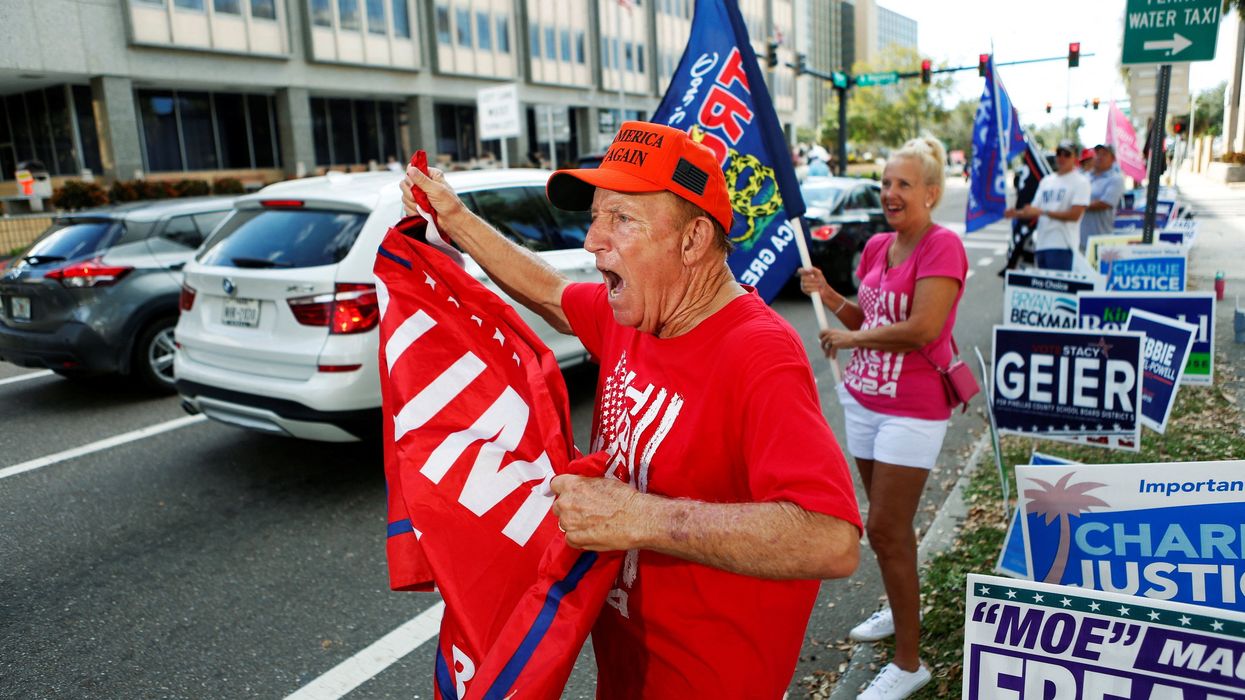
A supporter of Donald Trump rallies outside an early polling precinct as voters cast their ballots in local, state, and national elections, in Clearwater, Florida, U.S., November 3, 2024. REUTERS/Octavio Jones

January 02, 2025
ALTERNET

I just had a chat with an ATT office manager, a young Black man who is very attentive to his customers. After he learned that I worked with labor unions, he said, “I’ve always wanted to be in a union. My dad was a bus driver, and his earnings and benefits really took care of us. Our healthcare was amazing, $5 co-pay and that was it, no matter what the medical procedure.”

His comments both made me sad and angry. He took me back a few decades, when working people still earned a decent living. That’s the period before runaway inequality and job destruction basically wiped out the American Dream for the working class.


It’s not like we can’t afford to pay people decently. The money is there and then some. In 1980, there were 13 billionaires in the U.S. In 2023 there were 801. The top one-tenth of 1% saw their collective wealth jump from $1.8 trillion in 1990, to $22.1 trillion in 2024. For some context, the U.S. federal budget in 2024 was $6.8 trillion. Or consider that there are 1975,00 bus drivers in the U.S. One trillion dollars could pay them $100,000 a year for 57 years.

Have the Democrats learned anything from Trump’s ascendency? The jury is out. Will they actually take on the financial barons? Or will they continue to take in the money that flows so strongly from Wall Street and Silicon Valley?

Meanwhile the average income after inflation of the average worker did not rise at all from 1980 to 2024. And as we all know, during that time healthcare costs have gone through the roof for nearly all of us.

To add to working-class misery there is never ending job insecurity. One in four employed workers fear they will lose their jobs within the next year, according to polling done by Colorado State University.

And there’s a very powerful connection between job loss and enriching the super-rich. In many, if not most, cases, mass layoffs are used to free up cash for companies to pour into stock buybacks—buying back the corporation’s own shares to artificially boost its price. This moves money into the pockets of the largest Wall Street stock-sellers and the companies’ CEOs, who are mostly paid with stock incentives. In a very real way workers are sacrificing their jobs to enrich the richest of the rich. (To see why mass layoffs have little or nothing to do with AI and other new technologies please see my book, Wall Street’s War on Workers.)

In our capitalist economy there has always been a fierce struggle between corporate power and worker power. But when unions represented 25-35% of the private sector, during the post-WWII era, working people had sufficient clout, like that bus driver dad, to provide a good standard of living for their families. Today, with only 6% of the private sector workforce represented by labor unions, the balance has shifted strongly toward corporate power, and wages, benefits, and job security have gone backward.

The power imbalance is so great that our conventional wisdom has changed. Our minds have been warped by corporate power. When unions were strong, runaway inequality was viewed as out and out greed. Today, we are told it’s just the result of entrepreneurial brilliance, that we all benefit from the creation of more and more billionaires, that those left behind simply lack the skills to succeed in our modern economy.

But that bus driver still drives a bus, taking people to work and the doctor or shopping, using much the same skills as generations ago. The difference today is that instead of earning a living wage, as the bus driver once did, workers don’t have sufficient power to gain a decent standard of living. Relegated to gig work or jobs under threat of layoffs, the system is rigged against them.

Historically, working people saw the Democratic Party as the defender of the working-class. Not so today. Instead, they see politicians of both parties as just another group of elites feathering their own nests and protecting the establishment. Very few representatives are seen as willing to take on Wall Street and stop needless mass layoffs, because apart from some occasional rhetoric we don’t see politicians fighting for workers.

The frustration, the resentment, the anger about the rigged system was building long before Donald Trump came on the scene. But there he is, a giant wrecking ball, slamming away at the established order. For those left behind, smashing the establishment feels long overdue.

Have the Democrats learned anything from Trump’s ascendency? The jury is out. Will they actually take on the financial barons? Or will they continue to take in the money that flows so strongly from Wall Street and Silicon Valley?

Looking at the Democrats’ post-election discussions, it could be a long wait until our ATT union-supporter gets a chance to join a union.

Let’s try to have a happy new year, but it is likely to be a tough one for the working class.


'The Bible affirms queer people' — according to this Anglican group


Image via Pexels/Crestive Commons.

December 29, 2024
ALTERNET

One group is claiming that "the Bible affirms trans, intersex, and queer people," and providing evidence to back it up.

According to Christian Post, LGBT Faith UK — an Anglican group associated with the Church of England advocacy group "Changing Attitude" — published a resource guide to its website, including information about how "The Bible affirms Gays and Lesbians," how "The Bible affirms Bisexuals," and how "The Bible affirms trans and queer people."

Under the website's "About" section, the group writes, "This site is affirming of people of faith outside of the cis gender and heterosexual majority. All are children of God and deserve respect and affirmation."

READ MORE: What the Bible actually says about abortion may surprise you

Changing Attitude, which was founded by retired Anglican priest Colin Coward, "said it wants to transform what it describes as the Church's 'patriarchal, heteronormative, white, western privileged culture' into one that 'unconditionally embraces lesbian, gay, bisexual, transgender, intersex, and queer people," Christian Post reports.

To justify its argument that "The Bible affirms Gays and Lesbians", LGBT Faith UK points to the relationship between Ruth and Naomi, as well as the relationship between King David and Jonathan.

"These two stories are same-sex relationships told in the Bible," the group writes. "The Bible is completely positive about these relationships. There are other examples of LGBTQI people and situations in the Bible."

British Catholic cleric Calvin Robinson, according to Christian Post, "recently warned Americans to avoid the same mistakes that he said are leading to the destruction of his mother country."

Robinson, who now pastors a Michigan church, told the news outlet, "The Church of England has become very liberal in terms of divorce, sex outside marriage. And every time the Church tries to be more inclusive, it actually becomes more exclusive to Christianity and to Christian values, and more inclusive to worldly values and just further plummets that downward trajectory. It's a great shame."

Christian Post's full report is available here.