Saturday, January 04, 2025

AMERIKA

Op-Ed 


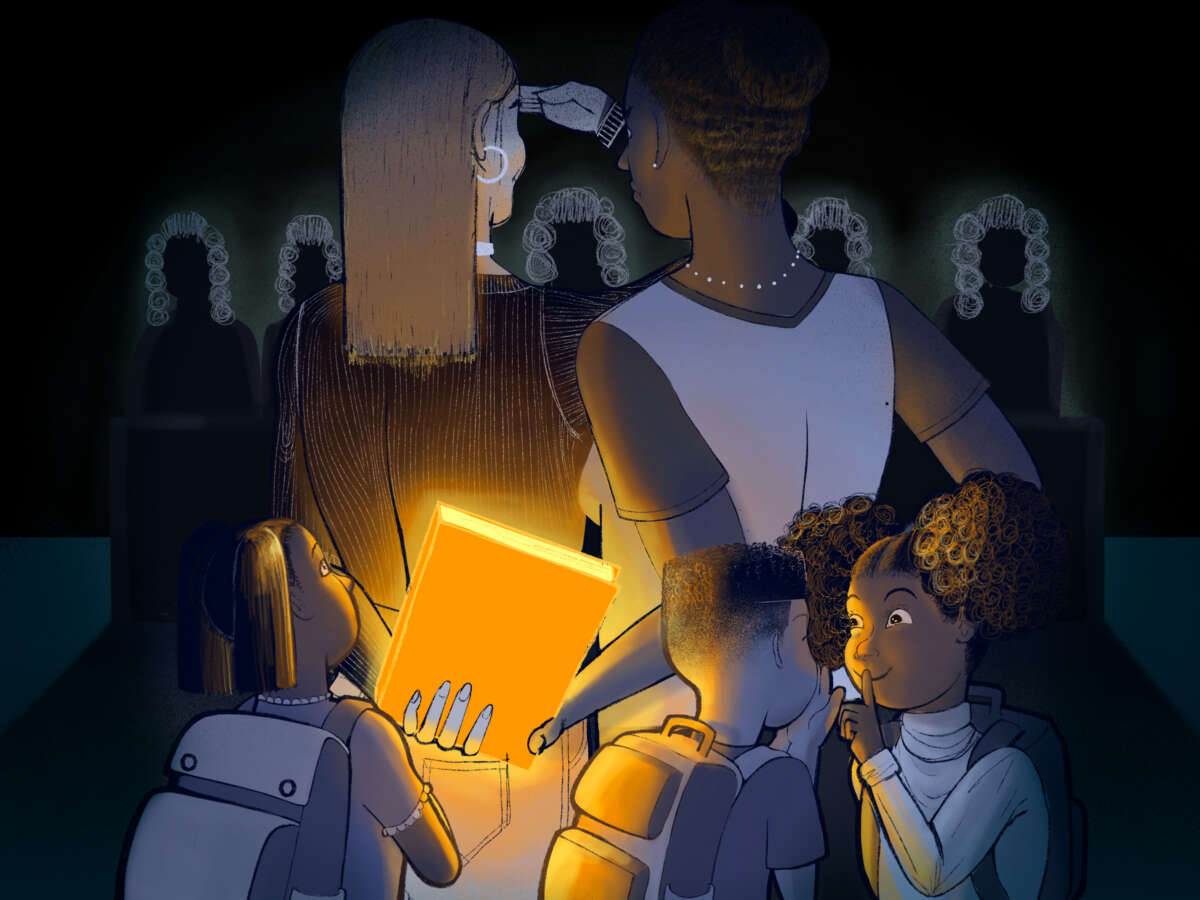
Teachers Turn to Study Groups for Anti-Racist Learning as History Is Whitewashed


Amid right-wing attacks on classrooms, study groups light a “fire of hope” among anti-racist educators.

December 30, 2024

\Ayo Walker / Truthout

It is hard to overstate the burdens public school educators have been asked to carry over the last several years.

There are the perennial stressors: inadequate funding, crumbling infrastructure, the inundation of schools with standardized testing, and too little time to plan, grade and collaborate with colleagues. Then came the COVID-19 pandemic: isolation, building closures, remote teaching, reopenings and severe staff shortages. Wielding the cudgel of “learning loss,” elites laid the blame for the traumatic impacts of a pandemic at the feet of teachers and public schools.

And through all that, there has been the steady and sinister growth of book bans, curricular gag orders and the criminalization of trans-affirming policies — all of which seek to muzzle educators from telling the truth and extending care to students. Today, almost half of all public school students have a teacher who has been prohibited from teaching the truth about systemic racism in U.S. history. As one teacher told the Zinn Education Project, “I’m terrified to say anything about enslavement because it might make students ‘uncomfortable.’ I also can’t recommend any books because a parent might not like it and then I could be charged with a felony.”

The impact of the relentless attacks on educators from right-wing forces is difficult to quantify, but a 2022 survey provides some insight into the harm being caused. According to a report by the National Education Association, “A staggering 55 percent of educators are thinking about leaving the profession earlier than they had planned.” The report also reveals that a disproportionate percentage of Black (62 percent) and Latinx (59 percent) educators — already underrepresented in the field — are considering an early departure from teaching. Many factors are pushing educators away, from health risks during the pandemic to low pay and a lack of respect that stems from politicians who aim to scapegoat educators for the social problems they refuse to address. Especially distressing is the toll taken by the ongoing criminalization of truth in education. As one teacher from Tennessee shared regarding the impact of educational gag order legislation on her decision to leave teaching, “I just can’t. I can’t do this. I really value being honest with students. I really don’t think I can navigate teaching in such a watered-down type of way.”

The fear of retribution for teaching the truth has created such a chilling effect that an astounding two-thirds of U.S. teachers now report self-censoring discussions on race, gender identity and sexuality in their classrooms.


The Right’s Push to Whitewash History Is a Precursor to Fascism
As a new school year begins, we must resist turning schools into right-wing indoctrination centers. By Henry A. Giroux , Truthout  August 18, 2024


But there is another story about teachers — buried beneath the headlines of doom and despair — that must be told to fully understand this era of education; this is a story about solidarity, community, hope and resistance.

As we have seen educators come under attack for teaching the truth about U.S. history, we have also seen them rise up and fight back. For the past three years, hundreds of educators have participated in the annual Teach Truth National Day of Action, organizing banned book swaps, historical walking tours, rallies, and more. In addition, thousands of educators have participated in the Black Lives Matter at School Week of Action, and many are increasingly joining the call for the Year of Purpose activities.

There is one story of educator resistance that has not been reported on: the Teaching for Black Lives (T4BL) study groups and the more than 3,795 educators from across the country — including in states that have prohibited anti-racist education — who have come together over the last several years to read, learn, reflect, and struggle for justice in classrooms and schools. Hundreds of T4BL study groups have formed since 2020, including groups comprised of teachers across Florida, educators from Wake County School District (K–12) in North Carolina and educators from Hayward Unified School District (pre-K–12) in California.


Two-thirds of U.S. teachers now report self-censoring discussions on race, gender identity and sexuality in their classrooms.

At most schools, isolation is the norm. Teachers scarcely have time to use the bathroom between classes, answer emails and plan lessons during their prep periods, and eat a nourishing meal during their lunch “break.” We have yet to see a place on a school’s daily bell schedule labeled “time to build meaningful relationships with other adults in the school.” Too often, professional development is imposed on educators and feels tangential to the most pressing issues in education. Study groups provide educators with a reliable structure of support and community, while allowing educators to direct their own professional development.

“Participating in this study group has reminded me that I am not alone in my district. This work can often feel really isolating, and it was so encouraging to meet with colleagues who are also passionate about equity,” says Crystel Weber from Gresham, Oregon. Similarly, Sarae Pacetta from Portland, Maine, reflects, “Our study group has been an anchor for all of us.…We are each other’s touchstones when we need to process an issue.”

No doubt, this moment calls for copious and varied forms of organizing — in our unions, at our local school and library boards, and in collaboration with community and parent groups. But as we fight the current wave of attacks on education, it is critical that we ground ourselves in what we are fighting for, not just against. Small, educator-led communities of study and reflection can provide that grounding. Study group members have told us that their groups have been a vital source of strength, support and guidance during budget cuts and right-wing attacks on education. “Having a national network of support and like-minded colleagues is a balm during these challenging times,” said one study group member.

A mainstay of school mission statements is that the educational program should create “life-long learners.” Yet, this value is rarely prioritized by school leaders when it comes to educators. Study groups encourage educators to claim time to learn — through book study and discussion, online classes and participatory workshops. We cannot apply principles of equity and justice that we ourselves have not learned.

“I’ve learned so much about the accurate and hidden history of Black Americans and how our systems continue to affect them,” says Teri McAllister, a teacher in Everett, Washington, on the impact of collective study. “This learning experience has deepened my commitment to creating change.”

Heidi Given from Somerville, Massachusetts, shares, “Our study group provided a platform to explore histories we were never taught, and to develop pedagogical practices for sharing those histories with our students.”

Yet these groups aren’t just about educators deepening their understanding of Black history and intersectional social issues; the T4BL study groups have also inspired educators to move from discussion to action, and to tackle issues of racial justice directly within their communities and schools.


The role of study groups is frequently underestimated in historical accounts of social change, yet these gatherings are often the bedrock of movements for social justice.

A T4BL study group in Florida — a state where draconian laws have been deployed to fire educators who teach the truth about racism — inspired educators to get active in their union to organize against the onslaught of anti-education bills imposed on them in recent years. In Madera, California, a T4BL study group took a deep dive into the discipline data at their school, and a member reported that their group “completely restructured” their school discipline approach. This included hiring an intervention specialist and transforming the position of the teacher who had supervised in-school suspensions to abandon a punishment model and become a trained restorative justice practitioner who “works closely with our intervention specialist, counseling team, and student psych services.” In Kansas City, Missouri, study group leader Michael Rebne and other educators participated in Teach Truth Days of Action by organizing events at historic sites to highlight the importance of truthful education, especially as right-wing anti-history bills threaten to mandate lies and omissions in classrooms across the country.

The role of study groups is frequently underestimated in historical accounts of social change, yet these gatherings are often the bedrock of movements for social justice. Study groups create spaces for individuals to explore ideas, develop critical consciousness and build the ideological foundations necessary for collective action. From the Black freedom struggle to the labor movement, study groups have brought together individuals eager to learn, strategize and ultimately transform society.

In the early 20th century, Black intellectuals and activists such as W. E. B. Du Bois and the members of the Niagara Movement met regularly in study groups to discuss racial justice and civil rights, laying the groundwork for the NAACP. During the civil rights movement, study groups were instrumental in the formation of the Student Nonviolent Coordinating Committee (SNCC), where young activists learned about direct action and Black liberation. In 1962, the Afro-American Association (AAA) emerged as a study group at Merritt College in Oakland, California, bringing together Huey P. Newton and Bobby Seale alongside other students and educators to explore Black history and revolutionary ideas. Some of the texts they studied included Frantz Fanon’s The Wretched of the Earth and the speeches and writings of Malcolm X. The discussions and debates they engaged in through the AAA laid the ideological groundwork that eventually inspired Newton and Seale to establish the Black Panther Party. In the late 1960s and 1970s, the Black Panther Party used study groups to educate members about systemic racism, political economy and the global struggle for liberation.

This important tradition continued into the 21st century. In 2008, for example, educators in Chicago started a study group around Naomi Klein’s The Shock Doctrine, which explains how the richest 1 percent have enriched themselves in the neoliberal era by taking advantage of political and economic crises to amass even more wealth and promote free market policies. Through their discussions, they examined the forces driving the privatization of public education and the urgent need for a new approach to unionism. This group of educators formed into the Caucus of Rank-and-File Educators, which soon ran Karen Lewis for president of the Chicago Teachers Union. Her victory marked a turning point as the union, under Lewis’s leadership, led some of the most significant teacher strikes in modern history, using a social justice unionism lens to advocate for teachers, students, and their communities.

In a time when forgetting history has been mandated by law, we must remember the power of study groups as an antidote to isolation and fear. As T4BL study group coordinator Jill Groff put it: “I would share that when the apathy seemed pervasive and morale was low, being in this group lit a fire of hope to keep me going and remember my why. I so appreciate the fellowship and support of people who genuinely love kids, all kids, and go above and beyond every day to fight for them, to make lessons to inform and empower, and just to be in a space with so many wonderful educators with shared values and goals.”

And that is exactly what communities of learning can provide: a fire of hope. Not a saccharine hope that delivers neither substance nor sustenance, but a hope rooted in a set of shared commitments — to learn together, analyze together, organize together and act together — for more justice in our classrooms and schools.

This article is licensed under Creative Commons (CC BY-NC-ND 4.0), and you are free to share and republish under the terms of the license.

Jesse Hagopianis a Seattle educator, an editor for Rethinking Schools magazine, a founding steering committee member of Black Lives Matter at School and serves as the director of the Teaching for Black Lives Campaign for the Zinn Education Project. Jesse is the author of the forthcoming book from Haymarket Books, Teach Truth: The Attack on Critical Race Theory and the Struggle for Antiracist Education, editor of More Than a Score: The New Uprising Against High Stakes Testing, and the co-editor of the books, Teaching for Black Lives, Black Lives Matter at School and Teachers Unions and Social Justice. You can connect with Jesse on IG @jessehagopian or via his website, www.IAmAnEductor.com.


Ursula Wolfe-Rocca is a high school social studies teacher in Portland, Oregon. She is an editorial board member of Rethinking Schools and has worked on a variety of Zinn Education Project campaigns.
I Entered Law to Protect My LGBTQ Community. I Need Solidarity From Colleagues.


The legal profession must fight to protect us — the lawyers, law students and legal workers fighting for a better world.
December 31, 2024

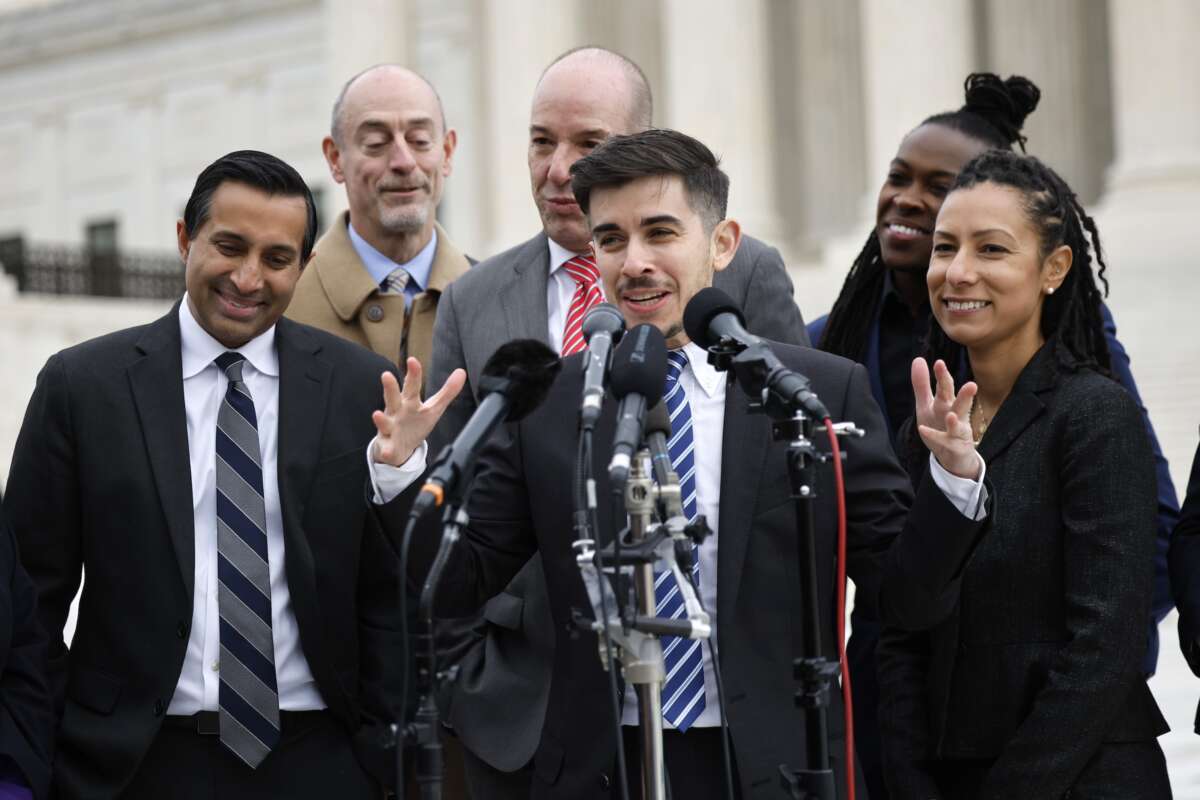
Lawyer and transgender rights activist Chase Strangio speaks after arguing in a transgender rights case before the U.S. Supreme Court on December 4, 2024, in Washington, D.C.
Kevin Dietsch / Getty Images


Did you know that Truthout is a nonprofit and independently funded by readers like you? If you value what we do, please support our work with a donation.

On December 4, 2024, Chase Strangio became the first openly transgender person to orally argue a case before the Supreme Court. Strangio, a co-director of the ACLU’s LGBTQ & HIV Project, appeared on behalf of the parents of a 16-year-old daughter challenging a law in Tennessee that banned puberty blockers, hormone therapies and gender-affirming surgeries for transgender youth. While the presence of Strangio in the country’s highest court is so important, many trans law students like myself worry we may not have the same opportunity in the future with the way things are headed.

I came into this profession to fight for my community, but by the time I graduate, I fear that legal protections for trans people will have been dismantled and that practicing law as a trans person will be unsafe. Tennessee was one of 19 states that passed such laws in 2023 — my first year of law school. Today, more than half the states in this country have enacted anti-trans laws, with 93 percent of transgender youth aged 13 to 17 living in states where such legislation has either been proposed or passed.

These are not symbolic laws; they are lethal. State bans on gender-affirming care have already resulted in an uptick in past-year suicide attempts among transgender and nonbinary young people. Indeed, even in states where such bans have not been implemented, a staggering 86 percent of trans and nonbinary youth report that the relentless political attacks have worsened their mental health. The impact of these laws, though, cannot be reduced only to statistics — they have affected not only hundreds of thousands of trans youth individually but also our community as a whole.

Take me, for example. Law school’s first year is brutal — it is intensive and arguably a hazing ritual designed to break you down. However, I could barely concentrate on my legal studies with the far right trying to literally erase my existence. This looked not only like the murder of members of my community at Club Q in Colorado Springs an hour away from my law school, but also the coordinated legislative attacks against trans people across the country.

Every day it seems to grow more and more impossible to envision any future where trans people will ever be safe. But I’m a staunch believer that the law can be used as a sort of harm reduction and that we can keep each other safe. This fight against anti-trans hate compelled me to dedicate my time during my first year to writing about the legislative onslaught on my community, advocating at the state capital, and participating in local mutual aid efforts. Yet, I found myself feeling deeply isolated. Many of my fellow law students, as well as my professors, were not only unaware of these attacks but indifferent, believing it wasn’t their community being targeted and that they were “safe” in Colorado.


Trans Candidates Triumph in Key Elections Despite GOP’s Anti-Trans Ad Campaign
“It’s clear that trans people are not going back without a fight, and we can win,” Allison Chapman told Truthout. By Zane McNeill , Truthout November 6, 2024


This sense of abandonment was especially painful within a legal environment that prides itself on its commitment to diversity, equity, inclusion, public interest and social justice. Because of the hard work and dedication of LGBTQ lawyers, the American Bar Association (ABA) has passed countless policy resolutions, actively opposed various pieces of discriminatory legislation, and filed amicus briefs in landmark cases — including U.S. v. Skrmetti. The ABA has also implemented initiatives like the Diversity, Equity, and Inclusion Center, the Commission on Sexual Orientation and Gender Identity and the Pipeline Diversity Directory to foster inclusion in the profession. Similarly, affinity groups like the National LGBTQ+ Bar Association and the National Trans Bar Association issue public statements, advocate for the LGBTQ community and provide resources for LGBTQ law students.


“What do we do when the courts won’t save us? Are we playing by rules that no longer exist?”

While those efforts are important, they occur within the boundaries of a profession that remains stubbornly conservative and slow to change. According to one 2020 ABA study, LGBTQ lawyers regularly encounter tremendous discrimination and bias in disproportionate measures compared to other colleagues. Similarly, a 2022 diversity report by the National Association for Law Placement showed that LGBTQ populations make up a small component of the legal profession, with many LGBTQ professionals facing distinctive challenges in their workplaces.

For example, my friend Robb Livingood, a trans attorney from West Virginia, went to law school to protect the vulnerable but ended up becoming a plaintiff in his own discrimination case. In 2018, he interviewed for a position at the Public Defender Corporation, Fifth Judicial Circuit, but the employer’s interest waned during the in-person meeting, seemingly due to transphobia. He filed a complaint with the West Virginia Human Rights Commission, which in 2020 found enough evidence to move forward with his claim. In 2021, an administrative judge ruled that Livingood had been a victim of sex discrimination under the West Virginia Human Rights Act, awarding him over $100,000 in lost wages and attorney fees.

“Even though I am from West Virginia, I honestly did not expect the onslaught of anti-transgender discrimination when I came out, especially not in the public interest sector where I aspire to work. I expected a lot better from West Virginia, especially from those charged with protecting the vulnerable,” Livingood told me. “While I did file a Human Rights Commission complaint against one local Public Defender office for sex-based discrimination in my early years of gender journey, that instance of discrimination was by no means isolated. The discrimination I took to court was just the tip of the iceberg. There were other situations where it was obvious, but less provable, that transphobia was the culprit behind negative employment decisions.”

Despite the court’s ruling, he has not yet received the $100,000 awarded to him by the court and, three years later, the Public Defender Corporation is continuing to fight the ruling. Moreover, if the Supreme Court were to overturn Bostock v. Clayton County, discrimination like what Livingood faced might well become legal again.

Anti-LGBTQ laws add to the already overwhelming stress placed on transgender law students who are trying to navigate a field riddled with similar instances of discrimination. These laws feed stress, anxiety and depression, turning what should be places of learning into hostile spaces and piling the odds even higher against us in an already biased job market.


While it’s easy to feel crushed under the weight of these barriers, we are also rooted in the histories of resistance paved by our elders and ancestors.

“Anti-trans legislation generates fear around being trans or even an ally, alienates trans and gender-nonconforming people, and tries to make gender nonconformity and transness taboo. I think this can make law school and the legal profession even more difficult to navigate than they already are,” Hannah Reynolds Martínez, a law student and activist, told me. “There are already structural barriers to the legal world for trans lawyers and law students: trans folks are likely to be overrepresented in public sector legal jobs, receive lower average salaries than their cisgender counterparts, and tend to be less likely to find employment in private firms. But adding in the additional barriers of legislation that denies gender-affirming health care and social stigmatization of transness, a legal career can become even more challenging.”

For many of us, the thought of practicing law in states with hostile laws feels impossible — whole regions are becoming no-go zones, shrinking our opportunities and mobility. Some of us might not even get to law school, disheartened before we’ve even begun.

“Trans lawyers and law students should be able to work in affirming and safe spaces, as well as [be] able to express themselves freely. However, some states with hostile legal and political environments may force trans folks to reconsider their employment, whether they can be out at work and in other environments, and more,” Martínez said.

With another Trump administration looming, these threats feel suffocating. Title IX protections could be dismantled, stripping away critical safeguards against discrimination in law schools. Far right judicial appointments have accelerated the erosion of anti-discrimination protections and make it even more dangerous for trans students to clerk or argue in court. This perceived erosion of judicial impartiality and the far right capture of the courts have also eroded many trans students’ faith in the profession.

“I’ve had a clear-cut plan for the next few years that includes getting into the best law school I can, securing appellate clerkships for afterward, and positioning myself to do impact litigation. However, the day after the election, I found myself questioning these goals for the first time. What’s the point of appellate advocacy if the Supreme Court and many lower courts will be overrun by far right appointees for the majority of my lifetime?” Julian Applebaum, a trans activist and incoming law student who has interned with the ACLU told me. “The ACLU’s motto for bringing big civil liberties suits is a triumphant ‘We’ll See You in Court!’ But that implies that we can rely on the courts for fair, transparent and impartial standards of ruling. What do we do when the courts won’t save us? Are we playing by rules that no longer exist?”


“Recent Supreme Court decisions signal that the federal judiciary will not be a reliable shield against anti-trans legislation.”

This doubt about the law’s current capacity to bring about positive change is something many of us can relate to. For example, many of the classes that I have taken in law school, such as administrative law and constitutional law, feel almost pointless now after the far right Supreme Court has overturned precedents like Chevron and Roe v. Wade and seem poised to dismantle equal protection as we know it.

Additionally, anti-trans federal and congressional policies will further limit the number of safe and affirming job opportunities for trans law students. For instance, while Applebaum is still planning on going to law school, he told me that the election has disrupted what he once felt was a stable career path. He said that he is deeply concerned that he will have to decline opportunities like summer internships with the Department of Justice, congressional offices, or other federal entities, especially if the Trump administration and Republican congressional majorities roll back protections for transgender staff.

“What if I work on Capitol Hill for my congressperson and I use the men’s bathroom (I’m a trans man, and I would refuse to use the women’s room) and I am disciplined for violating the new rule Rep. Mike Johnson enacted? And then Nancy Mace or Fox News or whoever blasts my face on national news for an absurd culture war spat? I don’t want to put myself through that,” Applebaum said.

Even getting licensed to practice law could become a minefield. The subjective “good moral character” requirements of bar applications could be used against trans applicants. Committees might probe into our gender identity and medical history although that would obviously have no bearing on our competence to practice law. In conservative states, we could be rejected outright if our identities are seen as incompatible with some narrow, outdated definition of “moral” values. Mental health history could become another weapon. And with high rates of depression in our community — often the direct result of systemic oppression — there’s a real fear that trans identities could be re-pathologized, making this bias even worse.

For trans folks in states like Florida, the barriers are even higher. Laws that restrict legal name changes or gender marker updates threaten to invalidate something as basic as a state ID. My own updated gender marker could lead my own ID to be flagged as “fraudulent” in Florida. Trans applicants may be forced to answer invasive questions about these changes and, if the names and gender markers on our birth certificates, driver’s licenses, academic transcripts, and other documents do not match because of such restrictive laws, we may face delays, confusion or outright rejection of our bar application.

While it’s easy to feel crushed under the weight of these barriers, to feel like the odds are insurmountable, I have to remind myself that we may feel like we are in uncharted territory, but we are also rooted in the histories of resistance paved by our elders and ancestors.

People such as Pauli Murray, Phyllis Randolph Frye and Kylar W. Broadus remind us of what resilience looks like in the face of systemic oppression. Murray’s work — as a legal scholar and civil rights activist — laid the groundwork for major victories like Brown v. Board of Education. A Black, gender-nonconforming person, Murray wrote about the experience of living “in-between” genders while pursuing justice in a world not built for them. Frye became an attorney and judge, overcoming estrangement, job loss and relentless discrimination in the 1970s to become the “grandmother of the transgender rights movement.” Broadus, a Black transgender man, has made a career out of advocating for transgender legal protections and workplace rights, including being the first openly transgender person to testify before the U.S. Senate. Strangio, Applebaum, Livingood, Martínez and I are in great company.

There are so many other trans attorneys who did not feel safe to be out, but still paved the way for a future where Strangio could argue in front of the country’s highest court. Their courage may not have been visible, but it’s no less meaningful. They — along with figures like Murray, Frye and Broadus — give me hope. They remind me that even in the darkest of times, our fight to exist, to thrive and to make change matters. And while the law is often an instrument of power that upholds capitalism and white supremacy, there may also be some merit in attempting to use it to protect our communities from further state violence as a form of collective defense.

But the legal profession must also fight to protect us — the lawyers, law students and legal workers fighting for a better world.

“Now more than ever, trans people, including law students and lawyers, need local-level protections,” says D Dangaran, co-chair of the National Trans Bar Association (NTBA). “Recent Supreme Court decisions and the argument in United States v. Skrmetti signal that the federal judiciary will not be a reliable shield against anti-trans legislation.”

Law schools, bar associations and employers should move beyond symbolic gestures of inclusion to take active steps to make these spaces truly equitable.

“I think now, more than ever, it’s necessary for the legal field to step up to advocate for marginalized communities in the light of anti-trans, ableist and racist policies and rhetoric that harm underrepresented legal professionals,” Martínez said. “Law schools, bar associations and advocacy groups should start centering trans voices in their scholarship, leadership and preparation for the upcoming administration now. Trans advocates and professionals are best positioned to address how individual schools and organizations can support their community.”

This will mean robust anti-discrimination policies, structured mentorship programs for trans professionals, and advocating for the improvement of mechanisms of accountability in causing harm.

“Shield laws, mutual aid and private protections are critical tools moving forward. NTBA is working towards creating toolkits and best practices guides for courts, schools and the legal profession to treat trans and nonbinary law students, members of the profession, and parties in court with dignity and respect,” D Dangaran said.

Legal organizations should set an example by creating spaces where trans people can not only survive but succeed because of policies that match up with the equity and justice they proclaim. If we are to build a better future, the profession must join us in creating it — where we not only can exist without fear, but also be supported in building a liberatory future for trans people together.

“To the other trans and gender-nonconforming law students and practitioners out there, your existence is a form of protest and resistance. Your resilience is enough, if you don’t have anything more to give,” Martínez said. “Your challenges are what make you a strong advocate. We need lawyers and legal professionals like you.”


This article is licensed under Creative Commons (CC BY-NC-ND 4.0), and you are free to share and republish under the terms of the license.


Zane McNeill is a trending news writer at Truthout. They have a Master’s Degree in Political Science from Central European University and are currently enrolled in law school at the University of Denver Sturm College of Law. They can be found on Twitter: @zane_crittheory.
With Trump at the Helm, Nuclear Uncertainty Is Set to Grow in 2025

Eighty years after the first atomic bombs, experts say it’s past time to rein in nuclear weapons.

By Jon Letman
December 31, 2024

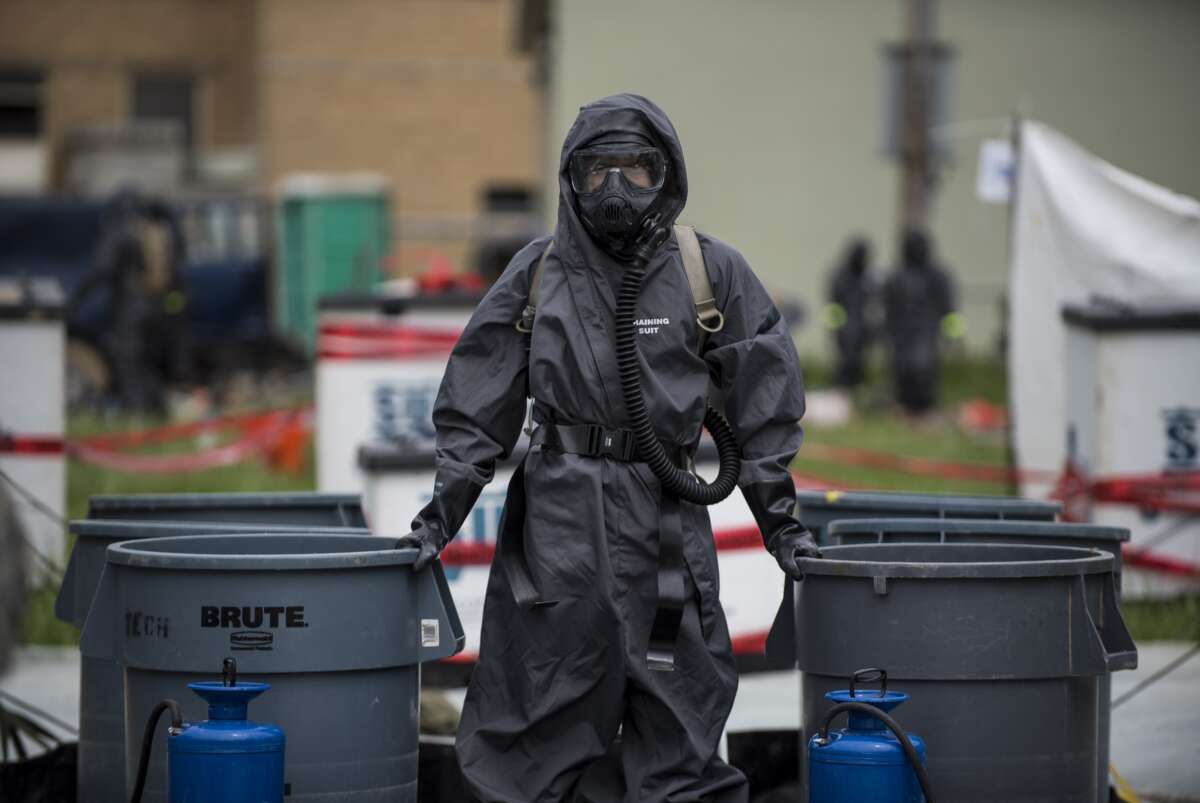
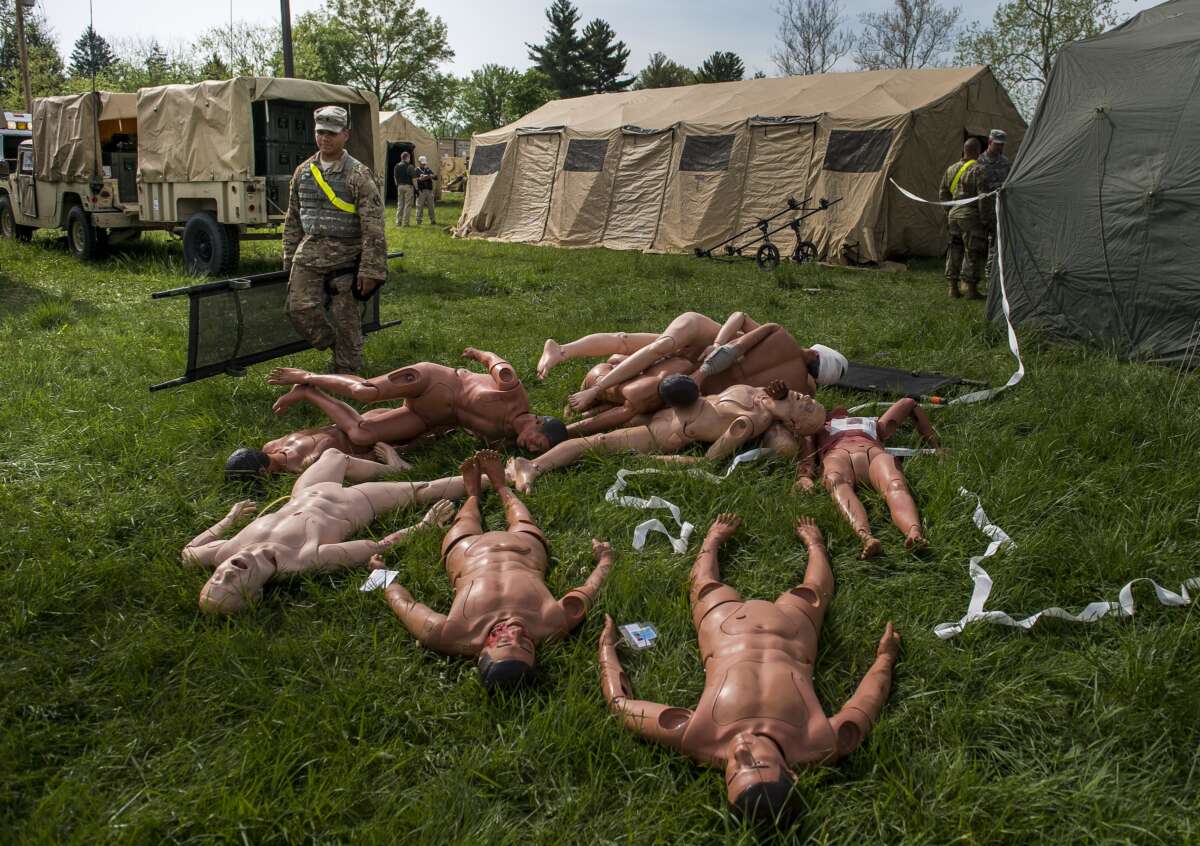
A U.S. Army soldier with the 51st Chemical Biological Radiological Nuclear Company, of Fort Stewart, Georgia, stands watch at a decontamination field site at the Muscatatuck Urban Training Center, Indiana.Master Sgt. Michel Sauret

When the clock strikes noon on January 20, 2025, Donald Trump will once again be given launch authority over the U.S.’s nuclear arsenal in a time of nuclear uncertainty and growing risks. From the volatility of the wars in Ukraine and the Middle East to rising tensions on the Korean Peninsula and potential clashes around Taiwan and the South China Sea, the danger of miscalculation points to a perilous future.

After decades of hard-fought arms control agreements and a major reduction in the U.S. nuclear stockpile between 1989 and 2009, the deteriorating global security environment is contributing to a greater reliance on nuclear weapons. Today, all nine nuclear-armed nations are “modernizing,” upgrading or expanding their stockpiles; spending on nuclear weapons is surging, international arms control agreements have been all but abandoned, and the threshold for nuclear use is falling.

These conditions, paired with cavalier threats to use nuclear weapons, in particular nonstrategic “tactical” nuclear weapons, have led nuclear analysts and experts to warn that we’re headed in the wrong direction. In early 2024, the Bulletin of the Atomic Scientists set the Doomsday Clock at 90 seconds to midnight, the closest the symbolic clock has been to global catastrophe


Time for a New Start

February 5, 2025, will mark the one-year countdown until the New START Treaty, the last remaining agreement limiting strategic arsenals of Russia and the United States, expires. Unless the treaty is extended or the two countries agree to abide by the limitations even without a formal extension, the world’s biggest nuclear rivals could rapidly begin building up their arsenals or uploading warheads onto submarine-launched ballistic missiles and intercontinental ballistic missiles.

The U.S. is poised to spend in excess of $756 billion over the next 10 years on its existing nuclear weapons modernization, but according to Daryl Kimball, executive director of the nonpartisan Arms Control Association, the number is likely much higher. Kimball said a larger nuclear arsenal is financially untenable and would only spur Russia and China to follow suit: “In the end, nobody gets ahead in an arms race. We just have more nuclear firepower and less security.”


Costly Replacement of ICBMs With Sentinel Missiles Increases Risk of Nuclear War
Many of our unmet needs as US citizens are due in part to the cost of the US nuclear arsenal. By Richard Krushnic , Nancy Goldner , Jonathan Alan King , Truthout
October 15, 2024

Kimball sees the year ahead fraught with nuclear challenges: elevated tensions between the U.S. and Israel with an Iran that has nuclear knowledge and capabilities that can’t be bombed away and the likelihood that Trump, further emboldened by his like-minded ally, Israeli Prime Minister Benjamin Netanyahu, will return to his maximum pressure approach to Iran, which includes the reinstatement of severe sanctions and restrictive measures.

There’s also the potential for renewed hostile rhetoric between Washington and Pyongyang with North Korean leader Kim Jong Un dismissing the prospect of future diplomacy with the U.S. based on his past experience. Since the failed Trump-Kim Hanoi summit in 2019, North Korea’s nuclear program has accelerated, its ballistic missile capabilities are greater, and it recently designated South Korea a “foreign, hostile state.”

With so many nuclear challenges, Kimball said, “it would have been a dangerous situation no matter who was elected, but there’s going to be even more unpredictability under Donald Trump.”
New Nukes? New Tests?

Among the many nuclear uncertainties the world faces in 2025, researchers at the Federation of American Scientists’ Nuclear Information Project are closely watching three key areas: alliance management, nuclear rhetoric and the potential resumption of underground explosive nuclear testing. Mackenzie Knight, a senior research associate with the project, said the way the U.S. manages its alliances with NATO nations and other partners like Japan and South Korea could have far-reaching implications for nuclear stability.

For example, if the U.S. under the incoming Trump administration were to dramatically reduce support for the U.S.-Republic of Korea alliance, South Korea has the domestic capability in terms of economy, infrastructure and technology to pursue its own nuclear weapon if it chooses to do so. Recent public opinion polls indicate widespread support among South Koreans for Seoul developing its own nuclear weapon, although survey results vary.

If a tenth country decided to pursue nuclear weapons, the first to do so since North Korea, the implications would be enormous. Likewise, if the U.S. were to resume underground explosive nuclear testing, the Comprehensive Test Ban Treaty (CTBT) would be gravely undermined. Although the CTBT has not yet entered into force, it has been ratified by 178 of 187 signatory nations and is recognized as an effective treaty preventing nuclear weapons explosive testing.

Speaking on a public panel in November, Corey Hinderstein, acting principal deputy administrator of the National Nuclear Security Administration (NNSA), addressed the question of a resumption of U.S. underground nuclear testing, saying, “… the answer was no. The answer remains no. And the answer to whether we need to conduct a nuclear test is also no and that is a technical conclusion and a political conclusion. And I don’t see that technical conclusion changing any time soon. The political conclusion could change. The technical conclusion is that there is no technical question about the safety, security, reliability or effectiveness of our nuclear arsenal that we envision that we could answer through an underground nuclear test.”

Knight told Truthout that she expects Trump will appoint new NNSA leadership, but given the complex dynamics that drive nuclear policy, it’s unclear to what degree new appointments may impact the agency’s work.

Knight and others have expressed concern over former Trump administration officials who have discussed the possible resumption of U.S. underground explosive nuclear testing. Over the summer, Trump’s former national security adviser, Robert O’Brien, wrote in Foreign Affairs magazine: “The United States has to maintain technical and numerical superiority to the combined Chinese and Russian nuclear stockpiles. To do so, Washington must test new nuclear weapons for reliability and safety in the real world for the first time since 1992 — not just by using computer models.”

The Project 2025 manifesto, a right-wing blueprint for the next Trump administration created by the Heritage Foundation, contains arguments for upscaling and increasing the U.S. nuclear arsenal, as well as a call to “Restore readiness to test nuclear weapons at the Nevada National Security Site to ensure the ability of the U.S. to respond quickly to asymmetric technology surprises.”A U.S. Army soldier carries a stretcher through a decontamination training site at the Muscatatuck Urban Training Center, Indiana.Master Sgt. Michel Sauret

“The concern here is several-fold. One, environmental,” Knight said. “Explosive nuclear testing was halted for a reason … it’s very harmful to the environment. And the other concern is that the desire to resume nuclear testing is based on political reasons.”

“Calls to prepare to resume explosive testing or develop the capability to do so,” Knight added, would be “incredibly concerning for the risk of nuclear war breaking out.”

Knight said the U.S. has overwhelmingly conducted more explosive nuclear testing than any other country and has the least to gain by resuming explosive nuclear testing. “If the U.S. decides to do so, it just green-lights other countries to engage in nuclear testing once again and they have way more to learn and much more to benefit from doing so.”

Knight noted the pivotal role of Congress in advancing or blocking funding that could support efforts to resume nuclear explosive testing, as well as nuclear weapons programs which are over budget and behind schedule. The same is true, she said, for the uncertain future of a nuclear-armed sea-launched cruise missile introduced by the first Trump administration, it was determined to be “cost prohibitive” by the Navy during the Biden administration, but could again be pursued in the new Trump administration despite financial and industrial challenges.

Knight and her colleagues continue to closely follow documents, reports and open-source satellite imagery that can reveal nuclear weapons-related activities. For example, specific language in military budgetary documents indicated construction of new infrastructure hinting at the possible return of U.S. nuclear gravity bombs to an airbase in the United Kingdom. In 2021, the same analysts discovered the construction of a new nuclear missile silo in China.
Calling Dr. Strangelove

Immediately after the U.S. election, Council For a Livable World, a nonpartisan organization that promotes policies to reduce nuclear weapons, identified nine goals for the incoming Trump administration, including demanding greater accountability over nuclear weapons modernization and systems considered “strategically questionable,” adhering to the New START Treaty, and upholding the taboo on explosive nuclear weapons tests.

The council’s executive director, John Tierney, told Truthout that he is concerned about how the Trump administration could respond to China’s rapid expansion of its nuclear forces.

“It’s ridiculous to think that the number of missiles and bombs that we have right now are not a suitable deterrent,” Tierney said. Currently, the U.S. has a total nuclear stockpile of around 3,700 warheads. Of these, approximately 1,770 warheads are deployed and available for delivery by strategic launchers. In comparison, China possesses an estimated stockpile of approximately 500 nuclear weapons.

Tierney is watching how the U.S. manages its own nuclear stockpile as it spends what could ultimately surpass $1.5 trillion to modernize an arsenal that includes Sentinel, a weapon system designed to replace the U.S.’s aging Minuteman III Intercontinental Ballistic Missiles. Tierney said that besides being grossly behind schedule and far over budget, Sentinel’s “very existence is an impediment to security.” Calling for closer scrutiny of the program, he described Sentinel as a “relic of the Cold War” which drains resources other programs more essential to U.S. security.

One area where Tierney sees potential for positive change is increased public engagement on nuclear weapons issues: “We’ve got to grab the public’s attention and give them the notion they can do something.” Without the public pressure that existed in the 1960s, ‘70s and ‘80s, Tierney said, nuclear treaties, agreements and norms wouldn’t have happened.

He sees a great need for a cultural shift that would introduce more music, books, movies, and other popular media, as well as more frequent reporting on nuclear issues. “It’s been a long time since Dr. Strangelove,” said Tierney.
A Reason for Hope

The year 2025 offers one bright spot in the form of an international agreement that is gaining member states. The Treaty on the Prohibition of Nuclear Weapons (TPNW), also called the nuclear weapon ban treaty, entered into force in 2021 and now has 94 signatories and 73 states parties, the latter being countries that have signed and ratified the treaty, including, most recently, Indonesia.

Leading efforts to advance the treaty is the International Campaign to Abolish Nuclear Weapons (ICAN), a global civil society coalition. Susi Snyder, ICAN’s program coordinator, told Truthout the treaty has crossed the threshold of more than half of UN members either signing or ratifying the treaty, with more on the way.

Next March, the TPNW’s Third Meeting of States Parties will be held in New York as a forum in which nations that have ratified the treaty can assess nuclear risks and realities and pursue implementation of treaty obligations and objectives. In addition to civil society and international organizations, the meetings are also open to countries that have not yet ratified the treaty but intend to do so or are willing to participate as an observer.

Snyder expects to see a growing number of observer nations that could include Germany, Norway, Australia and, in what would mark a major shift, Japan which is reportedly mulling participation as an observer. Because these countries are considered nuclear endorsers — meaning they enable, host or support the possible use of nuclear weapons — their participation as observers would be significant, having the potential to influence other endorsing nations, as well as the nine nuclear-armed states, all of which remain opposed to the treaty.

Parliamentarians may also participate as observers, equipping them to brief members of their own government. For example, in the U.S., Massachusetts Congressman Jim McGovern observed the Second Meeting of States Parties and is among a handful of Congress members calling for the U.S. to join the ban treaty. Similar efforts are underway in Australia and will likely spread to other nonsignatory nations.
80 Years Is Enough

In December, the Japanese NGO Nihon Hidankyo received the 2024 Nobel Peace Prize for its more than seven decades of work seeking the complete abolition of nuclear weapons. The group’s members are hibakusha — Japanese survivors of the atomic bombings of Hiroshima and Nagasaki in August 1945. The award was presented just ahead of the 80th anniversary of the atomic bombings. Snyder sees 2025 as a yearlong opportunity for people everywhere to reexamine the urgent need to eliminate nuclear weapons once and for all.

Snyder is based in the Netherlands, one of five NATO countries that host U.S. nuclear gravity bombs on military bases. She noted a nuclear conflict between the U.S. and Russia could lead to catastrophe — not just for nuclear hosting nations like the Netherlands, but the entire world. Pointing to her own community, Snyder said, “We know that we’re at risk. It’s taking that knowledge and not letting it freeze us and not letting it stop us, but recognizing this is actually an opportunity for action. That’s how wesee it. We see the local mayor talking about this issue. We encourage the local parliamentarians to do something and to demand action from the government.”

To bring the issue of nuclear weapons into daily life, Snyder said, is to commit to solutions because “it is a solvable problem. The tools exist and we just need to make it a priority for action.” Snyder pointed to ICAN’s more than 700 partners around the world and said the issue is something everyone can get involved in.

“We’re all looking at making it really clear, after 80 years this issue has gone on long enough. Well, let’s fix it.”

This article is licensed under Creative Commons (CC BY-NC-ND 4.0), and you are free to share and republish under the terms of the license.

Jon Letman is a freelance journalist on Kauai. He writes about politics, people and the environment in the Asia-Pacific region. Follow him on Twitter: @jonletman.
Jimmy Carter's Daughter Thanks Writer for Focus on Her Dad's Defense of Palestinian Rights

"There is no better way to remember him," said Amy Carter


Former U.S. President Jimmy Carter prepares to place a wreath at the tomb of Yaser Arafat in the West Bank on April 15, 2008.
(Photo: Thaer Ganaim/Office of the Palestinian President via Getty Images)

Jessica Corbett
Dec 30, 2024
COMMON DREAMS

Amid of flurry of reflections on former U.S. President Jimmy Carter following his death at age 100 on Sunday, his daughter Amy Carter thanked one writer for highlighting her father's historic support for Palestinian rights and criticism of Israeli apartheid.

Qasim Rashid, a human rights lawyer and former Democratic congressional candidate who has forcefully criticized the ongoing U.S.-backed Israeli assault on Palestinians in the Gaza Strip over the past nearly 15 months, remembered Carter on Sunday by writing on Substack about the 39th president's stance on Israel and Palestine. Rashid included a clip from a 2007 interview with Democracy Now! about a book that Carter published the previous year, Palestine: Peace Not Apartheid.

"In this book, President Carter cogently argues that the main obstacle to peace in Israel and Palestine is in fact the hundreds of thousands of illegal settlements that Israel continues to build, all with U.S. backing and support," Rashid wrote, also emphasizing Carter's point from the interview that it is politically risky for elected officials in Washington, D.C. to support Palestinian rights. "Contrast President Carter's clarity and courageous voice with the cowardice and complicit nature of every president since, including their appeasement of the Israeli government's settlement expansion, land annexation, and apartheid enforcement."

Later Sunday, Rashid posted on social media a screenshot of Substack subscriber Amy Carter's response to his article. The 57-year-old—who was arrested as a teenager for protesting apartheid in South Africa—said in part: "There is no better way to remember him and I appreciate that you and your readers are keeping this important part of his legacy alive. Thank you."


While the former president has faced praise and scrutiny from across the political spectrum for various foreign policy decisions and positions, the 2002 Nobel Peace Prize winner's support for Palestinian rights does stand out from those who have held the Oval Office since his single term—which included the Camp David Accords, signed in September 1978 by him, Israeli Prime Minister Menachem Begin, and Egyptian President Anwar Sadat.

Rashid was not alone in focusing on Carter's controversial 2006 book and broader position on Palestine in the wake of his death—as Israel faces a genocide case at the International Court of Justice for slaughtering over 45,500 Palestinians in Gaza and starving those who have managed to survive.

On Monday morning, Democracy Now! shared on social media a version of the 2007 clip Rashid noted, during which Carter stresses that the American Israel Public Affairs Committee (AIPAC) "is not dedicated to peace," but rather is working and succeeding at convincing the American public, media, and political leaders to support the policies of the Israeli government.


Journalist Mehdi Hasan—who recently launchedZeteo after his MSNBC show was canceled following his criticism of Israel's assault on Gaza—on Sunday shared "eight critical Jimmy Carter quotes you won't see in most mainstream media obits."

In a Sunday obituary for Foreign Policy, Jonathan Alter—author of His Very Best: Jimmy Carter, a Life—wrote:
The Camp David Accords turned out to be the most durable diplomatic achievement since the end of World War II. "What he has done with the Middle East is one of the most extraordinary things any president in history has ever accomplished," said Averell Harriman, a veteran U.S. diplomat who sometimes gave Carter advice.

Carter was the first president to back a Palestinian state, which along with his rhetoric afterward—including a 2006 book titled Palestine: Peace Not Apartheid—made him the most pro-Palestinian U.S. president ever, a fact that angered American Jews for decades. Based on the Camp David Accords alone, however, he also turned out to be the best U.S. president for Israel's security since Harry Truman. That's because the only army with the capacity to destroy Israel—the Egyptian army—has been neutralized for more than four decades.

Mitchell Plitnick, a political analyst and writer, asserted at Mondoweiss on Sunday that Carter "is a man whose legacy will forever be inextricably linked to Israel and Palestine. Yet that legacy will be built as much on myth as on reality, as with so many other aspects of the history and politics of the 'Holy Land.'"

Calling for Carter's legacy to be "scrutinized carefully and honestly," Plitnick—like Alter—wrote of the Camp David Accords that "Carter understood, as any observer would, that if Israel made peace with Egypt, it would remove the single biggest military challenger in the region and the remaining Arab states would no longer be able to mount a credible threat against Israel."

He also argued that Carter's 2006 book "itself was far less remarkable than the title," given that its substance "made it clear that he was trying to steer Israel away from its own self-immolation on the altar of its occupation."

"The hateful comments that came his way for many years, mostly from the Jewish community but also from the Christian Zionists who share his evangelical beliefs but not his understanding of what those beliefs mean, were horribly misplaced," Plitnick added. "He cared deeply and tried to do what he could to create a better future for Israelis and Palestinians alike. For that, he's been called an antisemite. Every person who ever uttered that slur against him owes him an apology. Now would be a good time to send it."

As The Guardian's Chris McGreal reported on Monday, at least one key person did apologize before Carter died:
Among those outraged by Carter's book in 2006 were members of the former president's own foundation, which has built an international reputation for its work on human rights and to alleviate suffering. Steve Berman led a mass resignation from the Carter Center's board of councilors at the time.

Earlier this year, Berman revealed that he later wrote to Carter to apologize and to say that the former president had been right.

"I had started to view Israel's occupation of the Palestinians as something that started in 1967 as an accident but was now becoming an enterprise with colonial intentions," Berman said in his letter to Carter.

Shortly before Carter's death, Peter Beinart, described as "the most influential liberal Zionist of his generation," said the time had come for the former president's critics to apologize for the "shameful way that the book was received by many significant people."

Leading Muslim groups in the United States have also released statements since Carter's death on Sunday.

"President Carter was a friend of the American Muslim community and a champion for many just causes, including Palestinian freedom," said Council on American-Islamic Relations (CAIR) national executive director Nihad Awad. "Even when President Carter faced vitriolic attacks from anti-Palestinian groups for his prescient book Palestine: Peace Not Apartheid, he stood firm. He was a humanitarian role model, and we pray that a new generation of political leaders will take inspiration from his legacy."

The U.S. Council of Muslim Organizations (USCMO)—an umbrella group that includes CAIR—said that it "joined American Muslims in commemorating former President Jimmy Carter as a principled humanitarian who dedicated his post-presidency to pursuing social and international justice, including courageously and forthrightly warning the American public about the harmful influence of pro-Israel lobby group AIPAC and the Israeli government's intent on entrenching a colonial apartheid state on Palestinian land."

In addition to praising Carter's 2006 book, USCMO said that "he candidly called the U.S. 'Road Map for Peace' a sham that intended failure. He went on record, nearly alone among U.S. politicians at the time, to debunk the so-called Israeli 'security wall' as an 'imprisonment wall' to intern West Bank Palestinians. Moreover, he stood alone among his political peers in the U.S. in unfailingly and publicly defending Islam and Muslims against a rising, politically motivated, systematic Islamophobia media campaign as a foil for promoting religious nationalism in American politics."

"We convey our sincere condolences to the family and loved ones of James Earl Carter Jr.," USCMO concluded, "and to the American people who have lost a rarity in our politics—a former president who stood for the best interests of this nation and its stated values of freedom, justice, and democracy, regardless of outside political pressure to sell out those American values."
Jimmy Carter’s lasting Cold War legacy: His human rights focus helped dismantle the Soviet Union

WHILE REAGAN TOOK THE CREDIT


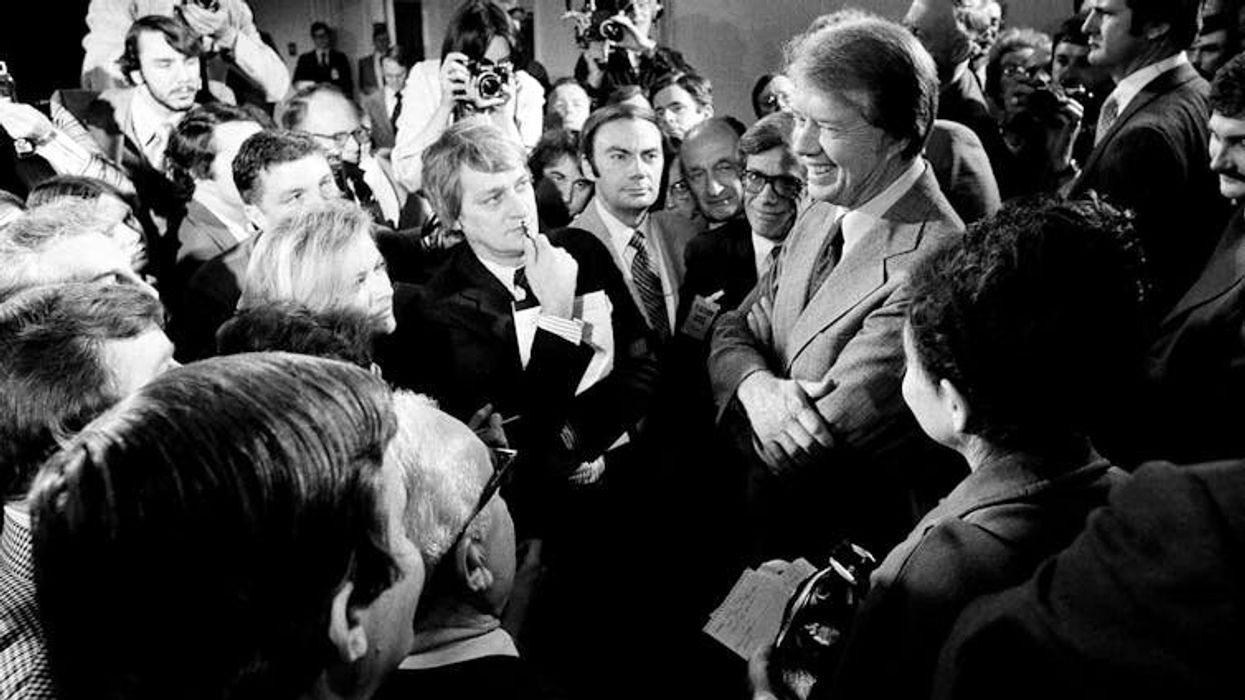
President Jimmy Carter, right, surrounded by journalists after announcing he was lifting the travel ban on Cuba, Vietnam, North Korea and Cambodia, March 9, 1977. 
AP Photo/file

December 30, 2024

Former President Jimmy Carter, who died on Dec. 29, 2024, at age 100 at his home in Plains, Georgia, was a dark horse Democratic presidential candidate with little national recognition when he beat Republican incumbent Gerald Ford in 1976.


The introspective former peanut farmer pledged a new era of honesty and forthrightness at home and abroad, a promise that resonated with voters eager for change following the Watergate scandal and the Vietnam War.

His presidency, however, lasted only one term before Ronald Reagan defeated him. Since then, scholars have debated – and often maligned – Carter’s legacy, especially his foreign policy efforts that revolved around human rights.

Critics have described Carter’s foreign policies as “ineffectual” and “hopelessly muddled,” and their formulation demonstrated “weakness and indecision.”

As a historian researching Carter’s foreign policy initiatives, I conclude his overseas policies were far more effective than critics have claimed.


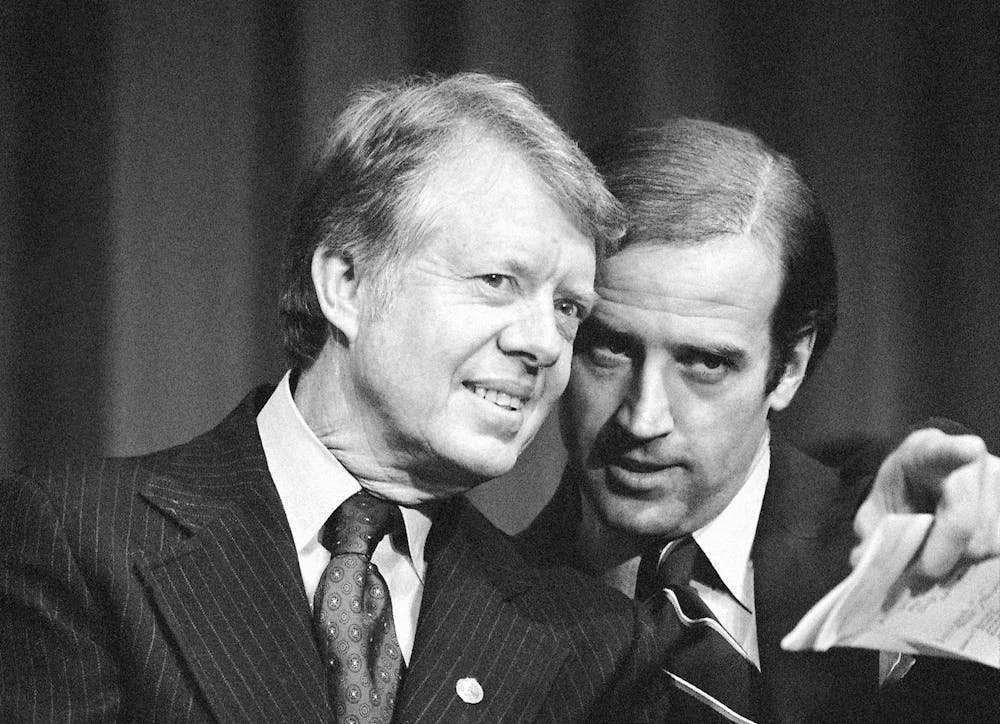
President Jimmy Carter listens to Sen. Joseph R. Biden, D-Del., as they wait to speak at fund raising reception in Wilmington, Del. on Feb. 20, 1978. AP Photo/Barry Thumma, File


A Soviet strategy

The criticism of Carter’s foreign policies seems particularly mistaken when it comes to the Cold War, a period defined by decades of hostility, mutual distrust and arms buildup after World War II between the U.S. and Russia, then known as the Soviet Union or Union of Soviet Socialist Republics (USSR).

By the late 1970s, the Soviet Union’s economy and global influence were weakening. With the counsel of National Security Advisor Zbigniew Brzezinski, a Soviet expert, Carter exploited these weaknesses.

During his presidency, Carter insisted nations provide basic freedoms for their people – a moral weapon against which repressive leaders could not defend.

Carter soon openly criticized the Soviets for denying Russian Jews their basic civil rights, a violation of human rights protections outlined in the diplomatic agreement called the Helsinki Accords.

Carter’s team underscored these violations in arms control talks. The CIA flooded the USSR with books and articles to incite human rights activism. And Carter publicly supported Russian dissidents – including pro-democracy activist Andrei Sakharov – who were fighting an ideological war against socialist leaders.


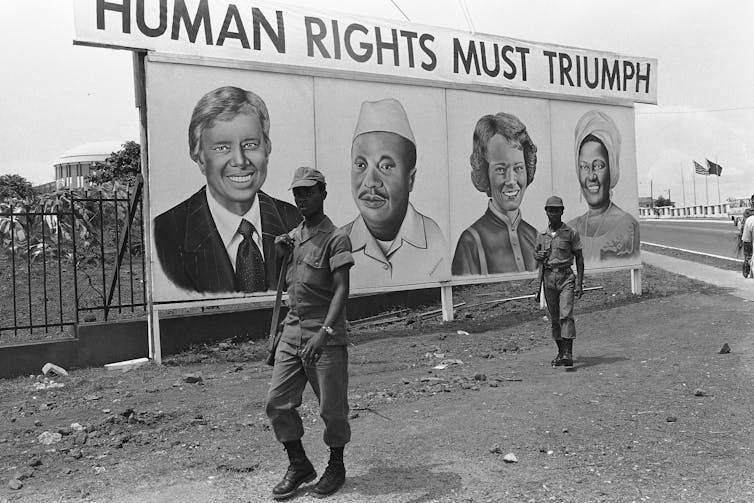
Human rights were a cornerstone of President Jimmy Carter’s foreign policy. Here, a billboard with his picture on it in Liberia. AP Photo/Michel Lipchitz

Carter adviser Stuart Eizenstat argues that the administration attacked the Soviets “in their most vulnerable spot – mistreatment of their own citizens.”

This proved effective in sparking Soviet leader Mikhail Gorbachev’s social and political reforms of the late 1980s, best known by the Russian word “glasnost,” or “openness.”
The Afghan invasion

In December 1979, the Soviets invaded Afghanistan in response to the assassination of the Soviet-backed Afghan leader, Nur Mohammad Taraki. The invasion effectively ended an existing détente between the U.S. and USSR.

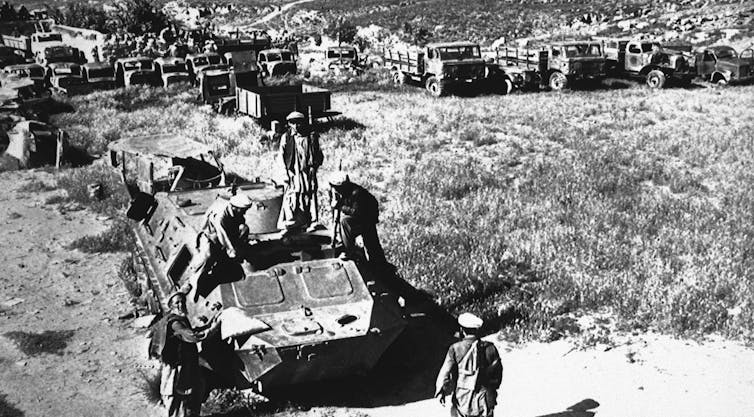
Beginning in July 1979, the U.S. was providing advice and nonlethal supplies to the mujahideen rebelling against the Soviet-backed regime. After the invasion, National Security Advisor Brzezinski advised Carter to respond aggressively to it. So the CIA and U.S. allies delivered weapons to the mujahideen, a program later expanded under Reagan

.
Afghan rebels examine a Soviet-built armored personnel carrier and scores of other military vehicles left behind when the Mujahedeen fighters overran a Soviet-Afghan garrison. AP Photo/Joe Gaal

Carter’s move effectively engaged the Soviets in a proxy war that began to bleed the Soviet Union.

By providing the rebels with modern weapons, the U.S. was “giving to the USSR its Vietnam war,” according to Brzezinski: a progressively expensive war, a strain on the socialist economy and an erosion of their authority abroad.

Carter also imposed an embargo on U.S. grain sales to the Soviets in 1980. Agriculture was the USSR’s greatest economic weakness since the 1960s. The country’s unfavorable weather and climate contributed to successive poor growing seasons, and their heavy industrial development left the agricultural sector underfunded.

Economist Elizabeth Clayton concluded in 1985 that Carter’s embargo was effective in exacerbating this weakness.

Census data compiled between 1959 and 1979 show that 54 million people were added to the Soviet population. Clayton estimates that 2 to 3 million more people were added in each subsequent year. The Soviets were overwhelmed by the population boom and struggled to feed their people.

At the same time, Clayton found that monthly wages increased, which led to an increased demand for meat. But by 1985, there was a meat shortage in the USSR. Why? Carter’s grain embargo, although ended by Reagan in 1981, had a lasting impact on livestock feed that resulted in Russian farmers decreasing livestock production.

The embargo also forced the Soviets to pay premium prices for grain from other countries, nearly 25 percent above market prices.

For years, Soviet leaders promised better diets and health, but now their people had less food. The embargo battered a weak socialist economy and created another layer of instability for the growing population.
The Olympic boycott

In 1980, Carter pushed further to punish the Soviets. He convinced the U.S. Olympic Committee to refrain from competing in the upcoming Moscow Olympics while the Soviets repressed their people and occupied Afghanistan.

Carter not only promoted a boycott, but he also embargoed U.S. technology and other goods needed to produce the Olympics. He also stopped NBC from paying the final US$20 million owed to the USSR to broadcast the Olympics. China, Germany, Canada and Japan – superpowers of sport – also participated in the boycott.

Historian Allen Guttmann said, “The USSR lost a significant amount of international legitimacy on the Olympic question.” Dissidents relayed to Carter that the boycott was another jab at Soviet leadership. And in America, public opinion supported Carter’s bold move – 73% of Americans favored the boycott.
The Carter doctrine

In his 1980 State of the Union address, Carter revealed an aggressive Cold War military plan. He declared a “Carter doctrine,” which said that the Soviets’ attempt to gain control of Afghanistan, and possibly the region, was regarded as a threat to U.S. interests. And Carter was prepared to meet the threat with “military force.”

Carter also announced in his speech a five-year spending initiative to modernize and strengthen the military because he recognized the post-Vietnam military cuts weakened the U.S. against the USSR.

Ronald Reagan argued during the 1980 presidential campaign that, “Jimmy Carter risks our national security – our credibility – and damages American purposes by sending timid and even contradictory signals to the Soviet Union.” Carter’s policy was based on “weakness and illusion” and should be replaced “with one founded on improved military strength,” Reagan criticized.

In 1985, however, President Reagan publicly acknowledged that his predecessor demonstrated great timing in modernizing and strengthening the nation’s forces, which further increased economic and diplomatic pressure on the Soviets.

Reagan admitted that he felt “very bad” for misstating Carter’s policies and record on defense.

Carter is most lauded today for his post-presidency activism, public service and defending human rights. He was awarded the Nobel Peace Prize in 2002 for such efforts.

But that praise leaves out a significant portion of Carter’s presidential accomplishments. His foreign policy, emphasizing human rights, was a key instrument in dismantling the power of the Soviet Union.

This is an updated version of a story that was originally published on May 2, 2019.

Robert C. Donnelly, Associate Professor of History, Gonzaga University

This article is republished from The Conversation under a Creative Commons license. Read the original article.


Why Jimmy Carter was actually one of the most consequential presidents in modern history


Former President Jimmy Carter image by Nir Levy, Shutterstock

December 29, 2024

This commentary piece originally ran in 2019.

There are at least two compelling reasons why this is a good time to reassess the presidency of Jimmy Carter. First, he is rapidly approaching his 95th birthday. On October 1, one month from today, he will solidify his record as America’s longest living former president. Second, during a brief but revealing dust-up between Donald Trump and Jimmy Carter recently, the President of the United States told us he thought his predecessor was a “terrible” and “forgotten” president. Having served four years in the Carter-Mondale White House, I believe strongly both assertions are dead wrong, and will argue here that Carter’s was one of the most consequential presidencies in recent history, particularly in his commitment to human rights.


When Americans think of Jimmy Carter today, they often hasten to commend his work after he left the White House. He and his wife Rosalynn founded the Carter Center in Atlanta dedicated to promoting democracy in emerging countries, to resolving international disputes peacefully, and to eradicating, especially in Africa, chronic and deadly diseases such as guinea worm. He has set a new standard for former presidents by selflessly dedicating himself to help people around the world improve their lives.

As worthy as Jimmy Carter’s post-presidency has been, it shouldn’t overshadow his time in office, which has been too often overlooked, and which stands in sharp contrast to what we see in the White House today. President Carter was well known for tackling almost every tough issue that came his way, usually regardless of the political cost:Carter struggled with a chronic energy crisis, but in the end he put the country on a clear path to energy independence.

By deregulating natural gas and appointing Paul Volcker to head the Federal Reserve, he brought inflation under control, where it remains.

Carter appointed more women, African Americans and Hispanics to judgeships and senior positions than all of his 38 predecessors coimbined.

He created new departments of Energy and Education, but perhaps the most significant structural change he made was the creation of “the modern vice presidency,” which he and Walter Mondale shaped to enable the nation’s number-two elected official to reside just steps from the Oval Office, with complete access to the president and the White House information flow, and to be available to the chief executive for advice and/or special assignment. This model has been replicated, with appropriate modifications, by almost every subsequent administration.

With use of administrative tools and the cooperation of Congress, President Carter successfully lead the effort to protect, incredibly, 140 million acres as new parklands, wildlife refuges, national forests and wilderness areas in Alaska.

Carter’s accomplishments in the international arena were equally impressive:He brought about a lasting peace between Israel and Egypt after 13 intense days at Camp David with Anwar Sadat and Menachem Begin.
Carter proposed transferring control of the Panama Canal to the people of Panama, perhaps the toughest issue of all, by his own account. The canal today under the Panamanians is an unqualified success story.
He also reached an arms control agreement with the Soviet Union and normalized diplomatic relations with China. The list goes on, all of it spelled out in Stuart Eizenstat’s splendid and thorough new book, “President Carter.” Other Carter biographies are in the works, ensuring that his presidency will not be “forgotten.”

In the administration’s final days, Vice President Mondale famously summarized the four years: “We told the truth, we obeyed the law, and we kept the peace,” words Carter had inscribed on the wall of The Carter Center. In 2015, in the introduction of his then-new book, “A Full Life,” he repeated the Mondale quote, and then wrote these words, “I would add. ‘We championed human rights.’”

It was an appropriate addition to his legacy, because, as he said later, “I decided that human rights would be the centerpiece of our foreign policy.” More than any other president since Abraham Lincoln, Carter consistently embraced human rights, whatever other issues required attention. Even Panama was a human rights issue because U.S. control of the canal embodied America’s flirtation with imperialism in an earlier era, and thus impeded our ability to promote democracy in a region enamored by authoritarianism.

After years of American neglect, the president dispatched his U.N. ambassador, Andrew Young and others to Africa to bring aid and American values, a combination that won many new friends. He sent Vice President Mondale to meet with Prime Minister Vorster of South Africa to state America’s unequivocal opposition to apartheid. Mondale also sought Vorster’s assistance in bringing majority rule to Zimbabwe/Rhodesia. Virtually all of these Carter initiatives were ultimately successful.

He ordered a reluctant U.S. Navy to rescue refugees fleeing Southeast Asia in unseaworthy boats on the high seas, seeking safe havens hundreds of miles away. The rescue operation likely saved thousands of lives.


It was this kind of principled and courageous leadership that earned Jimmy Carter the Nobel Peace Prize for his “untiring effort to find peaceful solutions to international conflicts, to advance democracy and human rights, and to promote economic and social development.”

As impressive as all this is, the administration’s record was not without setbacks. In the early years, the American people were hurt by high prices and long gas lines, painful reminders of a staggering economy and an uncertain energy future. By the end of his term, however, solid policies were in place in both sectors, and prosperity was in sight, if not yet fully in place.

Carter was committed to achieving universal health care, but believed it had to be achieved incrementally so he proposed a universal catastrophic plan ensuring that no family’s resources would be depleted by a serious illness or injury. But Senator Ted Kennedy, who planned to challenge the president for the 1980 nomination, insisted that the nation move immediately to universal coverage. Negotiations between the two broke down; Kennedy refused to compromise even after he lost his campaign for the nomination; sadly, the nation had to wait another 30 years to advance the cause of universal health care.

When the Soviet Union invaded Afghanistan, Carter imposed stiff economic sanctions, a controversial decision in the farm belt. He began a buildup of American military might -- continued by President Reagan -- that the Russians were compelled to match, eventually bringing on the economic crisis that caused the Soviet Union to disintegrate.


Perhaps most damaging to Carter, Iranians took 52 diplomats and others from the U.S. embassy in Tehran hostage for 444 days. Working patiently to secure their release through diplomacy with no results, he finally ordered the military to plan and execute a risky rescue mission, which tragically fell victim to desert sand fouling the helicopter engines on which the mission depended. Dejected but still determined, Carter continued to negotiate for the release of the hostages, which he ultimately secured, although the Americans did not clear Iranian air space until minutes after Carter officially left office.

If Jimmy Carter had a flaw as president, it wasn’t in the areas of policy or principle, but rather in the politics surrounding an issue. He believed the campaign was over and he hated hearing political arguments in policy discussions. I remember sitting in the cabinet room early on when someone made a political point about welfare reform; the president looked at him with his steely blue eyes and said, “I want to hear substantive arguments, I’ll take care of the politics.” Well, sometimes he did and sometimes he didn’t, but I saw him soon come to recognize that effective governance requires a mix of both policy and politics, in the right measure at the right time. He continued to grow in the office, and never strayed from what he thought was best for the country. Through four years in the White House, I never failed to feel proud to be there and to work for this president.

It was true what Mondale had said, as amended: “We told the truth, we obeyed the law, we kept the peace and we championed human rights.” Those words deserve serious reflection, because they bear virtually no resemblance to what we see in the presidency today, certainly not on our southern border.

Richard Moe served from 1977 to 1981 as chief of staff to Vice President Walter Mondale and as an assistant to President Jimmy Carter. He is the author, most recently, of Roosevelt’s Second Act – The Election of 1940 and the Politics of War.