Is Russia Helping China Build a Hybrid-Nuclear Submarine?
[By Dr. Sarah Kirchberger and CAPT Christopher P. Carlson, USN (Ret)]
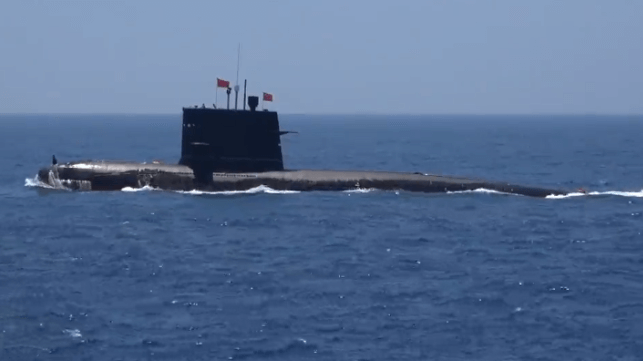
On September 27, 2024, news broke that a previously unreported new type of Chinese nuclear-powered submarine, dubbed the “Type 041,” had suffered a major mishap at its fitting out pier at the Wuchang shipyard in Wuhan, according to unnamed Pentagon sources. Submarine expert Thomas Shugart had previously spotted an unknown submarine with a distinct x-shaped stern at Wuchang Shipyard from satellite imagery taken on 26 April 2024, and days later reported unusual crane activity at the same pier location from June 2024 imagery, speculating that the new boat suffered a serious incident.
Even more intriguing and consequential than the question of whether a submarine incident of some sort actually did occur at Wuchang or not, is however another issue: What type of “nuclear-powered submarine” could this new design possibly be?
China watchers were quick to point out that the Wuchang Shipyard in Wuhan had not hitherto built any nuclear submarines, although the shipyard’s facilities were completely rebuilt at a new location (from 2012-2020) and massively enlarged. All Chinese nuclear-powered attack submarines (SSN) and ballistic missile submarines (SSBN) have so far been constructed exclusively at the Bohai Shipyard at Huludao. The imagery of the new submarine makes it clear it is too small for a SSN, and is similar in size to China’s Type 039A/B/C Yuan series of conventionally powered submarines. Another interesting indicator was the reported type number – “041” – which is a continuation of the traditional numbering scheme carried by China’s diesel-electric submarines. By contrast, China’s nuclear-powered subs, whether SSNs or SSBNs, all have official type numbers starting with “09.” The next-generation Type 095 SSN and Type 096 SSBN are possibly already under construction at the Bohai Shipyard in Huludao, and there is no plausible suggestion that the smaller, unknown boat observed in Wuhan could represent either of those two platforms, given the larger estimated displacement of the Type 095 and Type 096 compared with the previous generation of Chinese SSNs and SSBNs.
A new type of nuclear battery AIP propulsion?
It would have been easy to dismiss the news of a supposedly nuclear-powered Type 041 submarine built in Wuhan as misinformation, were it not for the fact that several years earlier Chinese sources had hinted at a project for developing small, low power auxiliary nuclear reactors for conventional submarines, replacing the Stirling engine air-independent power system (AIP) that China developed based on a technology transfer from Sweden during the 1980s. A 2017 report by Richard D. Fisher described some details of such a plan based on slides from an academic lecture given by retired Rear Admiral Zhao Dengping.
Despite successfully developing a Stirling engine-based AIP system, China is known to have struggled with developing a more advanced, fuel cell-based AIP system as is currently in use with the German, South Korean and Singaporean navies, among others. Neither has China deployed lithium-ion batteries aboard its submarines, as pioneered by Japan. Here, Chinese analyses have stressed unresolved issues regarding the danger of thermal runaway, which poses heightened risks of a severe fire aboard a submerged submarine.
In light of such technical challenges, China may have decided to forgo developing high power density fuel cells or even more powerful Stirling engines for submarine applications, even though lithium-ion batteries are probably still on the table, opting for a different solution altogether by developing a nuclear battery.
Interestingly, as reported by R.D. Fisher, Rear Admiral Zhao Dengping’s lecture slides described just such a nuclear battery project. Of the presentation slides posted online, three dealt specifically with a small-scale nuclear reactor for conventional submarine platforms. One slide showed a basic schematic diagram that depicted a possible layout of the nuclear-powered electric propulsion plant. The reactor itself is described as a low pressure, low temperature design that employs natural circulation in the primary loop. Steam is generated, however, through an intermediate loop that appears to be in a separate compartment, which is then sent to a secondary loop with a conventional steam driven turbine generator in yet another compartment. While this design suggests an emphasis on safety, it does so at the expense of internal volume requirements and thermodynamic efficiency.
It is reasonable to ask if these slides accurately reflect Chinese intentions. With the benefit of hindsight, the response would be a confident “yes” because every slide posted from RADM Zhao’s lecture showed a platform or system that was then in service, undergoing testing, or was in the advanced research and development stage. For example, Zhao presented a slide that discussed a large deck amphibious assault ship – larger than the Type 075. The computer-generated graphic on the slide is very similar to the Type 076 currently under construction at the new Hudong-Zhonghua shipyard on Changxing Island. Another slide depicted an anti-ship ballistic missile (ASBM) engagement launched from a surface ship. This too has come to fruition when a video of a Type 055 launching an ASBM was posted in April 2022. These two examples of a platform or system that hadn’t been known to exist in 2017, but became evident years later, demand that the small reactor concept be taken seriously.
Some seven years after RADM Zhao’s slides became public, on 24 April 2024, a Chinese news article claimed that, in honor of the 75th birthday of the PLA Navy, a “new nuclear-powered submarine installed with a domestically produced small nuclear reactor” and based on the hull design of the conventionally powered “Type 039C” AIP sub was in development at the Wuchang shipyard in Wuhan. Note, this article came out a mere two days before the satellite images of the shipyard were taken and subsequently analyzed by Tom Shugart. The article compares the new Type 041 submarine design to an enlarged French Rubis class and states that its submerged displacement would be around 4,000 tons and thus larger than the Rubis, allowing it to integrate more capable sensor and weapon systems. The article describes the small auxiliary reactor as a “low-temperature, low-pressure, subcritical nuclear reactor” to “directly charge” the boat’s battery rather than drive the propeller. This describes a nuclear battery AIP system that allows the battery to be charged continuously while the boat is submerged and would eliminate the need to surface every 20 days as in the case of China’s Stirling AIP submarines.
The article goes on to say the first one or two units of the Type 041 would likely be used as prototypes for weeding out technical issues before any further units would be produced. It speculates that if the development is successful, even older conventional submarines could be gradually retrofitted with a nuclear battery AIP system. The article states that this could potentially transform China’s conventional submarine fleet into a fully nuclear-powered fleet. Despite some questionable technical conclusions by the author, the article is consistent with Zhao’s lecture material.
What is a nuclear battery?
The reference to a “small” reactor on the Type 041 should be understood in the context of existing submarine reactors, which produce between 70 – 190 megawatts of thermal power (MWt) depending on the design and all belong to the category of microreactors. These reactors are defined by the International Atomic Energy Agency as having a power generation capability of less than 50 megawatts of electrical power (MWe), or approximately 220 MWt. Most microreactors are in the 1 – 20 MWe (≈6 – 125 MWt) range; the nuclear battery resides at the bottom end of this category. Nuclear batteries are loosely defined as nuclear reactors that produce up to 20 MWt or approximately 3 MWe. These reactors are indeed “small” in comparison to those on larger SSNs and SSBNs and can fit into a Type 039A/B/C submarine pressure hull that is about 7.1 meters in diameter.
While rather scarce, nuclear batteries have been used in submarine and submersible designs before: the American NR-1 (≈1 MWt), the Soviet Project 651E Juliett with the VAU-6 (4.9 MWt) boiling water reactor, the Project 20120 Sarov, and the collection of deep-diving submersibles of the Soviet/Russian Main Directorate of Deep-Sea Research or GUGI, including Project 1851 X-Ray, Project 1851.1 Paltus, Project 1910 Uniform, and Project 1083.1 Losharik, reported to have a pressurized water reactor in the 10 – 15 MWt range. Lastly, Canada conducted considerable research in the late 1980s to develop a “baby nuke” submarine using an Autonomous Marine Power Source or AMPS-1000 powerplant with a maximum design power of 10.8 MWt.
Based on RADM Zhao’s description that the small reactor being considered operates at low pressure and low temperature, it is reasonable to assume a maximum thermal power rating of 10 – 11 MW – consistent with Soviet and Canadian experience. The thermodynamic efficiency would be on the low side for historical nuclear batteries, around 12% – 13%, due to the losses involved with the additional intermediate steam generation loop as shown in the system diagram slide. Despite the low efficiency, such a nuclear power plant could generate about 1.3 MWe, four to five times that of any conventional AIP system. The hull size of the Type 041 revealed in satellite imagery is sufficiently large to accommodate the design as shown, but even with the additional 7 meters in length, the Stirling engines and cryogenic oxygen storage would have to be removed to free up additional volume.
Operational advantages of a nuclear battery
All types of advanced conventional AIP propulsion systems, whether fuel cell, Stirling engine, or steam turbine based, offer extended submerged endurance to small and medium size submarines when compared with traditional diesel-electric propulsion systems, such as that fitted to the Project 636M Kilo-class China imported from Russia. The latter typically needs to come up to snorkeling depth every day for two to three hours to recharge its batteries, assuming a 10% – 12% indiscretion rate, thus greatly increasing the risk of detection. At best, a Kilo-class submarine can stay submerged at slow speed for about three days before needing to snorkel. Chinese analysts have in the past lamented the fact that this limitation exposes Chinese submarines to adversary anti-submarine warfare (ASW) forces just when they are about to reach deeper diving depths in the Okinawa Trough after leaving port in East China. Any AIP system would help to alleviate this predicament, but the maximum submerged transit speed of a submarine utilizing a conventional AIP system is still only 4 – 6 knots. A nuclear battery AIP system as described above could support submerged transit speeds of up to 9 – 10 knots while meeting all hotel loads and the electrical power requirements of the nuclear plant auxiliaries.
Another advantage that is often not discussed is that there is ample electrical power available to outfit a Type 041 with a full spectrum of atmospheric control equipment. Conventional AIP boats still need to ventilate daily to renew the atmosphere with fresh air, unless the crew relies on a limited supply of consumable chemical systems to purge carbon dioxide and carbon monoxide from the atmosphere. Oxygen isn’t a problem as the crew can vent off a little from the AIP cryogenic oxygen tank to support their needs. A Type 041 can feasibly be fitted with compact oxygen generators, carbon dioxide scrubbers, and carbon monoxide-hydrogen burners, thereby giving the submarine complete independence from outside air.
Lastly, despite what the advertising brochures say, conventional AIP systems do not charge submarine storage batteries well. They can keep a fully charged battery topped off, but recharging a battery that has been significantly discharged is really not a viable option. Russian brochure data on the Project 636 Kilo states that it would take about 12 hours to recharge a completely discharged battery; this is with most of the output of two 1.5 MW DC generators run by the diesel engines. A conventional AIP system would be hard pressed to produce even a tenth of the power that diesel-driven DC generators can provide – this means multiple days to fully recharge a very low battery. A nuclear battery AIP system would be more capable of recharging a battery, but it will still take longer than using the diesel-driven DC generators. The main advantage in this case is the nuclear AIP system could support sufficient speeds to move the submarine clear of a possible ASW threat so that the diesel generators could be used to recharge the battery.
This severe limitation is why most AIP submarine crews tend to operate their boat like a traditional diesel-electric submarine for as long as they can, holding the AIP system in reserve for those tactical situations that demand greater stealth. By contrast, a nuclear battery AIP system turns this operating concept on its head. The crew can rely on the reactor to meet all their operating needs, allowing them to hold the battery in reserve to deal with those rare occasions where higher speed sprints are required to approach a target. In other words, a “SSn,” if you will, can patrol like a larger nuclear attack submarine, but because it lacks high-speed endurance would have to resort to conventional submarine approach tactics as the situation demands.
Due to their smaller size and comparative quietness, a SSn is better suited than larger SSNs to area-denial missions in shallow, coastal waters where the environment would make it difficult to detect a nuclear battery AIP platform; this makes them likewise useful for intelligence and mining missions. Whenever greater speed and longer steaming distances are required, however – for instance when hunting an adversary carrier strike group or tracking and trailing SSBNs on the high seas – their limitations render the SSn unsuitable. China, in light of its complex maritime geography of shallow littorals, does have an enduring requirement to operate both smaller coastal submarines for area denial missions in the Near Seas, as well as larger SSNs and SSBNs for its nuclear deterrence and missions in the Far Seas.
Could China have developed a nuclear battery AIP alone?
China has had difficulties in designing modern, reliable, and safe nuclear reactors for its next generation SSNs and SSBNs and reportedly has turned to Russian assistance in the recent past. This raises the question whether Russian help was also involved in developing China’s nuclear battery AIP submarine propulsion. Although open-source information falls short of a definitive answer, some indications hint at Russian assistance.
Firstly, the Soviet Union, and later Russia, have the most operational experience with this type of propulsion plant. The Soviet and Russian navies have operated nine relevant submarines, including the Project 651E Juliett and the Project 20120 Sarov, with the majority assigned to GUGI. Given that most of these nuclear battery plants were designed and built in the 1980s, Russia’s defense establishment would likely feel comfortable in sharing detailed design information on the older systems as well as providing technical support to China’s endeavors.
Secondly, Russia has previously transferred other types of nuclear propulsion technology to China. CMSI reported in 2023 that an agreement concluded in 2010 between Rosatom and the China Atomic Energy Agency for the expansion of Russian-Chinese joint nuclear power programs – including floating nuclear power plants – gave China “access to detailed technical information on the nuclear reactors Russia was installing on their nuclear power barges and new icebreakers.” These reactors either didn’t fully address China’s military needs or were too large for installation aboard a submarine, but nonetheless this transfer indicates a general willingness of Russia to provide China sensitive nuclear reactor technology.
Thirdly, there have been announcements that China and Russia are collaborating on a novel type of small submarine design. Already in 2015, reports indicated a Chinese interest in procuring four Lada-class submarines from Russia – a purchase that was never followed through in light of the Lada-class’s vexing technical issues. However, on August 25, 2020, quoting an official representative of the Federal Service for Military-Technical Cooperation (FSMTC), Russian state media announced that Russia and China were “jointly designing a new generation non-nuclear submarine.”
Although no further public information about this new type of jointly developed conventional submarine has since been disclosed, in October 2020, Vladimir Putin gave an intriguing answer to a question on Russian-Chinese relations at the 17th Valdai Annual Meeting:
“We have achieved a high level of cooperation in the defence industry—I am not only talking about the exchange or the purchase and sale of military products, but the sharing of technologies, which is perhaps most important. There are also very sensitive issues here. I will not speak publicly about them now, but our Chinese friends are aware of them. Undoubtedly, cooperation between Russia and China is boosting the defence potential of the Chinese People’s Army, which is in the interests of Russia as well as China.”
Though the nature of these “very sensitive” technologies remains unclear, submarine technology certainly fits the description, and in September 2024, news reports indeed indicated that Russia was supporting China with improving the nuclear propulsion plant of its next-generation Type 096 SSBN.
Fourth and lastly, Russia and China have for several years steadily enhanced their collaboration in sensitive anti-submarine warfare related technology areas – including fiber-optic hydrophones and underwater communication. This could be related to a general trend in their subsurface warfare cooperation.
Could the jointly developed Russian-Chinese “new generation non-nuclear submarine” be the Type 041? The apparent contradiction between the Russian statements and the arguments presented in this article could be accounted for if neither the Chinese nor the Russians consider this a traditional nuclear submarine, but a conventional submarine that uses a nuclear battery AIP system. Semantics? Perhaps, but this premise would also provide a rationale as to why the Type 041 was constructed at Wuchang instead of Huludao.
At this stage, it is not possible to determine whether the reported nuclear-powered Type 041 submarine spotted at Wuchang is related to the joint submarine collaboration that was announced in 2020. This new submarine could be solely a Chinese project, or a Chinese project that received some technical aid from Russia. None of these possibilities can be excluded.
The mutual benefits of collaboration on sensitive submarine technology
Russia, despite its superiority in the field of building nuclear submarines, has long struggled to develop AIP propulsion for its smaller conventional submarines. Russian industry representatives have envied China’s successful Stirling engine-based AIP system, going so far as to admit that the Rubin Design Bureau, when trying to develop fuel cell AIP and lithium-ion battery technology at the same time, was spreading itself too thinly and therefore did not succeed.
China, for its part, has lagged behind Russia in nuclear propulsion technology and has in the past received help from Russia in that area. The known transfers of Russian nuclear reactor technology might therefore just be the tip of the iceberg. There are thus clearly potential synergies that could be exploited. Joining forces to improve Chinese AIP with a small auxiliary nuclear reactor might be a project in which both sides could bring their respective strengths to the table while each profiting from a common submarine design. This hypothesis needs to be evaluated in the light of future information as it becomes available.
Since at least 2023, there has been speculation about the possibility that Russia might opt to rejuvenate its war-depleted fleet by ordering naval vessels from Chinese shipyards, which can offer competitive prices and superior production capacity, even for highly complex warships, when compared with cash-strapped Russian yards. On July 5, 2023, a Chinese news article reported a visit by Russia’s Navy Commander-in-Chief Yevmenov to the Jiangnan shipyard in Shanghai. The article frankly discussed the possibility that Russia might opt for Chinese shipyard orders to solve its production capacity problems – noting however that this would be possible only “if Russia can overcome its pride.” A joint submarine design could, however, be produced in parallel by Chinese and Russian shipyards.
Opting for an advanced, nuclear battery AIP design would also make operational sense for Russia, not least because the whole concept originated from the Soviet Union in the 1970s.
Russia is at a disadvantage vis-à-vis NATO submarines in the shallow and confined undersea domain of the Baltic Sea, where its traditional nuclear-powered submarines can’t operate as efficiently as in deeper water. For that theater alone, a more capable, smaller AIP submarine would be desirable – and likewise for the Black Sea, Barents Sea, and parts of the Arctic Ocean, where Russia also routinely encounters NATO navies. In particular the recent Norwegian-German Type 212CD class submarine cooperation would be a serious concern for Russia on its northern flank. The pressure of having to meet those challenges, against the backdrop of Russia’s increasingly lopsided dependency on Chinese political and economic support due its war against Ukraine and Russia’s reduced shipbuilding production capacity, may have induced Russia to agree to a joint development of nuclear battery AIP submarines.
Even without an official agreement, there is the possibility that Russia’s arms industries could be faced with a brain drain of Russian specialists towards China, as Russia’s economic crisis worsens. There could thus be informal, behind-the-scenes Russian involvement even in a “purely indigenous” Chinese submarine program.
Conclusion
So far, the limited information on a new Type 041 submarine spotted on satellite imagery at Wuchang Shipyard yields more questions than answers. The above musings should be treated as hypotheses, to be revised as new data emerges. However, given the rapid modernization of China’s military, and particularly its navy, it seems advisable to keep an eye on the likelihood that the Type 041 submarine could be sporting a novel, auxiliary nuclear powerplant in place of the Stirling engine previously employed in its AIP propulsion system. Furthermore, such an improvement may have been derived from Soviet (and now Russian) technology, which pioneered auxiliary nuclear batteries for submarines during the 1980s. And if that were the case, the Type 041 may be the outcome of a Russian-Chinese collaboration on a new type of conventional submarine as announced by Russian state media in 2020.
Lastly, even if the Type 041 is indeed a novel kind of nuclear-powered small submarine, the Chinese SSN and SSBN programs (Type 095 and 096) will almost certainly continue because they are independent submarine development projects that are designed for distinctly different operational roles. Indeed, suggestions that the reported flooding casualty suffered by the Type 041 constitutes a major setback in China’s nuclear submarine program is overstated. The development of a smaller nuclear AIP submarine is completely segregated from the Type 095 and 096 production effort – an effort the Huludao Shipyard was enhanced to meet. At worst, the Type 041 mishap is a minor speedbump in China’s overall submarine modernization plans.
If the theories on the nuclear battery propulsion system presented above are confirmed, then the Type 041 SSn is neither fish, nor fowl. It would possess some, but not all, of the benefits associated with a traditional nuclear-powered attack submarine. In short, it would be a tertium quid – a third something – designed to specifically address China’s geographical and geopolitical concerns in the Near Seas.
Dr Sarah Kirchberger is Director of the Institute for Security Policy at Kiel University (ISPK) and Vice President of the German Maritime Institute (DMI). She is the author of Assessing China’s Naval Power and editor of Russia-China Relations: Emerging Alliance or Eternal Rivals?. Formerly an Assistant Professor of Sinology at the University of Hamburg, she has also served as a naval analyst with shipbuilder TKMS. She holds a M.A. and a PhD in Sinology from the University of Hamburg.
Christopher Carlson is a retired U.S. Navy Reserve captain and Department of Defense naval systems engineer. He began his navy career as a submariner and transitioned to the scientific and technical intelligence field in both his reserve capacity and in his civilian job. He is one of the co-designers, with Larry Bond, of the Admiralty Trilogy series of tactical naval wargames – Harpoon V, Command at Sea, Fear God & Dread Nought, and Dawn of the Battleship. He has also authored numerous articles in the Admiralty Trilogy’s bi-annual journal, The Naval SITREP, on naval technology and combat modeling.
This article appears courtesy of CIMSEC and may be found in its original form here.
The opinions expressed herein are the author's and not necessarily those of The Maritime Executive.

 Courtesy Morspas