Friday, January 31, 2025


Life cycles of some insects adapt well to a changing climate. Others, not so much.


Grasshoppers that overwinter as juveniles have a head start on those that emerge in the spring.


University of California - Berkeley

Rocky Mountain grasshopper 

image: 

A grasshopper, Melanoplus boulderensis, typical of the Colorado Rocky Mountains.

view more 

Credit: Thomas Naef, 2022


As insect populations decrease worldwide in what some have called an "insect apocalypse," biologists are desperate to determine how the six-legged creatures are responding to a warming world and to predict the long-term winners and losers.

A new study of Colorado grasshoppers shows that, while the answers are complicated, biologists have much of the knowledge they need to make these predictions and prepare for the consequences.

The findings, published Jan. 30 in the journal PLOS Biology, come thanks to the serendipitous discovery of 13,000 grasshoppers all collected from the same Colorado mountain site between 1958 and 1960 by a biologist at the University of Colorado Boulder (CU Boulder). After that scientist's untimely death in 1973, the collection was rescued by his son and donated to the CU Museum, where it languished until 2005, when César Nufio, then a postdoctoral fellow, rediscovered it. Nufio set about curating the collection and initiated a resurvey of the same sites to collect more grasshoppers.

The newly collected insects allowed Nufio and his colleagues — Caroline Williams of the University of California, Berkeley, Lauren Buckley of the University of Washington in Seattle and postdoctoral fellow Monica Sheffer, who has an appointment at both institutions — to assess the impact of climate change over the past 65 years on the sizes of six species of grasshopper. Because insects are cold-blooded and don't generate their own heat, their body temperatures and rates of development and growth are more sensitive to warming in the environment.

Despite much speculation that animals will decrease in size to lessen heat stress as the climate warms, the biologists found that some of the grasshopper species actually got larger over the decades, taking advantage of an earlier spring to fatten up on greenery. This worked only for species that overwinter as juveniles — a stage called nymphal diapause — and thus can get a head start on chowing down in the spring. Species that hatch in the spring from eggs laid in the fall — the egg diapausers — did not have this advantage and became smaller over the years, likely as a result of vegetation drying up earlier.

"This research emphasizes that there will certainly be species that are winners and losers, but subgroups within those species populations, depending on their ecological or environmental context, will have different responses," Sheffer said.

The authors of the new study predicted much of this based on the life cycles of the grasshoppers and the environmental conditions at the site.

"We sat down and looked at all that was known about the system, such as elevational gradients and how that should modify responses and how different grasshoppers might respond, with all the wealth of information we knew about their natural history. And while not all our predictions were supported, many of them actually were," said Williams, the John L. and Margaret B. Gompertz Chair in Integrative Biology at UC Berkeley.

"Understanding what species are likely to be winners and losers with climate change has been really challenging so far," Buckley said. "Hopefully this work starts to demonstrate some principles by which we can improve predictions and figure out how to appropriately respond to ecosystem changes stemming from climate change."

Rescued grasshoppers

The 65-year-old grasshopper collection was assembled by entomologist Gordon Alexander of CU Boulder over three summers. He not only collected and mounted the specimens from plots in the Rocky Mountains near Boulder but also documented the timing of six different life stages of the grasshoppers. His death in a plane crash in 1973 left the specimens, pinned in neat rows in 250 wooden boxes, in limbo until Nufio came across them in 2005 and recognized their value if they could be compared to grasshoppers today.

Museum collections have become invaluable for long-term studies of the effects of climate change, as exemplified by a survey of mammals, birds, reptiles and amphibians conducted between 1904 and 1940 by Joseph Grinnell of UC Berkeley's Museum of Vertebrate Zoology. Recent resurveys of the same areas 100 years later that Grinnell visited helped biologists document the effects of climate change on California wildlife.

Nufio and many others eventually collected about 17,000 new grasshopper specimens from the same or similar sites around Boulder. While the new paper is the first to report the grasshopper size changes between 1960 and 2015, the authors leveraged previous studies in the lab and from experimental plots to understand why they found the patterns they did.

The insects were from a large group of non-descript grasshoppers in the Acrididae family that are so-called short-horned grasshoppers. Most were generalized grazers, though some specialized in grasses. Two species (Eritettix simplex and Xanthippus corallipes) were nymphal diapausers, achieving adulthood as early as May; two (Aeropedellus clavatus and Melanoplus boulderensis) were early season egg diapausers, maturing in mid-June; and two (Camnula pellucida and Melanoplus sanguinipes) were late season egg diapausers, maturing in late July.

The researchers found that the nymphal diapausers increased in size at lower elevations, around 6,000 feet, while the early and late emergers from overwintering eggs decreased in size over the decades at these elevations.

"For those that come out in late August, when it's very crispy and dry and we get very hot temperatures, we saw the most negative impacts of climate change," Williams said.

One thing that surprised the researchers, however, was that none of the species increased in size at higher elevations, up to about 13,000 feet, despite the fact that summer warming due to climate change is greater at higher elevations. This may be because, at higher elevations, snow inhibits early season greening up, reducing the food supply. The results confirm what the team found when it caged grasshoppers at various elevations to see how they adapted to elevational changes in heat and dryness.

"The data are consistent with grasshoppers either being able to take advantage of warming by getting bigger and coming out earlier, or for grasshoppers to experience stress and get smaller," Buckley said.

Other experiments performed by Buckley on butterflies show some of the same trends.

"We find a pretty similar message with butterflies, which is hopeful to me, in that if we can consider some basic biological principles, we really increase our ability to predict climate change responses," she said.

The team is continuing its collaboration to understand the metabolic, biochemical and genetic changes that underlie the size changes.

"Using those museum collections allowed us to go back in time to compare exactly the same sites — there hadn't been any changes in the land use over this 60-year period of warming — using exactly the same methodology," Williams said. "Having those unique historical specimens enabled us to look at the changes through time."

Other co-authors of the study are Julia Smith of the University of Washington; Simran Bawa of UC Berkeley; and Ebony Taylor, Michael Troutman and Sean Schoville of the University of Wisconsin, Madison. The work was supported by the National Science Foundation (DEB-1951356, DEB-1951588, DEB-1951364).


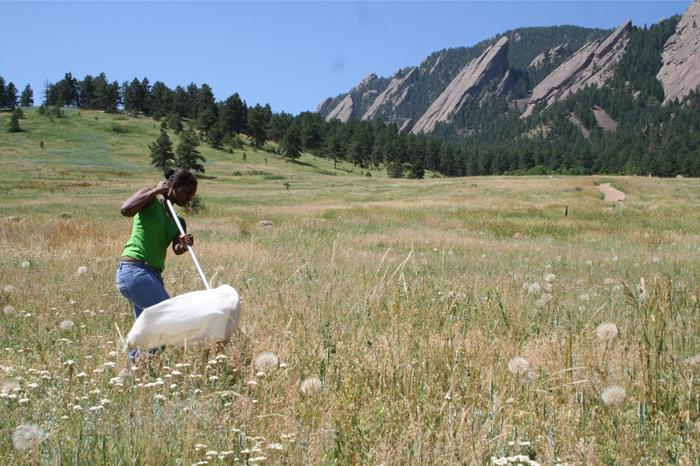
Collecting grasshoppers in the late 1950s  


Collecting grasshoppers in 2007 


A portion of the 13,000 grasshoppers collected by the late Gordon Alexander of CU Boulder. The 65-year-old grasshoppers were compared with contemporary insects to assess the effect of climate change on their size and range.

Credit

César Nufio


NIH-funded clinical trial will evaluate new dengue therapeutic


NIH/National Institute of Allergy and Infectious Diseases
Aedes mosquito and renderings of mature dengue virus particles 

image: 

A creative layout featuring a photo of an Aedes mosquito, which can transmit the dengue virus, and cryoelectron microscopy renderings of mature dengue virus particles. Groups of dengue virus particles (beige) captured through transmission electron microscopy (courtesy CDC) appear faintly in the outer background.

view more 

Credit: NIAID


A clinical trial supported by the National Institutes of Health (NIH) is testing an experimental treatment designed to help people suffering the effects of dengue, a mosquito-borne viral disease. The study is supported by NIH’s National Institute of Allergy and Infectious Diseases (NIAID), and will involve exposing adult volunteers to a weakened strain of dengue virus that causes a mild form of the disease and administering an investigational therapeutic at various doses to assess its safety and ability to lessen symptoms.  

Dengue is transmitted via infected Aedes mosquitoes and sickens as many as 400 million people each year, primarily in tropical and subtropical parts of the world, according to the U.S. Centers for Disease Control and Prevention. In 2024, dengue cases surged to record levels in the Americas with local U.S. transmission reported in Arizona, California, Florida, Hawaii, and Texas. Dengue is endemic in Puerto Rico, which reported nearly 1,500 cases last year. Most people with dengue do not develop symptoms, but those who do commonly experience severe headache and body aches, nausea and vomiting, fever and rash. One in 20 people who get sick with dengue progress to severe illness, which may lead to shock, internal bleeding, and death. There is currently no Food and Drug Administration-approved treatment for dengue. 

“When caring for a patient who is critically ill with dengue, healthcare providers have few options other than providing supportive care,” said NIAID Director Jeanne Marrazzo, M.D., M.P.H. “We must find safe and effective therapeutics to provide much-needed relief to people suffering from dengue.”

The new clinical trial will test the ability of AV-1, an investigational human monoclonal antibody therapeutic developed by AbViro (Bethesda, Maryland), to mitigate clinical symptoms when administered before and after dengue virus infection. The results of a previously completed NIAID-supported Phase 1 trial indicated that AV-1 is safe in humans, providing the basis for the new clinical trial to test its safety and efficacy. 

The Phase 2 clinical trial will enroll at least 84 healthy adult volunteers at two sites: the Johns Hopkins Bloomberg School of Public Health Center for Immunization Research in Baltimore, and the University of Vermont Vaccine Testing Center in Burlington. Following an initial screening and physical examination, volunteers will be randomly assigned to one of two groups. One group will receive AV-1 one day prior to being challenged with a mild strain of dengue virus, and the other will receive AV-1 four days after being challenged with the dengue virus. Each group will be further subdivided to receive 100 mg, 300 mg, or 900 mg of AV-1, delivered in a 60-minute intravenous infusion. For each of the three dosage levels, 12 participants will receive the investigational monoclonal antibody, and two will receive a placebo.

Before or after AV-1 dosing, each volunteer will receive an injection of attenuated (weakened) dengue virus. In earlier studies using this challenge virus, most volunteers developed a rash, and some had other mild dengue symptoms, such as joint and muscle pain or headache. None of the volunteers developed dengue fever or severe dengue. 

Volunteers will participate in regular follow-up visits with study staff for at least 155 days to carefully monitor the effects of the investigational monoclonal antibody. Through physical exams, diary cards and blood samples, researchers will document how the volunteers’ immune systems respond to the dengue virus challenge, how quickly the virus vanishes from their bloodstream and any symptoms they may experience. The researchers will use this information to determine how AV-1 affects the volunteers’ ability to recover from dengue compared to placebo and to determine the dosages at which AV-1 may be effective.

If AV-1 shows promising results in this clinical trial, researchers may pursue further clinical evaluations of its safety and efficacy against dengue virus. For more information about the study, visit ClinicalTrials.gov and search the identifier NCT06799741.


NIAID conducts and supports research—at NIH, throughout the United States, and worldwide—to study the causes of infectious and immune-mediated diseases, and to develop better means of preventing, diagnosing and treating these illnesses. News releases, fact sheets and other NIAID-related materials are available on the NIAID website. 

About the National Institutes of Health (NIH): NIH, the nation's medical research agency, includes 27 Institutes and Centers and is a component of the U.S. Department of Health and Human Services. NIH is the primary federal agency conducting and supporting basic, clinical, and translational medical research, and is investigating the causes, treatments, and cures for both common and rare diseases. For more information about NIH and its programs, visit https://www.nih.gov/. 

NIH...Turning Discovery Into Health®


Tigers in the neighborhood: How India makes room for both tigers and people


India's wild tiger population is rising despite habitat pressure. This success stems from ecological restoration, economic initiatives, political stability, and cultural reverence for tigers, fostering coexistence between humans and predators.


Aarhus University

Tiger 

image: 

Tigers now share space with nearly 60 million people in India. A camera trap photograph of tiger in the outskirts of the city of Bhopal in India. 

view more 

Credit: Yashpal Rathore


In India, tigers haven’t just survived − they’ve made a comeback. Despite a growing population and increasing pressure on their habitats, the number of wild tigers is rising. The reason? A combination of ecological restoration, economic initiatives, and political stability. And just as important: a deeply rooted reverence for tigers that has fostered a culture where humans and predators can coexist.

How do you protect an endangered species when that species is a tiger − a predator that also poses a threat to humans? India has found a way by combining protected reserves with areas where tigers and people share space. The result? A 30% increase in the tiger population over the past two decades.

According to a new study published in Science, India is now home to approximately 3,700 tigers, accounting for 75% of the world’s wild tiger population. This demonstrates that even in the world’s most populous country, it is possible to protect large carnivores.

A Plan B for Tigers

India’s tiger conservation strategy combines two approaches: some areas are strictly protected reserves, while others are multi-use landscapes where tigers and people share space. And this isn’t just for the benefit of the tigers.

“The advantage of combining these two methods is that reserves act as a source of tigers for surrounding areas. And if coexistence no longer works, the reserves provide a fallback option − ensuring that tigers are not at risk of extinction,” explains Ninad Mungi, assistant professor at Aarhus University and co-author of the study (see fact box).

Today, 45% of India’s tiger-occupied landscapes are shared with around 60 million people.

What Makes Coexistence Possible?

According to researchers, human population density alone is not what determines whether tigers can thrive – it’s people’s lifestyles, economic conditions, and cultural attitudes that shape their willingness to share space with large carnivores.

In relatively prosperous regions where ecotourism and government compensation schemes generate income, tolerance for tigers is much higher.

In fact, for some Indian farmers, losing cattle to a tiger does not essentially spell disaster. Farmers who keep their livestock in barns and enclosures are rarely affected by tigers. However, when cattle are released to graze in tiger-inhabited areas, and if a tiger eats it, the farmer receives financial compensation from the government – turning a loss into a gain.

The study shows that tiger populations are growing fastest in areas that:

  • Are close to tiger reserves
  • Have abundant prey and suitable habitats
  • Have relatively low human population density
  • Enjoy moderate economic prosperity

Poverty and Armed Conflicts Also Threaten Tigers

However, tiger populations remain low in rural areas with extreme poverty, where many people rely on forests for food, firewood, and other resources.

“In the past, foraging in the forest was sustainable. But now, with more people and less space for tigers, conflicts are increasing,” explains Ninad Mungi.

Tigers are also scarce in regions affected by armed conflict.

“Our study shows that nearly half of the areas where tigers have disappeared are in districts affected by the Naxal conflict,” says Ninad Mungi. When effective governance is weakened by conflict, the risk of poaching and habitat destruction increases – posing a major challenge for tiger conservation.

Tigers Rarely Attack Humans

Although the idea of having tigers nearby might seem alarming, attacks on humans are rare. On average, around 100 people are killed by tigers each year in India.

And if the worst happens, there is a safety net:

“If a person is killed by a tiger, their family receives financial compensation from the government,” explains Ninad Mungi.

When a tiger develops a habit of attacking humans, managers capture it and relocate it to a reserve or a zoo. 

Can the World Learn from India?

India’s model could provide valuable insights far beyond its borders. In Europe, many countries are struggling with wolves attacking livestock, and India’s experience may inspire new approaches that protect both wildlife and farmers’ livelihoods.

According to Ninad Mungi, India and Europe share some similarities when it comes to large carnivore conservation.

"In both India and Europe, protected areas are small − only 200-300 km² − and only a small fraction is strictly off-limits to humans. The debate in Europe and North America has been whether to focus solely on protected areas reserved for wildlife. It is critical to have such inviolate areas, where large carnivores are insulated from any human control. But a significant gain can be achieved by going an extra mile and fostering a culture of coexistence beyond protected areas. India offers an alternative by integrating shared landscapes," he says.

"There are, of course, cultural challenges, but culture can change over time. India’s experience proves that large predators can survive in a modern world – if we are willing to think creatively and find a balance between protection and coexistence."


FACT BOX

The study Tiger recovery amid people and poverty was conducted by a group of researchers from the Wildlife Institute of India, the National Tiger Conservation Authority in New Delhi, and the Center for Ecological Dynamics in a Novel Biosphere at Aarhus University.


Tigers in the outskirts of the city of Bhopal in India. The map shows the status of tiger occupancy in India from 2006 to 2018.

Credit

Photo: Y.V. Jhala, Map: Jhala et al. 2025 Science

'Huli Vesha’, the tiger dance, is performed to pay tribute to the hindu Goddess Durga, who rides a tiger.


Tiger populations remain low in rural areas with extreme poverty, where many people rely on forests for food, firewood, and other resources. Here, a couple of women collect fruit from the mahua  tree (also known as the Indian Butter Tree)

Credit

Yashpal Rathore


How does the atmosphere affect ocean weather?


New research reveals the surprising ways atmospheric winds influence ocean eddies, shaping the ocean’s weather patterns in more complex ways than previously believed.


University of Rochester

Motion in the Ocean 

image: 

The earth’s prevailing winds were previously thought to slow down ocean weather patterns like eddies and strain, but new research shows that prevailing winds can energize ocean weather patterns if their spin is aligned.

view more 

Credit: University of Rochester illustration / Shikhar Rai


Much like the windy weather patterns that affect the Earth’s surface, our planet’s oceans experience their own distinct weather patterns. These weather patterns, known as eddies, are circular currents of water that are typically about 100 kilometers wide.

A new study of satellite imagery and high-resolution climate model data by scientists at the University of Rochester upends previous assumptions and provides insight about how those surface and ocean weather patterns interact. Scientists formerly believed atmospheric wind had a damping effect, slowing the eddies, but the study, published in Nature Communications, offers a new theory that better explains the complexities of how atmospheric wind affects eddies.

“It’s actually more interesting than what people had previously thought,” says Hussein Aluie, a professor in the Department of Mechanical Engineering and the Department of Mathematics and senior scientist at the University’s Laboratory for Laser Energetics “There’s a marked asymmetry in how the wind affects these motions, and it depends on the direction they spin.”

Aluie says that prevailing winds that move longitudinally across the globe, such as the westerlies and trade winds, will slow the eddies when they move in the opposite direction but energize them if their spin is aligned.

In between the swirling eddies are intricate tangles of ocean weather patterns known as strain. While strain patterns aren’t as easily distinguished by the naked eye, Aluie says they account for about half of the ocean’s kinetic energy and are damped or energized by wind in similar ways as eddies.

“The new energy pathways between the atmosphere and the ocean that we discovered can help design better ocean observation systems and improve climate models,” says Shikhar Rai ’23 PhD (mechanical engineering), first author of the study and a postdoctoral investigator at Woods Hole Oceanographic Institution. In addition to improving climate modeling, being able to better predict the ocean’s weather patterns could have practical applications for fisheries and help better direct commercial ships where to go.

The study was supported by the National Science Foundation, NASA, the Department of Energy, and the National Oceanic and Atmospheric Administration, focused largely on the mechanical interactions between the atmosphere and the ocean. In future studies, Aluie plans to investigate the role eddies play in transporting energy between the oceans and atmosphere.