Workers in Germany Strike at Avnet (USA)
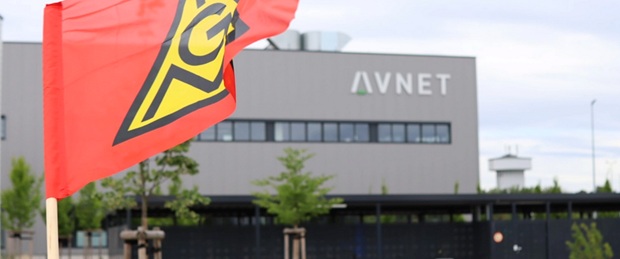
It is October 2025, and one room in southern Germany was in a rage. The discontent of workers over the loss of industry-wide collective bargaining had escalated at a local technology company.
Workers at Avnet and Tria had been excluded from Germany’s traditional collective bargaining regime covering the entirety of the metal industry. Avnet’s management sought to justify its attack on workers with “restructuring” – a rather common lame-duck excuse when inflicting harm on workers for the benefit – read: profits – of a company.
Unsurprisingly, Germany’s metalworkers’ union – IG Metall – is resisting management’s assault on workers. The 140-strong workforce at the US-owned Avnet Embedded Freiburg GmbH manufactures electronic components. The company’s Eschbach site offers technology consulting, electronic system design, development and integration, logistics, and repair services.
In a “tense economic situation” – read: the normal crisis of capitalism – collective bargaining, collective agreements, and a strong trade union offer workers at least some degree of security, even in the world’s third-largest economy: Germany.
At Avnet, however, workers at its southern German site have been denied their collective bargaining structure. It began in spring 2025 when management unilaterally cancelled an agreement that is standard in Germany’s metal industry.
Management’s “reason” for acting against workers was framed as “restructuring,” in which the sister companies – Tria Technologies and Avnet Integrated Solutions – were removed from the traditional collective bargaining structure.
This move affected around 140 workers in the 1,100-inhabitant town of Eschbach, situated on the French border near Freiburg (Baden-Württemberg) and Basel (Switzerland).
Immediately, workers were set to lose a “certain” degree of security – already fragile in capitalism and under the whip of often irrational management. Once the current collective agreement expires, workers are likely to be denied entitlements such as leave loading, holiday payments, and even the traditional Christmas “bonuses” – a little extra pay for the festive season – with other benefits are also likely to be cut.
Facing severe wage cuts in the foreseeable future, workers at Avnet in Eschbach did not accept this quietly. This is why the works meeting on 14 October 2025 was extremely well attended.
Workers and the trade union – IG Metall (IGM) – are taking on management. As a first step, IGM called on Avnet/Tria stubborn management to negotiate.
Following the simplistic re-naming of the former Freiburg company MSC Technologies under the Avnet umbrella, the company was divided into four entities. While Tria “Systems” and Avnet Integrated Solutions “IC” continued to maintain industry-wide collective bargaining, management decided that this should no longer apply to Tria “Technologies” and Avnet Integrated Solutions [no “IC”], both located in the Business Park in Eschbach.
In addition, IGM has rightly criticised Avnet’s management for nearly a year for banning the union from accessing the companies for crucial discussions with the works council and workers – a gross violation of German labor law.
In line with Germany’s cherished “social partnership ” ideology, IGM stated: “We urge employers to finally sit down at the negotiating table with us and talk seriously about solutions – under one condition: the interests of workers must remain at the centre of all negotiations.”
While collective bargaining is viewed as a “burden” by management, for workers it promises security, justice, a living wage, and a perspective for the future.
In other words, management that deliberately endangers what German unions call “social peace” should not be surprised if worker protest grows. Discontent among Avnet and Tria workers in the Gewerbepark Breisgau is intensifying. Workers are demanding a return to Germany’s standard collective bargaining practices.
Workers made their position unmistakably clear at the work-stop meeting. There was no doubt about the depth of dissatisfaction with Avnet’s current management. The room was buzzing. There were powerful speeches and a shared goal: fair conditions for all workers.
In a typical yet illogical move, Avnet’s corporate management has failed – to this day – to explain why only half of the four sister companies retained the collective bargaining agreement.
This is an anti-union strategy known as “divide and conquer,” designed to fragment the workforce and weaken the trade union.
For this purpose – and leaving one to wonder where the “H” for “human” (or humane or even humanity) is in HRM – the HR manager prohibited IGM representatives from entering the company. Yet IGM Freiburg remains adamant that Avnet’s management has no legal authority to do so.
Despite this inhuman “HRM” – at times, also camouflaged as business ethics – workers possess fundamental and human rights. These include, under Germany’s Works Constitution Act, the right to speak with their works council and trade union representatives.
As so often in real-existing capitalism, corporate management grossly disregards these rights.
Instead, and in further contradiction to German labour law, management demands that the works council negotiate issues such as remuneration and working hours – matters regulated by collective bargaining law, not works council law. Perhaps the HR manager should revisit “German Labour Law 101.” By law, the works council neither can nor may do this.
Worse still, the not-so “human” HR manager threatened to use force to compel the works council to comply – an act that is itself unlawful. German labour relations strictly separate collective bargaining from works council responsibilities.
At the same time, Avnet’s management has attempted to block workers’ access to information and advice.
Despite enormous pressure put on by Avnet’s management against workers, the works council sought IGM’s support for all talks with management. When the union announced a visit three days in advance and arrived – as permitted by German law – management blocked union officials at the door.
Avent’s HR later claimed that the works council was not allowed to conduct a company tour to speak with workers. This too violates labour law. HR further argued that the works council should not address workers “on such a large scale” – another legal violation.
Even worse, HR wrote to all workers stating that work-stop meetings were not permitted and that participants would not be paid. This too directly contradicts the Works Constitution Act.
All this demonstrates not only repeated violations of German labour law, but also a profound lack of respect for workers and their legitimate representation. In the hallucinations of management studies, this is known as corporate social responsibility – another ideology.
Unsurprisingly, IGM argues that Avnet’s management must urgently reconsider its position. The union is taking legal action. This is not the first time a US company has violated German labour law, only to discover that it must comply.
Meanwhile, the underlying corporate strategy is clear: Avnet wants to pay workers less. This is to be achieved through fragmentation into four companies.
Two – Avnet Integrated Solutions IC and Tria Systems – have returned to collective bargaining. The other two – Avnet Integrated Solutions and Tria Technologies – are excluded, without explanation.
This contradiction violates German labour law and labour relations. Management falsely claims the works council could resolve these matters.
IGM argues that the workforce cannot be divided. Workers want fair participation and secure jobs. They are prepared to strike to regain their collective agreement.
The company’s history stretches back to the late 19th century, when it operated as “Hellige” in Freiburg. It long formed part of Germany’s collective bargaining system.
Renamed MSC in 2001 and acquired by Avnet in 2013, the company changed significantly. Production expanded, the workforce grew, and in 2023 operations moved to Eschbach.
Soon after, management initiated “restructuring,” isolating the works council and presenting faits accomplis.
Four companies emerged: two production entities and two employee entities. Management believes this allows the collective agreement to lapse. After a one-year transition, management moved to cancel it.
Workers responded with industrial action. After a strike ballot on 14 July 2025, 91.5% voted for indefinite strike action.
On 16 July, management attempted to undermine the strike with €200-per-day [$235] strikebreaker bonuses – scab money – and threatening emails. Workers remained resolute, striking for two weeks.
After the summer break, strikes resumed on 22 September. Participation increased. Pressure mounted. As one union official put it: “Sometimes, you need a long breath.”
Management remains opposed to collective bargaining in principle, proposing instead illegal wage negotiations with the works council.
Workers reject this. They will continue to fight – for their families, their dignity, and their right to co-determination.
Despite management’s attempts to divide them, workers stand together and defend their right to strike at Avnet.


No comments:
Post a Comment