Thursday, February 06, 2025


Concerns and doubts mount over EU plan to build deportation camps outside its borders

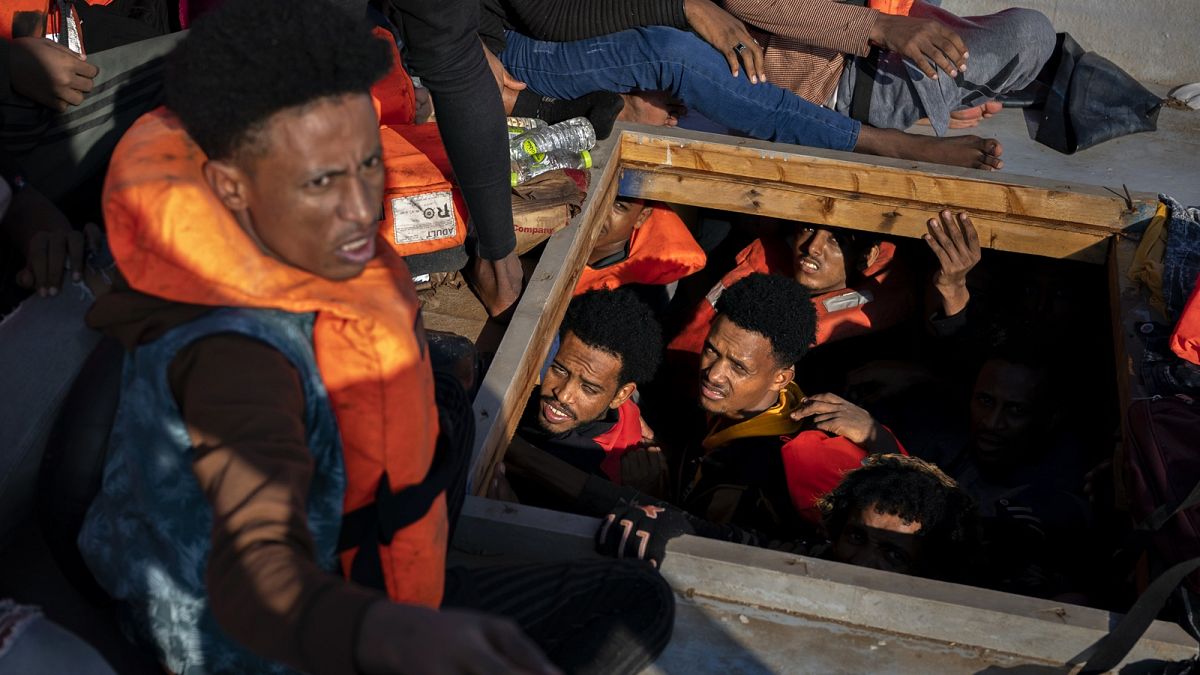
The EU plant to build "return hubs" has been met with criticism from NGOs.
Copyright Joan Mateu Parra/Copyright 2023 The AP. All rights reserved
By Jorge Liboreiro
Published on 

The EU's plan to outsource migration through so-called "return hubs," which has never been tried before, is shrouded in legal uncertainty.

The European Union's novel idea to build deportation camps outside its borders to house the asylum seekers whose applications have been denied continues to fuel concerns and doubts about its legal and logistical feasibility and the potential impact on human rights.

The unprecedented project – known euphemistically as "return hubs" – is expected to be included in a legislative proposal that the European Commission will present sometime before the next leaders' summit in March.

It will mark the first result of the political push to work on "new ways" to manage irregular migration, a vague concept most commonly associated with outsourcing schemes.

The main focus is now on returns: the deportation of asylum seekers who have arrived in the bloc, exhausted all their legal avenues to request international protection and are therefore asked to leave the territory. The EU has for years struggled with a low rate of deportations and sees the faraway centres as an "innovative solution" worth trying.

During an informal meeting of interior ministers last week, Magnus Brunner, the European Commissioner for Migration, pitched "stronger rules on detention" and the "possibility of developing return hubs," according to the minutes exclusively seen by Euronews.

The untested plan, though, is ridden with high risks.

In a position paper released on Thursday, the EU Agency for Fundamental Rights (FRA) issued a pointed warning to the Commission, insisting any project to establish "return hubs" must come with strong safeguards to guarantee lawful and dignified treatment.

The fact the camps would be built outside the bloc does not exempt compliance with EU law, the agency says, as member states and Frontex would remain "accountable for rights violations at the hubs and during any transfers."

FRA suggests the bloc should sign a "legally-binding agreement" with the host country that would set "minimum standards for the conditions and treatment" of the relocated migrants and introduce a "duty" to mitigate violations of fundamental rights. (So far, Brussels has not given any indication of where the hubs might be built.)

According to the agency, migrants sent to the centres must have a "valid and enforceable decision" based on an "individual assessment" of their asylum applications and never be subject to collective expulsions, which are illegal under international law. Vulnerable people and children should be excluded from the scheme.

"As the EU and member states try to find solutions to manage migration, they should not forget about their obligations to protect people's lives and their rights," Sirpa Rautio, the agency's director, said in a statement.

"The planned return hubs cannot become rights-free zones. They would only comply with EU law if they include robust and effective fundamental rights safeguards."

How to square the circle between outsourcing and legality is still unresolved.

In a 2018 document, the Commission found that "externally-located return centres" would be unlawful because EU law prevents sending migrants "against their will" to a country they do not come from or have not passed through.

The upcoming legislation is expected to change the legal basis to enable the relocation and sustain legal challenges.

Humanitarian organisations fear the removal outside EU territory would decrease judicial oversight and lead to rampant, unchecked violations of human rights.

Earlier this week, Commissioner Brunner met with a group of NGOs to discuss the new Returns Directive. "Your insights are key to shaping fair and effective migration policy. I look forward to continue and deepen our dialogue," he said on social media.

One of the participants, the Platform for Undocumented Migrants (PICUM), expressed serious concerns about the Commission's plan to speed up deportations, warning the law risks being "rushed through under political pressure."

The idea of building deportation centres outside the bloc, PICUM said, has the potential to increase "automatic arbitrary detention" of asylum seekers and infringe upon the principle of non-refoulement, which forbids authorities from deporting migrants to nations where they could face persecution, torture or any other form of ill-treatment.

Another participant, Eve Geddie, from Amnesty International, voiced similar worries and added economic costs, lack of transparency and operational challenges to the list.

"There is no evidence to suggest these schemes would be effective in either increasing returns or impacting people’s decision-making not to migrate," Geddie said. "None."


Google scraps diversity hiring goals to comply with Trump's new contractor rules

File picture of audience members attending a new product announcement at Google's HQ in California
Copyright Juliana Yamada/Copyright 2024 The AP. All rights reserved
By Lily Swift with AP
Published on 

Google is joining a lengthening list of US companies that have abandoned or scaled back their diversity, equity and inclusion programmes.

The move, outlined in an email sent to Google employees on Wednesday, came in the wake of an executive order from President Donald Trump aimed in part at pressuring government contractors to scrap their DEI initiatives.

Like several other major tech companies, Google sells some of its technology and services to the federal government, including its rapidly growing cloud division that's a key piece of its push into artificial technology.

Google's parent company, Alphabet, also signalled the shift in its annual 10-K report it filed this week with the Securities and Exchange Commission. In it, Google removed a line included in previous annual reports saying that it's "committed to making diversity, equity, and inclusion part of everything we do and to growing a workforce that is representative of the users we serve".

Google generates most of Alphabet's annual revenue of $350 billion (€338bn) and accounts for almost all of its worldwide workforce of 183,000.

"We're committed to creating a workplace where all our employees can succeed and have equal opportunities, and over the last year we've been reviewing our programs designed to help us get there", Google said in a statement to the Associated Press.

"We've updated our 10-K language to reflect this, and as a federal contractor, our teams are also evaluating changes required following recent court decisions and executive orders on this topic."

Trump toughens up on diversity

The change in language also comes slightly more than two weeks after Google CEO Sundar Pichai and other prominent technology executives - including Tesla CEO Elon Musk, Amazon founder Jeff Bezos, Apple CEO Tim Cook and Meta Platforms CEO Mark Zuckerberg - stood behind Trump during his inauguration.

Meta abandoned its DEI programme last month, shortly before the inauguration, while Amazon halted some of its DEI programmes in December following Trump's election.

Many companies outside of the technology industry also have backed away from DEI. Those include Walt Disney Co, McDonald's, Ford and Walmart.

Trump's recent executive order threatens to impose financial sanctions on federal contractors deemed to have "illegal" DEI programmes. If the companies are found to be in violation, they could be subject to huge damages under the 1863 False Claims Act. The law states that contractors who make false claims to the government could be liable for three times the government's damages.

The challenge for companies is knowing which DEI policies the Trump administration may decide are "illegal".

In both the public and private sector, diversity initiatives have covered a range of practices, from anti-discrimination training and conducting pay equity studies to making efforts to recruit more members of minority groups and women as employees.

Google ahead of the game

California-based Google has tried to hire more people from underrepresented groups for more than a decade but increased its efforts in 2020 after the police killing of George Floyd in Minneapolis triggered an outcry for more social justice.

Shortly after Floyd died, Pichai set a goal to increase the representation of underrepresented groups in the Mountain View, California, company's largely Asian and white leadership ranks by 30% by 2025. Google has made some headway since then, but the makeup of its leadership has not changed dramatically.

The representation of Black people in the company's leadership ranks rose from 2.6% in 2020 to 5.1% last year, according to Google's annual diversity report. For Hispanic people, the change was 3.7% to 4.3%. The share of women in leadership roles, meanwhile, increased from 26.7% in 2020 to 32.8% in 2024, according to the company's report.

The numbers are not much different in Google's overall workforce, with Black employees comprising 5.7% and Latino employees 7.5%. Two-thirds of Google's worldwide workforce is made up of men, according to the diversity report.

EVIL INSIDE
Google pledge against using AI for weapons vanishes


By AFP
February 4, 2025


Google's original principles when it came to developing artificial intelligence were not to use it for weapons or surveillance that could infringe on people's rights - Copyright AFP GREG BAKER

Google on Tuesday updated its principles when it comes to artificial intelligence, removing vows not to use the technology for weapons or surveillance.

Revised AI principles were posted just weeks after Google chief executive Sundar Pichai and other tech titans attended the inauguration of US President Donald Trump.

When asked by AFP about the change, a Google spokesperson referred to a blog post outlining the company’s AI principles that made no mention of the promises, which Pichai first outlined in 2018.

“We believe democracies should lead in AI development, guided by core values like freedom, equality, and respect for human rights,” read an updated AI principles blog post by Google DeepMind chief Demis Hassabis and research labs senior vice president James Manyika.

“And we believe that companies, governments, and organizations sharing these values should work together to create AI that protects people, promotes global growth, and supports national security,” it continued.

Pichai had previously stated that the company would not design or deploy the technology for weapons designed to hurt people or “that gather or use information for surveillance violating internationally accepted norms.”

That wording was gone from the updated AI principles shared by Google on Tuesday.

Upon taking office, Trump quickly rescinded an executive order by his predecessor, former president Joe Biden, mandating safety practices for AI.

Companies in the race to lead the burgeoning AI field in the United States now have fewer obligations to adhere to, such as being required to share test results signalling the technology has serious risks to the nation, its economy or its citizens.

Google noted in its blog post that it publishes an annual report about its AI work and progress.

“There’s a global competition taking place for AI leadership within an increasingly complex geopolitical landscape,” Hassabis and Manyika said in their post.

“Billions of people are using AI in their everyday lives.”

Google’s original AI principles were published after employee backlash to its involvement in a Pentagon research project looking into using AI to improve the ability of weapons systems to identify targets.

Google ended its involvement in the project.


Russian military in Ukraine riding on donkeys amid vehicle shortage

Russian military in Ukraine riding on donkeys amid vehicle shortage
The first reports of Russian soldiers using donkeys came from Russian military blogger Kirill Fedorov on his War History Weapons Telegram channel. / TelegramFacebook
By bne IntelliNews February 5, 2025

The Russian military in Ukraine is using donkeys and horses to transport ammunition due to a severe shortage of vehicles, war correspondents have claimed.

The development follows previous confirmed reports of Russian troops resorting to civilian cars and electric scooters for logistical support.

The first reports of Russian soldiers using donkeys came from Russian military blogger Kirill Fedorov on his War History Weapons Telegram channel, where he stated that the Russian Defence Ministry had provided pack animals for frontline supply operations. Fedorov cited an official ministry transport list that includes horses, camels and deer.

“The fighters were given a donkey to deliver ammunition to the front line. What did you expect? Cars are in short supply these day,” he wrote.

Fedorov’s post came on the same day that Ukrainian official Anton Gerashchenko published a video on social media showing Russian soldiers riding horses. Gerashchenko used the footage to criticise Moscow for “rolling back to the times of the Russian Empire.”

However, not everyone is convinced. A military expert interviewed by Novaya Gazeta Europe suggested that this is likely a local initiative rather than a widespread strategy. He explained that soldiers may be using abandoned animals from nearby settlements, as donkeys and horses can navigate difficult terrain where vehicles struggle.

“A donkey or a horse will be able to overcome the impassable roads in muddy conditions and deliver, for example, food or ammunition to a stronghold located in a forest plantation far from the roads,” he said.

The use of animals comes just months after the Russian command banned the use of privately owned and humanitarian vehicles. This policy, reportedly introduced to curb accidents involving drunk drivers, has disrupted logistics and battlefield operations across the region. The decision to confiscate civilian vehicles has created a severe logistical crisis, as more than 90% of light vehicles at the front are privately owned or donated. With these vehicles unavailable, some soldiers have resorted to bicycles to move ammunition, while others hide vehicles from commanders to avoid penalties.


Missing money, delayed arms deliveries and demands for mining deals, Ukraine's relations with Trump are off to a rocky start

Missing money, delayed arms deliveries and demands for mining deals, Ukraine's relations with Trump are off to a rocky start
Ukrainian President Zelenskiy is desperately trying to manage a mercurial US President Trump and keep the support for Ukraine coming, but it's proving to be a dificult task, especially as the situation on the battlefield continues to deteriorate. / bne IntelliNewsFacebook
By Ben Aris in Berlin February 4, 2025

Ukrainian President Volodymyr Zelenskiy has complained that Ukraine has only received $75bn from a pledged $177bn of aid pledged by the US to support Ukraine last year and he doesn’t know where the missing $100bn money is, he said in an interview with The Associated Press on February 1.

That follows reports that the US briefly stopped shipping weapons to Ukraine following President Donald Trump’s inauguration as the new White House administration debated its policies of supporting Ukraine with arms shipments, Reuters reported on February 3, citing four sources familiar with the matter.

Opposing factions within the administration had a heated debate on continuing supplies to Ukraine, but those advocating deliveries should continue for the meantime eventually won the argument, a US official told Reuters.

Trump vowed to end the war on his first day in office but has since extended the deadline to the first 100 days of his current term, but has made it clear that he wants to withdraw US support from the conflict.

That support has already been dwindling. Earlier Zelenskiy said that half of the $61bn aid package approved on April 20 last year, after the US ran out of money for Ukraine, has been caught up in bi-partisan wrangling and has not reached Kyiv. At the same time the US stopped supplying Ukraine with weapons from its own stockpile last year and all the arms and ammo delivered to Ukraine in 2024 came from European stockpiles – including the much vaunted F-16 jet fighters. What arms the US has pledged to provide have been ordered from US arms manufacturers rather than drawn from existing stockpiles.

Trump froze all of the US foreign aid programmes for 90 days after taking power; however, Ukrainian officials claim that arms deliveries for Ukraine were exempted. However, Trump has shut down all of the aid agency USAID activity, which has been playing a crucial role in providing Ukraine with temporary generating capacity to get through the winter after Russia destroyed half of Ukraine’s heating and generating capacity in 2024.

US President Donald Trump claimed that “serious progress” has been made toward settling the Ukrainian crisis. "We've made a lot of progress on Russia, Ukraine," he told journalists but did not explain what he actually meant. "We'll see what happens. But a lot of progress has been made. We've got to stop that ridiculous war," he added during a visit to the Andrews Air Force Base near the American capital at the weekend.

The Kremlin has said in recent weeks that it is prepared to start talks with the US, but has refused to include Ukraine in the offer, arguing that Zelenskiy is not the legitimate president of Ukraine after his term in office expired last May. Moreover, Putin repeatedly pointed out that Zelenskiy has banned himself from negotiating with the Russian president directly by decree.

The White House has also called for presidential elections to be held in Ukraine as soon as ceasefire is agreed. Zelenskiy would likely lose those elections, as his standing in the polls has been falling, while those of former commander-in-chief General Valerii Zaluzhnyi have been rising; the latter would likely win if elections were held this weekend.

Russian President Vladimir Putin said last week that it was “too early” to consider four-way talks between Russia, the US, Ukraine and the EU that have been proposed by some.

Zelenskiy told AP that excluding his country from talks between the US and Russia about the war in Ukraine would be “very dangerous” and asked for more discussions between Kyiv and Washington to develop a plan for a ceasefire. Zelenskiy remains convinced that the Kremlin does not want to engage in ceasefire talks or to discuss any kind of concessions at the moment and is only playing for time. But he said that Trump could force Putin to the table by further tightening oil and banking sanctions.

He repeated his opinion that Nato membership is the “cheapest” option for Ukraine’s allies, and it would strengthen Trump geopolitically. Without security deals from Ukraine’s allies, Zelenskiy said, any deal struck with Russia would only serve as a precursor to future aggression.

Trump has been lukewarm on Nato and has even threatened to withdraw from the military alliance unless other Nato partners increase their defence spending to at least 5% of GDP.

Zelenskiy also said a French proposal to supply European peacekeepers to oversee a ceasefire is taking shape, but he added that many questions remained about the command-and-control structure. The Kremlin has said it is categorically against any Nato troop presence in Ukraine on any terms.

Zelenskiy said his team has been in contact with the Trump administration, but those discussions are at a “general level,” and he believes in-person meetings will take place soon to develop more detailed agreements, AP reported.

The business of peace

One of the impediments holding up US supplies is the White House is linking continued supplies to business deals. Trump told reporters on February 3 that the US wants to strike a deal with Kyiv where aid is offered in exchange for access to Ukraine’s extensive deposits of crucial rare earth elements. As bne IntelliNews reported, Ukraine needs to present the deal-loving Trump a quid pro quo to ensure further support and has 20 out of the 31 mineral resources identified as critical to the EU, including the largest deposits of lithium in Europe.

As Senator Linsey Graham, an ardent Ukraine supporter, said at the end of last year: “This war is all about money and Ukraine has $2-$7 trillion worth of rare earth minerals.”

A deal on rare earth concessions was on the table in December, but US officials delayed finalising the agreement until January so that Trump could take the credit once it was closed, The New York Times (NYT) reports.

"We're telling Ukraine they have very valuable rare earth metals. We want them to pledge them as security. We want security because we're giving them money by the handful," Trump said while signing the executive orders, including those establishing a sovereign wealth fund. "So we're trying to make a deal with Ukraine where they'll secure what we're giving them with their rare earth metals and other things.”

Separately, it has been reported that some US senators want to link further aid to Kyiv lowering the conscription age to 18 to provide fresh troops to the battle, something that Zelenskiy has fiercely resisted in anticipation of a strong political backlash, and the ominous consequences it would have for Ukraine’s demographics, already the worst demographics in the world.

The mercantile Trump is hoping to continue to make a profit from the war. US arms exports reach a record $318bn in 2024 driven by Ukraine-related demand. The State Department described arms sales and transfers as "important US foreign policy tools with potential long-term implications for regional and global security." Washington openly admits that some 80% of the military aid provided to Ukraine has actually been spent in US arms factories, giving the US economy a military spending economic bump.

At the same time, the US has gleefully stepped into the hole following the end of Russian gas deliveries to Europe thanks to the war. At a stroke US LNG exports have captured about a third of Europe’s gas demand, a market share formerly dominated by cheap Russian piped gas.

Trump intends to follow through and expand this lucrative business. The Trump administration aims to push Russian LNG out of Europe and completely end Russian deliveries of LNG to Europe, the Financial Times reports. Despite calls by some EU member states to end imports of Russian gas, Europe imported more piped gas and LNG than ever in 2024 as even with US deliveries there is insufficient supplies of gas available for Europe to go completely without Russian supplies. Last year Europe consumed half of Russia’s entire gas production.

liquefied natural gas (LNG) from the European market, following the EU’s severance from Russian pipeline gas. The goal is to replace it with American LNG. According to the Financial Times, Trump has threatened the EU with a trade war if it doesn’t increase imports of US oil and gas. Technically, this goal could be feasible closer to 2029: "S&P Global Commodity Insights reported that 10.3mn tonnes of LNG have already been contracted for Europe from US plants under construction. An additional 9.5mn tonnes are also available for purchase, including by European buyers. These volumes surpass the 17mn tonnes of Russian LNG imported by the EU in 2024. These US LNG facilities are expected to become operational in 2029." Gas prices in Europe currently remain three times higher than in the US and are still over twice as expensive as before the Ukraine-Russia conflict began in early 2022. This price disparity has enabled American LNG producers to reap enormous profits from supplying Europe. Some way to bargain with Putin as well.

Front line in slow collapse

A dire shortage of infantry troops and supply routes under heavy fire are contributing to the slow collapse of the Armed Forces of Ukraine (AFU) defence of the front line in Donbas, AP reports.

Ukrainian troops are losing ground as the Armed Forces of Russia (AFR) have made steady, if very costly, advances towards the key logistical hub of Pokrovsk, the nexus of several roads and rail links that are crucial to the logistical support of Ukraine’s defence. The assault on Pokrovsk has been going on for months as AFR has made slow progress in an operation that is costing Russia up to 1,000 fallen soldiers a day, according to some reports.

Ukrainian soldiers in Pokrovsk told AP that Russian forces have changed tactics and abandoned their frontal attacks in order to try to outflank the defenders in a pincer movement instead. The AFR have already taken the high ground which puts several roads supplying the defenders in range.

The Pokrovsk-Pavlohrad-Dnipro highway is “already under the control of Russian drones,” the commander at Pokrovsk’s flanks told AP. Russian forces are less than four kilometres away and are affecting Ukrainian traffic, he said. “Now the road is only 10% of its former capacity,” he said. Another paved highway, the Myrnohrad-Kostyantynivka road, is also under Russian fire, he said.

Heavy fog in recent days has prevented Ukrainian soldiers from using surveillance drones, allowing Russian soldiers to move up and dig into well defended positions to consolidate the ground they control. In some places the AFU have already had to abandon the roads leading to Pokrovsk and drive supplies over open muddy fields to reach their troops on the frontline.

The village of Velyka Novosilka fell to Russia last week, on the approach to Pokrovsk, their most significant gain since seizing the city of Kurakhove in the Donetsk region in January, after Russia amassed ten columns of infantry supported by mechanised armour around the town. The Russian assault was aided by the bad weather, which has reduced the effectiveness of drones, Ukraine’s most potent weapon against advancing Russian infantry.

As bne IntelliNews reported, the last civilians and children still in Pokrovsk were evacuated last week and the key coal mine near the town, that supplies most of Ukraine’s metallurgy industry with coking coal, has been closed down in anticipation of the battle to come. Ukraine’s strategically important lithium deposit is also close to Pokrovsk.

Ukrainian commanders complained to AP of “catastrophic” shortages of men and one commander estimated that Russian forces outnumbered their Ukrainian counterparts by 20:1. Those fresh recruits the AFU have received in recent months are mostly inexperienced and undertrained fresh recruits that are ineffective on the battlefield.

Poorly trained and inexperienced newly created infantry units are putting more pressure on battle-hardened brigades in the front line who have to step in to shore up defences as they are “constantly extending the front line because they leave their positions, they do not hold them, they do not control them, they do not monitor them. We do almost all the work for them,” the Ukrainian commander told AP.

“Because of this, having initially a 2-km area of responsibility, you end up with 8-9km per battalion, which is a lot and we don’t have enough resources,” a deputy commander with call sign Afer told AP. “It’s not because they have lower quality infantry, but because they are completely unprepared for modern warfare,” he said of the new recruits.
 

Israel's defence minister orders IDF to facilitate Trump resettlement plan

Israel's defence minister orders IDF to facilitate Trump resettlement plan
Israel's defence minister orders IDF to facilitate Trump resettlement plan / bne IntelliNewsFacebook

Isra

el's Defence Minister Israel Katz ordered the IDF on January 6 to develop a plan facilitating voluntary emigration from Gaza, following US President Donald Trump's recent proposal to relocate Gaza residents permanently.

US President Donald Trump announced plans for American control and redevelopment of the Gaza Strip following his meeting with Israeli Prime Minister Benjamin Netanyahu on January 4.

During Israeli Prime Minister Benjamin Netanyahu's White House visit, Trump described Gaza as looking “like hell”. He went on to suggest that its residents would leave if given the opportunity, explicitly stating he was “talking about moving the Palestinians out of Gaza forever.”

“I welcome US President Trump's bold plan,” Katz stated, as quoted by Israel’s N12 television.

“Gaza residents should be allowed to enjoy the freedom of exit and migration as is practised everywhere in the world. Hamas used Gaza residents as human shields and built terror infrastructures in the heart of the population, and is now holding them hostage, extorting money from them using humanitarian aid, and preventing their exit from Gaza.”

The proposed plan would establish multiple exit routes, including land crossings, sea routes, and air transportation. Katz specifically called out countries that have criticised Israel's military operations in Gaza, suggesting they have a legal obligation to accept Gaza residents seeking relocation.

Katz highlighted potential destination countries, noting that Canada, with its established immigration program, had previously expressed interest in accepting Gaza residents. The defence minister envisions the plan as part of a broader strategy for Gaza's reconstruction in what he termed the “post-Hamas era.”

The proposal appears to be packaged as a method to facilitate both voluntary emigration and the eventual reconstruction of a demilitarised Gaza, though implementation details have yet to be revealed.

In addition to potential roadblocks to implementation, the Trump administration may also need to navigate international opposition to successfully implement this daring initiative. 

When questioned about potential US military deployment to fill any security vacuum, Trump left the possibility open, stating: “As far as Gaza is concerned, we'll do what is necessary. If it's necessary, we'll do that.”

“I do see a long-term ownership position, and I see it bringing great stability to that part of the Middle East, and maybe the entire Middle East,” Trump explained. “This was not a decision made lightly. Everybody I’ve spoken to loves the idea of the United States owning that piece of land, developing and creating thousands of jobs with something that will be magnificent.”

“Look, the Gaza thing has not worked. It's never worked. And I feel very differently about Gaza than a lot of people. I think they should get a good, fresh, beautiful piece of land, and we get some people to put up the money to build it and make it nice and make it habitable and enjoyable,” Trump had previously stated regarding the living conditions of Gazans following the war with Israel.

Trump says Gaza would be ‘turned over’ to US by Israel

Last updated: February 06, 2025 | 
AFP


WASHINGTON: President Donald Trump said on Thursday that Gaza would be “turned over” by Israel to the United States when the conflict is over, and no soldiers would be needed for his subsequent takeover and redevelopment plan.

Trump doubled down on the shock plan he first announced on Tuesday - and on his plan to resettle two million Palestinians elsewhere from Gaza in the Middle East - on his Truth Social network.

“The Gaza Strip would be turned over to the United States by Israel at the conclusion of fighting,” Trump said in an early morning post.

Also Read: Trump’s shocking Gaza takeover plan sparks global outrage

“No soldiers by the US would be needed! Stability for the region would reign!!!”

Trump stunned the world by announcing during a joint press conference with visiting Israeli Prime Minister Benjamin Netanyahu Tuesday that “the US will take over the Gaza Strip.”

“We will do a job with it, too. We’ll own it,” he said to audible gasps during the press conference, saying the United States would remove unexploded bombs and rubble and rebuild the war-torn enclave.

But he offered few details and his administration appeared to backtrack Wednesday after facing a wave of criticism from Palestinians, Arab governments and world leaders.

Trump’s Secretary of State Marco Rubio said the idea “was not meant to be hostile,” while the White House said there was no commitment to sending US troops and that any displacement of Palestinians would be “temporary.”

The Republican president however showed Thursday that he still wanted to press ahead with the plan as he had originally announced it, including the mass displacement of Palestinians.

Trump said that by the time of his planned handover by Israel to the United States Palestinians “would have already been resettled in far safer and more beautiful communities, with new and modern homes, in the region.”

“They would actually have a chance to be happy, safe, and free,” Trump added.

“The US, working with great development teams from all over the World, would slowly and carefully begin the construction of what would become one of the greatest and most spectacular developments of its kind on Earth.”

Trump had given mixed signals on Tuesday who would inhabit his planned post-war Gaza, saying it would be “the world’s people” but that “also, Palestinians would live there.”

The New York Times reported on Thursday that Trump had surprised both his own staff and the Israelis with the “hastily-written” plan for Gaza, with no discussions with the Pentagon or the State Department.

Israel’s defence minister meanwhile ordered the army on Thursday to prepare for “voluntary” departures from Gaza, following Trump’s remarks.

New report charts $4.1B in funding for Canada’s agrifoodtech sector, outlines challenges and opportunities


By Jennifer Kervin
February 5, 2025
DIGITAL JOURNAL


Photo by Getty Images on Unsplash

While Canada’s foodtech landscape has broadened significantly in ten years, a new report highlights challenges like funding and labour shortages.

The Canadian Food Innovation Network (CFIN) has released its first Foodtech in Canada: 2025 Ecosystem Report, offering a detailed look at the sector.

The report, developed with data from foodtech ecosystem platform Forward Fooding, examines more than 9,950 global foodtech companies, including 320 in Canada, mapping investment trends and highlighting key opportunities and challenges.

“Canada’s foodtech ecosystem has made remarkable progress over the last decade, driving transformative innovations that enhance sustainability, boost economic productivity, and create jobs nationwide,” says Dana McCauley, CEO of CFIN.

“However, to truly realize our potential as a global foodtech superpower, we must address the pressing challenges that remain. CFIN is fully committed to empowering homegrown innovators and fostering solutions that will shape the future of food technology in Canada.”
Public funding plays a key role in foodtech growth

Between 2014 and 2024, Canada saw $4.1 billion CAD ($2.9 billion USD) invested in agrifoodtech, with $2.3 billion CAD ($1.6 billion USD) directed toward foodtech projects. The report found that Canada’s foodtech investment has grown at a rate of 8.4% annually, compared to a global decline of 2.6%.

However, a significant portion of this funding has come from public sources. Over the last four years, only 40% of Canadian foodtech investment rounds were backed by venture capital, compared to 60% in the UK and the U.S.

Meanwhile, government grants accounted for 30% of Canada’s funding rounds — a stark contrast to just 5% in the UK and 8% in the U.S.
Where does Canada shine?

The report highlights Canada’s strengths in several areas, including plant-based food, biotech-driven food processing, and food waste solutions.

The plant-based sector, which includes companies such as New School Foods, No Meat Factory, and Smallfood, has grown at a five-year compound annual growth rate (CAGR) of 49.5%. Canada now accounts for 26% of global plant-based food innovation, compared to a 14% global average.

According to the David Suzuki Foundation, close to half of all food produced worldwide is wasted after production. Efforts to tackle food waste are on the rise in the food tech sector, with 11 Canadian companies working on solutions, including Flashfood, Knead Tech, and Crush Dynamics. The food waste sector has seen a five-year CAGR of 40.7%.

Biotech innovations in food processing are also making strides, with 18 companies leveraging biotechnology to produce nutrient-dense proteins for products such as infant formula and cognitive health supplements. Leading this segment are companies like Mara Renewables and Chinova Bioworks, which have contributed to a 24.7% five-year CAGR in biotech food processing.
Funding gaps and workforce challenges slow growth

While early-stage investment in Canada’s foodtech sector is strong, access to growth capital remains a challenge. The report found that Series A and B rounds in Canada are, on average, half the size of those in the UK and the U.S. Meanwhile, Series C rounds in the U.S. are three times larger than those in Canada.

Labour shortages and supply chain issues further complicate the sector’s growth. Companies across the food system, from manufacturers to restaurants and retailers, struggle to find skilled talent in an aging workforce with declining birth rates and lower immigration levels.

“As a farmer myself, I’ve seen how the sector has changed over the years when it comes to technology, and how folks everywhere are looking for better and more sustainable agri-food products,” says Lawrence MacAulay, Canada’s Minister of Agriculture and Agri-Food.

“This report will help businesses, researchers, and investors learn the lay of the land and bring more of our top-quality products from the farm to the table with cutting-edge innovations.”

Canada’s foodtech ecosystem benefits from a strong agrifood system, leading research and innovation hubs, and government-backed programs supporting food technology development. However, the report emphasizes that continued progress requires addressing funding challenges, scaling innovative startups, and strengthening private sector investment.


This article was created with the assistance of AI. Learn more about our AI ethics policy here.


Jennifer Kervin is a Digital Journal staff writer and editor based in Toronto.


Op-Ed: Do rich people know how to be sane? — Trade war is getting stonewalled


By Paul Wallis
February 5, 2025
DIGITAL JOURNAL


Beijing on Tuesday fired a return salvo in its escalating trade war with the United States, slapping fresh tariffs on everything from American crude oil to agricultural machinery - Copyright AFP STR

Some people may not know how truly weird these trade wars are. The world clearly refuses to play ball with Trump’s various shots in the dark. There’s a bit more to it than that.

The basics:

Trade generates revenue for governments and businesses. Every bit of business generates local trade, logistics, etc., generating state and country revenue.

This vast trade-related range of economic activities also generates jobs and profits for businesses so people can survive and grow the economy.

If governments reduce their revenue by blocking trade, they have to borrow.

Just about everyone associated with the Trump administration does business overseas.

These are super-rich people with major personal financial assets all over the world. Those assets could be very vulnerable if other countries retaliate to US trade policies or the super-unpopular foreign relations epic button-pushing by the administration. Sanity? None.

Assets can be frozen. Assets can be taken by court orders. It’s not that much of a mystery to those who miraculously moved on from grade school. I do mean grade school because most of this idiocy is truly infantile.

You can see the suicidal nature of the trade wars in lock step with foreign policy. The process of systematically and monotonously antagonizing America’s allies, notably Europe, is so stupid it must be deliberate.

You couldn’t possibly annoy so many people by accident.

There are perceptions albeit stupid perceptions to be had:

America First means isolationism. Cute, except isolationism has destroyed every country that’s ever tried it. See China, Japan, and Korea in the 19th century for details.

We can have our own medieval America. Except you can’t because you barely produce anything worth mentioning locally and US product quality puts a huge strain on tact in conversations. If you want to go back in time about 1000 years, that’s how.

China’s way behind. No, they’re not and they certainly won’t stay that way. Antagonizing all the sciences isn’t such a good move either, because the guys that make your tech need to make a living. They’d prefer to do that in a country that isn’t totally anti-science, anti-people, and anti-decent wages. The loss of IP alone is likely to be incredibly expensive. It will also compromise future tech. There are plenty of other countries ready to accept US science refugees, too.

Don’t expect the markets to like any of it. People worry about their money, including much bigger stakeholders. Want to see Apple at 10c a share? The futures market and short selling can do that. The US dollar could take a hit, too. Never mind BRICS. Sanity is a commodity in this environment.

A hit to the US credit rating would cost billions per day overnight. Making America look utterly incompetent is definitely not a good idea.

The physical and social state of America has been appalling for decades. It’s a rundown museum of 19th-century unsolved disasters in many ways. Nothing is changing at ground level except the anxiety. “Government of the criminals, by the criminals, for the criminals” isn’t likely to help much.

What’s “pro-American” about any of this mega-cluster? There has yet to be a mention of poverty and the real state of American society. All of this is an ongoing added cost to that famous charity the American people.

Credibility is extremely low. The vast costs in various Trump administration initiatives don’t make fiscal sense. Penny-pinching USAID just looks cheap and nasty which it is.

The lack of contact with reality at any level is staggering. It’s not even a month since this Petting Zoo for the Pointless took office.

It could be the Neutered States of America soon enough.

____________________________________________________________
Disclaimer
The opinions expressed in this Op-Ed are those of the author. They do not purport to reflect the opinions or views of the Digital Journal or its members.