Tuesday, February 25, 2025

'We are starting to worry': Economist sounds alarm on 'near-term downside' of 1 million DOGE layoffs


Elon Musk holds a chainsaw onstage as he attends the Conservative Political Action Conference (CPAC) in National Harbor, Maryland, U.S., February 20, 2025. REUTERS/Nathan Howard/File Photo


Naomi LaChance
February 24, 2025
ALTERNET

An economist is cautioning readers about the possible effects of President Donald Trump’s administration’s layoffs of federal workers on the economy. Torsten Sløk, chief economist at private equity firm Apollo, points out that “risks are intensifying.” Estimates of layoffs could be low, he notes, because they don’t include contractors who will be hit.

Derek Saul wrote at Forbes on Monday, “Thelayoffs from Elon Musk’s Department of Government Efficiency (DOGE) could be much bigger than many expect, according to a prominent economist, who warned about DOGE-led ‘growing’ risks on the broader economy—and the markets, which President Donald Trump has always emphasized as a key barometer of his success.”

Sløk listed DOGE layoffs and increased uncertainty as causes for concern.

READ MORE: 'Don't have access': Union president details 'unnecessary chaos' sparked by Trump HR email

“We are starting to worry about the downside risks to the economy and markets from: 1) the impact of DOGE layoffs and contract cuts on jobless claims and 2) persistently elevated policy uncertainty weighing on capex [capital expenditure] spending decisions and hiring decisions,” Sløk wrote on Saturday.

Data shows more people filing for unemployment benefits in Washington, D.C., but not in Virginia, Maryland, and Washington, D.C. together.

Sløk estimated that total layoffs by DOGE could be around 300,000, which is not a huge number compared to the national unemployment of 7 million. But that number could be misleading. “Studies show,” he wrote, “that for every federal employee, there are two contractors. As a result, layoffs could potentially be closer to 1 million. Any increase in layoffs will push jobless claims higher over the coming weeks, and such a rise in the unemployment rate is likely to have consequences for rates, equities, and credit.”

“The largest amount of spending on federal contractors are at defense companies Lockheed Martin, RTX and General Dynamics, according to the System for Award Management,” Saul wrote.


“Credit spreads have not responded the way they normally do to rising policy uncertainty. Economic policy uncertainty is spiking higher, but credit spreads are not widening... The question is if persistently elevated policy uncertainty will begin to have a negative impact on capex spending and hiring decisions,” he added.

“The bottom line is that the incoming data remains strong… But the near-term downside risks to the economy and markets are growing,” Sløk wrote.
Israel Delays Prisoner Release, Threatening Gaza Cease-Fire

Israeli Prime Minister Benjamin Netanyahu said Israel is "prepared to resume intense fighting at any moment."


Palestinian families react after Israel delayed the release of Palestinian prisoners in the occupied West Bank city of Ramallah on February 23, 2025.
(Photo: Mohammad Nazal/Middle East Image/AFP via Getty Images)

Julia Conley
Feb 23, 2025
COMMON DREAMS

The fragile Gaza cease-fire between Israel and Hamas was thrown into uncertainty Sunday after the Israeli government announced it would not immediately move forward with what would have been the largest single-day release of Palestinian prisoners since the truce was agreed to in January.

Israeli Prime Minister Benjamin Netanyahu said Sunday that Israeli forces "are prepared to resume intense fighting at any moment."


"In Gaza, we have eliminated most of Hamas' organized forces, but let there be no doubt, we will complete the war's objectives entirely—whether through negotiation or by other means," he said.

Netanyahu cited what it called "humiliating ceremonies" that Hamas has orchestrated while releasing some of the 25 Israeli hostages who the group has freed since the cease-fire went into effect, when he announced that 620 Palestinian prisoners would not be released as planned.

Nour Odeh, a reporter for Al Jazeera in Amman, Jordan, said the delay was announced "against the recommendation of Israel's security establishment."

Most of the prisoners were detained in Gaza since Israel began bombarding the enclave in October 2023 in retaliation for a Hamas-led attack.

Six Israeli hostages were released Saturday as planned; Hamas has paraded some of the captives on a stage while handing them over in ceremonies that the group has said do "not include any insult to them."

The cease-fire deal does not include stipulations about how prisoners should be released, and some international observers noted that Israel has released Palestinian detainees wearing shirts displaying the Star of David and phrases translated into Arabic that threatened revenge for Hamas attacks on Israel.

In Gaza and the West Bank, Palestinian families who were gathered to welcome their family members home from Israeli prisons learned that Israel was refusing to move forward with freeing prisoners until the future release of more Israeli hostages "has been assured."

"We wait for them, to hug them, and see them, but Netanyahu is always stalling," Fatiha Abu Abdullah, a mother of a detained Palestinian in Khan Younis, Gaza, toldAl Jazeera. "God willing, they will be released soon."

The cease-fire is set to expire in early March unless Israel and Hamas can agree to an extension. In the second phase of the truce agreement, a permanent cease-fire is set to be established and Israeli forces are set to completely withdraw from Gaza.

"By postponing the release of our Palestinian prisoners according to the phase one cease-fire agreement, the enemy government is acting rampantly and exposing the entire agreement to grave danger," senior Hamas official Basem Naim said in a statement, called on the U.S. "to pressure Netanyahu and his government to implement the agreement as it is and immediately release our prisoners."

As the prisoner release was delayed, Israeli warplanes flew at low altitudes over Beirut, Lebanon as thousands of people gathered for the funeral of Hezbollah leader Hassan Nasrallah. Israeli Defense Minister Israel Katz said the army planes were deployed to send "a clear message: Whoever threatens to destroy Israel and attacks Israel—that will be the end of him."

Ramy Abdul, chairman of Euro-Med Human Rights Monitor, called the delayed prisoner release along with the deployment of warplanes "childish, theatrical stunts by a shaken entity that sees no future for itself in this region."


The government media office in Gaza this week reported that Israel has violated the cease-fire agreement more than 350 times since it was established in mid-January, killing at least 92 Palestinians and injuring at least 822 more in direct attacks.

Meanwhile, Katz said Sunday that Israeli troops will remain in the West Bank for "the coming year" as tanks moved into the territory for the first time since 2002.

The United Nations has confirmed that about 40,000 Palestinians have been forcibly displaced from refugee camps in the West Bank, with Israel pushing to further its goal of achieving what Al Jazeeracalled a "demographic shift" in the territory.

Jewish settlers have carried out violent attacks across the West Bank since the Gaza cease-fire was reached, and as Common Dreams reported last week, Israeli officials have moved to expand a Jewish-only settlement in the West Bank by nearly 1,000 homes.

"If we look at history in 1948 and 1967, immediately after the war Israel tried to change Palestinian demography to seize maximum territory—it's doing the same now," Menachem Klein, a professor of political science at Bar-Ilan University in Israel, toldAl Jazeera. "There is a war and Israel tries to gain some demographic and geographic achievements to further base Jewish supremacy in the region."
As With Biden, Sanders Aims to Torpedo Trump's Weapons Sales to Israel

The senator highlighted how much of the carnage in Gaza "has been carried out with American bombs and weapons."


People move through a destroyed neighborhood of the Jabalia refugee camp in the northern Gaza Strip on February 24, 2025.
(Photo: Youssef Alzanoun/Middle East Images/AFP via Getty Images)


Jessica Corbett
Feb 24, 2025
COMMON DREAMS


U.S. Sen. Bernie Sanders said Monday that he had moved to block the sale of $8.56 billion in offensive American weaponry to Israel, citing the country's deadly and destructive assault on the Gaza Strip.

The Trump administration earlier this month notified Congress that had approved four sales: $6.75 billion for joint direct attack munition (JDAM) guidance kits and thousands of small diameter and 500-pound bombs; $688 million for additional JDAM kits and small diameter bombs; $660 million for 3,000 Hellfire air-to-ground missiles; and $312.5 million for high explosive artillery shells.

"It would be unconscionable to provide more of the bombs and weapons Israel has used to kill so many civilians and make life unlivable in Gaza."

Sanders (I-Vt.)—who also battled the Biden administration's efforts to arm Israel as it waged an assault on Gaza widely decried as genocidal—revealed that he responded to the Trump approvals last week by filing joint resolutions of disapproval (JRDs).

That move started a clock, giving the Senate Foreign Relations Committee just 10 calendar days to consider the JRDs, after which Sanders can force a floor vote on a motion to discharge the resolution from the panel. Both that motion and final passage would require a simple majority in the chamber, which is narrowly controlled by Republicans.


"Israel had the right to defend itself against Hamas and respond to the barbaric October 7, 2023, terrorist attack, which killed 1,200 innocent people and took over 240 hostages," Sanders said in a statement, before taking aim at Israeli Prime Minister Benjamin Netanyahu, who recently visited with President Donald Trump at the White House.

"But Netanyahu's extremist government has instead waged an all-out war against the entire Palestinian people, killing more than 48,000 and injuring more than 111,000—the vast majority of whom are women and children," the senator continued. "Tragically, much of this carnage has been carried out with American bombs and weapons."

"Netanyahu has used our bombs to damage or destroy almost 70% of the structures in Gaza, including hundreds of schools," he noted. "All of this has been done in clear violation of U.S. and international law. With Trump and Netanyahu openly talking about forcibly displacing millions of Palestinians from Gaza—in other words, ethnic cleansing—it would be unconscionable to provide more of the bombs and weapons Israel has used to kill so many civilians and make life unlivable in Gaza."


Since taking office last month, Trump has not only promoted a potential U.S. takeover of Gaza and welcomed Israel's leader to Washington, D.C., but also targeted the International Criminal Court (ICC) with sanctions for issuing arrest warrants for Netanyahu and former Israeli Defense Minister Yoav Gallant over their assault on the Palestinian territory, where a fragile cease-fire took effect last month.

Sanders previously forced three votes on JRDs about arms sales to Israel in November, when former Democratic President Joe Biden was still in the White House and Independents including the senator from Vermont gave Democrats slim control of the chamber. Only 17-19 of the Senate's 100 members supported the resolutions; none of them were Republicans.

Although those resolutions didn't advance to the House of Representatives, Demand Progress senior policy adviser Cavan Kharrazian said at the time that "never before have so many senators voted to restrict arms transfers to Israel, and we are extremely grateful to those who did. This historic vote represents a sea change in how elected Democrats feel about the Israeli military's campaign of death and destruction in Gaza."

Sanders revealed his new resolutions on the same day that U.S.-based Democracy for the Arab World Now disclosed its efforts to pressure ICC Prosecutor Karim Khan to investigate Biden and his former secretaries of defense and state, Lloyd Austin and Anthony Blinken, for "aiding and abetting" Israeli war crimes and crimes against humanity in Gaza.

Rights Group Urges ICC to Probe Biden for 'Aiding and Abetting' Israeli Crimes in Gaza

A veteran war crimes lawyer argues that "there are solid grounds to investigate Joe Biden, Antony Blinken, and Lloyd Austin for complicity in Israel's crimes."


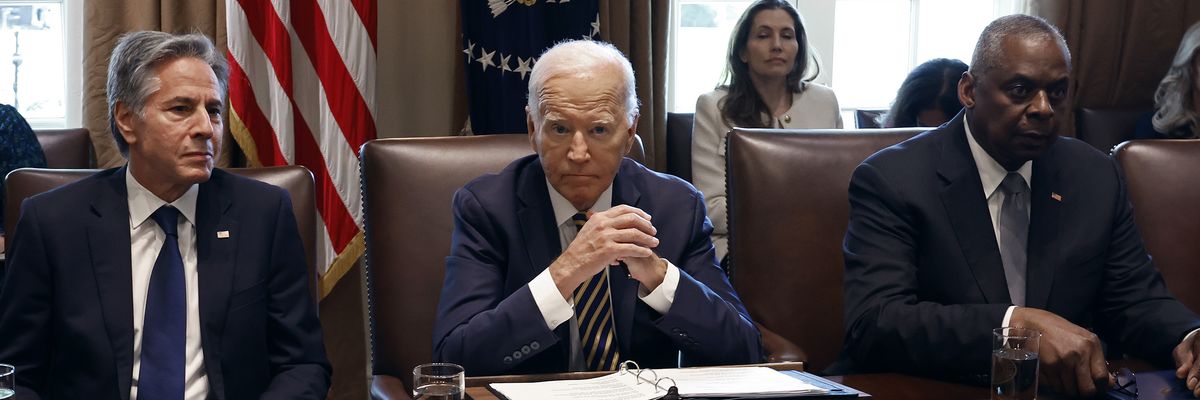
Then-U.S. President Joe Biden presided over a Cabinet meeting, flanked by Secretary of State Antony Blinken and Defense Secretary Lloyd Austin, at the White House in Washington, D.C. on September 20, 2024.
(Photo: Chip Somodevilla/Getty Images)

Jessica Corbett
Feb 24, 2025
COMMON DREAMS

A human rights group revealed Monday that on the last full day of U.S. President Joe Biden's term, it encouraged the International Criminal Court to investigate him and two of his Cabinet members for "aiding and abetting" Israeli war crimes and crimes against humanity in the Gaza Strip.


U.S.-based Democracy for the Arab World Now (DAWN) announced that on January 19, it submitted to the ICC Prosecutor Karim Khan a 172-page communication detailing why the tribunal should probe Biden and his former secretaries of defense and state, Lloyd Austin and Anthony Blinken.

Although a fragile cease-fire took effect in Gaza last month, Israel—backed by the Biden administration and Congress—responded to the Hamas-led October 7, 2023 attack with a 15-month blockade and military assault that killed tens of thousands, possibly hundreds of thousands, of Palestinians and left the territory in ruins.

"There are solid grounds to investigate Joe Biden, Antony Blinken and Lloyd Austin for complicity in Israel's crimes," DAWN board member and veteran war crimes lawyer Reed Brody said in a Monday statement. "The bombs dropped on Palestinian hospitals, schools, and homes are American bombs, the campaign of murder and persecution has been carried out with American support. U.S. officials have been aware of exactly what Israel is doing, and yet their support never stopped."

"By investigating and prosecuting U.S. officials, the ICC can deter and discourage further international support for Israeli crimes in Gaza and demonstrate that no one is above the law."

DAWN's document lays out how the United States, under Biden, "provided unwavering direct military and political support to Israel, even after it became manifest that Israel continued to carry out severe violations of international humanitarian law and human rights." That includes at least $17.9 billion in taxpayer-funded military assistance since October 2023, a 381% increase from the around $3.8 billion a year before Hamas' attack.

"In addition to new arms transfers and sales authorizations, the U.S. used pre-existing contracts and additional emergency military aid measures to expedite the delivery of major arms," the submission continues, also noting "the deployment of U.S.-operated military intelligence and active military operations targeting groups posing threats to Israel on other fronts."

Israel—like the United States—is not a party to the Hague-based ICC, but Palestine is. The court in November issued arrest warrants for Israeli Prime Minister Benjamin Netanyahu, former Israeli Defense Minister Yoav Gallant, and Hamas leader Mohammed Diab Ibrahim Al-Masri, also known as Mohammed Deif, who is dead.

DAWN's submission makes the case that "by continuously and unconditionally providing political support and military
support to Israel while being fully aware of the specific crimes committed by Netanyahu, Gallant, and their subordinates, President Biden, Secretary Blinken, and Secretary Austin contributed intentionally to the commission of those crimes while at least knowing the intention of the group to commit the Israeli crimes, if not aiming of furthering such criminal activity."

The group's executive director, Sarah Leah Whitson, said Monday that "not only did Biden, Blinken, and Secretary Austin ignore and justify the overwhelming evidence of Israel's grotesque and deliberate crimes, overruling their own staff recommendations to halt weapons transfers to Israel, they doubled down by providing Israel with unconditional military and political support to ensure it could carry out its atrocities."

"They provided Israel with not only essential military support but equally essential political support by vetoing multiple cease-fire resolutions at the U.N. Security Council to ensure Israel could continue its crimes," Whitson highlighted. She argued that "by investigating and prosecuting U.S. officials, the ICC can deter and discourage further international support for Israeli crimes in Gaza and demonstrate that no one is above the law."


DAWN also recommended that the ICC consider looking into half a dozen other Biden officials including Jake Sullivan, national security adviser; Gina Raimondo, secretary of commerce; Bonnie Jenkins, under secretary of arms control and international security; Stanley L. Brown, acting assistant secretary for the Bureau of Political-Military Affairs; Amanda Dory, acting under secretary of defense for policy; and Mike Miller, acting director of the Defense Security Cooperation Agency.

"It is important for the international community, and Palestinians in particular, to know that the American people do not support the crimes their elected officials committed in Palestine and that American organizations are doing their part to hold these officials accountable," said Whitson. "We have a duty, not just a right, as American civil society, to exercise our free speech to serve truth and seek justice."

So far, efforts to hold Biden and other U.S. leaders accountable for enabling what many experts around the world have called Israel's genocidal assault on Gaza via the U.S. court system have been unsuccessful. That includes a December lawsuit against Blinken backed by DAWN—which was founded by assassinated Saudi journalist Jamal Khashoggi.

"We have tried every available avenue within the U.S. to stop our government's complicity in the outrageous crimes we've witnessed since October 2023 in Gaza," said Raed Jarrar, DAWN's advocacy director. "When domestic institutions fail to uphold black-letter laws prohibiting military support to commit war crimes, we have a particular responsibility as Americans to hold American officials accountable for their roles in those crimes."

Since Biden left office last month, U.S. President Donald Trump has already welcomed Netanyahu to the White House, responded to the warrants by targeting the ICC with sanctions, and promoted a U.S. takeover of Gaza that would involve ethnically cleansing the territory of Palestinians.

"Trump isn't just obstructing justice; he's trying to burn down the courthouse to prevent anyone from holding Israeli criminals accountable," said Jarrar. "His plan to forcibly displace all Palestinians from Gaza should also merit ICC investigation—not just for aiding and abetting Israeli crimes but for ordering forcible transfer, a crime against humanity under the Rome Statute."
'Connect the dots': Why Trump’s president-for-life 'jokes' must be taken 'seriously'
 (Phil Mistry/Shutterstock.com)

February 24, 2025
ALTERNET

Some critics of President Donald Trump and MAGA allies like "War Room" host Steve Bannon are dismissing talk of a third Trump term as empty trolling designed to "own the libs." Trump and Bannon, they argue, should not be taken seriously — as the U.S. Constitution's 22nd Amendment clearly states that presidents are limited to two terms.

But The New Republic's Michael Tomasky, in an article published on February 24, warns that "jokes" about Trump staying in the White House after January 20, 2029 should not be taken lightly.

"When this comes up on cable news," Tomasky explains, "the host typically asks the guests whether Trump is just trolling the libs or should be taken seriously. It's a silly question, because the answer is obviously both. He's always trolling. But if you've watched these first four weeks and think he's not capable of finding a way to suspend the Constitution and stay in office, well, you're not watching the same show I am. Pay attention, and connect the dots."

Tomasky continues, "Trump installed a loyalist at the Justice Department. Pam Bondi is qualified for the job of attorney general on paper, but there is no question as to why she's really there: to wield the Department's power as Trump wishes. He installed a loyalist — an unqualified one — as the head of the nation's intelligence services. Tulsi Gabbard will also do whatever Trump wants. And he's done the same at the FBI. Kash Patel is obviously there to investigate Trump's political foes and critics. Incidentally, this week, Patel is also apparently going to be sworn in as the head of the Bureau of Alcohol, Tobacco, Firearms, and Explosives."

These appointments, according to Tomasky, "give Trump personal control over the country's legal and intelligence services." And the president "took an even more ominous step" when he fired Gen. CJ Brown as chairman of the Joint Chiefs of Staff and replaced him with "loyalist" John Dan Cain.

"Personal control over the Justice Department, the FBI, the intelligence services, and the Pentagon, along with a pliable right-wing Supreme Court majority, will enable Trump to do many things," Tomasky warns. "They're all bad, but it's having the lackeys in charge of the Defense Department and the Joint Chiefs that are the blaring sirens here…. People tend to dismiss talk of a Trump third term. They say the constitutional hurdles are too great, and indeed they are."

The New Republic editor continues, "Changing the Constitution requires either: (1) a two-thirds vote from both houses of Congress along with ratification by three-quarters of the states, or (2) a Constitutional Convention that would again require three-quarters of the states to agree on the change. Neither of those is happening. But those aren't the only ways to do it. Presidents can declare martial law. Several have, during wartime or other national emergencies. And a president can do almost anything he wants to under the Insurrection Act."

Michael Tomasky's full article for The New Republic is available at this link.


Bolivia inaugurates steel plant built with Chinese loan


By AFP
February 24, 2025


A Bolivian steel plant site is believed to hold more than 40 billion tons of iron ore, making it one of the largest deposits in the world - Copyright AFP AIZAR RALDES

Short on foreign currency, Bolivia inaugurated a steel plant Monday that it hopes will reduce its reliance on metal imports, thanks to a loan from China.

The Mutun megaproject in Puerto Suarez, near Bolivia’s border with Brazil, was built at a cost of $546 million, financed in large part by the Export-Import Bank of China — expanding its economic and political footprint in South America.

“The fundamental objective is that all of us Bolivians can benefit from a natural resource that has remained dormant for many years,” President Luis Arce said at the event.

The plant is forecast to produce nearly 200,000 tons of steel per year, which will allow us “to replace about 50 percent of imports” and prevent “a currency outflow of over $250 million” per year,” said Jorge Alvarado of the Bolivian public company that will operate the site.

The South American country has been in a deep economic rut since 2023, having used much of its international reserves on fuel, which it sells domestically at subsidizes prices.

China supported the project as part of its “Belt and Road Initiative” — a cornerstone of President Xi Jinping’s strategy to expand his country’s global influence.

Latin America has emerged as a key battleground in US President Donald Trump’s confrontation with China, and countries in the region are coming under increasing pressure from Washington to pick a side.

The site is believed to hold more than 40 billion tons of iron ore, making it one of the largest deposits in the world, according to Bolivian government estimates.

Read more: https://www.digitaljournal.com/business/bolivia-inaugurates-steel-plant-built-with-chinese-loan/article#ixzz91Hy6AUUH
‘All eyes on Arctic’: Canada boosts its northern force


By AFP
February 24, 2025

The Canadian Arctic is seen near Yellowknife, capital of the Northwest Territories - Copyright AFP Sumit DUBEY
Marion THIBAUT

In the mess hall of a Canadian military base a few hundred kilometers south of the Arctic Circle, Brigadier-General Daniel Riviere pointed to a map highlighting the region that is becoming a national priority.

“All eyes are on the Arctic today,” said Riviere, who heads the Canadian Armed Forces Joint Task Force North.

Thawing ice caused by climate change is opening up the Arctic and creating access to oil and gas resources, in addition to minerals and fish.

That has created a new strategic reality for Canada, as nations with Arctic borders like the United States and Russia intensify their focus on the region.

China, which is not an Arctic power, sees the area as “a new crossroads of the world,” the United States warned in the final weeks of president Joe Biden’s administration.

Ottawa has responded by announcing plans to reinforce its military and diplomatic presence in the Arctic, part of a broader effort to assert its sovereignty in a region that accounts for 40 percent of Canadian territory and 75 percent of its coastline.

Canada needs to act now because “the Northwest Passage will become a main artery of trade,” Riviere said, referring to the Arctic connection between the Atlantic and Pacific oceans.

Plans to bolster Canada’s Arctic presence include deploying new patrol ships, destroyers, icebreakers and submarines capable of operating under the ice cap, in addition to more planes and drones to monitor and defend territory.

– ‘Assert sovereignty’ –

At the Joint Task Force North’s headquarters in Yellowknife, the capital of Canada’s Northwest Territories, huge hangars house planes capable of landing on frozen lakes.

There is equipment designed to filter salt water from ice floes, and tents made for temperatures of -50 degrees Celsius (-58 degrees Fahrenheit).

Moving military resources around the area is complex work that is carried out by Twin Otters, a strategic transport aircraft that can operate in rugged environments.

On the tarmac after a flight over vast expanses of snow, forests and frozen lakes, Major Marlon Mongeon, who pilots one of the aircrafts, told AFP that part of the military’s job is “to assert sovereignty of our borders and land.”

Canada has only a handful of northern military bases.

To monitor the north, it relies on Canadian Rangers, reservists stationed in remote areas throughout the Arctic, many of whom are from the country’s Indigenous communities.

They’re known as “the eyes and ears of the north,” and some say their numbers need boosting in order to meet Canada’s evolving challenges.

The Rangers monitor more than 4 million square kilometers (1.5 million square miles), relying on their traditional knowledge of survival in this inhospitable area combined with modern military techniques.

They have been patrolling the country’s farthest regions since the Cold War began in the late 1940s, when military officials realized the Arctic was a vulnerable access point.

– ‘Most hostile threat’ –

“Having people from the area who know the land and the hazards, especially in the barren lands up there, to help assist you to get somewhere is vital,” said Canadian Ranger Les Paulson.

Because the military can’t deploy full-time soldiers across the entire region, the Rangers offer a rapid response option in remote communities, including in the event of “a breach of sovereignty” or airplane or shipping accidents, explained Paul Skrypnyk, 40, who is also a Ranger.

Climate change has made the Northwest Passage increasingly accessible to ships for navigation during summer months.

That promises to shorten voyages from Europe to Asia by one to two weeks, compared to the Suez Canal route.

Increased traffic, including among cruise ships, has compelled Canada to boost its capacities in the region to respond to accidents or emergencies.

In Yellowknife, training is being stepped up to prepare for a range of significant events, including how to respond to a fall into icy waters.

Among those training was Canadian Ranger Thomas Clarke.

Still soaked from his jump into a hole dug in the sea ice, Clarke said that in the Arctic, the environment remains the greatest danger.

“Mother nature… is the most hostile threat,” he told AFP. “Mother nature will try to end you, before anything else.”


Conservationists successfully rear two rare white-bellied herons


By Dr. Tim Sandle
February 24, 2025
DIGITAL JOURNAL


The white-bellied heron inhabits the wetlands of tropical and subtropical forests in the foothills of the eastern Himalayas. Image by Rajkimar99 - Own work, CC BY-SA 4.0

The critically endangered white-bellied heron (Ardea insignis) faces extinction due to habitat disturbance from human activities and predation. This makes protecting and conserving the species part of the global efforts to promote biodiversity.

Biodiversity is essential for the processes that support all life on Earth, including humans. Without a wide range of animals, plants and microorganisms, we cannot have the healthy ecosystems that we rely on.

In recent years, the heron’s habitat has been severely disturbed by human activities, and its population has decreased significantly. The white-bellied heron relies on forest and wetland habitats. Both are fast being degraded in all of its range states.

As of 2024, it is estimated that there are fewer than 45 birds in the world. Conservation efforts for the species are limited and fragmented. The white-bellied heron has a uniform dark grey plumage, a whitish belly, and long silvery or whitish plumes on the rear crown and lower foreneck.

In a recent study, researchers from Hosei University, Japan, have successfully hand-reared two white-bellied heron chicks in captivity. This represents a breakthrough for this critically endangered species.

The white-bellied heron is the world’s second-largest heron. It is a symbolic bird for the people of Bhutan and also a typical ‘umbrella species’ that requires a habitat with a vast, preserved environment.

The research was led by Professor Satoshi Shimano who collaborated with the White-bellied Heron Conservation Center in Bhutan, to revive the species through direct intervention.

The scientists overcame previous breeding failures, and the outcome offers new hope for species recovery. This achievement marks a vital step toward restoring wild populations.

The Royal Society for Protection of Nature (RSPN) in Bhutan decided to begin efforts to artificially breed White-bellied Heron outside their natural habitat (ex situ conservation), and the White-bellied Heron Conservation Center (WBHCC) was constructed and began operation in 2022.

The centre, located in the mountainous areas of south-central Bhutan, a six-hour drive from Bhutan’s capital, Thimphu, maintains three white-bellied herons in a large aviary on its grounds. Two of these birds were collected as chicks from wild nests, and the other was rescued as a wounded bird.

Back in 2018, Professor Shimano met a Bhutanese graduate student, Mr. Pema Khandu, who was working to conserve the white-bellied heron. Having witnessed the extinction of the Japanese original strains of the Oriental Stork and the Japanese Crested Ibis, Dr. Shimano volunteered to help.

Professor Shimano contacted other researchers. They concluded that the chick deaths were likely due to hand-rearing techniques rather than genetic abnormalities. To overcome rearing problems, the researchers provided continuous daily online support to Bhutan throughout the breeding season.

Advice included instructing that the bedding material be changed to twigs of a thickness that the chicks could easily grasp. As a result, one of the two chicks showed improvement in its legs and began to grow well.

Through such measures, the scientists are hopeful that, within five to 10 years, when the captive population rises to around 30 individuals, they will release a few into the wild.

The research paper describing the success appears in the journal Science and it is titled “Results of support activities to prevent the extinction of White-bellied Heron (Ardea insignis).”
Fires, strikes, pandemic and AI: Hollywood workers can’t catch a break


By AFP
February 24, 2025


Prop master Dutch Merrick lost his home in the Los Angeles fires and now finds himself relying on a food bank - Copyright AFP Robyn Beck
Romain FONSEGRIVES

Dutch Merrick isn’t really in a party mood for this year’s Oscars.

As for many below-the-line Hollywood workers, life has been hard for the veteran prop master, and became even more difficult when he lost his home in the deadly fires that ravaged Los Angeles in January.

The personal tragedy couldn’t have come at a worse time for Merrick.

Between the historic twin strikes that paralyzed Hollywood for much of 2023, the upheavals linked to streaming and the exodus of production projects from California, he hasn’t had a big job in two years.

“Work disappeared,” says Merrick, who specializes in supplying and ensuring the safe use of weaponry on sets.

“I don’t think anyone in our generation could fathom that this workflow would just turn to a trickle.”

He is now dependent on a food bank run by IATSE, the union for those working in Hollywood’s technical trades — editors, set designers, camera operators, costumers and makeup artists.

Volunteers see about 40 families every week at their premises near the Warner Bros. studios, stocking up on fruits, vegetables and other necessities.

Launched during the writers’ and actors’ strike in 2023, the initiative looks set to become a fixture, says union representative DeJon Ellis.

“The industry is in a contraction period, and it’s slow compared to the past seven years,” with around a third fewer jobs available, says Ellis.

“The fires compounded the problems.”

– Streaming bubble bursts –

Film and television built Los Angeles, and has for decades played a significant role in the city’s economy.

But 2024 logged the lowest number of days of filming in the region since records began — with the exception of the pandemic standstill of 2020.

The reasons are complicated but, Ellis says, the bursting of the streaming bubble was a significant contributing factor.

Gone are the days when each studio tried to imitate Netflix, launching frequent glossy, high-budget TV series.

Shareholders are now looking for a return on their investments and want profits, instead of just the promise of growth.

As a result, studios are producing less and relocating what they do make — if Los Angeles isn’t losing out to other US destinations like New Mexico or Georgia, it’s facing competition from tax-efficient destinations like Thailand, Hungary and South Africa.

“I think the very foundation of Hollywood has been shaken to the core,” says Merrick.

“I honestly think tax incentives started the race to the bottom.”

Much like departing automakers hollowed out Motor City, Merrick worries that Los Angeles could become a shell of its former self.

“I’m originally from Detroit, Michigan, and we’ve seen this script play out before,” the armorer said.

“We’ve seen an entire industry outsourced to other regions where they can get cheaper and cheaper labor.”

– Artificial intelligence –

Lawmakers under pressure to preserve a major industry are planning to double the tax credits available to companies filming in California.

But Veronica Kahn doubts that this will be enough in the face of fundamental changes in the way the audience thinks.

“People spend more time watching tons of 30-second videos on TikTok; they have less time to watch movies and series,” the 42-year-old sound engineer told AFP.

And even very short productions are not being made the way they used to be.

“For the Super Bowl this year… there was a lot of artificial intelligence, and a lot of animation. So our jobs are already disappearing,” she said.

Strikes by actors and writers that crippled Hollywood were in part about protecting them from the use of artificial intelligence and to demand better pay.

But Kahn says while the actors and the writers won, people like her lost.

When filming resumed in early 2024, “I was told that with all this extra money that they had to pay to the writers and the actors, they couldn’t afford an additional person for sound.”

Since then, “each time I’m meeting with producers, they tell me that it’s for work outside of Los Angeles,” she sighs.

Despite having cut back on eating out and — ironically, perhaps — cancelled her streaming subscriptions, Kahn still finds herself short and is grateful for the IATSE food bank.

“It really helps, any little bit helps,” she says, gesturing to a bag filled with lemons, avocados and eggs.

Since the fires, studios have provided millions of dollars to help those affected, including the people who rely on them to make a living.

But in his union hall, Ellis would prefer those studios do something else.

“If you really want to help all the fire victims, make more movies and TV shows here in Los Angeles,” he says.
EU vows to enforce digital rules despite Trump tariff warning


By AFP
February 24, 2025


US President Donald Trump, whose January inauguration was attended by big tech CEOs, vowed to protect US firms from foreign governments' actions - Copyright AFP/File Guillermo Arias

The EU promised on Monday to enforce its digital rules and to defend its laws “decisively” if necessary, after US President Donald Trump threatened to slap tariffs on countries that levy digital taxes on US tech firms.

Trump said in a memorandum on Friday he would consider tariffs in response to “digital services taxes, fines, practices, and policies” imposed on American companies.

He also ordered the US trade representative to consider whether to reopen investigations that had been started in 2019 during his first term into countries that hit US technology companies with digital services taxes.

The previous probes affected Austria, Britain, France, Italy, Spain and Turkey.

The president has taken aim at the European Union and others over trade, announcing plans for sweeping duties tailored to each US trading partner.

The European Commission, which acts as the EU’s digital watchdog, expressed concern at Trump’s memorandum.

“We have always enforced and will continue to enforce our laws fairly and without discrimination toward all companies operating in the EU,” it said.

“If needed, the EU will respond swiftly and decisively to defend its rights and regulatory autonomy against unjustified measures,” the commission added.

It insisted EU states’ digital services taxes were non-discriminatory, stressing they apply to all large digital services companies including Chinese and British firms.

Such taxes “ensure that all companies, regardless of their country of origin, pay their fair share in the markets where they generate revenue and profit”, the EU said.

The White House also said the European Union’s landmark rules covering competition and content moderation known respectively as the Digital Markets Act (DMA) and the Digital Services Act (DSA) “will face scrutiny”.

The EU has launched investigations under the DMA into Apple, Google and Meta.

There had been speculation that Apple would face a DMA fine late last year but sources close to the matter said the European Commission chief froze those plans, fearing any penalty could endanger fragile transatlantic ties under Trump.

Trump also ordered a probe into whether British and EU laws or policies encourage the use of US tech products or services “in ways that undermine freedom of speech and political engagement or otherwise moderate content”.

Trump’s ally, tech billionaire and X owner Elon Musk, has accused Brussels of censorship. His social media platform has faced a DSA probe since December 2023.

Meta CEO Mark Zuckerberg also accused Europe of passing laws “institutionalising censorship” as he announced an end to fact-checking in the United States in January.

He claimed shortly after that the EU had fined tech companies “more than $30 billion over the last like, 10 or 20 years”.


Trump’s chip tariff threats raise stakes for Taiwan


By AFP
February 24, 2025


Visitors take pictures of wafer samples at the Intel booth during Computex 2024 in Taipei in June 2024 - Copyright AFP/File I-Hwa CHENG

Allison JACKSON

US President Donald Trump’s threat of tariffs on semiconductor chips has complicated Taiwan’s bid to remain a global powerhouse in the critical sector and stay onside with key backer Washington, analysts said.

Since taking office last month, Trump has warned of sweeping tariffs against some of his country’s biggest trade partners to push companies to shift manufacturing to the United States and reduce its huge trade deficit.

The latest levies announced last week include a 25 percent, or higher, tax on imported chips, which are used in everything from smartphones to missiles.

Taiwan produces more than half of the world’s chips and nearly all of the most advanced ones, making the island essential to global supply chains.

The island’s economic importance has been described as a “Silicon Shield” against an invasion or blockade by China, which claims it as part of its territory and has threatened to use force to bring it under its control.

“Taiwan’s economic security depends heavily on its leadership in semiconductor manufacturing, which it has been using strategically to maintain its importance in global supply chains,” said Julien Chaisse, an international trade expert at City University of Hong Kong.

“I think that Trump’s tariff threats make this strategy much more complicated. For instance, Taiwan could face pressure to make concessions.”

Despite strong bipartisan support in the US Congress for Taiwan, there are fears Trump might not consider the island worth defending if China attacked.

Trump has accused Taiwan of stealing the US chip industry and suggested it should pay the United States for its protection.

Taiwan President Lai Ching-te has already vowed to boost investment in the United States to reduce the trade imbalance and spend more on the island’s military, while his government is also considering increasing US natural gas imports.

– Give it all away –

The pressure from Trump may accelerate the shift of Taiwanese chip production to the United States, said Wayne Lin of Witology Markettrend Research Institute in Taipei, but he added it would take years to build new foundries.

Taiwan’s TSMC, which is the world’s largest chipmaker, has long faced demands to move more of its production away from Taiwan.

The company has pledged to invest more than $65 billion in three factories in Arizona, one of which began production in late 2024.

TSMC plans a second facility in Japan and last year it broke ground on its first European plant.

But there are concerns Taiwan could lose its “silicon” protection if its companies build too many factories overseas.

“It’s a very dicey situation that they’re in,” Dan Hutcheson, a California-based senior research fellow at specialist platform TechInsights, told AFP.

“It’s in (Taiwan’s) interest to move some of their manufacturing (to the United States), but not to give it all away, because if they give it all away, then they lose their importance.”

– Recession threat –

Taiwan’s government is still calculating the potential impact of Trump’s tariffs and has flagged support for affected industries.

One determining factor would be whether levies are applied only to chips shipped to the United States or also on chips in finished products.

A fraction of Taiwan’s $165 billion in chip exports last year went directly to the United States, official data show.

The vast majority were sent to other countries where they were put into electronic products for export.

“A 25 percent tariff is significant, but it is unlikely to be a game changer for Taiwan’s semiconductor industry, certainly in the short term,” Robyn Klingler-Vidra, an innovation policy expert at King’s College London, told AFP.

But, she warned, the tariffs “will likely have broader global supply chain effects rather than simply curbing direct Taiwan-to-US exports”.

Tariffs could raise the price of smartphones and laptops, hurting demand for chips and potentially triggering a “recession in the semiconductor industry”, Hutcheson said.

Taiwan National Security Council chief Joseph Wu said last Thursday that US consumers would end up bearing the cost of the levies.

“I’m sure, eventually, the US will reconsider its decision,” Wu said.

Software as a medical device: Time to develop an ethical framework?


By Dr. Tim Sandle
February 24, 2025
DIGITAL JOURNAL


Generative artificial intelligence powered features such as chatting about what is in pictures, telling children bedtime stories, and imitating podcasters continue to roll out despite fears the technology will be used for more nefarious purposes 
- Copyright AFP Yasuyoshi CHIBA

Medical based AI is expanding, especially the concept of “software as a medical device”, yet regulatory approval is slowing and public acceptance is not significantly growing. What needs to be done to address opaque algorithms in medical AI? The answer may fall within the development of a universal framework based on an ethical structure. Through such a structure, developers, healthcare professionals, and legislators can become better ‘sensitized’ to the needs of the general population.

A new article, from US based medical researchers, has probed the use of artificial intelligence-based software in relation to medical devices. Such devices present the possibility for alleviating suffering through rapid identification and early intervention.

Yet the adoption of such devices in clinical practice has remained relatively slow. The limitation is not so much to do with the technology but more in relation to ethical questions.

While ethical questions will have some cultural differences, and there is an absence of any universal framework for the approval of AI-assisted medical devices, it is noticeable that the guiding principles remain very similar globally. However, these are often implemented in a haphazard way.

The article calls for a structured approach for the regulatory approval process. This is based around key principles of medical ethics: autonomy, beneficence, and fair distribution of healthcare sources.

Autonomy


Autonomy concerns the importance of informed consent, self-determination, and the right to refuse or accept treatment. In other words, the patient must maintain full control over the decision-making process about their health.

In terms of AI, different national legislation shapes whether or not patients retain data ownership, and the extent that users can decide how their data can be used by a healthcare facility or company

.
Medical device. Image by Orangeboxes2 – Own work, CC0

Beneficence


Beneficence obliges the physician to act only for the benefit of the patient and avoid anything that could oppose the patient’s well-being. This needs to run in tandem with non-maleficence, the rules that prevent physicians from harming patients in any capacity in any way.

In terms of AI, this means ensuring that AI-based devices lead to timely intervention and preventive measures.

This means avoiding AI algorithms being trained using biased datasets. The risk otherwise is that AI can perpetuate and amplify existing biases, leading to discriminatory and unfair outcomes.

Fair distribution

Fair distribution is part of the concept of ‘justice’ and this includes having appropriate measures in place to ensure that no implicit bias arises from the use of AI-based devices and that unfair discrimination is eliminated during the development process.

Explainability

An important area is with building public trust for AI. Here the paper calls for “explainability and transparency of AI algorithms” as “the characteristics that are crucial to ensuring the trust and accountability of these systems.” In other words, if the public do not understand what an Ai algorithm actually does and cannot see how their data is being handled, then the public acceptance of the AI and a willingness to share data or to participate in a trial is diminished.

Explainability is not a purely technological issue, and it invokes a host of medical, legal, ethical, and societal questions

In terms of a suitable outcome, the paper recommends regulating quality management, risk assessment, and data privacy to help in building trust to promote the adoption of AI in healthcare.

The research appears in the journal Cureus, titled “Integrating Ethical Principles Into the Regulation of AI-Driven Medical Software.”


Written By Dr. Tim Sandle

Dr. Tim Sandle is Digital Journal's Editor-at-Large for science news. Tim specializes in science, technology, environmental, business, and health journalism. He is additionally a practising microbiologist; and an author. He is also interested in history, politics and current affairs.