Thursday, March 13, 2025

'He’s getting bad advice': Trump is 'wreaking havoc' with the 'very good economy' he inherited
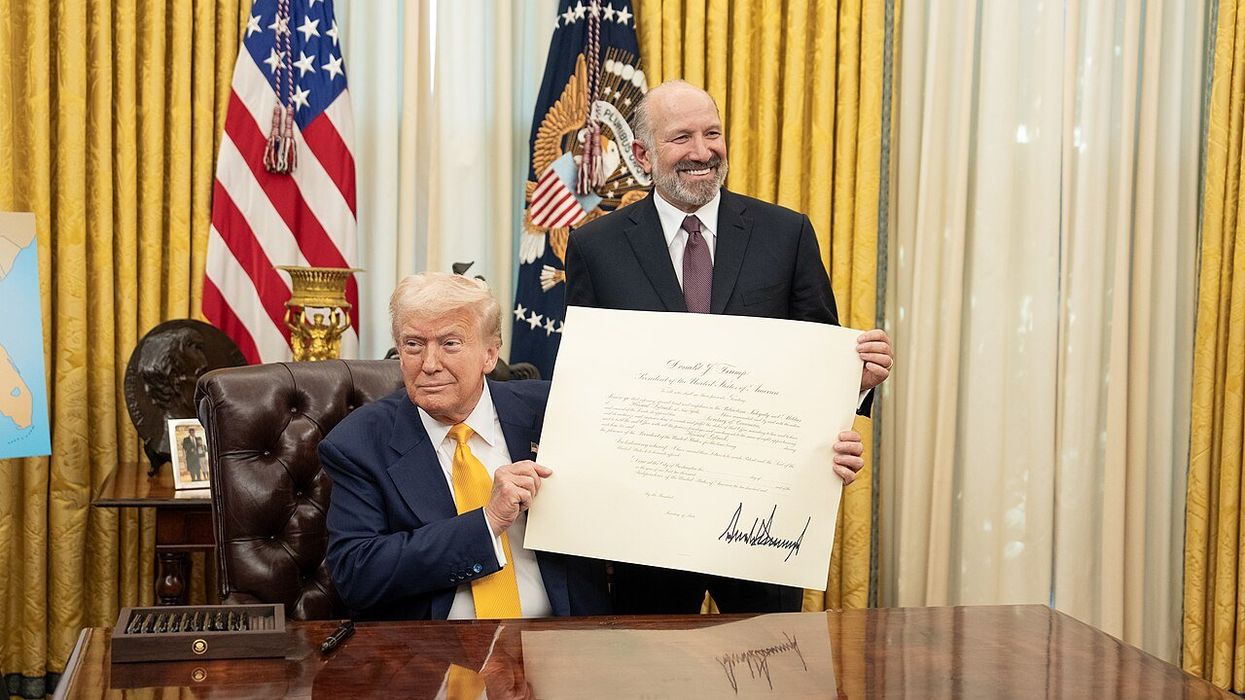

President Donald Trump with Commerce Secretary Howard Lutnick on February 21, 2025 
(Wikimedia Commons)

Alex Henderson
March 12, 2025
ALTERNET

President Donald Trump continues to claim that he inherited a "horrible" economy from former President Joe Biden. But in fact, the United States' unemployment rate in December 2024, Biden's last full month in office, was only 4.1 percent (according to the U.S. Bureau of Labor Statistics). And the U.S. enjoyed record-low unemployment earlier in Biden's term.

Trump is promising major economic growth, but Paul Krugman and other economists, along with business leaders, fear that his economic policies — from aggressive tariffs against U.S. allies to gutting the federal workforce to mass layoffs of federal workers — will push the United States into a recession. And the Dow Jones, according to CNN, fell by 890 points on March 10.

Washington Post columnist Catherine Rampell addressed the worries of economists, business leaders and consumers during a Wednesday, March 12 appearance on MSNBC's "Morning Joe." And she laid out a variety of reasons why Trump's policies are giving them major anxiety.

When host Joe Scarborough noted how badly the stock market has been tanking, Rampell — who MSNBC recently hired as a weekend host — replied, "It's just insane. I cannot fathom why Trump is doing this, except for the fact that: (A) He's in love with tariffs. He's a tariff man. And (B): [It's] worth reminding people that the two people who are egging Trump on to wage trade wars against our friends and allies are people…. who used to work for the steel industry. The U.S. trade representative represented Cleveland-Cliffs, a major steel company in the United States."

Rampell cited "Trump's trade guru," Peter Navarro, as another negative influence on his economic policies.

The Post columnist told Scarborough and fellow "Morning Joe" host Mika Brzezinski, "So, he's getting bad advice, I guess. Even if he got good advice, I'm not sure he would follow it. But clearly, markets are very unhappy with how things are going, as they should be."

Although Trump often attacks Biden's economic policies, Rampell noted that he "inherited quite a good economy, actually" from the previous administration.

"Trump actually inherited very strong economic growth, low unemployment, cooling — if not quite low enough — inflation," Rampell explained. "A lot of very good trends. And the best thing he could have done when he came into office, as I have said many times, is just nothing at all. You know, go play golf, take credit for the gains he was already inheriting. And instead, of course, he is wreaking havoc."

Rampell continued, "He's not only creating a lot more uncertainty and potentially higher costs for businesses, which will then be passed along, at least in part, to consumers. He's also threatening to deport half of the agricultural labor force, which also threatens to increase food prices. He's leaning on the Federal Reserve. I think this is sort of the sleeper story of this year. He did this last time, of course, when he was president. It would be very bad now for him to be seen as strongarming the Fed, which has historically, (been) politically independent (and) needs that political independence for its credibility…. And so, a lot of reasons to think he's messing up a very nicely wrapped gift that he had gotten.

Watch the full video below or at this link.


Egg prices have 'soared' — even as Trump insists they have 'come down a lot'

NEW CIVIL RIGHTS MOVEMENT
March 12, 2025

As President Donald Trump showcased Tesla electric vehicles on the South Lawn of the White House on Tuesday, he faced questions about the timing of what is being called a “car commercial.” With stock markets tumbling—taking retirement accounts with them—and some Americans grappling with job uncertainty, some wondered about his decision to highlight automobiles made by a company run by his top advisor and largest donor, Elon Musk.

But President Trump insisted everything was fine.

“Well I think they’re going to do great,” he said, insisting that prices are “all coming down” as he complained about the economy he “inherited.”

“We didn’t have these problems,” Trump told reporters, referring to his first term in office.


“I had no inflation. I had a great economy. He gave you high prices,” Trump said, criticizing President Joe Biden.

“You couldn’t buy bacon, you couldn’t buy anything, and also, I inherited a situation with eggs,” Trump said. “The price of eggs was through the roof. Well, now the price of eggs has come down a lot.”

“It’s all coming down. It’s all a beautiful thing,” Trump proclaimed.

Wednesday morning, The Associated Press reported, “US egg prices increased by an average of 10.4% last month, Consumer Price Index shows.”

“Egg prices have soared nearly 59% compared with a year ago, and is by far the highest inflated price on the Consumer Price Index report,” Fox9, a Fox affiliate, added.

The Consumer Price Index released one month ago also showed egg prices had risen to a “record high.”

“Egg prices hit a record high as the U.S. contends with an ongoing bird flu outbreak, but consumers didn’t need government figures … to tell them eggs are terribly expensive and hard to find at times,” the Associated Press reported last month.

On Tuesday, U.S. Secretary of Agriculture Brooke Rollins declared that the “average cost of a dozen eggs has now gone down $1.85 since we announced our plan about a week-and-a-half ago,” before appearing to also blame the high cost of eggs on “Easter season.”

Separately on Tuesday, Secretary Rollins wrote: “Wholesale egg prices dropped roughly ~$2.60/dozen from their peak this month — prices will likely fluctuate but relief is in sight as we fix what Biden broke!”


Secretary Rollins did not mention her source, but the weekly “Egg Markets Overview,” a publication of her USDA, on March 7 reported that a decline in demand was the cause for lower wholesale egg prices.

Last week, Secretary Rollins suggested Americans might want to consider raising chickens in their backyards to alleviate the high cost of eggs.

Watch the Trump Tesla event below or at this link


The Trump-Musk Recession: Because They Can


 March 13, 2025
Facebook

Photograph Source: The White House – Public Domain

Past recessions have been the result of policy errors or disasters. The most typical policy error is when the Federal Reserve Board raises interest rates too much to counter inflation. That was clearly the story in the 1974-75 recession, as well as the 1980-82 double-dip recession.

Then we have recessions caused by collapsing financial bubbles, the 2001 recession following the collapse of the stock bubble, and the 2008-09 recession following the collapse of the housing bubble. And of course, we had the 2020 recession because of the COVID-19 pandemic. But now Donald Trump is threatening us with a recession — not because of something that is any way unavoidable, but rather because as president he has the power to bring on a recession.

While a recession may not be fully baked into the cards at this point, the risk is evident and it’s almost entirely coming from Donald Trump’s policies. First and foremost are the costs associated with his import taxes (tariffs), or at least the threat of tariffs.

The impact of Trump’s threats should not be underestimated. If you were an auto executive trying to decide whether and where to expand capacity right now, what would you be doing? Would you look to continue to take the lowest cost route and further integrate your operations with Canada and Mexico? That would be a pretty bad choice if we have high taxes on imports from these countries going until Trump and his offspring have all left the White House.

Alternatively, you could go the MAGA route and invest in the United States. This would mean you would have far higher costs and likely be wiped out if the tariffs on Mexican and Canadian imports came down at some future date. Alternatively, it is possible President Xi, or some future Chinese leader, would make a visit to Mar-a-Lago and we would be able to buy high quality Chinese EVs for $17,000. Again, you would be wiped out.

Needless to say, the smart move here is to put off any major new investments until Donald Trump figures out what he wants to do with tariffs. And even then, it would probably be smart to limit investments, since we know Trump can change his mind at any time, depending on who shows up at Mar-a-Lago. Most industries are not as thoroughly integrated into the world economy as the auto industry, but almost all have some degree of integration, so we can expect many companies putting off investment plans to see where things go. This means that even without actually imposing new tariffs, Trump is already hurting the economy.

And if Trump does impose his taxes, it will undoubtedly be a big hit to the economy. It’s hard to gauge how big a hit since the threatened size of the tariffs and the items subject to the tax change daily or even hourly, but we could easily be looking at an increase in our annual taxes of $200 billion to $300 billion a year. That would be 0.7-1.0 percent of GDP or $1,600 to $2,400 per household.

To take some concrete examples: if Trump imposed a 25 percent tax on Canadian oil, which he has sometimes threatened, that would increase gas prices by more than 40 cents a gallon for large parts of the Midwest. He has recently talked about upping his tax on imports of Canadian lumber to 250 percent. This would effectively cut off a source of lumber that has accounted for close to 30 percent of the US supply in recent years. Lumber prices have already risen by more than 20 percent since Election Day due to Donald Trump’s clown show. This would be a huge hit to the housing industry.

These economic disruptions would be understandable if there were some rationale, but it is hard to see what it is. Trump’s stated reasons for his import taxes change constantly. He has complained about fentanyl and illegal immigration from both countries. The complaint about fentanyl from Canada is absurd on its face. A very small share of the fentanyl in the US comes from Canada and the Canadian government is engaged in cooperative efforts to reduce the amount further. It’s the same story with immigration, with only a small share of the flow of undocumented migrants coming from Canada.

Both of these are bigger issues with Mexico, but Mexico’s government has been cooperating with the United States for years in trying to limit the number of undocumented immigrants crossing the border, as well as the flow of fentanyl. In fact, President Biden reached an agreement with Mexico in June that cut the flow of immigrants by close to two-thirds. There is no obvious reason that Trump has to make threats of taxes for further reductions in these areas.

Trump has also complained about both countries’ trade surpluses with the US. He regularly gets Canada’s surplus off by a factor of 150 percent — it’s $60 billion, not $150 billion. Furthermore, the reason for the deficit is imports of oil that Trump himself tried to foster in his first term.

The trade deficit is larger with Mexico, but this is largely the result of the USMCA trade deal that Trump himself negotiated. That deal led to further integration of the two economics, which is presumably what was expected.

In short, the trade imbalances story does not make much more sense than the fentanyl and immigration story. There is also the possibility that Trump just sees these taxes as a good way to raise revenue without taxing his billionaire campaign contributors.

This is plausible, since tariffs are an extremely regressive tax. Low and middle-income families spend a much higher share of their income than the rich, and a larger share of what they spend goes to goods as opposed to the luxury services purchased by the Elon Musks of the world. A big tax increase might not sound great to Trump’s MAGA base, but that could be what they are looking at.

There is also the possibility that Trump is actually serious about wanting to make Canada the 51st state. That story likely ends up in warfare and occupation, since Canada is not likely to capitulate based on Trump’s tariff threats. Trump often tried to portray himself as the peace candidate during the campaign. It’s not clear how a war against our closest ally and the subsequent occupation would sell with his base.

The Smashing Government Route to Recession

Donald Trump’s tariff games are just one possible route to recession; the other is Elon Musk’s DOGE team attack on the government. If there was ever any doubt, it is now clear that this outfit has nothing to do with increasing government efficiency.

They show up at government agencies without even knowing what the agency does. They then do large-scale layoffs without knowing what the fired workers do. When they find out what they do, they often have to hire them back, as happened with air traffic controllers and workers keeping our nuclear weapons safe. There is no evidence that Musk or his “super-high IQ” DOGE boys have ever spent five minutes reviewing the evidence of waste and fraud that has been assembled by Government Accountability Office or the various agency inspector generals, most of whom have been fired by Trump.

But the direct impact of Musk’s job cuts on both the budget and the economy is likely to be small. The bigger impact is the uncertainty they have created in large sectors of the economy. This is most evident with medical research and universities more generally. Their funding streams through fiscal year 2025 (which ends October 1) and later have been called into question by Musk and Trump’s actions. Many of them are cutting back hiring, and even retracting job offers now that funding streams are no longer secure.

The uncertainty is also hitting the larger healthcare sector, which has been the major source of job growth in the last two years, accounting for more than one-third of the February job growth. Hospitals, nursing homes, and other providers can no longer be sure of their funding streams going forward, therefore they are likely to be far more cautious in hiring.

This will also be true for state and local governments which now have no idea when Donald Trump will arbitrarily decide to cut off a flow of federal money. These cutoffs may be illegal, but no one knows what the courts will decide and when and if Trump will respect the Constitution. As a result, state and local governments also have to be careful in their hiring and spending more generally.

The End of the Rule of Law

The large sectors of the economy forced to be more cautious in their hiring and spending as a result of the DOGE routine give us a second possible route to a recession in addition to the Donald Trump tariff reality TV show. But the impact of replacing the rule of law with the rule of Mar-a-Lago goes much further.

Most immediately, we are likely to see many fewer foreigners coming to the United States, as it comes increasingly to be seen as a “shithole country.” Foreign tourists spent almost $170 billion in the United States last year (line 339). This is likely to fall sharply as foreigners can no longer count on any of the rights that they would have been accorded in prior years. This applies not only to darker-skinned people, but even to lighter skinned types who for whatever reason run afoul of immigration officers.

The United States is also likely to be a less attractive tourist destination more generally as our national parks get run down due to large-scale layoffs, air travel becomes less reliable, and even weather forecasts become more uncertain due to mass layoffs at the weather bureau. Most people probably didn’t think of park rangers as the “Deep State,” but apparently Donald Trump did.

Foreigners spent almost $60 billion on tuition at US colleges and universities (line 341) last year. We can expect this also to fall sharply as schools can no longer promise their foreign students protection against arbitrary actions by immigration officers.

Also, the rule of Mar-a-Lago will make the United States a much less attractive place to invest more generally. Businesses will look to invest in Europe, Japan, Latin America, India, and possibly even China, as countries that have greater respect for the rule of law. This should further dampen investment in the United States.

In short, Donald Trump has good reasons for telling us that his MAGA policies might give us a recession. It’s hard to know how bad this recession would be, but it will definitely be the “Donald J. Trump recession.”

This first appeared on Dean Baker’s Beat the Press blog.

Dean Baker is the senior economist at the Center for Economic and Policy Research in Washington, DC. 


Inflation Numbers Don't Alter Fears That Trump Has US Economy 'Barreling Toward Recession'


"Instead of trying to lower the cost of living, he's doubling down on his plans to give massive tax breaks to billionaires and giant corporations," said one Trump critic.


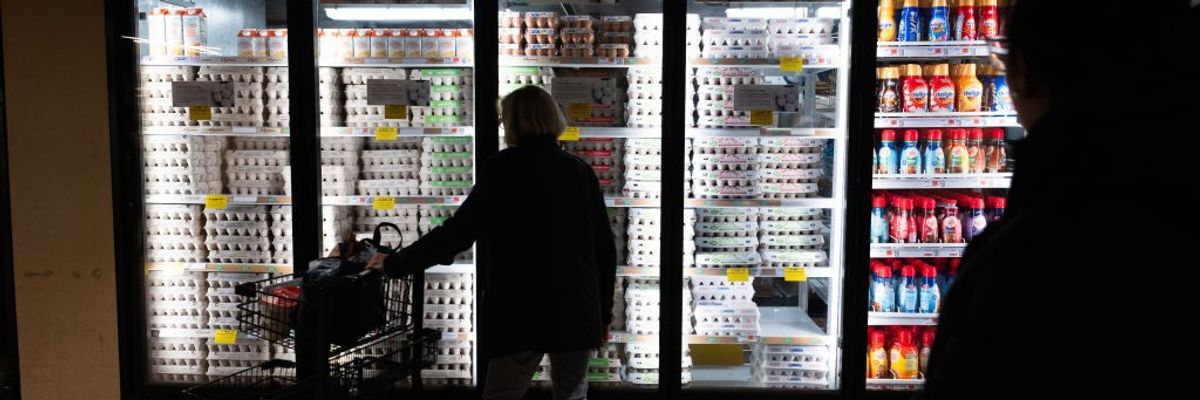
A shopper looks at eggs in a New York City grocery store on February 25, 2025.
(Photo: Spencer Platt/Getty Images)

Jessica Corbett
Mar 12, 2025
COMMON DREAMS

As the U.S. Department of Labor released its monthly consumer price index report on Wednesday, President Donald Trump's new tariffs for steel and aluminum imports took effect, highlighting his threat to the economy and working-class Americans.

The CPI, "a key gauge of inflation, showed that prices rose by 2.8% in February from a year earlier, driven by price relief from airfares and gas," The Washington Postreported. "That was cooler than the 3% annual gain reported for January and an unexpected signal of progress in combating high inflation."

While gasoline prices fell 1.0% and airline fares dropped 4%, the cost of food and shelter rose 0.2% and 0.3% respectively. The bird flu continued to drive up egg prices, which jumped 10.4%. The report adds, "Indexes that increased over the month include medical care, used cars and trucks, household furnishings and operations, recreation, apparel, and personal care."

The White House celebrated the inflation data, but economists were quick to point out that the numbers don't account for the latest developments in Trump's trade war: the new tariffs taking effect on Wednesday—after chaos-causing mixed messages from the president on Tuesday—and Canada and Europe's swift retaliatory measures.


"It's a classic head fake," Joe Brusuelas, chief economist at RSM, told the Post. "Going forward, tariffs are going to increase the costs of manufacturing in general and autos in particular."

Chris Low, chief economist at FHN Financial, similarly toldReuters that "trade wars are expected to raise prices in future inflation reports," though he also said the odds that the Federal Reserve can cut interest rates "again this year once the smoke from the tariff back-and-forth clears increased today nonetheless."

Trump's trade policies and other recent decisions, including letting billionaire Elon Musk gut the federal government, have elevated fears of a recession—which one economist suggested naming after the president—and even sparked speculation that he is tanking the economy on purpose.


In a Wednesday statement about the CPI report, Groundwork Collaborative chief of policy and advocacy Alex Jacquez said that "while families are still struggling to put food on the table and a roof over their head, the administration's response is that they should raise their own chickens in their backyards."

"Every economic indicator suggests that President Trump has us barreling toward a recession and stagflation. But instead of trying to lower the cost of living, he's doubling down on his plans to give massive tax breaks to billionaires and giant corporations," Jacquez added, referring to congressional Republicans' efforts to send Trump legislation that would fund tax giveaways by slashing Medicaid and the Supplemental Nutrition Assistance Program (SNAP).

In addition to Jacquez's comments, Groundwork and Data for Progress also released a poll showing that over a fifth of U.S. voters across the political spectrum are most frustrated with rising grocery costs. Another 10% are most frustrated with high bills for utilities like electricity, gas, and water. They were followed by around voters frustrated with out-of-pocket healthcare costs, rent or mortgage, or health insurance premiums.


Groundwork Collaborative warned that "Trump's threat of new tariffs risks making the housing crisis worse. By driving up the cost of construction materials, his trade war with Canada could shrink the supply of new housing, keeping overall prices high. That, in turn, forces the Federal Reserve to keep interest rates elevated, making mortgages more expensive."

The think tank also stressed that the Trump administration is "destroying affordable healthcare" by fighting to cut Medicaid and Medicare, reinstate work requirements, and limit Affordable Care Act enrollment; "raising energy bills" by freezing funds for clean energy projects while advocating for planet-wrecking fossil fuels; and "making groceries more unaffordable" by pushing SNAP cuts "instead of tackling corporate price gouging and market consolidation in the food industry."

Food & Water Watch similarly responded to the new CPI data by calling out failures to crack down on corporate price gouging—as detailed in the group's report from last week titled, The Rotten Egg Oligarchy.

"Record-high egg prices have everything to do with corporate greed," Food & Water Watch research director Amanda Starbuck said Wednesday. "While skyrocketing prices transform eggs into a luxury item, the food monopolies are seeing green. President Trump needs to get serious about lowering American food prices—starting with cracking down on the food monopolies exploiting the worsening bird flu crisis for profit."
Is Trump Falling Into the Trump Tarriff Trap?

The Democrats are once again abdicating the jobs terrain to Trump, hoping instead that his tariff toy will blow up in his dictatorial hands. Instead of calling tariffs “insane,” Democrats should call them job-killing tariffs. And as prices rise, they can blame Trump for that as well.


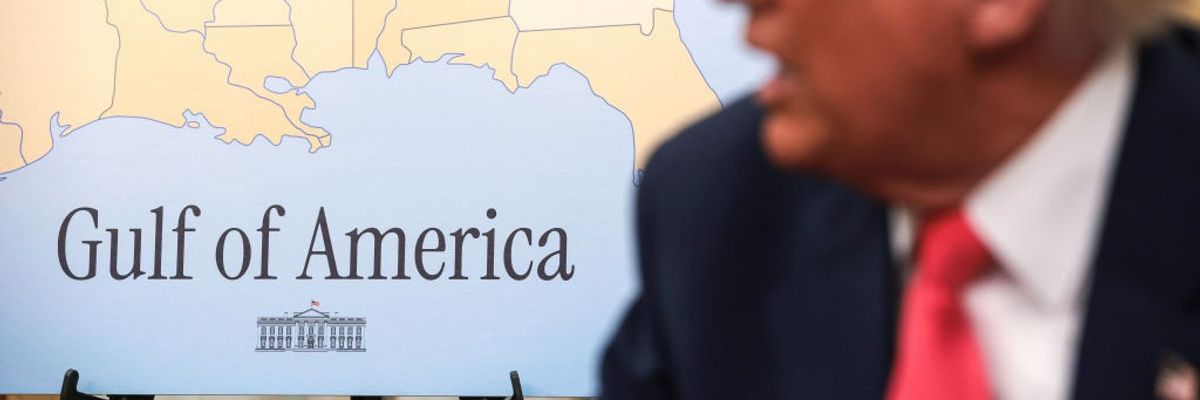
A map of the Gulf of America is seen as U.S. President Donald Trump speaks before signing executive orders in the Oval Office of the White House on March 06, 2025 in Washington, DC.
(Photo by Alex Wong/Getty Images)


Les Leopold
Mar 13, 2025
Common Dreams


Whether by design or instinct, candidate Donald Trump set a perfect trap for the Democrats when, in September 2024, he reacted to the John Deere and Company’s announcement that it would move a thousand jobs from the Midwest to Mexico. Trump said then:
I am just notifying John Deere right now that if you do that, we are putting a 200% tariff on everything that you want to sell into the United States.

Trump saw Deere’s announcement as the perfect opportunity to jump on Deere’s job destruction, which the company used to finance 12.2 billion in stock buybacks to enrich its investors.

The Democrats? They sent billionaire Mark Cuban out to the media to complain that the tariffs were “insane.”

But threatening tariffs did not feel insane to the Deere workers who were about to lose their jobs. Nor did they feel insane to the millions of other workers who had lost their jobs due to “free trade” deals like NAFTA.

The Democrats now have a chance to turn the tables—but, alas, they probably won’t.

The Democrats stumbled into the Trump’s tariff trap and provided many workers with yet another reason to abandon a party that had failed to say anything at all about the needless job destruction caused by overt corporate greed.

After Trump won the presidency last November, I was sure he would set more tariff traps, provoking the Democrats to reflexively react as corporate shills.

But along the way something funny happened. Trump fell into his own tariff trap, and his public support has fallen somewhat. The Democrats now have a chance to turn the tables—but, alas, they probably won’t.
Why Does Trump Love Tariffs?

Even the most ardent MAGA apologist knows that Trump has dictatorial impulses. He wants to play Brando in “The Godfather” and make you an offer you can’t refuse.

But playing Don Corleone in domestic affairs doesn’t come easily. Trump can flood the zone with executive orders, but the courts are still functioning and often enforce the law. Even a pliable Congress has rules which can get in the way of the legislative results Trump is demanding.

But there are two areas where Trump really can act unilaterally—foreign affairs and tariff policy.

As president, Trump is free to bully Ukraine, kiss up to Putin, threaten to annex Greenland, Panama, and even Canada. No one in the U.S. can really stop him. He doesn’t need the blessing of Congress unless he wants a new treaty, which he doesn’t.

Similarly, he can use Section 301 of the Trade Act of 1974, which authorizes the U.S. Trade Representative, a Trump toady, to impose tariffs in response to unfair trade practices, which are not defined.

There is no way a full-scale trade war with Canada will do anything but shatter jobs on both sides of the border, while raising prices as well.

Tariffs are a shiny new toy for Trump to play with. He can turn tariffs on and off, making entire countries jump to his tune. Each day he comes up with new reasons to justify them—fentanyl, immigrants, unfair subsidies, too much control of domestic banking (God forbid!). But these are just excuses for having fun by intimidating entire countries.

Trump can also combine his control of foreign policy with tariffs, as he is gleefully doing with Canada. What fun it is to threaten to take down the Canadian economy with tariffs while bullying them into becoming the 51st state. Clearly Trump wants to flex his dictatorial muscles, even as his real one’s sag with age.

But by playing dictator, he has abdicated the targeted use of tariffs to protect jobs. There is no way a full-scale trade war with Canada will do anything but shatter jobs on both sides of the border, while raising prices as well. Why? Because corporations like John Deere are not fleeing to Canada to find cheaper labor.

As a result, a tariff war with Canada is likely to kiss goodbye as many U.S. jobs as are protected. But Trump doesn’t seem to care because he’s all in on making Canada sweat. Damn the jobs! Damn inflation! He’s simply in love with his unilateral powers, which no one else in the world has. That’s a high that beats fentanyl.
The Trump Trap of Stagflation

Trump may not know it, but he is playing with fire. Tariffs are certain to raise U.S. prices. Why? Because when U.S. corporations see that their competition from Canada faces price increases caused by the 25 percent tariff, the companies will raise their own prices, especially in key industries with only a handful of large competitors.

A tariff war with Canada is likely to kiss goodbye as many U.S. jobs as are protected. But Trump doesn’t seem to care because he’s all in on making Canada sweat. Damn the jobs! Damn inflation! He’s simply in love with his unilateral powers...

Furthermore, by Trump turning his tariff toy on and off, he is causing economic uncertainty. That uncertainty has already had a drastic impact on the stock market.

But it will get much worse if corporations hold back on investment decisions until Trump stops fiddling with his toy.

It’s a very big deal when corporations delay investment decisions. Slower investment rollouts can lead to an economic slowdown and even a recession. And such a downturn can quickly get out of hand, because the Wall Steet derivative games, the kind of which that caused the 2008 crash, are up and running again, bigger than ever.

So, here’s the trap. Tariffs will cause inflation, forcing the Federal Reserve to increase interest rates to combat price increases. And higher interest rates will further reduce economic activity, leading to more unemployment. The Fed then will be unable to boost employment, because that requires decreasing interest rates, which are likely to further fuel inflation.

Bingo, stagflation. I wonder how Trump will feel if morphs into Jimmy Carter?
What Should the Democrats Do?

James Carville is telling the Democrats to do nothing. Play dead and let the guy implode.

But that’s a very dangerous game. Even with all the chaos Trump still has favorability ratings close to 50 percent. His supporters see him taking action, it’s why they voted for him, and they will give him time to make his plans work. Yes, there are protests, but they’re nothing like in Trump’s first term. The danger is, if the Democrats give him uncontested time and space, Trump might find a way to escape from his trap.

Instead, the Democrats should take a page from Trump and put job protection on the top of their agenda. As tariffs bite and cause job destruction, the Democrats should show up and support those laid-off workers. Instead of calling tariffs “insane,” they should call them job-killing tariffs. And as prices rise, they can blame Trump for that as well.

I wonder how Trump will feel if morphs into Jimmy Carter?

More importantly, they should go after any company that receives taxpayer money and is laying off taxpayers. They should slam stock buybacks that enrich Wall Street wealth extractors and CEOs. They should make it perfectly clear that protecting jobs from corporate greed is the number one priority of the Democratic Party.

Will they do this? Dream on.

There is little indication that the Democrats are willing to upset their Wall Street backers by interfering with private sector layoff decisions and stock buybacks. The Democrats are once again abdicating the jobs terrain to Trump, hoping instead that his tariff toy will blow up in his dictatorial hands.

Maybe it will, or maybe working people will see that the Democrats still don’t give a damn about their job security. At least Trump is trying, they may say.

Until the Democrats offer a compelling working-class vision, those living paycheck to paycheck have reasons to stick with Trump who, at the very least, has buried the free-trade mantra that working people know has destroyed so many jobs and damaged their communities.


Our work is licensed under Creative Commons (CC BY-NC-ND 3.0). Feel free to republish and share widely.


Les Leopold
Les Leopold is the executive director of the Labor Institute and author of the new book, “Wall Street’s War on Workers: How Mass Layoffs and Greed Are Destroying the Working Class and What to Do About It." (2024). Read more of his work on his substack here.
Full Bio >
Postal Workers Unions Ready to 'Fight Like Hell' Against Trump-Musk Attack on USPS


"The public Postal Service is a democratic right, and we won't back down in defending it...Together, we say: The U.S. Mail Is Not For Sale!" said the American Postal Workers Union.


A sign outside the U.S. Postal Service Baltimore Processing and Distribution Center is pictured in Baltimore, Maryland, on Monday, August 17, 2020.
(Photo: Tom Williams/CQ-Roll Call, Inc via Getty Images)

Eloise Goldsmith
Mar 12, 2025
COMMON DREAMS

Following reports that the Trump administration is interested in restructuring and perhaps even privatizing the U.S. Postal Service, unions representing postal workers are fighting back.

On March 20, postal workers who are represented by the American Postal Workers Union (APWU) and their allies will hold a day of action to resist "threats of privatization and political interference to the public Postal Service," according to the union's website. Locals around the country are participating.

Meanwhile, the National Association of Letter Carriers (NALC), which represents U.S. Postal Service employees who are city letter carriers, will host local rallies on March 23 at NALC branches to "fight like hell" against "dismantling" the widely cherished public delivery service.

On Tuesday, NALC also held an event in Atlantic City, New Jersey where workers rallied against changes to the Postal Service.

U.S. President Donald Trump is reportedly considering putting the Postal Service under the control of the Commerce Department. The agency, which is overseen by a bipartisan board of governors whose members appoint a postmaster general to run day-to-day operations, has functioned as an independent entity since the passage of the Postal Reorganization Act of 1970. Congress passed that law to make it freestanding and to shield it from "political tinkering," according to The Washington Post.

Also according to the Post, which cited postal experts, putting the Postal Service under the Commerce Department would likely violate federal law.

In December, the Post reported that Trump had designs to privatize the Postal Service.

Billionaire Elon Musk, who is playing a core role in the Trump administration's efforts to slash government, has also said the Postal Service should be privatized.

President of APWU, Mark Dimondstein, warned against privatization in a Q&A posted to the union's website on Monday.

"The USPS is owned by the people and exists to serve everyone with universal, affordable service; if privatized, it would exist to make maximum profit to enrich corporations, Wall Street, and billionaires," he said. "Privatization is bad for workers, bad for unions, and bad for the people. Prices go up and service goes down, while the bosses and billionaires like Elon Musk and Jeff Bezos laugh all the way to the bank."

"Let's be clear-eyed and ready for battle and declare 'The U.S. Mail Is Not for Sale!' Onward!" said Dimondstein.

According to materials distributed by NALC, "any effort to privatize or restructure USPS is a direct threat to: 640,000 postal employees, including 200,000 city letter carriers represented by NALC The universal service every American relies on Millions of households and businesses, especially in rural America."

This is not the first time that the Postal Service has been in the crosshairs of the Trump administration. Trump was interested in privatizing the Postal Service during his first term, but backed off the idea in the face of opposition.

In April 2020, a Postal Service Board of Governors member resigned over the Trump administration's attempts to politicize the Postal Service. Louis DeJoy, a Trump campaign donor, was appointed Postmaster General in 2020. DeJoy recently announced he plans to retire soon.