Socialist PM Sánchez: Spain must help countries facing Russian threats
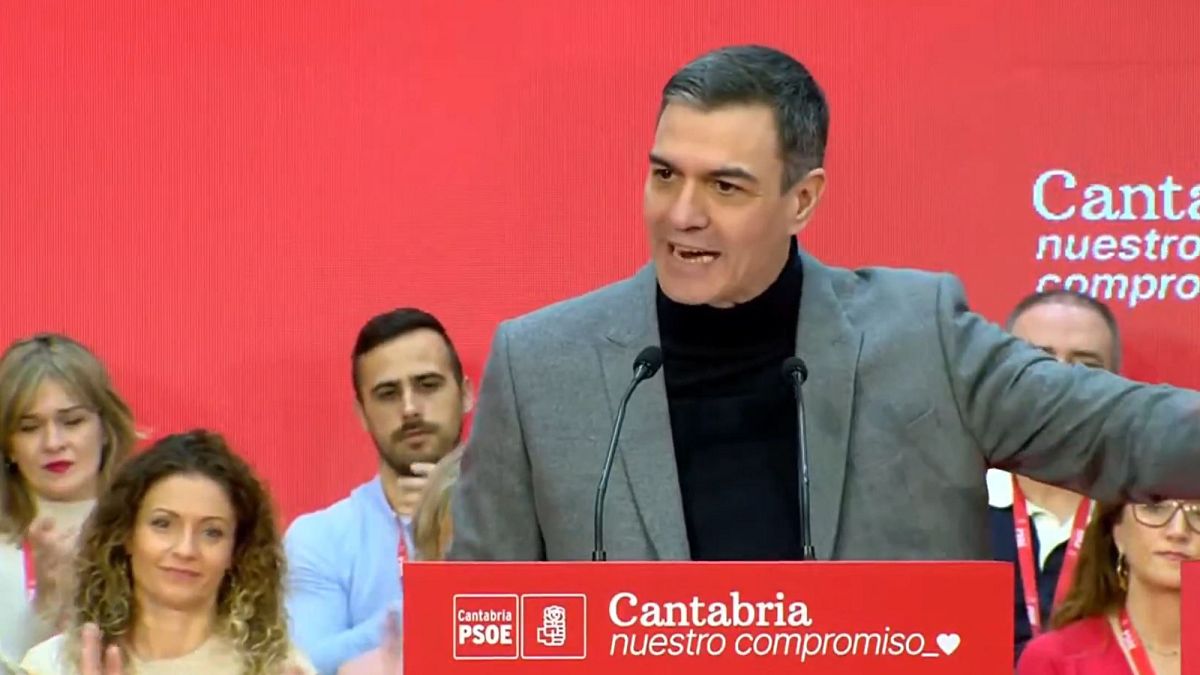
The Spanish prime minister also stressed the need for a just peace in Ukraine without rewarding Moscow's aggression.
In his speech at his centre-left PSOE party congress in Cantabria, Prime Minister Pedro Sánchez said Spain must show solidarity with countries on Russia's borders, as Moscow continues to threaten democracy and rule-based order.
"What is at stake is not simply a war or an invasion. There is something much more besides this, which would be important in itself, and that is that the multilateral order is at stake," Sánchez said at the closing event on Sunday, stressing that it is a system based on principles established in the United Nations Charter.
The Spanish leader indicated that the aim is to achieve a "just and lasting" peace in Ukraine, where "peace is urgent, but not at the cost of rewarding the aggressor, which will open the door to future, even more serious aggressions."
He was also blunt in declaring that "if Ukraine wants to be part of the European Union, Russia has to respect what Ukraine wants to be".
Sánchez, however, acknowledged the different security realities faced by European countries, admitting that "defence in the east of Europe has nothing to do with the security challenges we have in Spain."
Despite this, the president said that Spain would help those under threat.
"We are not going to have a physical attack from Russia like some of the Baltic or Nordic countries, such as Finland, might have," Sánchez said.
"They need our solidarity and they need and demand that together we increase our security capacity to dissuade Russia," he explained, reaffirming Spain's pro-European commitment both "out of interest" and "out of conviction".
Spanish state: PSOE Congress closes ranks around leader
Friday 14 March 2025, by Jaime Pastor
The 41st Congress of the Partido Socialista Obrero Español (PSOE – Spanish Socialist Workers’ Party), held from 29 November to 1 December 2024, took place against an increasingly unstable international and geopolitical backdrop, and at a time when the media and the judiciary are focusing on corruption, the new shadow hanging over ‘Sanchismo’, the method of government of the current prime minister, Pedro Sánchez, who is also the party’s general secretary, in particular the affair involving the party’s former number two, José Luis Ábalos.
In these conditions, the course of the Congress held in Seville was predictable: to make a grand show of cohesion around the charismatic leader and his Manual de Resistencia, and to reaffirm the gamble of playing the blackmail card (‘the arrival of the right and the far right’) to the full in order to discipline his partners in government and parliament. In this way, Sánchez is seeking to achieve his objective: to stay in the palace of Moncloa until 2027 and, despite the poor predictions of the opinion polls, to win the next elections. Unsurprisingly, there has been not the slightest hint of self-criticism about the policies pursued in recent years, or even about his co-responsibility for the inertia in the face of the tragic DANA disaster, although the reproaches have come from very different quarters, and even from some of his partners, such as Compromís and Podemos. [1]
Framework document
If we look at the Congress’ framework document, entitled ’Spain 2030. A socialism that advances, a Spain that leads’, we can see some signs of a rather radical rhetoric against the “super-rich”, in defence of the “middle and working classes”, but little programmatic novelty. In fact, the document begins by announcing four major challenges for 2030, which seems a long way off in these times of reactionary upsurge: developing a different model of growth and tackling the climate emergency (we’d have to explain how the first and second can be compatible), tackling the transformation of the world order and finally responding to the ‘rise of authoritarian values and the international ultra-right’.
This is followed by an attempt to magnify the ‘impossibles we have achieved’ in the last period (starting with the employment reform, albeit very limited) and the announcement of the ‘impossibles we will achieve’ (with the project, hardly viable with its allies, the Basque PNV and the Catalan Junts, of a constitutional shield for social conquests), before moving on to define a national project with ten objectives. The first of these (‘A more competitive, fair and sustainable economy’) sets out the framework within which the following objectives are to be pursued: shorter working hours, quality education, housing for all, the fight against all inequalities, a strengthened ‘autonomous’ state, full democracy to confront disinformation, a vocation for leadership of the European project, support for the (false) ‘two-state solution in Israel and Palestine’, and the strengthening of the EU’s ‘strategic autonomy’ in defence matters with the alibi of the war in Ukraine.
In addition to the most widely publicised measure to reduce working hours, the concrete content of which remains to be seen, other new measures that could attract attention include the creation of a ‘citizen’s seat’ in Congress and the Senate so that representatives of civil society can intervene, the right to vote from the age of 16 and the convening of deliberative citizen’s conventions, a ban on the conversion of residential housing into tourist and seasonal accommodation, the creation of a public office for the construction of social housing and the obligation that loans and rents should not exceed 30% of salaries, reform of the system for financing the regions (with a formulation vague enough to satisfy all the baronies) and the repeal of the 1979 agreement with the Catholic Church on cultural and educational issues.
Some of these promises sound like mere repetition of those already included in previous Congresses, while at the same time they highlight the scant attention paid to the mortifying migration policy (there is simply mention of the need for ‘an immigration model that guarantees a constant flow’) or the absence of a tax policy that goes beyond a reference to the obligation (how?) for big business to share some of the scandalous profits made in recent years. [2] Last but not least, the absolute silence on the Saharawi people’s right to self-determination, once again confirming complicity with the repressive Moroccan regime.
We should also note the triumph of the so-called ‘classical’ feminists with their amendment aimed at preventing the inclusion of Q+ alongside LGTBI. This result was obtained thanks to the lobby led by former vice-president Carmen Calvo, and was finally voted in plenary with a very low turnout. This decision represents a serious step backwards in the recognition of diversity, contributes to the promotion of transphobia, strengthens the right in its cultural war and distances the PSOE from a position on which there is a broad consensus throughout the feminist movement, particularly among its younger generations.
A fragile domination
In short, Sánchez took advantage of the Congress to demand the loyalty of the activist apparatus in the face of the judicial, political and media harassment to which he has been subjected, especially since the approval of the amnesty law (while seeking to make people forget that he did not protest, and was even complicit, when the harassment was directed at Catalan nationalism and Podemos). At the same time, he is proposing a government project that is sufficiently ambiguous on the fundamental issues that oppose him to the right wing Partido Popular (PP) to try to attract part of its electorate and even re-establish a two-party system with this party in the name of a sense of responsibility towards the state. This is a difficult task, as we can see from the migration emergency in the Canary Islands, since the PP remains under pressure not only from Vox (ready to unabashedly claim the legacy of the Franco dictatorship as we approach the 50th anniversary of the death of its founder), but also from the president of the Community of Madrid, Isabel Díaz Ayuso, both of whom have been strengthened by Trump’s election victory. Furthermore, given the heterogeneity of his allies in parliament, it is impossible to predict whether some of the progressive laws and measures promised, starting with their inclusion in the budget, will materialise.
As a result, we are going to end up with a PSOE that will continue along the path of reformism without structural reforms that challenge the interests of big business and the foundations of the monarchical regime of which this same party has been and still is a fundamental pillar. This is not the way to stem the real threat of the reactionary bloc, or even, despite the good macroeconomic data, to mitigate the worsening inequalities. At best, the PSOE can try to neutralise social conflicts by responding to certain demands, as in the case of the fight for decent housing; but it will be difficult to achieve this if the tax on seasonal rents has not made any headway in Parliament.
The strategic impasse into which the PSOE has plunged is not unrelated to the long-standing trend towards an Atlanticist social liberalism which is tending to lose its centrality in many countries, as is the case today in France and very probably in Germany after the general elections in February. Against this backdrop, in the case of Spain, the government’s resilience increasingly appears to be an anomaly made possible by the fact that it has managed simultaneously to cancel out the ‘breakaway’ potential of the parties that have emerged to its left - Podemos and then Sumar - and to maintain a policy of pacts with regional forces, mainly in the Basque Country and Catalonia, in exchange for modest concessions.
However, this policy of fear in the face of the ‘greater danger’ will not last forever, as social unrest and political disaffection, now accentuated by the consequences of the DANA disaster, continue to grow. This government’s policies will not prevent the reactionary bloc from capitalising on the spread of ‘anti-politics’ among new sectors of the electorate.
Fear of internal democracy
On an organisational level, the consolidation of a party model based on an increasingly reinforced Caesarism around the ‘leader maximo’ has also become evident, as Manuel de la Rocha Rubí, one of the few delegates from the Izquierda Socialista current present at the Congress, has already pointed out : according to him, a clear demonstration of a ‘fear of democracy’ was shown by ‘the very refusal to debate government management at Congress, violating a basic democratic principle and a key article of our statutes’. [3] And the party’s total subordination to the government has been established, in a way that is all the more visible given the large number of ministers on the new Federal Executive Committee. In the end, he concludes, ‘the party’s position is set by the government and not the other way round, without even the possibility of influencing each other’.
The case of Madrid, with the forced resignation of Juan Lobato from the post of Secretary General of the Partido Socialista de Madrid, regardless of what is thought of his behaviour in the case of Díaz Ayuso’s companion, is another clear example of these practices, and Izquierda Socialista de Madrid rightly criticised (with the slogan ‘Form counts!’) the ban on meetings aimed at setting up another candidacy to face the official one led by the current minister Oscar López. [4]
At the end of the day, according to the maxim of making a virtue of necessity, we are witnessing the triumph of a plebiscitary leadership model that aspires only to remain in government, at the price of a few concessions to its allies in areas that do not touch the hard core of the political economy dictated by the European Union, notably through the European Commission and the European Central Bank.
The vacuum on the left
Added to these gloomy prospects is the tragic absence of political forces to the left of the PSOE, capable of building an alternative to confront the right’s policies of division among the popular classes but also building an alternative to the declining social liberalism of Sánchez. Neither Sumar - who is increasingly content with the limits set by Moncloa and the EU - nor Podemos - despite its current efforts to appear hypercritical of the PSOE, with which it nevertheless aspires to govern - now have the credibility to constitute a pole of reference in the onerous task of recomposing a left that wishes to learn the lessons of the cycle opened by 15M and the Catalan process in order to chart a course of refoundation that is not subordinate to institutional politics.
On the social front, the leaderships of the major trade unions, the CCOO and UGT, which are themselves subservient to the government, do not appear today to be the frame of reference for the recomposition of a workers’ movement ready to confront employers and big business who are increasingly inclined to favour the arrival of the reactionary bloc in government.
Nevertheless, the mobilisations for decent housing - a true expression, in almost all of Spain, of a class struggle that directly attacks rentier capitalism - the admirable outpouring of solidarity towards the population of Valencia and other regions of the country in the face of the eco-social disaster of DANA, the various forms of resistance in different sectors such as health and education, or the solidarity with Palestine are signs of hope that a new cycle of mobilisation on the left, starting from the grassroots, can be opened up in the period ahead. It is on the basis of these experiences that we must learn to seek new forms of convergence, in the struggles and in the debates between renewed action collectives. And launch with them new initiatives to build a common political and social front, capable of confronting the reactionary threat and building up an anti-hegemonic potential from the neighbourhoods and workplaces. Only in this way can we put back at the centre the need for a strategy of ecosocial transition and a democratic rupture with this regime and the power bloc that supports it.
Attached documentsspanish-state-psoe-congress-closes-ranks-around-leader_a8900.pdf (PDF - 924 KiB)
Extraction PDF [->article8900]
Footnotes
[1] The DANA (‘depresion aislada en niveles alto’, or ‘isolated high-level depression’) is a meteorological phenomenon also known as a ‘cold drop’, caused by the warming of the oceans and polar zones, which caused terrible destruction in Valencia in November 2024.
[2] This is what Andreu Missé criticises: ‘The tax reform carried out by the government… and its partners is minimal. It is more like a succession of patches. The agreement reached in Congress approved the tax on banks, the increase in capital income, hydrocarbons and tobacco. But it had to defer the energy tax to a new law. And taxes on real estate (Socimis), private insurance, luxury goods and diesel, as well as VAT on tourist flats, were rejected’. Alternativas económicas, December 2024, 130, p. 3).
Not to mention the still-postponed repeal of the gag law and the law on state secrets; the urgently-needed democratic reform of the judicial system (where is that promise of ‘democratic renewal’? [[The Ley Mordaza(‘gag law’ is the nickname given to the Citizen Security Law passed in 2015 under the Popular Party (PP) government. It includes sanctions against unauthorised demonstrations in front of public buildings, a ban on filming the forces of law and order, subject to heavy fines, fines for contempt of the forces of law and order, even without physical violence, and the express expulsion of migrants at the borders of Ceuta and Melilla.
[3] ‘Congreso socialista y crítica a la gestión’, eldiario.es, Manuel de la Rocha Rubí, 6 December 2024.
[4] In November 2024, Juan Lobato resigned as Secretary General of the Madrid PSOE after a controversy surrounding his handling of information about Alberto González Amador, the partner of Isabel Díaz Ayuso, President of the Comunidad de Madrid. Lobato had revealed sensitive information about him, fuelling accusations of tax fraud. Faced with internal pressure and to avoid division, he chose to leave. Díaz Ayuso, a key figure in the Popular Party, is known for her neoliberal management, her opposition to Catalan independence and her handling of the pandemic.
Jaime Pastor, professor of political science, member of Anticapitalistas (section of the Fourth International in the Spanish state), is the managing editor of the magazine Viento Sur.
Spanish state: Housing – old problem, new
solutions
Saturday 15 March 2025, by Alex Francés , Blanca Martinez
Rent levels have been on everyone’s lips in recent months, and not for nothing. Not only because it’s a problem that affects hundreds of thousands of people, but also because the housing rights movement has succeeded in getting tens of thousands of people onto the streets of Madrid, Barcelona, Valencia, Seville, Gijón, Burgos, Zaragoza, Salamanca and other cities.
Like many people - including the organisers - we were surprised by the sudden outburst of tenants, but also from other social sectors, taking to the streets en masse. The fact is that these mobilisations, the largest in recent history, took place at a time of political ebb and flow, with a general retreat of the forces of the left and the rise of the right and the far right. Against this backdrop, the tenants’ unions (Sindicatos de Inquilinas) succeeded in carving out a place for themselves in the media and in defining the political agenda with a radical discourse of con-frontation with the rentier system and with the political parties of the so-called progressive bloc, incapable of providing real answers to the housing problem.
Building tenants’ unions as tools of struggle
Despite the surprise generated by these mobilisations, they did not come out of nowhere. They are the fruit of a housing movement built up over many years. And, above all, they are the result of the building of tenants’ unions, which have succeeded in affiliating thousands of people (more than 3,000 in Madrid and more than 5,000 in Catalonia), rowing against the tide during years of political regression. Both unions were founded in May 2017, when the 15M cycle was clearly running out of steam, Podemos was beginning its process of subordination and adaptation to the PSOE, and the large-scale mobilisations that had characterised the previous cycle were beginning to run out of steam.
The tenants’ unions were able to perceive and try to overcome some of the limitations char-acteristic of recent social movements, thanks to hybrid forms between the latter and workers’ trades unionism. They have opted for the creation of stable structures, with membership and permanent staff, like any trade union. It is these elements that have enabled these tenants’ unions to endure, develop and consolidate, and even resist the ravages caused by the restrictions on activism imposed in the context of the pandemic. These restrictions were the coup de grâce for the majority of social movements, which were unable to resist the cessation of their activities.
Concrete battles
However, the organisational challenge was not the only key to the unions’ success. Their ability to articulate the conflict between tenants and landlords in a collective manner was another, as was their ability to create trade union tools that enabled them to win victories. The ability to give concrete, useful answers to the people who came to the meetings to present their problems, and to resolve them, was the key to growth. There’s no better way to win members than to demonstrate the usefulness of tenants’ unions. There’s nothing like the collective struggle to make people understand the need to fight beyond individual cases. There’s nothing like victories against landlords to gain social legitimacy and improve the balance of power in favour of tenants and the working classes.
Different strategies have been developed to deal with most of the problems faced by tenants, such as the non-reimbursement of deposits, the illegal charging of fees, the lack of repairs and maintenance to flats and buildings, harassment aimed at pushing tenants out of their homes and so on. But above all, a strategy of resistance has been put in place in the face of the main problem: rising prices and the non-renewal of rental contracts, which are the main mechanisms by which housing is treated as a commodity, allowing landlords to increase their profits at the expense of a basic necessity and impoverishing more and more tenants.
A concentration of capital
Faced with this situation of abuse, tenants’ unions have developed the Nos quedamos/Ens quedem (We stay) union strategy, which consists of disobeying both price increases and lease non-renewals. The idea is simple: tenants stay in their homes after the end of the contract, paying the same price, and enter into a process of collective negotiation with the landlord to obtain a renewal of the contract without a price increase.
Although we are sold the idea of a housing stock in the hands of small owners who depend on this income to survive, the reality is much more complex. One of the dynamics of the property market that emerged in the wake of the 2008 crisis, and the shift in the property market from buy-to-let to leasing, was the rush by companies and investment funds. As a result, in recent years there has been a steady increase in the number of large landlords and a trend towards the concentration of ownership in a small number of hands. While these large landlords do not yet account for the majority of the rental property market, they do play a dominant role, spear-heading property speculation.
It is in this context that the organisation of vertical property blocks takes on its full meaning, sometimes comprising dozens of flats for rent, in which a large number of tenants affected by the same problems can be found and who can fight together against a common enemy. [1] Tenants’ unions have decided to break with the passive dynamic of waiting for the people concerned to come to their meetings, and adopt a proactive role that seeks conflict. In short, to go on the offensive. Seek out the different parts of the same property, talk to the neighbours, identify the main problems in each community and organise a joint fight by dozens or hundreds of tenants to guarantee the rights that are being trampled underfoot. And above all, act before the majority of tenants find themselves in a critical situation, thereby saving time in organising and fighting.
Articulating the conflict
Another of the fundamental pillars has been to combine the struggle through conflict with the struggle in the institutional arena, understanding the need to obtain legislative changes that recognise the rights and improve the general situation of tenants. In this sense, the legislative improvements achieved through the reform of the LAU [Ley de Arrendamientos Urbanos, Urban Tenancies Act] and the Housing Act (5/7 year contract duration, fees to be paid by the property, regulation of rents in force in some Catalan municipalities, limitation of deposits and so on) should be seen as victories achieved through struggle, but without falling into trium-phalism. Acknowledging these advances does not mean ignoring the fact that their effects have been very limited and totally inadequate. We must not forget that current legislation continues to protect the interests of landlords to the detriment of the right to housing.
The key to linking the trade union struggle with the institutional struggle and legislative im-provements is to understand the latter not as an end in themselves, not as a possible real solution to the housing problem, but as another tool for action, as an improvement in the balance of power in favour of tenants, a tool that serves as a basis for promoting subsequent conflicts against landlords and preparing the next round of struggles. Legislative improvements, the fight for a programme that raises awareness, trade union action and institutional pressure are all part of the political struggle that is being waged at all levels and against all parts of the state.
The rent strike
A large part of the success of the mobilisations of October and November 2024 lay precisely in their ability to put forward demands and a programme felt to be legitimate by large sections of the working class, in particular the need for an urgent and radical reduction in rent prices (minimum 50%), a measure totally unacceptable to the government. At the same time, the mobilisations denounced the fact that this supposedly progressive government regards housing as a commodity and always legislates to guarantee the continued existence of private property and its profits. Finally, they highlighted a new trade union strategy for achieving this autonomous price reduction: the rent strike.
But lower rents are not the only urgent measure. The following measures, among others, are necessary:
Stable, long-term leases with automatic renewal, providing long-term guarantees so that people can plan and develop their lives in good conditions.
The expropriation of all empty, tourist and vulture-funded housing that is not fulfilling its social function, in order to create a public housing stock under social control.
Genuine regulation of rents, taking into account the social and economic situation of families, and adjusting rents to a maximum of 10% of income.
All these measures are essential if we are to begin to alleviate the housing emergency from which we have been suffering for years. But let’s make no mistake, the only way to guarantee the right to housing for all is to take housing off the market and end renting as a method of extracting rents on the backs of the working class. And this will not be done within the framework of the capitalist system.
Rebuilding class consciousness and fighting the far right
Over and above the need to organise tenants to improve their material conditions, organi-sations and structures like tenants’ unions can play a key role in rebuilding class consciousness, by articulating important sectors of working women in their complexity, with a feminist and anti-racist perspective, and by serving as a bastion against the far right.
It is important to emphasise, as has been stressed on other occasions, that there is no such thing as a tenant class. Tenants are a sector of the working class, whose class position is con-ditioned not only by the exploitation of labour, but also by the lack of control over their housing, just as is the case for people with mortgages or who live in squats. Contrary to those who speak of a generational issue, we see it as a confrontation between the working class and the interests of the rentiers, who constitute a central fraction of the bourgeoisie in the Spanish state.
The potential of the housing rights movement offers us the chance to build a union capable of countering the dynamic imposed by the market, by bringing together the most impoverished sectors and those who, although not subject to the greatest precariousness, suffer the exploi-tation of rentiers on a daily basis. Tenants’ unions now have an obligation to work - by ar-ticulating conflict and organisation through the experience of struggle - to build a mass movement capable of integrating the majority of people who rent their homes.
The rising cost of living, the eviction of neighbours from our neighbourhoods, the prolif-eration of tourist flats, the systematic degradation and commodification of public services, are also a consequence of the process of commodification of our neighbourhoods, directly linked to the rentier offensive. But this situation also offers opportunities to the housing movement and to all those on the revolutionary left who feel it necessary to form a political and social bloc that breaks with the policy of social dialogue. In the case of housing, it’s a question of widening our field of action to include the whole of the working class, in particular those who own and live in a house, and whose interests are closer to those of people who don’t have control over their housing, than to those of the 6% of the population who make a living from renting.
Facing the reactionaries
Moreover, the class conflict over housing is one of the spearheads of the far right through the squadrism of the desokupación companies [private companies which offer quick and effective solutions to evict illegal occupants], generating security responses to invented panics - you can go downstairs to buy your bread and find your home squatted - and as a tool for the reproduction of the immiserated middle classes, in the struggle of the second last against the last. While the far right seeks to fragment the working class on the basis of issues such as nationality or race, tenant unionism - in general - makes it possible to unite the working class as a whole in the struggle.
The best way to confront the reactionary positions of certain sectors of the middle classes is to unite the working classes with a political programme that proposes universal solutions to the housing problem, recognising the diversity of the working class and emphasising the need to put forward anti-racist and feminist principles.
A feminist struggle
In the field of housing, this is very visible because migrant sectors - which are often on the margins of political circuits - are organising alongside non-migrant sectors, sometimes in less precarious situations. By generating communities and collective struggle processes, the native white population ceases to consider migrants as an ‘other’ and sees them as part of the same subject. All this with a large number of women as the main protagonists.
This is no coincidence: the home is still the space that patriarchy and capitalism re-serve for women, who continue to perform most of the tasks necessary for social reproduction. For many of them, the home remains a place of responsibility and work, but also of personal fulfilment. Moreover, when they are evicted from their homes, they are not only evicted from the home, but also from a community. This is also why, when it comes to defending the home and all that it contains, it is women who are on the front line.
While men often occupy more space at tenants’ union meetings, every week more and more women are taking charge of their own dispute, leading and managing their own cases, adding this extra workload to caring tasks and working for a living. In a neo-liberal culture and economy that wants us to be alone and powerless, where everyone has to save themselves, it’s our neighbours who support and back each other up to go where the state won’t, while the system continues its attacks.
Resistance against evictions and the fight for decent housing for all place life at the centre and focus attention on social reproduction. We are challenging the rules of the market and property speculation, which put economic profit before human needs and the preservation of life; we are forging links with feminist struggles against the gentrification and destruction of working-class neighbourhoods; we are resisting the commodification of public space. The fight for housing must embody this feminist and militant trade unionism that confronts the neoliberal attack on the reproduction of life, by building alliances with domestic workers, sex workers, sexual and gender dissidents, migrant and racialised women, and all those who bear the full brunt of the crisis of social reproduction.
New challenges for tenant unionism
In conclusion, we think it is important to highlight the main challenges that tenants’ unions, and the movement as a whole, must face in the coming years if we are to be able to provide a comprehensive response to the housing problem. Firstly, we need to develop and refine the tool of the rent strike so that it is genuinely useful and enables us to achieve further victories and large-scale price reductions, while also being able to take advantage of moments of political irruption. In addition, we need to go beyond the existing tenant unions, betting on the development of new tenant organisations at territorial and national level and taking a further step to overcome the fragmentation between tenants and owner-occupiers on loan, and create a housing unionism capable of providing a global response.
First of all, it has to be said that the rent strike is already underway. Hundreds of Nestar tenants, organised with the Sindicato de Inquilinas de Madrid, have already stopped paying part of their rent to combat the abuses of this vulture fund; similarly, the tenants of La Caixa are leading a total rent strike, with the Sindicat de Llogateres de Catalunya, to recover the IBI [Impuesto sobre Bienes Inmuebles, the local property tax that affects every property], fraudulently levied. The organisation of blocs in struggle has made possible active strikes in Madrid and Catalonia, taking advantage of the collective component of these strikes and directly attacking the big vulture funds. This is a direct attack on real estate capital, and it has also led to victories such as the elimination of unfair terms, demonstrating the effectiveness of collective struggle.
The Madrid tenants’ union put forward the idea of a rent strike in the run-up to the demon-stration on 13 October, and this possibility made its way into the media, arousing the horror and indignation of the rentiers, but also the curiosity and enthusiasm of many tenants. The strike is useful as an element of agitation and as a horizon towards which to march, on the understanding that it must be the consequence of a process of bottom-up struggles, which creates the possibilities from concrete experiences of strikes, partial or total, in vertical building blocks, to gain conflict and legitimacy while extending the organisation and the slogan to each neighbourhood and improving our balance of power. The rent strike cannot be a symbolic proclamation: if it is declared, it is to be won.
But in addition to developing the rent strike, tenants’ unions must be able to take advantage of the present moment. As we have already mentioned, unions have been able to build stable, long-term organisations, thanks to structured plans, long-term bets and a clear methodology. However, at a time when the issue of housing is bursting onto the political and media scene, it is essential to have the audacity to take the initiative, because the current political situation demands rapid responses in order to take advantage of a moment of political momentum and mobilise the masses by going beyond day-to-day action.
Confronting capitalism
On the one hand, this makes it possible to challenge the state with programmatic slogans, such as the expropriation of empty, tourist and temporary housing, while at the same time raising the general level of awareness and appealing to the need to organise. Challenging the state is essential if we are to understand that rent is one of the structural elements in the construction of capitalism in the Spanish state, which, although it may manifest itself in different forms - seasonal rentals, touristification, empty dwellings and so on - responds to the same speculative dynamic of generalised price rises.
The fact that rent is a widespread problem raises the question of political power and the state, which ultimately has the political capacity to intervene and guide society as a whole. This is why it is important that, in addition to the formation and development of tenants’ unions in all territories, they should be able to articulate and coordinate amongst themselves, forming a confederal organisation, which improves our balance of power when confronting each of the institutions of the state, maintaining a totalising orientation towards governments as the main parties responsible for the housing situation.
But the aim should not just be to make an organisational leap at the territorial level, but to make the leap towards an integral housing unionism, which deals with all the problems - renting, squatting, substandard housing, mortgages - and which would be able to unite and give effective responses to the whole of the working class which does not have control over its housing.
At the moment, renting is a starting point for organising the conflict around the lack of control over housing. On the one hand, it is a numerically very important sector of the working class and, on the other, it is the one that suffers most from the problems of the commodification of housing. What’s more, the instability of the contracts, which allow abusive increases or evictions of families on a regular basis, with only a few years between them, leads to a dynamic and effective fight against the rentier system.
However, we need to appeal to the entire working class who do not have control over their housing, understanding that ultimately the central problem lies in its commodification. It is essential to develop a programme that addresses all these sectors in a universal way so as to avoid confrontation between indebted landlords, tenants and squatters, whose common interest is to ensure that housing is a universal good and not a commodity. It is therefore also a political step forward, uniting, through a concrete programme, the demands and needs of those whom the market and the state seek to divide. To make progress in building a political bloc of the working class which, through the experience of the housing conflict, breaks with the strategy of social dialogue and conceives of politics as an awareness of our own capacity to build a social, cultural and political alternative to capitalism.
In our view, this unity is only possible through a common struggle and a common experience that highlights the imperative need and urgency of articulating a political alternative that, on the common basis of an anti-capitalist response to the whole system of capitalist domination and exploitation, articulates in the field of housing an ecosocialist programmatic response as a springboard for direct confrontation against all the parties of the regime and the state, in their own institutions. There are already many examples where, in the absence of a political tool of our own from which to confront without concessions the parties of rent and property speculation, we are presented with the main alternative of delegation to those who, at best, assume a critical management of the capitalist crisis. But we are aware that one of the historic slogans of the housing movement, vivienda universal y de calidad, ‘universal and quality housing’, has no chance of becoming a reality under the boot of capitalism. This imposes on us all the task of advancing towards this goal by combining daily conquests with the construction of a social and political bloc that embraces this idea and is prepared to fight for it in all areas of the class struggle.
Attached documentsspanish-state-housing-old-problem-new-solutions_a8899.pdf (PDF - 935.5 KiB)
Extraction PDF [->article8899]
Footnotes
[1] Vertical property blocks refer to buildings where all the flats belong to a single owner or entity (such as an investment fund, a bank or a large landlord), unlike horizontal property, where each flat has a different owner.
Alex Francés is a housing rights activists in the tenants’ union of Catalonia and a member of Anticapitalistas, the Spanish section of the IV International.
Blanca Martinez is a housing rights activists in the tenants’ unions of Madrid, and s member of Anticapitalistas, the Spanish section of the IV e International.
International Viewpoint is published under the responsibility of the Bureau of the Fourth International. Signed articles do not necessarily reflect editorial policy. Articles can be reprinted with acknowledgement, and a live link if possible.


