Saturday, April 05, 2025

 Resisting Autocracy

Source: Originally published by Z. Feel free to share widely.

LONG READ

Image: "The World war at a glance; essential facts concerning the great conflict between democracy and autocracy" (1918). Public Domain


How do relatively functional democracies backslide into autocracy, and what can be done to reverse this?

This is the second of what I originally planned as a two-part series, which I now intend to split into three. In part one, I outlined a framework for measuring regimes based on their level of authoritarianism and their level of patronalism. I argued that the regime Donald Trump aspires to install in the US is one of patronal autocracy—an intermediary system between democracy and dictatorship, in which a corrupt “patron” and his informal network of cronies rule the country as an extension of their business interests. Another name for this regime type is a “mafia state.” I then explored some implications of this framework for our analysis of the emerging Trump regime.

In this part, I will:

  • Outline a three-stage framework for understanding how aspiring autocrats go about transforming relatively functional liberal democracies into patronal autocracies.
  • Examine two key defense mechanisms for resisting autocracy: the separation of political powers and the autonomy of civil society.
  • Use these frameworks to assess the extent of US regression towards patronal autocratization at the level of both federal and state government, as well as that of civil society.

In the third part, I will:

  • Outline a three-part taxonomy for resisting autocratic transformation, reversing democratic backsliding, and restoring and expanding democracy
  • Discuss some implications of the above analysis for our tactics and strategy for the coming period.

Three stages of autocratic transformation

My analysis of stages of autocratization and democratization draws on a conceptual framework formalized by Hungarian political scientists Bálint Madlovics and Bálint Magyar. They argue that the transformation of democracy into patronal autocracy advances through three stages: autocratic attempt, autocratic breakthrough, and autocratic consolidation.

  1. In the first stage, autocratic attempt, an aspiring patronal autocrat who has been elected to office attempts to consolidate their unilateral control over all branches, levels, and levers of government. Within the executive branch, they attempt to change the rules on the appointment, promotion and replacement of civil servants, institutionalizing a nepotistic system of rewards and punishments. To weaken the judicial branch, they attempt to pack the courts, narrow the scope of judicial oversight, and appoint loyalists to prosecutorial and investigative state positions. To eliminate legislative checks, they attempt to change or ignore parliamentary procedures that obstruct the unilateral powers of the executive, and try to change election rules to disproportionately increase their party’s representation and deprive their opposition of a path to a majority. Simultaneously, the autocratic faction attempts to reduce or eliminate the vertical separation of powers between national, regional, and local governments by subordinating the latter to patronal vassalage and/or centralized political control.
  2. Autocracy advances to the second stage, autocratic breakthrough, if (and only if) the combination of the above attempts proves successful in effectively eliminating the separation of political powers. In this case, the autocratic faction achieves a constitutional coupa seizure of power that functionally transforms the state into a new regime type, but maintains formal legal continuity with the ancien régime. Unlike a military coup d’état, this process does not overtly disrupt or defy the existing structures of governance. Instead it exploits loopholes, ambiguities, and technically licit powers to transform the system from within, gradually liquidating democracy and institutionalizing autocracy. This often involves repeated changes to the country’s constitution, achieved within the framework laid out by said constitution, but progressively rewriting the latter so as to fundamentally alter the “rules of the game.” Although a formal separation of powers may be (and generally is) maintained, this process functionally eliminates any real independence of the judiciary, the civil service, and the legislative branch, as well as that of local and regional government. This is the point, after an autocratic attempt, where we can speak of an autocratic breakthrough.
  3. The third and final stage, autocratic consolidation, happens if—and only if—autocratic forces are able to functionally disable what Magyar and Madlovics call the “second defense mechanism” of democracy: the autonomy of civil society. Even without formal political checks and balances, a well-established, heterogeneous, and independent civil society creates many social checks on patronal autocracy: independent media sources question the regime, independent NGOs function as watchdogs, an unbowed citizenry creates many groups that organize and advocate for their interests, and independent liberal economic elites fund all these efforts (as well as the political opposition). To consolidate control, the autocratic faction must neutralize these and other sources of independent initiative, subordinating or “vassalizing” civil society through a mixture of threats and incentives. Compliant organizations, institutions, and individuals can be rewarded with state funding, government contracts, beneficial regulations, and opportunities for individual advancement; defiant ones can be excluded from these opportunities, and also threatened with investigation, litigation, tax penalties, criminal charges, firing, or blacklisting. Note that none of these mechanisms formally forbid or outlaw independent initiative—this is what distinguishes patronal autocracy from outright dictatorship. Instead they make civic independence seem costly, and compliance (ostensibly) advantageous. If these mechanisms effectively neutralize or marginalize oppositional forces and voices in civil society, the regime change has advanced to the third stage: autocratic consolidation.
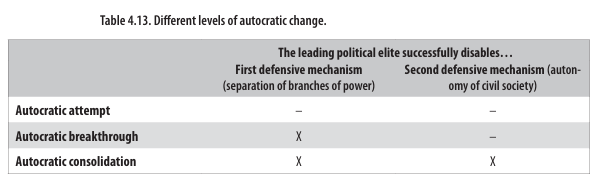
Table Source: Magyar and Malovics 2022

Two democratic defense mechanisms

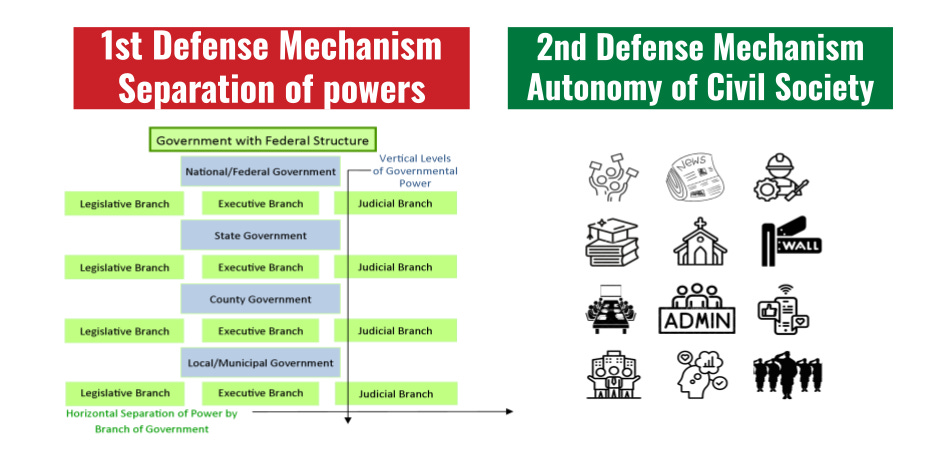
As the above analysis has already begun to surface, Magyar and Madlovics identify two key “democratic defense mechanisms” against the progressive transformation of liberal democracy into patronal democracy: the separation of political powers and the autonomy of civil society.

The first defense mechanism, the separation of powers, has both horizontal and vertical dimensions. Horizontally, this includes the separation of legislative, judicial, and executive powers—the branches of government. Additionally, this dimension involves the degree of operational autonomy exercised by the civil service and administrative apparatus—the levers of government. Vertically, this defense mechanism involves the separation of power between national, regional, and local government—the levels of government. The stronger the institutional boundaries between all these brancheslevers, and levels of government, the more difficult it becomes for autocrats to secure a monopoly on political power.

The second defense mechanism, the autonomy of civil society, concerns the size, strength, diversity, and resiliency of civil society organizations. By “civil society” we mean all the different groups, organizations, and associations that exist within the geographic territory governed by a state, but that are formally and functionally independent of government. In their book Violence and Social Orders, economic historians Douglass North, John Joseph Wallis, and Barry R. Weingast suggest that most societies fall into one of two poles when it comes to civil society: either almost everyone can freely form and participate in independent organizations that compete against powerful economic and political interests (what they term an “open-access order”) or almost no one can (what they term a “limited-access order”). The degree of openness has important implications for the resilience of a society to authoritarianism. As they put it:

“A civil society reflects a wide range of organizations that are easily adapted to political purposes when a government threatens an open access order. Organizations from garden clubs and soccer leagues to multinational corporations and nongovernmental organizations (NGOs) to interest groups and political parties all form pools of interest that can independently affect the political process.”

Drawing on this research, Magyar and Madlovics argue that the autonomy of civil society forms the second key defense mechanism against autocratization. While the separation of branches, levers, and levels of government provides internal checks on authoritarianism, it is the external independence of civil society that ensures the people’s right to have a say in how their life is governed. That is, the more independent civic organizations there are, the stronger they are, and the more people actively involved in those organizationsthe more difficult it becomes for patronal autocrats to consolidate control.
Assessing US regression towards autocracy

Let’s sum up the argument so far. Autocratic change unfolds through three broad stages: an autocratic attempt, when an aspiring autocrat uses their elected office to try to consolidate power; an autocratic breakthrough, when they successfully gain control over the entire state apparatus, disabling the first democratic defense mechanism, the separation of powers; and autocratic consolidation, when the autocratic faction successfully disables the second democratic defense mechanism, the autonomy of civil society. These stages are gradual, and progression through them is not totally linear. (An autocrat with only partial control of the state apparatus can nevertheless make use of it to try and subjugate civil society.) But at a very general level, this schema is helpful for understanding the typical course that an autocratic coup attempt will take.

So how does Trump’s second term stack up according to these criteria, thus far?

On the one hand, this is Trump’s second autocratic coup attempt. As others have noted, both he and the forces around him are much better prepared this second time than the first. They have a clearer plan, have greater understanding about the institutions of government, and have achieved both much deeper and broader patronal vassalization over the Republican Party. There is a pattern of aspiring autocrats being ousted from office, only to mount a second attempt better prepared to consolidate power. In Hungary, for instance, Victor Orban was prime minister from 1998 to 2002, then lost reelection, and then came roaring back in 2010. He has been in office ever since. This should serve us as a cautionary warning.

At the same time, the US political system has many more checks and balances than the Hungarian one. Part of what enabled Orban’s sweep to power was his party’s securing of a two-thirds parliamentary majority that enabled him to freely amend the Hungarian constitution. The US bicameral legislature makes it more difficult to secure even bare legislative majorities, least of all the two-thirds majorities needed in order to pass Constitutional amendments—which then have to be ratified by three-quarters of the states. This points to another distinctive feature of the US: its federal structure, where a great many powers are vested in state government—certainly more so than in Hungary. In significant ways, the US is just as much 50 separate “republics” as it is one.

Additionally, the US has a much longer and richer tradition of civil society organizations than Hungary, with a much higher degree of autonomy from the state. Orban also came to power with much higher approval ratings than Trump, operated with far greater strategic savvy, and worked to reward his supporters with concrete economic populist incentives, which Trump does not appear poised to do. In light of these factors, Trump’s ability to consolidate autocracy seems much more doubtful. Indeed, this is why Magyar and Malovics explicitly argue that “America Won’t Become Hungary.”

The slow coup & the speed run

At the same time, there are two important factors that Magyar and Malovics do not appear to take into account, which complicate our ability to assess stages of autocratization in a US context. These two factors have different temporalities: one concerns the speed and scale at which Trump seems to be running the authoritarian playbook; the other a much slower and longer-term “march through the institutions.”

On the first front: if Trump is following the autocratic playbook laid out by Magyar and Malovics, he is speed-reading the large print edition. It took Orban the better part of a decade to consolidate autocracy in Hungary, and arguably even longer than that for Putin in Russia. Trump, Musk, and their minions seem to believe they have only a small “window” between now and the midterms to accomplish a comparable transformation—and are thus trying to race through the stages of autocratization in a fraction of that time. Such haste points to an underlying insecurity; if they had more confidence in the strength of their political and popular position, they could afford to move more slowly. But because this “accelerationist” strategy is untested, its effects are somewhat unpredictable.

In addition to its greater speed, the scope of such an autocratic coup attempt is many magnitudes larger when attempted by an (even declining) economic and global superpower like the United States than by a middling global power like Russia, or a negligible one like Hungary. Running the play bigger and faster does not actually make them any more likely to succeed at it. (If anything, I would argue the contrary.) But it does increase the risk that, in moving fast and breaking things, they will break something—the federal payment system, the global economy, world peace—so big that its consequences will propel us beyond the purview of any existing “playbook” whatsoever. Most of the potential ensuing scenarios do not seem to me to be favorable to MAGA’s ability to consolidate long-term autocratic control over the United States, but the point is that there is a non-negligible chance that we end up in such unprecedented system chaos that, in a sense, all bets are off.

On the second front: Trump’s autocratic coup attempt did not emerge from nowhere, but rather in relation to a much longer radical right-wing project to roll back social, political, and economic rights and “repeal the 20th century.” As others have argued, those efforts can be traced back at least as far as the 1968 Goldwater campaign, which witnessed the emergence of a concerted right-wing backlash against progress towards racial justice and inclusive democracy. (See, e.g. herehere, or here.) That backlash led the right to plot a long term “march through the institutions” that culminated in the right-wing takeover of the US Supreme Court, particularly after 2006, and the Republican takeover of many state legislatures during and after the 2010 Tea Party backlash. Those two factors then worked in tandem to advance a “slow-motion coup,” as the far-right Supreme Court stripped powers from the federal government and returned them to the states, while GOP-dominated states consolidated conservative autocracy at the state level.

That longer, quieter, slower-moving “constitutional coup” set the stage for our current high-speed run. There are many limits that the latter can and will run up against, and Magyar and Malovics’ framework helps us account for these. At that point, however, we revert to the temporality of the “slow-motion coup,” whose stages are more difficult to capture within a streamlined version of their otherwise helpful rubric. In the following sections, I will attempt to apply that rubric to a more detailed analysis of our two democratic defense mechanisms—the separation of governing powers and the autonomy of civil society. But as I do, I will also try to track places where Trump’s high-speed coup attempt rubs up against the slower-moving one.
Defense Mechanism 1.1 – federal separation of powers

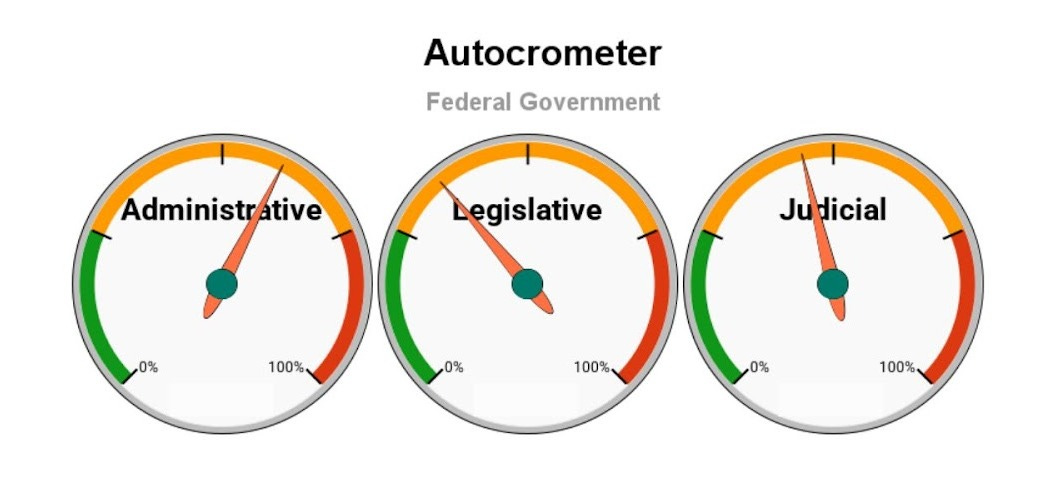
To visualize my analysis of stages of autocracy, I am going to bring back a reference from the first part of this series that I initially meant as something of a joke—an autocrometer. On the far left, in green, we can envision “zero” here as a flourishing liberal democratic system—not yet a post-capitalist socialist feminist utopia, but the very best version of, say, Scandinavian-style social democracy. On the far right, at 100%, we can envision full fascist dictatorship. In the middle, the yellow sections represent the various stages of autocratization: autocratic “attempt,” as green shades into yellow, then reaching autocratic “breakthrough” as it hits the middle marker, and approaching autocratic consolidation as the needle moves closer to the red/right. In the text I also indicate in which direction the “needle” is trending—deeper towards autocratic capture, or back towards democratization.

In a nutshell, it seems clear that the federal executive and administrative apparatus has experienced an autocratic breakthrough, which is rapidly trending towards autocratic consolidation. The judicial branch has experienced an autocratic attempt, but not yet a breakthrough; it is trending in that direction, but much more gradually. The legislative branch has experienced an autocratic attempt, but in contrast is trending back towards re-democratization.

The place where MAGA forces have made the fastest, deepest inroads towards autocratic capture is in their control over the administrative levers of the federal government. While reporting to the executive branch, the staff of federal departments and agencies have historically exercised a great deal of autonomy over their internal operations and external areas of administrative jurisdiction. Led by Musk’s DOGE team, MAGA forces have attempted a Blitzkrieg on virtually all bastions of administrative autonomy, shuttering entire departments, terrorizing others, and replacing career staff leadership with patronal loyalists. The consequences of these moves cannot be overstated; from taxation to criminal justice to foreign aid, many aspects of the federal administration are now deeply compromised.

At the same time, the federal administration is the component of the state apparatus with the fewest formal and constitutional protections from executive overreach; we should expect this to be the domain where fascist forces make the furthest inroads, the fastest. Even here, there have been many checks on autocraticization: resistance from organized labor, widespread litigation, court injunctions, media exposés, and public protest. In many areas, autocratic maneuvers have been blocked; where they have been successful, there is a real risk that MAGA’s victories will prove Pyrrhic, as the devastating consequences of dismantling popular programs start to be felt. As others have noted, we should not confuse their speed with their effectiveness—just because the clown car goes very fast does not mean it isn’t full of clowns.

In terms of the legislative branch, Trump’s patronal domination of his own party’s elected officials currently appears near-absolute; but on their own, the latter do not hold the majorities needed to pass substantive legislation. In a fully consolidated patronal autocracy, the legislative branch merely serves as a formal “rubber stamp” for decisions functionally made elsewhere. With a razor-thin House majority, and lacking the 60-vote supermajority needed to advance legislation in the Senate, Congressional Republicans can currently rubber-stamp cabinet and judicial appointments, and to a certain extent pass budget provisions through reconciliation, but can do very little else. This poses significant limits on the ability of autocratic forces to advance their agenda; the executive branch has great power over how (or if) to administer existing legislation and appropriations, but cannot create new laws and funding ex nihilo. Amidst deepening partisan legislative stalemate over the past decades, presidents have increasingly attempted to bypass such gridlock by “legislating” through executive order, contributing to the expanding power of the executive. But executive orders are inherently weaker and more limited than legislation, subject to reversal by future administrations, and vulnerable to rejection by the courts—to which we will turn in a minute.

Thus far we have seen virtually no independent initiative from within the ranks of the Republican House and Senate caucuses, even from the few remaining (relative) “moderates” like Susan Collins and Lisa Murkowski. The reason for this is simple: Trump commands the near-unwavering loyalty of a majority of the Republican primary electorate, allowing him to credibly threaten to unseat representatives who defy him. Yet this points to a seeming paradox of authoritarian leaders: their power is just as (perhaps more) dependent on popular support as that of their democratic counterparts. Trump is posturing as if he had a popular mandate, but his stranglehold over the Republican primary electorate should not be conflated with broad support. At present, Trump regularly commands 60% or more of the Republican primary vote. But as Republican primary voters are only about 20% of the electorate, this proves unwavering loyalty from only perhaps 12% of the population. In terms of the broader electorate, Trump received a 49.8% plurality (but not a majority) of the popular vote—many of whom were voting against the last administration rather than enthusiastically for Trump—and his popularity is already declining. As it drops still further, we will see more willingness from some within his party to exert occasional autonomy.

Perhaps the quintessential move of aspiring autocratic regimes is to rewrite the rules governing elections in order to give themselves a larger and more effective legislative majority. Right-wing forces have been working to subvert democratic rule for decades, particularly by judicial fiat and through state-level gerrymandering and voter restrictions in states under Republican control. At the federal level, however, the GOP does not currently possess the majorities needed to enact electoral rule changes. At the time of writing, Trump is attempting to restrict the vote via executive order, but this will be contested in the courts and can be resisted by the states, which have great power over the governing of elections. Absent very rapid and widespread degradation of election integrity, which at this point still appears relatively unlikely, Democratic Congressional candidates will compete with electoral rules and maps in 2026 and 2028 that are about as fair as they are currently. (Which is to say, kinda sorta fair… ish.) Given the underlying electoral dynamics, this gives Democrats a pretty sure shot at regaining a House majority in 2026 (although a much more uphill battle for the Senate) and a decent shot at gaining or holding both chambers in 2028. For this reason, I list the legislative branch as “trending democratic.”

On a judicial level, the federal courts have thus far been functioning as a fairly effective independent check on the Trump administration’s “fast-moving coup.” While there is no question that Trump is trying to skirt, sabotage, ignore, and overwhelm the courts, they have nonetheless been ruling against him frequently and consistently—the New York Times, which has been tracking lawsuits, has noted at least 53 rulings against Trump so far. According to the Institute for Policy Integrity, the first Trump administration lost almost 80% of court cases; at their current clip, the second one looks set to exceed that already high loss rate. And while Democratic-appointed judges have issued a majority of these rulings, Republican judges have also been fairly consistently ruling against the administration… at least those who were appointed by a president other than Trump.

We must be careful here to distinguish between the temporality of slow and fast-moving crises. Michael Podhorzer has convincingly argued that our deeper, slower-moving Constitutional crisis concerns the Federalist Society’s decades-long court-packing of the judiciary, whose rulings have paved the way for the situation we are now in. In that sense it is not just that the courts are currently “trending autocratic,” they have been doing so for many years; and while the rightwing 6-3 Supreme Court majority is the most visible component of this, Trump’s ability to push through hundreds of new federal judicial nominees over the next four years is perhaps an even greater risk to the long-term health and functionality of US democracy.

But in terms of the high-speed coup, the current federal judiciary seems prepared to resist judicial subordination to the executive branch, and to rule against many elements of Trump’s attempted subjugation of other branches and levels of government, and of civil society. Of the federal judiciary, 504 of the current sitting judges were appointed by Democratic presidents, 135 by one of the Bushes or Reagan, and 239 by Trump. We can expect reasonably independent rulings from non-Trump appointed judges, who currently make up over 75% of the federal judiciary. Although many cases will not make it as far as the Supreme Court, the latter will likely rule against the administration in many instances—despite the Roberts Court’s unrepresentative and hyper-partisan 6-3 Republican majority.

There is no question that the Roberts Court’s disastrous ruling on presidential immunity has given license to Trump’s most authoritarian impulses. But less noted has been that, while the Roberts Court has strengthened the personal power of the president, they have overall  weakened the political and policy-setting power of the executive branch. This is consistent with the longstanding conservative-libertarian orientation of the Federalist Society, which has overall sought to diminish the powers and purview of the federal government in favor of so-called “states’ rights” and the unfettered power of business. That ideological consensus is now splitting as some right-wing jurists contemplate using the right’s control of federal political power to advance its cultural agenda, but we should not underestimate the commitment of many right-wing juridical ideologues to the principles of separation of powers and limited government. Such judges will likely not oppose the deconstruction of federal administrative autonomy, which is consistent with their right-libertarian ideology, but will oppose attempted subjugation of the powers of the legislative branch and of state government. For this and other reasons, the balance of power at the state level will be particularly important.
Defense Mechanism 1.2 – state-level powers

Rather than concentrating power at the national level, the US “federated” system divides power between the national government and the states. Not only does this give the states significant internal autonomy over the governing of affairs within their territory; states also exert substantial “upward” influence over the federal government. This creates a reciprocal relationship in which the balance of power at the state level can transform that at the national level, and vice versa.

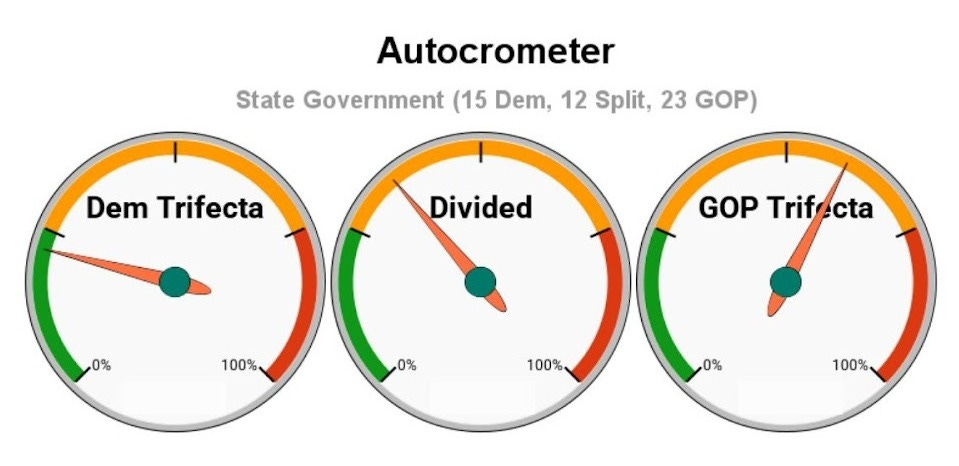
The reciprocal relation of state and federal power can perhaps best be understood by examining the “state-based strategy” that the right has used to consolidate political power. When populist backlash against Obama propelled Republicans to state-level government in 2010—critically, a redistricting year—the right undemocratically gerrymandered districts, passed restrictive new voter ID requirements, and otherwise rigged the rules so as to increase their chances of maintaining legislative (super)majorities even in situations where they won a minority of the vote, thus consolidating semi-permanent autocratic rule. A good rough measure of parties’ political power at the state level is “state government trifectas,” where one party controls the governorship and both chambers of the state legislature. By November 2016, the right’s autocratic measures had contributed to the GOP securing trifecta control over 26 states, compared to only six trifectas held by Democrats. In many ways, it was this state-based strategy that laid the groundwork for the right to begin to plan the takeover at the federal level that has culminated in the second election of Donald Trump.

The good news is that, since 2016, Democrats have come a long way in closing that gap. Today, GOP state trifectas have declined from 26 to 23, while Democratic state trifectas have risen to 15, with 12 states under divided rule. As Michael Podhorzer has noted, Americans increasingly live in not one but two different nations, as Democratic-controlled states have moved to expand political, social, and economic rights while Republican-dominated ones have further restricted them. The states under Democratic control (and, to a lesser extent, divided control) provide ample opportunities to check the autocratic ambitions of the Trump administration. Indeed, the Democratic states’ attorneys general have thus far proved one of the most well-prepared and consistent bastions of resistance to Trump’s authoritarianism.

A full analysis of US democratic backsliding would thus have to take into account the level of regression towards and resilience against autocracy at a state-by-state level. Very broadly, we could say that, of the 23 states under trifecta Republican control, most have experienced some level of autocratic attempt, and in many of them the right has achieved a state-level autocratic breakthrough, rigging the rules of the game so as to ensure semi-permanent rule despite the continuation of nominally competitive elections. In a handful of these states, such as Florida, authoritarianism has further progressed towards something like autocratic  consolidation, in which the autonomy of civil society has been deeply compromised. (See, for instance, the aggressive takeover of Florida liberal arts colleges.) In Democratic-controlled states, in contrast, democratic processes have been maintained, and in many cases expanded, and in divided states, autocratic attempts have thus far also largely been repulsed.

Because the states possess a great deal of power over the administration and regulation of elections, the state-level balance of power also impacts the level of fairness and competitiveness of US Congressional and presidential races. Of the seven battleground states most likely to determine the 2028 presidential election, Democrats currently control the main elected positions responsible for electoral administration in six of them (although in North Carolina, Republican state legislators have launched a power grab to wrest these powers from the Democratic governor and attorney general). Meanwhile, the Democratic Association of Secretaries of State has announced a $40 million electoral plan to defend those key seats in 2026, while targeting the seventh (Georgia) and expanding their efforts to other contestable states. Thus, although the right-wing’s autocratic capture of many state governments has contributed to the erosion of electoral fairness at both the state and federal electoral level, the current balance of state-level power is overall favorable to protecting the (relative) fairness of the 2026 and 2028 federal elections.
undefined
Image: International Civil Society Week 2019Gayane (WMAM) / CC BY-SA 4.0

Defense Mechanism 2.0 – civil society

If my analysis of the US’s “first defense mechanism” already proved unwieldy, a comprehensive analysis of its second dimension—civil society—exceeds what I can accomplish in a relatively short article. Instead, I will briefly review some existing civil society indexes and then add a few provisional points of my own.

Indexing Civil Society

In an ideal world, I could simply point to existing analyses to measure the US’s level of civil societal resilience. And indeed, plenty of datasets attempt to measure such a thing. The problem is that many of these efforts have historically been directly or indirectly backed by the US and/or used to advance its interests. That means that many rankings of US civil society are apt to be colored by bias—when they even bother to include the US in their rankings at all. Indeed, in a painful irony, one of the most commonly cited such frameworks, the “Civil Society Organizations Sustainability Index,” was managed by USAID, which has now been shuttered in the very kind of repressive maneuver that the now-compromised index set out to catalogue. (Who, one might ask, analyzes the global civil society analysts?) Still, with all their problems, such indices provide some helpful quick reference points—particularly when contrasting their rankings of the US with those of NATO allies and other regimes historically “friendly” to the US, where the analysis is less likely to be colored by bias than when ranking, say, China or Cuba. To that end, let’s briefly review two such indices.

One such index, the CIVICUS monitor, currently rates the US as a 62 on its “civil space”  ranking. While lower than truly open civil societies like Canada (82) or Sweden (87), this still places the US above the vast majority of nations assessed. Interestingly, CIVICUS places many western European countries at a level comparable to the US—France ranks only a few points higher (67) and the United Kingdom a few points below (60). For comparison with more autocratic regimes, CIVICUS scores Hungary at 46, Turkey at 24, and Russia at 14. This may provide one rough indicator of where US civil society falls on our “autocrometer.”
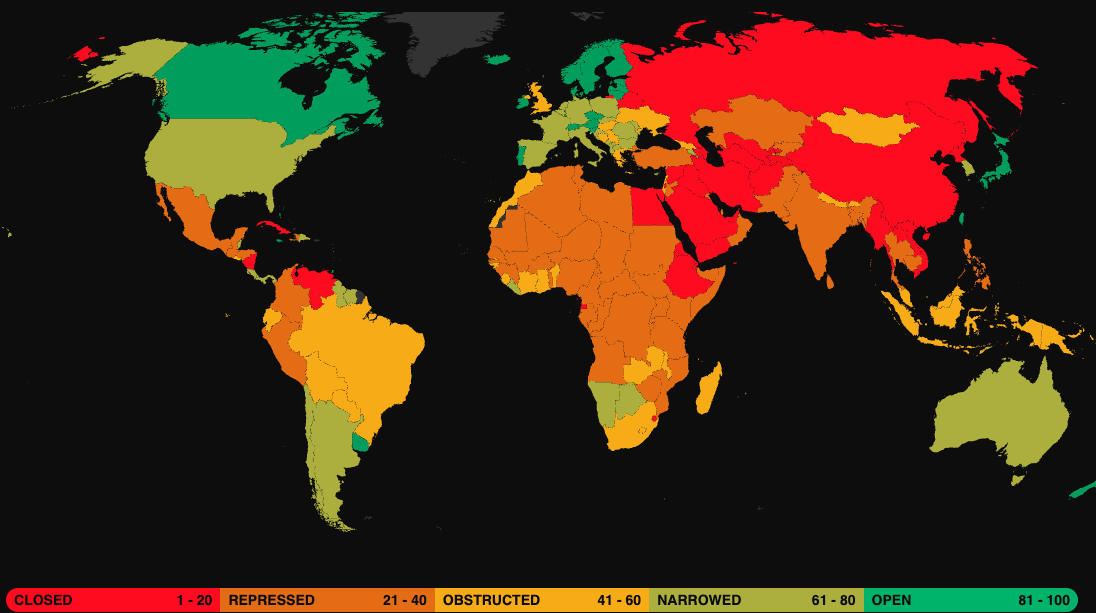
Image credit: CIVICUS

Another such assessment comes from Freedom House’s “freedom in the world” ranking, a combination of its “civil liberties” and “political rights” scores. It currently ranks the US as 33/40 on political rights and 50/60 on civil liberties, for a total of 83/100. (Though as Freedom House is mostly funded by the US State Department, it will be interesting to see how those rankings change… or if they last!) More helpful than looking at the topline number is drilling down into the description and ranking of various sub-components of US civil society. For those interested, I particularly encourage looking at their answers to the questions: “Are there free and independent media?” “Is there academic freedom, and is the educational system free from extensive political indoctrination?” and “Is there freedom for trade unions and similar professional or labor organizations?”

The Civil Societal Paradox

Here’s the paradox that I am struggling with. Let’s take some of the key institutional sectors of civil society: the media, universities, NGOs, labor unions, churches, civic associations, and grassroots membership groups. With the very notable exception of organized labor (to which I will return) the US is teeming with such organizations. Taken collectively, our civil society is older, richer, more well-established, and more manifold than almost anywhere else in the world. This is something that already stood out to the trenchant French writer Alexis de Tocqueville when he visited the fledgling United States in the 1830s. As he wrote then:

“Americans of all ages, conditions and all dispositions constantly unite together. … To hold fetes, found seminaries, build inns, construct churches, distribute books, dispatch missionaries to the antipodes. They establish hospitals, prisons, schools by the same method. Finally, if they wish to highlight a truth or develop an opinion by the encouragement of a great example, they form an association.”

This proliferation of civil societal organization astonished Tocqueville. Nothing equivalent then existed in a still quasi-feudal Europe, whose linkages were not those of voluntary association but of “bonds” (of kinship, fealty, guild, estate, etc.) that we might indeed qualify as “patronal.” Tocqueville initially feared that, in the absence of such “fixed” (involuntary) social relationships, America would fragment into a mass of isolated individuals, each pursuing their own solipsistic interests. He further feared that such social fragmentation, in turn, would leave an atomized American society vulnerable to the emergence of a paternalistic, despotic central government worse than even the most despotic of European monarchs. It was precisely the richness of American civil society that alleviated this concern for him. In other words, he agreed that civil society was a (perhaps the) key defense mechanism against authoritarianism.

Today, we have more civil society organizations than ever—some 1.97 million non-profits, according to the IRS, and that’s not counting the millions more (little leagues, neighborhood watches, etc) too small to register. And yet, despite that, we have witnessed the emergence of exactly the kind of “democratic despotism” that Tocqueville feared. Why?

The Civic Wizard of Oz

Here’s the answer I fear. The past decades have seen an explosion of civil society, with many individual organizations growing in size and complexity amidst a proliferation and diversification of the total number of organizations in aggregate. However, this growth has coincided with an overall decrease in the number and strength of member-led, participatory organizations; an increase in the number of top-down (staff-, board-, owner-, founder- or investor-driven) organizations; and a tendential process of verticalizing and hierarchizing power within “hybrid” organizations that fall somewhere in between those two extremes. In this sense it has seen an “explosion” of civil society in a second meaning of the term, of hollowing-out. The richness of our civil society is in some ways chimeric: behind the powerful facade of voluntary association and organization, there is very little actual associating or organizing going on. It’s a civic wizard of Oz.

In Bowling Alone, Robert Putnam famously traced the decline of participatory civic engagement. In the mid-twentieth century, most Americans belonged to and actively participated in one or more voluntary associations: rotary clubs, bowling leagues, cultural groups. Today, few do. Instead, as Theda Skocpol explored in Diminished Democracy, such participatory organizations have been replaced by staff-led advocacy groups. Where voluntary associations got most of their energy from their membership (perhaps supported by paid staff) today’s non-profit sector is mostly driven by paid staff (who perhaps occasionally wheel out a token member or two). Likewise, these organization’s financial models have shifted away from grassroots donations and membership dues towards wealthy donors and foundation funding— and, increasingly, government, as the neoliberal state has outsourced key formerly public sector roles to the non-profit sector. Today, almost 70% of nonprofits receive government grants, and 29% of total nonprofit revenue comes from the government sector. (See this recent article, which my analysis in this section draws on.)

Perhaps the most severe drop in participatory organizations has been the decline of organized labor. In the 1950s, some 35% of American workers belonged to labor unions. Today, only 9.9% do—and only 5.9% of workers in the private sector. This is in large part due to a systematic assault by the corporate elite against worker power, which was catalyzed by Reagan’s firing of 11,000 striking air traffic controllers, and which Trump, Musk, and DOGE appear to be trying to finish up with their nuclear assault on the federal labor force.

Meanwhile, many organizations which have retained the robust involvement of many people have nevertheless seen a usurpation of decision-making processes away from mass participation towards centralization and hierarchy. Take the recent, disastrous decision of Columbia University to concede to the demands of the Trump administration. I have no doubt that a majority of university students, staff and alumni oppose this capitulation, as did the faculty—who used to be the ones to make decisions about university policy. So who actually runs Columbia University? A small group of trustees, none of them academics, most of them wealthy entrepreneurs in the finance and technology sectors.

This shift away from faculty self-governance towards control by a wealthy, unaccountable elite is not unique to Columbia; it has played out across all of higher education, and resonates with parallel processes unfolding across many sectors of civil society. In other words, the undemocratic, anti-labor, patronal autocratic capture that Trump is now attempting to carry out at the level of the federal government has been preceded by a decades-long process of patronal capture that has played out within and across many institutions of American civil life. It is the decline of participatory, democratic processes in our civic institutions that has helped to pave the way for the assault on the broader political institutions of representative democracy.

And here’s the thing: even hierarchical, hollowed-out institutions can play a role in the resistance against authoritarianism. Our civil society institutions remain manifold, and Trump will have to subordinate an extraordinarily large number of relatively autonomous bastions of power if he is to bring them to heel. In the immediate temporality of our fast-moving coup, I would give our civic society a decent ranking in terms of resiliency. It is the longer-term, slower erosion that we may need to worry most about.

The good news is, most of us are connected to organizations we can revitalize, democratize and organize: universities, churches, unions, independent political organizations, non-profits, neighborhood groups. And just as in the first Trump administration, thousands of new grassroots resistance-focused groupings are again springing up. In the short term, organizing within all these spaces to refuse, resist and contest Trump’s agenda will be crucial to repelling authoritarianism; in the longer term, strengthening and democratizing them will be vital to laying the groundwork for the world we need to build.

But that will be the subject of the last section of my three-part post. Stay tuned.


ZNetwork is funded solely through the generosity of its readers.  Donate

Fighting the MAGA Assault
April 2, 2025

LONG READ


Members of dozens of unions held lunchtime picket in New York City on February 19, was part of a 30-city event pulled together by the Federal Unionists Network in response to weeks of illegal job cuts, funding freezes, and contract violations. Now, the Trump administration claims to have ended nearly all collective bargaining for federal workers. Photo: Jenny Brown

Since Trump was inaugurated and brought in billionaire oligarch Elon Musk and his hacker team to do a wrecking operation on many programs and agencies of the federal government, Trump and his team have moved in a rapid-fire way to disorient the opposition with a continuous stream of outrageous statements, illegal executive orders, firings of thousands of federal government workers and slashing of funding for services. The regime is pursuing a “flood the zone” strategy — shock-and-awe to distract, disorient and overwhelm the media and the opposition. Threats and intimidation tactics aim to paralyze with fear. This makes it ever more important to emphasize that organizing and collective action give us the power to fight back.

In the US constitutional structure, Congress has the power to allocate funds, pass laws and set up agencies and independent administrative boards. Once these actions are approved, a president — or members of his cabinet — cannot simply shut down these agencies or funding streams on their own. Doing so is illegal. For one thing, the Impoundment Control Act of 1974 requires the president to spend every cent Congress has appropriated for the purpose Congress has designated. In a recent warning to Trump, Republican Senator Susan Collins writes: “Just as the president does not have a line-item veto, he does not have the ability to pick and choose which emergency spending to designate.” This is true for all spending that Congress allocates for a particular purpose.

But Trump rejects this feature of the constitution. He’s said “I am the law.” The Trump administration now faces huge numbers of lawsuits. Just the wrongful termination lawsuits are likely to cost the taxpayers many millions of dollars. As one labor attorney put it: “These firings they’re conducting without following the law will result in thousands of former federal employees being owed back pay, plus interest, plus benefits, plus attorney fees. When the bill comes it will be monumental.”

The violations of the law are an intentional feature of the MAGA regime — it’s an attempt to blow up the guardrails of the US constitution — to establish a unitary, autocratic presidential power. Because the US constitution is not very democratic and the president has the most powerful role, this was always a potential danger. Trump no doubt anticipated the legal challenges now filtering through the courts. A federal judge has ordered re-instatement of thousands of federal employees in case brought by the federal employee union, American Federation of Government Employees. And another court has ordered re-instatement in further agencies, in a case brought by state governments. Trump appealed the ruling but has now agreed to rehire 25,000 people who were fired. The MAGA administration hopes it can blow away longstanding constitutional guardrails with the assistance of the right-wing political hacks on the Supreme Court and a gutless Republican majority in Congress.

Another MAGA tactic is intimidation. Reuters reported that several federal judges in the Washington, DC area had received pizzas sent anonymously to their homes. Police interpreted this gesture as “a form of intimidation meant to convey that a target’s address is known.” The Trump regime is also likely to ask the supine Republican congress to ratify its actions.

Elon and his muskrats claim they are finding “corruption, fraud and waste.” Meanwhile, Trump illegally fired the independent watchdogs whose actual job is to carefully ferret out “corruption, fraud and waste.” Congress set up various administrative boards over the years whose terms of office continue across the four-year presidential terms. This was designed to protect their independence. An example is the National Labor Relations Board, which can provide some protection for workers — such as reinstatement if they are fired for “talking union.” But Trump illegally fired a member of the National Labor Relations Board and appointed a replacement who is an anti-union hack. Trump has also issued an illegal executive order banning union rights or collective bargaining for many federal employees. According to Labor Notes, “Early estimates have the move affecting 700,000 to 1 million federal workers, including at the Veterans Administration and the Departments of Defense, Energy, State, Interior, Justice, Treasury, Health and Human Services, and even Agriculture.” This attack has echoes of Reagan smashing the air traffic controller’s union in 1981. At this point Trump has not moved to attack the postal unions. The half million postal workers are the largest unionized federal government workforce.

The Trump-Musk wrecking operation also took aim at the Consumer Financial Protection Board which has returned millions to people who have been charged illegal bank fees or other corporate scams. Although this was blocked by a judge, Trump is appealing these judicial rulings. Trump has also illegally seized the post office — firing the US Postal Service board of governors.

The firings are already having bad effects. Trump’s new boss for the Veterans Administration, Doug Collins, plans on cutting 80,000 jobs from the VA. Among the first thousand VA employees fired were “staffers working on treatments for vets with cancer, respiratory problems, missing limbs, and opioid addiction.” The Agriculture Department was forced to rehire 6,000 fired employees, mainly forest maintenance workers at the Forest Service, after the Merit Systems Protection Board has ordered their reinstatement. Meanwhile, Leland Dudek — Trump’s new boss for Social Security — plans to fire half the agency’s 60,000 employees and close many Social Security offices. This will make it very difficult for people to get setup for payouts if they’ve just retired. Wait times at Social Security offices will become unbearable. Underfunding services is used by right wing administrations to diminish public support and set the stage for privatization. Privatizing Social Security has been a Wall Street aim for decades.

Another illegal move is Trump’s order that would require a photo ID that meets socalled “Real ID” standards in order to vote. Obtaining such IDs requires documents which some may not have as well as a trip to a DMV office which might be expensive for some poor people. This would violate the constitutional amendment banning a poll tax. The order is illegal because it’s the states who determine qualifications for voting. Like other vote suppression measures, it’s an attempt to entrench Republican rule. The Republicans have also introduced the SAVE Act in Congress which could disenfranchise millions.
“Deep State” Talk Is Cover for Attacking Public Services

As anarcho-syndicalists, we are opposed to the top-down bureaucratic state. For one thing, the state is a vehicle of worker oppression — through the subordination of workers to the top-down managerial hierarchy of the state. But we are not opposed to the public services. On the contrary, we want them expanded — such as education free to students at all levels, free-to-user universal health care, and free abortion on demand. In our vision, the country’s hospitals, health clinics and drug factories would be self-managed by a democratic, worker-controlled staff organization, not a top down managerial bureaucracy. We would envision the postal service also run by a similar worker-controlled, democratic staff organization. In general, we favor re-organizing the whole economy on the basis of workers self-management — with distributed decision-making united into a social federation to replace the corporations and the top-down bureaucratic state.

Despite the MAGA talk about some secretive “deep state,” their attack is a direct assault on public services provided through the federal government — from the “people’s pension” (Social Security) to medical services provided via the Veterans Administration or Medicaid, to student financial supports. The people being laid off are not some secretive managerial power center but the workers who do the work — providing the public services Americans have come to expect.

For more than a century the politicians running the federal government have been mediators between mass middle class and working class protest, on the one hand, and the capitalist oligarchy who are the dominant power in this country. The people who run the state must be able to govern. Reducing the level of social unrest and mass struggle makes their job easier. Thus, Social Security, the legal minimum wage, and the minimal legal protections offered for worker on-the-job action and unionizing under the National Labor Relations Act were concessions won through the mass working class rebellion — mass strike wave and fights against evictions and so on — during the 1930s. A mass wave of eight-hour strikes during World War I gained government support for reducing the working day to eight hours. Social protest, wildcat strikes and urban rebellions in the 1960s-1970s added additional federal programs as concessions to the social movements of that era — such as the civil rights acts, Medicare, the clean air and water acts, and creation of the Environmental Protection Agency and the Occupational Safety and Health Administration. The various radical left “militant minorities” on the scene played an important role in popular education and organizing.

But in recent years the labor movement has been weak. Despite the promising do-it-yourself grassroots efforts of workers to build unions recently, only six percent of workers in the private sector belong to unions. When we add public sector union members, this rises to 10 percent of all wage-earners.

The radical left in the USA is also in a very weak state. The authoritarianism and failures of state socialism in the 20th century tended to undermine support for socialism, yet some tendencies on the left cling to obsolete ideas from that era.

A faction of American capitalists and their think-tanks and social media supporters see the current weakness of the left and the labor movement as an opportunity — an opportunity for a major political assault on all the federal government programs that represent the accumulated concessions to previous eras of mass protest and struggle.
A Convergence of Extreme Right-wing Tendencies

Over the past few decades a faction of the American oligarchy have gradually helped to finance a mass far-right extremist movement, which has coalesced into MAGA. Although this movement differs from the classical fascism of the 1920s and 1930s, it has some stark similarities.

In the decades before World War 2, fascism was a mass movement to smash the rapidly growing socialist and radicalizing labor movements of that era, which were perceived as a dire threat to the capitalist system. The present MAGA neo-fascist threat differs from that earlier form of fascism in that there is not now a strong socialist movement or powerful labor militancy posing a current threat to capitalism.

But there are similarities: For example, the use of intimidation and threats of prosecution for perceived “enemies” and reliance on the potential of violent vigilante action. According to recent polls, 11 percent of adults in the USA say violent extra-constitutional attacks on perceived political enemies is legitimate. That same poll found that 14 percent support extra-constitutional armed violence and thus favored the pardons of even the people convicted of violence in the January 6, 2021 attack on the US Capitol. Moreover, 14 percent also support Trump’s smashing through the existing US constitution by refusing to recognize the authority of the courts or the rule of law — defining the presidency as an autocratic power. These views are explicitly fascist.

Just as MAGA has been financed by sectors of private capital in various ways, the earlier fascist movements often had initial funding or backing from elements of the capitalist elite. Just as the small business class is the core mass constituency for MAGA, this was true also of those classical fascist movements.

The MAGA movement often makes absurd allegations that the moderate Democratic Party-enforced regulatory regime is “socialist” or “communist.” Why? To explain this, we need to look at the ideological tendencies that have converged in the MAGA movement. The extremist opposition to use of government as a means to protect society through regulation of the destructive activities of capital or provide social benefit systems has a long history in the USA. The word “liberal” first emerged as a political term in the USA to refer to a new faction in the Republican party in the 1870s. The liberals criticized the black-led Republican governments in the south that were attempting to provide land and services (such as schools) for the recently freed black population. The liberals opposed any government action to provide public benefits or any laws to protect labor, such as eight-hour laws or child labor laws. A well-known proponent of this view was Yale professor William Graham Sumner who gained a wide audience through his popular essays. Sumner opposed any social supports for people he deemed “weak” or “inferior” — the poor, the working class, black people, women. For Sumner, the dog-eat-dog competition of laissez faire capitalism was “the natural order” in which “the struggle for existence” would work itself out.

This extreme form of laissez faire liberalism had been a minority faction in the Republican party in the post-World War 2 years. In the 1960s Murray Rothbard and others decided to rebrand this earlier form of liberalism as “libertarian.” Here we see the origin of the MAGA claim that government benefit systems and regulation of capitalism are “socialist” or “communist.” Only the laissez faire “struggle of all against all” is “real” capitalism for some Republicans. This extremist opposition to all government regulation appeals to much of the small business class who fear the burden of government regulations and hate unions. But elements of the capitalist oligarchy also viewed the expanded benefit systems and environmental regulations of the 1960s and 1970s as “an attack on the free enterprise system” — as in the famous 1971 memo of Lewis Powell whcn he was a leader of the Chamber of Commerce.

In the extreme form of “libertarianism,” such as Rothbard’s “anarcho-capitalism,” the proposal was to do away with democracy and privatize the state functions —such as direct ownership of the police and courts by the capitalist oligarchy. This fusion of private and public power makes this ideology neo-feudal. Separating out a public realm run through “democratic” government and civil liberties was a key feature differentiating 19th century capitalism from the previous feudal society.

Curtis Yarvin’s neo-fascist “dark enlightenment” philosophy, worked out in the early 2000s, is an evolution from that “anarcho-capitalist” milieu — especially present in the California techbro capitalist environment. Yarvin sees the liberal evolution into the regulatory state as the “failure” of enlightenment humanism and liberalism. Yarvin is a software engineer and house philosopher for billionaire Palantir CEO Peter Thiel. Yarvin proposes doing away with democracy and re-organizing the world into a neo-feudal, multi-polar world of autocracies controlled directly by the oligarchy, and run by CEO style autocrats. In his advocacy of “race science” he is also explicitly racist.

Peter Thiel’s financial support was important for the political career of JD Vance. Both Vance and Musk are fans of Yarvin’s ideology. Musk’s wrecking operation at the federal government can be seen as an attempt to carry out Yarvin’s RAGE plan — Retire All Government Employees. In more statements, Musk admitted DOGE isn’t about saving money but “destroying a power base for liberalism.”

Pete Hegseth’s Christian Nationalist tattoos burn his ideological commitment into his skin. Christian Nationalists support the Project 2025 plan which also calls for firing vast numbers of government employees. And here we see convergence of diverse extreme right ideologies. As a recent essay notes, Christian Nationalism is “the anti-democratic notion that America is a nation by and for Christians alone. …Christian nationalism is…a contributing ideology in the religious right’s” practice of “circumventing laws and regulations aimed at protecting a pluralistic democracy, such as nondiscrimination protections for LGBTQI+ people, women, and religious minorities.” The religious right’s patriarchist ideology is the basis for the war on abortion.

The MAGA movement differs from the fascism of the pre-World War 2 years in its drive for direct control of state power by elements of the capitalist oligarchy. Not only is the regime deploying the world’s richest man in “blowing up the administrative state,” the Trump cabinet has 13 billionaires. This is more in keeping with the “anarcho-capitalist” ideology, rooted in the era of robber baron capitalism in the Gilded Age of the late 1800s.

Nonetheless, the use of scapegoating (such as the obsessive attacks on trans people), attacks on immigrants, and the (thinly veiled) racism and misogyny of the MAGA movement are similar to classic fascism — as are the methods of intimidation and threats of state prosecution of political “enemies.” The scrubbing of climate justice and “DEI” language from federal websites is a form of Orwellian Newspeak.

The USA was founded on an ideology of white supremacy to justify enslavement of people from Africa and land-grabbing against indigenous communities. This became deeply entrenched within the white population of the USA. From the 19th century abolitionist movement to the black freedom movement of the 1960s, systemic racist practices have been subject to a long fightback.

But the gains made in improving opportunities for non-white groups in the USA — in hiring, bank loans or schooling — have been resented by a sizeable fraction of the white population, and MAGA appeals to these people. Many MAGA fans describe these efforts as “racism against white people.” Hiring any woman or black person can be delegitimized as a “DEI hire.” Racism is implicit also in the hatred of public benefit systems that might benefit “Those People” (the groups despised by MAGA hard core). White supremacist ideology was explicit in Trump’s recent executive order attacking the Smithsonian Institution. He pointed to an exhibit titled “The Shape of Power: Stories of Race and American Sculpture.” Trump complained that the exhibit uses the phrase: “Race is a human invention.” He added that the exhibit “promotes the view that race is not a biological reality but a social construct.” Pointing to the reality of racism, sexism or other forms oppression is mistaken “historical revisionism,” as Trump calls it. But of course race is an invention. The colonial elite in North American created the idea of a division between “white race” and “black race” at the end of the 17th century to justify their creation of a system of life-time slavery limited specifically to people of African ancestry. Professional organizations in biology and anthropology have stated that race is pseudo-science as the biological race concept has no empirical foundation. It was a myth created to serve the interests of colonizers and slave plantation owners.

The Defense Department under Pete Hegseth initially removed thousands of pages and images of women, Navajo, Japanese-American and black military figures from the government websites as part of their attack on “DEI”. (Some of these pages have been restored due to popular outrage.) Pentagon press secretary John Ullyot told NBC News that “DEI is dead at the Defense Department. Discriminatory Equity Ideology is a form of Woke cultural Marxism that has no place in our military. It Divides the force, Erodes unit cohesion and Interferes with the services’ core warfighting mission.” “Cultural Marxism” is an anti-semitic neo-fascist conspiracy theory that sees a small group of Marxist intellectuals (the Frankfurt School) as somehow responsible for the urban uprisings, civil rights struggles and social movements of the 1960s. As far as “dividing the force,” that’s what racism and misogyny do.

Although the MAGA movement that coalesced around Trump has neo-fascist features, the Trump regime is still operating, more or less, within the inherited American governmental structure and has not completely implemented a fascist governmental autocracy. Thus we see some resistance from judges and from state and local governments. And anti-MAGA street protests are occurring all over the country.


MAGA Attack on the Green Transition


The fight against global warming is essential to ensure a livable planet for future generations. Global warming is driven by the burning of fossil fuels. As fossil fuel pollution cooks the planet, there will be increasing frequency of deadly heat waves and more powerful storms and rising sea levels. A common goal of the climate justice movement has been to achieve Net Zero carbon dioxide emissions by 2050. But Trump’s Energy Secretary Chris White calls “Net Zero 2050” a “sinister goal.” Trump has called global warming a “hoax.”

The fossil fuel industry and its well-funded think tanks are another thread in contemporary neo-fascist ideology. The far right thus attacks the scientific consensus that provides information about the global warming emergency and backs the fossil fuel industry’s goal of continuing to profit from generating emissions that are cooking the planet. This is not unique to the MAGA movement. It’s also a feature of the neo-fascist Alternativ für Deutschland in Germany.

The Trump administration has engaged in a wide-ranging and vicious attack on the movement to stop fossil fuel pollution and build the green transition. The MAGA regime is firing thousands of employees who monitor pollution, collect data at the Environmental Protection Agency, National Oceanic and Atmospheric Administration and other agencies. According to a recent report, the planned cut at the EPA will eliminate the scientific research office and possibly “fire more than 1,000 scientists and other employees who help provide the scientific foundation for rules safeguarding human health and ecosystems from environmental pollutants.” This would include more than a thousand chemists, biologists, toxicologists and other scientists — 75% of the research program’s staff.

The Inflation Reduction Act was an imperfect start at moving to a green transition — the transition to reliance on renewable energy as a substitute for fossil fuels. Now the Trump regime is trying to illegally stop the distribution of funds allocated under the IRA — such as subsidies for low-income solar installations, heat pumps to replace gas heating. Projects from Maine to Alaska to lower carbon dioxide emissions of fishing fleets through more efficient refrigeration systems are now being denied the funding they had been promised. The MAGA regime has also pulled the USA out of an international fund to compensate poorer countries for damages due to global warming.

The regime has also moved to eliminate electric vehicle chargers at government buildings. In a particularly crazy move, the FBI got a freeze on the bank account of Habitat for Humanity — accusing them and several other institutions such as the DC Green Bank — of a “conspiracy to defraud the government” by obtaining grants under the IRA. Thus if Habitat for Humanity wants to use the funds for increased home efficiency or installation of solar panels or heat pumps, that’s “fraud” on the assumption global warming is a “hoax.” These FBI prosecutions will probably be rejected by the courts. Federal judge Tanya Chutkan has already demanded evidence of fraud or illegality. But in the meantime these organizations will have to spend money on legal fees. Thus it’s a form of intimidation.


Blowing Up the Pax Americana


The era since World War 2 has been the era of the USA as global hegemon — dominant imperialist power. In previous history, empires were built through military conquest, colonialism and mercantilist “beggar thy neighbor” trade barriers to keep the imperial loot for the home country.

But the USA created a new kind of imperialism. For decades after World War 2, the American capitalist elite and its political cadre put a lot of effort into building trade pacts and military alliances to bring other capitalist elites within a system overseen by the USA. The USA also built a very powerful navy and a vast array of military bases around the world. The NATO alliance was used to reassure western European capitalism through American military protection. This has allowed the European capitalist countries to spend less money on military buildups. As European powers and other countries bought military gear built in the USA, this spread the costs of new weapons systems over a number of countries and was very lucrative for the USA — building up a huge American arms industry. It would have been much more costly to the USA if it had to do this on its own.

A strange feature of the MAGA regime is the way they are blowing up the Pax Americana. A faction of the American oligarchy seems to have come to the conclusion this is “too expensive.” They fail to appreciate the way the wealth and power of the American capitalist regime since World War 2 has been built on that intricate network of military alliances and trade relationships. They envision a return to an earlier era of go-it-alone imperialist powers. This MAGA push for USA to go it alone seems to reflect both the crisis of American globalist capitalism and the insular mentality of “America First” as well as Curtis Yarvin’s vision of a multi-polar world of autocracies controlled directly by the local oligarchy.

The MAGA regime’s attack on the Pax Americana takes various forms — from Trump’s mafia-like use of threats of tariffs as a form of intimidation, to his use of tariffs to blow up the relationships with the USA’s main trading partners (Canada, Mexico, and Europe), threats of imperialist conquests of Greenland and the Panama canal, the destruction of USAID’s humanitarian aid programs, talk of withdrawal from NATO’s defense of Europe, and Trump’s willingness to abandon Ukraine to Putin’s imperialist conquest.

As anarcho-syndicalists, we are opponents of American imperialism but we propose an internationalism of cross-border working class solidarity. This is why we join with the Ukrainian unions, socialists and anarchists in supporting Ukraine’s military resistance to Putin’s imperialist quest to conquer Ukraine. In this we are following the example of anarchist activist Errico Malatesta who supported the Arab resistance to Italy’s conquest of Libya in 1911.

USAID has been a relatively inexpensive form of US “soft power,” buying support of organizations and countries through its medical and food assistance programs. The radical left has long been critical of the way USAID has been used to support anti-socialist groups and right-wing labor unions. But the destruction of USAID’s medical and food assistance programs by Musk’s wrecker gang is having destructive consequences on the poor in refugee camps and elsewhere. Cancelling 5,000 contracts with nonprofits fighting AIDS in Africa means cutting off retroviral medicine for people who are HIV positive — drugs to prevent full-on AIDS. People are going to die as a result of the sudden cutoffs of medical and food aid.

Blowing up the system of alliances and established trade relationships will be very destructive for the USA. The American arms industry will lose many lucrative contracts. Portugal recently cancelled its F-35 fighter jet purchases for example. This will lead to layoffs. Retaliatory tariffs and consumer boycotts in Canada or Europe will cause a loss of trade and Trump’s tariffs will raise prices. Tariffs are paid by importers in USA and they will pass on the costs. The high tariffs on auto industry imports from Mexico and Canada will lead to much higher prices for cars.

Republicans will argue that raising prices on imports will spur American manufacture. The idea is that a higher price for the imported product makes them less competitive with American-made competition. But manufacturing facilities are an expensive investment that only pays off over a long period. Tariffs can be easily removed in the future and don’t provide investors enough assurance for massive investments.

Laying off thousands of federal employees will reduce consumer demand. When we combine this with loss of military contracts and inflation from tariffs, this makes a recession very likely.


Building an Effective Fightback

Trump and his team have pursued a shock-and-awe strategy with a constant stream of attacks targeting many different groups — from illegally rounding up legal immigrants with green cards, illegally banning union rights for federal workers and firing thousands of them, to narratives attacking “DEI” to rebuild white supremacy, to attacks on trans people, to attacks on health care for veterans, to bans on abortion and sowing fear among millions of Americans about their access to Social Security or health care funding. This “flood the zone” strategy is designed to exploit social divisions and disorient potential opposition.

But this strategy has a major risk for the MAGA regime. With so many different groups under attack, this means that there is an incentive for these groups to come together, build coalitions, and use solidarity to mobilize a wider fight back that could assume a vast scale. With vast firings of federal workers and smashing their legal union rights, this assertion of power by this billionaire-controlled authoritarian regime is also a threat to the entire working class in various ways.

A strategy for building an effective counterattack requires both organizing and popular education efforts to win “the battle of ideas” — countering the right-wing media machine. The MAGA propaganda says they are fighting for “freedom.” We can point out that their goal is maximizing the “freedom” of the capitalists to treat their workers in whatever way they like, freedom to pollute with impunity, and freedom to loot the federal treasury for their own enrichment. But this means an attack on our freedom — freedom in the workplace, freedom to organize, freedom of dissent.

A useful element of strategy from the experience of labor organizers is the idea of escalation. This means we don’t expect the maximum power of resistance initially but work to encourage increasing levels of action and disruption over time. Already we are seeing signs of rising opposition. Indivisible groups — and other groups of various kinds — have been forming and protesting all around the country. Groups are protesting at Tesla dealerships and calling for a boycott of Tesla. There have also been student walkouts and community resistance to raids by the ICE immigration cops.

A next step is building coalitions where more groups come together and build a common agenda that addresses their various concerns. LGBT people, federal government workers, environmental activists concerned about global warming, immigrant communities and other groups have a stake in the fight back.

Once people start participating in protests or meetings, they have a motivation to find more effective action. Their initial steps can help them to get past the fear that the MAGA regime is trying to instill, to keep people quiet.

In an escalating strategy, the idea is to use easier or less scary tactics to get people initially involved and overcome passivity or fear. A next step is moving to forms of disruption, such as occupying offices to shut own “business as usual”, occupying a Tesla dealership, or a short one-day walkout.

Disruption is where the working class begins to exert its potential power. The ultimate power of the working class lies in the ability to shut down workplaces — shutting government agencies or shutting off the flow of profits to companies. The maximum power of the strike occurs in a general strike where workers have built cross-union and cross-sector networks they can draw on for a society-wide assertion of working-class power. With a highly repressive regime in office, top paid officials are likely to fear any disruptive action that violates contract language or threatens the state directly. The solution here lies in rank-and-file organizing and building committees and networks independent of the union officials. With federal union leaders already terrorized by the Trump regime, federal workers are already building cross-union networks, as with the Federal Unionist Network. Another example of this type of organizing is Railroad Workers United, which came into being due to sellouts by top paid officials of the railway craft unions. A national general strike would exert a tremendous level of counter-power against the MAGA regime. It’s likely that a movement of that sort would have to come from the organizing and motivation of the rank and file.

Another essential element of strategy is the vision or goal — to provide motivation and a direction. The Trump regime is unprecedented in American history in many ways, but it builds on weaknesses of the inherited ancient US constitution which the Republicans have exploited for years. Since the MAGA movement wants to “blow up the administrative state,” trample the constitution and destroy a century of concessions to working class struggle, it won’t be easy to put Humpty Dumpty back together again.

The emergence of a faction of the oligarchy backing the MAGA regime’s “blow it all up” agenda and looting of the state is itself a symptom of a capitalism in crisis. The vision going forward needs to push beyond the inherited limits of the American capitalist framework. As green syndicalists, our program calls for rapidly ramping up the green transition program — shutting down fossil fuel extraction, phasing out the oil refineries, replacing petro-plastic with alternatives, and ramping up a de-carbonized green economy built around renewable energy. And doing all this with “just transition” supports to sustain incomes, health care, and retirement guarantees for the displaced workers.

We also envision worker self-management — direct control of the labor process — by workers in factories making electric stoves, heat pumps, solar panels, battery-powered buses and delivery trucks for the green economy. Our goal is a fundamental shift to a society built around democratic self-management — people controlling the decisions that affect them.

Rather than the top-down bureaucratic state as the basis of a green economy, we propose workers self-management of the industries. Thus we envision the drug industry and health care run by a society-wide, democratic staff organization — run by the people who do the work. With universal free-to-user health care funded by the society, health outcomes can be greatly improved.

We propose that the communication sectors — such as the postal service and telecom — be run by a worker-controlled industry organization without either capitalist ownership or top-down managerial bureaucracy over workers. To put long-distance freight transportation on an ecologically sound foundation, we agree with the Public Rail Now campaign — for public ownership of the railway network. But we propose control of the railways by regional industry organizations democratically self-managed by the railway workers. With railway electrification and an industrial policy favoring rail (including trucks on flat cars) for longer-distance freight transportation, the freight industry can operate with a vast reduction in greenhouse gas emissions.

These are just some elements of the vision that is needed for social transformation.

For a list of resources for the resistance, check out the sources listed here:
https://drive.google.com/file/d/1G-K23W9Jl23-ixJRCWrNvWjI7-VNOXCT/view?usp=drive_link
Glasshouse Communism

By Oscar Rickett
April 3, 2025
Source: Tribune


Volunteers at the Organic Lea workers' co-operative. (Credit: Oscar Rickett)

In leafy Chingford, a workers’ co-operative has combined socialist principles with organic horticulture to create a long-lasting hub for community activism and productive labour.

Close to Chingford Station in the suburbs of east London and along a path leading into Epping Forest, large iron gates stand at the entrance to Hawkwood Plant Nursery. Rows of fruit and vegetables are planted all around. Fields replete with raised beds and a forest garden provide the backdrop to a large glasshouse connected to a main building, from where the community food project Organic Lea is run.

Back in 2001, Ru Litherland was one of the founders turning the key in the lock of the old, creaking iron gate. ‘It was political from the beginning,’ he says today. ‘The realisation that we were disconnected from the food system, from food distribution, was beginning to dawn on people… We wanted to reclaim it.’

Organic Lea is not bound by conventional norms. The vision found here, in this slice of rural utopia on the edge of the capital city, this haven of carrots and communism, is directly at odds with the approach taken in Westminster or in most corporate boardrooms across the country. Established by a group of activists coming out of the global justice movement of the late 1990s, Organic Lea is a workers’ cooperative, with 23 members who are also directors of the company holding an equal say in how it is run.

One day in early summer last year, I came here to talk to workers and volunteers about what they do differently and about how, over the course of more than two decades, a group of people committed to equality have sought to turn traditional ideas about top-down leadership on their head.

These questions feel vital right now. Even a cursory look at Britain today reveals a land in which work is not working and in which trust in bosses and leaders is at an all-time low. Inequality is growing, real wages are falling, and the holes in Britain’s social safety nets grow ever more gaping. Work-related stress is rampant, with one poll finding that only one percent of employees had never experienced it.

And yet this landscape is often seen as a fact of life. The same can be said of our five-day working week, of the impossibility of juggling employment and childcare or the fact that so many workers are stuck in what the late anthropologist David Graeber dubbed ‘bullshit jobs’.

What is it like to be in an environment that seeks to address these problems? As I plant globe artichokes in the sunshine with three other volunteers, they all tell me a similar story: they work — or used to work — in offices. This work leaves them feeling alienated. They don’t trust the people telling them what to do and they aren’t sure if they are doing any good. ‘One day, I just had enough,’ says Kirsty Bennett, who worked in the charity sector for 20 years. When she is at Organic Lea, she feels something very different.

‘Ten years ago, I lost my partner,’ says the usually jovial Sandra Palmer, wearing a Chelsea Football Club shirt. ‘I came here and I listened, the way everyone else did. And now I devote my entire life here.’ Every Wednesday, Palmer gets paid to clean the toilets. ‘And I charge everyone who comes in,’ she tells me, cackling.

Clifford, her 29-year-old son, is with her. He has autism and his mother is his sole carer. ‘He’s got no social worker and I’ve lost my carers’ allowance,’ Palmer says, as we eat lunch, which is made onsite. Every week, Clifford reports to the job centre. ‘All he wants is to stack shelves, but they are doing nothing for him,’ Palmer says. ‘We don’t live in a caring world, but this place has become our family.’ She gestures to the tables around us, the fields and rows of vegetables beyond.

This feeling of community and family is one that Clare Joy, one of the founders of Organic Lea, recognises and seeks to foster by ‘looking to catch people’s interest in the everyday’. At the turn of the century, Joy was working in Ghana campaigning against the construction of a new oil pipeline when a colleague asked her what was happening back in Britain. ‘I couldn’t answer them,’ she says, and so she went home and started growing things. ‘If you want to change the world, an allotment is a good place to start.’

Organic Lea makes 70 percent of its income from its vegetable box scheme, which delivers to almost 1000 customers around London, and from training and courses in horticulture. The rest comes from grants. The 23 members of the co-operative are divided roughly equally according to the job they do: five are predominantly growers, five work on the distribution side, five are in community learning, four or five help other gardens and children with special educational needs and the rest do administrative support.

In the warm glow of the glasshouse, Ru Litherland sits to take a break, rows of plants and vegetables all around. A prolific chronicler of over two decades of life at Organic Lea on his ‘grower’s blog’, Litherland also wrote an account of what happens here for the Guardian headlined, ‘Carrots and communism: the allotments plotting a food revolution.’ He tells me that the cultivation of this part of the River Lea’s valley goes back to the sixth century, when the Saxons settled and worked the land.

At the end of the ninth century, Danes who had sailed up the Lea established the first market gardens in the area, which continued to play a vital role in the production of vegetables up into the 19th century — when London’s oldest allotments were introduced here — and on into the 20th century, with the peak of Lea Valley production coming during the Second World War.

Litherland has written that from their very beginning in the Victorian period, when land was given to the labouring poor for growing food, allotments have ‘provided a space for recreation and an alternative to industrial capitalism’. This keen sense of history applies to the unusual, as well as the political. While cucumbers, tomatoes and other fresh produce were dispatched to the markets of central London, the city’s bodily waste came back the other way on barges, fertilising the ground. This, Litherland tells me, is where the phrase ‘taking the piss’ originates: barge drivers taking the capital’s piss and shit back up the river would make up a story about the shameful cargo they were carrying.

‘For a long time, I tried to avoid the term leadership because of being disenfranchised by leaders and seeing how they had failed us on environmental issues,’ Litherland says. Leaders were men who ‘thwarted fairness and equality’, and as such he wanted to avoid being like them. He thought carefully — perhaps even painfully — about how to avoid falling into the trap of being the white man who thinks he knows best and who ends up dominating others.

‘We have a certain authority because we are founders,’ he says of himself and Joy, ‘so it’s an interesting dynamic. I have traditional authority as an elder. If this is accountable and nameable, then I think it’s OK.’ The standard joke about cooperatives and other kinds of egalitarian enterprises is that everyone (and no one) is in charge and nothing ever gets done (‘I ran an all-women’s theatre company, everyone was a vice president,’ observes Tina Fey’s Liz Lemon in the comedy series 30 Rock).

For the 23-member cooperative at Organic Lea, strategy is determined at group meetings held every six weeks, where everyone discusses and votes on different issues that need to be resolved. Anyone can veto, but if there is only one veto, that person has two or three meetings at which to convince others to join them before the issue is decided by a majority vote.

‘In my old work, the solutions were never there. Whereas here, it’s very solutions-based, you just discuss it with someone and then you work it out,’ says Chris Manahan, who has been the head chef at Organic Lea since 2017, after working for many years across communities in east London. ‘I have great conversations in the kitchen. I get feedback from everyone. I’m letting go of the need to be acknowledged.’

Standing in the kitchen, his dreadlocks contained in a hat, Manahan is making a gardeners’ pie with spiced green lentils, leeks, onions and cauliflower leaves. Cabbage, bulghur wheat and scotch bonnet with chilli jam are also in the mix. ‘I did youth work, mental health work — working in supported living situations,’ he says. ‘What I found was that the system is toxic. There were a lot of frustrated kids, a lot of anger. A lack of open space and a lack of green space. Young men need places to go and a lot of them feel purposeless. It doesn’t matter what race you are, it’s all very similar, the same anger.’

Manahan had always dreamt of being a cook and had always felt a connection to the land. ‘I’m from a Jamaican family. I’m quite into growing. One side of my family still lives in rural Jamaica. I yearned for that: people sharing things, not money,’ he says. ‘I longed for communalism but didn’t know where to find it.’ Then he started volunteering at Organic Lea. Soon he was working in the kitchen, then he was running it. Having worked with ‘troubled boys who were the victims of hierarchies’, Manahan found himself in a place where everyone was listened to, but where things still happened.

The kinds of boys and girls Manahan used to encounter working in the youth system also come to Organic Lea, and the chef notices the effect the environment has on them. He looks out of the kitchen’s window, at this land that has remained productive for 1,500 years, through times of war and times of peace. ‘There’s no better lesson than the ground,’ Manahan tells me. ‘Things don’t get lost here. It feels like magic.’


Oscar Rickett is a journalist who has written and worked for Middle East Eye, The Guardian, openDemocracy, the BBC, Channel 4, Africa Confidential and various others.
Germany Turns to U.S. Playbook: Deportations Target Gaza War Protesters

Objections from a top immigration official that none of the protesters were convicted of crimes were overruled amid political pressure.
April 3, 2025
Source: The Intercept


A pro-Palestine demonstration in the Kreuzberg area of Berlin, October 28, 2023.

Berlin’s immigration authorities are moving to deport four young foreign residents on allegations related to participation in protests against Israel’s war on Gaza, an unprecedented move that raises serious concerns over civil liberties in Germany.

The deportation orders, issued under German migration law, were made amid political pressure and over internal objections from the head of the state of Berlin’s immigration agency. The internal strife arose because three of those targeted for deportation are citizens of European Union member states who normally enjoy freedom of movement between E.U. countries.

The orders — issued by the state of Berlin, whose Senate administration oversees immigration enforcement — are set to take effect in less than a month. None of the four has been convicted of any crimes. The cases are drawing comparisons to the United States’ use of deportation orders to suppress social movements.

“What we’re seeing here is straight out of the far right’s playbook,” said Alexander Gorski, a lawyer representing two of the protesters. “You can see it in the U.S. and Germany, too: political dissent is silenced by targeting the migration status of protesters.

“From a legal perspective, we were alarmed by the reasoning, which reminded us of the case of Mahmoud Khalil,” Gorski continued, referring to the Palestinian Columbia University graduate and U.S. permanent resident who was seized from his apartment building on allegations related to campus pro-Palestine activities.

The four people slated for deportation — Cooper Longbottom, Kasia Wlaszczyk, Shane O’Brien, and Roberta Murray — are citizens of, respectively, the United States, Poland, and in the latter two cases Ireland. Under German migration law, authorities don’t need a criminal conviction to issue a deportation order, explained Thomas Oberhäuser, a lawyer and chair of the executive committee on migration law at the German Bar Association. The reasons cited, however, must be proportional to severity of deportation, meaning that factors like whether someone will be separated from their family or lose their business come into play.

“The key question is: How severe is the threat and how proportionate the response?” said Oberhäuser, who is not involved in the case. “If someone is being expelled simply for their political beliefs, that’s a massive overreach.”

Police suppress a pro-Palestine demonstration in the Neukolln area of Berlin, October 18, 2023.
‘Vague and unfounded accusations’

Each of the four protesters faces separate allegations from the authorities, all of which are sourced from police files and tied to pro-Palestine actions in Berlin. Some, but not all, of the allegations would correspond to criminal charges in Germany; almost none of them have been brought before a criminal court. The protests in question include a mass sit-in at the Berlin central train station, a road blockade, and the late-2024 occupation of a building at the Free University Berlin.

The only event that tied the four cases together was the allegation that the protesters participated in the university occupation, which involved property damage, and alleged obstruction of an arrest — a so-called de-arrest aimed at blocking a fellow protesters’ detention. None of the protesters are accused of any particular acts of vandalism or the de-arrest at the university. Instead, the deportation order cites the suspicion that they took part in a coordinated group action. (The Free University told The Intercept it had no knowledge of the deportation orders.)

Some of the allegations are minor. Two, for example, are accused of calling a police officer “fascist” — insulting an officer, which is a crime. Three are accused of demonstrating with groups chanting slogans like “From the river to the sea, Palestine will be free” — which was outlawed last year in Germany — and “free Palestine.” Authorities also claim all four shouted antisemitic or anti-Israel slogans, though none are specified.

Two are accused of grabbing an officers’ or another protesters’ arm in an attempt to stop arrests at the train station sit-in. O’Brien, one of the Irish citizens, is the only one of the four whose deportation order included a charge — the accusation that he called a police officer a “fascist” — that has been brought before a criminal court in Berlin, where he was acquitted. All four are accused, without evidence, of supporting Hamas, a group Germany has designated as a terrorist organization.

Three of the four deportation orders explicitly invoke alleged public safety threats and support for Hamas to argue that the protesters are not entitled to their constitutional rights to free expression and assembly in deportation proceedings. “What we’re seeing are the harshest possible measures available, based on accusations that are extremely vague and in part completely unfounded,” said Gorski, the lawyer for two of the protesters.

In an unprecedented move, said Gorski, three of the four deportation orders cite Germany’s national pledge to defend Israel – the country’s Staatsräson, German for reason of state – as justification. Oberhäuser, of the Bar Association’s immigration committee, said Staatsräson is a principle rather than a meaningful legal category. And a parliamentary body recently argued that there are no legally binding effects of the provision. The distinction, said Oberhäuser, makes the use of Staatsräson in deportation proceedings legally dubious: “That’s impermissible under constitutional law.”

A Palestine solidarity demonstration in the Potsdamer Platz area, Berlin, October 15, 2023. The police suppressed the demonstration shortly after authorizing it.


Internal objections


Internal emails obtained by The Intercept show political pressure behind the scenes to issue the deportation orders, despite objections from Berlin immigration officials. The battle played out between bureaucrats from the branches of the Senate of Berlin, the state’s executive governing body under the authority of Mayor Kai Wegner, who is in turn elected by the city’s parliamentary body.

After the Berlin Senate’s Interior Department asked for a signed deportation order, Silke Buhlmann, head of crime prevention and repatriation at the immigration agency, raised objections. In an email, Buhlmann noted her concerns were shared by the immigration agency’s top official Engelhard Mazanke. Buhlmann explicitly warned that the legal basis for revoking the three EU citizens’ freedom of movement was insufficient — and that deporting them would be unlawful.

“In coordination with Mr. Mazanke, I inform you that I cannot comply with your directive of Dec. 20, 2024 — to conduct hearings for the individuals listed under a) to c) and subsequently determine loss of freedom of movement — for legal reasons,” Buhlmann wrote, referring to the three citizens of EU states as cases A to C. Buhlmann wrote that, though the police reports “suggest a potential threat to public order from the individuals concerned, there are no final criminal convictions to substantiate a sufficiently serious and actual threat.”

The internal objection, known as a remonstration, was quickly overruled by Berlin Senate Department official Christian Oestmann, who dismissed the concerns and ordered to proceed with the expulsion orders anyway. “[F]or these individuals, continued freedom of movement cannot be justified on grounds of public order and safety, regardless of any criminal convictions,” he wrote. “I therefore request that the hearings be conducted immediately as instructed.”

In a statement to The Intercept, a spokesperson for the Senate Department said that the Interior department had authority over the immigration office. “The Senate Department for the Interior and Sport exercises technical and administrative supervision over the State Office for Immigration,” the spokesperson said. “As part of this role, it holds the authority to issue directives.” The Senate declined to comment on the specifics of the cases, citing privacy protections. The immigration agency did not respond to The Intercept’s request for comment.

In the end, Mazanke, the top immigration justice official, complied with the directive and signed the order.

A Palestine solidarity demonstration in Berlin’s municipal square in the museum district, November 4, 2023.


‘They’re being used as guinea pigs’

In Interviews with The Intercept, the four protesters on the receiving end of the deportation orders declined to discuss the specific allegations levelled against them. All four have, for the meantime, been ordered to leave Germany by April 21, 2025, or face forcible deportation.

The most severe consequences would be faced by Longbottom, a 27-year-old American student from Seattle, Washington, who would be barred by the order from entering any of the 29 Schengen Zone countries for two years after leaving Germany. Longbottom, who denied any antisemitism, told The Intercept they have only six months left to complete their master’s degree at Berlin’s Alice Salomon University studying human rights work.

“Will I be able to finish my Master’s program here? Where am I going to live?” Longbottom said. “All of these questions are very unclear.” Longbottom, who is trans, lives in Berlin with their partner, an Italian citizen. The prospect of being separated weighs heavily on them. “I don’t have anything to start over with,” they said. “As a trans person, the idea of going back to the U.S. right now feels really scary.”

Kasia Wlaszczyk, 35, a cultural worker and Polish citizen, said he never imagined this could happen. He emphasized that allegations of antisemitism are predominantly a racist tactic levelled against Palestinians, Arabs, and Muslims in Germany and the deportation orders reflected an increase in the use of the allegation against anyone standing in solidarity with them. “Germany weaponizes these accusations,” he said.

Wlaszczyk, who is also trans, hasn’t lived in Poland since the age of ten. “If this goes through, it would uproot me from the community I’ve built here.” he said.

The sense of an impending loss of community was common among the protesters. “My illusion of Berlin has been shattered by the lack of response to the genocide,” said Shane O’Brien, 29, an Irish citizen. The violent repression of Arab communities in Berlin, he said, has left him shaken.

After three years in Berlin, the threat of removal now feels like a rupture to Roberta Murray, 31, who is also Irish. “My life is here,” they said. “I’m not making any plans for Ireland. I believe that we will win — and that we’ll stay. I don’t believe this will hold up in a court.”

Gorski and other attorneys now filed an urgent motion for interim relief alongside a formal appeal challenging the legality of the deportation orders. He noted that he has worked on similar cases where migration law was used to target pro-Palestinian activists for their speech, but what sets the current four cases apart, he said, is the openness with which Germany’s so-called Staatsräson is used to justify expulsions.

“These people’s criminal records are clean,” Gorski said. Yet the Berlin government appears to be constructing a narrative of “imminent danger” to sidestep due process.

Gorski warned that the cases are a test run for broader repression against immigrants and activists in Germany, not just about four protesters. “They’re being used as guinea pigs.”
Source: Skwawkbox

‘Mothers against genocide’ group’s protest ‘forcibly broken up’ by Gardai as state continues its Jekyll and Hyde stance on Israel.

At least eight Irish women have been arrested by Irish police after a ‘sleep out’ vigil outside the Irish Dáil parliament against Israel’s genocide in Gaza, with supporters saying that the Gardai used force to break up the demonstration.

The vigil was filmed by Donegal Ireland Palestine Solidarity Campaign, which said:

Peaceful vigil, Mothers doing what they can to get our government to listen, to enact the OTB, to stop allowing weapons fly over our Irish airspace, to stop their silence. NOW ARRESTED. Garda presence by far outnumbering the number of peaceful protestors.

Gerry Carroll, an Assembly Member in Northern Ireland, described the arrests as ‘disgraceful’:


Disgraceful scenes in Dublin as Gardaí arrest Mothers Against Genocide members who were peacefully protesting outside the Dáil this morning.

The Irish Government cares more about punishing those who are protesting a genocide than doing anything about those committing a genocide.

Fianna Fáil and Fine Gael have refused to take any real action against Israel. They have bowed down to Washington at every turn.

And now they bring out scores of Gardaí to arrest peaceful protesters who were using Mother’s Day to highlight the Palestine mothers murdered in Gaza.

Full solidarity with those arrested and with Mothers Against Genocide.

While the Irish government has infuriated Israel by recognising Palestinian statehood, asking the EU to halt a trade deal with Israel over Israel’s contempt for Palestinian human rights and joining South Africa’s genocide case against Israel at the International Court of Justice, and Irish UN peacekeeping troops faced down Israeli thugs in Lebanon, it has also been heavily criticised for its collusion in Israel’s genocide for allowing weapons supply flights to cross Irish airspace.

Now it is using repressive policing tactics, reminiscent of the UK government’s war on anti-genocide speech, journalism and protest, against Irish mammies for demanding an end to Israel’s slaughter of children and mothers in Gaza – a repression that is just as much against the wishes of Irish people as Starmer’s is against the will of British people, most of whom want an immediate end to the genocide.

Human rights expert Craig Mokhiber said last week that the world is descending into darkness because of international governments colluding with Israel in its mass murder in Gaza and assaulting their own citizens democratic rights to protect the racist occupation. The British government has long decided to side with the occupiers, blockaders and war criminals; the Irish government must stop being Jekyll and Hyde and make its mind up on which side of history it wants to stand.