SPACE/COSMOS
Canadian astronomers use Webb to uncover Milky Way’s turbulent youth through galactic twins
York University
image:
Infographic of Milky Way progenitors by age of Universe and stellar mass
view moreCredit: Vivian Tan
A new study led by Dr. Vivian Tan, who recently completed her Ph.D. at York University under the supervision of Prof. Adam Muzzin, provides the most detailed reconstruction yet of how the Milky Way may have evolved from its earliest phases to the structured spiral we see today. Tan and her colleagues examined 877 “Milky Way twins” — galaxies whose masses and properties closely match what astronomers expect the Milky Way would have looked like at different ages across cosmic time. By observing more distant, and therefore progressively younger examples of these galactic look-alikes, the team effectively charted a timeline of our galaxy’s life, with surprising results. Our Milky Way’s history started from a remarkably tumultuous youth before its more settled adulthood.
The galaxies in the sample span a remarkable range of cosmic time, from when the Universe was just 1.5 billion years old (12.3 billion years ago) to 10 billion years old (3.5 billion years ago). This period covers as far back as when the Universe was only 10 per cent its current age, a crucial epoch when galaxies transformed from small, irregular systems into the stable disk galaxies familiar today.
To carry out this work, the team combined high-resolution imaging from JWST and the Hubble Space Telescope (HST). The JWST observations come from the Canadian NIRISS Unbiased Cluster Survey (CANUCS), a major Canadian observing program that uses five massive galaxy clusters as natural gravitational lenses. These clusters magnify background galaxies, revealing faint structures that would otherwise be too distant and too dim to study in detail.
CANUCS takes advantage of Canada’s hardware contributions to the JWST mission through the Near-Infrared Imager and Slitless Spectrograph (NIRISS) instrument, built for the mission by the Canadian Space Agency in partnership with the Université de Montréal, the National Research Council Herzberg Centre for Astronomy and Astrophysics, and Honeywell. In return, Canadian astronomers received valuable guaranteed observing time on JWST, including the data that enabled this study.
Building galaxies from the inside out
JWST’s exceptional spatial resolution allowed the researchers to create detailed maps of the stellar mass and star formation activity across each galaxy. These maps show where stars were already in place and where new stars were forming at different phases in a galaxy’s life.
Across the entire sample, the results point to a clear pattern: galaxies like our Milky Way grow from the inside out. The earliest Milky Way twins are dominated by dense, compact central regions. Over time, their outer parts — the regions that will later become the disk — rapidly gain mass and become the primary sites of star formation. This gradual expansion outward creates the extended spiral structures we see in present-day galaxies.
“Astronomers have been modeling the formation of the Milky Way and other spiral galaxies for decades,” says lead author Tan. “It's amazing that with the JWST, we can test their models and map out how Milky Way progenitors grow with the Universe itself."
Turbulent teenage years
The most exciting results of the study also reveal that young Milky Way-like galaxies lived through far more chaotic conditions than their older, more evolved counterparts. The youngest, most distant systems show highly disturbed shapes, asymmetric features, and evidence of frequent galaxy–galaxy interactions and mergers. These disturbances are signatures of a dynamic environment where galaxies were constantly colliding, accreting material, and triggering intense bursts of star formation.
By contrast, the Milky Way twins at later cosmic times appear much more stable and orderly. Their structures are smoother, their star formation is more evenly distributed, and signs of major interactions become far less common. Overall, they point to a more chaotic past for our Galaxy than we had expected.
Comparing observations and simulations
Tan and her collaborators compared their observations to state-of-the-art computer simulations that track the evolution of Milky Way–like galaxies. The simulations broadly agree with the observed inside-out growth and early clumpy, merger-driven activity. However, they sometimes fail to reproduce the high central compactness seen in the earliest galaxies, and they underestimate how quickly mass accumulates in the outer regions between 8 and 11 billion years ago.
These differences provide important constraints on feedback, merger rates, and disk formation models, and highlight the need to refine theoretical predictions in the era of JWST.
Building on Webb’s early insights
This study marks a significant milestone for Canada’s growing leadership in JWST galaxy research. With NIRISS and CANUCS continuing to deliver exceptionally deep, high-resolution data, astronomers will be turning to even larger samples of Milky Way–like systems and extending their analysis to include gas content, dust, and kinematic structure.
“This study is a significant step forward in understanding the earliest stages of the formation of our Galaxy,” says Muzzin, co-author of the study. “However, this is not the deepest we have pushed the telescope yet. In the coming years, with the combination of JWST and gravitational lensing we can move from observing Milky Way twins at 10 per cent their current age to when they are a mere 3 per cent of their current age, truly the embryonic stages of their formation.”
Other co-authors from York University are Ghassan Sarrouh, Visal Sok, Naadiyah Jagga, and Westley Brown. Other co-authors include researchers from the University of Toronto, the University of Ljubljana, Saint Mary’s University, Kyoto University, the University of Groningen, Columbia University, Wellesley College, the Space Telescope Science Institute, and the National Research Council Herzberg Astronomy & Astrophysics Research Centre.
This team and several international teams already have future JWST observations scheduled to do this. Combined with updated simulations, they will help determine precisely when galaxies like our Milky Way settle into stable disks, how long turbulent phases last, and what physical processes drive the transition between them. By expanding this work, the team aims to build an increasingly complete picture of how galaxies like our own assembled their stars and evolved from the early Universe to the present day.
York University is a modern, multi-campus, urban university located in Toronto, Ontario. Backed by a diverse group of students, faculty, staff, alumni and partners, we bring a uniquely global perspective to help solve societal challenges, drive positive change, and prepare our students for success. York's fully bilingual Glendon Campus is home to Southern Ontario's Centre of Excellence for French Language and Bilingual Postsecondary Education. York’s campuses in Costa Rica and India offer students exceptional transnational learning opportunities and innovative programs. Together, we can make things right for our communities, our planet, and our future.
Media Contact:
Emina Gamulin, York University Media Relations, egamulin@yorku.ca
Nathalie Ouellette, JWST Outreach Scientist, Université de Montréal, nathalie@astro.umontreal.ca
Journal
The Astrophysical Journal
Article Title
Resolved Mass Assembly and Star Formation in Milky Way Progenitors since z = 5 from JWST/CANUCS: From Clumps and Mergers to Well-ordered Disks
Europa Clipper instrument uniquely observed interstellar comet 3I/ATLAS
SwRI-led Ultraviolet Spectrograph viewed 3I/ATLAS both when and where most other assets could not
image:
The Southwest Research Institute-led Ultraviolet Spectrograph (UVS) aboard NASA’s Europa Clipper spacecraft made valuable observations of the interstellar comet 3I/ATLAS during a period when it was difficult to observe from Mars- and Earth-based vantage points, viewing its two tails from between their downstream directions.
view moreCredit: NASA/JPL-Caltech/APL/SwRI
SAN ANTONIO — December 18, 2025 — The Southwest Research Institute-led Ultraviolet Spectrograph (UVS) aboard NASA’s Europa Clipper spacecraft has made valuable observations of the interstellar comet 3I/ATLAS, which in July became the third officially recognized interstellar object to cross into our solar system. UVS had a unique view of the object during a period when Mars- and Earth-based observations were impractical or impossible.
“We’re excited that this opportunity to view another target on the way to Jupiter was completely unexpected,” said SwRI’s Dr. Kurt Retherford, the principal investigator for Europa-UVS. “Our observations have allowed for a unique and nuanced view of the comet.”
Europa Clipper launched in 2024 and is scheduled to arrive in the Jovian system in 2030, where it will orbit Jupiter and perform 49 close flybys of its moon Europa. The UVS instrument collects ultraviolet light to assess the composition of Europa’s atmospheric gases and icy surface materials.
Within a week of the comet’s discovery, analysts at NASA’s Jet Propulsion Laboratory (JPL) identified its trajectory through the solar system. The Europa Clipper team quickly realized their spacecraft could observe 3I/ATLAS during November, when Earth-based observations were largely blocked by the Sun’s position and after Mars-based views were optimal.
During this time, Europa Clipper bridged the gap between Mars-based views from late September and later Earth-based observations. With the comet’s trajectory passing between Europa Clipper and the Sun, its vantage point enabled the UVS team to view the comet from a unique perspective. Comets have both dust tails in the trailing direction and plasma tails in the direction away from the Sun.
Europa-UVS’s unusual sunward viewpoint obtained a unique downstream view of the comet’s two tails, viewing largely from “behind” the tails and looking back towards the comet nucleus and coma (cloud of gas surrounding it). Additional data from the SwRI-led UVS instrument aboard ESA’s Jupiter Icy Moons Explorer (JUICE) will complement these insights, providing a more common anti-sunward view at the exact same time.
“We’re hopeful that this new view, along with observations from Earth-based assets and other spacecraft, will help us to piece together a more complete understanding of the tails’ geometries,” said SwRI’s Dr. Thomas Greathouse, co-deputy principal investigator of Europa-UVS.
Europa-UVS detected oxygen, hydrogen and dust-related features, supporting the preponderance of data indicating that comet 3I/ATLAS underwent a period of high outgassing activity during the period just after its closest approach to the Sun.
“Europa-UVS is particularly adept at measuring fundamental transitions from atoms and molecules,” Retherford said. “We can see gases come off the comet, and water molecules break apart into hydrogen and oxygen atoms.”
This capability enables Europa Clipper to closely measure and analyze these atomic species, providing a deeper view into the comet's processes and composition.
“Understanding the composition of the comet and how readily these gases are emitted can give us a clearer view of the comet’s origin and how it may have evolved during transit from elsewhere in the galaxy to our solar system,” SwRI’s Dr. Tracy Becker, co-deputy principal investigator of Europa-UVS said. “What are the chemical processes at play, and how can we unravel the comet’s origin in its own star system? Were those processes similar to how we believe our solar system formed? Those are big questions.”
JPL manages the Europa Clipper mission for NASA’s Science Mission Directorate in Washington, D.C. The Europa Clipper mission was developed in partnership with the Johns Hopkins University Applied Physics Laboratory (APL), in Laurel, Maryland.
For more information, visit https://www.swri.org/markets/earth-space/space-research-technology/space-science/planetary-science.
------------------------------------------------
About SwRI:
SwRI is an independent, nonprofit, applied research and development organization based in San Antonio, Texas, with more than 3,200 employees and an annual research volume of $915 million. Southwest Research Institute and SwRI are registered marks in the U.S. Patent and Trademark Office. For more information, please visit www.swri.org.
The SwRI-led UVS instrument collects ultraviolet light to assess the composition of Europa’s atmospheric gases and surface materials. It detected oxygen, hydrogen and dust features in the interstellar comet 3I/ATLAS and made unique downstream observations of its tails. Europa-UVS Co-deputy principal investigator Dr. Tracy Becker (left) and Europa-UVS principal investigator Dr. Kurt Retherford (right) are pictured with Europa-UVS during clean cabin testing.
Credit
Southwest Research Institute
Interstellar comet 3I/ATLAS is seen in this composite image captured on Nov. 6, 2025 by the Europa Ultraviolet Spectrograph instrument on NASA’s Europa Clipper spacecraft instrument, from a distance of around 103 million miles (164 million kilometers).
Credit
NASA/JPL-Caltech/SwRI
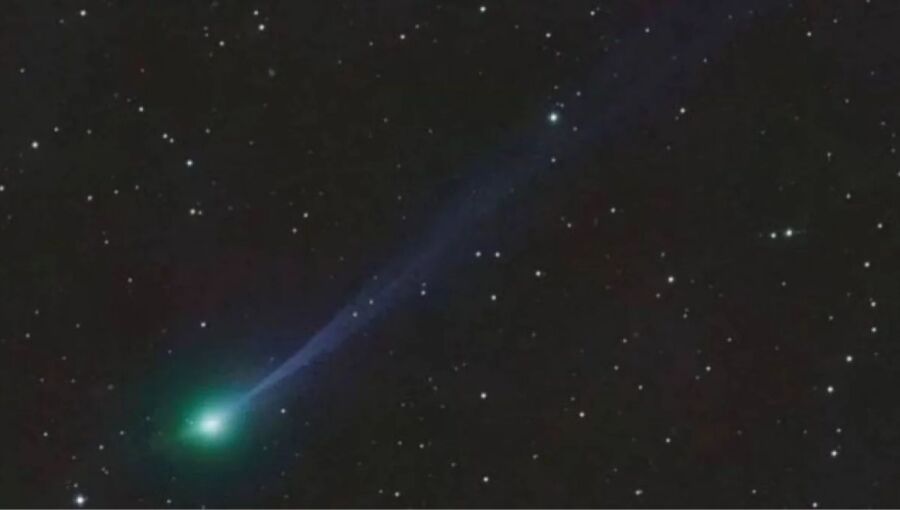
The European Space Agency's XMM-Newton space X-ray telescope has confirmed observations by Japan's Aerospace Exploration Agency showing an X-ray source within interstellar object 3I/ATLAS, Komsomolskaya Pravda reported on December 17.
According to the Russian media, Japanese astronomers photographed the alleged comet 3I/ATLAS in the X-ray spectrum from November 26 to 28, whilst European scientists conducted observations on December 3.
Both independent studies produced similar results, finding an X-ray source within the cloud surrounding the object.
Astronomers from both agencies agreed the radiation extends approximately five angular minutes into space, or 400,000 kilometres according to Japanese measurements.
European scientists described the image as showing "a bright red spot that looks like a fiery beacon" against a dark background in the centre.
The Japanese photograph appears more informative, suggesting the X-ray source has an elongated shape.
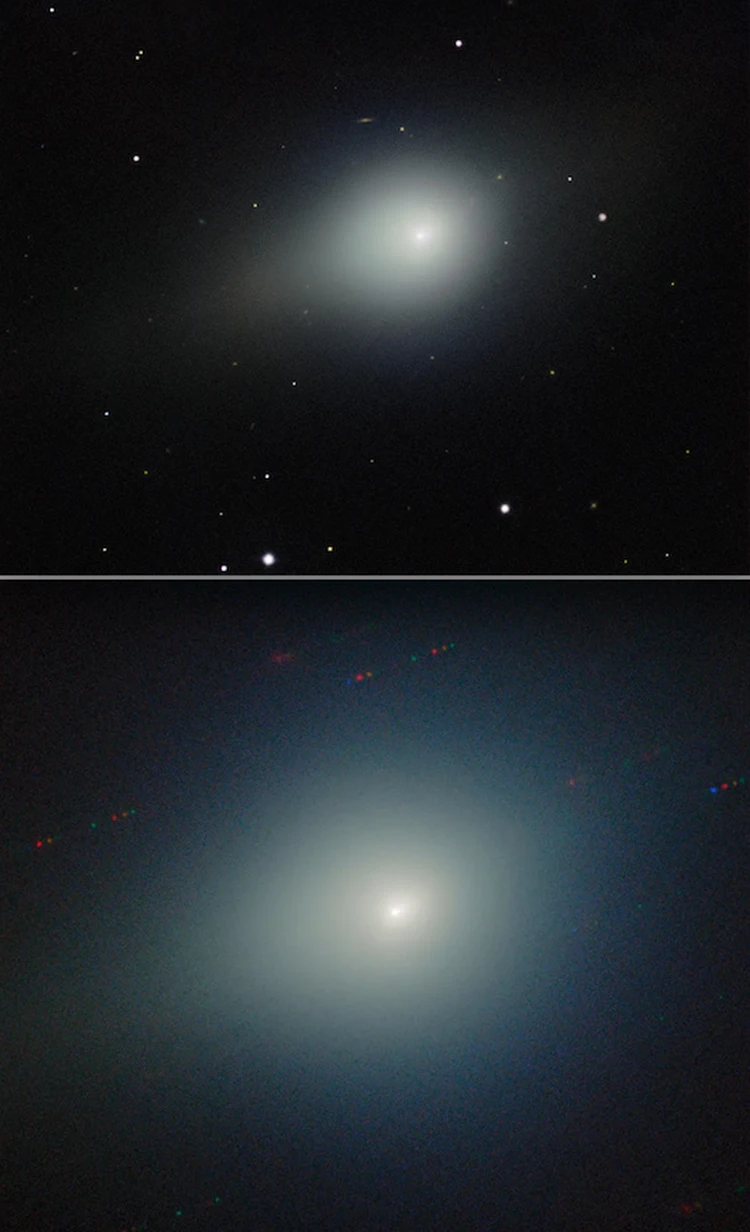
Images of 3I/ATLAS taken using 8.1-metre telescopes in Hawaii with the Gemini Multi-Object Spectrograph also revealed notable changes.
On September 4, the object's emission spectrum was shifted towards red and appeared dim. By November 26, the object had turned green and become much brighter, appearing to increase significantly in size and obscuring all previously visible stars. The anti-tail remains visible in images taken on December 13 from an observatory in Rayong, Thailand.
Russia not convinced
Russian astrophysicist Sergei Zamozdra has dismissed speculation linking the interstellar object 3I/ATLAS is anything other than a passing comet, stating the celestial body follows natural laws of physics, Russian science media reported on December 17.
Zamozdra, associate professor at Chelyabinsk State University's theoretical physics department, said the object's appearance near Earth results from its orbit, whilst its brightness changes stem from interaction with solar wind.
The natural origin of 3I/ATLAS is confirmed by several characteristics, according to the scientist. The object possesses a hyperbolic eccentricity and high velocity, indicating it is not gravitationally bound to the Solar System.
Such characteristics are typical for interstellar objects passing through the system, whilst an artificial object would likely have a more predictable and controlled trajectory.
Observations showed that the celestial body exhibits the typical behaviour of comets and asteroids containing volatile substances that evaporate under solar heating.
An artificial object would likely not exhibit such behaviour, some of the science community says.
Zoya Stepantsova, a member of the International Council of Roerich Organisations, said the Laboratory of Solar Astronomy at the Space Research Institute of the Russian Academy of Sciences noted 3I/ATLAS has generated interest not only in the scientific community but among those inclined to see omens or extraterrestrial spacecraft in celestial phenomena.
"In a couple of months, it will fly further away, and in six months, everyone will forget about it," Zamozdra said.
Earlier in November, Russian scientists from the Space Research Institute had suggested the mysterious non-gravitational acceleration of interstellar object 3I/ATLAS may be linked to solar flares rather than artificial origins, the Laboratory of Solar Astronomy reported on November 2.
The Laboratory of Solar Astronomy said the additional non-gravitational acceleration of 3I/ATLAS may be connected to plasma clouds ejected by the Sun approximately 10 days earlier during the object's approach to perihelion.
According to laboratory data, at least five powerful solar ejections passed along 3I/ATLAS's trajectory from October 23 to 27.
Cosmic crash caught on camera
Hubble Space Telescope captures rare collision in nearby planetary system
image:
This artist’s concept shows the sequence of events leading up to the creation of dust cloud cs2 around the star Fomalhaut. In Panel 1, the star Fomalhaut appears in the top left corner. Two white dots, located in the bottom right corner, represent the two massive objects in orbit around Fomalhaut. In Panel 2, the objects approach each other. Panel 3 shows the violent collision of these two objects. In Panel 4, the resulting dust cloud cs2 becomes visible and starlight pushes the dust grains away from the star.
view moreCredit: NASA, ESA, STScI, Ralf Crawford (STScI)
In an unprecedented celestial event, NASA’s Hubble Space Telescope (HST) captured the dramatic aftermath of colliding space rocks within a nearby planetary system.
When astronomers initially spotted a bright object in the sky, they assumed it was a dust-covered exoplanet, reflecting starlight. But when the “exoplanet” disappeared and a new bright object appeared, the international team of astrophysicists — including Northwestern University’s Jason Wang — realized these were not planets at all. Instead, they were the illuminated remains of a cosmic fender bender.
Two distinct, violent collisions generated two luminous clouds of debris in the same planetary system. The discovery offers a unique real-time glimpse into the mechanisms of planet formation and the composition of materials that coalesce to form new worlds.
The study will be published on Thursday (Dec. 18) in the journal Science.
“Spotting a new light source in the dust belt around a star was surprising. We did not expect that at all,” Wang said. “Our primary hypothesis is that we saw two collisions of planetesimals — small rocky objects, like asteroids — over the last two decades. Collisions of planetesimals are extremely rare events, and this marks the first time we have seen one outside our solar system. Studying planetesimal collisions is important for understanding how planets form. It also can tell us about the structure of asteroids, which is important information for planetary defense programs like the Double Asteroid Redirection Test (DART).”
“This is certainly the first time I’ve ever seen a point of light appear out of nowhere in an exoplanetary system,” said lead author Paul Kalas, an astronomer at the University of California, Berkeley. “It’s absent in all of our previous Hubble images, which means that we just witnessed a violent collision between two massive objects and a huge debris cloud unlike anything in our own solar system today.”
An expert on imaging exoplanets, Wang is an assistant professor of physics and astronomy at Northwestern’s Weinberg College of Arts and Sciences and a member of the Center for Interdisciplinary Exploration and Research in Astrophysics (CIERA).
Site of the smashup
For years, astronomers have puzzled over a bright object called Fomalhaut b, an exoplanet candidate residing just outside the star Fomalhaut. Located a mere 25 light-years from Earth in the Piscis Austrinus constellation, Fomalhaut is more massive than the sun and encircled by an intricate system of dusty debris belts.
“The system has one of the largest dust belts that we know of,” said Wang, who is part of the team that has monitored the system for two decades. “That makes it an easy target to study.”
Since discovering Fomalhaut b in 2008, astronomers have struggled to determine whether it is, indeed, an actual planet or a large expanding cloud of dust. In 2023, researchers used the HST to further examine the strange light source. Surprisingly, it was no longer there. But another bright point of light emerged in a slightly different location within the same system.
“With these observations, our original intention was to monitor Fomalhaut b, which we initially thought was a planet,” Wang said. “We assumed the bright light was Fomalhaut b because that’s the known source in the system. But, upon carefully comparing our new images to past images, we realized it could not be the same source. That was both exciting and caused us to scratch our heads.”
Double trouble
The disappearance of Fomalhaut b (now called Fomalhaut cs1) supports the hypothesis that it was a dissipating dust cloud, likely produced by a collision. The appearance of a second point of light (now called Fomalhaut cs2) further supports the theory that neither are planets, but the dusty remnants of dramatic smashups between planetesimals — the rocky building blocks of planets.
The location and brightness of Fomalhaut cs2 bear striking similarities to the initial observations of Fomalhaut cs1 two decades prior. By imaging the system, the team was able to calculate how frequent such planetesimal collisions occur.
“Theory suggests that there should be one collision every 100,000 years, or longer. Here, in 20 years, we've seen two,” Kalas said. “If you had a movie of the last 3,000 years, and it was sped up so that every year was a fraction of a second, imagine how many flashes you’d see over that time. Fomalhaut’s planetary system would be sparkling with these collisions.”
As unbelievable as it seemed, Wang helped substantiate the extraordinary occurrence. He provided one of four independent analyses to confirm the astronomers detected two transient events in Fomalhaut’s dust belt.
“This is the first time we’re seeing something like this,” Wang said. “So, we had to make sure we can trust our images and that we are measuring the properties of the collision properly. I crunched the numbers to show that the four independent analyses all confidently detect a new source around the vicinity of the star.”
A cautionary tale
While the discovery offers a rare laboratory for watching collisions in action, it also highlights the possibility of misinterpreting the dusty aftermath of such collisions as actual planets reflecting starlight. As next-generation telescopes, including the Giant Magellan Telescope, aim to directly image habitable-zone planets around nearby stars, understanding and distinguishing these transient collision clouds from genuine exoplanets will be critical.
“Fomalhaut cs2 looks exactly like an extrasolar planet reflecting starlight,” Kalas said. “What we learned from studying cs1 is that a large dust cloud can masquerade as a planet for many years. This is a cautionary note for future missions that aim to detect extrasolar planets in reflected light."
Although Fomalhaut cs1 has faded from view, the research team will continue to observe the Fomalhaut system. They plan to track the evolution of Fomalhaut cs2 and potentially uncover more details about the dynamics of collisions in the stellar neighborhood.
For those observations, Wang, Kalas and their collaborators will use the Near-Infrared Camera (NIRCam) instrument on NASA’s James Webb Space Telescope (JWST). NIRCam can provide color information that HST’s spectrograph instrument could not. This color data can reveal the size and composition of the cloud’s dust grains, including whether the cloud contains water and ice.
“Due to Hubble’s age, it can no longer collect reliable data of the system,” Wang said. “Fortunately, we now have the JWST. We have an approved JWST program to follow up this planetesimal collision to understand the new circumstellar source and the nature of its two parent planetesimals that collided.”
The study, “A second violent planetesimal collision in the Fomalhaut system,” was supported by NASA (award number HST-GO-17139).
Journal
Science
Method of Research
Observational study
Article Title
A second planetesimal collision in the Fomalhaut system
Article Publication Date
18-Dec-2025
This artist’s concept shows the violent collision of two massive objects in orbit around the star Fomalhaut.
Credit
NASA, ESA, STScI, Ralf Crawford (STScI)
Astronomers see fireworks from violent collisions around nearby star
While searching for exoplanets, scientists captured the first direct images of colliding objects in a nearby star system.
University of California - Berkeley
image:
This composite Hubble Space Telescope image shows the debris ring and dust clouds cs1 and cs2 around the star Fomalhaut. For comparison, dust cloud cs1, imaged in 2012, is pictured with dust cloud cs2, imaged in 2023. The dashed circles mark the location of these clouds. When dust cloud cs2 suddenly appeared, astronomers quickly realized they had witnessed the violent collision of two massive objects. Previously thought to be a planet, cs1 is now classified as a similar debris cloud. In this image, Fomalhaut itself is masked out to allow the fainter features to be seen. Its location is marked by the white star.
view moreCredit: Image: NASA, ESA, Paul Kalas/UC Berkeley. Image Processing: Joseph DePasquale (STScI)
Young star systems are a place of violent collisions. Rocks, comets, asteroids and larger objects bounce off one another and occasionally coalesce, gradually turning the primordial dust and ice of a stellar nebula into planets and moons. The largest of these collisions, however, are expected to be rare over the hundreds of millions of years it takes to form a planetary system — perhaps one every 100,000 years.
Now, astronomers have seen the aftermath of two powerful collisions within a 20-year period around a nearby star called Fomalhaut. These are either lucky observations or a sign that collisions are more frequent than predicted during planet formation.
The events — the first was detected in 2004 and the second in 2023 — are the first collisions between large objects directly imaged in any solar system outside our own.
"We just witnessed the collision of two planetesimals and the dust cloud that gets spewed out of that violent event, which begins reflecting light from the host star," said Paul Kalas, adjunct professor of astronomy at the University of California, Berkeley, and first author of the report. "We do not directly see the two objects that crashed into each other, but we can spot the aftermath of this enormous impact."
Over tens of thousands of years, he said, the dust around Fomalhaut would be "sparkling with these collisions" — like twinkling holiday lights.
Kalas first started searching for a dusty disk around Fomalhaut in 1993, hoping to see for the first time the debris left over after planet formation. Only 25 light years from Earth, the star is young — about 440 million years old — and a proxy for what our solar system looked like in its formative years. Thanks to NASA's Hubble Space Telescope (HST), he eventually found such a disk around the star and, in 2008, reported finding a bright spot near the disk that was likely a planet, the first to be imaged directly at optical wavelengths. He called it Fomalhaut b, per the naming convention for exoplanets.
That planet discovery has now turned to dust. What he thought was a planet was likely the dust cloud kicked up by the collision of planetesimals.
"This is a new phenomenon, a point source that appears in a planetary system and then over 10 years or more slowly disappears," he said. "It's masquerading as a planet because planets also look like tiny dots orbiting nearby stars."
Based on the brightness of both the 2004 and 2023 events, the colliding objects are at least 60 kilometers (37 miles) across — at least four times larger than the object that collided with Earth 66 million years ago and killed off the dinosaurs. Objects of this size are referred to as planetesimals — objects similar in size to many of the asteroids and comets in our solar system but much smaller than a dwarf planet like Pluto.
"Fomalhaut is much younger than the solar system, but when our solar system was 440 million years old, it was littered with planetesimals crashing into each other," Kalas said. "That's the time period that we are seeing, when small worlds are being cratered with these violent collisions or even being destroyed and reassembled into different objects. It's like looking back in time in a sense, to that violent period of our solar system when it was less than a billion years old."
The 2023 Fomalhaut observations are discussed in a paper to be posted online Dec. 18 in the journal Science.
"The Fomalhaut system is a natural laboratory to probe how planetesimals behave when undergoing collisions, which in turn tells us about what they are made of and how they formed," said Kalas's colleague, Mark Wyatt, a theorist and professor of astronomy at the University of Cambridge in the United Kingdom. "The exciting aspect of this observation is that it allows us to estimate both the size of the colliding bodies and how many of them there are in the disk, information which it is almost impossible to get by any other means."
He estimates that there are about 300 million objects around Fomalhaut the size of the ones that collided to generate these bright clouds of dust. Previous observations of the star detected the presence of carbon monoxide gas, which indicates that these planetesimals are volatile-rich and therefore very similar in composition to the icy comets in our solar system, he said.
Dust clouds masquerading as exoplanets
Fomalhaut, located within the southern constellation Piscis Austrinus, is 16 times more luminous than our sun and one of the brightest stars in the sky. After Kalas began observing it with HST in 2004, he discovered a large belt of dusty debris at a distance of 133 astronomical units (AU) from the star, more than three times the distance from the star as the Kuiper Belt is from the sun in our solar system. An AU is the average distance between the Earth and the sun, or 93 million miles.
To Kalas, the belt's sharp inner edge suggested that it had been sculpted by planets. After a second observation in 2006, he concluded that a bright spot in the outer belt visible in both the 2004 and 2006 images was, in fact, a planet. He acknowledged at the time that it could be a very bright dust cloud caused by a collision in the disk, but the likelihood of that seemed very low.
Kalas was able to schedule four follow-up HST observations of Fomalhaut, in 2010, 2012, 2013 and 2014. In the last, however, Fomalhaut b was nowhere to be seen. Nine years later, after three failed attempts to image Fomalhaut with HST, he obtained a new image that revealed another bright spot not far from the first, which is now referred to as Fomalhaut cs1, for circumstellar source 1. Based on its location, however, the new spot, dubbed Fomalhaut cs2, could not be a reappearance of Fomalhaut cs1. Because of the nine-year hiatus between the 2014 and 2023, it's unclear when Fomalhaut cs2 appeared.
In the new paper, Kalas and an international team of astronomers analyzed the 2023 image of Fomalhaut and a subsequent, though poor image obtained in 2024, and concluded that it could only be light reflected from a dust cloud produced by the collision of two planetesimals.
Kalas noted that at first, Fomalhaut cs1 moved like an exoplanet, but by 2013 its path had curved away from the star. This type of motion would be possible for very small particles being pushed outward by the radiation pressure of starlight. The appearance of cs2 supports the idea that cs1 was in fact a dust cloud.
Kalas compares these events to the dust cloud generated in 2022 when NASA's DART (Double Asteroid Redirection Test) mission slammed into the moonlet Dimorphos, which was orbiting the asteroid Didemos. The cloud around Fomalhaut is about a billion times larger, the team estimated.
Kalas has been awarded time over the next three years to use the James Webb Space Telescope's Near-Infrared Camera (NIRCam) and the HST to observe Fomalhaut and track the evolution of the cloud to see if it expands in size and determine its orbit. It is already 30% brighter than Fomalhaut cs1. Additional observations in August 2025 confirmed that cs2 is still visible.
In anticipation of future space missions to directly image exoplanets, Kalas cautioned astronomers to be on the lookout for dust clouds masquerading as planets.
"These collisions that produce dust clouds happen in every planetary system," he said. "Once we start probing stars with sensitive future telescopes such as the Habitable Worlds Observatory, which aims to directly image an Earth-like exoplanet, we have to be cautious because these faint points of light orbiting a star may not be planets."
Other co-authors of the paper are UC Berkeley research astronomer Thomas Esposito; former UC Berkeley graduate students Jason Wang, now at Northwestern University in Illinois, and Michael Fitzgerald, now at UCLA; former UC Berkeley postdoctoral fellow Robert De Rosa, now at the European Southern Observatory in Chile; Maxwell Millar-Blanchaer of UC Santa Barbara; Bin Ren of Xiamen University in China; Maximilian Sommer of the University of Cambridge; and Grant Kennedy of the University of Warwick in the UK. The work was supported by NASA (NAS5-26555, GO-HST-17139).
Journal
Science
Article Title
A second planetesimal collision in the Fomalhaut system
Article Publication Date
18-Dec-2025
Artistic representation of the collision of two planetesimals in the circumstellar disc of the star Fomalhaut.
Credit
Thomas Müller (MPIA)
Hubble captured the violent collision of two massive objects around the star Fomalhaut. This extraordinary event is unlike anything in our own present-day solar system. The video shows the sequence of events leading up to the creation of dust cloud cs2 around the star Fomalhaut. In the opening frames, Fomalhaut appears in the top left corner. Two white dots, located in the bottom right corner, represent the two massive objects in orbit around Fomalhaut. These objects approach each other and collide, resulting in a huge debris cloud that initially resembles an exoplanet as seen in reflected light. Years later, starlight is able to push the dust cloud outward from the star.
Credit
Animation: NASA, ESA, STScI, Ralf Crawford (STScI)
NASA’s VIPER mission gets vital help from Sandia
image:
Karen Rogers, left, Orlando Abeyta and Leticia Mercado discuss the testing of the VIPER rover at the Superfuge, while Chad Heitman, right, works on sensors for the test at Sandia National Laboratories.
view moreCredit: (Photo by Craig Fritz)
ALBUQUERQUE, N.M. — NASA’s VIPER rover, designed to map water on the moon, has reached another major milestone with help from Sandia National Laboratories and its one-of-a-kind testing capabilities.
“We’ve built a rover that is designed to go and prospect for water on the moon, but the vehicle must be certified for mission,” said Dave Petri, NASA VIPER system integration and test lead. “We need to be sure its structure is properly designed and built to survive the mission, including the launch environment.”
Sandia’s Superfuge
That’s where Sandia’s Large Centrifuge, or Superfuge, came in. A facility like none other in the world, the 29-foot underground centrifuge can subject test items to inertial forces up to 300 Gs — 300 times the force of the Earth’s gravity — and can accommodate a 16,000-pound payload capacity while integrating vibration, spin, thermal and shock environments simultaneously, mimicking flight conditions from launch to reentry.
For NASA, the challenge with testing the VIPER rover was its size and design. The VIPER team considered multiple test methods and facilities, including a drop tower or rocket sled, but Sandia’s test abilities stood out.
“This is a 1,000-pound article and it has to be oriented in a number of ways throughout the testing process,” said Ben Quasius, VIPER lead stress analyst. “In many cases we would do a static qualification test where we use pistons to push on certain locations of the article to test flex of the body, but there are sensitive things in the way. You have solar panels in prime locations and a drill in the middle that can’t be compromised during flight.”
NASA’s team spent three weeks testing the rover at Sandia’s centrifuge facility.
“There is not another machine in the world that has the capabilities we do here,” said Orlando Abeyta, Sandia operations engineer at the Superfuge. “We have tested weapons systems, components of weapons systems, aerospace tanks, and even the Jupiter fuel tank for NASA.”
What a team
Abeyta said he takes pride in the work they do. “That is what I like about working here. Even though the centrifuge is just turning, each test is different. That is what keeps me interested in being here.”
The Superfuge team spent months preparing for the NASA tests. Their job goes far beyond running the centrifuge. They engineer each test, determine how to load the article, connect all the required instrumentation and what angles to test at. They also have to troubleshoot when things don’t go as planned. On the VIPER rover, there were 48 different points of data to be collected and analyzed.
“You can model anything you want, but until you put it on that arm you don’t know what you are going to get,” Abeyta said. “As a centrifuge operator, anyone can push a button, but you need to know what is happening when you push that button — if it doesn’t work, then what? That’s what I’ve learned to do here.”
Test lead Leticia Mercado, who holds a master’s degree mechanical engineering with a concentration in space systems, called the rover testing a dream come true.
A native of Farmington, New Mexico, she grew up planning to leave her home state but after an internship at Sandia, she found her passion.
“I worked at the Drop Towers and the Mechanical Shock Complex and then this became my home facility,” Mercado said. “Personally, I am just excited to be part of this test and to lead it. I have such a unique job.”
The VIPER Mission
The Sandia team is eager to see the VIPER rover head to the moon, but will have to wait until late 2027.
NASA announced in September that it had chosen Blue Origin of Kent, Washington to deliver the rover to the moon’s South Pole using a Blue Moon MK1 lander, which is in production.
Once there, the rover will be charged with making a water concentration map of the moon.
“We know there is water on the moon, but we don’t know the concentrations of water,” Petri said. “It’s like prospecting for gold here on Earth. You need enough concentration for it to be worthwhile to mine. It’s the same with the moon.”
The rover is armed with three scientific instruments: a mass spectrometer, a near-infrared spectrometer and a neutron spectrometer. Those instruments can detect water volatiles, particles that evaporate, or boil off, when heated.
The rover also has a drill capable of reaching one meter beneath the surface to pull up samples of any existing water remnants.
The goal is for the rover to explore the moon’s South Pole, where permanently shadowed craters don’t experience boil off and have a higher probability of containing large concentrations of water.
The science could be groundbreaking, and Sandia’s team said they are proud to have played a role in it, just as they are of every test they’ve played a role in.
“I got a compliment from a manager for the VIPER testing saying they had never had an experience like they did here,” Abeyta said. “If something happens, we have an answer for it. We know how this equipment works. There are so many great people here, everybody helps each other and that’s what makes this place work so well. On Sunday nights I am excited to come to work on Monday to see what I get to do next.”
Toby Gomez, left, and Jason King work on sensor connections while the VIPER rover is suspended in a cage at the end of the Superfuge arm at Sandia National Laboratories.
Credit
Dave Lienemann/Sandia National Laboratories
Freddie Martinez figures out electrical connections for testing of the VIPER rover at the Superfuge at Sandia National Laboratories.
Credit
Dave Lienemann/Sandia National Laboratories
Orlando Abeyta works on wiring prior to placing a cage around and attaching the VIPER rover to the arm of the Superfuge at Sandia National Laboratories.
Credit
Craig Fritz/Sandia National Laboratories
GoPro video shows NASA Viper Rover on Sandia centrifuge during testing.
Credit
Sandia National Laboratories
Russia Falls Further Behind in the Space Race as Kazakhstan Turns to China
- Kazakhstan’s Dier-5 satellite launch with China highlights a pragmatic pivot toward faster and more reliable space partners.
- Persistent delays in Russia’s Soyuz-5 rocket threaten the long-standing Baiterek program and Moscow’s regional influence.
- Russia’s global launch market share has collapsed to under 5 percent, reflecting structural decline amid U.S. and Chinese dominance.
The bell may be tolling for a long-standing Russian-Kazakh space program following the launch of a “nanosatellite” jointly developed by Kazakhstan and China and launched into orbit by a Chinese rocket.
The launch of the Dier-5 spacecraft on December 13 placed the satellite into an orbit roughly 330 miles above Earth, according to a Kazakh government statement. It took a team of specialists from Kazakhstan’s Al-Farabi University and Northeastern Polytechnical University in Xi’an, China, just a little over one year to develop the satellite, which will carry out scientific experiments, the statement added.
Kazakh officials touted the satellite as cost-effective and reliable for gathering and transmitting data.
“This collaborative work opens up new opportunities for space research, training qualified specialists, and developing joint satellites,” the government statement noted. “In addition, the project provides the possibility of remote sensing of Earth using a microsatellite.”
Not only did the launch mark a milestone for Kazakhstan’s space program, it also gave a boost to Chinese efforts to capture a larger share of the commercial satellite launch market. The Dier 5 craft has a payload capacity estimated at about 660 lbs.
Some observers see the Kazakh-Chinese initiative as a tacit vote of no-confidence in a more than two-decade-long Kazakh-Russian venture, dubbed Baiterek, to develop Kazakhstan’s space program. Baiterek involves the adaptation of Kazakhstan’s Baikonur Cosmodrome to accommodate a new low-cost rocket design, the Soyuz-5.
The rocket, designed by Roscosmos, the Russian state space agency, has faced lengthy production delays. Originally intended to compete with SpaceX Falcon 9 rocket in the commercial satellite launch market, some experts now wonder whether the Soyuz-5 will be effectively obsolete before one ever gets off the ground.
In October, Russian Foreign Minister Sergei Lavrov assured that the Soyuz-5 was in its “final phase” of development. A month later, during a visit by Kazakh President Kassym-Jomart Tokayev to Moscow, Russian officials indicated that a Soyuz-5 would be ready to launch before the end of year. With just days left in 2025, there is no sign of a launch taking place.
As part of the Tokayev visit, Kazakh and Russian officials signed a protocol intended to infuse fresh momentum into the Baiterek program. But the Chinese launch makes it clear that Astana is hedging its bets.
Russia’s share of the launch market has steadily declined since the start of the 21st century. In 2005, Russia led the world with 26 orbital launches, commanding a nearly 50 percent share of the global total that year. A decade later, the overall number of launches increased dramatically around the world, while the number of Russian launches remained comparatively stagnant, resulting in a drop of its share of the market to 33 percent.
This year, Russia’s share has cratered, comprising under 5 percent of 312 total launches. The United States now enjoys a 57 percent share of the market.
By Eurasianet
E.L.O.N. MUSK'S TECK BRO
US Senate confirms Jared Isaacman as NASA chief amid budget cuts and moon race
The US Senate has confirmed billionaire private astronaut Jared Isaacman as NASA administrator, installing a strong advocate of Mars missions to lead the space agency as it faces deep budget cuts and intensifying competition with China to return humans to the Moon.
Issued on: 18/12/2025
By: FRANCE 24

The US Senate on Wednesday confirmed billionaire private astronaut Jared Isaacman to become President Donald Trump’s NASA administrator, making an advocate of Mars missions and a former associate of SpaceX chief executive Elon Musk the space agency’s 15th leader.
The vote on Isaacman, who Trump removed and then renamed as NASA administrator nominee this year, passed 67–30, two weeks after he told senators in his second hearing that NASA must pick up the pace in beating China back to the Moon this decade.
Isaacman will lead an agency of 14,000 employees as it invests billions of dollars into its most ambitious space exploration endeavour yet: returning humans to the Moon to seed a long-term presence on the surface before eventually sending astronauts to Mars.
NASA workforce cut in efficiency push
The White House, in its government efficiency push led by Musk, slashed NASA’s workforce by 20 percent and has sought to cut the agency’s 2026 budget by roughly 25 percent from its usual $25 billion, imperilling dozens of space science programmes that scientists and some officials regard as priorities.
Isaacman envisions a revamped focus on sending missions to Mars on top of the Artemis Moon effort, as well as a greater dependence on private companies such as SpaceX to save taxpayer money and stimulate private-sector competition.
Of the 67 votes in Isaacman’s favour, 16 were from Democrats, joining 51 from Republicans. All 30 votes against his confirmation were from Democrats.
Maria Cantwell, the ranking member of the Senate Commerce Committee that oversees NASA, has criticised the Trump administration’s efforts to cut NASA’s science unit. She supported Isaacman’s confirmation on Wednesday.
“During his nomination process, Mr Isaacman emphasised the importance of developing a pipeline of future scientists, engineers, researchers and astronauts to support the science and technology development and align with NASA’s objectives. I strongly agree,” Cantwell said.
Some Democratic senators said during Isaacman’s hearing on December 3 that they were concerned about his closeness to Musk, whose company holds about $15 billion in NASA contracts and could benefit from certain policies Isaacman has advocated.
Musk advocated for Isaacman’s nomination when Trump was elected in 2024. Musk had sought to realign the US space programme with a greater focus on Mars during his stint as a close adviser to Trump.
Senate Republicans and some Democrats, including Cantwell, have also stressed urgency in NASA’s Moon race with China, which is aiming to send its astronauts to the lunar surface by 2030. NASA faces a shaky target of 2028 using its Space Launch System rocket and SpaceX’s giant Starship rocket, under development, as the lander.
Acting NASA chief Sean Duffy, who also leads the US Transportation Department, congratulated Isaacman on X, wishing him “success as he begins his tenure and leads NASA as we go back to the Moon in 2028 and beat China”.
(FRANCE 24 with Reuters)

Possible "superkilonova" exploded not once but twice
Double explosion may have produced gravitational waves and light
California Institute of Technology
image:
This artist's concepts shows a hypothesized event known as a superkilonova. A massive star explodes in a supernova (left), which generates elements like carbon and iron. In the aftermath, two neutron stars are born (middle), at least one of which is believed to be less massive than our Sun. The neutron stars spiral together, sending gravitational waves rippling through the cosmos, before merging in a dramatic kilonova (right). Kilonovae seed the universe with the heaviest elements, such as gold at platinum, which glow with red light.
view more
Credit: Caltech/K. Miller and R. Hurt (IPAC)
When the most massive stars reach the ends of their lives, they blow up in spectacular supernova explosions, which seed the universe with heavy elements such as carbon and iron. Another type of explosion—the kilonova—occurs when a pair of dense dead stars, called neutron stars, smash together, forging even heavier elements such as gold and uranium. Such heavy elements are among the basic building blocks of stars and planets.
So far, only one kilonova has been unambiguously confirmed to date, a historic event known as GW170817, which took place in 2017. In that case, two neutron stars smashed together, sending ripples in space-time, known as gravitational waves, as well as light waves across the cosmos. The cosmic blast was detected in gravitational waves by the National Science Foundation's Laser Interferometer Gravitational-wave Observatory (LIGO) and its European partner, the Virgo gravitational-wave detector, and in light waves by dozens of ground-based and space telescopes around the world.
Now, astronomers are reporting evidence for a possible second kilonova event, but the case is not closed. In fact, this situation is much more complex because the candidate kilonova, named AT2025ulz, is thought to have stemmed from a supernova blast that went off hours before, ultimately obscuring astronomers' view.
"At first, for about three days, the eruption looked just like the first kilonova in 2017," says Caltech's Mansi Kasliwal (PhD '11), professor of astronomy and director of Caltech's Palomar Observatory near San Diego. "Everybody was intensely trying to observe and analyze it, but then it started to look more like a supernova, and some astronomers lost interest. Not us."
Kasliwal is lead author of a new study describing the findings in The Astrophysical Journal Letters. In the report, she and her colleagues describe evidence that this oddball event may be a first-of-its-kind superkilonova, or a kilonova spurred by a supernova. Such an event has been hypothesized but never seen.
Evidence for the possible rarity first came on August 18, 2025, when the twin detectors of LIGO in Louisiana and Washington, as well as Virgo in Italy, picked up a new gravitational-wave signal. Within minutes, the team that operates the gravitational-wave detectors (an international collaboration that also includes the organization that runs the KAGRA detector in Japan) sent an alert to the astronomical community letting them know that gravitational waves had been registered from what appeared to be a merger between two objects, with at least one of them being unusually tiny. The alert included a rough map of the source's location.
"While not as highly confident as some of our alerts, this quickly got our attention as a potentially very intriguing event candidate," says David Reitze, the executive director of LIGO and a research professor at Caltech. "We are continuing to analyze the data, and it's clear that at least one of the colliding objects is less massive than a typical neutron star."
A few hours later, the Zwicky Transient Facility (ZTF), a survey camera at Palomar Observatory, was the first to pinpoint a rapidly fading red object 1.3 billion light-years away, which is thought to have originated in the same location as the source of gravitational waves. The event, initially called ZTF 25abjmnps, was later renamed AT2025ulz by the International Astronomical Union Transient Name Server.
About a dozen other telescopes set their sights on the target to learn more, including the W. M. Keck Observatory in Hawaiʻi, the Fraunhofer telescope at the Wendelstein Observatory in Germany, and a suite of telescopes around the world that were previously part of the GROWTH (Global Relay of Observatories Watching Transients Happen) program, led by Kasliwal.
The observations confirmed that the eruption of light had faded fast and glowed at red wavelengths—just as GW170817 had done eight years earlier. In the case of the GW170817 kilonova, the red colors came from heavy elements like gold; these atoms have more electron energy levels than lighter elements, so they block blue light but let red light pass through.
Then, days after the blast, AT2025ulz started to brighten again, turn blue, and show hydrogen in its spectra—all signs of a supernova not a kilonova (specifically a "stripped-envelope core-collapse" supernova). Supernovae from distant galaxies are generally not expected to generate enough gravitational waves to be detectable by LIGO and Virgo, whereas kilonovae are. This led some astronomers to conclude that AT2025ulz was triggered by a typical ho-hum supernova and not, in fact, related to the gravitational-wave signal.
What Might Be Going On?
Kasliwal says that several clues tipped her off that something unusual had taken place. Though AT2025ulz did not resemble the classic kilonova GW170817, it also did not look like an average supernova. Additionally, the LIGO–Virgo gravitational-wave data had revealed that at least one of the neutron stars in the merger was less massive than our Sun, a hint that one or two small neutron stars might have merged to produce a kilonova.
Neutron stars are the leftover remains of massive stars that explode as supernovae. They are thought to be around the size of San Francisco (about 25 kilometers across) with masses that range from 1.2 to about three times that of our Sun. Some theorists have proposed ways in which neutron stars might be even smaller, with masses less than the Sun's, but none have been observed so far. The theorists invoke two scenarios to explain how a neutron could be that small. In one, a rapidly spinning massive star goes supernova, then splits into two tiny, sub-solar neutron stars in a process called fission.
In the second scenario, called fragmentation, the rapidly spinning star again goes supernova, but, this time, a disk of material forms around the collapsing star. The lumpy disk material coalesces into a tiny neutron in a manner similar to how planets form.
With LIGO and Virgo having detected at least one sub-solar neutron star, it is possible, according to theories proposed by co-author Brian Metzger of Columbia University, that two newly formed neutron stars could have spiraled together and crashed, erupting as a kilonova that sent gravitational waves rippling through the cosmos. As the kilonova churned out heavy metals, it would have initially glowed in red light as ZTF and other telescopes observed. The expanding debris from the initial supernova blast would have obscured the astronomers’ view of the kilonova.
In other words, a supernova may have birthed twin baby neutron stars that then merged to make a kilonova.
"The only way theorists have come up with to birth sub-solar neutron stars is during the collapse of a very rapidly spinning star," Metzger says. "If these 'forbidden' stars pair up and merge by emitting gravitational waves, it is possible that such an event would be accompanied by a supernova rather than be seen as a bare kilonova."
But while this theory is tantalizing and interesting to consider, the research team stresses that there is not enough evidence to make firm claims.
The only way to test the superkilonovae theory is to find more. "Future kilonovae events may not look like GW170817 and may be mistaken for supernovae," Kasliwal says. "We can look for new possibilities in data like this from ZTF as well as the Vera Rubin Observatory, and upcoming projects such as NASA's Nancy Roman Space Telescope, NASA's UVEX [led by Caltech's Fiona Harrison], Caltech's Deep Synoptic Array-2000, and Caltech’s Cryoscope in the Antarctic. We do not know with certainty that we found a superkilonova, but the event nevertheless is eye opening."
The paper, titled "ZTF25abjmnps (AT2025ulz) and S250818k: A Candidate Superkilonova from a Sub-threshold Sub-Solar Gravitational Wave Trigger," was funded by the Gordon and Betty Moore Foundation, the Knut and Alice Wallenberg Foundation, the National Science Foundation (NSF), the Simons Foundation, the US Department of Energy, a McWilliams Postdoctoral Fellowship, and the University of Ferrara in Italy. Other Caltech authors include Tomás Ahumada (now at NOIRLab, Chile), Viraj Karambelkar (now at Columbia University), Christoffer Fremling, Sam Rose, Kaustav Das, Tracy Chen, Nicholas Earley, Matthew Graham, George Helou, and Ashish Mahabal.
Caltech's ZTF is funded by the NSF and an international collaboration of partners. Additional support comes from the Heising-Simons Foundation and from Caltech. ZTF data are processed and archived by IPAC, an astronomy center at Caltech.
Journal
The Astrophysical Journal Letters
NASA’s Webb telescope finds bizarre atmosphere on a lemon-shaped exoplanet
University of Chicago
image:
This artist’s concept shows what the exoplanet called PSR J2322-2650b (left) may look like as it orbits a rapidly spinning neutron star called a pulsar (right). Gravitational forces from the much heavier pulsar are pulling the Jupiter-mass world into a bizarre lemon shape.
view moreCredit: NASA, ESA, CSA, Ralf Crawford (STScI)
Scientists using NASA’s James Webb Space Telescope have observed an entirely new type of exoplanet whose atmospheric composition challenges our understanding of how this type of planet forms.
This bizarre, lemon-shaped body, possibly containing diamonds at its core, blurs the line between planets and stars.
Officially named PSR J2322-2650b, this object has an exotic helium-and-carbon-dominated atmosphere unlike any ever seen before. It has a mass about the same as Jupiter, but soot clouds float through the air—and deep within the planet, these carbon clouds can condense and form diamonds. It orbits a rapidly spinning neutron star.
How the planet came to be is a mystery.
“The planet orbits a star that's completely bizarre — the mass of the Sun, but the size of a city,” explained the University of Chicago’s Michael Zhang, the principal investigator on this study, which is accepted for publication in The Astrophysical Journal Letters. “This is a new type of planet atmosphere that nobody has ever seen before.”
“This was an absolute surprise,” said team member Peter Gao of the Carnegie Earth and Planets Laboratory in Washington, D.C. “I remember after we got the data down, our collective reaction was ‘What the heck is this?’”
A bizarre pair
The new planet, PSR J2322-2650b, is orbiting a rapidly spinning neutron star, also known as a pulsar.
This star emits beams of electromagnetic radiation from its magnetic poles at regular intervals just milliseconds apart. But the star is emitting mostly gamma rays and other high-energy particles, which are invisible to the Webb telescope’s infrared vision.
This means scientists can study the planet in intricate detail across its whole orbit—normally an extremely difficult task, because stars usually far outshine their planets.
“This system is unique because we are able to view the planet illuminated by its host star, but not see the host star at all,” explained Maya Beleznay, a graduate student at Stanford University who worked on modelling the shape of the planet and the geometry of its orbit. “So we get a really pristine spectrum. And we can better study this system in more detail than normal exoplanets.”
Taking stock of the planet, the team was surprised.
“Instead of finding the normal molecules we expect to see on an exoplanet—like water, methane and carbon dioxide—we saw molecular carbon, specifically C3 and C2,” said Zhang.
At the core of the planet, subjected to intense pressure, it’s possible this carbon could be squeezed into diamonds.
But to the scientists, the larger question is how such a planet could have formed at all.
“It's very hard to imagine how you get this extremely carbon-enriched composition,” said Zhang. “It seems to rule out every known formation mechanism.”
‘A puzzle to go after’
PSR J2322-2650b is extraordinary close to its star, just 1 million miles away. In contrast, the Earth’s distance from the Sun is about 100 million miles.
Because of its extremely tight orbit, the exoplanet’s entire year—the time it takes to go around its star—is just 7.8 hours.
Applying models to the planet’s brightness variations over its orbit, the team finds that immense gravitational forces from the much heavier pulsar are pulling the Jupiter-mass planet into a lemon shape.
Together, the star and exoplanet may be considered a “black widow” system. Black widows are a rare type of system where a rapidly spinning pulsar is paired with a small, low-mass companion. In the past, material from the companion would have streamed onto the pulsar, causing it to spin faster over time, which powers a strong wind. That wind and radiation then bombard and evaporate the smaller and less massive star.
Like the spider for which it is named, the pulsar slowly consumes its unfortunate partner.
But in this case, the tiny companion is officially considered an exoplanet by the International Astronomical Union, not a star.
“Did this thing form like a normal planet? No, because the composition is entirely different,” said Zhang. “Did it form by stripping the outside of a star, like ‘normal’ black widow systems are formed? Probably not, because nuclear physics does not make pure carbon.”
Team member Roger Romani, of Stanford and the Kavli Institute for Particle Astrophysics and Cosmology Institute, is one of the world’s preeminent experts on black widow systems. He proposes one evocative phenomenon that could occur in the unique atmosphere.
“As the companion cools down, the mixture of carbon and oxygen in the interior starts to crystallize,” Romani theorized. “Pure carbon crystals float to the top and get mixed into the helium, and that's what we see. But then something has to happen to keep the oxygen and nitrogen away. And that's where there's controversy.”
“But it's nice to not know everything,” said Romani. “I'm looking forward to learning more about the weirdness of this atmosphere. It's great to have a puzzle to go after.”
With its infrared vision and exquisite sensitivity, this is a discovery only the Webb telescope could make. Its perch a million miles from Earth and its huge sunshield keeps the instruments very cold, which is necessary for conducting these observations.
“On the Earth, lots of things are hot, and that heat really interferes with the observations because it's another source of photons that you have to deal with,” explained Zhang. “It's absolutely not feasible from the ground.”
Other UChicago scientists on the study included Prof. Jacob Bean, graduate student Brandon Park Coy and Rafael Luque, who was then a postdoctoral researcher at UChicago and is now with the Instituto de Astrofísica de Andalucía in Spain.
Citation: “A carbon-rich atmosphere on a windy pulsar planet.” Zhang et al, The Astrophysical Journal Letters, accepted for publication.
Funding: NASA, Heising-Simons Foundation.
Exoplanet PSR J2322-2650b Orbiting a Pulsar [VIDEO]
This animation shows an exotic exoplanet orbiting a distant pulsar, or rapidly rotating neutron star with radio pulses. The planet, which orbits about 1 million miles away from the pulsar, is stretched into a lemon shape by the pulsar’s strong gravitational tides.
Credit
NASA, ESA, CSA, Ralf Crawford (STScI)
Journal
The Astrophysical Journal Letters
Article Title
A Carbon-rich Atmosphere on a Windy Pulsar Planet
Article Publication Date
16-Dec-2025
Groundbreaking ceremony marks the beginning of CTAO-South Array construction in Chile
Business Announcementimage:
A group of ESO and CTAO representatives, as well as Chilean authorities and regional representatives pose for a group photo near a monument at the CTAO-South site, where a symbolic time capsule was buried during the facility’s groundbreaking ceremony. From Left: Thomas Klein, Director of the ESO La Silla Paranal Observatory; Ricardo Díaz, Governor of the Antofagasta Region; Alejandra Pizarro, Director of the National Agency for Research and Development (ANID); Stuart McMuldroch, CTAO Director General; Xavier Barcons, ESO Director General; Valeska Molina, Regional Secretary of the Ministry of Science, Technology and Innovation for Antofagasta Region; Francisco Colomer, Chair of the CTAO ERIC Council; and Volker Heinz, CTAO Construction Programme Manager
view moreCredit: ESO/CHEPOX
Paranal, Chile, 17 December 2025 — Representatives from the Cherenkov Telescope Array Observatory (CTAO), the European Southern Observatory (ESO), and governmental authorities gathered today to celebrate the official groundbreaking of the CTAO’s southern site, CTAO-South. After years of successful site preparations, the event marked the beginning of construction on the telescope foundations, paving the way for the first telescopes to be completed by the end of 2026. The CTAO will be the world’s largest and most powerful observatory for gamma-ray astronomy, and the first to be built in the Southern Hemisphere. With it, Chile will open a new observational window, exploring the Universe at the highest energies.
The ceremony began at ESO’s Paranal Observatory with opening remarks from Thomas Klein, ESO Director of La Silla Paranal Observatory, followed by speeches made by Stuart McMuldroch, CTAO Director General; Xavier Barcons, ESO Director General; Francisco Colomer, Chair of the CTAO ERIC Council, as well as political authorities, including Ricardo Díaz, Governor of the Antofagasta Region; Valeska Molina, Regional Secretary of the Ministry of Science, Technology and Innovation for Antofagasta Region; and Alejandra Pizarro, Director of the National Agency for Research and Development (ANID). The event also brought together international partners from the Chilean scientific community and industry, along with CTAO and ESO staff that joined the celebration of this major milestone in the project’s development.
During his remarks, McMuldroch expressed his excitement for this moment, a culmination of years of dedication and international collaboration. “Thanks to the commitment of our partners from around the world and the support of ESO as our hosts here in Chile, we are now turning a vision into reality as construction begins on what will be the most advanced gamma-ray observatory on Earth.”
“We are happy to welcome this innovative facility to ESO’s family. It’s our pleasure to see the start of construction of the southern site of this powerful observatory here at Paranal in Chile’s Atacama Desert — a place with the most pristine skies on Earth. This groundbreaking is a huge milestone for both CTAO and ESO, but also for Chile as this new facility will strengthen the country’s position as a global hub for astronomy,” said Barcons in his speech.
Following the ceremony, participants moved to the CTAO-South site, located 10 kilometres southeast of Paranal in the Atacama Desert, for a symbolic onsite celebration. There, Volker Heinz, CTAO Construction Programme Manager, welcomed the attendees to the site and then representatives buried a time capsule containing items from Chile and partner countries around the world, symbolising how the work undertaken in Chile will contribute to scientific progress on a global scale. The capsule also included scientific items representing the ultimate goal of the telescopes now under construction: to advance our understanding of the Universe and expand human knowledge. A commemorative plaque, set upon nearby stones, now marks the location of the buried capsule, beside the future telescope area.
The CTAO, ESO, and Chile signed agreements to have the CTAO southern array hosted at ESO's Paranal Observatory in 2018. “Paranal is a unique place in the world to study the Universe,” highlighted Heinz during his welcoming speech at CTAO-South, explaining that Paranal is already home to ESO’s VLT — a key instrument in the discoveries recognised by the 2020 Nobel Prize in Physics — and the ESO’s Extremely Large Telescope that can be seen under construction in the distance from CTAO-South. "The Atacama Desert now welcomes another world-leading facility, and, in just one year, we expect to have here CTAO telescopes providing the first-ever observations of the gamma-ray sky from Chile.”
To cover its broad energy range — from 20 GeV to 300 TeV, billions of times more energetic than visible light — the CTAO will employ three types of telescopes: the Large-Sized Telescopes (LSTs), the Medium-Sized Telescopes (MSTs), and the Small-Sized Telescopes (SSTs). The current configuration for CTAO-South includes more than 50 telescopes. To give the CTAO a complete view of the night sky, it will have two arrays of telescopes located in both the northern and southern hemispheres. The CTAO-South site in Chile, in tandem with the CTAO-North site in La Palma, Spain, will revolutionize our view of the high-energy Universe.
With its unprecedented sensitivity and precision, the CTAO will help address some of the most fundamental questions in astrophysics. Its research will focus on three key areas: understanding the origin and role of relativistic cosmic particles; probing extreme environments such as black holes and neutron stars; and exploring the frontiers of physics by searching for dark matter and testing the limits of Einstein’s theory of relativity. In addition, the CTAO will play a key role in multi-wavelength and multi-messenger astronomy in the coming decades, providing essential gamma-ray data to complement observations across the entire electromagnetic spectrum and from other cosmic messengers such as neutrinos and gravitational waves.
The CTAO is also a Big Data project, expected to generate hundreds of petabytes of data each year (around 12 PB after compression). Committed to the principles of Open Science, it will be the first gamma-ray observatory to operate as an open, proposal-driven facility, providing public access to its high-level scientific data and software products. Ten per cent of the observing time at CTAO-South is reserved for Chilean scientists, guaranteeing that Chile, as host country, gains direct scientific returns and strengthens its own research capacities through the Observatory’s presence.
As construction begins in the Atacama Desert, today’s ceremony symbolises not only a technological milestone but also a shared commitment from Chile and the international community to push the boundaries of what we know about the most energetic and mysterious corners of the Cosmos.
About the CTAO
The CTAO ERIC (also known as CTAO Central Organisation) is in charge of the construction and operation of the CTAO. Thus, it is made up of the groups and people dedicated to the management and administration of the Observatory’s development and the overall project, science, computing and systems engineering activities. The high-level organisational structure is broken into five main groups: Director’s Office, On-Site Construction, Project Office, Project Science Office, and Administration Office. The Central Organisation is responsible for managing the CTAO’s four sites: the Headquarters hosted by the Istituto Nazionale di Astrofisica (INAF) in Bologna (Italy), the Science Data Management Centre hosted by the Deutsches Elektronen-Synchrotron DESY in Zeuthen (Germany) and the two telescope arrays, CTAO-North at the Instituto de Astrofísica de Canarias’ (IAC’s) Roque de los Muchachos Observatory on La Palma (Spain), and CTAO-South, at the ESO’s Paranal Observatory in the Atacama Desert (Chile).
This group works in close cooperation with partners from around the world toward the development of the Observatory. Major partners include In-Kind Contribution Collaborations that are developing essential hardware and software, in addition to the CTAO Consortium, an international group of researchers who works on the scientific exploitation of the Observatory.
The CTAO ERIC members include Austria, Croatia, the Czech Republic, the European Southern Observatory (ESO), France, Germany, Italy, Poland, Slovenia, Spain, and Switzerland. Further countries — Australia, Brazil, Japan, South Africa, and the United States — are engaged in the process of joining the CTAO ERIC as Strategic Partners or Third Parties.
About ESO
The European Southern Observatory (ESO) enables scientists worldwide to discover the secrets of the Universe for the benefit of all. We design, build and operate world-class observatories on the ground — which astronomers use to tackle exciting questions and spread the fascination of astronomy — and promote international collaboration for astronomy. Established as an intergovernmental organisation in 1962, today ESO is supported by 16 Member States (Austria, Belgium, Czechia, Denmark, France, Finland, Germany, Ireland, Italy, the Netherlands, Poland, Portugal, Spain, Sweden, Switzerland and the United Kingdom), along with the host state of Chile and with Australia as a Strategic Partner. ESO’s headquarters and its visitor centre and planetarium, the ESO Supernova, are located close to Munich in Germany, while the Chilean Atacama Desert, a marvellous place with unique conditions to observe the sky, hosts our telescopes. ESO operates three observing sites: La Silla, Paranal and Chajnantor. At Paranal, ESO operates the Very Large Telescope and its Very Large Telescope Interferometer, as well as survey telescopes such as VISTA. Also at Paranal, ESO will host and operate the south array of the Cherenkov Telescope Array Observatory, the world’s largest and most sensitive gamma-ray observatory. Together with international partners, ESO operates ALMA on Chajnantor, a facility that observes the skies in the millimetre and submillimetre range. At Cerro Armazones, near Paranal, we are building “the world’s biggest eye on the sky” — ESO’s Extremely Large Telescope. From our offices in Santiago, Chile we support our operations in the country and engage with Chilean partners and society.
Closeup of the plaque at the CTAO-South site commemorating the start of the construction works.
To commemorate the start of the CTAO-South construction works, a time capsule was buried at the site. It was filled with elements from Chile and CTAO partners, as well as scientific items, representing good wishes and goals for the telescopes now under construction. The capsule was buried next to a monument that was later unveiled.
Credit
ESO/CHEPOX

No comments:
Post a Comment