KCK's Kalkan: Öcalan's call can be implemented if the appropriate conditions are created
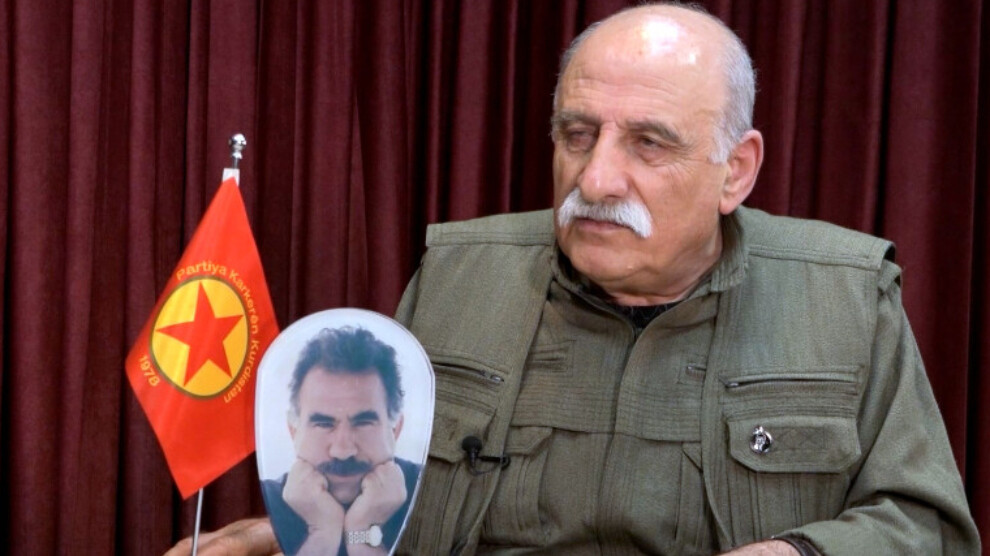
Duran Kalkan once again stressed the clear position of the Kurdish freedom movement, reiterating that "Öcalan's call can be implemented if the appropriate conditions are created."
ANF
NEWS DESK
Thursday, 17 April 2025
In this in-depth interview, Duran Kalkan, member of the KCK Executive Council, spoke about the state of affairs one and a half months after people's leader Abdullah Öcalan's ‘Call for Peace and Democratic Society’ was published. He once again stressed the clear position of the Kurdish freedom movement, reiterating that "Öcalan's call can be implemented if the appropriate conditions are created."
More than a month and a half has passed since the statement by peoples leader Abdullah Öcalan, which was read out on 27 February. Great hopes had been raised, especially regarding the change of the living and working conditions of Öcalan. What is the current status in this regard?
I respectfully salute the historic Imrali resistance and its conductor, Rêber Apo [Abdullah Öcalan]. The isolation in Imrali continues. There is no information about any serious change reflected to us. A period of one and a half months has passed since Rêber Apo made a historic call that was widely appreciated, and, accordingly, it was expected that there would be practical developments and changes. However, this is not the case. The Imrali system of torture, isolation, and genocide continues.
Free living and working conditions for Rêber Apo have not been ensured. However, it was stated that he would regain those within a week. There has been no change. So far, there is no serious approach that has been reflected and observed in this regard. Since the call did not find its response in practice, this led to a serious discussion and crisis. We, as the leadership of the party, expressed our position in this process quite clearly. We pointed out that like this there will be no outcome, and we assume that this is also Rêber Apo’s attitude. The rumors that Rêber Apo did not have the intention to make any statements on Newroz do not correspond to the facts.
As we read the situation, Rêber Apo is taking a clear stance to emphasize the crucial importance of the current situation, and the situation in Imrali is a crisis. It is claimed that this crisis has been overcome with recent statements and talks, but whether this really is the case or not, we don’t have concrete information on that. But what they intended to do was to reflect a positive atmosphere to the public.
The content of Rêber Apo’s call should, of course, be discussed, and everyone can express their own views on the Imrali system, on the physical freedom of Rêber Apo, and on the solution to the Kurdish question. But one should not spread rumors and claim that Rêber Apo said this or acted like that. One must not speak on behalf of Rêber Apo. Everyone needs to be careful in this regard in order not to create wrong perceptions. There are people that want to manipulate and play with minds. That is why it is necessary to be careful and sensitive.
Rêber Apo did more than his part and thereby surprised everyone. There were headlines stating, ‘He did the unexpected’. Rêber Apo made a confident and pioneering statement pointing towards a solution in such a way that it surpassed everyone’s expectations. This was, of course, very meaningful and important. However, one should not expect that Rêber Apo will solve the whole problem alone, that everything is solved with Rêber Apo’s statement. Rêber Apo did not create this problem. There is the Kurdish question behind it. It was created by the international capitalist modernity system and the state structure of the Republic of Turkey. They created it by denying the existence and identity of the Kurds, launching extermination attacks, and practicing genocidal attacks against the Kurds. The Kurdish question was created on the basis of enmity, on the basis of a mentality and politics of destruction and ignorance. This is the essence of the problem. And they based the Kurdish question on violence. Those who rely on violence, those who have conducted massacres and genocide against the Kurds over the past one, two hundred years, have to give up on this. Those who deny the existence and identity of the Kurds, who do not recognize even their most basic rights, and who want to annihilate them have to give up on this. Rêber Apo and the PKK have revealed the reality that they are living and put it in front of everyone.
As Rêber Apo pointed out, he has not created this problem. It is the work of others. He found it in front of him, while everyone else also saw it but ignored it. And Rêber Apo didn’t act like everybody else. He named it and started to work on its solution. He fulfills the duties and responsibilities that fall on his shoulders in this regard, but he alone cannot bring peace to Turkey. War and peace involve two sides. There cannot be a solution only by one side. Rêber Apo has been making a relentless effort for peace for more than 30 years, but nothing can be solved alone. Freedom, democracy, and democratization cannot be achieved by the efforts of one person alone. Everyone needs to participate in this. Everyone has a duty and responsibility in this. Therefore, no one should have the expectation that Rêber Apo can and will do it all by himself.
Kurdish society in particular, and among it the youth and women, needs to be sensitive to this reality. They need to be well aware of which responsibility falls on whose shoulders, what the way for a solution can be, what kind of duties emerge during this process, and what kind of struggle is necessary. The current situation demands that the global freedom campaign aiming at the physical freedom of Rêber Apo be developed and sustained in a multifaceted and effective manner. In this context, a conference was held in Rome. It was important, and the recent developments were evaluated. What will be done next is, as far as we can observe, still being discussed. I salute all those who carried out that effort, but I also want to highlight that it is necessary to further enlarge, spread, and strengthen the global freedom campaign on every dimension, in all four parts of Kurdistan, and in all corners of the world.
In his call, peoples leader Öcalan also points out the necessity of the convening of a congress. This is something that is being widely discussed. What can you, as one of the people directly responsible for this, say about this?
Rêber Apo’s statement from February 27 titled ‘Call for Peace and Democratic Society’ was a historic call, and its content carried a deep meaning. Therefore it was very meaningful, effective, and had a positive impact on everyone. There were some who opposed it, and even those who made harsh accusations for the call being published, but in general it had a positive impact on everyone. It was a call that not everyone could make, a call that not everyone could afford, a step that not everyone could take. But Rêber Apo took this step. It imposed duty and responsibility on everyone. The call was addressed not to one specific person or organization, but to everyone living in this world. No one can say that the call does not concern him. Even the most oppressed in the remotest corner of the world was addressed to the call because of being so. An unprecedented system of oppression and exploitation was created on the basis of the mentality and politics of destruction and ignorance of the Kurds, and it spread from there. Therefore, the Kurdish Freedom Struggle includes all of them. In this respect, one can say that maybe not on the same level, but at the end everyone is the addressee of the call.
We as a movement make our position known at the appropriate time, and so on March 1st we issued a statement to define our position, and to follow this up with practical steps, we declared a ceasefire. Most importantly, we openly defined our position. We said that this call can be implemented if the appropriate conditions are created. And we stated that we fully agree with its content and that we will comply and implement it. For the appropriate conditions, we defined the physical freedom of Rêber Apo, the conditions for him to live and work freely, because only Rêber Apo can organize the necessary congress. Only Rêber Apo can make the decisions to be taken at the congress, and only Rêber Apo can implement them. Apart from this, neither any force, person, nor institution within or outside our movement can do so. Our party leadership and all other current mechanisms within our movement are based on the administration of the war. It can only wage war. They say, “The Congress must dissolve the PKK.” The world united to destroy the PKK; they used all kinds of weapons and resorted to all kinds of ways and methods. They have never followed any rules of morality and law. They have been uninterruptedly attacking for forty years and could not get any results. For the last ten years they have been attacking on the basis of their so-called “collapse action plan” without success. They could not destroy or annihilate the PKK, and they could not continue Kurdish denial. No one but Rêber Apo can make them take those decisions and implement them. Now we stand on this view and explanation. A very long time has passed, and it was a difficult time. We made various evaluations, but still, due to the importance, content, and difficulties of the problem, we continued this process in the sense of not rushing and giving practice a little more chance. Our statements are still valid today. On this issue, we have not yet received anything concrete from Rêber Apo in the direction of holding a congress and having a decision taken.
Rêber Apo has stressed his determination. We have seen this, have attached importance to it, and find this determination meaningful and valuable. We are not against its realization; on the contrary, we are in favor of it. But it is obvious that a situation to realize it has not emerged in Imrali. More than forty-five days have passed, more than a month and a half, since the declaration, and still the isolation continues. There has been no new development, no change in the conditions under which Rêber Apo lives and works. The Imrali system continues; it has not been abolished, and not a single step in that direction has been taken. Rêber Apo cannot meet with anyone; he is not in a position to do any work regarding the congress. Once he gets in a position to realize this, he will advance the process.
Rêber Apo has made a decision and said that he is ready and willing to play his role. If the circles in power and the state really want it to be done, then there is the power to do it. When they pave the way, give him the opportunity; he implements his decision – he fulfills his promise – the problem will be solved. If what they really want is to solve the problem, then this can be done in this way. While there is the continuation of the Imrali system, the maintaining of the isolation, and the hostage system, the requirements defined in Rêber Apo’s declaration cannot be implemented. They cannot be practiced. Now it is being said that there are positive developments, that practical steps are being taken, and the Imrali delegation said that there will be changes in the conditions in Imrali, legal work will be done, the so-called ‘Right to Hope’ will become functional, there will be legal guarantees given, and so on. We don’t know what exactly is behind it and what is being discussed. But if it really happens like this, if Rêber Apo is enabled to run the congress, then it can work; then there will be no problem. There are no obstructive problems on our side; on the contrary, there are always facilitative approaches.
The rest is up to the power and state forces. It is up to those who created this problem, those who created the Imrali system, and those who maintain the most severe hostage system known to humanity. They babbled something about there being no legal legislation; however, there are European laws. Applying European laws is binding for Turkish law. They could have implemented it. They could have made legal arrangements within three days if they wanted to. It was not something that could not be done, but they have not done it until now; they have stalled and delayed. If they block the process, and they are responsible for it, it causes.
Duran Kalkan once again stressed the clear position of the Kurdish freedom movement, reiterating that "Öcalan's call can be implemented if the appropriate conditions are created."
ANF
NEWS DESK
Thursday, 17 April 2025
In this in-depth interview, Duran Kalkan, member of the KCK Executive Council, spoke about the state of affairs one and a half months after people's leader Abdullah Öcalan's ‘Call for Peace and Democratic Society’ was published. He once again stressed the clear position of the Kurdish freedom movement, reiterating that "Öcalan's call can be implemented if the appropriate conditions are created."
More than a month and a half has passed since the statement by peoples leader Abdullah Öcalan, which was read out on 27 February. Great hopes had been raised, especially regarding the change of the living and working conditions of Öcalan. What is the current status in this regard?
I respectfully salute the historic Imrali resistance and its conductor, Rêber Apo [Abdullah Öcalan]. The isolation in Imrali continues. There is no information about any serious change reflected to us. A period of one and a half months has passed since Rêber Apo made a historic call that was widely appreciated, and, accordingly, it was expected that there would be practical developments and changes. However, this is not the case. The Imrali system of torture, isolation, and genocide continues.
Free living and working conditions for Rêber Apo have not been ensured. However, it was stated that he would regain those within a week. There has been no change. So far, there is no serious approach that has been reflected and observed in this regard. Since the call did not find its response in practice, this led to a serious discussion and crisis. We, as the leadership of the party, expressed our position in this process quite clearly. We pointed out that like this there will be no outcome, and we assume that this is also Rêber Apo’s attitude. The rumors that Rêber Apo did not have the intention to make any statements on Newroz do not correspond to the facts.
As we read the situation, Rêber Apo is taking a clear stance to emphasize the crucial importance of the current situation, and the situation in Imrali is a crisis. It is claimed that this crisis has been overcome with recent statements and talks, but whether this really is the case or not, we don’t have concrete information on that. But what they intended to do was to reflect a positive atmosphere to the public.
The content of Rêber Apo’s call should, of course, be discussed, and everyone can express their own views on the Imrali system, on the physical freedom of Rêber Apo, and on the solution to the Kurdish question. But one should not spread rumors and claim that Rêber Apo said this or acted like that. One must not speak on behalf of Rêber Apo. Everyone needs to be careful in this regard in order not to create wrong perceptions. There are people that want to manipulate and play with minds. That is why it is necessary to be careful and sensitive.
Rêber Apo did more than his part and thereby surprised everyone. There were headlines stating, ‘He did the unexpected’. Rêber Apo made a confident and pioneering statement pointing towards a solution in such a way that it surpassed everyone’s expectations. This was, of course, very meaningful and important. However, one should not expect that Rêber Apo will solve the whole problem alone, that everything is solved with Rêber Apo’s statement. Rêber Apo did not create this problem. There is the Kurdish question behind it. It was created by the international capitalist modernity system and the state structure of the Republic of Turkey. They created it by denying the existence and identity of the Kurds, launching extermination attacks, and practicing genocidal attacks against the Kurds. The Kurdish question was created on the basis of enmity, on the basis of a mentality and politics of destruction and ignorance. This is the essence of the problem. And they based the Kurdish question on violence. Those who rely on violence, those who have conducted massacres and genocide against the Kurds over the past one, two hundred years, have to give up on this. Those who deny the existence and identity of the Kurds, who do not recognize even their most basic rights, and who want to annihilate them have to give up on this. Rêber Apo and the PKK have revealed the reality that they are living and put it in front of everyone.
As Rêber Apo pointed out, he has not created this problem. It is the work of others. He found it in front of him, while everyone else also saw it but ignored it. And Rêber Apo didn’t act like everybody else. He named it and started to work on its solution. He fulfills the duties and responsibilities that fall on his shoulders in this regard, but he alone cannot bring peace to Turkey. War and peace involve two sides. There cannot be a solution only by one side. Rêber Apo has been making a relentless effort for peace for more than 30 years, but nothing can be solved alone. Freedom, democracy, and democratization cannot be achieved by the efforts of one person alone. Everyone needs to participate in this. Everyone has a duty and responsibility in this. Therefore, no one should have the expectation that Rêber Apo can and will do it all by himself.
Kurdish society in particular, and among it the youth and women, needs to be sensitive to this reality. They need to be well aware of which responsibility falls on whose shoulders, what the way for a solution can be, what kind of duties emerge during this process, and what kind of struggle is necessary. The current situation demands that the global freedom campaign aiming at the physical freedom of Rêber Apo be developed and sustained in a multifaceted and effective manner. In this context, a conference was held in Rome. It was important, and the recent developments were evaluated. What will be done next is, as far as we can observe, still being discussed. I salute all those who carried out that effort, but I also want to highlight that it is necessary to further enlarge, spread, and strengthen the global freedom campaign on every dimension, in all four parts of Kurdistan, and in all corners of the world.
In his call, peoples leader Öcalan also points out the necessity of the convening of a congress. This is something that is being widely discussed. What can you, as one of the people directly responsible for this, say about this?
Rêber Apo’s statement from February 27 titled ‘Call for Peace and Democratic Society’ was a historic call, and its content carried a deep meaning. Therefore it was very meaningful, effective, and had a positive impact on everyone. There were some who opposed it, and even those who made harsh accusations for the call being published, but in general it had a positive impact on everyone. It was a call that not everyone could make, a call that not everyone could afford, a step that not everyone could take. But Rêber Apo took this step. It imposed duty and responsibility on everyone. The call was addressed not to one specific person or organization, but to everyone living in this world. No one can say that the call does not concern him. Even the most oppressed in the remotest corner of the world was addressed to the call because of being so. An unprecedented system of oppression and exploitation was created on the basis of the mentality and politics of destruction and ignorance of the Kurds, and it spread from there. Therefore, the Kurdish Freedom Struggle includes all of them. In this respect, one can say that maybe not on the same level, but at the end everyone is the addressee of the call.
We as a movement make our position known at the appropriate time, and so on March 1st we issued a statement to define our position, and to follow this up with practical steps, we declared a ceasefire. Most importantly, we openly defined our position. We said that this call can be implemented if the appropriate conditions are created. And we stated that we fully agree with its content and that we will comply and implement it. For the appropriate conditions, we defined the physical freedom of Rêber Apo, the conditions for him to live and work freely, because only Rêber Apo can organize the necessary congress. Only Rêber Apo can make the decisions to be taken at the congress, and only Rêber Apo can implement them. Apart from this, neither any force, person, nor institution within or outside our movement can do so. Our party leadership and all other current mechanisms within our movement are based on the administration of the war. It can only wage war. They say, “The Congress must dissolve the PKK.” The world united to destroy the PKK; they used all kinds of weapons and resorted to all kinds of ways and methods. They have never followed any rules of morality and law. They have been uninterruptedly attacking for forty years and could not get any results. For the last ten years they have been attacking on the basis of their so-called “collapse action plan” without success. They could not destroy or annihilate the PKK, and they could not continue Kurdish denial. No one but Rêber Apo can make them take those decisions and implement them. Now we stand on this view and explanation. A very long time has passed, and it was a difficult time. We made various evaluations, but still, due to the importance, content, and difficulties of the problem, we continued this process in the sense of not rushing and giving practice a little more chance. Our statements are still valid today. On this issue, we have not yet received anything concrete from Rêber Apo in the direction of holding a congress and having a decision taken.
Rêber Apo has stressed his determination. We have seen this, have attached importance to it, and find this determination meaningful and valuable. We are not against its realization; on the contrary, we are in favor of it. But it is obvious that a situation to realize it has not emerged in Imrali. More than forty-five days have passed, more than a month and a half, since the declaration, and still the isolation continues. There has been no new development, no change in the conditions under which Rêber Apo lives and works. The Imrali system continues; it has not been abolished, and not a single step in that direction has been taken. Rêber Apo cannot meet with anyone; he is not in a position to do any work regarding the congress. Once he gets in a position to realize this, he will advance the process.
Rêber Apo has made a decision and said that he is ready and willing to play his role. If the circles in power and the state really want it to be done, then there is the power to do it. When they pave the way, give him the opportunity; he implements his decision – he fulfills his promise – the problem will be solved. If what they really want is to solve the problem, then this can be done in this way. While there is the continuation of the Imrali system, the maintaining of the isolation, and the hostage system, the requirements defined in Rêber Apo’s declaration cannot be implemented. They cannot be practiced. Now it is being said that there are positive developments, that practical steps are being taken, and the Imrali delegation said that there will be changes in the conditions in Imrali, legal work will be done, the so-called ‘Right to Hope’ will become functional, there will be legal guarantees given, and so on. We don’t know what exactly is behind it and what is being discussed. But if it really happens like this, if Rêber Apo is enabled to run the congress, then it can work; then there will be no problem. There are no obstructive problems on our side; on the contrary, there are always facilitative approaches.
The rest is up to the power and state forces. It is up to those who created this problem, those who created the Imrali system, and those who maintain the most severe hostage system known to humanity. They babbled something about there being no legal legislation; however, there are European laws. Applying European laws is binding for Turkish law. They could have implemented it. They could have made legal arrangements within three days if they wanted to. It was not something that could not be done, but they have not done it until now; they have stalled and delayed. If they block the process, and they are responsible for it, it causes.
Kalkan: Words are not enough, peace requires actions
KCK's Duran Kalkan said that "the current government is not going through a change of mentality and politics that recognizes the existence of the Kurdish people."
ANF
NEWS DESK
Friday, 18 April 2025
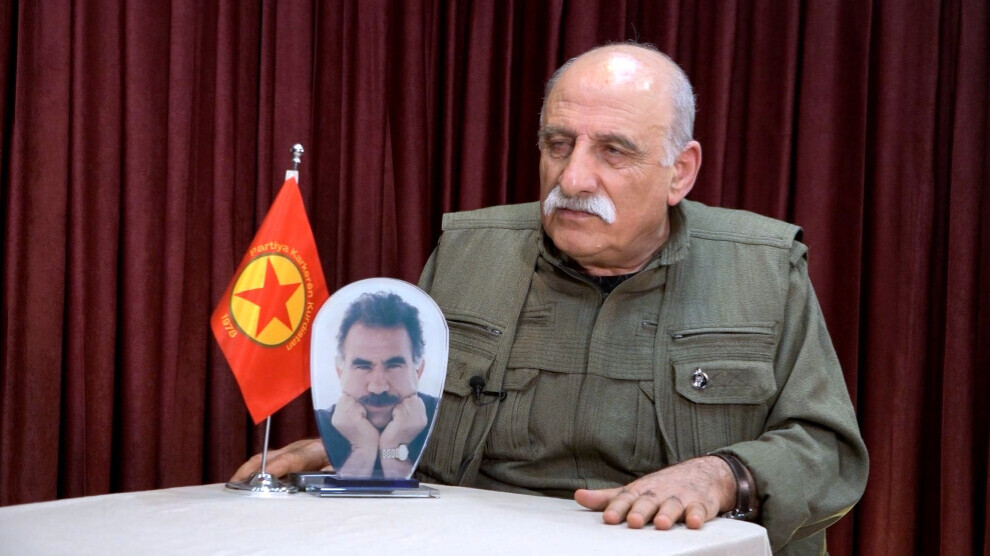
In the second part of this interview, Duran Kalkan, member of the KCK Executive Council, said that "the current government is not going through a change of mentality and politics that recognizes the existence of the Kurdish people."
The Imrali delegation recently held a meeting with the President of Turkey. How do you see and assess the rapprochement of the state and the rulers in the current phase?
The meeting took place after a long time, almost two weeks. There was even a debate about whether it would happen or not because of the time that had passed. But finally there was a meeting. Of course, it is important and meaningful that the President of the Republic met with the DEM Party’s Imrali delegation. They also met with the Speaker of the Parliament, they met with the heads of other parties, and with further circles. But it is decisive to meet with the President of the Republic as the interlocutor of the government and the number one responsible for the state, and for the President of the Republic to be involved in this matter at that level. Therefore, we see it as meaningful. And the statements given afterwards were very positive. It impressed everyone. But as we have expressed before, there are many wishes, many words, but no practice. No practical steps are taken. Now there are very positive, pleasing words and statements, but the question is what the practical outcome will be. We really don’t have any information about the content of the talks. We don’t know if something has been decided, or if wishes have been expressed, or how the results will be put into practice. We hope that it will be positive, that it will advance the process.
More can be said when a practice develops. Mere words will not be enough. We cannot say anything based on words. In this respect, both the talks and the statements are important. We hope that practice of it will follow.
The public, especially the Kurdish and the democratic public, first and foremost the women and the youth, must be aware that so far everything is just at the level of words and wishes. There should be no wrong perception. All this might be a concept of special warfare being in play. Caution is necessary, and evaluations from as many angles as possible are needed for it to be evaluated correctly, since there is enough reason to have doubts and to be concerned.
The war and the attacks of the Turkish state continue uninterruptedly. On behalf of our Central Headquarters Command, the HPG Press Office announces the statistics of the daily attacks against the guerrillas. We gave five martyrs in Zap and two martyrs in Gare. There are about 500-1000 bombardments every day. Prohibited weapons are being used. And airplanes continue to hover over the area.
I want to take this opportunity to salute the resistance of our guerrillas once again. I commemorate with respect, love, and gratitude the martyrs we gave in the face of these attacks. It is important and meaningful to be able to stand firm under these conditions, to use the right to legitimate defense against these attacks. No one can say anything different to this. But how will it be if it is being said that armed struggle must stop and arms must be laid down while they still uninterruptedly launch military attacks? How credible can that demand for laying down arms be? This is, to say the least, debatable. Why are these attacks still going on? It doesn’t look like a peaceful situation at all. I wonder what a force that attacks while there is a ceasefire will do to those armed people if they lay down their arms tomorrow. We are not ignorant. They should try to deceive us.
The current government is carrying out similar attacks not only on the military front but also on society and politics. Democratic individuals are constantly being arrested, and democratic institutions are being shut down. The prisons are filled to the brim. The government is attacking the opposition. There is massive pressure and attacks on the CHP, as well as on all the other parties. As comrade Karasu said, “Can we talk about an approach, mentality, and politics that cannot tolerate the opposition being democratic? Can such a mentality and politics democratize the state and society? Can it realize the democratic solution of problems?” This is not possible. If it cannot be democratic itself, then it cannot build democracy. It cannot create a democratic solution to problems. The current AKP-MHP regime is abusing this process and the opportunities created by it to consolidate its power. It is abusing it in the most reckless way. It is using the judiciary as a weapon. Democracy cannot come to Turkey with this approach. A mentality that cannot democratize Turkey cannot solve the Kurdish question. It is not possible for those who cannot solve the Kurdish question to make changes in the Imrali system or to take part in the process envisioned by Rêber Apo.
And these are not the only things. There are also external factors. For example, they held a meeting with Iraq in their joint mechanism. The only agenda was “PKK terrorism” and “joint fight against the PKK”. And you were making a deal with the PKK? You wanted the PKK to hold a congress, to dissolve, and to lay down its arms? They hold meetings in Syria, Iraq, Iran, Europe, and all over the world and make agreements with everyone against the “PKK terror”. There is no change in mentality and policy. Anti-Kurdishness, Kurdish denial, and Kurdish enmity continue as the guiding mentality and politics of the current government. Not only do they try to prevent the Kurds from obtaining their most basic rights, but they also want to annihilate them. They carry out all kinds of attacks. The attacks on Rojava and the struggle in Syria are very clear. There is no recognition of the existence and democratic rights of any Kurd here.
In short, yes, there are talks, there are some political discourses, but there is not much change in terms of mentality and politics. At the beginning, Devlet Bahceli said, “Let Apo come; let him speak in parliament.” But it remained at the level of words. Where remains the practice? He talked about Kurdish-Turkish brotherhood, about historical continuations. But the current government is not going through a change of mentality and politics that recognizes the existence of the Kurdish people, their existence as a people, and their democratic rights. What can be done with a government that follows anti-Kurdish mentality and politics? There is a genocide and no process. In this respect, yes, we have paid attention; there are optimistic statements, and there are wishes. “We will take steps,” they say. They are playing on time; they are stalling while there are no practical steps. There is an unclear, ambiguous situation, and it continues.
You have already mentioned that the declaration by peoples leader Abdullah Öcalan is being widely discussed. Let’s be more specific about this. How do you see the discussions in this regard on the part of the opposition and the press?
In terms of the opposition, one should not be too hopeless or denialist. There are important discussions within some democratic and leftist-socialist circles, as well as within women’s and youth movements. They are discussing the situation and rights of Rêber Apo, as well as the fact that the Kurdish question is a one- or two-hundred-year-old problem and the Kurdish people’s existence and gaining their democratic rights after 27 years of torture and isolation in Imrali. These are important discussions, and they are appropriate. The solution can only come from here. Without such discussions, there will be no solution. But there are also some discussions… It really surprises people. Can one be so narrow, chauvinistic, and nationalist? Can one be so racist? Can one be so power-hungry and self-interested? Some debates have nothing to do with the reality of Turkey. They are buried in their own interests; they are suffocating Turkey’s future and deepening its problems in a narrow power struggle. They are the ones preventing the democratization of Turkey, preventing Kurdish freedom. They are so confused that it is not even clear what they want. The only thing that can be seen is that they are enemies of Rêber Apo; they are enemies of the PKK. Whenever they open their mouths, it is only enmity that is coming out. You cannot reach anything with such people. They need to be reminded of the reality of Turkey and the reality of the region. The state that they know is cracking down. It is in search of how to save its future. It has fallen into a dangerous situation, but they don’t know it. Actually, they don’t really care about the survival of the state or about the future of the country; their only concern is their own narrow interests. There is such an individualistic, self-interested, materialistic environment. This is a very bad situation. These people need to be opposed and isolated.
There are discussions in this direction in the ruling circle. In terms of the opposition, the AKP suppresses it with its own methods. It has gotten the CHP into something, manipulating it. It made up a lot of things, but the CHP could not overcome them. Other opposition parties have expressed positive wishes, but they are unable to take steps. They are not pioneers, they cannot present projects, and they cannot develop an independent policy. They could not make the parliament work. Rêber Apo was also pointing to the parliament. We also considered it important. The institution that has to produce solutions in the first place is the parliament. And it is these parties that run the parliament. Many parties have groups or deputies in the parliament. They are in a position to work in parliament. “We are preparing a project,” the CHP said at one point. “We will present it to parliament on democratization and the solution of the Kurdish question”, but again nothing followed. They only say that the government is unreliable, express their doubts, and criticize the government. Fine, so be it; but if they really want to fight against this power, they can do so if they present their own projects and solutions that will overcome it. Otherwise, they will not criticize the government; they will just strengthen it even more.
They haven’t really taken very effective steps in terms of running the parliament and developing projects and plans. We haven’t seen it yet. “It can’t be done,” they say. They reject even the positive rhetoric of the government. Like this, they won’t achieve anything. If you really want to oppose the oppression, exploitation, and antidemocratic attitudes of the government, then make democracy work, develop it, take steps towards democratization, and develop projects. Make parliament work towards democratization. But practices to this extent have not developed. They create a narrowing, a blockage. It does so in such a way that it obstructs the solution of very historical, very important, very urgent problems such as the solution of the Kurdish question or the democratization of Turkey, or it confines this solution to a narrow power struggle, thus making them no longer a “solution force”. Everyone should abandon their self-interested, narrow, power-oriented approach. The solution of a problem such as the Kurdish question and the democratization of Turkey cannot be used for narrow power calculations. It cannot be handled with narrow interests. This is how the government handles it, this is how the AKP handles it; they carry out attacks on this basis. Doing something similar cannot surpass it!
The opposition should develop an attitude that develops democracy and shouldn’t try to imitate the government. The opposition should be able to become a democratic opposition, and step by step, it should operate the parliament and produce solutions for the democratization of Turkey. This is our call. If they do so, they will be effective. They will be understood, they can condemn the wrongdoings of the government, and they can find a base in society. We believe that such problems can indeed be overcome with a democratic mentality, with a democratic unity and alliance, and with an approach and effort that involves almost everyone in some way. This is our call to everyone. If the opposition does this, it will succeed. It will not be successful otherwise.
KCK's Duran Kalkan said that "the current government is not going through a change of mentality and politics that recognizes the existence of the Kurdish people."
ANF
NEWS DESK
Friday, 18 April 2025
In the second part of this interview, Duran Kalkan, member of the KCK Executive Council, said that "the current government is not going through a change of mentality and politics that recognizes the existence of the Kurdish people."
The Imrali delegation recently held a meeting with the President of Turkey. How do you see and assess the rapprochement of the state and the rulers in the current phase?
The meeting took place after a long time, almost two weeks. There was even a debate about whether it would happen or not because of the time that had passed. But finally there was a meeting. Of course, it is important and meaningful that the President of the Republic met with the DEM Party’s Imrali delegation. They also met with the Speaker of the Parliament, they met with the heads of other parties, and with further circles. But it is decisive to meet with the President of the Republic as the interlocutor of the government and the number one responsible for the state, and for the President of the Republic to be involved in this matter at that level. Therefore, we see it as meaningful. And the statements given afterwards were very positive. It impressed everyone. But as we have expressed before, there are many wishes, many words, but no practice. No practical steps are taken. Now there are very positive, pleasing words and statements, but the question is what the practical outcome will be. We really don’t have any information about the content of the talks. We don’t know if something has been decided, or if wishes have been expressed, or how the results will be put into practice. We hope that it will be positive, that it will advance the process.
More can be said when a practice develops. Mere words will not be enough. We cannot say anything based on words. In this respect, both the talks and the statements are important. We hope that practice of it will follow.
The public, especially the Kurdish and the democratic public, first and foremost the women and the youth, must be aware that so far everything is just at the level of words and wishes. There should be no wrong perception. All this might be a concept of special warfare being in play. Caution is necessary, and evaluations from as many angles as possible are needed for it to be evaluated correctly, since there is enough reason to have doubts and to be concerned.
The war and the attacks of the Turkish state continue uninterruptedly. On behalf of our Central Headquarters Command, the HPG Press Office announces the statistics of the daily attacks against the guerrillas. We gave five martyrs in Zap and two martyrs in Gare. There are about 500-1000 bombardments every day. Prohibited weapons are being used. And airplanes continue to hover over the area.
I want to take this opportunity to salute the resistance of our guerrillas once again. I commemorate with respect, love, and gratitude the martyrs we gave in the face of these attacks. It is important and meaningful to be able to stand firm under these conditions, to use the right to legitimate defense against these attacks. No one can say anything different to this. But how will it be if it is being said that armed struggle must stop and arms must be laid down while they still uninterruptedly launch military attacks? How credible can that demand for laying down arms be? This is, to say the least, debatable. Why are these attacks still going on? It doesn’t look like a peaceful situation at all. I wonder what a force that attacks while there is a ceasefire will do to those armed people if they lay down their arms tomorrow. We are not ignorant. They should try to deceive us.
The current government is carrying out similar attacks not only on the military front but also on society and politics. Democratic individuals are constantly being arrested, and democratic institutions are being shut down. The prisons are filled to the brim. The government is attacking the opposition. There is massive pressure and attacks on the CHP, as well as on all the other parties. As comrade Karasu said, “Can we talk about an approach, mentality, and politics that cannot tolerate the opposition being democratic? Can such a mentality and politics democratize the state and society? Can it realize the democratic solution of problems?” This is not possible. If it cannot be democratic itself, then it cannot build democracy. It cannot create a democratic solution to problems. The current AKP-MHP regime is abusing this process and the opportunities created by it to consolidate its power. It is abusing it in the most reckless way. It is using the judiciary as a weapon. Democracy cannot come to Turkey with this approach. A mentality that cannot democratize Turkey cannot solve the Kurdish question. It is not possible for those who cannot solve the Kurdish question to make changes in the Imrali system or to take part in the process envisioned by Rêber Apo.
And these are not the only things. There are also external factors. For example, they held a meeting with Iraq in their joint mechanism. The only agenda was “PKK terrorism” and “joint fight against the PKK”. And you were making a deal with the PKK? You wanted the PKK to hold a congress, to dissolve, and to lay down its arms? They hold meetings in Syria, Iraq, Iran, Europe, and all over the world and make agreements with everyone against the “PKK terror”. There is no change in mentality and policy. Anti-Kurdishness, Kurdish denial, and Kurdish enmity continue as the guiding mentality and politics of the current government. Not only do they try to prevent the Kurds from obtaining their most basic rights, but they also want to annihilate them. They carry out all kinds of attacks. The attacks on Rojava and the struggle in Syria are very clear. There is no recognition of the existence and democratic rights of any Kurd here.
In short, yes, there are talks, there are some political discourses, but there is not much change in terms of mentality and politics. At the beginning, Devlet Bahceli said, “Let Apo come; let him speak in parliament.” But it remained at the level of words. Where remains the practice? He talked about Kurdish-Turkish brotherhood, about historical continuations. But the current government is not going through a change of mentality and politics that recognizes the existence of the Kurdish people, their existence as a people, and their democratic rights. What can be done with a government that follows anti-Kurdish mentality and politics? There is a genocide and no process. In this respect, yes, we have paid attention; there are optimistic statements, and there are wishes. “We will take steps,” they say. They are playing on time; they are stalling while there are no practical steps. There is an unclear, ambiguous situation, and it continues.
You have already mentioned that the declaration by peoples leader Abdullah Öcalan is being widely discussed. Let’s be more specific about this. How do you see the discussions in this regard on the part of the opposition and the press?
In terms of the opposition, one should not be too hopeless or denialist. There are important discussions within some democratic and leftist-socialist circles, as well as within women’s and youth movements. They are discussing the situation and rights of Rêber Apo, as well as the fact that the Kurdish question is a one- or two-hundred-year-old problem and the Kurdish people’s existence and gaining their democratic rights after 27 years of torture and isolation in Imrali. These are important discussions, and they are appropriate. The solution can only come from here. Without such discussions, there will be no solution. But there are also some discussions… It really surprises people. Can one be so narrow, chauvinistic, and nationalist? Can one be so racist? Can one be so power-hungry and self-interested? Some debates have nothing to do with the reality of Turkey. They are buried in their own interests; they are suffocating Turkey’s future and deepening its problems in a narrow power struggle. They are the ones preventing the democratization of Turkey, preventing Kurdish freedom. They are so confused that it is not even clear what they want. The only thing that can be seen is that they are enemies of Rêber Apo; they are enemies of the PKK. Whenever they open their mouths, it is only enmity that is coming out. You cannot reach anything with such people. They need to be reminded of the reality of Turkey and the reality of the region. The state that they know is cracking down. It is in search of how to save its future. It has fallen into a dangerous situation, but they don’t know it. Actually, they don’t really care about the survival of the state or about the future of the country; their only concern is their own narrow interests. There is such an individualistic, self-interested, materialistic environment. This is a very bad situation. These people need to be opposed and isolated.
There are discussions in this direction in the ruling circle. In terms of the opposition, the AKP suppresses it with its own methods. It has gotten the CHP into something, manipulating it. It made up a lot of things, but the CHP could not overcome them. Other opposition parties have expressed positive wishes, but they are unable to take steps. They are not pioneers, they cannot present projects, and they cannot develop an independent policy. They could not make the parliament work. Rêber Apo was also pointing to the parliament. We also considered it important. The institution that has to produce solutions in the first place is the parliament. And it is these parties that run the parliament. Many parties have groups or deputies in the parliament. They are in a position to work in parliament. “We are preparing a project,” the CHP said at one point. “We will present it to parliament on democratization and the solution of the Kurdish question”, but again nothing followed. They only say that the government is unreliable, express their doubts, and criticize the government. Fine, so be it; but if they really want to fight against this power, they can do so if they present their own projects and solutions that will overcome it. Otherwise, they will not criticize the government; they will just strengthen it even more.
They haven’t really taken very effective steps in terms of running the parliament and developing projects and plans. We haven’t seen it yet. “It can’t be done,” they say. They reject even the positive rhetoric of the government. Like this, they won’t achieve anything. If you really want to oppose the oppression, exploitation, and antidemocratic attitudes of the government, then make democracy work, develop it, take steps towards democratization, and develop projects. Make parliament work towards democratization. But practices to this extent have not developed. They create a narrowing, a blockage. It does so in such a way that it obstructs the solution of very historical, very important, very urgent problems such as the solution of the Kurdish question or the democratization of Turkey, or it confines this solution to a narrow power struggle, thus making them no longer a “solution force”. Everyone should abandon their self-interested, narrow, power-oriented approach. The solution of a problem such as the Kurdish question and the democratization of Turkey cannot be used for narrow power calculations. It cannot be handled with narrow interests. This is how the government handles it, this is how the AKP handles it; they carry out attacks on this basis. Doing something similar cannot surpass it!
The opposition should develop an attitude that develops democracy and shouldn’t try to imitate the government. The opposition should be able to become a democratic opposition, and step by step, it should operate the parliament and produce solutions for the democratization of Turkey. This is our call. If they do so, they will be effective. They will be understood, they can condemn the wrongdoings of the government, and they can find a base in society. We believe that such problems can indeed be overcome with a democratic mentality, with a democratic unity and alliance, and with an approach and effort that involves almost everyone in some way. This is our call to everyone. If the opposition does this, it will succeed. It will not be successful otherwise.
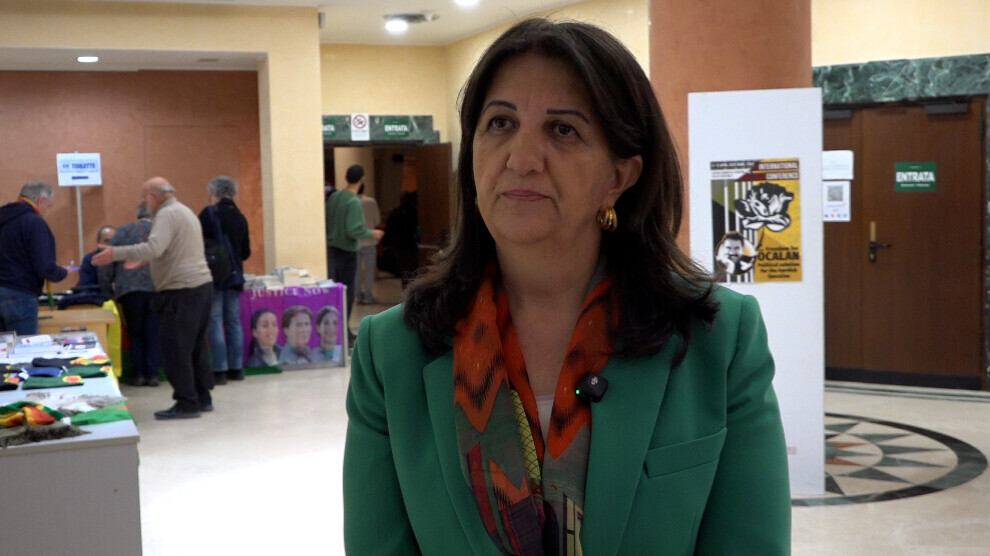
Pervin Buldan, member of the Imrali Delegation, said: "The construction and struggle of a democratic society never ends... The Call for Peace and a Democratic Society is, in itself, a call for struggle."
ANF
ROME
Sunday, 13 April 2025
The discussions about a new political process, which began following a call by MHP chair Devlet Bahçeli last October, continue. A long-anticipated meeting that was expected to add momentum to the process has now taken place, between the Imrali Delegation and President Tayyip Erdoğan.
Pervin Buldan, a member of the Imrali Delegation, spoke to ANF about the meeting.
This meeting with Erdoğan was seen as a key step in the ongoing process. What are your observations?
For the first time, the President has accepted a meeting with the Imrali Delegation. We’ve had discussions going on for quite some time. We had spoken with political parties, but as someone who should be at the center of this matter, the President had remained distant and hadn’t spoken publicly. There were expectations from all sides. This meeting clarified things. He accepted the delegation, we exchanged views. He listened to what we had to say, took our suggestions seriously, and took ownership of the process. We’ve said that Abdullah Öcalan has shown resolve and will to own the process, and we saw a similar commitment from the government. This makes it a historically important meeting.
Was Erdoğan’s previous distance from the issue addressed?
We didn’t ask why he stayed away for so long, and he didn’t offer an explanation. We suspect he wanted to see how things would unfold. There were concerns based on what happened after the 2015 process. Once he saw that progress was possible, he took a central role. That’s our interpretation.
Where are we in this process? There's no timeline, but what stage are we at?
There’s no official timeline, but we’ve been consistently expressing what needs to be done, and the government is aware. Notes have been taken during meetings with Öcalan, and state officials are involved. These discussions are likely to be conveyed to the President. So nothing here is entirely new. There are many issues, legal regulations that need to be passed. Instead of listing them, we expressed the need for a legal framework. They weren’t opposed to this. But there are no clear details yet.
Did the idea of meeting with the Minister of Justice come up during the meeting with Erdoğan?
No, we initiated that ourselves. It wasn’t something we discussed with the President. Later, we held an internal meeting and decided it was urgent to meet with the Minister of Justice.
Why the urgency?
Because there are legal steps that must be taken. We want to consult and move forward. If there are potential obstacles to peace, we need to remove them. It’s about avoiding pitfalls.
There has been talk of possible sabotage or intervention in the process. What's your view on that?
We live in a region full of dangers. In 2015, we were burned by such risks. To avoid a repeat and ensure the process isn’t derailed, we must eliminate those risks.
Don't practices like trustee appointments (kayyum), the sentencing of Istanbul Mayor Ekrem Imamoğlu, and repression of democratic voices harm the process?
Democratic steps are essential. And not just from the Ministry of Justice—opposition party leaders and Parliament must also take responsibility. This is not just a DEM Party or Kurdish issue; it concerns all 85 million people in Turkey. That’s why all political actors must contribute. We plan to meet with many parties and actors. If we meet with the Justice Minister soon, we’ll discuss what needs to be done. We’ll share our ideas, and they’ll share theirs. Talks with other political parties will follow. A visit to Imrali is also necessary, a meeting with Öcalan must happen. If steps are taken swiftly, this process could be completed in a few months.
When you say 'a few months,' do you mean by June?
Yes, if steps are taken quickly, the process could be completed by June.
What would constitute a 'completed' process?
Necessary laws would be passed, the PKK could declare its disbandment if conditions mature, and a congress is convened. If the government does its part and passes these laws swiftly, we could then speak of a completed process.
Is there any draft or concrete work being done on these laws?
Yes, there is work both on our side and within the government, but we’re not disclosing it yet.
Some say this peace process might delay or overshadow the democratic struggle. What's your response?
The struggle for a democratic society never ends. When one battle ends, another begins. We’ll continue to fight for new laws, for steps to be taken. In a country where women are killed daily, where children are murdered, like in the case of Narin, the struggle against this mindset will continue. The Call for Peace and Democratic Society is itself a call for struggle. Spreading this call and socializing it is part of that. Nothing matures in isolation. Attacks on Istanbul’s municipality are unacceptable. Just as we oppose a trustee in Hakkari, we also oppose interference in Istanbul. What can counter all of this is democratization—the struggle for democracy. Making that real is our shared duty.