It’s possible that I shall make an ass of myself. But in that case one can always get out of it with a little dialectic. I have, of course, so worded my proposition as to be right either way (K.Marx, Letter to F.Engels on the Indian Mutiny)
Saturday, April 19, 2025
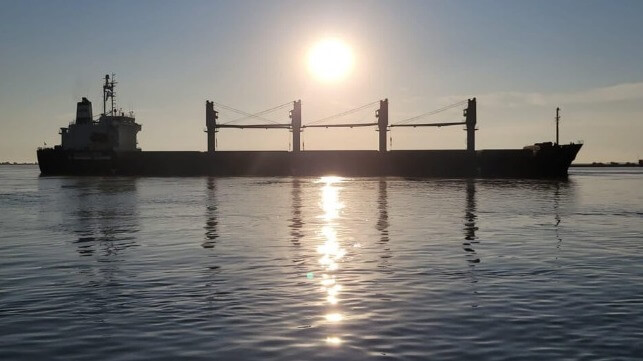
Indian Crew Stranded Without Pay Calls Renewed Attention to Abandonment
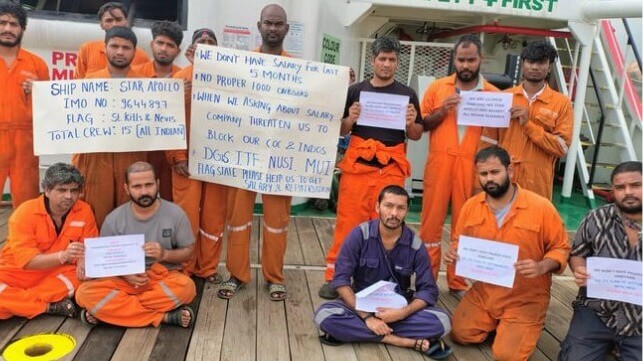
ITF highlights the crew star in Indonesia to call attention to the issue of abandonment (ITF / X)
The crew aboard an offshore support vessel has taken to social media with the aid of the International Transport Workers’ Federation to highlight their plight. It comes after the union groups called 2024 the “worst year on record for seafarer abandonment.”
The ITF posted on its social media channels a video of the 15 Indian crewmembers aboard the vessel which has remained in Indonesia since October 2024. They are holding handwritten signs saying they do not have proper food and the ship’s managers have threatened them when they ask for their back pay. They are appealing for the help of the Indian seafarer unions and the flag state of the vessel for help. The crewmembers want their pay and reparation back to India.
According to the ITF, the vessel named Star Apollo (1,500 gross tons) has been in the Batamec Shipyard in Indonesia since last year. There are 15 people, all Indian nationals, aboard who report they have not been paid since their contracts began between four and eight months ago. The ITF says it is trying to aid in the recovery of nearly $80,000 in unpaid wages.
The vessel, built in 2012, was sold in 2025 to Mumbai-based Vindhyawashini Offshore, according to the Equasis database. The ship is registered in St. Kitts & Nevis.
ITF - International Transport Workers' Federation's Post
15 crew members on the STAR APOLLO haven’t been paid since the start of their contracts—between 4 and 8 months ago.
The Indian shipowner has abandoned these seafarers and is refusing to take responsibility. This is unacceptable. The ITF Inspectorate is supporting the crew and working to recover the outstanding wages.
The 15 crew members of the STAR APOLLO (9644897), a St. Kitts & Nevis-flagged ship currently docked at Batamec Shipyard in Indonesia, haven’t been paid since the start of their contracts—between 4 and 8 months. Their total unpaid wages amount to almost USD$80,000.
The crew are extremely frustrated, and the stress of not being paid is taking a toll on their health.
ITF Inspector Mohammad Gulam Ansari, based in Haldia, India, who is supporting the crew, said "This is an Indian shipowner exploiting Indian seafarers, treating them like slaves. It's yet another example of an owner refusing to take responsibility."
If you think you might be abandoned, please email us at abandonment@itf.org.uk
“The crew are extremely frustrated, and the stress of not being paid is taking a toll on their health,” writes ITF Global Inspectorate Coordinator Steve Trownsdale on his social media account.
The ITF issued a warning in January that the abandonment of seafarers is “spiraling out of control.” It said abandonment of seafarers skyrocketed 87 percent (3,3133 seafarers compared to 1,676) in 2024 vs 2023. Vessel abandonment they reported was up a staggering 136 percent to 312 vessels in 2024.
Abandoned seafarers the ITF warned can experience months of unpaid wages, extremely poor on-board conditions, inadequate food and clean drinking water, and long periods of work without proper rest. In some cases, they are left completely stranded for months – even years – on end.
Under maritime regulations and the Maritime Labour Convention overseen by the International Labour Organization, flag states are obliged to step in when seafarers are abandoned. It calls for the states to arrange the transport home of seafarers, but many are reluctant to leave the ship until they settle their wages.
The lack of enforcement and responsiveness from flag and port states, the lack of insurance for vessels, and shipowners refusing to accept that they are mistreating their crew are common factors the ITF said that contribute to abandonment and complicate the resolution of cases.
Death Toll in Chinese Sand Carrier Capsizing Rises to Four
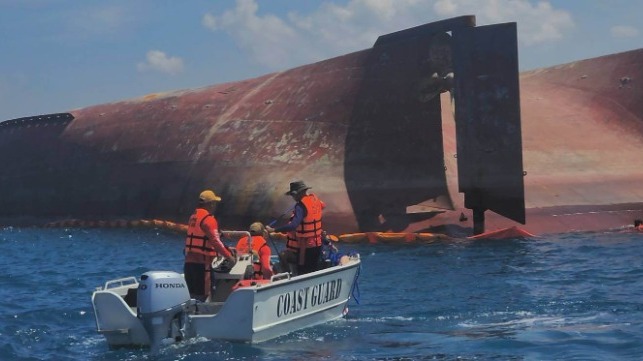
Dive boat approaches the upturned hull of Hong Hai 16, April 17 (PCG)
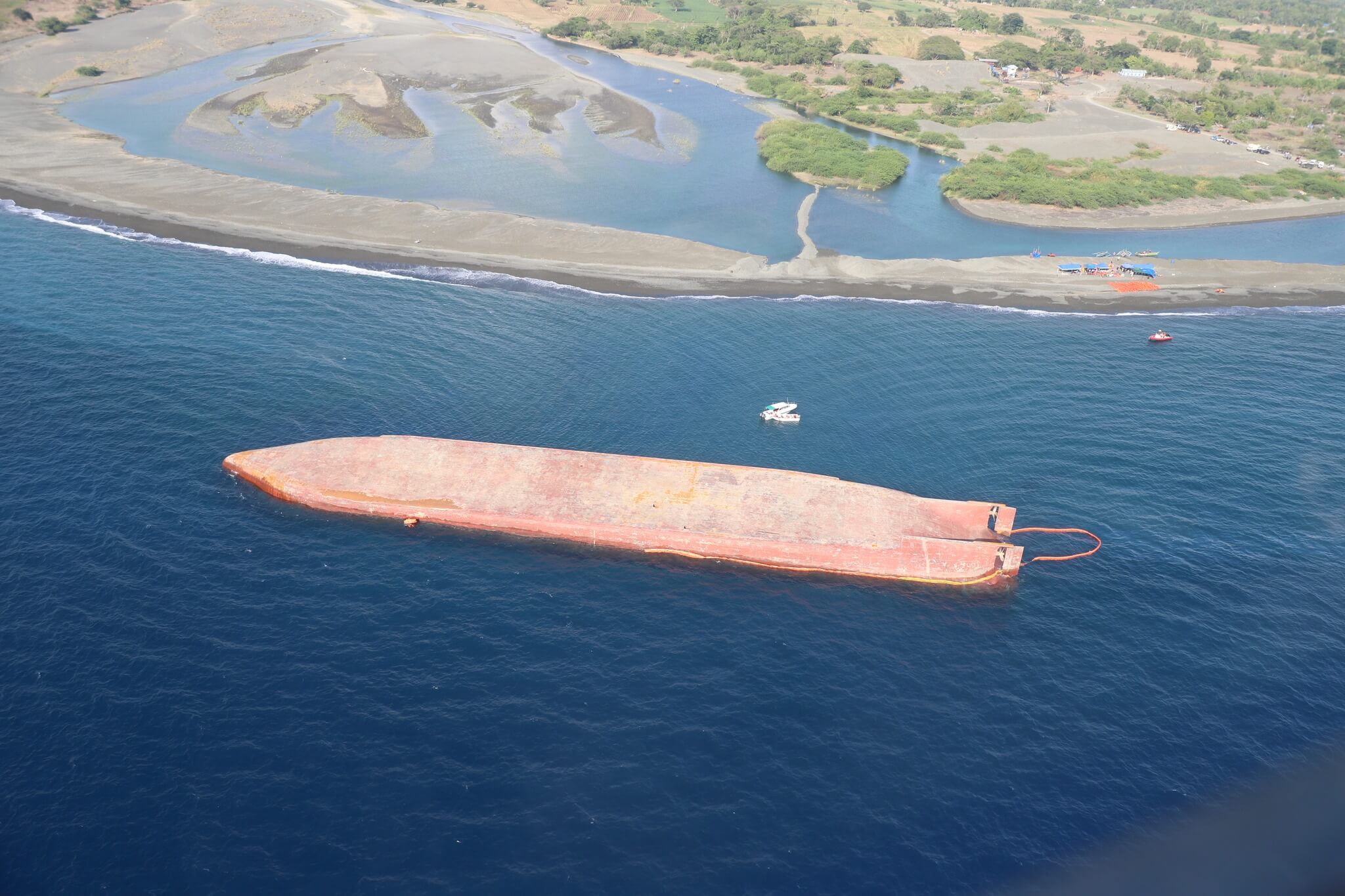
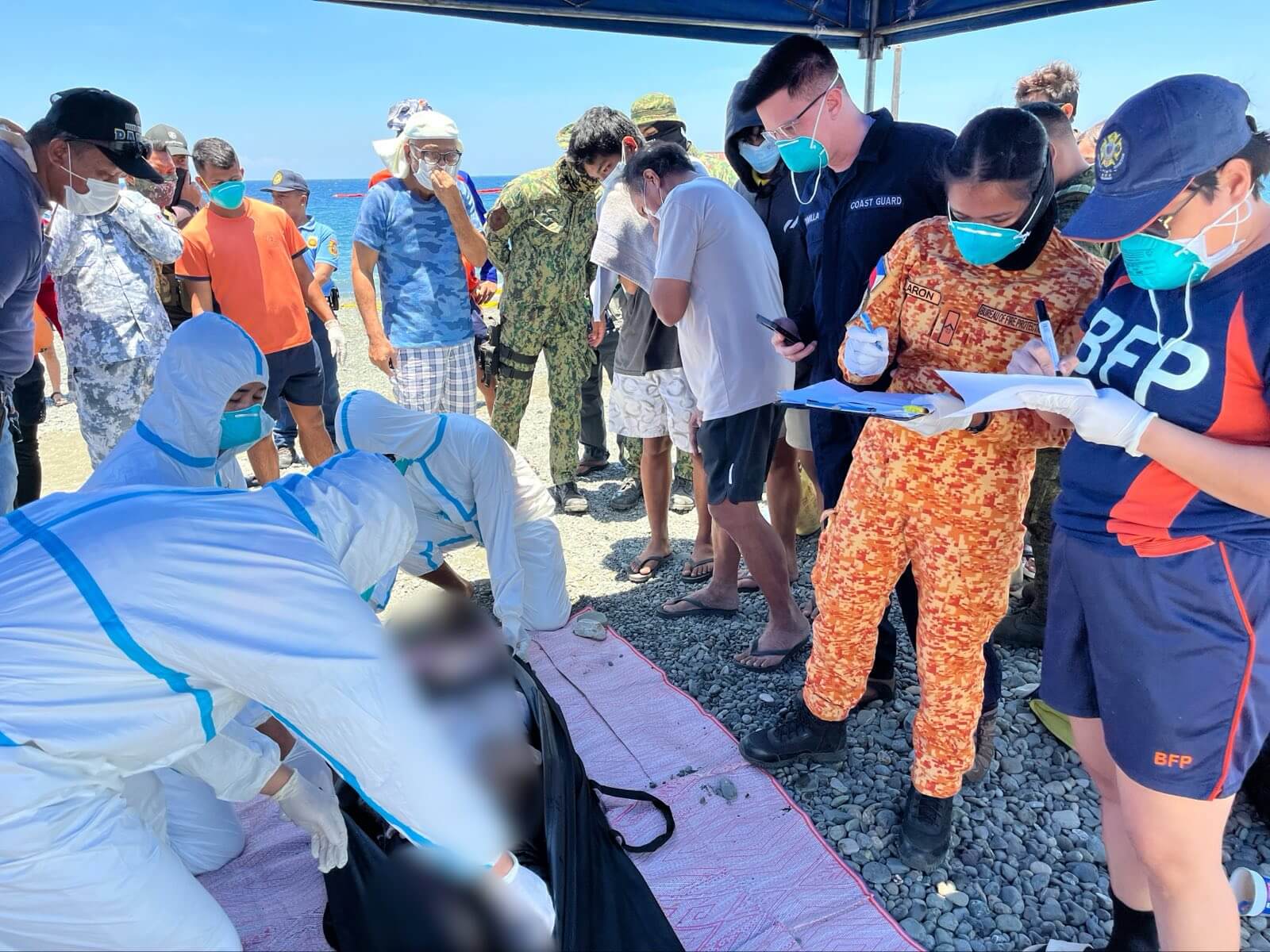
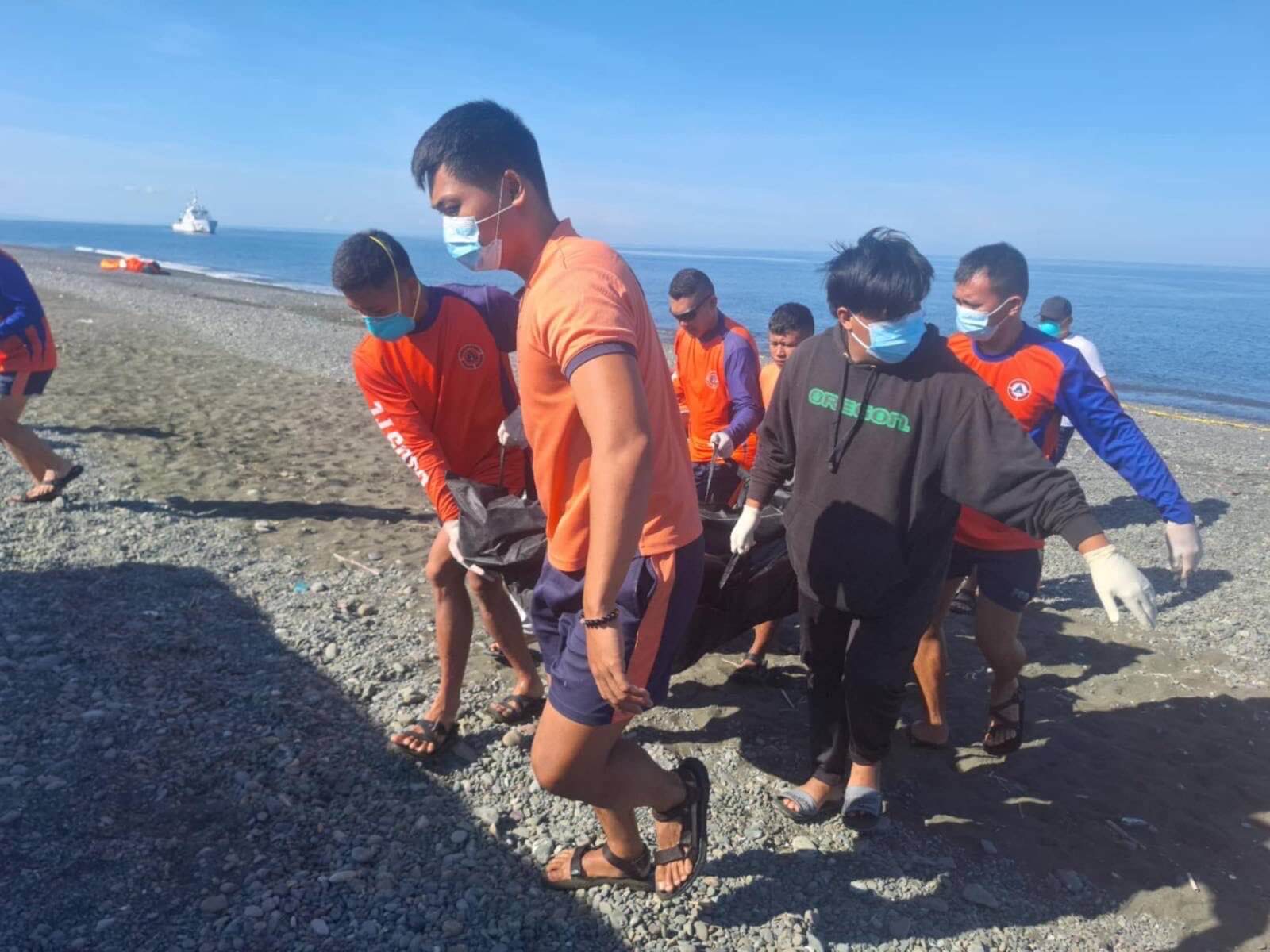
The remains of two more deceased crewmembers have been recovered from the wreck of the capsized sand carrier Hong Hai 16, according to the Philippine Coast Guard. The search continues as responders still hope to find survivors who may have been trapped inside the upturned hull.
The sand carrier Hong Hai 16 was operating off Barangay Malawaan on Tuesday morning in moderate seas. At about 0520 hours, the vessel capsized for reasons stil under investigation. There were 25 crewmembers aboard, and 14 were rescued alive, including six Philippine nationals and eight Chinese seafarers.
Courtesy PCG
On Wednesday afternoon at about 1430, a dive team found the body of a deceased Filipino crewmember on the vessel's bridge. At about 0815 on Thursday, divers with the Coast Guard Special Operations Unit – Southern Tagalog found one more body in an accommodation area below the bridge of the Hong Hai 16. At about 1135 hours, a third body was found in a cabin on the main deck level.
One injured Hong Hai 16 crewmember who was evacuated also died at the hospital, bringing the total number of fatalities to four.
Courtesy PCG
Seven crewmembers remain missing, and dive rescue operations continue. As a precautionary measure, Red Cross volunteers have conducted health assessments on all responders to make sure that ensure they remain in top physical condition, the PCG said.
The sand carrier was carrying about 2,000 liters of lube oil and 30,000 liters of diesel. As diesel fuel dissipates and is not persistent, the PCG is not treating it as an imminent environmental threat. 250 meters of containment boom have been deployed as a precautionary measure.
Four Crewmembers Injured in Fire as Bulker Departs Mozambique
Fire and a possible explosion injured for crewmembers (file photo)
[Brief] The maritime authorities in Mozambique report that four crewmembers required treatment at a local clinic after a fire broke out on their vessel as they were departing a northern port on the Indian Ocean. The crewmembers, whose nationality was not specified, are reported to be out of danger while their vessel is being detained pending further inspections.
The Maritime Transport Regulatory Authority (ITANSMAR) told the local media that the fire began on the bulker Altzek on Sunday afternoon, April 13. The vessel was reportedly loaded with coal and departing the Nacala port.
“It is assumed that there was an explosion in the engine room [of the ship], a fact that has yet to be ascertained,” Itransmar said in a statement sent to the news outlet Lusa. “The four crew members (…) are out of danger and are currently undergoing treatment at a clinic in Nacala,” the newspaper reports.
Four tugboats with fire-fighting equipment were sent to aid the 81,177 dwt bulker which is registered in Nigeria, but the fire had already been extinguished by the ship’s crew. After loading the ship was bound according to its AIS signal for a stop in Las Palmas, Spain with a final destination of Poland.
The ship according to the Equasis database had recently been acquired from South Korea by the Green Seeds General Trading Company of Oman. It was built in 2012.
The ship is showing that it is not under command while lying in the Nacala Porto anchorage. ITRANSMAR said a delegation of naval engineers would be sent to inspect the vessel. They are inspecting to determine if it can continue on its trip.
ECOCIDE CANADA
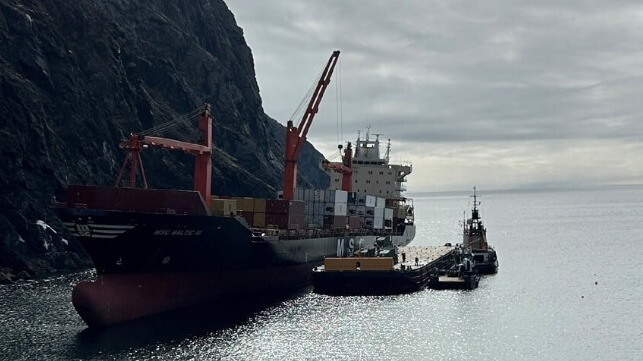
Tar Balls Wash Ashore as Salvage Continues of MSC Baltic III
Salvage efforts continue to focus on the fuel and potential contaminants aboard the grounded containership (Canadian Coast Guard)
The Canadian Coast Guard confirmed that a few tar balls have been recovered in the area near where the MSC Baltic III containership stranded two months ago in Newfoundland. While testing is still ongoing, the Canadian Coast Guard told the local media that it is almost certain the oil came from the vessel but they do not believe there is a consistent leak from the fuel tanks.
The first of the tar balls, which alternately are being described as the size of a tennis or golf ball, was found during a routine search on April 11 of the nearby beach, and two more were found the following day. Media reports indicate a total of six or seven of the tar balls have now been recovered and they were sent to a lab for testing. The Coast Guard suspects they are heavy fuel possibly washed from the ship during some of the heavy weather in the bay where the ship grounded.
An ROV was used to survey the hull on April 13, and it also confirmed that there was no consistent fuel leak from the vessel. The salvage effort had previously reported multiple cracks in the hull and water in the engine room and holds of the containership. The Coast Guard also says that no oil has been seen in the water or elsewhere in the bay so far.
Tar balls are being analyzed, but the Coast Guard thinks they are fuel washed from the ship during heavy weather
A subsequent survey of the vessel has lowered the estimate to approximately 1600 metric tons of heavy fuel and marine gas oil aboard the MSC Baltic III. The salvage company hired by the owners placed frac tanks on the deck of the vessel and in late March began an effort to pump the fuel from the vessel. However, it is a slow process due to the time required to heat and pump the fuel.
The current process calls for pumping the fuel into the temporary tanks on deck and when they are full they will be pumped into tanks on a barge alongside. Once filled, the tanks are too heavy to lift onto the barge. The Coast Guard explains this process is being used because the weather makes it difficult to keep a barge alongside the ship doe extended periods.
As of early April, the Coast Guard reported that 184 cubic meters of fuel had been pumped into the frac tanks. In an interview yesterday, April 17, with the local newspaper The Telegram, the Coast Guard said no fuel has been transferred off the vessel so far. The process continues to move slowly due to weather conditions in the area.
Initial salvage efforts in March removed from the vessel eight containers loaded with polymeric beads, which are considered dangerous goods. There were approximately 470 containers aboard when the vessel stranded on February 15. However, MSC reported approximately half were empties. The damage to the hull of the vessel makes it impossible at this time to consider refloating the ship.
The Canadian Coast Guard highlights that the country works under a “polluter pays” principle. The Coast Guard is overseeing the salvage effort which is being conducted by T&T Salvage hired by MSC. The vessel’s owners and its insurance will be responsible for all the costs of the salvage operation.
Report: Finland is Frontrunner Negotiating for USCG Icebreaker Order
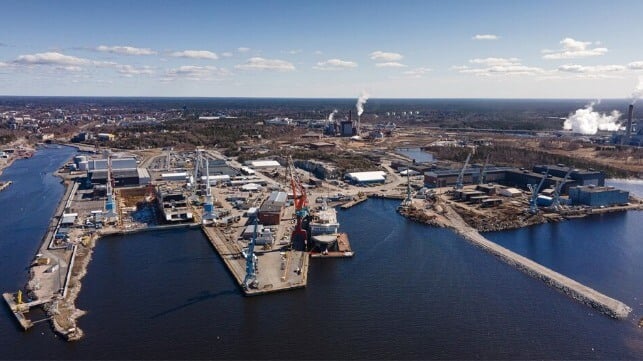
Rauma shipyard in Finland is reported to be negotiating for a USCG construction contract (RMC)
According to reports in the Finnish media, the country’s Rauma Marine Constructions shipyard is in negotiations with the United States to build a series of new medium icebreakers. A week ago, the USCG published a Request for Information for what were termed small icebreakers (370 feet in length) seeking shipyards that could deliver within three years of a contract award.
Finnish newspaper Helsingin Sanomat broke the news on Friday, April 18, saying it had confirmed the negotiations with three unnamed sources. Yle News has also picked up the story citing discussions in March between Finnish President Alexander Stubb and President Donald Trump. The newspaper reports just over a week ago Foreign Minister Elina Valtonen discussed the matter with U.S. Secretary of State Marco Rubio.
According to the report, the Rauma shipyard would build up to five medium-sized icebreakers, with the order valued at around €2.5 billion ($2.85 million). Helsingin Sanomat says that exploratory discussions are also underway regarding three larger vessels.
Rauma, located in southwest Finland on the Gulf of Bothnia, highlights on its website that three multi-purpose icebreakers were constructed in Rauma between 1993 and 1998 at the former Aker Finnyards and have been serviced at Rauma Marine. The yard also has experience with ice-strengthened hulls including for the ferry Aurora Botnia built in 2021.
The yard has been building ferries, including for Tasmania, and recently completed the hull for the first of four multi-role corvettes for the Finnish Navy. The first vessel is due to launch this spring and the second has started construction with the yard highlighted the vessels will be able to “operate in icy conditions.” The yard built a new enclosed construction hall for this project and has been positioning itself for expected orders to replace existing icebreakers in Scandinavia.
RMC, which was founded in 2014, is entirely Finnish-owned. It reports it currently has orders till 2028 valued at over one billion euros ($1.14 billion) as of October 2024.
Yle cautions in its report that the negotiations do not guarantee a deal. It says the U.S. Coast Guard has approached several shipyards around the world to assess their capacity to deliver icebreakers within 36 months. However, it also quotes Foreign Minister Valtonen who said after meeting Rubio, "We will likely have concrete news fairly soon."
A deal would be in keeping with the 2024 agreement between the United States, Canada, and Finland to jointly develop icebreakers. Canadian shipbuilder Davie was reported to be a driving force behind the agreement. Davie in 2023 acquired Helsinki Shipyard, which it was highlighted has built more than 50 percent of the global icebreakers. The Helsinki Shipyard was scheduled to build a new icebreaker for Russia, but the deal was blocked after the start of the war in Ukraine and that contributed to the financial collapse of the yard.
USCG Polar Star Starts Final Phase of Life Extension Program
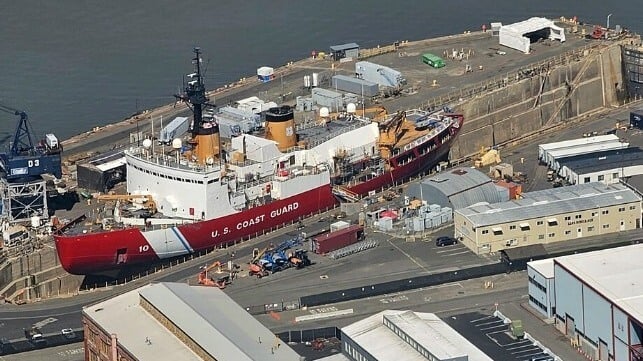
Polar Star during the 2024 life extension installment (U.S. Coast Guard Pacific Area photo)
The Coast Guard has initiated the final of five planned phases of the service life extension program (SLEP) for Coast Guard Cutter Polar Star, the service’s sole operational heavy icebreaker. Polar Star arrived at Mare Island Dry Dock in Vallejo, California, on March 30 to begin the remaining SLEP activities. The work is part of the In-Service Vessel Sustainment (ISVS) Program.
The SLEP is recapitalizing a number of major systems to extend the service life of the cutter and maintain polar ice-breaking capability until the polar security cutter fleet is operational. The Polar Star SLEP was designed to address targeted systems such as propulsion, communication, and machinery control systems for recapitalization. The USCG is undertaking the major maintenance program to extend the service life of Polar Star beyond its original design of 30 years.
Commissioned in 1976, Polar Star is the United States’ only heavy icebreaker capable of providing access to both polar regions. The Seattle-based cutter is 399 feet in length and 13,500 tons. The cutter's six diesel and three gas turbine engines produce up to 75,000 horsepower.
The life extension program began in 2021 in intervals timed between the vessel’s annual deployment to Antarctica. The current installment is the fifth and final phase planned in the program. The next generation polar icebreaker currently running six years behind the original construction schedule, with the shipyard Bollinger recently saying that completion of the first Polar Security Cutter is anticipated by May 2030 meaning Polar Star will remain active until age 55 or later.
Among the work scheduled during this period is a refurbishment in the two remaining zones of heating, ventilation, and air conditioning systems refurbishments. These zones will be refurbished with ventilation trunks, fans, and heaters to improve air circulation and maintain a comfortable living environment for the ship’s crew during extended deployments. The gyro repeater recapitalization will ensure that these critical pieces of navigation equipment are updated to modern standards, enabling safe navigation of the cutter. Ancillary pumps and motors are also targeted for recapitalization through the replacement of critical main propulsion and auxiliary systems with modern supportable units.
In addition, personnel from the Coast Guard Yard in Baltimore will be on site this summer, recapitalizing the sewage pumps and tank level indicators to ensure the crew can successfully monitor and manage sewage capacity while the cutter is executing its missions in ice.
Kenneth King, ISVS program manager, said “This phase represents a significant milestone for both Polar Star and the ISVS program, as our dedicated professionals ensure Polar Star meets its multifaceted missions in the polar regions until the arrival of the polar security cutter fleet.”
Last year’s effort targeted three systems aboard the vessel, including starting the refurbishment/ overhaul of the ventilation trunks, fans, and heaters that supply berthing areas of the ship. All the boiler support systems were also recapitalized/redesigned, including the electrical control station that is used to operate them. A complete recapitalization/redesign of the flooding alarm system also occurred from bow to stern to monitor machinery spaces for flooding.
In 2023, the program focused on improvements to shipboard equipment and numerous vital system upgrades for fire detection, communications, and monitoring water quality. Each year they also completed annual maintenance for the vessel.
Polar Star recently completed a 128-day deployment to Antarctica in support of Operation Deep Freeze 2025, the annual joint military logistics mission. This year’s deployment marked Polar Star’s 28th voyage to Antarctica in support of the joint military service mission to resupply and maintain the United States Antarctic Stations.
!!!!!
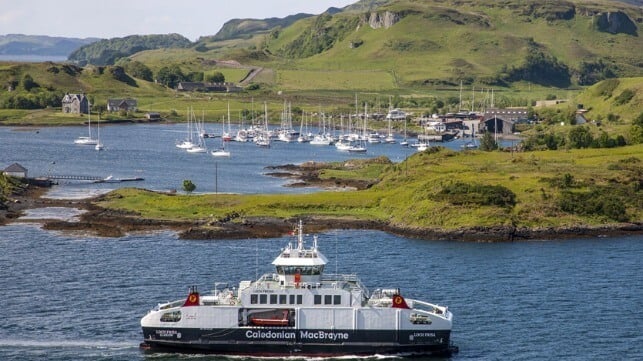
Study: Majority of Scotland’s Coastal Vessels Untracked Operate Without AIS
Study says the majority of small vessels operate without tracking or identification on the Scottish coast (CalMac file photo)
Scotland is largely operating blind in the management of its marine resources according to new research published this week as part of a project designed to create a better understanding of the exposure of whales, dolphins, and seals to coastal shipping. It emerged the researchers report that over half of vessels operating in the country’s coastal waters are “invisible” to standard maritime tracking systems.
A team of researchers at Scottish Heriot-Watt University carried out a study that was published this week which is sounding the alarm that the country is navigating blind in as far as understanding the potential adverse impacts of vessels crisscrossing its coastal waters is concerned. The study asserts that only 43 percent of vessels within a 10-kilometer radius of the Scottish coast broadcast an Automatic Identification System (AIS) signal, the standard global tool to monitor ship movements.
Smaller vessels, such as fishing boats under 15 meters, recreational craft, and jet skis, accounted for much of the missing data. Though they are not legally required to carry AIS, the vessels have the option of voluntarily installing and broadcasting data.
Considering that Scottish coast waters are getting busier, the study published in the academic journal Marine Policy contends that lack of visibility poses significant risks to marine life, safety, and sustainable ocean management. This is because governments, conservation bodies, and researchers mainly depend on AIS data to model vessel-related impacts such as underwater noise pollution, whale and dolphin collision risk, anchor damage to the seabed, greenhouse gas emissions, and climate impact. Scotland’s coasts are a vital habitat for species like bottlenose dolphins, minke whales, and orcas.
“With an improved understanding of the activities and movement of different types of vessels, marine planners and policymakers could tailor regulations to maximize their potential effectiveness,” said Lauren McWhinnie, one of the study’s authors. She adds that the wider maritime sector could further benefit through improved safety and awareness.
The study seeks to hold Scottish authorities accountable for assuming that they can rely on AIS to know what is happening in coastal seas. After analyzing over 1,800 hours of land and sea surveys conducted between 2019 and 2024 covering nine of Scotland’s 11 marine regions, the glaring fact is that a majority of vessels operate untracked with over 75 percent of vessel activity going unrecorded in some areas.
In the Outer Hebrides region, for instance, only 20 percent of vessels were transmitting AIS data despite the area being a hotspot for ecotourism, fishing, and aquaculture. The Orkney Islands region showed a higher rate, with 58 percent of vessels broadcasting.
The researchers are pushing authorities to take proactive actions in ensuring all types of vessels operating in the country’s waters, including smaller vessels, broadcast their position using AIS to effectively balance tourism and other vessel-based activities with local sustainability and environmental objectives.
Developing Waterway Cruises in Northern Canada
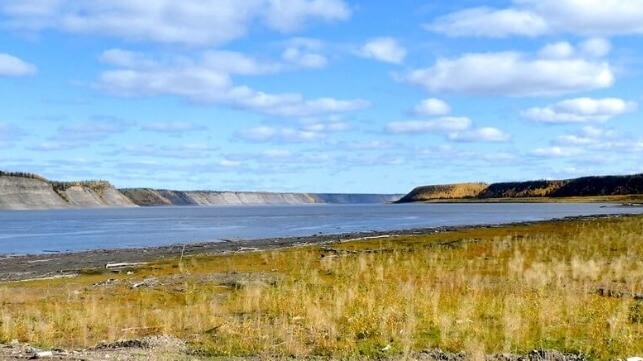
The Mackenzie River near Thiigehtchic, 150 miles inland from the Beaufort Sea (SF-DVS / CC BY 2.0)
Trump’s tariffs have elicited a backlash from Canadian tourists, who now choose to visit domestic attractions. The shift has opened the door to evaluate prospects to develop cruises that sail mainly in Canadian waters, including along shallow waterways and bodies of water where tourist cruise operations are presently absent. At present, cruise ships that carry guests on Arctic cruises, sail from the Port of Churchill on Hudson Bay. While most of the guests travel by air from Montreal to the airport at Churchill to board the ship, there is passenger railway service between Winnipeg and Churchill.
The precedent of Port of Churchill serving as a cruise ship terminal allows development of cruise tourism from other northern Canadian ports. Shallow draft river cruise ships that sail along European waterways would be an option to sail along Canada’s shallow Mackenzie River. However, extreme shoaling along some sections some northern Canadian waterways would require operation of a vessel capable of sailing in shallower water than the European river cruise design.
Precedents
Tug-propelled freight barges have sailed along the shallow Mackenzie River in northwestern Canada for decades, including into the Beaufort Sea and east toward Amundsen Gulf and Coronation Gulf. Such barges have also sailed on Hudson Bay, including along the navigable Chesterfield Inlet to the Hamlet of Baker Lake (pop. 2,000). The barges measured 450-feet length by 50-feet width, or very slightly larger than a European river cruise ship, and provide the basis to develop cruise vessels capable of sailing along shallow waterways such as the Mackenzie River, Slave River and Peace River in northwestern Canada.
Waterways
The Mackenzie River is navigable from the Beaufort Sea to Great Slave Lake, where the City of Yellowknife (pop. 20,000) has an airport and dock facilities. Duplicating the precedent at Churchill, guests interested in sailing aboard a river cruise from Yellowknife would arrive at the local airport from numerous other Canadian airports. Shallow water depth occurs along some sections of the Mackenzie River, requiring the cruise vessel to elevate in the water to transit shallow sections. There might be scope for the vessel to navigate the Slave River between Lake Athabasca and Great Slave Lake.
Arctic ice conditions during summer would determine as to whether a cruise vessel would be able to sail the extended voyage between the Beaufort Sea and Hudson Bay, sailing from Yellowknife to Port of Churchill. The sailing distance between Yellowknife and the Hamlet of Tuktoyaktuk (pop. 1,000) on the Beaufort Sea is equivalent to the Alaska cruise from Vancouver to Juneau. A cruise between Yellowknife and Churchill would likely involve a month of sailing, with stops at northern hamlets to allow guests to make extended visits to communities located north of the Arctic Circle.
Hudson Bay
A passenger train service connects Toronto to the Village of Moosonee, located on Moose River in the southwestern corner of James Bay. The shallow waters of the Moose River would allow for a river cruise ship or modified Mackenzie River barge to approach the village. A water taxi might need to shuttle guests from a dock at the village to a floating dock, to allow guests to board the cruise vessel. Once underway, the vessel could sail across Hudson Bay and to stop at Port of Churchill and other coastal villages including Baker Lake (pop. 2,000).
A large shallow draft vessel sailing from Moosonee might connect with a large cruise ship at the Port of Churchill, to allow for a transfer of passengers. Both a modified river cruise ship or a modified Mackenzie River barge rebuilt into a cruise vessel would be able to sail through the gentle summer wave conditions on James Bay and Hudson Bay. Such a cruise vessel would be able to sail to both Yellowknife and Moosonee. There would be scope to sail freight barges capable of elevating in shallow water, between Churchill and Moosonee.
Conclusions
As a result of the tariffs, Canadian are choosing to remain in Canada during their vacations, including booking passage aboard cruise vessels that sail in Canadian waters and visit Canadian destinations. There is now likely a market for cruise service along the Mackenzie River and on Hudson Bay.
The opinions expressed herein are the author's and not necessarily those of The Maritime Executive.
Norway Adopts Zero-Emissions Requirements for World Heritage Fjords
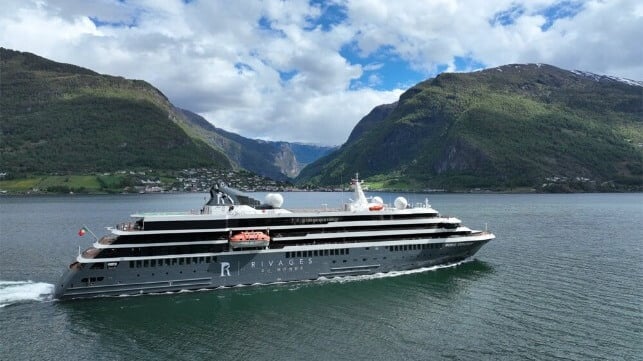
Smaller cruise ships (under 10,000 GT) and ferries are required to sail with zero emissions starting in 2026 (Port of Flam)
The Norwegian Storting (Parliament) has confirmed the requirements and schedule for the regulations to move passenger and ferry shipping to zero emissions while sailing within the country’s World Heritage fjords. The first phase is set to start in 2026 and progress as technology becomes available for larger ships to sail with zero emissions.
The process of developing the regulations began in 2018 with the Norwegian Maritime Authority. Implementation however has been delayed as they worked to define the scope of the regulations and waited for technology to advance to the level required to maintain shipping while achieving the goals.
“The process of developing zero-emission requirements for the World Heritage fjords has been long and demanding, both for the industry and for the Norwegian Maritime Authority,” said Alf Tore Sørheim, Director General of Shipping and Navigation. “Now that new provisions have been adopted, it is important to highlight that they provide the clarity the industry has long awaited. This ensures predictability and offers the opportunity to comply with the requirements.”
The first phase is just eight months away. As of January 1, 2026, passenger ships of less than 10,000 gross tons will have to meet the zero-emission requirement for the World Heritage fjords, which include Geirangerfjorden, a primary destination for the cruise industry, as well as Nærøyfjorden, Aurlandsfjorden, Sunnylvsfjorden and Tafjorden. All passenger ships, including ferries, must meet the requirement, but for larger ships of 10,000 gross tons and above it will be phased in with the requirement to sail with zero emissions as of January 1, 2032.
The Minister of Climate and Environment, Andreas Bjelland Eriksen, describes the legislation as a significant breakthrough for the World Heritage fjords. It is a key step in Norway’s overall sustainability programs and a commitment to the tourism industry.
The authorities note that the zero-emission requirement is technology-neutral and does not prescribe specific solutions. It is up to the operators in the World Heritage fjords to use energy sources that do not emit carbon dioxide (CO?) and methane (CH?). However, when such energy sources are used, there are requirements for greenhouse gas emission reductions, in accordance with the EU regulatory framework.
As part of the final test of the regulation, the government determined that passenger ships may use biogas as an alternative fuel, but that when biogas is used as an alternative fuel, it must be kept separate from fossil fuels until it is bunkered. In addition, the biogas must be bunkered within the final month before the ship enters the World Heritage fjords, and the amount bunkered must correspond to the amount expected to be used during the voyage through the fjords. Biogas sourced from the gas grid, accompanied by a certificate based on a mass balance system, does not meet the requirements for operating in the World Heritage fjords.
It also includes a requirement that ships must use shore power where available. The Storting also agreed to create shore-side electricity in the city of Flåm. It is allocating NOK 100 million ($9.5 million) in support of a shore power project.
Norway is at the forefront of developing technologies including batteries for its ferries as well as alternative fuels. In 2022, coastal ship operator Havila ran the first demonstration of a passenger ship operating solely on batteries in Geirangerfjord. Competitor Hurtigruten has also released its concept designs for a zero-emission passenger ship.


' xlink:href='%23b'/%3e%3cuse fill='black' filter='url(%23c)' xlink:href='%23b'/%3e%3cpath fill='white' d='M12.162 7.338c.176.123.338.245.338.674 0 .43-.229.604-.474.725a.73.73 0 01.089.546c-.077.344-.392.611-.672.69.121.194.159.385.015.62-.185.295-.346.407-1.058.407H7.5c-.988 0-1.5-.546-1.5-1V7.665c0-1.23 1.467-2.275 1.467-3.13L7.361 3.47c-.005-.065.008-.224.058-.27.08-.079.301-.2.635-.2.218 0 .363.041.534.123.581.277.732.978.732 1.542 0 .271-.414 1.083-.47 1.364 0 0 .867-.192 1.879-.199 1.061-.006 1.749.19 1.749.842 0 .261-.219.523-.316.666zM3.6 7h.8a.6.6 0 01.6.6v3.8a.6.6 0 01-.6.6h-.8a.6.6 0 01-.6-.6V7.6a.6.6 0 01.6-.6z'/%3e%3c/g%3e%3c/svg%3e)
' xlink:href='%23b'/%3e%3cuse fill='black' filter='url(%23c)' xlink:href='%23b'/%3e%3cpath fill='url(%23d)' d='M5.333 12.765c0 .137.094.235.25.235.351 0 .836-.625 2.417-.625s2.067.625 2.417.625c.156 0 .25-.098.25-.235C10.667 12.368 9.828 11 8 11c-1.828 0-2.667 1.368-2.667 1.765'/%3e%3cuse fill='url(%23e)' xlink:href='%23f'/%3e%3cuse fill='black' filter='url(%23g)' xlink:href='%23f'/%3e%3cpath fill='%234E506A' d='M4.616 7.986c.128.125.136.372.017.551-.12.178-.32.222-.448.096-.128-.125-.135-.372-.017-.55.12-.179.32-.222.448-.097zm6.489 0c.128.125.136.372.018.551-.12.178-.32.222-.45.096-.127-.125-.134-.372-.015-.55.119-.179.319-.222.447-.097z'/%3e%3cpath fill='url(%23h)' d='M4.157 5.153c.332-.153.596-.219.801-.219.277 0 .451.119.55.306.175.329.096.401-.198.459-1.106.224-2.217.942-2.699 1.39-.301.28-.589-.03-.436-.274.154-.244.774-1.105 1.982-1.662zm6.335.087c.099-.187.273-.306.55-.306.206 0 .469.066.801.219 1.208.557 1.828 1.418 1.981 1.662.153.244-.134.554-.435.274-.483-.448-1.593-1.166-2.7-1.39-.294-.058-.371-.13-.197-.459z'/%3e%3cpath fill='url(%23i)' d='M13.5 16c-.828 0-1.5-.748-1.5-1.671 0-.922.356-1.545.643-2.147.598-1.258.716-1.432.857-1.432.141 0 .259.174.857 1.432.287.602.643 1.225.643 2.147 0 .923-.672 1.671-1.5 1.671'/%3e%3cpath fill='url(%23j)' d='M13.5 13.606c-.328 0-.594-.296-.594-.66 0-.366.141-.613.255-.852.236-.498.283-.566.339-.566.056 0 .103.068.339.566.114.24.255.486.255.851s-.266.661-.594.661'/%3e%3c/g%3e%3c/svg%3e)

 Courtesy PCG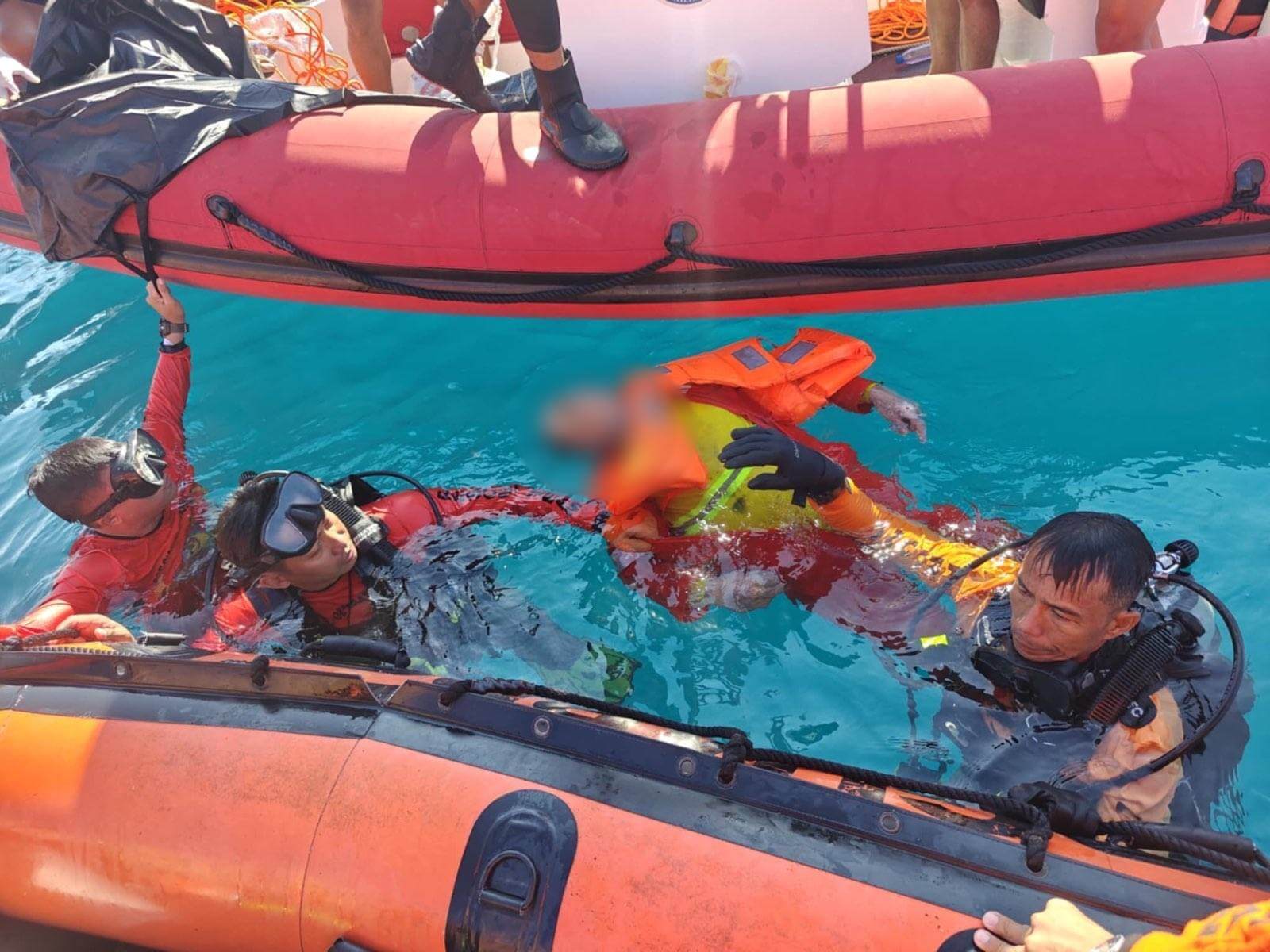
 Courtesy PCG