Executive Orders Ignite U.S. Nuclear Push
- President Trump signed four executive orders to fast-track U.S. nuclear energy expansion.
- The executive orders include mandates for military deployment, expedited regulatory approvals, testing of new reactor designs, and major federal funding for fuels and large-scale reactor construction.
- The market reacted strongly, with nuclear and SMR developer stocks like NuScale and Oklo surging over 50% in five days
Last Friday, the President signed four separate executive orders designed to accelerate nuclear energy development in the US. The first order directs the Department of Defense to deploy new reactor technologies at military installations. The second order, directed specifically at the Nuclear Regulatory Commission, mandated much tighter deadlines for new reactor approvals, demanded a review of current radiological exposure risks, and called for further agency staffing cuts. The third order directs the Department of Energy to test and approve no fewer than three new reactor designs by July 4, 2026. But the fourth of these EOs, where the real money is, 1) it called for the direct federal funding for uranium fuels (particularly HALEU), , 2) begin construction on at least ten new gigawatt scale reactors by the end of the decade, 3) and the development of reprocessing of spent nuclear fuel waste. In this context, the President garnered headlines when he called for an expansion of our existing nuclear power generation fleet to 400 gigawatts, roughly four times its present size, further stating “We’re not going to have cost overruns.”
What’s interesting to us is that virtually all of these initiatives were contained in the Biden administration’s ADVANCE Act, signed in July of last year. This bipartisan bill contained many of the same elements as the President’s recent EOs: regulatory acceleration of new reactor designs, a focus on microreactors, approval of two new reactor designs for military installations, encouraging the use of brownfield (i.e. coal) sites for new nuclear deployment, and the allocation of federal funds for actual uranium purchases related to HALEU and TRISO fuels—the former preferred by SMRs and the latter used in molten salt and HTGRs. The ADVANCE Act was an acknowledgement that our existing regulatory process has given short shrift to advanced reactor designs using different coolants and fuels and a new, emerging industry—one with considerable political clout—was demanding faster regulatory approvals. However, the only glaring difference between Trump’s recent EO’s and Biden’s ADVANCE Act is that the recent EOs urged further big cuts in regulatory personnel, while demanding they do more on expedited timelines, while Biden’s bill called for staffing increases to address new issues. So to us, an honest headline for this should read, “Trump wholeheartedly embraces Biden’s nuclear policy with a few personnel tweaks.”
In signing these EOs, Trump was accompanied by the CEOs from Constellation Energy and Oklo Power. Constellation is one of the biggest nuclear power owner/operators in the US, while Oklo is developing a small, 75 mw liquid metal cooled breeder reactor. Stock prices of SMR developers like NuScale, Oklo, and others rallied sharply. In the past five days, shares of NuScale have gained about 55% while Oklo’s shareholders were rewarded with 52% gains. The point here is that the administration is clearly indicating continued support for this industry and the equity markets responded. As to the magnitude of the response, we have no views.
But despite all the SMR hoopla, there is only one gigawatt reactor design presently approved for the US, already built, and ready to go—the Westinghouse AP 1000 recently built by Southern Company, aka Plant Vogtle Units 3&4. However, as our readers know, Westinghouse is a subsidiary of a Canadian conglomerate. So it’s a bit awkward. We conclude with two thoughts. First, the President, by picking a fight with his Canadian trading partner, may hinder his ability to rapidly accomplish a nuclear renaissance. And second, nuclear energy is evolving as a global industry and tariff uncertainty is also problematic.
By Leonard Hyman and William Tilles for Oilprice.com
US companies welcome Executive Orders
Nuclear fuel cycle companies, utilities and others have applauded the presidential executive orders that aim to revitalise the US nuclear industry - but questions are being raised about the impacts of some of the mandated reforms.
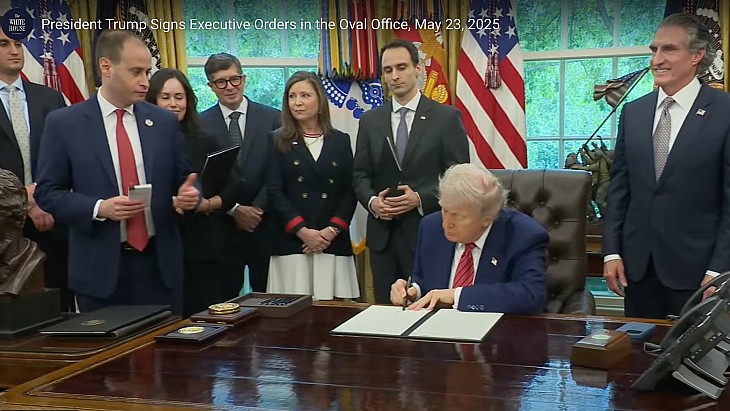
Four executive orders signed by President Donald Trump on 23 May aim to support the entire US nuclear supply chain and the ambition to quadruple the nation's nuclear energy capacity by 2050. Three of the orders are firmly focused on reforms that will boost the civil nuclear energy sector: you can read about them in WNN's article here. The fourth one aims to ensure the rapid development, deployment, and use of advanced nuclear technologies to support national security objectives, including AI data centres at Department of Energy facilities.
Many fuel cycle companies have responded positively to the Administration's action.
Amir Adnani, president and CEO of Texas-based Uranium Energy Corp applauded the US government's "decisive" action, saying the orders "send the strongest signal yet that energy security and national security start with a robust domestic uranium supply chain. As the US continues to import nearly all of its nuclear fuel amid a growing global supply deficit, the Administration is positioning the nation to lead the next era of global nuclear development by rebuilding a vertically integrated fuel cycle and investing in domestic uranium production. UEC is ready to support this transformation with secure, reliable, and 100% domestic uranium supply to power the future.”
Colorado-based uranium producer Ur Energy likewise commended the Administration, saying the actions support long-term uranium demand and therefore production from the company's Lost Creek and Shirley Basin mines. "The Executive Orders' mandate of rapid action will result in the expansion of the domestic reactor fleet and resulting demand for uranium," it said.
New opportunities
Global Laser Enrichment (GLE) recently began large-scale testing of the SILEX laser uranium enrichment process at its facility in North Carolina. "The administration has underscored the importance of expanding domestic conversion and enrichment capacity - priorities that align closely with GLE's capabilities and mission," CEO Stephen Long said. "These directives recognise the critical role of nuclear energy and a robust fuel supply chain in ensuring American energy dominance, as well as the necessary actions to accelerate deployment. Our proposed Paducah Laser Enrichment Facility is uniquely positioned to support both of these objectives, advancing innovation and US technology leadership and enhancing the nation’s energy security."
Advanced nuclear fuel company Lightbridge Corporation said the orders represent "the most significant policy shift toward nuclear energy in decades". It identified the provisions under the order on Reinvigorating the Nuclear Industrial Base, which directs the Department of Energy to prioritise work to facilitate power uprates to existing reactors, as being of particular relevance to the company which is developing innovative Lightbridge Fuel for existing reactors.
"We believe enabling power uprates of up to 17% in existing reactors is one of Lightbridge Fuel's most value-adding capabilities. We may not meet the executive order’s goal of adding five gigawatts of power uprates to existing reactors by 2030. Still, this direct policy support for power uprates aligns with the objectives of Lightbridge," the company said.
Lightbridge President and CEO Seth Grae also pointed to potential new opportunities created in the national security sector, which could open new market segments beyond traditional utility applications, including dedicated nuclear power supply at or near data centre locations.
Advanced nuclear technology company Oklo Inc is developing fast fission power plants capable of recycling used nuclear material, and has been given access to high-assay low-enriched uranium recovered from used fuel from the Department of Energy Experimental Breeder Reactor-II, which operated at Idaho National Laboratory from 1964 to 1994, to fuel its first core. The company said the executive orders also emphasise the importance of using existing domestic nuclear fuel feedstock to jump-start early projects and strengthen national energy resilience.
"These executive orders are about enabling deployment. They show clear alignment around the need to modernise how we license, fuel, and build advanced nuclear power to meet rising demand," Oklo co-founder and CEO Jacob DeWitte - who was present with other industry leaders at the White House for the signing ceremony - said.
Resolving the challenge
The executive orders represent a historic federal commitment to unlocking the full potential of nuclear energy, including a clear directive to develop a national policy for managing used nuclear fuel and evaluating recycling and reprocessing pathways, nuclear waste disposal technology company Deep Isolation said, signalling a shift towards enabling permanent solutions for the USA's growing inventory of nuclear waste.
The executive orders direct the Department of Energy to bring forward national policies on the management of used fuel and high-level waste, evaluate private-sector reprocessing options, and identify disposal pathways. Deep Isolation CEO Rod Baltzer welcomed the Administration's commitment to resolving the disposal challenge. "The Executive Orders mark a turning point for American innovation, science, and leadership. We have the tools and the technologies and, with these Executive Orders, we now have the political commitment to act. What we need next is execution," he said.
Regulation question
The executive order on Ordering the Reform of the Nuclear Regulatory Commission asserts that an unnecessarily slow, burdensome and risk-averse regulatory regime has stifled the US nuclear energy sector and orders the US regulator to carry out a wholesale revision of its regulations, as well as imposing an 18-month time limit for final decisions on applications to build and operate new reactors, and 12 months for applications to continue operating existing reactors.
But some commentators are questioning whether the regulatory regime - which was already undergoing reforms under the 2024 ADVANCE Act - is really the problem. Writing in The Hill, Toby Dalton, a senior fellow and co-director of the Nuclear Policy Program at the Carnegie Endowment for International Peace, and Ariel Levite, a senior fellow at the Endowment, said the orders "grossly exaggerate the delays to new deployment legitimately attributable to excessive nuclear regulation. They underestimate the addition of time to market due to limitations on workforce availability, supply chain, financing, specialty fuels and community buy-in.
"What Americans need is confidence that any nuclear power plant built and operated in the US is safe, secure and ultimately beneficial to American and host community prosperity."
Article researched and written by WNN's Claire Maden
Trump sets out aim to quadruple US nuclear capacity
US President Donald Trump has signed a series of executive orders titled Reinvigorating the Nuclear Industrial Base, Reforming Nuclear Reactor Testing at the Department of Energy and Ordering the Reform of the Nuclear Regulatory Commission with the goal of "re-establishing the United States as the global leader in nuclear energy".
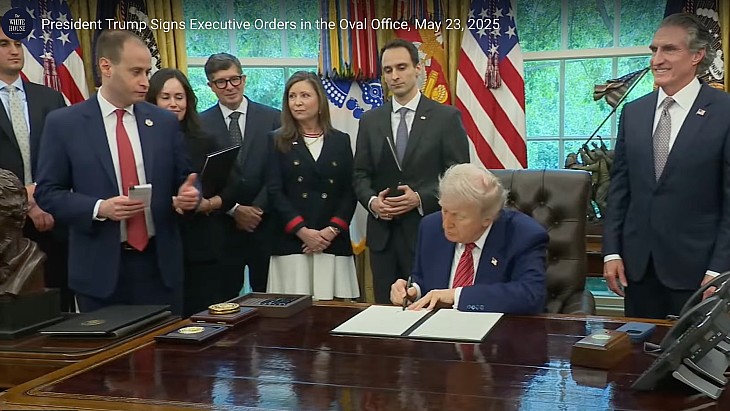
The aim is to increase US nuclear energy capacity from 100GW to 400GW by 2050, including the Department of Energy (DOE) prioritising work "with the nuclear energy industry to facilitate 5 gigawatt of power uprates to existing nuclear reactors and have 10 new large reactors with complete designs under construction by 2030".
Among the measures included are a reorganisation and cuts to the Nuclear Regulatory Commission and an order for licence decisions on the construction and operation of new reactors to be taken within a maximum 18 months.
The president was joined in the Oval Office on Friday afternoon for the announcements by representatives from the US nuclear industry and Secretary of the Interior Doug Burgum, who is Chairman of the National Energy Dominance Council, and Secretary of Defense Pete Hegseth.
A White House statement summarising the impact of the orders, said: "Today's executive orders allow for reactor design testing at DOE labs, clear the way for construction on federal lands to protect national and economic security, and remove regulatory barriers by requiring the Nuclear Regulatory Commission to issue timely licensing decisions."
'Reinvigorating the Nuclear Industrial Base'
The executive order Reinvigorating the Nuclear Industrial Base's purpose is described as: "The United States originally pioneered nuclear energy technology during a time of great peril. We now face a new set of challenges, including a global race to dominate in artificial intelligence, a growing need for energy independence, and access to uninterruptible power supplies for national security ... as American deployment of advanced reactor designs has waned, 87 percent of nuclear reactors installed worldwide since 2017 are based on designs from two foreign countries. At the same time, the Nation’s nuclear fuel cycle infrastructure has severely atrophied, leaving the United States heavily dependent on foreign sources of uranium as well as uranium enrichment and conversion services. These trends cannot continue.
"Swift and decisive action is required to jumpstart America’s nuclear energy industrial base and ensure our national and economic security by increasing fuel availability and production, securing civil nuclear supply chains, improving the efficiency with which advanced nuclear reactors are licensed, and preparing our workforce to establish America’s energy dominance and accelerate our path towards a more secure and independent energy future."
It aims to strengthen the domestic fuel cycle with a report required within 240 days to "recommended national policy to support the management of spent nuclear fuel and high-level waste and the development and deployment of advanced fuel cycle capabilities to establish a safe, secure, and sustainable long-term fuel cycle". This includes "recommendations for the efficient use of the uranium, plutonium, and other products recovered through recycling and reprocessing; recommendations for the efficient disposal of the wastes generated by recycling or reprocessing through a permanent disposal pathway; a recommended process for evaluating, prior to disposal, nuclear waste materials for isotopes of value to national security, or medical, industrial, and scientific sectors".
It also calls for a programme "to develop methods and technologies to transport, domestically and overseas, used and unused advanced nuclear fuels and advanced nuclear reactors containing such fuels in a safe, secure, and environmentally sound manner, including any legislation required to support this initiative" and within 120 days the Energy Secretary "shall develop a plan to expand domestic uranium conversion capacity and expand enrichment capabilities sufficient to meet projected civilian and defense reactor needs for low enriched uranium (LEU), high enriched uranium (HEU) and high assay, low enriched uranium (HALEU), subject to retention of such stockpiles as are necessary for tritium production, naval propulsion, and nuclear weapons".
There will also be an end to the general "surplus plutonium dilute and dispose" programme and instead a programme will be established to dispose of surplus plutonium by processing and making it available to industry in a form that can be utilised for the fabrication of fuel for advanced nuclear technologies, the order says.
There will also be energy-defence department work to "assess the feasibility of restarting or repurposing closed nuclear power plants as energy hubs for military microgrid support, consistent with applicable law, focusing initially on installations with insufficient power resilience or grid fragility".
There is also a section on expanding the nuclear energy workforce, saying that "within 120 days of the date of this order, the Secretary of Labor and the Secretary of Education shall seek to increase participation in nuclear energy-related Registered Apprenticeships and Career and Technical Education programs".
Reforming Nuclear Reactor Testing at the Department of Energy
The Reforming Nuclear Reactor Testing at the Department of Energy executive order says "commercial deployment of new nuclear technologies has all but stopped. The Idaho National Laboratory has principal responsibility for constructing and testing new reactor designs; it concluded construction of new reactors in the 1970s. Our proud history of innovation has succumbed to overregulated complacency".
It adds "the United States needs a reliable, diversified, and affordable supply of energy to drive development of advanced technologies, manufacturing, transportation, agriculture, and defense industries, and to sustain modern life and national security. Nuclear energy both is vital to this effort and has never held so much promise ... advanced reactors - including microreactors, small modular reactors, and Generation IV and Generation III+ reactors - have revolutionary potential. They will open a range of new applications to support data centers, microchip manufacturing, petrochemical production, healthcare, desalination, hydrogen production, and other industries".
It says that "within 90 days of the date of this order, the Secretary shall take appropriate action to revise the regulations, guidance, and procedures and practices of the Department, the National Laboratories, and any other entity under the Department’s jurisdiction to significantly expedite the review, approval, and deployment of advanced reactors under the Department’s jurisdiction. The Secretary shall ensure that the Department’s expedited procedures enable qualified test reactors to be safely operational at Department-owned or Department-controlled facilities within 2 years following the submission of a substantially complete application".
There will also be a pilot programme established for reactor construction and operation outside of the National Laboratories, with the goal of three reactors reaching criticality by 4 July 2026.
There will also be action taken "consistent with applicable law" to "use all available authorities to eliminate or expedite the Department’s environmental reviews for authorizations, permits, approvals, leases, and any other activity requested by an applicant or potential applicant".
Ordering the Reform of the Nuclear Regulatory Commission
The executive order Ordering the Reform of the Nuclear Regulatory Commission says that between 1954 and 1978 the US "authorised the construction of 133 since-completed civilian nuclear reactors at 81 plants. Since 1978, the Nuclear Regulatory Commission (NRC) has authorized only a fraction of that number; of these, only two reactors have entered into commercial operation".
The order says that "instead of efficiently promoting safe, abundant nuclear energy, the NRC has instead tried to insulate Americans from the most remote risks without appropriate regard for the severe domestic and geopolitical costs of such risk aversion".
It proposes that the NRC working with the Department of Government Efficiency "reorganize the NRC to promote the expeditious processing of license applications and the adoption of innovative technology. The NRC shall undertake reductions in force in conjunction with this reorganization". It proposes fixed deadlines for its evaluation and approval of licences, including "a deadline of no more than 18 months for final decision on an application to construct and operate a new reactor of any type, commencing with the first required step in the regulatory process, and a deadline of no more than 1 year for final decision on an application to continue operating an existing reactor of any type, commencing with the first required step in the regulatory process".
Answering questions from reporters after signing the orders. President Trump said that nuclear was "safe and clean" and said the country aimed to build small modular reactors but "we'll build the big ones too ... I think we're going to be second to none because we are starting very strong. But it's time for nuclear and we're going to do it very big".
Among those attending the Oval Office event was Nuclear Energy Institute (NEI) President and CEO Maria Korsnick who thanked the president for "leaning in" to support and bring attention to commercial nuclear energy.
And in a statement after the signings event, an NEI spokesperson said: "We appreciate the Administration’s ongoing actions to preserve existing nuclear plants and usher in the deployment of next generation nuclear. Policies to strengthen nuclear are essential to bolstering our national security and meeting our energy goals. We look forward to working with the Administration and other stakeholders to ensure the implementation of the orders will help us build a reliable, affordable, and increasingly clean energy system."
Article researched and written by WNN's Alex Hunt
Podcast: President Trump's nuclear announcements
US President Donald Trump has unveiled a series of executive orders aimed at quadrupling the country's nuclear energy capacity by 2050. In this podcast episode, we replay the announcements and pick out the key points and broader impact they could have.
The three nuclear-focused executive orders were entitled Reinvigorating the Nuclear Industrial Base, Reforming Nuclear Reactor Testing at the Department of Energy and Ordering the Reform of the Nuclear Regulatory Commission with the goal of "re-establishing the United States as the global leader in nuclear energy".
The aim is to increase US nuclear energy capacity from 100 GW to 400 GW by 2050, including the Department of Energy (DOE) prioritising work "with the nuclear energy industry to facilitate 5 gigawatt of power uprates to existing nuclear reactors and have 10 new large reactors with complete designs under construction by 2030".
As well as the president, the announcement also featured contributions from Secretary of the Interior Doug Burgum, who is also Chairman of the National Energy Dominance Council, Secretary of Defense Pete Hegseth, Joe Dominguez, CEO of Constellation Energy, Maria Korsnick, CEO of the Nuclear Energy Institute, Jacob DeWitte, founder and CEO of Oklo, and Scott Nolan of uranium enrichment company General Matter.
World Nuclear News's Claire Maden picks out some of the key points and the reaction to the announcement and Jonathan Cobb, World Nuclear Association senior programme lead, climate, considers the broader implications of the USA adopting a goal to quadruple nuclear energy capacity.
Listen and subscribe on all major podcast platforms:
World Nuclear News podcast homepage
Apple
Spotif
Amazon Music
Youtube Music
Episode credit: Presenter Alex Hunt. Co-produced and mixed by Pixelkisser Production