Thursday, July 24, 2025


A century of data reveals declining forest diversity


University of Illinois College of Agricultural, Consumer and Environmental Sciences
Virginia bluebells at Trelease Woods. 

image: 

Virginia bluebells at Trelease Woods.

view more 

Credit: Jennifer Álvarez


URBANA, Ill. — Researchers at the University of Illinois Urbana-Champaign have analyzed 96 years of forest census data to better understand ecological changes and inform management practices. Their study, published in Forest Ecology and Management, reveals concerning homogenization trends. This means the forest has become less diverse over time, losing trees that played a critical role in its ecosystem.

The researchers analyzed census data from Trelease Woods, which the university acquired in 1917. Homogenization was linked to the spread of the emerald ash borer, an invasive beetle, and Ophiostoma fungus, which causes Dutch elm disease. 

Many deciduous forests like Trelease Woods are losing diversity, co-author Jennifer Fraterrigo said. Fraterrigo is professor of natural resources and environmental sciences. She worked on the study with her former graduate  student, Jennifer Álvarez, who is currently an environmental assessment researcher at the Illinois State Geological Survey, part of the Prairie Research Institute at Illinois. Integrative biology professor James Dalling and former NRES forest ecologist John Edgington were also co-authors on the study.

Dutch elm disease and the emerald ash borer have significantly decreased the abundance of elm and ash trees in Trelease Woods and across North America, Fraterrigo said. However, diseases and pests failed to fully explain homogenization trends: suppression of forest fires, whitetail deer overpopulation, and the introduction of invasive plants can also drive homogenization, she said. 

“The study was focused on biotic disturbances — disease, pests, and invasives — because we have data from before they arrived, so that's something we knew was affecting the forest,” Álvarez said. “But we can’t isolate any single factor.”

Less diversity means less resilience

While the study focused on changes caused by Dutch elm disease and the emerald ash borer, these were not the only factors affecting the forest, and elm and ash were not the only species whose relative abundances changed.

When elm and ash die, they leave gaps in the forest, which other species compete to fill in. That’s when other factors come into play — fire suppression, for example. Wildfires also create space in the forest for new trees to grow. Without fire, forests become shadier and wetter, a process known as mesophication.

So instead of a wide variety of species replacing declining ones, only a handful of plants spread — mostly sugar maple and Ohio buckeye, which are well adapted to the new conditions. Oak trees, which don’t do well in the shade, have declined. 

“This can make the forest less resilient to future disturbances,” Fraterrigo said. “If one species makes up 70% of a forest, and then a pest or disease targeting that species is introduced, then 70% of the forest trees would be gone, likely leading to functional collapse.”

Broad implications from a unique case

The study is unusual in that it follows a single forest, Trelease Woods, over a long period of time. Most forests in the Midwest have been clearcut at least once or have sustained other significant forms of damage and degradation. But Trelease has survived with relatively little human interference and related physical damage, and scientists have been collecting data from the site for over a century. It’s a massive group effort, Fraterrigo said. Hundreds of NRES and integrative biology students have surveyed the site for class credit over the years.

“Most studies use space-for-time substitution to understand how ecosystems respond to disturbance over time. Researchers might not have long-term data for a specific site, so they’ll compare many sites that have been exposed to the same kind of disturbance but at different times. We’ll assume that any observed differences reflect how an ecosystem responds over time,” Fraterrigo said. “But that approach has its problems. Having the Trelease Woods data allowed us to directly investigate how the forest responded to ecological changes.”

Research at Trelease might help inform forest management globally, as the exceptional site was added to the Forest Global Earth Observatory Network in 2018. ForestGEO, as it’s called, helps researchers standardize forest data and collect it in one place. As of today, the network monitors roughly 7 million trees compromising nearly 13,000 species, connecting insights from individual scientists to reveal broader trends.

“Trelease is a relatively undisturbed forest, yet we see this mesophication trend,” Fraterrigo said. “More active management might be necessary to conserve certain species, even in places with little human activity.”
The study, “Homogenization of a temperate old-growth forest remnant in central Illinois following the introduction of Dutch elm disease (Ophiostoma novo-ulmi) and emerald ash borer (Agrilus planipennis),” is published in Forest Ecology and Management [DOI: 10.1016/j.foreco.2025.122707]. Authors include Jennifer Álvarez, James Dalling, John Edgington, and Jennifer Fraterrigo. The research was supported by the Student Sustainability Committee at UIUC, the USDA National Institute of Food and Agriculture Hatch Program (ILLU-875-925), and the Graduate College at UIUC.


UC Riverside scientists develop tool to detect fake videos


In collaboration with Google, new model spots fakes by interpreting faces and backgrounds


University of California - Riverside

Rohit Kundu and Amit Roy-Chowdhury 

image: 

Rohit Kundu and Amit Roy-Chowdhury

view more 

Credit: UC Riverside


In an era where manipulated videos can spread disinformation, bully people, and incite harm, UC Riverside researchers have created a powerful new system to expose these fakes.

Amit Roy-Chowdhury, a professor of electrical and computer engineering, and doctoral candidate Rohit Kundu, both from UCR’s Marlan and Rosemary Bourns College of Engineering, teamed up with Google scientists to develop an artificial intelligence model that detects video tampering — even when manipulations go far beyond face swaps and altered speech. (Roy-Chowdhury is also the co-director of the UC Riverside Artificial Intelligence Research and Education (RAISE) Institute, a new interdisciplinary research center at UCR.)

Their new system, called the Universal Network for Identifying Tampered and synthEtic videos (UNITE), detects forgeries by examining not just faces but full video frames, including backgrounds and motion patterns. This analysis makes it one of the first tools capable of identifying synthetic or doctored videos that do not rely on facial content.

“Deepfakes have evolved,” Kundu said. “They’re not just about face swaps anymore. People are now creating entirely fake videos — from faces to backgrounds — using powerful generative models. Our system is built to catch all of that.”

UNITE’s development comes as text-to-video and image-to-video generation have become widely available online. These AI platforms enable virtually anyone to fabricate highly convincing videos, posing serious risks to individuals, institutions, and democracy itself.

“It’s scary how accessible these tools have become,” Kundu said. “Anyone with moderate skills can bypass safety filters and generate realistic videos of public figures saying things they never said.”

Kundu explained that earlier deepfake detectors focused almost entirely on face cues.

“If there’s no face in the frame, many detectors simply don’t work,” he said. “But disinformation can come in many forms. Altering a scene’s background can distort the truth just as easily.”

To address this, UNITE uses a transformer-based deep learning model to analyze video clips. It detects subtle spatial and temporal inconsistencies — cues often missed by previous systems. The model draws on a foundational AI framework known as SigLIP, which extracts features not bound to a specific person or object. A novel training method, dubbed “attention-diversity loss,” prompts the system to monitor multiple visual regions in each frame, preventing it from focusing solely on faces.

The result is a universal detector capable of flagging a range of forgeries — from simple facial swaps to complex, fully synthetic videos generated without any real footage.

“It’s one model that handles all these scenarios,” Kundu said. “That’s what makes it universal.”

The researchers presented their findings at the high ranking 2025 Conference on Computer Vision and Pattern Recognition (CVPR) in Nashville, Tenn. Titled “Towards a Universal Synthetic Video Detector: From Face or Background Manipulations to Fully AI-Generated Content,” their paper, led by Kundu, outlines UNITE’s architecture and training methodology. Co-authors include Google researchers Hao Xiong, Vishal Mohanty, and Athula Balachandra. Co-sponsored by the IEEE Computer Society and the Computer Vision Foundation, CVPR is among the highest-impact scientific publication venues in the world. 

The collaboration with Google, where Kundu interned, provided access to expansive datasets and computing resources needed to train the model on a broad range of synthetic content, including videos generated from text or still images — formats that often stump existing detectors.

Though still in development, UNITE could soon play a vital role in defending against video disinformation. Potential users include social media platforms, fact-checkers, and newsrooms working to prevent manipulated videos from going viral.

“People deserve to know whether what they’re seeing is real,” Kundu said. “And as AI gets better at faking reality, we have to get better at revealing the truth.”

'It's a lifesaver': Making solar power affordable in South Africa


3 days ago
Pumza Fihlani
BBC News, Johannesburg
Pumza Fihlani / BBC
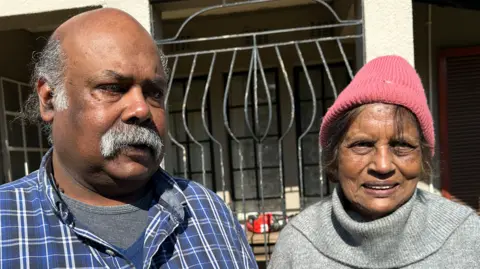
Mark Moodley (L) says that the lack of a consistent power supply endangered his mother's life

South African Mark Moodley believes that installing a domestic solar power system has helped keep his 81-year-old mother alive.

She spent three weeks in intensive care last year, and now back at home in Benoni, east of Johannesburg, she needs an oxygen concentrator to help her breathe.

But the country's erratic electricity supply meant could not be relied on.

"There were days we'd be without power for six hours. I had to use a car battery to run her oxygen tank, but that didn't last long and you'd have to sit with her with her arms raised to try and get oxygen into her lungs," Mr Moodley tells the BBC.

"Sometimes we had to rush her to hospital when that didn't work. It was scary."

Back then, doctors told the family she might not have long to live. But a steady power supply has given them more time together.

"It's been a lifesaver. I don't have to check on her constantly through the night. I know her oxygen tank has power no matter what," he says, voice trembling.

Despite recent improvements in South Africa's power grid, there are still outages.

Having a steady electricity supply has become a privilege in the country, which has endured nearly 15 years of "load-shedding" - scheduled nationwide blackouts introduced to ease pressure on the fragile infrastructure.

As well as endangering some lives, the crisis has damaged economic growth and contributed to job losses.

South Africa is heavily reliant on highly polluting coal for its power - it accounts for around 80% of all electricity generated. But in recent years it has loosened restrictions on small-scale solar generation and created tax incentives for installation.

The country is also looking for more investment in renewable energy in order to aid the switch from coal.

Domestically, those with financial means have gradually taken their homes and businesses off-grid, investing in solar power systems that require an initial outlay of $14,000- $19,600 (£10,400-£14,500).

Pumza Fihlani / BBC
Mr Moodley is hoping to go completely off-grid


That price tag means that this option is far out of the reach of most South Africans. Those scraping by cannot take advantage of the country's sunshine and invest in clean, reliable energy.

But Mr Moodley was able to turn to a pay-as-you-go scheme that has kept the lights on and the medical equipment working.

His electricity bill has dropped by $80 a week - savings he hopes to use to expand what he has and eventually go completely off-grid.

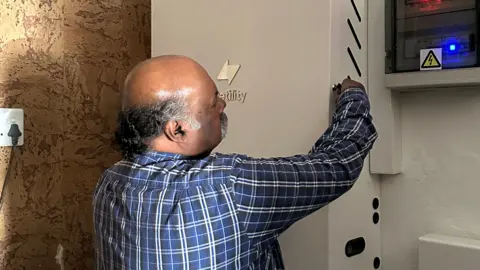
The system he uses comes from Wetility, a local start-up founded in 2019

For domestic users, the most basic package costs $60 a month - and crucially no prohibitive up-front payment - making solar power more accessible.

The company says it identified a gap in the market - affordable solar solutions tailored to small businesses and low-income households.

"South Africa has traditionally had high electricity access - but access means nothing if the power isn't reliable or affordable," says Vincent Maposa, the company's founder and a former energy analyst.

"We had to develop products that are both fit-for-purpose and financially accessible."

While solar power is not new in South Africa, Wetility's business model includes a mobile-phone style monthly payment plan, allowing customers to spread out the cost.


Pumza Fihlani / BBC
The boxes containing the inverter and battery that are installed in homes and businesses are put together at a factory in Johannesburg


For years, load-shedding has been used as a last-ditch attempt to keep the national grid from total collapse, following decades of mismanagement at state utility Eskom.

While blackouts have eased for some urban centres, poorer communities and business people continue to suffer forced cuts as aging infrastructure struggles to meet the growing demand.

For some in the townships worries about theft and practicality have also deterred people from getting solar equipment, but Wetility has also designed lightweight, flexible panels that can be fitted on the fragile rooftops common in many of these areas.

"We came up with a thin-film panel that sticks onto the roof. If someone tries to peel it off, it tears and becomes valueless. That was important for areas where theft is a concern," says Mr Maposa.

"In terms of efficiency, they perform about as well as traditional panels."

The energy unit, including an inverter, which converts the power generated by the panels into useable electricity, and a battery that works when the sun is not shining, is secured in a large steel box weighing about 300kg that bolts onto a wall.

The team says this reduces the risk of theft and avoids drawing attention in high-crime areas.


Pumza Fihlani / BBC
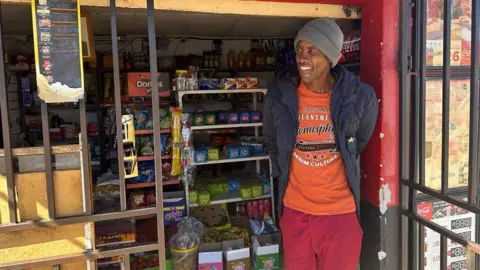
Julius Koobetseng's business was under threat because of the power cuts


Shopkeeper Julius Koobetseng recently made the switch to solar that may have saved his small grocery store.

In a grey beanie hat and thick blue jacket to ward off the cold in the southern Hemisphere winter, he stacks cans of drink in a brightly lit fridge remembering how the frequent power cuts nearly wrecked his livelihood.

"Meat would go off, dairy would spoil. Sometimes we'd be without power for four days," the 43-year-old says.

But since March, his shop in Krugersdorp, west of Johannesburg, has been using the pay-as-you-go solar power system to keep the lights and fridges on.

Some small business owners have turned to back-up diesel generators but Mr Koobetseng, who has had his shop for the past 13 years, was drawn to the more environmentally friendly option.

"Power cuts have badly affected small businesses. I know many in this area that had to shut down because they couldn't keep up with the uncertainty," he says.

"We live month-to-month, depending on what the business brings in. If you can't guarantee power, how do you even plan for the future?"

Now he does not worry when the power goes out which has been "a huge relief".

It costs his business $250 a month but Mr Koobetseng's business has picked up thanks to the reliable power.

"People know my shop stays open even when the power's out. Some just come to charge their appliances, but while they're here, they buy things too," he says with a smile.

For him, the benefit is not about lowering his electricity bills. It is the consistency.

"Solar gave me back control. I can plan my day knowing I'll have power."


Energy-efficient strategies may produce 10 times more health benefits in Eastern Europe than in Western Europe


The health benefits of energy interventions are greatest in countries such as Romania, Greece, and Bulgaria, according to a new study which provides a digital tool to help EU countries measure these effects and inform more sustainable climate policies


Boston University School of Public Health


The European Climate Law dictates that European Union (EU) countries must reduce harmful greenhouse gas emissions by at least 55 percent by 2030 and become climate neutral by 2050. 

In order to achieve this goal, it is imperative that EU countries’ energy policies and strategies quantify both the health and climate impacts of the air pollution generated from electricity use because these burdens vary substantially by country, region, and energy source, according to a new study by Boston University School of Public Health (BUSPH) and Harvard T.H. Chan School of Public Health. 

Currently, EU climate policies primarily consider only the climate effects of energy emissions from sectors such as buildings, public transportation, and industry. This approach overlooks the immediate harms that poor air quality is known to have on human health, including increased asthma, lung cancer, and cardiovascular disease. 

The new study quantifies these health effects, finding dramatic differences in this health burden from electricity use based on the source of energy that countries use. In places where coal or oil are the main energy source—including in Bulgaria, Romania, and Greece—the air quality-related health burdens can be up to 10 times greater than its climate burden. The findings were published in the journal Environmental Research Letters.

“This research is another example among growing data that show how closely related energy choices are to public health,” says study coauthor Dr. Jonathan Buonocore, assistant professor of environmental health at BUSPH. “In the European Union, there would be huge benefits to both health and climate if more renewable energy or energy efficiency strategies were deployed, especially in countries using large amounts of coal.”

The researchers also found that the health benefits of sustainable energy strategies are markedly higher in Eastern Europe than in Western or Northern Europe.

“Saving the same amount of electricity in Estonia can deliver over 1,000 times more health benefits than in Sweden—a striking disparity that highlights the importance of targeted policies,” says study lead author Dr. Gen Pei, research associate in the Department of Environmental Health at Harvard Chan School. “It is important to identify these variations to formulate effective, targeted energy and climate policies in the EU, such as the region-based EU Energy Efficiency Directive and the country-level policies like Spanish Building Technical Code.”  

With these findings, the researchers have developed a digital tool called CoBE EU that makes it easier for decision-makers in the EU to gather insight about buildings’ electricity consumption in different countries to understand the benefits of building decarbonization. 

“With this open-access online tool, building owners, operators, and policymakers can quantify the climate and health co-benefits of sustainable building development in EU countries,” Dr. Pei says.

For the study, the research team used novel methods to estimate greenhouse gas and air pollutant emissions of energy consumption in the EU. They used the social cost of carbon to estimate the potential monetary impacts of climate change attributed to greenhouse gas emissions from energy consumption, and additional methods to calculate worldwide deaths due to energy emissions in Europe. 

Notably, they found that it is critical for countries to distinguish each source that is used for energy consumption to avoid missing sources, such as biofuels, that could be harmful to human health and the environment.

“Biofuels are considered carbon neutral, but have considerable emissions of air pollutants and associated health impacts,” says Dr. Pei. “In countries such as Estonia and Hungary, we found that the relatively high use of biofuels may contribute to their health burdens of electricity use. Energy reports with biofuels lumped into renewables may overlook the potential health burden of air pollution from combusting biofuels.”

This information is also timely as EU countries will need to collectively achieve an additional 11.7-percent reduction in energy consumption by 2030 to meet its climate goal.

“We now have the capabilities to directly integrate public health considerations into energy policy,” Dr. Buonocore says. “Making these external, invisible public health and climate costs visible to energy policymakers can yield massive benefits to public health.”

The study’s senior author is Dr. Joseph Allen, professor of environmental health at Harvard Chan School and director of the Harvard Healthy Buildings Program.

** 

About Boston University School of Public Health 

Founded in 1976, Boston University School of Public Health is one of the top ten ranked schools of public health in the world. It offers master's- and doctoral-level education in public health. The faculty in six departments conduct policy-changing public health research around the world, with the mission of improving the health of populations—especially the disadvantaged, underserved, and vulnerable—locally and globally.

About Harvard T.H. Chan School of Public Health

Harvard T.H. Chan School of Public Health is a community of innovative scientists, practitioners, educators, and students dedicated to improving health and advancing equity so all people can thrive. We research the many factors influencing health and collaborate widely to translate those insights into policies, programs, and practices that prevent disease and promote well-being for people around the world. We also educate thousands of public health leaders a year through our degree programs, postdoctoral training, fellowships, and continuing education courses. Founded in 1913 as America’s first professional training program in public health, the School continues to have an extraordinary impact in fields ranging from infectious disease to environmental justice to health systems and beyond.


Making medicine out of millipedes


Virginia Tech
Chemist Emily Mevers (at right) and her graduate student, Rose Campbell, lift logs in Stadium Woods in search for millipedes. 

image: 

Chemist Emily Mevers (at right) and her graduate student, Rose Campbell, lift logs in Stadium Woods in search for millipedes.

view more 

Credit: Photo by Steven Mackay for Virginia Tech.


Millipedes get a bad rap — their many legs put people off and could classify them as “creepy crawly.” But these anthropods’ secretions could hold the key to new drug discovery for the treatment of neurological diseases and pain.

Chemist Emily Mevers and her team recently discovered a new set of complex structures in millipede secretions that can modulate specific neuroreceptors in ant brains.

The newly discovered structures fall into a class of naturally occurring compounds called alkaloids. The Mevers team named them the andrognathanols and the andrognathines after the producing millipede, Andrognathus corticarius, found on Virginia Tech’s Blacksburg campus in Stadium Woods. These discoveries were recently published in the Journal of the American Chemical Society.

A new compound discovery

Mevers specializes in leveraging the chemistry of underexplored ecological niches, in this case the millipede, in the name of drug discovery.

After collecting millipedes from under leaf litter and fallen branches in Stadium Woods, Mevers and team members used a variety of analytical tools to identify the compounds contained in the millipedes’ defensive glands. They also learned that the millipedes release these compounds to ward off predators while also sharing their location with their kin.

Broader implications

Despite their pervasiveness, much about millipedes remains mysterious — including their specific habitats, numbers, diets, behaviors, and chemistry. Mevers, in collaboration with millipede expert Paul Marek in the entomology department, is working to fill in some of these gaps and see if what they uncover could be useful for future medications.

Previously, Mevers and Marek examined a millipede native to the Pacific Northwest, Ishcnocybe plicata, and discovered that related alkaloids potently and selectively interact with a single neuroreceptor called Sigma-1. The interaction suggested that this family of compounds may have useful pharmacology potential for the treatment of pain and other neurological disorders.

The Mevers group discovered that the new alkaloids are actively secreted from the Hokie millipede when it is physically disturbed. The secretions cause disorientation in ants, a presumed natural predator. A subset of these compounds possesses similar interactions with the Sigma-1 neuroreceptor.

Moving toward drug development

With the newfound complex compounds in hand, the next step is finding people to actually make them in larger quantities and evaluate their biomedical applications.

“These compounds are quite complex, so they're going to take some time to synthesize in the lab,” said Mevers.

Once larger quantities are available, Mevers will be able to better study their properties and potential in drug development.

Original study: DOI 10.1021/jacs.5c08079

GUNS AN AMERIKAN PLAGUE

New study reveals critical link between neighborhood violence, youth fighting, and perceived firearm availability


University of Pennsylvania School of Nursing
Penn Nursing Junwong Min 

image: 

Jungwon Min, PhD, MS, Research Professor and Director of the BECCA Lab

view more 

Credit: Penn Nursing


PHILADELPHIA (Juny 24, 2025) – A new Penn Nursing study led by Jungwon Min, PhD, MS, Research Professor and Director of the BECCA Lab, uncovers a significant association between neighborhood firearm violence exposure, involvement in fighting, and adolescents' perceived ability to obtain a firearm outside the home. The research is available in the latest issue of the American Journal of Preventive Medicine.

The study, Neighborhood Firearm Violence, Psychosocial Risks, and Youth Firearm Perception, highlights that adolescents living in neighborhoods with higher rates of firearm violence are more likely to perceive firearms as accessible outside the home, even if they do not have firearms at home. Fighting behavior was found to mediate 32% of the relationship between neighborhood firearm violence and perceived outside-home firearm availability, pointing to the layered risks faced by youth in high-violence settings.

"Our findings underscore the urgent need for interventions that address youth firearm access not just within the home, but also in community contexts,” said Min. “Both structural and individual-level factors—like neighborhood violence and fighting behavior—shape how youth perceive firearm availability. The emergency department, where many of these youth are seen, is a crucial setting for early identification and intervention."

The cross-sectional study analyzed 23,334 emergency department visits by youth aged 14-18 years who completed behavioral health screenings between 2013 and 2024. Researchers linked self-reported data on perceived firearm availability and psychosocial risks to police-reported shootings and the Child Opportunity Index at the census tract level.

This research emphasizes that perceived firearm availability is not solely determined by neighborhood disadvantage but is significantly influenced by individual behaviors like fighting. The study suggests that ED-based screening for perceived firearm availability could be a vital step in preventing youth firearm carriage and future violence.

Co-authors include Vicky Tam, MA, Stephanie Mayne, PhD, MHS, Polina Krass, MD, and Joel A. Fein, MD, MPH. This project was supported by Clinical Futures, a Research Center of Emphasis at Children’s Hospital of Philadelphia.