While we wish we could do nothing but celebrate, the history of Social Security shows that we must always defend the program from those who would privatize or outright eliminate it.
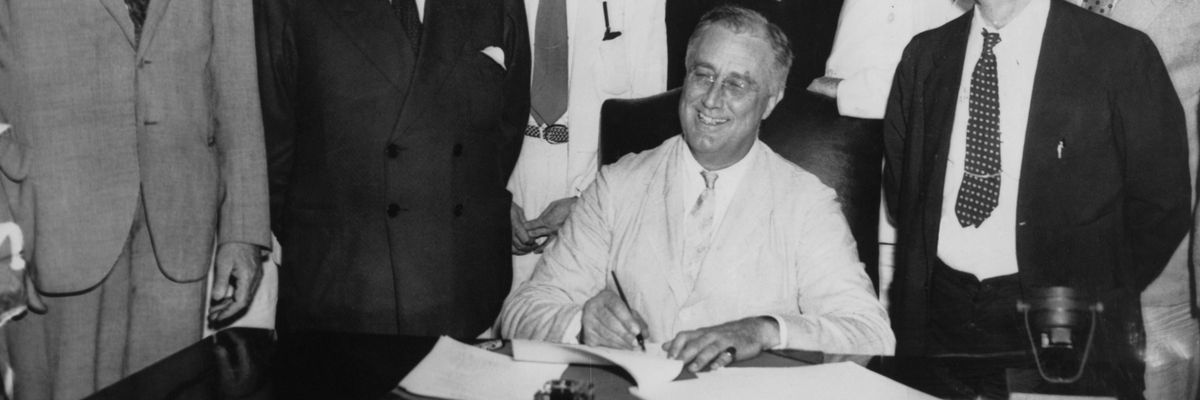
US President Franklin D. Roosevelt (1882 - 1945) signs the Social Security Act,
on August 14, 1935.
(Photo by FPG/Archive Photos/Getty Images)
Max Richtman
Aug 14, 2025
For Social Security’s 90th Birthday, Don’t Celebrate–Organize!
Instead of having a piece of birthday cake, make a call to your member of Congress, post on social media about how we need to protect Social Security, and talk to your friends about the need to speak up against threats to your benefits.
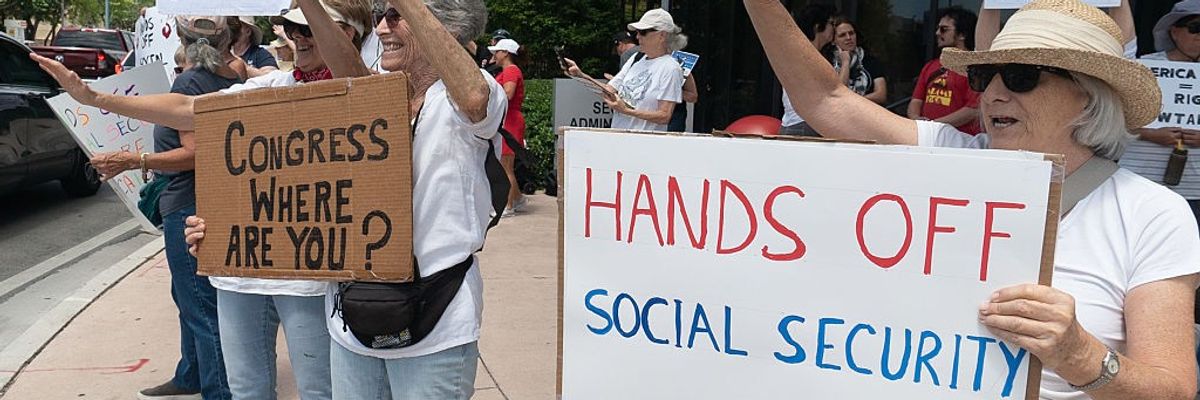
Members of the Miami community, especially senior citizens, gather to protest the new policies applied to the Social Security Administration by the administration of President Donald Trump on the International Labour Day in Miami, United States on May 1, 2025.
(Photo: Jesus Olarte/Anadolu via Getty Images)
Martin BurnsMary Liz Burns
Aug 14, 2025
President Donald Trump has said consistently since 2016 that he would not touch Social Security. I have no doubt that some will dismiss all that we are saying by pointing to Trump’s repeated promises to protect. Rather than focusing on how much a promise from Trump is worth, I would point to the fact that Scott Bessent, Trump’s Treasury secretary who was discussing the Trump Accounts created by the “One Big Beautiful Bill” (OBBB) described them as, “a backdoor for privatizing Social Security. Social Security is a defined benefit plan paid out. To the extent that if, all of a sudden, these accounts grow and you have in the hundreds of thousands of dollars for your retirement, then that’s a game changer, too.”
In March, Axios reported that “Commerce Secretary Howard Lutnick suggested this week that only ‘fraudsters’ would complain about missing a monthly Social Security check, and that most people wouldn’t mind if the government simply skipped a payment.”
All sides agree that Social Security faces some very significant long-term funding challenges. Rather than helping to solve Social Security’s challenges or even have no impact on them, the OBBB weakens Social Security’s finances. As The Hill recently reported: “President Trump’s tax and spending megabill could speed up insolvency for Social Security’s trust funds, according to an analysis from the Trump administration’s chief actuary for the program. The Office of the Chief Actuary (OACT) at the Social Security Administration (SSA) released an analysis this week of the law’s potential effects on the program’s finances in response to a request from Sen. Ron Wyden (D-Ore.), the top Democrat on the Senate Finance Committee.”
Last, but certainly not least, the Trump administration has made large cuts to Social Security staffing that impact its ability to help Americans access their earned benefits. As the Center for Budget and Policy pointed out in June: “Over the past five months, the Trump administration has forced the Social Security Administration (SSA) through a radical transformation that threatens to disrupt services for the largely older and severely disabled people who most rely on the agency. The Trump Administration and its so-called Department of Government Efficiency (DOGE) have created huge gaps in customer service and support by indiscriminately pushing out 7,000 workers to hit an arbitrary staffing reduction target. This is the largest staffing cut in SSA’s history.”
Given all of this, if you really care about Social Security, it is impossible to blithely celebrate its birthday.
So instead of having a piece of birthday cake, make a call to your member of Congress, post on social media about how we need to protect Social Security, and talk to your friends about the need to speak up against threats to your benefits. In other words, don’t celebrate–organize!
Our work is licensed under Creative Commons (CC BY-NC-ND 3.0). Feel free to republish and share widely.
Martin Burns
Martin Burns has worked as a congressional aide, polling analyst, journalist, and lobbyist. He was on the campaign trail for Harris-Walz in Pennsylvania and North Carolina. In addition to Common Dreams, his work has been published by The Hill, Irish Central, and the Byline Times. Martin resides in Washington, DC with his wife, and regular coauthor, Mary Liz. His website is Martinburns.news.
Full Bio >
Mary Liz Burns
Mary Liz Burns is financial education consultant and content creator focusing on personal finance topics including retirement decisions, maximizing Social Security, and managing debt. She is a certified financial behavior specialist® with an MBA specializing in financial psychology, and is based in Washington, D.C.
Full Bio >
(Photo by FPG/Archive Photos/Getty Images)
Max Richtman
Aug 14, 2025
Common Dreams
Social Security turns 90 years old this week! President Franklin D. Roosevelt signed the program into law on August 14, 1935, as insurance against what he called the “hazards and vicissitudes” of life. For a federal program to endure for 90 years and maintain an extremely high level of popularity among the American people is truly extraordinary.
As FDR’s grandson, Jim Roosevelt, put it, “A cake with 90 candles on it would probably be dangerous, but the 90-year success of Social Security should be celebrated in any way possible.”
While we wish we could do nothing but celebrate, the history of Social Security shows that we must always defend the program from those who would privatize or outright eliminate it. These forces have been at work ever since Social Security was enacted. President Roosevelt’s Republican opponent in the 1936 elections, Alf Landon, called Social Security “a fraud on the working man.” Some things never change.
This year, we already have seen unprecedented interference from the Trump administration in the workings of the Social Security Administration (SSA) as part of a phony campaign against “fraud.“ Severe cutbacks in SSA staff and reckless policy changes have made it harder for Americans to access their earned benefits, giving rise to a grassroots ‘Hands Off Social Security’ movement.
The only scheming around Social Security is coming from the White House and its allies in Congress.
Trump’s Treasury secretary revealed the administration’s real agenda when he said that savings accounts for children contained in the president’s Unfair, Ugly Bill were a “backdoor for privatizing Social Security.“
Rampant misinformation and myths about Social Security (spread mainly by the political right) are designed to undermine public support for the program. Both US President Donald Trump and Elon Musk have called Social Security a “Ponzi scheme.” This is the same team who told us that 150 year olds and 300 year olds are somehow collecting benefits. The only scheming around Social Security is coming from the White House and its allies in Congress.
Fortunately, knowledge is power. That is why we produced a new documentary film about the 90-year history of Social Security, a program born in the Great Depression that is equally crucial today as a lifeline for seniors, people with disabilities, and their families.
The documentary, Social Security: 90 Years Strong, was produced through a grant from AARP and is available for download by advocates and community members who would like to hold their own screenings. As the film reveals, Social Security came into being—and lives on—for a reason: It is part of the fabric of American life and must be preserved for the future.
Social Security turns 90 years old this week! President Franklin D. Roosevelt signed the program into law on August 14, 1935, as insurance against what he called the “hazards and vicissitudes” of life. For a federal program to endure for 90 years and maintain an extremely high level of popularity among the American people is truly extraordinary.
As FDR’s grandson, Jim Roosevelt, put it, “A cake with 90 candles on it would probably be dangerous, but the 90-year success of Social Security should be celebrated in any way possible.”
While we wish we could do nothing but celebrate, the history of Social Security shows that we must always defend the program from those who would privatize or outright eliminate it. These forces have been at work ever since Social Security was enacted. President Roosevelt’s Republican opponent in the 1936 elections, Alf Landon, called Social Security “a fraud on the working man.” Some things never change.
This year, we already have seen unprecedented interference from the Trump administration in the workings of the Social Security Administration (SSA) as part of a phony campaign against “fraud.“ Severe cutbacks in SSA staff and reckless policy changes have made it harder for Americans to access their earned benefits, giving rise to a grassroots ‘Hands Off Social Security’ movement.
The only scheming around Social Security is coming from the White House and its allies in Congress.
Trump’s Treasury secretary revealed the administration’s real agenda when he said that savings accounts for children contained in the president’s Unfair, Ugly Bill were a “backdoor for privatizing Social Security.“
Rampant misinformation and myths about Social Security (spread mainly by the political right) are designed to undermine public support for the program. Both US President Donald Trump and Elon Musk have called Social Security a “Ponzi scheme.” This is the same team who told us that 150 year olds and 300 year olds are somehow collecting benefits. The only scheming around Social Security is coming from the White House and its allies in Congress.
Fortunately, knowledge is power. That is why we produced a new documentary film about the 90-year history of Social Security, a program born in the Great Depression that is equally crucial today as a lifeline for seniors, people with disabilities, and their families.
The documentary, Social Security: 90 Years Strong, was produced through a grant from AARP and is available for download by advocates and community members who would like to hold their own screenings. As the film reveals, Social Security came into being—and lives on—for a reason: It is part of the fabric of American life and must be preserved for the future.
- YouTubewww.youtube.com
“Social security is an earned benefit,” says Tracey Gronniger of Justice in Aging, one of the key interviewees in the film. “People work for their entire lives and pay into this program—and we have to make sure that it’s there for them when they are ready to retire or they become disabled.”
Former Sen. Tom Harkin (D-Iowa) closes out the documentary with the powerful plea: “We have to save Social Security. We have to secure it. We have to make it live for future generations.”
The film features appearances by several other notables, including Jim Roosevelt, Sen. Chuck Grassley (R-Iowa), Rep. John Larson (D-Conn.), Nancy Altman (Social Security Works), Bill Arnone (formerly of National Academy of Social Insurance), Kathryn Edwards (Labor Economist), and Giovanna Gray Lockhart (Former Director, Frances Perkins Center).
FDR’s Secretary of Labor, Frances Perkins, who was a prime mover in the creation of the program, probably said it best: “Social security is so firmly embedded in the American psychology today that no politician, no political party, could possibly destroy this act and still maintain our democratic system.” Food for thought, indeed.
“Social security is an earned benefit,” says Tracey Gronniger of Justice in Aging, one of the key interviewees in the film. “People work for their entire lives and pay into this program—and we have to make sure that it’s there for them when they are ready to retire or they become disabled.”
Former Sen. Tom Harkin (D-Iowa) closes out the documentary with the powerful plea: “We have to save Social Security. We have to secure it. We have to make it live for future generations.”
The film features appearances by several other notables, including Jim Roosevelt, Sen. Chuck Grassley (R-Iowa), Rep. John Larson (D-Conn.), Nancy Altman (Social Security Works), Bill Arnone (formerly of National Academy of Social Insurance), Kathryn Edwards (Labor Economist), and Giovanna Gray Lockhart (Former Director, Frances Perkins Center).
FDR’s Secretary of Labor, Frances Perkins, who was a prime mover in the creation of the program, probably said it best: “Social security is so firmly embedded in the American psychology today that no politician, no political party, could possibly destroy this act and still maintain our democratic system.” Food for thought, indeed.
For Social Security’s 90th Birthday, Don’t Celebrate–Organize!
Instead of having a piece of birthday cake, make a call to your member of Congress, post on social media about how we need to protect Social Security, and talk to your friends about the need to speak up against threats to your benefits.
Members of the Miami community, especially senior citizens, gather to protest the new policies applied to the Social Security Administration by the administration of President Donald Trump on the International Labour Day in Miami, United States on May 1, 2025.
(Photo: Jesus Olarte/Anadolu via Getty Images)
Martin BurnsMary Liz Burns
Aug 14, 2025
Common Dreams
This August 14 marks the 90th anniversary of President Franklin Roosevelt signing the Social Security Act into law. This was a huge step forward for America, and our country has been profoundly changed for the better. We quite understandably focus on Social Security’s retirement benefits, but Social Security is much more than this. It is a social insurance policy that helps children whose parents have died and those who are disabled and provides spousal income.
It is very easy to be tempted into celebrating Social Security’s longevity and enjoying a piece of birthday cake. Given the threats to Social Security, as well as other programs like Medicaid, such celebrations are misleading. The best way to mark Social Security’s 90th birthday is to adapt a phrase made famous by the legendary labor organizer Joe Hill: “Don’t celebrate—organize!”
Given the threats to Social Security by the Trump administration in just seven months in office, celebrations are not helpful. Let’s briefly review some of the recent Trump actions that impact your benefits:Weakening confidence in Social Security by alleging widespread fraud. Back in April, Elon Musk, then the self-styled first buddy and head of the Department of Government Efficiency (DOGE), was leveling charges of massive fraud in Social Security. As The New York Times reported, “Elon Musk, the world’s richest man, has continued his campaign to aggressively undercut Social Security, leveling baseless and often misleading attacks on the insurance program.”
This August 14 marks the 90th anniversary of President Franklin Roosevelt signing the Social Security Act into law. This was a huge step forward for America, and our country has been profoundly changed for the better. We quite understandably focus on Social Security’s retirement benefits, but Social Security is much more than this. It is a social insurance policy that helps children whose parents have died and those who are disabled and provides spousal income.
It is very easy to be tempted into celebrating Social Security’s longevity and enjoying a piece of birthday cake. Given the threats to Social Security, as well as other programs like Medicaid, such celebrations are misleading. The best way to mark Social Security’s 90th birthday is to adapt a phrase made famous by the legendary labor organizer Joe Hill: “Don’t celebrate—organize!”
Given the threats to Social Security by the Trump administration in just seven months in office, celebrations are not helpful. Let’s briefly review some of the recent Trump actions that impact your benefits:Weakening confidence in Social Security by alleging widespread fraud. Back in April, Elon Musk, then the self-styled first buddy and head of the Department of Government Efficiency (DOGE), was leveling charges of massive fraud in Social Security. As The New York Times reported, “Elon Musk, the world’s richest man, has continued his campaign to aggressively undercut Social Security, leveling baseless and often misleading attacks on the insurance program.”
President Donald Trump has said consistently since 2016 that he would not touch Social Security. I have no doubt that some will dismiss all that we are saying by pointing to Trump’s repeated promises to protect. Rather than focusing on how much a promise from Trump is worth, I would point to the fact that Scott Bessent, Trump’s Treasury secretary who was discussing the Trump Accounts created by the “One Big Beautiful Bill” (OBBB) described them as, “a backdoor for privatizing Social Security. Social Security is a defined benefit plan paid out. To the extent that if, all of a sudden, these accounts grow and you have in the hundreds of thousands of dollars for your retirement, then that’s a game changer, too.”
In March, Axios reported that “Commerce Secretary Howard Lutnick suggested this week that only ‘fraudsters’ would complain about missing a monthly Social Security check, and that most people wouldn’t mind if the government simply skipped a payment.”
All sides agree that Social Security faces some very significant long-term funding challenges. Rather than helping to solve Social Security’s challenges or even have no impact on them, the OBBB weakens Social Security’s finances. As The Hill recently reported: “President Trump’s tax and spending megabill could speed up insolvency for Social Security’s trust funds, according to an analysis from the Trump administration’s chief actuary for the program. The Office of the Chief Actuary (OACT) at the Social Security Administration (SSA) released an analysis this week of the law’s potential effects on the program’s finances in response to a request from Sen. Ron Wyden (D-Ore.), the top Democrat on the Senate Finance Committee.”
Last, but certainly not least, the Trump administration has made large cuts to Social Security staffing that impact its ability to help Americans access their earned benefits. As the Center for Budget and Policy pointed out in June: “Over the past five months, the Trump administration has forced the Social Security Administration (SSA) through a radical transformation that threatens to disrupt services for the largely older and severely disabled people who most rely on the agency. The Trump Administration and its so-called Department of Government Efficiency (DOGE) have created huge gaps in customer service and support by indiscriminately pushing out 7,000 workers to hit an arbitrary staffing reduction target. This is the largest staffing cut in SSA’s history.”
Given all of this, if you really care about Social Security, it is impossible to blithely celebrate its birthday.
So instead of having a piece of birthday cake, make a call to your member of Congress, post on social media about how we need to protect Social Security, and talk to your friends about the need to speak up against threats to your benefits. In other words, don’t celebrate–organize!
Our work is licensed under Creative Commons (CC BY-NC-ND 3.0). Feel free to republish and share widely.
Martin Burns
Martin Burns has worked as a congressional aide, polling analyst, journalist, and lobbyist. He was on the campaign trail for Harris-Walz in Pennsylvania and North Carolina. In addition to Common Dreams, his work has been published by The Hill, Irish Central, and the Byline Times. Martin resides in Washington, DC with his wife, and regular coauthor, Mary Liz. His website is Martinburns.news.
Full Bio >
Mary Liz Burns
Mary Liz Burns is financial education consultant and content creator focusing on personal finance topics including retirement decisions, maximizing Social Security, and managing debt. She is a certified financial behavior specialist® with an MBA specializing in financial psychology, and is based in Washington, D.C.
Full Bio >
On Social Security's 90th Anniversary, Trump's Attacks on Program Top List of Policies Americans Oppose
Nearly two-thirds of Americans said they disapprove of the Trump administration slashing the Social Security Administration workforce.
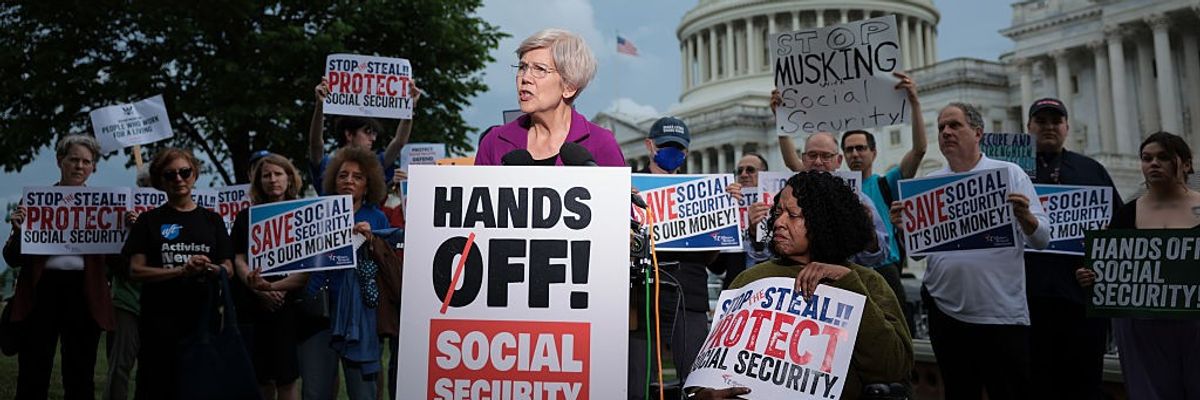
US Sen. Elizabeth Warren (D-Mass.) speaks during a press conference on Social Security in front of the US Capitol on May 5, 2025 in Washington, DC.
(Photo by Kayla Bartkowski/Getty Images)
Julia Conley
Aug 14, 2025
COMMON DREAMS
As the US marked the 90th anniversary of one of its most broadly popular public programs, Social Security, on Thursday, President Donald Trump marked the occasion by claiming at an Oval Office event that his administration has saved the retirees' safety net from "fraud" perpetrated by undocumented immigrants—but new polling showed that Trump's approach to the Social Security Administration is among his most unpopular agenda items.
The progressive think tank Data for Progress asked 1,176 likely voters about eight key Trump administration agenda items, including pushing for staffing cuts at the Social Security Administration; signing the so-called One Big Beautiful Bill Act, which is projected to raise the cost of living for millions as people will be shut out of food assistance and Medicaid; and firing tens of thousands of federal workers—and found that some of Americans' biggest concerns are about the fate of the agency that SSA chief Frank Bisignano has pledged to make "digital-first."
Sixty-three percent of respondents said they oppose the proposed layoffs of about 7,000 SSA staffers, or about 12% of its workforce—which, as progressives including Sens. Bernie Sanders (I-Vt.) and Elizabeth Warren (D-Mass.) have warned, have led to longer wait times for beneficiaries who rely on their monthly earned Social Security checks to pay for groceries, housing, medications, and other essentials.
Forty-five percent of people surveyed said they were "very concerned" about the cuts.
Only the Trump administration's decision not to release files related to the Jeffrey Epstein case was more opposed by respondents, with 65% saying they disapproved of the failure to disclose the documents, which involve the financier and convicted sex offender who was a known friend of the president. But fewer voters—about 39%—said they were "very concerned" about the files.
Among "persuadable voters"—those who said they were as likely to vote for candidates from either major political party in upcoming elections—70% said they opposed the cuts to Social Security.
The staffing cuts have forced Social Security field offices across the country to close, and as Sanders said Wednesday as he introduced the Keep Billionaires Out of Social Security Act, the 1-800 number beneficiaries have to call to receive their benefits "is a mess," with staffers overwhelmed due to the loss of more than 4,000 employees so far.
As Common Dreams reported in July, another policy change this month is expected to leave senior citizens and beneficiaries with disabilities unable to perform routine tasks related to their benefits over the phone, as they have for decades—forcing them to rely on a complicated online verification process.
Late last month, Treasury Secretary Scott Bessent admitted that despite repeated claims from Trump that he won't attempt to privatize Social Security, the One Big Beautiful Bill Act offers a "backdoor way" for Republicans to do just that.
The law's inclusion of tax-deferred investment accounts called "Trump accounts" that will be available to US citizen children starting next July could allow the GOP to privatize the program as it has hoped to for decades.
"Right now, the Trump administration and Republicans in Congress are quietly creating problems for Social Security so they can later hand it off to their private equity buddies," said Sen. Sheldon Whitehouse (D-R.I.) on Thursday.
Marking the program's 90th anniversary, Sanders touted his Keep Billionaires Out of Social Security Act.
"This legislation would reverse all of the cuts that the Trump administration has made to the Social Security Administration," said Sanders. "It would make it easier, not harder, for seniors and people with disabilities to receive the benefits they have earned over the phone."
"Each and every year, some 30,000 people die—they die while waiting for their Social Security benefits to be approved," said Sanders. "And Trump's cuts will make this terrible situation even worse. We cannot and must not allow that to happen.
Nearly two-thirds of Americans said they disapprove of the Trump administration slashing the Social Security Administration workforce.
US Sen. Elizabeth Warren (D-Mass.) speaks during a press conference on Social Security in front of the US Capitol on May 5, 2025 in Washington, DC.
(Photo by Kayla Bartkowski/Getty Images)
Julia Conley
Aug 14, 2025
COMMON DREAMS
As the US marked the 90th anniversary of one of its most broadly popular public programs, Social Security, on Thursday, President Donald Trump marked the occasion by claiming at an Oval Office event that his administration has saved the retirees' safety net from "fraud" perpetrated by undocumented immigrants—but new polling showed that Trump's approach to the Social Security Administration is among his most unpopular agenda items.
The progressive think tank Data for Progress asked 1,176 likely voters about eight key Trump administration agenda items, including pushing for staffing cuts at the Social Security Administration; signing the so-called One Big Beautiful Bill Act, which is projected to raise the cost of living for millions as people will be shut out of food assistance and Medicaid; and firing tens of thousands of federal workers—and found that some of Americans' biggest concerns are about the fate of the agency that SSA chief Frank Bisignano has pledged to make "digital-first."
Sixty-three percent of respondents said they oppose the proposed layoffs of about 7,000 SSA staffers, or about 12% of its workforce—which, as progressives including Sens. Bernie Sanders (I-Vt.) and Elizabeth Warren (D-Mass.) have warned, have led to longer wait times for beneficiaries who rely on their monthly earned Social Security checks to pay for groceries, housing, medications, and other essentials.
Forty-five percent of people surveyed said they were "very concerned" about the cuts.
Only the Trump administration's decision not to release files related to the Jeffrey Epstein case was more opposed by respondents, with 65% saying they disapproved of the failure to disclose the documents, which involve the financier and convicted sex offender who was a known friend of the president. But fewer voters—about 39%—said they were "very concerned" about the files.
Among "persuadable voters"—those who said they were as likely to vote for candidates from either major political party in upcoming elections—70% said they opposed the cuts to Social Security.
The staffing cuts have forced Social Security field offices across the country to close, and as Sanders said Wednesday as he introduced the Keep Billionaires Out of Social Security Act, the 1-800 number beneficiaries have to call to receive their benefits "is a mess," with staffers overwhelmed due to the loss of more than 4,000 employees so far.
As Common Dreams reported in July, another policy change this month is expected to leave senior citizens and beneficiaries with disabilities unable to perform routine tasks related to their benefits over the phone, as they have for decades—forcing them to rely on a complicated online verification process.
Late last month, Treasury Secretary Scott Bessent admitted that despite repeated claims from Trump that he won't attempt to privatize Social Security, the One Big Beautiful Bill Act offers a "backdoor way" for Republicans to do just that.
The law's inclusion of tax-deferred investment accounts called "Trump accounts" that will be available to US citizen children starting next July could allow the GOP to privatize the program as it has hoped to for decades.
"Right now, the Trump administration and Republicans in Congress are quietly creating problems for Social Security so they can later hand it off to their private equity buddies," said Sen. Sheldon Whitehouse (D-R.I.) on Thursday.
Marking the program's 90th anniversary, Sanders touted his Keep Billionaires Out of Social Security Act.
"This legislation would reverse all of the cuts that the Trump administration has made to the Social Security Administration," said Sanders. "It would make it easier, not harder, for seniors and people with disabilities to receive the benefits they have earned over the phone."
"Each and every year, some 30,000 people die—they die while waiting for their Social Security benefits to be approved," said Sanders. "And Trump's cuts will make this terrible situation even worse. We cannot and must not allow that to happen.
Sanders Bill Would Fight Trump Effort to 'Dismantle Social Security'
"On the 90th anniversary of Social Security, our job must be to reverse these disastrous cuts, expand Social Security, and make it easier, not harder, for Americans to receive the benefits they have earned and deserve."
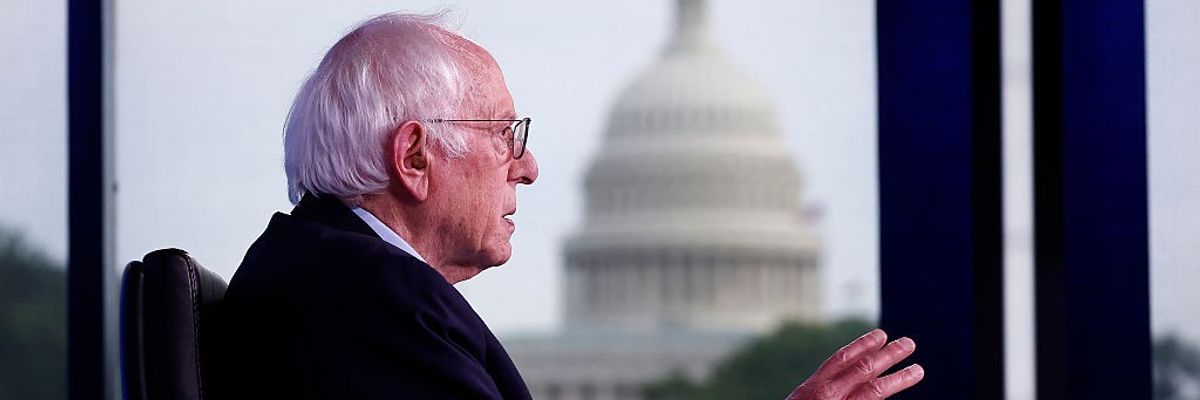
U.S. Sen. Bernie Sanders (I-Vt.) appears on at Fox News on May 7, 2025 in Washington, D.C.
(Photo: Paul Morigi/Getty Images)
Jessica Corbett
Aug 13, 2025
COMMON DREAMS
U.S. Sen. Bernie Sanders on Wednesday introduced the Keep Billionaires Out of Social Security Act, legislation intended to thwart President Donald Trump's attacks on the agency that administers benefits for millions of seniors and other Americans.
In a statement introducing his bill, Sanders (I-Vt.) called out not only Trump but also Elon Musk, who is the richest person on Earth and led the president's Department of Government Efficiency (DOGE) until he left the administration in May.
"Since Trump has been in office, he has been working overtime with the wealthiest man in the world, Elon Musk, to dismantle Social Security and undermine the faith that the American people have in this vitally important program," Sanders said. "Thousands of Social Security staff have lost their jobs, seniors and people with disabilities are having a much harder time receiving the benefits they have earned, field offices have been shut down, and the 1-800 number is a mess."
"That is beyond unacceptable," the senator declared, just days before a key milestone for the law that led to the Social Security Administration (SSA). "On the 90th anniversary of Social Security, our job must be to reverse these disastrous cuts, expand Social Security, and make it easier, not harder, for Americans to receive the benefits they have earned and deserve. That's precisely what this legislation will do."
As Sanders' office summarized, the bill aims to defend Americans and their benefits by:Protecting and improving Americans' access to Social Security offices—prohibiting closures, relocations, and service reductions, reversing Trump's layoffs, and ensuring Americans can speak to real people to get their benefits;
Increasing funding by $5 billion to improve customer service, modernize technology, and reduce backlogs;
Restoring assistance for vulnerable and disabled people to access their benefits;
Safeguarding Americans' data and stopping Trump's politicization of Social Security; and
Removing DOGE's authority and calling for an independent investigation into DOGE's actions at SSA.
The bill is backed by 20 other members of the Senate Democratic Caucus, including Majority Leader Chuck Schumer (D-N.Y.), and several organizations, including Social Security Works, Alliance for Retired Americans, National Committee to Preserve Social Security and Medicare, and the American Federation of State, County, and Municipal Employees.
Sanders introduced the bill on the same day that he joined former Social Security Commissioner Martin O'Malley, U.S. Reps. Debbie Dingell (D-Mich.) and John Larson (D-Conn.), and Sen. Ron Wyden (D-Ore.)—a co-sponsor of the new legislation—for a Protect Our Checks town hall, hosted by Unrig Our Economy, Social Security Works, and the Center for American Progress Action Fund.
Late last month, Treasury Secretary Scott Bessent "openly bragged about plans to use a back door to privatize Social Security and hand the benefits of working families over to those folks on Wall Street," Wyden pointed out. "Trump's so-called promise to protect Social Security, in my view, is about as real as his promise to protect Medicaid—no substance, big consequences for American seniors and families walking on an economic tightrope."
The so-called One Big Beautiful Bill Act that Republicans passed and the president signed in July is expected to strip Medicaid and other key assistance, including food stamps, from millions of Americans in the next decade.
Wednesday's town hall also featured testimony from Social Security recipients, including Judith Brown, who explained that "at 37, I became disabled. It was devastating, because I was a young mother to two sons [that] are on the autism spectrum."
"When my sons needed additional medical support, I was able to get care for them because of their Social Security benefits. Without those benefits, we would have been homeless on the street," Brown continued. "Social Security has always been there for us over all these years. Right now, this administration is bent on stripping us of our benefits that we paid into during our working years... We cannot allow this to happen. Social Security must be protected and expanded. Our entire existence is on the line, and we must fight to protect Social Security."
Unrig Our Economy spokesperson Saryn Francis said that "Republican tariffs are driving up prices at the grocery store, their bills are raising the cost of healthcare and electricity, and they've even found time to hand out more tax breaks to billionaires, and now they want to mess with Social Security, and we are not going to let them take that away from us."
Francis noted that "this weekend, with over 50 events across the country, Americans are rallying in a massive effort to support Social Security and calling on congressional Republicans to stop threatening what hardworking people have earned and need to survive."
"On the 90th anniversary of Social Security, our job must be to reverse these disastrous cuts, expand Social Security, and make it easier, not harder, for Americans to receive the benefits they have earned and deserve."
U.S. Sen. Bernie Sanders (I-Vt.) appears on at Fox News on May 7, 2025 in Washington, D.C.
(Photo: Paul Morigi/Getty Images)
Jessica Corbett
Aug 13, 2025
COMMON DREAMS
U.S. Sen. Bernie Sanders on Wednesday introduced the Keep Billionaires Out of Social Security Act, legislation intended to thwart President Donald Trump's attacks on the agency that administers benefits for millions of seniors and other Americans.
In a statement introducing his bill, Sanders (I-Vt.) called out not only Trump but also Elon Musk, who is the richest person on Earth and led the president's Department of Government Efficiency (DOGE) until he left the administration in May.
"Since Trump has been in office, he has been working overtime with the wealthiest man in the world, Elon Musk, to dismantle Social Security and undermine the faith that the American people have in this vitally important program," Sanders said. "Thousands of Social Security staff have lost their jobs, seniors and people with disabilities are having a much harder time receiving the benefits they have earned, field offices have been shut down, and the 1-800 number is a mess."
"That is beyond unacceptable," the senator declared, just days before a key milestone for the law that led to the Social Security Administration (SSA). "On the 90th anniversary of Social Security, our job must be to reverse these disastrous cuts, expand Social Security, and make it easier, not harder, for Americans to receive the benefits they have earned and deserve. That's precisely what this legislation will do."
As Sanders' office summarized, the bill aims to defend Americans and their benefits by:Protecting and improving Americans' access to Social Security offices—prohibiting closures, relocations, and service reductions, reversing Trump's layoffs, and ensuring Americans can speak to real people to get their benefits;
Increasing funding by $5 billion to improve customer service, modernize technology, and reduce backlogs;
Restoring assistance for vulnerable and disabled people to access their benefits;
Safeguarding Americans' data and stopping Trump's politicization of Social Security; and
Removing DOGE's authority and calling for an independent investigation into DOGE's actions at SSA.
The bill is backed by 20 other members of the Senate Democratic Caucus, including Majority Leader Chuck Schumer (D-N.Y.), and several organizations, including Social Security Works, Alliance for Retired Americans, National Committee to Preserve Social Security and Medicare, and the American Federation of State, County, and Municipal Employees.
Sanders introduced the bill on the same day that he joined former Social Security Commissioner Martin O'Malley, U.S. Reps. Debbie Dingell (D-Mich.) and John Larson (D-Conn.), and Sen. Ron Wyden (D-Ore.)—a co-sponsor of the new legislation—for a Protect Our Checks town hall, hosted by Unrig Our Economy, Social Security Works, and the Center for American Progress Action Fund.
Late last month, Treasury Secretary Scott Bessent "openly bragged about plans to use a back door to privatize Social Security and hand the benefits of working families over to those folks on Wall Street," Wyden pointed out. "Trump's so-called promise to protect Social Security, in my view, is about as real as his promise to protect Medicaid—no substance, big consequences for American seniors and families walking on an economic tightrope."
The so-called One Big Beautiful Bill Act that Republicans passed and the president signed in July is expected to strip Medicaid and other key assistance, including food stamps, from millions of Americans in the next decade.
Wednesday's town hall also featured testimony from Social Security recipients, including Judith Brown, who explained that "at 37, I became disabled. It was devastating, because I was a young mother to two sons [that] are on the autism spectrum."
"When my sons needed additional medical support, I was able to get care for them because of their Social Security benefits. Without those benefits, we would have been homeless on the street," Brown continued. "Social Security has always been there for us over all these years. Right now, this administration is bent on stripping us of our benefits that we paid into during our working years... We cannot allow this to happen. Social Security must be protected and expanded. Our entire existence is on the line, and we must fight to protect Social Security."
Unrig Our Economy spokesperson Saryn Francis said that "Republican tariffs are driving up prices at the grocery store, their bills are raising the cost of healthcare and electricity, and they've even found time to hand out more tax breaks to billionaires, and now they want to mess with Social Security, and we are not going to let them take that away from us."
Francis noted that "this weekend, with over 50 events across the country, Americans are rallying in a massive effort to support Social Security and calling on congressional Republicans to stop threatening what hardworking people have earned and need to survive."