Tuesday, September 23, 2025


Chile’s Corfo agency preps lithium contracts ahead of SQM-Codelco deal

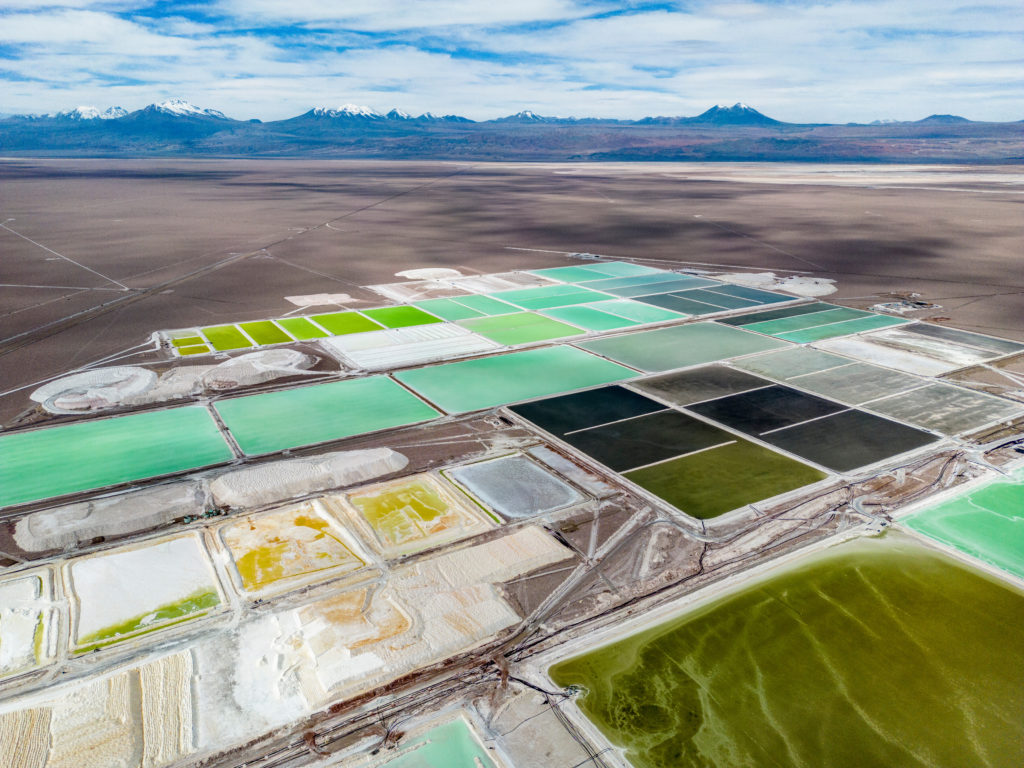
Stock image.

Chilean economic development agency Corfo said on Monday it has submitted to the comptroller’s office the terms of a modified lease agreement with lithium producer SQM through 2030, and of a new 2031-2060 lease for a joint venture between SQM and state copper producer Codelco.

SQM and Codelco are expected to finalize a partnership this year in the Atacama salt flat in northern Chile that will mark the state’s first major foray into lithium production

Corfo, which leases mining rights in the Atacama salt flat, said in a statement that its board last week approved the final version of the contracts.

They include lease payments tied to lithium prices and contributions. The contributions will be distributed to local governments and Indigenous communities to promote investment and fund development, and the contracts also outline stronger environmental requirements for clean energy and water use.

Corfo will also maintain its preferential pricing program for companies that seek to produce lithium-related products in Chile, it said.

Corfo added that it will lead a “monitoring table” for representatives of Indigenous communities to track the commitments made by SQM and Codelco.

Codelco, in a separate statement, said the new Corfo contracts will ensure operational continuity, environmental standards and respect for communities.

The partnership still requires the approval of Chinese antitrust regulators after other countries signed off, the last condition to finalize the deal.

(By Fabian Cambero; Editing by Daina Beth Solomon)

United States Antimony stock jumps after $245M Pentagon contract win

ALL CAPITALI$M IS $TATE CAPITALI$M

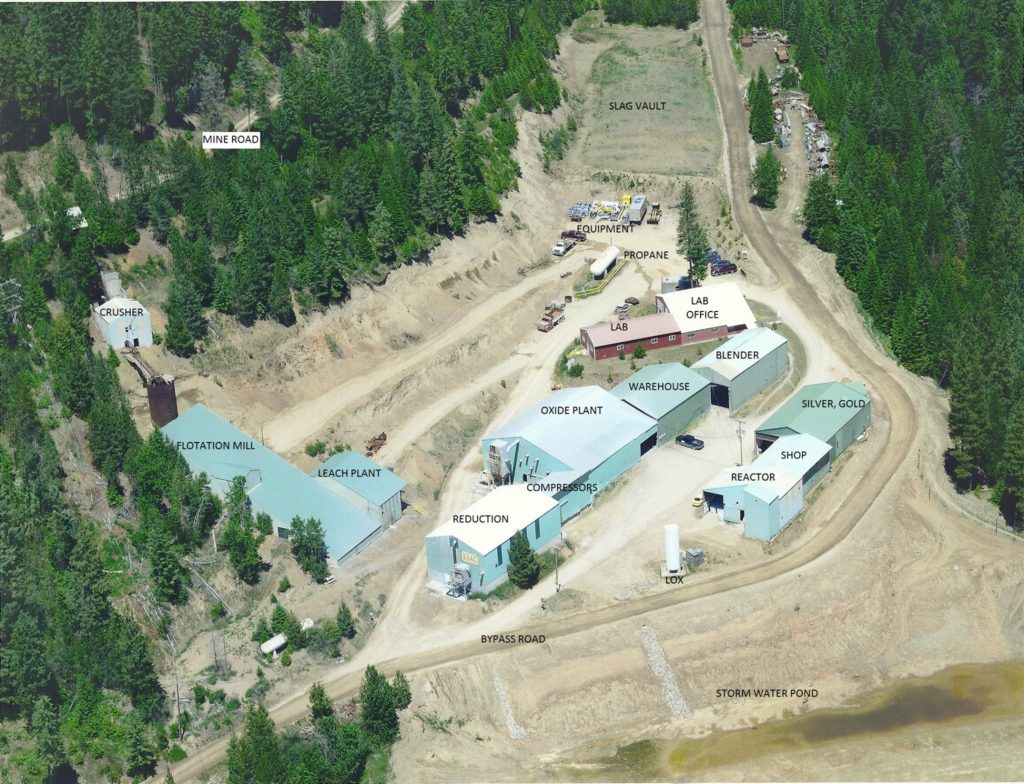
Layout of US Antimony’s operations. Credit: United States Antimony Corp.

United States Antimony Corporation (NYSE: UAMY) has secured a sole-source, five-year contract worth up to $245 million from the US Defense Logistics Agency (DLA) to supply antimony metal ingots for the national defense stockpile.

The news sent US Antimony’s shares soaring 17.8% in New York trading on Tuesday, pushing the company’s market capitalization to about $975 million.

Securing domestic supply

Antimony, a grey metal listed by the US as critical to national and economic security, is used in defense and high-tech applications including flame-retardant materials, certain semiconductors, ammunition primers, and superhard alloys. The US has not produced antimony commercially since 2016, making domestic supply a priority.

United States Antimony operates the only two smelters in North America with long-standing capacity to process the metal. According to the company, both facilities are already capable of producing ingots that meet stringent military specifications, with first deliveries under the contract expected this week.

US Antimony has been working to expand its feedstock base, sourcing ore globally while advancing domestic projects. Mining recently began on its Alaska acreage, with initial results showing high-grade deposits that the company says will enable efficient processing and contribute to the US supply chain. It is also advancing acreage in Montana.

The company emphasized that competing antimony sources, whether from the US or abroad, are at least three years away from commercial-scale production and may not meet defense standards.

Chairman and CEO Gary C. Evans called the Pentagon contract a “meaningful milestone” for the company and its employees.

“This sole-source award underscores our unique position as the only fully integrated antimony operation outside China,” Evans said, highlighting the significance of winning a government contract worth nearly 17 times the company’s 2024 revenue of $14.9 million.

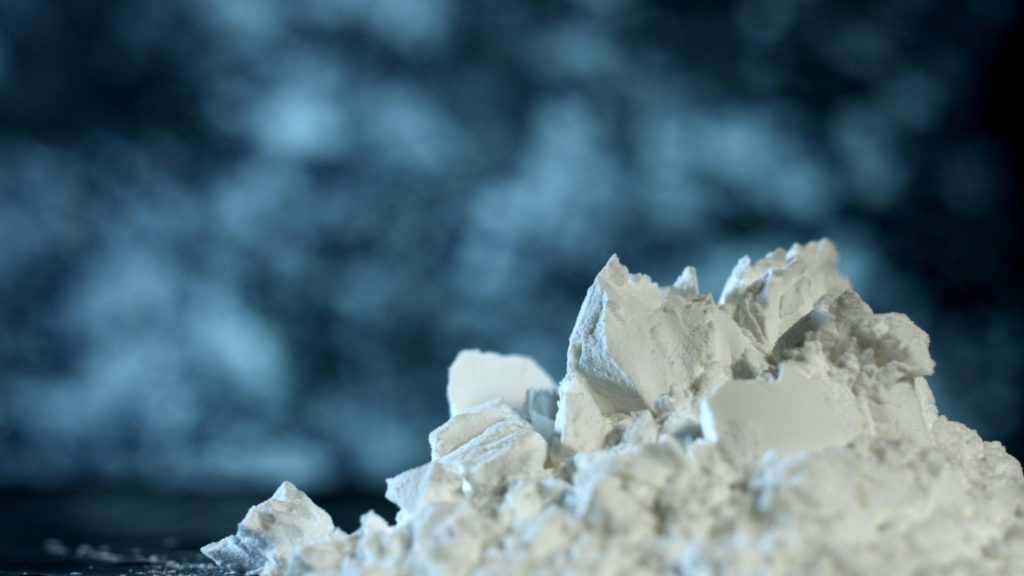
Founded decades ago, US Antimony Corporation produces and markets antimony, zeolite, and precious metals across the US and Canada. Its Montana facility processes ore into antimony oxide, antimony metal, and antimony trisulfide while also recovering gold and silver. Its Bear River Zeolite operation in Idaho supplies materials for water filtration, nuclear waste treatment, agriculture, and other industrial uses.

US agency wants to buy scandium oxide from Rio Tinto for defence stockpile


Scandium. Image from Rio Tinto.

The US Defense Logistics Agency is seeking to buy scandium oxide worth up to $40 million over the next five years from a unit of mining giant Rio Tinto to secure supplies of the critical material for addition to the national stockpile.

Scandium is one of the rare earth elements, whose importance to the Western defence and technology sectors has been in the spotlight since China, the main producer, imposed export controls.

“Scandium, until recently, was primarily sourced from China. In late 2024, China placed export controls on scandium, which constrained the supply chain and prompted this acquisition for the National Defense Stockpile,” DLA said in a document published last week.

It intends to buy 6.4 metric tons of scandium oxide within five years.

In the first year it will be seeking almost 2 tons, equivalent to about 5% of last year’s global production of scandium oxide, which, according to US Geological Survey, totalled 40 tons with existing capacity of 80 tons.

To increase domestic supply of scandium, the US awarded up to $10 million to Elk Creek Resources, a unit of NioCorp Developments, in August.

However, for now the US government has to seek the product, used in many defence systems, from outside the country.


“Rio Tinto Services Inc. has been identified as the only vendor available capable of fulfilling the government’s required product needs at the capacity required for the contract,” the document said.

Rio Tinto said it would not comment on commercial matters, but added that it was “actively collaborating with the US government to identify opportunities and leverage available support to increase domestic production and strengthen supply chains for the American market.”

In 2020, Rio Tinto’s scientists became the first to develop a process which allows the extraction of high-purity scandium oxide from waste streams of titanium dioxide production, without the need for any additional mining.

“Rio Tinto is uniquely positioned to help secure materials critical to America’s future,” the group said in an emailed reply to a Reuters‘ request for comment.

Rio Tinto’s facility in Quebec, Canada produced the first batch of scandium oxide three years ago and currently has the annual production capacity of 3 metric tons.

(By Polina Devitt; Editing by Ros Russell)


BAN DEEP SEA MINING

Oceans protection law to tighten squeeze on seabed miners


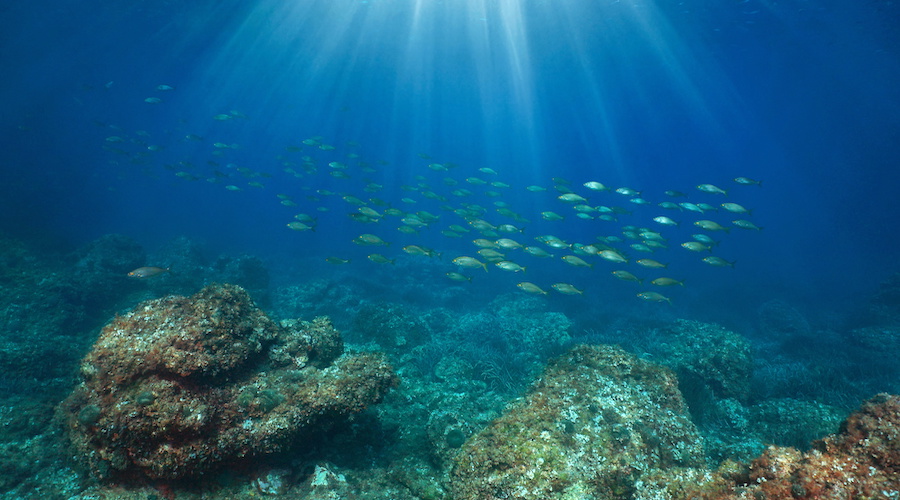
The High Seas treaty does not mention mining directly, but requires governments to co-operate with agencies. (Stock image by dam | Adobe Stock)

A newly ratified treaty to safeguard life at sea is expected to intensify opposition to deep-sea mining at a United Nations climate summit this week in New York, running alongside the leaders’ general assembly.

The High Seas Treaty, officially known as the Biodiversity Beyond National Jurisdiction (BBNJ) agreement, will enter into force in January next year. This was made possible after Morocco became the 60th nation to ratify it on Friday, crossing the threshold required for UN treaties. 

Two decades in the making, the pact allows the creation of vast conservation zones in international waters, with the goal of protecting 30% of the ocean and halting biodiversity loss by 2030.

Although the treaty does not mention mining directly, it requires governments to co-operate with agencies such as the Jamaica-based International Seabed Authority (ISA), which has yet to approve commercial mining in international waters.

Environmentalists welcomed the breakthrough. “This is a conservation opportunity that happens once in a generation, if that,” Lisa Speer, director of the International Oceans Program at the Natural Resources Defense Council, said in a statement.

WWF International director general Kirsten Schuijt called it a “turning point for two-thirds of the world’s ocean that lie beyond national jurisdiction.”

Not a barrier

Despite environmentalist backlash, countries are pushing ahead with plans to extract minerals from the ocean floor. Hours after the treaty crossed the ratification threshold, India signed a 15-year contract with the ISA granting it exclusive rights to explore polymetallic sulphides in the Indian Ocean. New Delhi now holds the largest ISA-assigned exploration zone for these deposits and has conducted deep-sea trials in the region.

India is also seeking exploration licences for nickel, manganese and copper in the Pacific ocean.

France is the only G7 nation to have ratified the High Sees treaty so far, but more are expected to do so at this week’s UN climate summit in New York.

The US signed the treaty under the Biden administration, but President Trump has not ratified it and it is unclear whether he will. Washington has moved to allocate mining licences to private companies, bypassing the UN-backed regulator

The Trump administration views seabed mining as a strategy to secure critical minerals and cut reliance on foreign supply chains. A White House official said the industry could generate 100,000 jobs and add hundreds of billions to the US economy over the next decade.

Companies are moving quickly. California-based Impossible Metals has applied for exploration rights both under US law and through the ISA, targeting the Clarion-Clipperton Zone (CCZ) in the Pacific, which holds nodules rich in copper, nickel, manganese and other metals vital for electric vehicles. 

Canada’s The Metals Company (TMC) filed for a commercial permit in April and secured an $85.2 million investment from South Korea’s Korea Zinc in June.The deal positioned Korea Zinc as a non-Chinese alternative capable of refining TMC’s extracted materials into battery-grade metals.

Scramble beneath

Beyond the US, nations including the Cook IslandsJapan and Norway are advancing seabed mining within their territorial waters, citing a looming supply crunch. The International Energy Agency (IEA) projects demand for copper and rare earth elements will jump 40% by 2040, while lithium, cobalt and nickel could rise by as much as 90%.

Industry advocates argue that seabed extraction has a smaller environmental footprint than land-based mining. Opponents counter that the deep ocean remains poorly understood, and disrupting fragile ecosystems could unleash cascading effects on marine life.


New study in "geology" on how diamonds make their rapid ascent


Geological Society of America


Boulder, Colo., USA: If you’ve ever held or beheld a diamond, there’s a good chance it came from a kimberlite. Over 70% of the world’s diamonds are mined from these unique volcanic structures. Yet despite decades of study, scientists are still working to understand how exactly kimberlites erupt from deep in Earth’s mantle to the surface.

Kimberlites—carrot-shaped volcanic pipes that erupt from mantle depths greater than 150 km—have long fascinated geologists as windows into the deep Earth. Their mantle-derived melt ascends rapidly through the mantle and crust, with some estimates suggesting ascent rates of up to 80 miles per hour before kimberlites erupt violently at the surface. Along the way, the magma captures xenoliths and xenocrysts, fragments of the rocks encountered on its path.

“They’re very interesting and still very enigmatic rocks,” despite being well-studied, says Ana Anzulović, a doctoral research fellow at the University of Oslo’s Centre for Planetary Habitability.

In a study published this month in the journal Geology, Anzulović and colleagues from the University of Oslo have taken a major step toward solving the puzzle. By modelling how volatile compounds like carbon dioxide and water influence the buoyancy of proto-kimberlite melt relative to surrounding materials, they quantified for the first time what it takes to erupt a kimberlite.

Diamonds make it to the surface in kimberlites because their rapid ascent prevents them from reverting to graphite, which is more stable at shallow pressures and temperatures. But the composition of the kimberlite’s original melt—and how it rises so fast—has remained mysterious.

“They start off as something that we cannot measure directly,” says Anzulović. “So we don’t know what a proto-kimberlite, or parental, melt would be like. We know approximately but everything we know basically comes from the very altered rocks that get emplaced.”

To constrain the composition of these parental melts, the team focused on the Jericho kimberlite, which erupted into the Slave craton of far northwest Canada. Using chemical modelling, they tested different original mixtures of carbon dioxide and water.

“Our idea was, well, let’s try to create a chemical model of a kimberlite, then vary CO2 and H2O,” says Anzulović. “Think of it as trying to sample a kimberlite as it ascends at different pressure and temperature points.”

The researchers used molecular dynamics software to simulate atomic forces and track how atoms in a kimberlite melt move under varying depths. From these calculations, they determined the density of the melt at different conditions and whether it remained buoyant enough to rise.

“The most important takeaway from this study is that we managed to constrain the amount of CO2 that you need in the Jericho kimberlite to successfully ascend through the Slave craton,” Anzulović says. “Our most volatile-rich composition can carry up to 44% of mantle peridotite, for example, to the surface, which is really an impressive number for such a low viscosity melt.”

The study also shows how volatiles play distinct roles. Water increases diffusivity, keeping the melt fluid and mobile. Carbon dioxide helps structure the melt at high pressures but, near the surface, it degasses and drives the eruption upward. For the first time, researchers demonstrated that the Jericho kimberlite needs at least 8.2% CO2 to erupt; without it, diamonds would remain locked in the mantle.

“I was actually pretty surprised that I can take such a small scale system and actually observe, ‘Okay, if I don’t put any carbon in, this melt will be denser than the craton, so this will not erupt,’” says Anzulović. “It’s great that modeling kimberlite chemistry can have implications for such a large-scale process.”

FEATURED ARTICLE
ABuoyancy of volatile-rich kimberlite melts, magma ascent, and xenolith transport

Ana Anzulović, Anne H. Davis, Carmen Gaina, and Razvan Caracas
Contact: Ana Anzulović, University of Oslo, anaanz@uio.no

GEOLOGY articles published ahead of print are online at https://pubs.geoscienceworld.org/geology/early-publication. Representatives of the media may obtain complimentary copies of articles by contacting Kalen Landow. Please discuss articles of interest with the authors before publishing stories on their work, and please make reference to GEOLOGY in articles published. Non-media requests for articles may be directed to GSA Sales and Service, gsaservice@geosociety.org.

About the Geological Society of America

The Geological Society of America (GSA) is a global professional society with more than 17,000 members across over 100 countries. As a leading voice for the geosciences, GSA advances the understanding of Earth's dynamic processes and fosters collaboration among scientists, educators, and policymakers. GSA publishes Geology, the top-ranked geoscience journal, along with a diverse portfolio of scholarly journals, books, and conference proceedings—several of which rank among Amazon's top 100 best-selling geology titles.

###

Botswana seeks securing control of De Beers by October

De Beers sources about 70% of its diamonds from Botswana. (Image courtesy of De Beers)

Botswana is accelerating efforts to secure control of De Beers as parent company Anglo American (LON: AAL) moves forward with plans to divest its 85% stake in the diamond giant.

President Duma Boko said his government intends to finalize a deal by the end of October, despite ongoing negotiations between Anglo and other potential buyers. He confirmed Botswana is in talks with partners, including Oman’s sovereign wealth fund, to help finance the deal.

“We are more than ready for the transaction and we’ve said the transaction must be concluded by the end of October,” Boko told Bloomberg News. “It’s a matter of economic sovereignty for Botswana.”

Securing a controlling stake would raise Botswana’s interest in De Beers above 50%. The company sources about 70% of its rough diamonds from the country, making the deal a strategic priority for Gaborone.

Adverse market

De Beers, the world’s leading diamond producer by value, has been on the block since May 2024, when Anglo announced it would sell the unit or consider an initial public offering (IPO). This decision came after the miner fended off a £39 billion ($49 billion) takeover bid by Australian rival BHP (ASX: BHP) and launched a broad restructuring.

Anglo has since delayed the sale amid a prolonged slump in the natural diamonds market, pressured by rising demand for cheaper lab-grown alternatives.

The miner has twice cut De Beers’ valuation, most recently to $4.1 billion in February. In the first half, De Beers swung to a $189 million loss from a $300 million profit a year earlier as revenues fell 10% to $2 billion from $2.2 billion.


Tallvine Partners Launches North America Marine Infrastructure Platform

Tallvine Partners

Published Sep 22, 2025 7:56 PM by The Maritime Executive


[By: Tallvine Partners]

Tallvine Partners (“Tallvine”), an independent investment advisor focused on value-add middle-market infrastructure opportunities, today announced the acquisition of Donjon Marine Co., LLC (“Donjon Marine”), a critical marine infrastructure platform based in New Jersey with operations across the U.S. The acquisition marks the creation of Tallvine’s third platform and the establishment of its North American marine infrastructure strategy. Terms of the transaction were not disclosed.

Donjon Marine is a leader in critical marine infrastructure with a comprehensive suite of essential solutions for the operation and maintenance of North America’s waterways, coastal regions, and harbor infrastructure. John A. Witte, Jr., a seasoned executive with over four decades of experience in the maritime sector, will continue to lead the business as its CEO, alongside Thomas and Paul Witte, as part of the platform’s executive team. In addition, Thoroughbred LLC (“Thoroughbred”)—led by Co-Founders and Managing Partners Charles Wesley and Aaron Bowlds—will serve as industrial partner in the platform. Together, the group brings extensive operational expertise and deep industry relationships to drive the platform’s growth.

“The launch of our marine infrastructure platform and acquisition of Donjon Marine underscore our commitment to investing in resilient, essential infrastructure that supports global commerce, advances environmental stewardship, and delivers stable, recurring cash flows,” said Thomas Lefebvre, Partner & CEO of Tallvine Partners. “With its long-standing reputation for safety, excellence, and service, Donjon Marine is an ideal cornerstone for this platform. We are thrilled to partner with the Witte family and Donjon Marine’s executive team, world-class leaders in the marine sector, to drive the platform’s growth together.”

Donjon Marine, founded in 1964 and headquartered in Hillside, New Jersey, is a premier marine infrastructure platform, renowned for its expertise in dredging solutions, salvage operations and emergency response, heavy lift and towing capabilities, and environmental remediation. With a fleet of more than 70 specialized vessels, over 1,000 linear feet of berth space, and an estimated daily spoils processing capacity of 4,500 cubic yards in the New York and New Jersey harbors, Donjon Marine and its skilled team of over 270 employees have been essential in maintaining navigable waterways and accessible harbor infrastructure, responding to maritime emergencies, and delivering complex infrastructure projects across the U.S. and abroad. Donjon Marine also operates a shipyard in the Great Lakes, equipped with a 1,250 feet by 120 feet by 22 feet (depth over sill) dry dock and has more than 200,000 square feet of production area on 44 acres of land. The company will continue to operate under the Donjon Marine brand.

Victor Sosa, Partner at Tallvine Partners, added: “We view this acquisition and partnership as a highly compelling opportunity to build a leading marine infrastructure platform across North America. We look forward to working closely with the team to pursue exciting initiatives, including expanding our geographic reach and service offerings, driving the growth and modernization of our fleet, and executing strategic acquisitions in the sector.”

“This is a truly transformative moment for Donjon Marine, and I am thrilled and honored to continue leading the platform,” said John A. Witte, Jr., CEO of Donjon Marine. “With a shared commitment to long-term investment, strategic growth, and innovation, we are poised to build upon Donjon Marine’s proud legacy, expand our reach, and continue to provide the highest level of service to our clients while seizing exciting new opportunities in the marine industry.”

The products and services herein described in this press release are not endorsed by The Maritime Executive.


The Sanctions Game

There's no limit to human ingenuity, especially when there's oil and gas involved

Bosporus
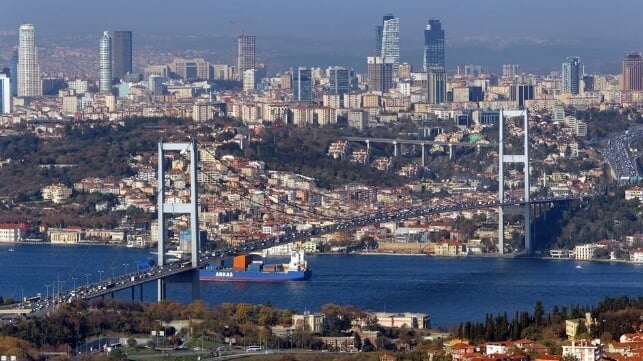
Traffic on the Bosporus, the Turkish-controlled seaway connecting Russia's Black Sea ports with the world

Published Sep 22, 2025 10:04 AM by Erik Kravets


(Article originally published in July/Aug 2025 edition.)


Here's an extreme example of globalization's tenacity and resilience: Russia, while subject to over 30,000 separate sanctions from nations around the world, has nevertheless exported $913 billion of oil and gas these past few years. The lion's share – $213 billion – was sold to the E.U., which is, now as before, Russia's biggest rival and customer. How can this happen? And why?

I've said before that cargo, like water, will find its path from seller to buyer. When that cargo is critical, as it is in the global energy markets, imagine the political and economic pressure. Even if 30,159 sanctions stand in the way of a deal, it's likely to just happen.

In "No Coffee for You" in the May/June 2024 edition, I noted that origin paperwork for the E.U.'s Supply Chain Act might be "cut to fit." And while I personally consider coffee, not crude, to be the true "black gold," caffeine is small change compared to fossil fuels.

WORKAROUNDS

Buyers and sellers are relentless in their drive to find workarounds for their businesses. They've loaded their cargoes onto Moscow's 600-vessel "shadow fleet," avoided port calls using ship-to-ship transfers of oil and gas in international waters, hidden vessel ownership behind spiderwebbed shell companies and management arrangements and gotten around origin rules by blending Russian and non-sanctioned fuels together.

Yet the most audacious workaround is not a tactic, but a country: Turkey. Turkey offers a systematic, structured way to indirectly but legally do business with Russia – a way that economically benefits itself, Russia and the companies that fear violating sanctions. The reason is found in Turkey's tricky diplomatic history.

Turkey is nominally a Western ally with European aspirations, but its interactions with the U.S. and E.U. have suffered from strategic frictions. In 2003, Turkey's parliament refused to let U.S. troops use Incirlik Air Base for the Iraq War. In 2016, when Turkish President Recep Tayyip Erdo?an was targeted by a military coup, the U.S. rejected Turkey's demand for the extradition of Fetullah Gülen, a critic of Erdo?an.

During the Syrian civil war, the U.S. armed Kurdish fighters whom Turkey deemed terrorists. Then, more recently, Turkey purchased Russian S-400 missiles, which broke its military compatibility with NATO, of which Turkey is a member, and led to its exclusion from the F-35 fighter program. And throughout, Cyprus has blocked Turkey's E.U. membership due to its illegal 1974 invasion of the island.

That list of issues is long and potentially crippling. Perhaps, then, the surprise is not that Turkey is looking for other dance partners but that bouncers haven't escorted it out?

RUSSIAN/TURKISH COOPERATION

Apart from a few difficult moments, Russia has over time deepened and broadened its connection to Turkey. Evidently, Russia and Turkey see enough strategic value in each other, or need each other enough, to mend rifts as they appear.

In November 2015, for example, Turkey shot down a Russian Su-24 fighter jet during the Syrian civil war. Russian leader Vladimir Putin called it "a stab in the back" and imposed sanctions on Turkey. It looked like the end of the line. Yet within seven months, Erdo?an sent a letter of apology and, remarkably, the two countries emerged with stronger ties than before.

A review of Turkish and Russian projects shows, overall, a broad spectrum of successful cooperation that helps sustain the relationship. Beginning with the Astana partnership between Turkey, Iran and Russia that paralleled U.N. efforts to broker a Syrian ceasefire, then continuing through the $23 billion TurkStream natural gas pipeline and the $20 billion Akkuyu nuclear plant, which Russia is building and maintaining, Turkey has leaned on Russia to reduce its dependence on the U.S. and E.U.

In charting a diplomatic course between major powers, Turkey has recast Mediterranean trade by allowing Russia an outlet – geographically and economically – for its oil and natural gas. While doing so, Turkey has threaded the needle with its Western partners: The E.U. is Turkey's biggest trading partner, and NATO's Article 5 provides Turkey a security guarantee that Russia, especially now, cannot match.

Turkey has implemented only sanctions that have been ratified by the U.N. Security Council, such as the ones targeting North Korea. So transactions with Russia that would be prohibited under U.S. or E.U. rules remain legal in Turkey. This has led to frustration for some and opportunity for others.

Al-Arabiya quoted a senior U.S. Treasury official, who asked to remain anonymous: "We've shared our concerns with the Turkish government and private sector and informed them of the significant risks of doing business with those we've sanctioned who are tied to Russia's war."

But Russia's ships passing through the Dardanelles and the Bosporus are protected under international treaty law by the 1936 Montreux Convention, at least during peacetime. And the otherwise permissive legal and diplomatic environment in Turkey encourages Turkish companies to acquire Russian business whenever possible.

In 2023, for example, one company transported 49 million barrels of Russian oil, leading the U.K. to sanction it in February 2024. But its Russian oil operation didn't stop. It just moved down the hall. Three other Turkish companies with the same address and the same owners took over.

A COMPLETE ECOSYSTEM

The scale of Turkey's blending and re-exporting operations can be derived from statistics. Turkey's purchasing of Russian oil products went up 105 percent from 2023-2024, but its domestic oil consumption grew just eight percent – so it's not satisfying domestic demand. A refinery in Izmir, Turkey, reportedly processes 98 percent Russian crude, mostly from Lukoil. These refined oil products are labeled "Turkish" and become legal for export to the E.U.

Similar loopholes are permitted by the E.U. when it comes to blending. In late 2023, one terminal in Ceyhan, Turkey received 26,923 tons of gasoil from Novorossiysk, then legally exported a similar quantity to a refinery in Greece ten days later, per the Centre for Research on Energy and Clean Air.

Meanwhile, Turkish shipping lines have captured 55 percent of the Russian-Black Sea container market. International carriers abandoned this market, and Turkish firms expanded services specifically for Russian routes. One such line, launched in May 2022, offers its Novorossiysk Express Service to connect Russian ports with Turkish facilities and railways.

And then there are the Turkish banks affiliated with the Credit Bank of Moscow. The most famous of these facilitated payments from buyers and transferred proceeds to Russian banking institutions after taking off its own commission. The comprehensive oil-for-credit scheme it was running legally bypassed traditional Western financial channels.

In aggregate, Turkey has pursued an approach that has led to the establishment of other maritime clusters: a combination of clearinghouse services, financing, vessel management, port and terminal operations and shipyards for repair and refit. What is unique is the complete ecosystem that Turkey offers, which enables Russian trade to flow while Western competitors face compliance problems and legal obstacles.

AN INDISPENSABLE SERVICE

The key is that Turkey has cleverly maintained strategic leverage in both directions. Cyprus and the United Arab Emirates (UAE), both significant Russian gateways, have not fared as well. Cyprus is constantly pressured by the E.U. while the UAE, according to the Atlantic Council, has been gray-listed by the G7's Financial Action Task Force.

Right now, Turkey is providing Russia and the E.U. with an indispensable service. But, as Charles de Gaulle said, "The graveyards are full of indispensable men."

The opinions expressed herein are the author's and not necessarily those of The Maritime Executive.
 

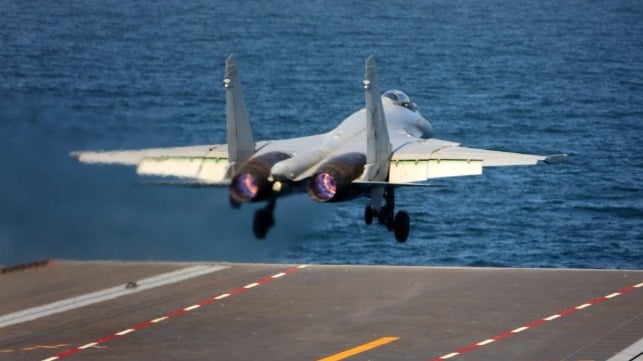
China's Navy Releases First Video of Electromagnetic Catapult Launches

PLA Navy jet fighter launch
Courtesy PLA Navy

Published Sep 22, 2025 7:23 PM by The Maritime Executive


For the first time, China's PLA Navy has released video footage of aircraft launch and recovery with a catapult aboard the new carrier Fujian, which leapfrogged steam technology and jumped straight to electromagnetic launch. 

The new carrier Fujian is currently operating in the South China Sea on a final shakedown cruise prior to its commissioning date. A newly-released video shows that at some point this year, it launched and recovered at least three different PLA Navy aircraft - the J-15T fighter, the J-35 stealth fighter and the KJ-600 airborne early warning plane. These are the three key components of its air wing. 

Fujian is China's first catapult-equipped carrier, and adds significantly to the capabilities of the Soviet-designed Liaoning and Shandong. Both of these previous-generation carriers have a ski-jump ramp at the bow, an arrangement that lacks the accelerating force a catapult provides on a carrier's ultra-short runway. Launches performed from a ski-jump carrier are typically limited in fuel and weapons stores, restricting the combat range and capability of the air wing; however, as an incremental starting point towards modern carrier aviation, these two older vessels have provided China with invaluable training time for pilots and sailors. 

Fujian's launch system is superficially similar to the electromagnetic aircraft launch system (EMALS) aboard the USS Gerald R. Ford, the U.S. Navy's new $13 billion supercarrier, raising considerable speculation about the source of the engineering. The Chinese carrier is the first anywhere outside of the U.S. to incorporate this technology; unlike Ford, which houses two nuclear reactors to generate electricity for the launch system, Fujian is conventionally powered. 

Fujian brings new capabilities to the South China Sea, not just in firepower but also in signaling to China's rivals. "Only those with ill intentions would feel nervous" about the carrier's presence, Chinese military commentator Fu Qianshao told state outlet Global Times earlier this month. 


China's Victory Day Parade: A Tale of Two Audiences

Beijing’s military showcase revealed the challenge of projecting strength abroad while maintaining confidence at home.

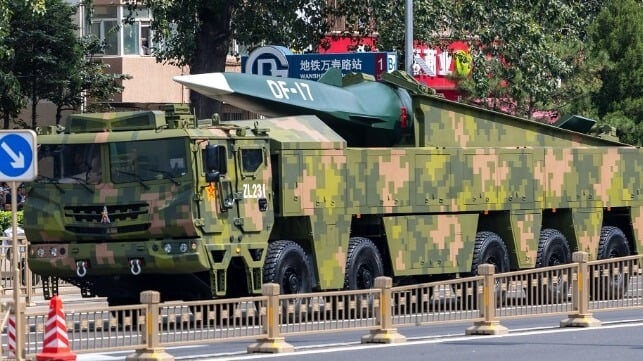
A PLA hypersonic antiship missile on display at Beijing's WWII victory parade (Weibo / ????)

Published Sep 22, 2025 9:07 PM by The Lowy Interpreter


The twin messages from the spectacle that unfolded in Tiananmen Square on September 3 could not be missed. China’s military parade, watched over by Xi Jinping as he stood shoulder-to-shoulder with Vladimir Putin and Kim Jong-un to commemorate the 80th anniversary of Japan’s surrender in the Second World War, was carefully calibrated for distinctly different audiences at home and abroad.

For domestic consumption, the parade served as a powerful reassurance during uncertain times, particularly around the economy. The helicopters flying above the display of military might carried banners proclaiming “Justice shall prevail”, “Peace shall prevail”, and “People shall prevail” as a promise that China’s rise remains inexorable despite Western containment efforts.

Crucially, the parade allowed Xi to demonstrate that China isn’t isolated despite American pressure. The presence of 26 foreign leaders, down from the 30 who attended in 2015, still projected an image of diplomatic vitality. For Chinese citizens bombarded with news about trade restrictions and technology bans, seeing their president flanked by fellow world leaders was intended to offer comfort that China maintains meaningful international partnerships.

The international messaging, however, operated on an entirely different frequency. The unprecedented public alignment of Xi, Putin, and Kim wasn’t subtle – it was calculated. This visual representation of what some analysts term the “axis of upheaval” sent an unmistakable signal that China has options beyond Western engagement. The timing, coming as US President Donald Trump pursues aggressive trade policies toward China, transformed the parade into a geopolitical statement about alternative world orders.

The military hardware on display carried specific messages for different international audiences. The DF-61 intercontinental ballistic missiles spoke directly to American defense planners, while the Yingji-series hypersonic anti-ship missiles – tested against mock US aircraft carriers – delivered pointed warnings about China’s anti-access capabilities in the Indo-Pacific. The revelation of undersea drones and cyber warfare units signalled China’s commitment to asymmetric capabilities that could neutralize traditional American advantages.

But not every message could be controlled. The conspicuous absence of Indian Prime Minister Modi, despite his presence in China for the Shanghai Cooperation Organisation summit, highlighted the parade’s politically charged nature. Japan’s reported efforts to discourage attendance, and the subsequent Chinese protest, underscored how competing historical narratives continue to shape contemporary regional dynamics.

The subsequent invocation of shared wartime history suggests Beijing recognizes the need to balance its new alignments with maintaining workable relations with Washington.

The parade sought to appeal to the Global South. By framing the event as anti-fascist rather than anti-Western, and by securing attendance from leaders across Africa, Asia, and Latin America, though not pursuing formal alliances as its principle, China positioned itself as leading a coalition of nations seeking alternatives to Western hegemony while maintaining its principle of non-alliance partnerships rather than formal military blocs. The presence of leaders such as Myanmar’s Min Aung Hlaing and Zimbabwe’s Emmerson Mnangagwa – both isolated by Western sanctions – reinforced China’s role as patron to regimes marginalized by the existing international order.

Xi’s declaration that “the Chinese nation is never intimidated by any bullies” gave voice to the divergent messaging strategies. Domestically, this rhetoric taps into the narrative of China suffering centuries of humiliation, rallying nationalist sentiment around the Chinese Communist Party’s leadership. Internationally, it signals China’s willingness to confront what it perceives as American aggression, even at the risk of further deteriorating relations. Rather than seeking to reassure international audiences about China’s peaceful rise – the dominant narrative of the previous decade – Beijing now appears comfortable projecting strength even at the cost of heightened tensions. The prominence given to the DF-5C, alongside China’s public acknowledgement of its nuclear modernization after years of obfuscation, reflects China’s calculation that its economic leverage and military capabilities have reached a threshold where accommodation with the West is no longer essential.

Yet this dual messaging strategy carries inherent risks. The domestic promise of inevitable triumph may prove difficult to sustain if China’s economic challenges deepen. Internationally, the explicit alignment with Russia and North Korea may accelerate the very containment China seeks to avoid, pushing fence-sitting nations towards American partnerships. Trump’s response, accusing the three leaders of “conspiring against the United States” while at the same time reaffirming his “very good relationship” with Xi, exemplifies the complex reactions Beijing’s assertiveness generates.

This complexity deepened during Trump and Xi’s 19 September phone call, where both leaders emphasized that the United States and China had fought together as allies in the Second World War – a historical reminder that seemed to deliberately contrast with the 3 September parade’s display of alternative partnerships. The parade sought to portray China as unapologetically assertive abroad while reassuringly confident at home. Yet the subsequent invocation of shared wartime history suggests Beijing recognizes the need to balance its new alignments with maintaining workable relations with Washington.

As Beijing continues navigating between these sometimes contradictory imperatives, the effectiveness of this messaging strategy will largely determine whether China’s rise continues to challenge or ultimately upends the existing international order. For policymakers observing from capitals worldwide, understanding these divergent messages – from parade-ground assertions of new partnerships to phone-call reminders of old ones – isn’t merely academic, it is essential for anticipating China’s future trajectory.

Sophie Wushuang Yi is a Postdoctoral Teaching Fellow at Schwarzman College, Tsinghua University, specializing in international relations, military and strategic studies, and China’s foreign policy.

The opinions expressed herein are the author's and not necessarily those of The Maritime Executive.