China's Navy Releases First Video of Electromagnetic Catapult Launches
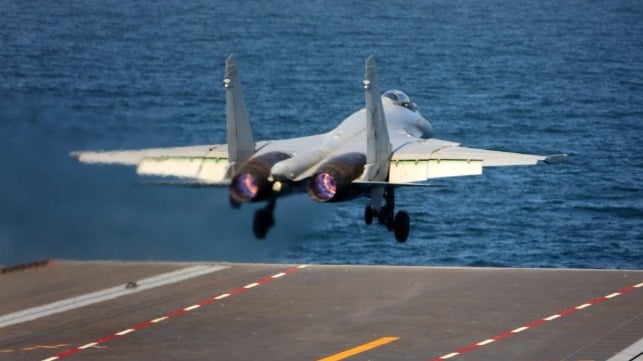
For the first time, China's PLA Navy has released video footage of aircraft launch and recovery with a catapult aboard the new carrier Fujian, which leapfrogged steam technology and jumped straight to electromagnetic launch.
The new carrier Fujian is currently operating in the South China Sea on a final shakedown cruise prior to its commissioning date. A newly-released video shows that at some point this year, it launched and recovered at least three different PLA Navy aircraft - the J-15T fighter, the J-35 stealth fighter and the KJ-600 airborne early warning plane. These are the three key components of its air wing.
Fujian is China's first catapult-equipped carrier, and adds significantly to the capabilities of the Soviet-designed Liaoning and Shandong. Both of these previous-generation carriers have a ski-jump ramp at the bow, an arrangement that lacks the accelerating force a catapult provides on a carrier's ultra-short runway. Launches performed from a ski-jump carrier are typically limited in fuel and weapons stores, restricting the combat range and capability of the air wing; however, as an incremental starting point towards modern carrier aviation, these two older vessels have provided China with invaluable training time for pilots and sailors.
Fujian's launch system is superficially similar to the electromagnetic aircraft launch system (EMALS) aboard the USS Gerald R. Ford, the U.S. Navy's new $13 billion supercarrier, raising considerable speculation about the source of the engineering. The Chinese carrier is the first anywhere outside of the U.S. to incorporate this technology; unlike Ford, which houses two nuclear reactors to generate electricity for the launch system, Fujian is conventionally powered.
Fujian brings new capabilities to the South China Sea, not just in firepower but also in signaling to China's rivals. "Only those with ill intentions would feel nervous" about the carrier's presence, Chinese military commentator Fu Qianshao told state outlet Global Times earlier this month.
China's Victory Day Parade: A Tale of Two Audiences
Beijing’s military showcase revealed the challenge of projecting strength abroad while maintaining confidence at home.
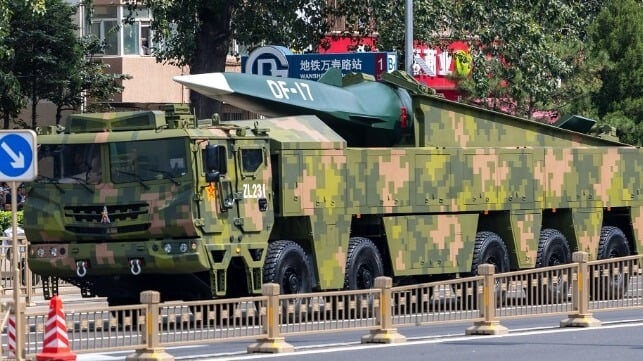
The twin messages from the spectacle that unfolded in Tiananmen Square on September 3 could not be missed. China’s military parade, watched over by Xi Jinping as he stood shoulder-to-shoulder with Vladimir Putin and Kim Jong-un to commemorate the 80th anniversary of Japan’s surrender in the Second World War, was carefully calibrated for distinctly different audiences at home and abroad.
For domestic consumption, the parade served as a powerful reassurance during uncertain times, particularly around the economy. The helicopters flying above the display of military might carried banners proclaiming “Justice shall prevail”, “Peace shall prevail”, and “People shall prevail” as a promise that China’s rise remains inexorable despite Western containment efforts.
Crucially, the parade allowed Xi to demonstrate that China isn’t isolated despite American pressure. The presence of 26 foreign leaders, down from the 30 who attended in 2015, still projected an image of diplomatic vitality. For Chinese citizens bombarded with news about trade restrictions and technology bans, seeing their president flanked by fellow world leaders was intended to offer comfort that China maintains meaningful international partnerships.
The international messaging, however, operated on an entirely different frequency. The unprecedented public alignment of Xi, Putin, and Kim wasn’t subtle – it was calculated. This visual representation of what some analysts term the “axis of upheaval” sent an unmistakable signal that China has options beyond Western engagement. The timing, coming as US President Donald Trump pursues aggressive trade policies toward China, transformed the parade into a geopolitical statement about alternative world orders.
The military hardware on display carried specific messages for different international audiences. The DF-61 intercontinental ballistic missiles spoke directly to American defense planners, while the Yingji-series hypersonic anti-ship missiles – tested against mock US aircraft carriers – delivered pointed warnings about China’s anti-access capabilities in the Indo-Pacific. The revelation of undersea drones and cyber warfare units signalled China’s commitment to asymmetric capabilities that could neutralize traditional American advantages.
But not every message could be controlled. The conspicuous absence of Indian Prime Minister Modi, despite his presence in China for the Shanghai Cooperation Organisation summit, highlighted the parade’s politically charged nature. Japan’s reported efforts to discourage attendance, and the subsequent Chinese protest, underscored how competing historical narratives continue to shape contemporary regional dynamics.
The subsequent invocation of shared wartime history suggests Beijing recognizes the need to balance its new alignments with maintaining workable relations with Washington.
The parade sought to appeal to the Global South. By framing the event as anti-fascist rather than anti-Western, and by securing attendance from leaders across Africa, Asia, and Latin America, though not pursuing formal alliances as its principle, China positioned itself as leading a coalition of nations seeking alternatives to Western hegemony while maintaining its principle of non-alliance partnerships rather than formal military blocs. The presence of leaders such as Myanmar’s Min Aung Hlaing and Zimbabwe’s Emmerson Mnangagwa – both isolated by Western sanctions – reinforced China’s role as patron to regimes marginalized by the existing international order.
Xi’s declaration that “the Chinese nation is never intimidated by any bullies” gave voice to the divergent messaging strategies. Domestically, this rhetoric taps into the narrative of China suffering centuries of humiliation, rallying nationalist sentiment around the Chinese Communist Party’s leadership. Internationally, it signals China’s willingness to confront what it perceives as American aggression, even at the risk of further deteriorating relations. Rather than seeking to reassure international audiences about China’s peaceful rise – the dominant narrative of the previous decade – Beijing now appears comfortable projecting strength even at the cost of heightened tensions. The prominence given to the DF-5C, alongside China’s public acknowledgement of its nuclear modernization after years of obfuscation, reflects China’s calculation that its economic leverage and military capabilities have reached a threshold where accommodation with the West is no longer essential.
Yet this dual messaging strategy carries inherent risks. The domestic promise of inevitable triumph may prove difficult to sustain if China’s economic challenges deepen. Internationally, the explicit alignment with Russia and North Korea may accelerate the very containment China seeks to avoid, pushing fence-sitting nations towards American partnerships. Trump’s response, accusing the three leaders of “conspiring against the United States” while at the same time reaffirming his “very good relationship” with Xi, exemplifies the complex reactions Beijing’s assertiveness generates.
This complexity deepened during Trump and Xi’s 19 September phone call, where both leaders emphasized that the United States and China had fought together as allies in the Second World War – a historical reminder that seemed to deliberately contrast with the 3 September parade’s display of alternative partnerships. The parade sought to portray China as unapologetically assertive abroad while reassuringly confident at home. Yet the subsequent invocation of shared wartime history suggests Beijing recognizes the need to balance its new alignments with maintaining workable relations with Washington.
As Beijing continues navigating between these sometimes contradictory imperatives, the effectiveness of this messaging strategy will largely determine whether China’s rise continues to challenge or ultimately upends the existing international order. For policymakers observing from capitals worldwide, understanding these divergent messages – from parade-ground assertions of new partnerships to phone-call reminders of old ones – isn’t merely academic, it is essential for anticipating China’s future trajectory.
Sophie Wushuang Yi is a Postdoctoral Teaching Fellow at Schwarzman College, Tsinghua University, specializing in international relations, military and strategic studies, and China’s foreign policy.
The opinions expressed herein are the author's and not necessarily those of The Maritime Executive.

No comments:
Post a Comment