Sunday, November 09, 2025


U.S. Shipyard Workers Blast White House's Suspension of Chinese Ship Fees
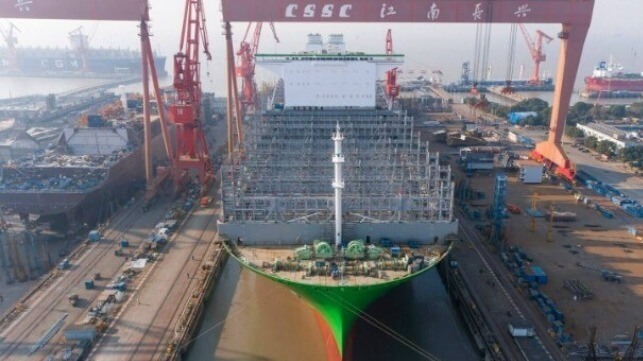
CSSC
File image courtesy CSSC

Published Nov 9, 2025 4:20 PM by The Maritime Executive


When the Trump administration agreed to suspend its Section 301 port fees on Chinese shipping late last month, America's shipbuilding unions interpreted the deal as a betrayal. U.S. shipyards did not comment on the suspension formally, but their employees were vocal in their displeasure. 

The fee suspension has been interpreted as a sign of the leverage that Beijing has in Washington, thanks to a combination of China's importance to American soy farmers and Chinese exports of rare earth elements. Since 2011, Beijing has worked hard to consolidate its rare earths industry into half a dozen large conglomerates - the "Big Six" - which together control about 90 percent of global processing capacity. In October, ahead of trade talks with U.S. President Donald Trump, Beijing announced a new licensing system that would allow it to tightly meter out all exports of products containing Chinese rare earths. Virtually all high-tech weaponry requires these ingredients to manufacture, and metering the rare earth supply would give China de facto control over the production rate of U.S. fighter jets and missiles. Chinese buyers also stopped importing American soy altogether, cutting off about half of American soy farmers' export market.

After talks between Xi Jinping and Donald Trump in Busan, China agreed to buy American soybeans at normal levels and to hold off on its rare earth export restrictions. In exchange, the Trump administration gave up its port fees on Chinese ships for one year - relinquishing the cornerstone of its plans for renewing America's shipbuilding industry. The fees were supposed to disincentivize Chinese ship orders and (with accompanying legislation) provide a funding stream for subsidizing American shipyards. After the announcement of the fee suspension, international ordering activity at Chinese shipyards jumped back up - and American shipbuilding workers noticed.

"American workers throughout the shipbuilding and maritime supply chains were cautiously optimistic, hopeful that the 'decades of government neglect' identified by the administration as having weakened our nation’s shipbuilding capacity were finally coming to an end," wrote the United Steelworkers, International Brotherhood of Boilermakers and other unions in a joint statement. "Following this retreat, workers who know all too well the boom-and-bust nature of American shipbuilding are again being pushed aside, even as new commercial orders — worth billions of dollars — flow back into Chinese shipyards."

The unions noted that the fee suspension removes any disincentives for buying Chinese ships, and eliminates a potential source of funding for the Maritime Security Trust Fund as outlined in the SHIPS for America Act - contrary to the President’s Executive Order on Restoring Maritime Dominance. 

While the pause drew the ire of unions, the Section 301 fee suspension has broad support from American importers, exporters, energy firms, and international shipping interests. Among many others, the European Community Shipowners Associations, International Chamber of Shipping, Chamber of Shipping of America, Union of Greek Shipowners, American Petroleum Institute, American Fuel & Petrochemical Manufacturers, National Retail Federation, and American Soybean Association all wrote in support of the unencumbered use of Chinese ships at American seaports. 

The Asian Shipowners Association went one step further and expressed its hope that "the agreed suspension evolves into a permanent arrangement" - an outcome that Beijing will press for again next year.

The opinions expressed herein are the author's and not necessarily those of The Maritime Executive.

CLIMATE CRISIS

Philippines evacuates more than a million, at least two die as super typhoon nears

The Philippines evacuated more than a million people on Sunday and at least two people died as super typhoon Fung-wong moved west towards the archipelago nation. The storm is set to bring wind and heavy rain to broad swathes of the country just one week after another typhoon, Kalmaegi, killed hundreds of people.


Issued on: 09/11/2025 - 
By: FRANCE 24
Video by: Eliza HERBERT


Nearly a million people have been evacuated as the Philippines prepares for super Typhoon Fung-wong in Remedios. © Erwin Mascarinas, AFP
01:48


Super Typhoon Fung-wong slammed into the Philippines' eastern seaboard on Sunday, the national weather service said, after killing at least two people and forcing more than a million to evacuate.

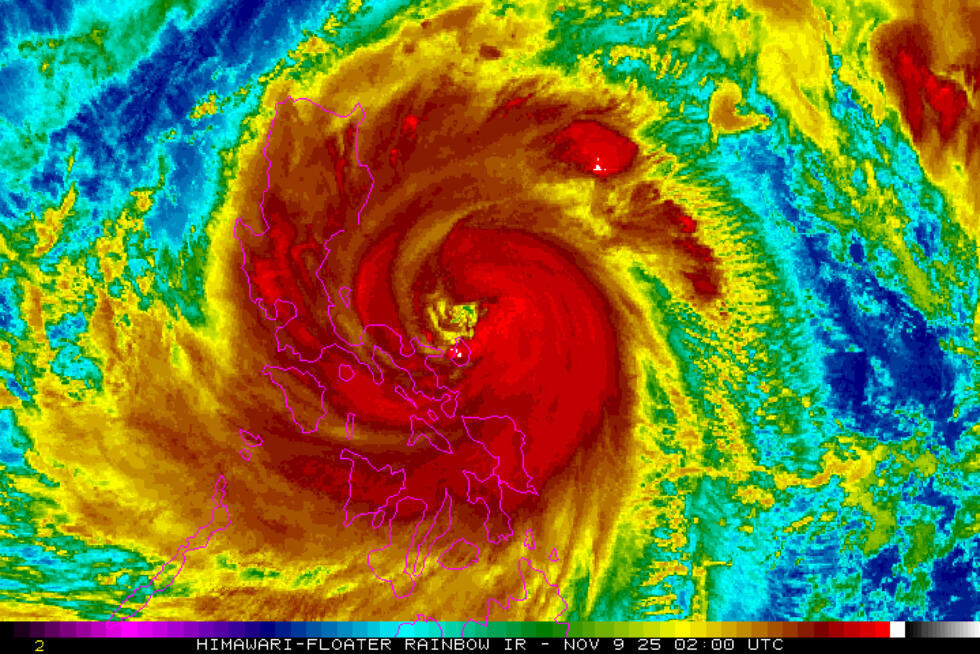
The storm, with a radius spanning nearly the whole of the Philippines, made landfall in Aurora province on the main island of Luzon at 9:10 pm (1310 GMT), the state forecaster reported.

Fung-wong is expected to bring wind and heavy rain to swathes of the archipelago nation, which just last week saw more than 220 people killed by Typhoon Kalmaegi.

Earlier Sunday, one of the already storm-stricken provinces in the central Philippines recorded the first known death from the new typhoon.

Rescuer Juniel Tagarino in Catbalogan City told AFP the body of a 64-year-old woman attempting to evacuate had been pulled out from under debris and fallen trees.

The Philippines' Catanduanes island could take a direct hit from Typhoon Fung-wong. © Facebook user Edson Casarino via AFP


"The wind was so strong and the rain was heavy... According to her family members, she might have forgotten something and went back inside her house," Tagarino said.

The civil defence office later confirmed a second death, a person who drowned in a flash flood on Catanduanes island.

In Aurora, where the eye of the storm made landfall, government worker Aries Ora was boarding up his home in Dipaculao town with steel sheets and wooden boards.

"What really scares us is that the expected landfall is at night," the 34-year-old told AFP earlier on Sunday.

"Unlike previous typhoons, we won't be able to clearly see the movement of the wind and what's happening around us."

Further north, in Cagayan province, people sheltering in an evacuation centre told AFP that fear of flooding had convinced them to leave their homes.

"We often suffer flooding in our home, so when we were told to evacuate, we evacuated, because we would be trapped," said Loretta Salquina.

"The typhoon might blow away our roofs... We're safer here."

Schools and government offices have been ordered closed on Monday across the main island of Luzon, including the capital Manila, where nearly 300 flights have been cancelled.


This handout from the US' National Oceanic and Atmospheric Administration taken on November 9 shows satellite imagery of super typhoon Fung-wong as it approaches the Philippines. © National Oceanic and Atmospheric Administration National Environmental Satellite, Data, and Information Service via AFP

'The ground was shaking'


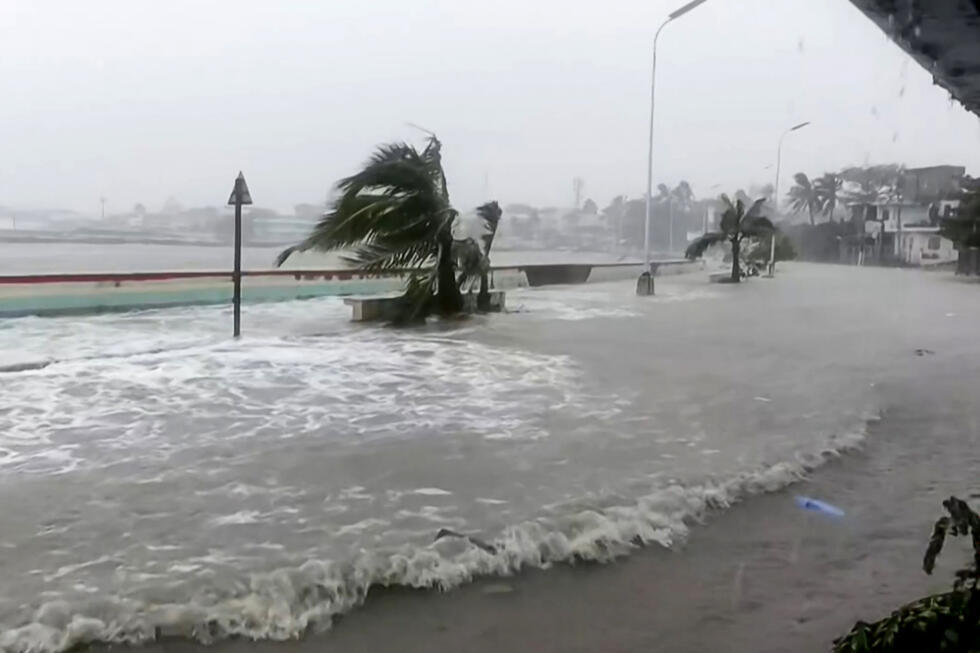
Catanduanes, a small island that the state weather service said could take a "direct hit", was already being lashed by wind and rain early Sunday, with storm surges sending waves hurtling over streets and floodwaters rising in some areas.

"The waves started roaring around 7:00 am. When the waves hit the seawall, it felt like the ground was shaking," Edson Casarino, 33, a resident of Catanduanes' Virac town, told AFP.

Video verified by AFP showed a church in the town surrounded by floodwaters that reached halfway up its entrance.

Flooding was also reported in southern Luzon's Bicol region, according to civil defence deputy administrator Rafaelito Alejandro, who later confirmed the preemptive evacuation of nearly 1.2 million people nationwide.

In Guinobatan, a town of about 80,000 in the region's Albay province, verified video showed streets transformed into a raging torrent of floodwaters.

Typhoon Fung-wong is expected to bring at least 200 millimetres (eight inches) of rain to many parts of the country, according to government meteorologists.

Scientists warn that storms are becoming more powerful due to human-driven climate change. Warmer oceans allow typhoons to strengthen rapidly, and a warmer atmosphere holds more moisture, meaning heavier rainfall.

'Strapping down the roofs'


On Saturday, Catanduanes rushed to prepare for the onslaught, with residents tying down their houses with ropes and putting weights on their roofs.

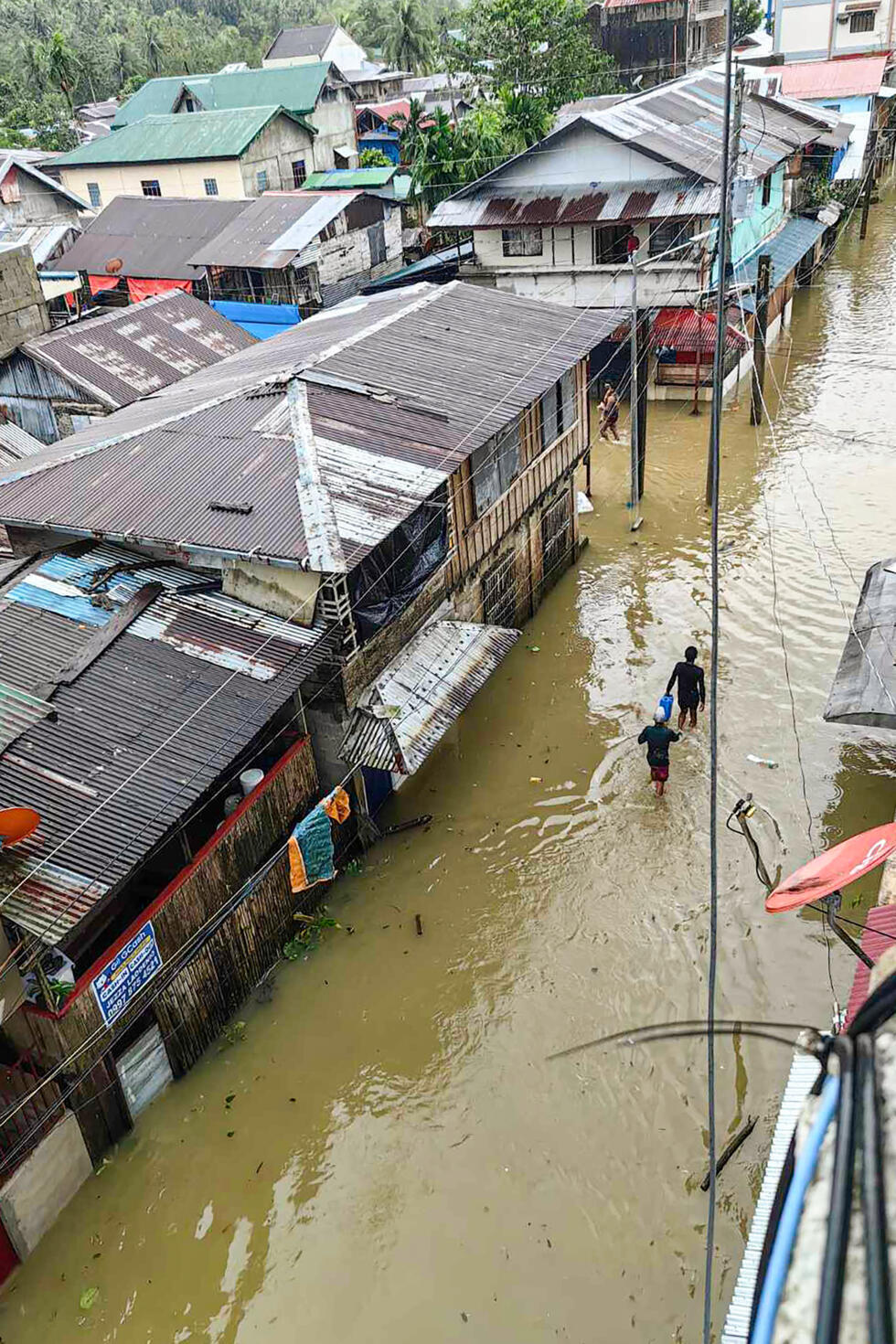
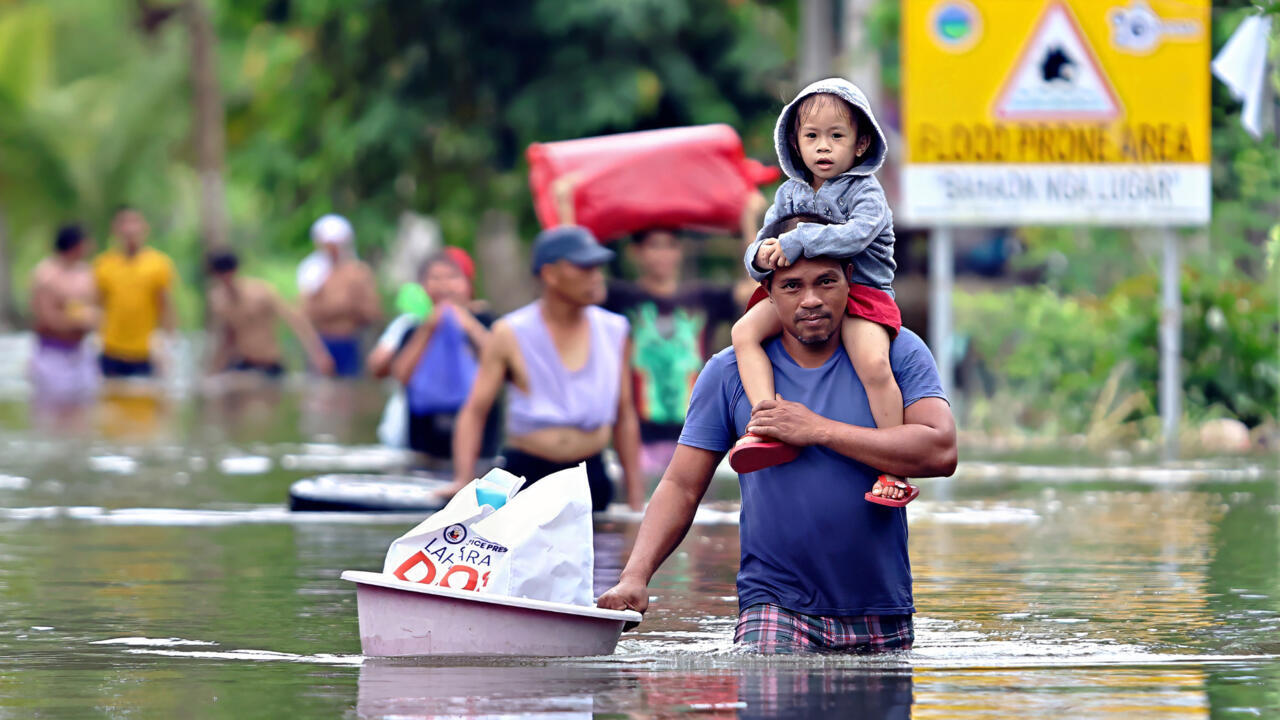
A photo taken by Mayor Benjie Ver shows people wading through a flooded street following heavy rains in Jipapad town, Eastern Samar province. 

© Handout, Mayor Benjie Ver, AFP

"They decided to do our tradition of strapping down the roofs with big ropes and anchoring them on the ground, so they won't be blown away by the wind," provincial rescue official Roberto Monterola told AFP.

Only days earlier, Typhoon Kalmaegi sent floodwaters rushing through the towns and cities of Cebu and Negros islands, sweeping away cars, riverside shanties and massive shipping containers.

READ MOREPhilippine president declares state of emergency in the wake of Typhoon Kalmaegi

The typhoon, the deadliest of 2025 according to disaster database EM-DAT, killed at least 224 people and left 109 missing, according to government figures.

Search and rescue efforts in Cebu were suspended on Saturday due to safety concerns over the approaching super typhoon.

(FRANCE 24 with AFP)

Another huge typhoon bears down on the Philippines

Another huge typhoon bears down on the Philippines
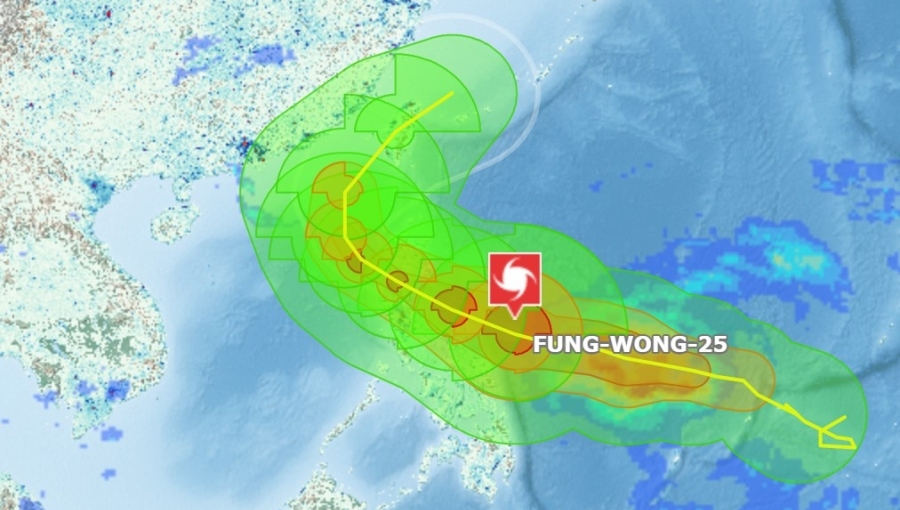
/ GDACS
By bno - Taipei Office November 8, 2025

The Philippines is preparing for the impact of another powerful typhoon, less than a week after a deadly storm left at least 200 people dead and caused widespread devastation across the archipelago the BBC reports.

Typhoon Fung Wong, known locally as Uwan, is expected to strengthen into a super typhoon — with sustained winds of at least 185 km per hour before striking the main island of Luzon as early as the evening of November 9, according to the Philippine weather bureau/

Officials have warned that Fung Wong could prove even more intense than Typhoon Kalmaegi, which battered the country on November 4 and 5, triggering landslides, floods, and power outages. The new storm is forecast to bring torrential rainfall and dangerous storm surges to coastal regions.

Schools have cancelled classes on November 10 or shifted to online learning, while Philippine Airlines has suspended multiple domestic flights in anticipation of severe weather.

Authorities in the Philippines have said eastern provinces had already begun to experience heavy downpours and gusty winds as of late November 8 the BBC adds. It has also been projected that Fung Wong would make landfall between 12:00 GMT on Sunday and 12:00 GMT on Monday, before moving northwards towards Taiwan by November 11.

Preparations for the arrival of the storm are also underway across much of eastern Taiwan.

Although the storm is expected to weaken once it crosses land, meteorologists said it was likely to retain typhoon strength while passing over Luzon.

Fung Wong is the latest in a series of intense tropical storms to strike the Philippines and Taiwan this year, underscoring both nation’s growing vulnerability to extreme weather events linked to climate change.


BBC director resigns after row over Trump documentary edit

The director general of Britain's BBC, Tim Davie, and the chief executive of news, Deborah Turness, have stepped down following criticism over bias at the corporation, including in the way it edited a speech by US President Donald Trump.


Issued on: 09/11/2025 -
By: FRANCE 24

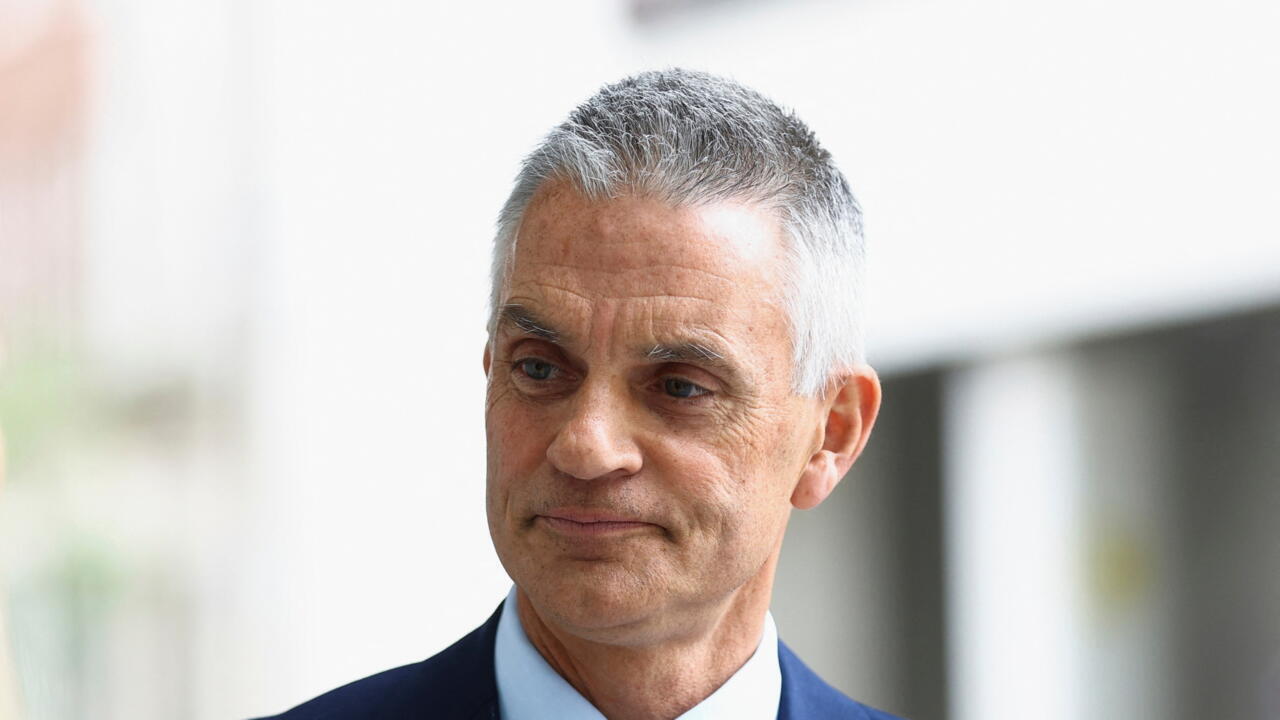
BBC Director-General Tim Davie is pictured at BBC World Service offices in London, April 28, 2022. © Hannah McKay, AP

The director general of the BBC announced his resignation Sunday following a row over the editing of a documentary about Donald Trump as the US president attacked "corrupt journalists".

Tim Davie and the broadcaster's head of news, Deborah Turness, resigned after accusations that a documentary by its flagship Panorama programme had edited a speech by Trump in a misleading way.

Reacting to the news, Trump said "corrupt journalists" had been exposed, adding "these are very dishonest people who tried to step on the scales of a Presidential Election".

Announcing his resignation Davie said in a statement posted on the BBC website: "Like all public organisations, the BBC is not perfect, and we must always be open, transparent and accountable.

"While not being the only reason, the current debate around BBC News has understandably contributed to my decision... I have to take ultimate responsibility."

The latest controversy follows a Daily Telegraph report this week that said concerns were first raised in the summer in a memo on impartiality by Michael Prescott, a former external adviser to the BBC's editorial standards committee.

Earlier Sunday, the UK Culture, Media and Sport Minister Lisa Nandy called the allegations "incredibly serious".

The BBC has promised "a full response" to parliament's culture media and sport committee on Monday.

Trump speech edited

The criticism emerged over clips spliced together from sections of a Trump speech on January 6, 2021, when he was accused of fomenting the mob attack on the US Capitol seeking to keep him in power despite losing his re-election bid.

The edit made it appear he had told supporters he was going to walk to the US Capitol with them and "fight like hell".

In the undoctored clip, however, the president urged the audience to walk with him "and we're going to cheer on our brave senators and congressmen and women".

At the time, Trump was still disputing President Joe Biden's election victory, in a vote that saw him ousted after his first term in office.

The edit was included in a documentary entitled "Trump: A Second Chance?" that was broadcast by the BBC the week before last year's US election.

'Bias' allegation

Nandy had said earlier Sunday that the Trump edit was one of several concerns about editorial standards at the BBC.

"It isn't just about the Panorama programme, although that is incredibly serious," she told BBC television in an interview.

"There are a series of very serious allegations made, the most serious of which is that there is systemic bias in the way that difficult issues are reported at the BBC," she said.

Nandy said she was concerned about a tendency for editorial standards and the language used in reports to be "entirely inconsistent" whether it be on "Israel, Gaza... trans people or on this issue about President Trump".

White House press secretary Karoline Leavitt seemed to rejoice over the news, posting on X a screen-shot of the BBC news site announcing the resignation.

Leavitt was previously quoted by the Telegraph condemning "this purposefully dishonestly, selectively edited clip by the BBC".

The BBC is funded by a licence fee paid by anyone who watches live TV in the UK.

Earlier this year, it issued several apologies for "serious flaws" in the making of another documentary entitled "Gaza: How To Survive A Warzone", broadcast in February.

In October it accepted a sanction from the UK media watchdog for what was deemed a "materially misleading" programme, whose child narrator was later revealed to be the son of Hamas's former deputy agriculture minister.

(FRANCE 24 with AFP)
Protests suspend opening of Nigeria heritage museum

Benin City (Nigeria) (AFP) – The opening of a contested museum in Nigeria, meant to display west African art, has been postponed after protesters disrupted a private visit on Sunday, officials said.


Issued on: 09/11/2025 - FRANCE24
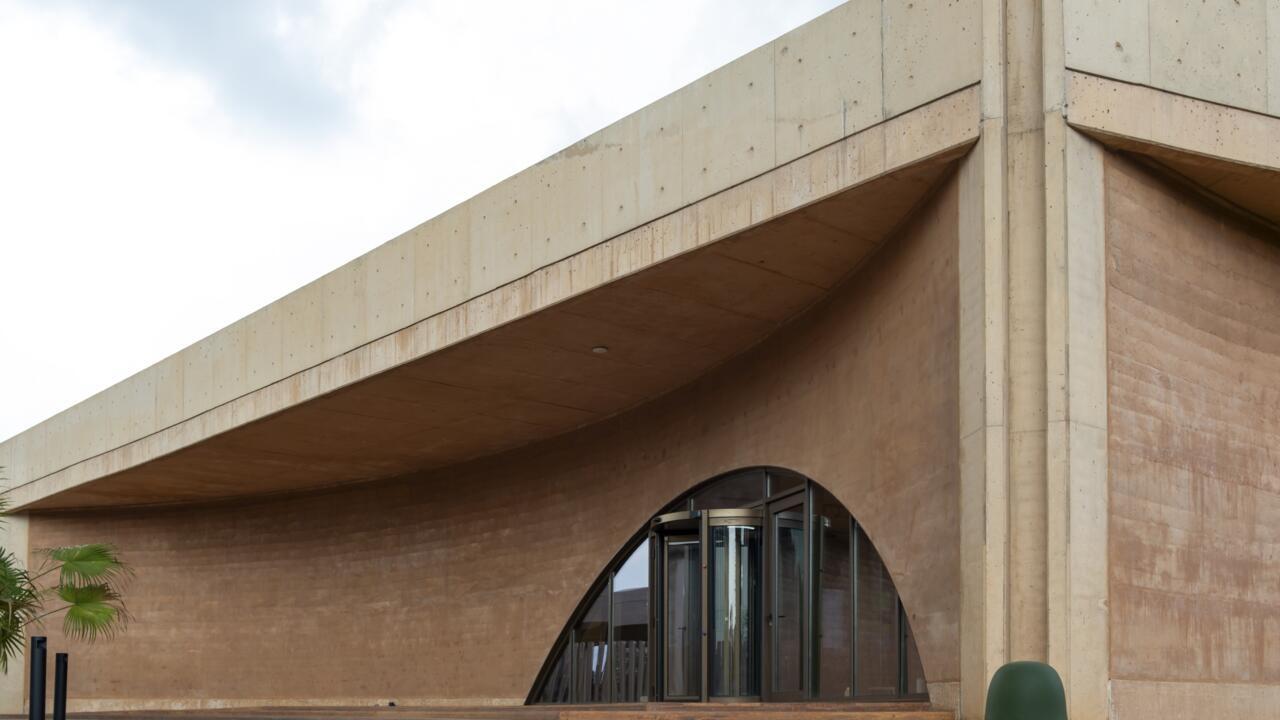
MOWAA was launched five years ago by Nigerian businessman Phillip Ihenacho in Benin City, Edo State © TOYIN ADEDOKUN / AFP

The Museum of West African Arts (MOWAA) had been due to officially open on Tuesday, but this will now be postponed indefinitely, officials said.

MOWAA was launched five years ago by Nigerian businessman Phillip Ihenacho in Benin City, Edo State, with the support of its former governor.

It has also been financed with help from the French and German governments as well as the British Museum, and from private donors.

It is due to house exhibition spaces and archives and aims to host residencies for west African artists and craftspeople, and on Sunday was holding a pre-opening event for donors and industry professionals.

But around 20 men, some armed with wooden bats, stormed into the museum courtyard, forcing guests to take refuge inside.

The group, whose demands were not clear, caused minor damage in the museum courtyard, AFP reporters saw.

"Protesters entered and began vandalising part of the reception pavilion, where we receive visitors, then they stormed inside the front section, where the exhibition area is located," Ihenacho told AFP.

After around two hours, guests were escorted away in buses to a nearby hotel.
Political tensions

The museum has sparked tensions between the former state governor and his successor, an ally of the city's traditional ruler, Oba Ewuare II, who says he should be in charge of the museum.

Benin for years has been trying to recover artefacts seized during the colonial era, in particular the "Benin Bronzes" looted more than 120 years ago.

Most of the ornate bronzes were seized by British soldiers in a retaliatory raid on Benin, and then auctioned off or sold to museums across Europe and the United States.

Ihenacho said he believed the protesters were "representatives from the palace" of Oba Ewuare II.

"We have never pretended to be anything other than the Museum of West African Art," Ihenacho added.

Nigeria's Culture Minister Hannatu Musa Musawa condemned the incident in a statement late Sunday.

"The reported disruption at MOWAA not only endangers a treasured cultural asset but also threatens the peaceful environment necessary for cultural exchange and the preservation of our artistic patrimony," she said.

"We are in active consultation with the Edo State government, security agencies and all relevant stakeholders to establish a full understanding of the circumstances and to ensure and appropriate and proportionate response," she said in a statement.

© 2025 AFP
MISOGYNIST INCEL SLANDER

'Centuries of patriarchal history': why trans rumours are wielded against women

Emmanuel Macron's wife Brigitte has frequently been the target of rumours that she is transgender, with 10 people currently on trial in France for spreading such stories online. France's first lady is far from the only victim of this type of attack, says feminist historian Christine Bard, who explains that it aims to undermine women in positions of power.

Issued on: 09/11/2025 - RFI

Brigitte Macron, pictured on 21 May, 2025. © AP - Christophe Petit Tesson

RFI: Before Brigitte Macron, former United States First Lady Michelle Obama and former New Zealand Prime Minister Jacinda Ardern, as well as numerous female athletes, have been the target of rumours questioning their "true femininity" and claiming they are in fact transgender. Why do these types of allegations come up again and again in relation to women with a certain amount of power?

Christine Bard: We have inherited centuries of patriarchal history. Women who have attained a certain degree of power, however relative, have always been portrayed as unnatural, masculine women – masculinised by the power that they desired or that was attributed to them.

This is a way of reminding everyone at all times that in a patriarchal system, the roles assigned to each sex must be respected and that any deviation will be punished by public condemnation.

The beginning of the 21st century is no exception to this historical burden, and the conservative camp has stuck with this view. Despite progress in equal rights, we are still far from effective equality.

Judges adjourn Brigitte Macron cyberbullying case until January

If, even today, questioning "femininity" remains such an effective way of disempowering women in public life, what does this reveal about society's relationship with the female body?

The devaluation of women who are perceived as powerful takes the form of attacks targeting their bodies. People look for signs of masculinity in them and if they cannot find any, they invent them.

In addition, the masculinity that people believe they can see in these women in turn diminishes the masculinity of their partners. Isn't this the aim of the attacks on Brigitte Macron? They are targeting a woman, but also a couple – and not just any couple, the head of state and his partner.

What does this type of attack tell us about sexism and transphobia? Why is the mere suggestion that a woman is transgender enough to discredit her?

The rumour that Brigitte Macron is a transgender person comes at a time when transphobia is on the rise. The attack is sexist, transphobic and homophobic.

It is sexist because it uses a woman to target a man and calls into question the criteria for assessing "true femininity" through physical characteristics, gestures and dress. It reinforces a normative definition of femininity.

In the logic of transphobia, trans identity does not exist, cannot exist – for transphobes, "Brigitte" will always be "Jean-Michel" [Macron's brother, who American YouTubers Natacha Rey and Amandine Roy accused of having changed gender and assumed the identity "Brigitte"].

Thousands rally for trans rights in France over bill on gender transition

This is a way of insinuating that the president of France is married to a man and is therefore homosexual – and therefore, by the logic of homophobia, cannot offer the same guarantee of virility.

The fact that people are receptive to this fake news provides a measure of the persistence, and even intensification, of sexist, homophobic and transphobic hate speech – which is a real cause for concern.
THE LAST COLONY,  VIVA INDEPENDENCE!

France's new overseas minister due in New Caledonia to revive dialogue

France’s overseas minister Naïma Moutchou faces a tough debut in New Caledonia, where economic hardship and political tensions are testing Paris’s resolve to rebuild trust in the South Pacific territory.


Issued on: 09/11/2025 - RFI

Naïma Moutchou, France’s new minister for the overseas territories, begins a four-day visit to New Caledonia, aiming to revive political dialogue and tackle the archipelago’s deepening economic crisis. © AFP

By:RFIFollow
Advertising


France’s new minister for the overseas territories, Naïma Moutchou, begins a four-day visit to New Caledonia on Monday with a double mission – to restart long-stalled political dialogue and to take stock of an economy still reeling from last year’s unrest.

Her trip comes at a delicate moment for the South Pacific archipelago, which has been mired in an unprecedented financial crisis since the violent riots of 2024.

The turmoil caused billions of euros in damage, sent the local economy into freefall and left deep scars across the territory’s fragile political landscape.

According to government estimates, New Caledonia’s GDP plunged by 13 percent in 2024, and hopes of a recovery this year have failed to materialise.

Fiscal revenues are also shrinking sharply – down by 26 percent instead of the 20 percent originally forecast – putting even more strain on already overstretched public finances.

New Caledonia independence bloc rejects deal giving powers but no referendum
Economy in freefall

To stave off bankruptcy, the territory took out a one-billion-euro state-guaranteed loan from the French Development Agency (AFD). But most of that safety net has already been used, leaving just €200 million earmarked for 2026 and 2027.

“I don’t give much for our collective chances,” warned Philippe Michel, head of the anti-independence Calédonie Ensemble group in the territorial Congress. He estimates a “gap” of around 500 million euros to balance next year’s budget. “And it’s not with the usurious interest rates imposed by the State that we’re going to get through this,” he added bluntly.

The AFD loan has pushed New Caledonia’s debt-to-GDP ratio to a worrying 360 percent, with repayments due to begin in 2026.

The interest rate – set at 4.54 percent – has caused an outcry among local politicians, who are calling for “national solidarity” and the conversion of part of the loan into direct grants.

However, the upcoming Overseas Territories budget, to be debated in mid-November as part of France’s 2026 finance bill, includes no such provision.

Hardship and calls for reform

The social fallout from the crisis is equally alarming. Around 11,000 jobs have been lost in the territory of 260,000 people since last year’s violence.

In Dumbéa-sur-mer, a suburb of Nouméa that was particularly hard hit, mayor Yohann Lecourieux of the conservative Les Républicains party said the situation was deteriorating rapidly.

“We have 800 fewer pupils eating in our school canteens because families simply can’t afford it anymore,” he said. “We’ve been promised an envelope for social aid, but it’s nowhere near enough given the scale of the hardship.”

In the rural commune of Bourail, mayor Patrick Robelin painted a slightly less bleak picture – at least for now.

“It’s harvest season, and seasonal jobs have helped families make it to the end of the year,” he said. “But I’m very worried about what’s coming next.” He urged “far-reaching reforms” and “a collective wake-up call” to prevent a deeper crisis.

The two associations representing New Caledonia’s mayors have written to Minister Moutchou to raise the alarm over the situation in their municipalities.

They are expected to meet her on the final day of her visit.

(with newswires)
CRIMINAL CAPITALI$M

Two MLB pitchers indicted on manipulating bets on pitches


New York (AFP) – Cleveland Guardians pitchers Emmanuel Clase and Luis Ortiz were indicted Sunday in New York on federal charges involving rigged bets on individual pitches in Major League Baseball games.


Issued on: 09/11/2025 - RFI

Cleveland pitcher Emmanuel Clase and teammate Luis Ortiz were indicted on charges they were part of a gambling conspiracy involving rigged bets on specific pitches in Major League Baseball games © Griffin Quinn / GETTY IMAGES NORTH AMERICA/AFP/File


The Dominican right-handers had been placed on leave by MLB since July while the league conducted an investigation into sports gambling surrounding them.

Ortiz was arrested Sunday in Boston and will appear in court on Monday while Clase is not in custody.

Prosecutors in Brooklyn charged Clase, a 27-year-old closing reliever, and Ortiz, a 26-year-old starter, with being part of a scheme with corrupt bettors who placed hundreds of thousands of dollars in wagers on specific throws.

Charges included wire fraud conspiracy, honest services wire fraud conspiracy, conspiracy to influence sporting contests by bribery, and money laundering conspiracy.

"Professional athletes, like Luis Leandro Ortiz and Emmanuel Clase de la Cruz, hold a position of trust -- not only with their teammates and their professional leagues, but with fans who believe in fair play," US attorney Joseph Nocella said.

"As alleged, the defendants sold that trust to gamblers by fixing pitches," he added.

"When corruption infiltrates the sport, it brings disgrace not only to the participants but damages the public trust in an institution that is vital and dear to all of us."

The announcement follows the late October arrests of two prominent NBA basketball figures, Miami Heat guard Terry Rozier and Portland Trail Blazers coach Chauncey Billups, in a separate far-ranging probe into illegal gambling.

Prosecutors in the baseball case said the pitchers agreed in advance with their co-conspirators on specific pitches they would throw, the bettors using that inside information to place hundreds of fraudulent bets.

Clase agreed to the scheme around May 2023 to rig "prop" bets on particular pitches he threw, with wagers on the speed and type of throws he would make, coordinating with Clase at times during games, prosecutors said.

"Clase often threw these rigged pitches on the first pitch of an at-bat," a statement from prosecutors said. "To ensure certain pitches were called as balls, Clase threw many of them in the dirt, well outside the strike zone."

Clase received kickbacks from the bettors for the information and sometimes provided money to finance the scheme, according to charges.

Among the rigged pitches was one in New York in a game against the host Mets.

Prosecutors claimed Clase caused his co-conspirator bettors to win at least $400,000 in fraudulent wagers.
June pitches eyed

This past June, charges claim, Ortiz joined the conspiracy, agreeing in advance to throw balls rather than strikes on certain pitches in two games in exchange for bribes and kickbacks.

Before a game on June 15, Ortiz allegedly agreed to throw a ball on a particular pitch in exchange for a $5,000 bribe with Clase getting a $5,000 bribe for arranging the rigged pitch.

Ortiz allegedly agreed to throw another rigged pitch on June 27 in exchange for a $7,000 bribe for himself and another for Clase.

Clase allegedly withdrew $50,000 in cash and provided $15,000 to a co-conspirator to wage on Ortiz's rigged pitch during the June 27 contest, with Ortiz producing at least $60,000 in winning wagers for the co-conspirators.

Each defendant faces a maximum sentence of 20 years in prison on wire fraud conspiracy, 20 years for honest services wire fraud conspiracy, five years on conspiracy to influence sporting contests by bribery and 20 years on the money laundering conspiracy charge.

© 2025 AFP
Scottish universities a haven for US students fleeing Trump's college crackdown

Edinburgh – Scotland has become an increasingly popular destination for students from the United States in the wake President Donald Trump's interventions in higher education. RFI spoke to Americans enrolled at the University of Edinburgh, where one in 10 students is now from the US.


Issued on: 09/11/2025 - RFI

Graduation day at Edinburgh University's McEwan Hall.
 © Corbis via Getty Images - Ken Jack

Universities have been among Trump's favourite targets since his return to the White House. Between cutting funding for certain degrees, demonising individual institutions and arresting students from immigrant backgrounds on campus, the college dream has soured for many in the US.

With the administration making visas harder to secure, the number of international students arriving in the US fell by 19 percent compared to the last academic year, according to the New York Times. Americans, too, are increasingly looking elsewhere.

A record number applied this year to universities in the United Kingdom – which itself has been actively pursuing foreign students post-Brexit – according to figures from the UK's higher education application body Ucas.

It received nearly 8,000 American undergraduate applications, marking a rise of almost 14 percent on the previous year.
Scotland is particularly popular, with three of its universities in the UK's top 10 for the highest number of US students.

Scotland's oldest university, St Andrews – long popular with Americans thanks to its starring role in the love story of Prince William and Kate Middleton – takes the top spot, with one in five students now coming from the US.


'It feels like a way of escaping'

Edinburgh University is second on the list, with the University of Glasgow in fifth place.

Gabby arrived at Edinburgh this year. "I'm doing a master's degree in comparative public policy. My husband was accepted into the university first, and I wanted to do a master's degree, so this was the easiest way to get a visa and join him," she told RFI.

"But now that I'm here, it feels a bit like a way of escaping what's happening at home: the defunding of university research, students being arrested just for voicing opposition... It's concerning," she added.

John Rappa, from New Jersey, came to study in Edinburgh in 2019.

"I could have found an affordable university in the United States, but an institution as prestigious as Edinburgh would have been beyond my means. Including visa and tuition fees, studying here costs the same as a public university in my state... Why the hell would I not?"

While cost was his main motivation for choosing to study outside the US at that time, he notes that the change in political climate since then has only convinced him he made the right choice.

"My friends who stayed behind are seeing their course budgets cut. My brother is a PhD student in pharmacology, but the Trump administration has stopped funding his research, so he can't graduate. The future looks bleak."

'Quality of life'

In terms of his own future, Rappa also sees advantages to staying in Scotland.

"The quality of life is much better here, starting with social security for all. If I have children, I want them to have access to education, and that's not the direction the United States is taking."

Edinburgh University students have revived the defunct North American Society, thanks to growing demand. Freddie Pusch – a native Scot – is its treasurer. "It had ceased to exist since the pandemic, so we revived it."

He jokes: "[The American] students are particularly noisy... No, they bring an enthusiasm that we locals don't have. They remind us that we live in a great city."
Sudan’s civilians flee mounting atrocities as Darfur’s war deepens

Tens of thousands of Sudanese are on the move once again, fleeing reported atrocities after the paramilitary Rapid Support Forces (RSF) captured the key western city of el-Fasher late last month.


Issued on: 09/11/2025 - RFI

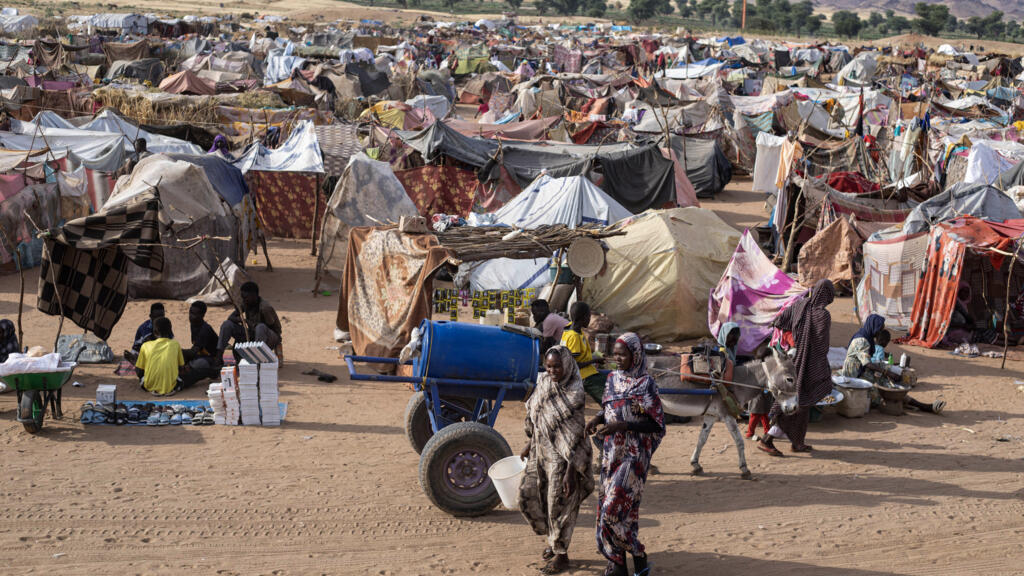
Displaced Sudanese who fled El-Fasher after the city fell to the Rapid Support Forces (RSF), walk in the Um Yanqur camp, located on the southwestern edge of Tawila, in war-torn Sudan's western Darfur region on 3 November 2025. © AFP


Aid groups working on the ground say those who manage to escape are now crammed into makeshift camps in Tawila, around 70 kilometres away – a barren stretch of desert that’s rapidly becoming a desperate refuge.

Videos posted by the local organisation Sudan’s IDPs and Refugee Camps paint a bleak picture: children darting across dusty ground, families huddled under patched-together tarps, and adults hauling huge pots of food in the hope of stretching one meal to feed dozens.

Since the RSF’s takeover on 26 October, more than 16,000 people have reached Tawila, according to the group’s spokesperson Adam Rojal.

The International Organization for Migration puts the wider figure at over 80,000, including those who fled nearby areas. Many made the journey on foot, through dangerous terrain and under the constant threat of attack.

Tawila’s hospital, run by Médecins Sans Frontières (MSF), is overflowing. “We’ve received at least 1,500 people from el-Fasher since the city fell,” said Abu Bakr Hammad, MSF’s medical director there. “Many have serious fractures and trauma injuries.” The aid agency added that hundreds more are still arriving every day, many severely malnourished. “We’re seeing extremely high levels of malnutrition among children and adults alike,” MSF said on Friday.

The humanitarian situation is dire. Rojal said that displaced families are surviving on as little as one or two meals a day, with little access to medicine or clean water. “They need food, medical care, shelter and psychological support – urgently,” he told reporters.

A city under siege

El-Fasher’s fall came after an 18-month siege that has left the once-vibrant Darfur capital in ruins. Reports from survivors and satellite imagery suggest that RSF fighters stormed through the city, attacking hospitals and homes.

The World Health Organization said that over 450 people were killed in the Saudi Hospital alone, where witnesses described patients being shot in their beds. The RSF denies any involvement in killings there, but independent footage tells a grimly different story.

The United Nations’ top human rights official, Volker Türk, has warned that atrocities may still be unfolding inside the city. “Traumatised civilians are still trapped in el-Fasher and are being prevented from leaving,” he said in Geneva on Friday. “I fear that summary executions, rape and ethnically motivated violence are continuing within the city – and even those who flee face unimaginable cruelty on the routes out.”

The RSF announced on Thursday that it had accepted a humanitarian truce proposed by the US-led Quad mediation group. The Sudanese army said it too welcomed the plan – but only if the RSF withdrew from civilian areas and disarmed. For now, however, the guns show little sign of falling silent.

Growing crisis, fading hope

Sudan’s brutal conflict began in April 2023 after months of tension between the army and the RSF, once allies in ousting long-time ruler Omar al-Bashir. The fighting has since spread across the country, leaving at least 40,000 people dead – though aid workers believe the true toll could be far higher.

Around 12 million have been displaced, and nearly half the population is facing acute food insecurity, according to the WHO.

In neighbouring North Kordofan, violence has also intensified. A drone attack on the provincial capital, el-Obeid, killed at least 40 people earlier this week, with the army later claiming to have intercepted two more drones on Saturday morning.

Analysts say the RSF’s victory in el-Fasher marks a turning point in the war. Jalale Getachew Birru, a regional expert with Armed Conflict Location and Event Data, said the capture was “a strategic win for the RSF but a catastrophe for civilians”, estimating that around 2,000 people were killed across Sudan in just one week after 26 October.

Still, aid agencies continue to push into Tawila and other areas with what little support they can muster, determined to keep civilians alive as another harsh Sudanese winter looms.

(with newswires)

Hundreds of civilians buried in mass graves, others burned by RSF in Sudan’s El-Fasher: Medics


November 9, 2025


Displaced Sudanese families shelter at the newly established Al-Afadh camp in Al Dabbah after fleeing Al-Fashir and other conflict zones in North Darfur following the Rapid Support Forces’ (RSF) takeover of the city, on November 6, 2025. [Stringer – Anadolu Agency]

Hundreds of civilians were buried in mass graves and others burned by the paramilitary Rapid Support Forces (RSF) in El-Fasher city in western Sudan, local medics said Sunday, Anadolu reports.

“The RSF has collected hundreds of bodies from the streets and the city’s neighborhoods and buried some in mass graves and burnt others in a desperate attempt to conceal evidence of their crimes against civilians,” the Sudan Doctors Network said in a statement.

It called the burying of civilians a “full-fledged genocide” and a “violation of all international and religious norms that prohibit the mutilation of corpses and guarantee the dead the right to a dignified burial.”

“The situation in El-Fasher has gone beyond a humanitarian catastrophe to become a systematic genocide, targeting human life and dignity amid an appalling international silence that amounts to complicity,” the statement said.

“The RSF crimes cannot be erased by burying or burning,” the medical group said, calling on the international community to take immediate action to launch an independent international investigation into atrocities against civilians in El-Fasher.

On Oct. 26, the RSF seized control of El-Fasher, the capital of North Darfur, and committed ethnic-based massacres, according to local and international organizations, amid warnings that the assault could entrench the country’s geographical partition.

Since April 15, 2023, the Sudanese army and the RSF have been locked in a war that regional and international mediations have failed to end. The conflict has killed thousands of people and displaced millions of others.

BAN DEEP SEA MINING

Deep-sea mining waste could disrupt marine food chains and threaten global fisheries, study warns

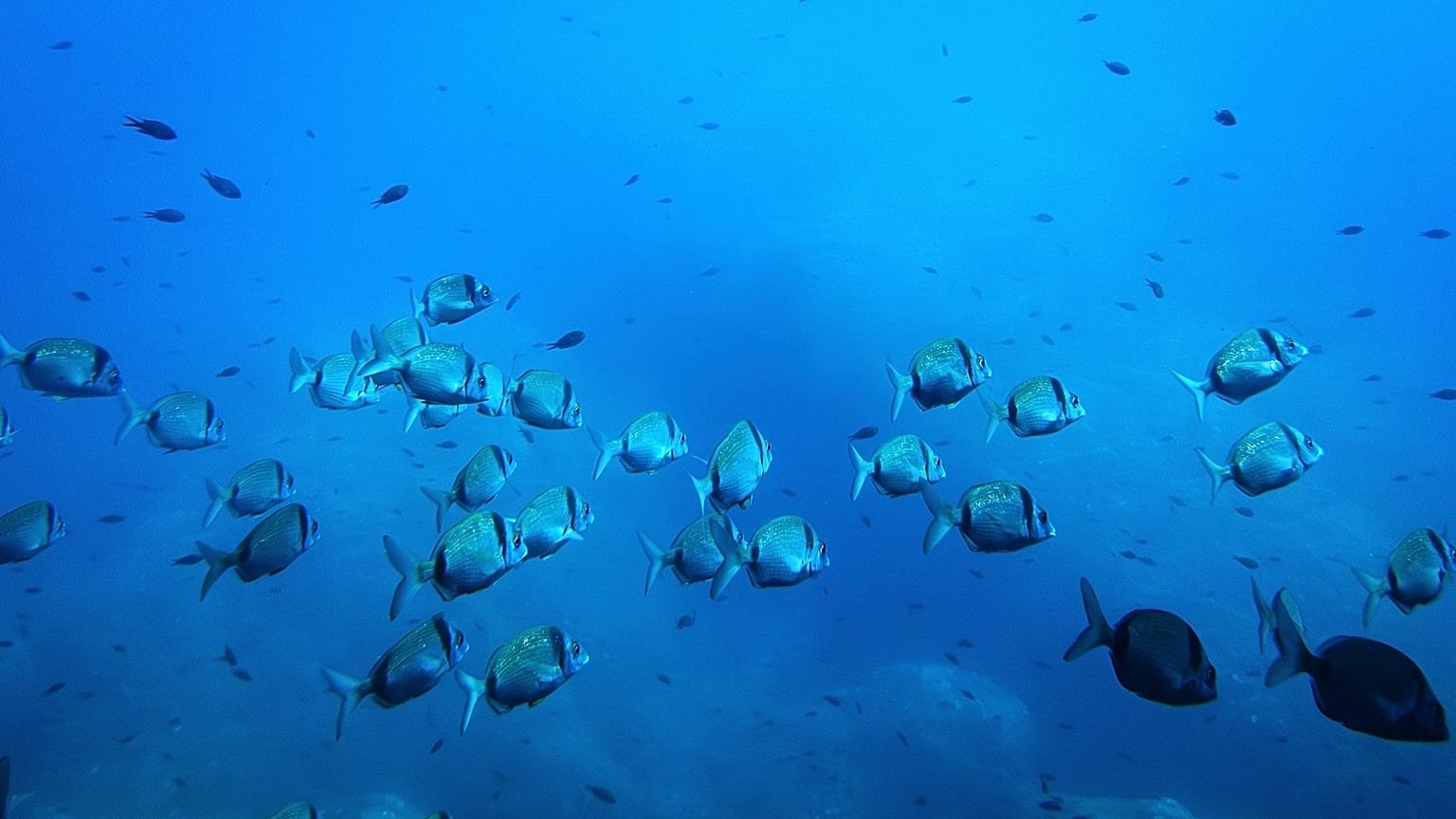
 Common two-banded seabream fish swim in the protected area of France's Porquerolles National Park.
Copyright AP Photo/Annika Hammerschlag, File


By ALEXA ST. JOHN with AP
Published on 

Scientists warn deep-sea mining plumes could starve tiny marine life, disrupting food webs and threatening fisheries

Drilling for minerals deep in the ocean could have immense consequences for the tiny animals at the core of the vast marine food web — and ultimately affect fisheries and the food we find on our plates, according to a new study.

Deep-sea mining means drilling the seafloor for “polymetallic nodules” loaded with critical minerals including copper, iron, zinc and more.

While not yet commercialised, nations are pursuing deep-sea operations amid rising demand for these minerals in electric vehicles and other parts of the energy transition, as well as for technology and military use.

The researchers examined water and waste gathered from a deep-sea mining trial in 2022.

What the study discovered

University of Hawaii researchers studied an area of the Pacific Ocean called the “twilight zone,” about 200 to 1,500 meters below sea level. Their peer-reviewed findings, published Thursday in the Nature Communications scientific journal, say mining waste could affect anything from tiny shrimp smaller than 2 millimetres long to fish 5 centimetres long.

That's because, after mining companies bring the mineral-rich nodules up to the surface, they have to release excess seawater, ocean floor dirt and sediment back into the ocean. That creates a murky plume of particles about the same size as the naturally occurring food particles normally eaten by the zooplankton that swim at that depth.

That's a little more than half of the zooplankton in the ocean. If those organisms eat the waste particles — what senior study author Brian Popp called “junk food” — then that affects 60 per cent of micronekton that eat the zooplankton.

And that undernourishment is a problem because these tiny organisms are the food source up the chain, ultimately affecting commercially important fish such as mahi mahi or tuna.

“Surface fish can dive down deep into the water; they feed on organisms down at depth,” said Michael Dowd, study lead author and oceanography graduate student.

“If these organisms down at depth are no longer present because their food web has collapsed, then that can impact higher food webs and more commercial interests."

Impact on the water and alternative sources

While other research has highlighted the negative environmental impacts from deep-sea mining of nodules, the focus is often on the seafloor. This study looks at mid-water.

The researchers said more work needs to be done to assess the appropriate quality and depth at which dirty water and sediment from sea mining could be returned to the ocean.

But they said returning the excess directly to the ocean floor or at other depths could be just as environmentally disruptive as in the “twilight zone,” only in different ways.

Popp said digging up the deep sea might not be necessary, and instead noted alternative sources of metals, including recycling batteries and electronics, or sifting through mining waste and tailings.

“If only a single company is mining in one single spot, it’s not going to affect a huge fishery. It’s not going to affect a huge amount of water. But if many companies are mining for many years and outputting a lot of material, this is going to spread across the region,” Dowd said.

“And the more mining occurs, the more a problem it could be.”

Where deep-sea mining stands

It might not be viable to simply halt ocean mining. The International Seabed Authority, which governs mineral activity beyond national jurisdiction, has already granted several contracts for exploration.

In the US, President Donald Trump has expressed interest in deep-sea mining operations amid tense trade negotiations with China that have limited US access to China’s wide swath of critical minerals.

In April, Trump signed an executive order directing the National Oceanic and Atmospheric Administration to expedite the permitting process for companies to mine the ocean floor, and in May, the administration said it would consider selling leases to extract minerals off the South Pacific island of American Samoa. Last month, NOAA sent a draft rule to the White House to streamline operations.

Environmental groups have advocated against deep-sea mining, citing not only the direct harm to wildlife and parts of the sea, but also the disturbance of planet-warming carbon dioxide that is currently sequestered in the ocean and on its floor.

The question being: Is it worth a few minerals to potentially destroy the way that the oceans function?
 Sheryl Murdock 
Deep-sea postdoctoral researcher at Arizona State University

“It was well laid out in the study that the impacts wouldn’t necessarily be just the depth that the plume is released," said Sheryl Murdock, a deep-sea postdoctoral researcher at Arizona State University who was not involved in the study.

“The question being: Is it worth a few minerals to potentially destroy the way that the oceans function?"

Diva Amon, a marine biologist and postdoctoral researcher at the University of California, Santa Barbara, praised the research for examining potential consequences.

"All of this could lead to species illness, species movement, species death. And depending on the scale of this, that could have graver repercussions, like species extinctions,” said Amon, who wasn't involved in the study but has previously worked with some of the researchers.

"There’s a lot more research that needs to be done to be able to make an informed decision about how to manage this industry, if it does start, in a way that will prevent, essentially, serious harm to the ocean and ocean ecosystem.”