Sudan’s civilians flee mounting atrocities as Darfur’s war deepens
Tens of thousands of Sudanese are on the move once again, fleeing reported atrocities after the paramilitary Rapid Support Forces (RSF) captured the key western city of el-Fasher late last month.
Issued on: 09/11/2025 - RFI
Growing crisis, fading hope
Sudan’s brutal conflict began in April 2023 after months of tension between the army and the RSF, once allies in ousting long-time ruler Omar al-Bashir. The fighting has since spread across the country, leaving at least 40,000 people dead – though aid workers believe the true toll could be far higher.
Around 12 million have been displaced, and nearly half the population is facing acute food insecurity, according to the WHO.
In neighbouring North Kordofan, violence has also intensified. A drone attack on the provincial capital, el-Obeid, killed at least 40 people earlier this week, with the army later claiming to have intercepted two more drones on Saturday morning.
Analysts say the RSF’s victory in el-Fasher marks a turning point in the war. Jalale Getachew Birru, a regional expert with Armed Conflict Location and Event Data, said the capture was “a strategic win for the RSF but a catastrophe for civilians”, estimating that around 2,000 people were killed across Sudan in just one week after 26 October.
Still, aid agencies continue to push into Tawila and other areas with what little support they can muster, determined to keep civilians alive as another harsh Sudanese winter looms.
(with newswires)
Tens of thousands of Sudanese are on the move once again, fleeing reported atrocities after the paramilitary Rapid Support Forces (RSF) captured the key western city of el-Fasher late last month.
Issued on: 09/11/2025 - RFI
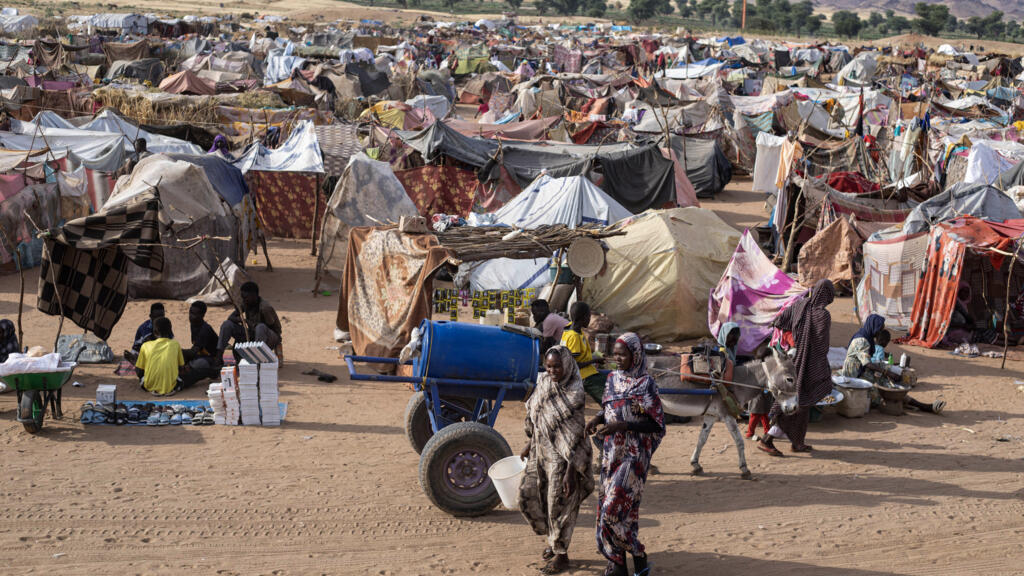
Displaced Sudanese who fled El-Fasher after the city fell to the Rapid Support Forces (RSF), walk in the Um Yanqur camp, located on the southwestern edge of Tawila, in war-torn Sudan's western Darfur region on 3 November 2025. © AFP
Aid groups working on the ground say those who manage to escape are now crammed into makeshift camps in Tawila, around 70 kilometres away – a barren stretch of desert that’s rapidly becoming a desperate refuge.
Videos posted by the local organisation Sudan’s IDPs and Refugee Camps paint a bleak picture: children darting across dusty ground, families huddled under patched-together tarps, and adults hauling huge pots of food in the hope of stretching one meal to feed dozens.
Since the RSF’s takeover on 26 October, more than 16,000 people have reached Tawila, according to the group’s spokesperson Adam Rojal.
The International Organization for Migration puts the wider figure at over 80,000, including those who fled nearby areas. Many made the journey on foot, through dangerous terrain and under the constant threat of attack.
Tawila’s hospital, run by Médecins Sans Frontières (MSF), is overflowing. “We’ve received at least 1,500 people from el-Fasher since the city fell,” said Abu Bakr Hammad, MSF’s medical director there. “Many have serious fractures and trauma injuries.” The aid agency added that hundreds more are still arriving every day, many severely malnourished. “We’re seeing extremely high levels of malnutrition among children and adults alike,” MSF said on Friday.
The humanitarian situation is dire. Rojal said that displaced families are surviving on as little as one or two meals a day, with little access to medicine or clean water. “They need food, medical care, shelter and psychological support – urgently,” he told reporters.
Aid groups working on the ground say those who manage to escape are now crammed into makeshift camps in Tawila, around 70 kilometres away – a barren stretch of desert that’s rapidly becoming a desperate refuge.
Videos posted by the local organisation Sudan’s IDPs and Refugee Camps paint a bleak picture: children darting across dusty ground, families huddled under patched-together tarps, and adults hauling huge pots of food in the hope of stretching one meal to feed dozens.
Since the RSF’s takeover on 26 October, more than 16,000 people have reached Tawila, according to the group’s spokesperson Adam Rojal.
The International Organization for Migration puts the wider figure at over 80,000, including those who fled nearby areas. Many made the journey on foot, through dangerous terrain and under the constant threat of attack.
Tawila’s hospital, run by Médecins Sans Frontières (MSF), is overflowing. “We’ve received at least 1,500 people from el-Fasher since the city fell,” said Abu Bakr Hammad, MSF’s medical director there. “Many have serious fractures and trauma injuries.” The aid agency added that hundreds more are still arriving every day, many severely malnourished. “We’re seeing extremely high levels of malnutrition among children and adults alike,” MSF said on Friday.
The humanitarian situation is dire. Rojal said that displaced families are surviving on as little as one or two meals a day, with little access to medicine or clean water. “They need food, medical care, shelter and psychological support – urgently,” he told reporters.
A city under siege
El-Fasher’s fall came after an 18-month siege that has left the once-vibrant Darfur capital in ruins. Reports from survivors and satellite imagery suggest that RSF fighters stormed through the city, attacking hospitals and homes.
The World Health Organization said that over 450 people were killed in the Saudi Hospital alone, where witnesses described patients being shot in their beds. The RSF denies any involvement in killings there, but independent footage tells a grimly different story.
The United Nations’ top human rights official, Volker Türk, has warned that atrocities may still be unfolding inside the city. “Traumatised civilians are still trapped in el-Fasher and are being prevented from leaving,” he said in Geneva on Friday. “I fear that summary executions, rape and ethnically motivated violence are continuing within the city – and even those who flee face unimaginable cruelty on the routes out.”
The RSF announced on Thursday that it had accepted a humanitarian truce proposed by the US-led Quad mediation group. The Sudanese army said it too welcomed the plan – but only if the RSF withdrew from civilian areas and disarmed. For now, however, the guns show little sign of falling silent.
El-Fasher’s fall came after an 18-month siege that has left the once-vibrant Darfur capital in ruins. Reports from survivors and satellite imagery suggest that RSF fighters stormed through the city, attacking hospitals and homes.
The World Health Organization said that over 450 people were killed in the Saudi Hospital alone, where witnesses described patients being shot in their beds. The RSF denies any involvement in killings there, but independent footage tells a grimly different story.
The United Nations’ top human rights official, Volker Türk, has warned that atrocities may still be unfolding inside the city. “Traumatised civilians are still trapped in el-Fasher and are being prevented from leaving,” he said in Geneva on Friday. “I fear that summary executions, rape and ethnically motivated violence are continuing within the city – and even those who flee face unimaginable cruelty on the routes out.”
The RSF announced on Thursday that it had accepted a humanitarian truce proposed by the US-led Quad mediation group. The Sudanese army said it too welcomed the plan – but only if the RSF withdrew from civilian areas and disarmed. For now, however, the guns show little sign of falling silent.
Growing crisis, fading hope
Sudan’s brutal conflict began in April 2023 after months of tension between the army and the RSF, once allies in ousting long-time ruler Omar al-Bashir. The fighting has since spread across the country, leaving at least 40,000 people dead – though aid workers believe the true toll could be far higher.
Around 12 million have been displaced, and nearly half the population is facing acute food insecurity, according to the WHO.
In neighbouring North Kordofan, violence has also intensified. A drone attack on the provincial capital, el-Obeid, killed at least 40 people earlier this week, with the army later claiming to have intercepted two more drones on Saturday morning.
Analysts say the RSF’s victory in el-Fasher marks a turning point in the war. Jalale Getachew Birru, a regional expert with Armed Conflict Location and Event Data, said the capture was “a strategic win for the RSF but a catastrophe for civilians”, estimating that around 2,000 people were killed across Sudan in just one week after 26 October.
Still, aid agencies continue to push into Tawila and other areas with what little support they can muster, determined to keep civilians alive as another harsh Sudanese winter looms.
(with newswires)
November 9, 2025

Displaced Sudanese families shelter at the newly established Al-Afadh camp in Al Dabbah after fleeing Al-Fashir and other conflict zones in North Darfur following the Rapid Support Forces’ (RSF) takeover of the city, on November 6, 2025. [Stringer – Anadolu Agency]
Hundreds of civilians were buried in mass graves and others burned by the paramilitary Rapid Support Forces (RSF) in El-Fasher city in western Sudan, local medics said Sunday, Anadolu reports.
“The RSF has collected hundreds of bodies from the streets and the city’s neighborhoods and buried some in mass graves and burnt others in a desperate attempt to conceal evidence of their crimes against civilians,” the Sudan Doctors Network said in a statement.
It called the burying of civilians a “full-fledged genocide” and a “violation of all international and religious norms that prohibit the mutilation of corpses and guarantee the dead the right to a dignified burial.”
“The situation in El-Fasher has gone beyond a humanitarian catastrophe to become a systematic genocide, targeting human life and dignity amid an appalling international silence that amounts to complicity,” the statement said.
“The RSF crimes cannot be erased by burying or burning,” the medical group said, calling on the international community to take immediate action to launch an independent international investigation into atrocities against civilians in El-Fasher.
On Oct. 26, the RSF seized control of El-Fasher, the capital of North Darfur, and committed ethnic-based massacres, according to local and international organizations, amid warnings that the assault could entrench the country’s geographical partition.
Since April 15, 2023, the Sudanese army and the RSF have been locked in a war that regional and international mediations have failed to end. The conflict has killed thousands of people and displaced millions of others.

No comments:
Post a Comment