Sunday, November 09, 2025


Galveston Prepares for Cruise Growth Opening Fourth Terminal with MSC
Port of Galveston
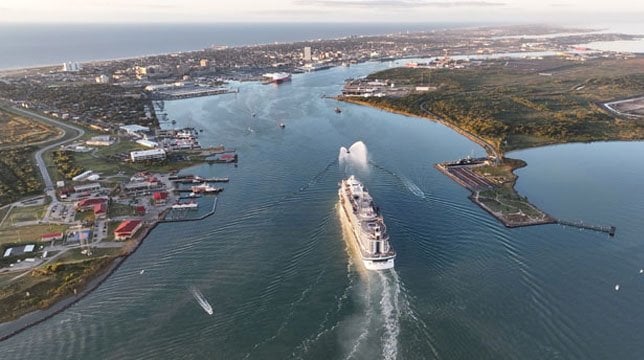
MSC Seascape making her maiden arrival in Galveston as the port continues its cruise growth (MSC)

Published Nov 7, 2025 8:52 PM by The Maritime Executive


The Port of Galveston, which is preparing for its continued strong growth in the cruise segment, marked the opening of its fourth cruise terminal with the arrival of the MSC Seascape cruise ship. The port has entered into long-term contracts with MSC Cruises and Norwegian Cruise Line to homeport from the new terminal, Cruise Terminal 16.

Work on the new terminal began in 2024 on a project that entailed transforming two existing cargo buildings into a 160,00-square-foot cruise terminal. It included the construction of a two-story vertical core, elevators, escalators, stairs, and a passenger ramp. The terminal has two passenger boarding bridges.

As part of the project, the port added its first newly built, on-site parking garage. It is a seven-story facility that provides more than 1,600 spaces as well as ground transportation areas for buses, shuttles, ride share cars, and taxis. The project was designed by Bermello Ajamil and executed by contractors Hensel Phelps and Orion Marine Services.

During the dedication ceremonies on November 7, Galveston Wharves port director and CEO Rodger Rees called it is a tremendous milestone in the port’s history as a major U.S. cruise port. Galveston notes that in 2019 its board approved a long-term plan that did not envision adding the fourth cruise terminal till 2031.

The port said long-term contracts with both MSC and Norwegian Cruise Line Holdings made it possible to fund the $156 million project. It invested $55 million for the parking garage. The Port of Galveston provides strong access to the drive market from the mid-U.S. for cruises.

Galveston has already become the fourth-largest U.S. cruise home port and expects to see significant growth with the arrival of MSC and expanded homeporting from NCL. The port is scheduled for 445 sailings this season with a projected total of just under four million passenger movements (two million embarkations) in 2026. It now rivals Port Everglades in Florida, which last season handled just over four million passengers and has projected 4.4 million for the 2025-2026 season. PortMiami and Port Canaveral handle significantly larger numbers as the two largest cruise homeports.

MSC is positioning its MSC Seascape in Galveston to operate year-round 7-day cruises to the Western Caribbean. The company, which now has 23 cruise ships, highlights that Galveston becomes its fourth U.S. homeport as it expands its North American footprint. It is the first time the line has homeported from Texas, which joins its operations from PortMiami, Port Canaveral, and the Port of New York.

After limited sailings from Galveston in recent seasons, NCL will expand its homeporting in Texas using one of its newest ships. Norwegian Viva will arrive at the port in December and will sail seasonally from Galveston till April 2026 and return in October.

Norwegian Cruise Line Holdings has a 10-year contract with renewal options. It contemplates the company going to year-round homeporting in Galveston.

A busy commercial port for cargo, Galveston Harbor ranks among the top 40 busiest U.S. cargo waterways. The cruise segment has become an important economic contributor to the port and the Texas economy.


Ports of Indiana Secures Two FEMA Grants to Enhance Security Infrastructure

Ports of Indiana

Published Nov 7, 2025 10:15 AM by The Maritime Executive

[By: Ports of Indiana]

Ports of Indiana has been awarded two federal grants from the Federal Emergency Management Agency (FEMA) to strengthen security infrastructure and assessment capabilities at its Burns Harbor and Jeffersonville ports.  

The FEMA Port Security Grant Program provides funding to state and municipal entities to help protect critical port infrastructure from terrorism, enhance maritime domain awareness, improve port-wide maritime security risk management, and maintain or reestablish maritime security mitigation protocols that support port recovery and resiliency capabilities. 

The grants made to Ports of Indiana, totaling more than $140,000, will support critical upgrades and evaluations that advance the safety and resilience of Indiana’s multimodal logistics network.

Burns Harbor – CCTV Infrastructure Upgrades
A $115,691 federal grant will fund the procurement and installation of advanced CCTV infrastructure at the Burns Harbor port. The project includes installation of new lighting and fiber – which will enhance surveillance capabilities. Ports of Indiana will contribute a $38,564 match to complete the project. 

Jeffersonville – Comprehensive Security Assessment 
A $25,000 federal grant will support a third-party security assessment at the Jeffersonville port. The assessment will evaluate all aspects of physical and cybersecurity, identify vulnerabilities, recommend improvements, and produce a Facility Security Plan (FSP) tailored to the port’s operational needs. No matching funds are required for this project. 

“These grants reflect our ongoing commitment to proactive security investment and operational excellence across Indiana’s ports,” said Ports of Indiana COO David Parrott “We’re grateful for FEMA’s support in helping us strengthen infrastructure and safeguard critical assets that drive economic growth.” 

Dan Henson, Security Manager at Ports of Indiana-Burns Harbor added, “Maintaining and improving the highest level of security at our ports is of utmost importance, given the significance of Ports of Indiana to this state’s economy.  We are extremely appreciative of FEMA’s recognition of that fact and their assistance toward that goal.” 

The products and services herein described in this press release are not endorsed by The Maritime Executive.


Poland Will Invest $2.3B for Container Terminal in the West Near Germany
Poland Baltic container terminal
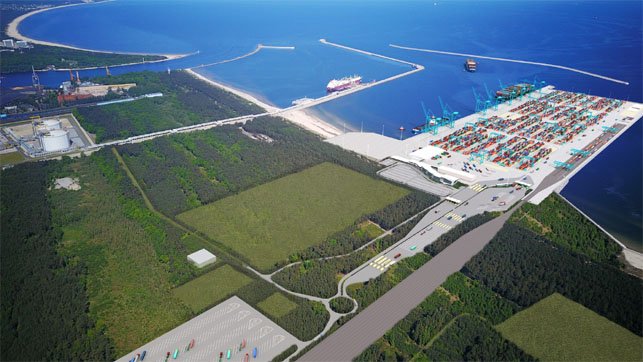
The new terminal will be one of the Largest Investments in the Baltic (Szczecin-Swinoujscie Seaports Authority)

Published Nov 5, 2025 6:42 PM by The Maritime Executive


The Polish government mapped out a new plan for what it is calling the most ambitious project in the 75-year history of the Szczecin Swinoujscie Seaports Authority. It calls for an investment of approximately $2.3 billion to create a large container terminal on the Baltic near Germany that will be a regional center for distribution inland and to neighboring countries.

"We have developed a new development concept for the port of ?winouj?cie from scratch, because the previous one was flawed, lacked guaranteed funding, and was delayed,” said Deputy Minister of Infrastructure Arkadiusz Marchewka. “We will build the Pomeranian Cape, the most ambitious project in the 75-year history of the Szczecin-?winouj?cie Seaports Authority and one of the most spectacular investments in the Baltic Sea. The Deepwater Container Terminal will be the main, but not the only, part of this massive project.”

The project is part of the ongoing efforts to expand the port facilities in the region. The port authority has highlighted improvements at its facilities for breakbulk and designs for a massive staging area of the offshore wind industry.

Pomeranian Cape will entail 186 hectares of new land and provide three kilometers of new quay. It will have a 17-meter deep port basin. The Deepwater Container Terminal will be able to handle the largest containerships in the world with 1.3 km of quay and a transshipment capacity of two million TEU. The terminal will be able to handle three containerships simultaneously, including two 400-meter vessels and one 250-meter vessel. The port will be able to handle both commercial ships and naval vessels.

To support the new facility, the government is also planning a new road and rail system. They will also ensure that it is a green port with zero-emission transshipment technologies and a shore-based ship power supply system. The plan calls for connections to Central Europe, including Germany, the Czech Republic, Slovakia, Austria, and Hungary.

“The Deepwater Container Terminal will be the main, but not the only, part of this massive project,” said Arkadiusz Marchewka, Deputy Minister of Infrastructure, responsible for the Maritime Economy at the Ministry of Infrastructure. “The world's largest container ships will dock at the port, ensuring Poland's budget revenue for decades. This investment will strengthen our country's security and Poland's presence at sea.”

The budget for the development of the new facility estimates that the Seaport Authority will be responsible for $405 million in the construction costs. In addition, the state is committing $1.9 billion for the land and seaway improvements. This will include deepening of 70 kilometers of the port’s approach freeway, as well as creating a new port basin and the land infrastructure.

A TEU or Twenty-foot Equivalent Unit is an exact unit of measurement used to determine cargo capacity for container ships and terminals.


Stena Bulk Vessels Use Inmarsat Nexuswave As Part of Crew Welfare Strategy
Inmarsat Maritime
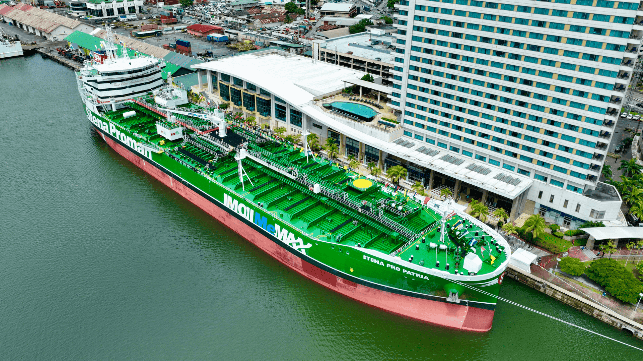
Northern Marine Management install NexusWave on board Stena Bulk and Proman Stena Bulk vessels to support crew welfare, recruitment and retention

Published Nov 8, 2025 2:24 PM by The Maritime Executive


[By: Inmarsat Maritime]

Inmarsat Maritime, a Viasat (NASDAQ:VSAT) company, is installing NexusWave on board selected Northern Marine Management Ltd (NMM) vessels operated by Stena Bulk and Proman Stena Bulk. This is part of their ongoing strategy to continually improve crew welfare through enhanced communications.

Building on existing onboard connectivity provisions, NMM recognises the growing importance of high-speed internet access in attracting and retaining talent and supporting operational performance. The implementation of NexusWave reflects NMM’s commitment to deliver even better, more homelike internet experiences for its personnel.   

Inmarsat’s NexusWave is designed to deliver exceptional aggregated speeds, 99.9% availability, global coverage, secure-by-design infrastructure, and unlimited data to ensure seamless, uninterrupted crew communications wherever a ship is operating – whether in a busy shipping lane or a congested port.

The fully managed bonded connectivity solution enables seafarers to enjoy improved internet access while onboard, supporting activities such as staying in contact with family and friends, managing their finances, browsing and uploading to social media, streaming and downloading online entertainment, and undertaking remote learning courses.

This enhancement supports NMM’s commitment to promoting well-being, personal growth, and job satisfaction among its seagoing workforce, strengthening its reputation as an employer of choice.

John Cook, Ship Management Director, Northern Marine Group, said: “High-quality onboard connectivity has long been part of our approach to supporting crew welfare, recruitment, and retention. As expectations evolve, so too must our solutions. Northern Marine Management’s implementation of Inmarsat NexusWave on selected vessels represents a significant step forward for the Stena Bulk and Proman Stena Bulk vessels under our management.

“We continue to explore and implement a range of connectivity solutions across our entire managed fleet, with NexusWave forming a key part of the strategy for selected vessels.”

Robert Mathieson, Sales Manager, Inmarsat Maritime, said: "By integrating NexusWave into their connectivity strategy, Northern Marine Management and Stena Bulk and Proman Stena Bulk have confirmed their status as technologically progressive industry leaders who are committed to promoting the happiness and development of their seafarers. The move will have a positive impact not only on crew welfare but also, as a direct consequence, on the reputation and operational performance of both companies.”

The products and services herein described in this press release are not endorsed by The Maritime Executive.


Smart Analytics for Proactive Threat Detection in Ports and Harbors

containership in port

Published Nov 5, 2025 11:04 AM by Jose Rojas


An estimated 11 billion tons of cargo pass through global ports and harbors every year, illustrating the importance of maritime facilities to international trade. However, as with other examples of critical infrastructure, this importance can introduce unique security challenges.

Port security teams face continual threats of theft, unauthorized access, smuggling, and acts of sabotage that often require continuous observation to reliably address. In high-traffic and fast-paced maritime environments, these workflows can place significant strain on operators.

To help improve security outcomes and reduce operator fatigue, many facilities are exploring ways to integrate smart technologies into traditional security workflows. For maritime security personnel and facility operators interested in the practical benefits of such technologies, this article discusses how smart analytics support proactive threat detection in ports and harbors.

Common Security Challenges for Maritime Facilities

The fast-paced and complex nature of port operations can introduce unique challenges that hinder traditional security operations. When designing effective security installations, leaders must ensure hardware and related workflows are optimized to navigate the following challenges.

Inconsistent Visibility

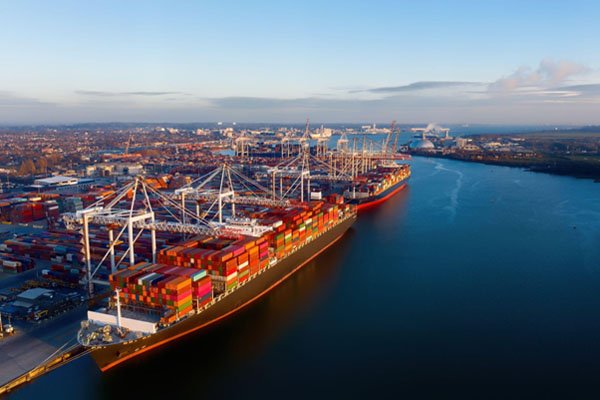
Securing and maintaining required visibility into port operations can be uniquely challenging due to the scope and complexity of maritime infrastructure. Moving containers, vehicles, and equipment can obscure security cameras accidentally or intentionally, creating blind spots that intruders can use to their advantage when attempting to cause damage or steal assets.


Unauthorized Access

Varying degrees of access must be provided to contractors, port authority staff, drivers, and visitors passing through maritime facilities every day. Safely and securely managing access requests manually can be resource-intensive and time-consuming, introducing the potential for operator fatigue or miscommunication to accidentally expose high-risk areas to intruders.

Environmental Hazards

Harsh weather conditions like heavy rain and fog can obscure camera feeds and negatively impact security operations, making it hard to reliably identify hazards and emerging threats. In addition, high winds and salt spray can damage physical hardware over time, introducing significant risks associated with cameras and sensors going offline at inopportune moments. Saltwater damage can impact the ROI of security devices, which is why most maritime ports opt for stainless steel cameras.

Operator Fatigue

A typical port or harbor can have hundreds of security cameras in operation at any one time, with camera feeds requiring constant observation to identify hazards and threats. Performing this task manually can place significant strain on human operators, raising the risk of subtle anomalies being overlooked and alerts being missed that could expose wider vulnerabilities.

How Smart Analytics Drive Proactive Port Security Operations

Smart analytics and AI-powered security cameras are showing promise in helping maritime security teams overcome industry-specific challenges. Modern coastal detection imbued with intelligent features can autonomously identify site-specific hazards and risks, allowing operators to proactively address threats without continuously observing feeds.


Intelligent Object Detection

Intelligent security cameras equipped with smart analytics tools can autonomously identify objects and persons of interest across complex areas of operation. Cameras can be programmed to immediately alert operators if an unknown object, person, or vehicle enters a target area, enabling teams to proactively combat emerging security threats. Additionally, cameras can be long-range for offshore detection, ensuring no one approaches unannounced.

Through deep learning, cameras equipped with smart analytics software can learn expected behavior over time, helping to ensure subtle and novel anomalies don’t go unnoticed. Smart analytics can help operators identify common issues like cameras being obscured by moving vehicles and equipment, to help proactively address common visibility challenges.

Occupancy Counting

Smart camera analytics can help ensure only select individuals and a number of persons can access high-risk areas. Cameras can be programmed to warn operators when occupancy levels surpass a predetermined threshold, with object classification features helping to ensure only authorized people can enter secure areas unimpeded.

Advanced smart analytics can also be configured to trigger responses when select objects and persons move into regions of interest. It can alert operators and activate wider security responses if a person, object, or vehicle enters a high-risk area or moves in a prohibited direction of travel to help address emerging security concerns swiftly.

Predictive Maintenance

Smart camera analytics software can be configured to identify signs of damage and wear to critical equipment and infrastructure. Pattern recognition and anomaly detection features can help facility managers spot subtle defects and operational issues associated with important equipment, helping staff to perform required maintenance before vulnerabilities are exposed.

Smart analytics can also analyze operational data associated with security cameras themselves to help ensure devices function optimally. Via automated health, tamper detection, and performance detection features, smart analytics software can warn operators of emerging issues that may impact camera functionality and suggest required maintenance.

Autonomous Threat Detection

Cameras equipped with smart analytics can autonomously identify and warn operators of suspicious activities and dangerous behaviors across complex target areas. On and off-site teams can be sent remote, real-time alerts containing links to relevant footage and camera feeds to support operators in planning and enacting informed responses to emerging threats.

By providing security staff with real-time, intelligent alerts that can be accessed via secure smart devices, leaders can remove the need for operators to continuously observe camera feeds. This workflow can help to reduce operator fatigue and enable security staff to focus on more complex aspects of their roles to help ensure threats are addressed appropriately.

Summary

Effectively and efficiently managing security operations across complex maritime facilities can be uniquely challenging, often requiring operators to continuously observe security feeds to manually identify anomalies, environmental hazards, and signs of emerging safety threats.

Traditional workflows can place significant strain on human teams and introduce risks related to operator fatigue, raising the risk of missed alerts resulting in significant security breaches.

By enhancing existing security with smart analytics, leaders can develop workflows whereby operators are warned of emerging risks in real-time. Cameras can provide detailed, data-rich insights into suspicious events and trigger automated security responses, enabling security teams to focus on matters of importance and proactively address identified threats.


About the author:

Jose Rojas is a sales engineering manager at Pelco with 25 years of experience supporting enterprise customers around the world. He focuses on delivering tailored technical solutions and leading an engineering team that meets the needs of mission-critical clients.


This article is provided by Pelco.

The opinions expressed herein are the author's and not necessarily those of The Maritime Executive.



Shake-Up at DFDS as Ferry Operator Looks to Accelerate Financial Turnaround

DFDS ferry at sea
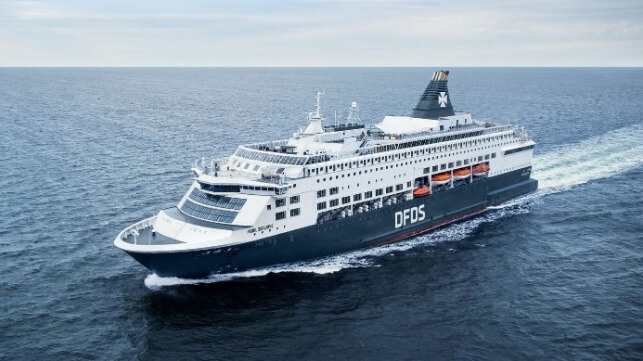
DFDS is one of Europe's largest ferry operators (DFDS)

Published Nov 6, 2025 5:49 PM by The Maritime Executive


DFDS, one of Europe’s largest ferry operators, announced a series of shake-ups after posting disappointing financial results for the third quarter. The company had said that 2025 would be a transitional year as it laid the foundations for improving financial performance, and now it is adding layoffs, cost-cutting, and a search for a new chief executive officer.

While saying that it was making progress on most of the priorities laid out in its plan, DFDS reported a 32 percent year-over-year decline in income (EBIT). Revenues were up four percent, but the growth in the existing business lines was off two percent this quarter.

The company said among its priorities are a focus on its logistic operations, adapting its Mediterranean ferry network, including a new pricing model, and a turnaround for operations in Turkey and Europe South. While reporting progress on its initiatives, it also said the earnings trend improvement for Turkey and Europe South is slower than expected “amid challenging market conditions.” 

Citing uncertainties for the business in Q4, the company lowered its income (EBIT) forecast. It said it was mainly driven by the uncertainties for the Mediterranean ferry and logistics activities.

Long-term CEO Torben Carlsen is a casualty, with the board reporting it is initiating a search for a successor to lead the next phase of the strategy execution. Carlsen will remain in place while the search is ongoing.

Torben Carlsen joined DFDS in 2009 as Executive Vice President and CFO and was appointed President and CEO in May 2019. During his tenure with DFDS, he has led the company through several key acquisitions, including Norfolkline in 2010 and the expansion into the Mediterranean with UN RoRo in 2018, and expanded DFDS’ network and geographical scope, while also navigating significant macro challenges such as Brexit, Covid, and adverse inflationary and market developments as a consequence of the Russian invasion of Ukraine.

He also served as Chair of Danish Shipping for the last three years and represented Danish Shipping in the European Shipowners’ Association while also being a board member of Interferry.

To accelerate the earnings improvements, the company also said it will implement a cost reduction program, including layoffs, in 2026. The plan calls for a reduction of approximately 400 mainly office-based positions. The company says it currently has 16,500 full-time employees.

The cost-saving initiatives are expected to reduce costs by around DKK 300 million ($46 million). The company implementation would cost approximately DKK 100 million ($15.5 million) in Q4 2025. 


Maersk Disappoints Investors, Points to Continued Challenges in Shipping

Maersk containerships
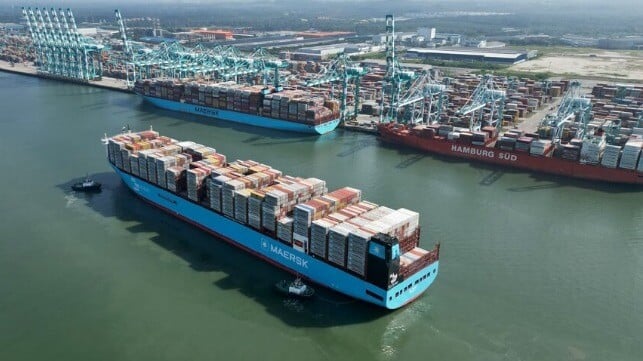
Maersk points to continuing challenges with freight rates and the potential impact from the introduction of new ships (Maersk)

Published Nov 6, 2025 4:19 PM by The Maritime Executive


Despite reporting better than expected third quarter results and narrowing the range for its yearly income estimate, investor concerns continue to grow on the container shipping segment as Maersk pointed to continuing issues. While it reported strong quarterly results, it was the underlying issues around freight rates that raised the greatest concern for Maersk and the industry more broadly.

Among the first of the large, publicly traded container carriers to report financial results, Maersk’s reports draw broad attention as a bellwether for the segment and global economy. In good news for the industry, speaking with reporters, Maersk CEO Vincent Clerc dismissed the talk of “de-globalization” and changes in trade patterns due to the trade wars and tariffs. He pointed to the continued high volumes during the quarter, as well as strong performance in its terminal operations and improved margins for the logistics businesses.

Maersk experienced a seven percent increase in its volumes during the third quarter, highlighting the strong exports from East Asia and China. It also pointed to the success of the Gemini Cooperation with Hapag-Lloyd, which it said enables cost savings and supports the volume growth with industry-leading reliability. It said it had experienced sequential growth across all its business segments while saying the company is well-positioned to help customers adapt and maintain stability across their supply chains.

After starting 2025 with a pessimistic outlook that foresaw a potential decline in container market volume growth, Maersk has raised its forecast several times. Today it is it forecasts four percent growth for the year, revised from a previous interim estimate of two to four percent. 

The main factor impacting the company’s financial performance was freight rates. While rates were largely stable versus the prior quarter, they continued a step decline versus the year ago. Average freight rates were down by nearly a third (31 percent). The company was able to offset some of these declines with cost savings and lowered fuel costs.

Freight rates, Clerc reported, had fallen during the third quarter below Maersk’s breakeven level. Although the rates appeared largely stable, the outlook is for rates to continue forward at similar levels, putting pressure on the company’s financial performance. During the third quarter, revenues from the ocean division were off 18 percent versus last year. The overall company reported a significant drop in income (EBIDTA) during the third quarter.

Another factor that it said is likely to impact results is “huge uncertainty” from the containership orderbook. Clerc echoed the concerns of many investors and industry executives about how the new ship deliveries will impact the industry over the next three years. He also said that the rerouting away from the Red Sea would continue for the remainder of the year. Analysts have speculated that the return to routes through the Red Sea would create excess capacity, which could weigh on freight rates going forward.

Based on the nine-month results, Maersk narrowed the range for its full-year estimates for earnings (EBITDA and EBIT). After starting 2025 with the low end of the range for EBITDA at $6 billion, the company again raised the low end from $8 billion to $9 billion for the year while maintaining the high end of the range at $9.5 billion.

Concerned about the outlook and disappointed that the company had not increased its income forecasts for 2025, investors drove the share price of Maersk down approximately five percent. Maersk does not provide forecasts for the year ahead until reporting year-end results in early 2026.


Residential Cruise Line Crescent Seas Relinquishes Charters on NCLH Ships

crusie ship Insignia
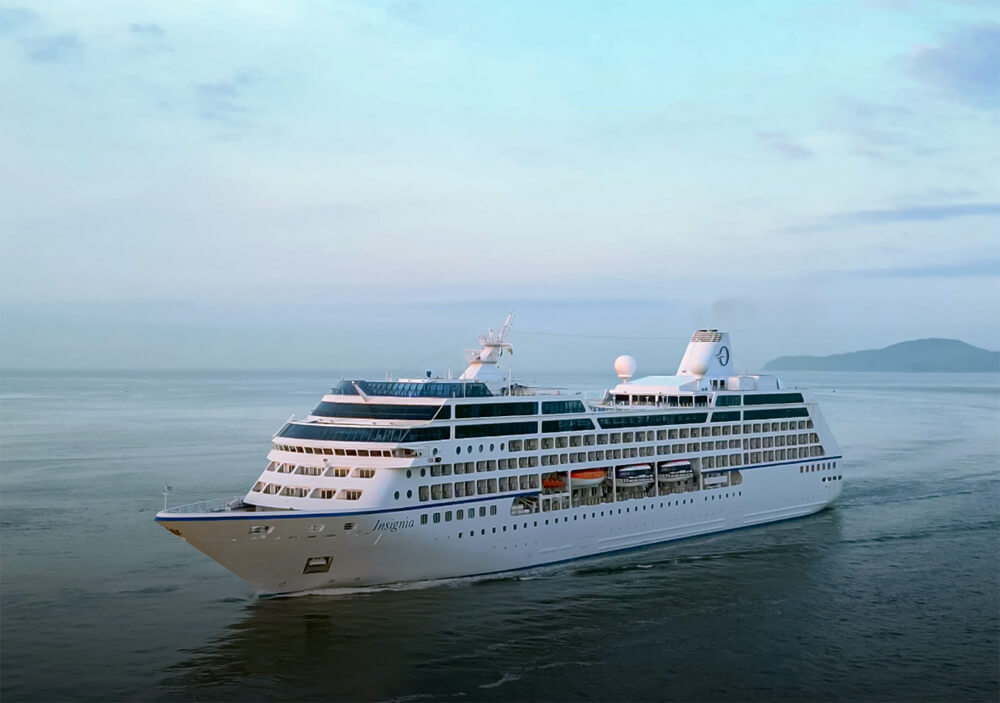
Oceania's Insignia was one of the two cruise ships that Crescent Sea had agreed to charter (Oceania)

Published Nov 5, 2025 2:18 PM by The Maritime Executive


Eight months after going public with plans to launch a resident cruise line called Crescent Seas, the company has relinquished charter agreements with Norwegian Cruise Line Holdings (NCLH) for two cruise ships, instead saying it is focusing on plans for a newbuild. It becomes the latest in a series of efforts that tried but failed in concepts to convert existing cruise ships into residences at sea.

“In the six months since launching Crescent Seas, the brand captured extraordinary interest from individuals around the world,” said a spokesperson for the company. After conversations with potential buyers, the company, however, says it became clear that the demand is for larger, more customizable residences. They said it far exceeded expectations.

Plans for the cruise line were announced in March 2025 by Russel Galbut, a lawyer and high-end real estate developer. Galbut was a founding director and investor in Prestige Cruises starting in 2005 till the company was acquired by Norwegian Cruise Lines Holdings in 2014. Prestige is the parent to Regent Seven Seas Cruises and Oceania Cruises. Galbut served as a director and later Chairman of the NCLH board from 2018 to 2024.

Crescent Seas, they reported, would take the Seven Seas Navigator (28,800 gross tons), which was introduced in 1997 on a long-term charter, and handle the marketing of the residences, while Norwegian Cruise Line Holdings was to continue the technical operations. Handover was scheduled for October 2026 and to re-launch in December as the resident ship after a more than $50 million renovation. The plan called for reducing the ship’s 248 suites down to 210, which were to be priced between $750,000 and $8 million.

The company had ambitious plans, saying it would have five ships announced over the next five years. In April 2025, it announced it had also chartered the Insignia (30,000 gross tons) from Oceania Cruises. The ship, which was introduced in 1998, was due to be handed over in November 2027. The reconstruction was to reduce the ship from 333 cabins to 290, priced between $650,000 and $10 million.

Crescent Seas says the sales operation, which launched in the spring, helped in “market validation and deepened understanding of what high-net-worth buyers want.” It said the potential buyers wanted more space, flexibility, and participation in the design. People who put money down on the first two ships will get full refunds and priority access to the planned new ship. 


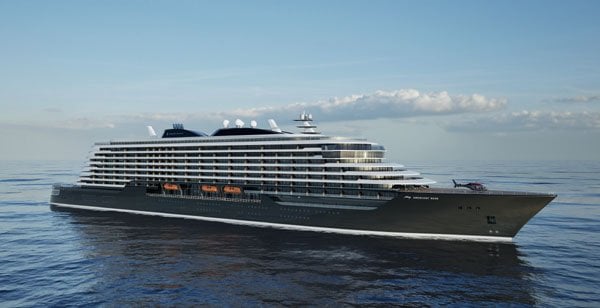
Crescent Seas' concept for Ocean, a 55,000 GT newbuild (Crescent Seas)


The company says it is evolving its strategy from existing ships to newbuilds. They had previously revealed plans for a ship called Ocean, which they now report will be 55,000 gross tons. It will have more than 200,000 square feet of salable inventory across 300 units. The company projects delivery in Q4 2031. In addition to the customizable spaces, the larger ship, while more expensive, will make it possible for the per-unit maintenance costs to be lower due to economies of scale, according to Crescent Seas. 

Seven Seas Navigator and Oceania Insignia will no longer be chartered by Crescent Seas Development, and will remain in the Regent Seven Seas Cruises and Oceania Cruises fleets, respectively,” confirms a spokesperson for Norwegian Cruise Line Holdings. 

NCLH is focusing on its newbuilds for the two brands, and the charters were presented as part of a fleet modernization strategy that includes new ships for both lines. Regent Seven Seas Cruises, which operates Seven Seas Navigator, said it is planning a multi-million-dollar refurbishment for late 2026 for its ship. Both lines said new itineraries would be released shortly for future cruises.

The resident cruise ship segment was pioneered by The World, which entered service over 20 years ago, as a custom-designed newbuild. Since then, several companies have announced concepts that are yet to come to fruition, and several plans called for rebuilding existing cruise ships. The only one that has succeeded so far is a start-up with a ship called Villa Vie Odyssey, rebuilt from a 30-year-old cruise ship and introduced as a residency in September 2024. With the growth in high-end luxury cruising, several firms continue to look to leverage interest in cruising to expand residential cruise ship offerings.

CMA CGM Highlights French Ties with New Class of Ultra-Large Boxships

containership launch
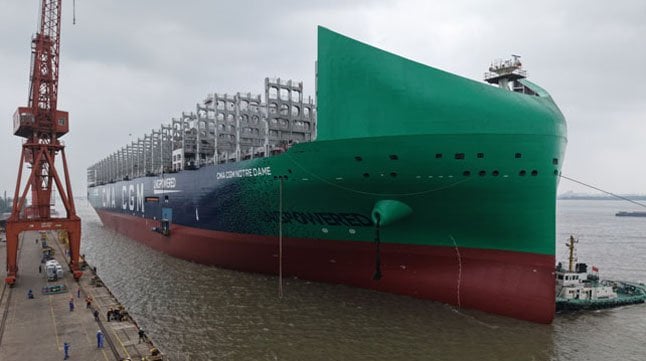
CMA CGM Notre Dame was floated in October as the first ship of the new class (CMA CGM)

Published Nov 4, 2025 3:56 PM by The Maritime Executive


Chairman and Chief Executive Officer of CMA CGM Group Rodolphe Saadé used a prestigious forum in France today to highlight the company’s next class of ultra-large containerships and its ties to France. Speaking before French President Emmanuel Macron, Saadé said it was a step to emphasize the company’s long-term commitments to France and deflect from some of the criticisms of the company.

Speaking at the Assises de l’Économie de la Mer event, CMA CGM highlighted its investment, reportedly valued at $2 billion for a new class of 24,000 TEU ultra-large containerships. The first of the ships was recently floated out at China’s Yangzijiang Shipbuilding, with the company saying it will take delivery of 10 ships of the class starting in 2026. While they have similar dimensions to the company’s current large vessels (399 meters / 1,309 feet in length), capacity increased to 24,212 TEU with 2,200 reefer slots. The ships are dual-fuel LNG and will be compatible with biomethane and e-methane.

CMA CGM said it will register the new class in France, after having earlier this year registered its new large vessel in Singapore and recently highlighted plans for investments in the U.S. and reflagging vessels to India. 

“By choosing France, CMA CGM is making a powerful statement in favor of French maritime and logistics sovereignty on the global stage,” CMA CGM asserted. It said the move is part of the group’s “determination to strengthen France’s maritime competitiveness.” It noted that France is the world’s second-largest maritime domain.

To further emphasize the connection to France, the company said the class will bear the names of iconic French monuments and landmarks. This includes: Notre Dame, Panthéon, Orsay, Luxembourg, Pont Neuf, Versailles, Austerlitz, Nation, Cluny, and Longchamp. Further, the ships will call regularly at Le Havre and Dunkirk as part of their route between Northern Europe and Asia.

The decision to flag the ships in France means that the company will also be recruiting 135 additional French seafarers to operate the ships. The company said that it will mean an additional cost of between approximately $17.5 million and nearly $20 million per year versus operating with a foreign flag registration.

CMA CGM has been criticized in France for its lavish profits and low tax rate despite the country’s economic challenges. In addition, the company has lobbied to maintain tax breaks, including a tonnage tax, versus the calls to require the company to pay the higher corporate tax rate.

The group is in the midst of an expansion effort that calls for an additional 129 vessels with a total capacity of more than 1.7 million TEU, according to Alphaliner. The company highlights that it currently has a fleet of over 650 ships (total capacity of just over 4 million TEU) and that in 2024 it carried over 23 million TEU. The larger group has also expanded its logistics operations, launched air cargo including acquiring Air Belgium, started car carrier operations, purchased a ferry operator, and launched a media division that is the third largest in France.


New Entrants into “Green” Cruising

sail-powered cruise ship
Captain Arctic due to enter service in 2026 will be sail powered (SELAR)

Published Nov 9, 2025 11:32 AM by The Maritime Executive


Cruising is among the shipping segments pursuing new environmentally sensitive technologies, with exploration and luxury at the forefront. Large cruise ships have adopted LNG, scrubbers, and solar panels, while two newly launched expedition cruise ships will be among the most environmentally advanced to date.

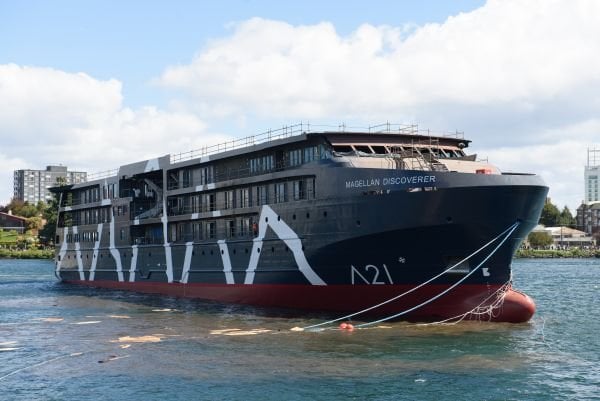
The ASENAV shipyard in Valdivia, Chile, seeks to establish its position in the sector with the launch of the new Magellan Discoverer for the sustainable polar travel company Antarctica21. The yard previously built the line’s Magellan Explorer, which was introduced in 2019. The new ship was floated out at the yard on October 24 and is scheduled for delivery in September 2026. Magellan Discoverer is due to enter service in November 2026.

At 94 meters (308 feet) in length, the ship is the first hybrid diesel-electric polar cruise vessel. It will use ABB’s Azipod maneuvering technology and an advanced energy storage system powered by marine-grade lithium batteries. The power management system will ensure optimal engine efficiency, reduced emissions, and quieter operations. The ship will have two 1,800 kW hybrid-electric diesel engines, which will give it a speed of 14 knots in open water.


Launch of Magellan Discoverer (ASENAV)


The hull is PC6 Ice Class, and the ship has a draft of 4.3 meters (14 feet). Continuing the trend of mixing luxury and expedition, the Magellan Discoverer’s cabins all feature a private balcony, with a maximum passenger capacity of 96 people. The ship has a panoramic lounge, dining room, sauna, outdoor BBQ deck, and a science lab.

According to Fernando Rodriguez, General Manager of ASENAV, “This vessel marks a significant leap in sustainable engineering.”

The ship is undergoing interior outfitting and the integration of navigation systems. It will then undergo technical trials and receive its maritime certification. The ship will be registered in the Bahamas, as is the Magellan Explorer.

Sail Drive Exploration Cruising

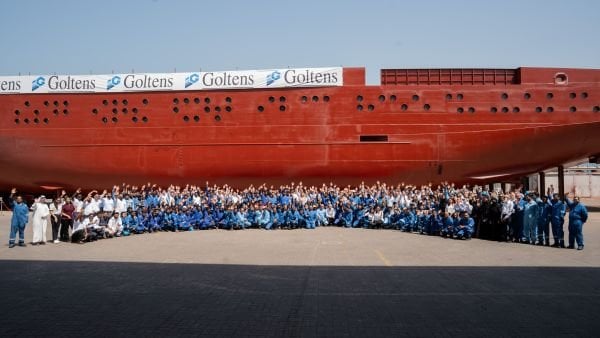
An equally revolutionary new exploration cruise ship, Captain Arctic, is progressing, with Goltens Dubai reporting the hull was floated on October 2. Work then began preparing and loading the hull for transfer to the Chantier Naval de l’Ocean Indien (CNOI) shipyard in Mauritius, where the outfitting is taking place. The hull was due to reach CNOI on November 3.

When completed, the ship will be unique, operating as a near-zero-emission exploration vessel for the French company SELAR. The ship will use wind propulsion, and the sails will also be fitted with integrated photovoltaic solar panels. The drawings show five rigid sails. They expect the ship will reduce CO2 emissions by up to 90 percent compared to conventional ships.


Completion of the hull for Captain Arctic (Goltens)


Goltens Dubai was responsible for the hull construction, fabrication of the king post, and supplying and installing products such as water-tight doors. Assembly of the hull was completed in 10 months from keel to launch.

Captain Arctic will be 70 meters (230 feet) and the sails will be 35 meters (115 feet) in height and retractable. They are made of aluminum and will have 2000 square meters of solar panels. The ship also has two propeller shafts that will produce energy and act as hydro turbines. Water will be made aboard through reverse osmosis, and heating for the ship will come from a pellet boiler that uses recycled wooden waste pellets. To further reduce the environmental impact, Captain Arctic will have organic food digesters, a treatment tank that transforms black and gray water into technical potable water.

The ship will accommodate 36 passengers with a crew of 24. There will be no set itineraries, with the captain determining the best route based on current conditions. 

Captain Arctic is scheduled to complete construction in August 2026. She will operate cruises in the winter of 2027 for skiing in the Viking fjords and pursuing the Northern Lights in Norway. She will also call in Svalbard and cruise to Greenland.


Video from CNOI showing the hull construction and launch at Goltens Dubai