Shake-Up at DFDS as Ferry Operator Looks to Accelerate Financial Turnaround
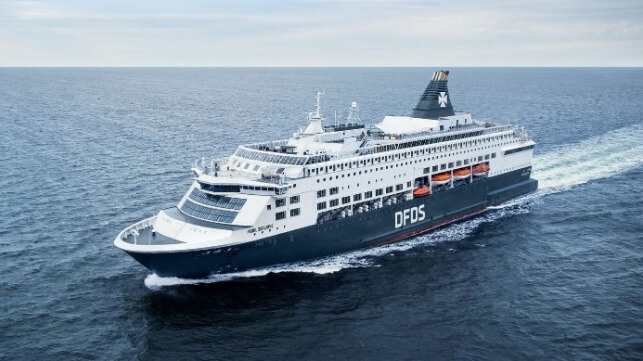
DFDS, one of Europe’s largest ferry operators, announced a series of shake-ups after posting disappointing financial results for the third quarter. The company had said that 2025 would be a transitional year as it laid the foundations for improving financial performance, and now it is adding layoffs, cost-cutting, and a search for a new chief executive officer.
While saying that it was making progress on most of the priorities laid out in its plan, DFDS reported a 32 percent year-over-year decline in income (EBIT). Revenues were up four percent, but the growth in the existing business lines was off two percent this quarter.
The company said among its priorities are a focus on its logistic operations, adapting its Mediterranean ferry network, including a new pricing model, and a turnaround for operations in Turkey and Europe South. While reporting progress on its initiatives, it also said the earnings trend improvement for Turkey and Europe South is slower than expected “amid challenging market conditions.”
Citing uncertainties for the business in Q4, the company lowered its income (EBIT) forecast. It said it was mainly driven by the uncertainties for the Mediterranean ferry and logistics activities.
Long-term CEO Torben Carlsen is a casualty, with the board reporting it is initiating a search for a successor to lead the next phase of the strategy execution. Carlsen will remain in place while the search is ongoing.
Torben Carlsen joined DFDS in 2009 as Executive Vice President and CFO and was appointed President and CEO in May 2019. During his tenure with DFDS, he has led the company through several key acquisitions, including Norfolkline in 2010 and the expansion into the Mediterranean with UN RoRo in 2018, and expanded DFDS’ network and geographical scope, while also navigating significant macro challenges such as Brexit, Covid, and adverse inflationary and market developments as a consequence of the Russian invasion of Ukraine.
He also served as Chair of Danish Shipping for the last three years and represented Danish Shipping in the European Shipowners’ Association while also being a board member of Interferry.
To accelerate the earnings improvements, the company also said it will implement a cost reduction program, including layoffs, in 2026. The plan calls for a reduction of approximately 400 mainly office-based positions. The company says it currently has 16,500 full-time employees.
The cost-saving initiatives are expected to reduce costs by around DKK 300 million ($46 million). The company implementation would cost approximately DKK 100 million ($15.5 million) in Q4 2025.
Maersk Disappoints Investors, Points to Continued Challenges in Shipping
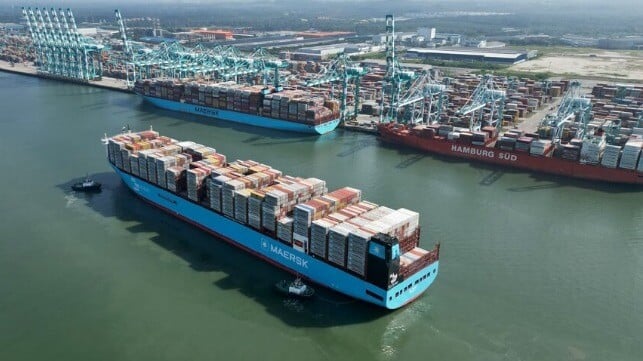
Despite reporting better than expected third quarter results and narrowing the range for its yearly income estimate, investor concerns continue to grow on the container shipping segment as Maersk pointed to continuing issues. While it reported strong quarterly results, it was the underlying issues around freight rates that raised the greatest concern for Maersk and the industry more broadly.
Among the first of the large, publicly traded container carriers to report financial results, Maersk’s reports draw broad attention as a bellwether for the segment and global economy. In good news for the industry, speaking with reporters, Maersk CEO Vincent Clerc dismissed the talk of “de-globalization” and changes in trade patterns due to the trade wars and tariffs. He pointed to the continued high volumes during the quarter, as well as strong performance in its terminal operations and improved margins for the logistics businesses.
Maersk experienced a seven percent increase in its volumes during the third quarter, highlighting the strong exports from East Asia and China. It also pointed to the success of the Gemini Cooperation with Hapag-Lloyd, which it said enables cost savings and supports the volume growth with industry-leading reliability. It said it had experienced sequential growth across all its business segments while saying the company is well-positioned to help customers adapt and maintain stability across their supply chains.
After starting 2025 with a pessimistic outlook that foresaw a potential decline in container market volume growth, Maersk has raised its forecast several times. Today it is it forecasts four percent growth for the year, revised from a previous interim estimate of two to four percent.
The main factor impacting the company’s financial performance was freight rates. While rates were largely stable versus the prior quarter, they continued a step decline versus the year ago. Average freight rates were down by nearly a third (31 percent). The company was able to offset some of these declines with cost savings and lowered fuel costs.
Freight rates, Clerc reported, had fallen during the third quarter below Maersk’s breakeven level. Although the rates appeared largely stable, the outlook is for rates to continue forward at similar levels, putting pressure on the company’s financial performance. During the third quarter, revenues from the ocean division were off 18 percent versus last year. The overall company reported a significant drop in income (EBIDTA) during the third quarter.
Another factor that it said is likely to impact results is “huge uncertainty” from the containership orderbook. Clerc echoed the concerns of many investors and industry executives about how the new ship deliveries will impact the industry over the next three years. He also said that the rerouting away from the Red Sea would continue for the remainder of the year. Analysts have speculated that the return to routes through the Red Sea would create excess capacity, which could weigh on freight rates going forward.
Based on the nine-month results, Maersk narrowed the range for its full-year estimates for earnings (EBITDA and EBIT). After starting 2025 with the low end of the range for EBITDA at $6 billion, the company again raised the low end from $8 billion to $9 billion for the year while maintaining the high end of the range at $9.5 billion.
Concerned about the outlook and disappointed that the company had not increased its income forecasts for 2025, investors drove the share price of Maersk down approximately five percent. Maersk does not provide forecasts for the year ahead until reporting year-end results in early 2026.
Residential Cruise Line Crescent Seas Relinquishes Charters on NCLH Ships
Eight months after going public with plans to launch a resident cruise line called Crescent Seas, the company has relinquished charter agreements with Norwegian Cruise Line Holdings (NCLH) for two cruise ships, instead saying it is focusing on plans for a newbuild. It becomes the latest in a series of efforts that tried but failed in concepts to convert existing cruise ships into residences at sea.
“In the six months since launching Crescent Seas, the brand captured extraordinary interest from individuals around the world,” said a spokesperson for the company. After conversations with potential buyers, the company, however, says it became clear that the demand is for larger, more customizable residences. They said it far exceeded expectations.
Plans for the cruise line were announced in March 2025 by Russel Galbut, a lawyer and high-end real estate developer. Galbut was a founding director and investor in Prestige Cruises starting in 2005 till the company was acquired by Norwegian Cruise Lines Holdings in 2014. Prestige is the parent to Regent Seven Seas Cruises and Oceania Cruises. Galbut served as a director and later Chairman of the NCLH board from 2018 to 2024.
Crescent Seas, they reported, would take the Seven Seas Navigator (28,800 gross tons), which was introduced in 1997 on a long-term charter, and handle the marketing of the residences, while Norwegian Cruise Line Holdings was to continue the technical operations. Handover was scheduled for October 2026 and to re-launch in December as the resident ship after a more than $50 million renovation. The plan called for reducing the ship’s 248 suites down to 210, which were to be priced between $750,000 and $8 million.
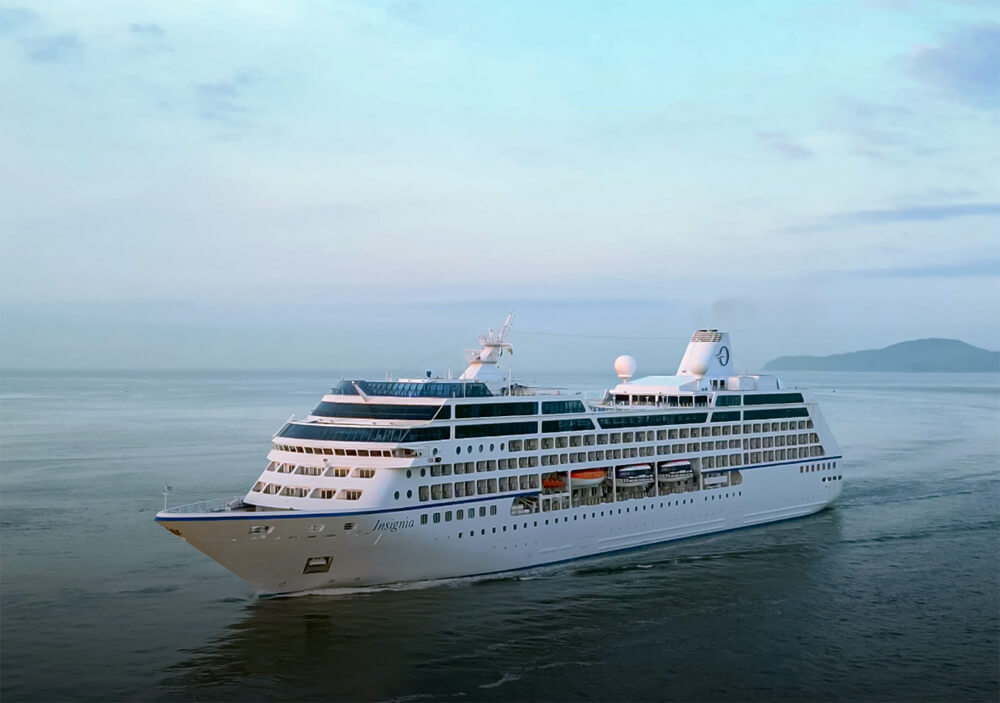
The company had ambitious plans, saying it would have five ships announced over the next five years. In April 2025, it announced it had also chartered the Insignia (30,000 gross tons) from Oceania Cruises. The ship, which was introduced in 1998, was due to be handed over in November 2027. The reconstruction was to reduce the ship from 333 cabins to 290, priced between $650,000 and $10 million.
Crescent Seas says the sales operation, which launched in the spring, helped in “market validation and deepened understanding of what high-net-worth buyers want.” It said the potential buyers wanted more space, flexibility, and participation in the design. People who put money down on the first two ships will get full refunds and priority access to the planned new ship.
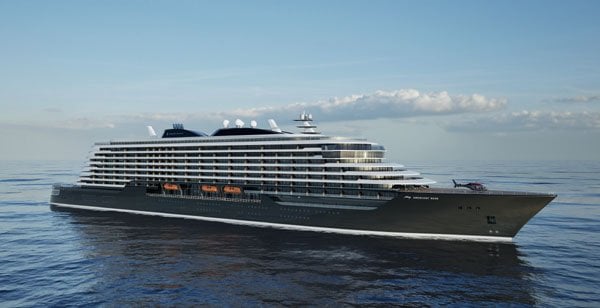
Crescent Seas' concept for Ocean, a 55,000 GT newbuild (Crescent Seas)
The company says it is evolving its strategy from existing ships to newbuilds. They had previously revealed plans for a ship called Ocean, which they now report will be 55,000 gross tons. It will have more than 200,000 square feet of salable inventory across 300 units. The company projects delivery in Q4 2031. In addition to the customizable spaces, the larger ship, while more expensive, will make it possible for the per-unit maintenance costs to be lower due to economies of scale, according to Crescent Seas.
“Seven Seas Navigator and Oceania Insignia will no longer be chartered by Crescent Seas Development, and will remain in the Regent Seven Seas Cruises and Oceania Cruises fleets, respectively,” confirms a spokesperson for Norwegian Cruise Line Holdings.
NCLH is focusing on its newbuilds for the two brands, and the charters were presented as part of a fleet modernization strategy that includes new ships for both lines. Regent Seven Seas Cruises, which operates Seven Seas Navigator, said it is planning a multi-million-dollar refurbishment for late 2026 for its ship. Both lines said new itineraries would be released shortly for future cruises.
The resident cruise ship segment was pioneered by The World, which entered service over 20 years ago, as a custom-designed newbuild. Since then, several companies have announced concepts that are yet to come to fruition, and several plans called for rebuilding existing cruise ships. The only one that has succeeded so far is a start-up with a ship called Villa Vie Odyssey, rebuilt from a 30-year-old cruise ship and introduced as a residency in September 2024. With the growth in high-end luxury cruising, several firms continue to look to leverage interest in cruising to expand residential cruise ship offerings.

No comments:
Post a Comment