Tuesday, November 11, 2025

FE

Iron ore price hits multi-month lows as China demand concerns linger
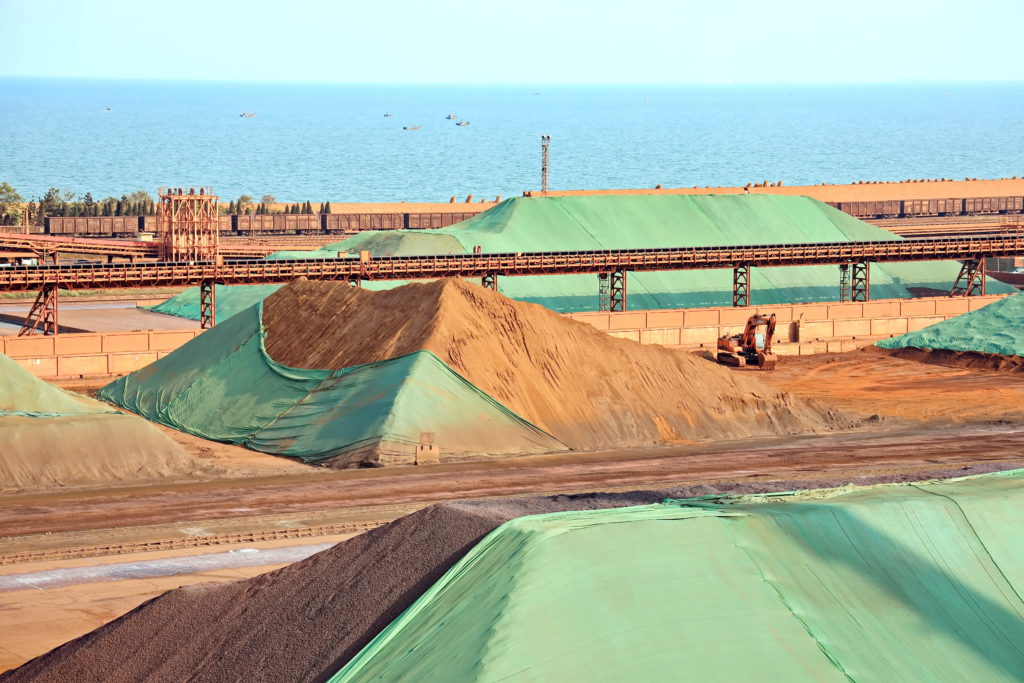
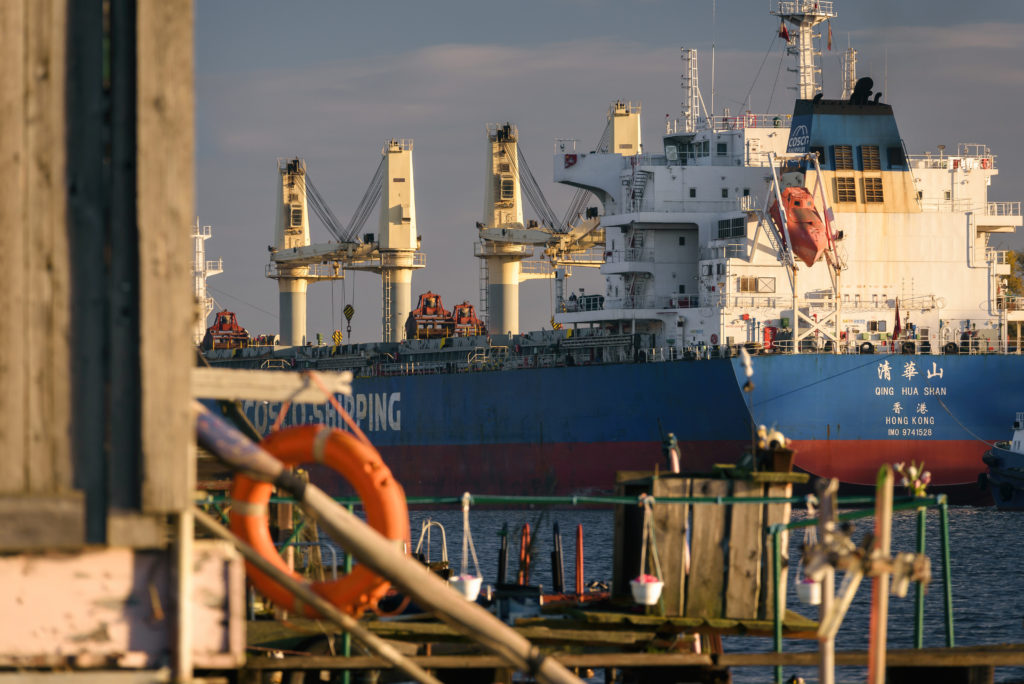
Port Rizhao, China. Stock image.

Iron ore touched multi-month lows on Monday amid concerns over demand in top consumer China and rising portside ore inventories, although falling shipments helped pare some losses in the afternoon trading.

The most-traded January iron ore contract on China’s Dalian Commodity Exchange (DCE) ended daytime trade little changed at 765 yuan ($107.40) a metric ton. The contract hit its lowest level since July 10 at 756 yuan earlier in the session.

The benchmark December iron ore on the Singapore Exchange was up 0.72% at $102 a ton, as of 07:25 GMT, after hitting its lowest level since September 1 at $100.85 earlier.

Prices were supported by lower global shipments, which slipped to the lowest level in two months, data from consultancy Mysteel showed.

Further signs of easing trade tensions between China and the United States also boosted risk appetite.

China said on Monday that it would suspend port fees levied on US-linked vessels for a year.

Meanwhile, data showing China’s producer price deflation eased in October and consumer prices returned to positive territory due to efforts to curb overcapacity and cut-throat competition among firms, also boosted sentiment.

However, price gains were curbed by pressure from lower demand amid wider production cuts triggered by losses.

That came even as some regions in northern China, including key steel production hub Tangshan, lifted environmental protection-led production controls from Sunday.

Resilient raw material prices and softening downstream demand have squeezed steel margins, propelling some mills to start equipment maintenance, said analysts.

Iron ore inventory at major Chinese ports rose 2.1% to 138.44 million tons – the highest since March 21- as of November 7 from the previous week, data from consultancy SteelHome showed.

Coking coal and coke, other steelmaking ingredients, slid 1.02% and 1.19%, respectively.

Most steel benchmarks on the Shanghai Futures Exchange bucked the downtrend. Rebar added 0.26%, hot-rolled coil nudged up 0.06%, stainless steel advanced 0.28% while wire rod shed 0.12%.

($1 = 7.1230 Chinese yuan)

(By Amy Lv and Lewis Jackson; Editing by Subhranshu Sahu and Eileen Soreng)


Guinea to fast-track alumina, iron ore processing, minister says
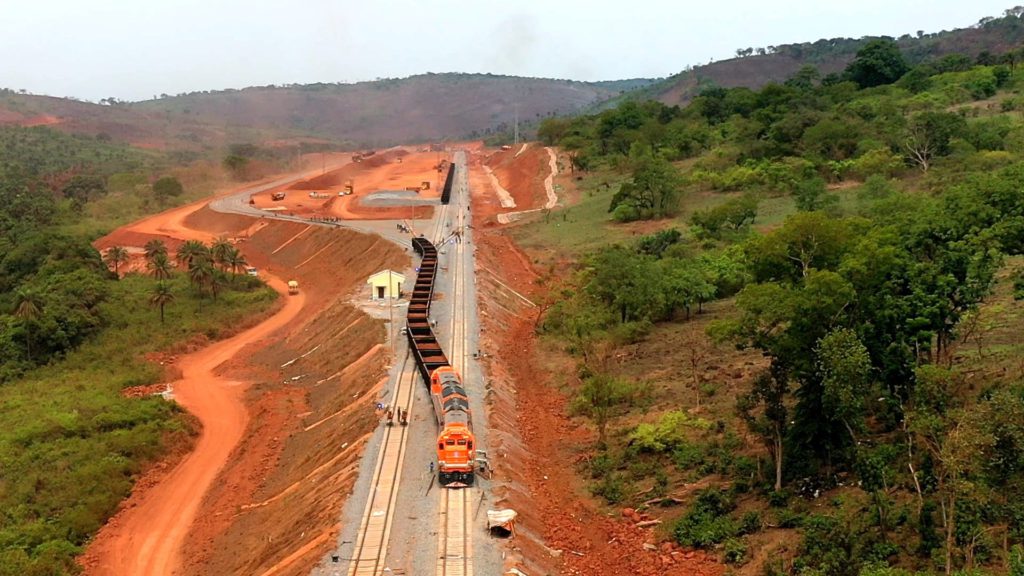

Credit: SMB

Guinea will fast-track the development of alumina refineries and iron ore pellet plants to end decades of raw ore exports, its mines minister told reporters, as the country prepares for the first shipments from its huge Simandou iron ore mine this week.

In-country alumina and iron ore processing could transform Guinea’s economy by creating industrial jobs and reducing exposure to commodity price swings, the World Bank said in July.

Guinea ships about 60% of its bauxite, a feedstock for aluminum, to China, while a third of iron ore produced by the Simandou mine is destined for Chinese mills.

Conakry has signed its first alumina refinery deal with Chinese state-owned SPIC, with construction underway and completion due by end-2027, said Mines Minister Bouna Sylla.

Talks for additional plants are advanced with Chinalco and France’s Alteo, and ongoing with Compagnie des Bauxites de Guinee and Alcoa, he added.

“We are the biggest bauxite producer in the world now … but we don’t have any refineries built since colonial times,” Sylla said. “That will change.”

Six refineries by 2030

Guinea joins a raft of mineral-rich African countries from gold producer Mali to oil driller Nigeria that have pushed to boost domestic refining capacity in recent years, a step key to maximizing returns, boosting economic growth and reducing costly imports.

The country aims to install five to six alumina refineries by 2030, boosting domestic processing capacity to about 7 million metric tons annually, Sylla said.

The West African nation in August revoked a bauxite concession awarded to a unit of Emirates Global Aluminium after the firm failed to build a promised alumina refinery locally, according to the minister.

EGA did not immediately respond to a request for comment.

China’s alumina projects in Guinea won’t cut its dependence on the country as exports will simply shift to alumina from bauxite, Allison Ju of SMM said.

Guinea’s bauxite, low in silica and suited for low-temperature refining, underpins 25% of global aluminum output.

Iron ore processing

Beyond alumina, Sylla said Guinea is pushing for domestic processing of iron ore.

Current agreements require Rio Tinto and Winning Consortium Simandou, who are jointly developing the Simandou deposit, to study and build a 500,000-ton steel plant or a 2 million-ton pellet facility, Sylla said.

The partners must submit feasibility studies for a steel mill or pellet plant within two years of first exports, said Djiba Diakite, chief of staff to the president.

If they fail, Guinea can hire a top global firm at the expense of Compagnie du Transguineen — the joint venture managing Simandou’s rail and port services — for the study.

“We believe we have identified the minimum capacities to design (this facility) based on sound economic principles,” Sylla said.

Rio Tinto’s Simfer venture, which operates part of the Simandou project, has a commitment for a feasibility study on a pellet plant to help understand the viability and options available, a Rio Tinto spokesperson told Reuters on Monday.

WCS did not immediately respond to a request for comment.

Guinea’s proximity to Europe and the US gives it a logistics edge over Middle Eastern hubs, Sylla said, adding that producing pellets and direct reduced iron for green steel are the preferred path.

Energy remains the biggest hurdle, Sylla admitted, but said Guinea is courting hydro, solar and liquefied natural gas investments, including a US-backed plan to import LNG for power plants.

(By Maxwell Akalaare Adombila; Editing by Clara Denina and Jan Harvey)


The shipping mogul who carved a route to China’s African mining prize
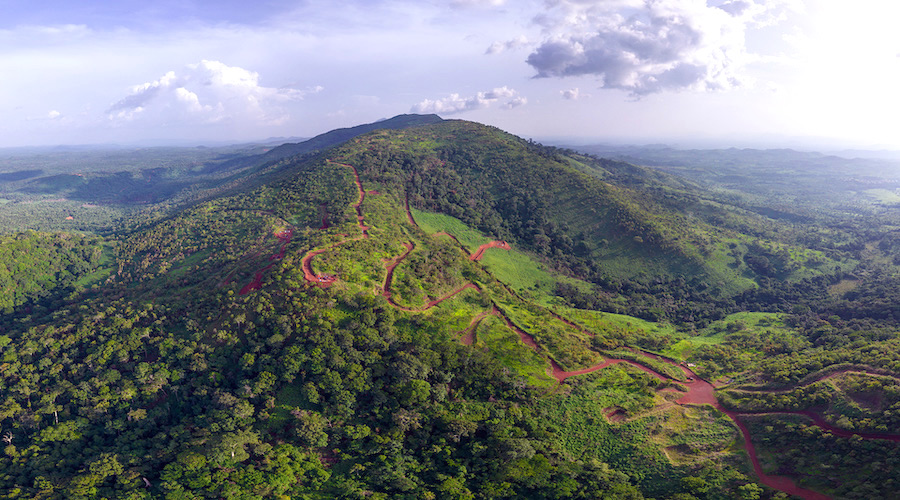

Aerial view of the Simandou project area. (Image courtesy of Rio Tinto).

When Sun Xiushun began to travel to Guinea just over a decade ago, he was an unknown shipowner desperate to stay in the aluminum game. He found the West African nation in the grip of an Ebola epidemic, with even the most hardened investors pulling out.

Sun — a Shandong native and long-time partner of aluminum giant China Hongqiao Group — dug in.

He needed a source of bauxite to replace Indonesia, a top supplier of the ore preparing to ban exports, and that meant connecting deposits in Guinea’s forested interior to a vast ecosystem of smelters in China. It took barges, floating cranes and the first new rail link in half a century, but the country became the single most important exporter and a vital supplier for the top metals market globally.

Now the one-time merchant seaman has repeated the feat, effectively unlocking the world’s largest untapped iron ore deposit with a more than 600-km (roughly 370-mile) railway across the country, bridges, tunnels and a purpose-built port — likely making himself a billionaire in the process.

One of the most storied projects of recent decades, Simandou, tucked away in Guinea’s mountainous south, lay in a state of suspended animation for years, becoming a byword for the Western industry’s apparent inability to build large-scale operations on time and on budget

This month, three decades after Rio Tinto Group was first given an exploration license, loading is beginning on the first shipment to be sent out from the new port of Morebaya — in large part thanks to Sun. The $23 billion project has become a study in why China continues to dominate African infrastructure. For many Western mining executives and advisors involved, it has also made a powerful case for collaboration with Chinese operators, even at a time of heightened geopolitical tension.

“For years, the challenge at Simandou was not the ore itself, but the formidable infrastructure needed to reach it,” said Qiang Fu, economist and professor in strategy and policy at the National University of Singapore. “By treating the railway and port as the strategic foundation rather than a secondary requirement, Sun redefined the venture and pushed it forward at a pace few expected.”

Sun’s methods are not those of large diversified miners. There is typically limited subcontracting and his personal interest, given a share of a portion of the main deposit and significant funds invested, encouraged him to press ahead even before others had signed on the dotted line. That urgency came with shortcuts — and reports of worker accidents. Still, by the time a co-development deal was signed in 2023, unlocking capital from other partners, nearly half the infrastructure was complete, at a lower-than-expected cost.

His goals and those of the Guinean government required him to move at speed, people on his team said, asking not to be named as the details of the negotiations are not public. And Sun did.

“Trading action for trust, and trust for resources, that’s the key strategy,” he said in a 2016 speech to students, recounted by people who heard it. “By fulfilling our promises, we earned high recognition from the government — and in return, access to the resources we needed.”
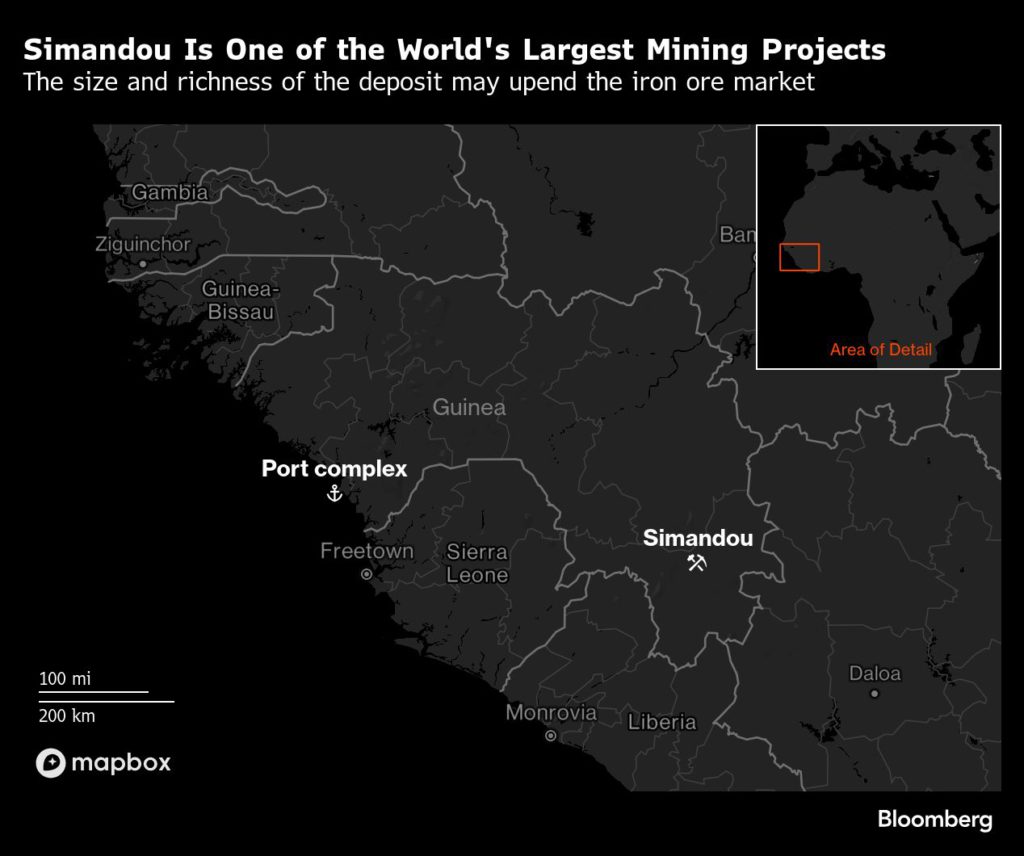
Simandou — so enormous and so rich that it could account for a tenth of the world’s supply of the steelmaking ingredient — has had an exceptionally fraught history. Its remote location makes access to the coast difficult and logistics, the toughest part of the challenge in any bulk-commodity operation, painfully costly. Add to that two coups, market vicissitudes, unwelcome government interventions and several corruption investigations. Real advances have taken years.

Rio initially held the entire deposit, but in 2008 it was seized by Guinea’s then president, unhappy with slow progress. A portion was handed to Israeli mining magnate Beny Steinmetz, who later brought in Brazil’s Vale SA. That venture ended in legal battles and graft allegations, and Steinmetz eventually agreed to walk away. Sun, having earned government trust with his bauxite operation, stepped in with his Singapore-based Winning International Group, in a consortium that took Simandou’s northern blocks in 2019.

Now surrounded by Chinese partners and rivals, Rio shares the southern half with Aluminum Corporation of China, or Chinalco, and other smaller holders. Guinea holds a minority stake in each half.

Rio Tinto declined to comment. Winning didn’t respond to emailed queries.

“Dealing directly with China is a way for us to deal with those that will provide funding for a project and also be the market for the project, making it bankable,” Abdoulaye Magassouba, mining minister until 2021, said in a January 2025 speech at Williams College in the US. And investors who are happy to dig even before all the paperwork is complete, he said — in an apparent reference to Sun — encourage confidence.

Digging in

Sun was born in 1964 to a farming family in Shandong and trained at a maritime school. Eager to travel, he spent nearly a decade working as a seaman and mechanic before rising through the ranks and eventually moving ashore to a unit of Cosco Shipping Holdings Co. in the northern Chinese port of Qingdao. Friends say those years left him with a straight-talking, direct manner, and with ambitions — but with little desire to stand out. An abstemious figure, he prioritizes home life in Singapore over the lengthy banquets favored by Chinese executives of high standing, often dispatching deputies to events in his place.

After Sun set up Winning in 2002, his mainstay was transporting bauxite for China Hongqiao — a business relationship that has meant close ties with the prominent Weiqiao family, who have close ties to the aluminum giant. It ultimately led to a connection with Zhang Bo, now chairman of Shandong Weiqiao Pioneering Group Co., who became one of his strongest allies and a source of significant financial support.

But his real break came after 2013, as Indonesia moved toward a bauxite ban. Sun lost no time in pivoting to Guinea, where he recognized both the poverty and the solution he could provide — infrastructure. Those experiences and connections laid the ground for what followed.

Building a bauxite port in the country’s north, he struggled to drag hundreds of thousands of tons of material onshore in what was a shallow basin. He flew in a 12-person specialist crew from the Chinese port of Yantai to survey tides, anchorages and approaches. Tugs had to haul barges to the shoreline, pull cargoes in, check for damage, and head back out.

It was, as one of his team described later, duct-tape logistics at an industrial scale.

But the bauxite link that emerged earned valuable trust. Construction began in March 2019 and completed in June 2021. At the inauguration, Magassouba, then still minister, shook Sun’s hand. “Since I was born, this is the first time Guinea has seen a railway completed and opened,” he said, according to people present at the gathering.

Sun saw the moment as a turning point. “What changed Simandou’s fate was that they saw our capability and strength,” he said in a rare newspaper interview earlier this year.

Rivals and traders, though, were skeptical back in 2019. Apart from his recent aluminum win, Sun had limited experience in mining. Bankers in Singapore and China were unwilling to back him or his consortium, formed with long-standing aluminum partner Hongqiao, and, later, with China Baowu Steel Group. So he poured in his own money, and relentlessly squeezed costs.

Instead of hiring a single engineering, procurement and construction company — the industry norm — Sun turned his company into a builder and operator, splitting work among dozens of specialist teams, with experienced Chinese crews working along thousands of local workers, people who worked on the project said. On the ground, he used the same hardline methods that served him well in the early years in Guinea, while building out bauxite infrastructure — hard milestones, daily reports and an eye only on what had been done that day. If a target slipped, teams were expected to fix it.

But Simandou was a challenge of a different order — where the Dapilon–Santou bauxite line ran for 125 km, the iron ore project was to be roughly five times that, and in far more complex terrain. Sun used fewer middlemen but more contractors, including units of China Railway Engineering and China Harbour Engineering. The pace rattled large Western incumbents, advisors said.

Again, Sun’s methods were idiosyncratic, reversing the traditional mining project timeline, which requires reserves to be confirmed first, then feasibility to be studied, before companies turn to logistics and infrastructure. Sun, playing to his strengths, turned to logistics first, and he used Chinese standards, Chinese cut-and-paste designs, Chinese materials and Chinese crews — just as rivals did in Indonesia and the Democratic Republic of Congo. He was on site himself almost throughout, thanks to a regular commute from Singapore to Conakry, via Paris.

A decade ago, he had kept working even through the Ebola epidemic with strict rules and three on-site doctors. Those methods were used again during the Covid pandemic, with bubble zones and mobile PCR testing stations to keep crews insulated and the project on track.

Speed and Sun’s relentless approach did not always produce smooth results, as the project advanced through villages in a rich and previously isolated equatorial ecosystem. There were fatalities, and the Guinean government said earlier this year it was looking into safety practices. (The Winning consortium has said previously that it works to constantly improve safety protocols and “ensure they meet international standards.”)

Still, Rio executives, for whom Simandou has been a long-standing headache as well as a tantalizing prospect, took notice of the advances after a trip to the bauxite operation in the north, and approached the group, according to people familiar with the conversations. Sun was not receptive. Executives on his team later recalled that he felt a partnership with the world’s second-largest miner meant he would get caught up in red tape, squandering the momentum he had built up.

A new Guinean government that took power after a 2021 coup, however, was eager to push development of the country’s flagship asset with a single, jointly backed rail line to the coast serving both halves of the deposit. Officials brokered a meeting with the then-chief executive officer of Rio, Jakob Stausholm, at the presidential palace. With an eye on the country’s uncertain politics, Sun took the hint.

To operate the shared corridor, the parties formed Compagnie du TransGuinéen, with state participation alongside Rio’s Simfer and Winning Consortium Simandou.

When loading accelerates and shipments finally begin, all parties will claim a much-needed victory — a gargantuan new mine for Rio, with some of the highest grades around, and a high-profile infrastructure win for China at a time when its big-ticket spending in Africa has cooled. Vice Premier Liu Guozhong will attend the official inauguration this week as President Xi Jinping’s representative.

“Simandou has presented an opportunity for China to remind the world that they are involved in Africa, and in a big way,” said Tara O’Connor, managing director of Africa Risk Consulting, who has followed the mine’s development for years. “The project is probably even more important to them now in the Trump era of tariffs and trade wars. It’s a show of force.”

(By Alfred Cang)


Vale gearing up to meet Indian demand as China steel output stagnates, CEO says
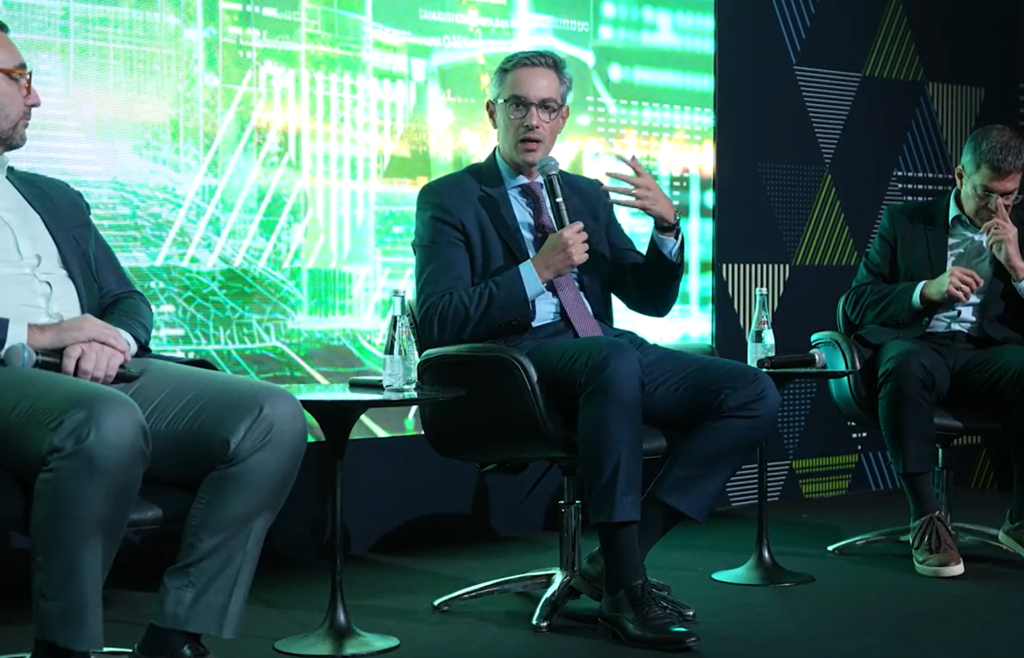
Vale CEO Gustavo Pimenta. (Image courtesy of Vale.)

Brazilian miner Vale is preparing to meet rising iron ore demand from India, which could double its steel production by the end of the decade, chief executive Gustavo Pimenta told Reuters.

Rising sales to India and other Asian markets should help to offset stagnant demand from China, where steel production has flattened to near 1 billion metric tons annually and could decline slightly in coming years, he said.

“India has 1.6 billion people, has surpassed China, and needs massive infrastructure investments, which means a lot of steel,” Pimenta said in an interview at Vale’s Rio de Janeiro headquarters on Friday.

He said the capacity of India’s steel producers is likely to double to around 300 million tons in the next five to seven years.

Vale’s high-grade ore blends well with India’s lower-quality supply, Pimenta added, creating opportunities for both markets.

“We bring quality to the Indian mix. As steel output doubles, we see a big growth opportunity,” Pimenta said.

India is expected to import about 10 million tons of Vale’s ore this year, up from almost none a few years ago, but still a small fraction compared to China, which accounts for around 60% of Vale’s sales.

While China will remain the world’s top steel producer, Vale sees its output stabilizing. “We don’t see growth ahead. Chinese production will probably remain steady, perhaps even decline,” Pimenta said, contrasting that with India’s 12% annual growth.

Vale also expects rising demand from other Asian markets, with sales to Vietnam projected at 8 million tons in 2025, up sharply from previous years.

Vale Day

Strong third-quarter performance, including 5% sales growth and its highest iron ore output since 2018, positions Vale well ahead of a long-term strategy update to be detailed at its annual “Vale Day” investor event in New York on December 2.

Pimenta declined to comment on new production targets, but said Vale will outline projects to boost iron ore and copper capacity in its key Northern System operations.

Vale plans to invest 70 billion reais ($12.95 billion) by 2030 in its “Novo Carajas” program in Brazil, including a project to raise annual iron ore capacity by 20 million tons. Now 80% complete, the initiative is set to begin operations in late 2026.

“As we explore more of Carajas, we get increasingly optimistic about its potential,” Pimenta said. “At Vale Day, we’ll give investors more visibility and confidence.”

Vale also aims to double its copper output by 2035.

Amid expansion plans, Vale expects to reclaim the title of world’s largest iron ore producer this year, surpassing Rio Tinto, which took the lead after Vale’s 2019 Brumadinho dam disaster.

Outside Brazil, Vale is considering selling its Thompson nickel mine in Canada amid market interest and weak prices due to Indonesia’s surging output.

“It’s an asset we struggled to bring to the cost level we wanted,” Pimenta said. “We’re assessing if there’s a better owner.”

The mine produced about 10,000 tons in 2024, or 6% of Vale’s total.

($1 = 5.4039 reais)

(By Marta Nogueira, Roberto Samora and Marcela Ayres; Editing by Brad Haynes and Chris Reese)

Column: China’s major commodity imports ease, except for iron ore

Stock image.

China’s imports of major commodities were largely soft in October as high prices weighed on volumes, with iron ore’s resilience bucking the trend despite the steel sector showing signs of pressure.

Crude oil, natural gas, copper and coal all showed declines from September, according to data released on Friday by the General Administration of Customs.

China, the world’s biggest importer of crude oil, saw arrivals of 11.39 million barrels per day (bpd) in October, the third straight monthly decline and down from 11.50 million bpd in September.

The easing in oil imports is most likely a reflection of the higher global prices that prevailed at the time when October-arriving cargoes would have been arranged.

Benchmark Brent futures hit a six-month high of $81.40 a barrel on June 23 during the brief conflict between Israel and Iran, and while they retreated to a low of $66.34 by July 1, they once again trended higher to reach $73.63 by July 31.

Since then, oil prices have been declining on a trend basis, with the occasional spike higher, largely caused by geopolitical events such as the announcement of new sanctions on Russia’s crude producers by US President Donald Trump.

Brent ended at $63.63 a barrel on Friday, and the current lower prices are likely to encourage China’s refiners to increase imports, even if much of the crude flows into commercial and strategic storages.

The impact of higher prices can also be seen in imports of natural gas, which totalled 9.78 million metric tons in October, down 11.5% from September’s 11.05 million and 7.2% below the 10.54 million from October last year.

It’s likely that pipeline volumes from Central Asia and Russia were largely steady, meaning the decline was from imports of liquefied natural gas, which have been trending weaker this year amid elevated spot prices caused by European demand for the super-chilled fuel.

Higher prices are also likely behind the 9.7% drop in imports of unwrought copper in October from September.

October arrivals were 438,000 tons, down from 485,000 tons in September and 506,000 tons in October 2024.

Copper prices have been trending higher since April, but the gains accelerated from late September, with London contracts jumping 12.8% from $9,927.50 a ton then to a record high of $11,200 a ton on October 29.

Coal, iron ore

But it’s not always prices driving China’s commodity imports, with coal being a case in point.

Imports of all grades of coal dropped 9.3% in October to 41.74 million tons from September’s 46.0 million tons, and were also down 9.8% from October last year.

The lower imports came as seaborne thermal coal prices languished near five-year lows, with commodity price reporting agency Argus assessing Indonesian coal with an energy content of 4,200 kilocalories per kilogram at $40.45 a ton in the week to July 4.

The grade, which is popular with Chinese utilities, has since recovered to $47.09 a ton in the week to November 7, but still remains well below the $52.30 from the same week in 2024.

However, with the northern winter imminent and higher domestic coal prices, it’s likely China’s imports will recover heading into the end of the year.

Iron ore was the surprise packet of China’s commodity imports in October, with arrivals of 111.31 million tons.

While this was down 4.3% from September’s record high of 116.33 million, it was up 7.2% from October last year and was also the fifth consecutive month that imports have topped 100 million tons.

The strength in imports isn’t price-related, as benchmark contracts in Singapore have been stable in a relatively narrow range anchored around $100 a ton so far this year.

Steel production has also been soft, dropping to a 21-month low in September of 73.49 million tons, with output for the first nine months of the year down 2.9% from the same period in 2024.

It appears that the strength in iron ore is largely because inventories are being rebuilt, with port stockpiles monitored by consultants SteelHome rising to 138.44 million tons in the week to November 7, a seven-month high and up from the low so far this year of 130.1 million tons in early August.

With inventories still shy of the 150.7 million tons they reached in November last year, there is still scope for iron ore imports to remain resilient heading into the end of the year.

(The views expressed here are those of the author, Clyde Russell, a columnist for Reuters.)

(Editing by Jamie Freed)

BAN DEEP SEA MINING

Deep Sea Rare Minerals seeks US seabed licences


Research team studying the environmental impacts of deep-sea mining. (Image courtesy of Global Sea Mineral Resources.)

Deep Sea Rare Minerals (DSRM), the parent company of autonomous underwater vehicle operator Deep Sea Vision, has applied for subsea mineral exploration licences with the US National Oceanic and Atmospheric Administration (NOAA).

The move makes DSRM only the second company, after The Metals Company (Nasdaq: TMC), to publicly announce such an application since US President Donald Trump’s executive order in April promoting the deep-sea mining industry.

The filing coincides with DSRM’s sponsorship of the 2025 Underwater Minerals Conference, running November 9–14 in Honolulu. 


NOAA, which regulates mineral exploration and recovery by qualified US entities in international waters, recently pledged to speed up its review process, saying it would “provide the necessary resources for license and permit reviews to ensure that those reviews go forward without undue delays.”

Tony Romeo, chief executive of DSRM and a former US Air Force intelligence officer, said the company is ready to help strengthen national mineral supply chains.

“As an American-based company, we are ideally positioned to leverage our deep-water equipment, personnel, and operational expertise,” Romeo said. “We look forward to working with NOAA and other federal agencies throughout this application process to become a dependable supplier of US-sourced critical minerals.”

Spiking interest

DSRM’s application comes barely a day after a joint announcement by Japan and the US outlining plans to develop deep-sea mining near Japan’s Minamitorishima Island. The partnership aims to secure rare earth materials critical to advanced technologies and defence while reducing dependence on China, which controls nearly the entire global supply chain.

DSRM’s move also comes amid growing environmental scrutiny. A study published this week warned that waste from deep-sea mining could disrupt ecosystems in the ocean’s “twilight zone,” a vital midwater layer supporting much of the marine food web. 

NI

Aqua Metals partners with Westwin to strengthen US nickel supply chain

Credit: Westwin Elements

Aqua Metals said on Monday it has signed a non-binding letter of intent with Westwin Elements, the only major US nickel refinery, to supply up to 1,000 metric tons of recycled nickel carbonate a year starting in 2027.

The potential deal, valued at around $12 million annually based on current nickel prices, aims to strengthen domestic production of critical minerals used in batteries and clean energy systems.

The companies are looking build one of the first fully domestic, recycled nickel supply chains, from battery waste to refined metal, as the US pushes to secure clean, homegrown sources of critical materials and cut reliance on imports.

Aqua Metals said the agreement follows successful testing of its battery-grade nickel carbonate made from recycled lithium-ion battery material at its Nevada pilot plant.

Under the LOI, the companies plan to finalize terms for Aqua Metals to supply between 500 and 1,000 metric tons of nickel carbonate a year once both complete their commercial facilities and secure financing.

(By Arunima Kumar; Editing by Krishna Chandra Eluri)

U.S. and Australia Team Up to Counter China's Rare-Earths Dominance

Mountain Pass Mine, California, 2022 (Tmy350 / CC BY SA 4.0)

Published Nov 10, 2025 8:01 PM by The Maritime Executive


Engagement between Australia and the United States on critical minerals has matured from technical cooperation into a strategic partnership, aligning resource security with clean energy and defense priorities. Both governments recognize the urgency of diversifying supply chains as China entrenches its dominance across critical mineral extraction and processing. US policy has so far delivered strong domestic signals and backed its producers, but outcomes of its recent allied contributions remain to be seen.

China’s 2023 export ban exposed allied dependence on its processing power, prompting a strategic shift. While the US shielded firms including MP Materials with price guarantees, Australian producers such as Lynas Rare Earths remained vulnerable to market swings. October’s US–Australia Critical Minerals Framework signals continued momentum in bilateral cooperation. However, it is part of a broader sequence of initiatives that have achieved limited success in reshaping supply chains toward greater diversity and sustainability.

From technical cooperation to strategic compact

This partnership has rapidly evolved. A 2019 agreement between Geoscience Australia and the US Geological Survey provided a foundation for joint mapping and mineral assessments. By 2022, the Net-Zero Technology Acceleration Partnership formalized cooperation around zero-emissions technologies and diversified supply chains.

A breakthrough came in May 2023 with the Climate, Critical Minerals, and Clean Energy Transformation Compact. This established ministerial-level task forces and joint investment mechanisms, deepening the integration of supply chain planning. By October 2024, cooperation extended into batteries, long-duration storage, and solar supply chains through the Clean Energy Ministerial Dialogue. In July, Washington announced a Quad critical minerals initiative, signalling a more coordinated—but still US-led—effort to reduce Chinese dominance.

More significantly, both the US and Australia are members of the Minerals Security Partnership, a US-led multilateral forum launched in 2022. The US is a G7 member and Australia is an endorsing partner, and each has supported the G7’s five-point plan on critical-minerals security.

US strategy in transition

China’s December 2023 ban on exporting rare earth extraction and separation technologies was a wake-up call. It highlighted just how reliant the US and its partners remain on Chinese midstream processing. Even Western-backed projects, such as Brazil’s Serra Verde heavy rare earths mine, still depend on China to refine product. Raw supply diversification is meaningless without processing capacity.

In July, US President Donald Trump reshaped Biden-era industrial policy. By scaling back parts of the Inflation Reduction Act, Trump’s One Big Beautiful Bill Act weakened incentives for electric vehicle uptake and reduced demand certainty for critical minerals. Without long-term offtake agreements, more projects could turn to Chinese financing, ironically reinforcing Beijing’s dominance just as Washington seeks to undermine it.

The US Department of Defense’s US$400 million investment in MP Materials provides a stark contrast. With a guaranteed minimum price nearly double China’s market rate, Washington showed that industrial policy can shield producers from market volatility and strategic manipulation. But the benefits have so far been ringfenced for US firms.

Australia’s opportunity and risk

Australia brings to the table what Washington needs: resource abundance, political stability and a proven record as a secure supplier. Yet Washington’s protectionist tilt risks eroding trust. The Trump administration’s March decision to reject a reciprocal access deal, which guaranteed US access to Australian minerals in exchange for relief on steel and aluminum tariffs, was a missed opportunity.

Canberra has signalled it will not wait indefinitely. Australian Minister for Resources Madeleine King has floated an Australian price floor for critical minerals. The move suggests a more assertive industrial strategy designed to keep value onshore and diversify partnerships if Washington remains narrowly focused.

Meanwhile, firms such as Lynas Rare Earths face an uneven playing field. While MP Materials enjoys guaranteed prices and Pentagon backing, Lynas must contend with volatile markets and Chinese oversupply. Unless US policy expands beyond its borders, allied producers may remain perpetually vulnerable.

The trajectory ahead

China’s export bans underscore that allies must move up the value chain, not just secure raw supply. The MP Materials deal proves that price guarantees can stabilize projects and protect against Chinese manipulation. Extending such mechanisms to allies would not only strengthen trust but also deliver the scale of supply diversification that Washington’s strategy requires.

In a marked shift, under the United States–Australia Critical Minerals Framework, announced on 20 October, both governments pledged over US$3 billion in joint investments within six months to advance projects valued at US$53 billion. The announcement follows a major milestone a month earlier, when the US made a historic investment in Australia’s critical-minerals sector through the US Export–Import Bank’s financing of RZ Resources’ Copi Project, the first US-backed Australian minerals venture in more than a decade.

As part of the agreement, the bank will issue US$2.2 billion in financing to unlock up to US$5 billion in total investment. In addition, the US Department of Defense backs construction of a 100-metric-ton-per-year gallium refinery at Alcoa’s Wagerup facility in Western Australia, developed with Japanese participation through the Japan Australia Gallium Associates, a joint venture between the Japanese Government and Sojitz Corporation.

Building on this momentum, the Australian government has committed a $100 million equity investment to the Arafura Nolans project in the Northern Territory, which is expected to supply about 5 percent of the world’s rare earths once it becomes operational.

Scale and coordination remain essential. Australia must move beyond isolated critical-minerals projects and develop an integrated corridor through Darwin with pre-structured offtake, pricing, and traceability frameworks aligned to US standards.

Looking ahead, the US–Australia framework could be broadened into a wider Indo-Pacific partnership that includes Japan, South Korea and India, leveraging each country’s strengths in processing, industrial capacity and market demand.

The challenge now is to turn investment pledges into integrated, resilient supply chains that extend across the Indo-Pacific and deliver lasting stability for all partners involved.

Alice Wai is a junior researcher at ASPI. 

This article appears courtesy of ASPI and may be found in its original form here

Top image: Mountain Pass Mine, California, 2022 (Tmy350 / CC BY SA 4.0)

The opinions expressed herein are the author's and not necessarily those of The Maritime Executive

Marubeni to invest in Australian critical minerals project

Credit: RZ Resources

Japan’s Marubeni Corp will invest in a mineral sands project owned by Australia’s RZ Resources, it said on Monday, following in the footsteps of compatriot JX Advanced Metals, which struck a similar deal with RZ earlier this year.

If the project’s feasibility is confirmed, Marubeni will contribute A$15 million ($9.75 million) for options granting it up to 5% equity participation in RZ’s Copi mineral sands mine project in New South Wales along with certain marketing rights.

RZ, which owns the Copi project and a mineral separation and processing plant in Brisbane, Queensland, plans to produce heavy mineral sands products such as rutile, ilmenite, zircon and monazite. These minerals are used in industries including aerospace, defence and permanent magnets.

Alternatives to China

The alliances come as Japan and its Western allies step up efforts to secure critical minerals supply chains outside China, which has been tightening export restrictions on key resources.

JX, a producer of advanced materials from copper and rare metals used in chips and telecommunications parts, became a strategic partner of RZ in June.

Marubeni, RZ and JX will jointly work on developing the Copi mine project, upgrading RZ’s mineral separation plant, and enhancing RZ’s definitive feasibility study and environmental impact statement, Marubeni said in a statement.

JX said in a separate release that its participation in the project aims to secure a long-term, diversified supply of minerals, including minor metals and rare earths. It also cited the project’s location in a geopolitically stable region with well-established transport infrastructure, including shipping routes.

The project has received expressions of support from the Export-Import Bank of the United States and the Export Finance Australia, it added.

“Through Marubeni’s participation, we expect to leverage its network to secure sales channels for minor metals and rare earths, which we believe will further advance the project,” JX said, adding that it plans to expand similar partnerships.

($1 = 1.5389 Australian dollars)

(By Yuka Obayashi; Editing by Muralikumar Anantharaman and Joe Bavier)


Ionic Rare Earths signs preliminary deal for US recycling plant

Belfast-based commercial plant. ( Architect’s Impression courtesy of Ionic Rare Earths Limited.)

Ionic Rare Earths said on Monday it has signed a non-binding memorandum of understanding with US Strategic Metals to build a recycling facility that will produce rare earth oxides, including those subject to export restrictions from China.

The Missouri recycling facility is expected to produce significant quantities of neodymium and praseodymium (NdPr) as well as heavy rare earths including dysprosium, terbium, samarium, gadolinium, and holmium, the companies said in a joint statement.

The agreement focuses on rapidly producing high-purity, separated magnet rare earth oxides, with potential expansion to include a wide range of magnet and heavy rare earths from a range of strategically sourced mixed rare earth carbonates, the statement said.

“Magnet recycling is the fastest and lowest-cost pathway to developing an ex-China rare earth supply chain in the United States,” Ionic Rare Earths managing director Tim Harrison said.

Ionic Rare Earths said it was looking to replicate the capability it has demonstrated at its Belfast recycling plant to provide a strategic supply of magnet and heavy rare earths into the US supply chain.

The MOU comes after the US and Australia signed a wide-ranging critical minerals agreement last month with an aim of countering China’s hold over the industry.

(By Melanie Burton; Editing by Jamie Freed)


Mercuria sizes up Congo coltan mine as Trump pursues peace deal

The Luwowo coltan mine near Rubaya, DRC. Credit: Wikipedia

Mercuria Energy Group Ltd. has held discussions with a US-backed investment company about developing a prized tantalum project in a Congolese war zone, if the Trump administration can broker a peace deal.

The Geneva-based trading house and TechMet Ltd. are considering a venture to modernize mining and processing at one of the world’s richest deposits of tantalum-bearing coltan ore, near the eastern Congolese town of Rubaya, according to people familiar with the matter.

The potential collaboration is being explored as the governments of the US and the Democratic Republic of Congo near a deal to boost American investment in the central African nation’s mineral reserves, including copper, cobalt and lithium. Rubaya is one of the assets involved in those deliberations, with tantalum playing a crucial role in high-tech industries including electronics, aerospace and defense.

TechMet and Mercuria have held early-stage discussions with the US government, but are yet to engage officially with Congolese authorities, two of the people said, asking not to be identified as the matter is private. Kinshasa is eager to bring in US-aligned investors in pursuit of peace and to boost the economy.

Any deal, however, would require the withdrawal from Rubaya of M23 rebels, who control mining in the region and – according to the US and United Nations – are backed by neighboring Rwanda.

State-owned Societe Aurifere du Kivu et du Maniema SA, or SAKIMA, holds the permit near Rubaya containing the coveted coltan mining areas, according to an online government register. But the firm cannot access the concession due to the conflict in eastern Congo. It also secured a court victory last month in an ongoing legal dispute with another local company, which claims to be the rightful owner of the license.

Mercuria, TechMet and SAKIMA declined to comment. Congo’s mines minister and the US State Department didn’t respond to a request for comment.

TechMet is a Dublin-based critical minerals investment company which counts the US International Development Finance Corp. and the Qatar Investment Authority among its major shareholders. The company has already invested in Trinity Metals Ltd., a producer of tin, tungsten and tantalum – known collectively as the 3Ts – in Rwanda.

Mercuria – which also owns a significant interest in TechMet – is making an aggressive push into metals trading, with a particular focus on copper produced in Congo and Zambia.

Congo and Rwanda accounted for almost 60% of the world’s tantalum output of about 2,500 tons last year, according to the US Geological Survey.

Coltan – which contains both tantalum and niobium – is mainly extracted in Congo using rudimentary methods and often in dangerous conditions by so-called artisanal miners. Several companies have aspired to mechanize mining operations in the area, especially at Rubaya, but years of conflict and instability have hampered those efforts.

President Donald Trump’s administration is mediating a peace deal between Congo and Rwanda that aims to end decades of deadly violence in the border region. The US is also pursuing minerals partnerships with both nations as it seeks to loosen China’s grip of supply chains of key materials required for industries such as defense and the energy transition.

The “industrialization of Rubaya” is part of that initiative, Massad Boulos, the US State Department’s senior adviser for Africa, told Bloomberg News in September.

A lasting peace would need to be established in the wider area before TechMet or Mercuria could invest in Rubaya’s tantalum resources, the people familiar said. The mine sites themselves have been run since April 2024 by the M23, which has occupied a large swath of eastern Congo.

Conversations between TechMet and the US government about Rubaya and other potential mining assets in Congo have been preliminary, emphasizing the considerable challenges associated with the projects and the conditions that would have to change before progress becomes possible, the people said.

(By William Clowes and Michael J. Kavanagh)


Teck had on-off talks with rival partner to Anglo for two years

Image courtesy of Teck

Before it agreed to merge with Anglo American Plc, Canadian miner Teck Resources Ltd. had been in parallel talks with a rival suitor for two years. 

From May 2023 to May 2025, Teck held discussions with a “strategic counterparty” referred to as Party X in documents sent to shareholders ahead of the Dec. 9 vote on its sale to London-based Anglo American. They considered a no-premium, all-share transaction, but were stalled by disagreements over valuation and “governance considerations,” according to the documents published Monday. 

The discussions came at the same time Teck management was meeting with Anglo to consider a combination of the two miners. Those conversations, which began in 2023, culminated in a deal announced in September that would see the firms combine a suite of copper, zinc and iron ore mines into one metals-producing giant. 

Teck’s portfolio of copper assets has long been coveted by major mining firms, with its flagship asset — the giant Quebrada Blanca copper mine — operating in Chile. It neighbors Collahuasi, one of the world’s top copper mines, which is owned by Anglo and Glencore. 

The sector has kicked into deal mode over the past two years, with BHP Group Ltd. launching an unsuccessful bid for Anglo in 2024 and Rio Tinto Plc holding talks to buy Glencore Plc. Teck’s discussions with Party X in May 2023 started one month after the firm rebuffed Glencore’s $23 billion acquisition proposal.

Teck began discussions with the unnamed mining firm in May 2023, but put those talks on hold while the Canadian miner worked to sell off its steelmaking coal assets. Around the same time, members of Teck’s board and executive team, including Chief Executive Officer Jonathan Price, met with Anglo representatives including CEO Duncan Wanblad to discuss a possible merger, according to the documents. 

As discussions with Anglo heated up in early 2025, Teck re-engaged with the unnamed third party. But by May the firms reached another stalemate, and discussions were permanently terminated. 

Talks with Anglo also stalled repeatedly over the two years, according to the documents. Negotiations were suspended as recently as Aug. 30 — less than two weeks before the companies announced the merger — over differences regarding the deal’s “exchange ratio and other economic terms.”

Attempts to acquire Teck have been made complicated by its dual-class share structure, which gives Canada’s Keevil family control of the company through its “supervoting” Class A shares. Bloomberg previously reported that Teck’s chairman emeritus, Norman Keevil, agreed to a deal with Anglo on the condition the combined company is headquartered in Canada. 

(By Thomas Seal)

Debuting Experimental Graphical Marine Wind Warnings

NOAA

Published Nov 10, 2025 9:45 PM by The Maritime Executive


[By: NOAA]

The National Hurricane Center's Tropical Analysis and Forecast Branch is proud to announce the availability of our experimental Graphical Marine Wind Warnings.

Experimental Graphical Marine Wind Warnings are a graphical depiction of official marine warnings, based on cumulative wind speed (gridded) forecasts where the resultant warning reflects specific wind speed thresholds. 

This service will offer shapefiles of graphical marine wind warnings for the next 48 hours, encompassing all of the National Hurricane Center/Tropical Analysis and Forecast Branch’s tropical oceanic domains (tropical North Atlantic Ocean, Caribbean Sea, Gulf of America, and tropical Northeast Pacific Ocean).

This proposal enables the display of wind-based warnings in the high seas (areas of 34-47 kt, 48-63 kt, and 64 kt or greater) for both the 0-24 hour and 24-48 hour forecast periods, a capability beyond the previous wind speed-based warnings which were only available previously via text products and broad brush graphics.

The experimental phase will involve providing this information live, updated four times daily with each forecast cycle.

The intent is for these experimental warning graphics to be displayed in a user-friendly format for integration into various navigational ship software and displays, such as Electronic Chart Display and Information Systems (ECDIS). By accessing these products that indicate active Tropical Storm, Hurricane and Hurricane Force, Gale, or Storm Warnings, captains and mates can make better hazardous weather avoidance decisions for their vessels, crew, and cargo.

The Experimental Graphical Marine Wind Warning will be available at the following link: https://www.nhc.noaa.gov/gis/marine/warnings/

An example of the GMWW in the Atlantic (Hurricane Melissa, 2025):


The legend for the GMWW:

The Experimental Graphical Marine Wind Warnings are scheduled to be available daily by: 0445 UTC, 1045 UTC, 1645 UTC, and 2245 UTC. *Note: that because these are experimental, there may be times when they are not available or delayed.

GMWWs are valid for both tropical cyclones (tropical storms and hurricanes) as well as extratropical cyclones (gale, storm, and hurricane force).

For an explanation of the KML format, please visit: www.weather.gov/media/cio/Keyhole%20Markup%20Language.pdf which is provided by NOAA’s National Weather Service.

Input on the Experimental Graphical Marine Wind Warnings is being sought from users: https://www.surveymonkey.com/r/ExpGraphicalMarineWindWarnings_2025

The products and services herein described in this press release are not endorsed by The Maritime Executive.