Tuesday, November 11, 2025

The United States Continues Its Attempt to Overthrow Venezuela’s Bolivarian Revolution

With rapid military escalation and a redeployed ‘War on Drugs’ narrative, the Trump administration appears to be laying the groundwork for an attack on the Venezuelan people.



Children play on the beach during a security deployment in Anzoátegui, Venezuela, 19 September 2025. Credit: Rosana Silva R.

Since early September, the United States has given every indication that it could be preparing for a military assault on Venezuela. Tricontinental: Institute for Social Research partnered with ALBA Movimientos, the International Peoples’ AssemblyNo Cold War, and the Simón Bolívar Institute to produce red alert no. 20, ‘The Empire’s Dogs Are Barking at Venezuela’, on the potential scenarios and implications of US intervention.

In February 2006, Venezuelan President Hugo Chávez travelled to Havana to receive the United Nations Educational, Scientific and Cultural Organisation’s José Martí Prize from Fidel Castro. In his speech, he likened Washington’s threats against Venezuela to dogs barking, saying, ‘Let the dogs bark, because it is a sign that we are on the move. ’ Chávez added, ‘Let the dogs of the empire bark. That is their role: to bark. Our role is to fight to achieve in this century – now, at last – the true liberation of our people.’ Almost two decades later, the empire’s dogs continue to bark. But will they bite? That is the question that this red alert seeks to answer.

The Sound of Barking

In February 2025, the US State Department designated a criminal network called Tren de Aragua (Aragua Train) as a ‘foreign terrorist organisation’. Then, in July, the US Treasury Department added the so-called Cartel de los Soles (Cartel of the Suns) to the Office of Foreign Assets Control’s sanctions list as a ‘transnational terrorist group’. No previous US government report, either from the Drug Enforcement Administration (DEA) or the State Department, had identified these organisations as a threat, and no publicly verifiable evidence has been offered to substantiate the claimed scale or coordination of either group. There is no evidence that Tren de Aragua is a coherent international operation. As for the Cartel de los Soles, the first time the name appeared was in 1993 in Venezuelan reporting on investigations of two National Guard generals – a reference to the ‘sun’ insignia on their uniforms – years before Hugo Chávez’s 1998 presidential victory. The Trump administration has alleged that these groups, working with Venezuelan President Nicolás Maduro’s government, are the primary traffickers of drugs into the US – while providing zero evidence for the connection. Moreover, reports from the UN Office on Drugs and Crime (UNODC) and the DEA itself have consistently found Venezuelan groups to be marginal in global drug trafficking. Even so, the US State Department has offered a $50 million reward for information leading to Maduro’s arrest – the largest in the programme’s history.


Members of the first cohort of the Tactical Method of Revolutionary Resistance (Método Táctico de Resistencia Revolucionaria, MTRR) course smile after completing training at the Commando Actions Group in Caracas, Venezuela, October 2025—credit: Miguel Ángel García Ojeda.

The US has revived the blunt instrument of the ‘War on Drugs’ to pressure countries that are not yielding to its threats or that stubbornly refuse to elect right-wing governments. Recently, Trump has targeted Mexico and Colombia and has invoked their difficulties with the narcotics trade to attack their presidents. Though Venezuela does not have a significant domestic drug problem, that has not stopped Trump from attacking Maduro’s government with much more venom. In October 2025, the Venezuelan politician María Corina Machado of the Vente Venezuela (Come Venezuela) movement won the Nobel Peace Prize. Machado was ineligible to run for president in 2024 largely because she had made a series of treasonous statements, accepted a diplomatic post from another country in order to plead for intervention in Venezuela (in violation of Article 149 of the Constitution), and supported guarimbas (violent street actions in which people were beaten, burned alive, and beheaded). She has also championed unilateral US sanctions that have devastated the economy. The Nobel Prize was secured through the work of the Inspire America Foundation (based in Miami, Florida, and led by Cuban American lawyer Marcell Felipe) and by the intervention of four US politicians, three of whom are Cuban Americans (Marco Rubio, María Elvira Salazar, and Mario Díaz-Balart). The Cuban American connection is key, showing how this political network that is focused on the overthrow by any means of the Cuban Revolution now sees a US military intervention in Venezuela as a way to advance regime change in Cuba. This is, therefore, not just an intervention against Venezuela, but one against all those governments that the US would like to overthrow.


A woman holds a rifle during a security deployment in the Petare neighbourhood of Caracas, Venezuela, 15 October 2025. Credit: Rosana Silva R.

The Bite

In August 2025, the US military began to amass naval forces in the southern Caribbean, including Aegis-class destroyers and nuclear-powered attack submarines. In September, it began a campaign of extrajudicial strikes on small motorboats in Caribbean waters, bombing at least thirteen vessels and killing at least fifty-seven people – without offering evidence of any drug trafficking links. By mid-October, the US had deployed more than four thousand troops off Venezuela’s coast and five thousand on standby in Puerto Rico (including F-35 fighter jets and MQ-9 Reaper drones), authorised covert operations inside the country, and flown B-52 ‘demonstration missions’ over Caracas. In late October, the USS Gerald R. Ford carrier strike group was deployed to the region. Meanwhile, Venezuela’s government has mobilised the population to defend the country.
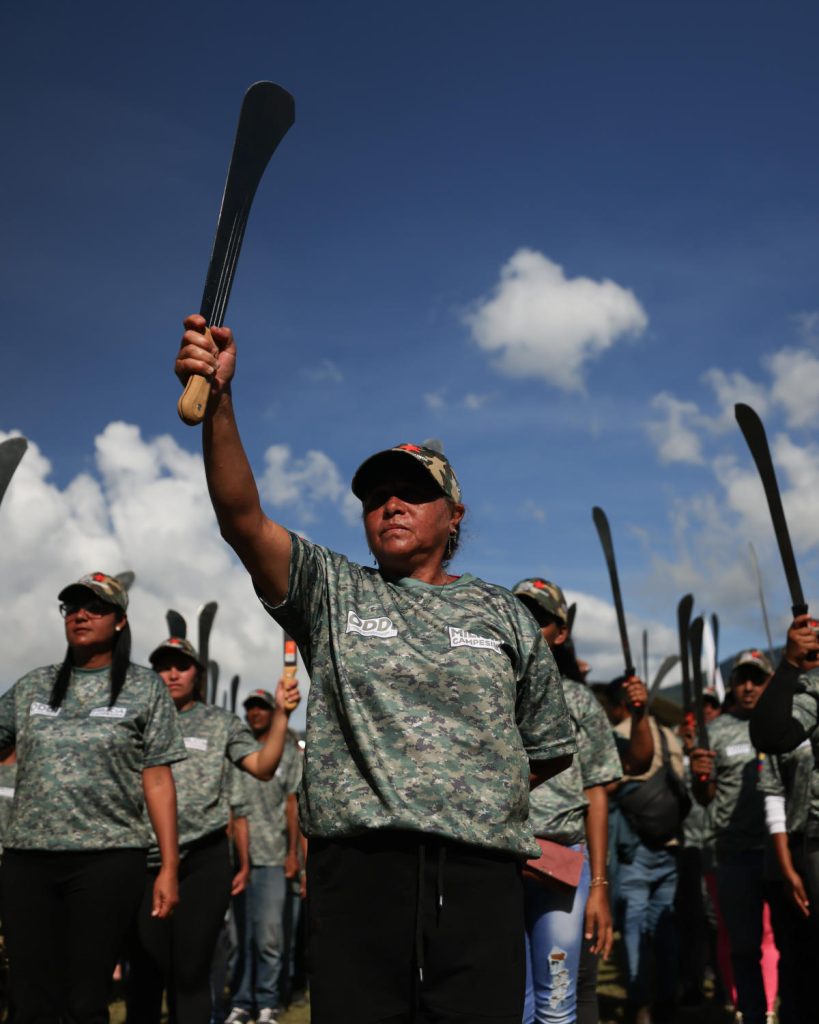

A woman from the Peasant Militia (Milicia Campesina) holds a machete during her graduation as a combatant from the MTRR course, October 2025. Credit: Rosana Silva R.

Five Scenarios for US Intervention

Scenario no. 1: the Brother Sam option. In 1964, the US deployed several warships off the coast of Brazil. Their presence emboldened General Humberto de Alencar Castelo Branco, chief of the Army General Staff, and his allies to stage a coup that ushered in a twenty-one-year dictatorship. But Venezuela is a different terrain. In his first term, Chávez strengthened political education in the military academies and anchored officer training in defence of the 1999 Constitution. A Castelo Branco figure is therefore unlikely to save the day for Washington.

Scenario no. 2: the Panama option. In 1989, the US bombed Panama City and sent in special operations troops to capture Manuel Noriega, Panama’s military leader, and bring him to a US prison while US-backed politicians took over the country. Such an operation would be harder to replicate in Venezuela: its military is far stronger, trained for protracted, asymmetric conflicts, and the country boasts sophisticated air defence systems (notably the Russian S-300VM and Buk-M2E surface-to-air systems). Any US air campaign would face sustained defence, making the prospect of downed aircraft – a major loss of face – one Washington is unlikely to risk.

Scenario no. 3: the Iraq option. A ‘Shock and Awe’ bombing campaign against Caracas and other cities to rattle the population and demoralise the state and military, followed by attempts to assassinate senior Venezuelan leadership and seize key infrastructure. After such an assault, Nobel Peace Prize winner Machado would likely declare herself ready to take charge and align Venezuela closely with the US. The inadequacy of this manoeuvre is that the Bolivarian leadership runs deep: the roots of the defence of the Bolivarian project run through working-class barrios, and the military would not be immediately demoralised – unlike in Iraq. As the interior minister of Venezuela, Diosdado Cabello, recently noted, ‘Anyone who wants to can remember Vietnam… when a small but united people with an iron will were able to teach US imperialism a lesson’.
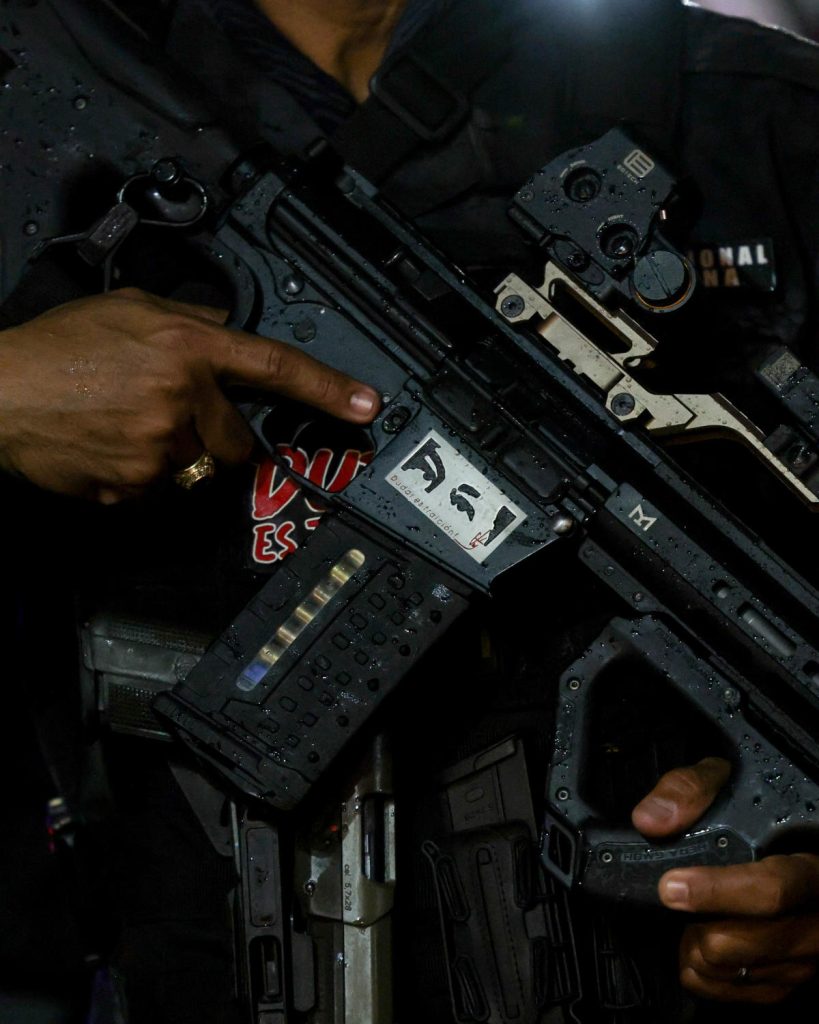

The commander general of the Bolivarian National Police, Brigadier General Rubén Santiago, holds a rifle with a sticker of Chávez’s eyes during a security deployment in Petare. Credit: Rosana Silva R.

Scenario no. 4: the Gulf of Tonkin option. In 1964, the US escalated its military engagement in the Vietnam War after an incident framed as an unprovoked attack on US destroyers off the country’s coast. Later disclosures revealed that the National Security Agency (NSA) fabricated intelligence to manufacture a pretext for escalation. The US claims it is now conducting naval and air ‘training exercises’ near Venezuelan territorial waters and airspace. On 26 October, the Venezuelan government said it had received information about a covert CIA plan to stage a false-flag attack on US vessels near Trinidad and Tobago to elicit a US response. Venezuelan authorities warned of US manoeuvres and said they will not give in to provocations or intimidation.

Scenario no. 5: the Qasem Soleimani option. In January 2020, a US drone strike ordered by Trump killed Major General Qasem Soleimani, head of Iran’s Quds Force. Soleimani was one of Iran’s most senior officials and was responsible for its regional defence strategy across Iraq, Lebanon, Gaza, and Afghanistan. In an interview on 60 Minutes, former US chargé d’affaires for Venezuela James Story said, ‘The assets are there to do everything up to and including decapitation of [the] government’ – a plain statement of intent to assassinate the president. After the death of President Hugo Chávez in 2013, US officials predicted that the project would collapse. Twelve years have now passed, and Venezuela continues along the path set forth under Chávez, advancing its communal model whose resilience rests not only on the revolution’s collective leadership but also on strong popular organisation. The Bolivarian project has never been a one-person show.

China and Russia are unlikely to permit a strike on Venezuela without pressing for immediate UN Security Council resolutions, and both routinely operate in the Caribbean, including joint exercises with Cuba and global missions such as China’s Mission Harmony 2025.
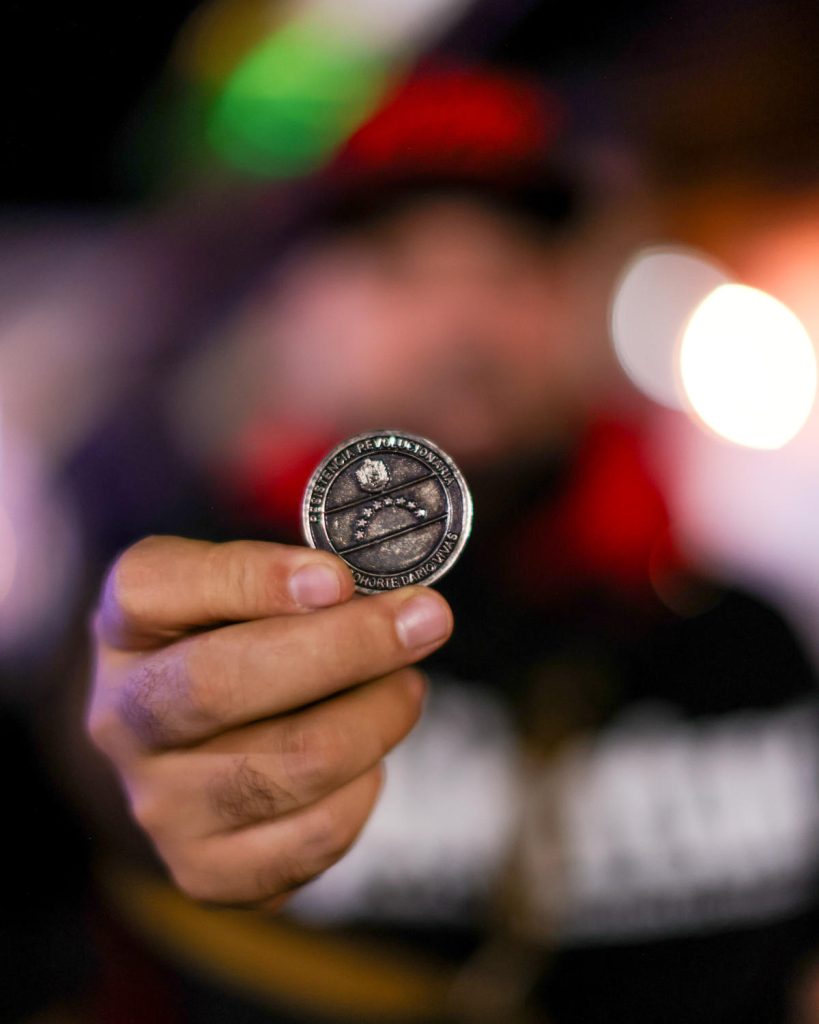

A member of the Juventud Socialista de Venezuela (Socialist Youth of Venezuela) shows a coin given to graduates of the MTRR course during a security deployment in La Guaira, Venezuela, October 2025. Based on the methods of Vietnamese General Võ Nguyên Giáp, the MTRR course is designed to train people with no prior military experience for possible guerrilla warfare. Credit: Rosana Silva R.

We hope that none of these scenarios come to pass and that the United States takes its military options off the table. But hope alone is not enough – we must work to expand the camp of peace.

Vijay Prashad is an Indian historian and journalist. Prashad is the author of twenty-five books, including The Darker Nations: A People’s History of the Third WorldThe Poorer Nations: A Possible History of the Global South, and The Withdrawal: Iraq, Libya, Afghanistan, and the Fragility of U.S. Power Noam Chomsky and Vijay PrashadRead other articles by Vijay, or visit Vijay's website.

Congressional Republicans Must Stand Up to the President on Venezuela!


by  | Nov 11, 2025 | ANTIWAR.COM

I recall when then-President Barack Obama was planning to send troops to enforce his “Assad must go” policy in Syria, many Republican US Senators passionately argued that the US President must come to Congress for approval before sending US troops into combat overseas. At the time, they portrayed themselves as brave defenders of the US Constitution.

Last week, when the Senate held a vote to remind President Trump that he is required to seek approval from the Legislative Branch before launching an attack on Venezuela, only two Republican Senators stood up to defend the Constitution. Why? Perhaps because a Republican President was now in office.

According to Politico, war-enthusiast Senator Lindsey Graham went so far as to say that Congress can’t “substitute our judgment” for the president’s when it comes to the decision to attack Venezuela.

The Senator needs a refresher course in high school civics. The US Constitution requires Congress, as the branch most directly accountable to the people, to substitute its judgement for the president’s when it comes to warmaking!

We fought a war against George III to negate the ability of a king to take the people to war on his whim. Now, Congress scrambles to abrogate that hard-fought achievement in the name of political expediency.

While the DC foreign policy blob – made up of both parties – is always pro-war, with each election we get a charade that one party or the other is standing up for the Constitution by challenging a president of the other party on war powers.

Why not stand up for the Constitution regardless of who the President may be?

The truth is, these days most Members of the House and Senate hold their heads down, follow their leadership, and enjoy that 97 percent incumbency reelection rate. After all, making waves by standing up for the Constitution can cost you your seat. You might even find yourself in a position where a President from your own party raises millions of dollars to try and get you ousted.

In an excellent recent essay in The American Conservative, George O’Neill Jr. recounts the current round of pro-war lies being bandied about to gin up support for a war on Venezuela. There are “narco-terrorists” threatening the US! Hezbollah is training in the Venezuelan jungles! Maduro is in league with Hamas!

We’ve heard it all before. The sinking of the USS Maine. The “domino theory.” Babies ripped from Kuwaiti incubators by Saddam’s stormtroopers. WMDs. Assad’s gas attacks. And so on.

All lies, and as O’Neill writes, the interventions they spawned have all turned out to be devastating, expensive failures. We’ve gone from six trillion dollars in debt at the beginning of the war on terror to 38 trillion dollars today. The global US military empire cannot continue if we want to keep our country.

Benjamin Franklin famously said “a republic if you can keep it” when asked what kind of government the Framers of our Constitution had created. But the Republic cannot be held together by magic or good luck. “If you can keep it,” means representation by men and women of good moral character who put the interests of their constituents and their country before their political party or the President. And it requires a population willing to stand up to propaganda and politics to elect such good people and hold them to account.

Ron PaulRon Paul is a former Republican congressman from Texas. He was the 1988 Libertarian Party candidate for president.


U.S. Military Kills Six More Drug Smuggling Suspects in Two Boat Strikes

Boat strike
Courtesy of the Pentagon

Published Nov 10, 2025 10:25 PM by The Maritime Executive


The U.S. military has carried out two more strikes on suspected drug boats in the Eastern Pacific, according to the Pentagon. 

In a statement, the department said that two boats were eliminated, each carrying three male suspects. All were killed in airstrikes in international waters, at no risk to U.S. servicemembers. 

The military has now conducted a total of 19 strikes on suspected drug boats, bringing the total number of deceased suspects to 76 people. Two survivors were rescued after a strike in mid-October and returned to Colombia and Ecuador, their respective nations. 
 
The Trump administration describes the targets as "narco-terrorists" or "cartel terrorists," and claims that the boats are "known to our intelligence" to be involved in narcotics smuggling. Anecdotally, reporters who have interviewed relatives and acquaintances of the deceased boat operators have found that most are low-income individuals with limited economic options. Among the dead are commercial drivers, fishermen, laborers, petty criminals, and at least one local crime boss, according to the AP. 

The Pentagon has not disclosed the identities of those eliminated in the strikes, if any are known. The majority of the deceased remain unidentified, according to MSNBC, consistent with the secretive nature of smuggling enterprises and the remoteness of the waters where they were killed. 

The legality of the strike program has been questioned by political critics, legal experts and even the United Nations' top human rights official. Even if these matters are set aside, there is the more practical matter of efficacy: some smuggling experts question whether the flow of drugs can be stopped with airstrikes on low-level "mules." Even if the attacks make the established boat routes too risky, the loosely-organized South American crime networks have a long history of developing alternatives, like complex container freight strategies and foot traffic.  

"I don’t think it’s going to cause the [Jalisco New Generation Cartel] or Sinaloa cartel to say, ‘Wait, this is too dangerous,'" one congressional official told MSNBC. "These guys feed their rivals to tigers. They are not easily intimidated."



Shell Takes Venture Global LNG Arbitration Loss to NY Supreme Court

Shell has challenged an arbitration ruling against it in the long-running dispute with Venture Global over contracted LNG supply, alleging the U.S. LNG exporter withheld information to Shell and the arbitration court.

Shell has challenged the arbitration decision at the New York Supreme Court, the supermajor told Reuters on Tuesday. 

Shell has sued Venture Global for selling LNG on the spot market while foregoing long-term supply contracts because of delaying the commissioning phase of its first LNG plant at Calcasieu Pass. 

Shell and other major oil and gas firms accused Venture Global in 2023 of profiteering by selling on the higher-price spot market LNG cargoes that should have been supplied under their long-term contracts. The U.S. firm used a loophole to do that by extending the deadline for officially commissioning the Calcasieu Pass export project.

In August, Shell lost the arbitration against Venture Global as the tribunal ruled that the U.S. company had not violated its contractual obligations with its long-term clients. 

Venture Global claimed that it was under no obligation to honor its long-term commitments until the plant was officially commissioned, which happened earlier this year. Meanwhile, it managed to build a second LNG facility that produced its first LNG at the end of 2024—before the first one was officially commissioned.

Meanwhile, another European supermajor, TotalEnergies, earlier this year declared it would not do business with Venture Global because of the profiteering affair, with chief executive Patrick Pouyanne saying that “I don't want to deal with these guys, because of what they are doing. ... I don't want to be in the middle of a dispute with my friends, with Shell and BP.”

Last month, BP won a similar arbitration case it brought against Venture Global. 

In its Q3 results and outlook, Venture Global on Monday reduced and tightened the range of its Consolidated Adjusted EBITDA guidance to $6.35 billion - $6.50 billion from $6.40 billion - $6.80 billion, due to lower expected fixed liquefaction fees and accounting reserves relating to ongoing arbitrations.  

By Tsvetana Paraskova for Oilprice.com


Global Precious Metals to Add Over $95 Billion in Market Value by 2030

  • The global precious metals market is forecast to grow by over $95 billion to reach $386.16 billion by 2030, reflecting a compound annual growth rate of 5.87%.

  • The primary drivers of this growth are sustained investor demand for safe-haven assets amid global uncertainty and increasing industrial consumption from the electrification trend, particularly in the automotive and electronics sectors.

  • The Asia-Pacific region currently leads the global market due to strong demand for jewelry and expanding industrial applications, while North America and Europe remain key players through advanced trading and ethical sourcing practices.

The global precious metals market is projected to grow by over USD 95 billion in the next five years, driven primarily by sustained investor demand for safe-haven assets and increasing industrial use in rapidly expanding technologies, according to a new report from Mordor Intelligence.

The market size, which was valued at $290.34 billion in 2025, is forecast to reach $386.16 billion by 2030. This expansion reflects a compound annual growth rate (CAGR) of 5.87%, the research firm stated. Growth is being supported by a combination of investors seeking financial security during uncertain geopolitical and economic times, alongside rising demand for metals like silver and platinum in the electronics and renewable energy sectors.

Key Market Drivers

The research highlights two key dynamics propelling the market: the electrification trend boosting industrial metal consumption and the continued strengthening of safe-haven demand linked to global uncertainty.

The shift toward electric mobility is fundamentally reshaping industrial consumption patterns. This transition is lifting demand for silver, platinum, and palladium used in automotive electronics. Car manufacturers are reportedly diversifying their supply contracts and experimenting with substitute materials to manage rising costs associated with these in-demand metals. This trend benefits refiners and miners focused on the expanding electric vehicle (EV) ecosystem, particularly in regions that are scaling up vehicle production, according to the report.

Meanwhile, growing political tensions and trade disruptions globally are directing investors toward precious metals as a reliable store of value. Gold remains the primary refuge asset, with central banks continuing their accumulation efforts, underscoring the metal’s importance in diversified investment strategies. Furthermore, the report notes that silver and platinum are increasingly being utilized by investors to diversify their holdings. Institutional investors and central banks view bullion as a stabilizing asset amid volatile currency movements and geopolitical uncertainty, which is helping to keep long-term demand elevated.

Asia-Pacific Leads Regional Growth

Geographically, the Asia-Pacific region remains the largest area in the global precious metals trade. This dominance is attributed to strong regional jewelry demand and the expanding industrial application of precious metals. The report points to India's role in gold jewelry production and China's focus on bullion investment as key drivers. Japan and South Korea contribute to regional momentum through the extensive use of gold and silver in their electronics and semiconductor industries, keeping the Asia-Pacific ahead in both luxury and industrial segments.

North America maintains its market influence largely through advanced trading systems and exchange-traded fund (ETF)-based investments, which enhance bullion liquidity. The United States leads in financial innovation within the sector, while Canada and Mexico reinforce the supply chain through mining and refining operations. Europe, meanwhile, is noted for its emphasis on ethical sourcing and sustainable production practices, with Germany, France, and the United Kingdom playing important roles in global manufacturing, craftsmanship, and the bullion trade.

Sector Implications and Outlook

The expanding applications span several key sectors. Investment (including bars, coins, and ETFs) remains a core segment, alongside jewelry manufacturing. However, industrial applications are becoming more prominent, specifically in electronics, automotive catalysts, chemical catalysts, and photovoltaic systems. End-user industries contributing to the demand include banking and financial services, the automotive industry, and the electronics and electrical sector.

The precious metals market continues to demonstrate resilience, supported by sustained investment interest, expanding industrial utility, and a growing sector-wide emphasis on ethical sourcing, the report concluded. 

By Michael Kern for Oilprice.com 

CRIMINAL CAPITALI$M

Ex-Glencore staff plead not guilty to Africa bribery charges


(Image courtesy of Glencore.)

Four former Glencore Plc staffers charged with bribery offenses related to winning the commodity trading firm business in West Africa pleaded not guilty in London.

Martin Wakefield, David Perez, Paul Hopkirk and Ramon Labiaga appeared at Southwark Crown Court on Monday in the Serious Fraud Office prosecution. The four are all facing charges of conspiracy to give corrupt payments, while Perez and Wakefield also face one count of conspiracy to falsify invoices between 2007 and 2011.

The four men pleaded not guilty to all of the offenses. Andrew Gibson and Alexander Beard, the billionaire former head of oil at Glencore charged in the case, will enter their pleas at a later date.

The charges related to allegations the men conspired to win business for Glencore from state-owned companies in Cameroon, the Ivory Coast and Nigeria between 2007 and 2014. The offenses include allegations of payments of bribes to government officials and executives at state-run oil companies.

“We continue to progress our bribery case against six former Glencore employees ahead of trial on 4 October 2027,” a spokesperson for the SFO said on Monday.

Glencore was fined £276 million in 2022 over paying out corrupt payments in Africa, on top of around $1.1 billion the company already paid in related cases in the US and Brazil.

Beard is the most senior of the men charged with bribery offenses by the SFO, and was among Glencore’s longest-serving top executives before his departure in 2019. He became a billionaire in 2011, after Glencore listed on the London Stock Exchange.

Beard and Gibson, Glencore’s ex-head of oil operations, have previously indicated that they will plead not guilty.

(By Lucca de Paoli)

AU

Booming gold prices are hiding China’s deflationary pain for now

Jewelleries on display at Luk Fook Jewellery store in Hong Kong. Stock image.

Gold is a traditional hedge against inflation for investors but in China surging bullion prices are having the opposite effect, providing a temporary respite from deflationary pressures.

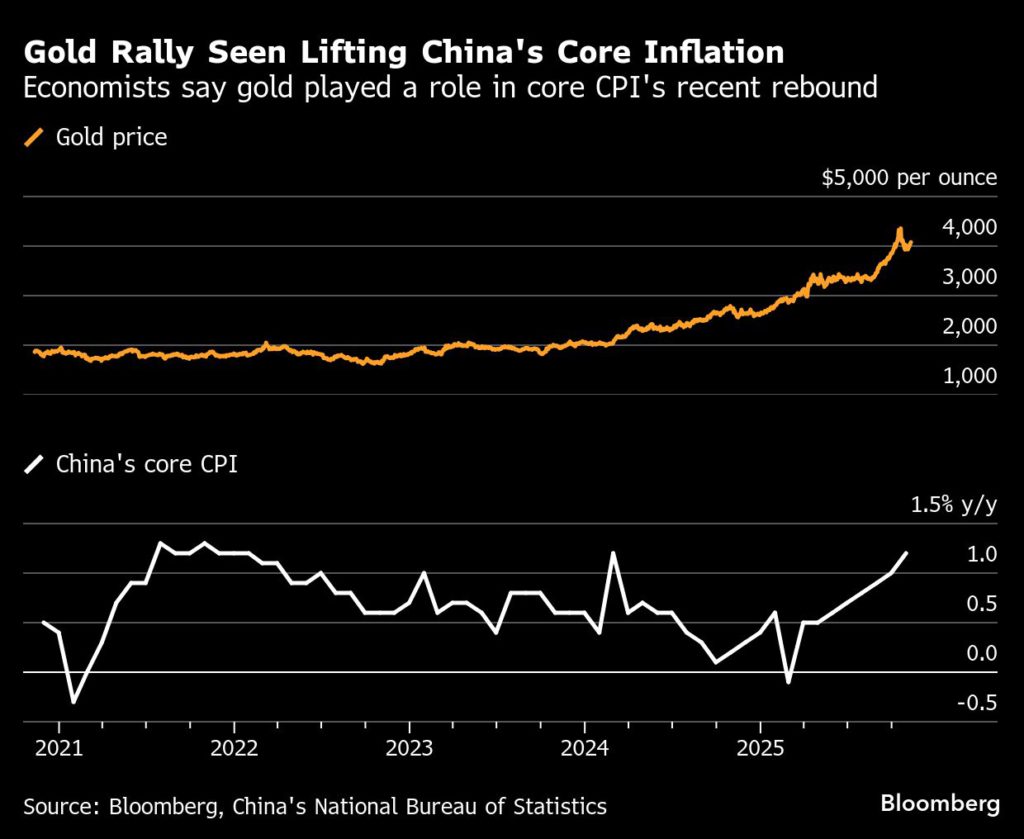
Core inflation last month saw its fastest increase in almost two years, unexpectedly helping the broader consumer-price index end a stretch of three months at or below zero. The precious metal in October contributed close to half or more of the 1.2% jump in the core index, which excludes food and energy, according to estimates from Goldman Sachs Group Inc. and Shenwan Hongyuan Group Co.

CPI “gains largely reflect temporary factors, most notably higher gold prices, and don’t suggest to us that China’s deflation problem is going away,” Zichun Huang, China economist at Capital Economics, said in a note on Monday. “We expect supply and demand imbalances to persist, keeping deflationary pressures in place throughout next year.”

Deflation has been gnawing at the economy that demonstrated resilience throughout a second trade war with the US. A reflection of weak demand, lower prices have led to plunging corporate profitability and falling wages.

The situation could even be worse than captured in official data. A Bloomberg News analysis of almost 70 everyday products and services from multiple sources found prices dropped more sharply than the CPI figures indicate.

Bullion is on track for its best yearly surge since 1979 with a gain of more than 50% this year, creating a pocket of inflation in China — one of the world’s biggest gold markets. Gold jewelry has long been a favorite for households as a gift and a store of value.

Seen as a haven at times of rising geopolitical tensions, global gold prices have also benefited from heavy purchases by central banks trying to diversify away from the dollar.

The rally is having an outsized impact on China even though the weighting of gold and platinum jewelry in the consumer basket is less than 1%, according to Citigroup Inc., which puts bullion’s contribution to core CPI and core goods inflation at “a few tenths.” The National Bureau of Statistics reported an increase of around 50% in prices for those types of jewelry in October.

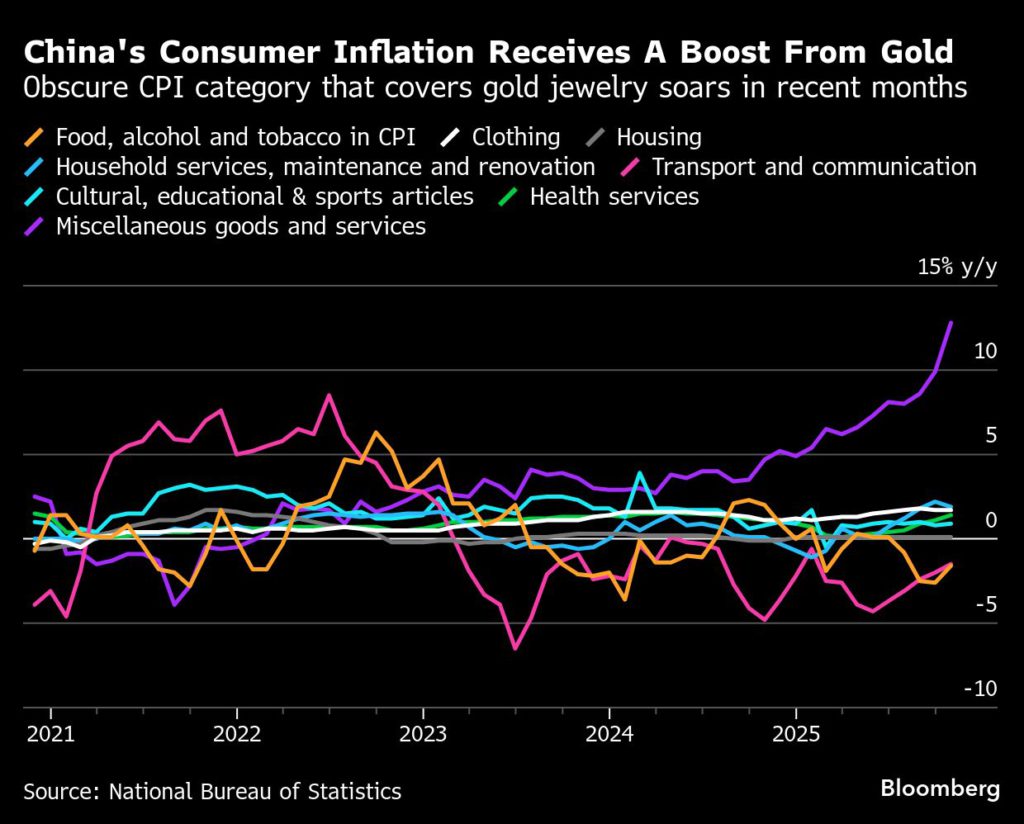
Gold jewelry falls under the obscure CPI category of “miscellaneous goods and services,” which surged a record 12.8% on year in October — far more than any other component. By contrast, food prices declined almost 3%, while items ranging from consumer goods and fuels to housing rentals and traditional Chinese medicine were all stuck in negative territory.

Other seasonal factors — such as holiday spending and a low base of comparison from last year — also had the surprise effect of pushing up both CPI and producer prices last month.

Only two analysts surveyed by Bloomberg correctly predicted that consumer inflation would reach 0.2% in October from a year earlier.

And while factory-gate deflation also eased, it was mainly a result of a low base last year, according to Goldman Sachs. The improvement was also concentrated in some upstream sectors like the mining and processing of metals, showing the limit of capacity curbs in industries such as steel and coal in the face of weak demand.

For many economists, the rosy picture of inflation likely marks a blip. Domestic demand is still weak, with retail sales slowing sharply and investment in decline.

The downward pull of weak domestic spending is frustrating government efforts to curb price wars and overcapacity in the world’s No. 2 economy, which has seen 10 straight quarters of deflation.

To pull out of the spiral, China needs to take bigger steps to stimulate consumption and growth. Despite the so-called “anti-involution” campaign, the risk is that price weakness will linger without a bolder policy response.

“An only modest letup in China’s producer price deflation in October suggests anti-involution policies to curb price wars still have a lot of unfinished business. Consumer prices swinging back to inflation reflect a holiday boost that will fade. In other words, deflationary pressures remain entrenched — and weaker growth in the fourth quarter means there’s little to change the trend.”

— Eric Zhu

While the ruling Communist Party has signaled greater resolve to boost consumption in the coming few years, economists expect officials to favor a gradual approach.

Beijing lacks effective tools to stimulate consumer spending, largely because China’s tax system encourages localities to support investment and production. A focus on developing advanced manufacturing and achieving technological breakthroughs in the face of hostility from the US will also likely keep the supply side of the economy stronger.

While economists have called for bigger fiscal and monetary stimulus, Chinese officials have refused to provide massive aid like they did in past downturns, due to concerns over a build-up of debt in the economy.

“It is too early to conclude the deflation is over,” said Zhang Zhiwei, chief economist at Pinpoint Asset Management. “The property prices are still on a downward trend. Domestic demand is weak. Meanwhile export momentum seems to be fading as the frontloading ended.”

Barrick hikes dividend, shifts focus to North America as gold prices bolster profit

Cortez gold project. Credit: Barrick Gold

Barrick Mining on Monday raised its dividend and expanded its share buyback program after reporting an adjusted quarterly profit that beat estimates, as stronger gold prices helped offset a decline in production.

The Canadian miner’s interim CEO Mark Hill told Reuters that its focus in the future will be “firmly on North America … because it is our next growth area and it is the next growth in gold as well, so that is what we are focused on going forward.”

The miner jointly owns Nevada Gold Mines with Newmont and is also looking to develop the Fourmile gold mine in Nevada. Barrick shares rose nearly 6% in early trading on the Toronto Stock Exchange.

Mali issues

Barrick, the third-largest gold miner by production, has had a volatile year, marked by the loss of control of its gold mine in Mali, which led to a $1 billion write-off of the asset, and the exit of Mark Bristow as its chief executive officer.

The Barrick board’s search committee, led by independent director Brett Harvey, is working to find a new president and CEO, the company said in a statement.

In Mali, four of Barrick’s employees are in jail over a dispute with the company over the country’s new mining tax code.

Hill said his main focus is to get those employees out of jail, adding that the company has to change some of the ways it is approaching the issue. Barrick also filed for arbitration against Mali, though the recent hearings over the company’s request for an urgent hearing over the dispute were rejected by the World Bank’s dispute tribunal.

“We agree that arbitration, while an option, it is probably not a preferred option and is not going to resolve (the problem of) the people who are incarcerated in the short term,” Hill said.

Barrick has been locked in a long-running standoff with Mali’s military-led government since it was forced to suspend operations in mid-January. That move followed the government’s decision to block Barrick’s exports for two months, detain some of its executives and seize three tons of bullion.

Gold prices, which are sensitive to geopolitical and financial uncertainty, averaged $3,574.95 per ounce in the third quarter, more than 16% higher than the preceding quarter and 43% above the levels seen a year earlier.

Prices of the precious metal were buoyed by safe-haven demand as uncertainty over US President Donald Trump’s tariff plans and geopolitical tensions stoked inflation concerns.

Barrick said its average realized gold price rose to $3,457 per ounce during the third quarter from $2,494 per ounce a year earlier.

Its quarterly production decreased to 829,000 ounces from 943,000 ounces last year.

The company’s all-in sustaining costs for gold, an industry metric reflecting total expenses, rose to $1,538 per ounce from $1,507 per ounce during the third quarter.

Barrick declared a 25% rise in its quarterly dividend to $1.25 per share and announced that its board had approved a $500 million increase to the existing share repurchase program.

The company earned 58 cents per share on an adjusted basis in the third quarter, compared with analysts’ average expectation of 57 cents per share, according to data compiled by LSEG.

(By Pooja Menon and Divya Rajagopal; Editing by Shreya Biswas and Paul Simao)