Thursday, November 20, 2025

Trump to skip Dick Cheney's funeral after speaking snub: report

Daniel Hampton
November 19, 2025 
RAW STORY


FILE PHOTO: Republican vice presidential candidate Dick Cheney (L) points out something to Texas Governor and Republican presidential candidate George W. Bush during a campaign stop July 26, 2000 in Casper, Wyoming, Cheney's home state. REUTERS/Jeff Mitchell/File Photo

The late former Vice President Dick Cheney may have irked President Donald Trump one last time, as the MAGA leader plans to skip Cheney's funeral after being curiously left off the list of speakers.

Cheney was a strong critic of Trump, once calling him "the greatest threat" to the republic.

“In our nation’s 248-year history, there has never been an individual who is a greater threat to our republic than Donald Trump,” Cheney said last year in announcing he'd vote for Vice President Kamala Harris. “He tried to steal the last election using lies and violence to keep himself in power after the voters had rejected him. He can never be trusted with power again.”

Cheney died on Nov. 3 at the age of 84 from complications from pneumonia and cardiac and vascular disease. On Wednesday, USA Today reported at least two former presidents plan to attend the service: George W. Bush, who served two terms with Cheney as his vice president, and Joe Biden. Bush is slated to speak at the service.

Trump, however, will not attend the funeral — and "wasn't asked to speak at the service," the report noted.

"A senior White House official said that the president would not attend the funeral and was not aware of anyone else on his staff going to the invitation-only service that will be held in Washington, DC, on Nov. 20 at the National Cathedral," the report said.

The White House has said Trump was "aware" of Cheney's death and lowered flags to half-staff.
How Donald Trump and his Jeffrey Epstein scandal lay bare our racist roots


Thom Hartmann
November 19, 2025 
COMMON DREAMS


The Jeffrey Epstein scandal stripped away the polite fiction that wealthy white men in America are held to the same standards as everyone else.

Epstein wasn’t an exception. He was the rule, laid bare.

From the first days of European settlement, powerful white men have moved through this country with a kind of immunity that would be unthinkable for anyone else. That isn’t just a cultural habit: it’s the residue of the original architecture of America.

We built a nation on the belief that white men were entitled to rule, entitled to take, entitled to decide whose lives mattered and whose didn’t.

That belief never died. It adapted. It modernized. And today it animates a political movement that has captured one of our two major parties.

The root of the problem goes all the way back to the Doctrine of Discovery. A European/papal decree announcing that white nations had a God-given right to seize any land they encountered became the legal and moral starting point for American expansion.

The Supreme Court wrote it into our jurisprudence in the nineteenth century, and we never really let it go. From that twisted foundation flowed the taking of Native land, the destruction of Native nations, and the belief that whiteness itself conferred ownership.

And then — as I point out in The Hidden History of American Oligarchy — that logic didn’t stay confined to the frontier. It seeped into every corner of American life and rose up to try to destroy even the idea of a pluralistic democracy in this country.

Slavery was built on the same logic. It wasn’t an ugly exception to American values; it was a central expression of them. The economy depended on it. Congress bent itself into knots to protect it. The Constitution accommodated it.


When the Civil War ended, our country had a chance to uproot the white male supremacist ideology that had allowed human beings to be treated as property. Instead, we dodged it.

I still remember well, when our son was nine years old and we lived in suburban Atlanta, asking him over dinner, “What did you learn in school today?” and his answer was, “We studied the ‘War of Northern Aggression.’”

We allowed the old Confederates back into the halls of power in the 1870s. We let them write the history books. We abandoned the freedmen who had been promised protection and citizenship.


And the system that emerged was simply white male supremacy, the foundation of slavery, by another name.

Jim Crow wasn’t a detour; it was the natural continuation of the racial hierarchy this country was built on and today’s GOP — and ICE, CPB, and Trump’s toadies in DHS — are trying to re-solidify for the 21st century.

Every tool was used to maintain it. Poll taxes. Literacy tests. Lynching. Chain gangs. Sharecropping. Segregated schools. Redlining. Policing practices that looked far more like occupation than law enforcement.


All of it justified by the same foundational lie that today animates the brutality of Trump‘s ICE raids: that white people were meant to rule and everyone else existed by their pleasure. And the Big Lie that brown-skinned immigrants are committing “voter fraud” that justifies purging millions from our voting rolls every year.

That lie still echoes in our institutions. It’s why entire communities — and now polling places — are policed like enemy territory. It’s why Republicans on the courts (particularly SCOTUS) have so often sided with the powerful over the vulnerable. And it’s why we’ve seen, in recent years, an explicitly brutal willingness to use federal force against Americans exercising their constitutional rights of free speech and protest.

When Trump sent federal agents and troops into Los Angeles, DC, Chicago, Portland, Memphis, and threatened to deploy them elsewhere, it wasn’t a new idea. It was an old ideology flexing its muscles again. It treats American citizens as though they’re foreign enemies. It uses military-trained forces not for defense but for control.


James Madison warned us precisely about this danger of the military policing civilians:
“The means of defense against foreign danger have been always the instruments of tyranny at home.”


He couldn’t have been clearer. The Founders feared the domestic use of military force not because they were naïve, but because they knew exactly how easily power could be turned inward. They knew that once a government starts treating its own people as threats, liberty becomes the first casualty because they’d seen it done by the British in their own time.

The chilling truth is that the movement dominating the modern GOP has embraced that very mentality.


It draws its energy from white grievance and Christian nationalism. It relies on the belief that democracy is legitimate only when it protects white cultural dominance (which is why the Trump Department of Labor is exclusively posting pictures of white workers as if they’re the only “real” Americans).

It thrives on fear and resentment, and encourages a view of fellow nonwhite and female Americans as enemies to be controlled rather than citizens to be represented.

Today’s GOP and the rightwing-billionaire-funded, 50-year-long “Conservative Movement” that drives it have embraced every bad instinct of the Confederacy, the frontier, Jim Crow, and the backlash to the Civil Rights Movement.

They’re not “conserving” anything. They’re restoring an old order.


This didn’t happen suddenly. It took decades and the investment of billions of dollars.

People of a certain age (like me) well remember William F. Buckley Jr.’s 1966-1999 show Firing Line, every Sunday on PBS, as he pontificated about the wonders of “conservatism” and promoted Republican politicians. My dad was a religious viewer and we watched it together every weekend; the show was a major force in national politics.

In a 1957 editorial titled Why the South Must Prevail, Buckley laid out explicitly what the foundation of conservatism must be.

“Again, let us speak frankly,” Buckley wrote: “The South does not want to deprive the Negro of a vote for the sake of depriving him of the vote. … In some parts of the South, the White community merely intends to prevail — that is all. It means to prevail on any issue on which there is corporate disagreement between Negro and White. The White community will take whatever measures are necessary to make certain that it has its way.”


He asked, rhetorically, if white people in the South are “entitled” to “prevail” over nonwhites even in rural areas of the country or large cities with majority Black populations.
“The sobering answer,” Buckley wrote, “is Yes — the White community is so entitled because, for the time being, it is the advanced race.”


Arguably following up, in April 2021, the National Review published an article headlined: Why Not Fewer Voters? justifying Republican voter suppression.

Nixon welcomed the old segregationist Democrats into the GOP. Reagan polished the rhetoric and wrapped it in patriotic language. The Republican Party spent years perfecting techniques to suppress votes, gerrymander districts, and reshape the judiciary.

By the time Trump arrived, the Party was ready for someone who would drop the coded language and say the quiet part out loud.

Trump told white male voters they were the only “real Americans” and everyone else was suspect. He told them the military and the police existed to protect them from demographic change. He told them the only valid elections were the ones they won.

The good news is that most Americans reject this.

Most Americans believe in a multiracial democracy. They want equal justice. They want freedom that applies to everyone. They don’t want their own government treating nonwhites or women as enemy combatants. They don’t want Epstein-style impunity for morbidly rich white men. They don’t want leaders who behave as if the military is a toy for intimidating political opponents.

But we can’t defeat what we refuse to name. America’s original sin wasn’t just slavery or colonialism: it was the belief that white men are entitled to rule by default and women and nonwhites must be subordinate to them.

That belief still infects our politics and largely controls the GOP. It still shapes our institutions. It still animates Republican justices on the Supreme Court who see equality as a threat and democracy as negotiable.

We can’t move forward until we reckon with that truth about our nation’s history and today’s GOP.

We can’t protect liberty while ignoring the warnings of the people who built this country.

And we can’t defend American democracy — and democracy around the world — while the GOP wages war against the very idea of a nation where everyone counts.

The reckoning is long overdue. This time we have to finish the job.

Double-check your voter registration and pass along the good word to everybody you know.
This horrifying comment exposed an ugly truth about America

Robert Reich
November 19, 2025 
RAW STORY


Donald Trump, Melania Trump and Mohammed bin Salman arrive for a dinner. REUTERS/Tom Brenner


When Saudi Crown Prince Mohammed bin Salman (MBS) arrived at the White House yesterday, he was met by a Marine band, officers on horseback carrying the Saudi and American flags, and fighter jets flying over the White House in a V formation.

It was far more pomp than visiting foreign leaders normally receive.

What had the crown prince done to merit such honor from the United States?

He has helped broker a tentative peace between Hamas and Israel. But so have Egypt, Qatar, Jordan, and the United Arab Emirates.

The real reason for the honor is that MBS and the Saudis are doing lots of business with Trump’s family — and this visit is part of the payoff.

It’s MBS’s effort to rehabilitate his reputation after Saudi operatives murdered Washington Post columnist Jamal Khashoggi and chopped his body into pieces with a bone saw: a killing that U.S. intelligence determined was greenlit by MBS.

But in yesterday’s joint Oval Office appearance — freighted with flattery between Trump and MBS — Trump brushed off a reporter’s question about MBS and the murder.

“A lot of people didn’t like that gentleman that you’re talking about, whether you like him or didn’t like him, things happen,” said Trump, referring to Khashoggi.

Things happen?


When the reporter then asked MBS about the finding by U.S. intelligence, Trump quickly interjected:

“He knew nothing about it. You don’t have to embarrass our guest by asking something like that.”

All of which raises once again the question of who is honored in this upside-down Trump era, and who is subject to shame and disgrace.

Larry Summers, who had been secretary of the treasury under Bill Clinton and a high official in the Obama White House, said Monday he was “deeply ashamed” about his relationship with the convicted sex offender Jeffrey Epstein and therefore would be “stepping back” from all public engagements as he works to “rebuild trust and repair relationships.”

New details of Summers’s relationship with Epstein emerged last week when a House committee released emails showing years of correspondence between the two men, including Summers’s sexist comments and his seeking Epstein’s romantic advice.

Consultants who specialize in rehabilitating the reputations of public figures often advise that they begin with a full public apology, along with a period in which they “step back” out of the limelight.

What separates consultant-driven contrition from the real thing depends on whether it involves any real personal sacrifice.

It’s not clear what Summers will have to sacrifice. Apparently he’ll continue in his role of University Professor at Harvard, the highest and most honorable rank a faculty member there can achieve. (Sen. Elizabeth Warren (D-MA) has called on Harvard to sever ties with Summers to hold him accountable for his close friendship with Epstein.)

The same question — whom we honor, whom we shame, and who is genuinely contrite — is also relevant to Eric Adams’s final weeks as mayor of New York City, during which the pace of his foreign travel is increasing even as the city foots much of the bill. No contrition from the mayor — although he was indicted on corruption charges that focused, in part, on improper foreign travel.

And then comes Elon Musk, who, despite his reign of terror in the federal government, including a stack of court rulings finding what he did to be illegal, to say nothing of his blowup with Trump, will preside this weekend at a festive DOGE reunion in Austin at a high-end hotel where Musk often has a suite.

In this era of Trump, America’s moral authority — its capacity to separate right from wrong, and to pride itself doing (or at least trying to do) what is honorable — seems to have vanished, along with the norms on which that authority has been based.

Under Trump, the only normative rule is to gain as much power and money as possible. Power and wealth are honored, even if the honoree has greenlit a brutal murder.

The only exception appears to be pedophilia. Or close association with a pedophile, for which an earnest expression of contrition may be sufficient to get back on the honor track.

High on the list of things America must do when this period of moral squalor is behind us will be to restore real honor and real shame.Robert Reich is a professor of public policy at Berkeley and former secretary of labor. His writings can be found at https://robertreich.substack.com/

Robert Reich's new memoir, Coming Up Short, can be found wherever you buy books. You can also support local bookstores nationally by ordering the book at bookshop.org


'Irreversibly damaged': Trump sued over 'big white blob' Eisenhower Building plan

November 20, 2025 
RAW STORY


Legal action could be taken against Donald Trump over the president's proposed refashioning of the Eisenhower Building.

Historic preservationists have sued the president over his plans to paint the office building next to the White House. Trump has been warned that such a plan could do irreversible damage to the building, with a suit filed on Friday by the DC Preservation League and Cultural Heritage Partners, CNN reported.

The suit has asked the US District Court for the District of Columbia to stop Trump and other federal officials from making any changes to the Eisenhower Executive Office Building before the potential changes are assessed in a standard review process. Judge Dabney L. Friedrich is, according to The Washington Post, expected to rule on this request.

The White House has since confirmed no changes will be made to the building until 2026. A statement from the acting commissioner of the General Services Administration, Andrew Heller, confirmed on Tuesday (November 18) that there would be no "physical actions of power" used on the building before New Year's Eve, 2025.

Heller said, "GSA will not authorize or engage in the physical actions of power washing/cleaning, painting, or repointing the Eisenhower Executive Office Building before Dec. 31, 2025." Work on other parts of the White House, such as the East Wing, began earlier this year.

Trump's ballroom plan was roundly criticised when first announced, and his plans for the Eisenhower Building were also ridiculed, described as a "big white blob" by Fox News host Laura Ingraham. Trump shared a photo of the proposed redesign of the 137-year-old building, saying, "Look at that, how beautiful is that?"

Ingraham replied, "Are you not worried it's like... a big white blob?" Trump disagreed, replying, "No, what it does is it brings out the detail." Trump is unsure of whether the renovation of the Eisenhower Executive Office Building will go ahead, but did say he's "getting bids" for the project.

He added, "I don’t even know if I’m going to do it yet, I’m getting costs, I’m getting bids right now from painters, and we’ll see. It would be a great addition to Washington." Trump was roundly criticized for knocking through the East Wing to make way for a ballroom.

One presidential historian likened the change to "slashing a Rembrandt painting." Douglas Brinkley said, "Maybe it’s just the dislike of change on my part, but it seemed painful, almost like slashing a Rembrandt painting. Or defacing a Michelangelo sculpture.
John Roberts' 'corrupt bargain' exposed in eye-popping new analysis

Nicole Charky-Chami
November 19, 2025 
RAW STORY


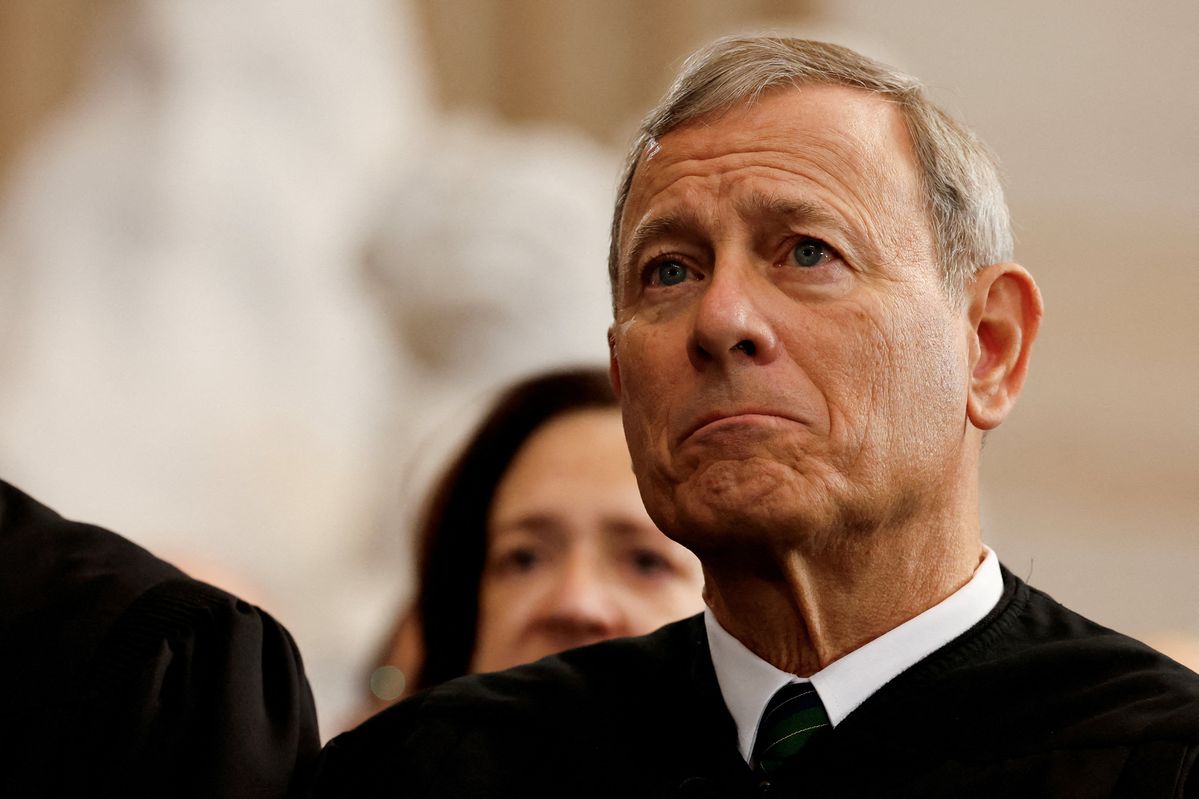
FILE PHOTO: WASHINGTON, DC - JANUARY 20: U.S. Supreme Court Chief Justice John Roberts attends inauguration ceremonies in the Rotunda of the U.S. Capitol on January 20, 2025 in Washington, DC. Donald Trump takes office for his second term as the 47th president of the United States. Chip Somodevilla/Pool via REUTERS/File Photo

The Supreme Court’s John Roberts' ‘corrupt bargain’ reveals what led to President Donald Trump's "abusive reign," a new analysis found.

Roberts and the high court are in a "love triangle" with Republicans and billionaires, Mother Jones wrote Wednesday.

" Trump needed Roberts to win, and Trump’s victory came just in time for Roberts," according to Mother Jones.

"His corrupt bargain has had an exorbitant cost, both for the nation and the court’s reputation," the outlet reports.

The conservative majority justices have paved the way for the president's "lawless second term."

“The court has traded public legitimacy as a significant basis for its authority in favor of just alignment with the GOP," Harvard Law professor Ryan Doerfler told the outlet.

And the justices appear to be on Trump's side, allowing the courts to be used as a shadow docket while "the Roberts court had handed Trump almost unlimited power to defy the law without accountability. And once Trump was back in office, it weaponized the shadow docket to bless his lawless actions, reversing lower court findings, often without a word of explanation. As of this writing, the right-wing majority has used the shadow docket to uphold Trump’s actions roughly 90 percent of the time, repeatedly bailing him out of any obligation to follow the law."

It's puzzled lower courts and added more questions to the high court's decisions.

"As the justices keep rushing to Trump’s aid, Democrats grow more open to reform if they return to power—and thus Roberts lashes himself more tightly to Trump’s mast," Mother Jones reports.

“It seems like what the court is trying to do is maximize the likelihood of future GOP control,” said Doerfler, who studies the judiciary's role in democracy.

With a legal attack on the Voting Rights Act in the current term, the court will also consider "the last remaining limits on billionaires financing campaigns; it’s no mystery how the justices are likely to rule."

It's now a matter of whether the Roberts court will push to secure a permanent GOP court.

"Roberts didn’t just strip political power from ordinary people—he handed it to billionaires," Mother Jones reports. "His decisive vote in 2010’s Citizens United v. FEC lifted restrictions on political spending, while ludicrously insisting it would not 'lead to, or create the appearance of, quid pro quo corruption.' Political spending by billionaires has since increased 160-fold. There’s a direct line between the ruling and Elon Musk buying Trump the White House with more than $290 million and being given free rein to fire his companies’ regulators in return."
'We protect our own': Chicago parents stand up to ICE despite threat of gas and violence
RAW STORY
November 20, 2025


A demonstrator confronts agents in Little Village, Chicago. REUTERS/Jim Vondruska/File Photo

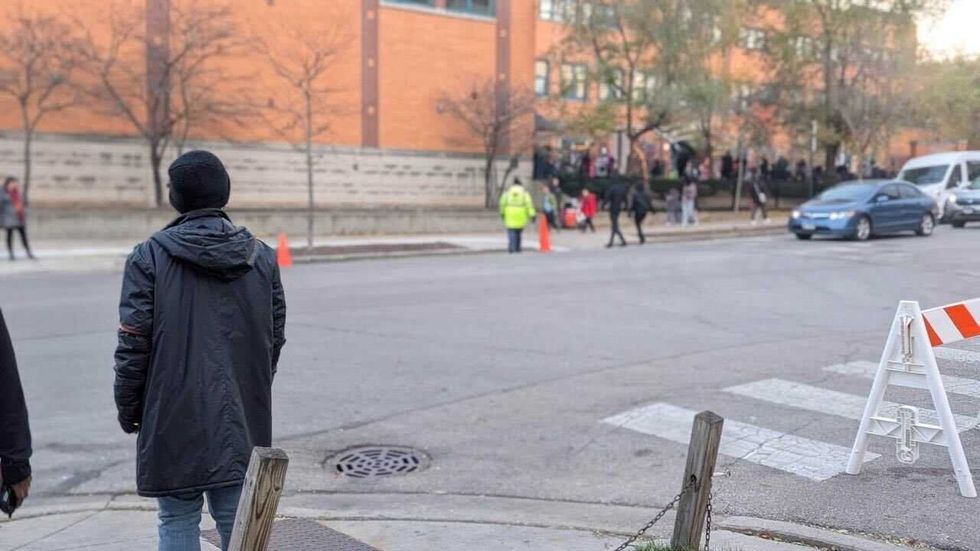
One recent weekday, a group of Chicago kindergartners visited their neighborhood high school. It should have been an unremarkable moment — but as the visit was in motion, parents learned that U.S. Immigration and Customs Enforcement (ICE) agents had been spotted nearby.

Instantly, the community mobilized. Teachers left school and hopped on their bikes. Around 100 volunteer patrollers came out to “protect these kindergarteners … and make sure that they got back safely,” said Lizzie Turner, a parent of a sixth-grader at the Peirce School of International Studies in the Andersonville neighborhood.

“It was very encouraging and very inspiring,” Turner said.

Turner is an administrator of Peirce Pathways, a parent-led support network with more than 100 volunteers currently monitoring neighborhood ICE activity, coordinating parent patrols and working with the school “sanctuary” team to address concerning interactions with agents known to detain parents and teachers, and to have deployed chemical agents near schools.

The group is one of several activated in Chicago since agents descended on the city as part of an aggressive Trump administration immigration enforcement mission, Operation Midway Blitz.


“The resistance movement here has been so successful,” Turner said.


“As much harm as they have been able to get away with, I also think as a city we protect our own … everybody's come together, and everybody's been very selfless in how they've approached it — the collaboration and just willingness to put our own needs aside in the moment to protect our neighbors.”

Jenn Graville Bricker, a second-grade parent, co-founded another parent-led network, Rogers Park School Patrols.


A volunteer with Rogers Park School Patrols watches a school (Photo credit: Meggus Wolf)

Part of grassroots neighborhood support organization Protect Rogers Park, the group has nearly a thousand volunteers across 10 schools on the city's north side, Graville Bricker said.

Volunteers wear orange armbands to signal they’re safe people to ask for help. Children have taken note, Graville Bricker said, describing how one child was recently overheard telling her caretaker, “Orange is for whistles, butterflies and safety.”

“Kids are clearly feeling it, and there's a lot of fear,” she said. “It impacts families in really, really deep ways.”

‘On the fly’

Turner said her group was “building the plane as we fly it” but had come up with a multi-faceted system for monitoring ICE activity and protecting children whose families might be undocumented.

First, a coordinator monitors channels on Signal, an encrypted messaging platform, for reported ICE sightings.


Then the group organizes two volunteers at each of the four corners around a school, during drop-off and pick-up. Mobile patrol teams use bikes or cars.

Local businesses have agreed to be “safe haven sites” for anyone in need of protection from ICE, Turner said.

The community has created other “scrappy” ways to monitor and respond to ICE activity, said Turner, who built a searchable database of license plates confirmed to be ICE vehicles.


“Even just the tooling and technology that we've thrown together on the fly to make it work has been impressive,” said Turner, whose day job is at a software company.

“I hope that other cities don't experience this but if they do, I hope we can be a helpful starting point or model for how to tackle it, and I'm sure other cities will do it better if they build on it.”
‘Collective response to oppression’


Volunteers working with Turner have gone through “ICEWatch” training, which nonprofits and community organizations throughout Chicago have put together to help people know their rights, document when ICE comes into neighborhoods and warn neighbors who might be targets.

Jill Garvey, co-director of anti-authoritarianism nonprofit States at the Core, hosts a weekly ICEWatch training in partnership with Protect Rogers Park.

Gabe Gonzalez, an organizer with Protect Rogers Park, said as many as 6,000 people have been trained — 80 percent from the north side of Chicago and 20 percent watching from around the country.

Gonzalez estimates the group’s reach is as much as 7 percent of Rogers Park, which he said is “enormous.”


“I did community organizing for years, and if you had 1 percent of the neighborhood engaged in what you're doing, you had power, and we're well past that,” he said.

The training has its roots in CopWatch training that originated in the 1960s with the Black Panther Party and is focused on “documenting and responding, not interfering,” Garvey said, adding that the training emphasised “nonviolent protest and dissent.”

Volunteers who respond to an ICE encounter are instructed to send videos and documentation to their local ICEWatch group and an immigrant rights hotline.


Protect Rogers Park’s efforts extend to incorporating other community-based support as a “collective response to oppression,” Gonzalez said.

That includes a knitting club making hats and scarves for patrollers, volunteer appreciation events and arts shows, including one where people get two minutes to vent or perform at a local wine shop. It’s all part of “people coming together to resist,” Gonzalez said.
‘Breaking bodies’

ICEWatch and neighborhood support work comes with risks. Garvey said training focuses on helping people “physically stay safe and to be as prepared as possible for what we would now consider really unusual or aggressive behavior from law enforcement.”

Responders have been detained, tear-gassed, driven off the road while riding bikes and “had guns pointed into their cars,” Garvey said.

Illinois State Senator Graciela Guzmán said she and her staffers are working by 7 a.m. nearly every day, responding to calls from the Northwest Side Rapid Response Team. Ninety schools on Chicago’s Northwest Side have “school watch” teams, Guzmán said.

One Saturday in October, in a residential neighborhood, Guzmán and her staffers were tear-gassed.

“I'm not sure that I'm gonna get the sound of my staffer trying to breathe out of my brain for quite some time,” Guzmán said.

“It's really, really scary when that happens to you. It's scary when you're seeing it happen en masse to community members.”

Guzmán said ICE’s presence has been "overwhelming," the Trump administration "indiscriminate" in who it detains.

Of Guzmán’s constituents, those detained include a daycare worker, a cook, “parents on their way to school with their kids” and a handyman — not to mention U.S. citizens, she said.

“One of the eerie feelings is when you just miss someone getting detained, and you get on site and their car is still on. It's parked, everything is open,” she said.

Andre Vasquez, alderman for Chicago’s 40th Ward, said the Trump administration’s claim of detaining the "worst of the worst" was “bull—t.”


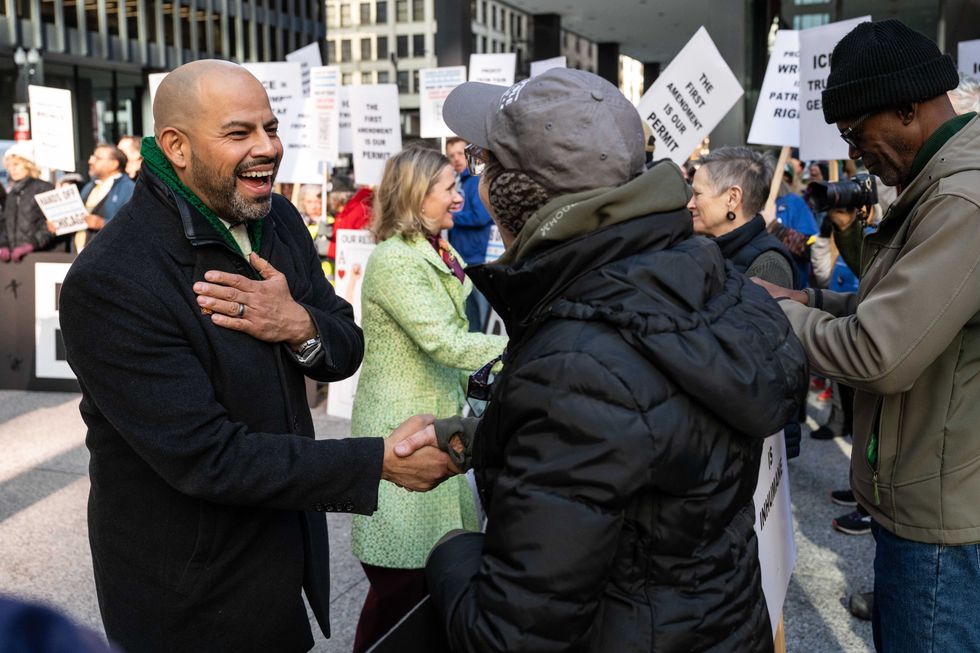
Andre Vasquez at a protest in downtown Chicago (Photo credit: Deana Rutherford)


Landscapers, single parents, elderly people and churchgoers have also been detained, Vasquez and Garvey said.

“They're breaking bodies. They're breaking doors. They're breaking windows, and they use tear gas as if it's something that should be used every day in our streets, when we know that it should not be,” Guzmán said.

“They're using incredibly violent, heartbreaking tactics.”

One ICE agent “clocked” a young man in the chin as he observed the arrest of a woman in suburban Evanston who crashed her car into an ICE vehicle after it stopped suddenly, Gonzalez said.

Gonzalez said he and other observers were threatened with pepper spray. Agents sat on the young man and one “put his foot by his neck” before handcuffing him, he said.

“The kid was staring at me. His face was just beat up, already starting to swell up, and it was ugly. It was really f—g bad,” Gonzalez said.

Vasquez was tear-gassed twice when visiting the ICE facility in Broadview, Ill.

He has organized whistle kit events, “Know Your Rights” business trainings and rapid response efforts with his chief of staff, Cat Sharp, who is running for Cook County commissioner and was one of six Broadview protestors federally indicted for conspiracy to impede or injure federal officers.

“These fascists are looking [at] every possible way to attack people,” Vasquez said.

“If it's not physically on residential streets, it's politically to the court systems, so what we know is, ultimately, justice will prevail.

“These folks don't understand Chicago if they think we're going to tolerate it.”

Alexandria Jacobson is a Chicago-based investigative reporter at Raw Story, focusing on money in politics, government accountability and electoral politics. Prior to joining Raw Story in 2023, Alex reported extensively on social justice, business and tech issues for several news outlets, including ABC News, the Chicago Sun-Times and the Chicago Tribune. She can be reached at alexandria@rawstory.com. More about Alexandria Jacobson.
#METOO REDUX
Young girls told to forgive and forget after sex abuse by church member

Jessica Lussenhop, 
Propublica
Minnesota Star Tribune
November 20, 2025 


The Woodland Park Old Apostolic Lutheran Church in Duluth, Minnesota. 


LONG READ


The girl pleaded not to go.

She fought with her father on the drive over, screaming and crying in his truck until they arrived at the office building for Bruckelmyer Brothers, a home construction company on the outskirts of Duluth, Minnesota. She was just entering her first years of grade school.

In the office, two men were waiting. One of them was Clint Massie, who the girl had recently told her parents had touched her genitals and groped her under her shirt. The other was Daryl Bruckelmyer, a preacher and leader of the Old Apostolic Lutheran Church down the road, where the girl’s family worshipped. Massie was a respected member of the congregation. Bruckelmyer had asked them all to the meeting, according to the girl’s account to police years later.


In front of the girl, her father and Bruckelmyer, Massie asked her for forgiveness. Looming over her, the three men wept. Then the girl’s dad and preacher allowed the man who had been sexually abusing her since kindergarten to hug her.

“It was one of the worst things ever,” she told police some 15 years later.

In accordance with one of the core tenets of their church, the matter was resolved. It was forgiven. It should now be forgotten. If she spoke of it again, she would be guilty of having an unforgiving heart and the sins would become hers.


But she could never forget. And neither could the other children.

Over the course of about 20 years in two states, Massie had, according to court documents and by his own admission, sexually abused children within the Old Apostolic Lutheran Church, or OALC, community. He touched girls under blankets when their parents were present, in the backseat of a car with other passengers — even in the pews at church. His abuse was such an open secret among the tight-knit congregation that mothers warned their daughters to stay away from him.

Some former victims, as adults, confronted preachers, including Bruckelmyer, about what Massie had done to them. Church leaders told Massie to stay away from the congregation’s children, and they sent him to a therapist who specialized in sex offender treatment.


But they never reported Massie’s crimes to police, as required by the law. Instead, Bruckelmyer and other leaders in the church encouraged the victims to take part in forgiveness sessions — which allowed Massie, now 50, to continue abusing children, according to an investigation by the Minnesota Star Tribune and ProPublica.

Massie did not respond to requests for comment but has denied abuse allegations relating to some individual victims in pending lawsuits. In December 2024, he pleaded guilty to four counts of felony criminal sexual conduct with victims under the age of 13. In March, a judge sentenced him to 7 1/2 years in prison. Church officials, including Bruckelmyer, were not charged in connection with Massie’s crime, but prosecutors said they should have done more to stop him.

“It gives the appearance of a group of people who are not just trying to protect someone — but something,” Mike Ryan, the St. Louis County assistant district attorney who prosecuted Massie, said at his sentencing. “And they have enabled something awful here.”


Law enforcement there first became aware of the allegations against Massie in 2017. They said that the church’s lack of cooperation — including pressuring potential witnesses and victims to stay quiet about the abuse and preachers failing to report it to authorities — was a major factor in the delay in bringing charges.

Bruckelmyer declined to comment or to answer a detailed list of questions. But in a 2023 interview with a St. Louis County detective, he acknowledged knowing about Massie’s sexual abuse and didn’t dispute that he took part in forgiveness sessions involving Massie and his victims.

He said it was up to the victims to report the crimes to police, a clear misreading of the law for mandated reporters — doctors, teachers and others who are required to report crimes against children.


“We don’t protect either one,” Bruckelmyer said of sexual abusers and their victims.

Bruckelmyer also told police his actions followed church protocol. An internal church document, obtained by the Star Tribune and ProPublica, suggests that, when appropriate, church leaders and others facilitate “a conversation with both parties together” — an action that experts who work with abuse victims say can add to a victim’s trauma. While the document praises the police and the justice system, it doesn’t mention mandatory reporting laws and gives preachers wide latitude on whether to involve police.

Kimberly Lowe, a lawyer and crisis manager for the church, said its preachers are unpaid and therefore might not be legally required to report sexual abuse of children. Asked if she believes the preachers are mandated reporters under Minnesota law, Lowe would only say that the language of the statute is unclear.


Bruckelmyer’s church, Woodland Park, is one of two OALC congregations north of Duluth, in the bluff region above Lake Superior. Some members live nearby, in a rural, forest-lined community. Members are not obviously identifiable by their clothing — they dress modestly but modernly, in muted colors and long skirts. Women do not wear makeup, jewelry or open-toed shoes and they keep their hair up in a bun, giving rise to the nickname “bunners.” According to church literature, members are to live simple, modest lives like Jesus did; television, music and dancing are seen as sinful, according to former members.

On a recent Sunday, the modern, unadorned sanctuary of the Woodland Park church, which seats 1,000, was full of families, parents soothing babbling and crying infants, older children clutching baggies of candy or toy cars.

At the close of the sermon, the preacher asked the entire congregation for forgiveness, which kicked off “movements” — a portion of the service when congregants embraced and begged one another for forgiveness for various sins, frequently in tears.


OALC is a conservative Christian revival movement that came to the U.S. with 19th-century settlers from Norway, Finland and Sweden, and it is not affiliated with any mainstream Lutheran denominations. There is no official count, but one academic study estimated 31,000 members worldwide as of 2016, with most in the United States. The church is rapidly growing, experts say, and the member count today is likely much higher. OALC’s emphasis on large families has created booms in places like Washington state and Duluth.

There are 33 OALC churches in the U.S. and Canada. Only men hold leadership positions. The less formal nature of OALC structure — a spokesperson said there’s no headquarters in the U.S. — means that, unlike sexual abuse scandals in the Catholic Church or Southern Baptist Convention, there’s no central authority to hold accountable. Still, news of the criminal case against Massie spread widely in the insular OALC, inspiring more victims to come forward in Minnesota and other states.

St. Louis County investigators say they have been contacted by current and former church members in South Dakota and Washington who allege they were victims of sexual abuse that was never reported to law enforcement. The Star Tribune and ProPublica have interviewed more than a dozen alleged victims of Massie and of other church members in Wyoming, Maryland and Michigan.

By forgiving men like Massie, prosecutors and police said, preachers created a situation where the alleged victims had to worship next to their alleged abusers — and allowed Massie to escape arrest and prosecution for years.


“He was so brazen about it — and there was so little done about it — that he thought it was permission,” Ryan said.
“Church Knows”


For the girl who said she was pressured to forgive Massie at Bruckelmyer’s office, the silence that followed only compounded her trauma. She reported struggling with debilitating anxiety and obsessive-compulsive disorder in her teens. She grew tense every time she walked into the church, especially when she saw Massie holding another little girl.


“I lived in darkness for so many years of my life because I couldn’t talk about it,” the girl said in a recorded interview with police. “Multiple times in my life I wanted to die.”

When she was 16 and in counseling, she told her therapist how Massie had abused her. The therapist reported it to the police, which is how the St. Louis County Sheriff’s Office in Duluth first learned about Massie in summer 2017.

Sgt. Jessica LaBore was the investigator assigned to the case. In a recorded interview, the girl reluctantly told LaBore how she used to sit with Massie and his wife, Sarah, at church, just a few rows from the front. Massie would snake his hands up her skirt and touch her thighs and genitals. Another time, at a gathering at the home of her parents’ friends, she said, Massie told her to get a blanket and began touching her underneath it, with her mom and dad nearby.

She told LaBore that she’d reported the abuse to a preacher, Calvin Raisanen, and that her mother had spoken to Bruckelmyer about it, according to police documents and a recording of the interview obtained through a public records request. Raisanen did not respond to requests for comment. In her own conversation with LaBore, the girl’s mother confirmed that Massie had asked forgiveness from her husband and daughter years ago.

Like some victims in the records from Massie’s case, she declined to speak to reporters for this story and is not being identified because the news organizations typically don’t name victims of sex crimes without their consent.

In an email to reporters, she wrote that she is still a member of the church and feels supported by its community: “I truly believe I’m in the right place.”

When LaBore interviewed Massie, he confirmed some important details about the allegations: Bruckelmyer was aware that several girls had accused Massie of sexual abuse. And he remembered asking for forgiveness at his preacher’s business office.

LaBore did not respond to requests for comment, but police reports show that the girl’s family stopped cooperating with the investigation. The mother told her that preachers at the church had spoken to Massie and that he’d “learned his lesson,” though the mother believed that Massie had “continued to sexually assault children after this point,” according to LaBore’s notes.

LaBore referred the case for charges to Deputy St. Louis County Attorney Jon Holets. In a statement to the Star Tribune and ProPublica, Holets said he also spoke to the victim’s mother, who informed him “that there had been therapeutic intervention, that ‘they were good’” and that her daughter did not want anything more to be done. Without the girl’s cooperation, Holets said he decided he could not bring charges against Massie, an outcome he said gives him “heartache” to this day.

Three years later, Massie again came to the attention of the sheriff’s office. Two crime-reporting hotlines received anonymous tips saying Massie had sexually assaulted “little girls” over the course of three decades. “Church knows but no action,” reads a police summary of one of the tips.

This time, LaBore went to Bruckelmyer. According to her notes, Bruckelmyer said the church encourages abuse victims to go to police, but he told her he believed it was “on them to do that.”

LaBore explained the state’s mandated reporting law to Bruckelmyer and told him that he and others at the church could be charged criminally if “somebody that they already know about” were to keep abusing children and they failed to report it.

“We are finding out from our investigations that these Mandated Reports are not being made, and instead, these incidents are being dealt with within the church,” she wrote in a departmental memo to update other detectives. “Sometimes the preachers are facilitating in the asking for forgiveness.”

For the second time, Holets decided not to bring charges, though this time it was about church preachers rather than Massie. In a statement to reporters, Holets said law enforcement decided to try to “educate” church leaders about their legal responsibility to report the sexual abuse of children.

“I believed it was more effective to work with existing leadership to influence practices and attitudes regarding child abuse reporting, rather than to pursue criminal enforcement at that stage,” Holets wrote. “That said, criminal charges for failure to report remain a possibility in such cases.”

When LaBore spoke to Bruckelmyer, she read him the entire mandated reporter law over the phone, line by line, then texted it to him.
Haunted by Silence


In 2023, a call to police breathed new life into the case.

A woman told police that she’d been sexually abused repeatedly as a kid. Her abuser was a relative: Clint Massie.

The case landed on the desk of Sgt. Adam Kleffman of the St. Louis County Sheriff’s Office. He interviewed the victim and listened to the different ways the woman said Massie sexually abused her: the nights when she slept over after helping tend to his horses, the day when she rode a tractor with him, or swam with him and other members of her family at the lake.

Her mom had reported Massie to a preacher when she was a child, she told Kleffman. At the time, the preacher promised to handle it, she said, and told her mother never to speak of it again, not even to her husband. Later, she went through a session with Bruckelmyer, similar to the other girl, where she was pressured to forgive Massie and forget the abuse.

As an adult, she was alarmed to see Massie in church, hugging and kissing children about the same age she was when the abuse began, which is why she’d felt a duty to report it all these years later, she said.

“I went back to the same preacher, which is Daryl [Bruckelmyer], and said, ‘Why is he still able to hold kids and whatever?’” she recalled to Kleffman in a recorded interview. “And he’s like: ‘I don’t know. Like, we’ve told him that he’s not supposed to, but he still does.’”

Kleffman picked up where LaBore left off and contacted the girl who spoke to their office in 2017. She was now in her early 20s, married, a new mom living in Washington state. In a recorded conversation, she told Kleffman that the trauma — and in particular, the mandate that she remain silent about it — still haunted her.

Though the woman had tried to put time and distance between herself and Massie, Massie’s wife, Sarah, had asked for a meeting about a year earlier when the woman returned to Duluth for a visit. At a Starbucks, she said, Sarah Massie told her that the abuse was no big deal and she needed to forget about what happened. The conversation, the woman said, was “horrible.”

Sarah Massie declined to comment for this story.

The woman agreed to be part of the police investigation but told Kleffman that she had little faith it would go anywhere. It did not, after all, go anywhere last time.

“I can tell you,” Kleffman said, “you should have lots of faith in me.”

The investigator now had two victims. They gave him the names of others they suspected had also been abused by Massie. Kleffman tried to contact them, but some were reluctant to cooperate. One woman told Kleffman that Massie had asked for forgiveness. The sin, she said in the recorded call, was “washed away in the blood of reconciliation.”

“It is gone forever,” she told Kleffman.

“So you’re following what the church says to do,” Kleffman replied.

“I am following what God says to do,” the woman told him, before hanging up.
“There Could Be Hundreds”


On Feb. 10, 2023, Massie sat opposite Kleffman and Investigator Tony McTavish in a beige, windowless room at the sheriff’s office in Duluth. In a video of the interrogation, Massie downplayed the allegations as a series of accidents and misunderstandings. But as the 90-minute interrogation progressed, his demeanor shifted. He admitted he’d felt a “tinge” of a “sick, perverted thing” when, he claimed, one very young girl had pulled his hand to her vagina before he realized what was happening.

“I’m a lustful man, sure,” he said, but he denied he touched girls on purpose. “Strike me dead right now if I’m lying to you. I was not trying to touch her sexually.”

“I call bullshit on that,” Kleffman said.

Massie told Kleffman and McTavish that Bruckelmyer had spoken to him “at least” three times about inappropriate behavior with children. The investigators asked how many more girls might come forward with stories about him touching or kissing them.

“I mean, there could be hundreds,” Massie said.

Five days later, Bruckelmyer walked into the same interview room with Raisanen, another preacher at the church.

Bruckelmyer, now 68, is described as a kind but domineering force in the church, a father of at least 12 who worked in construction.

Unlike in other branches of Christianity, OALC preachers like Bruckelmyer do not attend traditional seminaries or receive formal training before assuming their leadership roles. Instead, according to a church spokesperson, they are selected by the congregation.

Their advice is seen as coming directly from God, according to several former church members.

In a video recording of the police interview, Bruckelmyer and Raisanen joked quietly with one another before Kleffman and Sgt. Eric Sathers, another investigator, entered the room.

“Do you know what the mandated reporting laws are in the state of Minnesota?” Kleffman asked.

“We have looked at them some, but it’s hard for us to interpret everything,” Bruckelmyer replied.

“Have you ever been told about them?” the officer asked.

“No,” Bruckelmyer said.

Kleffman said he knew that wasn’t true and brought up the 2020 call with LaBore. “I just listened to the audio recording, and it was line-for-line. You said you understood what they were,” Kleffman said.

“We felt, unless it’s changed, that as a part of the church that we keep silent,” Bruckelmyer said.

https://www.youtube.com/watch?v=hys6s4WqDJk&rel=0

Kleffman and Sathers explained that if someone like Massie confessed to Bruckelmyer one-on-one, that would constitute a protected conversation with clergy. But hearing directly from the victims, from parents of victims or about abuse allegations in a group setting was another matter entirely.

Bruckelmyer and Raisanen claimed ignorance of the legal distinction and thanked the officers for the “clarification.” Bruckelmyer asked what became of the 2017 investigation into Massie. “I mean, it should have been taken care of then, you know?” the preacher said. “It’s like, what happened?”

Kleffman reminded him that a decade before that, the girl’s parents had come forward to Bruckelmyer and was told to forgive Massie.

“Nothing was done by you,” Kleffman said. “So in that meantime, she is not being protected while Clint is still scot-free doing what he’s been doing for 15 years.”

“I see,” Bruckelmyer said quietly.

“You’re just keeping a pedophile in your church,” Kleffman said.

Both Bruckelmyer and Raisanen confirmed they’d known about the girl from the 2017 report, and Bruckelmyer said he knew of two others as well. He expressed his eagerness to cooperate with law enforcement moving forward but denied knowledge of any other victims beyond the three.

Bruckelmyer and Raisanen left the St. Louis County Sheriff’s Department office without facing any consequences. John Hiivala, a spokesperson for the Woodland Park Old Apostolic Lutheran Church, said that the church “has fully complied with the law in the referenced case, and it’s a matter of legal record.” Hiivala declined to comment further.

By the time prosecutors brought the case against Massie, the three-year statute of limitations had run out on charging Bruckelmyer with failure to report.
Reckoning


On the day of Massie’s sentencing in March 2025, Kleffman walked Kyla Chamberlin to the front row of the high-ceilinged courtroom. The opposite side of the courtroom quickly filled with at least a dozen Massie supporters, including his wife, Sarah.

Chamberlin had flown in from North Dakota alone. Of the nine alleged victims prosecutors identified from the case, she was the only one to attend the sentencing in person. As she waited, she was shaking. She didn’t want to look back, particularly at Sarah Massie, whom she’d adored as a child. She said she could feel the eyes of her former church community on her, people she’d once trusted and loved.

A former EMT and mother of three, Chamberlin had grown up in the Black Hills of South Dakota in the 1990s. Clint and Sarah Massie lived nearby and opened their home to Chamberlin and her four siblings. Her parents sometimes asked Clint, starting in his late teens, to babysit.

The sexual abuse began around the time Chamberlin was 7 years old, she told police. In interviews with Kleffman, she described a remarkably similar pattern of abuse as the two Duluth victims.

After the Massies moved to Duluth in the early 2000s, Chamberlin’s parents say she went from meek and sweet to being filled with an inexplicable anger. She rebelled, she drank. The close-knit family began to fray. She and one of her older sisters, Kristi Bertolotto, stopped speaking to each other.

“I’ve lost a lot of friendships, a lot of relationships, divorces, anger management — didn’t understand why I was so mad,” Chamberlin said.

She stopped attending church in 2010 and, in response, her parents made it clear that she was no longer welcome at family and holiday functions, a painful and common experience described by several former church members.

“It’s like you don’t even think for yourself,” Janie Williamson, Chamberlin’s mother, said in an interview. “To turn against your own children because of some of those things is — it’s awful.”

After St. Louis County announced charges against Massie, Kleffman began receiving calls from alleged victims all over the country. One of those was from Chamberlin. Months later, Kleffman realized that one of the other victims he interviewed was Chamberlin’s older sister, Bertolotto.

Neither of them knew what had happened to the other. Neither knew the other sister had come forward. Both women agreed to be named in this story.

Court filings listed nine alleged victims, but only three of the cases resulted in charges of felony sexual conduct with a victim under the age of 13. The statute of limitations under South Dakota law had run out for Bertolotto and Chamberlin. And the girl who’d been pressured to forgive Massie in Bruckelmyer’s office hadn’t had her case charged either; under Minnesota law, too much time had passed between her initial report in 2017 and the prosecution.

Nevertheless, six of the alleged victims whose cases didn’t result in charges were still part of the case, and some of the women traveled to Duluth in December 2024 to testify at Massie’s trial. Just after jury selection, Massie agreed to plead guilty to four felony counts. One charge was dropped.

Four months later, at his sentencing, Massie looked pale and paunchy in an orange jumpsuit, his hands and feet shackled. His attorney, citing Massie’s lack of a criminal record, asked that he receive no prison time and be allowed to seek treatment and receive probation that he could serve at home. Massie apologized to his victims and their families.

“I beg for their forgiveness, for the damage and hurt that I’ve caused them over the years,” he said in a quavering voice. “I feel responsible for the horrible acts to these children.”

But Judge Eric Hylden noted that since Massie had pleaded guilty, he’d never tried to enroll in sex-offender treatment or written apology letters to his victims. Hylden also quoted aloud from one of 17 letters of support for Massie, many from OALC members, which he said demonstrated that some in Massie’s community still did not believe he’d done anything wrong: “I wish you find ones that have actually done these things and get them put away rather than putting your energy into lying and seeking evil where there is none to be found.”

The judge sentenced Massie to 7 1/2 years in prison.

Afterward, in the witness room a floor higher in the courthouse, Chamberlin met Ryan, the assistant district attorney, and Kleffman — the two men she credited with putting Massie in prison 30 years after he’d abused her. The three exchanged hugs.

“I feel a sense of justice for the first time in 30 years,” Chamberlin said.

At the same time, none of them felt completely satisfied that the problem began and ended with Massie — that church leaders had not been held accountable.

Ryan said that he’d struggled as he prepared to go to trial with keeping several of the women from succumbing to what he called “a constant effort” by members of the church to “try to get these girls to either tone down their position on it or just to not cooperate.” One alleged victim, he said, had dropped out weeks before trial.

Chamberlin and her sister have retained the same lawyer who represented some of the victims in the Jeffrey Epstein case. He has filed lawsuits on their behalf against Massie, their church in South Dakota and the Old Apostolic Lutheran Church of America.

In a letter written from prison that was filed in court, Massie denied both sisters’ allegations. The OALC, in a motion to dismiss both lawsuits, wrote that “while OALC-America is mindful and sympathetic to Plaintiff for the abuse Plaintiff alleges occurred by Massie, such empathy does not take away from the plain fact that this Court does not have personal jurisdiction over OALC-America.”

Chamberlin and Bertolotto’s family has left the church. They are now navigating a delicate reconciliation, which Chamberlin credits to the abuse finally coming to light.

Chamberlin said she hoped to have a role encouraging other victims to come forward before the secrecy consumes their lives the way it had consumed hers.

“There’s a lot more to be done,” she said. “There’s a lot of Clints out there.”


Op-Ed: 
How not to manage public science – Deep and angry multigenerational groans as Australia’s CSIRO faces job cuts


ByPaul Wallis
EDITOR AT LARGE
DIGITAL JOURNAL
November 19, 2025


CSIRO Hobart -Awaiting call up....these Argo robots or floats ready for deployment around Australia are the new kids on the ocean observing block 
- photo by Bruce Miller 4/2008. Source - Bruce Miller, CSIRO. CC SA 3.0.

You need to be Australian to understand the depth of the furious response to job cuts at the Commonwealth Scientific and Industrial Research Organization, aka CSIRO.

It’s a unique organization and also a government agency. It’s publicly funded specifically because Australian science always has been chronically underfunded. The country simply didn’t have the capital back when. Now, funding core business seems to be being undercut by “budgetary housekeeping” that shouldn’t even be an issue.

CSIRO partners with private enterprise on a broad bandwidth of science and technology programs. The organization is famous for doing a lot with stingy acknowledgment.

The chronic undervaluation of Australian science is a much-unappreciated fact. The decades of systemic undervaluation are truly despised and very much resented. In terms of achievements, CSIRO punches far above its weight.

The recent announcement of job cuts at CSIRO has gone down very badly. These cuts aren’t even based on some primitive Trumpian anti-scientific pseudo-ideology.

The supposed reason, so far extremely badly articulated, is the “need to manage costs of the property portfolio”.

The sheer mediocrity of the cuts has pushed a lot of buttons. Absolutely nobody likes this scenario, and the gut-level reaction is making its views clear.

The cuts look far more like some petty spreadsheet formula getting too big for its ballet slippers.

Let’s pussyfoot around this a bit. You can’t cost basic property management? There are supposed to be provisions for that in any competent management budget. Why is this even an issue?

Most people understand that properties don’t manage themselves.

Even first-year accountants know what “depreciation” means.

This can’t possibly be the whole story or anything like it. Somebody’s managed to bury big-ticket basic costs in the backyard for years. How? Doesn’t seem likely, does it?

How long has this pitiful rationale for mismanagement been allowed to fester on the balance sheets? If this really is the case, there’s no doubt where and with whom any cuts should start. The CSIRO budget clearly needs to be idiot-proofed for the future.

We’ve heard it all before, and we still don’t believe it. It’s the same logic that values universities the same as office block buildings. It’s as though the buildings were worth as much as the training that generates billions of dollars,

Science valuations also apply elsewhere in this long, turgid parade of mindless penny-pinching. Salaries for Australian researchers are also pretty anaemic. I’m still wincing at comparative numbers I saw over a decade ago.

Where do you think all these trillion-dollar high-tech companies are coming from? We are pricing ourselves out of the big money of the future with this cheapskate approach to our own high-value tech and research.

The core problem seems to be a total lack of clear and trustworthy funding provisions for CSIRO. “A handout here and a handout there” doesn’t work.

A few suggestions:

IP royalties for CSIRO are built into research and development. That’s huge money even at relatively low percentages.

Licensing agreements, like every other semi-rational commercial venture on Earth. More big money.

Integration of cross-disciplinary research to maximize innovation opportunities. This is just common sense, and we have plenty of people who can benefit and contribute to it and from it.

Home-based R&D is bread and butter for CSIRO. This approach has generated a lot of business and innovation since day one. Costing is not exactly mysterious. All researchers know how to cost their work down to the last cent.

International research partnerships work well and can generate significant revenue.

Funding CSIRO is literally funding the future. Make it happen.

____________________________________________________________

Disclaimer
The opinions expressed in this Op-Ed are those of the author. They do not purport to reflect the opinions or views of the Digital Journal or its members.
US presses Ukraine to cede land as Russian strikes kill 26


By AFP

November 19, 2025


The surprise peace proposal comes as Russian missiles hit the western city of Ternopil - Copyright AFP YURIY DYACHYSHYN

Yuriy DYACHYSHYN with Burcin GERCEK in Ankara

A new US peace proposal for Ukraine would see Kyiv ceding land and more than halving its army, a source told AFP Wednesday, as a Russian strike in the west of the country killed 26 people, including three children.

The proposal appears to repeat Russia’s maximalist terms to end the war — demands consistently rejected by Ukraine as tantamount to capitulation.

The surprise initiative comes as Russian missiles hit the western city of Ternopil, far from the front line, in one of the deadliest attacks on western Ukraine since the invasion began in 2022.

Meanwhile, Ukrainian President Volodymyr Zelensky’s efforts to re-engage US President Donald Trump’s administration in the peace process during a surprise visit to Turkey fell flat after an American envoy thought to be joining him did not make the trip.

The draft US peace proposal provides for “recognition of Crimea and other regions that the Russians have taken” and “reduction of the army to 400,000 personnel”, a source familiar with it, who did not wish to be identified, told AFP.

It would also see Ukraine giving up all long-range weapons.

“An important nuance is that we don’t understand whether this is really Trump’s story” or “his entourage’s”, the official added.

It was “unclear” what Russia was supposed to do in return, according to the source.

At the same time, US Army Secretary Daniel Driscoll arrived in Kyiv, leading a high-profile Pentagon delegation to meet Ukrainian officials and find ways to settle the conflict, US broadcaster CBS News said, citing the US military. Driscoll met with Ukrainian Defence Minister Denys Shmygal on Wednesday.

American media outlet Axios earlier reported Moscow and Washington had been working on a secret plan to end the almost four-year war.

The Kremlin had declined to comment on the report, later saying there was nothing new in the peace settlement progress. AFP has contacted the White House for comment.

Russia now occupies around a fifth of Ukrainian territory, much of it ravaged by fighting.


– ‘Too late’ –


In Ternopil, AFP saw dozens of rescuers searching through rubble after cruise missiles slammed into apartment blocks, using cranes to reach the destroyed building. Thick grey smoke engulfed the streets just after explosions were heard at 7:00 am (0500 GMT).

City officials reported the fires had caused chlorine levels in the air to spike to six times the norm, and called on Ternopil’s 200,000 residents to stay home and close their windows.

Rescuers dangled on cabins hanging from cranes trying to reach the top of the stricken Soviet-era apartment building.

Wrapped in a pink blanket, 46-year-old Oksana waited for news of her 20-year-old son, Bohdan.

“I went to work, and my son stayed at home. I called him from the minibus and said ‘Bohdan, get dressed and come out’,” she said. “He said: ‘Mum, don’t worry, everything will be fine.’ But it was too late. That’s it,” she told AFP.

Her sister, Natalia Bachinska, said the family lived on the ninth floor.

“Their apartment is completely gone… He still has not been found.”

The state emergency service said 26 people, including three children, were killed, and another 92 people, including 18 children, wounded.

“These were people who were simply at home, peacefully sleeping,” Zelensky said, warning that rescuers were still searching for people trapped in the rubble.

UN human rights chief Volker Turk said he was “appalled” by the number of civilian casualties in the attack.

“The horror of powerful long-range missiles combined with waves of drones increasingly being used by Russian forces was again painfully laid bare in Ukraine this morning,” Turk said in a statement.

“This is how Russia’s ‘peace plans’ look in reality,” said Ukrainian Foreign Minister Andriy Sybiga.


– Winter looming –


The strike came as Russia batters Ukraine’s energy grid ahead of the winter, and with Ukraine’s stretched troops under pressure on the front line.

Kyiv had pitched Zelensky’s unexpected visit to Turkey as part of efforts to re-engage the US in trying to end the war.

But Trump’s envoy Steve Witkoff did not travel after Ukraine had said he was expected to join the talks.

And there were no Russian officials present.

Turkish President Recep Tayyip Erdogan urged the warring sides to join talks in Istanbul, where three rounds of negotiations this year have yielded only prisoner exchanges and the repatriation of killed soldiers’ bodies.

Zelensky said he wanted to resume POW swaps with Russia by the end of the year.

But Ukraine’s main hope is that Washington can push Russia to the negotiating table, including by imposing sanctions.

On the battlefield, Russian troops are making slow but steady advances, and Moscow insists it will carry on fighting if Ukraine does not cave to its demands.

“The war must end, there is no alternative to peace,” Zelensky said in Ankara.


'This sounds ominous': Foreign ally told to 'buckle up' for new peace deal being imposed

Travis Gettys
November 19, 2025
ALTERNET


FILE PHOTO: Republican presidential nominee and former U.S. President Donald Trump and Ukraine's President Volodymyr Zelensky meet at Trump Tower in New York City, U.S., September 27, 2024. REUTERS/Shannon Stapleton/File Photo


New details have emerged about a Ukraine peace plan secretly worked up between the U.S. and Russia – and how Trump administration officials intend to impose its conditions.

President Donald Trump's special envoy Steve Witkoff has been drafting the 28-point plan with Russian envoy Kirill Dmitriev, according to reporting from Tuesday night, and Politico Playbook reported Wednesday the White House will soon unveil the agreement to end the three-and-a-half year war to an end.

"So this is one way to distract from the Epstein files," Playbook reported. "A senior White House official [says] they expect a framework for ending the conflict to be agreed by all parties by the end of this month — and possibly 'as soon as this week.'"

"Buckle up," the report added.

Army Secretary Dan Driscoll, along with a pair of four-star general and other senior U.S. military officials, made a highly unusual trip to Kyiv on Wednesday to meet with Ukrainian President Volodymyr Zelenskyy ahead of his talks with Turkish President Recep Tayyip Erdoğan, and Trump administration officials said a plan was on the table to end the Russian invasion.

"But here’s the thing: This new peace plan has seemingly had no direct input from Ukraine, nor from America’s allies in Europe," Playbook reported. "And we have no sense yet of the details, of what’s been hammered out on the thorniest questions around Russia’s seizure of vast swathes of Ukrainian territory, the kidnapping of tens of thousands of Ukrainian children or the security guarantees being offered to Ukraine in the aftermath."

The White House feels confident an agreement will be reached because, as administration officials said, Zelenskyy is under too much pressure to turn it down.

"What we are going to present is reasonable," a senior White House official said.

Russian officials apparently agree, and Playbook noted "this sounds ominous."

“We feel the Russian position is really being heard," Dmitriev, the Russian envoy. "[This is a proposal] to address the Ukraine conflict, but also how to restore U.S.-Russia ties [and] address Russia's security concerns. It's actually a much broader framework, basically saying, 'How do we really bring, finally, lasting security to Europe, not just Ukraine.'"

A senior White House official was asked to comment on Europe's possible input on the agreement and dismissed the issue entirely.

“We don't really care about the Europeans,” the official told Playbook. “It's about Ukraine accepting.”

Education for girls hit hard by India’s drying wells

By AFP
November 17, 2025


In drought-hit villages in India, wells are drying up, forcing families to adapt to harsher conditions - Copyright AFP Shefali RAFIQ


Shefali Rafiq

Each morning, 17-year-old Ramati Mangla sets off barefoot with a steel pot in hand, walking several kilometres to fetch water from a distant spring in India’s Maharashtra state.

By the time she returns, school has already started.

“I have kept my books,” she said. “But what if I never get a chance to go back?”

In the drought-hit villages of Maharashtra’s Nashik and Nandurbar districts, wells are drying up and rainfall has become increasingly erratic — forcing families to adapt to harsher living conditions.

As men migrate to nearby cities in search of work, girls like Mangla are left to take on the responsibility of collecting water.

It’s a chore that can take hours each day and leaves little time for school.

Local officials estimate that nearly two million people in these regions face daily water shortages.

A 2021 UNESCO report warned that climate-related disruptions could push millions of girls worldwide out of classrooms.

It is a pattern already visible across India’s rural heartlands.

Teachers say attendance among girls has sharply dropped in recent years, particularly during the dry months.

Many families, struggling to survive, see no option but to keep their daughters home or marry them early.

“Children living in drought prone areas, with family responsibilities for fetching water, struggle with attending school regularly — as collecting water now takes a longer time due to water scarcity and pollution,” the UN children’s fund wrote in a report.

For Mangla, and many other girls across India, climate change is turning the simple act of fetching water into a choice between survival and education.

Mangla’s story has been spotlighted alongside a photography series shot by Shefali Rafiq for the 2025 Marai Photo Grant, an award open to photographers from South Asia aged 25 or under.

The theme for 2025 was “climate change” and its impact on daily life and the community of the photographers who enter.

The award is organised by Agence France-Presse in honour of Shah Marai, the former photo chief at AFP’s Kabul bureau.

Shah Marai, who was an inspiration for Afghan photographers throughout his career, was killed in the line of duty at the age of 41 in a suicide attack on April 30, 2018, in Kabul.