Sunday, November 23, 2025

 Trump's obsession with Saudi Arabia 'backfiring' on US oil companies: report
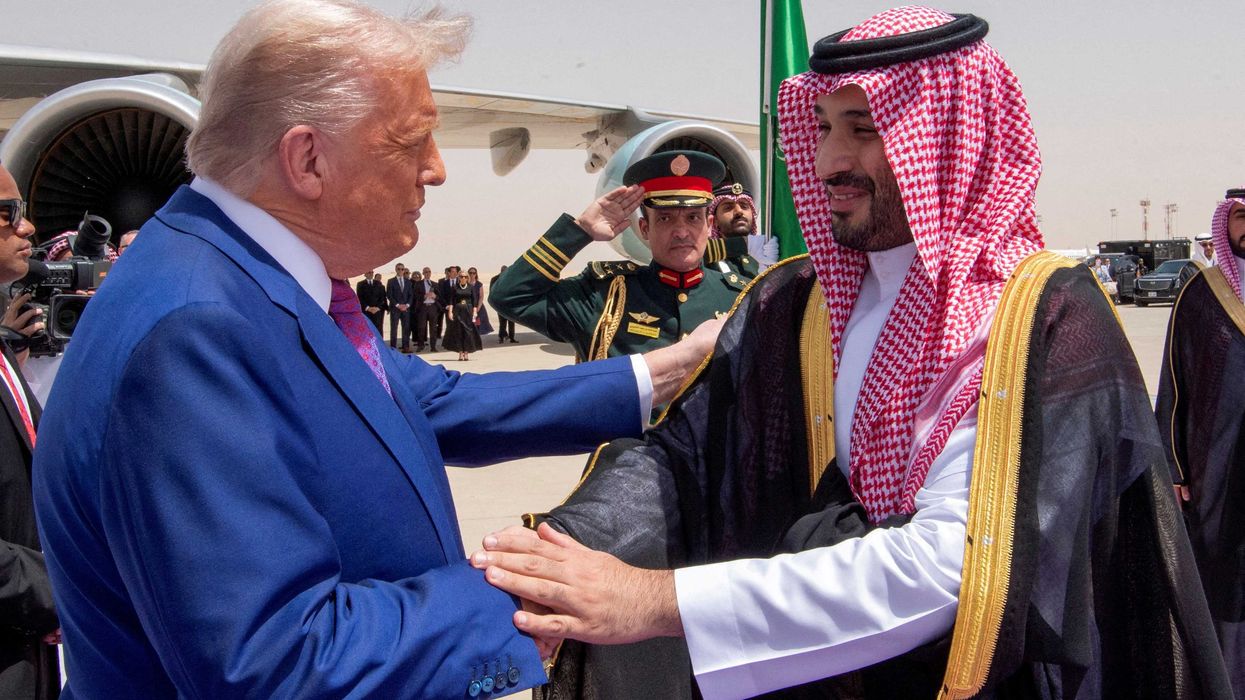


U.S. President Donald Trump shakes hands with Saudi Crown Prince Mohammed Bin Salman during a welcoming ceremony in Riyadh, Saudi Arabia, May 13, 2025. Bandar Algaloud/Courtesy of Saudi Royal Court/Handout via REUTERS

November 22, 2025
ALTERNET

New York Times reporter Noah Shachtman says Trump made a “corrosive pact” with the U.S. oil industry, and today that pact is “wiping out jobs at home and strangling what little hope was left of avoiding a climate disaster.”

“Trump promised them he would do them so many favors that a billion dollars in donations would feel like a ‘deal.’ The executives gave him only a fraction of the money he sought. Mr. Trump, on the other hand, has given them more than they asked for,” said Shachtman.

As predicted, Trump scaled back regulations and encouraged more drilling. He’s also worked to crush the industry’s green competition, pulling the plug on the largest solar project in North America, which was on track to supply enough power for nearly two million homes. Trump also put a $5 billion wind farm project in New York temporarily on hold, threatening thousands of jobs until the state approved a new gas pipeline. And he’s killed incentives for electric vehicles, sales of which had more than doubled since his first term.

It's all outdated political instinct from the 1970s, said Shachtman, back when Saudi Arabia and the rest of the OPEC cartel cut production and brought the world economy to its knees. For decades afterward, Trump expressed a mixture of admiration and resentment of the kingdom’s resource wealth.

But now, Trump is taking on damaging OPEC-like maneuvers, trying to dominate the international market, warning the world to buy more fossil fuels — or else. Now America is the planet’s leading producer of oil and natural gas, but his America First energy goals have their contradictions.

“In his total commitment to a hydrocarbon-heavy world, he has pushed not only domestic producers but also Saudi Arabia and the rest of the OPEC nations to keep pumping out more, more, more cheap oil,” said Shachtman. “That might be good news for consumers, offsetting some of these high electric rates. But with oil prices down to around $60 per barrel, American companies say they can’t afford to open up new wells, especially now that [Trump’s] tariffs have made drilling equipment so expensive. The total number of active rigs is down year over year.”

Meanwhile the combo of more data centers and fewer renewables is spiking average Americans’ electric bills. Natural gas prices are up, thanks to Trump’s export deals.

“If you gave me a piece of paper and asked me to think about the most creative way, the most effective way, to raise electricity prices in the United States, it would look a lot like what they’ve done,” said Ethan Zindler, a former climate counselor in the Biden Treasury Department who works on policy at Bloomberg New Energy Finance.

The U.S. oil and gas business would probably be thrilled were Trump’s “capricious attacks on renewables and the big swings in energy policy” not also a liability for an industry forced by the nature of its complex engineering projects to plan years, or even decades, ahead.

“Ever-changing policy, particularly as administrations change, is not good for business. It’s not good for the economy and ultimately, it’s not good for people,” said Exxon Mobil’s chief executive, Darren Woods.

Energy executives are unhappy, but they can’t be surprised, said Shachtman. Trump’s favor was always transactional and he wanted to use his oil industry favor to make their energy a tool to leverage his own personal power.

“If they drill themselves out of business, I don’t give a damn,” Trump told voters at a rally last year.

Read the New York Times report at this link.


U.S. and Saudi Arabia Rebuild a Strategic Alliance

  • Saudi Arabia pledged up to $1 trillion in U.S. investments, strengthening ties with Washington across energy, defense, and technology.

  • Aramco signed $30 billion in new deals with U.S. firms, including major LNG investments in Energy Transfer’s Lake Charles and Commonwealth LNG projects.

  • The partnership also includes nuclear technology sharing and critical minerals projects, such as a rare earth processing plant by MP Materials and Ma’aden.


Saudi Arabia made investment commitments of as much as $1 trillion during the visit of Crown Prince Mohammed bin Salman in the United States. The sum is a substantial increase on an original pledge of $600 billion, but it is also a sign that the relationship between two of the world’s largest oil producers is back on track.

The relationship, dating back to the early 20th century, was rather damaged during the Biden administration, in part due to its focus on the energy transition, which put it at odds with Saudi Arabia as an economy heavily dependent on oil revenues. Another part of the reason for the worsened bilateral relations was the issue of human rights and the murder of a dissident Saudi journalist, which included President Biden at one point calling the kingdom a pariah state. On top of those complications, President Biden at one point threatened to punish Saudi Arabia if Riyadh did not ramp up oil production to lower prices. In short, the Biden administration did not play well with the Saudis.

President Trump changed all that, bringing relations back to the friend zone and extracting massive investment commitments across industries, but notably in LNG, defense, and critical minerals. The two also made progress on nuclear energy, with the U.S. agreeing to share its nuclear power technology with the Saudis on the condition that it would not be used for weapons-grade uranium enrichment.

The latter had been a thorny issue for years, ever since talks about nuclear tech sharing began during the first Trump administration. At the time, the Saudis refused to sign off on the non-enrichment clause, which delayed the deal. Now, Chris Wright and Abdulaziz bin Salman signed a preliminary deal for the tech sharing, with specific steps forward presumably to follow.

Aramco, meanwhile, announced preliminary agreements with U.S. companies worth a total $30 billion, noting the prospective deals build on earlier investment commitments made this year, with a value of up to $90 billion. The areas that the deals cover span from LNG to advanced materials manufacturing and financial services, the company said.

In liquefied gas specifically, Aramco is looking into an investment in the Lake Charles project led by Energy Transfer, and an offtake deal for Commonwealth LNG.

The Lake Charles LNG project is fully permitted, uses existing infrastructure, and benefits from an abundant natural gas supply through existing connections to the Henry Hub and connectivity to Energy Transfer’s vast network of natural gas pipelines. It will have an annual capacity of some 15 million tons of liquefied natural gas once completed. Finding equity partners for 80% of the facility is the condition Energy Transfer has set for making the final investment decision for the project.

The Commonwealth LNG facility in Cameron Parish, Louisiana, will have an annual capacity of 9.5 million tons of liquefied gas. The construction of the first phase will cost $11 billion, according to Commonwealth LNG, and generate annual export revenues of some $3.5 billion. However, the company has yet to make the final investment decision on the project, just like Energy Transfer, after revising the timeline for the project’s completion, with commissioning moved from 2027 to 2031.

Critical minerals and metals were another area of interest for both. Saudi Arabia has considerable deposits of some of these minerals and metals. The United States needs them. That one was really a no-brainer, and only a matter of time. During the Saudi visit, U.S. MP Materials announced a deal with Saudi Maaden and the U.S. federal government for the construction of a rare earths processing plant in Saudi Arabia.

Nuclear, LNG, and critical minerals—this is more or less all the priority boxes ticked, plus weapons and military equipment supply deals to cement the mended fences. Now, the only question is how many of the preliminary commitments will progress to full deals.

By Charles Kennedy for Oilprice.com


The Saudi F-35 Gambit: A High-End Arms Sale Meets Middle Eastern Geopolitics – Analysis
Hudson Institute
By Can Kasapoğlu


President Donald Trump’s announcement that the United States will sell F-35 combat aircraft to the Kingdom of Saudi Arabia is a turning point for airpower dynamics in the Middle East, with broad geopolitical implications.

The Lockheed Martin F-35, a fifth-generation, multirole stealth aircraft with unrivaled information superiority features, represents the leading edge of American tactical military aviation. Its high-end capabilities, from providing deep battlespace awareness to enabling distributed, networked precision strikes in nonpermissive airspace, make it one of the rare assets that can single-handedly alter the outcome of a conflict.

The announcement that Saudi Arabia will be the first Arab nation to procure this system has severe implications for three key pillars of American engagement in the Middle East:Outcompeting China in the quest for long-term influence over the region’s militaries and weapons markets.
Boosting the capabilities of Washington’s Gulf Arab partners to counter Iran.
Preserving Israel’s qualitative military edge (QME) in a worsening threat landscape.
Geopolitical Importance: Preventing the Saudis from Hedging toward China

President Trump’s announcement, made on the eve of Crown Prince Mohammed bin Salman’s White House visit, is an important step for preventing Saudi Arabia from drifting further into China’s military orbit. The sale likely cleared a Pentagon review in advance of the president’s meeting with the de facto Saudi monarch. If it goes through, Saudi Arabia will acquire 48 F-35s, making it the first Arab nation to operate a fifth-generation combat aircraft.

The United States Defense Intelligence Agency reportedly warned Trump administration officials that, because of Riyadh’s defense partnership with Beijing, selling the F-35 to Saudi Arabia might give China access to the aircraft’s critical technologies. Nonetheless, Saudi Arabia’s increasing ties with China were likely a key reason why President Trump decided to go through with the sale. Riyadh has signaled that it will not depend solely on the United States for its security—and that if Washington hesitates, the kingdom will pursue other avenues. Moreover, Riyadh’s recent strategic mutual defense agreement with Pakistan—a China-aligned Muslim-majority nation with a capable military and nuclear assets—sent an unmistakable message to the US about the House of Saud’s leverage.


Beijing has been deeply involved in supplying the kingdom with armaments, especially missile and drone warfare assets, for at least a decade. Geospatial analysis shows that Saudi Arabia has significantly expanded the Royal Saudi Strategic Missile Force in recent years while also seeking to expand its indigenous defense industrial base. The crown prince has also pressed for local production agreements as a condition of major defense acquisitions—especially missile programs. Saudi Arabia now has a solid-propellant motorproduction line at the al-Watah ballistic missile base, and US intelligence assesses that Riyadh is manufacturing an undisclosed slate of ballistic missiles with direct Chinese assistance.

For many countries, ballistic missile cooperation with China would end any hope of close military ties with the US—let alone an F-35 acquisition. But whenever Washington withholds a capability that Riyadh views as vital, the kingdom hedges further toward Beijing. When America withheld Pershing ballistic missiles from Riyadh in the 1980s, the Saudis sought DF-3 missiles from China. The eventual $3.5 billion deal between Riyadh and Beijing was the start of a pattern that endures today. It is therefore likely that the Trump administration believed that the crown prince’s major ask was more than mere posturing.

Beijing has publicly signaled that its ostensible fifth-generation competitor to the F-35, the J-20 stealth fighter, remains under strict export restrictions. But the strategic situation is fluid. If China’s leadership sees a chance to score a strategic victory over the United States, those export barriers could quickly fall. The United Arab Emirates—another Gulf state that Washington has thus far shut out from F-35 procurement over concerns about Chinese defense technology espionage through local Huawei 5G infrastructure—has reportedly shown interest in the J-20. If the right opportunity to erode US aerospace dominance in the Gulf presents itself, Beijing may decide to seize it.

Fortunately for the White House, providing Riyadh with the F-35 might serve multiple US strategic interests—if the political-military perspective holds and the diplomatic stars line up. As mentioned, it boosts America’s position as it competes with China for regional influence. F-35s would be an effective but American-dependent asset for the Saudis to operate. Second, Washington needs capable Gulf partners that can plug seamlessly into the US military’s regional architecture to help counter Iran. This architecture became even more critical when the US officially moved Israel from the European Command (EUCOM) area of responsibility to Central Command (CENTCOM) in 2021. Having an allied F-35 detachment in the Gulf would allow CENTCOM to respond even more forcefully to future Iranian aggression, enhancing deterrence. Finally, Saudi Arabia, sitting at the nexus of the Red Sea and the Gulf, is a valuable geopolitical partner. Its critical role in global energy markets and its fast-growing portfolio of high-tech and defense industrial investments under its Vision 2030 further increase its importance. Militarily, the kingdom remains one of the few states capable of hosting large-scale US detachments to anchor American deterrence against Iran.

The Trump administration’s decision to sell the F-35 to Saudi Arabia reveals the strategic trust Washington is willing to extend to its longtime ally—and reinforces the alignment it expects from Riyadh in return. In the White House’s calculus, this deal benefits the US and its Saudi allies while harming China.
Stealth in the Gulf: The Potential Military Transformation behind Fifth-Gen Air Superiority

Saudi Arabia, thanks to its considerable wealth, is already one of the world’s top defense spenders. Between 2020 and 2024, the kingdom ranked fourth among the world’s arms importers and was the primary Middle Eastern recipient of US-made munitions. But Riyadh has, for years, viewed the acquisition of a fifth-generation combat aircraft as the capstone of its Vision 2030 defense transformation agenda—an ambitious program to rapidly advance its military capabilities.

The stealth-equipped F-35 is the backbone of the North Atlantic Treaty Organization’s tactical aviation deterrent. According to Lockheed Martin, more than 600 F-35s will be stationed across NATO air bases in Europe by the 2030s. For reference, the French military has ordered just 234 of its indigenous Dassault Rafale combat aircraft as of November 2025. Beyond Europe, the F-35I has given the Israeli Air Force operational freedom in hostile Middle Eastern skies.

The F-35’s stealth and information superiority capabilities would dramatically shift the Saudi-Iranian balance of power. The aircraft’s ability to operate deep in nonpermissive airspace and overcome layered air defense architectures would allow Saudi Arabia to threaten the Islamic Revolutionary Guard Corps’ missile sites, drone nests, command hubs, and other critical infrastructure.

Moreover, the F-35 would serve as a force multiplier, enhancing the effectiveness of the rest of the kingdom’s air warfare posture. Fifth-generation platforms like the F-35 operate within smart battle networks, or systems of systems. In Israel’s recent 12-day war with Iran, F-35Is played a central role in the Israeli Air Force’s strike packages. The fifth-generation aircraft’s advanced computational systems and data fusion capabilities enhanced Israeli forces’ real-time awareness. Its high-end sensors, including the AN/AAQ-37 Distributed Aperture System and the AN/APG-81 active electronically scanned array (AESA) radar, fed continuous targeting and threat information to fourth-generation F-15Is and F-16Is, supercharging their lethality and survivability. The F-35 would offer a similar boost to the Saudi Royal Air Force’s F-15s, giving Riyadh access to a realm of operational concepts that is unique among Arab militaries.
The Shifting Regional Balance: Saudi Ambitions Encroach on Israel’s Qualitative Military Edge

No Arab state has ever operated a platform that rivals, let alone matches, Israel’s prime air warfare asset. This is no accident. Israel has long insisted on maintaining its QME, undergirded by a US policy commitment to ensure the Israeli military’s regional superiority.

The Israeli strategic community is now wondering whether Washington will end Israel’s long-standing regional monopoly on stealth technology, or whether the Trump administration will give the Israeli Defense Forces a new, decisive warfighting advantage.

Israeli planners have seen this dynamic play out before. When Washington agreed to transfer F-15s and airborne early warning and control system (AWACS) aircraft to Saudi Arabia in the 1980s, Israeli diplomatic efforts convinced the Reagan administration to restrict the supplies Riyadh received. Washington thus withheld its most advanced jamming configurations and forbade Saudi AWACS aircraft from flying outside the nation’s borders. The Trump administration could place similar technical and operational limits on the F-35s it sells to Riyadh.

Yet even if Saudi Arabia receives fully capable F-35s, Israel’s advantage would not disappear overnight. Israel’s unmatched combat experience flying F-35s in hostile airspace and the modifications unique to the Israeli F-35I Adir, including its indigenous electronic warfare suite, would help the Israeli Air Force retain its edge.

Nonetheless, a strategic calculus will likely inform Israel’s response to the Saudi F-35 acquisition. Rather than citing the QME policy to oppose Riyadh’s fifth-generation airpower ambitions, the Israeli government will likely press Washington to make a normalization of Saudi-Israeli diplomatic relations a precondition of the F-35 sale.
Conclusion

The Trump administration’s decision to supply Saudi Arabia with F-35s could reshape airpower in the Middle East for a generation. A fifth-generation fleet in the kingdom could enhance deterrence against Iran, strengthen the US-led regional coalition, and anchor the US—rather than China—as Saudi Arabia’s main defense industrial partner.

Yet the move also challenges Israel’s long-standing stealth exclusivity and the long-standing QME framework. Israel’s position on the Saudi acquisition of the F-35—conditional openness tied to normalization of relations—reflects a recognition that outright rejection is no longer politically or militarily sustainable. But the Israeli defense establishment nonetheless realizes that safeguards, restrictions, and political reciprocity will best serve its qualitative edge privileges and strategic interests.

For the United States, the choice is clear. Anchoring Riyadh in the US-led security architecture by delivering a carefully designed F-35 deal that preserves Israel’s QME advances US military and economic interests and regional stability. On the other hand, if the White House balks at the deal, it risks ceding strategic ground to Beijing in the Gulf’s most strategically vital market.

How the Trump administration navigates this deal will be a key test of US statecraft in the Middle East, with major implications for great power competition against China. The sale of F-35s to Saudi Arabia is fraught with risks—but charged with massive upside.About the author: Can Kasapoğlu is a nonresident senior fellow at Hudson Institute. His work at Hudson focuses on political-military affairs in the Middle East, North Africa, and former Soviet regions. He specializes in open-source defense intelligence, geopolitical assessments, international weapons market trends, as well as emerging defense technologies and related concepts of operations.


Source: This article was published by the Hudson Institute

Hudson Institute is a nonpartisan policy research organization dedicated to innovative research and analysis that promotes global security, prosperity, and freedom.




DOGE ‘Doesn’t Exist’ Anymore, But the Damage It Did ‘Will Be Felt for a Long Time’

“The little bit of spending DOGE cut has already killed hundreds of thousands and will eventually lead to millions of deaths,” one expert said.


People join in a “Hands Off!” protest against the Trump administration on April 5, 2025 in Riverside, California.
(Photo by David McNew/Getty Images)


Olivia Rosane
Nov 23, 2025
COMMON DREAMS


The Department of Government Efficiency—Elon Musk’s much-heralded attempt to take a chainsaw to the federal bureaucracy—has quietly disbanded eight months before its official expiration date, Reuters reported on Sunday.

The news agency received confirmation of DOGE’s demise from Office of Personnel Management Director Scott Kupor earlier this month.

“That doesn’t exist,” Kupor told Reuters, adding that it was “no longer a centralized agency.”

Kupor also said that a government hiring freeze implemented by DOGE had ended.

DOGE is fading away like bank robbery gangs fade away after the robberies are done.”

When President Donald Trump first signed the executive order creating DOGE, he said that it would last until July 4, 2026. However, following a public feud with Musk in late spring, Trump and his team had indicated the department was no longer active, often speaking of DOGE in the past tense.

Musk originally set out to save $1 trillion in federal expenditures by cutting what he claimed to be waste. According to the DOGE website, the department has only saved $214 billion of that aim. However, even that number is in dispute, with one Senate report finding the agency wasted over $21 billion.

At the same time, DOGE sowed chaos in the federal government by mass firing workers, hobbling consumer watchdog agencies, and gutting the US Agency for International Development (USAID)—a move that could lead to more than 14 million deaths worldwide by 2030. At the same time, DOGE employees’ attempts to gain access to sensitive government data have made the data of millions of Americans less secure. One whistleblower report said the department uploaded Social Security data to a cloud server at risk from hacking.

Several experts reacted to Reuters’ report by reflecting on DOGE’s destructive legacy.

“Difficult to overstate how profound a failure DOGE was,” Bobby Kogan, the senior director of federal budget policy at the Center for American Progress, wrote on social media. “Spending in FY2025 was not only than in FY2024—but higher than it was projected to be when Trump first took office.* The little bit of spending DOGE cut has already killed hundreds of thousands and will eventually lead to millions of deaths.”

Rachel Khan wrote for the New Republic:
DOGE’s legacy is both very stupid and very sad: It decimated the federal workforce, including Social Security personnel at local offices, and made it easier for hackers to access your data. The agency tore apart USAID, which resulted in hundreds of thousands of lives lost globally. And all this for projected savings—numbers which grew smaller and less ambitious every time Musk mentioned them.

While DOGE may fade away into a fever dream of Trump’s first 100 days, its effects—and the suffering it inflicted—will be felt for a long time.

Dean Baker, senior economist at the Center for Economic and Policy Research, joked, “DOGE seems to be out of business, I guess Elon put our $5k dividend checks in the mail,” referring to a promise Musk had made to redistribute DOGE’s savings to taxpayers.

However, other commenters argued that DOGE had not failed, but had rather succeeded at its unstated aims.

Georgia State University political scientist Jeff Lazarus wrote that Musk “donated $277 million to Trump so he could steal the federal government’s data, dismantle the nation’s infrastructure, and stop foreign aid from going to nonwhite people. It’s a quid pro quo breathtaking in scope, corruption, and damage, & completely unprecedented in American history.”

Bluesky user En Buen Ora wrote: “DOGE did not fail in any way to accomplish its goals. Its goals were never efficiency or saving money. Its goals were to destroy as much of government as possible forever, and to steal data for the Space Nazi. DOGE is fading away like bank robbery gangs fade away after the robberies are done.”

While DOGE as an entity may not longer be working, Reuters noted that several of its employees had moved on to other government positions:Airbnb cofounder Joe Gebbia now runs the Trump-created National Design Studio;
former Acting DOGE Administrator Amy Gleason is an adviser at the Department of Health and Human Services (HHS);
DOGE team member Zachary Terrell is chief technology officer at HHS;
Rachel Riley is chief of the Office of Naval Research; and
Jeremy Lewin, who helped gut USAID, works for the State Department overseeing foreign assistance.

ProPublica has compiled a running list of every DOGE staffer it could verify, which now totals 114.

Author Tyler King wrote on social media that “'DOGE doesn’t exist anymore’ is a misleading premise because more than 100 former DOGErs have become deeply embedded in federal agencies to generally fuck around with our data and arbitrarily disrupt budgets.”


Rebuilding the World: The Inspiring Success of the Klamath Dam Removals

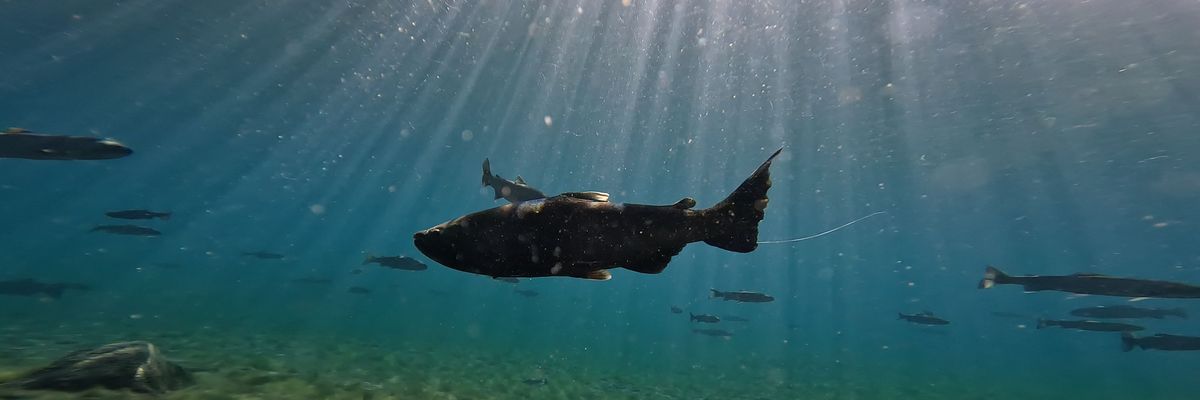
The 2024 removal of four dams on the Klamath River is an amazing example of how, when you address a human-based problem, nature can come back.


Klamath salmon spawn in the Williamson River in October, 2025 for the first time
 in 100 years.
(Photo by Paul Wilson/Klamath Tribes/X)


David Helvarg
Nov 23, 2025
Common Dreams


Since 2002, I’ve been reporting on the generations-long battle led by Klamath River tribes to take down four dams damaging the northern California river and its salmon. Recently Natasha Benjamin and I got to interview Amy Bowers Cordalis, the former general counsel for the Yurok Tribe, the largest of California’s tribes, about her new book The Water Remembers: My Indigenous Family’s Fight to Save a River and a Way of Life. We did this on our Rising Tide, the Ocean Podcast.

David Helvarg (DH): Amy, usually our opening question is about one’s first connection with the ocean. But since all rivers connect to the sea, let’s ask what your first memory of wild water was?

Amy Bowers Cordalis (ABC): Oh, I love that question. My first memory of wild waters is not even a visual memory, it’s an embedded experience. My family is from the village of Requa at the north side of the mouth of the Klamath River, and our ancestral home is an old Yurok traditional redwood plank house. And that’s where I spent most holidays and that’s where we’d go and stay, that was home base during fishing season.

I grew up just running around the village area and grandma’s house, and it sits overlooking the Klamath estuary, the mouth of the Klamath River, and the ocean. And so, my first connection with wild water was just being in that place surrounded by different forms of water; there’s the ocean and there’s always these extremely powerful waves at the mouth of the Klamath. And then you go inland, in the mouth, and that’s a really powerful exchange of different kinds of water, of salt water and fresh water merging. And then you’re in the estuary and it’s just like deep and wide, but then it’s right in the middle of the redwoods. And so often there is fog and mist surrounding you.

I was on a Yurok Fisheries tribal boat looking at the dead fish, and I just felt like my great grandma who had passed away, 20 years before, came to me and was like, “You got to stop this. We can’t have this anymore.”

DH: It’s amazing when you stand on the bluff at the mouth of the Klamath and you look north and south and it’s forested as far as you can see, and you think you’re in the most populous state in the nation? It’s just hard to grasp how much of it is still wild. Of course there’s been decline over time. Before we get into that, let’s ask a bit more of your history.

ABC: Well, I grew up fishing. I grew up hearing the family stories about all these fights just to be on the river, right? Just to sort of survive colonization. And I write about those in the book and so I just felt like I had to get all this out in a narrative format so that people could know this history, but also share this experience with me.

I heard about the family’s Supreme Court case, the fish wars, and how the family fought back against federal marshals armed with machine guns and how we, even, like my dad, who’s one of the kindest humans I know, he drove around with a machine gun in his trunk because they weren’t safe. I grew up hearing these fish stories, like about catching lots of salmon in one night and how much fun and all the hard work it was. And the role of salmon and the value of salmon in feeding our families and continuing our way of life. And, so I just had a deep, deep love for the river, for our culture, for our salmon. And then in 2002, tragedy hit. And you know, people have heard about the Klamath River fish kill. It was the largest fish kill in American history.

Over 70,000 adult Chinook salmon died in the Klamath River on the lower part of the river within the Yurok Reservation. I was in college then, and I was home that summer when the fish kill happened working for the tribal fisheries (department). And my job that summer was to go and count salmon harvested by Yurok tribal members. And so, I spent the whole summer up and down the river talking to the people. And then when the fish started dying, it was so deeply moving and profound. It was like we were under attack again. It was hard for all the Yurok families who depended on salmon for their livelihood, but also we as Yurok people have a duty to protect Yurok country and to protect our salmon. And so, I just felt compelled to try and do something to help.

I was on a Yurok Fisheries tribal boat looking at the dead fish, and I just felt like my great grandma who had passed away, 20 years before, came to me and was like, “You got to stop this. We can’t have this anymore.” And then my next thought was, you gotta go to law school. So, I went to law school and the whole goal was to get a legal education and be in a position to try to help my tribe… I went out to Colorado for law school and was able to work at the Native American Rights Fund for a period of time. They are the largest and oldest legal defense fund for tribes.

And then eventually I was called home. I’ll never forget a call I got from the then-Yurok chairman saying, “Amy, it’s time.” And he asked me to be general counsel, and I had two little kids. My second son was about a year old, and I thought, “Oh, the timing’s not right, I got young babies, how am I gonna do all this?” And also, things on the river were really, really bad. That was 2016. The river was just getting sicker and sicker and the dam removal agreements were not certain. Things were just awful. And I just thought, well, this is what you’ve been training for. This is what you were called to do. So, I moved home and started that job and made arrangements so that I could work remotely a couple days and also take the baby to work.

DH: So, for those who haven’t yet read your book let’s go back a little. During the Gold Rush there was what California Gov. Gavin Newsom in 2019 apologized for, which was a (federal, state, and vigilante) genocide against California’s Native Americans. You fast forward and “cultural fire”—Indigenous fire setting for forest management and protection—was outlawed as arson. And then the fish wars of the 1970s and 80s (that Amy’s father was involved in) were about reasserting tribal rights or treaty rights to fish salmon on the rivers.

Fast forward and I wrote about the 2002 fish kill which was more like a fish assassination when Gail Norton, the secretary of Interior under George W. Bush, opened the floodgates for alfalfa and potato farmers in eastern Oregon against the science advice that had been put forward by the National Oceanic and Atmospheric Administration. And that resulted in this disaster, the salmon kill (downriver), but also inspired the growth of the tribal movement and some environmental groups, who did what?

ABC: Everything we could to save our culture and ourselves. We have a myth that says if the salmon die, so to do the Yurok people, because there’d be no reason for Yurok to be here because we are so deeply connected to them, you know, the salmon and the river, and our sole purpose on Earth is to steward them.

So, we fought with that kind of veracity and that kind of determination, and failure was not an option. After the fish kill a whole new generation of Indigenous peoples from the Klamath were launched into the fight. And you know what was interesting about that time was more and more non-Indians, NGOs, other folks were also compelled by the fish kill. And the fish kill was tragic, it was awful. And I write about how the fish kill started (on) the last day of a world renewal ceremony that the tribe hadn’t done in 100 years. And the whole point of that ceremony is to bring about world renewal and restore balance between humans and the natural world.

And so, there’s one way of looking at this, where it was like that ceremony really did its job. You know, the medicine was really strong and although we would never wish for the salmon to die in that way, their deaths launched the undammed, the Klamath movement, and showed the humans like, “Hey, look, you keep up this regime of out-of-balanced management of the system, it’s gonna collapse.”

Natasha Benjamin (NB): So, can you describe to us just what happens to a river when you put up dams and why all these fish died?

ABC: There were a few contributing factors to the fish kill and so the order by then Vice President (Dick) Cheney to divert an extreme amount of water from the upper part of the basin in southeastern Oregon to support agriculture (and try and win Oregon in the 2004 presidential election), what that did was cause water flows at the bottom of the river, 250-300 river miles lower by my village, to be the lowest (water levels) in history. So, nothing about this was natural.

And this year, the salmon were bigger and beautiful and stronger than I’ve seen in years. I mean, they were just fierce.

Also, a contributing factor was the dams. The Klamath dams were built right in the middle of the Klamath River without fish ladders. So first off, you know, they’re blocking salmon habitat and salmon are on a mission. They will die trying to get to their spawning grounds. And so that’s what they would do at Iron Gate Dam is they would just hit their heads on the dam until they died. And if you ever went to Iron Gate, there was evidence of this. There were salmon carcasses all over. I mean, it was eerie. It was like a salmon graveyard.

But also, what was happening with the Klamath dams was that all of the agricultural runoff was coming down into the reservoirs behind the four dams. It (the upper Klamath) was former wetlands. They converted 200,000 acres of wetlands into agricultural lands. And so, what happens is that when you put chemicals on the land, it goes into the surface water and (into) the Klamath, and then that would pool behind the reservoirs and the water would get really polluted and it would get really hot. You’d have toxic blue-green algae blooms every year, and then that water would go down the entire Klamath River and poison it, from top to bottom. Then on top of that, the other thing that dams do is they block the natural sediment that would go down a river. And so, on a healthy river bed, you have lots of little, teeny rocks that help clean the river bar.

So you block that, and then you have just hard rock at the bottom of the riverbed. And what was happening under these bad conditions, is you would have these little worms (parasites) that would attach to those boulders at the bottom of the river and that would (then attach to fish and) spread fish disease. And that was causing the death of baby fish each year.

Also, behind the dams are these amazing cold water springs that cool the entire water system down the whole river. But it (the cold water) can’t get past the dams. It’s blocked under that hot, green, toxic (reservoir) water. So, all of those conditions were killing the river. By about 2010, over 90% of the Klamath salmon runs had been slaughtered. Like we were down to single digit percentages. So we had to do something, or there’d be no future.

DH: So, you moved from confrontation to collaboration to actually take the dams down. Maybe you could talk about what it took to get people to understand that taking out the dams was good for everybody on the river.

ABC: It definitely started with the grassroots Indigenous peoples of the Klamath. And they are diehards, they are hardcore, and they are brilliant. They organized protests all over the world and, you know, had signs that said things like “Warren Buffet kills salmon,” because he was the owner of it (PacifiCorp, the owner of the dams) for a time. What they did was raise awareness about the issue, and they demanded attention. They demanded that the stakeholders be accountable for how their company’s business practices were essentially killing their way of life.

We have this common life force that is is bringing us together and in a lot of ways making us more accountable for our actions.

And then what happened is there’s also a bit of good medicine here too. In 2007, PacifiCorp’s Federal Energy Regulatory Commission (FERC) license to operate the dams was set to expire. And so, in 2006, a relicensing proceeding started, which gave the tribes and our allies an opportunity to advocate for dam removal, and that really launched the whole movement. But the grassroots effort really set the stage and educated people in a way you couldn’t ignore. By the time that relicensing hearing started, everybody knew about the issue.

And then what was really cool in the FERC proceeding is that the tribe put forth its ancient, federally reserved fishing and water rights and said that these rights demand that these dams come out. And then we coupled those with energy law, the Federal Power Act, and environmental laws to basically make the case that the Klamath dams were so harmful to salmon, to the river’s overall health and Indigenous lifeways, that it was against the public interest to keep them in.

And then there’s this really powerful section of the Federal Power Act, Section Eight, that says if you’re on a river where there are salmon you have to have some kind of fish passage in order to get a new license. And so, what that meant in the context of the Klamath is that if PacifiCorp wanted to renew their license to operate the dams, they had to put in some kind of fish ladders. Then there was an economic analysis completed and it turns out that it was cheaper to remove the dams than it was to keep them in. And then we had our turning point.

(With the eventual dam removal ending in 2024) there was like earth and rock and rebar and all kinds of things, and we repurposed it or returned it to where it came from. And now we are restoring over 20,000 acres within the former reservoir footprint. We have planted over 19 billion native seeds through the whole area. And there will be restoration projects going on for at least 10 more years.

And one thing I’m really excited about is that we’re also seeing more collaboration between all the Indigenous peoples (four tribes) on the basin. My nonprofit Ridges to Riffles is facilitating an inter-Indigenous group that is advising all of this restoration work. So, we’re renewing the world and rebuilding it and decolonizing it. And that’s not just good for us, but that of course also creates ecosystems for all the little critters. And so, you go there now and it’s remarkable. And there are fish that, oh the fish. I mean the fish. We have a salmon phenomenon happening. It is a straight up phenomenon. Amazing. This year the fish have gone past upper Klamath past the (now removed) dams. They haven’t been there in 100 years, but they went past the dams, past Keno Dam, past upper Klamath Lake, and are now in the Williamson and the Sprague rivers (in Oregon). We always said we’re gonna open up 400 miles of spawning habitat, and we’re about there with all that.

NB: Within a year of taking down the dams?

ABC: So last year we took out the dams, and there was every kind of scientific study, I mean 20 years of studies about what was going to happen, and they never anticipated that this many salmon would come back this fast and that they would go back into those spawning grounds, you know, where they hadn’t been in 100 years.

And this year, the salmon were bigger and beautiful and stronger than I’ve seen in years. I mean, they were just fierce. They just fought and they were gorgeous. And so, I kind of knew like, these guys are gonna do something, and they just surpassed everybody’s expectation.

You know we have this common life force that is is bringing us together and in a lot of ways making us more accountable for our actions. Because what happens at the top of the river so greatly impacts what happens at the bottom.

NB: This is an amazing example of when you address a human-based problem, nature can come back.

ABC: Absolutely. The concept is to remove the dams so that the river’s natural ecosystem functions can start performing again. And when we did that, I mean it was almost instantly the water was cleaner, you don’t have those reservoirs and those stagnant bathtubs, like everything is just being flushed out. And the river almost immediately was stronger and healthier.

NB: The Klamath is the antidote to the current political and climate crisis.

ABC: And what’s interesting too is that Klamath dam removal was also profitable. You know, it pumped $515 million into the economy. And some of the world’s largest construction corporations were responsible for the physical removal of the dams. And they used the same engineering techniques and business practices as they use for regular construction projects or building infrastructure. So, there’s a scalable business model that supports nature-based solutions… You know, there is a movement of people who are using nature-based solutions to solve the climate crisis and they’re accepting that humans are a part of the natural world and that we can actually work to rebuild the world!


Our work is licensed under Creative Commons (CC BY-NC-ND 3.0). Feel free to republish and share widely.


David Helvarg
David Helvarg is an author, former war correspondent, and licensed private investigator.
Full Bio >
Who’s Afraid of a Socialist Mayor? The Corporate Media

These editorial boards are not afraid that Katie Wilson and Zohran Mamdani’s policies will fail—they fear that they will work, thus making a “tax the rich” agenda more popular nationwide.


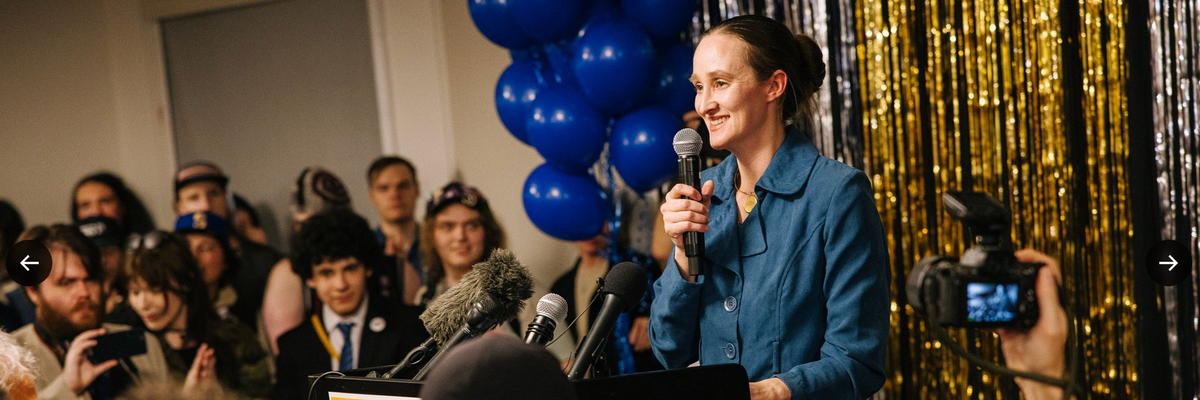
Katie Wilson addresses supporters at an Election Night party on November 4, 2025 in Seattle.
(Photo by @wilsonformayor/X)


Ari Paul
Nov 23, 2025
FAIR

New York City isn’t the only city to have elected a democratic socialist as mayor. Seattle voters ousted incumbent Mayor Bruce Harrell for community organizer Katie Wilson, who had the endorsements of unions, Democratic clubs, and the Stranger (7/2/25), the city’s alt-weekly.

She credited her win to a “volunteer-driven campaign among voters concerned about affordability and public safety in a city where the cost of living has soared as Amazon and other tech companies proliferated,” AP (11/13/25) reported. The wire service noted that “universal childcare, better mass transit, better public safety, and stable, affordable housing are among her priorities”—similar to those of New York City Mayor-elect Zohran Mamdani.

Corporate media are not happy about her victory, priorities or rhetoric. The Seattle Times editorial board (11/17/25) said upon her victory that she “painted her opposition as big businesses content with keeping people down,” and countered that residents will “fear that no one will come when they call 911, that parks will be unusable, that small businesses will shutter because of crime and revenues that don’t keep up with expenses.”
‘Woke Republic of Seattle’

The reliably right-wing Wall Street Journal editorial board (11/13/25) called Wilson “Mamdani West,” and described her as “soft on crime but tough on businesses.” The paper scoffed, “Maybe Ms. Wilson will moderate her views once she is confronted with the responsibilities of office, but the campaign had little evidence of that.” The board ended, sarcastically, “Good luck.”

In a smaller editorial, the Journal (11/17/25) mocked the “Woke Republic of Seattle,” quoting Wilson saying:
I will appoint a cabinet of exceptional leaders whose lived experiences reflect the diversity of Seattle’s Black, Indigenous, Asian and Pacific Islander, Latinx/Hispanic, and people of color communities, as well as that of women, immigrants and refugees, 2SLGBTQIA+ communities, people with disabilities, people of all faith traditions, and residents from every socioeconomic background.


The editorial board continued:
Now, that is some coalition. But what’s a 2SLGBTQIA+ community? We looked it up. It’s apparently an acronym for Two-Spirit, Lesbian, Gay, Bisexual, Transgender, Queer or Questioning, Intersex, Asexual, with the + covering anybody who feels left out.

With all of these groups to satisfy, we’re not sure there are enough jobs to go around. But may the Two-Spirit be with the mayor.


The New York Times (11/13/25) gave Wilson’s win tepid coverage, offering an unexciting news piece that failed to put her victory into context or contemplate the gravity of ousting a powerful incumbent. It also, bizarrely, quoted that defeated incumbent—and never quoted the actual winner of the race.
Childcare and other ‘goodies’


But it was the Washington Post editorial (11/16/25) about Wilson’s win that takes the cake here. And that makes sense: Socialist and left-wing activists in the Puget Sound point fingers at Amazon and other corporate giants as the main drivers of inequality.

The Post is owned by Amazon’s founder Jeff Bezos, one of the richest people on the planet. Since Donald Trump’s inauguration this year as president, the Post has vowed to become more right wing on the editorial page (NPR, 2/26/25). This fall the opinion page took a “massive stride in its turn to the right by hiring three new conservative writers after losing high-profile liberal columnists,” as the Daily Beast (10/2/25) noted.

First, the Post belittled Wilson’s proletarian life and went on to degrade her political priorities for being tied to her economic position. It said:
Who is Wilson? She does not own a car. She lives in a rented 600-square-foot apartment with her husband and 2-year-old daughter. By her own account, she depends on checks from her parents back East to cover expenses. To let them off the hook, she seeks to force residents of Seattle to pay for “free” childcare and other goodies.


“Goodies” in this case mean services that make life affordable for a working parent who doesn’t own much, like Wilson. This is in a town with feudal levels of inequality: “While one-third of residents are classified as low-income, 1 out of every 14 is a millionaire” (KCPQ, 6/12/24). Seattle’s housing rental costs are “among the highest in the nation, ranking 16th among the country’s 100 largest cities,” while the city’s “median rent is now also 47.4% higher than the US average of $1,375, placing it on par with prices in Los Angeles and Oakland” (KCPQ, 3/7/25). An op-ed in the Seattle Times (3/18/25) noted that in the state generally “hunger is on the rise” while “Food banks and meal programs are on the front lines of an unprecedented hunger crisis.”

This is truly a “let them eat cake” moment for the Bezos Post. The Post went on:
The mayor-elect’s plans will simultaneously accelerate the exodus of businesses while making the city more of a magnet for vagrants and criminals. For example, Wilson criticized Harrell’s sweeps of homeless encampments. She backed off previous support for defunding the police, but many officers remain nervous.

Like the mayor-elect in New York, Wilson wants to open government-run grocery stores, despite their record of failure. She suggested during a September event that she won’t allow private supermarkets to close locations that aren’t profitable. Instead, she wants to require them to give more notice and pay generous severance packages to their employees. “Access to affordable, healthy food is a basic right,” Wilson said.


It’s bad enough that a paper owned by a Bond villain is mad that the next mayor of an expensive city has too much compassion for the homeless. But the dismissal of the grocery store idea isn’t based in fact, as Civil Eats (8/20/25) noted that “publicly owned grocery stores already exist, serving over a million Americans every day, with prices 25 to 30% lower than conventional retail.” Civil Eats said that “every branch of the military operates its own grocery system, a network known as the Defense Commissary Agency (DeCA),” with more than 200 stores around the world generating $5 billion in annual revenue. The outlet added, “If it were a private corporation, it would rank among the top 50 chains in the nation.”
‘Identifying Class Enemies’


The editorial was an echo of the Post’s earlier pearl-clutching (11/8/25) in response to Mamdani’s victory speech:
Across 23 angry minutes laced with identity politics and seething with resentment, Mamdani abandoned his cool disposition and made clear that his view of politics isn’t about unity. It isn’t about letting people build better lives for themselves. It is about identifying class enemies—from landlords who take advantage of tenants to “the bosses” who exploit workers—and then crushing them. His goal is not to increase wealth but to dole it out to favored groups. The word “growth” didn’t appear in the speech, but President Donald Trump garnered eight mentions.


Bezos, as part of the billionaire class, finds himself as the target of this year’s leftward electoral swing. “Affordability” was Mamdani’s buzzword, an offense to the Bezos board, who wanted to hear “growth,” a catchphrase for the financial elite. Bezos’ position makes sense from his rarefied position, but that is precisely why billionaire-owned media, whether it’s the Ellison family’s consolidation of TikTok and CBS or the Murdoch empire of Fox News and the New York Post, are bad for democracy. These are media that are materially situated to side with landlords and bosses over tenants and workers, but there are no outlets in major media with editorial boards that consistently lean in the other direction.

Once again, these editorial boards are not afraid that Wilson and Mamdani’s policies will fail—they fear that they will work, thus making a “tax the rich” agenda more popular nationwide.

These media don’t grapple with why voters aren’t scared of socialism and want the rich to pay more for services. It is up to them to make a case that voters should choose a political platform of consolidating political power with the billionaire class.


© 2023 Fairness and Accuracy In Reporting (FAIR)


Ari Paul
Ari Paul is a New York-based journalist who has reported for the Nation, the Guardian, the Forward, the Brooklyn Rail, Vice News, In These Times, Jacobin and many other outlets.
Full Bio >
What Jeffrey Epstein’s Emails Really Expose: The System Itself

The Epstein files aren’t about one dead predator or even about the powerful men who enabled him. They’re about a revelation that terrifies the ruling class: We’re finally seeing the structure of division and dehumanization clearly.


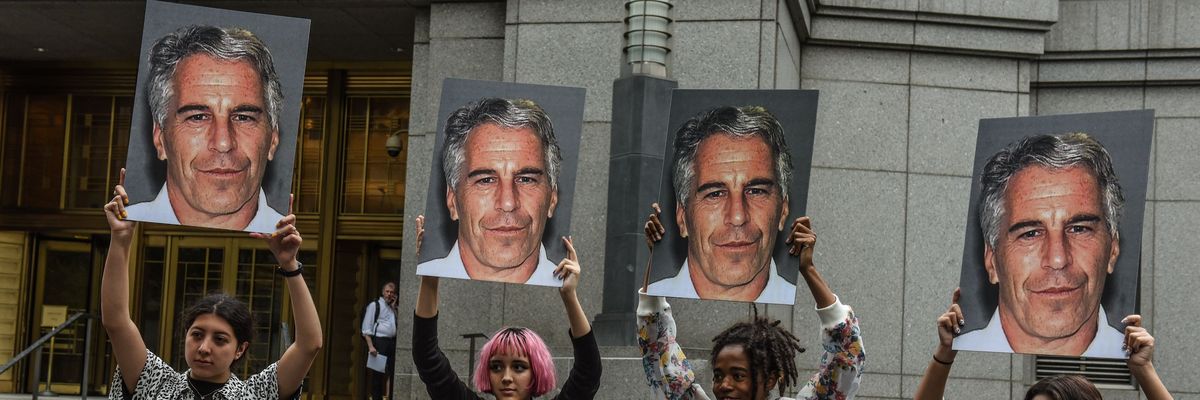
A protest group called “Hot Mess” holds up signs of Jeffrey Epstein in front of the Federal courthouse on July 8, 2019 in New York City.
(Photo by Stephanie Keith/Getty Images)

Emese Ilyés
Nov 23, 2025
Common Dreams

Over the past few years, Jeffrey Epstein has dominated our collective attention in ways that are both revealing and troubling. On the surface, the sustained focus on a wealthy sexual predator who trafficked children over decades seems like progress. Perhaps a sign that we’re finally holding powerful people accountable. But look closer. This has unfolded during a backlash against survivors of sexual violence, a rollback of protections for women, and the systematic removal of women from positions of power. Research funding for gender equity has vanished. So what does our obsession with Epstein really mean?

Part of it is obvious: The details are sensational, and social media algorithms reward outrage. The names in those files read like a global directory of power: political leaders, billionaires, academics, celebrities. Everyone who’s anyone seems to orbit this depravity. That explains the clicks.

But I want to suggest something else is happening. Something more profound. As a psychologist who teaches students to analyze complex social problems, I see us collectively engaging in what I call for in my classroom: a dual analysis, what Lois Weis and Michelle Fine termed as critical bifocality. We’re learning to hold two truths, two ways of understanding the world, at once. And that terrifies the powerful.

Why We Blame Individuals, and Why That’s Dangerous Now

Americans have been trained to see failure as personal. Lost your home in foreclosure? You must have been irresponsible. Can’t afford groceries? You should have worked harder. This is the logic of capitalism, and it’s everywhere.

Psychologists call this the fundamental attribution error: We overestimate individual responsibility for others’ suffering while excusing our own struggles as caused by circumstances. It’s a cognitive bias that protects our self-esteem but destroys our capacity for solidarity.

This isn’t just about one man’s moral failure. It’s about a system where wealth creates impunity. Where the rules simply don’t apply.

Right now, this error is especially dangerous. Grocery prices are up nearly 30% since 2019. Jobs feel precarious as AI reshapes entire industries. Immigration and Customs Enforcement (ICE) raids are terrorizing communities, disappearing neighbors and co-workers. For millions in Appalachia and the Rust Belt—regions promised economic revival—things have only gotten harder. This is the case all over the country, no matter whether red or blue designations have been imposed on us by the pundits.

When we’re scared, we want simple answers. We want someone to blame. The fundamental attribution error gives us that: blame the immigrant, blame the lazy, blame anyone but the system itself.
The Power of Dual Analysis

But here’s what I see happening with Epstein: We’re refusing that simple narrative. We’re doing something more sophisticated, more dangerous to power.

We’re using what I teach as the individual lens: Yes, Jeffrey Epstein made choices. Yes, every person who enabled him (the many who looked away, who benefited, who participated) bears individual moral responsibility. We must hold them accountable. Children were harmed. Yes, Megyn Kelly, they were children. That demands justice.

But we’re also using the structural lens: What system allowed this to happen? What conditions enabled it? And here’s where it gets uncomfortable for the powerful in the world, like Donald Trump, one of Epstein’s closest friends.

When the System Protects the Predator

In 2008, Jeffrey Epstein was convicted of soliciting prostitution from a minor. He served barely a year in the private wing of a county jail with work-release privileges, where he was able to leave 12 hours a day, and even the door to his cell was unlocked. Most Americans would have gone to federal prison. But Epstein had connections.

Fast forward a decade. Between November 2018 and July 2019, 10 years after his conviction, Larry Summers was texting with Epstein, seeking advice on how to seduce a female colleague he called his “mentee.” Summers was former president of Harvard, former treasury secretary, one of the most powerful economists in America. And he was asking a convicted sex offender to be his “wing man” in pursuing a woman professionally vulnerable.

The correspondence ended July 5, 2019, one day before Epstein’s arrest on federal sex trafficking charges.

This isn’t just about one man’s moral failure. It’s about a system where wealth creates impunity. Where the rules simply don’t apply.

The Numbers Don’t Lie

The wealthy aren’t just getting richer. They’re extracting from the rest of us at an accelerating rate.

Today, the top 1% hold 30.5% of America’s wealth. The bottom 50% (that’s half of us) hold only 2.5%.

Imagine 100 of us in a room with a meal to share. It is a delicious platter of burgers and warm, salty fries that fills the room with a savory smell. All of us are hungry.

One person walks up and takes nearly a third of everything. They pile their plate high and walk away.

Nine more people step up and take most of what’s left, about another third of the food between them.

The Epstein files are thousands of emails, each one a point of light illuminating how the system actually works. And it’s terrifying to those who benefit from it.

That leaves 90 of us to divide the remaining third. But here’s the thing: It’s not divided equally. Forty people in the middle get modest portions. They have access to just enough to take the edge off their hunger. And the last 50 of us? We’re left fighting over a few cold fries and some burger crumbs on the edge of the platter. That tiny pile is 2.5% of the meal that fed one person so lavishly.

The one person who took a third? They’re not worried about the 90 of us who got less. They’re counting on the 40 who got modest portions to blame the 50 who got crumbs. They’re counting on all of us to fight each other instead of asking why one person gets to take so much in the first place.

It wasn’t always this way. Since 1989, the richest 1% have increased their share of national wealth by 34%. The bottom 50% have lost 26% of theirs.

This isn’t about hard work or merit. The system is designed for extraction. You work every day. You show up. And still your debts deepen. Your loans grow. Your ability to build security evaporates.

Meanwhile, the wealthy fly on private jets to private islands where they commit acts of cruelty most of us can’t imagine but all of us (except Megyn Kelly) agree are unlawful and immoral.
Why Trump Is Scared

The Epstein files are thousands of emails, each one a point of light illuminating how the system actually works. And it’s terrifying to those who benefit from it.

Watch Trump’s reaction. On November 14, when Bloomberg reporter Catherine Lucey asked about the files aboard Air Force One, Trump jabbed his finger at her: “Quiet! Quiet, piggy.” Days later, he threatened ABC's broadcast license when reporter Mary Bruce asked similar questions.

This is the powerful suddenly being exposed, the curtain is lifting, and we see that these monsters are just tiny pathetic, greedy people. This is fear.

Trump campaigned in Appalachia promising economic relief. Eleven months later, he’s proposed cutting the Appalachian Regional Commission by 93%, from $200 million to $14 million. In a region with 75 counties classified as economically “distressed,” he’s pulling the last federal lifeline.

The people who voted for Trump because they were promised someone who would fight the elites are watching those same elites protect each other. They’re watching the system close ranks.
What Comes Next

The Epstein files aren’t about one dead predator or even about the powerful men who enabled him. They’re about a revelation that terrifies the ruling class: We’re finally seeing the structure of division and dehumanization clearly.

This is why they are afraid: the 50 of us fighting over crumbs have far more in common with the 40 who got modest portions than any of us have with the one who took a third of the meal. The worker whose factory closed in Ohio and the immigrant whose neighbor was disappeared by Immigration and Customs Enforcement? We’re all being crushed by the same system. The rural Appalachian who can’t afford medication and the urban renter who is being priced out? Same system. The young person drowning in student debt and the parent who can’t afford childcare? Same system.

We can hold individual wrongdoers accountable AND dismantle the systems that enabled them.

The powerful maintain control by convincing us we’re each other’s enemies. Red versus blue. Urban versus rural. Immigrant versus native-born. But Jeffrey Epstein’s private island wasn’t divided by those lines. It was divided by one line only: those with enough wealth and power to do whatever they wanted to whoever they wanted, and those without.

The Epstein files show us something the powerful never wanted us to see: They protect each other. Across party lines, across industries, across borders, wealth creates a solidarity among the ruling class that transcends everything else. Larry Summers stayed loyal to Epstein a decade after his conviction. Trump’s fear when reporters ask questions isn’t about embarrassment, it’s about exposure of that solidarity.

The question isn’t just, “What will we do with what we know?” It’s “Who will we do it with?”

The answer has to be each other. All of us who show up and work and still fall further behind. All of us whose neighbors are disappearing, whose communities are being stripped of resources, whose futures are being extracted by those private jets to private islands.

We can hold individual wrongdoers accountable AND dismantle the systems that enabled them. We can refuse the fundamental attribution error that asks us to blame our neighbors while ignoring who’s taking the largest share.

This is the moment for clarity. This is the moment we refuse to unsee what’s been revealed. This is the moment we recognize each other.

The 99% of us who aren’t eating the majority of the meal? We have everything in common. Let’s build with each other instead of for those who extract from us.


Our work is licensed under Creative Commons (CC BY-NC-ND 3.0). Feel free to republish and share widely.

Emese Ilyés
Emese Ilyés is a critical social psychologist and participatory action researcher whose work examines community resistance and collective survival in the face of authoritarianism. Her research focuses on grassroots movements and mutual aid networks.
Full Bio >


This plague of frogs tells us something hopeful about resistance to Trump

The Conversation
November 23, 2025 
Assistant Professor of Sociology, University of Dayton


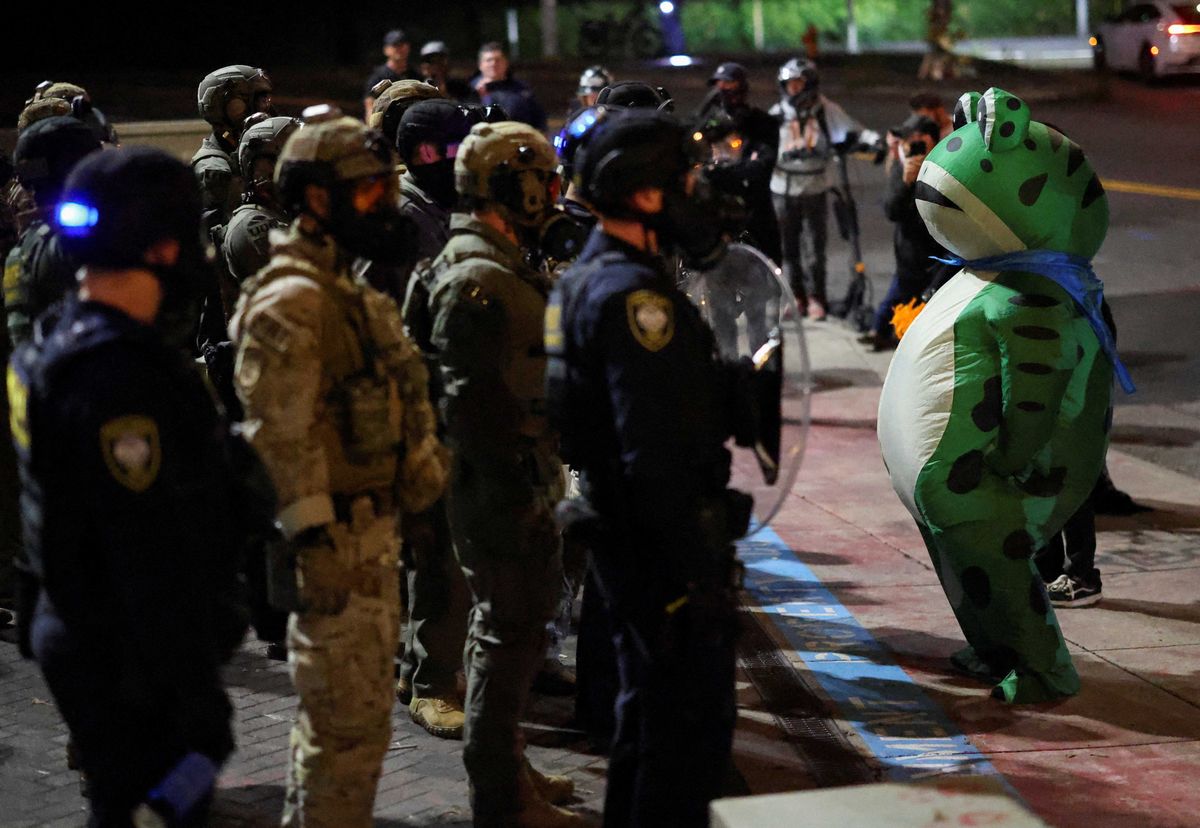
A demonstrator in a frog costume stands in front of law enforcement officers in Portland. REUTERS/Carlos Barria

When the center of protests against immigration enforcement switched recently to Charlotte, North Carolina, so did the frogs.

Back in October, an agent with Immigration and Customs Enforcement, the agency popularly known as ICE, deployed pepper spray into the air vent of a peaceful protester’s inflatable frog costume. Video of the incident in Portland, Oregon, quickly went viral. Frogs and other inflatable costumes became a fixture of protests against Trump administration actions everywhere.

As a sociologist who studies social movements and political discourse, I knew when I saw the video that we’d soon see frogs everywhere at protests.

And indeed, the costumes have visually distinguished recent events from earlier anti-Trump demonstrations, softening their public image at a time when Republican officials were calling protesters “violent” and “Antifa people.”

It’s hard to be violent in a frog suit.


Humor is subversive. When used strategically, it can help undermine the legitimacy of even the most powerful opponents.
Playful and potentially protective

Portland activist Seth Todd began protesting in an inflatable frog costume as a way of “looking ridiculous” when federal law enforcement ramped up repressive tactics against his fellow protesters at ICE facilities.

“Nothing about this screams extremist and violent,” he told The Oregonian newspaper.

Such costumes are interactive, playful, physically unwieldy and potentially protective. They can help activists appear less threatening to police, evade facial recognition systems and even deflect the blows of police batons or rubber bullets.

Wearing inflatable costumes at demonstrations checks all the boxes for tactics that can be widely imitated: cultural relevance, symbolic power, accessibility and easy participation.

My interviews with activists who used glitter bombing in past protests revealed that light-hearted tactics can expand participation by attracting newcomers who are wary of more confrontational forms of protest. This is especially true when the tactics are easy to adopt — notably, wearing inflatable costumes in the weeks leading up to Halloween.

“Protest costumes” are now a category on Amazon.

Unlike the seasoned activists who were early adopters, protesters who wore inflatable animal and character costumes — sometimes because frog costumes had sold out — at No Kings protests on Oct. 18 represented a range of experiences and affiliations, including many first-timers.

“We are middle of the road,” explained one protesting frog in Chicago. “We’re just regular folks who have had enough.”
Bears, unicorns, dinos and raccoons

Activists continue to don frog costumes in solidarity. One group calling itself the Portland Frog Brigade says its goal is “artfully exercising our First Amendment right to free speech.”

Others created Operation Inflation to collect and distribute inflatable costumes to Portland protesters.

Just days after the pepper spray incident, a video circulated showing people outside the Portland ICE facility wearing inflatable bear, unicorn, dinosaur and raccoon costumes, dancing to raucous music in front of a line of law enforcement officers clad in riot gear.

Despite the almost literal novelty value of frog costumes, there’s nothing new about any of this.

Inflatables have long played an important role in outlandish protest tactics. A large inflatable “Trump chicken” was installed outside the White House back in 2017, while a “Trump baby” blimp hovered over Parliament in London during a 2018 state visit.

During the 1960s, the Bread and Puppet Theater used towering puppets and satirical street performances to protest the Vietnam War and social inequality.

Carnivalesque tactics and clown costumes have been popular responses to police repression at anti-globalization protests.

The Raging Grannies were a mainstay at antiwar and antinuclear demonstrations in the early 2000s, easily recognizable with their colorful costumes and witty songs.


And LGBTQ+ rights advocates have thrown pies and glitter-bombed right-wing politicians, while also staging costumed flash mobs and dance parties outside the offices and homes of prominent public figures.

Absurdist performances and playful public displays are powerful tools of political dissent, especially when they stand in contrast to state violence, authoritarianism and human rights abuses.