Monday, November 24, 2025


Britain 2032. A dystopian state of the nation

NOVEMBER 23, 2025

Ian Hodson looks into the future and makes an assessment of what three years under Reform rule might look like.

Foreword: A Nation Rebuilt on Fear

When Reform UK swept to power in the 2029 election, taking nearly every English constituency and unexpected gains in Wales and Scotland, supporters declared a new era of pride, sovereignty, and national rebirth.

But by 2032, what emerged was not renewal.

It was a country hollowed out by authoritarianism, exclusion, and forced conformity.

This assessment details what Britain became.

1. THE GREAT PURGE OF CITIZENSHIP

1.1 The Three-Generation Rule

The British Heritage and Security Act 2030 required proof of three generations of British lineage for full citizenship.

Thousands who had lived here their entire lives teachers, nurses, delivery drivers, parents, children, were reclassified as:

  • Provisional Residents,

  • Non-British Dependents, or

  • Foreign-Aligned Persons.

1.2 Evictions and Exclusion

Those unable to meet the standard were:

  • evicted from public housing

  • removed from NHS patient lists

  • barred from state education

  • denied passports

  • stripped of voting rights

The government’s justification:

“National resources must serve real British families.”

1.3 Segregated Access Zones

Non-white residents were redirected to Alternative Community Access Zones for basic services.

These were segregation centres in all but name.

Complaints were labelled anti-British agitation.

2. THE MEDIA TAKEOVER

2.1 The Fall of the BBC

In 2031, the BBC was dismantled and sold.

GB News Media Group gained control of the national broadcaster.

2.2 The Free Speech Ethics Code

All media were ordered to follow a strict content code banning:

  • “woke messaging”

  • “identity propaganda”

  • critical journalism

  • satire

  • reporting that could “undermine national unity”

Investigative journalism disappeared.

Local radio died.

National news became state-scripted.

3. EXIT FROM THE ECHR: THE END OF RIGHTS

Leaving the European Court of Human Rights removed the last external safeguard.

3.1 The Work Sovereignty Act

This law abolished:

  • the minimum wage

  • health and safety laws

  • unfair dismissal

  • employment tribunals

  • discrimination protections

  • whistleblower safeguards

Employers were told workers were now “free to compete.”

Wages collapsed.

3.2 No Regulators Left

HSE, ACAS, and the EHRC were defunded or dissolved.

There was nowhere to appeal.

4. UNIONS OUTLAWED

4.1 Leaders Arrested

Union general secretaries, regional organisers, and reps were arrested on charges of

  • “economic sabotage,”

  • “domestic extremism” and

  • “obstructing national productivity.”

4.2 Membership Criminalised

Union membership became an offence punishable by detention,

Union assets were seized.

Collective bargaining died overnight.

5. THE END OF UNEMPLOYMENT – AND OF DECENT WORK

5.1 Forced Workfare

The British Work Contribution Scheme required all adults to work at least 30 hours.

Refusal meant:

  • loss of benefits

  • relocation to Work Preparation Centres

  • or loss of residency rights

5.2 Pensioners Drafted

Under the Elder Contribution Act, pensioners were forced into

  • agricultural labour

  • care work

  • neighbourhood “Civic Patrols”

Those who refused lost all top-up benefits.

6. TRANSITIONAL RESIDENCY CAMPS

6.1 New Internment Sites

Across the UK, fenced compounds called Transitional Residency Centres (TRCs) housed

  • those with revoked citizenship

  • families awaiting lineage checks

  • “heritage-incomplete” communities

6.2 No Oversight

The centres were

  • privately run

  • heavily monitored

  • legally inaccessible

  • shielded from media scrutiny

No statistics were published.

7. FOREIGN POLICY COLLAPSE

7.1 Ukraine Abandoned

Reform ended support for Ukraine and demanded repayment.

International trust evaporated.

7.2 The New Axis

Britain aligned with far-right governments across Europe and US isolationist factions.

It became known as “Europe’s rogue democracy.”

8. A NATION OF WORKERS COMPETING TO SURVIVE

8.1 Wage Auctions

Gig platforms allowed workers to bid downwards for shifts.

£2–£3/hour became normal.

8.2 Collapse of Public Services

Health services prioritised “work-ready” patients.

Education became indoctrination:

  • British Heritage Academies

  • Patriot Technical Colleges

  • censored curricula

  • monitored teachers

9. THE NATIONAL ATMOSPHERE IN 2032

Britain felt:

  • watched

  • divided

  • fearful

  • impoverished

  • exhausted

Neighbour reported neighbour.

Propaganda filled screens.

Food queues lengthened.

Public speech shrank into whispers.

Britain survived, but it no longer lived.

10. THE VANISHING OF DISABLED PEOPLE

Disabled people didn’t become invisible.

They were made invisible.

10.1 The Reassessment for National Fairness Act

Disability benefits were abolished.

Assessment was outsourced.

Most claimants were declared “fit” in minutes.

Support ended immediately.

10.2 Mass Institutionalisation

Those unable to work were taken to:

  • Residential Work Centres

  • Community Independence Hubs

  • Secure Assisted Living Facilities

Families often lost all contact.

10.3 Removal From Public Life

Accessibility laws vanished

  • disabled parking bays removed

  • assisted travel abolished

  • mobility grants scrapped

  • wheelchair access no longer required

Disabled people vanished from public spaces.

10.4 Hospital Exclusion

Hospitals prioritised those “most able to return to the workforce.”

Those with complex needs were diverted to institutions.

10.5 Behavioural Conduct Orders

People with learning disabilities, autism, or behavioural differences faced criminal penalties for,

  • “non-compliance with independence targets”

  • “public disruption”

  • “dependency behaviours”

Many disappeared into Secure Stability Units.

10.6 Media Erasure

Disability disappeared from screens, storylines, and public appeals.

10.7 The Unpublished Statistics

Independent estimates suggested:

  • tens of thousands institutionalised

  • thousands dead

  • vast numbers unaccounted for

The state stopped counting.

11. TESTIMONIALS FROM A BROKEN BRITAIN

Personal Stories Collected from Survivors, Witnesses, and Families

11.1 Amina — The Nurse Who Lost Her Citizenship

Amina, born in Birmingham, worked 18 years as an NHS nurse.

Her grandparents were Kenyan; she couldn’t produce their documents.

Her citizenship was revoked.

Her NHS ID stopped working.

Her children were removed from school.

She now queues in an Alternative Access Zone.

She still keeps her NHS lanyard in her handbag.

She says she can’t throw it away: “it’s the last proof I belonged.”

11.2 Peter — The Disabled Man Who Disappeared

After a four-minute reassessment, Peter lost his benefits and care support.

Officials arrived with a “Streamlined Support Pathway” order.

He texted his sister once,

“They’re taking us to a centre. Keep fighting.”

She never heard from him again.

The centre denies he was ever there.

11.3 Margaret and Bill — Pensioners in the Fields

In their seventies, they were forced into agricultural work.

Bill collapsed on the first day.

The supervisor shouted,

“If you can’t hack it, you shouldn’t get benefits.”

They now sort onions twelve hours a day.

Margaret says the worst part is hearing her husband apologise for “letting the country down.”

11.4 Olivia — The Teacher Watched by Cameras

Olivia’s pupils asked why children from “heritage-incomplete” families were removed.

She told them it was unfair.

A parent reported her for undermining unity.

She was suspended and placed on a “Behavioural Excellence” course.

She still teaches.

She refuses to give up.

11.5 The Fennings — A Family in the Camps

Unable to prove three generations, the Fennings were taken to a Transitional Residency Centre at dawn.

Inside were bunkbeds, floodlights, and ration queues.

Jacob, aged 9, asked,

“Are we criminals?”

His mother couldn’t answer.

11.6 Tom — The Worker Who Outbid Himself

On WorkMatch, Tom once bid £1.27/hour for a 14-hour shift.

He won the bid.

He told his daughter everything would be okay.

He knew it wasn’t true.

11.7 Keisha — The Campaigner Silenced

Her community group was raided.

She was detained for three weeks and forced to sign a National Integrity Contract.

She still organises, quietly. “If we stop speaking, they’ve won.”

11.8 Liam — The Boy in the Behavioural Unit

Liam, an autistic 13-year-old, had a meltdown in the lunch queue.

He was accused of “behavioural non-compliance” and taken to a Secure Stability Unit.

When his mother finally saw him, he whispered: “I’m trying to be normal, Mum.”

She hasn’t stopped fighting for him.

11.9 Matt — The Journalist Who Stopped Writing

After submitting a piece on camp conditions, he was told,“Your commitment to national values is under review.”

He shredded his notes.

He hasn’t written since.

12. THE FINAL TRUTH. HOW BRITAIN FELL

Britain did not collapse through a coup.

It slid — step by step — into authoritarianism wrapped in patriotism.

Reform said they would give Britain back to the people.

Instead, they built a country where:

  • rights vanished

  • neighbours feared each other

  • dissent was criminal

  • and entire communities were erased

The powerful prospered.

Everyone else tried to survive.

This is Britain in 2032 – a warning written in advance.

Ian Hodson is National President of the BFAWU.

Image: https://www.rawpixel.com/image/6038956 Creator: rawpixel.com  Licence: CC0 1.0 Universal CC0 1.0 Deed

UK 

Right-wing media watch: Where are the cries of “crisis and chaos”? The Telegraph sale falls through – again


Gabrielle Pickard-Whitehead 
Yesterday
Right-Wing Watch

Surely, media scrutiny should be consistent, not weaponised selectively.


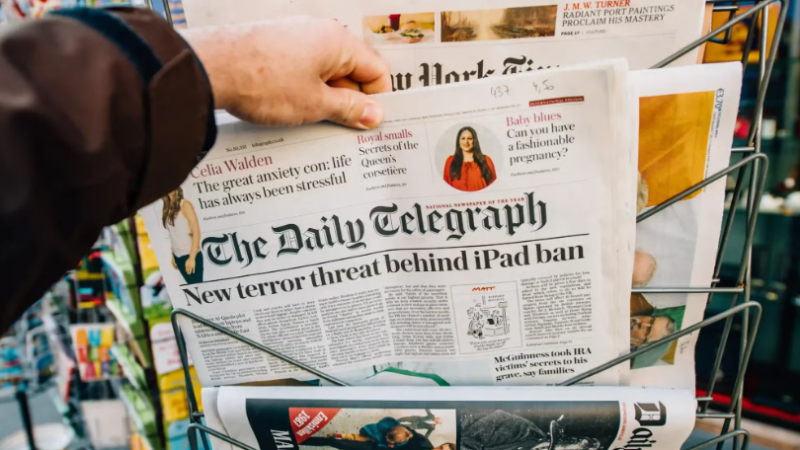
The Telegraph – the perpetuator of last week’s BBC’s ‘crisis’ over alleged left-wing bias – has, once again, hit its own crisis. Yet when it comes to the Telegraph’s very prolonged crisis, the paper and its ideological allies, it seems, suddenly lose their voice.

This week, with barely a murmur from the right-wing press, the Telegraph’s long-running ownership saga collapsed yet again.

Earlier this week, Sky News reported that RedBird Capital Partners had abandoned its proposed £500m takeover of the Telegraph Media Group. RedBird, alongside Abu Dhabi-based International Media Investments (IMI), formally withdrew its offer, confirming:

“RedBird has today withdrawn its bid for the Telegraph Media Group. We remain fully confident that the Telegraph and its world-class team have a bright future ahead of them and we will work hard to help secure a solution which is in the best interests of employees and readers.”

The Telegraph has been stuck in ownership limbo for more than two and a half years, ever since lenders seized control from the Barclay family. A complex financing arrangement with RedBird IMI was scuppered after objections to foreign state ownership of British media.

In May, the government changed the rules, raising the cap on foreign state-owned investors from 5 percent to 15 percent. This in theory reopened the door for IMI, which would have taken a 15 percent stake. Yet even after the rule-change, the consortium walked away without explanation. Again, the outcry one might expect for a major national newspaper in disarray didn’t materialise.

Yet inside the Telegraph, the situation was anything but quiet. Sky News reports that newsroom unrest played a role in RedBird’s withdrawal. Senior figures, including former editor Charles Moore and former Spectator editor Fraser Nelson, launched an attack on RedBird, publishing articles demanding scrutiny of alleged links to Chinese influence.

RedBird denies any such influence, and no evidence has been publicly established. Nonetheless, the campaign within the Telegraph became so fierce that Moore accused RedBird founder Gerry Cardinale of threatening to “go to war with our entire newsroom.”

When journalists are openly attacking their would-be buyers, something is clearly amiss. Yet the wider right-wing media, normally so quick to frame instability elsewhere as symptomatic of a broader “crisis in public trust,” suddenly found no such narrative to deploy here.

Only a handful of outlets, such as the Guardian, have given the collapse the attention it warrants.

Potential new bidders are reportedly circling again, including GB News investor Sir Paul Marshall, and a previous consortium led by Lord Saatchi and Lynn Forester de Rothschild. But nothing is guaranteed, and the asking price remains contentious.

Meanwhile, morale inside the Telegraph newsroom is reportedly deteriorating.

“We’re sick of being the story,” one frustrated member of the newsroom told the Guardian.

“This sorry saga has dragged on for more than two years now and most of us just want to see the back of it,” they add.

For a paper that delights in diagnosing institutional malaise elsewhere, the irony is striking.

None of this is to say the BBC is above criticism. It isn’t. But surely, media scrutiny should be consistent, not weaponised selectively.


Telegraph mocked for Brexit and tumble dryer story


Yesterday
Left Foot Forward


“Well at least the Telegraph was warning us Brexit would be a terrible idea."


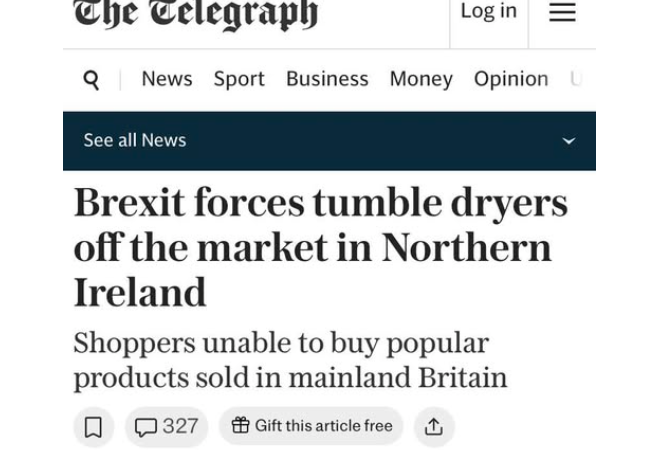
The Telegraph, a paper whose Eurosceptic editorial line has been a fixture since the early 1990s, and which championed the Leave campaign during the 2016 EU referendum, found itself mocked this week after publishing a story about tumble dryers disappearing from the Northern Irish market – because of Brexit.

The article, headlined: “Brexit forces tumble dryers off the market in Northern Ireland,” reports that some popular models sold in Great Britain are no longer available in Northern Ireland because of new EU rules. According to the piece, shoppers are unable to buy certain appliances after updated European eco-design and energy-labelling regulations came into force.

Under the Windsor Framework, the post-Brexit agreement designed to keep the Irish border invisible and protect the peace process, Northern Ireland continues to follow EU product and environmental rules that the rest of the UK no longer applies. The deal introduced Irish Sea checks on goods entering Northern Ireland from Britain to ensure EU standards are met.

Unionists argue these arrangements weaken Northern Ireland’s place in the UK and encourage a drift towards a united Ireland. They also warn that the divergence will push supply chains away from long-established British suppliers in favour of those in the Republic of Ireland.

The Telegraph article explains that Northern Ireland’s alignment with EU eco-design rules means consumers can no longer buy certain types of traditional condenser tumble dryers and must instead purchase more energy-efficient appliances, such as heat-pump dryers.

Robin Swann, the Ulster Unionist Party MP for South Antrim, raised the matter after being contacted by a constituent. He told the paper:

“Unfortunately, this is reflective of the ongoing issues facing Northern Ireland consumers because of the divergence caused by the Windsor Framework.”

“This outworking of the framework once again unacceptably limits the range of products available to customers here, and risks sending customers out of the Northern Ireland market and into the Republic of Ireland to purchase these tumble dryers.”

The article sparked an onslaught of mockery online.

“Tumble dryer update…” Leeds for Europe posted on Facebook.

“Well at least the Telegraph was warning us Brexit would be a terrible idea,” another user mocked.

Others pointed out that the appliances still available in Northern Ireland are newer and more efficient. “But, unlike us, they have access to better, more efficient ones, so it doesn’t bloody matter,” read one comment.

Another observer didn’t beat around the bush: “It’s embarrassing how desperate the Torygraph has become. It promoted Brexit based on xenophobia and lies. Just a posh Daily Mail for narrow-minded people.”
Woke-bashing of the week: For proof of the ‘go woke, go broke’ myth, just look at Sydney Sweeney’s box office record
Yesterday
Right-Wing Watch

Sydney Sweeney is treated as a symbol of the ‘unwokening.’


Since the dawn of the culture wars, the right has insisted ‘woke means broke,’ especially when it comes to Hollywood. If a film includes diversity, a social message, or simply an actor they dislike, any box-office wobble is instantly ridiculed as ‘woke drivel.’

In 2023, the Daily Mail shouted: “Woke Disney loses $900million in recent box office flops as liberal agenda being pushed in movies like ‘Lightyear’ and ‘The Little Mermaid’ turn off movie-goers.”

Two years later… it declared: “Snow White suffers worst humiliation yet after woke Rachel Zegler remake tanked at box office.”

Yet funnily enough, no such triumphant headlines appear when a film flops without a supposedly woke agenda, say, when US actress Sydney Sweeney is involved. Why? Because Sweeney has been elevated into one of the right’s newest cultural darlings.

This summer, the Mail splashed: “Donald Trump sensationally anoints Sydney Sweeney his anti-woke queen as he hurls blistering insult at Taylor Swift.”

Since Taylor Swift announced her endorsement of Kamala Harris, Republicans have been circling. Trump even took to Truth Social, posting “I HATE TAYLOR SWIFT!”

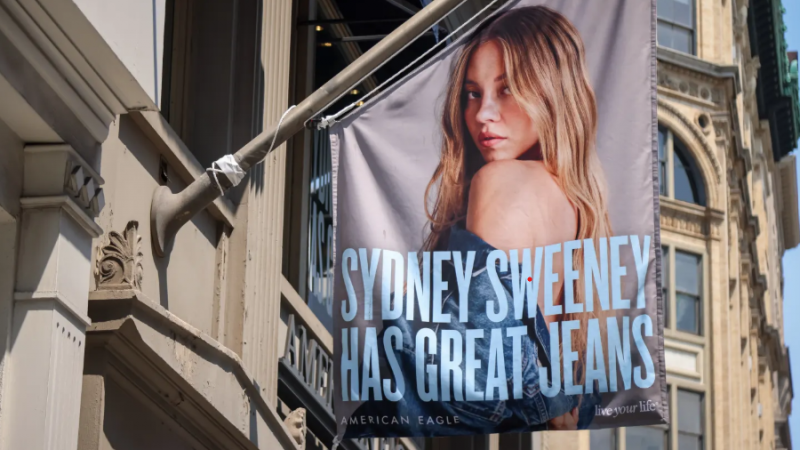
Sweeney, by contrast, is treated as a symbol of the ‘unwokening.’ When clothing brand American Eagle came under fire for a “racially charged” ad featuring the blonde hair blue eyed Sweeney, complete with the tagline
“Sydney Sweeney Has Great Jeans” which ‘critics’ likened to white-genetic-superiority aesthetics, while conservatives rushed to her defence.

“’Sydney Sweeney, a registered Republican, has the “HOTTEST” ad out there. It’s for American Eagle, and the jeans are “flying off the shelves.” Go get ‘em Sydney!’” the president said.

When GQ asked Sweeney about the controversy, journalist Katherine Stoeffel noting that “in this political climate, white people shouldn’t joke about genetic superiority”, the actor shrugged: “I think that when I have an issue that I want to speak about, people will hear.”

To her right-wing admirers, this non-answer was an act of cultural bravery.

But the inconvenient part for those eager to weaponise the box office, the “go woke, go broke” rule doesn’t seem to apply to their own icons.

Sweeney’s latest film, Christy, in which she plays boxer Christy Martin, recorded one of the worst opening weekends in box-office history. It follows other recent Sweeney-led flops like Eden and Americana. Yet somehow, the failures don’t trigger the same avalanche of ‘going broke’ headlines.

As always, it’s one rule for them and another for the rest of us. Surely if the right’s self-anointed ‘anti-woke’ queen keeps stumbling at the box office, their culture war catchphrase will expose itself for what it has always been – a convenient fiction propped up by selective outrage.
Storm Claudia hits and Thames Water dumps – again

22 November, 2025 
Left Foot Forward

"So how's all that banning bonuses, sending executives to jail bulls*t working out I wonder?"


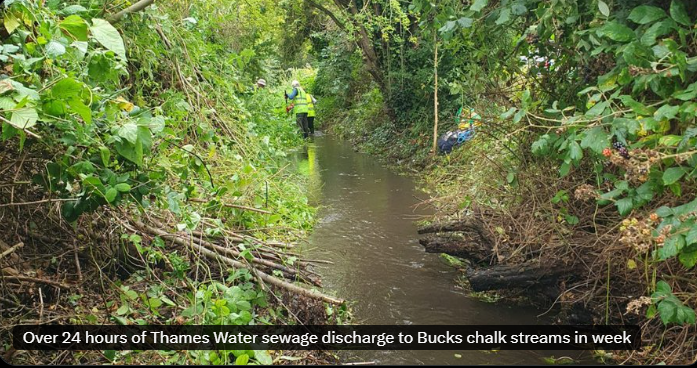
Storm Claudia swept across the UK this week, causing widely reported floods across Wales, Gloucestershire and Derbyshire. But one quieter casualty lay in Buckinghamshire, where two rare chalk streams, the River Misbourne in Gerrards Cross and the River Chess in Chesham, endured hours of sewage discharges under the label of ‘storm release.’

These rivers, fed by groundwater filtered through chalk bedrock and home to diverse wildlife, saw more than 24 hours of sewage pumped into them by Thames Water in the space of a week.

According to the Bucks Free Press, the Misbourne recorded 23 hours and 15 minutes of discharges even as the river remains in the midst of infrastructure ‘upgrades.’

The pollution came despite Thames Water having recently completed a £20 million upgrade to its treatment works, a project the company claimed would “reduce the need for untreated discharges in wet weather” and deliver a “higher quality of treated effluent.” The company says the capacity upgrades were completed in early 2023, with the improvements to effluent quality finished in early 2025.

Yet the rivers continue to bear the burden of repeated contamination.

This isn’t the first time sewage has derailed community life in Buckinghamshire. In 2024, Chalfont St Giles withdrew from the Best Kept Village competition because pollution in the Misbourne made the area impossible to present as ‘kept’ at all. The parish council publicly urged Thames Water to “clean up its act,” a message that still appears unanswered.

In September 2024, the government introduced sweeping powers to crack down on Thames Water and the wider water industry. Those reforms promised environmental protection, financial accountability, automatic fines for pollution, bonus bans, and even possible jail time for senior executives.

Yet Storm Claudia has offered a test of those powers, and the results are hard to ignore.

Environmental campaigner Feargal Sharkey summed up the public mood in a post on X, writing: “Bucks chalk streams have seen over 24hours of sewage discharged into them by Thames Water in a week. So how’s all that banning bonuses, sending executives to jail bulls*t working out I wonder?”

“Things Happen:” Is Murder OK If the Victim Was Controversial?


 November 21, 2025

Photograph Source: Jami430 – CC BY-SA 4.0

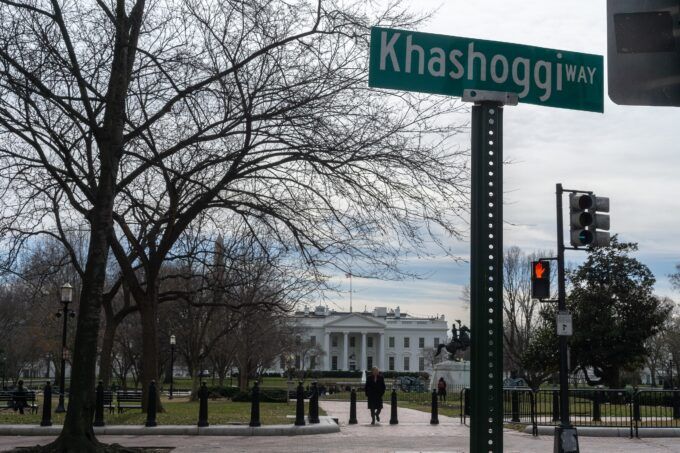
President Donald Trump on Tuesday angrily dismissed a question about the 2018 murder of Jamal Khashoggi, claiming the Washington Post columnist, a Saudi dissident, was “extremely controversial” and insisting the issue was only raised during his meeting with Saudi Crown Prince Mohammed bin Salman to embarrass his visitor.

“A lot of people didn’t like that gentleman [“Kashoggi],” that you’re talking about,” the president explained. “Whether you like him or didn’t like him, things happen.” He added that the crown prince “knew nothing about it.”—again implying that US intelligence agencies, which blamed the prince for the murder, don’t know what they are talking about.

During the joint appearance, Trump called Mohammed “one of the most respected people in the world” and said that they talk on the phone at all hours. Trump also upbraided a reporter from ABC News–libeled as “fake news” by the president—for asking Mohammed about Khashoggi. Trump called her question “horrible, insubordinate and just a terrible question.” He added that the network’s “license should be taken away.” So much for the free speech Trumpists claim to enforce at American universities, where the White House forbids criticism of Israeli “genocide.”

The Saudi prince and US president agreed to sign a mutual defense deal. The president pledged to sell the kingdom American F-35 fighter jets, brushing aside Israeli concerns that such a deal would compromise Israel’s military edge in the Middle East. The two sides made progress on negotiations over exporting Nvidia chips to power Saudi Arabia’s deep investments in artificial intelligence, despite concerns from some U.S. officials that such a move could lead to the spread of American know-how and benefit China.

The president is not burdened by worries about human life. Between July 2020 and January 2021, the Trump administration resumed federal executions after a 17-year hiatus, putting 13 death row inmates to death in the final months of his first term. This unprecedented flurry of executions made Trump the “most prolific executioner in over a century” and broke with precedent by continuing executions during a presidential transition period

In January 2020 Trump authorized a drone strike that killed Iranian Major General Qasem Soleimani and several others near Baghdad International Airport. The UN special rapporteur on extrajudicial executions considered the assassination a potential violation of international law.

The Trump administration has killed many dozens in military strikes on boats in the Caribbean Sea and the eastern Pacific suspected of transporting illegal drugs. Some lawmakers and international law experts call these actions “sanctioned murder” or extrajudicial killings, arguing they blur the line between law enforcement and an act of war.

Trump and some of his associates have been charged with and convicted of various federal crimes, but none for murder.

The administration’s war on immigrants has killed many in body or spirit, breaking up families and sending targets to countries where they do not know even the language, A Human Rights Watch report cited cases of more than 138 Salvadorans who were killed after being deported  to dangerous conditions in their home country. Even  Russians and Afghan dissidents have been sent back to their dictatorial homelands. Trump has never condemned Russia’s president for killing thousands of Ukrainians and his own people in a war over “controversial” issues.

The administration has shown clemency to many individuals convicted of violent crimes such as the January 6, 2021, attack on Congress.

The bottom line seems to be that if something benefits the president, anything goes. Trump and his family have multiple business interests in the Middle East and other “controversial” places such as Serbia. They expect that whatever they do, no matter how controversial, will go unpunished.

Walter Clemens is Professor Emeritus of Political Science at Boston University and Associate, Harvard University Davis Center for Russian and Eurasian Studies. He is the author Complexity Science and World Affairs and the Republican Virus in the Body Politic.