Monday, November 24, 2025

Tyson to Close Major Beef Facility, Shafting 3,000 Workers After Boosting Stock Buybacks

“It’s no secret that just a few years ago, packers like Tyson were making windfall profits while the rest of the industry was continuously in the red,” said a Republican US senator from Nebraska.


Tyson Foods frozen products are pictured in a Safeway store on August 8, 2023 in Washington, DC.
(Photo by Anna Moneymaker/Getty Images)


Jake Johnson
Nov 24, 2025
COMMON DREAMS

Tyson Foods, the largest meat supplier in the United States, is shutting down a Nebraska beef-processing plant that employs more than 3,000 people just months after the company rewarded shareholders by boosting its dividend and ramping up stock buybacks.

The company said late last week that its decision to shutter the Lexington, Nebraska plant and scale back shifts at its Amarillo, Texas facility is “designed to right size its beef business and position it for long-term success” even as beef prices are close to record highs. The Wall Street Journal reported that Tyson and other meatpackers, which are facing federal scrutiny for allegedly colluding to drive up prices, “have been losing hundreds of millions of dollars processing beef because of the lowest amount of cattle on U.S. pastures since the 1950s.”


Tyson, the latest company to cut thousands of jobs after prioritizing stock-boosting share buybacks, said it intends to provide “relocation benefits” to impacted workers, but provided no details.

“Tyson Foods recognizes the impact these decisions have on team members and the communities where we operate,” the company said in a statement.

The plant in Lexington, which has a population of 11,000, is one of the largest beef-processing facilities in the United States. US Sen. Deb Fischer (R-Neb.), a member of the Senate Agriculture Committee, said in a statement that she was “extremely disappointed” by Tyson’s decision to close the Lexington plant, warning it would “have a devastating impact on a truly wonderful community, the region, and our state.”

“It’s no secret that just a few years ago, packers like Tyson were making windfall profits while the rest of the industry was continuously in the red,” Fischer added. “As we head into the holiday season, I call on Tyson to do everything in its power to take care of the families affected by this short-sighted decision.”

Tyson’s announcement came days after the company said its adjusted operating income increased by 26% this fiscal year compared to 2024. The company also said it repurchased 3.5 million of its own shares for $196 million.

In early August, Tyson announced that its board “approved an increase of 43 million shares authorized for repurchase under the company’s share repurchase program.”

Stock buybacks have long been associated with mass layoffs, wage stagnation, and other harms to workers.

“Tens of thousands of workers are losing their jobs in thousands of companies only because CEOs and their major stockholders want to make a quick killing by artificially jacking up the price of their stock,” Les Leopold, executive director of the Labor Institute, told Common Dreams last year after mass layoffs at John Deere.

“We must always call stock buybacks for what they really are: blatant stock manipulation,” he added.


Why Trump Tried Tariffs: The Turn to Nationalist Capitalism

Trump’s trade policies are an admission of capitalism’s failures. Perhaps finally enough people have learned the lessons of the past so that we can build an economy that works for working people.


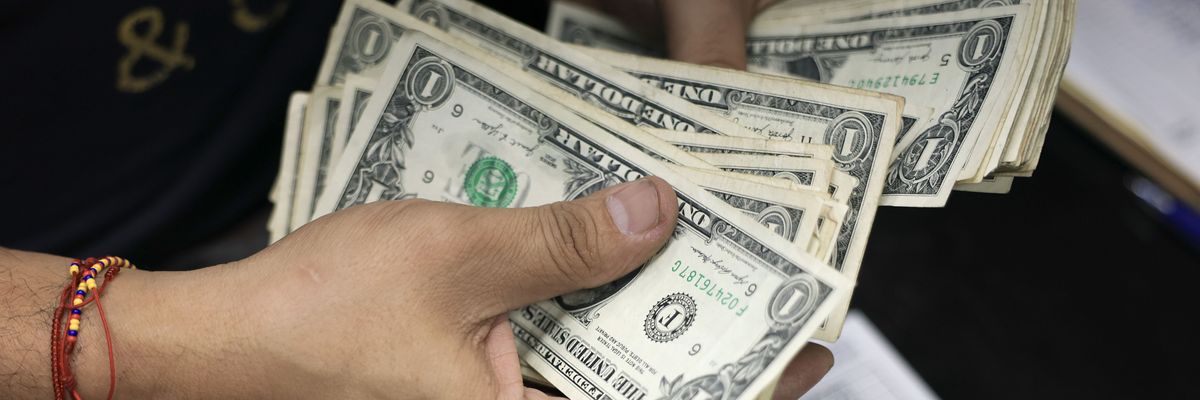
Money is counted at the National Produce Fruit and Vegetable store on November 14, 2025 in Miami, Florida. The Trump administration is reportedly working on a framework of deals to grant tariff exemptions to some South and Central American nations that could lead to reduced tariffs on some goods in the hopes that it will bring down the costs of certain groceries.
(Photo by Joe Raedle/Getty Images)

Richard Wolff
Nov 24, 2025
Common Dreams


A short response to this essay’s title is: “because he, and the US system he now sits atop, are desperate.”

A mid-length answer connects certain similarities in the histories of US and British capitalisms. Britain’s declining empire and economy led to Boris Johnson, blaming Europe for that decline, cutting off from Europe via Brexit, and Britain’s downward self-isolation since. The US’s declining empire and economy led to Trump, his blaming that decline on the whole world, cutting off from and punishing the world via tariffs and trade wars, and the resulting US downward self-isolation.

A fuller response is more complicated and requires specifying the historical context. Before the 1970s, US citizens had long been told about the exceptional virtues and benefits of US capitalism. We had achieved unprecedented success, the world’s only truly “middle-class” society. Extremes of wealth and poverty barely existed except for a very few superrich and a few very poor. After the 1970s, we were told a different story, namely that the US government had excessively intervened from the 1930s to the 1970s in the workings of “our optimally efficient private enterprise economy.” Regaining prosperity required ending such government interventions. Since the 1970s, terms like neo-liberalism, globalization, free-trade, and privatization became prominent markers of US capitalism, differentiating it from the 1930s to 1975 when the state’s economic interventions had won praise. After the 1970s, freedom from those government interventions became the dominant dogma governing state economic policy.

Before the 1970s, private capitalism had widely seemed the problem and government intervention had seemed the necessary solution. After the 1970s, the reverse view prevailed. It insisted that government intervention was the problem and privatization was the solution. This reversal reminded many of an important earlier reversal: after 1945, when the US and the USSR reversed their status as great allies to became instead the opposite, great enemies.

After the 1970s, the US government increasingly resumed its pre-Great Depression limitations on economic intervention (associated with classical, i.e. British, liberalism). Increasingly too, after the 1970s, the 1930s New Deal seemed a distant, long-ago emergency time. Its reforms were considered no longer needed or, worse, deemed counterproductive. A few Depression era reforms survived because of working-class pressures from below, plus widespread apprehensions that they might well prove useful to constrain future economic downturns. The US business community had never wanted the New Deal, resented its reforms, and recoiled at the taxes on their profits that helped pay for them. That community’s political goals after 1945 boiled down to undoing the New Deal. That had to be done slowly, gradually, and cautiously for political reasons from 1945 through the 1970s. After that, with Reagan’s election, it could and did accelerate. It has done so still more in Trump’s second term.

After the 1970s, US capitalism’s ceaseless relocation of capital investments from lower- to higher-profit opportunities increasingly took two prominent forms. First was automation: employers sequentially installed computers, robots and AI. Second was globalization: employers increasingly went beyond US borders. They moved jobs abroad and especially to Asia and Latin America. US military bases by the hundreds, originally justified after 1945 as needed to contain the Soviet Union and communism’s expansion, revealed their other and more important purpose. They served nicely to enforce a world trade system (later exalted as a “rules-based international order”) committed to US-led and US-defined “free” trade.

Tying everything together ideologically, a new dogma effectively reversed its 1930s to 1970s predecessor. The old dogma had admitted that private capitalism sometimes encountered serious business cycle problems. For example, those in the 1930s had threatened capitalism itself. Keynes had shown the world how to prevent or at least greatly moderate them. Timely government intervention, monetary and fiscal, could do the trick. Central banks could manipulate the quantity of money in circulation and interest rates to control capitalism’s cycles. Governments could likewise maneuver tax collections, spending programs, and resulting borrowing toward the same end. For a while it was widely believed that capitalism’s long-standing problem of cyclical instability had been solved. Leading US economists, among others, went to work to persuade and explain the Keynesian solution to business, political, and academic leaders. Most of the rest of the economics profession followed by teaching Keynesian economics to successive generations of college students. From the 1930sto the 1970s, economists were mostly the old dogma’s priests.

At the margins of the US economics profession from 1945 to 1975 were some who rejected the dominant old dogma more or less. Among them Milton Friedman refused the premise that capitalism had somehow “failed” in the 1930s. It could have rallied, he believed, to overcome a cyclical downturn as it had many times before. Indeed, he and his co-authors labored to suggest how and why governmental interventions did more to worsen the Great Depression than to prevent or moderate it. Marxist economists such as Paul M. Sweezy, admired Keynes’ critical insights into capitalism’s cyclical dysfunction yet disagreed that his work had or could overcome that cyclical instability. Still other marginal economists demurred, but even taken altogether, the marginalized economists could not undermine the Keynesian dogma. For decades, government leaders believed that they and their business and academic advisers “knew” how to manage capitalism to end its dangerous instability. They ruled the US (and beyond) after the 1930s Great Depression.

What finally undid that dogma were two key movements that converged in the 1970s. The first was the recovery of all the major economies that had destroyed one another in World War 2 (especially Japan, Germany, UK, France, and others except the US). While US capitalism had been the only globally dominant economy from 1945 to 1975, serious foreign competition resumed for the US again by the end of that period. The second development that undermined the Keynesian dogma was technological development: chiefly the computer and jet air travel. They enabled employers to raise profits (1) by exporting jobs to lower-waged regions overseas and (2) by automation that replaced workers with computers, robots and now AI. US employers profited from relocating abroad because they thereby escaped the high wages and costly benefits that US workers had won in rough union and class struggles with employers before and during the 1930s Great Depression. They also escaped the costs of ecological protection.

Of course, automation and job exports represented costs to workers who lost jobs, to their families, and to the businesses relying on their purchasing power. Employers targeted especially the highest-paid workers since replacing them by automation or overseas relocation boosted employers’ profits the most. Often unionized, those workers tried to resist and pushed back. In response, globalizing employers mobilized and funded a massive ideological program to undermine those workers’ resistance. It updated classical defenses of capitalism whenever its social costs, such as automation and relocation, became more burdensome.

A positively defined term, globalization, came to the fore. It replaced terms like imperialism and colonialism that had acquired increasingly pejorative connotations. Economists celebrated globalization for bringing everyone greater efficiency via free trade. The same economists denounced national regulations and controls for restraining global capitalist expansion and the prosperity it delivered. In the US, enthusiasts for capitalism extolled immense gains awaiting capitalists who expanded inside the US and then globally. Not only would profits soar, but societies as a whole—all classes, the claimed—would benefit. Globalization was the greatest of historical tides that lifted all boats.

Within the US employer class, the risk-takers went first. They moved enterprises, built them, or partnered with existing enterprises in China, India, Brazil, etc. The low wages there, accommodating governments, and access to their large and fast-growing markets proved uncommonly profitable. That forced their more risk-averse competitors back in the US to join the relocation. Their exodus shaped the US and most of the world’s other economies over the last half-century.

Yet right from the beginning, there were victims and critics. They tended to arise from among the highest-paid job-holders: unionized, white, male factory workers. They had risen to the top of the working class during the century before the 1970s. There they encountered a tendency of capitalism bitter for workers. The more successfully US laborers had struggled to raise their wages, the greater the incentive that resulted for employers to fire them and substitute machines or cheaper foreign workers.

Globalization as an efficiency-maximizing kind of capitalism became an ideological campaign slogan for US corporations relocating overseas. Celebrating globalization spread from corporate leaders to podcast hosts, journalists, academics, and politicians. The voices of those who objected and criticized globalization found few outlets. Globalization’s celebrants insisted that everyone everywhere would benefit.

The working class, bearing the brunt of globalization, slowly but increasingly turned against it. The richest 10 percent of Americans, invested in the stock market, did not. Corporate gains boosted by relocating production abroad (firing workers and thereby saving on wage costs) enabled higher dividends, capital gains from appreciating stock, and soaring executive pay packages. But that trickle-down got little further than the nation’s richest 10 percent. American capitalism thus devolved over many years into two economies. Today, in the rich one, 10% of US citizens account for 50% of total consumer spending. In the poor one, the other 90% do the other half of consumer spending.

For those deprived of good jobs, appealing to their union leaders, both major parties’ establishments, and broad public opinion yielded little. Most unions had long since narrowed their focus and targets to more immediate gains workers could still get or to reducing further losses. Unions devoted relative few resources to educating members on, let alone mobilizing them around, international issues. Most Republicans had long sided with employer interests and thus readily endorsed globalization. For many Democrats, the long post-1950s decline of the labor union movement deprived them of their labor base and also of large numbers of their most skilled union-donated campaign workers. Democratic Party leaders’ resulting turn to corporate donors led them increasingly to mimic Republicans’ endorsements of globalization. The large but amorphous and disorganized US left made some criticisms of corporate globalization but managed only sporadic resistance.

Globalization proved an effective ideological cover as the US replaced the old European empires across the 20th century. The US presented its global position and resulting actions—economic but also political and military—as so many steps leading to “global freedom” as they “helped” liberate other nations caught in doubly backward conditions. Backward economically because they had not sufficiently developed the private capitalist enterprises needed for a “modern, developed economy.” They were not yet integrated into that maximally efficient world economy that globalization could and would achieve. They were backward politically because they had not sufficiently developed the necessary “liberal democratic institutions” credited for making the US the leading global model economy for our times. Establishing US-style “freedom” and “capitalism”—often merged into an identity—became the globally necessary road to social success and progress. Saying so won Nobel prizes.

Until that road no longer seemed necessary. A confluence of social changes finally turned many in the US against globalization while many in China turned in favor of it. China’s state-led and sustained high rates of economic growth after the 1970s plus the relocation to China of many US, European and Japanese private capitalist enterprises combined to make China the manufacturing powerhouse of today’s world economy. “Socialism with Chinese characteristics”—China’s official self-definition—is a hybrid of state-owned and operated enterprises alongside private foreign and domestic capitalist enterprises. Supervisory economic planning and management of that hybrid by the Chinese state and the Chinese Communist Party combined to make China’s economy the world’s fastest growing during the 21st century’s first generation. Ironically, the stable hegemony of the US dollar provided the context for China’s remarkable growth.

A key factor distinguished Chinese from other Global South circumstances. The West had denied post-1949 China the foreign aid and development “assistance” deployed elsewhere. Its resulting self-reliance sped China’s growth. Even the initial assistance China obtained from the USSR vanished when the two nations’ relationship deteriorated (roughly 1960 to 1989). Another key factor was China’s commitment to national economic planning before and after it allowed, invited, and facilitated a private capitalist sector of both domestic and foreign enterprises. Chinese economic growth displays a remarkable mastery of both economic nationalism and openness to the world economy, both state and private enterprises. All were integrated to serve maximum economic growth.

In contrast, the US and the collective West, 70 years after World War 2, transitioned from free trade toward economic nationalism under Presidents Biden and especially Trump. That transition flowed chiefly from (1) steadily rising working class opposition to the globalization after the 1970s in the US and Europe, and (2) growing Chinese challenges to the global dominance of the US in the world economy.

Angry white male unionized (and thus relatively well-paid) factory workers, displaced by automation and globalization, knew that it was their employers who made the decisions that displaced them. They also knew that profit considerations motivated those decisions. However, they also feared the backlash that would crash in on anyone who blamed employers, the employer class, or the capitalist system for anything negative. Seventy-five years of Cold War ideology had taught the US working class how ferociously the US employer class could mobilize the mass media, academia, and most major social institutions to demonize and repress anything that even hinted of anti-capitalism or socialism.

Therefore, US workers hurt by automation or job exports rarely chose to blame corporate owners and leaders. They rarely opposed free trade, globalization, multiculturalism, neoliberalism, nor the anti-communism/socialism usually woven into them. The employer class and its media, political and academic spokespersons, most Republicans and Democrats, all celebrated globalization as the cause and expression of a wonderfully successful capitalism. It brought material prosperity and political freedom. Blaming capitalists was therefore considered irrational, perverse, or both.

The economic theories of the academics simply reinforced the way the economy and politics blocked any revolt. Generations of leaders in business, politics, and mass media learned in their college courses that private enterprises in markets minimally regulated by any state apparatus achieve the “maximum possible utility.” In short, capitalism was the human race’s greatest and finest achievement. Criticizing it thus became, for many, literally unthinkable.

Trump explained to victimized US workers what caused their economic pains: foreign immigrants, China, and indeed foreign nations generally, including even Canada and Mexico. For decades, he said, all had economically cheated and abused the US. Traditional Republicans and Democrats had been complicit. He presented himself as the new and different kind of politician who alone would end that abuse and the pains it caused. He would “Make America Great Again,” and the “rest of the world will have to pay for it.” His means: anti-immigrant walls supplemented by mass deportation, tariff walls, and trade wars that would reshore manufacturing (i.e. secure, high-paying) jobs, and reduce federal budget deficits. All that would revive US capitalism and its global dominance; the decline of the empire would be reversed.

More recently, Trump broadened his list of primary targets to blame for US social distress: protesters against ICE deportation actions and critics of his other policies (especially “efficiency” firings of federal employees and government “shutdowns”). He called them all “radical left lunatics.” In the case of New York City’s new socialist mayor-elect Zohran Mamdani, who won with more votes than all other candidates combined, Trump’s denunciations peaked in calling him a “communist.” The McCarthyite tragedy of the 1950s returns, but this time already well en route to becoming a farce.

Trump has likewise sharply increased the severity of punishment he decrees for those he decides are “evil-doers.” He has summarily executed an estimated 83 persons in fishing boats in the Caribbean and Pacific whom he has called “drug traffickers in narco-boats.” No trials, no evidence, no lawyers, no judge: Trump simply ordered the killings in international waters (executions without trial or evidence). Trump has likewise attacked or threatened to attack foreign governments (Iran, Venezuela, Nigeria, Panama, Greenland, Mexico, and Canada).

Trump’s nationalist political theater includes repetitions of his belief that tariffs punish those foreign countries he blames. He seemed not to understand, as every undergraduate economics student learns, that tariffs imposed by the US government fall only on the US businesses or individuals who import goods and services. By saying or implying that foreigners pay his tariffs, Trump makes it appear that he thereby punishes them for causing US workers’ distress. Of course, Trump’s tariffs are a major new tax imposed by a Republican president on US businesses and individuals (those who import tariffed items). For opponents of taxation and Trump followers who blame foreigners for US problems and suffering, it is very politically convenient and comforting to imagine that Trump’s tariffs hurt them.

US tariffs can also hurt foreign economies in so far as US buyers order fewer foreign-made products. This can happen if US importers raise their prices for imported goods and services as a way to pass on (recoup) their tariff costs. To the rest of the world, Trump’s tariffs were aggressive economic warfare: risking losses for them to secure economic gains for the US. The world awaits how each foreign country will decide whether, how, and when to retaliate and how badly retaliations will impact the US economy.

One last point about tariffs can show how systematically Trump protects and serves the employer class in the US. In contrast, what he does for his MAGA base is mostly symbolic and theatrical. Tariffs are taxes that fall directly on US businesses and so might have been expected to anger and provoke them. Trump avoided that problem by means of his “big beautiful tax bill” passed by Congress before Trump presented his tariffs. That bill extended the huge tax cuts for businesses and the rich (originally scheduled to expire in 2025) that were Trump’s first act in his first term as president. That tax bill also provided further tax cuts for them. In other words, Trump cut all business taxes before his tariffs raised them on business imports. The net effect on business and the rich was to protect them even as they proceeded to pass on the cost of the tariffs by raising retail prices for the US employee majority.

Most Republican and Democratic leaders (Bushes, Clintons, Obama) kept on supporting globalization after the 1970s. Increasingly the same donors funded both parties, and those donors were globalization’s chief beneficiaries. The leaders marginalized the few voices that publicly blamed employers for choosing to automate or relocate abroad. Those few voices—people like Sen. Bernie Sanders, Rep. Alexandria Ocasio-Cortez, or Mamdani—provoked intense hostility from party leaders. Trump’s rare outbursts focused only and briefly on particular companies, not on the employer class per se as the key and therefore blameworthy decision-makers.

China’s economic growth after the 1980s was unprecedented in its speed. In addition, China built an economic alliance initially with Brazil, Russia, India, and South Africa known as the BRICS; it kept adding various members into the new century. By 2020, the aggregate GDP of China and its BRICS allies had caught up to the aggregate of the US and its G7 allies. Since 2020, China and its BRICS allies have outgrown the US and its G7 allies each year. Before 2010, China was viewed by most in the West as just another poor, subordinate Global South nation slowly being “modernized” thanks to the West’s globalization/free trade program. Unlike them, however, China grew much faster. “Modernization theories and theorists” had often expected China’s economic development to be slower. It was, after all, cut off from much Western assistance, trade, and investment for ideological reasons. Its communist party, presiding over its “socialism with Chinese characteristics” was thought to hamper growth with regulations and planning.

For US and European leaders, as China’s development progressed into the 21st century, it was redefined from a subordinate nation into an evil and aggressive dictatorship. Most established political leaders in the West accused China of outcompeting the West economically by means that were illegal or unfair. That soon broadened to accusing China of threatening the West politically, ideologically, and even militarily. China’s endorsement of free trade (as the global context for its own spectacular economic development over the last 30-40 years) helped to provoke the West’s turning away from it toward economic nationalism instead.

Already during Obama’s presidency, 2009-2017, it became common to hear of the “need to pivot toward China” as the key adversary for the current century. China’s embrace of “free trade” and globalization was interpreted as part of its adversarial position. Of course, many larger US employers who had invested heavily in China after the 1970s also still supported free trade. Those investments assumed access to China’s expanding market plus the profitable export of their outputs back to the US market. Yet China’s rise steadily undercut the West’s support for free trade. Increasing numbers of US business leaders questioned free trade orthodoxy, became supporters of a US turn to economic nationalism, and supported Trump as its emerging champion.

To conclude, statistical projections mostly agree that China’s dominance in world industrial production will grow between now and 2030. Already, China’s industrial output exceeds that of the US, Germany, Japan, and South Korea, combined. There is little evidence to support the possibility that the US can or will reverse its decline relative to China. That decline will impede the reshoring of US manufacturing, balancing the federal budget, and offsetting the likely employment impacts of the AI revolution and other nations’ retaliations to US tariffs. The US working class might then shift leftward politically to solve the problems that Trump’s rightward turn failed to overcome.

A new New Deal (Green or otherwise) might then emerge much as the original did in the 1930s. Then the US working class responded to a sustained capitalist crisis by surging sharply to the left around the New Deal Coalition (the CIO unions, two Socialist parties, and the Communist Party). Today’s coalition would differ from its predecessor because its activists will have learned key lessons from the 1930s as well as from the subsequent period that undid so much of the New Deal. Chief among those lessons is that capitalism itself must be put into question.

That means the new New Deal will not leave corporations in private hands. After 1945, corporate capitalism’s major shareholders and top managers had retained their social positions as receivers of the system’s corporate profits. That position gave them every incentive to protect and boost their profits by, among other strategies, using them to undo the regulations, tax structures, and indeed the whole progressive spirit of the New Deal. That is what they succeeded in doing over the last 75 years. Those 75 years also taught us why we must put capitalism itself in question. Many of us have done that and reached conclusions guiding our contributions to social change now.

The organization of enterprises—factories, offices, and stores—can no longer entail a basic division between a class of employers and a class of employees. Their consequentially different class interests and conflicts provoke and produce capitalism’s difficulties and the obstacles to overcoming them. Reforms of capitalism were the experiment undertaken in and by the New Deal. Those reforms left unchallenged capitalism’s basic class structure. History—the undoing of the New Deal over the last 75 years—has shown those reforms to be insufficient.

Our next step is to democratize enterprises as a needed addition to the 1930s-type reforms of capitalism so that they do not again get undone. If profits flow to the workers in enterprises where employers and employees are the same people, equal components of a democratically organized community, they will not be used to undo reforms generated by those workers. Changing the class structure of enterprises will ramify throughout the society experiencing such change. Democratizing enterprises will make the largely formal democracy elsewhere in that society far more real than it has ever been.

A genuinely new New Deal should remember and build on all the old New Deal accomplished. Yet it must also not repeat its crucial mistake: not challenging capitalism itself. Evidence is accumulating that that crucial lesson is being learned.

Our work is licensed under Creative Commons (CC BY-NC-ND 3.0). Feel free to republish and share widely.


Richard Wolff
Richard D. Wolff is professor of economics emeritus at the University of Massachusetts, Amherst, where he taught economics from 1973 to 2008. He is currently a visiting professor in the graduate program in international affairs of the New School University, New York City. His newest book: "The Sickness is the System" (2020). His other books include: "Capitalism's Crisis Deepens: Essays on the Global Economic Meltdown" (2016); "Democracy at Work: A Cure for Capitalism" (2012); "Occupy the Economy: Challenging Capitalism" (2012); "Contending Economic Theories: Neoclassical, Keynesian, and Marxian" (2012); and "Capitalism Hits the Fan: The Global Economic Meltdown and What to Do About It" (2009). A full archive of Richard's work, including videos and podcasts, can be found on his site. Follow him on Twitter: @profwolff
Full Bio >
U-Turn by Establishment as Corporate Dem Guru Carville Pushes ‘Platform of Pure Economic Rage’

“It really is starting to feel like economic populists have won the debate.”


James Carville speaks onstage during Election Night Live With Brian Williams at Amazon Studios on November 5, 2024 in Culver City, California.
(Photo by Matt Winkelmeyer/Getty Images for Amazon Studios)

Brad Reed
Nov 24, 2025
COMMON DREAMS

James Carville, a one-time political strategist for former President Bill Clinton who has long sparred with the progressive wing of the Democratic Party, turned some heads on Monday when he appeared to embrace a more populist economic vision.

Writing in the New York Times, Carville argued that the American people “are pissed” by the state of the US economy, and that Democrats must now “run on the most populist economic platform since the Great Depression.”

“It is time for Democrats to embrace a sweeping, aggressive, unvarnished, unapologetic, and altogether unmistakable platform of pure economic rage,” Carville added. “This is our only way out of the abyss.”

While Carville then took a shot at the “era of performative woke politics from 2020 to 2024,” which he said “left a lasting stain on our brand, particularly with rural voters and male voters,” he said that Republicans’ total failure to address the affordability crisis has given Democrats a second chance to win them back with bold economic populism.

“In the richest country in the history of our planet, we should not fear raising the minimum wage to $20 an hour, which had a 74% approval rating in 2023,” he said. “We should not fear an America with free public college tuition, which 63% of US adults favored in a 2021 poll. When 62% of Americans say their electricity or gas bills have increased in the past year and 80% feel powerless to control their utility costs, we should not fear the idea of expanding rural broadband as a public utility. Or when 70% of Americans say raising children is too expensive, we should not fear making universal childcare a public good.”

Taken together, the longtime centrist Democratic strategist declared that “the era of half-baked political policy is over.”

Progressives who have long advocated for more economic populism cautiously welcomed Carville’s new approach, although they expressed skepticism that the Democratic Party was really ready to go in this direction.

“The Democratic Party has to decide if they will let folks build that table,” wrote former Democratic Ohio state Sen. Nina Turned on X. “For too long, the party has done everything to hurt the populist movement.”

David Sirota, founder of The Lever and one-time senior adviser to Sen. Bernie Sanders’ (I-Vt.) 2020 presidential campaign, noted with amusement that Carville’s recommendations to Democrats had changed dramatically over the last few months.

Specifically, Sirota pointed to a editorial Carville wrote for the Times back in February where he recommended that the party “roll over and play dead,” while waiting for President Donald Trump and the GOP to inevitably implode from self-inflicted errors.

“He’s gone from demanding Dems play dead to demanding Dems be Bernie Sanders,” Sirota observed. “A good reminder that thumb-in-the-wind politicos with no principles will change their tune when others do the hard work of shifting the political environment.”

Gun violence prevention activist David Hogg, on the other hand, took the Carville op-ed as a hopeful sign that “times are changing.”

Climate advocate and attorney Aaron Regunberg also saw signs that Carville’s op-ed marked a turning point in Democratic Party conventional wisdom.

“It really is starting to feel like economic populists have won the debate,” he argued. “Our haters have become our waiters—time for us to all build a table of success for the Democratic Party.”
NDP Leadership Candidate Avi Lewis Calls for ‘Public Options’ to Fight High Costs of Groceries, Housing, and Telecoms in Canada

“When people are being gouged at the checkout aisle, on their phone bills, and in their rents, it’s clear that the market is failing,” Lewis said.

HIS GRANDDAD LED THE PARTY IN THE SEVENTIES 
THE ONLY NON ZIONIST IN THE FAMILY
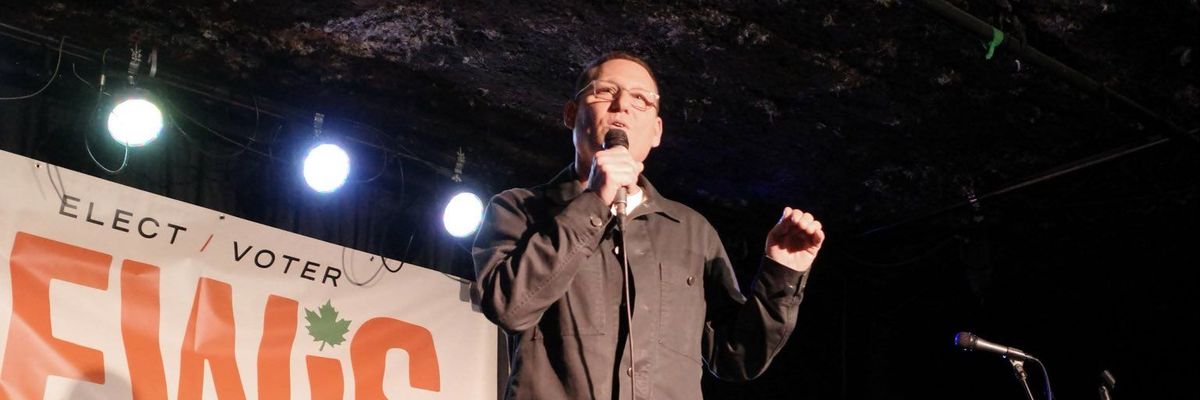

Journalist and filmmaker Avi Lewis delivers a speech at a rally as part of his campaign for leadership of Canada’s New Democratic Party (NDP) in Vancouver, British Columbia, on November 19, 2025.
(Photo from the Avi Lewis campaign)


Stephen Prager
Nov 24, 2025
COMMON DREAMS

As Avi Lewis moves forward with his bid to become the next leader of Canada’s New Democratic Party, the progressive activist, filmmaker, and journalist, announced his first major policy proposal on Monday: an array of “public options” for groceries, housing, phone bills, and other necessities aimed at combating Canada’s cost-of-living crisis.

After two failed parliamentary bids in 2021 and 2025, the Vancouver-based Lewis in September launched his bid to take Canada’s leftmost party in a more economically populist direction following a series of defeats under its long-serving, Jagmeet Singh.

He hopes his laser focus on corporate greed, which he says is driving Canada’s cost-of-living crisis, will help set him apart from other front-runners, including Edmonton Member of Parliament Heather McPherson and British Columbia union leader Rob Ashton.

“It’s a moral outrage that so many people in Canada can’t afford the basics of a dignified life at a time when corporate profits are only skyrocketing,” Lewis said as he unveiled an array of new proposals Monday. “When people are being gouged at the checkout aisle, on their phone bills, and in their rents, it’s clear that the market is failing.”

Lewis called for the creation of a public not-for-profit grocery store chain that would operate coast to coast to combat the growing crisis of food insecurity.

According to data published earlier this year by the Canadian Income Survey, approximately 10 million Canadians—over 25%—lived in food-insecure households in 2024, nearly doubling since 2021 amid skyrocketing food prices.

Lewis described it as a “market failure” that so many Canadians could struggle to pay for food while Galen Weston, the owner of Canada’s largest grocery chain, Loblaw, has a net worth of over $18 billion.

Lewis called for the government to create “a low-cost alternative to the big grocery chains, using a high-volume, warehouse-style model supported by local and regional food hubs.” He likened the proposal to Mexico’s chain of state-owned grocery stores and the government-run commissaries that provide affordable food to US servicemembers and their families, both of which cost less on average than shopping at major grocery chains.

“Think Costco—but run as a public service,” Lewis explained in a policy document.


Lewis proposed a similar solution for the cost of cell phone and internet service, which are higher in Canada than in other peer countries.

Attributing this to “an oligopoly of telecom providers that dominate cellphone and internet services in Canada and gobble up smaller competitors,” he proposed that the nation create a network of public telecom providers modeled after SaskTel. This publicly owned company serves the province of Saskatchewan and has led to “substantially lower” prices for customers than in other parts of Canada, according to the nation’s Competition Bureau.

To combat the spiking cost of rent and a growing homelessness crisis, Lewis also pledged that his NDP would once again prioritize the construction of public housing, which Canada built prolifically until the early 1990s.

He pledged that under his leadership, Canada would establish a public builder to create a million new units of social, co-op, non-profit, and supportive homes within five years.

Lewis also championed the return of nationwide postal banking as an antidote to the predatory fees and interest rates of Canada’s financial institutions.

He plans to leverage the nation’s national postal service, which is already the only option for financial services in many remote parts of the country, as a competitive alternative to Canada’s six largest banks, which brought in more than $50 billion in profits last year, and to predatory payday loan and check-cashing companies.

Finally, he proposed the reestablishment of Canada’s government-owned nonprofit pharmaceutical company, Connaught Labs, which created and cheaply mass-produced life-saving vaccines and other medications like insulin for free public distribution. The company was privatized in the 1980s under former Conservative Prime Minister Brian Mulroney.

“During the Covid pandemic, for-profit pharmaceutical companies made billions while countries competed with one another for vaccine supplies instead of distributing them globally to stop the virus’s spread across borders,” Lewis said.

He said that his new version of Connaught would invest in the public development of innovative pharmaceuticals, such as mRNA vaccines and cancer immunotherapies, and share that technology with low-income countries.

“It’s time to take the power back from the price-fixing corporate cartels that have a stranglehold on our economy and put it in the hands of the people,” Lewis said. “It’s time to build a new generation of public options to reduce costs and raise our quality of life.”

Lewis described his “next generation” of public options as following in the footsteps of those pursued by NDP-led provincial governments.

“Whether it’s public auto insurance in Manitoba, the agricultural land reserve to protect food security in British Columbia, a public telecom provider in Saskatchewan, or, of course, Medicare, our party has created public institutions that continue to make people’s lives better and more affordable decades after their creation.”

“The cost of living crisis we face today demands bold solutions,” he added. “That means expanding public ownership to lower bills and improve services while creating good union jobs in the process.”

Jul 21, 2017 ... His son Stephen Lewis, is a former Ontario NDP leader who served as the United Nations Special Envoy for HIV/AIDS in Africa. His other son, ...

The only Jew to lead a national party in Canada, David campaigned against “corporate welfare bums” and paved the way for parliamentary acceptance of acts ...

Apr 20, 2021 ... This country's greatest political orator is battling abdominal cancer as he continues to fight for causes near and dear to his heart.

Jun 4, 2021 ... During the convocation ceremony that day, Lewis, who was receiving the first of his 42 honorary degrees, spoke to graduates and their families ...

Apr 9, 2016 ... Stephen Lewis (the former leader of the Ontario NDP and the co-founder of the Stephen Lewis Foundation) addresses the NDP National ...

Aug 25, 2015 ... For the first time in our history, Canadians can elect a truly progressive federal government. Tom Mulcair is a strong, experienced, and principled leader.

May 1, 2022 ... Back in 1977, when this family photo was published in the Toronto Star, Stephen Lewis was leader of Ontario's New Democratic Party. Lewis, who .


70% of US Public Opposes Military Attack on Venezuela as Trump Eyes ‘Deadly New Phase’

“It should come as no surprise by now that the president who campaigned on keeping the US out of wars and then promptly bombed Iran has now found another conflict in which to embroil the country.”


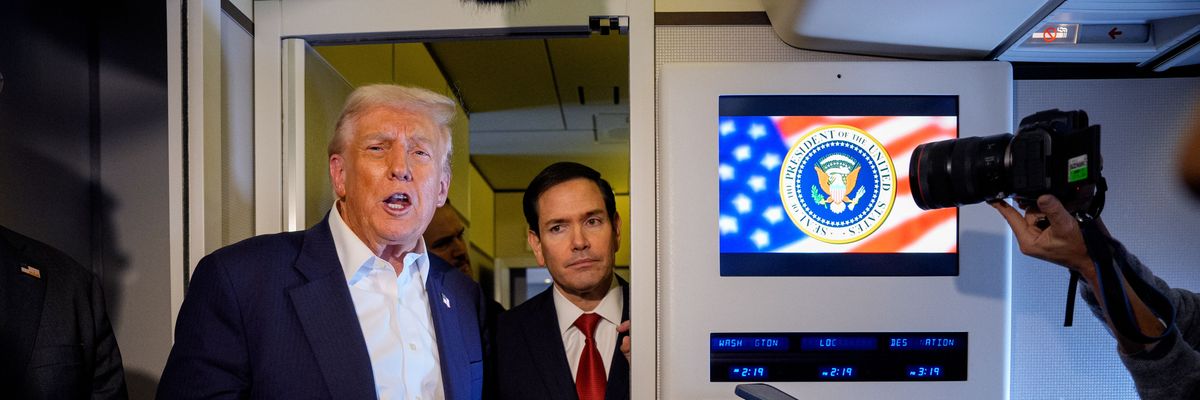
US President Donald Trump, accompanied by Secretary of State Marco Rubio, speaks to members of the media aboard Air Force One on October 27, 2025.
(Photo: Andrew Harnik/Getty Images)


Jake Johnson
Nov 24, 2025
COMMON DREAMS

New survey results show that Americans strongly oppose US military action against Venezuela as the Trump administration privately weighs options for land strikes against the South American country—as well as possible covert action targeting the government of President Nicolás Maduro.

The CBS News/YouGov survey, published on Sunday, found that 70% of Americans—including 91% of Democrats and 42% of Republicans—are against the “US taking military action in Venezuela,” and a majority don’t believe a direct attack on Venezuela would even achieve the Trump administration’s stated goal of reducing the flow of drugs to the United States.


The poll also found that a slim majority, 53%, support “using military force to attack boats suspected of bringing drugs into” the US, even as human rights groups and United Nations experts say such attacks—which have killed more than 80 people since early September—are grave violations of US and international law.

The survey data came amid reports that the Trump administration is set to launch “a potentially deadly new phase” of its campaign against Maduro’s government, which has responded to the US president’s threats and military buildup in the Caribbean with a large mobilization of troops and weaponry.

Citing two unnamed US officials, Reuters reported on Sunday that “covert operations would likely be the first part of the new action against Maduro.” The outlet quoted one anonymous official as saying Trump is “prepared to use every element of American power” to achieve his stated goals in the region.

On Monday, as the New York Times reported, the chairman of the US Joint Chiefs of Staff is set to visit “Puerto Rico and one of the several Navy warships dispatched to the Caribbean Sea to combat drug trafficking as the Trump administration weighs the possibility of a broader military campaign against Venezuela.”

Gen. Dan Caine, the top US military officer, has “been a major architect of what the Pentagon calls Operation Southern Spear, the largest buildup of American naval forces in the Caribbean since the Cuban Missile Crisis and the blockade of Cuba in 1962,” the Times added.

Also on Monday, the Trump administration formally designated Maduro and top officials in his government members of a foreign terrorist organization, a move that the White House believes expands US military options in Venezuela.

While polling data has consistently shown that the US public opposes military intervention in Venezuela by significant margins, Republicans in Congress have thus far blocked action to prevent the Trump administration from attacking the country and bombing vessels in international waters without lawmakers’ approval.

Al Jazeera columnist Belén Fernández wrote Sunday that “it should come as no surprise by now that the president who campaigned on keeping the US out of wars and then promptly bombed Iran has now found another conflict in which to embroil the country.”

“And as is par for the course in US imperial belligerence, the rationale for aggression against Venezuela doesn’t hold water,” Fernández added. “For example, the Trump administration has strived to pin the blame for the fentanyl crisis in the US on Maduro. But there’s a slight problem—which is that Venezuela doesn’t even produce the synthetic opioid in question.”

Late last week, a group of House Democrats led by Seth Moulton of Massachusetts announced a new legislative effort aimed at preventing the Trump administration from attacking Venezuela without congressional authorization.

The bill, titled the No Unauthorized Force in Venezuela Act, would bar the White House from spending federal funds on military action against Venezuela absent specific congressional approval.

“We owe our service members clarity, legality, and leadership—not threats, not chaos, and not another unnecessary conflict,” said Moulton. “This legislation draws the line the president refuses to draw. It protects our troops, reasserts Congress’ constitutional role, and ensures we do not sleepwalk into another ill-advised war.”

‘Venezuela, for the American Oil Companies, Will Be a Field Day,’ Says US Lawmaker Pushing Invasion


“They’re not even hiding it anymore. A US-led regime change war abroad to line the pockets of Big Oil—where have we heard this one before?”


US Rep. María Salazar (R-Fla) speaks during a roundtable discussion at the Capitol on March 3, 2025 in Washington, DC.
(Photo by Kayla Bartkowski/Getty Images)

Jessica Corbett
Nov 24, 2025
COMMON DREAMS

“Going to war for oil, the sequel.”


That’s how one film and television producer responded to a Monday clip of US Rep. María Salazar (R-Fla.) discussing President Donald Trump’s potential military invasion of Venezuela on Fox Business.

Amid mounting alarm that Trump may take military action, Salazar said there were three reasons why “we need to go in” to the South American country. The first, she said, is that “Venezuela, for the American oil companies, will be a field day.”

After journalist Aaron Rupar noted her remarks on social media, many critics weighed in, including Justice Democrats, which works to elect progressives to Congress.

“They’re not even hiding it anymore. A US-led regime change war abroad to line the pockets of Big Oil—where have we heard this one before?” the group said, referring to the invasion of Iraq.


Fred Wellman, a US Army combat veteran and podcast host running as a Democrat in Missouri’s 2nd Congressional District, replied on social media: “They are sending our troops to war for the oil companies and not even pretending to lie about it. These sick SOBs are going to get our kids killed and it’s all a big joke.”

Salazar also described Venezuela as a launching pad for enemies of the US and claimed the country’s president, Nicolás Maduro, leads the alleged Cartel de los Soles, or the Cartel of the Suns—which the Trump administration on Monday designated as a foreign terrorist organization.

Venezuela’s interior and justice minister, Diosdado Cabello, has long claimed the cartel doesn’t exist, calling it an “invention.” As the UK’s BBC reported Monday:
Cabello, who is alleged to be one of the high-ranking members of the cartel, has accused US officials of using it as an excuse to target those they do not like.

“Whenever someone bothers them, they name them as the head of the Cartel de los Soles,” he said in August.

Gustavo Petro, the left-wing president of Venezuela’s neighbour, Colombia, has also denied the cartel’s existence.


“It is the fictional excuse of the far right to bring down governments that do not obey them,” he wrote on X in August.

The terrorist designation and Salazar’s comments came as the Trump administration is under fire for blowing up boats it claims are running drugs off the coast of Venezuela, and after a CBS News/YouGov survey showed on Sunday that 70% of Americans—including 91% of Democrats and 42% of Republicans—are against the “US taking military action in Venezuela.”