Wednesday, November 26, 2025

Caspian Littoral States Sign Cooperation
Document – Analysis


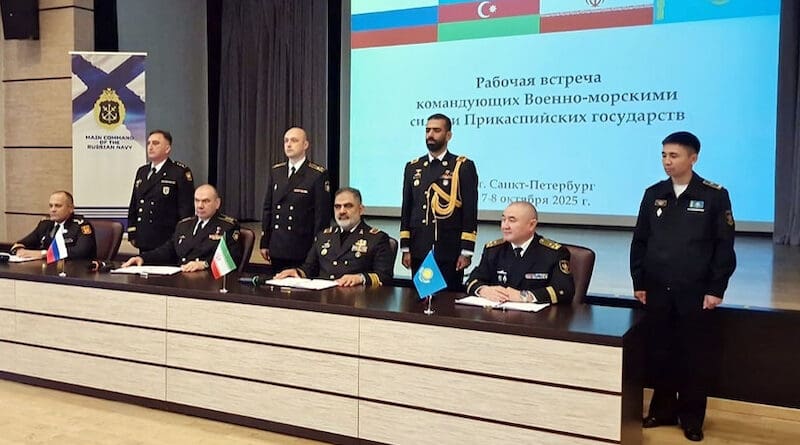
Naval commanders from Azerbaijan, Iran, Kazakhstan and Russia signed a strategic agreement to enhance security and cooperation in the Caspian Sea, during a meeting held in Saint Petersburg, Russia, on October 8, 2025. / Mod.Gov.Az

November 26, 2025 
The Jamestown Foundation
By John C. K. Daly


On October 8, the naval leaders of Iran, Russia, Kazakhstan, and Azerbaijan signed the “Caspian Sea Comprehensive Strategic Cooperation Agreement,” rejecting any foreign interference in the sea (Agentstvo Azeri-Press, October 8). Turkmenistan notably did not send a delegation. While many post-Soviet states have discreetly been distancing themselves from Russia since its full-scale invasion of Ukraine in 2022, this agreement demonstrates that some ties remain.

The agreement commits signatories to strengthened security cooperation in the 143,244 square-mile Caspian while emphasizing that no country or force outside the region will be able to interfere in the Caspian’s internal affairs. Apart from Russia, of the Caspian littoral states—Azerbaijan, Iran, Turkmenistan, and Kazakhstan—only Iran has access to a second sea, the Persian Gulf. The Caspian is endorheic, and its only connection to the ocean is the 63-mile Volga-Don Canal, which provides a navigable waterway between the Caspian and the Azov Sea.

This October 8 agreement comes as post-Soviet Central Asian and Caucasian nations are forging deeper ties with Russia’s rivals, including the People’s Republic of China (PRC), the European Union, Türkiye, the United States, and the Gulf states. These countries are pursuing multi-vector diplomacy partly as protection against possible Russian aggression in the aftermath of its war against Ukraine.

The agreement stresses that the Caspian belongs solely to its littoral states, and that security and related matters would be determined among them. Since Russia controls the Volga-Don Canal, the agreement effectively shuts out foreign navies from the Caspian, even though many post-Soviet Caspian maritime forces include foreign-built warships, including several built in the United States. Before the 1991 collapse of the Soviet Union, Azerbaijan’s capital, Baku, was the only modern naval base on the Caspian’s shores.


The agreement builds on the 24-article 2018 “Caspian Sea Legal Status Convention,” which delineated seabed sectors by state (President of Russia, August 12, 2018). The convention, signed by all five littoral states on August 12 at the Fifth Caspian Summit in Aktau, Kazakhstan, has proven difficult to enforce due to the signatories’ differing priorities.

Russia remains the predominant naval force in the Caspian, with its Caspian Flotilla consisting of more than seven dozen warships, among them patrol ships, missile carriers, and small artillery ships, several of which have been transferred to the Black Sea for the Kremlin’s war against Ukraine (VKontakte/Kaspiiskaia Flotiliia, March 25). The flotilla’s core consists of two patrol ships, three small missile ships, three small artillery ships, and one missile boat (Pravda.ru, October 30, 2024).

During the October 8 meeting of naval delegations from Iran, Russia, Azerbaijan, and Kazakhstan in Saint Petersburg, Russia proposed holding a multilateral naval exercise in the Caspian in 2026 to practice guarding shipping and maritime economic facilities (RIA Novosti, October 8). The Russian naval delegation was led by Russian Navy Fleet Commander-in-Chief Admiral Aleksandr Moiseev, who said:

The fundamental principle we are guided by is a strict and clear understanding that the Caspian Sea is a closed waterway, where naval activity should be carried out exclusively by the five Caspian littoral states (KOROBEL.RU, October 8).

In the wake of the 1991 collapse of the Soviet Union, the Soviet Caspian Flotilla was divided among Russia, Azerbaijan, and Turkmenistan, with Russia retaining the lion’s share. Today, the Russian Caspian Flotilla is the most powerful of the post–Soviet naval forces on the Caspian, with many warships mounting long-range missiles, unlike the other Caspian navies (VKontakte/Kaspiiskaia Flotiliia, March 25). Russia has used the Caspian to launch missiles at Ukraine, and could use the Caspian Flotilla as a reserve for the Black Sea Fleet via the Volga-Don Canal.

Iran’s Caspian naval forces field six ships, including a new 1,400-ton Dilman destroyer, capable of carrying cruise missiles and torpedoes (Topwar.ru, January 12, 2024). The ships are based at Bandar Anzali, the Iranian fleet’s Caspian main base. Azerbaijan has utilized its vast oil wealth to strengthen its navy, which now deploys 38 warships, primarily based in Baku, including four submarines, among them the Triton-2submarine (VMS Azerbaidzhana, accessed November 18).

Kazakhstan did not receive any of the Soviet Navy Caspian Flotilla warships, so it constructed its own fleet. The Kazakh Navy began in 1993, when its formation was decreed by former President of Kazakhstan Nursultan Nazarbayev. Currently, the Kazakh Navy consists of 25 warships, based primarily in Aktau. While many were built in Kazakhstan, the Kazakh Navy also includes vessels of South Korean, U.S., Israeli, Turkish, and Russian origin (Statbase.ru, accessed November 18).

Turkmenistan was the last of the five littoral states to develop a navy. When the Soviet Navy’s Caspian Flotilla was divided following the 1991 collapse of the Soviet Union, most of the ships went to Russia and Azerbaijan, with only a handful destined for Turkmenistan. In July 1992, Russia and Turkmenistan signed a treaty on joint defense actions, under which the Russian Federation acted as Turkmenistan’s security guarantor, obviating Turkmenistan’s immediate need for its own naval force. In January 2010, a meeting of the State Security Council of Turkmenistan approved the “Program for the Development of the Naval Forces of the Armed Forces of Turkmenistan through 2015” (Kaspiiskii vestnik, February 12, 2018). In early September 2012, Turkmenistan held its first-ever naval exercises, “Khazar-2012.” The Turkmen navy had been the weakest in the Caspian, so the exercises were intended to showcase their increased capabilities (Stoletie, September 19, 2012). In the subsequent decade, Turkmenistan’s naval forces, based at Karshi, a new naval port opened in 2021, have expanded to 35 warships, including corvettes, offshore patrol ships, and amphibious assault vessels (World Directory of Modern Military Warships, January 4).

Besides multilateral training exercises, the Caspian navies carry out their own training operations, particularly Russia’s Caspian Flotilla. From July 23 to July 27, the Russian Caspian Flotilla participated in the navy-wide “July Storm” exercises, which included forces from the Northern, Pacific, and Baltic fleets under the command of the Russian Navy’s commander-in-chief, Admiral Aleksandr Moiseev. More than 150 warships and support vessels, 120 aircraft, 10 coastal missile systems, 950 units of military and special equipment, and over 15 thousand military personnel were involved in the exercises (Port News, July 26). The operation concluded on Navy Day, during which Russian President Vladimir Putin addressed participants via video link, noting that such exercises would improve the combat training of crews of surface and submarine vessels. The Kremlin plans to equip them with the most modern equipment and weapons, and “as a result, the strike power and combat capabilities of the fleet will qualitatively increase” (Port News, July 27).

Other Caspian states have been conducting solo exercises, sometimes with their neighbors. On October 15, Iran and Azerbaijan began the AZIREX 2025, a four-day bilateral naval drill and maritime rescue and relief exercise near Boyuk Zira Island off the coast of Baku. Forces from the Iranian Navy and the Islamic Revolution Guards Corps (IRGC) Navy participated alongside Azeri naval units. The Iranian flotilla included the Paykan and Separ missile warships along with the IRGC Navy’s Shahid Basir. The joint exercise was intended to enhance maritime security, promote naval cooperation, and strengthen operational coordination between the Iranian and Azeri armed forces (Tasnim News Agency, October 19).

The Caspian is a geopolitical nexus where the interests of coastal states and global powers converge. Key transport routes such as the Russia–India North–South Corridor and the PRC–Europe Middle Corridor (Trans-Caspian International Trade Route) intersect there, intertwining Russia, Iran, Türkiye, the PRC, Central Asia, the Caucasus, and the European Union in a constantly shifting geopolitical, economic, military, and diplomatic matrix of cooperation and competition.

The assets the five littoral states are scrambling to protect include subsea reserves, offshore production fields, undersea pipelines, and tankers, heightening the possibility of disputes. The murkiness of the Caspian’s maritime borders has led to past clashes. On July 23, 2001, Iran sent military aircraft and a warship to intimidate two Azeri survey vessels—Geofizik-3 and Alif Hajiyev, which were working for BP-Amoco—into leaving the Alov-Araz-Sharq field. Azerbaijan claimed the site was well within its national sector, which Iran disputed (Azer History, accessed November 18). Azerbaijan ceased exploration activities for the Araz-Alov-Sharq project until the dispute over its maritime border with Iran was resolved. A month after the survey vessel incident, then-Azeri President Heydar Aliyev hosted the chief of the General Staff of the Turkish Armed Forces, Huseyin Kırçoğlu, for a performance by the “Turkish Stars” military acrobatic team in Azerbaijan. Türkiye followed the aerial display with a pointed diplomatic note to Iran stating that if Iran committed further military aggression against Azerbaijan, it would encounter the Turkish Armed Forces, after which tensions ebbed (VKontakte/Azerbaijan Army, June 30, 2021).

Russia has used its Caspian Flotilla for military operations beyond the Caspian, seeing it as a secure launch site for cruise missiles and a storage depot for Russian ships equipped with precision-guided weapons. On October 7, 2015, four Caspian Flotilla warships launched 26 Kalibr SS-N-30A cruise missiles approximately 932 miles at Islamic State targets in Syria. Russia was fulfilling its role as a member of the international anti-terrorist coalition, and its missiles flew through both Iranian and Iraqi airspace on their way to their targets (RBC, October 7, 2015).

More recently, on March 18, 2022, less than a month after Russia’s full-scale invasion of Ukraine, the armed forces of Ukraine reported the first missile attacks by Russia’s Caspian Flotilla against Ukraine (RBC-Ukraine, March 18, 2022). Russian missile launches from the Caspian at Ukrainian targets have intermittently occurred. On November 6, 2024, the Ukrainian military launched its first retaliatory drone raid against the Caspian Flotilla’s base in Kaspiisk, damaging the missile ships Tatarstan and Dagestan, the flagship of the Caspian Flotilla (Haqqin.az, November 6, 2024).

Russia’s Caspian Flotilla’s military advantage over its Caspian neighbors lies in the Volga-Don Canal, built under Stalin. The canal ends westwards from the Volga in the Sea of Azov, which connects with the rest of the Black Sea via the Kerch Strait, now controlled on both sides by Russia after its 2014 Crimean annexation and 2022 full-scale invasion of Ukraine. While the Volga-Don Canal, as Russian “internal waters,” allows Russia to control the entry of warships from the world’s oceans into the Caspian from the Black Sea, its shallowness means that it can currently only handle ships up to 5,000 tons. The canal, in some places less than 12 feet deep, requires constant dredging. In 2025, the Kremlin-owned Rosmorport deployed seven vessels for dredging, which, since the beginning of the year, have removed more than 4 million cubic meters of a planned 5 million cubic meters of earth (KORABEL.RU, October 17).

Despite benign displays of naval solidarity, the Caspian littoral states face growing challenges that extend well beyond their borders. Caspian environmental changes have become regional security and sustainable development concerns. Climate change, increased evaporation, and reduced inflows from feeder rivers such as the Volga are contributing to a dramatic, rapid drop in water levels in the Caspian, with grave implications for surrounding countries (see EDM, November 16, 2023,June 3).

According to Kazakhstan’s Ministry of Ecology, since 2006, the Caspian’s surface area has decreased by more than 48,050 square miles, and water levels have dropped approximately 4.9 to 6.5 feet (The Times of Central Asia, October 17). Projections indicate severe consequences for spawning grounds, the Caspian seal population, port infrastructure, and the regional economy.

An upcoming opportunity to address Caspian hydraulic issues will occur in Rasht, Iran, on November 18 and 19. Iranian Deputy Foreign Minister for Legal and International Affairs Kazem Gharibabadi will convene the first International Conference of Governors of the Caspian Sea Littoral States, hosting governors, officials, and economic activists from Iran, Russia, Azerbaijan, Turkmenistan, and Kazakhstan. The proposed agenda includes economic issues, investment, regional development, transit, logistics, the North–South Corridor, and the Caspian Sea ecosystem (Mehr News Agency, November 10).

Beyond fraternal declarations of solidarity, fissiparous forces still stymie collective efforts on problems of rising importance, most notably the shrinkage of the Caspian. Given the Aral Sea’s earlier fate, it is difficult to be optimistic that the Caspian littoral will find the collective will to solve its most pressing environmental concern.


About the author: Dr. John C. K. Daly is a Eurasian foreign affairs and defense policy expert for The Jamestown Foundation and a non-resident fellow at the Central Asia-Caucasus Institute in Washington DC.

Source: This article was published at The Jamestown Foundation


The Jamestown Foundation

The Jamestown Foundation’s mission is to inform and educate policy makers and the broader community about events and trends in those societies which are strategically or tactically important to the United States and which frequently restrict access to such information. Utilizing indigenous and primary sources, Jamestown’s material is delivered without political bias, filter or agenda. It is often the only source of information which should be, but is not always, available through official or intelligence channels, especially in regard to Eurasia and terrorism.


AU-EU summit ends with pledges on trade, minerals and migration

African and European leaders ended a summit in Luanda on Tuesday with new cooperation pledges on trade, minerals and migration but acknowledged that the two-day gathering produced no major breakthroughs.


Issued on: 26/11/2025 - RFI

European Council President Antonio Costa (left) with Angolan President Joao Lourenço, host of the seventh AU-EU summit, in Luanda on 24 November 2025. 
AFP - LUDOVIC MARIN


The summit brought together 80 delegations for negotiations on trade, minerals, migration and security. The final communiqué listed commitments to strengthen commercial ties, expand cooperation on strategic minerals and curb irregular migration while improving legal mobility.

It also set out a pledge to support a rules-based international order.

European Council President Antonio Costa warned that letting states undermine recognised borders risked wider instability.

“When we allow a state, whichever it may be, to flout the serenity and internationally recognised borders of another country, we authorise all of them to do the same," Costa said.


"That is why there is no alternative to the multilateral and international order based on rules.” He added that the partnership rested on “shared values.”

A European Commission statement released during the meeting detailed new EU investment packages for energy, digital networks, infrastructure and businesses in African countries.

Trade and minerals


Trade and strategic minerals featured heavily in the talks. African representatives pressed for more processing to take place on the continent.

Angola’s foreign minister Tete Antonio said Africa wanted a shift in how its resources were exported. “We need to be able to export cobalt, but also vehicle batteries,” he said.

Antonio gave a broader view of what leaders discussed.

“We talked about peace, security and governance but above all, we recalled that we will have to work in such a way that prosperity is shared and that the values of solidarity, cooperation and dialogue are preserved,” Antonio said.

Conflicts and crises


The talks also focused on Sudan and eastern DR Congo. Leaders condemned killings by the Rapid Support Forces in El-Fasher and backed UN resolution 2773.

They also backed efforts in Washington and Doha aimed at reducing tensions in eastern DR Congo.

Belgian foreign minister Maxime Prévost said the EU needed to reassess its approach to Congo sanctions.

“The European Union may have been too quick to be satisfied with having taken sanctions in February or March, without then worrying sufficiently about how the situation evolved,” said Prévost.

“And today, I am not sure that new sanctions would be appropriate, at the risk that they be instrumentalised to justify the derailment of ongoing mediation processes."

Migration was another major theme. The communiqué said the aim was to curb irregular migration while improving mobility for citizens of both blocs.

Ages in Turmoil: The Rise and Fall of States in and out of Yankeedom

Author, Bruce Lerro, Co-founder and Co- Manager for Socialist Planning Beyond Capitalism

Orientation


Does history have any rhyme or reason?
Mostly liberal historians insist that there are no patterns of history and that all historical periods are unique. Other historians such as Danilevsky, Spengler and Sorokin claim that history runs in cycles. Peter Turchin, author of the books Ages of Discord and End Times agrees with the later but bases his theory on much more quantitative studies which are called “cliodynamics” (after Clio, the Greek mythological muse of history) which are subject to empirical tests with data. He writes that his colleagues focused on cycles of political integration and disintegration, particularly on state formation and state collapse throughout history

Why This Matters
Comparison of the 1850s to the 2020s
Turchin begins by writing that the America of 1850 and the American of 2020, despite being very different countries share a number of striking similarities

  • Between 1820-1860 the relative wage, the share of economic output paid out to workers’ wages declined nearly 50% just as it has in the past 5 decades.
  • The average life expectancy at age 10 decreased by 8 years.
  • The heights of native-born Americans who in the 18th century were the tallest people on earth, started shrinking.
  • In the five years before the Civil War in 1855-1860 American cities were convulsed by no fewer than 38 lethal riots.
  • There was the rise of the populist party, such as the anti-immigration, know-Nothing parties.

Turchin writes that we are due for another sharp instability spike by the early 2020s because of the following conditions:

  • a state has stagnating and declining real wages;
  • a growing gap between rich and poor;
  • overproduction of young upper middle class graduates –set up for entry into the elite, and
  • exploding public debt.

Turchin  tells us these causes are related to each other dynamically. All this has not happened just in the 2020s. In the US, all these factors started to take an ominous turn for the past 50 years. Turchin also says that the past 40 years resemble what happened in the US between 1870-1900, a kind of second Gilded Age.

Cycles of Disintegration and Integration

According to Turchin, over the course of world history the most common pattern is the alternations of integrative and disintegrative phases lasting for roughly a century. Disintegration refers to social instability, the breakdown of cooperation among and within the elite, and persistent outbreaks of political violence including rebellions, revolutions and civil wars. The longest period of integration is 200 years and the shortest disintegrative phases are 50 years. His analysis points to four structured drivers of instability:

  • popular immiseration leading to mass mobilization potential;
  • elite overproduction resulting in intra-elite conflict;
  • failing fiscal health and weakened legitimacy of the state, plus
  • geopolitical factors—such as what he calls “external forcing”.

The length of the overall integrative-disintegrative sequences varies depending on the characteristics of the society. Turchin claims that the most important driver for looming instability is elite overproduction. We will discuss this more later.

State Breakdown
What explains social breakdown? Why do states collapse? How do civil wars start? According to Turchin’s research, the danger of violent onset is especially high when one of the ethnic factions perceives itself as losing ground. Few people are born revolutionaries. It is only when people become convinced there is no hope of fixing their problems through means of reform that they turn to revolutionary strategies. Discussing the sweep of European history, during the late medieval crisis most conflicts in Europe were due to dynastic intrigue. In what has been called the General Crisis of the 17th century, religion was the most important ideology –  for example the Huguenots vs Catholics or the Puritans vs Anglicans. During the Age of Revolutions in the 19th century, the ideologies of liberalism and Marxism were prominent.

Still speaking of the world historically statistically crises result in which population declines are very common. Fifty percent of breakdown came from here. Next, thirty percent are from major epidemics. Other indicators focus on what happened to the elites themselves. Nearly 2/3 of the cases resulted in massive downward mobility from elites to commoners. One sixth of the time elites were targeted for extermination. The probability of assassination was 40%. But the biggest reason for state breakdown – 75% of the crises ended in revolutions or civil wars (or both). 20% of the civil wars dragged on for a century of more. 60% of the time the crisis led to the end of the state, whether conquered by another state or the state disintegration into fragments. These conclusions seem depressing. There are very few cases in which societies managed to navigate the crisis with no or few major consequences. Two states had revolutionary situations but came out of them with reforms The two exceptions are the British and Russian states.

Exceptions to the rule: 19th Century England and Russia
The First example Turchin sites is England, specifically the Chartist period between 1819-1867. It began as massive popular protest demanding full male suffrage and improvement in working conditions. In Manchester the protest was brutally repressed by the authorities but the turbulence lasted until 1867. The reason it did not turn into a revolution was not because the rulers became enlightened. One reason was commoners went to other places either as immigrants, or refugees. This reduced immiseration numbers from below. Another was the repeal of the Corn Laws that imposed tariffs on grain benefitting the large landowners. The Reform Act of 1832 shifted the balance of power away from the landed gentry to the upwardly mobile commercial elites. This combined struggle of workers to establish their right for trade unions allowed for reform without threatening to overthrow the state.

Turchin points out that 1833 Russia was the mightiest European land power with an army of 860,000. In his 43-year reign, Peter the Great made the military serve the state either in the army or the bureaucracy. In addition, beginning in the 19th century the number of peasant protests increased, culminating in 1858. After much pressure, Alexander II abolished serfdom. This let some air out of the immiseration bubble for the lower classes. Further reforms followed in the 1860s and 1870s. However, the loss to the aristocrats of their workforce resulted in their downward mobility and a large number of what became counter-elites. The upper-middle class sons and daughters of the dispossessed gentry could not get state jobs. Half of the students were the children of nobles or government officials. A combination of abject downward mobility and exposure to western revolutionary ideas of anarchism and Marxism radicalized the students and turned them into revolutionaries. Their agitation accelerated in the 1880s and culminated with the assassination attempts of Czars in the first Russian Revolution of 1905.

How Monogamy or Polygamy Affects the Cycles of Integration and Disintegration
Depending on their constitution some societies go through integrative-disintegrative cycles more swiftly and others more slowly. Why is this? Turchin writes that:

In preindustrial societies the speed with which elite ranks could grow was strongly influenced by the biological reproduction of elites, or more specifically by the reproduction rate of elite men and the number of mates men have access to.

In Western European kingdoms such as France and England, Christianity restricted how many legal mates men could have:

In Islamic countries a man could have 4 legal wives and as many concubines as he could support. This is also the rule of steppe pastoralists like the Mongols. As a result, these societies churned out elite aspirants at a frightening rate. The faster the rate of elite overproduction the shorter the integrative phase.

The theory tells us there should be a significant difference in cycle lengths between societies with monogamous ruling classes from those with polygamous ones.

  • Monogamous societies average is 200-300 years cycles
  • Polygamous elites –100 years or less

Geographical Factors Impacting the Cycles
Speaking of the world historically, why did waves of instability often hit many societies at the same time? Turchin asks why did the English Civil War, the Times of Troubles in Russia, and the collapse of the Ming dynasty in China happen at roughly the same time? Conversely, why was the 18th century a time of internal peace and imperial expansion in all three countries later on in history?

How Much do Climate, Demography, Famines and Sickness Matter
Turchin distances himself from environmental determinism. He says drawing a direct causal arrow from worsening climate to social breakdown does not work very well. For example, the troughs of solar activity during the past millennium only sometimes coincide with disintegrative phases. However, major epidemics and pandemics are often associated with periods of major socio-political instabilitiesHe points out these patterns for the last 2000 years:

  • Antonine plague 2nd century CE;
  • Plague of Justinian 6th century;
  • the spread of the Black Death through Afro-Eurasia 14th century was an integral part of the Late Medieval Crisis, and
  • the most devastating cholera pandemics of the 19th century occurred during the Age of Revolutions.

Power Politics
Any complex human society has a number of specialized positions that go with the functions they perform to manage the state. In a prosperous society as social wealth grows the number of positions available for work grow with it. But in a society where the ruling elites are too narrow in their visions for navigating society, the number of positions remain static. The rulers are either too short-sighted or they cannot afford to tell aspiring elites the truth about job availability. Therefore, they do not shut down educational opportunities to those training for specialized positions and their applicants continues to grow. It is these folks who are trained with no work prospects that have subversive potential. The number of satisfied elites stays the same while the number of frustrated aspirants continues to grow. As the number of aspirants per power position grows, some will decide to stretch the rules. Each revolving musical chair acquires a jostling crowd which is the consequence of elite overproduction.

Turchin reminds us that 200 years ago China’s economy was by far the mightiest in the world. Today, it is 20% higher than that of the US. But between these periods was a “Century of Humiliation” mostly at the hands of England. After 1820, China’s total GDP began to shrink and by 1870 it was less than half that of Western Europe. The Taiping Rebellion 1850-1864 was an attempt to overcome this humiliation. What we want to know is which classes were involved, not necessarily how successful they were.

Between 1644 and 1912 China was ruled by the Qing dynasty. It was ruled by a class of scholar administrators, who could advance up the ranks only after successfully passing a series of increasingly difficult examinations. Early industrialization also helped to fuel robust population growth. But population growth did not stop even after the beneficial effects of these innovations had been exhausted. By 1850 the Chinese population was 4 times greater than at the beginning of the Qing. In addition:

  • The arable land per peasant shrank nearly threefold;
  • real wages declined and
  • the average height decreased.

It was those who could not get jobs within the Chinese bureaucracy that became the leading edge of the Taiping rebellion. Turchin claims that the most important driver for looming instability is elite overproduction.

Forms and Faces of Power
Following closely on the work of CW Mills and William Domhoff, Turchin identified four forms of power:

  • coercion or force — used by the army, generals, and police – this is the harshest form of power;
  • wealth — economic power of accumulated material resources which includes not only goods but all public and private media;
  • state, bureaucratic or administrative or political power and
  • ideological — control over “meaning making” systems such as science, religion, art and philosophy

While all forms of power are always present, they are present in different proportions in different societies.

A good example of state bureaucratic administration power was the rise to power of Vladimir Putin. Putin led an alliance of administrative military elites who defeated the plutocrats. There was no sudden revolution, rather a process that was gradual. One oligarch after another was exiled. The Putin regime enjoyed a number of successes, especially within the first 10 years. It ended the civil war in Chechnya, put the state finances on a sound basis and its economic growth was rapid.

The three faces of power came out of a debate within the field of political sociology. The first form of power championed by left-liberal Robert Dahl has it that citizens themselves shape policies and contested issues. In this liberal democratic mode, politicians passively carry out what citizens want. The second face of power is more critical of what is called “democracy” in the US. What Bachrach and Baratz and others have said is that politicians behind the scenes control the agenda of public meetings and decide which issues can talked about, which don’t and which aren’t even put on the agenda.

Lastly, Steven Lukes in his book Power: A Radical View takes a major step further. He states that following Marx, the ruling class controls people’s preferences as to what is even talked about. This is done through ideology. As Marx says, the ideas of the ruling class are the dominant ideas of society even for the middle and working classes. To review:

  • 1st face—citizens to shape policies on contested issues
  • 2nd face—upper classes shaping the agenda on issues
  • 3rd face—ability of the elites to shape the preference of the public through ideology

Is Power Wielding a Conspiracy?
Typically liberals imagine that there are no conspiracies and whatever happens between interest groups are simply the results of chance or unintended consequences. Those people who see that there are patterns in political and economic events in which the same group seems to maintain their power suggests that there are doings going on behind the scenes. They believe there are conspiracies. Liberals have spilled a lot of ink making fun of conspiracy theories, tin foil attempts that are products of paranoia. The degeneracy of the Democratic Party is revealed when the Democratic Party proclaimed a Russian conspiracy to explain why Hillary lost to Trump.

But there is a third kind of theory, a structural theory of what William Domhoff called class domination theory. Class domination theorists insist some conspiracies are real but not everything is a conspiracy. Turchin, identifying with Domhoff’s class domination theory offers the criticisms.

First, conspiracy theories attributed to the rulers’ motives are either vague or outlandish and require that the population be mind readers. For class domination theory the motives of the rulers are simple and direct. Rulers want to increase their wealth and power. Secondly, conspiracy theories usually attribute to the rulers omnipotent power in which those rulers’ plans are perfectly enacted and the follow-through is seamless. For class domination theory, rulers can botch the job and still stay in power. Class domination theory says that there can be unintended consequences that no ruling class can predict

Third, for conspiracy theories power is super centralized where there is no conflicting power within the conspirators. In class domination theory, the  power of the rulers is decentralized into networks of schools, clubs, and think tanks through which the rulers stay in touch. They have their squabbles but they conspire when their class interests as a whole are threatened by  the lower classes, especially the working class. Conspiracy theorists imagine that their plans require air tight secrecy so that their plans are not made public. For class domination theory, rulers’ plans can get leaked but the problem is will the lower classes be paying enough attention to notice, let alone be in a position to do anything about it.This is where Lukes’ third face of power comes into operation. Workers may be ideologically blocked from thinking the rulers would do such a thing or by being too preoccupied by escapist sports, music or movies to give a hoot.

Usually, conspiracy theories imagine the lower classes are ignorant, stupid and passive. But conspiracy theories often don’t offer mechanisms for controlling people. Domhoff’s theory offers empirical research in how PAC’s funding of lobbyists, campaign contributions and  mainstream media control people through the political stances of both parties. Lastly, conspiracy theories require that the rulers’ plans be top secret and not subject to any public record. Domhoff has spent decades recording statistics as to earnings, interlocking directorates and think tanks of the rulers that are a matters of public record. You don’t have to discover the Dead Sea Scrolls to understand what the rulers are up to. The table below is a summary.

Conspiracies TheoriesCategory of ComparisonScientific Theories (class domination) Domhoff
Vague or outlandish.MotivesAre realistic, “we don’t need to be mind-readers”. They want to expand their wealth
Are omniscient and plans are carried out seamlesslyHow smart are theorists?Can be bumblers, or dealing with unintended consequences
One strong leader or cabal centralizedWho is driving?Decentralized networks of prep schools, country clubs, colleges, interlocking think tanks
Illegal plans can be kept secret for a long timeCan plans be kept secret?Plans may get leaked but workers may not be paying attention or don’t care
Masses of people are assumed to be passive and stupid and offer no specific method of control. No empirical research.Methods of controlPACs funding lobbyists, campaign contributions mainstream media based on empirical research.
No elite class conflict. A single concentration of rulersPresence of class conflictYes, inter-ruler conflict
SecretWho knows what they are doing?Transparent…matters of public record
NoMake predictions?Yes, data is testable
No chance or unintended consequencesHow effectively carried out?Chance and unintended consequences are part of the picture

How Cliodynamics the Science of History Came to be

Turchin describes cliodynamics as assembling a huge body of knowledge collected by professional historians and then using this data in a professional, scientific way comparing different  types of societies. It does not assume that people consciously act in their material interests. They factor in that people can act against their material interests because they misunderstand them or they are misled by manipulation of others

In the one of the Appendix of his book End Times, Turchin discusses how his quantitative research into history began. He points out that English mathematician an engineer Babbage  invented the Analytical Engine, a machine capable of general purpose computation. Its first description was published in 1837. Two years before, Babbage discovered the Belgium mathematician and statistician Adolphe Quetelet who published a book, Treatise on Man and the Development of His Faculties or Essays on Social Physics. This was an approach to understanding human societies using statistical laws. Inspired by the ideas of Quetelet and the father of modern sociology, August Comte, Crawford and his colleagues formed the Babbage Society whose goal is to develop a science of human history which they called “cliology” which stood for the Greek mythological muse of history.

The hallmark of mathematical chaos is the sensitive dependence on initial conditions. Ibn Khaldun was the great medieval Arab historian who wrote about the rise and fall of states, but he didn’t have the quantitative data. Turchin said that along with some of his colleagues he built a model of state formation in the Old World to the beginnings of the New World, between 1500 BCE and 1500 CE. He says that despite its relative simplicity the model did a very good  job of predicting  where and when macro-states (large states and empires) formed and how they spread. 1981 marked the introduction of the IBM PC. Gradually the plentiful computer power and storage revolutionized data science including the Era of Big Data.

One of the key members of the cliodynamics community was Jack Goldstone. Early in his graduate school.  Gladstone became interested in revolutions. He discovered an interesting relationship between population rise and revolutions. He found that between every revolution or rebellion between 1500 and1900 the population had grown substantially in the prior half of the century. Conversely, when revolution as in major rebellions were absent in Europe, the Ottoman Empire and China roughly from 1450 to 1550 and from 1660 to 1760 population growth was almost nil.

Cliodynamics only gained traction around the year 2000. The model of dynamic cycles followed the work of was Alfred J. Lotka and Vito Volterra.  In 2011, Turchin and his colleagues built “Seshat: Global History Databank”. So far, they have identified about 300 cases of crises spanning from the neolithic period to the present and located over all the major continents of the world.

The bones and ice cores of history

How do we collect data when we have no written record, or the written record is sketchy or from the experience and viewpoint of the upper classes? How is it that we can track changes in population size, health, equality or inequality in societies in which historians have very little data? One way of finding out about ancient climates is through the work of a group called paleoclimatologists. Through ice cores, sediment cores, tree rings and checking pollen they can reconstruct the environmental history of the region along with housing construction. Furthermore, Turchin states that skeletons have remarkable staying power for measuring size, malnutrition, high disease and parasite burdens. Low height  is usually a sign of an unhealthy lifestyle. Skeletal remains can also trace how people died. Violent deaths often leave telltale marks on a skeleton. Skeletons can also show where people were born and whether they moved.

Cycles of Prosperity and Decline in the United States

The United States has gone through two periods of prosperity (integration) and two periods of disintegration. The two cycles of prosperity went from 1760 to 1830 and between 1900 to 1960. During these periods wages doubled and people actually grew in height. The two periods of decline were between 1830-1900 and the second period of decline began in 1960 and has lasted into today. During these periods of the disintegration wages were lower and humans actually shrank in size. In both periods there were spurts of violence, the Civil War in the middle of a declining period as well as spurts of violence during a rising period. Please see  the summary table below :

Cycles of ProsperityCycles of Decline
Cycle 1 1760- 1830Historical periodCycle 2 1830-1900
US has tallest people in world Height increased 9 centimetersHeight of peopleDecline in height of more than 4 centimeters
Relative wages doubled

1780 -1830

WagesWages lost most of their gains

1830 – 1860

Southern slave plantersRuling Class


Southern planters
Northern industrialists
Working class farmers and mechanicsLower classWorking class farmers and mechanics
Democrats, WhigsPolitical partyRepublican Party
Cycle 3 – 1900 -1960Historical periodCycle 4 – 1960 to present
Height increased 9 centimetersHeight of peopleHeight trend stopped in US and Germany, Netherlands continued to grow because of better social programs
Relative wages doubled
1780 – 1830
Wages Wages lost 30%
Industrial capitalistsType of capitalismIndustrial capitalists
Military capitalists
Finance capitalists

History of Ruling Classes in America
Gilded Age
Before the Civil War the US was ruled by a coalition of Southern slaveholders and Northeast merchant patricians. They were challenged beginning in the 1850s by a new kind of wealth based on mining, railroads and steel production rather than on cotton and overseas trade. These new millionaires chafed under the rule of the southern aristocracy. The new elite who made their money in manufacturing favored high tariffs to protect budding American industries. The Democratic Party was clearly the party of the slave owners. The Whig party was actually split and destroyed by their inability to take a stand on the issue of slavery. The Republican Party rose up to take its place and in the second election won the presidency. The defeat of the South in the Civil War destroyed this ruling class. Between 1860 and 1932 the Republican Party won every election with the exceptions of 1884, 1892, and 1912.

In what became the first Gilded Age, northerners like JP Morgan, JD Rockefeller, Andrew Carnegie and Jay Gould ruled the roost. In just 10 years between 1860 and 1870 the number of millionaires exploded from 41 to 545. They were protected by high tariffs as a national banking system was established. Towards the end of the Gilded Age it was realized that the idea of unrestricted competition had dire consequences for small businesses, let alone for workers. Rockefeller and JP Morgan pointed out that more state regulation was introduced. They instigated a Great Merger Movement  between 1895 and 1904. Gabriel Kolko in his book The Triumph of Conservatism exposed how the political elites knew each other, went to the same schools, belonged to the same clubs, married into the same families and shared the same values. The main benefit was not in increasing economic efficiency but in increasing the political power of business against the rising socialist movement and populist farming.

Think tanks, foundations and policy discussion groups
The 1920s saw the beginning of policy planning networks funded by corporate power. The money came from Rockefeller, Carnegie and Robert Brookings. The roaring 20s was a wild and insecure time. By 1929 the party was over. Nearly ½ of the millionaires who thrived in the 1920s were wiped out by the depression. This corporate conglomerate also controlled the ideological basis of power through ownership of mass media. Turchin contends that the remaining source of social power, the military, has been thoroughly subordinated by the political network throughout American history.

From the New Deal to the Great Society of the 1960s, non-market forces pushed the minimum wage up faster than inflation. Some have said that from the end of World War II to 1970 was the golden age of capitalism. Things began to change as early as mid-60s as Germany and Japan recovered after World War II and the United States faced some stiffer competition. Corporate capitalists made a decision to close up shop in the US and invested in cheaper land and cheaper labor elsewhere in the capitalist periphery. These were called runaway shops. The standard of living began to decline as capitalists continued to invest in the military rather than produce goods. Finance capital rose to prominence along with credit cards, real estate and insurance companies.

During this period, there was a ¾ divergence between productivity and median hourly wages.

  • Austerity and macroeconomics kept unemployment higher than is needed to keep inflation in check.
  • They responded to recessions with insufficient force.
  • Corporate driven globalization undercut wages and job security of non-educated workers.
  • Purposely eroding collective bargaining  resulted from judicial decisions – individualized arbitration
  • Weaker labor standards including declining minimum wage, eroding overtime protections began to fall into place.
  • Industrial deregulation started.

There was a decline in family, church, the labor union, public schools, PTA and volunteer neighborhood associations. This undermined social connections.

Power at the Top in Contemporary United States
In terms of the upper echelons  of society, Turchin focuses on three social classes: the lower upper middle class, the higher upper middle class and the working class. He claims  if you are an American and your net worth is 1-2 million dollars you are roughly in top 10% or lower echelons of the upper middle class. Still higher up are those that make 10s of millions of dollars. These are the owners of businesses and CEO of large corporations  might be categorized as upper middle class. Many powerful politicians are also in this rank and there are 50 members of Congress who are in this category.

Engines of Disruption
Both in world history and in the case of the United States there are three factors that spell trouble for the ruling classes:

  • Elite overproduction;
  • Inter-elite conflict and
  • Working class immiseration

Counter-Elites
Turchin points out that early in the 1950s fewer than 15% of the population went to college. By the 2000s the number of college degree holders greatly outnumbered the positions for them. Turchin goes on to say Credentialed salaried employees are the most dangerous class for social stability and this is based on numerous studies that include, not just the Taiping revolution in China. It was the factor in driving the revolution of 1848 in France and the Arab Spring of a few years ago. The most dangerous occupation of all, Turchin says is that of a lawyer. Famous revolutionary lawyers were Robespierre, Lenin and Castro; Lincoln and Gandhi. This would make sense given the rhetorical skills of a lawyer in court when it is turned loose on the lower classes.

Popular Immiseration
In the medium wage between 1976 to 2016 there is a big break in economic fortunes. First, the lower classes all lost ground while the more educated with salaries pulled ahead. During the same period the average medium wage rose from $ 17.11 to $18.90 per hour, a 10% increase. This is not much over a period of 50 years. For Americans without a 4-year degree – 64% of the population – have been losing ground in absolute terms. Their real wages shrank over the 40 years before 2016Turchin says are the three items that define the quality of life for the working class are:

Higher education

Owning a home

Keeping yourself healthy

The cost of all three has risen faster than the rise of inflation. For example, the 1976 cost of college for a year was $617. Median workers had to work 150 hours to earn one year of college. By 2016 the cost has risen to $8,804. A person has to work 500 hours for it – three times more. In terms of owning a home a worker must work 40% longer. As far as keeping yourself healthy the obesity rate and drug use statistics have shot up in the last 50 years to the point where the Army has had to lower its entry standards because so many potential recruits cannot meet those standards.

In quantitative terms of employment, we must ask how many workers are looking for work? In this area the Bureau of Labor Statistics is unreliable because they don’t count part-time workers who are unemployed or those who are unemployed for a long time and have given up looking. Another factor Turchin sites is the rates of immigration. But this too is tricky for many reasons because a number of workers are working under the table so the official statistics come up short. An additional factor is the number of jobs which are leaving the country and how many jobs are lost to automation. Unfortunately, under capitalism automation is not the friend of workers. Most of the time workers do not keep their jobs. Instead, automation usually means jobs are lost. No matter how you slice and dice it the overall labor trends during the past 50 years have been an oversupply of workers.

Something called the “political stress index” combines the strength of immiseration and elite overproduction as a way of predicting disruption which is getting worse. To stabilize the wealth pump the pump must be shut down until wages are driven up to the point where upward and downward rates of mobility between commoners and elite are balanced.

Why is Yankeedom a Plutocracy?

Turchin points out that the extent to which economic elites dominate government in the United States is very unusual compared to other western countries. He cites Denmark and Austria that have ruling classes. However, they have been fairly responsive to the wishes of their population and they are ranked highly by the UN for their ability to deliver a high quality life for their citizens in the areas of life expectancy, equality and education.  In Denmark, the first Social Democratic Party was founded in 1871 in Copenhagen. It first entered Parliament in 1884. In 1924, it became the biggest party with 37% of the vote. Its leader became prime minister. The US is an exception to the Western world – why?

Importance of military power in Europe
In the Western world as a whole between 1500-1900 the geopolitical landscape was reshaped in that the total number of states was drastically cut down from over 500 to 30. In Europe, most of the plutocracies were extinct or swallowed up by “meritocracies” because of the military revolution in weaponry and fighting techniques. Gunpowder and weapons underwent a rapid evolution during the 15th century and had changed the nature of warfare along with emergence of oceangoing ships. Small principalities and city states could no longer hide behind their walls easily breached by cannons. Intense military competition between states weeded out those that couldn’t raise large armies. The conditions of intense warfare favored larger, more cohesive states.

Weakness of military power in the United States

Unlike the  European great powers that had to direct most of their resources into land armies the British poured its resources into its Navy. The antebellum ruling class in the US was a direct offshoot of the English squirearchy. Virginia, the Carolinas and Georgia were settled by cavaliers. They brought with them their aristocratic ways and indentured servants. The Early American Republic was an oligarchy modeled after the United Kingdom. The military did not develop in the United States in the second half of the 19th century the way it did in Europe, partly because most of the well-trained military men of the South were either incapacitated or killed in the Civil War.

Geography and racial issues

The United States has the forces of geography on its side. Turchin points out that neither Mexico nor Canada posed any danger to the US north. North American is a giant island protected from any potential threats by two oceans. However, its continued survival and efflorescence during the 20th and 21st centuries, is largely due to race and ethnicity.

Black workers, especially in the South, were excluded from the social contract of even the New Deal. This exclusion of Black Americans from the contract was a result of a tactical choice made by the FDR administration which needed southern votes to push its legislation against the resistance of conservative business elites. These conservatives were dead set against giving any ground to the working class. This was intensified by The Republican “southern strategy” which was to make the Republican Party the dominant party in the former Confederacy by appealing to the southern white voters and using racist issues. Such a strategy could not work in Denmark, at least until immigration slowly made workers more suspicious. Up until that time Denmark was racially and culturally homogeneous. The consequence to plutocrats is that they did not have to shell out union wages to both whites and blacks.

The Revolutionary Situation in America
Stepping back and now stepping forward, from 1960 on the most important trend during is the decline in relative wages. By 2020 both immiseration and elite overproduction, according to the PSI, reached very high levels. As usual, the ruling class is paying no attention. The tax code has become reactionary. Today taxes on corporations and billionaires are at the lowest levels since the 1920s and we know what happened soon after that! Turchin then divides conservatives into two categories, elite (my term) and populist.

Ultraconservative elitists
Elite ultraconservatives like Koch, the Mercer Family and Sarah Scaife are called by Domhoff the policy obstructurist network. While other think tanks develop policy proposals that push things through legislation, ultraconservatives attack all government programs and challenge the motives of all federal  officials. An example is of this is the climate denial campaign of the Heartland Institute. Meanwhile an organization called The Federalist Society has reshaped the judiciary. Furthermore, Turchin informs us that the hard right organizations have infiltrated police forces, as if the police were not right-wing to begin with. He writes that white supremacists in the US are not a marginal force. They are inside Yankee institutions. Yet strangely, 1% is losing its traditional political vehicle, the Republican party

The Populist Republican Party

Before 2016 the Republican Party was the stronghold of the ruling class for the 1%. But there is a rebellion afoot. There is growing dissention in the representatives of the  upper ranks in the persons of Steve Bannon and Tucker Carlson. Turchin tells us that Steve Bannon was not born with a silver spoon in his mouth. Bannon grew up in a working class Virginia family and served in the US Navy. While serving in the Navy he got a master’s degree from Georgetown University and an MBA from Harvard Business school. This led to a job as an investment banker at Goldman Sachs. He then then launched his own investment bank. Turchin tells us of Bannon’s loathing of the ruling elites and his desire to overthrow them seems to come out of his experience of living and working among them. As he says, at Goldman Sachs these transnational elites are people in New York who feel closer to people in London and Berlin than they do to the people in Kansas and Colorado. Bannon is a firebrand. In 2012 he became executive chairman of Breitbart News, a far-right on-line news site. He ran a popular talk radio call-in show in which he  attacked mainstream Republicans. The right-wing popularism of Bannon wants the Republican party to overthrow its ruling elites.

Though lacking in the deep background of politics and economics, Tucker Carlson is more accessible and speaks more directly to conservative populists. He asks questions that were too much for his handlers at Fox and eventually left with legions of plebians right behind him.

Before leaving Fox, Carlson was the most outspoken journalist operating within the corporate media. He has been the most listened to political commentator in America. Turchin summarizes the  main ideas of Carlson’s book Ship of Fools:

  • the two governing parties have merged;
  • Democrats have lost whatever dwindling support they once had. He writes that kowtowing to identity politics is a lot cheaper than raising wages;
  • the Republicans and Democrats are completely aligned in imperialist frequent military intervention abroad and
  • he asks why we tax capital at half the rate of labor – why do working-class people die younger?

Tucker Carlson Tonight has become the most successful show in the history of cable news. Turchin rightfully points out that Carson is missing a key driver of instability – elite overproduction. Turchin puts his money on Tucker Carlson rather than on Donald Trump as the seed crystal around which a new radical party forms. The Economic Policy Institute tells us that Trump’s erratic ego-driven and inconsistent trade policies have not achieved any measurable progress in restoring manufacturing jobs.

Where is the Democratic Party in this revolutionary situation?

It is striking that after this in-depth analysis of Republican party, Turchin has so little to say about the Democrats other than the Democratic Party is now the party of the 10% upper middle class and the 1% of the ruling class. In other places he mentions that the Democratic Party has lost its working-class roots. The Democratic Party was never for the working class. The working class just tagged along for a while.  What Turchin does not discuss is the Democratic Party was the party of slaveowners up until the Civil War. Neither does Turchin trace the Democratic Party’s move from a centrist party in the 60s to center-right party with Clinton and Obama. Turchin names Bernie Sanders and AOC as constituting the progressive wing of the Democratic Party. He never mentions Sanders’ role as sheepdog for rounding up naïve socialists to join the Democratic Party beginning in 2016 and ever since.

Will the Democratic Party go the way of the Whigs?
Most Americans who haven’t studied American history just vaguely assume that the Republicans and Democrats are simply eternal parties with us forever. But in early US history we had a Federalist Party that came and went. In the 1840s or thereabout the Whig Party was the major competition for the slave-owning Democrats. But the Whig party fell apart in the 1850s as the Republican Party rose and after two elections won the presidency. Today the approval rating of the Democratic Party is 16%. This is partly so right-wing even the conservative elitists feel safe in joining. Where will the middle-class and working-class people who constitute 70% of the population go? Before you answer that a third party will never work, remember Ross Perot? He came out of nowhere and got 19% of the vote in a country where 40-45% of people don’t bother to vote and where 30% wins an election. A new second party of the middle and working classes is not far-fetched provided it has the backing of unions.

Criticisms of End Times
Where’s capitalism?
 In the index of End Times the word “capitalism” is mentioned three times and never in any significant way. In all of Turchin’s statistics comparing the rise and fall of states there is no distinction between capitalist state dynamics and the state dynamics of pre-capitalist agricultural civilizations like Egypt, India or China. It’s hard to believe that whether a society is capitalist or not does not impact the statistics of the rise and fall of states. After all, Marxists have developed at least four crisis theories of the rise and fall of capitalism that makes them different from pre-capitalist or socialist countries. World Systems Theory has discussed the history of capitalism and how it differs from the earlier empires and discusses its unique cycles as technological, commercial, industrial, military and financial. Turchin ignores this research, as far as I can tell.

Where are globalization and imperialism?
All nation-states are treated as self-subsisting entities. Whether speaking of the United States, China or South Africa there is no mention of how nation-states interact. There isn’t any consideration that countries in the capitalist core subjugate the capitalist periphery and semi-periphery and this changes the statistics of each country. There is nothing resembling Andre Gunder Frank’s argument that the west underdeveloped Latin America. There is no mention of imperialism as a force impacting the rise and fall of states. At the same time, there isn’t much mention of regional confederations like the European Union impacting the fates of individual nation states such as Greece or Italy. Nothing about the IMF, the World Bank and its impact on African countries. Lastly and most importantly, the presence of a Eurasian block as large as BRICS has changed the world dynamics of nation states. BRICS as a global unit is now more powerful than any Western configuration. There is no mention of how BRICS might impact the rise and fall of states today.

Irreversible Accumulation and Consequences
In the history of human societies there are the following trends that go beyond Turchin’s cycles:

  • Growth in the human population within societies;
  • The shrinking number of all human societies;
  • Increase in the permanence of human societies;
  • Expansion of societies into biophysical environments;
  • Increase in technological innovation in complexity, durability, power and expansion;
  • Increase in the store of symbolic information;
  • Growth in material wealth;
  • Growth in the quality, diversity and complexity of material products;
  • Increasing complexity and specialization of social organization;
  • Increasing stratification both within and between societies and
  • Accelerated rate of social change.

All these trends show that there is more to history than never-ending cycles. The accumulation of social processes over time and many other processes are irreversible. One example is the impact of capitalism on the ecological environment over the past 200 years. Two results of many are caused extreme weather and the loss of diversity of species. In short, the dynamics of the world-system today may be partly a predictable cycle, but it also contains irreversible trends that make social-historical dynamics today unique. Turchin has nothing to say about this.

Bruce Lerro has taught for 25 years as an adjunct college professor of psychology at Golden Gate University, Dominican University and Diablo Valley College in the San Francisco Bay Area. He has applied a Vygotskian socio-historical perspective to his three books found on Amazon. He is a co-founder, organizer and writer for Socialist Planning Beyond Capitalism. Read other articles by Bruce, or visit Bruce's website.