It’s possible that I shall make an ass of myself. But in that case one can always get out of it with a little dialectic. I have, of course, so worded my proposition as to be right either way (K.Marx, Letter to F.Engels on the Indian Mutiny)
Friday, December 05, 2025
Pirates Attack LPG Carrier, Kidnap Crew Off West Africa
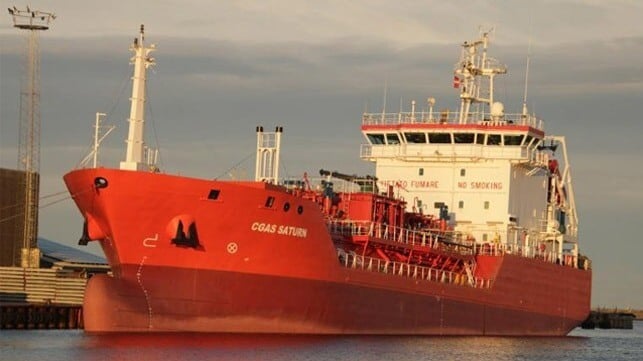
LPG carrier was boarded and nine crewmembers kidnapped (photo by René Nielsen, courtesy of VesselFinder)
An LPG carrier has become the latest target of the ongoing piracy off West Africa, with reports confirming that nine of the ship’s crew have been kidnapped and one injured. The vessel was underway bound for Malabo, Equatorial Guinea, when it was boarded.
Security group Vanguard reports the vessel was approximately 50 nautical miles west of the coast when an unknown number of armed pirates boarded the ship. The vessel is identified as the CGAS Saturn (3,090 dwt), built in 2003 and operating under the Portuguese flag. The ship is 75 meters (246 feet) in length.
The crew was rounded up according to a report from Diaplous. Personal belongings were stolen, and during the incident, one seafarer sustained what Christiania Gas is describing as “light injuries” and received medical care onboard.
The pirates left the vessel, taking with them nine of the ship’s crew. Vanguard reports the second captain, third captain, a deck officer, and an oiler were left behind. Diapolous says that a Portuguese Navy patrol boat was tasked to intercept the vessel, while the company reports the CGAS Saturn has proceeded to safe waters.
Christina Gas said its emergency response team has been activated and is liaising with all relevant authorities.
Neptune P2P Group highlights that the incident emphasized the continuing risk to seafarers in the region and specifically the kidnap-for-ransom threat to commercial shipping. They report that there have been at least 17 armed robbery or piracy incidents reported in the Gulf of Guinea in the past 12 months. The International Maritime Bureau, in its last report, said there were 15 incidents in 2025 with a total of 14 crewmembers having been kidnapped between January and September 2025.
Top photo by René Nielsen, courtesy of VesselFinder
Russia and Myanmar Conclude Annual Joint Naval Exercise
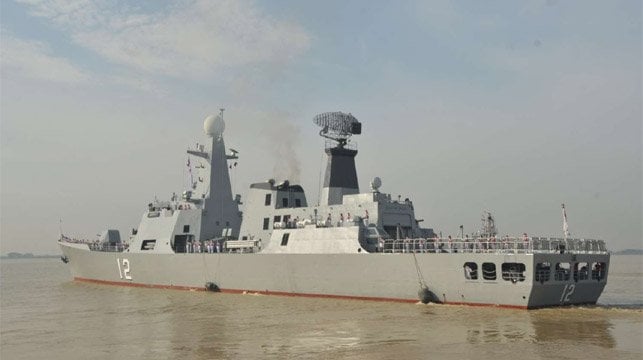
Kyan Sitthi of the Myanmar Navy (Myanmar Ministry of Information)
Russia and Myanmar have conducted their annual joint naval exercise over two days in mid-November, training in the Andaman Sea.
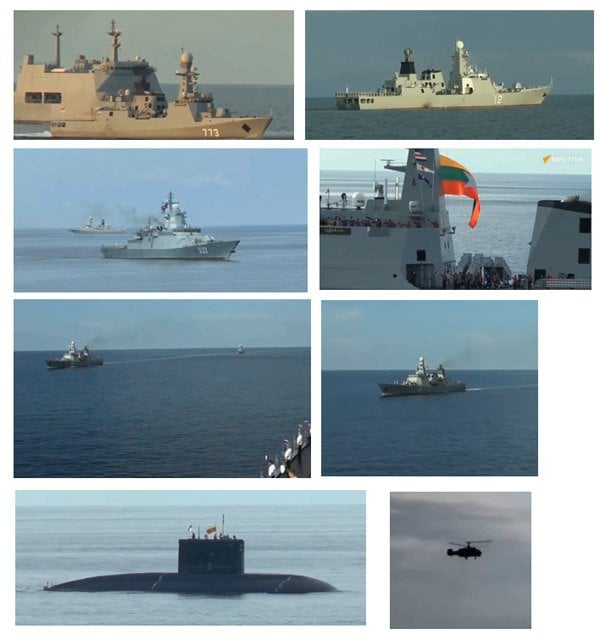
Exercise Marumex-2025 focused on training in anti-submarine and anti-piracy operations, involving gunnery practice, helicopter operations, and the use of Myanmar's Kilo Class submarine as a target.
The Burmese navy deployed the Kyan Sittha Class frigates UMS Kyansitta (F12) and UMS Sinphyushin (F14), and the Anawrahta Class corvette UMS Tabinshwehti (F773). These three stealth-profile vessels were all built relatively recently in Myanmar's own Naval Dockyard. Also deployed was the Kilo Class submarine UMS Minye Theinkhathu (S71), purchased second-hand from India after refurbishment in Hindustan Shipyards, and the Makassar Class landing platform dock UMS Muttama (L1501), which was built by Dae Sun Shipbuilding in South Korea. From outward appearances based on the video released by Sputnik, all these vessels appeared to be shipshape and well-handled.
The Russian representation was from the Pacific Fleet, and consisted of the Udaloy Class frigate RFS Marshal Shaposhnikov (F543), the Gremyashchiy Class corvette RFS Gremyashchiy (F337), and the Boris Chilikin Class oiler Boris Butoma (IMO 8842557). This flotilla made port calls in made port calls Da Nang (Vietnam), Sattahip Naval Base in Thailand, and Sabang (Indonesia) en route to the exercise.
A Kamov Ka-28 Helix anti-submarine warfare helicopter was seen flying during the exercise, piloted by a dual Burmese-Russian aircrew. The Myanmar Navy is thought to have two such aircraft, for operation from their Kyan Sittha Class frigates, but the type also equips the Russian Udaloy Class frigates.
The presence of the Burmese Kilo Class submarine will have provided a valuable training opportunity for both navies in anti-submarine warfare drills. A target drone was also used during the exercise in gunnery live-fire anti-aircraft drills. In comparison with joint training that the Russians carry out with other navies, for example, with that of Iran, there seems to have been a high-level ambition in the joint training objectives of the two navies.
Myanmar enjoys uneasy relations with all its neighbors, a consequence of continued military rule and a civil war that has not been going the government's way for some time. There has been an overflow of fighting across borders in jungle areas, with large sections of the Burmese border with Thailand, China, and India being controlled by a multiplicity of well-organized rebel armies such as the Kachin Independence Army and the Shan State Army. China has managed to support both the government and some rebel groups simultaneously, while Russian support for the regime has been more consistent.
Commentators in the region believe that Russia's naval diplomacy with Myanmar is based on a desire to underwrite arms sales, but also to help close commercial contracts to build a new deep-sea port and 110MW nuclear power plant at Dawei, 150 miles due west of Bangkok. Given the unstable security situation in Myanmar, this latter proposal has raised nuclear pollution concerns in Thailand.
Sinking Russia’s ‘shadow fleet’: Has the Ukraine war reached Senegal?
ANALYSIS
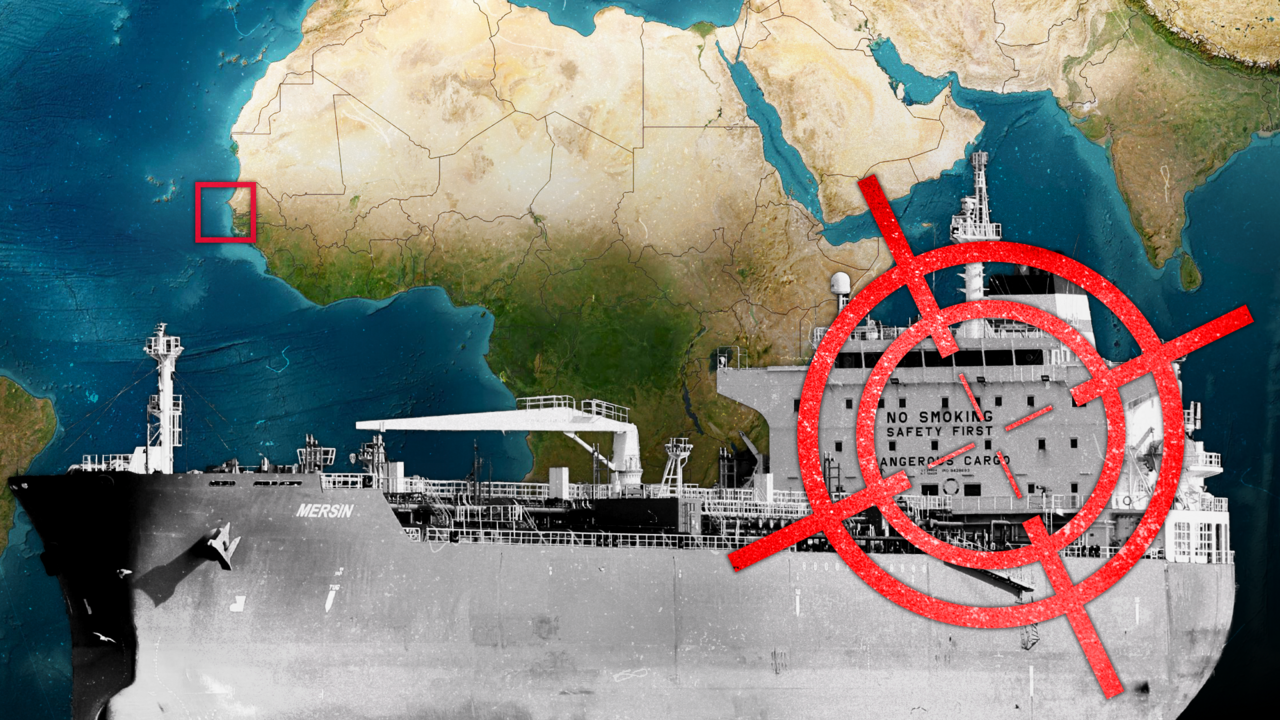
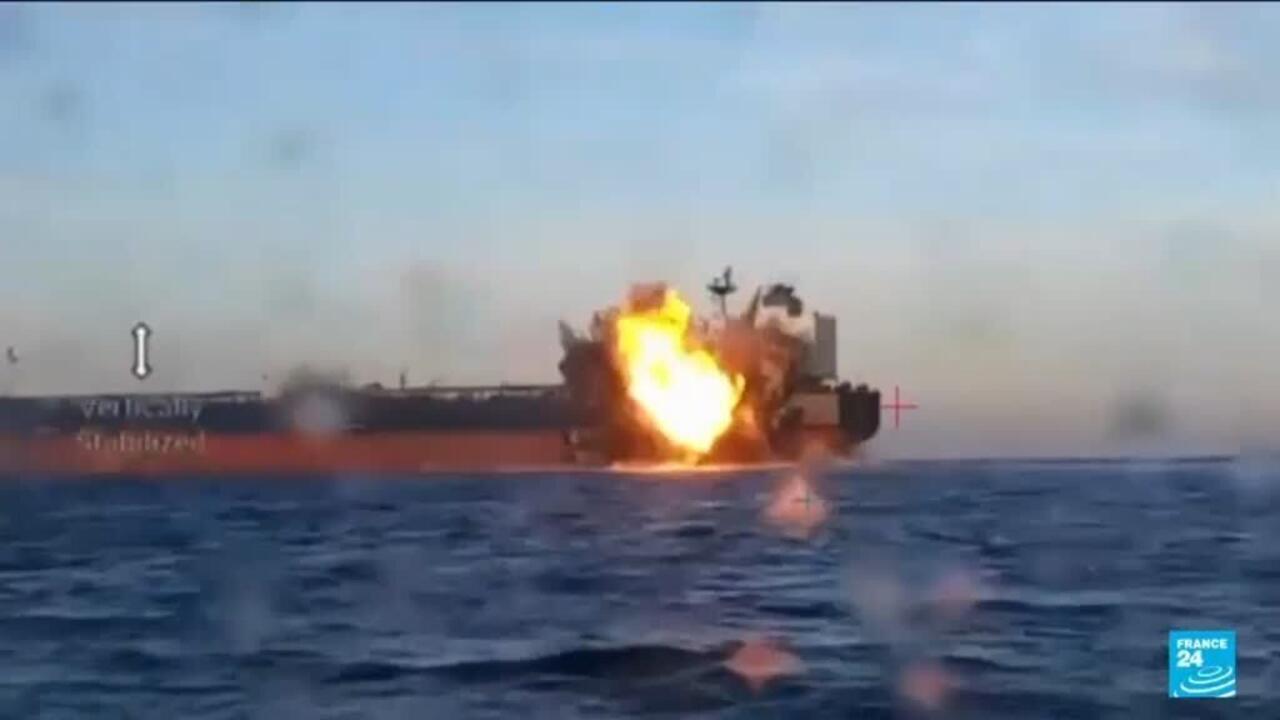
A Turkish-owned oil tanker that recently visited a Russian port was heavily damaged by explosions off the coast of Senegal last Thursday. While Kyiv has not claimed responsibility for the attack, the bombing follows a campaign targeting ships accused of belonging to Russia’s “shadow fleet” – raising suspicions that the Ukraine war has spread all the way to West Africa.
Does the long arm of Ukraine’s intelligence services stretch all the way to Senegal? Kyiv has come under suspicion of pursuing the fight against Moscow all the way to Africa's Atlantic coast after a series of explosions ripped through the Mersin oil tanker – accused of belonging to Russia’s “shadow fleet” – off the shores of Dakar last Thursday.
“The situation was immediately brought under control, and we confirm that all crew members are safe; there are no injuries, no loss of life and no pollution,” Besiktas Shipping said in a statement. The company added that the cause of the explosions remained unclear.
Suspicion immediately fell on Ukraine, which has not claimed responsibility for the attack. Kyiv’s silence is unsurprising – the oil tanker is not on any list of sanctioned vessels.
“Under the law of armed conflict, belligerents must distinguish between civilian and military targets,” said Basil Germond, a specialist in international and maritime security at the University of Lancaster.
“That said, historically, in total wars such as the two world wars, commercial shipping was often targeted as part of economic warfare. So, energy exports can be considered as strategic objectives – similar to Russia's attacks on Ukraine's energy grid or Ukraine's attacks on Russian refineries.”
Be that as it may, Ukraine claiming official responsibility for the explosion would likely be controversial in the case of the Mersin, a commercial freighter without any official links to Russia.
Dirk Siebels, a specialist in maritime security at the Risk Intelligence consulting firm, said the tanker would likely be a legitimate target in Ukraine's eyes.
“From a Ukrainian point of view, of course, that's still something that finances the Russian government – and therefore the Russian war effort in Ukraine,” Siebels said. Russia’s ‘shadow fleet’ under fire
The explosions off Senegal’s coast come during a mounting campaign of attacks against commercial ships suspected of belonging to Russia’s “shadow fleet” – ageing commercial oil tankers with often opaque ownership structures used by Moscow to export its oil and gas and slip through Western sanctions.
The EU, US and UK have largely banned Russian oil imports, and companies based in G7 countries can only provide critical services such as insurance and transport for Russian oil being sold to third countries under a fixed price cap.
“This fits into the pattern of these vessels that have been attacked in a very similar fashion earlier this year,” Siebels said.
FRANCE 24’s Observers team has recorded seven vessels linked to Russia that have either been damaged or sunk following “mysterious” explosions off the coasts of Russia, Spain, Libya, Turkey and Italy since December 2024.
None of the ships were under Western sanctions at the time of the attacks. Russian tanker attacked off Turkey, Putin warns of retaliation
“Even though the Ukrainians never actually admitted to being involved in any of these incidents individually, they have communicated in relatively certain terms that they wanted to send a signal with these particular incidents,” Siebels said. “And in all these cases, they targeted tankers specifically, and they targeted tankers which were involved in transporting Russian oil and oil products.”
In the days after the Mersin was wracked by explosions, two other freighters suspected of belonging to Russia’s “shadow fleet” were attacked in the Black Sea. This time, Ukraine claimed full responsibility.
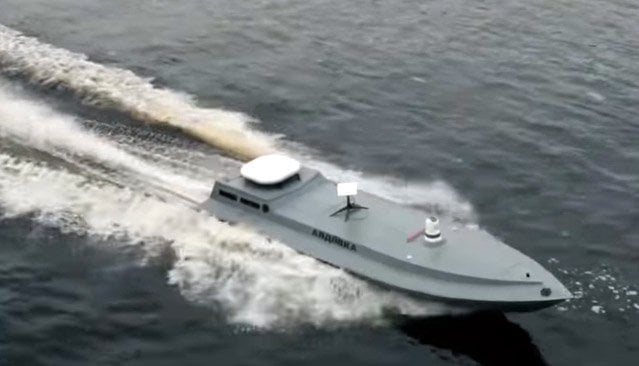
Sea Baby naval drones inflicted heavy damage against two ships off the Turkish coast last week. The Kairos and the Virat – both flying Gambian flags of convenience – were headed to Russia’s Novorossiysk oil terminal. Both ships were empty at the time of the attacks.
It was the first time that Kyiv explicitly took credit for using naval drones against civilian ships. Unlike the other tankers rocked by explosions in recent months, both the Kairos and the Virat were on a list of ships sanctioned for facilitating illegal exports of Russian oil.
But while these targets may seem more legitimate, Siebels said the operations remained fraught with risk.
“When you're targeting vessels in an area with a relatively good amount of maritime traffic, then yes, definitely things can go wrong,” Siebels said. “They may actually end up hitting the wrong vessel … there's always the risk of something going wrong. You're definitely running the risk of injuring or even killing seafarers.”
This is likely the reason why Ukraine has used its most advanced naval drones to carry out the attacks, said Patrick René Haasler, an analyst specialising in the post-Soviet space at the Verona-based International Team for the Study of Security.
“The Ukrainian Sea Baby drones are remotely controlled in real time via Starlink satellite connections and use high-resolution front cameras and thermal sensors,” he said. “Since the 2025 upgrades, AI-based object recognition and automatic target tracking have been added, increasing accuracy to less than 10 metres.”
Despite this, he said, it was vital that such attacks did not target tankers that were currently transporting oil.
“Despite their high precision, Sea Baby drones pose a significant potential for collateral damage in the Black Sea,” he said. “Their 850kg explosive payload can cause oil spills and create wave effects on neighbouring ships or coastlines if they miss their targets or hit loaded tankers.”
High risk, high reward
Despite the risks, Haasler said that Ukraine’s attacks made sense given Russia’s increasing reinforcement of its own energy infrastructure against Kyiv’s ongoing assaults.
“Against this backdrop, it seems reasonable to assume that Ukrainian drone attacks on Russian energy facilities could be less effective in the future,” he said. “Kyiv could therefore focus on supposedly easier targets in order to achieve success at least on an operational level in times of crumbling front lines.”
Germond said that the clandestine nature of Russia’s shadow fleet made it a tempting target.
“These vessels, by design, operate independently and covertly, leaving them vulnerable to attack in the 'grey zone' with limited options for protection or for claiming liability following an attack,” he said.
Moscow, which does not acknowledge the existence of a shadow fleet of oil tankers tasked with shipping Russian oil, is unlikely to provide the vessels with a naval escort or station troops aboard.
If Ukraine’s intelligence services were in fact behind the blasts that targeted the Mersin last week, it would mark a significant extension of the Russia-Ukraine war beyond the waters of the Black Sea and the Mediterranean.
So how would Ukraine have been able to launch such an attack more than 5,000 kilometres from Kyiv? For Siebels, it was not such a stretch.
He said that the attacks on ships involved in shipping Russian oil seemed to be a calculated risk.
“If you can actually make a dent in the number of companies that are willing to engage in transporting Russian oil and oil products, and then I would say it's definitely worth it. Because that is, to a large extent, the Russian government budget and by extension, the Russian military budget,” he said. “So for Ukraine, as a long-term strategy, that makes a lot of sense.”
The Romanian Navy released a video showing the destruction of a maritime drone that it identified as a “Sea Baby” found in the Black Sea. The official statement said it was part of the ongoing efforts to monitor the Black Sea and ensure safe transit for commercial ships.
The Coast Guard spotted a drifting object, which was approximately 36 nautical miles east of Constanta, Romania. The Navy’s EOD military divers, specialized in the fight against explosive devices, were dispatched to investigate.
The soldiers identified the object as a Sea Baby type of unmanned surface vehicle (drone). They did not make any comments on where the drone might have come from or how long it had been drifting.
The team received approval to destroy the drone based on the operational procedures of the Romanian military forces. At approximately 1300 local time, it was destroyed in a controlled detonation.
Ukraine has not commented on the incident, but said last weekend that it had used an adapted type of the Sea Baby during the attacks on the two sanctioned tankers in the Black Sea. An explosion and fire were reported on one vessel, which was abandoned, while the second tanker reported two attacks on successive days and sustained some damage above the waterline.
The Sea Baby drones first appeared in 2022 and 2023, and Ukraine appears to have outfitted at least one version for long-range attacks. They are approximately 6 meters (20 feet) in length and believed to have a top speed nearing 50 knots. The range is reported to be up to 540 nautical miles, with some variations able to carry 850 kg of explosives.
The use of the drones in international waters or the Turkish EEZ has raised concerns. Turkey’s President Recep Tayyip Erdogan condemned the attack in Turkish waters. Reuters reports Turkey has now discussed the attacks with NATO.
Russian President Vladimir Putin also lashed out at the attacks on the tankers, calling them piracy. He said Russia would intensify its attacks on Ukrainian facilities and vessels and threatened to take measures against the tankers of countries helping Ukraine. He said the “most radical solution” would be to cut Ukraine off from the sea. Russia last summer increased its naval escorts of tankers in the Baltic in response to the efforts to stop tankers to check their flag state status and insurance.
Romania highlights that it has, since February 2022, worked to monitor the safety of the Black Sea, saying it has ensured the navigation for over 12,000 commercial ships. It notes that drifting mines continue to be a key concern. In the past four years, the Romanian Navy reports approximately 150 sea mines have been neutralized in the Black Sea, including seven that were destroyed by its forces.
Romania, along with Turkey and Bulgaria, established a joint operation known as the Black Sea Mine Countermeasures Task Force. The naval forces are coordinating efforts to monitor the Black Sea for dangers.
Dublin Port Plans Large Fee Increases to Fund Infrastructure Upgrades
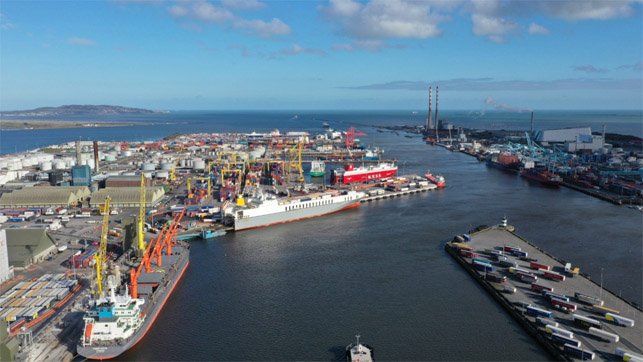
Dublin plans to raise prot fees to cover investments in its infrastructure (Dublin Port)
To fund expansion and infrastructure upgrades, Ireland’s Dublin port has proposed a massive hike in its port fees starting next year. The fees would increase an over 40 percent for container charges, a move that shippers have criticized as an added tax on businesses in Ireland. The port’s owner, Dublin Port Company, defends the increase, arguing that the seaport is running close to capacity and must make critical investments.
“As a self-financing entity, it is required to raise charges to cover capital expenditures. Again, the charges have been flat for two decades, albeit modest increases in recent years,” commented Barry O'Connell, CEO of Dublin Port Company.
O'Connell further noted that the port had a small capital spend between 2004 and 2021, hence, no fee review was undertaken during the period. The annual capital spend between 2015 and 2024 was $75 million. However, this is expected to rise to $198 million for the period 2025-2030, an increase of about 160 percent.
The proposed port fees review plans a five percent increase to the base price of a 40ft container, adding $2.13 to the current cost. For context, the current price is $44.74 for unaccompanied containers. In addition, a new $17 infrastructure charge has been added, effectively raising container charges by 46 percent. Therefore, the overall charges per container will rise to around $62 in 2026.
With these charges, Dublin Port is hoping to raise over $1 billion for infrastructure work planned by the end of this decade. The port expansion is being implemented under the Masterplan 2040. Some of the earmarked projects include the construction of a new container terminal with capacity for 612,000 TEUs. Another major project re-integrating the port to Dublin City, which will involve the construction of a new access road and bridge across the River Liffey, helping to decongest truck traffic from local roads.
But the Irish Road Haulage Association said that the hike in port fees will be disproportionately borne by consumers at a time when the cost of living is already high. “It’s an attack on every home in Ireland. It’s going to be seen in every shopping basket and every shopping trolley,” said Ger Hyland, President of the Irish Road Haulage Association.
Dublin reported that it handled a total of 35.2 million tons of cargo in 2024. The port has a large portion of RoRo volume and, in addition, handled just over 800,000 lift-off containers last year.
China’s Container Trade Surges as Two Ports Set New Record Totaling 90M TEU
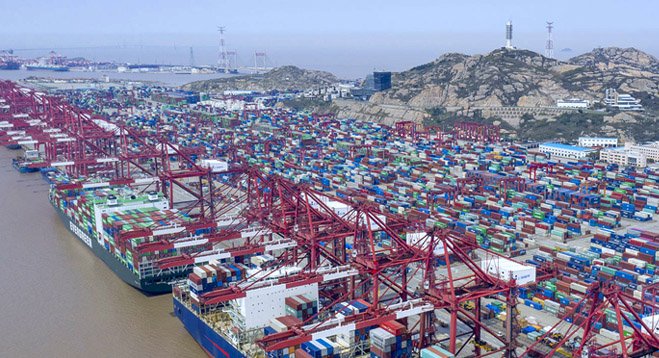
Shanghai reached 50 million TEU a month earlier than last year (SIPG)
Despite a year of turbulent trade policies and interruptions, China’s container volumes are continuing to surge. Two of the country’s largest port complexes have set new records after just 11 months, combined handling over 90 million TEU so far in 2025.
The Port of Shanghai, which highlights that it has maintained the top global ranking for 16 years, has once again surpassed the 50 million TEU threshold. It is the second consecutive year the port complex reached these levels, but officials point out the port is about a month ahead of last year’s levels. The 50 millionth container moved through the port on November 26.
Port officials did not release a forecast for the full year. But even with December typically being a slower month, the port has been averaging over 4 million TEU a month this year. For 2024, the port said it had set a record at 51.5 million TEU, which looks like they will exceed this year.
The management of the port highlights that they continue to invest in the operations and that the focus has moved from expanding the physical assets to restructuring the entire operational landscape. They highlight that it has been critical to help maintain the growth and become more important for the future.
Instead of operating as isolated terminals, they say the port operates more like a single, synchronized site. The main port is highly automated, and they are working to integrate the operations with the legacy terminals upriver.
Technology plays a critical role, with the complex using remote-controlled cranes, unnamed yard vehicles, and AI-driven planning tools. They point to an integrated port management and control system that acts as the central nervous system, allocating equipment, sequencing operations, and balancing capacity in real time. Systems including digital twins, high-precision positioning, and F5G networks have all become part of the daily operations, with AI supervision overseeing what once took layers of human intervention.
Ningbo-Zhoushan marked its first 40 million TEU mark on December 2 (Port Authority)
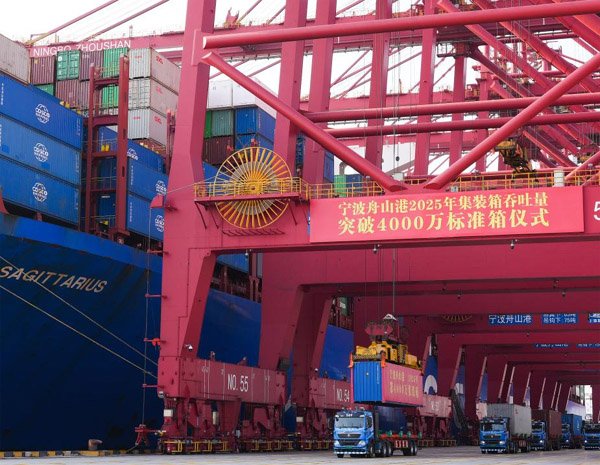
Equally impressive is the dramatic growth in the Ningo-Zhoushan Port in eastern China. On December 2, the port handled its 40 millionth TEU in 2025. It was the first time the port had reached this level. For all of 2024, the complex handled approximately 39.3 million TEUs.
Officials highlight that the port’s rate of growth continues to accelerate. A relative newcomer to the industry compared to established ports such as Shanghai, the complex took seven years to grow from 10 to 20 million TEU and another six years to reach 30 million TEU. It reached 40 million TEU in just four years, and they assert that based on total cargo tonnage, it is the only port to handle more than 1 billion tonnes annually for 16 consecutive years.
The Ningbo-Zhoushand port complex is now linked, they said, to more than 300 container shipping routes with 600 ports in 200 countries and regions. It now operates over 210 berths for ships above 10,000 tons, and that includes 135 berths for vessels over 50,000 tonnes.
Port of Long Beach to Name Long-Time Executive Hacegaba Next CEO
Port of Long Beach named a long-time executive as its new CEO
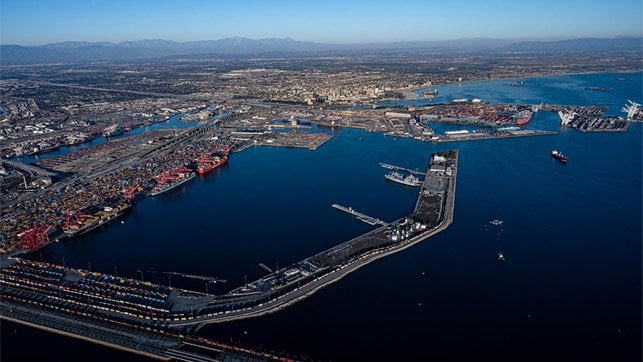
The Port of Long Beach (California) revealed today that it plans to name long-time executive and well-known industry figure Dr. Noel Hacegaba as the port’s next Chief Executive Officer as of the new year. With nearly 16 years of experience with the port, Hacegaba succeeds Mario Cordero, who will step down at year’s end.
Hacegaba is well-known in the industry, having first joined the Port of Long Beach in July 2010 with a background in trade and supply chains. He rose through the ranks, becoming Deputy Executive Director in 2018 and Chief Operating Officer in March 2023.
In announcing the decision to elevate Hacegaba to the CEO role, the port noted that in recent years, he has supported the CEO in critical issues ranging from the response to the pandemic-era global supply chain disruptions to directing the Business Recovery Task Force and coordinating with industry, labor, and government partners to keep cargo moving. He also spearheaded the port’s Supply Chain Information Highway, a digital platform designed to improve cargo visibility and data sharing across the national freight network.
Hacegaba has negotiated several major business transactions, including the multibillion-dollar sales of Long Beach Container Terminal and Total Terminals International. In his role as Chief Operating Officer, for nearly three years, he has overseen daily operations including commercial services, engineering, finance and administration, planning and environmental affairs, and strategic advocacy.
Dr. Noel Hacegaba (Port of Long Beach)
“Noel Hacegaba is the ideal choice to lead the Port of Long Beach,” said Harbor Commission President Frank Colonna. “Noel brings extensive experience managing all key Port functions, deep knowledge of the goods movement industry, and a collaborative leadership style that will serve the port well as we navigate future challenges and opportunities.”
A graduate of the University of Southern California, Hacegaba holds undergraduate and graduate degrees in economics, business administration, and planning, and also earned a doctorate in public administration from the University of La Verne.
Speaking after his selection, Hacegaba said he is excited to lead the port’s stellar staff as they work to strengthen the nation’s supply chain and build the port of the future. He said they would be focusing on accelerating the economic engine as they elevate the port’s profile internationally by delivering world-class infrastructure and customer service and industry-leading sustainability programs.
He takes the leadership of the port and container shipping industry is facing increasing uncertainties. While volume is up over 4 percent for the first 10 months of 2025, it has been impacted by the fluctuating tariffs and trade policies. Year-over-year volume has fallen off sharply this fall, with forecasts that container volumes will remain low well into 2026.
The Long Beach Board of Harbor Commissioners is set to make the appointment official at its next meeting on December 8. Hacegaba will assume the CEO position as of January 1, 2026.
ALT. FUELS
Third LCO2 Carrier to Launch Europe’s Largest Carbon Capture Project
The third vessel will be used starting in 2026 to transport CO2 for Yara in the Netherlands for storage in Norway (Yara)
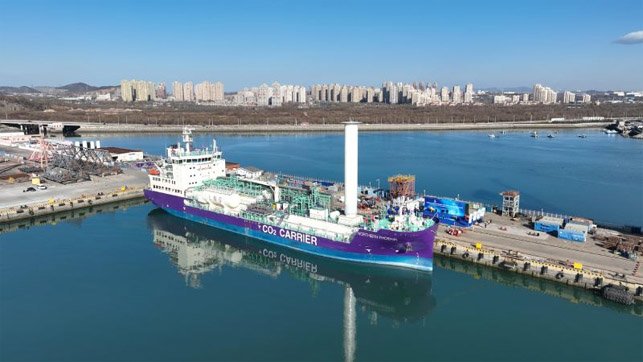
Norway’s Northern Lights project, along with Japanese ship operator “K” Line (Kawasaki Kisen Kaisha), marked the delivery of the third commercial liquefied CO2 transport vessel. The ship named Northern Phoenix will join the operation in 2026 and be part of Europe’s largest carbon capture project.
The ship is a sister to the first two Northern Lights’ vessels, which were delivered in late 2024 and began the commercial CCS program in 2025. It is the first commercial carbon capture project transporting the liquified gas cross-border and preparing and storing it more than 2.6 kilometers (1.6 miles) beneath the seabed on the Norwegian continental shelf.
The vessels, with a capacity of 7,500 cubic meters of LCO2, are being built by Dalian Shipbuilding Offshore Co., a division of China State Shipbuilder Corp. The Northern Phoenix was officially handed over on December 2 and is registered in Norway. It is expected to depart China shortly. Northern Lights reports the ship will conduct testing and optimization of its energy-saving devices during the repositioning voyage. Once it arrives at the company’s terminal in Øygarden, it will start mechanical commissioning and training before starting its operations.
The first three vessels are each being operated with bareboat charter contracts and time charters with “K” Line Energy Shipping based in London. In addition to their unique capability to transport LCO2 (maximum pressure of 19 bar(g) and minimum temperature of -35 degrees C), the ships are fueled with LNG and have a wind-assist rotor sails and air lubrication under the hull.
Commercial operations began in 2025 with Northern Lights under contract to transport and store CO2 from two Norwegian industries, Heidelberg Materials’ cement factory in Brevik and the Hafslund Celsio’s waste-to-energy plant in Oslo. Northern Lights has already announced plans to increase its operations to an annual capacity to handle a minimum of five million tonnes of CO2.
The third vessel will be dedicated to the transport of CO2 from Yara’s flagship ammonia and fertilizer plant in the Netherlands. Yara reports it will begin to capture and liquify up to 800,000 tons of CO2 annually at the plant. It expects to remove approximately 12 million tons of CO2 from its production at the plant in Sluiskil over the next 15 years.
Yara has invested in the facilities at the plant, which include an on-site storage capacity of 15,000 tons of CO2. The plan calls for two shiploads per week to be transferred to the Northern Lights’ vessel for delivery to the receiving station in Norway. From there, it is pumped to the storage site.
In December 2023, Northern Lights announced an agreement to build a fourth vessel. It will be owned and operated by Germany’s Bernhard Schulte Group. Northern Lights signed a long-term time charter party for the cross-border transport of CO2 and now says the vessel will be delivered in 2026. It reports that the vessel will permit it to expand operations with new customers, including Stockholm Exergi.
Design for Large Ammonia-Powered Containership Achieves Key Milestone
MSC is building on its partnership with the Chinese shipbuilders to develop next-generation ships (Zhoushan Changhong International Shipyard)
Classification society DNV reports that it has awarded an Approval in Principle (AiP) to an emerging design for a 21,700 TEU ammonia-powered mega-boxship. This key step, which confirms the feasibility of the design and ensures no major technical hurdles to meeting class, comes as the shipping industry continues to flirt with ammonia as an emerging alternative power source.
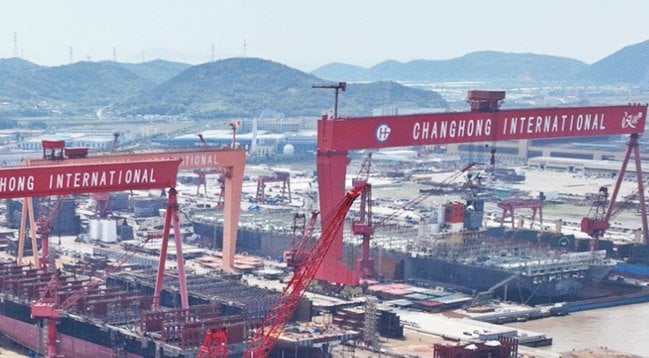
The design for the vessel was developed by a joint consortium of MSC Mediterranean Shipping Company, shipbuilder Zhoushan Changhong International, and CIMC ORIC. MSC has a long-standing relationship with the Chinese shipbuilder, which has built some of the company’s largest containerships currently in service.
“We are proud to see our 21,700 TEU ammonia-dual fuel design recognized with DNV’s AiP,” said Yin Xunbin, General Manager of CIMC ORIC. “This vessel concept offers shipowners an option for a high-capacity, energy-efficient, zero-carbon container ship as part of the next-generation sustainable global liner services. This milestone validates our commitment to providing future-ready vessels that meet global trade demands while reducing emissions.”
DNV reports the proposed 21,700 TEU container ship integrates the latest-generation of ammonia dual-fuel main engines alongside oversized C-type ammonia tanks. The hull design, with a new vertical bow, optimized stern, and hull lines, alongside low-resistance coatings, high-efficiency propellers, and energy-saving hydrodynamic features, targets improved fuel efficiency. Validation of the design was undertaken through CFD simulations and model tests.
The design has also been optimized for a high load-to-capacity ratio and efficient hold utilization. In addition, the twin-island deck layout and foredeck design allow additional 40-foot container bays to increase cargo capacity while maintaining port and operational compatibility.
“Ammonia-dual fuel options are firmly in the decarbonization race,” says Norbert Kray, DNV Senior Vice President and Maritime Regional Manager for Greater China. “We have gone from concept to orders, and soon will see the first deliveries. The AiP demonstrates that the design is in line with industry’s leading safety and design standards, reinforcing confidence in ammonia as a viable fuel for large container vessels.”
The design reaches this key step in the process as the first ammonia combustion engines are poised to enter the commercial market. As the project develops, the consortium will proceed towards more detailed design and safety analyses, including ammonia mitigation and gas handling, and integration into the fuel system.
Norsepower Extends Wind Rotor Installations to Japanese Newbuild VLCCs
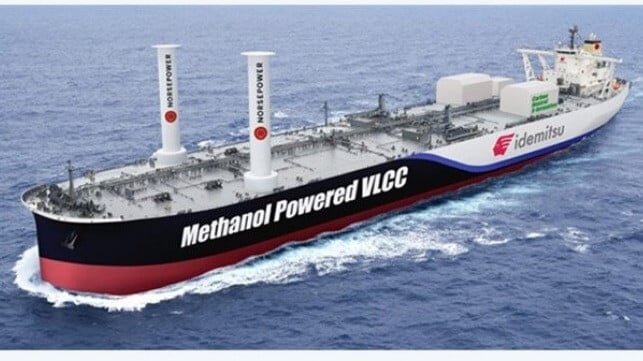
Norsepower has its first contract to install wind rotors on a newbuild VLCC and its first newbuild in Japan (Idemitsu Tankers)
Wind-assisted propulsion continues to make advancements into more segments of the shipping industry, with Norsepower reporting it has signed its first contract for newbuild VLCCs and its first newbuilds in Japan. The company offers a modernized, data-driven evolution of the century-old Fletter rotor, a spinning cylinder that uses the Magnus Effect to create a propulsive force that lowers engine power and fuel consumption.
Idemitsu Tanker Co., Ltd., the shipping arm of Idemitsu Kosan, which reports it has one of the world's largest fleets of tankers, has been developing a next-generation design to increase efficiency and reduce emissions. The company has more than a dozen VLCCs under charter as well as additional managed ships. The concept incorporates efficiency for the vessels and prepares them for future low-carbon fuels such as methanol.
Norsepower reports that it signed the landmark deal the the tanker company for the installation of its wind-assisted propulsion technology. The vessels will be built by Japan Marine United Corporation (JMU) and Nihon Shipyard Co. Each will be delivered with two 35x5 meter (115x16.5 foot) explosion-proof Norsepower Rotor Sails. The first vessel is scheduled for delivery by the end of 2028.
“By equipping our new VLCCs with the Norsepower Rotor Sail™, we are not only investing in fuel savings and emission reductions but also taking a decisive step towards the decarbonisation of long-haul shipping,” said Idemitsu Tankers.
According to Norsepower, the project demonstrates how integrating the intelligent, data-driven rotor sails into purpose-designed vessels can deliver exceptional performance gains. Depending on wind patterns, routing, and vessel operations, the company reports Norsepower Rotor Sails typically reduce fuel use by 5–25 percent — and even higher when conditions are favorable.
The installation is supported by advanced digital control systems that optimize performance in real time. According to Norsepowe, it ensures the sails operate at peak efficiency in every condition. By reducing reliance on engines, the system cuts both fuel consumption and emissions.
With the maturity of wind propulsion, Norsepower had found strong interest in the tanker segment. It reports it has 22 units in operation in this segment, with its systems installed on tankers ranging from smaller chemical tankers, LCO? carriers, MR, LR, VLGC, and now, for the first time, on VLCCs.
GOOD RIDDANCE TO A COMPRADOUR
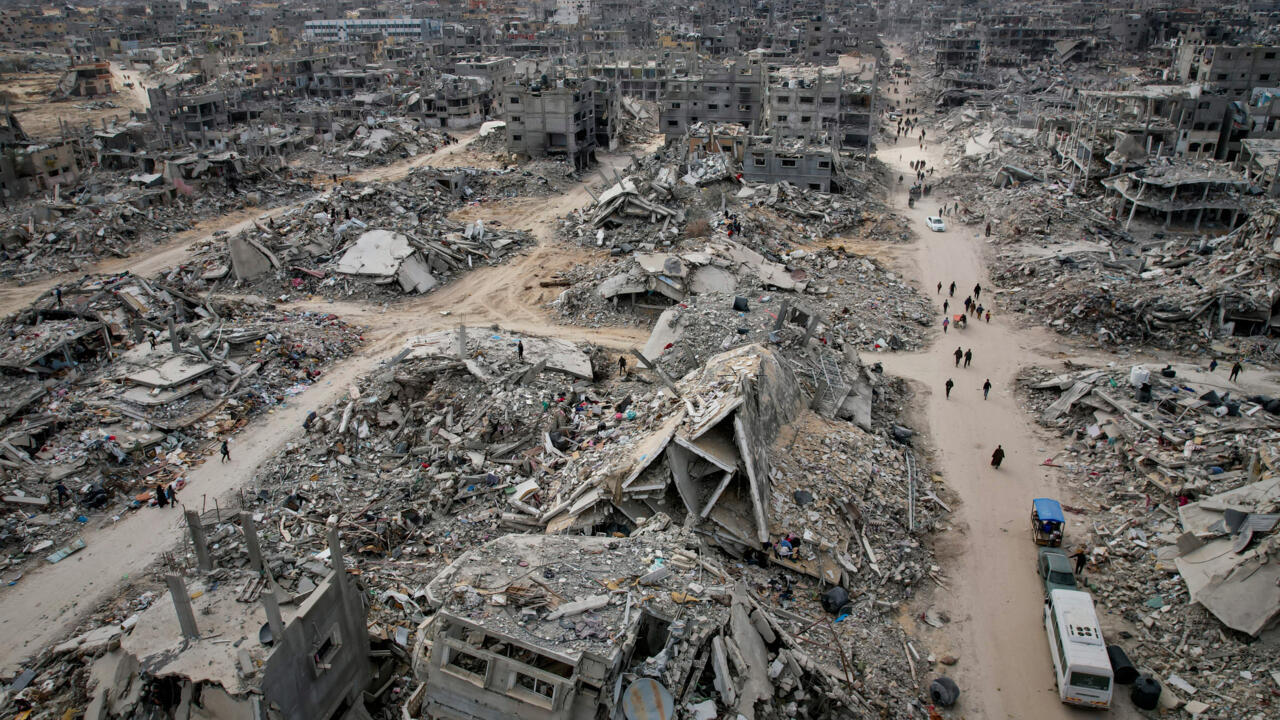
Israeli-backed, anti-Hamas Palestinian militia chief Abu Shabab killed in Gaza Yasser Abu Shabab, a Bedouin clan chief and leader of an armed Palestinian militia opposed to Hamas, was killed in Gaza while trying to resolve a family dispute, his group said. The Israeli-backed Popular Forces in Gaza on Thursday denied "misleading" reports that Hamas was behind Abu Shabab's killing.
The head of an armed Palestinian faction that opposes Hamas in Gaza died while mediating a family dispute, the group said on Thursday, in what would be a blow to Israeli efforts to support Gazan clans against the Islamist movement.
Yasser Abu Shabab, a Bedouin tribal leader based in Israeli-held Rafah in southern Gaza, had led the most prominent of several small anti-Hamas groups that emerged in Gaza during the war that began more than two years ago.
His death would be a boost to Hamas, which has branded him a collaborator and ordered its fighters to kill or capture him.
Gaza's Popular Forces said in a statement that its leader died of a gunshot wound as he intervened in a family quarrel, and dismissed as "misleading" reports that Hamas was behind his killing.
Prime Minister Benjamin Netanyahu acknowledged in June that Israel had armed anti-Hamas clans, though Israel has announced few other details of the policy since then. Rafah security sweep
Abu Shabab's group has continued to operate from areas of Gaza controlled by Israeli forces since Hamas and Israel reached a US-backed ceasefire in October.
Rafah has been the scene of some of the worst violence during the ceasefire. Residents had reported gunbattles there on Wednesday, and Israel said four of its soldiers were wounded.
The Israeli military said on Thursday its forces had killed some 40 Hamas militants trapped in tunnels below Rafah.
On November 18, Abu Shabab's group posted a video showing dozens of fighters receiving orders from his deputy to launch a security sweep to "clear Rafah of terror", an apparent reference to Hamas fighters believed to be holed up there.
The Popular Forces vowed to continue Abu Shabab's path and to "fight terrorism" in Gaza, the group said.
Abu Shabab's death was first reported by Israeli media including Kan, Israel's public broadcaster, citing a security source.
Israel's Army Radio, also citing a security source, said he had died in Soroka hospital in southern Israel of unspecified wounds, but the hospital denied admitting him. Rafah administration
An Israeli government spokesperson declined to comment on the reports. Hamas had no comment, its Gaza spokesperson said.
Israel's policy of backing anti-Hamas clans took shape as it pressed the Gaza offensive against the group, aiming to end its rule of the coastal strip in the wake of the October 7, 2023 attacks on communities in southern Israel.
In an article published in the Wall Street Journal in July, Abu Shabab – a member of the Tarabin Bedouin tribe – said his group had established its own administration in the Rafah area and urged US and Arab nations to recognise and support it.
Abu Shabab's group has denied being backed by Israel. But Netanyahu said in June that Israel's backing for Gazan clans had saved the lives of Israeli soldiers.
The policy has also drawn criticism from some in Israel who have said such groups can provide no real alternative to Hamas, which has controlled Gaza since 2007. 'Writing on the wall'
"The writing was on the wall. Whether he was killed by Hamas or in some clan infighting, it was obvious that it would end this way," said Michael Milshtein, a former Israeli military intelligence officer at the Moshe Dayan Center in Tel Aviv.
Several other anti-Hamas groups have emerged in areas of Gaza held by Israel. Palestinian political analyst Reham Owda said that Abu Shabab's death would fuel doubts among them about their "ability to challenge Hamas".
US President Donald Trump's Gaza plan foresees Hamas disarming and a transitional authority running the enclave, supported by a multinational stabilisation force. But progress has appeared slow, with Hamas so far refusing to disarm and no sign of agreement on the formation of the international force.
Hamas has accused Abu Shabab of looting UN aid trucks during the war. Abu Shabab's group has denied this, saying it has protected and escorted aid.
(FRANCE 24 with Reuters)
Macron takes on ‘French Murdoch’ in battle against disinformation
ANALYSIS
French President Emmanuel Macron has come under fire from the political right for suggesting that news outlets be labelled to distinguish those that comply with journalistic ethics from those that do not. Right-wing parties and media outlets owned by billionaire tycoon Vincent Bolloré are leading the charge, accusing Macron of seeking to establish an Orwellian “Ministry of Truth”.
When media mogul Vincent Bolloré appointed a far-right editor to run the “Journal du Dimanche” (JDD) in the summer of 2023 – triggering a weeks-long strike at France’s best-known Sunday newspaper – the beleaguered newsroom appealed to President Emmanuel Macron not to let their paper “die in silence”.
“When the JDD, the newspaper of temperance and balance, goes on strike, it means the situation is truly bleak,” the striking journalists wrote in a letter to Macron, framing their tussle as part of a wider battle for press freedom. “Beyond the JDD, what is at stake is the independence of the press and the journalists who produce it – a pillar of democracy,” they said.
The JDD has duly lurched to the right under chief editor Geoffroy Lejeune, whose previous tenure at far-right magazine “Valeurs Actuelles” included a conviction for publishing racist hate speech.
Two years on, the addition of the JDD to Bolloré’s arch-conservative media empire has come back to haunt the French president, undermining his stated push to combat disinformation and the spread of fake news on social media.
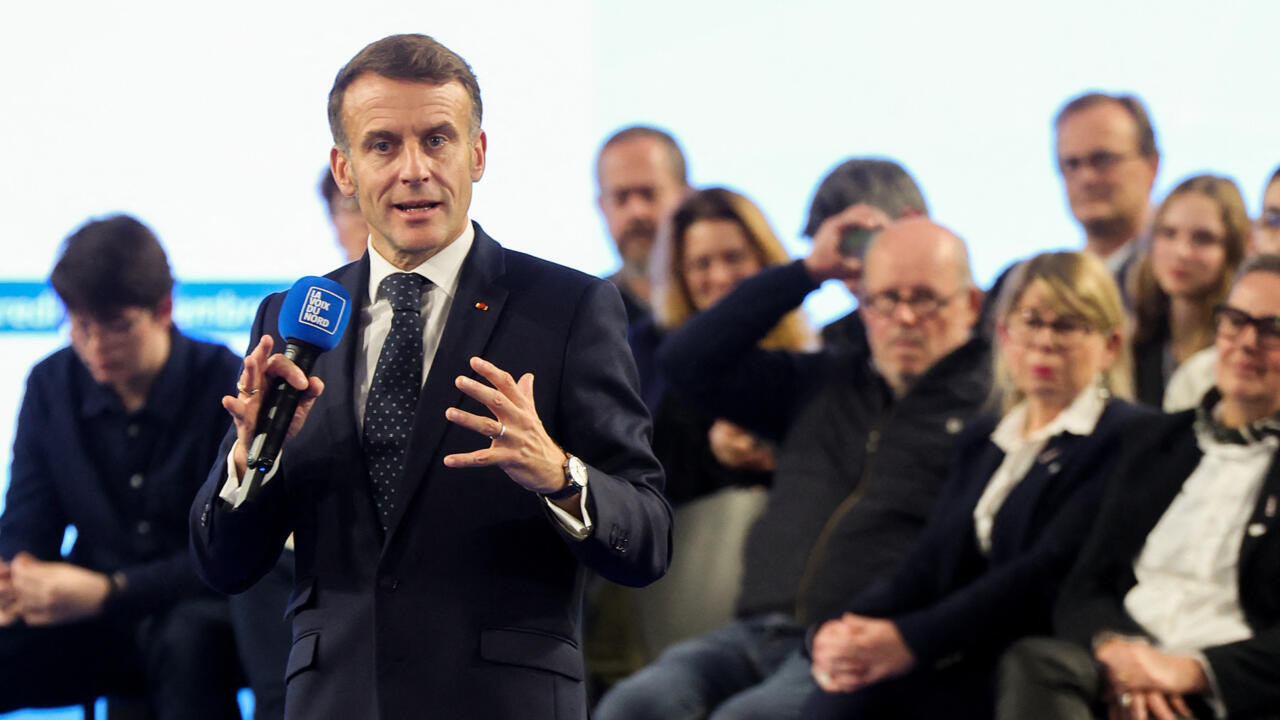
The French president has made waves since he publicly called for a “labelling system created by media professionals”, designed to distinguish news outlets that comply with journalistic ethics standards from those that do not.
Speaking at a Q&A session with readers of a local French newspaper on November 19, Macron stressed that such a label would be based on peer review and not attributed by the state, adding that the state’s role “should never be to say, ‘This is true or false’”.
The reaction on the right has been scathing.
The JDD ran a front-page story on Sunday describing Macron’s campaign against disinformation as an attempt to “control information”. Its warning against the establishment of an Orwellian “Ministry of Truth” fired the opening salvo in a right-wing campaign that has elicited a firm riposte from the Élysée Palace. Between Pravda and Ministry of Truth
Other right-wing outlets owned by Bolloré – dubbed the “French Murdoch” due to his sprawling media stable and conservative politics – soon jumped on the JDD’s bandwagon, accusing Macron of attempts to muzzle the press.
Pascal Praud, the star anchor of Bolloré-owned broadcasters CNews and Europe 1, lambasted a “president unhappy with his treatment by the media and who wants to impose a single narrative”. He quipped that Macron was seeking a “middle ground” between the Soviet-era Communist Party newspaper “Pravda” (Truth) and the Ministry of Truth from George Orwell’s “1984". Right-wing politicians quickly followed suit.
Speaking on CNews, far-right National Rally (RN) leader Jordan Bardella blasted the “authoritarian temptation” of a president “who has lost power and seeks to maintain it by controlling information”. Former interior minister Bruno Retailleau, who heads the conservative Les Républicains (LR) party, warned in a post on X that “no government has the right to filter the media or dictate the truth”.
Both Les Républicains and a splinter party led by hardliner Éric Ciotti have launched online petitions, with Retailleau’s party accusing Macron of undermining freedom of speech “under the guise of fighting fake news”. Catch-22
The Élysée Palace has responded to the barrage head-on, in line with its recent practice of going public to call out fake news. Taking aim at Praud from CNews in a fact-checking video posted on its X account, Macron’s office lamented the fact that “talking about the fight against disinformation itself causes disinformation”.
The riposte mirrored past attempts to challenge the spread of fake news on social media, including unfounded rumours about the purchase of an Aston Martin and the false claim – pushed by pro-Russian bloggers – that Macron took cocaine with German Chancellor Friedrich Merz and UK Prime Minister Keir Starmer while on a train travelling to Kyiv.
“When fake news goes viral, we must go viral too,” French daily “Le Monde” quoted a Macron aide as saying earlier this week.
Analysts, however, have warned of a Catch-22 situation for the French president as he battles disinformation.
“It’s a constant dilemma: responding fuels the controversy, while remaining silent allows the rumour to flourish,” says Arnaud Mercier, a professor at Paris 2-Assas University, who has published a book on disinformation and manipulation in the media.
The French president and his wife Brigitte Macron have long been targeted by false online claims that she was assigned male at birth. Ten people went on trial in Paris in October, charged with online harassment of the French first lady, in the latest phase of a legal battle on both sides of the Atlantic.
Macron sees this fight as “a political and personal necessity in the face of the rise of false and manipulative content”, says Mercier. The trouble for the French president is that “he is so unpopular his words no longer carry the same weight”.
Strengthening trust in the media
The latest controversy comes as Macron has stepped up his push for greater regulation of social media, including calls for algorithm transparency and mechanisms to block fake news, as well as plans to ban social media for young people under 15 years old.
He is not the first to advocate for a “label” or professional certification to combat disinformation in the media. In fact, his remarks in November echoed the recommendations of a 2024 industry forum aimed at “strengthening public trust” in journalism.
Macron notably cited the Journalism Trust Initiative (JTI) promoted by advocacy group Reporters Without Borders (RSF). According to its website, the JTI was developed by “130 media organisations, journalists’ associations, editors’ associations, regulatory and self-regulatory bodies and other stakeholders of the news industry to promote independent, pluralistic and reliable information”.
More than 2,000 news outlets around the world have JTI certification. They include AFP, AP, BBC World News and FRANCE 24’s parent group France Médias Monde. Macron-Bolloré divorce?
In an interview with French daily “Libération”, media historian Alexis Lévrier argued that Macron’s mistake was to “want to embody this push for quality journalism” – a stance Lévrier said inherently leads to “suspicions of interference with the media” and “reinforces the very conspiracy theories (Macron) claims to fight”.
The row over media “labels” also signals the apparent failure of Macron’s strategy to avoid confrontation with Bolloré’s sprawling media empire, which has actively pushed the nationalist right in recent years, precipitating a rightward shift in French politics.
When the head of Macron’s party in the National Assembly told lawmakers in 2023 to shun the JDD in the wake of Lejeune’s appointment, the French president refused to issue similar instructions for ministers. Instead, he encouraged ministers to flood Bolloré’s media outlets to counter the far right’s message.
As “Le Monde” wrote earlier this week, Macron notably cultivated ties with Praud to the point that he informed the CNews anchor of his ill-fated plan to call snap elections last year before his own prime minister.
Such efforts took a first hit in March when the Élysée Palace publicly denied a report in the JDD that alleged Macron was seeking to “scare” the French by playing up the threat from Moscow, amid growing concern about the pro-Russia stance espoused by several of Bolloré’s media outlets.
The latest row over disinformation has led “Le Monde” to ponder “whether the divorce between the president and the Bolloré media empire is now final”.
CNews, the JDD and other outlets in the Bolloré stable are now “exploiting the topic of freedom of expression in a cultural battle inspired by Trumpism and the alt-right, in which any regulation is denounced as an attack on fundamental freedoms”, says Mercier, describing it as a win-win strategy for the billionaire tycoon and his companies.
“If they end up getting some form of certification, they'll say they’re legitimate,” he explains.
“And if they don’t, they’ll pose as martyrs and rail against censorship.”