ALT. FUELS
Third LCO2 Carrier to Launch Europe’s Largest Carbon Capture Project
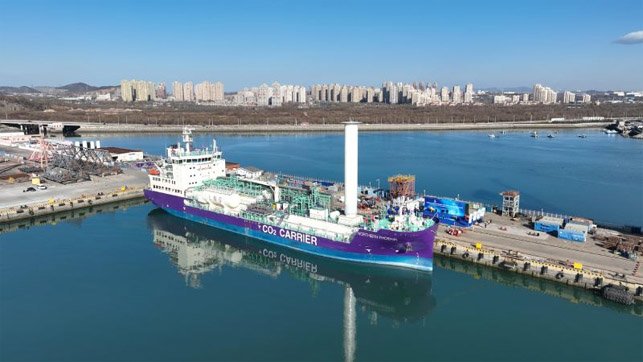
Norway’s Northern Lights project, along with Japanese ship operator “K” Line (Kawasaki Kisen Kaisha), marked the delivery of the third commercial liquefied CO2 transport vessel. The ship named Northern Phoenix will join the operation in 2026 and be part of Europe’s largest carbon capture project.
The ship is a sister to the first two Northern Lights’ vessels, which were delivered in late 2024 and began the commercial CCS program in 2025. It is the first commercial carbon capture project transporting the liquified gas cross-border and preparing and storing it more than 2.6 kilometers (1.6 miles) beneath the seabed on the Norwegian continental shelf.
The vessels, with a capacity of 7,500 cubic meters of LCO2, are being built by Dalian Shipbuilding Offshore Co., a division of China State Shipbuilder Corp. The Northern Phoenix was officially handed over on December 2 and is registered in Norway. It is expected to depart China shortly. Northern Lights reports the ship will conduct testing and optimization of its energy-saving devices during the repositioning voyage. Once it arrives at the company’s terminal in Øygarden, it will start mechanical commissioning and training before starting its operations.
The first three vessels are each being operated with bareboat charter contracts and time charters with “K” Line Energy Shipping based in London. In addition to their unique capability to transport LCO2 (maximum pressure of 19 bar(g) and minimum temperature of -35 degrees C), the ships are fueled with LNG and have a wind-assist rotor sails and air lubrication under the hull.
Commercial operations began in 2025 with Northern Lights under contract to transport and store CO2 from two Norwegian industries, Heidelberg Materials’ cement factory in Brevik and the Hafslund Celsio’s waste-to-energy plant in Oslo. Northern Lights has already announced plans to increase its operations to an annual capacity to handle a minimum of five million tonnes of CO2.
The third vessel will be dedicated to the transport of CO2 from Yara’s flagship ammonia and fertilizer plant in the Netherlands. Yara reports it will begin to capture and liquify up to 800,000 tons of CO2 annually at the plant. It expects to remove approximately 12 million tons of CO2 from its production at the plant in Sluiskil over the next 15 years.
Yara has invested in the facilities at the plant, which include an on-site storage capacity of 15,000 tons of CO2. The plan calls for two shiploads per week to be transferred to the Northern Lights’ vessel for delivery to the receiving station in Norway. From there, it is pumped to the storage site.
In December 2023, Northern Lights announced an agreement to build a fourth vessel. It will be owned and operated by Germany’s Bernhard Schulte Group. Northern Lights signed a long-term time charter party for the cross-border transport of CO2 and now says the vessel will be delivered in 2026. It reports that the vessel will permit it to expand operations with new customers, including Stockholm Exergi.
Design for Large Ammonia-Powered Containership Achieves Key Milestone
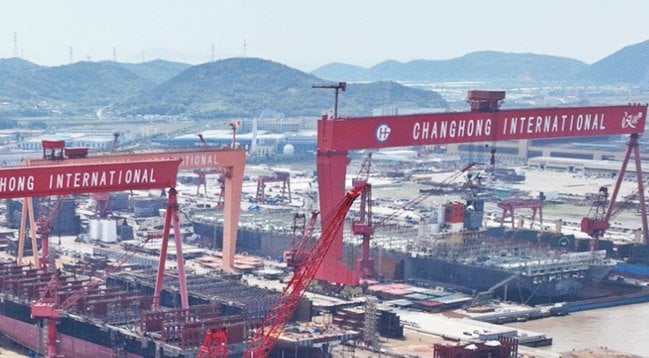
Classification society DNV reports that it has awarded an Approval in Principle (AiP) to an emerging design for a 21,700 TEU ammonia-powered mega-boxship. This key step, which confirms the feasibility of the design and ensures no major technical hurdles to meeting class, comes as the shipping industry continues to flirt with ammonia as an emerging alternative power source.
The design for the vessel was developed by a joint consortium of MSC Mediterranean Shipping Company, shipbuilder Zhoushan Changhong International, and CIMC ORIC. MSC has a long-standing relationship with the Chinese shipbuilder, which has built some of the company’s largest containerships currently in service.
“We are proud to see our 21,700 TEU ammonia-dual fuel design recognized with DNV’s AiP,” said Yin Xunbin, General Manager of CIMC ORIC. “This vessel concept offers shipowners an option for a high-capacity, energy-efficient, zero-carbon container ship as part of the next-generation sustainable global liner services. This milestone validates our commitment to providing future-ready vessels that meet global trade demands while reducing emissions.”
DNV reports the proposed 21,700 TEU container ship integrates the latest-generation of ammonia dual-fuel main engines alongside oversized C-type ammonia tanks. The hull design, with a new vertical bow, optimized stern, and hull lines, alongside low-resistance coatings, high-efficiency propellers, and energy-saving hydrodynamic features, targets improved fuel efficiency. Validation of the design was undertaken through CFD simulations and model tests.
The design has also been optimized for a high load-to-capacity ratio and efficient hold utilization. In addition, the twin-island deck layout and foredeck design allow additional 40-foot container bays to increase cargo capacity while maintaining port and operational compatibility.
“Ammonia-dual fuel options are firmly in the decarbonization race,” says Norbert Kray, DNV Senior Vice President and Maritime Regional Manager for Greater China. “We have gone from concept to orders, and soon will see the first deliveries. The AiP demonstrates that the design is in line with industry’s leading safety and design standards, reinforcing confidence in ammonia as a viable fuel for large container vessels.”
The design reaches this key step in the process as the first ammonia combustion engines are poised to enter the commercial market. As the project develops, the consortium will proceed towards more detailed design and safety analyses, including ammonia mitigation and gas handling, and integration into the fuel system.
Norsepower Extends Wind Rotor Installations to Japanese Newbuild VLCCs
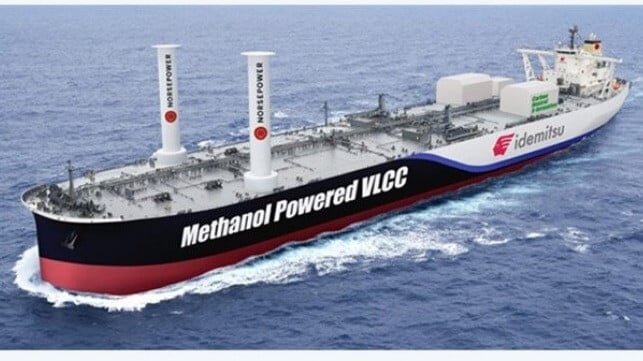
Wind-assisted propulsion continues to make advancements into more segments of the shipping industry, with Norsepower reporting it has signed its first contract for newbuild VLCCs and its first newbuilds in Japan. The company offers a modernized, data-driven evolution of the century-old Fletter rotor, a spinning cylinder that uses the Magnus Effect to create a propulsive force that lowers engine power and fuel consumption.
Idemitsu Tanker Co., Ltd., the shipping arm of Idemitsu Kosan, which reports it has one of the world's largest fleets of tankers, has been developing a next-generation design to increase efficiency and reduce emissions. The company has more than a dozen VLCCs under charter as well as additional managed ships. The concept incorporates efficiency for the vessels and prepares them for future low-carbon fuels such as methanol.
Norsepower reports that it signed the landmark deal the the tanker company for the installation of its wind-assisted propulsion technology. The vessels will be built by Japan Marine United Corporation (JMU) and Nihon Shipyard Co. Each will be delivered with two 35x5 meter (115x16.5 foot) explosion-proof Norsepower Rotor Sails. The first vessel is scheduled for delivery by the end of 2028.
“By equipping our new VLCCs with the Norsepower Rotor Sail™, we are not only investing in fuel savings and emission reductions but also taking a decisive step towards the decarbonisation of long-haul shipping,” said Idemitsu Tankers.
According to Norsepower, the project demonstrates how integrating the intelligent, data-driven rotor sails into purpose-designed vessels can deliver exceptional performance gains. Depending on wind patterns, routing, and vessel operations, the company reports Norsepower Rotor Sails typically reduce fuel use by 5–25 percent — and even higher when conditions are favorable.
The installation is supported by advanced digital control systems that optimize performance in real time. According to Norsepowe, it ensures the sails operate at peak efficiency in every condition. By reducing reliance on engines, the system cuts both fuel consumption and emissions.
With the maturity of wind propulsion, Norsepower had found strong interest in the tanker segment. It reports it has 22 units in operation in this segment, with its systems installed on tankers ranging from smaller chemical tankers, LCO? carriers, MR, LR, VLGC, and now, for the first time, on VLCCs.

No comments:
Post a Comment