D. E. I. AT SEA
Naval Research Laboratory engineer receives prestigious Department of the Navy award
Naval Research Laboratory
image:
U.S. Naval Research Laboratory Engineer Shannon McGarry, Ph.D., received the prestigious Department of the Navy 2025 G. Dennis White Early Career Human Systems Integration (HSI) Practitioner Award for contributions and unwavering commitment embodying the essential qualities critical to the advancement of the HSI discipline, ensuring the safety and effectiveness of systems delivered to our warfighters. (U.S. Navy photo)
view moreCredit: U.S. Navy photo
WASHINGTON, D.C. – U.S. Naval Research Laboratory (NRL) Engineer Shannon McGarry, Ph.D., received the Department of the Navy (DON) 2025 G. Dennis White Early Career Human Systems Integration (HSI) Practitioner Award for contributions and unwavering commitment embodying the essential qualities critical to the advancement of the HSI discipline, ensuring the safety and effectiveness of systems delivered to our warfighters.
“McGarry has exemplified these attributes through her dedicated work and research expertise in the application of eye tracking methodologies to explain and predict individual performance within complex and dynamic environments,” said Deputy Assistant Secretary of the Navy for Research, Development, Test, and Engineering, Mr. Peter C. Reddy, SES, in a memorandum. “Her leadership, management, and collaborative spirit with HSI practitioners and researchers, both within and beyond the U.S. Navy, are highly commendable and have significantly contributed to a broader understanding and application of the HSI discipline.”
This prestigious award acknowledges the values White sought to instill in junior and developmental engineers: Cooperation, Courage, Proactivity, Flexibility, and Persistence - as key factors in the success of HSI practitioners.
“Dr. McGarry’s work is focused on using eye tracking to monitor an operator’s state in real-time, which is being able to identify when someone is overloaded or has lost their situational awareness,” said NRL Warfighter Applied Cognition and Technology Section Head Joseph Coyne, Ph.D. and McGarry’s supervisor. “Our section as a whole is focused on warfighter performance and conduct science on building better measures of cognitive abilities, like attention or spatial ability, that are now being used to determine who qualifies to be aviators and Flight Officers in the U.S. Navy and Marine Corps.”
Human-systems integration focuses on delivering methods and solutions on how to best integrate technology and information systems as it relates to the human. The field is varied and multidisciplinary as it pulls from ergonomics, psychology, engineering, cognitive science, and beyond.
“This award is one of a few HSI awards in the Department of the Navy and I was not expecting to be selected given all the great HSI work going on across the Naval Research Enterprise,” McGarry said. “I have dedicated my career to this discipline, and it is great to be recognized as it brings awareness to the field and its value for the services. HSI work can be challenging, as there is much to consider; first and foremost, the human, and then all of the traditional engineering challenges engineers and scientists face, like constraints on cost, design, and feasibility.”
McGarry’s research explores how a person’s scan patterns reflect performance in complex, fast-moving environments, such as supervisory control settings where operators monitor multiple systems and respond to emerging issues. The ultimate goal is to inform the design of displays and control systems so they are best for the warfighter’s real-time cognitive demands and state. Rather than presenting static information, her work examines how eye tracking data can indicate whether an operator is seeing, processing, and comprehending critical information.
“Identifying problems is only part of the challenge,” McGarry said. “You need actionable plans so people don’t just accept the status quo, but engage in problem-solving.”
She added that proposing human-centered solutions - rather than just highlighting design flaws - helps gain buy-in across the Navy. “The Navy values safe, effective human-systems integration,” McGarry said. “When we frame it as advancing science and technology to improve performance, people start to listen.”
McGarry earned a Bachelor of Science from Clemson University in Industrial Engineering in 2016, a Master of Science from Clemson University in Industrial Engineering in 2018, and a Doctorate in Systems Engineering from the University of Virginia in 2021.
The NRL Warfighter Applied Cognition and Technology Section investigates how warfighter performance can be enhanced through selection, training, and technology. The Section studies human performance, human-system interaction, and individual differences by leveraging physiological measurement and cognitive modeling within both basic and operationally relevant environments to maximize Department of War capability through improved assessment, training, and systems design.
About the U.S. Naval Research Laboratory
NRL is a scientific and engineering command dedicated to research that drives innovative advances for the U.S. Navy and Marine Corps from the seafloor to space and in the information domain. NRL, located in Washington, D.C. with major field sites in Stennis Space Center, Mississippi; Key West, Florida; Monterey, California, and employs approximately 3,000 civilian scientists, engineers and support personnel.
NRL offers several mechanisms for collaborating with the broader scientific community, within and outside of the Federal government. These include Cooperative Research and Development Agreements (CRADAs), LP-CRADAs, Educational Partnership Agreements, agreements under the authority of 10 USC 4892, licensing agreements, FAR contracts, and other applicable agreements.
For more information, contact NRL Corporate Communications at NRLPAO@us.navy.mil.
###
Strong Progress In The Feminization Of CMA CGM’s Seafaring Workforce
[By: CMA CGM]
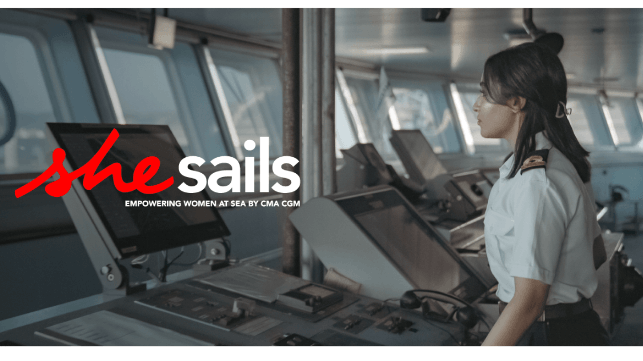
She sails, CMA CGM’s internal program designed to accelerate the presence of women in maritime careers, is celebrating its first anniversary. One year after its launch in December 2024, the program, which seeks to significantly increase the number of women on board CMA CGM vessels, has successfully doubled the number of female seafarers.
Building on this momentum, the Group has now set a target of 1,000 women at sea by 2030, while promoting the wide range of roles and opportunities offered by an international company such as CMA CGM. The program also highlights the importance of sharing experiences among women seafarers and serves as a powerful lever to inspire younger generations to pursue careers at sea.
Within just one year, She sails has enabled the Group to double the number of its women seafarers, from 200 in 2024 to 403 by the end of 2025, an increase of more than 100%.
Christine Cabau Woehrel, the Group’s Executive Vice President in charge of Operations and Assets, said: “In just one year, our program has proven its effectiveness: the results exceed our expectations. More women are accessing key positions, their career paths are accelerating, their confidence is growing, and our teams are gaining in both diversity and performance. These achievements are a source of pride, but above all a responsibility: to continue our efforts, to go further, and to make equal opportunities a lasting reality across all our teams.”
Throughout the year, the She sails program has played a decisive role in accelerating women’s careers across the fleet, notably through the mobilization of a network of 42 ambassadors in 19 countries and through new partnerships with maritime academies. Three agreements have been signed, one in Abu Dhabi and two in India, while two more are being prepared in the Philippines and Indonesia to strengthen the recruitment of cadets. This momentum is also reflected in career progression: 74 promotions were recorded this year, including 8 to senior officer positions on board (the four highest levels of responsibility), 48 from cadet to junior officer, and one from deckhand to qualified deckhand, a first for the Group.
This anniversary is only the beginning. Building on this positive first assessment, CMA CGM reaffirms its determination to make gender diversity and equal opportunities a long-lasting reality. The Group will continue its efforts to support maritime careers for women, ensure fair conditions of access and advancement, and contribute to reshaping the face of the global merchant navy.
The products and services herein described in this press release are not endorsed by The Maritime Executive.
Crowley Appoints Megan Davidson as Chief Operating Officer

Crowley announced today that Chief Operating Officer Ray Fitzgerald will be succeeded by Megan Davidson, effective Jan. 1, 2026. The planned succession is designed to seamlessly advance operational excellence and the company's growth trajectory.
Fitzgerald has served as COO for more than five years, driving the evolution of Crowley's operational structure and advancing innovation and customer-focused solutions. These efforts have positioned the company for growth in energy, maritime, and inland transportation sectors. He will continue as an advisor to Crowley as he transitions to his anticipated retirement in 2026.
"Ray has been instrumental in shaping Crowley's success during a dynamic period of growth and evolution," Chairman and CEO Tom Crowley said. "With decades of experience in our industry, Ray’s steadfast commitment to operational excellence and our people has set a strong foundation for our future as solutions provider in not just maritime, but in land and energy transportation sectors. We are grateful for his leadership and vision, and pleased that he will continue to serve as an advisor to the company."
Since being appointed Crowley’s chief people officer in 2021, Davidson has led the continuing evolution of the company’s culture, strengthening its talent, governance and performance management systems across the enterprise. She has aligned talent strategies to business outcomes and built systems – clear goals, leadership standards and accountability – that help teams move faster and deliver results. In 2024, she also began leading functions over legal, risk, safety and environmental assurance as chief people and regulatory officer.
"I am honored to lead the next steps at Crowley from the foundation Ray has created," Davidson said. "My focus has always been our people and empowering them to do their best work. Together, we drive our collective success. I believe Crowley's greatest asset is our team, and I'm committed to enhancing our culture of excellence where every person sees the value of their contribution and we lift each other up. Together, we'll continue advancing what's possible for our customers, communities and each other."
"It's been an honor to lead operations at Crowley and to work alongside such talented, dedicated people," said Fitzgerald. "I'm confident in Megan's leadership and excited about the next chapter for the company in its evolution as an innovative, U.S.-based supply chain leader. I look forward to supporting the organization as we make this transition."
The products and services herein described in this press release are not endorsed by The Maritime Executive.
