Wednesday, December 17, 2025

MAGIC PREDATES RELIGION

From church to crystals: One study shows interest in magic as religion declines

(RNS) — Baylor University scholar Paul Froese said the findings may reflect a greater interest in magical thinking as people move away from traditional religious beliefs.


(Photo by Gerardo Manzano/Pexels/Creative Commons)

Adelle M. Banks
December 16, 2025
RNS


(RNS) — Would you buy a house where you knew there had been a murder?

Researchers asked that question and found that 64% of Americans would be disinclined to take such a step. That discomfort held whether respondents were interested in religion (64%) or not (62%), according to the latest findings from the Baylor Religion Surveys.

It’s one example of what scholars are calling “secular supernaturalism,” as more people move away from regular attendance in religious institutions and toward individual spiritual explorations that don’t involve God or gods but could involve anything from internet rituals to palm reading — activities researchers are categorizing as “magic.”

“In general, we conceptualize secularity and religiosity as separate spheres. Now, in reality, of course, that’s not true,” said Baylor sociology professor Paul Froese, who gave a presentation titled “Who Believes in Magic? The Relationship between Magical Beliefs, Traditional Religion, and Science” on Halloween at the annual meeting of the Society for the Scientific Study of Religion and the Religious Research Association in Minneapolis.

The Baylor findings from the survey of 1,812 American adults in early 2025 show significant differences between the religiously interested and the religiously indifferent, especially around more traditional beliefs. For example, 80% of respondents who were interested in religion believe in angels and in heaven, compared with 55% and 53% of those not interested in religion. Almost 7 in 10 (69%) of those interested in religion believe in hell, compared with 43% of the religiously uninterested.
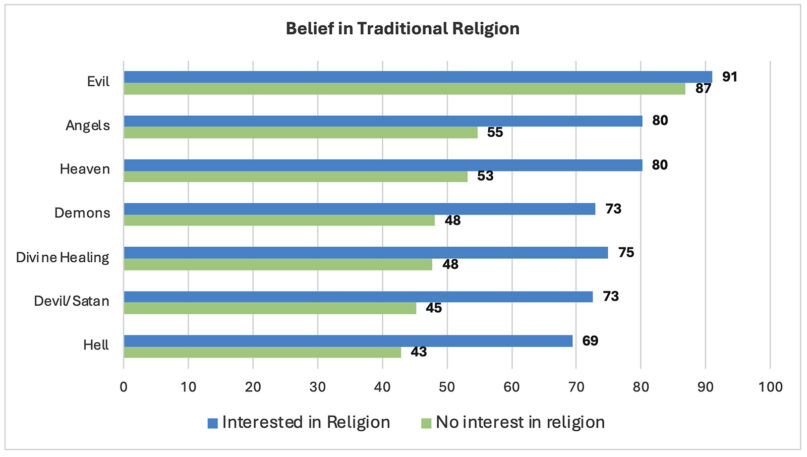


“Belief in Traditional Religion, by interest in religion” (Courtesy of Baylor University)

But similar percentages of both groups believe in ghosts (53% of religion-interested and 50% of religiously indifferent) and the possibility of talking to the dead (48% of religion-interested and 46% of religiously indifferent).

RELATED: Secularism is not atheism. A new book explains why the distinction is so critical.

Jen Buzzelli, 57, a former Catholic who describes herself as “nonreligious and agnostic,” said in an interview that the Baylor findings resonate with her.

“There must be a section of overlap where we share beliefs in our different camps,” she said, adding that she has “a little bit of an open heart” to the inexplicable.

Buzzelli believes in evil and divine healing, and the ability to communicate with the dead, but not in heaven, angels, demons, Satan or hell — all part of the inquiry in the Baylor study, whose survey was written by the university’s scholars and administered by Gallup.

The film and television executive in Brooklyn, New York, describes herself as being fascinated by the 1988 bestseller “Many Lives, Many Masters,” a book by a psychiatrist about past-life therapy, which she read as she grieved her father’s sudden death almost two decades ago.

“It gave me hope to think that his spirit was still alive out there somewhere, and that maybe we will meet again,” said Buzzelli, who also recalled lights flickering or exploding shortly after the time of his death.

“Even though that book wasn’t about heaven or hell or the afterlife, it just showed there’s a whole ’nother realm out there that we don’t know about.”
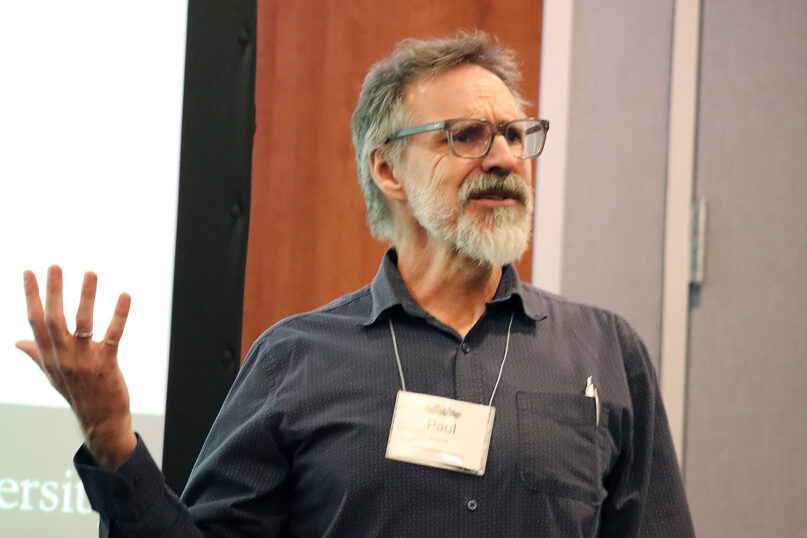


Paul Froese presents to the joint meeting of the Society for the Scientific Study of Religion and the Religious Research Association, Oct. 31, 2025, in Minneapolis. (RNS photo/Adelle M. Banks)

Lila Wilson, also 57, was baptized Catholic but grew up in an agnostic household and attends an Episcopal church service when she visits her mother. Never a Bible reader, Wilson said she gained her understanding of Christianity by reading “The Chronicles of Narnia” as a child.

“My understanding of anything beyond the Earth is sort of amorphous,” said the data analyst from Texas. “So to think we’re putting these structures on that — that seems a little bit off to me.”

Like Buzzelli, Wilson said she began a journey after the loss of a close relative — in her case, her mother-in-law.

“I just was like, where did she go? And I was looking for any way to figure it out,” said Wilson, who met with psychic mediums and has read about and watched documentaries on near-death experiences. Now, she wonders if learning about ghosts and near-death experiences may be a different avenue to achieve what one might through attending church.

“I believe in energy that we don’t understand yet,” Wilson said, noting other people may label that as belief in the paranormal. “That’s my belief system.”
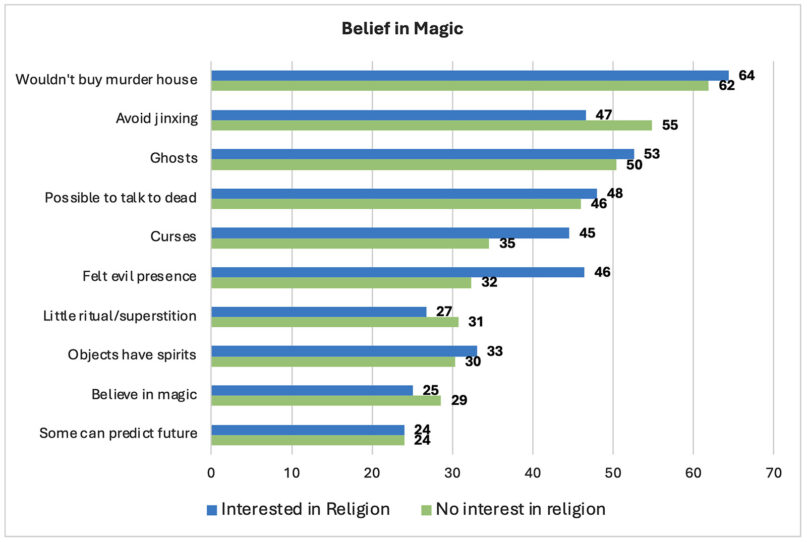


“Belief in Magic, by interest in religion” (Courtesy of Baylor University)

Both Buzzelli and Wilson said they’d have some discomfort buying a house where someone had been murdered.

In a November interview, Froese, director of the Baylor Religion Surveys, said popular characters from the past, such as the 1960s depiction of Mr. Spock on the original “Star Trek” series, may have given the impression that secularity is purely rational and has nothing to do with the supernatural.

“Most people have some sense of some supernatural stuff going on: Superstitions are very routine,” he said. “It’s a continuum. You’re either kind of closer to this secular ideal, or you’re closer … to a religious ideal.”


Froese said the findings may reflect a greater interest in the pursuit of secular, seemingly magical thinking as some move away from traditional religious beliefs around the supernatural. What may have once been labeled “paranormal” by some could become normalized.

“As we see a decline in church membership, we see a decline in trust of church organizations; then we’re seeing a rise of magic,” he said. “And I think part of that has to do with the internet and just, essentially, it’s a much more individualistic, transactional kind of thing. And so, I think that the future is maybe we’re going to have more magic belief and less traditional religious belief.”


‘AI superintelligence regulation is what we owe voters of this generation and those to come’


© everything possible/Shutterstock.com

The Labour Government’s strong view is that AI can transform the lives of Britons for the better. AI can help foster growth; boost productivity; make services and utilities more efficient; unlock cheap energy; and propel medical advances. This is why we are investing in AI infrastructure all across the UK and encouraging adoption across the whole economy. We need AI we can leverage as tools to empower British citizens. But there is a problem – this is not what leading AI companies are aiming for.

Instead, they are rushing to create ever more competent and autonomous AIs that can outcompete humans at most cognitive and economically valuable tasks. This is their explicit end goal – superintelligence, or smarter-than-human AI.

Not only are these smarter-than-human AIs not what we want, but they also pose enormous risks for British citizens. This is because even AI developers do not know how to control AIs that are smarter than them. In a recent blog post, OpenAI wrote that “Although the potential upsides are enormous, we treat the risks of superintelligent systems as potentially catastrophic […]. Obviously, no one should deploy superintelligent systems without being able to robustly align and control them, and this requires more technical work.” Indeed, experts, including the very CEOs of the leading AI companies, warn that advanced AIs pose a risk of human extinction on par with “pandemics and nuclear war.”

Governments have the right and responsibility to protect their citizens from such risks. But what can be done? I recently joined AI experts, policymakers, and public figures in signing an open letter proposing a solution: an international prohibition on the development of superintelligence for the foreseeable future. This would vastly reduce the gravest risks from advanced AI, and redirect the productive energy of the tech sector towards genuinely valuable AI development and applications.

In the face of this pressing challenge, we need principled leaders who will show others the way. The UK is uniquely well placed to lead in negotiating an international agreement on prohibiting the development of superintelligence. Notably, we established the world’s first AI Security Institute, which conducts cutting edge research on AI risks, how to measure them, and what to do about them. It has inspired the creation of institutes modelled after it across the world, including the U.S. Center for AI Standards and Innovation and the Chinese AI Safety Network.

This is why our Manifesto promised to “ensure the safe development and use of AI models by introducing binding regulation on the handful of companies developing the most powerful AI models”.

Unfortunately, because of competing priorities, this issue has not moved as quickly as it needs to. More than a year later, the Government has yet to introduce a Bill in Parliament regulating advanced AIs.

Subscribe here to our daily newsletter roundup of Labour news, analysis and comment– and follow us on BlueskyWhatsAppX and Facebook.

The UK deserves growth. But it deserves the right kind of growth. And we cannot safely leverage AI for growth without regulation on the most advanced systems. So it is time for us to deliver on the promise we made to the British public, and propose regulation that redirects AI companies away from developing uncontrollable superintelligence.

Concretely, this AI Bill can achieve its aim by making the pursuit of superintelligence illegal, and by creating a regulatory regime to monitor development and enforce this prohibition. The AI Security Institute is well positioned to become the regulator of choice, leveraging its wealth of technical expertise. And by targeting specifically the most powerful AI systems, the AI Bill could let specialised and tool-like AI development thrive, which is exactly what we need.

I am not alone in believing this matters.  A coalition of more than 100 cross-party parliamentarians joins me in supporting a statement by the UK non-profit ControlAI that “The UK can secure the benefits and mitigate the risks of AI by delivering on its promise to introduce binding regulation on the most powerful AI systems.”

Whatever shape it takes, AI regulation is not just one more item on the agenda; it is what we owe British citizens now and to safeguard future generations.


Labour’s identity crisis – caught between Blairism and Blue Labour


Photo: Sean Aiden Calderbank/Shutterstock

The problem most tribes in the Labour Party have is that they rarely get to fully define themselves. Choices they make early on, when they are still feeling their way — ones that may have felt trivial or tangential to their mission — come to assume outsized importance. The projections placed upon them by those who either know very little about what their aims are, or who understand and oppose those aims (and so wish to paint them as negatively as possible), can come to define them more strongly than anything they do or say themselves, if they are not vigilant and unrelenting in their own self-definition.

I was thinking about this as I read the fascinating piece by my colleague Daniel Green about the recent ‘in conversation’ event between leading Blue Labour figure Shabana Mahmood and the architect of New Labour, Tony Blair.

There are whole books in existence about both factions — and many more will be written. I return to my first paragraph as a warning that I too will use shorthand when defining what those movements are about: shorthand that will be informed by my own experiences, perceptions and prejudices.

In essence (or shorthand, if you will), New Labour’s belief was in using the free-market economic system they inherited from Thatcher to grow the economy and then better redistribute the results, both directly through measures such as the introduction of the minimum wage, and indirectly through using increased tax receipts (and private funding models) to inject cash into state functions such as schools and hospitals, while reforming how those institutions worked.

Their largely unspoken deal with the left was that they would, at the same time, increase the state’s support for socially liberal values through things like the Human Rights Act, the repeal of Section 28 and the introduction of civil partnerships (which may seem almost quaint now, but at the time were considered a giant leap forward for gay equality), as well as a series of pieces of legislation that first introduced the notion of hate crimes into UK law.

However, New Labour’s economic model died with the 2008 crash.But so dominant had it been that there had been no thinking done throughout the New Labour years about how to pursue a politics of redistribution in a time of scarcity. So all we had left was a model of cuts and a fight over who would introduce those more fairly, Alistair Darling or George Osborne. I would take the former any day – of course. But the orthodox terrain being fought over was very narrow.

Into that breach stepped Blue Labour – a complete inversion of New Labour politics, but one deliberately situated on the old Labour right. This was a politics of strong statism economically, with an equally strong state distaste for social liberalism. Blue Labour came into being at the tail end of the New Labour government and was formed as a reactionary counter to it. Its name, though, almost killed it at birth because, as a piece of marketing shorthand, it is an incredibly poor way to sell the philosophy behind the organisation. It made it sound as though they wanted Labour to be more like the Tories, when economically they were arguing for a break with free market economics.

Labour from 2010 to 2019 was not about building on and moving on from the New Labour years, but about repudiating them. First this came in a gentle rebuke from the soft left in the form of Ed Miliband (who capitalised on Labour members’ understandable disgust at the Iraq War), and then from the hard left under Jeremy Corbyn, who was able to point to the ease with which the Tories (and the Lib Dems) had undone so much of the progress of the New Labour years and argue that this was the result of the shallowness of those changes.

This, in turn, simply led to a full-throated defence of the whole New Labour project from those who felt the rejection of their politics keenly. Then everyone spent about a decade distracted by Brexit and the new political and social fissures it exposed.

So when the wheel turned again and the party moved on from Corbynism, there wasn’t a new set of institutions, policy ideas and political fundamentals from the right of the party that had been developed in response to the challenges of the 21st century. As Starmer has refused to develop such an ideological framework, he has instead been trapped between the ideologies of those who surround him — two opposing camps of old New Labour hands and Blue Labour devotees. It is perhaps this incoherence that has driven many of Labour’s problems in government.

Starmer’s government is often accused of doing ‘un-Labour’ things by those on the left of the party. I don’t think that’s quite right. What they mean is that it is doing things that don’t gel with their particular vision of Labour — socially or economically. But, as they were accused frequently of in the aftermath of the Budget, they are doing things that are quite old Labour in terms of welfare and state provision. That may or may not be to the taste of all members; it may or may not go down well with the public. But it is not un-Labour. Nor, too, is being socially conservative. It’s just not the flavour of Labour in government that we have become used to or that many of us are comfortable with. 

What they aren’t doing is picking an ideology and sticking with it. That might suit Starmer’s distaste for such things, but it is driving the persistent feeling that there is a lack of coherence and consistency. It is exceptionally hard to discipline people for not singing from the same hymn sheet if you refuse to provide the words.

If the powwow between Mahmood and Blair is the start of a reconciliation between New Labour and Blue Labour, it might just have a chance to develop into an ideology that can meet in the middle between the two and move both into a  politics that match the moment we’re in now rather than harking back to a pre-crash past. Or we might end up with the worst of both worlds. I suspect 2026 will provide an answer pretty quickly.

‘Labour needs to regain the narrative from Lib Dems and Reform on Europe’


Photo: Shutterstock

As we reach the tenth anniversary of the 2016 Brexit referendum, we have observed war erupting in Europe with Russia’s illegal invasion of Ukraine, the rise of populist right-wing movements across Europe, and the US stepping back from its role as a hegemonic force.  

With all the geopolitical tension and the sense of a growing polycrisis looming over the world order as we know it, the Labour Party finds itself in a unique position to take an active role in shaping the future.

While the Lib Dems call for us to start arguments with the US that will only lead to more global unrest and hardship for the British public, Labour’s role in diplomacy has been crucial in giving the Western world time to recalibrate after a turbulent year in US and Euro relations. At the same time as the Lib Dems lose all sense of diplomacy, Reform seeks to attack our nation by deliberately trying to stoke tension between the US and the UK by suggesting that the UK is like “North Korea” when giving “evidence” at a US Congressional Hearing in September 2025. 

While it is important to maintain diplomatic relations and a close bond with the US, the UK must assess its independent stance and consider a future where the Western post-war consensus may have broken down beyond repair. Where depending on any single nation for global security becomes irresponsible. The Labour Party faces a critical period where we must forge a way through these challenging times. Slogans, media stunts, and foolishness are not an option for a government, and we as a party need to be confident in our resolve going forward. 

The only way the Labour Party can progress in this evolving environment is by addressing past wrongs. That means Brexit must be tackled, and discussions about a long-term plan for European and EU/UK security should be central to our purpose moving forward. Whilst it is comforting knowing Labour have pledged to reach 3.5 per cent of GDP spending on defence by 2035 – with an extra 1.5 per cent on resilience against online warfare, it is clear that money alone isn’t enough. 

The government need to develop a long-term strategy for strengthening relations with Europe and the EU. This involves reorienting our nuclear weapons programme towards European security, investing in making it truly independent of US control, and granting the UK full autonomy. Additionally, we must address European steel and British steel capabilities in an uncertain global landscape. 

While it is essential for the Labour Party to address our relationship with Europe for security reasons, the UK has paid a heavy cultural price due to Brexit, with many young people considering moving overseas as opportunities and growth decline. The UK’s creative sector has lost an estimated €184 million from the EU “Creative Europe Budget,” with touring barriers and studies showing 47.4% of musicians having fewer EU opportunities and 39% being turned down for work due to visa and cost issues. This attack on the creative industry, which accounts for 15% of all UK service exports, isn’t only damaging to culture but also harms our capacity for economic growth and causes our talented young people to move their skills abroad.

The Labour Party needs to protect jobs, as  a core value of our party that should take precedence over any manifesto pledge. Jobs are what Labour stands for, and if that means going back on the manifesto about freedom of movement or even our future membership of the EU, then that is a price worth paying for Labour’s core values of work and employment. 

The Labour Party needs to be bolder in its approach to the EU, but that isn’t the only bold action the party must take. With the illegal Russian war in Ukraine, Labour must become a true leader on this issue. The coalition of the willing requires us to show genuine commitment by declaring we will push for meaningful negotiations with Russia, Ukraine, and the Coalition, as it is entirely inappropriate to have negotiations about European and Ukrainian security without either one at the table. The era of gesture politics is over and the coalition needs to be more than just words. Failing to take control of the narrative in this war will make Europe less safe, more people will die, and the UK with be weaker. 

There is a strong Labour case for European friendship and close ties both with the EU and the rest of Europe, which goes to the core of what our movement stands for—creating safe and secure jobs; improving social conditions; and fostering solidarity with those around us.

The Lib Dems and Reform fail to grasp these fundamental values, and the Conservatives have abandoned any credible stance on the international stage. It is for the Labour Party to be brave enough to champion the benefits of Europe, emphasising the need for closer European ties for our national and global security, and to champion the future of our national renewal through equitable growth. 

It isn’t too late to reconsider our future, especially in today’s challenging geopolitical world. Changing your mind can be a strength, not a weakness. It is our duty as a party to rewrite the narrative and unite Europe against the rise of the populist right, hate, and war. This is our moral mission and the only way to build a safe and secure Europe from Ukraine to Portugal with the Labour Party and the UK at the centre of it.

Recently, Labour List published an article stating that a third of Labour members want to rejoin the EU, and multiple polls across the nation show a willingness to do so. If the Labour leadership truly wants to put the UK back on the world stage, now is the time to act and become the strong voice of leadership that Europe and the EU needs and that the world expects us to be.

Reform candidate refuses to apologise for saying David Lammy should ‘go home to the Caribbean’

Olivia Barber Yesterday
Reading Time: 2 minutes


Chris Parry would not confirm that the former foreign secretary's “primary loyalty” is to the UK


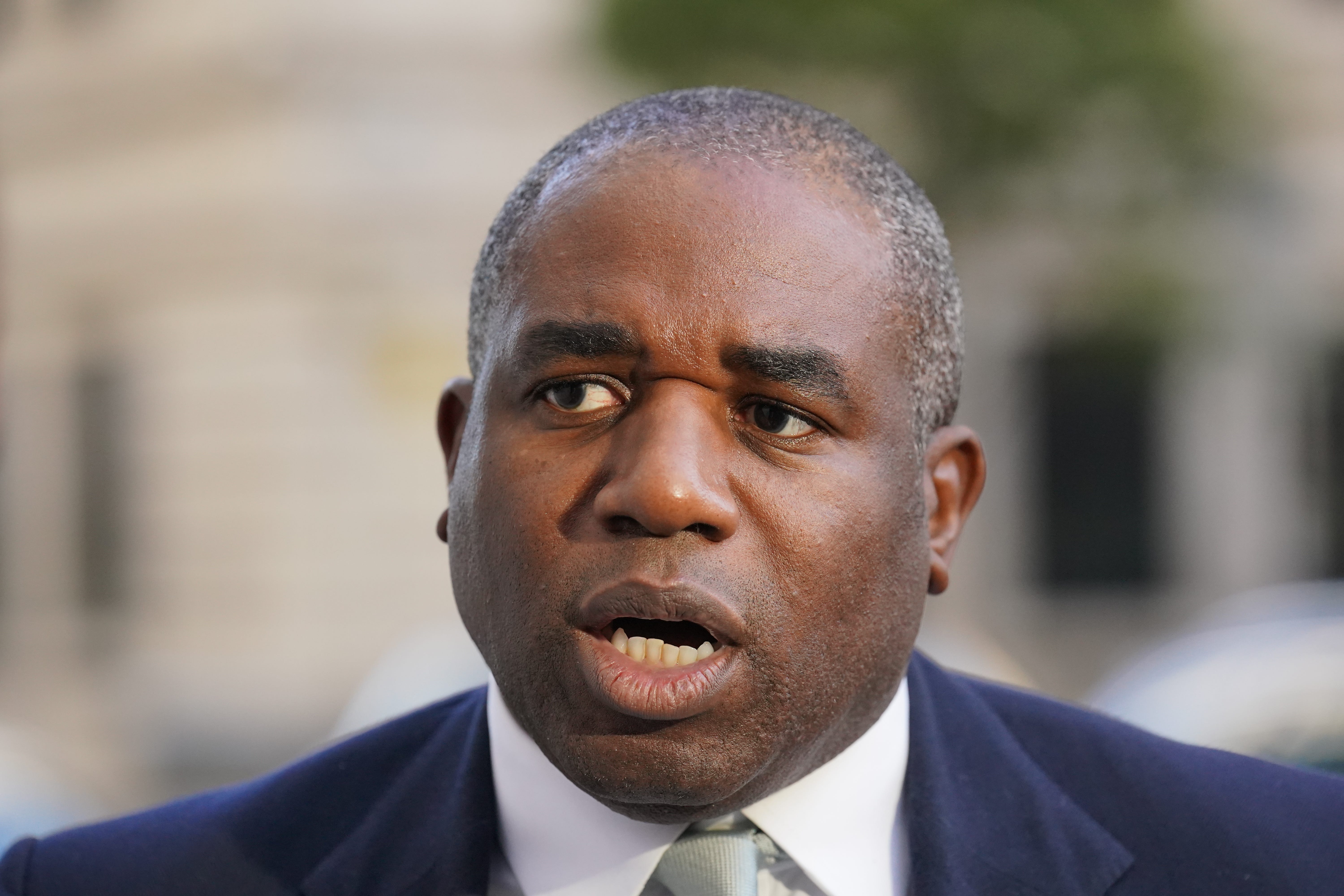
Foreign secretary David Lammy (Jonathan Brady/PA) (PA Archive)

A Reform candidate who said that David Lammy should “go home” to the Caribbean where his “loyalties lie”, has refused to apologise for his remarks.

Chris Parry, a retired Navy admiral and Reform’s candidate for mayor of Hampshire and the Solent, doubled down on his comments in a TalkTV interview, saying that people should “look at the context” they were made in.

He made the comment on X in February, after Lammy said he was “open” to having slavery reparations talks with former British colonies.

Parry claimed that a journalist at a major newspaper has “a bit of an obsession about this”, adding “you really shouldn’t believe everything you read in the newspapers”.

In response, TalkTV’s Peter Cardwell asked him: “Did you write it, did you write that?”.

The Reform candidate responded: “I’m not going to talk about it, people should go to Twitter and see what was written and the context in which it happened.”

He added: “All I’m saying is that if you’re the foreign secretary of this country, your primary loyalty must be to this country.”

Lammy was the foreign secretary between July 2024 to September 2025, and is now the justice secretary.

Cardwell asked: “Do you believe his primary loyalty is to this country? Because he was born in this country, his parents weren’t of course.”

Parry refused to say whether Lammy’s primary loyalty is to the UK, and instead answered: “Ask him.”

Reform is facing calls from Labour, including MP Calvin Bailey to sack him as their candidate due to his “vile” comments.

Labour chair Anna Turley said: “No matter what Reform’s senior leadership say, telling a black British man from London to ‘go home to the Caribbean’ is racist, and no ‘context’ can excuse it.”

Parry has also used the sexist term ‘harpy’ to refer to several female Cabinet ministers including the chancellor Rachel Reeves.

Olivia Barber is a reporter at Left Foot Forward

UK

‘Labour’s blind spot on rents is becoming a political liability’


When Olivia, a surveyor, first moved into her flat in Manchester in 2020, her rent was £750 a month. The home was “very basic”, but she was happy to have her own place. But in just five years her landlord has raised her rent to £1100, an almost 50% increase, despite not improving the home.

Incensed at her latest rent rise, Olivia did some digging into the man who owns her home and found out he doesn’t have a mortgage to pay off. “It’s profiteering, pure and simple” she says. Having to spend more and more of her income on rent has left her hopeless: “Despite having a good job, my rent means I simply can’t save for my own home. It’s a deterrent to work hard because what’s the point?” 

Unfortunately, Olivia’s story is all too common for private renters across the country. A July 2025 report from the property website Rightmove found the average monthly rent a new tenant faces paying is £417 more than in 2020. This is around £1,200 a year more than average wages have increased in the same time period. It’s therefore no surprise that, on average, we renters spend over 36% of our income on rent. This figure jumps to well over 40% in places like London and Bristol.

READ MORE: One in five Labour members see Greens as biggest electoral threat

The government’s Renters’ Rights Act, which comes into force in May 2026, will be a vital first step in addressing the power imbalance between renters and landlords. But, the glaring hole in the law is that it does not tackle the soaring cost of renting. 

Ministers have repeatedly cited the government’s ambitious housebuilding programme as the best way to bring rents down. However, Generation Rent’s modelling found that, even if the Government meets its target of building 1.5 million new homes, this will reduce rent inflation in England by just 1.8 percentage points. This analysis is based on a large share of these homes being for social rent, which has already come under threat as affordable housing targets for developments in London have since been significantly watered down. 

At Generation Rent, we believe a common sense solution to this problem is a cap on how much landlords can raise the rent, linked to the lower of inflation or wage growth. This would protect renters from sudden, unaffordable rent hikes, while still giving landlords room to raise the rent modestly in line with inflation. 

We recently urged parliament to seize the opportunity of the English Devolution and Community Empowerment Bill to allow Mayors of combined authorities to introduce limits on rent increases in their areas. Sadiq Khan has said this power is “top of his list” of what he wants from the government, while Andy Burnham has also called for them in the past. However, we were told that introducing rent caps were out of scope of the bill. 

But kicking the can down the road on this issue could lead to a real headache for the government as the next election looms. Private renters were the most likely tenure type to vote for Labour in 2024. Meanwhile, recent YouGov polling found Labour is losing twice as much support to parties on the left than on the right, with research from the Joseph Rowntree Foundation finding economic insecurity is the key factor in people switching away from Labour. With Green Leader Zack Polanski enthusiastically supporting rent controls, polling shows the Greens have already taken one sixth of Labour’s support from the last election and are likely to win many traditionally Labour seats in urban areas.

Subscribe here to our daily newsletter roundup of Labour news, analysis and comment– and follow us on BlueskyWhatsAppX and Facebook.

Keir Starmer has been clear that this is a government for working people. But its opposition to put a common sense limit on rent increases is tying his own hands.

Starmer categorically said that people who receive additional income from assets such as property wouldn’t come within his definition of working people. Half of private renters have no savings whatsoever, while the vast majority are working. Meanwhile, just 42% of landlords declare mortgage interest payments on their tax returns, meaning close to three in five, like Olivia’s landlord, don’t have a mortgage. Furthermore, according to the latest Private Landlord Survey, two thirds are retired and only three in 10 are in full-time employment.

Unchecked rents are leading to a huge transfer of wealth from traditionally Labour voting younger, working people to more conservative leaning asset rich people. A household paying the average rent in London will send over £100,000 to their landlord in just four years. In the main, this is money that is sucked out of the economy, with 56% of landlords saying they use their income to invest in their own pension.

Labour entered government on a landslide in 2024. But  each month, renters up and down the country continue to send a huge chunk of their income to a landlord who they may have never met. For renters like Olivia, alongside millions of others across the country, it creates a sense of hopelessness, of an economic system that is rigged against us.

Five Brent Labour councillors quit party and defect to Greens


Five Labour councillors in Brent have resigned from the party and defected to the Greens.

The councillors, including a former council cabinet member and the Labour group’s former chief whip, accused Keir Starmer of a lack of ambition to deliver change, and criticised the government for “copying far-right policy and rhetoric on migration”, being “complicit” in the war in Gaza and for “silencing internal debate dissent”.

Iman Ahmadi Moghaddam, Harbi Farah, Mary Mitchell, Tony Ethapemi and Erica Gbajumo have joined Green Party leader Zack Polanski at a press conference in Wembley to announce their decision.

Polanski claimed that “good Labour councillors” could see the party had abandoned progressive politics “in its doomed attempt to out-Reform Reform”.

Ahmadi Moghaddam, who served as chief whip until the defection, said: “I joined Labour to build a fairer society, but Starmer’s government has abandoned any ambition to change the system. This government has doubled down on austerity whilst the cost of living devastates families, sides with big developers instead of fixing Brent’s housing crisis and scapegoats migrants to distract from its own failures. While Israel commits genocide in Gaza, this government arms the perpetrators and criminalises peaceful protest.”

‘My values have not changed, the party has’

Farah, who previously served as a cabinet leader for safer communities, said that, while he joined Labour because it “represented the ideals of social justice, equality and collective well-being”,  she now felt an “overwhelming and accumulating sense of disappointment”.

He said: “We were offered a transformative agenda, a genuine shift in power dynamics, but time and again, when faced with political headwinds or internal pressures, those commitments seemed to vanish, such as welfare reform, scapegoating immigrants, the race to the far right, scrapping jury trials and silencing internal debate dissent.

“I am leaving the Labour Party because my values have not changed, the party has. I still believe in a society structured around solidarity and genuine systemic change. I am a socialist, and I seek a political home that unambiguously champions these ideals.”

It comes after dozens of Labour councillors across the country have quit the party or defected in protest against different decisions being made by the government in Westminster.

‘Labour in Brent has focused on delivery rather than posturing’

A London Labour spokesperson told LabourList: “Zack Polanski has today announced a slate of Green councillor candidates in Brent. For the avoidance of doubt, all but one of the individuals unveiled were not selected to stand for the Labour Party at the next election, as they fell below the standards we require of those seeking to represent Labour.

“The Labour Party operates rigorous and transparent selection processes and maintains the highest standards for its candidates. Mr Polanski’s approach suggests a far lower bar for entry, raising serious questions about the level of scrutiny and judgment applied in the Green Party.

“In contrast, Labour in Brent has focused on delivery rather than posturing. Through the Cost-of-Living Advice Hub and Resident Support Fund, we have provided direct help with bills, food, debt and employment at a time of real pressure for families. We are delivering 5,000 genuinely affordable homes by 2028, including new council homes, tackling the housing crisis head-on. Backed by £1.5 million of Pride in Place funding from a Labour government, we are investing in town centres, high streets and neighbourhoods that residents are proud of.

“We look forward to the 2026 local elections, where we will stand on a proud record of delivery and on our work hand in hand with a Labour mayor and a Labour national government to deliver for the people of Brent.”

Keir Starmer’s self-inflicted ‘nightmare’


December 16, 2025

“Nightmare for Keir Starmer as he’s hit by five Labour defections,” headlined the Daily Express.  Five councillors in the London borough of Brent have defected from Labour to the Greens and Green Party leader Zack Polanski says his party is ready to “bury” Labour at next year’s local elections as he welcomed them.

Another Campaign Improvement Board disaster

Four of the five councillors were barred by Labour from running again in 2026 after the Party instituted a ‘Campaign Improvement Board’ to replace the local Party’s usual democratic selection process. Normally, Labour allows local branches to select its candidates, but this time the Board interviewed the would-be candidates and then either approved or barred them from standing. The process was rubber-stamped by Labour’s National executive Committee, with no right of appeal.

This controversial and undemocratic process has been used elsewhere, most notoriously in Leicester. A Campaign Improvement Board was set up there ahead of the 2023 city council elections, and local Party members were denied the opportunity to select their candidates. Nineteen sitting councillors were barred, including all the Hindu councillors, and a high proportion of BAME councillors. The demoralisation and disgust at these manoeuvres meant the Party lost 22 seats in the subsequent election. In the 2024 general election, Leicester East was the only Tory gain from Labour in the entire country and Leicester South was won by an Independent.

Notwithstanding the damage done, a similar process was imposed on Brent earlier this year. Eight sitting councillors were excluded. All of them had signed a statement calling for a ceasefire in Gaza in October 2023. All eight were from minoritised communities.

The flimsy justifications for the top- down process, such as alleged concerns over the previous selection process in 2022, look absurd, given that all steps in that process were fully coordinated with and signed off by regional Party officials. Instead, the entire exercise smacks of a factional strike against councillors who are out of step with the increasingly right wing politics of the Party’s national leadership.

Statements from those leaving

Yesterday, four of the sitting councillors, along with one who was not barred by Labour from re-standing, announced they were leaving the Party to join the Greens. A statement from the group said: “Like thousands of others, we joined the Labour Party because we believed in building a fairer society. As councillors, we took that mission into Brent, determined to stand up for the people who placed their trust in us…

“We have now come to the realisation that we can no longer play that role effectively while remaining within the Labour Party. We always knew being a party of government would put the principles and values of the party to the test, but we have watched as on every issue this government goes further away from the founding Labour Party principles of democracy, social justice and equality…

“We did not enter public life to serve a party machine – we entered it to serve our residents and we will not abandon that duty. That is why we are today resigning our membership of the Labour Party, and joining the Green Party, becoming the first Green Group of Councillors in Brent…

“We invite all who share this vision to work with us in offering Brent a real alternative. Together, we can build a Brent that puts people before profit, public good before private greed and hope before fear.”

 The councillors, including a former council Cabinet member and the Labour group’s former chief whip, accused Keir Starmer of a lack of ambition to deliver change, and criticised the government for “copying far-right policy and rhetoric on migration”, being “complicit” in the war in Gaza and for “silencing internal debate dissent”.

In a personal statement, Iman Ahmadi Moghaddam, who served as the Labour group’s chief whip until his defection, said: “I have given thousands of hours of my life to this party – knocking doors, delivering leaflets, recruiting members, volunteering at conference, facilitating meetings, giving presentations, and taking on countless other roles. I did this because I believed Labour, in government, could deliver meaningful change and move us towards a fairer society rooted in socialist values.

“I stayed even when I disagreed with decisions taken locally or nationally. I stayed while experiencing bullying, racism and Islamophobia that many long-standing members will recognise. I stayed because I believed that, ultimately, Labour’s success would be in the service of the people we exist to represent.

“But it has become impossible to ignore the reality that Labour has already left the principles that brought many of us into public life. Remaining a Labour member no longer feels like a route to change, and increasingly feels actively harmful.

“Under Keir Starmer, Labour has abandoned any serious ambition to transform society. It has embraced austerity during a cost-of-living crisis, sided with big developers and corporate interests, and hollowed out internal democracy so that dissent is punished and conscience is treated as a liability. The party is now dominated by a narrow, self-serving clique more concerned with control and careerism than with delivering real change.

“This is clearest on Gaza. What is taking place is a genocide, with British roots and ongoing British involvement through arms sales and the criminalisation of peaceful protest. Members and elected representatives who have spoken out (from a position of basic human decency) have been bullied, suspended or silenced. I include myself among them.

“At the same time, the leadership has chosen to pander to the far right by scapegoating migrants and stoking division to mask its own economic failures. This is not only a betrayal of Labour’s values; it actively legitimises forces that threaten our communities and our democracy.

“There remain many members, Councillors and MPs in Labour who are principled, well-intentioned and committed to socialist values. Many of you will read this. This statement is not written in anger towards you, but in sadness at what the party has become.”

Councillor Mary Mitchell said: “The Labour Party has left the values that I stand for, and what the Party historically has stood for and achieved. 

“In copying far-right policy and rhetoric on migration, scrapping jury trials and the draconian policing of protest, we have seen the Labour Party move to the right.  

“In downgrading investment in the energy transition and deepening fossil-fuel interests, the party has gone against manifesto promises on tackling climate change and nature depletion.  

“The appalling complicity in Israel’s genocidal actions in Gaza and suspension from the party of those who call this out is a stain on Labour’s historic record of free speech and human rights advocacy.”

Cllr Harbi Farah, former Cabinet Leader for Safer Communities, said: “I am leaving the Labour Party because my values have not changed; the party has. I still believe in a society structured around solidarity and genuine systemic change. I am a socialist, and I seek a political home that unambiguously champions these ideals.”

All the defecting councillors criticised the restrictive internal culture of the Labour Party that had abandoned its former inclusivity and openness.

Consequences

 A London Labour spokesperson responded to the defections, saying: “For the avoidance of doubt, all but one of the individuals unveiled were not selected to stand for the Labour Party at the next election, as they fell below the standards we require of those seeking to represent Labour. The Labour Party operates rigorous and transparent selection processes and maintains the highest standards for its candidates.”

Most local members would disagree. There was no transparent selection process for the 2026 local elections – it was replaced by a secretive, factional operation that carved out a number of excellent councillors, many of whom enjoyed wholehearted support from their local members.

Brent councillor Shama Tatler is widely thought to have had a hand in this undemocratic process, as she did in the Leicester carve-up. She has now been rewarded with a peerage, as one of the 25 Labour nominees to the House of Lords last week. The list was one of the most narrowly factional in many years – it includes Geeta Nargund, the mother of the failed Labour candidate who ran against Jeremy Corbyn in Islington North last year – she runs a private fertility clinic.

One of the ostensible justifications for imposing a Campaign Improvement Board on Brent Labour Party was the significant drop in Labour’s vote share and the problem of left-leaning voters migrating to the Greens or independents. The consequence of the whole shoddy process is that this trend is likely to accelerate.

Brent Labour has a massive majority in Brent, but the Party’s national unpopularity is unprecedented. Locally, the Greens and Lib Dems are campaigning hard and upsets are expected across the capital next year: Brent is not the only borough experiencing defections from Labour.

The upshot is that politics for the foreseeable future is likely to get unusually messy, with a number of credible parties fielding progressive candidates.  October’s Caerphilly byelection showed that in the right circumstances, progressive voters can find a way to defeat both Reform and their imitators within Labour, in that case voting for Plaid Cymru. This historic loss for Labour, it should be remembered, was again the result of factional interference in the local selection process, where an experienced and popular local councillor was barred from running on spurious grounds.

It wouldn’t be surprising if the narrow faction currently in control of the Party sees the latest resignations as a positive, given their utter hatred of the left.  If this proves to be a “nightmare” for Keir Starmer, it’s very much a self-inflicted one.

Image: Source: This W3C-unspecified vector image was created with Adobe IllustratorThis SVG file was uploaded with Commonist. This vector image includes elements that have been taken or adapted from this file: Greater London UK location map 2.svg (by Nilfanion). Author: TUBS, licensed under the Creative Commons Attribution-Share Alike 3.0 Unported license.