Saturday, December 20, 2025

Guyana Is Using Its Oil Revenues to Spark a Renewable Energy Boom

  • Guyana is reinvesting oil revenues into solar, hydro, and other renewables as part of a strategy to reach 80 percent renewable electricity by 2040.

  • United Nations-backed initiatives are supporting workforce training, solar infrastructure, and equitable participation in the energy transition.

  • Small-scale but expanding renewable projects signal an effort to diversify the energy mix early in Guyana’s emergence as a global oil producer.


Since the discovery of vast oil reserves in Guyana around a decade ago, the South American country’s oil industry has grown significantly following investment from several international oil majors and the beginning of offshore production. As Guyana begins to see the revenue from its black gold, the government is reinvesting some of the money in renewables to diversify the energy mix and strengthen the country’s energy security. Guyana’s government aims to achieve 80 percent renewable energy in the electricity grid by 2040.

In February, the United Nations (UN) in Guyana announced the launch of the Just Energy Transition (JET) Seed Funding Initiative with financing from the Joint Sustainable Development Goals (SDGs) Fund. The initiative will provide funding to help Guyana undergo a green transition by implementing its Low Carbon Development Strategy (LCDS) 2030. Investments will be made in expanding Guyana’s renewable energy capacity and promoting sustainable mobility. The UN will also provide technical and policy support. 

The initiative will support the development of three solar-powered EV charging stations in strategic locations and the delivery of a technical training programme to develop a Guyanese workforce in the renewable energy sector. The UN aims to use the initiative to empower youth, women, and marginalized groups and ensure equitable access to opportunities. 

The UN Development Programme’s Officer-in-Charge, Nadira Balram, stated, “The anticipated impact of this initiative is far-reaching. This initiative will create jobs and new economic opportunities. By equipping a new generation of technicians with specialised skills, we are fostering a workforce that is prepared for the transition to a green economy.”

At the national level, the President of Guyana, Mohamed Irfaan Ali, said in a recent interview with The New York Times Magazine that Guyana is using its newfound oil revenues to drive a green transition. 

“Guyana is a new oil producer, but we are using the resource to finance our energy transition, to build resilient infrastructure, to support the region that we are in, to invest in livelihood options that will keep our forest standing, which stores many gigatonnes of carbon,” said Irfaan Ali. “We’re investing in solar farms, hydro, natural gas, wind and biomass, all aimed at transitioning to a low-emission energy grid. We are building off-grid systems, solar farms, and wind farms for the hinterland community, where the Indigenous people live.”

One of the renewable energy industries that Guyana is looking to advance is solar power. Several companies have shown interest in the country’s solar potential, with multiple new solar projects expected to launch in the coming years. The government has gradually been expanding its solar energy capacity, with around 4.8 MW of solar power having been installed under the Solar Photovoltaic (PV) Home Energy Systems. The off-grid solar power project launched in 2023 and aims to expand clean electricity access in the hinterland and riverine communities of the country that do not have access to the national grid. The government aims to supply and deliver 30,000 solar PV home energy units as part of the scheme. 

In August, the Guyana Energy Agency commissioned a 0.6 MW grid-forming solar farm on the island of Leguan, at a cost of $1.4 million. The project will include a 1.2 MWh battery energy storage system. This follows the installation of a similar solar power system on Wakenaam Island in 2023 and is aimed at providing rural populations with greater energy security. 

In November, the Indian green energy firm Oriana Power Limited announced it had been approved by the Guyana Energy Agency to develop a solar energy project in Guyana consisting of the design, supply, installation, and commissioning of a 3 MW grid-tied solar PV system at the Cheddi Jagan International Airport. The contract is valued at almost $2.5 million, and it is expected to be completed within three years. 

In July, the government commissioned a 1.5 MW hydropower project, the Kumu plant, in Lethem. This follows the development of the 0.7 MW Moco Moco Hydropower Plant. While Guyana’s hydropower projects are relatively small-scale, the gradual development of the industry demonstrates the government’s commitment to diversifying Guyana’s energy mix. 

Prime Minister Mark Phillips stated, “From 2020 to now, we’ve delivered 14.5 megawatts of renewable energy through solar and hydro projects. Today’s commissioning of the 1.5 MW Kumu Hydropower Station builds on that foundation, expanding our renewable energy portfolio while improving quality of life for residents in Region Nine.” 

Guyana has transformed from a little-known South American country that was highly dependent on fossil fuel imports less than a decade ago to a growing global oil power. The exploitation of its oil resources is allowing the government to increase spending on green energy to diversify the country’s energy mix from the outset, a feat that has not been possible in most oil-rich countries. Meanwhile, additional technical and funding support from the UN is expected to help Guyana diversify its energy mix and enhance its energy security in the coming years. 

By Felicity Bradstock for Oilprice.com

Beetles block mining of Europe’s biggest rare earths deposit


By AFP
December 20, 2025


The Fensfeltet treasure has an estimated 8.8 million tonnes of rare earths - Copyright GETTY IMAGES NORTH AMERICA/AFP/File Drew Angerer

Pierre-Henry DESHAYES

As Europe seeks to curb its dependence on China for rare earths, plans to mine the continent’s biggest deposit have hit a roadblock over fears that mining operations could harm endangered beetles, mosses and mushrooms.

A two-hour drive southwest of Oslo, in the former mining community of Ulefoss home to 2,000 people, lies the Fensfeltet treasure: an estimated 8.8 million tonnes of rare earths.

These elements, used to make magnets crucial to the auto, electronics and defence industries, have been defined by the European Union as critical raw materials.

“You have rare earths in your pocket when you carry a smartphone,” said Tor Espen Simonsen, a local official at Rare Earths Norway, the company that owns the extraction rights.

“You’re driving with rare earths when you’re at the wheel of an electric car, and you need rare earths to make defence materiel like F-35 jets,” he added.

“Today, European industry imports almost all of the rare earths it needs — 98 percent — from one single country: China,” he added.

“We are therefore in a situation where Europe must procure more of these raw materials on its own,” he said.

In its Critical Raw Materials Act (CRMA) aimed at securing Europe’s supply, the EU has set as an objective that at least 10 percent of its needs should be extracted within the bloc by 2030.

No rare earth deposits are currently being mined in Europe.


– ‘Rush slowly’ –


Due to environmental concerns, Rare Earths Norway has already been forced to push back its schedule. Now it aims to begin mining in the first half of the 2030s.

Its so-called “invisible mine” project is intended to limit the mine’s environmental footprint. It plans to use underground extraction and crushing — as opposed to an open-pit mine — and re-inject a large part of the mining residue.

But the location of the mineral processing park, where ore extracted underground would be handled and pre-processed, has posed a problem.

The company had planned to transport the minerals on an underground conveyor belt emerging above ground behind a hill, in an area out of sight from the town and largely covered by ancient natural forests, rich in biodiversity.

But experts who examined that site found 78 fauna and flora species on Norway’s “red list” — species at risk of extinction to varying degrees. They included saproxylic beetles (which depend on deadwood), wych elms, common ash trees, 40 types of mushrooms, and various mosses.

As a result, the county governor formally opposed the location during a recent consultation process.

Adding to concerns was the fact that disposing of waste rock would take place within a protected water system.

“We need to start mining as quickly as possible so we can bypass polluting value chains originating in China,” said Martin Molvaer, an adviser at Bellona, a Norwegian tech-focused environmental NGO.

“But things should not move so quickly that we destroy a large part of nature in the process: we must therefore rush slowly,” he said.


– ‘Lesser of two evils’ –


Faced with such objections, the municipality has been forced to review the plans and take a closer look at alternate locations for the above-ground part of the mine.

While there is another less environmentally sensitive zone, neither the mining developers nor the local population favour it.

“We accept that we will have to sacrifice a significant part of our nature,” local mayor Linda Thorstensen said.

“It comes down to choosing the lesser of two evils.”

Thorstensen supports the mine project, given the small town has seen jobs and young people move elsewhere for decades. It is “a new adventure”, she said.

“A lot of people live outside the job market, many receive social welfare assistance or disability pensions. So we need jobs and opportunities,” she said.

In the almost-empty streets of Ulefoss, locals were cautiously optimistic.

“We want a dynamic that makes it possible for us to become wealthy, so that the community benefits. We need money and more residents,” Inger Norendal, a 70-year-old retired teacher, told AFP.

“But mining obviously has its downsides too.”


China’s rare earths El Dorado gives strategic edge


By AFP
December 20, 2025


The hills of Jiangxi province are home to most of China's rare earth mines - Copyright AFP Hector RETAMAL

Peter CATTERALL

Buried in the reddish soil of southern China lies latent power: one of the largest clusters of crucial rare earths is mined around the clock by a secretive and heavily guarded industry.

The hills of Jiangxi province are home to most of China’s rare earth mines, with the materials used in a wide range of products including smartphones and missile guidance technology.

The flourishing industry is closely protected by Chinese authorities and media access is seldom granted.

In a rare visit to the region last month, AFP journalists were trailed and monitored by minders who declined to identify themselves. Companies did not accept requests for interviews.

Business has been booming: the number of rare earth processing points in China observed by the US Geological Survey jumped from 117 in 2010 to 2,057 by 2017. Most of the 3,085 nationwide recorded by the USGS today are clustered in the hills of Jiangxi.

Locals there told AFP that one rare earths mine was maintaining near-constant operations.

“It’s busy 24 hours a day, seven days a week,” a resident in the town of Banshi said.

Nearby, construction work was getting started for the day on a vast new industrial park housing facilities including rare earth processing sites.

The bustling mining region is the result of a decades-long push by Beijing to build up its might in the strategic sector.

Those efforts paid off this year, with a tentative truce in a trade war with the United States reached when China relaxed stringent export controls on rare earths.

Washington is now racing to establish alternative supply chains, but experts warn such efforts will take years.

In a sign of deepening concern among other Western governments, the European Union announced new measures this month to reduce the bloc’s dependence on China for securing the critical minerals.

The bloc said it would earmark nearly three billion euros ($3.5 billion) to support projects in mining, refining and recycling vital materials, and proposed the creation of an EU supply hub — the European Centre for Critical Raw Materials.


– Heavy metal –


“The Middle East has oil, China has rare earths,” former Chinese leader Deng Xiaoping said in a 1992 speech.

Since then, China has taken advantage of its natural reserves — the largest of any country — to dominate processing and innovation in the field.

The country’s rare earths industry is concentrated in two main hubs.

One is the Inner Mongolia region’s Bayan Obo mining district on the edge of the Gobi Desert, which is rich in “light” rare earths used for magnets in everyday items.

The other hub, around the city of Ganzhou in Jiangxi, specialises in “heavy” rare earths — harder to extract but more valuable because of their use in heat-resistant magnets, fighter jet engines, missile guidance systems and lasers.

The rugged hills surrounding Ganzhou are home to the world’s largest mining and processing operations of the strategic “heavy” elements, including dysprosium, yttrium and terbium.

And in the county-level district of Longnan alone, USGS counted 886 such locations, accounting for 31.5 percent of Jiangxi’s total.

An AFP team in Longnan saw rows of large rare earths processing plants in an industrial district adjacent to that dense smattering of extraction sites.


– ‘Moving mountains’ –


Heavy rare earths are formed over millions of years, as rainfall weathers igneous rocks, breaking them down and leaving elements concentrated near the surface.

Jiangxi’s gentle slopes, high rainfall and natural stone make it a prime location for such elements.

Mining methods in the region have evolved throughout the decades.

Authorities have criticised highly destructive approaches and cracked down on what they call “chaotic extraction” since the early 2010s.

One method — termed “moving mountains” — was described in 2015 by China’s top industry and technology regulator as “first cutting down trees, then clearing weeds and finally stripping away the topsoil, causing irreparable damage”.

Unlicensed mining has been drastically reduced over time.

Large signs in rural areas now warn against illegal extraction of rare earth resources. Others offer cash rewards for reporting such actions.

The industry has been largely consolidated into two huge state-owned companies.

On a Ganzhou street dubbed “Rare Earth Avenue”, construction workers bustled to complete a sprawling new headquarters for one of those giants, China Rare Earth Group.

But the province’s hills still bear the scars of bygone mining practices, with bare patches of red soil visible where vegetation has struggled to regrow.

Trump EPA Plan Would Restrict Public’s Right to Know About Climate Pollution


“The problems don’t go away when the reporting goes away,” says the Corporate Toxics Information Project’s co-director.

By C.J. Polychroniou
Truthout
December 20, 2025

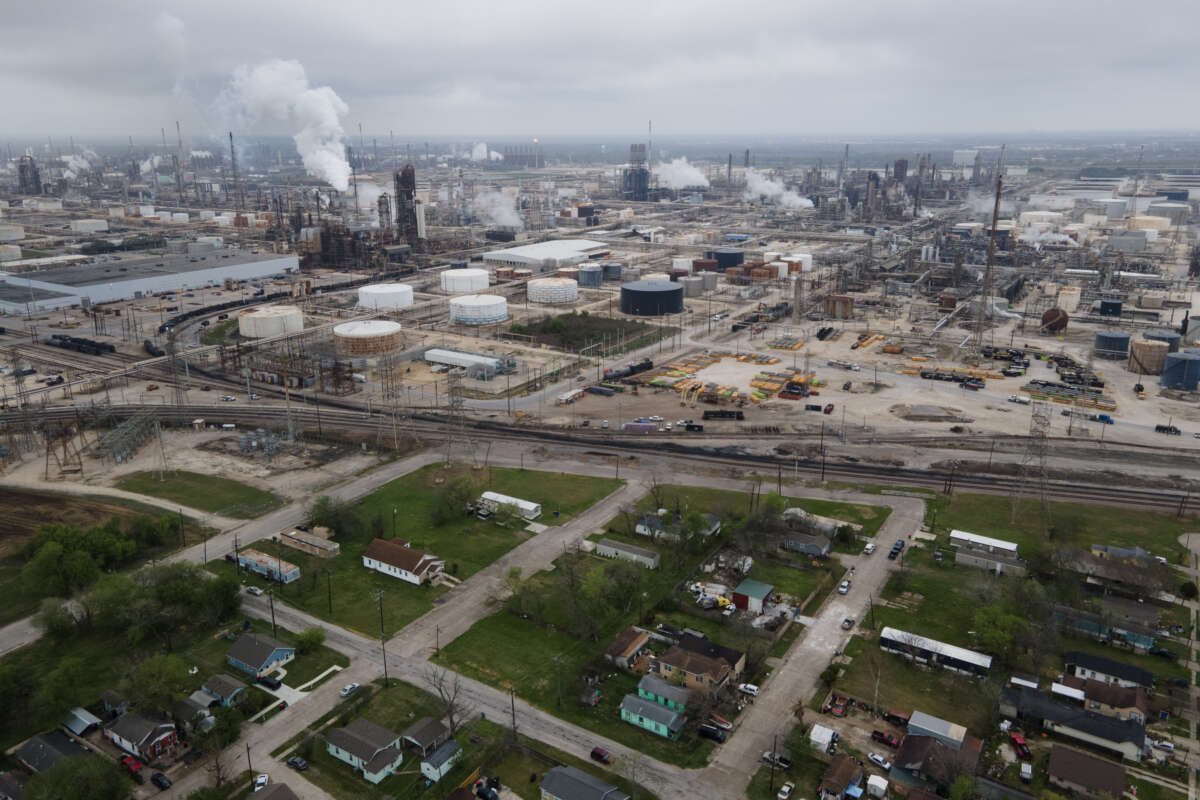
The ExxonMobil Baytown Refinery in Baytown, Texas, on March 2, 2023.Mark Felix for The Washington Post via Getty Images


Since 2010, the Environmental Protection Agency (EPA) has required large industrial facilities to report their greenhouse gas emissions. The data, which the EPA’s Greenhouse Gas Reporting Program has been collecting since 2011, is essential in efforts to reduce emissions and provides vital information to the public about climate pollution from the largest U.S. polluters. However, the Trump EPA has proposed to put an end to greenhouse gas reporting by major polluters. This move is consistent with the Trump administration’s intent to make climate denial an official U.S. policy and restricts the public from the right to know. Subsequently, it will deprive communities from having access to a critical tool for holding pollutants accountable.

Researchers at the Political Economy Research Institute (PERI) at the University of Massachusetts Amherst have been using EPA data for many years now to rank the top U.S. polluters and disseminate vital information to the public. They publish their findings annually and have just released the 2025 edition of Greenhouse Gas Emissions Index. In the interview that follows, Michael Ash, professor of economics and public policy and co-director of PERI’s Corporate Toxics Information Project, shares the latest data on the top U.S. climate pollutants and discusses the consequences of the potential end of EPA’s Greenhouse Gas Reporting Program in the fight against climate change and climate justice.

C.J. Polychroniou: For many years now, the Political Economy Research Institute (PERI) at the University of Massachusetts Amherst has been providing a valuable service to public interest in general and to activists in particular by collecting and releasing information and analysis on corporate pollution and greenhouse gas emissions through its Corporate Toxics Information Project. Last month, the 2025 edition of Greenhouse Gas Emissions Index was published, using the latest data available from the U.S. Environmental Protection Agency’s Greenhouse Gas Reporting Program. The index takes on new significance since the EPA has announced plans to end the program, which amounts to an erosion of the people’s right to know. But before we get to that, what does the new edition of Greenhouse Gas Emissions Index look like? Which corporations are the top climate polluters in the country, and have there been any significant changes in total emissions and rankings from last year


Michael Ash: The top of the list remains similar; the biggest point emitters of greenhouse gases are the electrical power companies that burn fossil fuels to generate electricity. Topping the list are Vistra Energy, Southern Company, and Duke Energy. Their combined 235 million metric tons of CO2 equivalent emissions made up just under 4 percent of all U.S. contributions to climate change that year (including all sources, such as automobiles, airplanes, and home heating, not just industrial emitters). Again, the top of the list are the fossil electricity generators. Next come the major oil refiners and petrochemical processors, such as Exxon Mobil (at the number 7 spot); and that is only accounting for the direct releases from their facilities, not the releases from the fuels that they bring into the economy. (For that, see our companion list of Toxic 100 Suppliers.)

This list has been stable for some years; a company may move up or down by a position or two based on acquisitions or sales of facilities, but the list is entirely recognizable from year to year.


Trump’s Second Term Dispels Any Notion of CEOs Saving Us From Climate Crisis
Corporate actors have shed any pretense of climate action and now openly back Trump’s doubling down on fossil fuels. By Derek Seidman , Truthout  November 28, 2025


In which states do companies emit the most heat-trapping gas that feeds climate change, and which corporations have the highest share of residents of color living close to their polluting facilities?

We have prepared state-specific lists of greenhouse gas releasers. We stay at the company level, because the company is the crucial decision-making unit, but in each state, we rank companies based on the facilities they own in the state. The big petro states, Texas and Louisiana, top the list, by quite a lot. Fossil electricity generation is widespread; so almost everywhere has a share. A petroleum-processing industry can make individual states stand out. For example California is near the top of the state list (at number 7) because of large refineries; the top five greenhouse-gas-releasing facilities in the state are refineries owned by Marathon Petroleum, Chevron, Valero, and PBF energy, even though the electricity sector as a whole is responsible for more greenhouse gas releases in California.

We think that the state listings are particularly important in this era of diminished local news capacity. This is the type of inquiry that local news sources might pursue in the public interest.

In addition to the absolute impact rankings, we also take a look at the share of people of color living near companies’ pollution-emitting facilities. At first glance, it might seem odd to look at local populations when greenhouse gas emissions are a global problem, but almost all the greenhouse gas emissions we examine are from combustion and, hence, coupled with the release of local pollutants. These local pollutants that come with the greenhouse gases are called co-pollutants, including sulfur oxides, nitrous oxides, and particular matter, as well as a host of toxics. In addition to the Puerto Rico Electric Power Authority, some companies among the Top 100 Greenhouse emitters that have a particularly high share of people of color (people categorized as “minorities” in this study) living near their facilities are the chemical company LyondellBasell (72 on the overall greenhouse emissions list, with people of color composing more than 75 percent of the population within 10 miles of their plants) and BP (50 overall, with people of color composing more than 75 percent of the population near their facilities). Marathon Petroleum (14 overall) and Valero Energy (19 overall) are other high emitters with people of color composing more than 70 percent of the population near their facilities. Forty-one of the companies on the top 100 list have their emissions near populations that are more than 50 percent people of color. The country as a whole is around 40 percent people of color; 63 of the top 100 companies exceed that share in their impact.

These local co-pollutants add to the case for reducing greenhouse gas emissions. For those who harbor the view that greenhouse gas emissions are a problem for the future — a shortsighted view in my opinion, but people face a variety of constraints — the health benefits of reducing co-pollutants are local and immediate. We’d see fewer hospitalizations for asthma, less COPD [chronic obstructive pulmonary disease], fewer cases of cancer when we stop burning fossil fuels near vulnerable populations. I’m not necessarily a fan of placing dollar values on human life and health, but by reasonable estimates, the health benefits of the co-pollutant reduction alone are as big as the climate benefits. There’s a potential very large improvement in the quality of the air that we all breathe, with special benefit for the vulnerable, such as children, older people, and communities that are heavily exposed to the burden of cumulative pollution.

Isn’t climate pollution a racial justice issue since communities of color and marginalized groups disproportionately feel the effects of corporate pollution?

Climate pollution is a justice issue for a host of reasons, including the disproportionate impact of the local co-pollutants on marginalized groups, but also because climate vulnerability, for example, to extreme weather events, is higher among marginalized groups.

The Trump administration has canceled billions of dollars in clean energy projects nationwide, seeks to revive the coal industry, and contends that the EPA has no legal authority to regulate greenhouse gas emissions. Under these new government approaches to pollution and climate change, what incentives would U.S. corporations have to reduce greenhouse gas emissions? Indeed, isn’t it most likely to expect an increase in corporate greenhouse gas pollution in the years ahead?

The actual and pending regulatory changes at EPA are deeply troubling.

One sign of hope is that some states have enacted and many are considering state-level Climate Superfund Bills. These bills would hold corporations responsible for climate change accountable for costs of adaptation, remediation, and disaster recovery. The bills are modeled on the Superfund legislation (Comprehensive Environmental Response, Compensation, and Liability Act of 1980) that sought both to recover damages and to finance cleanup from the effects of corporate toxic dumping. New York and Vermont have passed bills, of varying stringency, and legislation has also been introduced in Oregon, California, Maine, New Hampshire, Massachusetts, Rhode Island, Connecticut, New Jersey, Maryland, Illinois, Virginia, and Tennessee. There is plenty of corporate pushback against these Climate Superfund bills, and we should expect to see contentious fights in the coming years. But the main point is that these laws — and the potential for a federal law if there are changes in the control of the federal government — provide significant incentives for corporations to consider future liability in making decisions about greenhouse gas emissions. So we might see efforts to curtail greenhouse gas emissions even in the face of the current administration’s hostility to greenhouse gas regulation.

Ending the EPA’s Greenhouse Gas Reporting Program, which has been tracking the climate emissions of major polluters for the last 15 years, constitutes an unmistakable attack on the right-to-know movement. However, do you think that the Trump administration’s intent to stop collecting greenhouse gas data from thousands of facilities across the United States will have an impact on environmental activism? And what effect in particular would the killing of Greenhouse Gas Reporting Program have on PERI’s efforts to continue to provide the public with valuable information and analysis on U.S. corporate pollution?

As you indicated, the EPA is in the process of eliminating the Greenhouse Gas Reporting Program, the regulatory program that makes these crucial right-to-know data available to the public. This fall EPA carried out a “Reconsideration” of the program which would outright eliminate most of the reporting requirements and suspend the remainder until 2034.

We are still assessing the future of the Greenhouse 100 without the Greenhouse Gas Reporting Program. The Greenhouse Gas Reporting Program was extraordinarily valuable because it was mandatory and uniform – it provided a clear look at greenhouse gas pollution from U.S.-based facilities, and it was hard to cherry pick or to greenwash. The problems don’t go away when the reporting goes away, of course, and I expect that environmental activism will continue. It will simply continue with less information, and this important tool won’t be available to the full set of stakeholders, including socially responsible investors, environmental and community activists, state and local regulators, and even companies themselves as they seek to improve their operations and benchmark against comparison companies. It’s a right-to-know disaster and it means that all of us will be operating in the dark.

This article is licensed under Creative Commons (CC BY-NC-ND 4.0), and you are free to share and republish under the terms of the license.


C.J. Polychroniou

C.J. Polychroniou is a political scientist/political economist, author and journalist who has taught and worked in numerous universities and research centers in Europe and the United States. Currently, his main research interests are in U.S. politics and the political economy of the United States, European economic integration, globalization, climate change and environmental economics, and the deconstruction of neoliberalism’s politico-economic project. He is a columnist for Global Policy Journal and a regular contributor to Truthout. He has published scores of books, including Marxist Perspectives on Imperialism: A Theoretical Analysis; Perspectives and Issues in International Political Economy (ed.); and Socialism: Crisis and Renewal (ed.), and over 1,000 articles which have appeared in a variety of journals, magazines, newspapers and popular news websites. Many of his publications have been translated into a multitude of languages, including Arabic, Chinese, Croatian, Dutch, French, German, Greek, Italian, Japanese, Portuguese, Russian, Spanish and Turkish. His latest books are Climate Crisis and the Global Green New Deal: The Political Economy of Saving the Planet (with Noam Chomsky and Robert Pollin as primary authors, 2020); The Precipice: Neoliberalism, the Pandemic, and the Urgent Need for Radical Change (an anthology of interviews with Noam Chomsky, 2021); Economics and the Left: Interviews with Progressive Economists (2021); Illegitimate Authority: Facing the Challenges of Our Time (an anthology of interviews with Noam Chomsky, 2023); and A Livable Future Is Possible: Confronting the Threats to Our Survival (an anthology of interviews with Noam Chomsky, 2024).

For People of Color, Citizenship Offers No Protection Against ICE’s Techno Terrorism

The only thing that definitively clears suspicion for ICE is biometric identification. The presumption is that people may lie, documents may be forged, but biometric scans are objective and certain. People are guilty until an algorithm proves them innocent.


Federal agents, including members of ICE, drag a man away after his court hearing as they patrol the halls of immigration court at the Jacob K. Javitz Federal Building on July 24, 2025 in New York City.
(Photo by Spencer Platt/Getty Images)


Jordan Liz
Dec 20, 2025
Common Dreams


On December 9, Mubashir, a Minneapolis man who has chosen to only disclose his first name, was wrongly arrested by Immigration and Custom Enforcement for the crime of stepping “outside as a Somali American.” During his lunch break, masked men tackled him onto the ground, dragged him across the road, choked, and restrained him. Mubashir insisted that he was a US citizen. He repeatedly offered to show the men his digital passport, as well as to provide his name and date of birth to prove his citizenship. The agents refused.

Instead, they forced him to undergo a facial recognition scan to prove his identity. After several failed attempts to scan his face, he was arrested and taken to a detainment center. Mubashir was held for several hours without medical assistance or water, until eventually he was given the opportunity to present his passport. He was released after being subjected to fingerprint scanning.

Mubashir’s case is horrifying, but it’s becoming a common occurrence in President Donald Trump’s America. In April, Juan Carlos Lopez-Gomez was arrested, detained. and threatened with deportation after “biometrics indicated he was not a citizen.” This, despite his insistence that he was a US-born citizen and offering his Real ID as proof. Lopez-Gomez was eventually released once his story gained national news coverage.

Another example: two ICE agents stopped Jesus Gutiérrez after he exited a Chicago gym. He didn’t have any identification on him, but he told officers he was a US citizen. Agents took a facial scan using the app Mobile Fortify to determine his legal status. While Gutiérrez wasn’t arrested, the experience left him traumatized.

Somehow, for the Trump administration, a voter ID is enough to prove one’s citizenship at the ballot box, but a Real ID is not enough proof if masked men randomly assault and question you about your legal status on the street.

In each of these cases, a person of color is stopped without probable cause or justification, forced to undergo biometric scans, and has their freedom left to the discretion of an algorithm.

These technologies function to silence those whose rights are being violated. Mubashir, Lopez-Gomez, and Gutiérrez all insisted that they were citizens—they all told the truth. However, for those agents, their words, even their state and federal documentation, were insufficient. Under ICE’s technologically driven terrorism, the only thing that definitively clears suspicion is biometric identification. The presumption is that people may lie, documents may be forged, but biometric scans are objective and certain. People are guilty until an algorithm proves them innocent.

However, biometric scanners are far from precision tools. Several of the problems with these technologies are spelled out in the Biometric Technology Report jointly submitted by the Department of Homeland Security (DHS), the Department of Justice (DOJ), and the White House Office of Science and Technology Policy (OSTP). According to the report, factors such as “facial features, expressions, obstructions, exposure, and image quality” can all influence the results of biometric scanners. Moreover, a “key challenge” for facial recognition algorithms is that they are more likely to err “when comparing images of two people who look comparatively similar,” such as family members. These algorithms also “yield consistently higher false positive match rates when applied to racial minorities.” This is the algorithmic bias problem.

DHS, as a co-author of the report, is clearly aware of these problems. Yet, they still choose to prioritize these algorithms when confronting people they merely suspect of being undocumented—a feature that is impossible to tell simply by looking at a person.

This choice, however, is strategic. DHS and ICE are using these algorithms to help minimize their own responsibility. If Mubashir is arrested, it’s because the biometric scan was inconclusive. If Lopez-Gomez is detained, it’s because the algorithm says so. If Gutiérrez is released, it’s because the algorithm cleared him. The responsibility for the arrests, threats, and psychological harms these people experience has now been offshored onto an algorithm that cannot be held accountable.

After all, if the algorithm incorrectly identifies you as being undocumented, who do you appeal to? Even if the system is wrong, it’s now the voice of the accused against a voiceless algorithm. Unless an actual person is finally willing to listen to you, your words and documents won’t matter. Unless the press—an institution that is constantly under attack by the Trump administration—raises the alarm on your behalf, you may find yourself detained for weeks.

Even if someone speaks out after they’re released, DHS simply denies any wrongdoing. Despite more than 170 confirmed cases of US citizens being kidnapped by ICE agents, Homeland Security Secretary Kristi Noem still claims that “we have never once detained or deported an American citizen. We have not held them or charged them. When we find their identity, then that is when they are released.”

What’s interesting here is this notion that “their identity” must be found, as if it’s some grand mystery that requires an entire array of surveillance and identification technologies. As if this problem hasn’t already been solved by the invention of identification documents. Somehow, for the Trump administration, a voter ID is enough to prove one’s citizenship at the ballot box, but a Real ID is not enough proof if masked men randomly assault and question you about your legal status on the street.

DHS claims that biometrics “help enable operational missions, both to support national security and public safety, and deliver benefits and services with greater efficiency and accuracy.” The reality is that these technologies widen the scope of who is vulnerable to ICE’s secret police. So long as the algorithm legitimizes the agent’s racial profiling, anyone can become a legitimate target of state violence. This violence has already been judicially legitimized by Supreme Court Justice Brett Kavanaugh’s absurd ruling that immigration agents can deliberately target people on the basis of race, language, employment, or location.

The threat of biometric and surveillance technologies is only growing larger. DHS is still heavily investing in more invasive technologies that target undocumented immigrants and citizens alike. This will be a different struggle, but there are things we can do right now. First, we need to support independent news organizations that work to keep the public informed. The extent to which we know about many of these technologies is due entirely to the incredible work being done by journalists.

Second, we need to build tools and networks to support each other. This includes developing our own technologies to warn people about ICE raids, such as the website “People over Papers” and the “ICEBlock” app. Recording and posting pictures of ICE’s cruelty to popular social media sites is also incredibly important. The people who recorded Mubashir’s illegal arrest helped his story become national news.

Third, we need to put more pressure on Democrats to curb this violence. Democratic candidates running in 2026 are already integrating calls to “Abolish ICE” into their platforms. There is also movement at the state and federal level to stop ICE kidnappings. This includes bills like California’s SB 805 and SB 627 and Illinois’ HB1312, as well as HR 4456 and HR 4843. Even the recent House Homeland Security Committee saw Democrats holding Noem responsible for ICE’s abuses. These are positive steps, but more work is still needed.

While the road will be daunting, together, we can keep each other safe.


Our work is licensed under Creative Commons (CC BY-NC-ND 3.0). Feel free to republish and share widely.


Jordan Liz
Jordan Liz is an Associate Professor of Philosophy at San José State University. He specializes in issues of race, immigration and the politics of belonging.
Full Bio >


Mitt “47%” Romney’s Post-Career Call to Tax the Rich Met With Kudos and Criticism


“When Romney had real power,” noted journalist David Sirota, “he fortified the rigged tax system that he’s only now criticizing from the sidelines.”


Mitt Romney, then a Republican US senator from Utah, rode the chamber’s subway in the Capitol in Washington, DC on May 21, 2024.
(Photo by Tom Williams/CQ-Roll Call, Inc. via Getty Images)


Jessica Corbett
Dec 19, 2025
COMMON DREAMS

In a leaked fundraiser footage from the 2012 US presidential campaign, Republican candidate Mitt Romney infamously claimed that 47% of Americans are people “who believe that they are victims, who believe that government has a responsibility to care for them, who believe that they are entitled to healthcare, to food, to housing, to you name it.” On Friday, the former US senator from Utah published a New York Times opinion piece titled, “Tax the Rich, Like Me.”

“In 2012, political ads suggested that some of my policy proposals, if enacted, would amount to pushing grandma off a cliff. Actually, my proposals were intended to prevent that very thing from happening,” Romney began the article, which was met with a range of reactions. “Today, all of us, including our grandmas, truly are headed for a cliff: If, as projected, the Social Security Trust Fund runs out in the 2034 fiscal year, benefits will be cut by about 23%.”

“Typically, Democrats insist on higher taxes, and Republicans insist on lower spending. But given the magnitude of our national debt as well as the proximity of the cliff, both are necessary,” he argued. “On the spending-cut front... Social Security and Medicare benefits for future retirees should be means-tested—need-based, that is to say—and the starting age for entitlement payments should be linked to American life expectancy.”

“And on the tax front, it’s time for rich people like me to pay more,” wrote Romney, whose estimated net worth last year, when he announced his January 2025 retirement from the Senate, was $235 million. “I long opposed increasing the income level on which FICA employment taxes are applied (this year, the cap is $176,100). No longer; the consequences of the cliff have changed my mind.”

“The largest source of additional tax revenues is also probably the most compelling for fairness and social stability. Some call it closing tax code loopholes, but the term ‘loopholes’ grossly understates their scale. ‘Caverns’ or ‘caves’ would be more fitting,” he continued, calling for rewriting capital gains tax treatment rules for “mega-estates over $100 million.”


“Sealing the real estate caverns would also raise more revenue,” Romney noted. “There are more loopholes and caverns to be explored and sealed for the very wealthy, including state and local tax deductions, the tax rate on carried interest, and charity limits on the largest estates at death.”

Some welcomed or even praised Romney’s piece. Iowa state Rep. JD Scholten (D-1), a progressive who has previously run for both chambers of Congress, declared on social media: “Tax the rich! Welcome to the coalition, Mitt!”


US House Committee on the Budget Ranking Member Brendan Boyle (D-Pa.), who is part of the New Democrat Coalition, said: “I welcome this op-ed by Mitt Romney and encourage people to read it. As the next chair of the House Budget Committee, increasing revenue by closing loopholes exploited by the wealthiest Americans will be a top priority.”

Progressive Saikat Chakrabarti, who is reportedly worth at least $167 million and is one of the candidates running to replace retiring former House Speaker Nancy Pelosi (D-Calif.), responded: “Even Mitt Romney now agrees that we need to tax the wealthiest. I call for a wealth tax on our billionaires and centimillionaires.”

Michael Linden, a senior policy fellow at the Washington Center for Equitable Growth, said: “Kudos to Mitt Romney for changing his mind and calling for higher taxes on the rich. I’m not going to nitpick his op-ed (though there are a few things I disagree with), because the gist of it is right: We need real tax reform to make the rich pay more.”


Others pointed to Romney’s record, including the impactful 47% remarks. The Lever‘s David Sirota wondered, “Why is it that powerful people typically wait until they have no power to take the right position and effectively admit they were wrong when they had more power to do something about it?”

According to Sirota:
The obvious news of the op-ed is that we’ve reached a point in which even American politics’ very own Gordon Gekko—a private equity mogul-turned-Republican politician—is now admitting the tax system has been rigged for his fellow oligarchs.

And, hey, that’s good. I believe in the politics of addition. I believe in welcoming converts to good causes in the spirit of “better late than never.” I believe there should be space for people to change their views for the better. And I appreciate Romney offering at least some pro forma explanation about what allegedly changed his thinking (sidenote: I say “allegedly” because it’s not like Romney only just now learned that the tax system was rigged—he was literally a co-founder of Bain Capital!).


“And yet, these kinds of reversals (without explicit apologies, of course) often come off as both long overdue but also vaguely inauthentic, or at least not as courageous and principled as they seem,” Sirota continued, stressing that “when Romney had real power, he fortified the rigged tax system that he’s only now criticizing from the sidelines.”
Elon Musk Is Vowing Utopia Driven by AI and Robotics. Bernie Sanders Has a Few Questions

“I look forward to hearing about how you and your other oligarch friends are going to provide working people with a magnificent life that you promise,” the Vermont senator said in a sardonic video.


Elon Musk looks on as US President Donald Trump speaks at the US-Saudi Investment Forum at the John F. Kennedy Center for the Performing Arts in Washington, DC, on November 19, 2025.
(Photo by Brendan Smialowski/AFP via Getty Images)


Stephen Prager
Dec 19, 2025
COMMON DREAMS

The world’s richest man, Elon Musk, continues to insist that the artificial intelligence technology he profits from will create an economic utopia free from poverty, where work is optional and saving money is unnecessary.

But at a time of unprecedented wealth inequality that the Trump administration Musk supports has helped to accelerate, Sen. Bernie Sanders (I-Vt.) expressed incredulity about how Musk envisions such a future coming about.


‘Who Will Be in Charge?’ Sanders Warns of AI Future Dominated by Handful of Billionaires


Sanders Pushes for Moratorium on New AI Data Center Construction Amid Growing Backlash

Musk, the CEO of SpaceX and Tesla, made his comments on his social media app X, in response to billionaire investor Ray Dalio, who’d announced that he and his wife were contributing to an initiative backed by the Trump administration to create savings accounts for children born between 2025 and 2028.

Dalio mentioned that the computer billionaire Michael Dell and his wife had also pledged $6.25 billion to the effort.


Unprompted, Musk responded: “It is certainly a nice gesture of the Dells, but there will be no poverty in the future, and so no need to save money. There will be universal high income.”

It’s a theory that Musk has proposed repeatedly of late. Last month, while on a podcast, he suggested that thanks to rapidly accelerating AI and robot technology, all labor will soon be automated, making the need for wages obsolete: “In less than 20 years, working will be optional. Working at all will be optional. Like a hobby.”

Earlier this week, he postulated—in almost Marxian fashion—that automation would do away with the need for money as a store of value.

“I think money disappears as a concept, honestly,” he told another podcast. “It’s kind of strange, but in a future where anyone can have anything, you no longer need money as a database for labor allocation. If AI and robotics are big enough to satisfy all human needs, then money is no longer necessary. Its relevance declines dramatically.”

Social media users have had a field day with Musk’s fanciful predictions. One noted that it was a bit strange that a person who believed money would soon lose all value recently strong-armed Tesla shareholders into giving him a nearly $1 trillion pay package, the biggest corporate compensation plan in history. Another simply asked, “Are you high on ketamine?”

But perhaps the most blistering reaction came from Sanders, one of Musk’s most steadfast adversaries, who posted a sardonic response video on Thursday.


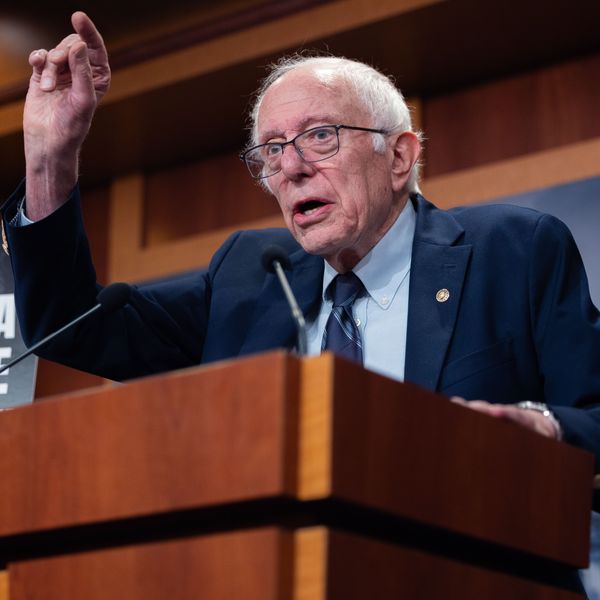
“I was delighted to hear that through the rapid advancement in artificial intelligence and robotics that you are funding, you will be bringing about utopia to the world,” the senator said. “You have told us that poverty will be wiped out, work will be optional, there will be universal high income, and that everyone will have the best medical care, food, home, transport, and everything else. That is wonderful news.”

“I just have a couple of questions. How will this utopia come about?” he continued. “If young people can’t find the entry-level jobs that used to exist, and they are unemployed without income, when are they going to get the free housing you talk about? If manufacturing workers lose their jobs because robots take their place, when are they going to get the free healthcare you promise? If a young nurse with kids loses her job, how is she going to get the food she needs to feed her family?”

Sanders then turned his attention to the fact that Musk spent an unprecedented amount of more than $270 million to help elect President Donald Trump, who earlier this year enacted historic cuts to the social safety net to fund tax breaks that overwhelmingly benefit the rich, in what has been described as the greatest upward transfer of wealth in US history.

“I look forward to hearing about how you and your other oligarch friends are going to provide working people with a magnificent life that you promise,” he continued. “Because let’s not forget, Donald Trump, the guy you got elected, is kicking 15 million people off their healthcare, doubling insurance premiums for more than 20 million, and is making massive cuts to nutrition assistance and education for kids across the country.”

Sanders concluded, “With that track record, I can’t wait to hear how your plan to provide universal high income for every American is going to be implemented.”


Dems Call to Investigate Commerce Secretary Boosting AI Data Centers That ‘Enrich His Entire Family’


“Never in modern US history has the office intersected so broadly and deeply with the financial interests of the commerce secretary’s own family,” according to the New York Times.


US Secretary of Commerce Howard Lutnick attends a meeting with President Donald Trump and Prime Minister of Hungary Viktor Orban in the Cabinet Room of the White House on November 7, 2025 in Washington, DC.
(Photo by Roberto Schmidt/Getty Images)


Stephen Prager
Dec 19, 2025
COMMON DREAMS

A group of Democratic lawmakers has called for the Commerce Department to investigate whether its billionaire secretary, Howard Lutnick, is improperly boosting artificial intelligence data centers that “stand to enrich his entire family.”

The group of 25 House and Senate Democrats, led by Sen. Elizabeth Warren (D-Mass.) and Rep. Madeleine Dean (D-Pa.), sent a letter on Thursday urging the department’s acting inspector general, Duane Townsend, to review whether Lutnick violated any part of the ethics agreement he signed following his nomination.


230+ Environmental Groups Call On Congress to Impose Moratorium on New AI Data Centers


Big Tech Ramps Up Propaganda Blitz As AI Data Centers Become Toxic With Voters

That agreement required him to divest his stake in the financial services firm Cantor Fitzgerald, which he had owned and led for decades. Cantor owns the Newmark Group, a real estate broker that facilitates leases for AI data centers.

Lutnick stepped down from his position as CEO in February, handing his financial stake in the company to his adult sons, Brandon and Kyle.

Though the transfer of his stake was supposed to happen in May, records show he did not do so until October, after receiving an ethics waiver from the Trump administration that allowed him to continue working on matters that could affect the company.


Our people-powered journalism cannot survive without you

Your support allows Common Dreams to continue covering the stories and amplifying the voices that the corporate media never will. Make a tax-deductible year-end gift to ensure we can sustain the reporting needed to meet the challenges of 2026.


The lawmakers described some of these potential conflicts in the letter, many of which were revealed by a New York Times investigation last month:
Multiple press reports indicate that, in his capacity as head of the Commerce Department, Secretary Lutnick has helped boost AI data centers in ways that will likely enrich his own family. He has made public appearances promoting data center projects—including at least one that his family’s company has worked on.

Furthermore, Secretary Lutnick has reportedly pressured foreign governments to invest in the US data center industry. For example, as part of a recent AI chips export deal with the United Arab Emirates (UAE), Secretary Lutnick reportedly pushed the UAE to “build data centers in America,” in exchange for the United States loosening export control restrictions on certain advanced chips. The Trump administration ultimately approved this deal, under which the Lutnick-backed Newmark Group is primed to profit from that Emirati investment.

Similarly, as part of another trade deal, Secretary Lutnick reportedly pushed South Korea to invest hundreds of billions of dollars in the United States. One startup vying for some of South Korea’s investment has paid the Lutnick family’s companies millions in fees to help it secure financing and land for its new data center.

Though businesspeople have often occupied the role of Commerce Secretary, the Times reported last month that “never in modern US history has the office intersected so broadly and deeply with the financial interests of the commerce secretary’s own family, according to interviews with ethics lawyers and historians.”

According to the company’s most recent quarterly earnings report, Newmark has completed more than $25 billion in data center deals over the past 12 months, resulting in its most lucrative year in the firm’s history.

Citing evidence that the construction of AI data centers considerably spikes energy costs for consumers, the lawmakers said, “There is substantial public interest in ensuring that Secretary Lutnick is not violating federal ethics law to propel data centers that will be profitable for his family while making life more expensive for working Americans.”