Monday, December 29, 2025


Could Northeast States Trade Pipeline Access for Offshore Wind Permits?

Any deal requires honesty about costs, infrastructure realities, domestic energy availability, and past policy decisions.
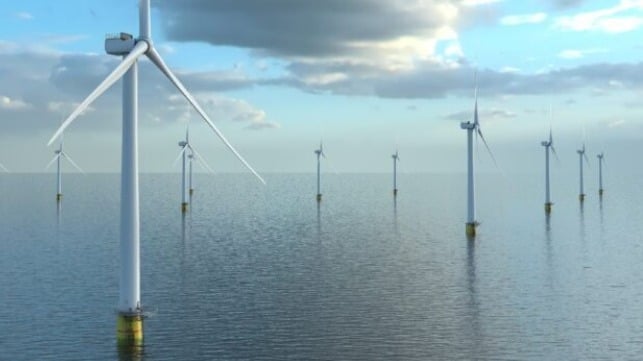
A rendering of Empire Wind 1, a planned wind farm currently under a halt work order from the Trump Administration (file image courtesy Equinor)

Published Dec 28, 2025 4:31 PM by William P. Doyle


In mid-December 2025, the Trump Administration halted offshore wind projects from New England to Virginia, placing development on an indefinite pause. Just weeks earlier, I spoke at a conference in New England and had numerous side conversations with officials and stakeholders from across New England and New York about the outlook for maritime and energy policy.

The timing was telling. The Northeast is arguably the center of the universe for offshore wind, and the perspectives expressed in those discussions ran the full spectrum from thoughtful and informed to, frankly, detached from reality.

In my opening remarks, I made one point unmistakably clear: we have never seen more sustained focus on U.S. maritime policy, including the Jones Act, from both the White House and Congress in the lifetime of anyone attending that conference. That reality framed the discussions that followed.

A common refrain on the sidelines was: “Trump’s a dealmaker — don’t you think he’ll make a deal on offshore wind?” I reminded folks that a deal requires two parties coming together, with each side offering something and giving something. I am not suggesting that the Trump Administration will or will not make a deal on offshore wind, but it is worth examining what is actually on the table.

Electricity Prices

The offshore wind industry has not provided an accurate picture when discussing pricing. The European multinationals behind these projects provided states with project costs and electricity rates that were never going to hold. The truth is straightforward: in the U.S., offshore wind is not a cheaper alternative for ratepayers today, and it is not going to be cheaper in the foreseeable future.

If developers were honest with governors’ offices and public utility commissions about costs upfront, things would go a lot better. Transparency matters.

As of December 2025, the U.S. national average residential electricity price is about 18¢ per kilowatt-hour. Compare that to the approximate rates for the Northeast:

Massachusetts: 30¢ /kWh

Connecticut: 30¢ /kWh

Rhode Island: 29¢ /kWh

Maine: 28¢ /kWh

New York: 27¢ /kWh

New Hampshire: 25¢ /kWh

Vermont: 23¢ /kWh

New England electricity prices run roughly 60–70 percent above the national average. Vermont and New Hampshire are lower largely because they rely more heavily on nuclear power and hydroelectricity, including imports from Canada.

Energy Policy in New York and New England

This is not a Jones Act problem.

Over the past decade, New York and multiple New England states took deliberate actions that halted or cancelled major natural gas pipeline projects. Those decisions continue to shape the region’s energy landscape and have direct implications for maritime commerce, dredging, port infrastructure, and U.S.-flag energy transportation. Understanding this history is essential as policymakers revisit energy security, offshore wind integration, and domestic maritime supply chains.

New York has been the most consequential state in halting interstate pipeline expansion into the Northeast. The Constitution Pipeline, proposed by Williams and its partners, would have moved Marcellus natural gas from Pennsylvania into New York and New England. The Northeast Supply Enhancement Project was designed to supply additional gas to downstate New York and Long Island. The Northern Access Project was intended to increase deliveries into western New York. In all three cases, New York denied state-level permits.

Massachusetts policy opposition significantly affected regional pipeline proposals intended to alleviate winter gas shortages. The Northeast Energy Direct Pipeline was a major interstate proposal to deliver Marcellus gas into Massachusetts and New Hampshire. The Access Northeast Project was a regional expansion involving Massachusetts, Connecticut, and Rhode Island. Massachusetts opposition to proposed cost-recovery mechanisms and pipeline financing effectively halted the project in 2017.

In New Hampshire, both the Northeast Energy Direct Pipeline and the Granite Bridge Pipeline were ultimately cancelled following state-level opposition. Rhode Island similarly opposed the regional Access Northeast expansion, eliminating a potential source of additional gas supply.

Connecticut provides one of the clearest examples of policy contradiction. The state opposed regional pipeline expansion through Access Northeast and, at the same time, publicly blamed the Jones Act for natural gas shortfalls and high winter energy costs. That narrative ignores several inconvenient facts: Connecticut does not have a single LNG receiving terminal at any of its ports, and in the 2000s the state actively opposed offshore floating storage and regasification units (FSRUs) that would have delivered natural gas directly to Connecticut.

In other words, the state rejected both pipeline and maritime LNG supply options and then blamed federal maritime law for the resulting constraints.

Offshore Wind Developers and the Jones Act Narrative

Against this backdrop, another unhelpful pattern emerged during offshore wind development: European offshore wind developers repeatedly blamed the Jones Act for project delays and cost overruns. These criticisms were not confined to private conversations. Executives and industry representatives publicly cited Jones Act compliance and the limited availability of U.S.-flag installation vessels as obstacles to offshore wind development off the East Coast, despite the fact that the Jones Act has been settled U.S. law for more than a century and was fully known to developers when they entered the U.S. market and bid on federal lease areas. What was often omitted from those critiques is that the Jones Act did not change, but rather it was the business case assumptions did.

At the same time, U.S. shipyards, U.S.-flag vessel operators, and traditional Jones Act companies fully embraced offshore wind as a new line of business. They invested heavily in vessels, port infrastructure, workforce development, and long-term capacity in good faith, responding directly to the demand signals sent by developers and government policymakers.

Unfortunately, Jones Act–centric trade associations were repeatedly forced into a defensive posture, having to rebut ill-advised and sometimes inaccurate public statements made by C-suite European developers blaming the Jones Act for their own planning and execution challenges. This dynamic was counterproductive. It diverted attention away from legitimate infrastructure and policy issues and undermined the collaborative environment offshore wind development required to succeed in the United States.

Blaming the Jones Act may have been convenient, but it ignored the broader reality: offshore wind delays and cost overruns were driven by unrealistic pricing assumptions, immature supply chains, permitting complexity, and conflicting state energy policies — not U.S. maritime law.

Is There a Deal to Be Made?

Is there a deal that could be made between the states and the Trump Administration with respect to offshore wind and natural gas? Possibly. But deals require both sides giving a little to get a little. It also requires honesty about costs, infrastructure realities, domestic energy availability, and past policy decisions.

If there has ever been a moment to have that conversation seriously, with domestic energy production, maritime policy, and grid reliability aligned, 2026 is as good a time as any.

William P. Doyle is CEO of the Dredging Contractors of America. He previously served as Executive Director of the Port of Baltimore and as a U.S. Federal Maritime Commissioner. A graduate of Massachusetts Maritime Academy and Widener University Commonwealth Law School, he is a licensed officer in the U.S. merchant marine and a member of the Marine Engineers’ Beneficial Association. ?

The opinions expressed herein are the author's and not necessarily those of The Maritime Executive.

 

China Announces Sanctions and Naval Drills Around Taiwan

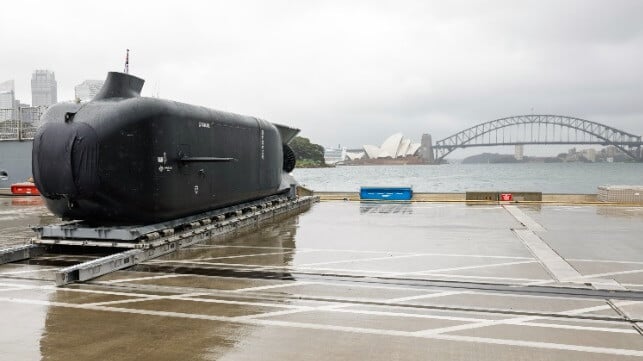
Anduril's Ghost Shark extra-large UUV on the pier in Sydney, Australia. The firm is already blacklisted by China (Anduril file image)

Published Dec 28, 2025 9:13 PM by The Maritime Executive


In response to a new multi-billion dollar U.S. arms sale to Taiwan, China's government has announced sanctions on a swath of the American naval-technology industrial base, including Northrop Grumman, L3Harris Maritime Services, Advanced Acoustic Concepts, and several divisions of the defense drone conglomerate Anduril Industries. In a follow-on announcement Sunday, China's Eastern Theater Command announced that it would hold mass military drills around the island to send a message, including simulated "sea-air combat readiness patrol, joint seizure of comprehensive superiority, blockade on key ports and areas, as well as all-dimensional deterrence outside the island chain."

The $10 billion package of U.S. arms for Taiwan was announced on December 18. If approved by Congress and fulfilled by U.S. manufacturers, it would be the biggest single U.S. defense sale to the island ever. One week later, China's foreign ministry said that it would sanction 20 U.S. defense tech companies in retaliation, asserting that the arms deal "seriously violates the one-China principle . . . and undermines China’s sovereignty and territorial integrity." 

The U.S. has sold defensive weapons to Taiwan for decades, and formally recognizes China's "one China" policy. It also supports Taiwan's continued independence, through quiet diplomacy and military preparations - including reorienting the focus of both the Navy and Marine Corps to prepare for a Western Pacific conflict. 

China's sanctions target some of the biggest names behind the U.S. Navy's technology. The list includes blue-chip companies like Boeing's St. Louis plant, builder of the F/A-18 Hornet fighter series, and defense conglomerate Northrop Grumman, which provides countless weapons and sensor systems for the surface fleet and submarine fleet. L3Harris' division for ship repair and ship services is on the list, along with one senior executive. Leidos' Gibbs & Cox naval architecture division - co-designer of the Constellation-class frigate - is listed too, as is sonar company Advanced Acoustic Concepts (a Thales division). 

The most eye-catching names on the list are American drone builders. Headline name Anduril has already been sanctioned by China  - a decision Anduril celebrated at the time - so the Chinese Foreign Ministry opted to list two more of its divisions and blacklisted its CEO, Palmer Luckey. Red Cat, the drone company that owns Black Sea drone boat technology developer Blue Ops, is named as well. Epirus, the developer of a microwave anti-drone system for the Marine Corps and Navy, is also on the list.

For all of the named firms and executives, any assets held within China will be frozen, and all Chinese companies and individuals will be prohibited from engaging in transactions or "cooperation" with them.  


Abandoned Transatlantic Rowboat Rediscovered After Three Years at Sea

Fight Oar Die
Handout courtesy Fight Oar Die / Facebook

Published Dec 28, 2025 9:34 PM by The Maritime Executive


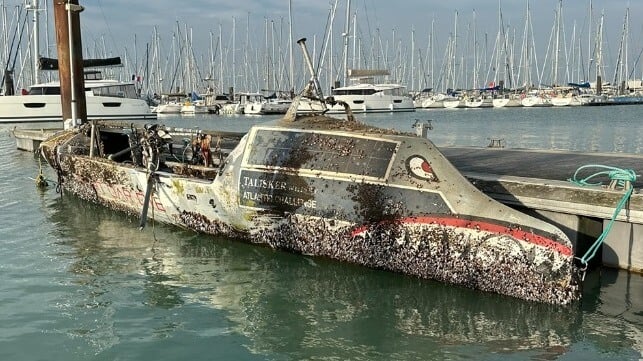
The wreck of a rowing boat that a team of U.S. Air Force veterans used in a doomed attempt to cross the Atlantic in 2022 has been found and recovered after being adrift in the high seas for almost three years.

The U.S. team behind the Fight Oar Die (FOD) mission that attempted the 2022 Talisker Whiskey Atlantic Challenge that involved crossing the Atlantic using rowing boats is announcing the wreck of their abandoned vessel has been located in western France.

In December 2022, the team of four veterans embarked on the race as part of efforts to raise awareness for veteran mental health. Using a rowing boat christened Woobie, the team’s mission was to row 3,000 nautical miles from the Canary Islands to Antigua.

The men had left La Gomera in Canary Islands attempting to cross the Atlantic Ocean along with about 30 rowboats in what was termed as the world’s toughest row. The final destination was the island of Antigua in the Caribbean. The boats, each with one to five participants from different countries on board, were taking part in the challenge that was expected to last 45 days.

The mission for the U.S veterans was however doomed 16 days into the challenge, when their boat was capsized by a massive wave and failed to self-right. Despite efforts, the crew were unable to right the vessel, and they abandoned ship into a life raft. The team was rescued by the crew of the bulk carrier Hanze Göteborg after spending 22 hours drifting on the ocean.

After three years adrift in the Atlantic, FOD founder and crewmember Bryant Knight is announcing that the boat has been recovered. The boat was found after a commercial fishing vessel contacted the Marine Rescue Coordination Center in Western France after spotting a ‘ghost ship’. A recovery team was dispatched, and Woobie was towed to Port La Rochelle. Plans are underway to bring the boat back home to Mobile, Alabama next year.

Woobie has been adrift in the Atlantic for almost three years since her abandonment, and maybe she will help provide us answers to that stormy night in December so that we may better understand and help improve the sport of ocean rowing,” said Knight.

Organized by the Atlantic Campaigns SL since 2012, the Talisker Whisky Atlantic Challenge is an annual ocean rowing race across the Atlantic - a grueling voyage with a charitable fundraising goal. 


Sulfuric Acid Spills Into Houston Ship Channel

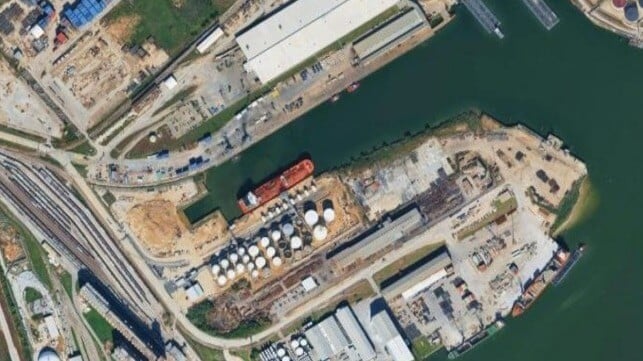
The BWC chemical tank terminal just off the ship channel in Jacintoport, center (Courtesy Google / Maxar / Vexcel / Airbus)

Published Dec 28, 2025 10:18 PM by The Maritime Executive


Over the weekend, a ruptured pipe spilled an industrial quantity of sulfuric acid into the water at a chemical terminal on the Houston Ship Channel, according to local officials in Channelview, Texas. 

In the early hours of Saturday morning, the BWC Terminals facility in Channelview sustained a leak, releasing one million gallons of sulfuric acid. Part of that spill went into the water, but most went into a containment area on shore, the terminal said in a statement to local media. 

At a press conference Saturday, Harris County Judge Lina Hidalgo told reporters that it appears that a catwalk at the site had collapsed and ruptured a pipe connected to an acid tank. Sheriffs' deputies added that it was a six-inch supply pipe, and that the leak started at about 0200 and continued until about 0600 hours, according to KTRK.  

Two people were briefly hospitalized with breathing problems, but have since been released. The crews of two nearby berthed merchant ships were also evaluated. There were no effects on traffic in the ship channel, Judge Hidalgo said. 

Air quality was unaffected, she said, and environmental monitoring is planned to determine effects on aquatic life. So far, no impacts have been reported. 

BWC is a leading tank terminal operator in North America, with about two dozen sites and a wide variety of services. The largest share of its infrastructure is along the Gulf Coast, including five sites on the Houston Ship Channel and Galveston Bay. The Saturday incident occurred at its Jacintoport terminal, located in a small harbor just off the main ship channel.


Japan Gives Suez Canal a New Dive Vessel to Support Emergency Preparedness

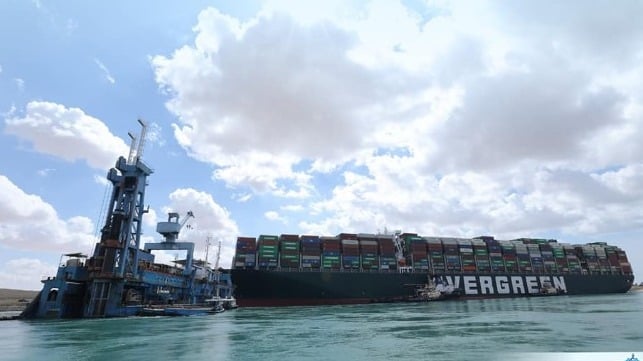
The new support vessel would boost preparedness for emergencies, like the grounding of the Ever Given, above (SCA file image)

Published Dec 28, 2025 10:25 PM by The Maritime Executive


Egypt is hoping to enhance the navigational safety of the busy Suez Canal after securing a $22 million grant to finance the construction of a dual-fuel diving support vessel (DSV).

As more shipping lines make a return to the waterway owing to the gradual return of stability in the Red Sea region, the country said it has secured the grant from the Japanese government for the vessel, which will join the Suez Canal Authority (SCA) fleet. The grant was provided through the Japan International Cooperation Agency (JICA).

Described as the first of its kind, the new vessel will be deployed for multiple purposes, notably to enhance navigational safety, towing operations, assisting vessels during maneuvering and strengthening emergency response capabilities.

The vessel, which will be built in Japan, will measure 45 meters in length and will have a total weight of 620 tonnes. Cruising at a maximum speed of 12 knots and with capacity to accommodate up to 29 personnel, the vessel will operate on a dual-fuel engine system (diesel and natural gas) to reduce carbon emissions and ensure sustainable operations.

Also of importance is that the DSV will be equipped with advanced search and diving systems and essential equipment to support divers safely and efficiently, including two decompression chambers for diving, search, rescue, and recovery operations, as well as a waste treatment unit.

Construction of the new vessel comes as SCA is in the process of acquiring two rescue tugboats with a bollard pull of 190 tonnes, which are scheduled to join its fleet next year. The tugs are being built domestically at the Alexandria Naval Yard.

SCA says the additional assets are critical in guaranteeing safe passage of vessels on the Suez Canal where approximately 12 percent of global trade passes. The canal is seeing a return of major global shipping lines, driven by the end of the Red Sea security crisis, and traffic is rising. Projections point to a normal return in traffic by mid-2026, the authority says. 


NOAA: Higher Temps and Less Ice in a Changing Arctic

Arctic
Courtesy NOAA

Published Dec 28, 2025 10:58 PM by The Conversation


[By Matthew Druckenmiller, Rick Thoman and Twila Moon]

The Arctic is transforming faster and with more far-reaching consequences than scientists expected just 20 years ago, when the first Arctic Report Card assessed the state of Earth’s far northern environment.

The snow season is dramatically shorter today, sea ice is thinning and melting earlier, and wildfire seasons are getting worse. Increasing ocean heat is reshaping ecosystems as non-Arctic marine species move northward. Thawing permafrost is releasing iron and other minerals into rivers, which degrades drinking water. And extreme storms fueled by warming seas are putting communities at risk.

The past water year, October 2024 through September 2025, brought the highest Arctic air temperatures since records began 125 years ago, including the warmest autumn ever measured and a winter and a summer that were among the warmest on record. Overall, the Arctic is warming more than twice as fast as the Earth as a whole.

For the 20th Arctic Report Card, we worked with the National Oceanic and Atmospheric Administration, an international team of scientists and Indigenous partners from across the Arctic to track environmental changes in the North – from air and ocean temperatures to sea ice, snow, glaciers and ecosystems – and the impacts on communities.

Together, these vital signs reveal a striking and interconnected transformation underway that’s amplifying risks for people who live there.

A wetter Arctic with more extreme precipitation

Arctic warming is intensifying the region’s water cycle.

A warmer atmosphere increases evaporation, precipitation and meltwater from snow and ice, adding and moving more water through the climate system. That leads to more extreme rainstorms and snowstorms, changing river flows and altering ecosystems.

The Arctic region saw record-high precipitation for the entire 2025 water year and for spring, with the other seasons each among the top-five wettest since at least 1950. Extreme weather – particularly atmospheric rivers, which are long narrow “rivers in the sky” that transport large amounts of water vapor – played an outsized role.

These wetter conditions are reshaping snow cover across the region.

Snow and ice losses accelerate warming, hazards

Snow blankets the Arctic throughout much of the year, but that snow cover isn’t lasting as long. In 2025, snowpack was above average in the cold winter months, yet rapid spring melting left the area covered by snow far smaller than normal by June, continuing a six-decade decline. June snow cover in recent years has been half of what it was in the 1960s.

Losing late spring snow cover means losing a bright, reflective surface that helps keep the Arctic cool, allowing the land instead to be directly warmed by the sun, which raises the temperature.

Sea ice tells a similar story. The year’s maximum sea ice coverage, reached in March, was the lowest in the 47-year satellite record. The minimum sea ice coverage, in September, was the 10th lowest.

Since the 1980s, the summer sea ice extent has shrunk by about 50%, while the area covered by the oldest, thickest sea ice – ice that has existed for longer than four years – has declined by more than 95%.

The thinner sea ice cover is more influenced by winds and currents, and less resilient against warming waters. This means greater variability in sea ice conditions, causing new risks for people living and working in the Arctic.

Arctic sea ice concentration in September 2025, during its annual minimum extent at the end of summer, was much smaller than the 1979-2004 median extent. The shades of blue reflect the concentration of sea ice. NOAA and CIRES/University of Colorado Boulder.

The Greenland Ice Sheet continued to lose mass in 2025, as it has every year since the late 1990s. As the ice sheet melts and calves more icebergs into the surrounding seas, it adds to global sea-level rise.

Mountain glaciers are also losing ice at an extraordinary rate – the annual rate of glacier ice loss across the Arctic has tripled since the 1990s.

This poses immediate local hazards. Glacial lake outburst floods – when water that is dammed up by a glacier is suddenly released – are becoming more frequent. In Juneau, Alaska, recent outburst floods from Mendenhall Glacier have inundated homes and displaced residents with record-setting levels of floodwater.

Glacier retreat can also contribute to catastrophic landslide impacts. Following the retreat of South Sawyer Glacier, a landslide in southeast Alaska’s Tracy Arm in August 2025 generated a tsunami that swept across the narrow fjord and ran nearly 1,600 feet (nearly 490 meters) up the other side. Fortunately, the fjord was empty of the cruise ships that regularly visit.

Record-warm oceans drive storms, ecosystem shifts

Arctic Ocean surface waters are steadily warming, with August 2025 temperatures among the highest ever measured. In some Atlantic-sector regions, sea surface temperatures were as much as 13 degrees Fahrenheit (7.2 Celsius) above the 1991-2020 average. Some parts of the Chukchi and Beaufort seas were cooler than normal.

Arctic sea surface temperatures are much warmer today than in past decades, as this map and chart of August 2025 sea surface temperatures shows. NOAA and CIRES/University of Colorado Boulder.

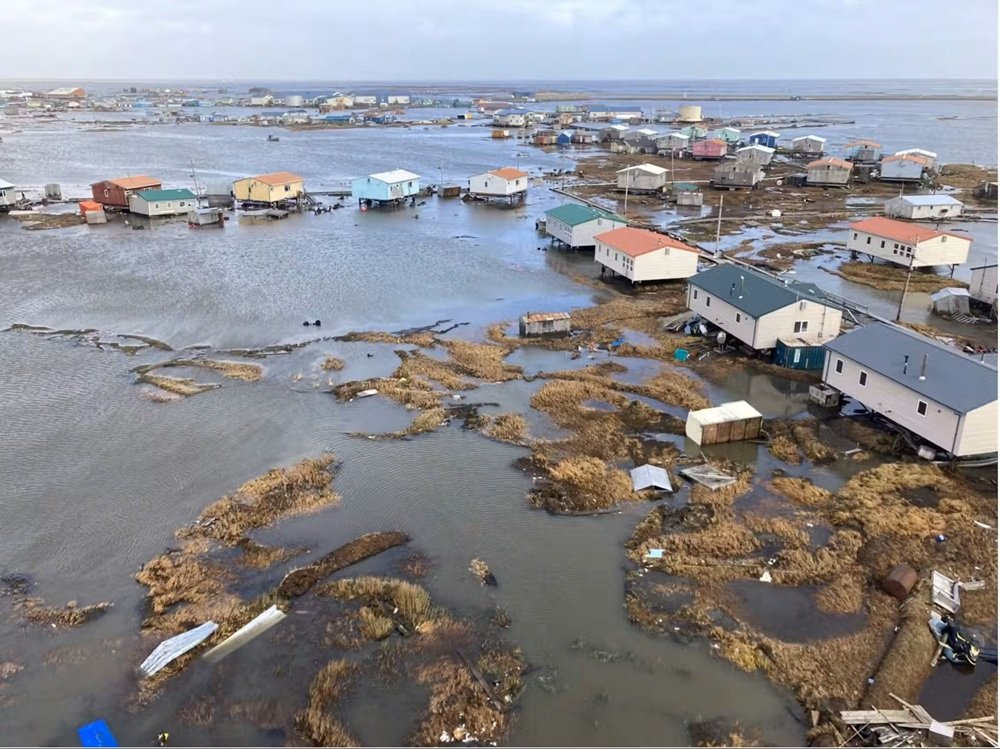
Warm water in the Bering Sea set the stage for one of the year’s most devastating events: Ex-Typhoon Halong, which fed on unusually warm ocean temperatures before slamming into western Alaska with hurricane-force winds and catastrophic flooding. Some villages, including Kipnuk and Kwigillingok, were heavily damaged.

As seas warm, powerful Pacific cyclones, which draw energy from warm water, are reaching higher latitudes and maintaining strength longer. Alaska’s Arctic has seen four ex-typhoons since 1970, and three of them arrived in the past four years.

The village of Kipnuk, shown on Oct. 12, 2025, was devastated by ex-Typhoon Halong. The storm displaced at least 1,500 people from across western Alaska. Alaska National Guard

The Arctic is also seeing warmer, saltier Atlantic Ocean water intrude northward into the Arctic Ocean. This process, known as Atlantification, weakens the natural layering of water that once shielded sea ice from deeper ocean heat. It is already increasing sea ice loss and reshaping habitat for marine life, such as by changing the timing of phytoplankton production, which provides the base of the ocean food web, and increasing the likelihood of harmful algal blooms.

From ocean ‘borealization’ to tundra greening

Warming seas and declining sea ice are enabling southern, or boreal, marine species to move northward. In the northern Bering and Chukchi seas, Arctic species have declined sharply – by two-thirds and one-half, respectively – while the populations of boreal species expand.

On land, a similar “borealization” is underway. Satellite data shows that tundra vegetation productivity – known as tundra greenness – hit its third-highest level in the 26-year record in 2025, part of a trend driven by longer growing seasons and warmer temperatures. Yet greening is not universal – browning events caused by wildfires and extreme weather are also increasing.

Summer 2025 marked the fourth consecutive year with above-median wildfire area across northern North America. Nearly 1,600 square miles (over 4,000 square kilometers) burned in Alaska and over 5,000 square miles (over 13,600 square kilometers) burned in Canada’s Northwest Territories.

Permafrost thaw is turning rivers orange

As permafrost – the frozen ground that underlies much of the Arctic – continues its long-term warming and thaw, one emerging consequence is the spread of rusting rivers.

As thawing soils release iron and other minerals, more than 200 watersheds across Arctic Alaska now show orange discoloration. These waters exhibit higher acidity and elevated levels of toxic metals, which can contaminate fish habitat and drinking water and impact subsistence livelihoods.

In Kobuk Valley National Park in Alaska, a tributary to the Akillik River lost all its juvenile Dolly Varden and slimy sculpin fish after an abrupt increase in stream acidity when the stream turned orange.

Arctic communities lead new monitoring efforts

The rapid pace of change underscores the need for strong Arctic monitoring systems. Yet many government-funded observing networks face funding shortfalls and other vulnerabilities.

At the same time, Indigenous communities are leading new efforts.

The Arctic Report Card details how the people of St. Paul Island, in the Bering Sea, have spent over 20 years building and operating their own observation system, drawing on research partnerships with outside scientists while retaining control over monitoring, data and sharing of results. The Indigenous Sentinels Network tracks environmental conditions ranging from mercury in traditional foods to coastal erosion and fish habitat and is building local climate resilience in one of the most rapidly changing environments on the planet.

The Arctic is facing threats from more than the changing climate; it’s also a region where concerns of ecosystem health and pollutants come sharply into view. In this sense, the Arctic provides a vantage point for addressing the triple planetary crisis of climate change, biodiversity loss and pollution.

The next 20 years will continue to reshape the Arctic, with changes felt by communities and economies across the planet.

Matthew L. Druckenmiller is Senior Scientist, National Snow and Ice Data Center (NSIDC), Cooperative Institute for Research in Environmental Sciences (CIRES), University of Colorado Boulder.

Rick Thoman is an Alaska Climate Specialist, University of Alaska Fairbanks.

Twila A. Moon is Deputy Lead Scientist, National Snow and Ice Data Center (NSIDC), Cooperative Institute for Research in Environmental Sciences (CIRES), University of Colorado Boulder.

The Conversation

The opinions expressed herein are the author's and not necessarily those of The Maritime Executive.
 

Australian Cruise Ship Grounds off Papua New Guinea

Cruise ship
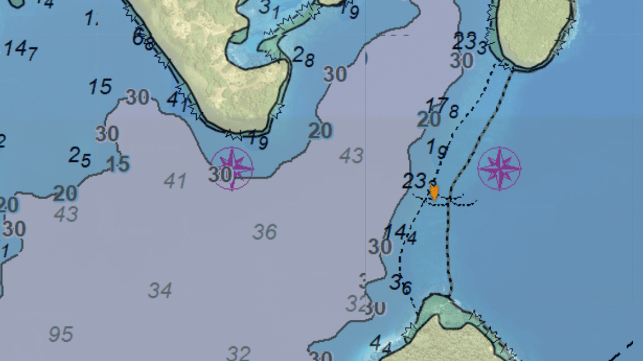
Coral Adventurer aground (in orange), center right (Pole Star Global)

Published Dec 28, 2025 5:22 PM by The Maritime Executive


On its first voyage following the controversial the death of a passenger two months ago, the expedition cruise ship Coral Adventurer went aground off Papua New Guinea during a Christmas cruise.

The operating company has confirmed that the ship ran aground on a reef near Dreghafen Point off the east coast of the island, about 15 nautical miles from Lae. Strong currents were a likely contributing factor, according to Travel and Tour World. 

The 80 passengers and 43 crewmembers on board are all safe, and no flooding or pollution has been reported. A response officer from the Papua New Guinea government has joined the ship and is on board, according to Sky News. As of early Monday, the vessel was still in position, AIS data provided by Pole Star Global shows. 

The Coral Adventurer is a 2019-built expedition ship with room for up to 120 passengers. The vessel departed Cairns on the 18th of December for a Christmas cruise, heading for Ferguson Island, Trobriand Island, then working its way along the east coast of Papua New Guinea and making multiple stops in small port towns and scenic bays. The cruise's final destination is Madang, followed by a long return voyage arriving Cairns on January 11. 

In October, Australian authorities launched an investigation after the death of a woman who appeared to have fallen while on a shore excursion from Coral Adventurer at Lizard Island, an outpost in the Great Barrier Reef. 

Coral Adventurer departed the island before the woman's absence was reported, then returned and sent crew ashore to help. A helicopter aircrew found the woman's body the next morning. AMSA is investigating the casualty and interviewed the crew when the ship returned to port at Darwin.

"While investigations into the incident are continuing, we are deeply sorry that this has occurred and are offering our full support to the woman’s family," said CEO Mark Fifield in a statement. 


Op-Ed: Maritime Surveillance Would be Key to an Indo-Pacific Conflict

Triton drone
A U.S. Navy MQ-4C Triton surveillance aircraft in operation (USN)

Published Dec 28, 2025 1:06 PM by The Strategist


[By David Axe]

The notable thing was the timing. In back-to-back strikes on Russian air power from 18 to 20 December, the Ukrainian state security agency, the vaunted SBU, launched long-range attack drones at Russian warplanes at Belbek air base in occupied Crimea, 240 km from the front line.

Imagery from the nighttime or early morning attacks indicates that the drones hit a Mikoyan MiG-31 interceptor and two Sukhoi Su-27 fighters. The drone strikes on Russian warplanes were, from a certain point of view, unremarkable: Ukrainian drones have hit 14 Russian aircraft on the ground in Crimea since August.

What was remarkable was when the drones struck. The MiG-31 and one of the Su-27s were fully armed and fuelled and their crews were in the cockpits at the moment the drones barrelled in. It’s rare for a Ukrainian drone to hit a Russian warplane when it’s fully loaded and most vulnerable to catastrophic secondary explosions. That the Ukrainians did it twice in three days indicates it wasn’t an accident.

It’s apparent the SBU knew the aircraft were getting ready to launch and timed the drone strikes accordingly. How the SBU knew isn’t hard to guess—and it sheds light on a critical Western capability—and vulnerability. It’s one that could win a war in the western Pacific or, by way of its absence, lose the same war.

Fast, fine-grain intelligence makes all the difference between a successful deep strike and a failed one. Even more than Ukraine, the US-led alliance that may come to Taiwan’s defence in the event of a Chinese attack on the island democracy utterly depends on deep strikes for victory.

To that end, the United States, Japan, Australia and Taiwan are rapidly expanding arsenals of air- and ground-launched land-attack and anti-ship missiles and one-way attack drones that, aimed at a Chinese invasion fleet, its supporting air and naval forces and Chinese logistical infrastructure and headquarters, could defeat the fleet or at least delay it long enough for allied naval forces to counterattack.

The roughly 4,000 long-range cruise missiles that arm US Air Force bomber squadrons alone could, with the right guidance capabilities, make US counterinvasion strategy ‘an almost uncomplicated exercise’, the Center for Strategic and International Studies concluded in a 2023 study. But the weaponeers would have to know where to aim the missiles.

Ukrainian agencies may have human intelligence sources on the ground in Crimea, and Kyiv is developing its own space surveillance capability, initially by leveraging commercial capabilities. Finnish satellite firm Iceye devotes one of its imaging satellites solely to the Ukrainian war effort.

But it’s no secret the Ukrainians also greatly benefit from allied ground-based, aerial and space surveillance. Just look at the publicly available flight tracks for US and allied surveillance aircraft flying daily sorties over the Black Sea within sensor range of Crimea. There’s a reason why the Trump administration’s frequent threats to suspend intelligence-sharing with Ukraine carry such weight.

The overlapping surveillance capabilities US and allied forces deploy in the western Pacific is much more impressive than those on display in Ukraine.

Surveillance systems watching China are extensive: Australian, US and Japanese over-the-horizon radars and radio listening posts, the new team-up between Australian and American Boeing P-8 Poseidon crewed maritime patrollers and Northrop Grumman MQ-4C Triton uncrewed ones, the Americans’ secretive Northrop Grumman RQ-180 stealth drones and the hundreds of military and commercial signals, radar and imaging satellites operated by, or on behalf of, US and allied forces. In the absence of effective Chinese countermeasures, all this should be able to detect a Chinese build-up for war, track individual planes, ships and regiments and quickly generate coordinates for precision strikes on moving targets.

The problem, of course, is that the Chinese are deploying countermeasures in abundance. Friends of a free Taiwan need to harden their intelligence systems against these countermeasures—and fast.

Chinese forces have conceivable ways of defeating every allied intelligence system. Fixed radars and listening posts are subject to attack and jamming. Patrol planes and drones can be shot down. Satellites can be lasered blind or attacked in orbit.

It’s not for no reason that the Chinese navy is building up a land-attack cruise missile arsenal to rival the US Navy’s, while the Chinese air force arms its hundreds of stealth fighters with very-long-range air-to-air missiles and Chinese space forces experiment with so-called inspection satellites that can maneuver close to, and tamper with, other countries’ satellites.

The US and its allies deploy a ‘three-dimensional’ surveillance system in space, in the air, on the surface, below the surface in the form of undersea sensors and in cyberspace, to borrow phrasing from Senior Captain Zhang Ning, a faculty member at China’s Naval University of Engineering, and his team.

In a November 2023 journal article translated by Ryan Martinson, a professor at the US Naval War College, Zhang and coauthors specifically addressed vulnerabilities in the US Navy’s undersea surveillance. But they noted allied weaknesses in other surveillance domains, too.

‘In recent years, they explain, it has become increasingly difficult for US manned platforms to conduct reconnaissance close to the Chinese coast,’ Martinson noted. ‘Indeed,’ he added, the ‘survival space’ for US drones inside the First Island Chain from Japan to The Philippines ‘has been shrinking,’ Martinson wrote in his summary of Zhang’s article.

Chinese ships, planes and shore batteries are nudging US and allied air and surface forces farther back, outside the First Island Chain. Meanwhile, bad weather could interrupt the allies’ space surveillance, blinding it even in the absence of any direct attacks on satellites—and lending Chinese forces freedom of movement in critical moments.

There’s no single solution for US and allied forces trying to preserve their surveillance advantage in a possible clash with Chinese forces. Shifting resources from one domain to another would simply invite the Chinese to shift their own countermeasures in the same direction. So it’s not enough merely to deploy more satellites with self-defense systems, add stealthy drones to the aerial surveillance layer or install more over-the-horizon radars and listening posts and prepare to defend them from attack.

No, the allies need to do all of the above—and with haste—if they expect to strike Chinese warplanes (and other targets) the way the Ukrainians strike Russian warplanes: when their destruction matters the most.

David Axe is a journalist and filmmaker in South Carolina, United States.

This article appears courtesy of The Strategist and may be found in its original form here

The opinions expressed herein are the author's and not necessarily those of The Maritime Executive.
 

Rekind Accelerates Development of Biomass Pyrolysis Technology in Indonesia

RINA

Published Dec 28, 2025 10:27 AM by The Maritime Executive


[By: RINA]

PT Rekayasa Industri (Rekind), Advanced Energy Solutions (AES), and RINA, the multinational engineering consultancy, inspection and certification group, have officially formed a strategic partnership to accelerate the development of biomass pyrolysis technology in Indonesia.

This collaborative step was confirmed through the signing of a Memorandum of Understanding (MoU) on the sidelines of The Carbon Digital Conference (CDC) 2025, which took place at the West Hall of the Bandung Institute of Technology (ITB) on December 8–9, 2025.

This collaboration is expected to encourage the commercial-scale production of bio-energy, bio-methanol, and bio-char, while also strengthening the utilization of the nation's abundant biomass resources.

Biomass Pyrolysis technology is typically a process of treating organic materials, such as agricultural waste, wood, sawdust, palm shells, empty fruit bunches, or crop residues, through high-temperature heating in the absence of oxygen. The goal is to break down the biomass structure into three main products:

  • Bio-oil (pyrolysis oil): Can be used as fuel or processed into chemical products.
  • Syngas: A gas that can be utilized to generate energy or electricity.
  • Bio-char: High-quality charcoal that can be used to support agricultural activities, adsorbents, or other industrial applications. 

According to Rekind's CEO, Triyani Utaminingsih, this cooperation is a strategic step in accelerating the clean energy transition in the country. “Indonesia has enormous biomass potential. Through this collaboration, we want to ensure this potential can be processed into renewable energy and high-value products that support a sustainable economy,” she stated.

Through this cooperation, Rekind, a national Industrial Process EPC (Engineering, Procurement and Construction) company with over four decades of experience in the energy and infrastructure industry, will lead the aspects of engineering, technology integration, and preparation for future EPC execution.

Rekind's capability in managing national strategic mega-projects across various sectors gives it confidence to spearhead the development of new-generation clean energy technology in Indonesia. “We are committed to delivering solutions that are not only innovative but also relevant to industry needs and national energy policy,” she added.

AES, a global clean energy company, will provide advanced pyrolysis technology capable of converting biomass waste and agricultural residues into renewable energy and various commercially valuable derivative products. This technology can produce syngas, bio-oil, and bio-char while helping to reduce emissions. With this environmentally friendly approach, AES provides solutions that support circular-economy practices.

“The signing of the agreement with PT Rekayasa and RINA is a truly important milestone. This partnership brings together our company’s shared commitments for technology Innovation, environmental and social responsibility together with company long-term growth. We are looking forward to the positive impact we’ll be able to create”, said Gianni Marziali, CEO of AES.

Meanwhile, RINA will play a crucial role as the technical consultant. The company will conduct a comprehensive study covering process design, technology evaluation, system integration, economic studies, as well as safety and environmental aspects. With international-standard engineering benchmarks, RINA will ensure every project stage meets global best practices and is financially viable.

Michele Budetta, CEO of RINA Consulting, commented, “This collaboration marks a key step in unlocking Indonesia’s biomass potential and advancing its clean energy transition. By combining RINA’s engineering expertise with Rekind’s capabilities and AES’s technology, we aim to accelerate commercial-scale biomass pyrolysis. Together, we seek to turn agricultural residues and biomass waste into clean energy and valuable products, supporting a circular economy and Indonesia’s transition goals.”

Through this collaboration, the three companies agree to build scalable and sustainable biomass solutions. This project also opens up significant opportunities for the development of the biomass-based biofuel industry, which is expected to support emission reduction targets and strengthen national energy security in the future.

“This initiative is not just about technology; it’s also about the future of Indonesia’s energy. We want to ensure that the transformation towards clean energy can take place quickly, accurately, and provide the greatest benefits for the public and industry,” Triyani Utaminingsih affirmed.

The products and services herein described in this press release are not endorsed by The Maritime Executive.