Wednesday, December 31, 2025

The Permian Is Drowning in Its Own Wastewater

  • The Permian basin's massive oil production from hydraulic fracturing generates huge amounts of wastewater, and the industry is running out of safe places to dispose of it.

  • The Texas Railroad Commission has restricted new disposal wells due to widespread increases in reservoir pressure, leading to drilling hazards, ground deformation, and seismic activity.

  • Potential solutions, such as treating the water for release into rivers, face regulatory hurdles and would add significant, unwelcome costs to producers operating below $60 per barrel West Texas Intermediate.

The Permian Basin is the largest contributor to U.S. oil production, accounting for nearly half of total production in both 2024 and 2025. But success comes at a price, and in the Permian’s case, the price is huge amounts of wastewater—and the industry is running out of places to store it.

Hydraulic fracturing, which is the dominant way of extracting oil in the Permian, is a water-intensive process. Fracking involves injecting chemicals and sand into the horizontal well to open up the oil-bearing rock and keep it open. The longer the laterals got, the more water needed to be injected. This water, which is mixed with chemicals, then gets disposed of in special wells. But there are too many of those, and they are overflowing, according to reports.

The first signs of serious trouble emerged earlier this year, when the Texas Railroad Commission sent out notices to companies applying for licenses for wastewater disposal wells in the basin, stating that there were ground pressure issues caused by wastewater disposal. The number of new ones was to be restricted.

Wastewater disposal, the Railroad Commission wrote in the letters sent out in May, “has resulted in widespread increases in reservoir pressure that may not be in the public interest and may harm mineral and freshwater resources in Texas.” The RRC added that “Drilling hazards, hydrocarbon production losses, uncontrolled flows, ground surface deformation, and seismic activity have been observed.”

It is difficult to find a solution to this problem without compromising oil production, and while local communities may not have a big problem with that, the industry will. So decision-makers in relevant positions are considering options. One of these, per a recent Bloomberg report, is releasing the water—after treating it—into local rivers. 

The report cited regulatory filings concerning the issue of permits to energy companies to treat their wastewater and then release it into the Pecos River near New Mexico. Texas Pacific Land Corp. and NGL Energy Partners were two of the companies named as potential receivers of such a permit. At least one of these could be awarded by the end of March 2026, the Bloomberg report also said, citing Texas Pacific Land Corp.

If the wastewater problem is to be solved, however, more such permits would be needed—unless opposition to them emerges and spreads. There is also the issue of additional costs, Bloomberg noted. Treating the water to make it of suitable quality to be poured into a river would add to oil producers’ costs, and this is not the time to have more costs pile up for most producers, with West Texas Intermediate firmly below $60 per barrel. What’s more, Bloomberg reports that the safety of the whole procedure of releasing treated water into rivers has not yet been confirmed.

The Texas Commission on Environmental Quality has already signaled it will not be handing out wastewater-to-river permits like candy. The watchdog told Bloomberg it was monitoring the water quality at four locations along the Pecos River and two locations in its Red Bluff Reservoir—while considering the first of those permits.

The Wall Street Journal, meanwhile, reported that while regulators are looking for solutions to the wastewater problem, pressure is building in the rock, suggesting it may come to affect production. There is so much wastewater across the Permian that it is moving into old wellbores, causing geysers that cost a lot to clean up, the publication said, adding that pressure in injection reservoirs in some parts of the Permian has reached 0.7 pounds per square inch per foot. This is 0.2 pounds higher than the threshold over which liquid can flow up to the surface and potentially affect drinking water.

The Wall Street Journal noted that drillers in the Delaware Basin are pumping between 5 and 6 barrels of fluid for every barrel of oil they recover. That, it appears, is a lot, and the practice, as suggested by these reports, is unsustainable. The current solutions also appear to be falling short, mostly consisting of switching from deep disposal wells to shallower ones to avoid changes in seismic activity, as reported by the U.S. Geological Survey.

The shallow disposal wells have fixed the seismic problem and are currently receiving three-quarters of all wastewater produced in the Permian, the WSJ reported, noting, like Bloomberg, the unwanted water geysers that the migrating water is causing. One of these costs $2.5 million to plug, with the Texas Railroad Commission also shutting the injection wells that it suspected were leading to leaks, the Wall Street Journal wrote.

Meanwhile, the industry is trying to fortify its wells against wastewater seeping from injection wells, which also leads to additional costs. “Bit by bit, it adds cost, it adds complexity, it adds mechanical challenges,” one Chevron executive told the WSJ. On top of this, the wastewater is seeping into the oil and gas reservoirs, and there seems little that anyone can do about it except spend more to remove it. The issue with excess wastewater in Texas remains a challenge to an industry that is pumping almost half of the nation’s oil.

By Irina Slav for Oilprice.com 

Duke Energy Takes Early Step Toward New Nuclear Build in North Carolina


Duke Energy has formally entered the early stages of nuclear development planning in North Carolina, submitting an early site permit (ESP) application to the U.S. Nuclear Regulatory Commission for land near its Belews Creek Steam Station in Stokes County.

The filing, announced on December 30, marks the first time Duke has pursued an ESP and reflects a broader effort by U.S. utilities to keep nuclear power on the table as electricity demand rises and decarbonization pressures intensify. While the move does not commit the company to construction, it significantly advances licensing groundwork and reduces long-term regulatory and financial risk should Duke later decide to build.

An ESP is an optional NRC process that evaluates environmental and site safety issues independently of a specific reactor design. By resolving these issues upfront, utilities can shorten timelines and lower uncertainty if projects proceed. Duke says the strategy is aimed at protecting both customers and investors as it evaluates next-generation nuclear options.

The application is technology-neutral and includes six potential reactor designs—four small modular reactors (SMRs) and two non-light-water reactors. Notably, Duke excluded large traditional light-water reactors, even though it already operates 11 such units across the Carolinas. The emphasis on SMRs underscores growing industry interest in smaller, factory-built reactors that promise lower upfront capital costs and more flexible deployment, though none have yet been built at commercial scale in the United States.

Company executives framed the submission as a measured step rather than a firm commitment. Duke Energy has not made a final investment decision, but if further evaluation supports the economics and performance of SMRs at the site, the utility plans to add up to 600 megawatts of advanced nuclear capacity by 2037. The first unit could enter service as early as 2036.

Nuclear power remains a central pillar of Duke’s long-term resource planning, particularly in the Carolinas, where coal retirements and load growth from data centers, manufacturing, and electrification are straining existing capacity. Unlike intermittent renewables, nuclear plants provide continuous baseload generation, a feature utilities increasingly value as grids become more complex.

The Belews Creek location already hosts a coal-fired plant, which could ease infrastructure and transmission challenges if a nuclear facility were eventually developed. Similar brownfield or adjacent-site strategies are being explored by other U.S. utilities seeking to replace retiring fossil assets without overhauling local grid connections.

Duke’s move comes amid renewed federal support for nuclear energy, including tax credits for existing plants and incentives for advanced reactors under recent U.S. energy and climate legislation. Still, the sector faces persistent hurdles, including cost overruns, long development timelines, and public skepticism - factors that make early-stage risk reduction especially attractive.

By pursuing an ESP now, Duke is effectively buying time and flexibility. Whether SMRs ultimately deliver on their promise remains uncertain, but utilities like Duke are signaling that nuclear power, in some form, is likely to remain part of the U.S. energy mix well into the next decade.

By Charles Kennedy for Oilprice.com

Argentina’s Shale Boom Propels It Past Colombia in Oil Output

  • Rapid growth in Vaca Muerta shale oil has pushed Argentina’s crude output to near-record levels, making it the region’s fourth-largest producer.

  • While oil production continues to surge, natural gas output has declined due to infrastructure constraints, maintenance, and weaker prices.

  • YPF’s low-cost shale operations and aggressive investment plans position it as the primary driver of Argentina’s long-term hydrocarbon expansion.

Argentina, in a surprise development, overtook Colombia to become South America’s fourth-largest oil producer. The country is undergoing a once-in-a-generation unconventional hydrocarbon boom, which began with Buenos Aires nationalizing integrated energy major YPF in 2012. Since then, Argentina’s oil and natural gas output has kept soaring higher, regularly hitting new monthly highs as volumes of shale oil and gas production grow. It is Argentina’s national oil company, YPF, which is at the forefront of the boom with it responsible for this strong production growth.

For November 2025, Argentina’s crude oil production, despite falling from the October 2025 record of 849,646 barrels per day to 844,386 barrels per day, was still an impressive 12.5% higher than a year earlier. This was the first month out of the last six where output did not rise to a new record high. Rapidly growing shale oil production in the Vaca Muerta shale, Spanish for Dead Cow, is driving Argentina’s stunning production growth. For November 2025, shale oil output hit a new monthly record of 578,461 barrels per day, a 30.68% year over year increase, which saw it responsible for 68.51% Argentina’s total production. 

Natural gas production, however, continues to decline. Output dropped 7% year over year to 4.2 billion cubic feet per day, the lowest level since December 2023. This represents a sharp drop from the record 5.7 billion cubic feet per day pumped for July 2025. It is rising shale gas output from the Vaca Muerta which is responsible for the solid growth of Argentina’s natural gas production over the last five years. For November 2025, shale gas production fell 1% year over year to 2.7 billion cubic feet daily, which despite being significantly less than the record 3.8 billion cubic feet per day reported for July 2025, still comprised 65% of Argentina’s total gas production.

Since July 2025, a combination of well maintenance, reduced drilling activity due to weaker spot prices, and a lack of infrastructure, notably storage and pipeline facilities, which is impacting takeaway capacity, are weighing on output. Indeed, the lack of pipeline and other transportation infrastructure has long been viewed as a key constraint with the potential to impact production in the Vaca Muerta. Although the increasingly prolific shale formation and Argentina’s national oil company YPF will be responsible for further production growth.

The 8.6-million-acre Vaca Muerta is a massive shale formation, roughly the size of Switzerland, located in the Neuquén Basin in northern Patagonia. It is among the world’s largest unconventional hydrocarbon resources and is frequently compared to the prolific Eagle Ford and Permian shales. The Vaca Muerta is estimated to contain 16 billion barrels of light tight oil and 308 trillion cubic feet of tight gas, making it the world’s fourth-largest unconventional oil and second-largest unconventional gas reserve. According to analysts, characteristics such as superior shale thickness, greater quantities of biological material, higher reservoir pressures, and increased well productivity make the Vaca Muerta superior to major U.S. shale plays.

After a decade of development, the Vaca Muerta is responsible for 69% of Argentina’s oil production and 65% of the country's natural gas output. With less than a tenth of the formation under development, there is tremendous production growth ahead. By the end of the decade, Argentina’s crude oil output is expected to hit at least 1 million barrels per day, with some analysts forecasting 1.5 million barrels per day by 2030. This is a massive increase over the 787,395 barrels per day lifted for the first 11 months of 2025. Natural gas output is expected to surpass 6 billion cubic feet per day by 2030, driven by the Vaca Muerta’s rising shale gas production.

It is national oil company YPF and its unconventional hydrocarbon acreage in the Vaca Muerta that will be responsible for most of the expansion of Argentina’s hydrocarbon output. The integrated energy major, which was nationalized by President Cristina Fernández de Kirchner in April 2012, holds the most acreage in the Vaca Muerta, controlling 2.9 million gross acres. YPF, after being the first energy company to start developing conventional energy assets in the Vaca Muerta, is the largest shale oil and gas producer in the formation. This first-mover status is delivering a tremendous windfall for the energy company.

During November 2025, YPF lifted 397,420 barrels of crude oil and 936 million cubic feet of natural gas per day. This amounts to 47% and 22% respectively of Argentina’s total oil and gas production respectively, making the national oil company the country’s largest hydrocarbon producer. For the same period, YPF lifted 315,937 barrels of shale oil and 725,716 million cubic feet of natural gas per day. This represents 79.5% and 77.5%, respectively, of the energy company’s oil and natural gas production for November 2025.

YPF is focused on developing the Vaca Muerta with plans to become a pure shale oil and gas producer. The company plans to achieve this by divesting higher-cost mature conventional oilfields while investing tremendous sums of capital to develop its Vaca Muerta acreage. Between 2025 and 2030, YPF plans to invest $36 billion with annual capital expenditure peaking at $6.8 billion during 2029. This will give YPF’s reserves and production a solid lift. By the end of 2024, the energy company held just over 1 billion barrels of proven reserves, of which 78% or 854 million barrels are unconventional oil located in the Vaca Muerta. 

YPF’s shale acreage is proving to be particularly profitable. For the third quarter of 2025, Argentina’s national oil company reported low lifting costs averaging $8.80 per barrel, with the company only spending $4.60 per barrel to lift oil from its Vaca Muerta acreage. Those numbers underscore just how profitable YPF’s upstream shale oil operations are, even in the current difficult operating environment impacted by weaker oil prices. CEO Horacio Marín believes YPF can sustain profitable operations even if prices drop to $40 or $45 per barrel. In an interview with Infobae, he stated: “We made ourselves resilient at less than $40 a barrel, and at $45 we can develop all of Vaca Muerta.”

It will be YPF which will be responsible for Argentina’s unconventional oil and gas production soaring higher. Forecasts vary, but analysts believe the country will be lifting 1 million to 1.5 million barrels per day by 2030, while natural gas output is expected to exceed 6 billion cubic feet per day. This will deliver a generous economic windfall for Argentina with the country emerging as a net energy exporter during 2024, a year when the economically crisis-riven country reported its largest energy surplus in nearly two decades.

By Matthew Smith for Oilprice.com

Russia’s Pipeline Gas Sales to Europe Plunge to 50-Year Low

  • Russia's pipeline gas exports to Europe dropped by 44% in 2025, reaching their lowest level since the mid-1970s, primarily driven by the shutdown of the Ukrainian transit route at the start of the year.

  • The collapse represents a "simple structural loss" for Russia, eliminating the significant political leverage and tens of billions of dollars annually generated from what was once Moscow's most lucrative energy market.

  • In response, Russia has accelerated its eastward pivot with pipeline deliveries to China expected to surge by 25% this year, though Asia presents challenges with tougher pricing and expensive, unresolved infrastructure projects.

Russia’s pipeline gas exports to Europe collapsed by 44% in 2025, falling to their lowest level since the mid-1970s, according to Reuters calculations. The drop marks the clearest statistical endpoint yet for what was once Moscow’s most lucrative and politically potent energy relationship.

The decline was driven primarily by the closure of the Ukrainian transit route at the start of the year, leaving TurkStream as the only remaining pipeline corridor for Russian gas into Europe. Even that route now serves a shrinking group of buyers, mainly in southeastern Europe, as the European Union presses ahead with its plan to eliminate Russian fossil fuel imports entirely by 2027.

The numbers can only mean one thing: simple structural loss for Russia. Not a cyclical dip. Before the invasion of Ukraine, Europe was the anchor market for Russian pipeline gas, generating tens of billions of dollars annually, which gave the Kremlin considerable leverage—leverage that has now mostly vanished. The EU’s phased bans on pipeline gas and LNG and tighter monitoring to prevent circumvention have turned what was once a gradual decline into a cliff edge.

There were brief moments earlier this year that suggested there was at least some level of stabilization. Pipeline flows via TurkStream actually rose in May, and year-to-date deliveries at that point were even slightly ahead of 2024 levels. But those increases proved temporary. With Ukrainian transit shut and no alternative westbound routes available, total volumes still plunged over the full year.

Russia has responded by accelerating its eastward pivot. Pipeline deliveries to China are expected to jump by about 25% this year, with Gazprom shipping close to 39 billion cubic meters via the Power of Siberia line, above its nominal capacity. LNG exports to China have also surged, reaching record monthly levels in November. But Asia is not Europe. Pricing is tougher, infrastructure is expensive, and projects like Power of Siberia 2 remain years away and commercially unresolved.

The collapse in Russian pipeline gas flows confirms that the energy divorce between Europe and Russia is real and largely irreversible. Imports that once accounted for nearly half of EU gas supply now make up a small and shrinking share. The transition has been costly and politically fraught, but the strategic direction is now locked in.

By Julianne Geiger for Oilprice.com

Tuesday, December 30, 2025


Platinum price set for biggest monthly gain in 39 years on EU auto policy boost


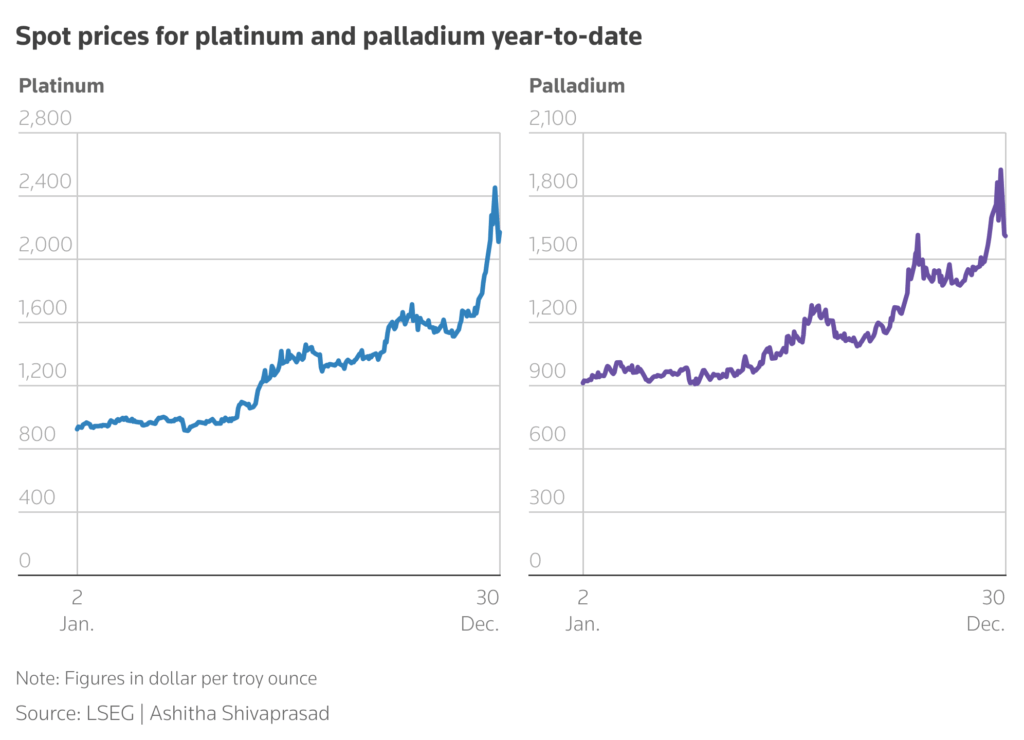
Platinum prices are on track for their strongest monthly rally in nearly four decades in December, fuelled by the EU’s U-turn on its 2035 combustion-engine ban, a tight supply backdrop and rising investment demand for precious metals.

Platinum and palladium, both used in autocatalysts that reduce car exhaust emissions, have surged this year as US tariff uncertainty and a rally in gold and silver helped offset long-term headwinds from the rise of electric vehicles.

The EU’s plan unveiled in December is “a steroid jab for PGMs, prolonging their use in catalytic converters”, analysts at Mitsubishi said.

“Not only is the extension indefinite, but the EU will require ongoing tighter emission levels, which by extension will require higher PGM loadings.”

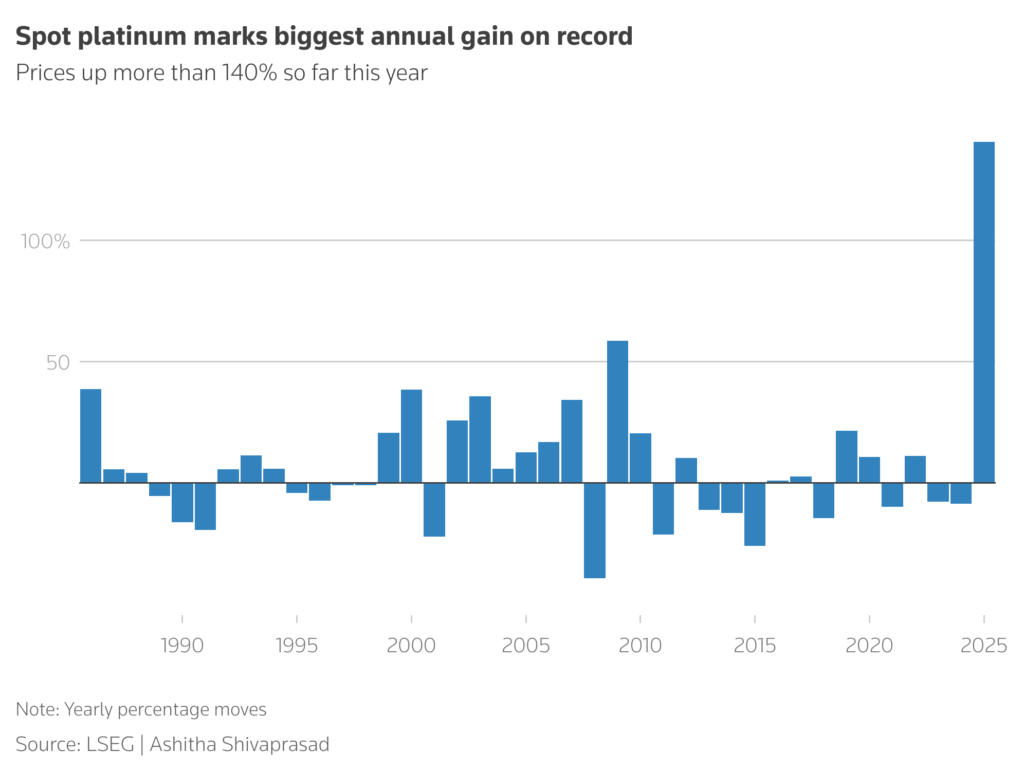
Platinum, also used in other industries such as jewellery, is up 33% so far in December, its biggest jump since 1986, according to LSEG data.

After hitting a record high of $2,478.50 per ounce on Monday, the metal is heading for its biggest yearly growth on record of 146%. Its sister metals, palladium and rhodium, are up 80% and 95% respectively so far in 2025.

Both platinum and palladium also benefited from defensive stock-building and tighter supply in the regional physical markets due to outflows to the US as Washington included the metals on the US critical minerals list.

The market expects more clarity on US tariffs in January.

The start of PGMs futures trading in China a month ago gave another boost, attracting heavy speculative flows and prompting the Guangzhou Futures Exchange to adjust price limits.

These contracts are the first domestic price-hedging mechanism for the PGMs in the world’s second-largest economy, which is also the top PGMs consumer, relying heavily on imports.

“If Chinese spot import buying remains elevated, the major test for platinum group metals will likely come after there is clarity on US tariffs,” Macquarie analysts said.

(By Ashitha Shivaprasad, Pablo Sinha, Sherin Elizabeth Varghese and Polina Devitt; Editing by Jan Harvey)


Nickel price hits nine-month high as Indonesia plans to cut output

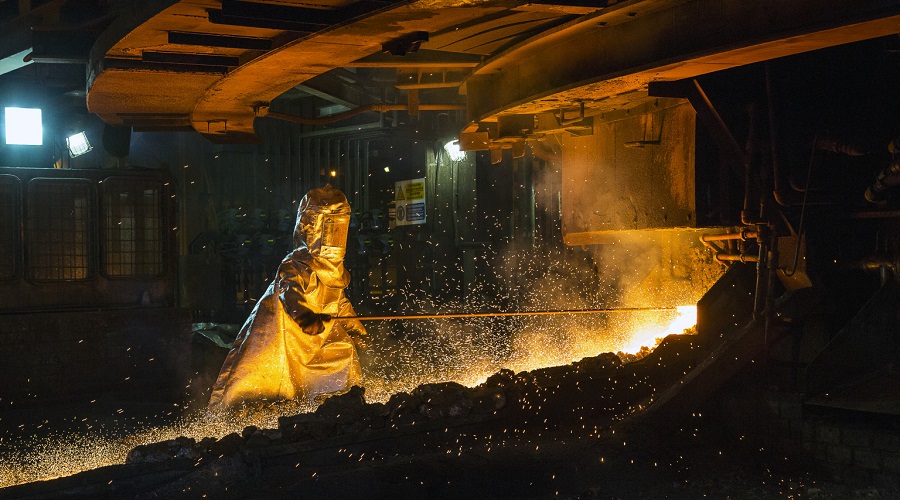
Nickel smelter in Sorowako, Indonesia. (Image by Marcelo Coelho, courtesy of Vale).

Nickel hit the highest since March after top producer Indonesia flagged plans to cut supply in order to boost prices.

Output will be reduced in 2026 to better match demand with supply, said Energy and Mineral Resources Minister Bahlil Lahadalia, according to CNBC Indonesia. The Southeast Asian country’s production of the metal, which is used in both stainless steel and electric vehicle batteries, has surged this decade to almost 70% of the world’s total.

Nickel is still among this year’s weaker performers on the London Metal Exchange as demand from the battery sector continues to disappoint due to the rise of alternative chemistries. Supply from Indonesia has continued to rise even as prices dragged for much of the year, causing stockpiles in warehouses tracked by the LME to rise rapidly.


Indonesian production is now central to the outlook for nickel prices next year. The government is able to control supply by tightening the issuance of mining quotas, known locally as RKABs.

Nickel rose as much as 4.7% to $16,560 a ton on the LME, extending a rally that tracked other metals from mid-December.

Copper price racks up longest rally since 2017 with bulls at the helm

Copper bull statue in Shanghai. Stock image.

Copper recorded the longest winning run since 2017 in a December rally powered by the prospect of more stress in the supply chain.

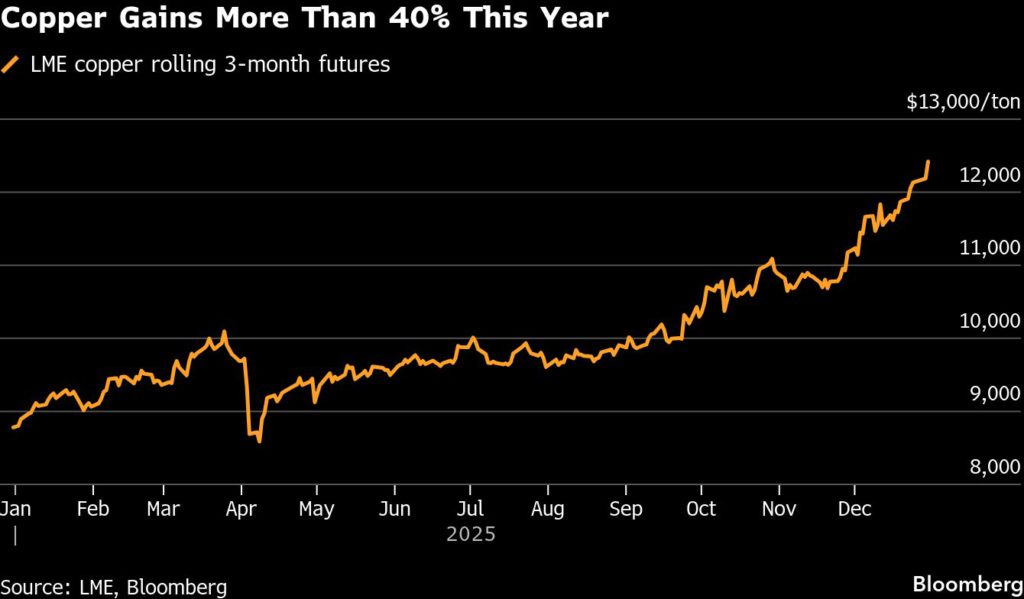
The metal rose 2.7% to settle at $12,558.50 a ton, the eighth day of gains, with positive sentiment showing resilience. Traders have been rushing metal to the US in anticipation of potential tariffs, tightening the market in the rest of the world.

Copper hit a record just below $13,000 a ton Monday in an end-of-year surge, before paring gains. Futures have rallied by more than 40% this year, setting up the biggest annual advance since 2009. A weaker US dollar — which makes metals less costly for buyers in other currencies — also has helped to bolster the gains, with a gauge of the greenback losing about 8% in 2025.

Supply issues have dominated metals this year, with copper mines from Indonesia and Chile to the Democratic Republic of the Congo suffering accidents. Aluminum production, meanwhile, is under threat from higher energy costs and supply limits in China, while zinc mines have also been disrupted.

For copper, it’s the threat of US import tariffs that remain the major driver. Mercuria Energy Group Ltd. warned in November there would be an extreme shortage of the metal in the rest of the world in 2026.

In the coming months, copper is likely “to be led by sentiment from investors over US copper specific tariffs, with focus on regional levels of global stocks and material entering the US, rather than underlying global fundamentals,” according to Natalie Scott-Gray, senior metals analyst at StoneX Financial Ltd.

The premium for March copper futures on Comex over comparable contracts on the London Metal Exchange has come down in recent days, but inventories in the US exchange are still rising, she said. Along with a “warming” macroeconomic outlook and supply risks, “the narrative hasn’t changed for copper with this perfect storm situation” seen throughout the fourth quarter, Scott-Gray said.

All other metals on the exchange rose, led by nickel, after top producer Indonesia flagged plans to cut supply in order to boost prices


Silver price: Here’s what to watch for after wild ride past $80

Stock image.

Silver’s exceptional volatility in recent days has captured the zeitgeist — with even the likes of Elon Musk drawing attention to the metal’s ferocious rally to all-time highs.

The metal rose to a record above $84 an ounce early Monday, before promptly crashing close to $70 in thin, post-holiday trading. It was one of silver’s largest price reversals ever.

Prices remain up more than 150% this year. Now the big question is: where does silver go from here?

Here are key charts to watch in the silver market to evaluate what happens next.

Chinese buying

Surging investor interest in China has been a key driver of silver prices in recent days. Speculators piled into the precious metal, mirroring a similar dynamic playing out in platinum. Elevated buying in the Shanghai Gold Exchange’s silver contract in December has pushed premiums to a record high, dragging other international benchmarks along.

The blistering rally provoked the country’s only pure-play silver fund to turn away new customers last week, after repeated risk warnings went unheeded. The fund’s manager announced the unusual step Friday after multiple actions — from tighter trading rules to cautionary advice about “unsustainable” gains — failed to quell an eruption of interest fueled by social media.

ETF inflows

Holdings in physical-backed silver exchange-traded funds have surged this year, rising by more than 150 million ounces. The total amount of metal held by the funds is still below a peak set during a Reddit-driven retail investment surge in 2021, but the inflows have been instrumental in eroding available supplies in an already tight market. Holdings in the funds have risen every month but one this year, according to Bloomberg calculations.


Technical indicators, margins

Silver prices jumped more than 25% in December alone, on track for the biggest monthly increase since 2020. The speed of the gains meant some technical indicators were signaling that prices had run too far, too quickly. The metal’s relative strength index — a gauge of buying and selling momentum — has stayed above 70 for most of the past few weeks. A reading higher than 70 usually indicates that too many investors bought silver in a short period.

Some exchanges are moving to rein in risk amid heightened volatility. The margins for some Comex silver futures contracts will be raised from Monday, according to a statement from CME Group Inc. That’s adding to headwinds since traders will need to put up more cash to keep their positions open. Some speculators won’t want to do that and will be forced to shrink or close their trades instead.

Options frenzy

One indication of speculative fervor has been the level of buying for call options, both on silver futures and related ETFs. Call options, which give the buyer the ability to buy a security at a pre-determined price level, are typically seen as a cheap way to bet on market upside.

For iShares Silver Trust (SLV), the largest silver ETF, total call volume hit the highest since 2021 last week. The cost of buying calls on silver futures relative to the cost of buying equivalent puts, which protect against price declines, also jumped to historical highs in December.


Borrowing costs

Thanks to a tariff-related trade, much of the world’s available silver still remains in New York warehouses. Meanwhile, the market is awaiting the outcome of a US Section 232 probe into critical minerals, which could lead to levies or other trade restrictions on the metal.

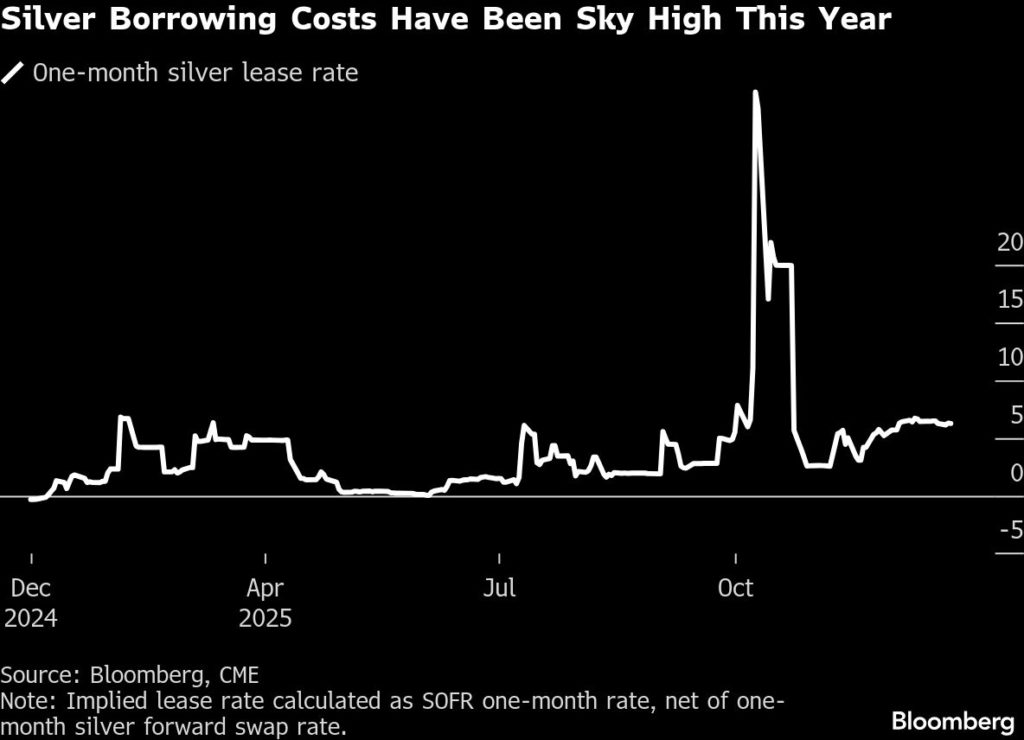
The surge of metal into the US pushed the London market into a full blown squeeze in October, and borrowing costs there still remain well above their normal levels of close to zero. That helped set the stage for increased volatility and frequent price spikes.


Catching up with gold

Precious metals generally have seen a surge in investment demand this year, supported by a sagging US dollar, President Donald Trump’s aggressive moves to remake global trade and threats to the Federal Reserve’s independence.

Gold was the first to rally, benefiting additionally from strong buying by global central banks. Some market watchers hold as a rule of thumb that when gold makes a decisive move, silver will eventually move twice as far in the same direction — this year, of course, they would have been right.

Many investors also track the ratio between the two commodities. After gold’s initial surge in the early months of this year, that ratio stretched above 100 to 1, signaling to some that it was time to buy the white metal. But in recent weeks, the ratio has rapidly shifted lower.

(By Jack Ryan)