It’s possible that I shall make an ass of myself. But in that case one can always get out of it with a little dialectic. I have, of course, so worded my proposition as to be right either way (K.Marx, Letter to F.Engels on the Indian Mutiny)
Thursday, January 01, 2026
Congo to allow cobalt quotas for 2025 to be executed until March 31
Mutanda, the world’s largest cobalt mine, is responsible for a fifth of global output. (Image courtesy of Glencore.)
The Democratic Republic of Congo will allow cobalt shipments under quotas set for the last three months of 2025 to take place until the end of March, the country’s mining regulator said, as preparations to implement its new quota system are protracted.
Congo accounts for more than 70% of global mined cobalt production that was estimated by analysts at around 280,000 metric tons this year. But a months-long export ban drove cobalt prices sharply higher and squeezed availability of the metal needed for electric vehicles.
A system, launched on October 16, has allocated a quota of 18,125 metric tons for the fourth quarter and will cap annual exports at 96,600 tons from 2026.
Quotas covering October 16 until December 31 “remain executable” until March 31, the regulator, ARECOMS, said in a statement dated Sunday and seen by Reuters on Wednesday.
CMOC and Glencore, the world’s two largest cobalt-producing companies, received the largest allocations. CMOC’s quota for the fourth quarter is 6,650 tons and Glencore’s 3,925 tons.
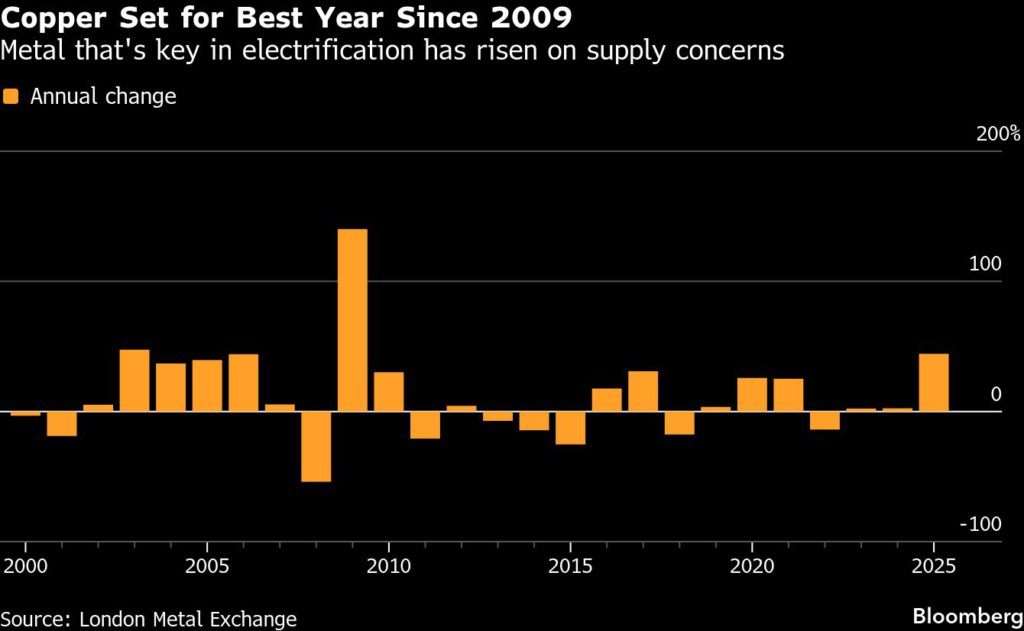
Copper had its best year since 2009, fueled by near-term supply tightness and bets that demand for the metal key in electrification will outpace production.
The red metal has notched a series of all-time highs in an end-of-year surge, rallying 42% on the London Metal Exchange this year. That makes it the best performer of the six industrial metals on the bourse. Prices dipped 1.1% Wednesday, the last trading day of 2025.
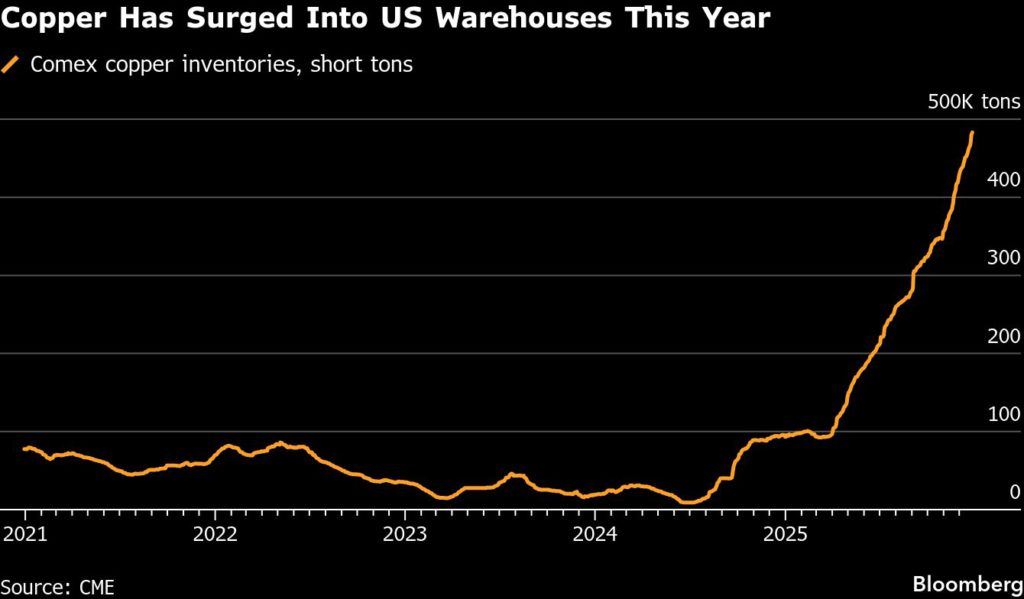
The latest gains also have been driven by traders rushing to ship copper to the US in anticipation of potential tariffs, creating tightness elsewhere. Trump’s plan to revisit the question of tariffs on primary copper in 2026 revived the arbitrage trade that rocked the market earlier in the year, tightening availability elsewhere even as underlying demand in key buyer China has softened. That price spread narrowed recently amid a power December rally on the LME.
“The expectation for future US import tariffs on refined copper has resulted in more than 650,000 tons of metal entering the country, creating tightness ex-US,” wrote Natalie Scott-Gray, senior metals analyst at StoneX Financial Ltd. She noted two-thirds of global visible stocks now are held within COMEX.
Beyond the tariff-driven flows, a deadly accident at the world’s second-largest copper mine in Indonesia, an underground flood in the Democratic Republic of Congo and a fatal rock blast at a mine in Chile have all added more strain to availability of the metal.
The near-term outlook for copper demand growth has been clouded by weakness in China, the world’s top consumer of the red metal. The country’s property market has been stuck in a yearslong downturn that’s dented the need for copper plumbing and wiring, while consumer spending has been sluggish, weighing on appetite for finished goods such as electronic appliances.
Still, robust momentum in global copper demand is expected over the long term. BloombergNEF estimates consumption could increase by more than a third by 2035 in its baseline scenario.
The drivers of this trend include the ongoing shift to cleaner energy sources such as solar panels and wind turbines, growing adoption of electric vehicles and the expansion of power grids.
Copper settled 1.1% lower at $12,558.50 a ton in London. Prices hit a record $12,960 on Monday.
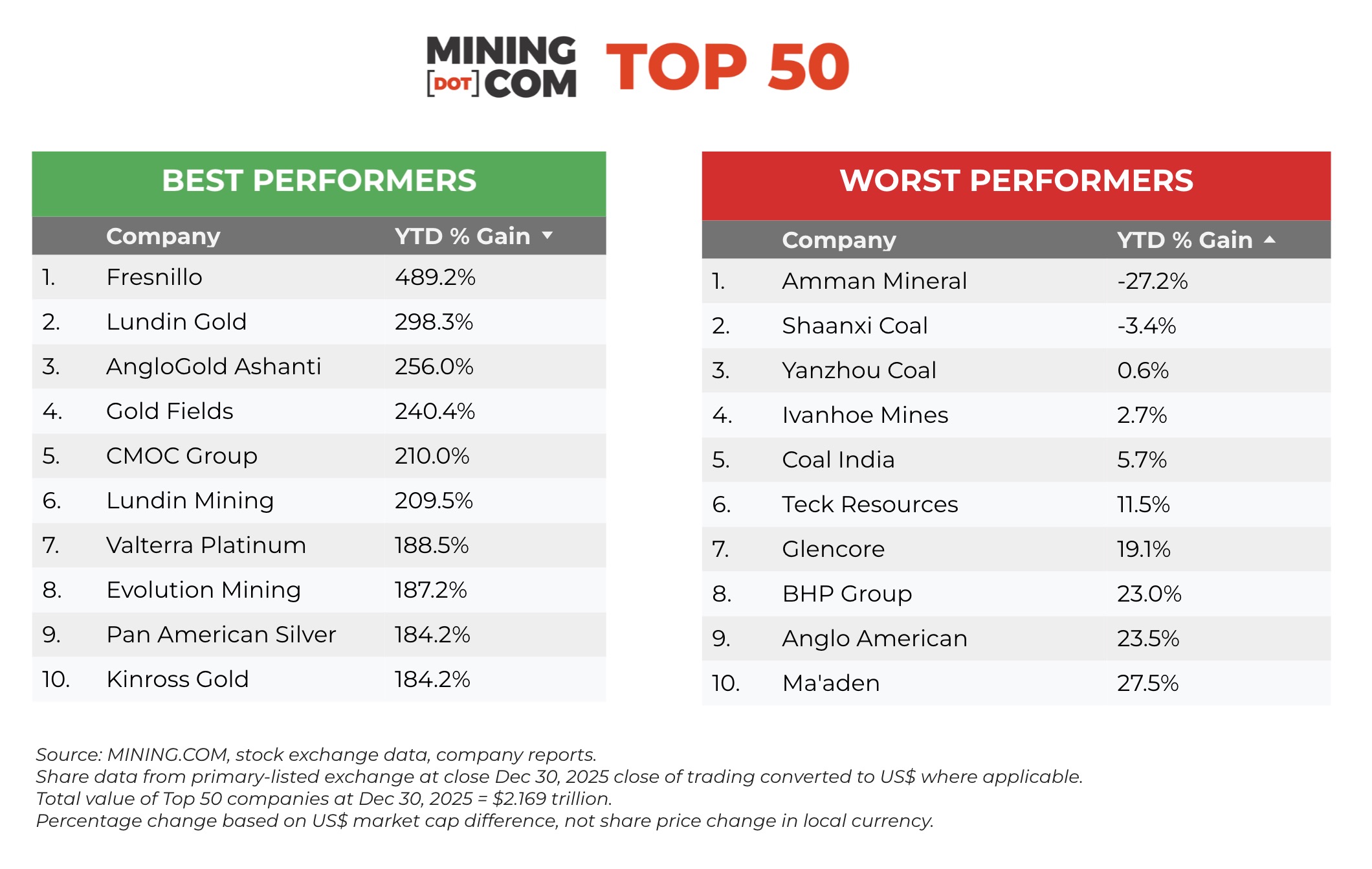
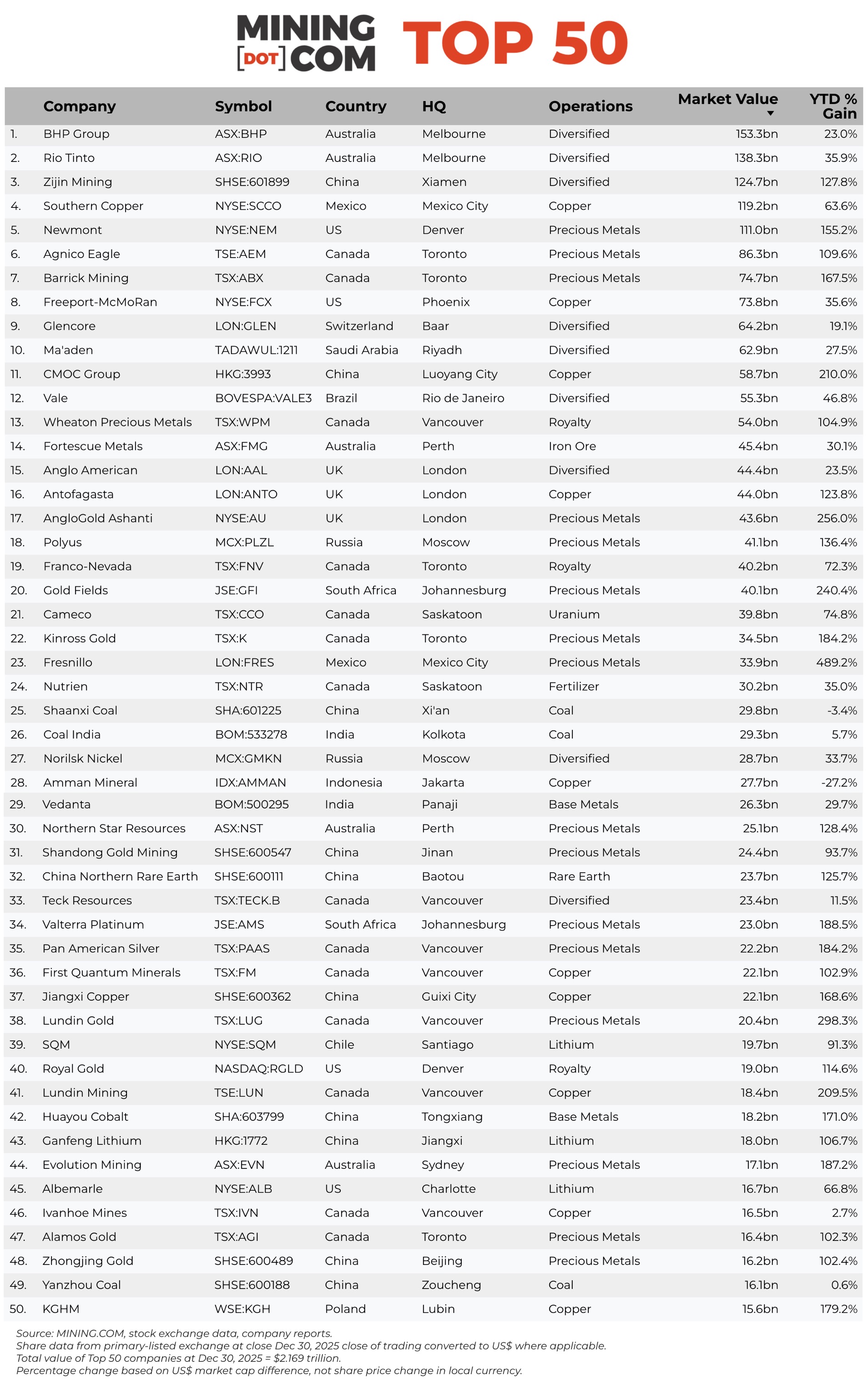
RERATED: Top 50 mining companies soar past $2 trillion valuation
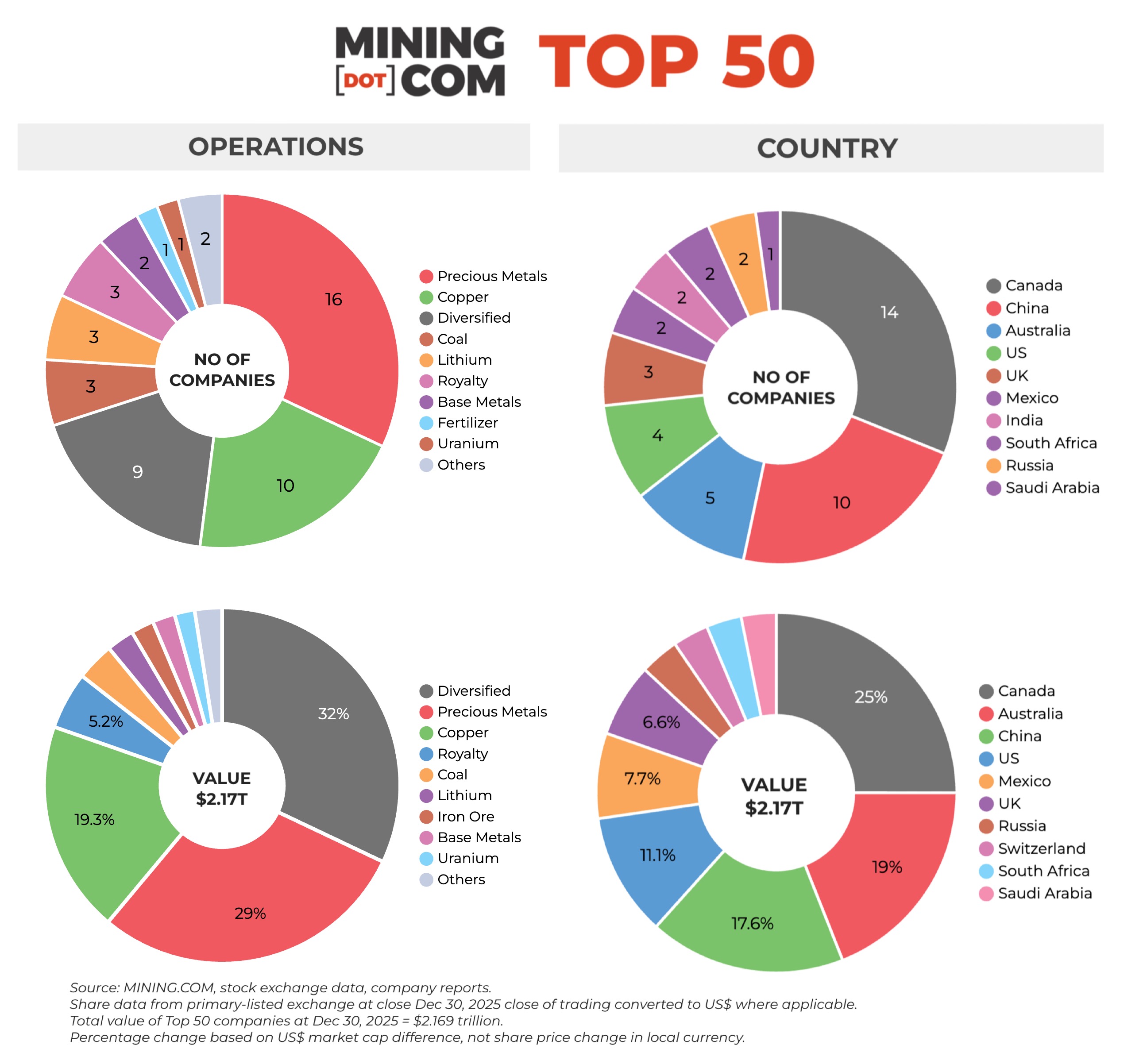
At the end of the fourth quarter the MINING.COM TOP 50* ranking of the world’s most valuable miners had a combined market capitalization of $2.17 trillion, up an astonishing $892 billion in 2025.
Most of the gains accumulated in the second half and after three years of stagnation, the market valuation of mining and metals appears to have finally caught up with other sectors. The building blocks of the global industrial economy are finally seen for what they are: critical.
From lip service (not even), Western governments (the US in particular) are now putting money behind mining, catching up to a competitive strategy China has successfully employed since the turn of the century.
The ranking is based on a company’s market capitalization in local currency on its primary exchange and then converted to USD so the near-double digit decline in the greenback this year gave some support to stock and commodities prices. But a rerating of the industry has been long overdue.
Most of the credit for the 70% jump in the value of the Top 50 can go to rampant precious metals prices and copper, but gains have been broad-based and even old-economy iron ore and much reviled lithium joined the party, albeit late.
The best performing list shines with gold and silver counters including a five-fold increase for Fresnillo, the London-listed silver miner controlled by Mexico’s Peñoles, which has now cemented its position halfway up the ranking after dropping in and out for years.
The stiff competition to make the list this year is evidenced by the fate of Coeur Mining. After entering the Top 50 for the first time at the end of September, a middling performance in Q4 saw the Chicago-based silver and gold miner fall out of the ranking despite more than tripling in value over the course of 2025.
Apart from all things precious and base, rare earth was the standout story of 2025. Perth’s Lynas Rare Earth squeaked in at no 49 after at the end of Q3 to join Las Vegas-based MP Materials which rocketed up the charts in the first half after a groundbreaking deal with the Pentagon.
MP Materials still show gains north of 200% for the year and Lynas has doubled, but that was not enough and now both counters have fallen out of the ranking again, leaving only China Northern Rare Earth to represent the 17 elements as it has for years.
Taking the place of the rare earth stocks are the world’s two largest lithium producers. A boost to the price of the battery metal in the second as oversupply began to ease, saw Chile’s SQM and US producer Albemarle return to the Top 50, bringing the number of lithium miners back to three.
The sector peaked in 2022 with six stocks in the ranking and Tanqi Lithium ranked 58th at the moment may well join its Chinese counterpart Ganfeng if the lithium uptrend continues, but Australian producers like Minerals Resources and Pilbara Minerals (now PLS Group) may have a harder time of it.
Since inception, the MINING.COM TOP 50 was headed by two firms – BHP and Rio Tinto – the only miners with consistent market capitalizations above $100 billion (with a wobble here and there). Now there are five firms with the distinction.
With a string of acquisitions behind it, Chinese champion Zijin Mining, worth $124 billion after a 127% appreciation only just pipped Southern Copper, which has also embarked on an aggressive expansion strategy, for third, up 64% to $119 billion.
Southern Copper, the NYSE-listed mining arm of Grupo Mexico, was joined by Newmont in the triple digit club last quarter but unlike its acquisitive peers, shortly after swallowing Australia’s Newcrest Mining for $17 billion, Denver-based Newmont embarked on a multi-billion dollar divestiture program.
Agnico Eagle and Kirkland Lake Gold combined in 2022 and the Toronto-based group continues to bolt on assets, making it a candidate for the $100 billion mark should gold continue its gravity defying rally. Agnico has doubled in value this year and is worth $86.3 billion.
Anglo and Teck Resources could yet turn out to be the biggest mining deal of the decade now that Ottawa has blessed the combination, thanks in no small part to Anglo’s commitment to move its London headquarters to Vancouver.
But scaling the $100 billion level may prove elusive. Despite double digit gains, both Teck and Anglo made the year’s worst performer list – just another indication what a wild ride 2025 has been.
Anglo-Teck would hardly crack the top 10 with a combined value of a shade under $68 billion, but will place it ahead of Swiss miner and commodities trader Glencore, which once again underperformed in 2025.
That would add insult to injury for Baar, which tried and failed to acquire Teck a couple of years ago and is still trading, nearly 15 years later, below its 2011 IPO price.
NOTES:

Source: MINING.COM, stock exchange data, company reports. Share data from primary-listed exchange on December 30, 2025 close of trading converted to US$ where applicable. Percentage change based on US$ market cap difference, not share price change in local currency.

As with any ranking, criteria for inclusion are contentious. We decided to exclude unlisted and state-owned enterprises at the outset due to a lack of information. That, of course, excludes giants like Chile’s Codelco, Uzbekistan’s Navoi Mining (the gold and uranium giant may list later this year), Eurochem, a major potash firm, and a number of entities in China and developing countries around the world.
Another central criterion was the depth of involvement in the industry, and how far upstream is the bulk of its revenue, before an enterprise can rightfully be called a mining company.

For instance, should smelter companies or commodity traders that own minority stakes in mining assets be included, especially if these investments have no operational component or even warrant a seat on the board? This is a common structure in Asia and excluding these types of companies removed well-known names like Japan’s Marubeni and Mitsui, Korea Zinc and Chile’s Copec.

Levels of operational or strategic involvement and size of shareholding were other central considerations. Do streaming and royalty companies that receive metals from mining operations without shareholding qualify or are they just specialised financing vehicles? We included Franco Nevada, Royal Gold and Wheaton Precious Metals on the basis of their deep involvement in the industry.

Vertically integrated concerns like Alcoa and energy companies such as Shenhua Energy or Bayan Resources where power, ports and railways make up a large portion of revenues pose a problem. The revenue mix also tends to change alongside volatile coal prices. Same goes for battery makers like China’s CATL which is increasingly moving upstream, but where mining will continue to represent a small portion of its valuation.

Another consideration is diversified companies such as Anglo American with separately listed majority-owned subsidiaries. We’ve included Angloplat (now Valterra) to track PGM representation in the ranking but excluded Kumba Iron Ore in which Anglo has a 70% stake to avoid double counting. Similarly, we excluded Hindustan Zinc which is listed separately but majority owned by Vedanta.

With other groups like Mexico’s Penoles where refining and chemicals make up a substantial part of the business where possible the Top 50 would include separately listed operating subsidiaries that are dedicated to mining. This is also why Southern Copper represents Grupo Mexico in the ranking.
Many steelmakers own and often operate iron ore and other metal mines, but in the interest of balance and diversity we excluded the steel industry, and with that many companies that have substantial mining assets including giants like ArcelorMittal, Magnitogorsk, Ternium, Baosteel and many others.

Head office refers to operational headquarters wherever applicable, for example BHP and Rio Tinto are shown as Melbourne, Australia, but Antofagasta is the exception that proves the rule. We consider the company’s HQ to be in London, where it has been listed since the late 1800s.

Please let us know of any errors, omissions, deletions or additions to the ranking or suggest a different methodology: email Frik Els at fels@mining.com with Top 50 in the subject line.
In Venezuela, price of US dollar up 479 percent in a year
The Venezuelan bolivar is losing value on the US dollar as tensions mount between the two countries - Copyright AFP/File Federico PARRA
Venezuela, currently in the throes of an escalating crisis with the United States, closed the books Wednesday on a complicated year for its economy, with the official cost of buying a US dollar up 479 percent in the last 12 months.
The gap between the official and black market rate is mounting as well, nearing 100 percent in an economy that has become increasingly dollarized as a way to tackle hyperinflation.
Even though President Nicolas Maduro projected economic growth of nearly nine percent in 2025, the oil-rich South American country has seen a sharp decline, with inflation soaring and hard currency in short supply.
US President Donald Trump has piled the pressure on Maduro, stiffening sanctions and ordering the seizure of “sanctioned oil vessels” sailing to and from Venezuela.
Venezuela’s central bank on Wednesday set the official rate at 301.37 bolivars to the US dollar, a rate in effect until January 2. That marks a 479.25 percent increase from the rate of 52.02 bolivars to the dollar posted in early 2025.
On the black market, where prices are determined by crypto exchange platforms, one US dollar is going for nearly 560 bolivars — at least an 85 percent difference with the official rate.
Economists say that 80 percent of Venezuela’s currency exchanges are carried out on such platforms.
Inflation could ultimately pass the astronomical rate of 500 percent in 2025, according to estimates from private firms. Official data has not been published since October 2024.
Venezuela has been under a US oil embargo since 2019 and exports the vast majority of its output on the black market at a sharp discount.
Search Launched for Four Survivors After U.S. Strike on Three Drug Boats
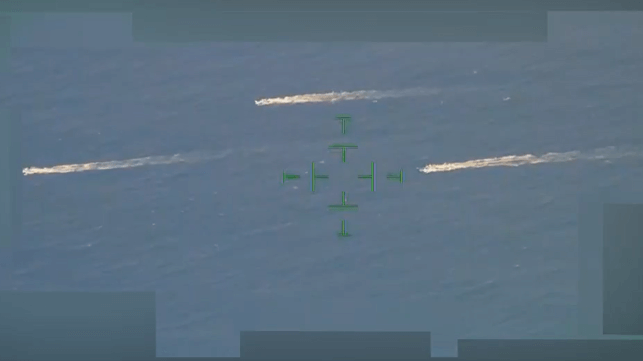
On Tuesday, U.S. Southern Command launched strikes to destroy three drug-smuggling boats in one engagement, killing three suspected traffickers and - in a departure from other recent attacks - leaving four alive for potential rescue.
In a statement Wednesday, Southern Command said that the three boats were operating in international waters along known smuggling routes. The three targets had previously engaged in a boat-to-boat transfer of suspected narcotics, and all three were operating together in a formation.
One boat was destroyed in an airstrike, killing three people on board. The operators of the other two boats jumped over the side into the water and swam away before follow-up strikes hit their vessels, Southern Command said. This left four survivors overboard.
Rather than conduct another follow-up strike, Southern Command notified the U.S. Coast Guard of a search-and-rescue situation at the scene. The command did not specify whether any survivors had been rescued as of Wednesday.
Video of the strikes shows the use of cannonfire on at least one instance, signaling the presence of a U.S. Air Force AC-130J gunship, which has been seen deployed in Southern Command and has been used in some previous interdictions.
Bankrupt Chinese Yard Relaunches Under New Ownership
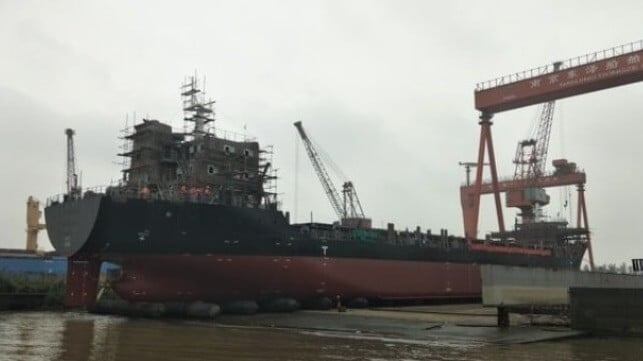
China's shipbuilding industry has been expanding capacity as it takes on more and more global market share, and investors and conglomerates have been getting in on the opportunity by reactivating old yards that went bankrupt after the last downturn. Buyers get ready-made drydocks, gantry cranes and fabrication plants for a fraction of the time and cost of building a greenfield yard. The latest instance is the restart of the Nanjing Dongze Shipyard on the Yangtze, which began with a judicial sale of the plant earlier this year.
Nanjing Dongze was an independent yard on the northeastern outskirts of the city of Nanjing, on the Yangtze's right descending bank. Modest in size, it delivered smaller cargo vessels until 2017, when it ceased operations and began leasing out its facilities, according to EWorldShip.
By early 2025, the firm had accumulated about $50 million in unpaid debts, and it filed a petition for bankruptcy reorganization. A local court approved the petition in May, stipulating that a buyer would acquire the company for zero payment on condition that it settle the firm's outstanding debts.
A division of China Merchants Shipbuilding Industry Group acquired the firm and agreed to pay $33 million to the yard's creditors. In return, the buyer gained two slipways for ships up to 50,000 dwt, along with acreage and half a mile of shoreline on the Yangtze. The new site complements China Merchants' existing facility in Nanjing, Jinling Shipyard. Stay on Top of the Daily Maritime News
Get the latest maritime news delivered to your inbox daily.Subscribe Now
The rebranded Nanjing Dongze Shipbuilding launched its first newbuild under new ownership in mid-December. The chemical tanker SC Emerald is the inaugural ship the facility has launched as a division of China Merchants, and photos suggest that many more are to come.
China holds more than half of global shipbuilding market share, and Nanjing Dongze is just one of a dozen-plus Chinese yards that have rebooted over the last several years to meet demand. In late 2024, new orders led to a restart at the giant Rongsheng Shipyard in Nantong, reviving a mega-yard capable of producing about one percent of global tonnage on its own.
Major Cargo Improvements on Track for 2026 Completion
While the Port of Galveston made headlines with the opening of its fourth cruise terminal in 2025, next year we’ll celebrate another port milestone – completion of major improvements at the West Port Cargo Complex.
Located on Galveston Harbor, one of the nation’s busiest cargo waterways, the port moves more than 3 million tons of general and breakbulk cargos, including roll-on/roll-off (ro-ro) and giant wind turbine pieces a year.
Hundreds of cargo ships call at the complex to move cargo across our docks, generating thousands of jobs and economic growth for our region.
For the first time in decades, the port is investing $106 million to improve dilapidated waterfront infrastructure, add acreage for cargo handling and extend berthing space. This will allow port tenants to move more cargo through the area and put more people to work on the waterfront.
The phased work began in 2024 with funding from a state grant and port operating reserves, largely from cruise revenues. Here’s an update on our progress:
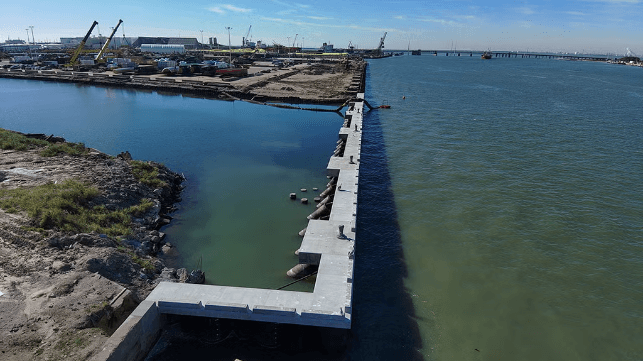
Pier 38/39 – The port-funded work includes enclosing and filling an outdated slip. The port built a closure structure which will double as a berth beginning in 2026. The slip will be filled with dredge materials beginning in January and completed within the year. The fill will need to settle for a period before the area can be used for cargo laydown.
Pier 40/41 – This project includes another slip closure structure and berth extension project. It is funded with a state grant and port operating reserves. The slip closure structure and berth infrastructure will be completed by mid 2026. The slip will be filled in a future phase.
Pier 39-40 berth – Along with slip closures, this rehabilitation project makes it possible for the port to complete a 1,434-foot-long berth extending from Pier 38/39 to Pier 40/41. Designed to accommodate 46-foot-draft ships, the berth will be commissioned in the second half of 2026.
Pier 41 paving – Six acres at Pier 41 has been repaved to repair failed subgrade and concrete paving. Now that the giant holes are gone, the area is fully usable for cargo handling.
Grain elevator demolition – The port demolished a decades-old, decommissioned grain elevator to add more acreage for cargo handling. The berth and some acreage are being used now for cargo ships. The area will be completely cleared for cargo use in 2026.
This is the first time in decades that the port has made an investment of this size in our docks. These master plan projects demonstrate our commitment to a diversified revenue stream and jobs growth.
The investment puts us on the cusp of a new era of cargo growth for Galveston. For the first time in decades, the Galveston Wharves and its partners can develop our cargo business to its full potential, generating hundreds of new jobs and tremendous economic growth for the region.
The products and services herein described in this press release are not endorsed by The Maritime Executive.
SMART-SEA System Guides Seafarers Away From Collisions
Machine learning and radar imaging combine to give mariners real-time maneuvering advice, potentially reducing accidents at sea and beyond.
Collisions between marine vessels and stationary structures, like offshore oil platforms and depleted wellheads, are becoming increasingly common. These collisions come with a cost — including the financial burden of lost goods and potential loss of life.
Ocean engineering researchers at Texas A&M University are developing a smarter system to combat these collisions and their costs. By combining raw radar imaging data with advanced machine learning, researchers have created SMART-SEA, a system that gives seafarers real-time guidance on how and when to maneuver their vessel.
To design a practical system for seafarers, researchers conducted a focus group with Texas A&M at Galveston faculty members, many of whom are former seafarers. Researchers also collaborated with industry experts, the U.S. Navy and the U.S. Coast Guard. Their experience assisted researchers in defining practical decision-making skills — like when to yield and how far to turn — and implementing them into the SMART-SEA system.
“Many of these collisions are caused by human error,” said Dr. Mirjam Fürth, an assistant professor of ocean engineering. “By using data to provide seafarers with real-time instructions, we hope to reduce marine collisions.”
At its core, the SMART-SEA system aims to provide seafarers with the ideal maneuvers to ensure vessel safety, without controlling movements autonomously. SMART-SEA provides the information visually on a dashboard, but the decision and steering of the vessel is controlled by the seafarer.
Key data points used by SMART-SEA to provide maneuvering suggestions are raw radar images and vessel maneuverability — determined through a tiered model based on seafarer experience, state of the art computational fluid dynamics models and machine learning trained on past vessel motions.
Raw radar images are processed using a machine learning tool that identifies and classifies stationary objects near the vessel. Once identified, the vessel’s maneuverability and seafarer’s experience level are considered to recommend the safest action for the vessel.
Fürth and her team, including former seafarer and Texas A&M Galveston Professor of Practice Ryan Vechan, tested SMART-SEA aboard the Texas A&M research vessel Trident, with preliminary data supporting the prototype as a way to reduce marine collisions.
SMART-SEA can detect stationary objects in all weather conditions, and seafarers can choose how to receive the data — either visually, audibly or a combination of the two.
“I do think SMART-SEA could reduce marine collisions and possibly pave the way for more autonomous vessels,” Fürth said.
The project’s initial funding came from the U.S. Department of the Interiors and the U.S. Department of Energy through the Ocean Energy Safety Institute under a one-year contract.
Researchers hope to secure additional funding to continue testing SMART-SEA on other vessels and to improve the system. Fürth believes that the system’s low costs could allow it to be adapted for recreational vessels, reducing boating accidents.
“I hope we get to continue this research in the future. I think we just scratched the surface,” said Fürth.
Also collaborating on this research from the ocean engineering department are Ph.D. students Andrew Deng and Yijun Sun, Research Assistant Professor Dr. Björn Winden, and Assistant Professor Dr. Freddie Witherden.
The products and services herein described in this press release are not endorsed by The Maritime Executive.
PIL Marks New Year’s Eve Sponsoring Humanity Matters’ Gaza Relief Effort
More than 25 PIL Volunteers participated in the packing of 18 tonnes of humanitarian relief supplies
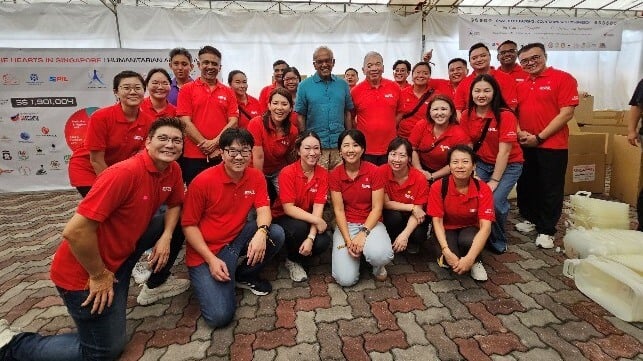
Pacific International Lines (PIL), Singapore’s home-grown shipping line, ushered in the New Year with purpose and compassion as 25 staff members joined more than 130 community volunteers to pack 18 tonnes of humanitarian relief supplies for conflict-stricken civilians in Gaza. The activity follows PIL’s sponsorship of Singaporean non-profit organisation Humanity Matters’ (HM) Gaza Relief Collection on 20 December 2025.
The relief packing initiative, titled Countdown with Compassion – HM Gaza Relief Packing, was partially funded by PIL and held at Charis Tabernacle on New Year’s Eve. The event was attended by Mr. K. Shanmugam, Coordinating Minister for National Security and Minister for Home Affairs, as the Guest-of-Honour.
During the session, volunteers packed:
60,000 packs of Ready?to?Eat bean soup meals (MREs) to alleviate hunger; and
3,000 collapsible jerry cans to support hygienic collection and storage of drinking water distributed weekly by water trucks inside Gaza.
As the official Shipping & Logistics Partner for Humanity Matters (HM), PIL will transport the relief cargo to Jordan in early January on two 40?foot containers. The shipment will subsequently be delivered into Gaza through land crossings or airdrops, depending on operational conditions.
PIL’s Executive Chairman, Mr. S.S. Teo, said, “Following our sponsorship of Humanity Matters’ Gaza Relief collection earlier this month, today’s relief packing activity is a continuation of our strong support to this worthwhile cause. It is a good platform for us to further inculcate the spirit of common humanity and compassion amongst our workforce and amongst Singaporeans. I am heartened that so many of our employees have come out on New Year’s Eve to help out - this community spirit of giving runs deep in our company and our people wherever we operate."
The products and services herein described in this press release are not endorsed by The Maritime Executive.
Danish Archaeologists Uncover Largest Medieval Sailing Cog Ever Found
A team of archaeologists in Denmark have discovered the largest medieval European cargo ship ever found, according to the Viking Ship Museum.
The team found the wreck on the bottom of the Oresund while conducting site investigations for the construction of Lynetteholm, the controversial manmade island being built just off central Copenhagen. The new 270-acre land feature is both a harbor protection feature to defend against storm surge and a new urban development district.
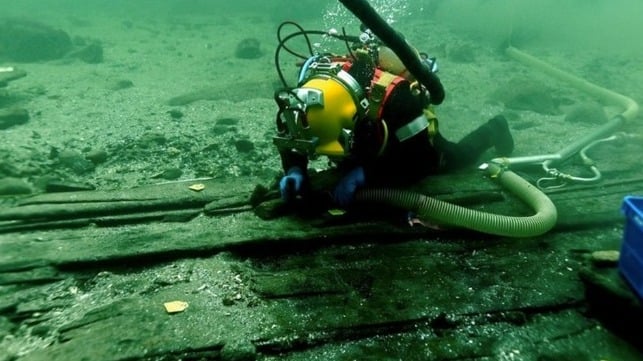
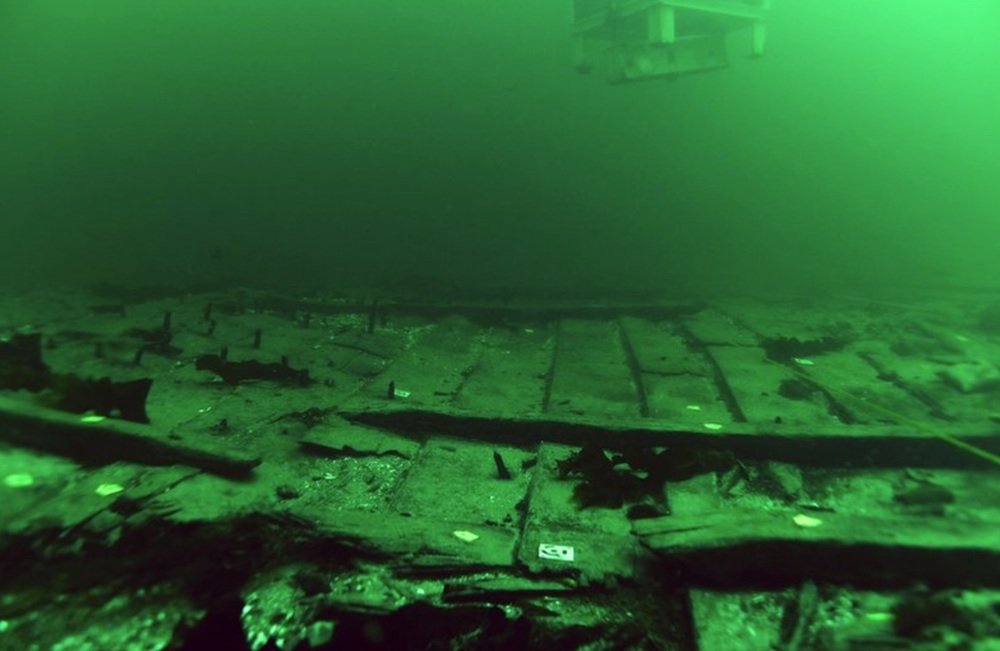
During examination of the seabed between Amager and Saltholm - near the Oresund Bridge's western tunnel - the team from the Viking Ship Museum stumbled upon an extraordinary find: the largest "cog" ever discovered. It is about 100 feet long by 30 feet wide, and it dates back to the early 1400s. No cargo was found, but there were plenty of personal effects from the crew on site.
The medieval cog: Period illustration of a small cog from Stralsund, circa 1329 (Vrak)
The vessel, which the team named Svaelget 2 after the name of the channel, would have had a deadweight of about 300 tonnes. The high cargo capacity suggests a long-distance, large-volume route in the era's rapidly-expanding maritime trade network, the museum said.
"It is clear evidence that everyday goods were traded. Shipbuilders went as big as possible to transport bulky cargo – salt, timber, bricks or basic food items," excavation leader Otto Uldum said. "We now know, undeniably, that cogs could be this large – that the ship type could be pushed to this extreme."
The ship's planking came from Poland and the ribs from the Netherlands, the researchers found. Since Dutch shipwrights had expertise in building cogs, it is likely that Polish planks were shipped to a yard in the Netherlands for construction. Tree rings in the timber dated the ship to about 1410.
Viking Ship Museum / press handout
A large vessel like this one likely would have been built for moving cargo between modern-day Holland and ports in the Baltic, the museum said. It was a challenging voyage for a small wooden sailing vessel, requiring transit through the often-rough North Sea and the Skagerrak.
The degree of preservation of the wreck is extraordinary, the museum said, and even some traces of the rigging are still intact. Parts of a raised deckhouse on the stern are also still in evidence - the first time ever that this kind of structure has been found intact at the wreck site of a cog. The cog's rudimentary deckhouse was an advance over previous Viking Age designs that exposed the crew to the weather at all times, Uldum said. The vessel was also fitted with an advanced galley for the era, equipped with a brick hearth for cooking hot food under way.
Russia Adds Long-Delayed Multifunction Vessel Capable of NSR Support
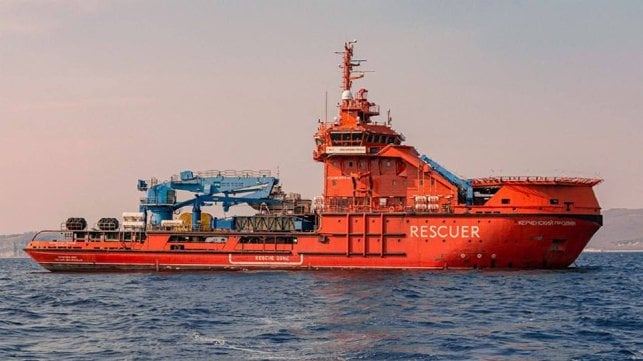
Kerch Strait multifunctional rescue and support ship will aid shipping in the Far East (Sea Rescue Service)
Russia’s Sea Rescue Service took delivery of the Kerch Strait, a multifunction support and rescue vessel. It is the latest in the efforts to expand support services for vessels operating along the Northern Sea Route.
Construction of the vessel was first proposed nearly two decades ago, and construction began, according to media reports, in 2010 at the Amur Shipyard. The project was suspended due to litigation and did not resume till 2018, with the ship finally launched in November 2020. Trials began in November 2025, and delivery was recently completed.
At 86 meters (282 feet) in length and with an icebreaking stem, the vessel can operate along the Northern Sea Route. It will be based with the Primorsky Branch in the Far East and is designed both for patrol and emergency rescue duties.
The ship has two Azimuth propulsion pods and bow thrusters with a maximum engine power on each of two units of 3500kW. It is expected to have a maximum speed of 15 knots and operate with a crew of 26. It can also accommodate 12 special personnel and has places for up to 95 people during rescue operations. It has a forward helipad for Ka-32 helicopter operations.
During icebreaking operations, it will support ports and local waterways as well as freezing non-Arctic seas with ice up to 1.5 meters (nearly 5 feet) in thickness. It will be used to provide support and assistance in areas of hazardous navigation, supporting operations from shipping to fishing and oil and gas fields. It can also support underwater technical work and towing.
The delivery on the vessel comes as Russia looks to add capabilities along the shipping routes to support year-round service on the Northern Sea Route.