Friday, January 02, 2026


Allowing coral reef fish stocks recover could feed millions


Smithsonian Tropical Research Institute

School of Surgeonfish fish at Coiba Island in Panama 

image: 

School of Surgeonfish fish at Coiba Island in Panama

view more 

Credit: Sean Mattson


With a human population of 8.3 billion people worldwide and millions facing malnutrition, food security is something to think about. But imagine if the ocean could help with that. Scientists at the Smithsonian Tropical Research Institute (STRI) in Panama and collaborators from several other institutions have found that allowing coral reef fish populations to recover could dramatically increase the number of fish servings produced sustainably per year, feeding millions of people. Their research reveals that many reef fish populations are so depleted that they are producing far less than their sustainable potential — yet rebuilding these stocks could help fight global hunger. 


“Our study quantifies how much is being lost by having overfished reef fish communities in terms of food provisioning and, in turn, how much could be gained from rebuilding reef fish stocks and managing them at sustainable levels,” explains Jessica Zamborain-Mason, a professor at King Abdullah University of Science and Technology (KAUST) and first author of the recently published paper in the journal PNAS

 
The study shows that coral reefs worldwide could increase sustainable fish yields by nearly 50% if fish populations were allowed to recover. This recovery could provide countries with 20,000 up to 162 million additional sustainable servings, enough to meet recommended seafood intake for several million people annually, which is eight ounces per week per person. Country-by-country, the greatest benefits would occur in regions suffering from the greatest hunger and micronutrient deficiencies, such as parts of Africa and Southeast Asia. Indonesia for example is the region with the greatest potential benefit. 

“There is a positive correlation between countries’ potential increase in the number of fish servings with stock recovery and their global hunger index. Therefore, countries with higher malnutrition indexes could benefit more from recovered reef fish stocks,” expressed STRI staff scientist and co-author of the study Sean Connolly.  

Researchers analyzed data from all territories worldwide that contain coral reefs, located in a variety of countries such as Dominican Republic, Panama, Jamaica, Kenya, Mauritius, Oman, Jamaica, Madagascar, Philippines, Indonesia, among others. They used statistical models to estimate current fish quantities and potential yields from allowing fish stocks to recover, on reefs classified as overfished. That is, they calculated how much fish stocks would need to grow to reach “maximum sustainable yields” and “pretty good yields” and how long recovery would take under different management scenarios. Fish recovery time would depend on the state of depletion and fishing restrictions, but scientists calculated that it could take on average from six to 50 years. 


Rebuilding coral reef fisheries shouldn’t be just an ecological goal— this study shows it could be a pathway to help fight hunger and improve nutrition. However, achieving these gains would require effective fisheries management that allows fish stocks to grow. For some locations, making such a strategy viable would require improved fisheries management, alongside alternative livelihoods during recovery periods and international support. The next challenge is designing specific strategies that balance conservation with human livelihoods, ensuring that the ocean’s potential is fully realized. 

“Our findings also reinforce that effective reef fisheries monitoring and management has substantial and measurable benefits beyond environmental conservation; it has food security and public health implications,” explains Zamborain-Mason. 


Reference: J. Zamborain-Mason, J.E. Cinner, M.A. MacNeil, M. Beger, D. Booth, S.C.A. Ferse, C.D. Golden, N.A.J. Graham, A.S. Hoey, D. Mouillot, & S.R. Connolly. 2025. Potential yield and food provisioning gains from rebuilding the world’s coral reef fish stocks, Proc. Natl. Acad. Sci. U.S.A. 122 (51) e2508805122, https://doi.org/10.1073/pnas.2508805122.

Fishing for food security: On a small island in Papua New Guinea, families lay an assortment of smoked reef fish across a shared table, illustrating the importance of sustainably managed multispecies reef fisheries for food security. 

Credit

Jessica Zamborain-Mason

A multi species coral reef fish catch in North Sulawesi, Indonesia.

Credit

Joshua Cinner

 the Smithsonian Tropical Research Institute

Headquartered in Panama City, Panama, STRI is a unit of the Smithsonian Institution. Our mission is to understand tropical biodiversity and its importance to human welfare, to train students to conduct research in the tropics and to promote conservation by increasing public awareness of the beauty and importance of tropical ecosystems. Watch our video, and visit our websiteFacebookX and Instagram for updates.

Not playing by the rules: USU researcher explores filamentous algae dynamics in rivers


Statistician and river ecologist Alice Carter publishes new findings about algal assemblage patterns in Montana's Clark Fork River in journal 'Ecology.'


Utah State University

Filamentous Algae in Montana's Clark Fork River 

image: 

Large amounts of filamentous algae, known as FAB, are appearing in Western U.S. waterways. Researchers report findings about these plant-like organisms in the Dec. 9, 2025, issue of the journal 'Ecology.'

view more 

Credit: Laurel Genzoli


LOGAN, UTAH, USA -- Algae is a ubiquitous feature in waterways throughout the globe, including western North America. Slippery, green epilithic algae is a familiar sight on river rocks. Toxic blue-green algae – cyanobacteria – is a visually interesting, yet worrisome phenomenon. Increasingly prevalent filamentous algae, with its long, voluminous green strands joins the picture, and is presenting new questions for scientists, recreationalists and land managers.

“In recent years, people have noted very large filamentous algae blooms in big, western rivers in the United States, including in Utah’s Provo, Jordan and Bear Rivers,” says Utah State University river ecologist and statistician Alice Carter. “They create a ton of biomass and grow filaments up to 12 meters long. Though not toxic, they’re a nuisance interfering with traditional recreational river uses, including kayaking and fishing. Further, these huge blooms are essentially a food web dead end that don’t support fisheries or macroinvertebrate communities.”

Carter and colleagues from the University of Montana and Woods Hole Oceanographic Institution in Massachusetts have been studying these massive plant-like organisms in the Upper Clark Fork River in western Montana. They report findings in the Dec. 9, 2025 online issue of the journal Ecology. The research was supported by the National Science Foundation.

Carter, a professional practice assistant professor in USU’s Department of Mathematics and Statistics and the USU Ecology Center, says the study revealed some unexpected aspects of these filamentous algae blooms – known as ‘FABs.’

“While FABs are creating a significant shift in the ecosystem structure, we’re seeing minimal change in the river’s ecosystem metabolism and function,” she says. “Instead, smaller, more fast-cycling epilithic algae appears to be quietly doing the heavy lifting of producing a healthy ecosystem good for the food web and driving the whole system.”

FABs are producing roughly the same amount of carbon as slimy epilithic algae that occupies a much smaller footprint.

“This implies rivers might be an exception to our theory surrounding ecosystem ecology,” Carter says. “In terrestrial ecosystems, structure and function are tightly linked. If you have a dense forest with tons of trees and biomass, it’s also a productive forest. Whereas, If you have a small amount of vegetation, it will be a less productive environment.”

In contrast, structure and function seem decoupled in rivers, she says.

“Rivers might not be playing by the rules, and that raises interesting management implications,” Carter says. “If we’re not seeing a large shift in function with big structural changes caused by FABs, then the inputs should be similar whether we have these big plants choking our waterways or not. It implies that something other than overabundance of nutrients has tipped us into a state where we’re seeing the large algal blooms.”

Finding that tipping point could help managers get rivers back to a healthier state without massive nutrient reduction campaigns.

“We might discover an easier-than-expected management solution,” she says. “That might be overly optimistic, but it would be exciting to find out.”

Carter will present the research at the 2026 Ecological Society of America Annual Meeting, to be held July 26-31 in Salt Lake City.

###


Low-cost visible light communication system achieves stable outdoor data transmission using LEDs


New 8B13B coding scheme enables robust, low-cost VLC using only commercially available components


ELSP

A VLC system consisting of a transmitter and a receiver was constructed, and a serializer/deserializer using 8B13B coding was implemented on an FPGA. The data modulated onto the LED light were generated by a Raspberry Pi and transferred to the FPGA via SP 

image: 

A VLC system consisting of a transmitter and a receiver was constructed, and a serializer/deserializer using 8B13B coding was implemented on an FPGA. The data modulated onto the LED light were generated by a Raspberry Pi and transferred to the FPGA via SPI communication. The communication performance was evaluated in an outdoor environment exposed to sunlight, with a transmission distance of 3 m between the transmitter and the receiver. As a result, the packet loss rate for packets consisting of 893 bits was 10−4–10−5.

view more 

Credit: Tokio Yukiya, Nobuo Nishimiya and Takayuki Uchida/Tokyo Polytechnic University


Researchers have developed a low-cost visible light communication (VLC) system using commercially available hardware that enables stable data transmission even under strong ambient light. By implementing a newly designed 8B13B coding scheme on an FPGA and interfacing it with a Raspberry Pi, the team achieved reliable outdoor VLC at data rates of up to 3.48 Mbit/s over distances of several meters. The approach addresses key challenges in VLC, including pulse distortion and sunlight interference, and offers a practical path toward intelligent transportation system (ITS) applications.

Visible light communication (VLC) is attracting increasing attention as an alternative wireless technology that uses light emitted from LEDs to transmit data. Because VLC does not rely on radio frequencies, it offers potential advantages in environments where radio communication suffers from congestion, interference, or regulatory constraints. In particular, VLC is considered promising for intelligent transportation systems (ITS), where traffic lights and street lamps could serve as communication infrastructure. However, practical deployment has been prevented by sensitivity to ambient light, waveform distortion in LEDs.

A research team at Tokyo Polytechnic University has now demonstrated a simple and affordable VLC system that overcomes several of these obstacles. The researchers developed a new 8B13B line coding scheme tailored for VLC and implemented serializer/deserializer (SerDes) logic using Verilog HDL on a field-programmable gate array (FPGA). The FPGA is connected to a Raspberry Pi via a standard serial peripheral interface (SPI), allowing data to be transmitted using only widely available components.

The proposed 8B13B coding employs a return-to-zero format and maintains a balanced number of logical “1” and “0” bits, suppressing visible flicker and ensuring stable synchronization. By relying primarily on the rising edges of optical pulses, the system is robust against pulse-width variations caused by LED response characteristics, a phenomenon known as data-dependent pulse width shrinkage.

Experimental evaluations showed that the system achieved a maximum data rate of 3.48 Mbit/s and maintained stable communication over distances of approximately 3 meters under strong ambient light, including direct sunlight exceeding 90,000 lux. The researchers made a receiver having multiple photodiodes and a narrow-band optical filter to suppress background light, enabling reliable operation in outdoor environments relevant to ITS applications.

All key components— including the FPGA, Raspberry Pi, and electronic components of LED driver and photodetector—are commercially available, making the system highly reproducible and cost-effective. The receiver and transmitter circuit diagrams are provided in the paper. The authors have also released the FPGA SerDes source code as open source, encouraging further research, educational use, and adaptation to other platforms.

The proposed VLC system could support future applications such as transmitting intersection or blind-spot video information from traffic infrastructure to vehicles, enhancing safety even in autonomous driving scenarios. Beyond ITS, the researchers note that the system provides a practical educational platform that integrates analog circuits, logic circuits, and software in a single communication system.

Funding

This research was supported by the regular institutional budget of Tokyo Polytechnic University.

Journal

Electron. Signal Process.

Article Title

A study of SerDes logic for visible light communication using 8B13B code

Authors

Tokio Yukiya, Nobuo Nishimiya, Takayuki Uchida

DOI0.

10.55092/esp20250006

Contact

Tokio Yukiya
Graduate School of Engineering, Tokyo Polytechnic University
Email: yukiya@eng.t-kougei.ac.jp

Yukiya T, Nishimiya N, Uchida T. A study of SerDes logic for visible light communication using 8B13B code. Electron. Signal Process. 2025(2):0006, https://doi.org/10.55092/esp20250006.

Why plastic bans aren't working and what needs to change
DW
02/01/2026 


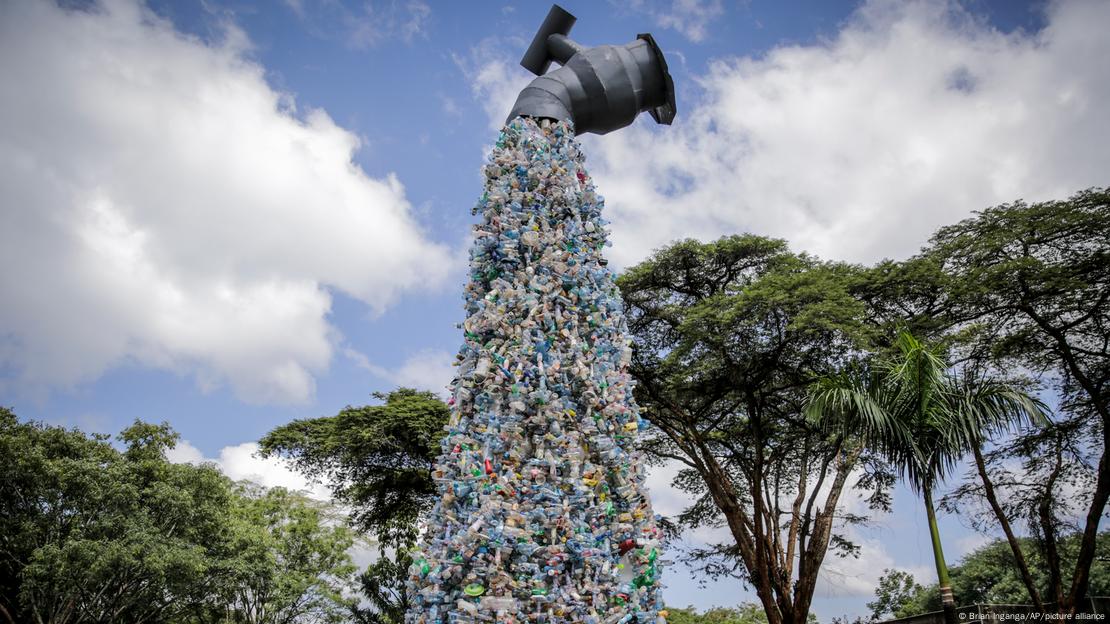
Five years after Kenya's plastic ban, a giant sculpture reminded UN stakeholders of the persistent pollution problem when they convened to tackle plastic pollution for the third time in 2022Image: Brian Inganga/AP/picture alliance

Four years after Germany phased out light plastic bags, how has the EU addressed plastic waste — and why do single-use items still pile up in takeaway restaurants, shops and the environment?

Single-use plastic is like the toxic ex that just keeps reappearing. Plastic straws, cutlery and Styrofoam boxes still show up on takeaway counters, coffee shops and restaurants across Europe, despite being blocked and officially dumped by the EU in 2021.

The bloc targeted several items after discovering that 85% of the trash washing up on its shorelines was plastic — almost half of which were disposable items such as straws, takeaway boxes, cutlery and plates.

In order to tackle this growing problem of discarded plastic, which can release harmful chemicals and tiny particles that enter the environment and the human body — potentially raising the risk of serious health issues including cancer and infertility — the EU decided to take action.

The logic was simple. Just ban the sale, production and import of the worst offenders and the problem will vanish.

But the reality is very different. Roughly 70% of takeaway restaurants surveyed in Germany's capital, Berlin, still offer banned plastic items, according to tests carried out by NGO Environmental Action Germany (DUH) in 2024. A continent-wide report by five NGOs from the same year found the prohibited items are still widely available in most European countries.

More than 400 million metric tons of plastic are produced each year — about 50 kilograms (110 pounds) per person. With production still rising and global regulations largely ineffective, researchers warn the problem will continue to worsen.

Plastic, plastic everywhere

One theory puts the persistence of single-use plastics following the EU's ban down to leftover stockpiles from the COVID pandemic. Particularly at the height of the 2020 lockdowns, takeaway orders surged when restaurants closed or people avoided eating out.

But experts, like Britta Schautz from Berlin's consumer watchdog, say the timeline doesn't quite add up.

"The ban came into effect in 2021," said Schautz, who has spent a decade helping consumers cut down on plastic.

It's unlikely most restaurants would be able to store mountains of containers for so long, Schautz told DW, adding that plastic becomes porous over time and has a limit on how long it can safely hold food and beverages.

She said a lack of compliance from retailers and food businesses is the more likely reason.

Many small business owners who have switched to paper or aluminum substitutes record higher expenses. "It's a disaster," one restaurant owner told DW. "We can't get the right paper plates and it's costly." Another confirmed the difficulties, adding that handing out plastic straws held sentimental value for him.

But, in theory, the sentimentality could cost him dear, as he could be fined up to €100,000 ($116,000) in Germany for not sticking to the new rules.

Failure to enforce the rules is another problem. When DW contacted authorities in five of Germany's biggest cities to ask how they monitor compliance and sanction violators, not one could point to an example of any fines. Most said they only act on complaints or, at most, carry out random checks.

Imposing fines consistently and communicating the ban more effectively would be a better deterrent, said Thomas Fischer, who heads the department for circular economy at Environmental Action Germany. He compared the effect to dodging the fare in public transport. If people felt that violations were punished, they wouldn't do it, he told DW.

Other countries have taken tougher measures. Kenya banned plastic bags in 2017 backed by fines of as much as 4 million Kenyan shillings — roughly $31,000/€26,000 — or up to four years in jail. And unlike Germany, it's not just an empty threat. Two years after the ban was introduced, authorities had already registered several hundred arrests and prosecutions. Three Kenyan fruit vendors were arrested over using prohibited plastic bags.


Ways around the plastic ban

Online retail is one of the law's blind spots. Plastic straws and cutlery are widely available on major retail platforms like Temu, eBay and Fruugo.

"It's really easy to order banned plastics from countries outside the EU," said Schautz. "And manufacturers there don't have to adhere to EU legislation when producing such things."

But even in the EU, manufacturers exploit gaps in the law. Some bypass restrictions by producing disposable cutlery that's a little thicker and labeling it "reusable."

"Reusable does not mean reused," said Nathalie Gontard of the French National Research Institute for Agriculture, Food and Environment, adding that the EU ban has increased consumption in some cases.

"The law can be easily circumvented by just increasing the thickness," said the plastics researcher. Gontard also recalled companies contacting her during the drafting of EU bans for advice. A while later, "they came back to me and said: 'Sorry, but we don't need help anymore. We'll just increase the thickness.'"


A patchwork of plastic legislation

Around the world, at least 90 countries have introduced some form of plastic ban. But the rules vary widely, targeting different regions and items. Experts say this fragmented system does little to curb waste.

In Germany, only plastic bags between 15–50 micrometers thick are banned. Yet 87% of bags handed out in 2022 fell into this category, highlighting the confusion around the law.

Even in Kenya, where the plastic bag ban is considered relatively successful and observers confirm cleaner streets in large cities such as Nairobi, progress has slowed. Plastics bags are now entering Kenya from neighboring countries without bans.

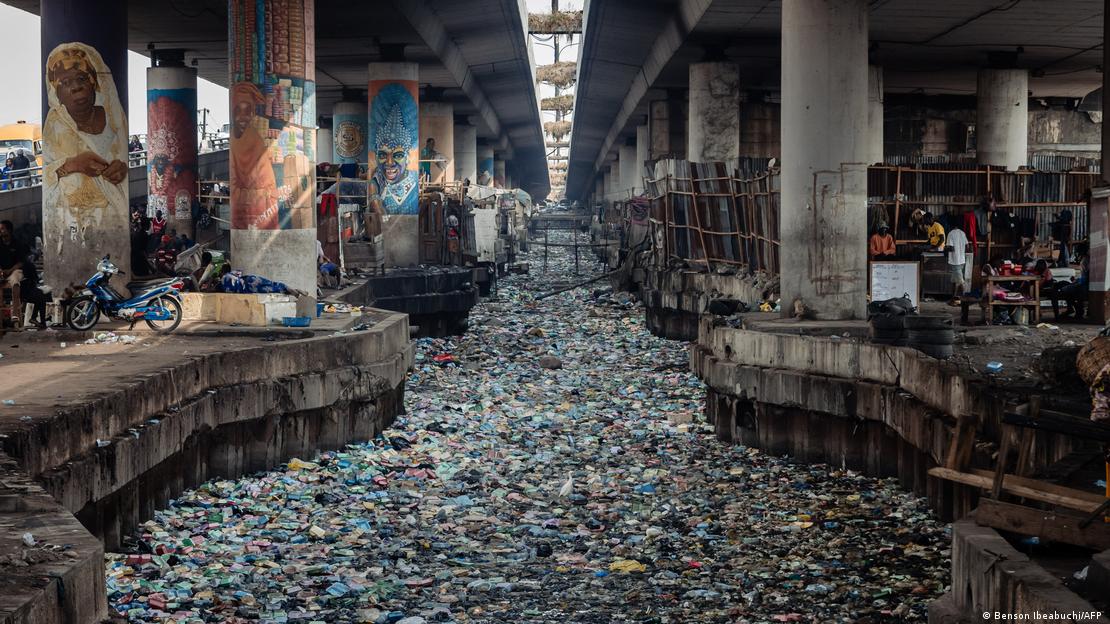
In July 2025, single-use plastics were banned in Lagos, Nigeria's most populous city. But residents say poor enforcement and few alternatives have made the ban ineffective (FILE photo January 2024)Image: Benson Ibeabuchi/AFP

A 2025 study from the US — where some states even prohibit any plastics legislation — found large-scale or country-wide bans are the most robust.

"The idea that we will be able to solve the issue country per country is not the solution anymore," said Ximena Banegas from the Center for International Environmental Law. "We're all just playing whack-a-mole in banning one product here while it's still produced elsewhere."

Besides calling for global bans, Banegas also advocates capping plastic production, a proposal discussed at the UN's plastic treaty talks, most recently in August 2025.

A coalition led by oil-producing countries Iran, Saudi Arabia, China and Russia wanted legislation kept at the national level, focusing on waste management. Opponents, led by Norway, Rwanda, Canada and 72 other countries, pushed for broader bans and a production cap. Positions were too far apart for the UN to reach consensus. About 98% of all plastic is made from fossil fuels.

Nathalie Gontard said stricter policies are overdue. "We need to start right now," she told DW. "Even if we ask for a 10% reduction in plastic consumption during the next decade, it will already be a victory."

Edited by: Jennifer Collins

Katharina Schantz Multimedia journalist with expertise in climate and environment reporting
Indian workers earn highest median pay in Germany

DW with dpa, epd
02/01/2026 

Indian employees have emerged as the highest earners among foreign workers in Germany, a study shows. Elevated pay levels among Indian employees are largely driven by their concentration in technical and academic roles.

German workers earned a median gross income of €4,177 ($4,900) a study published on Friday showed — more than €1,200 less than Indian employees.

The high pay levels among Indian workers were largely driven by their prominence in technical and academic roles, according to the authors.


How do the numbers stack up?

The employer-linked Institute of the German Economy (IW) said foreign workers overall earned €3,204.

Its survey showed the median gross monthly wage for Indian workers reached €5,393 in 2024, ahead of Austrians at €5,322, US nationals at €5,307, and Irish nationals at €5,233.

The number of Indians working in MINT professions — mathematics, IT, natural sciences, and technology including engineering — has risen by nearly ninefold since 2012 to more than 32,800, the study found. About one-third of full-time Indian workers aged 25 to 44 are employed in MINT occupations.


The trend has also been fueled by a sharp rise in Indian students in Germany.

Many completed their studies, stayed on, and contributed to research and innovation, with patent applications involving inventors of Indian origin increasing twelvefold between 2000 and 2022.

How much does Germany need Indian workers?

"Without skilled immigration, growth in the German economy would hardly be possible today – especially in the STEM professions and in terms of innovative strength," says IW expert Axel Plünnecke. Skilled immigration from India is "a particular success story," he added.

Since 2012, the German government has actively recruited skilled workers from non-EU countries, focusing on academic and technical professions. In 2024, then German Chancellor Olaf Scholz's government passed a raft of measures designed to foster immigration from India.

The institute noted that high wages among workers from Austria and the United States reflected their employment in economically strong urban regions with higher pay levels.

The analysis covered nationalities with more than 5,000 full-time employees in Germany and was based on data from the Federal Employment Agency.

Edited by: Kieran Burke

Richard Connor Reporting on stories from around the world, with a particular focus on Europe — especially Germany.