Monday, January 05, 2026

World Nuclear News


US enrichment companies end 2025 on high note


As Centrus Energy begins manufacturing centrifuges in the USA to support domestic commercial uranium enrichment, Urenco USA has followed recently announced operational milestones with a new analysis of benefits to the US economy from its activities.
 
The AC100M centrifuge (Image: Centrus)

Centrus announced on 19 December that it had started manufacturing centrifuges at its centrifuge manufacturing factory in Oak Ridge, Tennessee - relying on a domestic manufacturing supply chain - to support commercial low-enriched uranium (LEU) enrichment activities at its facility at Piketon, Ohio. The first new production capacity is expected to come online in 2029.

This is part of a multi-billion-dollar uranium enrichment capacity expansion which is underpinned by funding from the Department of Energy via task orders for the production of LEU and high-assay low-enriched uranium (HALEU), private capital, commercial contracts and third-party investments.

Centrus Energy CEO and President Amir Vexler described the official start of "industrial-scale centrifuge manufacturing build for commercial LEU enrichment" as an "historic step" for the company. "We make this announcement after carefully evaluating the business's internal and external progress as well as its future prospects and many competitive advantages. These include the significant progress in building our supply chain; the advancement across the many available avenues to acquire low-cost of capital to support our build, including imminent DOE funding announcements; and, evaluating the progress in our internal manufacturing capabilities," he said.

The USA's last domestically owned commercial uranium enrichment capacity, the Paducah gaseous diffusion plant in Kentucky, closed in 2013, leaving the Urenco USA (UUSA) plant at Eunice in New Mexico as the only commercial enrichment capacity in the USA - a plant using a European centrifuge design manufactured in the Netherlands. This has left the USA dependent on overseas enterprises. But with demand for nuclear power expected to grow in the coming years - and a complete ban on US imports of Russian enriched uranium from 2028 - "new domestic, US-owned uranium enrichment capacity is urgently needed and in high demand", the company said. A fully domestic source of enriched uranium is also needed to fulfil national security missions - and Centrus says its AC100M centrifuge is the only deployment-ready US-origin enrichment technology that can currently meet that need.

The expansion programme is expected to support thousands of direct and indirect jobs in Ohio, Tennessee, and across the country.

Economic benefits

Meanwhile, a new report by Oxford Economics has found that the operations of Urenco USA contributed more than USD360 million to the US economy in 2024-2025 and supported more than 1,700 jobs in total at the UUSA plant and elsewhere in the USA. The company also purchased some USD68.6 million worth of goods and services from US suppliers.

The report, using 2024 data, was commissioned by Urenco USA to quantify its impact at the local, state, and national level as it looks to make further investments in the site in future years, including adding new capacity and constructing new facilities, the company said.

"From fuelling reliable electricity production across the country to inspiring the next generation in our local schools, Urenco USA and our employees make substantial contributions at a local, regional, and national level, as evidenced by the results seen in the Oxford Economics report," Managing Director John Kirkpatrick said.

The study was released in the same month that Urenco USA completed its first production run of low-enriched uranium plus, or LEU+ - material enriched to 8.5% in the fissile uranium-235 isotope - and also started up a new cascade of centrifuges that are part of a programme to install 700,000 separative work units (SWU) of capacity by 2027 at the New Mexico plant.

US awards $2.7 billion worth of orders to boost uranium enrichment
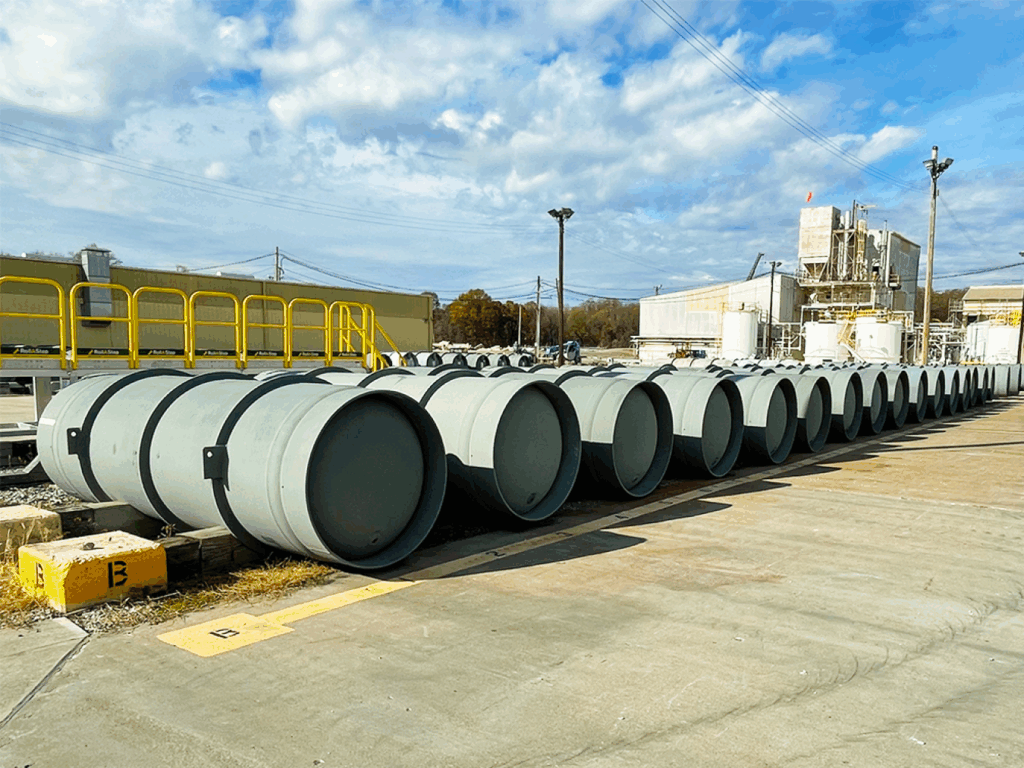

The US Energy Department announced on Monday it was awarding orders totaling $2.7 billion to three companies to boost domestic uranium enrichment over the next 10 years in a broader effort to reduce US dependence on Russian supply.

American Centrifuge Operating, General Matter and Orano Federal Services secured the orders, the department said in a statement.

The contracts would require the companies to meet specific milestones to provide enrichment services for low-enriched uranium and high-assay low-enriched uranium, or HALEU, for existing nuclear power plants and new, smaller modular reactors.

“Today’s awards show that this Administration is committed to restoring a secure domestic nuclear fuel supply chain capable of producing the nuclear fuels needed to power the reactors of today and the advanced reactors of tomorrow,” Secretary of Energy Chris Wright said.

Russia is currently the only country that makes HALEU – uranium enriched to between 5% and 20%, which is said to make new high-tech reactors more efficient – in commercial volumes. Funds to make the fuel domestically in the United States were included in a law to ban uranium shipments from Russia fully by 2028.

The DOE awarded American Centrifuge Operating, a subsidiary of Centrus Energy, and General Matter, backed by tech billionaire Peter Thiel, with $900 million each to develop domestic HALEU enrichment capacity. It awarded Orano Federal Services with $900 million to expand domestic low-enrichment uranium production.

The Energy Department separately awarded an additional $28 million to Global Laser Enrichment, part-owned by Canadian uranium company Cameco, to further its work to build next-generation uranium enrichment technology for the nuclear fuel cycle.

Global Laser Enrichment had sought a $900 million award.

HALEU’s critics say it is a weapons risk if it gets into the wrong hands and recommend limiting enrichment to between 10% and 12% for safety. Uranium fuel used in today’s reactors is enriched to about 5%.

(By Valerie Volcovici and Costas Pitas; Editing by Susan Heavey and Nia Williams)


Denison ready to start construction at Canadian uranium project


Denison Mines Corporation says it is ready to make a final investment decision and begin construction of the Phoenix In-Situ Recovery uranium mine, with first production expected by mid-2028.

(Image: Denison)

Regulatory, engineering, and construction planning progress over the past year has positioned Phoenix in a "construction-ready state", the company said, and has confirmed an expected 2-year construction timeline. Provided final regulatory approvals to commence construction are received in the first quarter of 2026, "targeted first production remains on track for mid-2028".

The company has also issued an updated estimate of post-final investment decision (FID) initial capital costs for the project, of CAD600 million (USD437 million). The updated capital expenditure figure is a 20% increase relative to the previous estimate in the 2023 Phoenix feasibility study, when adjusted for inflation, but the project is now in a construction-ready state and no further adjustments to the figure are expected prior to commencement of construction, the company said.

Denison President and CEO David Cates said the company "stands ready" to make the FID and begin construction of the mine following the recent conclusion of a Canadian Nuclear Safety Commission public hearing and receipt of an initial approval to commence construction activities from the Province of Saskatchewan.

"Owing to years of work de-risking and advancing Phoenix, the project is now ready to become the first new large-scale uranium mine built in Canada since Cigar Lake, with first production expected by mid-2028," he said, adding that the timeline positions Phoenix to benefit from an anticipated acceleration in uranium demand based on increasingly widespread global adoption of nuclear energy, as well helping reinvigorate Canada's natural resources sector.

"Based on our strong balance sheet, and the advanced state of project engineering, construction planning, and procurement activities, we are confident that we will be able to make a positive final investment decision following receipt of final regulatory approvals. While our estimate of initial capital costs has increased modestly from the 2023 Phoenix feasibility study, it is important to note that the project is now ready for construction, continues to have only a two-year construction schedule, and that the updated costs are the basis for our project Control Budget - meaning that there are no further revisions expected prior to the commencement of construction," Cates said.

Phoenix is part of the Wheeler River project, described by Denison as the largest undeveloped uranium project in the infrastructure-rich eastern portion of the Athabasca Basin region, in northern Saskatchewan. The project is host to the high-grade Phoenix and Gryphon uranium deposits, discovered by Denison in 2008 and 2014, respectively, and is a joint venture between Denison (90%) and JCU (Canada) Exploration Company Limited (10%). Denison is the operator.

In-situ recovery (ISR) - also referred to as in-situ leach - is a method of recovering uranium minerals from ore in the ground by dissolving them in situ, using a mining solution injected into the orebody. The solution is then pumped to the surface, where the minerals are recovered from the uranium-bearing solution. More than half of the world's uranium production is now produced by such methods. The technique - which requires a geologically suitable orebody - has not so far been used in Canadian uranium operations, although in addition to the Phoenix deposit Denison has been investigating the potential for using ISR at other Canadian projects including the Heldeth Túé uranium deposit at Waterbury Lake and the Midwest Main project.

China begins construction of two new nuclear power units


First concrete has been poured for the nuclear islands of unit 1 of the Bailong nuclear power plant in China's Guangxi Zhuang Autonomous Region and of unit 2 at the Lufeng plant in Guangdong province, marking the official start of construction of the two CAP1000 reactors.
 
Workers mark the start of construction of Bailong 2 (Image: SPIC)

The construction of Phase I (units 1 and 2) of the Bailong plant was among approvals for 11 new reactors granted by China's State Council in August 2024. State Power Investment Corporation (SPIC) plans to build two CAP1000 pressurised water reactors - the Chinese version of the Westinghouse AP1000 - as the first phase of the plant. An investment of about CNY40 billion (USD5.6 billion) is planned for the two units, which are expected to take 56 months to construct. Excavation of about 66,000 cubic metres of earth to form the foundation pit - which will eventually be 12.2 metres deep and cover an area of about 3000 square metres - began in late December 2024.

SPIC subsidiary Shanghai Nuclear Engineering Research & Design Institute (SNERDI) - joint general contractor for the project - announced it poured the first concrete on 22 December for the basemat of the nuclear island at Bailong unit 1. The company said a total of a 6,662 cubic metres of concrete was poured in a process lasting just over 64 hours.


(Image: SNERDI)

Located on Jiangshan Peninsula in Fangchenggang City, Guangxi Province, the Bailong plant is planned to have six units, with a total installed capacity of 8.62 GWe and a total investment of approximately CNY120 billion. The first phase of the project adopts the CAP1000 design, with each unit having a capacity of 1.25 million kilowatts. Four CAP1400 reactors are also proposed to be built at the site - located about 24 kilometres from the border with Vietnam and about 30 kilometres southwest of China General Nuclear's Fangchenggang nuclear power plant - in later phases.

After the first phase of the project is completed and put into operation, it is expected to generate about 20 billion kilowatt-hours of electricity per year, which is equivalent to reducing standard coal consumption by about 6 million tonnes and carbon dioxide emissions by about 16 million tonnes per year. "It will play a positive role in optimising Guangxi's energy structure and promoting energy conservation and emission reduction, and provide stable and reliable clean energy support for Guangxi to accelerate the construction of a national comprehensive energy security zone and serve the high-quality development of ethnic minority areas," SPIC said.

SNERDI also poured the first concrete for the nuclear island basemat of Lufeng unit 2 on 22 December.


(Image: SNERDI)

The proposed construction of four 1250 MWe CAP1000 reactors (units 1-4) at the Lufeng site was approved by China's National Development and Reform Commission in September 2014. However, the construction of units 1 and 2 did not receive State Council approval until August 2024. Approval for units 3 and 4 is still pending. First concrete for unit 1 was poured in February last year.

Contractor China Nuclear Construction Corporation 22 (CNI22) said about 6,635 cubic metres of concrete was expected to be poured in a process lasting about 68 hours to form the foundation of unit 2's nuclear island, measuring about 89 metres long and 49 metres at its widest point.


(Image: SNERDI)

The Lufeng plant - located in Jieshi Town, Lufeng City, Guangdong Province - is planned to eventually have six 1,000-megawatt pressurised water reactor units.

In April 2022 the State Council approved construction of two HPR1000 (Hualong One) units at Lufeng as units 5 and 6. First concrete was poured for unit 5 on 8 September 2022 and that for unit 6 on 26 August 2023.

"Upon completion, [the plant] will further optimise the regional energy structure, alleviate power supply pressure, and provide a continuous and stable supply of clean energy for the economic development of the Greater Bay Area," CNI22 said.

Chinese reactor enters commercial operation


Unit 2 of the Zhangzhou nuclear power plant has entered commercial operation, China Nuclear Power Corporation announced. The unit is the second of six Hualong One (HPR1000) reactors planned at the site in China's Fujian province.
 
Zhangzhou units 1 and 2 (Image: CNNC)

On 1 January, the 1126 MWe (net) domestically-designed pressurised water reactor completed a series of commissioning tests, including a test run lasting 168 hours, the China National Nuclear Corporation (CNNC) subsidiary said. "This marks the full completion and commissioning of the first phase of the Zhangzhou nuclear power project, making an important contribution to optimising the national energy structure and achieving the 'dual carbon' goal."

China's Ministry of Ecology and Environment issued construction licences for Zhangzhou units 1 and 2 on 9 October 2019 to CNNC-Guodian Zhangzhou Energy Company, the owner of the Zhangzhou nuclear power project, which was created by CNNC (51%) and China Guodian Corporation (49%) in 2011. Construction of unit 1 began one week after the issuance of the construction licence, with that of unit 2 starting in September 2020. Zhangzhou 1 entered commercial operation on 1 January last year.

The loading of nuclear fuel into Zhangzhou 2 began on 11 October 2025 and the reactor achieved its first criticality on 3 November. It was connected to the grid on 22 November.


The Zhangzhou site (Image: CNNC)

Once fully completed, the six-unit Zhangzhou plant is expected to provide over 60 billion kilowatt-hours of clean energy annually, estimated to meet 75% of the total electricity consumption of Xiamen and Zhangzhou cities in southern Fujian.

China Nuclear Power Corporation said that following the start of commercial operation of Zhangzhou 2, the number of operating nuclear power units controlled by the company has increase to 27, with the installed capacity increasing from 25,000 MWe to 26,212 MWe.

Gantry crane delivered for Atucha 2's dry storage project
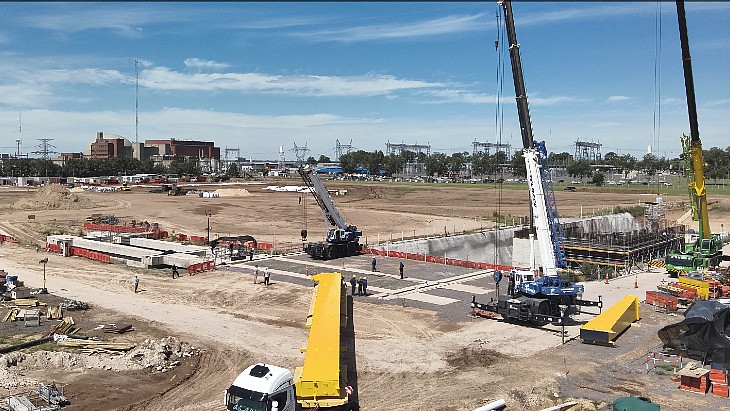

A specially-designed gantry crane which allows for the precision handling and positioning of containers has been delivered to Nucleoelectrica's used fuel dry storage project for Argentina's Atucha 2.
 
(Image: Nucleoelectrica)

The crane was developed by IMPSA, based on a technical specification from Nucleoelectrica.

Installation and commissioning of the equipment is scheduled to take place over a four-month period this year.

According to Nucleoelectrica, the dry storage facility is now 38% complete and is "essential ... to ensure the future operation of Atucha 2 and to guarantee the responsible management of nuclear fuel". It said that the capacity of the current storage pools at the site is scheduled to be reached in December 2027.

The company says that the high-strength concrete base has been completed and "construction is progressing on system components, including containers, shielded lids, and supporting steel structures".

It said the new facility is designed with passive ventilation, which will ensure temperatures remain within safe ranges without the need for electrical power or human intervention. The gantry crane has been designed to ensure the ability to safely handle and place the storage containers for used nuclear fuel during dry storage operations.

A dry fuel storage facility for the Atucha 1 nuclear power plant was opened in 2022 to store fuel assemblies used in the pressurised heavy water reactor.

Situated about 100 kilometres northwest of Buenos Aires, Atucha 1 has been generating electricity since 1974. The fuel bundles used by unit 1 of the plant had previously been stored within the reactor building, but a decision was made to increase the storage space available as part of a project to increase its service life.

Atucha 2 is a 693 MWe pressurised heavy water reactor and was ordered in 1979. It was a Siemens design, a larger version of the first unit at Atucha, and construction started in 1981 by a joint venture of Argentina's National Atomic Energy Commission and Germany's Siemens-Kraftwerk Union. However, work proceeded slowly due to lack of funds and was suspended in 1994 with the plant 81% complete.

In 1994, Nucleoeléctrica Argentina was set up to take over the nuclear power plants from CNEA and oversee construction of Atucha 2. In 2003, plans for completing Atucha 2 were presented to the government. The government announced a strategic plan in August 2006 for the country's nuclear power sector, including completion of Atucha 2. The unit was effectively completed in September 2011. First criticality was achieved early in June 2014, and grid connection was later that month, with full power in February 2015.

Fourth shell of BREST-OD-300 peripheral cavity installed


The fourth and final shell of the peripheral cavity has been installed at the BREST-OD-300 lead-cooled fast neutron reactor in Seversk in Russia's Tomsk region.
 
(Image: Rosatom)

Ivan Babich, from the Experimental and Demonstration Energy Complex at the Siberian Chemical Combine, said: "At the moment, the pressure vessel of the BREST-OD-300 reactor block is approximately 70% assembled."

He said that during 2026 the lead coolant circulation circuit will be formed, the vessel concrete will be completed, and all major internal devices will be installed. "Completion of the reactor vessel assembly is scheduled for the end of 2026," he added.

The next stage will see the reactor's peripheral cavities connected to the central cladding, which was installed in September, forming a closed circuit for the lead coolant circulation. This circuit will eventually house steam generators, main circulation pumps, coolant purification system equipment, and other internal reactor equipment. The central cladding is designed to accommodate the core basket and fuel assemblies, Rosatom said.

The BREST-OD-300 reactor has an integral layout - its vessel is not an all-metal structure, instead it is a metal-concrete structure with the space between the cavities gradually filled with concrete during construction. Because of its large size, it can only be delivered in parts, with assembly only possible at the construction site.

The background

The BREST-OD-300 fast reactor is part of Rosatom's Proryv, or Breakthrough, project to enable a closed nuclear fuel cycle. The 300 MWe unit will be the main facility of the Pilot Demonstration Energy Complex at the Siberian Chemical Combine site. The complex will demonstrate an on-site closed nuclear fuel cycle with a facility for the fabrication/re-fabrication of mixed uranium-plutonium nitride nuclear fuel, as well as a used fuel reprocessing facility.

Recent progress updates included the news in October that the last roofing truss had been moved into place on the turbine hall and the metal shell for the central cavity- which weighs 143 tonnes and is more than 14 metres tall with a diameter of 8 metres - had been installed in place. The four perpheral cavity shells were all installed during December.

Initial operation of the demonstration unit will be focused on performance and after 10 years or so it will be commercially oriented. The plan has been that if it is successful as a 300 MWe (700 MWt) unit, a 1200 MWe (2800 MWt) version will follow - the BR-1200.

First Kursk II unit connected to the grid


The first new VVER-TOI power unit at the Kursk II nuclear power plant in Russia has been connected to the grid and reached a capacity of 240 MW on 31 December.
 
(Image: Rosatom)

The power unit's capacity will be gradually increased in steps, with safety tests and checks, to 35-40%. This will be followed by a lengthy period of increasing it to 100%.

The VVER-TOI pressurised water reactor has a capacity of 1,250 MW - higher than previous generations  of VVER reactors. Rosatom says the service life of the main equipment has doubled, and it features a mix of passive and active safety systems and includes a core meltdown localiser.

The construction of the Kursk II power plant will more than replace the capacity of the four RBMK-1000 units at the Kursk plant as they come to the end of their lives.

Rosatom Director General Alexei Likhachev said: "The Kursk nuclear scientists deserve congratulations and thanks for such a wonderful New Year's gift, and the entire country for acquiring a new source of clean energy. Much work remains ahead for the Kursk residents. But the following can already be confirmed - the Kursk unit is the first embodiment of the latest VVER-TOI nuclear power unit design. This design not only incorporates the latest advances in nuclear energy. It is also the most powerful power unit in Rosatom's fleet: 1,250 MW, which is 50 MW more than the previous record-holders, the power units of Leningrad NPP-2."

Andrey Petrov, First Deputy Director General for Nuclear Energy at Rosatom and President of JSC ASE said: "Today's power start-up is the result of the hard work of tens of thousands of people - from those who poured the first concrete in 2018 to the engineers involved in the commissioning operations. Despite external threats, every specialist successfully completed their work, recognising their responsibility to the team and to the country. The new power unit will increase nuclear power generation by more than 50% to meet the needs of the Kursk Region and ensure the stable operation of the Central Asian Unified Energy System, guaranteeing its energy stability and confident progress."

Alexander Shutikov, CEO of Rosenergoatom, said: "The power unit's commissioning is proceeding according to plan. Comprehensive testing of the unit is currently under way, ensuring the required power level is reached. The equipment and systems must operate efficiently, reliably, and safely, as required by the process regulations. After all the process operations, we will confirm with Rostekhnadzor (Russia's nuclear regulator) that the unit's characteristics and physical parameters comply with modern nuclear energy standards and requirements."

Background

Kursk II is a new nuclear power plant in western Russia, about 60 kilometres (37.5 miles) from the Ukraine border, that will feature four VVER-TOI reactors, the latest version of Russia's large light-water designs. They have upgraded pressure vessels and a higher power rating of 3300 MWt that enables them to generate 1300 MWe gross. Construction of the first unit began in 2018, its polar crane was installed in October 2021 and the reactor vessel was put in place in June 2022. Concreting of the outer dome of the first unit was completed in August 2023. The second unit is also under construction and the target is for all four units to be in operation by 2034.

The new units will replace the four units at the existing, nearby Kursk nuclear power plant, which are scheduled to shut by 2031. The first unit was shut down after 45 years of operation in December 2021 and the second unit followed in January 2024. The original design life for the four RBMK-1000 reactors at the plant was for 30 years but had been extended by 15 years following life extension programmes.

Duke Energy submits early site permit application for nuclear project


Duke Energy has submitted a technology-neutral application to the US nuclear regulator for an early site permit for potential small modular reactors at a site near the Belews Creek Steam Station in North Carolina.
 
The proposed site at Belews Creek (Image: Duke Energy)

An early site permit - or ESP - is an optional process to confirm a site's suitability for new nuclear generation: possession of such a permit reduces the risk of delays during licensing and construction. The early site permit is technology neutral - a technology can be selected later in the development process - but Duke said its application includes six potential reactor technologies, including four small modular reactor (SMR) designs and two non-light-water designs. Large light-water reactors are not included in the permit application.

"We're taking a strategic approach to new nuclear development that allows us to advance licensing activities while reducing risks and allowing technologies to mature," said Duke Energy's Chief Nuclear Officer Kelvin Henderson.

An early site permit will provide "future optionality" for Duke's customers and the communities it serves, the company said, adding that - if additional evaluation confirms small modular reactor technology at the Belews Creek site offers the best value for customers - it plans to add 600 megawatts of advanced nuclear to the system by 2037, with the first reactor coming on line in 2036. An early site permit is valid for 10 to 20 years, and can be renewed for an additional 10 to 20 years, but would not allow the construction of a plant to begin - that would require a construction permit, or a combined construction and operation licence.

Submission of the application to the US Nuclear Regulatory Commission (NRC) marks the culmination of two years of work, Duke Energy said.

The NRC notified Duke in a letter dated 18 December that it had completed a pre-application readiness assessment of the draft site safety analysis report, environmental report and other supporting documents for the application.

In October, Duke Energy filed a resource plan with utility regulators proposing the evaluation of large light-water reactor technology, as well as small SMRs, to help meet growing electricity demand across North Carolina and South Carolina. The plan identifies the William States Lee III Nuclear Station site in Cherokee County, South Carolina, and the Shearon Harris Nuclear Plant site in Wake County, North Carolina, as those best suited for new large reactors.

The existing Belews Creek Steam Station is a two-unit plant on the shores of Belew Lake, in Stokes County, with a total capacity of 2200 MWe. It was built as a coal-fired plant, entering commercial operation in 1974, but is now co-fired on coal and natural gas (co-firing means the units can use either coal or natural gas, or a combination of these fuels). The current units are scheduled to retire in the late 2030s. Repurposing the site offers a cost-saving opportunity for customers, and enables Duke Energy to reinvest in the local community, the company has said.

TODA Switches On Japan’s First Commercial Floating Offshore Wind Farm

Japan has officially entered the era of commercial floating offshore wind power, with the Goto Offshore Wind Farm commencing operations on January 5, 2026, according to a statement from project operator Goto Floating Wind Farm LLC.

Located off Goto City in Nagasaki Prefecture, the 16.8-megawatt project is the country’s first floating wind farm to reach commercial service and the first to be certified under Japan’s Marine Renewable Energy Sea-Area Utilization Act. The milestone places Japan among a small group of countries moving floating wind from demonstration to commercial-scale deployment.

The project consists of eight 2.1-MW turbines mounted on floating platforms, enabling deployment in deeper waters where conventional fixed-bottom turbines are not viable. This is particularly significant for Japan, where steep coastal bathymetry has long constrained offshore wind development.

At the core of the project is a hybrid spar-type floating foundation, featuring a steel upper structure and a concrete lower section. Designed and constructed by TODA Corporation, the system represents the world’s first commercial application of this hybrid spar technology, according to the project partners. Floating foundations are widely viewed as critical to unlocking large-scale offshore wind potential in Japan and other deepwater markets across Asia.

The Goto project was developed by a consortium of major Japanese industrial and energy companies, including TODA Corporation, ENEOS Renewable Energy Corporation, Osaka Gas, INPEX, Kansai Electric Power, and Chubu Electric Power. The special-purpose company was established in October 2021 after the consortium won a government tender for the site earlier that year.

The project has been nearly seven years in the making. The Goto offshore area was designated as a promotion zone for marine renewable energy in 2019, with the public tender launched in 2020. Offshore construction began in 2022 following formal certification and permitting by Japan’s central government.

Beyond its technological significance, the wind farm is also positioned as a regional development project. Local companies were involved in construction and are expected to play roles in operations and maintenance. Electricity generated by the facility will be supplied preferentially to local retail power providers, aligning with Japan’s policy push for local production and local consumption of energy.

Floating offshore wind is emerging as a strategic pillar of Japan’s long-term decarbonization plans. The country has set ambitious offshore wind targets, but faces structural challenges due to limited shallow waters and complex maritime conditions. As a result, floating wind is expected to play a disproportionate role compared with markets in Europe.

While the Goto project is modest in scale, it is widely seen as a proof point for future commercial developments. Larger floating wind projects are under consideration across multiple regions, and policymakers and investors will closely watch operational performance, costs, and supply chain localization.

For Japan’s utilities and energy majors, the project also reflects a broader strategic shift. Companies traditionally focused on thermal power, LNG, and upstream oil and gas are increasingly investing in renewables, offshore wind, hydrogen, and carbon management technologies as part of long-term portfolio diversification.

With the Goto Offshore Wind Farm now online, Japan has crossed a key threshold—moving floating offshore wind from concept and pilot phase into commercial reality.

By Charles Kennedy for Oilprice.com

Autonomous Vehicles and the Myth of Necessity

  • Autonomous taxis and trucks have yet to demonstrate a clear necessity or safety advantage over human-driven vehicles in real-world conditions.

  • Claims of labor shortages in driving professions often mask deeper issues of pay, working conditions, and corporate cost-cutting strategies.

  • The push for autonomy risks sidelining human judgment and livelihoods while shifting safety and social costs onto the public.

Aesop's Fables date back to the 7th century BCE and may be the first known written expression of an often repeated proverb, namely: Necessity is the mother of invention. In the story called "The Crow and the Pitcher," during a terrible drought a thirsty crow finds water in a partially full water pitcher. But the mouth of the pitcher is too small to allow the crow to reach the water. The crow discerns that if it drops enough pebbles in the pitcher, this will raise the water level. So the crow proceeds with this plan and finally gets a drink.

Aesop's Fables come in many versions which often include a "moral" or "application" at the end. Hence, we have the summary of the lesson of the story that we recognize today.

Trouble is, it's all too easy to apply this idea to any invention and assume that "necessity" refers to some common problem that, if solved, helps the entire community or society. So, when I saw that Waymo's autonomous taxis had shut down, not once, but twice about five days apart in the same city—the first time from a power outage that darkened about one-third of San Francisco and the second due to concerns that a coming storm would create flash floods—I asked myself what necessity is pushing the deployment of autonomous vehicles forward. (To state the obvious, cars with drivers were still able to move about San Francisco during the blackout and adapt to the outage of traffic signals.)

First, I asked whether there is a shortage of taxi rides available for lack of drivers. With the rise of Uber, Lyft and other ride-hailing services alongside taxicab companies, there appears to be adequate availability of taxi rides in most cities around the world. So far, autonomous vehicles as taxis appear to be a solution looking for a problem.

Second, I wondered whether autonomous vehicles are safer for riders. There's not a lot of evidence since the use of these vehicles is in the early stages. What evidence there is seems equivocal and incomplete. An article in "New Scientist" begins with this:

One of the largest accident studies yet suggests self-driving cars may be safer than human drivers in routine circumstances – but it also shows the technology struggles more than humans during low-light conditions and when performing turns.

It's hard to understand how low-light conditions and performing turns are not routine parts of driving. So, I'm not persuaded by the reasoning of study. While this piece explains that 90 percent of all accidents are caused by human error, it also asks how autonomous vehicles could make eye contact with other drivers or pedestrians to sort out intentions. Then, there is our instinctive sense of whether another driver is not in good control of his or her car when we sense that car drifting toward the edge of the lane it's in.

It's true that autonomous vehicles don't get drunk or get tired. But then the human backup crew behind the cars—a crew that is constantly in touch with these vehicles as they roll—could get tired or be under the influence of drugs or alcohol—which would pose different kinds of problems for riders should an autonomous vehicle malfunction.

The jury is out on whether on balance autonomous vehicles are safer than those driven by humans. It's worth noting that so far we are referring to autonomous vehicles as ride-hailing services. The drivers for those services are required to be sober and alert as part of their job and so more likely to be so than average drivers driving themselves around. You should note whether any safety claims made for autonomous vehicles are made in comparison to drivers who do similar jobs, for example, ride services, delivery or long-haul freight, and not to the general run of drivers.

My third question was whether there is a shortage of truck drivers. This is relevant as trucking companies begin to test autonomous trucks. There is even less data on the safety of these vehicles on the open road as testing began only in May 2025.

As for whether there is a shortage of drivers, some say yes and some say no. It's easy to see why driving a truck may not be as attractive as other careers since truck driving requires long periods away from home, often alone in a truck cab, and long hours each day. But the naysayers to the shortage problem label it an ongoing myth perpetrated by the industry designed to "lower standards, suppress wages, and prioritize big carriers over safety and sustainability." As proof, they note the American Trucking Association's sudden change in wording in its public statements to a shortage of "quality" drivers. But, the real problem may be a shortage of freight which is sending many trucking companies to their deaths.

Assuming for the moment that there is a shortage of truck drivers, it turns out there's a solution. Walmart just upped its starting pay for truck drivers to $115,000 per year. High pay causes people to reframe their views of previously "undesirable" occupations. Bloomberg (cited just above) reports:

While competitors worry about potential worker shortages, Walmart Inc. has grown its trucking workforce by 33% in the last three years by making the job more attractive to people who might otherwise eschew the field.

The success Walmart is having can't really be all that surprising. I am reminded of the perpetual nursing "shortage" which we often hear about in the media. Perhaps those who employ nurses can take a page out of Walmart's book and simply give them better pay and working conditions.

So, after considering all this, I asked myself what "necessity" is really driving the autonomous vehicle push. The only answer I can think of is that employers, whenever possible, want to minimize labor costs and also the supposed aggravation of having to deal with people. If employers can eliminate drivers of all kinds, they can make more money (so long as their competitors don't do the same and underprice them). Clearly, employers believe all or most of the savings will go into their own pockets and those of their shareholders. Any safety issues will just be other people's problems.

And, of course, there is the problem of what to do with all those drivers (of which there was a supposed shortage). Back in 2011 I wrote that the Roman emperor Vespasian—under whom Rome's great Colosseum was built—was told by one of his engineers of a labor-saving machine that would hasten the work. He rejected the idea saying: "I must always ensure that the working classes earn enough money to buy themselves food."

I do not think the trucking industry will care about whether their former employees can buy themselves food. But I do think the owners of the growing fleet of autonomous vehicles have found a way to make it seem that such vehicles are a response to some necessity that will result in public good.

Previously, I have suggested that such vehicles will only be able to function safely on a closed course, something that is simply not in the cards for today's applications which are all on public roadways. There is no way to implant human judgement, perception and flexibility into a truly autonomous vehicle (without the eyes and ears of humans in the background in real-time) so that it can coexist harmoniously with human drivers and pedestrians.

One more note, in this case regarding autonomous semis—and I can't resist saying this again—I believe that we are unfortunately about to be reminded that force still equals mass times acceleration.

By Kurt Cobb via Resourceinsights.com


The Quiet Unraveling of the Power Grid Monopoly

  • Distributed energy, solar, and battery storage are making electricity demand more elastic.

  • As consumers self-generate and defect from the grid, traditional cost-of-service regulation accelerates a “death spiral,” where rising prices push even more customers away.

  • Electricity distribution may need to be treated as a public good, implying greater government ownership or municipal-style models.

Will the electric utility distribution monopolies (”discos”) remain financially viable over the longer term? That is the question, and not an idle one.  When the government broke up the Bell Systemm (some of you may remember that formerly ubiquitous entity) in the 1980s, it assumed (as did most investors) that the local exchange (the telephone equivalent of the disco) had an unassailable regulated monopoly. Technology (the internet and cell phones) changed that picture, and today only 30% of the population utilizes local exchange land lines. Could that loss of market happen to the electric disco, too?

First, consider that the other two key components of the utility business, generation and transmission, have already been deregulated with radical changes in their economics. Do we think utility distribution assets will be exempt from this process forever? No. And the reason is simple: the consumer’s elasticity of electricity demand is increasing, due to the increased penetration of renewables and distributed energy systems into the marketplace.  And this undermines one of the bedrock principles of utility economics since the time of Samuel Insull 100 years ago— inelastic consumer demand. Consumers wanted products, such as heating and lighting, and they had no viable alternatives. Now, consumers can produce and store energy during the day, reducing daily demand peaks, and rely on battery discharge for off peak hours. All of this increasing commercial activity will have an adverse effect on the profitability of monopoly utilities.

Let’s take a step back.  Three interrelated concepts underpin modern utility economics: inelastic demand, natural monopoly, and the attendant cost-based regulatory paradigm. Think of these as components of a three-legged stool. Take away one of the legs, and it falls. And right now, the emergence of new renewable technologies (hardware and software) threatens utility profitability by undermining inelastic demand when utility profitability levels should be highest. However, this also erodes the utility’s natural financial monopoly, which presupposes that one firm can provide service far more cheaply than multiple, competing firms. We view distributed energy like the ocean waves undermining beachfront homes with wildly exposed foundations. The end result is inevitable: the house collapses, but the process can take a long time. Same here. But there’s one more thing. If the natural monopoly erodes, which we believe it will, the state and federal regulatory structures also lapse into irrelevance. Why? Because they are designed to set rates so as to permit utilities to recover all their costs from captive consumers. What happens when companies can’t recover all their costs because their monopoly is slipping away? All the regulators can do is facilitate price increases that hasten the legacy monopoly’s demise. This is the logic of the so-called “death spiral”. Consumer migration leads to higher prices, which encourages even more consumer migration away from the legacy utility. What’s interesting to us is that these core utility regulatory concepts that have basically existed undisturbed for almost a century are now being undermined by new, distributed and renewable technologies.

Going forward, start with three related ideas: 1) the utility distribution network still provides considerable consumer value 2) its natural monopoly status and hence its economics are being eroded by new technologies and thus 3) the existing regulatory paradigm, which presupposes a natural monopoly, is also becoming irrelevant and obsolete. The simplest conceptual solution is to change the way we as a society regard electricity and to think of it as a public good. A public good for us is simply something that everyone in society wants and needs, like cheap electricity, but for whatever reason, the full cost recovery via market-based prices is no longer possible, Public goods also imply government ownership and price setting—the way municipally owned utilities operate today.

The electric distribution utility, to operate as a prosperous for-profit business that can attract capital requires two things: continuous growth in assets ( rate base) and a consistent and predictable growth in earnings.  A “good” utility should be a declining cost business (via technology) while spreading its expenses over an increasing number of customers. Thanks to the proliferation of distributed, renewable technologies this growth dynamic is beginning to run in reverse due to competition from renewables, which is eroding the natural monopoly. Government ownership of utilities (even in the guise of share ownership in ostensibly commercial ventures) is the norm in much of the world. Whether the US remains wedded to private ownership in the future remains to be seen.

By Leonard Hyman and William Tilles for Oilprice.com


Indonesia tightens grip on resources with Switzerland-sized land grab


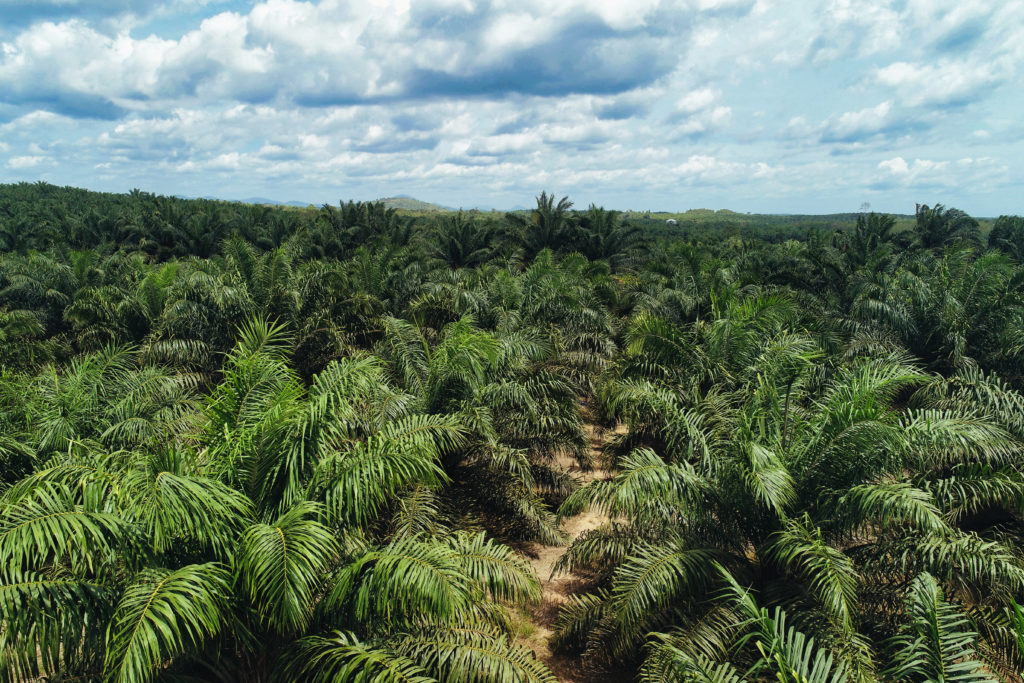
Oil palm trees in Borneo, Indonesia. Stock image.

It started in earnest in March, with a swath of palm-oil estates seized from a tycoon caught up in corruption allegations. Nine months later, a drive overseen by Indonesia’s defense minister has brought an area the size of Switzerland under state control.

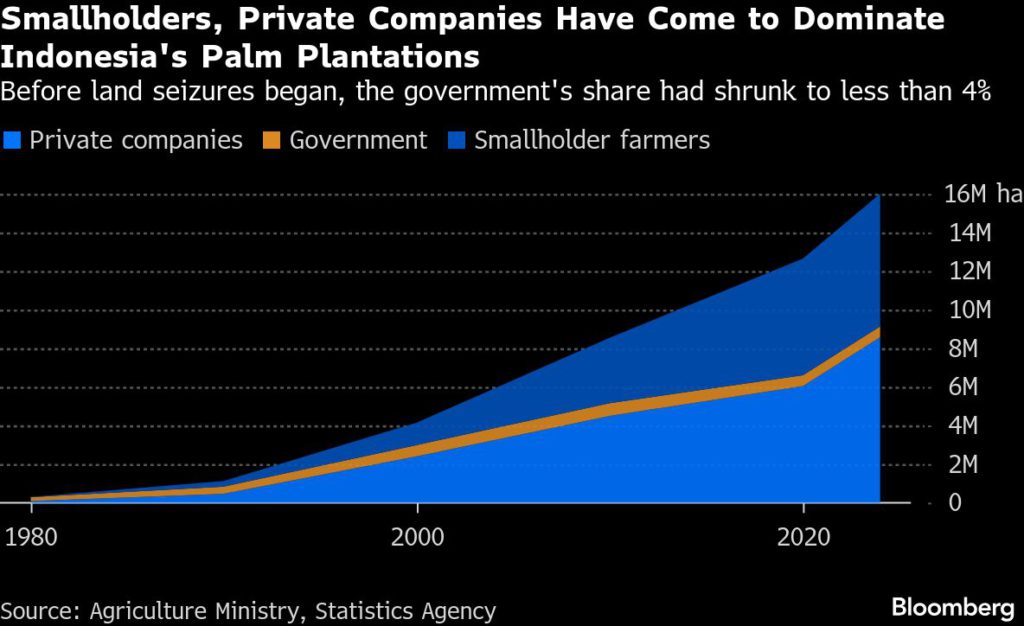
The campaign, outwardly a push to improve governance, is a show of force by President Prabowo Subianto, an ex-general who has regularly railed against both Indonesian elites and foreigners for profiting off the country’s resource riches at the expense of the nation. Already, the central government has taken more than 4 million hectares (roughly 10 million acres) of plantations, mine concessions and processing facilities — and much of that land has been handed to a state-owned firm newly tasked with managing seized estates.

“This is just the beginning,” Prabowo said at an event late last month. “We are on the right and noble path of defending the interests of millions of Indonesians.”

Domestic upheaval could soon have global consequences. Indonesia is the world’s top exporter of coal and palm oil, the biggest nickel producer and a leading source of copper and tin — commodities key for food and energy supplies, as well as future-facing technologies.

“This increasingly shows the character of a Prabowo-style command economy,” said Bhima Yudhistira Adhinegara, executive director at the Jakarta-based Center of Economic and Law Studies. “Methods like this reduce interest from investors, both in the plantation sector and in conservation,” he said.

Prabowo established the Forest Area Enforcement Task Force last January, only months into his tenure. At the helm he placed Defense Minister Sjafrie Sjamsoeddin, a longtime ally who has known the president since his early days in the military.

The task force issues fines and transfers land, frequently to the state-owned giant at the heart of the effort, Agrinas Palma Nusantara. In a matter of months, this repurposed company led largely by retired military officers has become the world’s biggest palm oil player by area held.

To date, official pronouncements on the confiscations have focused on better land management, an area where Indonesia has not always excelled — the country has lost millions of hectares of forest in recent years, much of it because of palm-oil and mining expansion. The role of deforestation in worsening floods and landslides that killed more than 1,000 people in Sumatra last month has added momentum to Jakarta’s campaign.

But growers in the government’s sights say they are farming land that was bought, or in some cases handed to them years earlier under government programs to encourage internal migration.

Prabowo “claims that the state has reclaimed 4 million hectares because these plots were located within forest zones,” said Achmad Sukarsono at consultancy Control Risks. “But how did it come to this? Such a vast amount of land couldn’t have been taken illegally by palm oil companies without approval from local governments and military officials.”

Agrinas and Sjamsoeddin’s task force did not respond to Bloomberg queries.

For generations, Rubahan Hasibuan’s family and those of his neighbors have been working the same land in northern Sumatra, today one of the nation’s main palm-growing areas. Back in March, some 20 to 30 officials arrived in his village of Ujung Gading Julu. Many wore uniforms from the military and prosecutor’s office, he later recalled.

The forestry task force posted a sign on a nearby plantation, declaring the land to be under government control. About 2,000 hectares of farmland in the village, owned by roughly 500 families, were seized, he said. He and his neighbors have since met with officials four times and have been offered the option of staying on their land in exchange for a cut of the profits.

Agrinas has proposed allowing farmers to stay in exchange for a 15% share of revenue, but the group has resisted.

“We turned it down to keep our independence,” the 48-year-old said, speaking at the governor’s office in the provincial capital of Medan, having driven 11 hours to seek backing from local officials. “We planted the trees, and we worked hard to take care of them.”

For now, they are still farming, Hasibuan said, though the city meetings ultimately proved fruitless. No one in the group knew how long they could continue.

“We will not give up,” he said.

Tighter control of domestic resources has been a vital concern for the Prabowo administration, in part to fund an ambitious but costly policy program. He has also pledged to protect ordinary people from what he calls “greedy-nomics,” the actions of business elites who relentlessly pursue maximum profit.

The campaign gained momentum in March, with the handover of 221,000 hectares from Duta Palma Group, a palm oil firm owned by Surya Darmadi, formerly one of the country’s richest men and more recently the subject of a money laundering and corruption probe. Since, plantations have been targeted across the archipelago, as well as a half dozen tin smelters and a portion of the world’s largest nickel mine.

About four dozen palm companies have been ordered to pay a total of around $560 million, while 22 miners were ordered to pay more than $1.7 billion as a way to return what the government says are illegal gains to the state, according to figures provided by the Indonesian attorney general’s office.

The impact is already rippling beyond Indonesia. Singapore-based crop trader Wilmar International Ltd. has said it expects a few thousand hectares of its plantation area to be impacted and is in discussion with authorities, according to a spokesperson. Malaysian-listed IOI Corporation Bhd., which operates palm plantations and mills in Kalimantan, will now undertake more risk assessments before investments in Indonesia, according to chief executive officer Lee Yeow Chor. First Resources Ltd. and SD Guthrie Bhd. declined to comment.

Other major palm oil operators, including Golden Agri-Resources Ltd., Cargill Inc. and state-owned PT Perkebunan Nusantara III, did not respond to Bloomberg queries on the seizures. The Indonesian Mining Association and Indonesia Nickel Miners Association didn’t reply to requests for comment.

Changing regulations are not new for Indonesia’s commodities sector, nor are unclear permits. Overlapping land allocations are common in palm oil, where some areas are permitted for cultivation though they are still classified as forest areas, said Tungkot Sipayung, executive director of the Palm Oil Agribusiness Strategic Policy Institute. One veteran plantation owner working in Sumatra, who requested anonymity due to the sensitivity of the issue, expressed frustration that even a plot farmed for decades, bought from other farmers, could now be said by officials to be on forest land.

Mining suffers similar problems, as the government struggles to monitor illegal mining in vast tracts of land in some of the country’s most remote areas. These illicit operations have cost Indonesia billions, Prabowo said in his first State of the Nation address.

The campaign’s breadth has echoes of the nationalizations and dramatic reorganization of property under Indonesia’s first president after the end of the colonial era, said Eve Warburton of Australian National University, who works on governance and resource nationalism in Indonesia. But the clean-up is also being led by a task force with a great deal of discretion in terms of who it goes after, when and why.

“The risk of politicization is high,” said Warburton. “This can undermine investor confidence and the credibility of resources governance more broadly.”

For commodity companies, the past months have already jangled nerves as they reckon with the impact of new state players.

According to Agrinas and the attorney general, it now holds 1.7 million hectares of plantations. It aims to supply a third of Indonesia’s cooking oil and begin producing biodiesel by 2029.

Much of that vast land bank isn’t yet productive — less than half is already planted with trees, Agrinas President Director Agus Sutomo told parliament in September. The portfolio also includes a plethora of small plots that individually lack the scale to be cultivated efficiently. Managing it will require vast investment in land restoration and productivity.

What that means in the short term is that it needs to bring farmers onside. Many growers on seized properties are still working the land, as in Hasibuan’s village in Sumatra.

But, as for those farmers, conditions for what Agrinas calls joint operations are not always appealing. Growers are allowed to keep only about 55% to 60% of revenue, with the rest handed to the state player, according to a corporate presentation. The share for smallholders can be higher — but not always high enough to encourage the compromise.

As a result, some farmers are walking away from seized areas. Others, facing little choice, agreed to joint ventures with the state, according to officials from two palm companies, who declined to be named. For those who stayed, costly replanting — vital to maintaining crop yields over time — has often been put on hold.

Industry group Gapki has heard complaints from members that harvest proceeds are fully directed to Agrinas’s account, with payments to partners made more than 30 days later, according to a closed-door presentation made to parliament, later seen by Bloomberg. Gapki did not respond to Bloomberg queries.

Similar scenes have unfolded in mining. On Halmahera, an island in the far northeast of Indonesia’s archipelago, soldiers arrived alongside a TV crew in September alleging violation of a forestry permit by the world’s biggest nickel mine. Only 148 hectares of the 45,000-hectare site owned by PT Weda Bay Nickel were seized, but the threat briefly pushed up global prices.

According to a person familiar with the matter, the government is demanding a penalty of around 3 trillion rupiah ($179 million) from the firm, whose largest shareholder is Tsingshan Holding Group Co. — a Chinese heavyweight that spearheaded metals investment in Indonesia and transformed the industry. A spokesperson for WBN said the company complies with authorities and was running checks on the fines.

It’s not clear where Prabowo’s campaign goes from here. Enforcement and long-term management is more challenging than the initial seizures, especially in a country as expansive as Indonesia. For now, benchmark palm oil futures are trading not far off a six-month low, suggesting the wider market is not yet worried about production — while broad supply concerns are only starting to filter into the nickel market.

But at one of the palm industry’s biggest gatherings in Bali in November, concern over long-term consequences of seizures and fines permeated conversations.

According to a formula laid out by the government, growers will face a charge of $1,497 per hectare for every year since land clearing began, aside from a five-year exemption to account for the time it takes for oil palms to become productive. That could leave companies facing penalties heftier than the value of their land, the Sumatra plantation owner said.

For nickel miners, the rate was set at $389,000 per hectare — enough to bankrupt many of the small companies who still dominate output, according to two miners caught up in the situation. Coal, bauxite and tin miners face smaller penalties. Barita Simanjuntak, an expert at the attorney general’s office, said the government’s internal auditor calculated the fines using established formulas.

“The risk that production will suffer more than we dare to say now is probably bigger than vice versa,” Thomas Mielke, executive director of Oil World and leading palm industry analyst said at the Bali event. “This is a very critical and very sensitive situation.”

(By Eko Listiyorini and Eddie Spence)


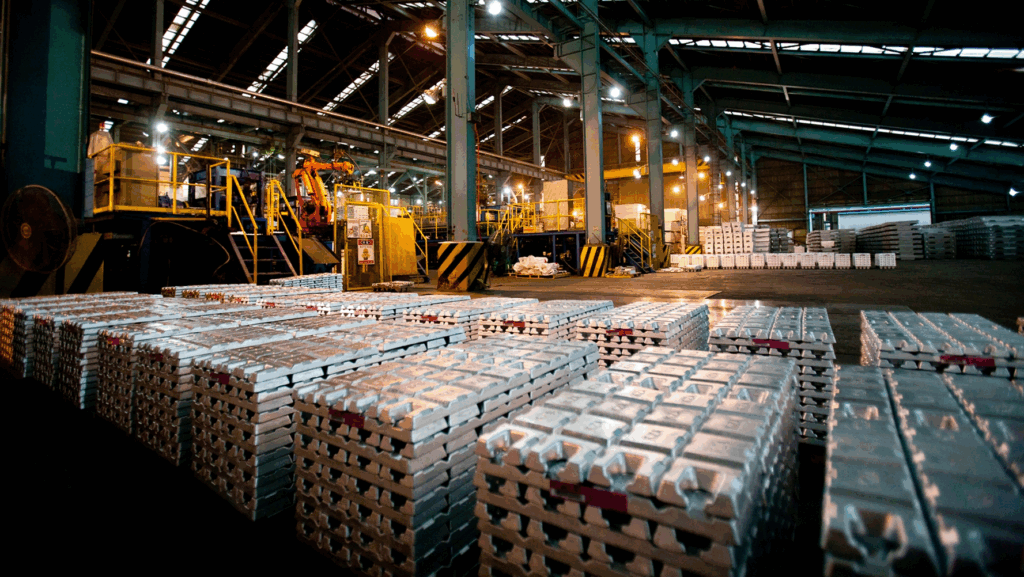
Korea Zinc revises share issuance for US smelter to $1.94 billion

Korea Zinc said on Wednesday it has revised its planned share issuance to 2.833 trillion won ($1.94 billion) from the previously announced 2.85 trillion won, citing the finalized issuance price per share and changes in currency exchange rates.

The non-ferrous metal smelter said in a regulatory filing that the $1.94 billion would fund the establishment of a non-ferrous metal smelter for the production of core minerals such as antimony and gallium in the US state of Tennessee.

The project aims to support US efforts to reduce dependence on China for materials critical to industries such as electronics and weapons manufacturing.

($1 = 1,460.60 won)

(By Joyce Lee; Editing by Jacqueline Wong)


Ganfeng Lithium says it may face insider-trading charges


Ganfeng Lithium Group Co., a major Chinese producer of the battery material, said it faces possible charges related to an ongoing insider-trading case.

The company’s operations, mainly in Jiangxi province, are continuing as normal and are not likely to be affected by the case, Ganfeng said in a filing to the Shenzhen Stock Exchange on Monday evening. The company’s shares fell as much as 5.8% in Hong Kong on Tuesday.

A public prosecutor will review the charges after police in the city of Yichun – a major lithium-mining hub – transferred the case, according to the filing. In 2024, Ganfeng was fined 3.32 million yuan ($473,880) for insider trading by the China Securities Regulatory Commission.\\\

The company, among the world’s biggest lithium producers, said it had rectified the issues raised last year. In a statement published in July 2024, Ganfeng said it had traded shares of Jiangxi Special Electric Motor Co. in 2020 using insider information, resulting in illegal gains of 1.1 million yuan.


China’s Longi to replace silver in solar panels to reduce costs

Credit: LONGi

LONGi Green Energy Technology Co. will begin using base metals instead of silver in its solar cells, marking a major shift as surging prices of the precious metal increase cost pressure on manufacturers already struggling with intense competition and deep losses.

The mass production of solar products using base metals is expected to start in the second quarter, which will help “further lower the costs of solar modules,” the company said in a filing on Monday, without elaborating further.

The solar industry has been pushing for less use of silver in its products. Record high silver prices, fueled by strong safe-haven demand amid geopolitical tensions and interest rate cuts by the Federal Reserve, have only accelerated the process. According to BloombergNEF, silver has accounted for 14% of solar module production costs, up from 5% two years ago.

Unlike most of its rivals, the Chinese company produces back-contact solar cells, a technology that generates more power from the same amount of sunlight. Although they hold a smaller share of the market compared with the more mainstream TopCon approach, it’s easier to replace silver with base metals in BC cells, the company said in May. The cost could be cut by 0.02 yuan per watt, according to the company.

Longi further said in the Monday filing that the company will focus on the domestic market, as well as Europe, the US and Australia, for its new energy storage business.


Even Russian Ports Along Northern Sea Route Must Be Dredged More Often, And Those Which Aren’t Won’t Function – OpEd


By 


The need to dredge waterways in the southern portions of the Russian Federation has attracted increasing attention over the last few years, especially as Moscow has had to use dredging equipment and personnel from other countries because of its own shortages in both (windowoneurasia2.blogspot.com/2025/06/falling-water-levels-forcing-moscow-to.html).

These challenges in the south have continued to mount, but now they have been joined by the increased need to dredge ports along the Northern Sea Route in the Arctic; and this combination has led Moscow to announce plans for the construction of new domestic Russian dredgers (https://en.portnews.ru/news/385647/). 

According to the Rosatom State Corporation’s Hydrographic Enterprise, “the total volume of dredging on the Northern Sea Route (NSR) along will reach 60 million cubic meters of materials over the next five years. Because Russian yards are unlikely to be able to produce enough vessels of this kind, China and other countries are likely to play an expanded role.

But given that China and other countries have a greater interest in traversing the entire route of the NSR rather than stopping at intermediate points, it is entirely likely that some of the latter will cease to be able to handle large ships in the coming years because no one will be dredging these ports.

That will hurt Moscow’s ability to develop these areas or even to control them, especially as China will be in a position to decide which ports get dredged and thus remain functional and which ones remain un-dredged and thus cannot be effectively used for trade (windowoneurasia2.blogspot.com/2025/10/as-russia-falters-in-north-china.html).