Monday, January 19, 2026

Ginsberg’s “America” Revisited


 January 19, 2026
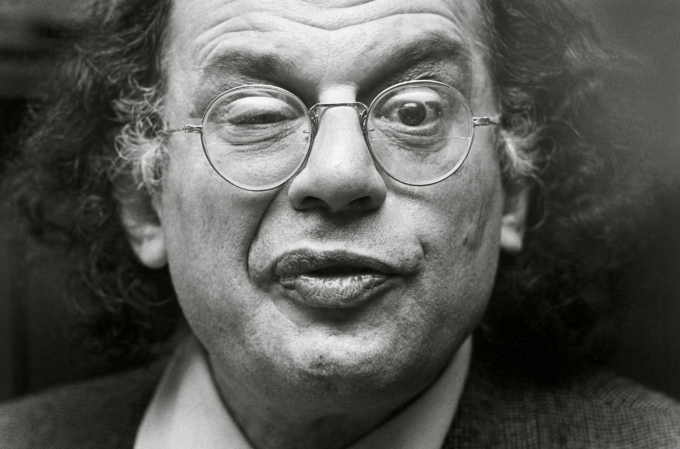


Allen Ginsberg, 1979. Image Wikipedia.

January 1956, Allen Ginsberg wrote: “America I’ve given you all and now I’m nothing.”

It is January 2026. I’m not sure if we’ve given it all as citizens or as a society. Some votes, some taxes, some rants, some protests, but surely not enough.

“Two dollars and twentyseven cents”? Don’t mention to Ginsberg the price of living in this economy.

Sometimes I, too, can’t stand my own mind.

“America when will we end the human war?” he asked. Not yet, Ginsberg, not yet. Nuclear weapons, missiles, drones, assault rifles, wrongful arrests, deportations without due process, homicides, the violence goes on and on.

“I don’t feel good don’t bother me.
I won’t write my poem till I’m in my right mind.”
Ginsberg, it’s simply not possible to be in our right minds anymore.

“America when will you be angelic?” Not angelic yet.
“When will you take off your clothes?” Fully armored still.
“When will you look at yourself through the grave?” That moment feels near, as we seem set on a suicide mission: democracy, foreign affairs, ecology. America First, burning itself down from the inside.

Ginsberg implored, “America why are your libraries full of tears?” But those volumes that contain our tears—genocide, slavery, discrimination, injustice—are now being removed from the shelves across the nation. Instead, the libraries are urged to display books that sing of power, pride, and progress.

“America when will you send your eggs to India?” Don’t get him started on the price of eggs.

Like Ginsberg, so many of us are sick of the insane demands. The ultimatum is: be a white Christian male, or else.

Well, I’m all else.

Ginsberg suspected, “There must be some other way to settle this argument.” There must be. An uprising. A declaration of heart and sanity. Saints against authoritarians. Radical hope against despair. Resilience, no matter what.

“America the plum blossoms are falling.” Then let us sweep the streets.

Ginsberg admitted he hadn’t read the newspapers for months with somebody going on trial for murder every day. Today the killers wear badges: ICE agents and police officers who often evade consequence. White House blames left-wing ideology, not bullets. It’s an old story in America, guns above human lives. All hail the Second Amendment.

Ginsberg predicted that there’s going to be trouble. And troubles followed. Detroit, Los Angeles, Seattle, Ferguson, Standing Rock. In this moment the pulse is in Minneapolis. The unrest feels inevitable, unstoppable. Necessary.

America’s emotional life was run by Time Magazine, Ginsberg lamented. Now there is Fox News, Facebook, X, CNN, morning talk shows, late-night comedy, alternative truths, deepfakes, AI.

It occurs to me that we are all America.
We are talking to ourselves in circles.

Ginsberg observed Asia rising. Oceans are also rising. Greenhouse emissions are rising. Inflation is rising. Unemployment is rising. Death toll is rising. May civilians rise like no other.

“I’d better consider my national resources.” And what are they now, a flag and a Bible? What about civil rights? What about national parks? What about schools, hospitals, museums?

So much for Ginsberg’s “unpublishable private literature that jetplanes 1400 miles an hour and twentyfive-thousand mental institutions.”

He said his ambition was to be President despite being Catholic. Don’t bother Ginsberg. This is a spectacle, nothing more.

“America how can I write a holy litany in your silly mood?”

And though the mood remained silly, even sinister and deceitful, Ginsberg raged on, obscene and luminous, word after word. He howled at America, and so will we:

America, free the immigrants.
America, defend democracy.
America, protect civilians.
America, restore the planet.

“America you don’t really want to go to war.” Please don’t.

“America its them bad Russians.
Them Russians them Russians and them Chinamen. And them Russians.
The Russia wants to eat us alive. The Russia’s power mad.”

But of course, we know Russia is not alone in its appetite to devour everything.
The President of the United States is power mad.
He wants to rule Venezuela.
He wants to claim Greenland.

He wants the Nobel Peace Prize.
He wants his name to crown the Kennedy Center.

He wants a gold-gilded ballroom.

Absolute loyalty. Solely his own morality. A government turned into reality TV. The whole world watching.

“America this is quite serious,” Ginsberg wrote; we ought to agree.

“I’d better get right down to the job,” he declared. And because he didn’t want to join the Army or turn lathes in precision parts factories, he offered, “America I’m putting my queer shoulder to the wheel.”

One poem at a time, 1400 miles an hour. That was his job. His gift to America.
It’s our turn. So I’m putting my immigrant shoulder to the wheel.

Because if not now, when?

Ipek S. Burnett, PhD, is the author of A Jungian Inquiry into American the Psyche: The Violence of Innocence (Routledge, 2020) and the editor of Re-Visioning the American Psyche: Jungian, Archetypal, and Mythological Reflections (Routledge, 2024). Based in San Francisco, she works with nonprofit organizations that specialize in social justice, human rights, and democracy. For more information visit: www.ipek burnett.com


LA REVUE GAUCHE - Left Comment: Search results for GINSBERG HOWL

Allen Ginsberg's "Howl" : a literary and cultural analysis. Allen ... Files. 2013-2014 Iglesias Rivas, Sara.pdf (240.55 KB). Identifiers. URI: http ...


Howl | The Poetry Foundation


Can the AI Folks Save Democracy?


 January 19, 2026

Photograph Source: Official White House Photo by Adam Schultz – Public Domain

The AI promoters have made grand promises about how AI will change everything and give us all happier, healthier lives.  Maybe that will be proven right, but it’s fair to say they have not yet delivered.

However, AI workers may have the power to do something very important in the present, not some distant or not so distant future. They can save democracy.

Their route to saving democracy is by not doing AI, or at least not doing AI with their current employers. At the moment, AI is clearly driving the economy. Investment in data centers and the power plants to support them directly account for a large share of economic growth.

Probably even more important than the direct investment is the impact of AI on stock market wealth and thereby on consumption. We have seen a huge run-up in the stock market driven primarily by companies that are heavily invested in AI.

To take the obvious examples, Nvidia, which makes most of the key chips for AI, now has a market capitalization of almost $4.5 trillion. Its stock has risen 1,500 percent in the last five years. Microsoft has a market capitalization of $3.4 trillion. Its stock price has doubled in the last five years. Apple and Meta’s stock prices have risen less dramatically, but now have market capitalizations of $3.8 trillion and $1.6 trillion, respectively.

Stock wealth translates into higher consumption as people spend annually between 2 and 3 cents on a dollar of stock wealth. In the last five years the market has added nearly $30 trillion in wealth as the market has more than doubled in value. That stock gain translates into between $600 billion and $900 billion in annual consumption spending, or 2-3 percent of GDP. This is clearly a huge factor in driving the economy.

If the AI bubble were to burst, this pattern of growth would come to an end. If I and many others are correct in calling AI a bubble, it will burst in any case, the only question is the timing.

One factor that could hasten the collapse would be if a substantial number of top AI researchers took a hike, and either took some time away from the industry (maybe literally take a hike) or moved into some other area of research. The big AI companies that have gone to great lengths to recruit top researchers would likely see their stock valuations plummet. This could quickly end the current AI frenzy.

How does this save democracy? In my crude analysis of our current politics, Trump has a hard-core base of around 25 percent of the electorate. This crew will be with Trump no matter what. As he put it some years back, he could kill someone on Fifth Avenue and they would still support him.

Roughly 50 percent percent of the population oppose Trump, most of them very strongly, as they see clearly the threat he poses to democracy and our fundamental rights. Then there is another 25 percent or so that may not really like Trump, they might even think he’s a jerk, but hey, their 401(k)s are up, the economy isn’t doing badly, so why not?

This group has been edging away from Trump in the last year, with polls showing his overall approval now hovering near 40 percent. But they would edge away far more quickly if their 401(k)s suddenly took a big hit and we got our second Trump recession. (The first one was in 2020, for the folks with bad memories.)

If Trump went from being slightly unpopular to being extremely unpopular, we would start to see Republican politicians in the House and Senate suddenly come back to life. Very few of this group have any real commitment to Trump. In fact, some of them were hardcore never Trumpers before he took over the party.

These politicians care first and foremost about their careers, and they will not wed themselves to a 79-year-old man whose popularity is sinking like a rock. They will start again acting like members of Congress and doing things like overseeing spending, limiting Trump’s barrage of executive orders, and reining in ICE, which Trump is using as his personal police force to terrorize the states and cities that support Democrats.

The top AI researchers have the ability to set this ball in motion. It may be some personal sacrifice, but these people’s skills will still carry enormous value a year or two from now. They will not go hungry. And if the bubble is going to burst anyhow, why not get out front and do something great for the world?

To be clear, in my view this is not an issue of doing something bad to the economy. I have written before on how it would be good if the AI bubble bursts sooner rather than later. The same was true for the 1990s tech bubble and the housing bubble in the 00s. In all these cases we would have been much better off if the bubbles had burst years earlier.

Huge amounts of resources were being misallocated. The larger the bubble, the more painful the readjustment process. And to be clear, an economy where all the consumption growth is coming from the richest 20 percent of the population is not a healthy one. Bringing that pattern of growth to an end soon looks pretty good in my book.

We know the top people in tech, folks like Jeff Bezos at Amazon and Mark Zuckerberg at Meta, are just fine with Trump’s destruction of democracy. But these are not the people who make their companies economic powerhouses. If the people who actually do the work step forward, they really can change the world. The rest of us will keep trying too.

This first appeared on Dean Baker’s Beat the Press blog. 

Dean Baker is the senior economist at the Center for Economic and Policy Research in Washington, DC.