Wednesday, January 21, 2026

Resistance Grows as US Border Wall Construction Threatens Jaguars
Source: Originally published by Z. Feel free to share widely.

On a sunny and modestly warm day in mid-November, I have a clear view of the San Rafael Valley from high in Montezuma Pass in the Coronado National Monument. A road cuts a straight orange-red line through the juniper trees and grassland below. That road, I am told by one of the border wall resisters I traveled with from Tuscson, marks the delineation between Mexico and the United States. Turning, she points to the south. I focus my eyes as she says, “See that black line? That’s the new border wall.”

Though there are sections of border wall that have been in place for decades, the desire of the current regime to build a complete wall which would stretch nearly 2000 miles from the Pacific Ocean in California to the Gulf of Mexico in Texas is unprecedented. If successful, such a wall would mark the first time in human history that a continent has been cut in half by a man-made structure.

Though it is touted by proponents as necessary to stop undocumented people including drug runners and murderers from entering the United States, the wall will ultimately fail in this task (as existing border walls show). Instead, it will merely stand as a monument to arrogance, xenophobia, and enriching the already rich.

The mountain pass where I am standing is part of the Coronado National Monument, which is named after Francisco Vazquez de Coronado, who, in 1540, set off from a small city north of Puerto Vallarta, Mexico, believing he would find boundless riches within the mythical “Seven Cities of Gold.” On foot and horseback, the Coronado expedition navigated the Huchuca Mountains that we have just driven up. But after two years of searching for gold-lined streets and gilded buildings as far away as western Kansas, Coronado returned to Mexico with no gold; as far as the history books go, he has been noted as a dismal failure.

History repeats. Today, just as in Cornando’s time, the drive to build the wall reflects greed and the abuse of power running roughshod over communities, existing laws, and the land itself. Trump’s desperate desire for this monstrosity to be a part of his legacy, regardless of the impacts, is a mirror of the arrogant lust for power of the conquistadors. The gold of today is forty-five billion dollars of American taxpayers money that is being spent to build this wall which is lining the pockets of private contractors — a number of whom have personal relationships with the Trump Administration.

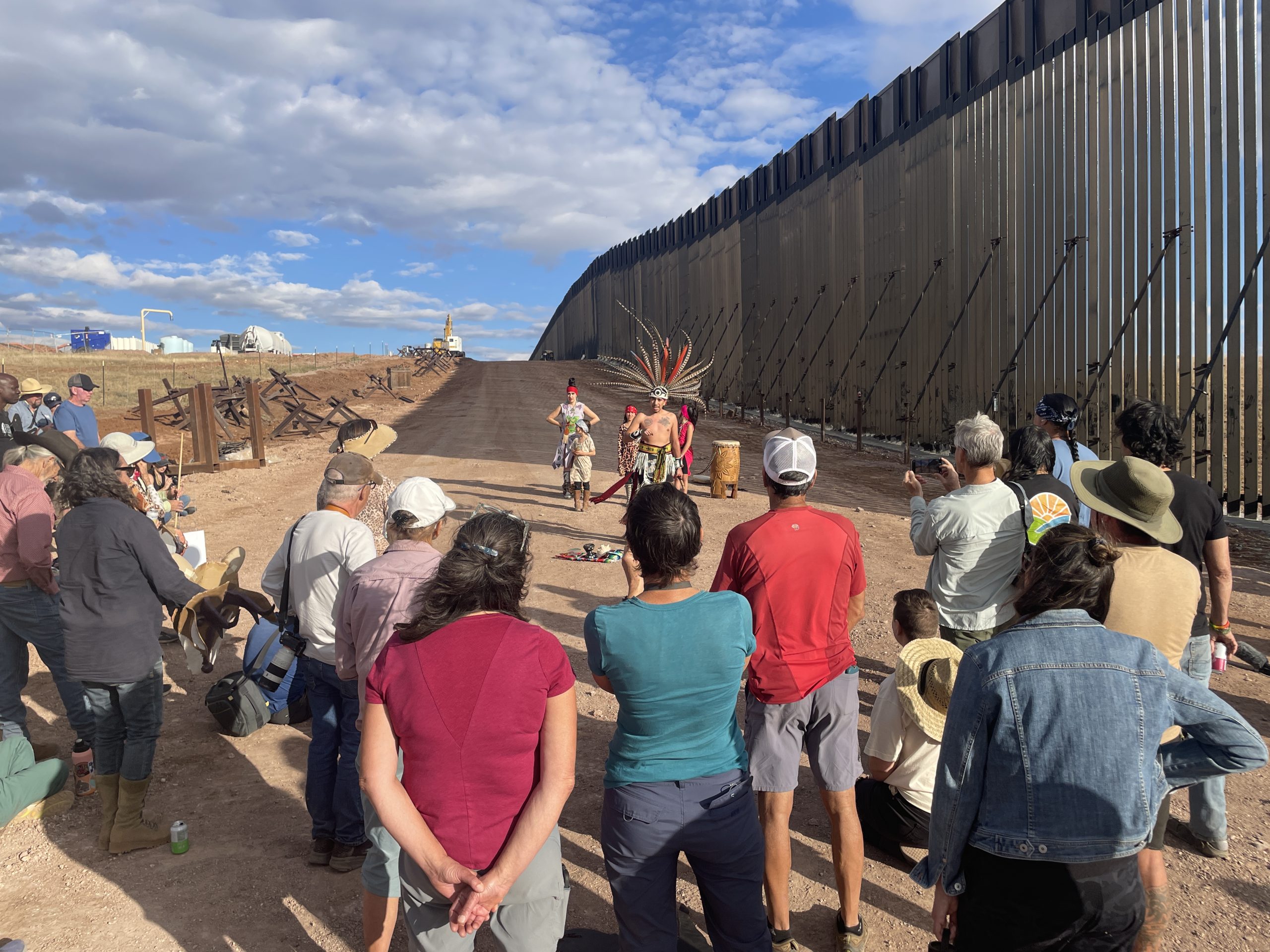
We pile back into our vehicles, and after a bumpy ride down from the pass and across the valley, gather with two hundred other people who converged this day near a section of the new wall. It looks like oversized black prison bars, like something meant more to contain dinosaurs than people, rising up thirty feet from the ground. Though this section is not even a mile long at this point, it already stands out like a dark scar across the landscape. I imagine Cornando’s expedition must have looked similar from Montezuma Pass as they marched north: fools on a fool’s errand.

What currently guards the border road is something on a much smaller scale: a simple fence that resembles any in cattle country. It is a cross-hatch construction of railroad iron meant to be a vehicle barrier. As out of place as this fence is, it would stop a car or truck but allows people and other animals to pass under or over.  And though any barrier separating the landscape in this manner is still a form of violence to those who inhabit the area, in comparison to the new wall, the existing barrier feels quaint. There will be no passing the new wall for anything larger than a mouse, unless it has wings. The jaguars, pronghorn, cougar, black bears, ocelots, javelina, deer, bobcats, badgers, and other wildlife will all be cut off.

The gathering has been dubbed “the Rally in the Valley.” The people who have come are border wall resisters, family members, first timers like me, journalists and others concerned about the construction of the wall, and they’ve come mostly from Arizona, with others hailing from other areas along the path of the new wall like Laredo, Texas and San Diego, California. There is music, customary dances from Tohono O’odham people, and varieties of art from an oil painting of the valley to paper mache animal masks to “NO BORDER WALL” stickers that found their way on the construction equipment and the bars of the new wall. There are speeches and hundreds of conversations about the beauty of the valley, the fate of residents like the pronghorn and jaguar, ways to disrupt the wall construction, and how best to bring people together on both sides of the border to stop the madness.

Along with tribal leaders of the Tohono O’odham and a handful of activists from various national and local organizations who provide words of guidance, facts, inspiration, and warning, Arizona Representative Adelita Grijalva, just two days after being sworn in, also addresses the crowd. Though she speaks powerfully about the absurdity of the wall and promises that she will do what she can inside the morass that is Congress, it isn’t her words that had the most impact on me; I find out later that evening from one of the rally organizers that upon seeing the wall, she became physically ill and needed a moment to settle herself before talking.

Tohono O’odham leader Austin Nuñez speaks about how this area for millennia was open land: a place to migrate through, to be nourished by, or to call home depending on the time of year and conditions. The wall threatens this history of right-relationship with the land and with non-humans. In the scheme of the fear-mongering the federal administration has been pronouncing about the flood of illegal immigrants and the crime they will bring and taxpayer resources they will drain, it is well-documented that the overwhelming majority of those who cross the border into the United States without papers find a way to become valuable contributors in American society. Even discounting this, the San Rafael Valley is not a typical place where people look to cross. A wall here is simply useless. It’s political theatre. The valley is, however, habitat for small and large animals alike from jackrabbit to bear to pronghorn to ocelot to the highly endangered jaguar. These non-human relations of ours will be cut off from each other and the place that sustains them. The wall will function not as a deterrent to human migration but as an ecocidal wound on the land.

The high desert is spectacular anytime of year, but as we head into the winter solstice the sunlight is even more spectacular in how it frames and illuminates everything on the ground and in the sky. Looking out across this threatened land, I can see why so many find this place to be special. Shortly before the shade of night falls on the gathering, we share a meal next to the new wall. The food, a variety of burritos, is a gift from border wall resisters on the Mexican side. They have traveled a long distance on a combination of roads and open landscape to join those on the US side.  It looks like a picnic between friends and family with people chatting, sitting and leaning on the existing border fence, passing food across, laughing, and exchanging hugs. At one point I look up and see two little blond-haired girls running through the grass on the Mexican side of the fence. They have slipped under from the US side, doing what kids want to do: play and take in the wonders around them. Their freedom and friendship is a sacred reminder.

Though the wall is intended to stop and separate people, from my vantage it looks to be doing more to bring people together, whether it be the two hundred people gathered for the rally  this day, or those coming together on a daily basis  to resist the kidnapping of people by border patrol and Immigration and Customs Enforcement (ICE) in small and large communities all across the United States. As we drive away from the border, I keep thinking that for those wanting to disrupt the construction and to ultimately keep the wall from being built will need to channel the power and resolve of the landscape itself to insure that this foolish quest fails just as spectacularly as Coronado’s did nearly 500 years ago.Email

Kai Huschke is the Executive Director of the Community Environmental Legal Defense Fund (CELDF) which pioneered the first “rights of nature” laws in the United States as a form of collective civil disobedience against corporate power. Kai has served as a national lecturer for CELDF’s Democracy School and as a board member of the Oregon Community Rights Network and Washington Community Rights Network. He teaches, presents, and writes extensively on movement building, community rights, rights of nature, and the intersection of culture and law.

Mayor Mamdani Can Empower New York’s Municipal Workers

Source: Jacobin

What does it augur to have a socialist mayor of New York City? The basic tenets of Zohran Mamdani’s election platform are, of course, directed at reducing inequality in the most unequal city in the nation: free childcare and buses, frozen rents, and more subsidized housing are all steps in that direction. But sabotage from Washington and resistance from state and local lawmakers and economic elites will all put limits to how far and how fast we can go.

Beyond the economic sphere, however, the city should have a freer hand in empowering the working class — against employers, to be sure, but also by allowing it to participate in the daily administration of the city. Gabriel Hetland and Bhaskar Sunkara have written about the need for popular assemblies, not just as a tactic to fend off capital, but because a basic tenet of socialist strategy should be “to increase the capacity of workers to collectively shape the decisions that shape their lives.” But building assemblies that are both truly democratic and wield institutional and economic power from scratch will take time.

In the meantime, there is another reform aimed at increasing working-class participation in government that the Mamdani administration can begin to put into place immediately: the replacement of antagonistic bargaining with its own workforce and their unions by a model based on consultation and collaboration to improve work, workplaces, and the provision of city services. This is a big piece of what socialism in practice should look like: combining some amount of necessary top-down organization with the opportunity for workers themselves to have meaningful input into how work is organized and services are delivered.

It is a well-worn trope on the Left, but a true one nonetheless, that the best experts on how to do the work better and more efficiently, and how to make the workplace more enjoyable, are the workers themselves. The vast majority of municipal workers — there are hundreds of thousands of them — want to have pride in their work; they want to do it better. And, of course, they would also like to address the workplace concerns that have produced massive worker flight and demoralization among the rest. Yet their experience is that their unions cannot deliver any of these outcomes, and that changes that come down from above — some of them good and useful; others not so much — are implemented unilaterally.

Who’s to blame for this state of affairs? The employer primarily, but city unions also share some measure of culpability.

The Cost-Cutting Dogma

Under both Democratic and Republican administrations, the city government has crafted its labor policies, especially its bargaining practices, as though it were a private employer trying to maximize profits by minimizing labor costs. It has been so successful in holding down those costs that many city agencies are perpetually understaffed because they can’t hire or retain qualified employees. But the problem is not just that it holds down wages and subjects all the municipal unions to one-size-fits-all “pattern bargaining” — a system in which the city bargains with one municipal union first, and then all the other city unions are expected to accept similar terms in their own contracts.

The Public Employees’ Fair Employment Act (commonly known as the Taylor Law) allows the city to refuse to bargain about many issues that private sector labor law allows. It won’t bargain with the United Federation of Teachers (UFT) about class size. It won’t bargain about shift scheduling. It won’t bargain about service changes. It won’t engage in what in other cities and states has come to be known as “Bargaining for the Common Good,” in which the union negotiations process goes beyond bread-and-butter issues like pay to include demands that benefit the broader working class.

In effect, the city has forgotten that its primary imperative should be to maximize service — measured both quantitatively and especially qualitatively — per unit cost. That means thinking about “productivity” in an entirely different way, requiring a completely different bargaining mindset — one based on cooperation and collaboration with its unions and employees. In fact, “bargaining” is too restrictive a term, for it implies that these discussions should only take place when contracts expire every four or five years, rather than continuously, and primarily with the affected agencies rather than a cost-driven labor relations department.

Union Bargaining Excludes the Rank and File

New York’s municipal unions have been well-trained by years of a neoliberal economic and political order to lower their sights and shrink their imaginations. Most unions have come to privately embrace and appreciate the city’s demand that all contracts must conform to a single economic pattern. It took the pressure off them to win better contracts. When members gripe, they shrug their shoulders: the pattern is the pattern. Because so little is negotiated, bargaining is typically a top-down affair, with little or no member participation or agency.

Ironically, unions have the perverse incentive to show at the bargaining table how their proposals will replace skilled veteran workers with inexperienced new hires. One of these long-ago “deals” explains why virtually all newly hired uniformed employees make less than half the wage of “veterans” with sixty-six months on the job, inhibiting recruiting.

Teacher salaries, for instance, are very skewed, with substantive raises beginning only after eight years of service. Years ago, proposals to give early career teachers some relief from the classroom and use that time for additional teacher education and coaching were shot down as being too costly. Exhausted from learning how to teach and having to devise new lesson plans from scratch every day, and underpaid to boot, newer teachers burn out and leave the profession at remarkable rates, with even more inexperienced (and cheaper!) replacements taking their place. How does anyone besides the bean counters in the city’s labor relations department benefit from this vicious circle?

Largely restricted to negotiating about money items, and even hemmed in over those, union leaders have little incentive to engage with their members about their workplace needs; that would only lead to heightened expectations and later frustrations. For the same reason, they rarely engage with the communities their members serve. It is hard now to even imagine that in 1965 New York City social workers went on strike to win an easing of bureaucratic requirements for their clients.

Of course, in many workplaces, workers and their front-line managers use their on-the-ground knowledge to develop unofficial arrangements that ease workflow and working conditions. But because of the opposition of the Office of Labor Relations and union leaders, it is difficult to formalize these agreements.

Toward Collaborative Bargaining

The solution to the problems of low worker morale and poor service delivery is both simple and complicated. It is simple in that the starting point is clear: our new mayor must indicate a willingness to adopt — and then enjoin agency heads to embrace — a different form of labor relations. This approach would mean a collaborative exploration of how services can be delivered better, and worker treatment improved, across whole agencies but also in individual workplaces.

It is more complicated in that the city will need to identify unions ready to partner with it in this new form of bargaining. Judging from my experience in New York City’s labor movement, at the start, many of the municipal unions may be afraid of changes that would disrupt their largely top-down internal equilibriums. In DC 37, for example, with its sixty-one different locals representing one thousand different titles, bargaining about a purposefully wide range of issues will require more open and deliberative processes and also will require that its executive director allow a more decentralized bargaining process.

It is more complicated still, because the types of changes the city desperately needs in its delivery of services require a big shift in culture: listening to, and having serious conversations with, worker representatives, often right in the workplace. And after a start during the cycle of collective bargaining — among the major municipal unions, DC 37’s contract is the first to expire in November 2026 — forms should be institutionalized for ongoing discussions at workplaces between mid-level managers and workers and for codifying changes.

Is this merely a pipe dream — visionary, perhaps, but impracticable? If there will ever be a chance to end decades of ossified and bureaucratically creaky service delivery, to explore new methods of planning and engagement, this is the time, with a pro-worker socialist mayor in city hall.

And imagine the payoff if it works, in whole or part. One of the characteristics of a socialist mayoral administration should be a different and more fruitful government-union-worker-community relationship, one that encourages working-class voices. It is a crime that we have failed to use all the detailed worker knowledge and experience about how to more efficiently and more humanely run this city. It’s time to start now.Email

Marc Kagan is the author of the forthcoming book The Fall and Rise and Fall of NYC’s TWU Local 100, 1975–2009.

Dear America, Keep Your Republic and Let All Others Keep Theirs


Source: The Wire

It is not easy to play poker with Washington these days. It holds a trump card never seen in the deck before. It is now an ace, a king, a jack, and a joker with very dark intent.

For example, just when we were being schooled to believe that Russia and China could be gunning for Greenland, it turns out that is the trump card gunning for Europe and NATO.

The terrible child, having snatched the bauble of world opinion – which he otherwise despises –  from Maria Machado, with a forthrightly stated “I am the one who deserves the peace prize’,  is again to the fore.

“I want Greenland, give me Greenland,” says he. “And if you don’t I will thee tariff more and yet more; you are allies only if I be your lead bad boy. If not, Europe and NATO can go as many leagues below the Mediterranean as they might, so long as I have my Greenland.”

Gosh, if only the good old Dr. Sigmund Freud were still with us, what illuminations  he might have shared with us little people.

What of the  lilliputians who live on that land?

The joker in the poker would say, “In poker, the winner takes all, be they chips or homo sapiens.”

So come forth, speak to them the truth that only muscle matters; the rest is moral blackmail visited by the weak on the puissant.

Thus spake Zarathustra, have you forgotten?

No sir, we haven’t.

And we remember what inferno them teachings of Nietzsche brought the world to not too long ago, dear Trump; which is why we need regime change, foremost in that land which once shook off the monarchs who tyrannised those whom you now lead as did the despots of old.

So, dear Europe, do you begin to see the new poker game and the new trump card that begins to do that to you what neither Russia nor China have yet done?  Ten percent tariffs more already, with promise of 25% come first of June, should you fail to come to supplicant senses?

Dear NATO, you may well be fighting the next war not against Russia or China but your chief guarantor, the US.

Do laugh; But also begin to take a leaf from Canada’s book.

Neither Europe nor Canada seem any more to belong to the  “western hemisphere” which Trump has vowed to protect with blood and guts; so why not turn East?

You have a combined GDP equivalent to the US. So think how you might put the joker back in the pack by simply teaming up with Russia and China who, after all, have never coveted any of your belongings, not even Greenland; and who, in fact, saved you from your own predators eight decades ago.

So rise and shine. Bring down the  poker. Save Greenland. Show the way down to the Greenback, where it may begin to be reborn with a human face. Build a new world with sturdy, self-confident, peace-loving BRICS.

Prepare a new American ground to plant a Bernie Sanders here, a Zohran Mamdani there.

Forestall the bad boy of the day from extracting Mette Frederiksen, who governs Greenland, as he did the incautious Nicolas Maduro.

And, dear Americans, look to Minneapolis. Allow yourselves to take in the full meaning of the contention there, before the moment comes when, like a century and a half before, a call goes up for secession from the Union.

Save the federation, save democracy and save the ideals which led mankind out form the dark ages. Recall  Benjamin Franklin’s prophetic caution: “A republic, if you can keep it.”

Keep your republic and help all others keep what they have chosen for themselves.Email

avatar

Badri Raina is a well-known commentator on politics, culture and society. His columns on the Znet have a global following. Raina taught English literature at the University of Delhi for over four decades and is the author of the much acclaimed Dickens and the Dialectic of Growth. He has several collections of poems and translations. His writings have appeared in nearly all major English dailies and journals in India.


Exporters Aren’t Eating the Tariffs, We Are


 January 20, 2026

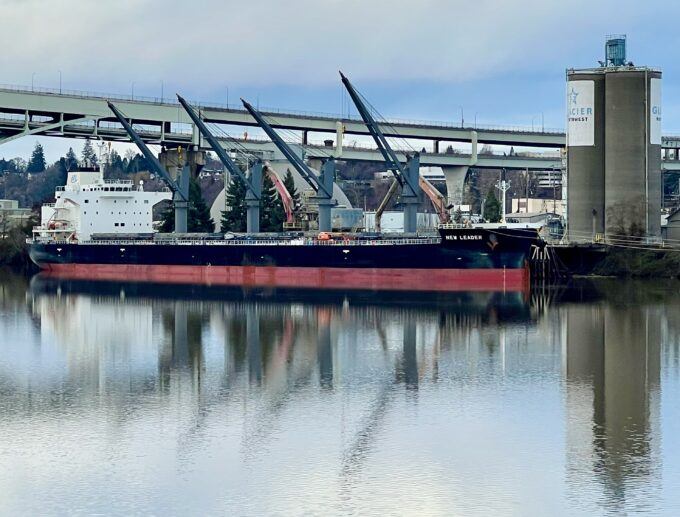
Cargo ship off-loading on the Willamette River in Portland, Oregon. Photo: Jeffrey St. Clair.

Donald Trump keeps saying that foreigners are paying his tariffs. He talks as though he thinks China, Japan, and other trading partners are sending the Treasury checks every month. (They go on the “tariff shelf.”) Who knows what Trump actually thinks, but insofar as there is a story of foreigners paying the tariffs it would take the form of lower import prices.

We have good data on this. The Bureau of Labor Statistics releases data on import prices every month. We got the data for November on Thursday and it goes the wrong way. Non-fuel import prices rose 0.1% for the month and 0.7% over the last year. It doesn’t look like exporters are eating the tariffs.

There is an argument that import prices are rising less rapidly than would otherwise be the case, but that could only cover a small portion of the tariffs. For example, in the case of China, Trump imposed tariffs of 30%. (I think that’s where we are now.) Import prices from China are down 3.6% year-over-year, or 12 percent of Trump’s tariffs.

But don’t go out and celebrate too much. China has been experiencing deflation, so goods prices are falling more generally, quite independent of Trump’s tariffs. But exporters are probably eating at least some portion of Trump’s tariffs.

The story in other countries doesn’t look as promising for the MAGA crew. The index for imports from Japan rose 2.6% year-over-year, the index for imports from Taiwan rose 2.3% year-over-year. Clearly the overwhelming majority of Trump’s tariffs is a tax on us.

There is an issue of who the us is. Consumers have been seeing much of the tariff increase in the form of higher prices. Goods prices had been falling from the second half of 2023 until the election, when they turned around and began rising.

It is likely that retailers or intermediaries are eating some of the tariffs in the form of lower profit margins, but the CPI likely rose between 0.5-0.7 percentage points more last year than would have been the case without the tariffs. And there could be more on the way, insofar as businesses were refraining from raising prices in the hope that Trump would reverse his tariffs.

It will take more time to get good data on the ultimate incidence of the tariff, but the part borne by our trading partners is pretty straightforward. If import prices aren’t falling, they aren’t paying.

This first appeared on Dean Baker’s Beat the Press blog.

Dean Baker is the senior economist at the Center for Economic and Policy Research in Washington, DC.