Wednesday, January 28, 2026


Shell and BP Seek U.S. Licenses for Shared Venezuela-Trinidad Gas Fields

UK-based supermajors Shell and BP are seeking U.S. licenses to develop gas fields that Trinidad and Tobago shares with Venezuela, the Caribbean island’s Energy Minister Roodal Moonilal said on Wednesday.

BP and Shell have sought to develop two separate cross-border gas fields in Venezuelan and Trinidad and Tobago waters, but progress has been slow in recent years due to the frequent changes in U.S. policy toward allowing international firms to do business with Venezuela.

In July 2024, BP, together with its partner, the National Gas Company of Trinidad and Tobago (NGC), was awarded an exploration and production license by Venezuela for the development of the Cocuina gas discovery. Cocuina is part of the cross-border Manakin-Cocuina gas field.


However, Nicolas Maduro’s government last year halted joint development of gas projects with Trinidad and Tobago, while the Trump Administration in May 2025 revoked licenses for Shell and BP to develop joint fields.

But in October, the U.S. authorized Shell to develop the Dragon gas field offshore Venezuela, which is expected to supply gas to Trinidad and Tobago, which is an LNG exporter.

Now, after the capture of Maduro by the U.S., the supermajors have renewed efforts to secure licenses as the Trump Administration looks to have major oil companies develop Venezuelan oil and gas resources.

According to Trinidad’s minister Moonilal, Shell is working to get a license for the Loran-Manatee discovery, estimated to hold about 10 trillion cubic feet of natural gas, most of which is in Venezuelan waters.

BP, for its part, is seeking a license to develop Manakin-Cocuina, the minister added.

“The United States is an ally and a very strong friend trying to reform, so we would help the companies when it comes to supporting their applications,” Moonilal told Reuters on the sidelines of an energy conference in India.

BP is betting on Trinidad and Tobago to boost oil and gas output. Last year the company approved the development of the offshore Ginger gas project, which will be one of the ten major new projects that the UK supermajor promised to start up by 2027.

By Charles Kennedy for Oilprice.com


Venezuela's oil reform fails to lure US majors despite push for private investment

Venezuela's oil reform fails to lure US majors despite push for private investment
While smaller independent producers expressed eagerness to pursue opportunities, major oil companies are leaning against deploying the tens of billions of dollars needed for meaningful production growth without physical security guarantees, legal certainty and competitive fiscal terms.
By bnl editorial staff January 28, 2026

Venezuela's interim government has fast-tracked sweeping changes to the country's hydrocarbon law in a bid to attract foreign capital to its battered oil industry, but major US producers remain reluctant to commit billions of dollars amid persistent legal uncertainties and the absence of security guarantees from Washington.

The legislative reform, approved in its first reading last week following the capture of President Nicolás Maduro by US special forces, marks the first substantial overhaul of Venezuela's oil sector since Hugo Chávez's 2006 nationalisation. Under the proposals, private firms would gain authority to market their crude directly, joint venture minority partners would secure enhanced technical and operational control, and the government could slash royalty payments from the current 33% rate to a minimum of 15%.

Yet the changes fall short of what international oil executives say is needed to justify large-scale investment in a country whose industry has been crippled by decades of mismanagement, corruption and underinvestment, according to lawyers and company officials quoted by Reuters.

"This is sufficient enough for the transition, until there is a permanent government in Venezuela," Ali Moshiri, chief executive of Amos Global Energy Management, told the news agency. Moshiri, whose firm holds stakes in Venezuelan energy projects, cautioned: "If you don't make this [industry] more attractive, the entire progress we want to make is going to come to a halt."

The legislation would codify a model for production-sharing agreements that has existed informally under Maduro, giving participating companies greater operational independence in managing their oilfields. Several firms already work under such arrangements, which would continue alongside traditional joint ventures where PDVSA maintains majority control.

But scepticism runs deep, stemming from concerns about Venezuela's dismal institutional track record. "The past seven decades of Venezuela's oil industry are marked by broken contracts and resource nationalism," Francisco Monaldi, director of the Latin America Energy Program at Rice University's Baker Institute, wrote in Americas Quarterly. "No agreement has survived to maturity without significant deterioration of terms."

Industry associations and legal advisers have flagged imprecise wording in the latest bill and conflicting provisions regarding commercial operations, fiscal terms and recognition of international arbitration. The reform gives Venezuela's oil ministry broad discretionary powers to approve contracts and lower royalties without consulting the National Assembly, prompting criticism from the few remaining opposition lawmakers who received the text only hours before parliamentary debate began.

Legal experts warn that additional legislative changes would be necessary to secure the $100bn that the US says Venezuela requires to revitalise its ailing energy infrastructure. Modifications to income tax legislation and the removal of so-called shadow tax provisions, which guarantee the state receives no less than half of each barrel's value, remain pending, according to six lawyers and executives who spoke to Reuters.

The caution among international majors reflects both operational and political risks. Major US producers including ExxonMobil and ConocoPhillips have outstanding legal claims over assets seized during earlier nationalisations, with Conoco's three arbitration cases valued at up to $12bn. President Donald Trump has urged claimants to drop their cases, but the unresolved claims will not vanish on their own and still compound investor wariness.

In fact, past disputes over contractual terms continue to shape their calculations. After Chávez consolidated control over PDVSA during the early 2000s, he replaced much of the state company's qualified management and engineering staff with party loyalists before imposing revised agreements that increased fiscal burdens and mandated state majority stakes. Conoco and Exxon rejected the renegotiated terms and withdrew, initiating arbitration proceedings. Chevron remained under the new arrangements, though Monaldi notes that Chávez and Maduro subsequently "kept reneging on deals with foreign investors, driving most of them out of the country."

The gap between Trump’s encouraging rhetoric and Washington’s limited policy support has also added to the uncertainty. "Oil and gas companies operate all around the world in all different settings, they're well versed in those challenges," Energy Secretary Chris Wright said in a Bloomberg TV interview, ruling out security guarantees for firms operating in Venezuela.

The American Petroleum Institute has said policy changes, security arrangements and investment protections are prerequisites for significant industry engagement. Mike Sommers, the group's president, outlined these conditions earlier this month as US refiners began purchasing Venezuelan crude at steep discounts through trading houses.

Some analysts expect the largest US producers to remain on the sidelines until clearer reforms emerge and a more representative National Assembly takes office.

“This law is a law of ambiguity, designed to avoid openly breaking with Chavez’s oil legacy,” said Jose Guerra, former director of research at Venezuela’s Central Bank, according to Al Jazeera. “It is not emphatic about private participation.”

In a similar vein, Monaldi argues that meaningful recovery requires more than legal reforms. "Venezuela needs stable, constructive relations with the US and Europe, and a permanent end to oil sanctions," he wrote. "Investors must see genuine political stability and a durable consensus among the country's leadership and society to reopen the sector to foreign participation.”

Venezuela holds roughly 17% of the world's proven oil reserves, predominantly extra-heavy crude suited to certain US Gulf coast refineries. Yet output has plummeted from 2.5mn barrels per day in the mid-2010s to approximately 1mn b/d currently, following years of sanctions, capital flight and operational deterioration.

Acting president Delcy Rodríguez, Trump’s handpicked successor to rule the country following Maduro’s ouster, has said the reform would preserve national sovereignty whilst enabling Venezuela to emerge as a major hydrocarbon producer backed by private capital. She recently met with executives from oil companies including Repsol, Chevron and Shell at PDVSA's Caracas headquarters as part of a public consultation process required before the bill can clear parliament. Investment in the oil and gas sector is projected to reach about $1.4bn this year, up from nearly $900mn in 2025, she told oil executives.

Following the meeting, Chevron's representative said the US company was prepared to continue contributing technology and expertise, pointing to its longstanding partnership in the country. In contrast, Halliburton, the US oil services company that departed Venezuela in 2019, said commercial and legal terms must be clarified before it considers re-entering a market that previously generated approximately $500mn in annual revenue.

Monaldi suggests Chevron has an extra edge because it is already on the ground with contracts offering significant development potential, allowing it to reinvest some cash flow. Spanish oil firm Repsol and perhaps Italy’s Eni could add more modest production increments. But he warns that "major projects requiring substantial fresh capital and long maturity will remain out of reach" without deeper institutional change.

In the near term, Venezuelan barrels are re-entering global markets through discounted spot trades rather than upstream investment. Refiners including Valero and Phillips 66 have bought cargoes through trader Vitol at discounts approaching $9 per barrel below Brent benchmark prices, attractive economics for Gulf Coast facilities designed to process heavy sour grades.

Venezuela's reserves present significant technical challenges. The country's largest deposits contain ultra-heavy crude that requires specialised and expensive extraction methods, and commands substantial discounts in global markets. Industry analysts say such projects would need oil prices considerably higher than current Brent levels near $50 to $55 per barrel to become economically attractive.

Production growth forecasts suggest output might increase by 200,000 to 250,000 b/d annually over four to five years, assuming investment of $10bn per year. Major oil companies, however, face difficult allocation decisions, particularly during a period of subdued prices when financial discipline typically takes precedence.

Venezuela's National Assembly, still dominated by the ruling socialist bloc despite Trump's claims of maintaining oversight following Maduro’s removal, is now expected to approve the reform after brief public consultations. The bill must still undergo article-by-article debate before enactment.

But Big Oil remains in no rush to re-enter Venezuela. The tepid response from executives at a White House meeting with Trump earlier this month laid bare the industry's hesitancy. Most brazenly, ExxonMobil chief executive Darren Woods told the gathering the oil-rich nation remained "uninvestable" after the company had its assets seized twice previously. "To re-enter a third time would require some pretty significant changes from what we've historically seen and what is currently the state," he said. Trump "didn't like" his response and threatened to keep Exxon out of the country.

While smaller independent producers expressed eagerness to pursue opportunities, major oil companies are leaning against deploying the vast sums needed for meaningful production growth without physical security guarantees, legal certainty and competitive fiscal terms – conditions that Venezuela's US-mandated reform has yet to convincingly deliver. 

Venezuela Signals a Historic Energy Reset as Oil Laws Open to Foreign Capital

  • Venezuela is moving to overhaul its hydrocarbons law, opening the door to deeper foreign and private-sector participation.

  • The reforms introduce far more flexible operating and fiscal structures, allowing private and mixed companies to take on operational control.

  • If paired with sanctions relief, the changes could mark a true reopening of Venezuela’s oil sector, shifting policy from ideological rigidity toward pragmatic, investment-led recovery.

Venezuela is edging toward what could become the most consequential energy shift in a generation. Interim President Delcy Rodriguez reportedly met with senior international oil executives this week at a PDVSA facility, as the government opens consultations on a partial reform of the country’s Organic Hydrocarbons Law.

The proposed changes, now moving through Venezuela’s National Assembly, would fundamentally reshape the fiscal and contractual rules governing the country’s oil and gas sectors.

 While the state would retain sovereignty over Venezuela’s oil, highlighting how the reform can foster growth and attract investment can inspire confidence among industry professionals and investors.

If approved, the new framework would allow external operators to become more deeply involved in the production process than ever before, potentially increasing foreign investment and modernizing Venezuela’s oil industry.

One of the reform’s most significant shifts is an expansion of who can operate upstream. It would allow mixed enterprises, as well as private Venezuelan-domiciled companies, to work in tandem with state authorities on contracted projects.

In essence, this would create a dual-track system, one more aligned with the financial realities of Venezuela’s oil industry. Rather than forcing all investment projects into a single joint-venture model, the government would gain more flexibility to structure deals around the realities of capital requirements.

Capital-intensive developments, including pipeline repairs, which have been neglected for many years, could finally attract the scale of private investment that they so desperately require.

The intent of the interim administration is clear. Venezuela is moving away from the inflexible investment framework that has long constrained the sector.

Perhaps even more important, however, is how the reform plans to tackle control dynamics. State-owned companies and their subsidiaries would be permitted to transfer operational responsibility to private partners by contract, either full or in part. While this may appear as a minor technical change, it represents a substantial shift in the government’s policy.

For years, Venezuela’s joint-venture system has been defined by a distinct structural rigidity. External partners have been allowed to supply capital and expertise, but operational control remained tightly held within state entities. The proposed reforms would alter that long-standing balance, giving space for hybrid operating models that are better suited to the complex nature of oil projects and to both their construction and financing.

The royalties would remain capped at 30%, but the actual rate will be set project-by-project. A new Integrated Hydrocarbons Tax will apply at up to 15% of gross income, but again would be adjusted depending on the demands of each project.

The government is also looking to address some of the financial bottlenecks that have historically worried international investors. Minority partners would not only be allowed to open and manage bank accounts in any currency or jurisdiction, but also to directly market their share of production.

Direct commercialisation improves cash-flow visibility, while offshore banking flexibility removes the friction of getting foreign direct investment into Venezuelan ventures. New project contracts will also include expanded dispute-resolution mechanisms. In essence, removing the additional layers of complications that have previously slowed or complicated arbitration agreements.

The reforms aim to make Venezuelan projects easier to finance and to protect external capital, emphasizing that stability and sanctions reform are essential for success, reassuring policymakers and investors.

The proposed changes in Rodriguez’s government acknowledge that reviving the country’s oil sector requires long-term investment, which can reassure investors and industry stakeholders of sustained commitment.

Considering the scale and scope of the large upstream developments and infrastructure projects that Venezuela’s oil industry will require to start seeing consistent increases in production, investment horizons have to be widened. The reforms are seeking to do precisely that.

While the reforms to the bill are still navigating Venezuela’s legislative process, for international investors, the intention behind them is encouraging. They represent a substantial strategic pivot, moving Venezuela’s oil industry away from the constraints of ideology and toward a programme of pragmatic partnership.

Venezuela needs investment, and that investment will come from partnerships that have the flexibility to invest in the ways and at the scale they need.

Of course, the success of the reforms will hinge on broader sanctions reform and stabilisation of the region’s geopolitical situation. But at the legislative level, Venezuela seems to be building a framework to say what it has not said clearly in years: the door is open again, and this time, the terms are negotiable.

By Cyril Widdershoven for Oilprice.com


Grupo Mexico targets US expansion on copper boom


Image: Grupo Mexico

Mexican mining giant Grupo Mexico is weighing sizeable investments in the US to cash in on the copper boom, executives said on Wednesday.

In a long-awaited move, the firm said its Asarco unit was proceeding with plans to reopen and renovate its mothbolled Hayden smelter in Arizona and the Amarillo refinery in Texas.

The overhaul would cost an expected $230 million, mining head Leonardo Contreras told analysts following Grupo Mexico’s fourth-quarter earnings report.


The move would increase capacity to smelt 600,000 metric tons of copper concentrate and refine up to 450,000 tons of copper content per year, with medium-term increases possible, the firm said.

Grupo Mexico’s transport division (GMXT) is planning $472.7 million in investments this year. No funds were identified as being earmarked for a bid for Argentine rail lines, with a source telling Reuters GMXT planned to invest $3 billion in if it won the bid.

The conglomerate’s infrastructure division was dinged by halted production at oil rigs operated by state-run producer Pemex, with an executive saying it was in talks with the firm and expected work to restart soon.

(By Kylie Madry; Editing by Iñigo Alexander)

AU

Gold CEO ousted over mystery payments returns to African mining

Endeavour Mining former CEO Sebastien de Montessus. (Credit: Endeavour Mining)

Sebastien de Montessus — ousted as boss of Endeavour Mining Plc over alleged irregular payments — is back at the helm of an Africa-focused gold miner.

The 51-year-old French national was appointed chief executive officer of Mansa Resources Ltd. to turn around the firm’s flagship Kouroussa mine in Guinea, according to people familiar with the matter. A company database in the United Arab Emirates shows de Montessus is on the board of the Dubai-registered firm, which was set up 10 months ago.

As bullion’s record-breaking rally accelerated, the former Endeavour CEO returned to gold mining to advise Burkinabe businessman Idrissa Nassa on refinancing troubled Hummingbird Resources Plc, one of the people said. Nassa – whose companies were Hummingbird’s biggest shareholder and creditor – acquired the rest of the London-listed miner and took the firm private last March.

De Montessus is now heading Mansa, which has taken over two former Hummingbird assets: Kouroussa and the Dugbe development project in Liberia. He’s also a shareholder in the new firm, the people familiar said, asking not to be identified discussing the matter.

It’s a swift comeback after Endeavour’s board forced de Montessus out in January 2024 for alleged “serious misconduct” related to payments of more than $20 million to a company incorporated in the UAE. Following an investigation, Endeavour said it was unable to determine the ultimate beneficiary.

De Montessus has previously said he didn’t benefit personally from the payments and that they were made to an established Endeavour contractor. The miner and its ex-CEO reached a settlement in July 2024.

Nassa’s Nioko Resources Corp. is Mansa’s largest shareholder, one person familiar said. Orion Resource Partners – a New York-headquartered investment firm that’s teamed up with the US government to raise up to $5 billion for critical minerals deals – also owns shares in Mansa and has a seat on the board, according to the UAE registry, which doesn’t specify the size of the interest.

Nassa is the founder and owner of Coris Bank International SA, a banking group present across 10 African nations. Several executives at Nassa’s companies are also listed as Mansa shareholders.

De Montessus was CEO of Endeavour for almost eight years, during which time the company’s annual gold production more than doubled. Before that, he ran a mining firm owned by the family of Egyptian billionaire Naguib Sawiris, which became a major Endeavour shareholder in late 2015.

(By William Clowes)

MONOPOLY CAPITALI$M

CHARTS: Mining M&A surges as Canada deal values hit post-2009 high

Recent large deals, including the proposed Anglo–Teck merger, highlight the rush into mining M&A. (Image of Highland Valley Copper. Courtesy of Teck.)

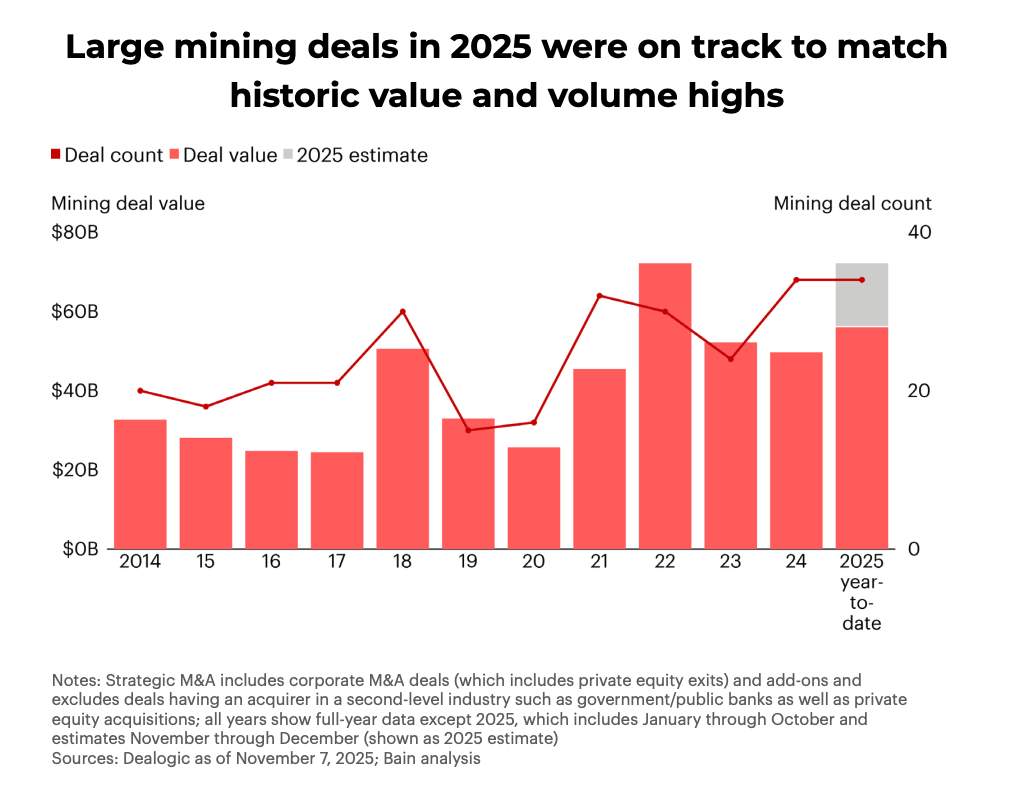
Mining companies are rushing into mergers and acquisitions (M&A) as a core growth strategy, a shift that is helping drive Canada’s deal market to its highest level in more than a decade, a Bain & Company report shows.

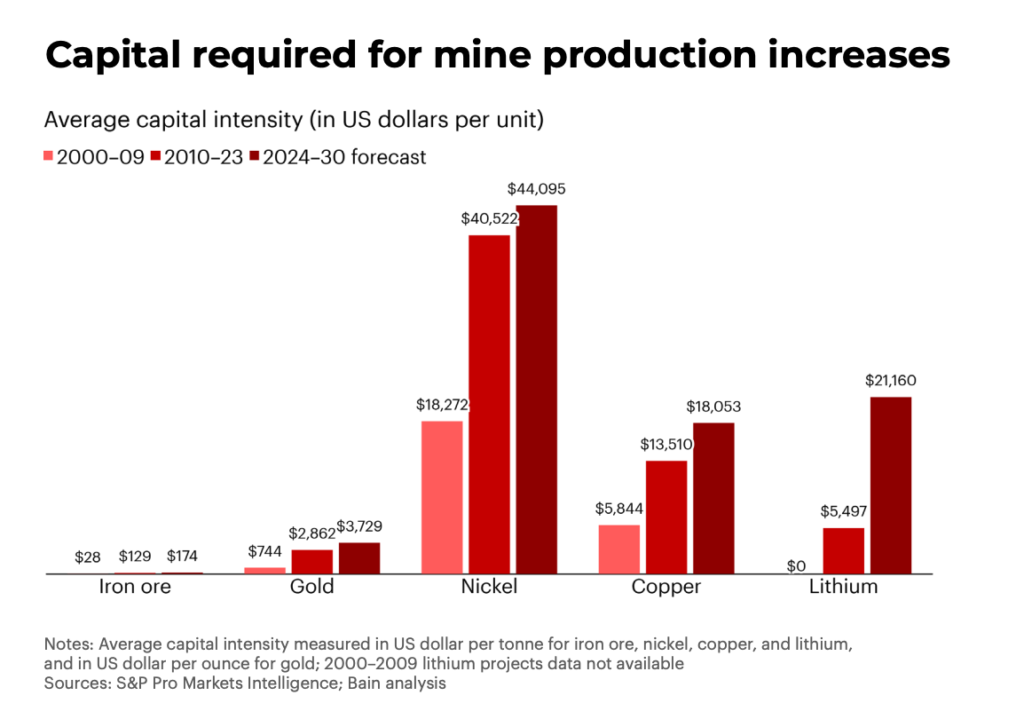
The shift reflects mounting pressure from rising capital costs, longer development timelines and intensifying competition for high-quality assets, which are the main forces reshaping how miners pursue growth and efficiency.

Bain estimates that global mining transactions valued above $500 million rose about 45% in 2025 compared with 2024, as companies looked to secure scale and resilience through acquisitions rather than greenfield development.

Recent large moves underscore the trend. Anglo American’s (LON: AAL) proposed merger with Teck (TSX: TECK.A TECK.B, NYSE: TECK), which values the Canadian miner at nearly $24 billion including debt, would create a combined entity with a market value of roughly $53 billion

Courtesy of Bain & Company’s 2026 Global M&A Report.

Bain says such transactions highlight how strategic M&A is becoming a critical tool for competitiveness and capital efficiency as the sector positions for a new commodity supercycle.

The next wave of mining dealmaking is expected to be larger, more complex and more decisive in determining long-term winners, the report finds.

Execution matters


While most large mining deals over the past decade have delivered neutral or positive shareholder outcomes, few have reached their full potential. Bain points to timing risk, peak-cycle valuations and execution challenges as the main constraints on value creation.

Successful examples show what is possible when execution is strong. Agnico Eagle’s $10.7 billion merger with Kirkland Lake Gold created the world’s second-largest gold producer, anchored in the Abitibi gold belt. The deal targeted between $800 million and $2 billion in synergies over five to 10 years, with only 15% to 20% tied to general and administrative costs and the bulk expected from operational and strategic integration.

Courtesy of Bain & Company’s 2026 Global M&A Report.

By the second quarter of 2022, Agnico reported early “quick-win” synergies and signalled it could exceed the $2 billion target. Subsequent milestones—including commissioning the Macassa mine’s No. 4 shaft in 2023 and record gold production and free cash flow in 2024—point to growing momentum, though Bain notes it is still early to fully assess outcomes.

Canada focus

Canada’s total M&A deal value rose 30% to $178 billion last year, outperforming the US on strategic transactions even as it lagged the 40% increase globally. Strategic M&A value jumped 57% year over year in Canada, compared with 54% growth south of the border.

Energy and natural resources led Canadian strategic dealmaking, with deal value rising 133% in 2025, while advanced manufacturing and services declined 21%. Strategic buyers accounted for $149 billion in total deal value, though the number of Canadian deals larger than $30 million increased just 8% from the prior year.

Beyond Canada, Bain highlights Evolution Mining (ASX: EVN) as an example of repeatable, strategic M&A done well. The company focuses on building regional, long-life operating hubs where adjacent assets and shared expertise compound value. Rather than relying on top-down cost cutting, Evolution emphasizes operating leverage —shared infrastructure, transferable mining methods and portfolio mix— to strengthen margins across cycles.

Looking ahead, dealmakers remain optimistic about 2026 but warn that macroeconomic and geopolitical uncertainty could still temper market momentum, particularly for capital-intensive sectors such as mining.

Anglo-Teck merger would create a ‘global minerals family’ HQ’d in Vancouver, CTO says


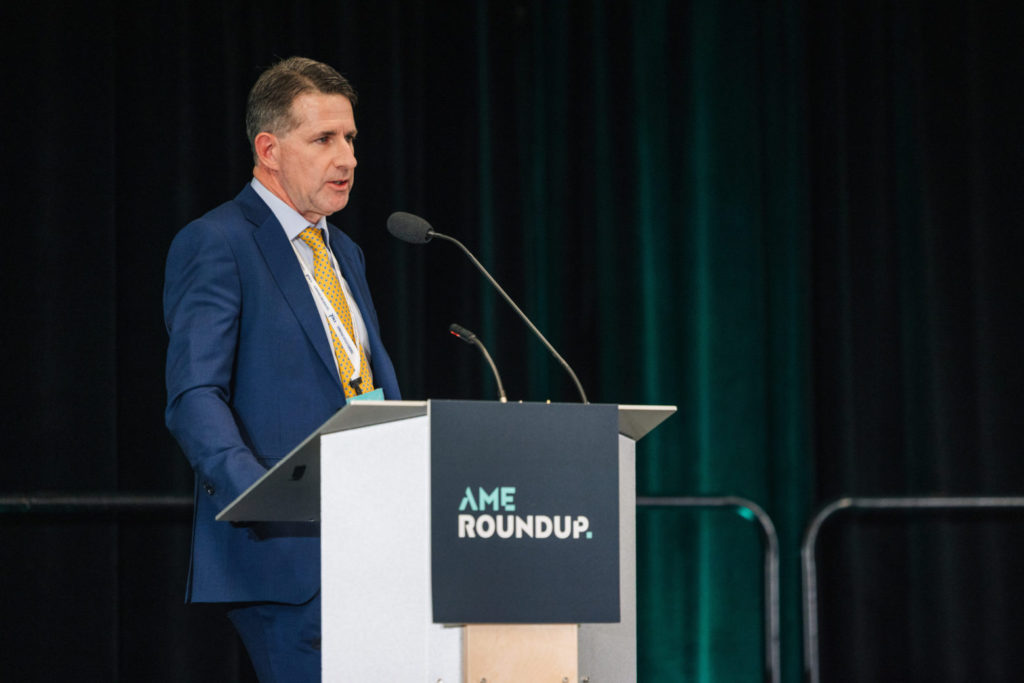
Anglo American’s chief technical officer Tom McCulley. Credit: AME.

Anglo American’s chief technical officer Tom McCulley used his first appearance at the Association for Mineral Exploration (AME) Roundup to deliver a clear message to the industry: the global energy transition will fail without faster, deeper and more innovative mineral discovery.

Speaking at the annual  conference in Vancouver on Monday, McCulley said the pace of global change – driven by electrification, artificial intelligence, population growth and geopolitical uncertainty – is accelerating demand for critical minerals at a time when supply is falling behind.

“The world needs more critical minerals, and it needs them faster, safer and more sustainably,” he told delegates, warning that declining ore grades, deeper and more complex deposits, rising capital costs and lengthening permitting timelines are tightening the supply outlook.

Copper, McCulley noted, illustrates the scale of the challenge. While developed economies have roughly 230 kilograms of installed copper per person, the global average is closer to 70 kilograms, he said. 

Closing that gap would require installed copper stocks to rise from about 500 million tonnes today to more than 2 billion tonnes in the coming decades, a figure likely to increase further with the expansion of data centres, electrification and grid infrastructure.

Against that backdrop, exploration remains the industry’s most critical lever, McCulley said. Anglo American’s approach, he noted, is built around scale, discipline and innovation, supported by an integrated discovery and geosciences team that combines global exploration, near-asset discovery and advanced geoscience capabilities.

McCulley highlighted several proprietary technologies that Anglo American is deploying to improve discovery success,  highlighting the Spectrum airborne system, which collects high-resolution electromagnetic, magnetic and radiometric data in a single pass; a highly sensitive ground-based magnetometer known as “low-temperature SQUID” used to detect metallic sulphides in complex geological settings; and AI-assisted core logging, which can reduce weeks of manual relogging work to a single day.

While technology is critical, he stressed that trust and community relationships ultimately determine whether discoveries become mines. Drawing on his experience at Anglo American’s Quellaveco copper mine in Peru, commissioned in 2022, he said early and sustained engagement with communities and government was essential to managing social and environmental risks – particularly water access in arid regions.

At Quellaveco, Anglo American worked with local communities to design water diversion and storage infrastructure that prioritised community needs, including a 60-million-cubic-metre dam largely dedicated to regional water supply.

 “The community feels this is their dam,” he said, describing the project as a model for future developments across the company’s global portfolio.

“This dam, known as the Vizcachas dam, we did this all because of open dialogue with the community. The majority of the water from that dam is for the community  – not the mine. The community not only worked with us, but helped us design – this is their dam.” 

Mega-merger with Teck

Turning to Canada, McCulley said the country is uniquely positioned to supply critical minerals for the energy transition, citing its geological endowment, regulatory framework and commitment to responsible mining. 

He pointed to the federal government’s 2025 budget, which earmarks more than $2 billion to enhance mining competitiveness and accelerate critical minerals investment.

Anglo American’s proposed $53-billion mega- merger with Teck Resources, announced last September, would create a global copper giant.

The Canadian government has approved the Anglo-Teck merger, clearing the way for the creation of one of the world’s largest copper producers as demand accelerates.

“We have a long history of partnerships…and this year’s theme: Materials for a changing world, couldn’t be more fitting for us at Anglo American, but us as an industry.”

“We announced the merger with Teck, to form ‘Anglo-Teck’. This will be a global minerals family – based right here in Vancouver,”  McCulley said. That’s something we all can be proud of.” 

As part of the strategy, the company plans to invest $300 million over five years in exploration and technology in Canada, establish a $100 million global institute for critical minerals research, and continue supporting the junior mining ecosystem, McCulley said.

“Discovery is about more than finding ore bodies,” he said. “It’s about creating enduring economic, environmental and social value for future generations.”


Bolivia’s lithium gamble tests US realignment in Latin America


Latin America is rich in copper, lithium, silver, and gold, among other valuable resources. ( AI-generated photo with background image by Dmitry Pichugin.)

Latin America is entering 2026 with resources at the centre of a fast-moving geopolitical realignment, underscored by the US capture of Venezuela’s Nicolás Maduro.

For years, political risks for miners and explorers operating in South America for the most part had to do with changes to tax regimes and royalties, interference with permitting processes, or local government and citizen opposition. Only in rare cases were there outright property seizures, production halts or blanket bans on activity (and when it happened is was usually not permanent). 

Now the stakes are higher and the politics global: Governments and investors are focused on who controls critical minerals, which capitals have Washington’s backing, and how far states will go to secure supply chains that underpin everything from electric vehicles to weapons systems.

In a new series, MINING.COM will track the forces reshaping the region’s markets, examining Latin America through a geopolitical lens, where mineral-rich frontiers increasingly resemble security zones, and markets react as much to shifting alliances as to domestic election results.

In our first installment, we dig deep into Bolivia’s mining past, present and future — a country whose vast mineral wealth and shifting political tides make it a bellwether for where the region could be headed next.


Bolivia to produce first lithium from Uyuni plant by 2025-end
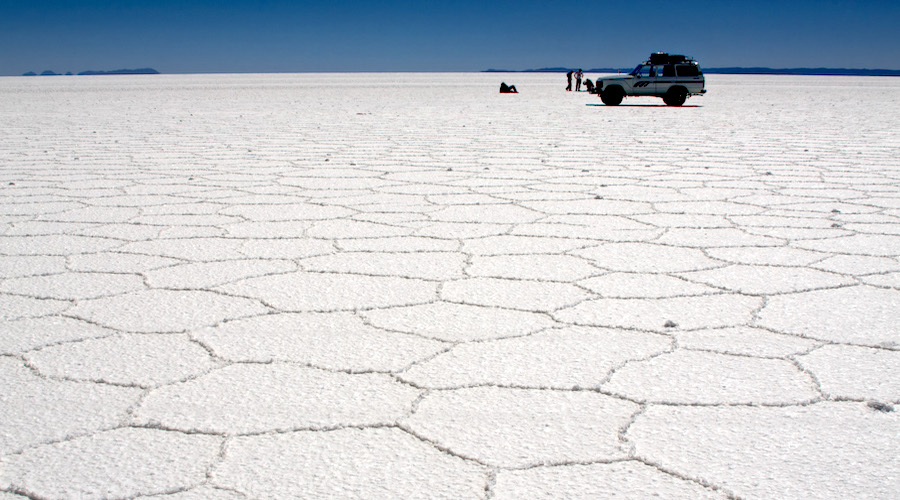
Stretching more than 4,050 sq. miles of the Altiplano, Uyuni is the world’s largest salt flat. (Image courtesy of Pedro Szekely | Flickr Commons.)

Bolivia’s political trajectory shifted in November 2025 when President Rodrigo Paz took office, signalling a turn toward closer ties with the US after two decades of Socialist rule.

Paz’s centre-right, pro-business government is betting that Bolivia’s vast but underdeveloped lithium resources can help stabilize an economy strained by inflation, fuel shortages and dwindling dollar reserves. A pro-US tilt, officials hope, will unlock development finance, draw much-needed technical expertise into the country and forge new multi-lateral partnerships.

But analysts warn that geopolitics alone will not overcome Bolivia’s long-standing execution and governance challenges. 

Mariano Machado, Americas Principal Analyst at Verisk Maplecroft, told MINING.COM that Bolivia’s lithium contracts are “contracted but contested” — investable for early-stage work, but not yet bankable for large-scale project finance.

“Congress, courts and public pressure can still re-price deals midstream,” Machado said, noting that lenders are therefore likely to insist on phased drawdowns, escrowed revenues, step-in rights and political risk insurance rather than relying on sovereign assurances.

That caution, he added, is well grounded. Chinese and Russian direct lithium extraction (DLE) agreements signed in 2023–2024 collapsed into congressional turmoil in July 2025 and were later halted by court order.

Meanwhile, the state-owned lithium company YLB’s first industrial plant, opened in late 2023, is reportedly operating well below capacity, reinforcing what Machado described as an “execution-and-governance discount” on Bolivia.

Dreams of lithium riches

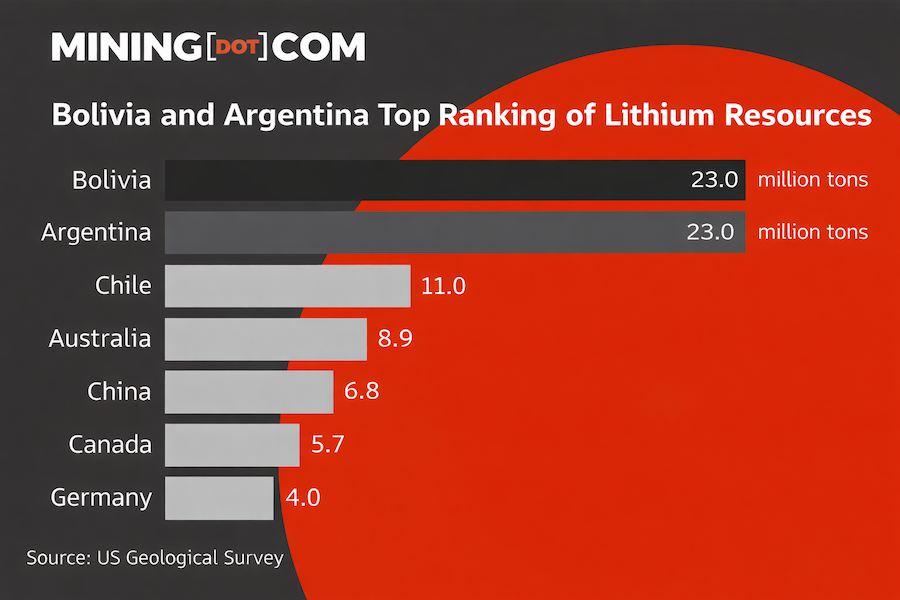
Bolivia holds some of the world’s largest lithium resources. According to the 2025 United States Geological Survey (USGS), the country has 23 million tonnes of identified lithium resources, about 20% of the global total — roughly double Chile’s.

The landlocked South American country has a history of shattered lithium dreams. It has tried and failed to develop its industry several times since the 1990s, producing only an accumulated 1,400 tonnes since 2018. 

The new government plans to open lithium projects to foreign capital, boost transparency around opaque contracts, certify resources through independent third parties and pursue broader economic reforms aimed at restoring investor confidence.

Analysts including Juan Ignacio Guzmán, CEO of Chile-based GEM Mining Consulting, warn that political promises alone are unlikely to shift sentiment without hard guarantees.

Guzmán told MINING.COM that investors will not commit capital without legal certainty, fiscal stability, and reliable mechanisms to resolve disputes, noting that international arbitration clauses are often a minimum requirement. 

Machado agreed, saying that while policy signals can improve sentiment, investment decisions ultimately depend on firm legal and fiscal foundations, including stable tax and royalty regimes, clear legislative authority, workable consultation and permitting processes, and credible dispute resolution—particularly given the risk of social unrest tied to Bolivia’s economic stabilization efforts.

“The moment fuel prices rise, and protests hit the streets is when governments test contract boundaries,” Machado said. He pointed to Paz’s emergency economic Decree 5503, which lasted less than a month from mid-December to early January before being replaced following nationwide protests after fuel prices jumped between 86% and 162%.

Several factors impede Bolivia’s ability to turn its vast lithium resources into bankable projects. High magnesium content, complex geology and costly logistics — including a more than 300-mile route to the nearest port — mean the US Geological Survey does not classify Bolivia’s resources as commercially viable.

Guzmán said the key technical barrier is the impurity profile. “The magnesium-to-lithium ratio in the case of Uyuni is around 20 to 1,” far higher than in Chile’s Salar de Atacama or Argentina’s Puna, “making extracting lithium from Bolivia much more expensive due to the necessary processing and more complex quality control required to achieve battery-grade lithium.”

YLB has recently moved to address that technical bottleneck on paper. On Jan. 23, it filed patent applications for a DLE process tailored to Uyuni’s high-magnesium brines, as well as an industrial design patent for a portable fast-charging lithium-ion charger. 

The filings build on a 2023 patent for high-purity lithium carbonate, but for investors and analysts they underline a familiar gap: Bolivia continues to generate intellectual property faster than it can translate it into reliable, bankable production.

Machado noted these challenges raise a larger strategic risk: timing. “The biggest risk is missing the lithium cycle,” he said. “Bolivia may win the politics but lose the timing.”

Uyuni’s high-magnesium brines, landlocked logistics and the need to prove extraction technologies —including DLE — at scale already stretch costs and timelines, he said. Combined with a volatile street environment and uneven state capacity, Bolivia risks arriving late to a market that increasingly penalizes delayed, high-friction entrants. By contrast, Argentina and Chile have spent years aligning their projects with investor and market expectations.

Markets remain skeptical. Federico Gay of Benchmark Mineral Intelligence said in a research note that even with regulatory improvements, Bolivia is unlikely to become a major producer before the end of the decade.

From a project finance perspective, Guzmán said existing agreements remain unbankable. “As long as the legal and social milestones that Bolivia require to assure investors that the investment will materialize into future cash flows are not in place, the contracts are not bankable,” he said. He added that deals with a Chinese consortium led by CBC and the uranium-linked agreement with One Group remain under international scrutiny amid political disputes and litigation risk.

Reform in motion

The government has moved to shore up its finances as it pushes for reform. La Paz has announced plans for a $3.1 billion loan from the Latin American Development Bank, and Economy Minister Marcelo Montenegro Aramayo has held talks with the International Monetary Fund, the Inter-American Development Bank and other multilateral lenders. Aramayo has declined to say how much support the US might provide.

Guzmán said US financing could help lower the cost of capital but flagged a key constraint: because major contracts are tied to Chinese and Russian partners, it is unlikely Washington would finance projects linked to those actors.

Verisk’s Machado said US support could still play a role if deployed carefully. A time-bound currency swap or other measures to ease near-term foreign exchange pressure and fuel shortages could help de-risk the macro environment without adding to sovereign stress, he said. But such support would not unlock lithium capital expenditure unless Bolivia pairs it with credible fiscal consolidation and an investable rulebook that attracts private capital through guarantees and political risk insurance.

The pivot marks a sharp break from the era of former president Evo Morales, who ruled from 2006 to 2019, expelled the US ambassador and counterdrug officials, nationalized the energy sector and maintained generous fuel subsidies. Those policies contributed to declining natural gas production, shrinking foreign exchange reserves and mounting fiscal pressure, while cheap fuel encouraged widespread smuggling to neighbouring countries.

Morales is now holed up in his rural Chapare stronghold to avoid arrest over allegations of statutory rape, which he denies. His successor, Luis Arce, was arrested in mid-December on corruption charges a month after handing over power to Paz; Arce also denies the allegations.

The new government has made reforming fuel subsidies a priority, aiming to stabilize supply and ensure subsidies reach small businesses and vulnerable groups rather than smugglers at the borders.

Beyond lithium, Bolivia hopes to revive its hydrocarbons sector, targeting an oil and gas bidding round in 2027. That plan hinges on passing a new hydrocarbons law and a separate lithium law this year to attract foreign investment.

Even if reforms advance quickly, Guzmán said Bolivia’s near-term impact on global lithium supply will remain limited. The country currently produces about 2,000 tonnes of lithium carbonate equivalent, he said. 

In a best-case scenario, output could rise to around 40,000 tonnes by 2030, which is still a small share of a market that is moving fast and leaving little room for late entrants.

The other gems in the crown

While lithium dominates the headlines, Bolivia’s near-term mining stability still comes from established silver and base-metal production.

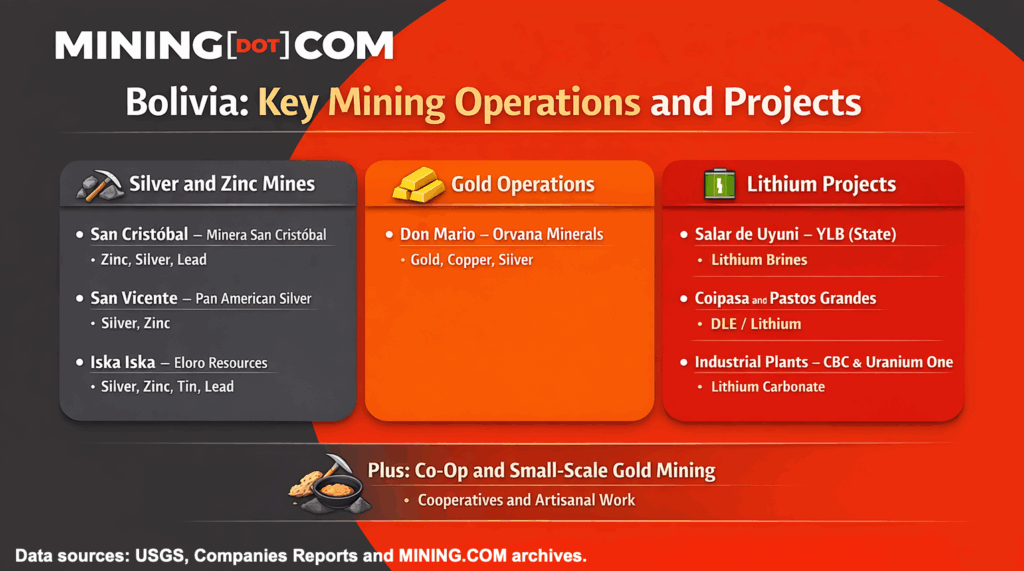
The country’s largest modern operation is San Cristóbal, a major open-pit mine producing zinc-silver-lead concentrates, operated by Minera San Cristóbal. The nation also hosts key silver operations such as San Bartolomé, run by Andean Precious Metals (TSX: APM), through its subsidiary Manquiri, focused primarily on silver.

Among the most important advanced-stage polymetallic projects is Iska Iska, led by Eloro Resources (TSX: ELO), with a resource story anchored in silver and zinc, alongside meaningful tin and lead exposure—one of the few large development-scale pipelines in the country outside lithium.

Gold, meanwhile, remains structurally important but highly fragmented. Beyond industrial-scale plans, a large share of Bolivian production comes from cooperatives and smaller-scale operations, which can be economically significant but bring a different mix of regulatory and social risks. 

Still, the country has seen activity around potential industrial continuity, including Orvana Minerals’ (TSX: ORV) Don Mario asset, associated with gold (with copper/silver credits depending on ore).

The country’s mining outlook is likely to remain a two-speed story: silver and zinc provide continuity and cash flow, while lithium represents the transformational prize— one that will depend on the new administration’s ability to align investment rules, partner selection and social license with the scale of the industrial challenge.