Thursday, February 05, 2026


Humidity-resistant hydrogen sensor can improve safety in large-scale clean energy


Chalmers University of Technology
Humidity-resistant hydrogen sensor can improve safety in large-scale clean energy 

image: 

Hydrogen plays an important role in society’s energy transition. For the technology to be used on a broad scale, effective hydrogen sensors are required to prevent the formation of flammable oxyhydrogen gas when hydrogen is mixed with air. Now, researchers at Chalmers University of Technology, Sweden, can present a compact sensor that can be manufactured on a large scale and is well suited to the humid environments where hydrogen is to be found. Unlike today’s sensors, the new sensor performs better the more humid it gets.

view more 

Credit: Chalmers University of Technology | Mia Halleröd Palmgren


Hydrogen plays an important role in society’s energy transition. For the technology to be used on a broad scale, effective hydrogen sensors are required to prevent the formation of flammable oxyhydrogen gas when hydrogen is mixed with air. Now, researchers at Chalmers University of Technology, Sweden, can present a compact sensor that can be manufactured on a large scale and is well suited to the humid environments where hydrogen is to be found. Unlike today’s sensors, the new sensor performs better the more humid it gets.
ImageChalmers University of Technology | Mia Halleröd Palmgren

Wherever hydrogen is present, safety sensors are required to detect leaks and prevent the formation of flammable oxyhydrogen gas when hydrogen is mixed with air. It is therefore a challenge that today’s sensors do not work optimally in humid environments – because where there is hydrogen, there is very often humidity. Now, researchers at Chalmers University of Technology, Sweden, are presenting a new sensor that is well suited to humid environments – and actually performs better the more humid it gets.

“The performance of a hydrogen gas sensor can vary dramatically from environment to environment, and humidity is an important factor. An issue today is that many sensors become slower or perform less effectively in humid environments. When we tested our new sensor concept, we discovered that the more we increased the humidity, the stronger the response to hydrogen became. It took us a while to really understand how this could be possible,“ says Chalmers doctoral student Athanasios Theodoridis, who is the lead author of the article in the journal ACS Sensors.

Hydrogen is an increasingly important energy carrier in the transport sector and is used as a raw material in the chemical industry or for green steel manufacturing. In addition to water being constantly present in ambient air, it is also formed when hydrogen reacts with oxygen to generate energy, for example in a fuel cell that can be used in hydrogen-powered vehicles and ships. Furthermore, fuel cells themselves require water to prevent the membranes that separate oxygen and hydrogen inside them from drying out.

Facilities where hydrogen is produced and stored are also constantly in contact with the surrounding air, where humidity varies greatly over time depending on temperature and weather conditions. Therefore, to ensure that the volatile hydrogen gas does not leak and create flammable oxyhydrogen, reliable humidity-tolerant sensors are needed here as well.

The sensor causes the humidity to ‘boil away’

The new humidity-tolerant hydrogen sensor from Chalmers fits on a fingertip and contains tiny particles – nanoparticles – of the metal platinum. The particles act as both catalysts and sensors at the same time. This means that the platinum accelerates the chemical reaction between hydrogen and oxygen from the air, which leads to heat development that causes the humidity, in the form of a film of water on the sensor surface, to ‘boil away’. The amount of hydrogen in the air determines how much of the water film boils away, and the moisture content in the air controls the thickness of the film. It is therefore possible to measure the concentration of hydrogen by measuring the thickness of the water film. And since the thickness of the water film increases as the air becomes more humid, the sensor’s efficiency increases at the same rate. The result of this process can be observed using an optical phenomenon called plasmons, where the platinum nanoparticles capture light and give them a distinct colour. When the concentration of hydrogen gas in the environment changes, the nanoparticles change colour, and at critical levels the sensor triggers an alarm.

At Chalmers, the development of plasmonic hydrogen gas sensors has been under way for many years. Professor Christoph Langhammer’s research team has made several major breakthroughs in the field in terms of sensor speed and sensitivity, as well as the ability to optimise sensor response and humidity resistance using AI. Previously, the group based its sensors on nanoparticles of the metal palladium, which absorbs hydrogen in much the same way as a sponge absorbs water. The new platinum-based concept, developed within the framework of the TechForH2 competence centre at Chalmers, has led to the creation of a new type of sensor – a “catalytic plasmonic hydrogen gas sensor” – which opens up new possibilities.

“We tested the sensor for over 140 hours of continuous exposure to humid air. The tests showed that it is stable at various given degrees of humidity and can reliably detect hydrogen gas in these conditions, which is important if it is to be used in real-world environments,” says Athanasios Theodoridis.

The energy transition is placing greater demands on sensors

According to the researchers’ measurements, the sensor detects hydrogen down to the ‘parts per million’ range: 30 ppm – that is, three thousandths of a per cent, making it one of the world’s most sensitive hydrogen gas sensors in humid environments.

“There is currently strong demand for sensors that perform well in humid environments. As hydrogen plays an increasingly important role in society, there are growing demands for sensors that are not only smaller and more flexible, but also capable of being manufactured on a large scale and at a lower cost. Our new sensor concept satisfies these requirements well,” says Christoph Langhammer, Professor of Physics at Chalmers and one of the founders of the sensor company Insplorion, where he now serves in an advisory capacity.

He also recognises that more than one type of material may be required for future hydrogen gas sensors to function in all types of environments.

“We expect to need to combine different types of active materials to create sensors that perform well regardless of the environment. We now know that certain materials provide speed and sensitivity, while others are better able to withstand humidity. We are now working to apply this knowledge going forward,” says Christoph Langhammer.


The new hydrogen sensor from Chalmers University of Technology, Sweden, is based on tiny particles of the metal platinum. The particles act as both catalysts and sensors at the same time, and the sensor is well suited to humid environments. It actually performs better the more humid it gets. (The platinum particles in this microscope image have been coloured.) 
Image: Chalmers University of Technology | Athanasios Theodoridis


More about the research:

The article A Catalytic-Plasmonic Pt Nanoparticle Sensor for Hydrogen Detection in High-Humidity Environments has been published in ACS Sensors. It was written by Athanasios Theodoridis, Carl Andersson, Sara Nilsson, Joachim Fritzsche and Christoph Langhammer. All researchers are or were employed in the Department of Physics at Chalmers University of Technology when the research was conducted.

The sensor was developed in Chalmers’ clean room (the Myfab nanofabrication laboratory) and Chalmers’ materials analysis laboratory (CMAL), under the umbrella of Chalmers’ Area of Advance Nano.

The research has been funded by the Swedish Foundation for Strategic Research, the Knut and Alice Wallenberg Foundation, Vinnova and the TechForH2 competence centre, hosted by Chalmers University of Technology. TechForH2 is supported by the Swedish Energy Agency, Volvo, Scania, Siemens Energy, GKN Aerospace, PowerCell, Oxeon, RISE, Stena Rederier AB, Johnsson Matthey and Insplorion.

Christoph Langhammer is one of the founders of Insplorion, a company that was started fifteen years ago via the Chalmers School of Entrepreneurship. Last year, the company launched its first hydrogen gas sensor based on nanoplasmonic technology.


The new hydrogen sensor from Chalmers University of Technology, Sweden, is based on tiny particles of the metal platinum. The particles act as both catalysts and sensors at the same time, and the sensor is well suited to humid environments. It actually performs better the more humid it gets. (The platinum particles in this microscope image have been coloured.)

Credit

Chalmers University of Technology | Athanasios Theodoridis

Hydrogen plays an important role in society’s energy transition. For the technology to be used on a broad scale, effective hydrogen sensors are required to prevent the formation of flammable oxyhydrogen gas when hydrogen is mixed with air. Now, researchers at Chalmers University of Technology, Sweden, can present a compact sensor that can be manufactured on a large scale and is well suited to the humid environments where hydrogen is to be found. Unlike today’s sensors, the new sensor performs better the more humid it gets.

Hydrogen plays an important role in society’s energy transition. For the technology to be used on a broad scale, effective hydrogen sensors are required to prevent the formation of flammable oxyhydrogen gas when hydrogen is mixed with air. Now, researchers at Chalmers University of Technology, Sweden, can present a compact sensor that can be manufactured on a large scale and is well suited to the humid environments where hydrogen is to be found. Unlike today’s sensors, the new sensor performs better the more humid it gets.

Credit

Chalmers University of Technology | Mia Halleröd Palmgren


The Strange, Drawn-Out Death of Scottish Labour?


In May Scotland goes to the polls to elect its devolved parliament, using the Additional Member System, where voters get a constituency vote and a regional party list vote to make the overall result more proportional. The prospects are not looking good for Labour, reports Mike Cowley.

According to January You Gov polls, only 32% of Scottish Labour voters intend to give the Party their constituency vote in May. The SLP is sitting on 15% for both Constituency and List votes. If these figures are accurate, the Party should “prepare for its worse result in either a Westminster or Holyrood election in 116 years.”

Notwithstanding You Gov hyperbole, there is no doubt that since manoeuvring to oust Richard Leonard from office with the backing, and indeed assistance, of the UK leadership, Anas Sarwar and Jackie Baillie have provided further evidence that the ‘grown-ups’ we were told held a monopoly insight into how to win elections are in danger of leaving the Party at the abyss. Keir Hardie’s vision of a ‘Sunshine of Socialism’ appears not to have dawned on those handed the responsibility of leading the Party he founded.

Recent internal polling reveals a widening disconnect between the UK and Scottish leaderships and the Party’s rank and file. 64% of members want to see the party “moving to the left.’” A clear majority support redistributive wealth taxes, as well as public ownership of key utilities. More importantly, the Fairness Foundation recently published polling showing that two-thirds of Britons hold the opinion that “the super-rich have too much influence over UK politics.”

Peter Mandelson’s exposure as a self-serving bagman for global capital at the heart of the Labour government is hardly likely to disabuse anyone of that view. Reform UK sit in second place behind the SNP. A deepening of public disaffection runs the risk of further emboldening the far right. May’s elections threaten to bring to a close the previously stubborn narrative of Scottish progressive exceptionalism. Rather than that part of the electorate supportive of redistributive politics opting for the Green Party (who sit on 9% (Constituency) and 12% (List) votes respectively), many appear to have opted for a politics of nihilism depicted in Richard Seymour’s Disaster Nationalism.    

Many Scottish CLPs fail to achieve quorate meetings, unable to table, discuss or vote on motions. My own experience is of CLP officers detached from either the causes or the implications of Reform’s advances. Despite Anas Sarwar’s strategic and limited distancing from the UK party on key issues like Gaza or support for trade union disputes, many activists have downed tools, refusing to work for candidates not explicitly committed to the socialist case. 

More positively, Scottish Labour Campaign for Socialism (CfS) has, despite a landscape unforgiving of socialist organisation, achieved significant progress in recent months.

In February, we relaunch our quarterly journal, the Citizen. Late last year, we published Choose to Fight! a pamphlet restating the case for socialist intervention in the Labour Party. Our Young Socialists group is active, energised and creatively reimagining left political activism.

CfS has drawn up broad criteria for endorsing prospective Holyrood candidates. We look forward to comradely discussions in the coming weeks with prospective MSPs looking to align themselves with the Scottish Labour left. The loss of Mercedes Villalba, Alex Rowley and Richard Leonard will be keenly felt. Each of these comrades can look back on political records to be proud of. Katy Clark, Carol Mochan, Simon Watson, and, we hope, others, will represent the socialist case after May. Their presence will be all the more critical in reviving the party where racists have a platform in Scotland’s devolved parliament.  

A post-May leadership election is increasingly likely. The SLP left is open to working alongside anyone who recognises the existential crisis the Party faces. The stakes are too high to forego alliances rooted in basic principle. CfS stands ready to talk with leadership candidates committed to Party democracy and redistributive principles in line with the Scottish TUC’s recent paper on wealth taxes.

Mike Cowleyi s Co-convenor of Campaign for Socialism and EIS-FELA National Executive Committee (personal capacity).

UK

Is it too late for Your Party?


FEBUARY 5, 2026

Mike Phipps reviews Your Party: The Return of the Left, edited by Oliver Eagleton, published by Verso.

Whatever you think of the Starmer Government’s record so far – and some might argue that Oliver Eagleton’s assessment in the introduction to his collection of interviews is a bit one-sided – the fact that last July 850,000 people expressed an interest in a new party to the left of Labour shows the huge potential for such a project.

Six months later fewer than a tenth of that number have actually signed up. It underlines the utter mess that the main personalities involved have made of the whole enterprise.

Eagleton hopes that the various contributions here will transcend “factionalism and infighting”; but it could just as well entrench them. The book was compiled before Your Party’s founding conference, the first day of which was boycotted by Zarah Sultana MP in response to individuals being barred from the room by security guards – apparently on the instruction of leading figures in the Jeremy Corbyn camp, although seemingly without his foreknowledge – because they were members of other groups.

This was a new nadir, on top of the very public slanging match between the two camps which saw nasty briefings to right wing media outlets from Corbyn’s team about Sultana followed by her retort that they were part of a “sexist boys’ club.”

On that basis, the real problem with this book might be that it is already out of date, superseded by yet more infighting, which the vast majority of its potential supporters find alienating and destructive.

The Sultana view

The problem is underlined by Eagleton’s first interview, with Sultana herself, who quit Labour last July to announce she was co-founding a new party with now-independent MP Jeremy Corbyn, although the latter appeared surprised by this and posted coolly a day later only that “discussions are ongoing”.

In her interview, Sultana says: “we have to hold on to the strengths of Corbynism – its energy, mass appeal and bold policy platform – and we also have to recognise its limitations.” These are then itemised in some detail over the next twenty lines: “it capitulated” on antisemitism, “triangulated” on Brexit, “abandoned” mandatory reselection of MPs, “didn’t make a real effort” to gets its members into the labour movement; it was “too conciliatory”, “dysfunctional”, “centralised”.

Quite a charge sheet! It’s clear from Sultana’s answers here that behind the organisational disagreements over when and how to launch the new party, there lie more significant political differences. She favours a more member-led organisation and is unimpressed by the all-male Independent Alliance MPs that the Corbyn wing installed at the helm of the new organisation, two of whom have now stepped away from the project. These MPs may hold principled positions on Gaza, which was central to their election to Parliament in 2024, but are less clearly socialist on issues such as education, housing and personal rights, to name a few areas of controversy.

Sultana also wants a more programmatic organisation than Jeremy Corbyn perhaps envisages, one that is consciously anti-Zionist and economically intransigent, captured in her response in interview that we should nationalise the economy.

Sultana’s ideological stance drew a lot of support from the many centralist left groups operating around Your Party, which the Corbyn wing sought to exclude at the founding conference on account of their divided loyalties. Now part of her voting base, Sultana championed their right to be inside the tent and appeared to have won. Yet the battle seems to be ongoing, with a recent attempt by the Corbyn apparatus to exclude several such individuals from running for the leadership body of Your Party being denounced by Sultana as a “witch-hunt.”

One former member of Your Party went further: “It’s as if the conference votes never happened. Exclusions of members of left groups still stand, and candidates for the Central Executive Committee have been barred if they are suspected of paying subs to another organisation.”

Long before these conflicts surfaced, Zarah Sultana was facing public factional attacks from some of the more divisive figures around Jeremy Corbyn, including anonymous briefings to the Murdoch press, “the very same people who tried to destroy Jeremy’s reputation.” Despite Sultana calling them out, these unattributable briefings have continued into 2026.

Other contributors

Eagleton’s interview with James Schneider reprises many of the themes in the latter’s Our Bloc. Schneider identifies the key sociological constituencies a new party needs to hegemonize and give political agency to – “the asset-poor working class, downwardly mobile graduates and racialised communities.” His approach repudiates the idea of perfect programmes and favours real steps forward in the mass movement. The problem is that, while this is something that a Corbyn-led Labour Party might have – should have – striven for, it’s much more difficult for a new, less known, smaller group to achieve. In Our BlocSchneider seemed to reject the idea that Labour could never be the vehicle for such a strategy: here the possibility of pursuing it independently of Labour – and the mass organisations affiliated to it – seems a bit unlikely.

Andrew Murray favours a more traditionally-defined working class party, based on the Marxist concept of a class that sells its labour power. But he dismisses the possibility, in the short term, of existing trade unions having a formal relationship with the new party, or even bringing together party members in a given union to pursue a common line. Yet, that being so, the unions will continue to see Labour as their political expression, and Labour’s ties to the unions are likely to go unchallenged.

That seems odd, given that Murray favours a party co-led by both Jeremy Corbyn and Zarah Sultana. The latter recently said: “The Labour Party is dead. It has destroyed its principles and its popularity. Some Labour MPs who consider themselves on the left are still clinging to its corpse.” Shouldn’t the unions be prised away from this corpse – or is this assessment simply premature?

Eagleton interviews Leanne Mohamad, who came within 500 votes of unseating Labour’s Wes Streeting MP in Ilford North, demonstrating the potential of a challenge to the left of Labour when the process is democratic, inclusive and united. Mohamad emerged as the candidate after an open selection process involving hundreds of activists, which laid the basis for an inspiring mass campaign. The challenge, she admits here, is to keep communities united and maintain the momentum beyond the electoral cycle.

Alex Nunns focuses more on Jeremy Corbyn’s leadership of the Labour Party, a subject about which he has written extensively. Avoiding simplistic narratives, he is keen to emphasise that Corbyn’s forces “didn’t surrender: they lost.”

He goes on: “I don’t think we should console ourselves with a false history that says that if only Corbyn had been more combative then things would have turned out well.” In particular, the fudge – some wrongly claim ‘betrayal’ – over Brexit in 2019 reflected a genuine difference in strategy within the Corbyn camp and was not the result, as Eagleton appears to believe, of a buckling to establishment pressure. We might add that it is a failure to see these developments clearly that has resulted in so few correct lessons being drawn from this rich experience – which might help explain the ongoing bunker mentality hampering the new project.

The last interview is with Andrew Feinstein, who ran against Keir Starmer in his London seat  in 2024’s general election and came second. It was Feinstein who proposed the motion last July to invite Zarah Sultana to leave Labour and join the new party as an “interim co-leader” with Jeremy Corbyn at an online meeting where Corbyn and his team, who opposed it, refused to vote on the grounds that the meeting did not have the constitutional power to make such a decision. The victory claimed by Feinstein’s group led to Sultana’s public declaration of a new party and her claim to joint leadership on the same evening. His focus here is on how his experience in South African politics informs his approach to community organising in London.

Shedding socialists

What’s missing from this collection is the view of Jeremy Corbyn MP himself. Corbyn was invited to participate “but it was not possible.” One wonders why.

There are other leading figures who are not included here. Alongside Andrew Feinstein, former Labour MP Beth Winter and Jamie Driscoll, the highly respected former Mayor of North Tyne, have said they are “exasperated” with the way the internal dispute has developed. Jamie Driscoll, who said Your Party did not meet the high standards he believed were necessary for public life, subsequently abandoned the project and  joined the Greens.

He told The House magazine: “I’m not a member of Your Party, and won’t be joining. I do feel sorry for their members, though, who joined on a prospectus of a new kind of politics, only to find people at the centre repeatedly issuing anonymous briefings that damage Your Party. You’ve really got to ask why their political leadership is allowing this to happen.”

Mish Rahman is another activist who has had enough of the factional paralysis. This year he gave up the fight within Your Party for a member-led organisation and joined the Greens. Referring this week to the “different sects” in Your Party, he said: “I’ve come to the realisation that they never might overcome the battle of the £1 newspapers before taking on the real challenges this country faces.”

Shedding such leading socialists constitutes a major loss of momentum which should ring alarm bells. Furthermore, if the Labour Party is now as degenerated as Oliver Eagleton believes it is, with its authoritarian suspension of backbench MPs and blocking of councillors seeking re-election, one might have expected many more of its representatives to come over to Your Party. In reality, those leaving Labour seem increasingly to be bypassing this proposition, many preferring the Greens, whose public profile seems to be unencumbered by the factional “antics” (Tariq Ali’s words) that have marred the launch of Your Party.

A left revival within Labour?

The fact is there may be life in the Labour Party yet. Jeremy Gilbert, Professor of Cultural and Political Theory at the University of East London, has written and broadcast extensively on the Labour Party. Here is his view:

“What one has to understand about an organisation like the Labour Party is that it is not one thing, with one identity or one locus of power and intention. It’s not an ideological membership-based party, as are most European political parties. It’s a vast, federated organisation the component parts of which include all of the largest trade unions in the country, 650 local constituency parties various affiliated societies and organisations, as well as the parliamentary leadership and local elected legislators. Within that federation, there are several very distinct ideological tendencies that have coexisted, while competing for control of the organisation, for decades.”

Is Labour irrevocably committed to a right wing agenda, whereby even if Starmer is forced to quit, he would inevitably be replaced by a leader with the same politics? For Gilbert, the answer is determined by an understanding of where the real power lies in the Labour Party. “In effect, the leadership of the three major trade unions decide the fate of the party and its leadership, partly through their control of delegations to the party’s National Executive Committee, but also because they have a capacity to contact and organise party members and their own members which is on a different scale to that of any other organisation or institution, inside or outside the labour movement. It was the unions who let Corbynism happen, and who have allowed Starmer’s faction to run the party for the past few years… If the union leaderships turn against Starmer and his right-wing faction, then there is a reasonable chance that something like Corbynism could happen again.”

Keir Starmer, it should be noted, needed the votes of affiliated trade union delegates to block Andy Burnham’s return to Parliament at Labour’s NEC last month. This battle, reaching right into the Cabinet, reflects a Party in turmoil. Despite the short-term victory for the leadership faction on this, Labour’s continued poor electoral performance can only increase levels of internal dissent against the line of the Starmer leadership.

These ongoing conflicts make it difficult to declare Labour definitively dead. Of course, it’s not beyond the bounds of possibility that a new party could establish itself and quickly attract mass support. UK politics has entered an unprecedently volatile phase, with Labour haemorrhaging votes and relatively new organisations gaining support. But even without the unnecessary and destructive factional warfare between the two leading camps of Your Party, the prospects for success would not be high. The strengths of both Corbyn and Sultana were as left wing champions of a broader mass movement; isolated from that, their individual weaknesses are far more exposed.

Long before Your Party, there was Arthur Scargill’s Socialist Labour Party, a particularly bureaucratic outfit which died under the weight of its own control-freakery. This sect seems to have been the formative organisation of Your Party Returning Officer Andrew Jordan, who has recently ruled several candidates ineligible for election to the leadership of Your Party. Then there was the Socialist Alliance and George Galloway’s Workers Party, neither of which made the promised breakthrough.

Over thirty years ago, Mike Marqusee identified the central difficulty facing all such formations in the UK context: “The chimera of an ’independent’ socialist party, to the left of Labour but somehow different from the democratic centralist sects, is resurrected every few years only to die an obscure death after a few more. Without a mass base in the working class, which in this society can only mean a base in the organised workforce, such an ’independent’ left party can only be a propaganda party – a talking shop which, in the absence of the discipline imposed by a mass base, will rapidly be torn apart by sectarianism, egotism and triviality.”

More questions than answers

For Your Party not to go down this road – and some might say it already has – it will have to set aside the personality clashes and face up to some big existential questions. What is its programme? Will it be ideologically clearcut or a broad church? Who is it going to represent? What is its relationship the existing organisations of the working class, in particular the trade unions? What is its electoral strategy? How will it relate to parties, like the Greens, who are trying to occupy the same space? And how will it relate socialists in the Labour Party, who, in Sultana’s view, are “clinging to its corpse”?

The fact is that many on the left who are not members of the new party want it to do well, if only to put greater pressure on the Labour Government from the left. Labour’s Director of Policy under Jeremy Corbyn’s leadership Andrew Fisher recently endorsed this approach. Many hoped the enthusiasm and energy of its grassroots members would thrust to the margins the posturing of the nascent bureaucracies emerging at the top of the project. As the weeks go by, even paid up members think this is looking increasingly unlikely.

Your Party could have made headlines with an inspiring socialist campaign in the upcoming Gorton and Denton byelection. Instead, it won’t even be fielding a candidate, because it’s has to elect its governing Central Executive Committee first. As one commentator noted, “The party cannot participate in an actual election because it is too busy electing itself.”

If Your Party fails because of these very avoidable and largely self-inflicted blows, it won’t just be an indictment on the inability of the left to come together and work collectively. It will be a betrayal of the hopes of millions of people who were willing to vote for popular socialist policies in 2017 and 2019 and who are hungry for the real change promised by Labour in 2024, but far from delivered.

Mike Phipps’ book Don’t Stop Thinking About Tomorrow: The Labour Party after Jeremy Corbyn (OR Books, 2022) can be ordered here.

Former UK PM Liz Truss roasted after welcoming the ‘financial collapse’ of the UN

2 February, 2026


'You’re a big fan of financial collapses aren’t you'


Former Tory Prime Minister Liz Truss is being brutally mocked after she welcomed news that the United Nations (UN) was in financial trouble.

It comes after the Secretary General of the UN, António Guterres, warned that the United Nations is at risk of “imminent financial collapse” due to member states not paying their fees.

He warned that the UN faced a financial crisis which was “deepening, threatening programme delivery”, and that money could run out by July.

The problem has been compounded by the fact that under Trump, the US has refused to contribute to its regular and peacekeeping budgets, and withdrawn from several agencies it called a “waste of taxpayer dollars”.

Reacting to the news, Truss posted on X: “Excellent”.

However, given the role Truss played in ruining Britain’s finances following her disastrous mini-budget that resulted in her being booted out of office after just 49 days, social media users were quick to point out the irony.

One wrote: “You’re a big fan of financial collapses aren’t you”, while another added: “Liz loves a good imminent financial collapse. Nostalgia.”

Basit Mahmood is editor of Left Foot Forward


Canada’s Pivot is a Warning to the US and the Entire Alliance System


February 5, 2026

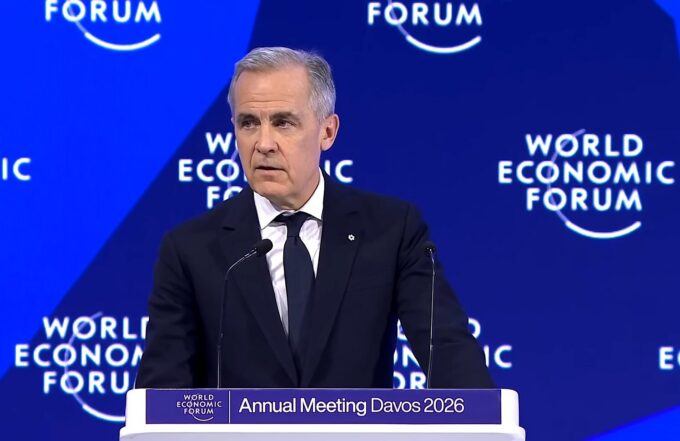
Photograph Source: World Economic Forum – CC BY 4.0

Canadian Prime Minister Mark Carney’s speech at the World Economic Forum on January 20 was not an exercise in pique. It was the clearest articulation yet of a strategic shift that has profound implications—not just for U.S.-Canada relations, but for the entire structure of American alliances worldwide.

Carney told the Davos audience that “the old order is not coming back” and that the rules-based international system was always “partially false.” The strongest exempted themselves when convenient, trade rules were enforced asymmetrically, and Canada “placed the sign in the window” while avoiding the gaps between rhetoric and reality. That bargain, he declared, no longer works. Canada is now building what Carney called “strategic autonomy”—the capacity to feed itself, fuel itself, and defend itself without depending on the United States.

The speech codified what six months of frenetic diplomacy had already demonstrated. Since taking office, Carney has signed 12 trade and security agreements across four continents. Canada has joined the European Union’s €150 billion Security Action for Europe (SAFE) defense procurement program; the first non-European nation admitted. Recently, Carney announced a strategic partnership with Xi Jinping and opened Canadian markets to Chinese electric vehicles. Ottawa has committed to the largest military spending increase since World War II, deliberately structured to reduce reliance on American defense contractors.

This matters beyond North America because Canada was, until recently, the test case for deep integration with the United States. More than 75 percent of Canadian exports went south. Supply chains, especially in automotive and energy, were seamlessly continental. Defense was jointly managed through NORAD. If any country had conclusively answered the question of whether binding one’s self to American hegemony was safe, it was Canada.

The answer, Ottawa has now concluded, is no. And that conclusion is being watched carefully in Brussels, Tokyo, Canberra, and Seoul.

The proximate cause is the Trump administration’s tariffs, threats to abandon the U.S.-Mexico-Canada Agreement, and repeated suggestions that Canada should become the fifty-first U.S. state. But Carney’s Davos speech made clear that the problem runs deeper than one administration. The issue is structural: American policy now swings so dramatically between presidencies that commitments made by one administration cannot be trusted to survive the next. For allies making decade-long investments in defense procurement, energy infrastructure, or trade relationships, this volatility is intolerable.

Carney borrowed a framework from Finnish President Alexander Stubb: “values-based realism.” Canada will remain committed to sovereignty, human rights, and international law in principle. However, Canada will be pragmatic about working with partners who do not share those values. This explains the China pivot. Beijing is not a trustworthy partner, and Canadians know this better than most after the arbitrary detention of the two Michaels—Michael Spavor and Michael Kovrig—in 2018 (and released in 2021). But China is predictable in ways that Washington no longer is. As Carney noted in Beijing, the relationship with China is now “more predictable” than the one with the United States.

That statement should alarm policymakers in Washington far more than any tariff retaliation. When allies begin describing authoritarian rivals as more reliable than the United States, something fundamental has broken.

The Canadian pivot also reveals the limits of geographical determinism. American analysts have long assumed that Canada has no real alternatives; that proximity and integration lock Ottawa into the U.S. orbit regardless of policy. Carney is testing that assumption. The Trans Mountain pipeline now ships Canadian oil to Asia. LNG terminals are under construction for Pacific exports. The EU defense partnership opens European procurement to Canadian manufacturers.

Canada cannot replace American trade overnight, but it can build sufficient alternatives to survive without it. That is precisely what Carney has pledged: doubling non-U.S. exports within 10 years.

For other U.S. allies, the lesson is clear. If Canada, the most integrated, most proximate, most culturally similar American ally, has concluded that dependence on Washington is too risky, then no alliance is safe from reassessment. The Europeans are already drawing similar conclusions. The EU’s Mercosur deal and accelerated talks with Japan and South Korea reflect the same diversification logic. Even Australia, historically the most reliable U.S. partner in the Indo-Pacific, is quietly exploring options.

None of this necessarily serves those allies’ long-term interests. China is not a benign alternative to American hegemony. The middle-power coalitions Carney envisions may lack the capacity to provide genuine security. And the economic costs of unwinding continental integration will be substantial. Canada’s gamble may yet prove to be a mistake.

But that is not the point. America’s closest ally has made a rational decision, based on observed evidence, that the United States can no longer be trusted, and is acting accordingly. Other allies are making similar calculations. The network of relationships that has amplified American power since 1945 is fraying, and American policy is what’s fraying it.

Carney closed his Davos speech with a line that deserves attention beyond Ottawa: “Nostalgia is not a strategy.” For those in Washington who assume the old alliances will endure regardless of how allies are treated, the warning applies with equal force. The old order really is not coming back. The question is what replaces it, and whether the United States will have any role in building it.

This first appeared on FPIF.

Reza Hasmath is a professor of political science at the University of Alberta and was the 2025 Fulbright Research Chair in Public Diplomacy at the University of Southern California.