Monday, March 03, 2025

The Trump Gaza AI Video Gives Us a Free Vacation in the Twilight Zone
February 28, 2025
Source: Originally published by Z. Feel free to share widely.

Screengrab from Trump's Gaza AI video via AlJazeera


The dialectic that struggles in my brain pits two terrible things against one another – I sometimes think that Trump’s fascist coup has been an example of the chickens coming home to roost. The US – the fount that always destroys, plunders, extracts, exploits and tosses bombs (nuclear and “conventional”) on civilians across the face of the planet – has come to its predetermined fate. Trump is America, and America is Trump – “he alone” has not perfected cold hearted, transactional violence, he has merely become the face of the monster that has been there all along. Caitlin Johnstone argues that Trump is a mere distraction – the evil resides in the capitalist, colonial soul of historical America. We subtract Trump, in Johnstone’s view, and nothing changes. Johnstone – the Australian Journalist – offers US citizens a darkly rational view of ourselves.

On the other hand, I often feel that analytical, objective reasoning cannot capture the essential absurdity that has often evaded our pureed, confounded and injured minds. To engage in rational observations about American neofascism seems to be an act of self -deception. Trump comes from The Twilight Zone, or, he is a bad mushroom trip twisting the frayed neurons of hundreds of millions of us – we have been reduced to laboratory rats in a study of neurotoxicity.

I tend to gently list toward the mushroom/Twilight Zone theory of Trumpian fascism. The human brain has limits – if shit gets too weird we waste our time on reason. Perhaps the great Irish writer, Samuel Beckett, can explain human folly better than I can – in his novel Molloy, his narrator details a preposterously involved mathematical system designed to assure that his “sucking stones” (gathered pebbles that he holds in his mouth) be arranged in such a way that his collection of sixteen pebbles be sucked in an exact sequential order:

“There was something more than a principle I abandoned, when I abandoned the equal distribution, it was a bodily need. But to suck the stones in the way I have described, not haphazard, but with method, was also I think a bodily need. Here then were two incompatible bodily needs, at loggerheads. Such things happen. But deep down I didn’t give a tinker’s curse about being off my balance, dragged to the right hand and the left, backwards and forewards. And deep down it was all the same to me whether I sucked a different stone each time or always the same stone, until the end of time. For they all tasted exactly the same. And if I had collected sixteen, it was not in order to ballast myself in such and such a way, or to suck them turn about, but simply to have a little store, so as never to be without. But deep down I didn’t give a fiddler’s curse about being without, when they were all gone they would be all gone, I wouldn’t be any the worse off, or hardly any. And the solution to which I rallied in the end was to throw away all the stones but one, which I kept now in one pocket, now in another, and which of course I soon lost, or threw away, or gave away, or swallowed …”

In Beckett’s world, rational, analytic thinking does not obscure the deeper truth of existential absurdity, it is the absurdity. In our black hole of chaos, we cannot understand Trump with “sucking stone” reasoning. The pundits and political scientists can’t go below the surface – we can only look at Trump in the spirit of jaw dropped astonishment.

We have been dragged along to a point in time in which physical reality may no longer be relevant. Consider the Trump Gaza AI video. This will ultimately be viewed more times than the population of the planet. If you can find a piece of video somewhere, more ridiculous, ominously sinister, bat-shit warped, and beyond the pale, please send it along.

If even one person hasn’t seen it, I link it here. On the literal surface of things, it shows bombed out Gaza morphing into an ostentatious resort with Trump and Elon Musk gyrating to a catchy beat under showers of floating dollar bills. We see gold statues of Trump, a close up of Musk eating, Trump and Netanyahu reclining on beach chairs, belly dancers with beards and a panorama of sparkling ocean and yachts. But we have a still weirder subtext – evil has become entwined with comic nonsense, we have crossed the threshold into something morally unrecognizable. This isn’t just bad taste, but the alternative, parallel reality of some lost corner of the multiverse. Nazism never evolved to a point of moral refinement in which piles of corpses inspired choruses of Beer Barrel Polka.

The Nazis saw genocide as shameful, and once all hope of a military victory had vanished, they busily destroyed the evidence – burnt the corpses, the mass graves, and plowed the land over. Death camps became fields of grain. No Nazi ever imagined that Treblinka would be a nice spot for golf courses, restaurants and hotels. Trump Gaza transforms genocide into glitzy shlock. We have been inducted into a new reality that lays waste to our ability to comprehend.

My vain hope is that Trump Gaza will illuminate the moment in a way that our rational minds never dreamt possible. The public comments on YouTube videos are relentlessly hostile.

My favorite says quite simply: “What a terrible time to have eyes.”


Phil Wilson writes the blog Nobody’s Voice.


ZNetwork is funded solely through the generosity of its readers.  Donate


Phil Wilson is a retired mental health worker and union member. His writing has been published in ZNetwork.org, Current Affairs, Counterpunch, Resilience, Mother Pelican, Common Dreams, The Hampshire Gazette, The Common Ground Review, The Future Fire and other publications. Phil's writings are posted regularly at Nobody's Voice (https://philmeow.substack.com/).
How Capitalism Pillages the Planet and Creates Chaos – Patrick Bond


February 27, 2025
Source: The Analysis.News


Following decades of ongoing mineral extraction, environmental plunder, and the subsidization of the fossil fuel industry, the second Trump administration’s aggressive pro-drilling agenda unapologetically seeks to seize as many foreign and domestic minerals and dirty energy sources as possible. Patrick Bond, political economist and Director of the Centre for Social Change in Johannesburg, discusses the mix of neoliberalism and paleo-conservatism undergirding Elon Musk’s corporate takeover of the US government. Bond also discusses the motivation behind US Secretary of State Marco Rubio’s decision to skip the solidarity-equality-sustainability G20 in South Africa, and the implications of the US’ withdrawal from international climate agreements, slashing of emissions-reduction goals, and support for destructive carbon-intensive industries.

A People’s History, Retold in Graphics
March 1, 2025


Roxanne Dunbar-Ortiz’s an AN Indigenous Peoples’ History of the United States was first released in 2015 as part of Beacon Press’s Revisioning History series. Other books in the series include the histories of queer and disabled people.

From the beginning, Dunbar-Ortiz’s book met with broad approval from the political left. Prominent radicals like Bill Ayers and Robin D. G. Kelley praised it.

At Counterpunch the late Louis Proyect stated the title “will be of great value to those first learning about the Indigenous perspective,” and that the publisher should “be commended for initiating the Revisioning Series and especially for publishing this stirring counter-history for a country that Karl Marx must have been envisioning when he wrote that ‘capital comes dripping from head to foot, from every pore, with blood and dirt.’”

Not everyone was so appreciative. An anonymous reviewer for Kirkus took umbrage with Ortiz’s use of “ideological” language. They thought it unfair for her to write that “indigenous peoples were overwhelmed by a ‘colonialist settler-state’ the very language broadly applied to Israelis vis-à-vis the Palestinians today.”

Doubtless any member of Moms for Liberty or any other group looking to whitewash history would have similarly negative reactions. The celluloid Indian-killer John Wayne also could fit in that category considering he said: “I don’t feel we did wrong in taking this great country away from the Indians. Our so-called stealing of this country from them was just a matter of survival.”

Surprisingly, the reviewer did not also take issue with Dunbar-Ortiz’s description of the policies of Andrew Jackson as auguring a “final solution” for the Indigenous people. Heaven help us if writers are no longer expected to call things what they are! She uses similar language because the situations are similar.


Roxanne Dunbar-Ortiz


The Comics Adaptation

Paul Peart-Smith, a comics artist with a background at U.K. comics mainstay 2000 AD, has adapted An Indigenous Peoples History of the United States to comics form, with the help of editor Paul Buhle, himself no stranger to nonfiction comics.

Buhle and Peart-Smith previously collaborated on last year’s comic adaptation of Souls of Black Folk by W.E.B. Du Bois, published by Rutgers University Press. The same craft and attention that went into that volume can be found here.

The book begins in media res at the 1973 Wounded Knee Occupation when the American Indian Movement occupied the site of an 1890 massacre of 120 Lakota by U.S. Cavalry. The Occupation meant to draw attention to the repeated violations of treaties between the U.S. government and Native tribes.

Beginning the story at this point has important symbolic value, as Peart-Smith knows. The 1973 Occupation birthed a new era of indigenous activism and opened a space for historians and scholars to think more critically about the conquest of the Americas.

Dunbar-Ortiz appears throughout as our guide, reminiscent of Howard Zinn’s similar appearances in the 2008 comic A Peoples’ History of the American Empire, illustrated by Mike Konopacki, also edited by Buhle. Other historians appear as talking heads.

The effect is something like an informative documentary, but given the comics form, readers can pore over the images in a way impossible with film.

Returning to the outraged Kirkus reviewer, a commonality that gives the present volume urgency is the similarity between the arguments made in favor of European colonization and those of Zionist ideologues, as in Joan Peters’ notorious academic fraud From Time Immemorial, which posited there was no such thing as a Palestinian people and that Zionists had entered an empty land to “make the desert bloom.”

Peart-Smith makes the connection explicit in a panel about settler colonialism that shows a Palestinian flag on top of an Israeli tank.

Nor were the Americas a “land without a people,” as Ortiz and Peart-Smith aptly demonstrate. “Contrary to the American origin myth,” they write, “European explorers and invaders developed an inhabited land.”

Prior to colonization, Native tribal nations had their own governments, some of which had progressive elements.

In some tribes “certain female lineages controlled the choice of male representatives for their clans in their governing councils.” Nationally, U.S. women wouldn’t get the right to vote until 1920.
Historical Images and Symbolic Monsters

Peart-Smith’s artwork does excellent work at reproducing historical images. At one point, he shows readers the logo of the Massachusetts Bay Colony, depicting a native man with a “harmless, flimsy-looking bow and arrow.” The text says “Come over and help us,” an indication of the so-called civilizing mission that white Europeans thought they were undertaking.

A connection is drawn to the imperial conquests of Cuba and the Philippines centuries later. President McKinley (Trump’s hero) argued that the occupation of the Philippines (Cost: Over 200,000 dead Filipinos) was necessary in order to “uplift and civilize and Christianize them.”

Peart-Smith’s experience with 2000 AD aids him in drawing symbolic monsters that exemplify some of the book’s themes. He draws a Scots-Irish frontiersman as a gigantic grotesque, astride a Native village. Later on, Uncle Sam is shown as a killer cyborg, resisted by Native protestors.

Terror was a valuable weapon in the conquest. Scalping, first employed in the British conquest of Ireland, was a key part of these terror attacks.

Taking scalps was not just a way to terrify one’s opponents, it was also needed to claim the bounties of those killed. No scalp, no bounty. Scalping, then, was not something inherent in so-called “savages,” rather it was something introduced by their oppressors.

Terror tactics also came in the form of mercenaries used when the military wanted plausible deniability. The goals and methods were the same; the difference was the lack of uniforms.

The effect is something similar to that engendered by the death squads in El Salvador, Guatemala, and Colombia. Not coincidentally, those death squads were also used primarily against poor peasants of Native descent.
The Killer Terrorists

The authors write that the “Father of Our Country,” George Washington, “resigned himself to the necessity of using what were essentially vicious killers to terrorize the region, annexing land that could be sold to settlers.” There were some things even the U.S. Army would balk at.

One of those vicious killers was John Sevier. Sevier launched an unprovoked attack on the Chickamauga in western North Carolina. He then used scorched earth tactics and employed starvation as a weapon.

This was no obstacle to Sevier serving as governor of Tennessee. His statue, still on display in the National Statuary Hall Collection in the U.S. capitol, appears in this book. Arms crossed, he looks smug, if it’s possible for a statue to do so.

The statue’s prominence is indicative of the kind of men elevated as heroes worthy of emulation in the United States. Unfortunately it wasn’t removed during the taking down of statues honoring prominent racists.

The comparisons that can be made to modern politics don’t stop there. In 1754 a leader of the Catawba asked authorities in North Carolina to stop selling liquor to the Indigenous people:

“You sell it to our young men many times…I heartily wish you would do something to prevent your people from daring to sell or give them any of that strong drink…”

Of course, the colonists had no intention of doing so. Alcohol sales meant profits, and if it weakened the Native people, so much the better. Peart-Smith draws Catawba King Hagler (1700-1763) as a proud man, even though he had been forced to beg.

The use of alcohol as a weapon against the Native people reminds one of the allegations made by writers Alexander Cockburn, Jeffrey St. Clair, Alfred McCoy and others of CIA complicity in drug trafficking in order to finance covert wars. Addiction to hard drugs, like alcoholism, was an acceptable loss, especially when their victims could be dismissed as members of a despised minority.

As another Indigenous Peoples’ Day passes by, it’s important that radicals remember that we live in a “state based on the ideology of white supremacy, the widespread practice of African slavery, and a policy of genocide and land theft.”

Not only is it important for us to remember; this is a history that must be taught, especially at a time when the Ron DeSantises of the world are trying to teach children such travesties as a beneficial side of the African slave trade.

Despite what countless films, novels, textbooks and even comics would tell you, the “winning of the west” was no heroic affair. Peart-Smith has done a great job of adapting Dunbar-Ortiz’s peoples history in an accessible way. It’s educational and disturbing, but never boring.

The comic ends with words from Acoma poet Simon Ortiz: “Eyes will become kind and deep, and the bones of the nation will mend after the revolution.” I hope he is right.


Hank Kennedy
Hank Kennedy is a Detroit area educator and writer. My work has appeared in the Comics Journal, New Politics, and Logos: A Journal of Politics and Culture. I also wrote pieces the Progressive and Detroit's LGBTQ newspaper Between the Lines. I link a few samples of my writing below.

We’re Parents: Trump’s Attacks on Trans Kids Don’t Speak for Us


 March 3, 2025
Facebook

Photograph by Nathaniel St. Clair

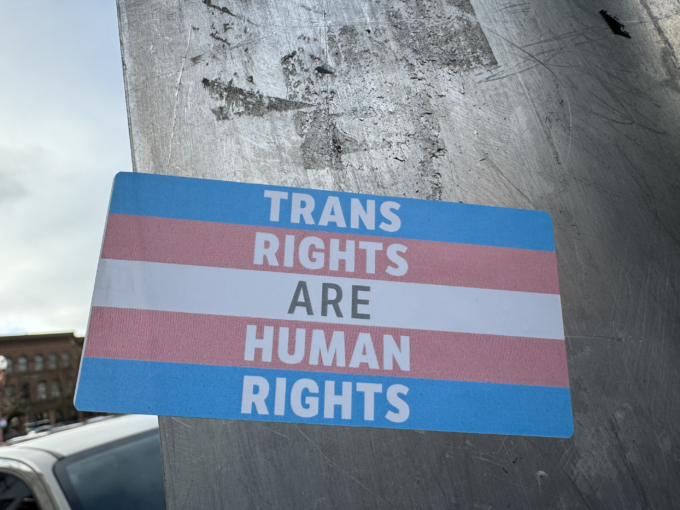
As parents, we’re horrified by the denial of health care to trans children that’s being imposed on families and communities across this country right now.

Through President Trump’s executive orders and harsh anti-trans laws in different states, policy makers are making it a crime to provide for trans kids’ medical needs. That’s sickening. We’re especially outraged that the people leading these attacks are often doing so in the name of “parents’ rights.”

Our children aren’t transgender, but we want to be clear: These attacks don’t speak for us.

Like all parents, we feel deeply what it means to care for our kids’ health. We remember how scary it was the first times they had fevers or broken bones. When our kids are hurting or afraid, we’ve worked to comfort them even when we feel afraid ourselves.

We know the anxiety our kids may have — or that we have as parents — in anticipation of a doctor’s visit. We also know the relief and gratitude of a visit that goes well, especially when we trust that we have competent health professionals to collaborate with.

We’ve never had to consider the possibility that powerful political forces could compel our children’s doctors not to provide the care that they determine to be in our children’s best interest, based on their professional judgment.

Yet that’s exactly what these politicians are doing to families with trans children right now. Age-appropriate gender-affirming care — as determined by kids, their families, and health professionals — is the standard of carethat’s universally endorsed for trans kids by reputable medical organizations.

Access to this care, which lawmakers and the president are targeting so aggressively, can be a matter of life and death. We’re appalled that these officials are demonizing trans kids, their families, and health professionals in their attempts to deny it.

This is bullying in its most repulsive form: powerful men targeting vulnerable children, all with the full weight of the law. And just like we teach our kids, if bullies aren’t challenged, they feel emboldened to target other vulnerable people.

We urge any parents of cis-gender children who think these attacks on trans children don’t impact their own families to consider what this could mean. Your own children could be targeted in the near future, based on some other hateful ideology conjured up by the bullies.

As disgusted as we are by these attacks, we’re also heartened by the rising sensibilities about gender and sexuality that we’re witnessing in our kids’ generation. The world they’re creating together is less judgemental, more inclusive, and more affirming than the one we grew up in.

Like so many things with parenting, sometimes this requires learning and adjustment on our part. But instead of fearing this emerging world, we honor it — and find ourselves being transformed by it. A world where trans kids are safe to be who they are is a world that honors the fullness of everybody.

We’re not the exceptions. Surveys show that significant majorities of parents say they would support their children who come out as trans or nonbinary and encourage others to do the same. And vast majorities agree that kids and their parents, not politicians, should get to decide what medical care is appropriate.

We hope that parents everywhere can raise our voices in defense of this more inclusive world against those who seek to destroy it — especially by targeting children and families. As parents, we have a responsibility to protect kids — not just our own, but all the children of our communities.

We already see glimpses of a world where we treat each other with greater compassion and dignity. That world — and its children — deserve to be nurtured and protected.

Khury Petersen-Smith, Basav Sen, and Lindsay Koshgarian are fellows of the Institute for Policy Studies and parents.

The DOGE Charade
March 1, 2025 


Photograph Source: Gage Skidmore – CC BY-SA 2.0

Donald Trump and Elon Musk keep claiming that their scorched-earth approach to remaking the federal government is made necessary by the prevalence of fraud and waste. Musk’s DOGE attack-squad tabulates its progress on a Wall of Receipts that currently purports to have saved Uncle Sam $65 billion.

That number appears to have been plucked out of thin air. The savings for the 2,300 individual contracts listed on the site add up to only $9.6 billion, and even that amount is shaky. For example, the single biggest savings, $1.9 billion, is attached to a Treasury Department contract that is reported to have ended during the Biden Administration.

DOGE gives no details of any fraud it may have found in the contracts. That is not surprising, since it is impossible to have done a careful examination of that many contracts in such a short amount of time.

Large number of the contracts are linked to agencies the Trump Administration is in the process of dismantling. USAID accounts for 246 contracts with total purported savings of $4.2 billion. The Consumer Financial Protection Bureau has 404 listings with savings of $109 million. The Education Department, reported to be headed for the chopping block, has 119 contracts with supposed savings of $659 million.

It seems clear DOGE targeted those contracts because of the agency involved, not any evidence of misconduct. Among the remaining 769 contracts, there are many that seem to be targeted for ideological reasons. They include numerous awards whose descriptions refer to now-taboo areas such as DEI or environmental justice.

There are more than 100 listings for subscriptions, especially for expensive services such as Politico, Bloomberg Law, and Lexis Nexis. Those may not always be worth the cost, but there is nothing corrupt about the need for an agency to have good access to information.

Then there are listings for contracts that have not gone into effect. The second biggest saving amount, $318 million, is attached to an Office of Personnel Management pre-award. How can there be fraud when there is no contractor yet?

DOGE’s list also contains numerous entries with obvious errors. These include instances in which there are two links pointing to different contract awards, making it unclear which one is meant to be included. For example, there is a $149 million savings connected both to a contractor called Advanced Automation Technologies Inc. (for three assistants) and to Airgas USA for refrigerated liquid gases.

By pointing to DOGE’s sloppy work, I do not mean to deny the existence of contract fraud. The problem is that Musk’s people, whether through ignorance or design, are looking in the wrong places. They seem to be ignoring the types of large contractors that have repeatedly been found to have cheated federal agencies.

The classic examples are the big weapons producers. As of now, DOGE lists only $8 million in savings from Defense Department contracts—and those are mainly from DEI awards and subscriptions. The same is true for the Department of Health and Human Services, even though healthcare is a major source of contractor fraud.

What gets forgotten in the claims about fraud coming from Trump and Musk is that the federal government already had a robust system for fighting contractor misconduct. Audits were done by agency inspectors general—who have now been fired by Trump—and prosecutions were launched by the Justice Department using the False Claims Act. Over the past decade, the DOJ has collected about $30 billion in fines and settlements.

That is serious fraud fighting. What we see in DOGE is instead the illusion of an attack on corruption that serves as a smokescreen for the Trump Administration’s scheme to dismantle large portions of the federal government. It remains to be seen how long they can keep up the charade.
China Tackles Trump’s Trade War and Global Headwinds

What China does at the Two Sessions will not only define its own economic growth but also influence the world economy as a whole.

March 1, 2025
Source: Foreign Policy In Focus


China’s political calendar is again focusing on one of the most anticipated events of the year, the Two Sessions. To be held from March 5, these annual meetings of the National People’s Congress (NPC) and the Chinese People’s Political Consultative Conference (CPPCC) are a chance to see where the country is heading strategically. With Beijing encountering more and more difficult international relations, this year’s sessions will focus on both domestic and international issues, especially against the background of the protectionist trade policy and erratic diplomacy of U.S. President Donald Trump. What China does at the Two Sessions will not only define its own economic growth but also influence the world economy as a whole.


The main event of the Two Sessions will be the Government Work Report delivered by Premier Li Qiang. This report will present the main objectives, economic goals, and policy objectives for the next year. Since 2025 marks the end of the 14th Five-Year Plan in China, much attention will be paid to how effective Beijing has been in achieving its objectives in the previous plan and what adjustments it will make in drawing up its next development plan. The discussions and reports that will be made available during the sessions will help to reveal the general vision of the leadership towards the 15th Five-Year Plan, which will define the future of the country’s economy and technology for several years.

China’s economic performance remains central to these deliberations. The country is still expected to account for 21 percent of global growth in the next five years. As the world’s biggest trading partner and an innovative power, its policies are significant for the whole world. But the new economic confrontationalism from Washington—the restriction on Chinese technology firms, the increase of tariffs on electric vehicles, and the pressure on allies to reduce economic links with Beijing—has left China with no choice but to readjust its strategy to maintain its momentum despite these headwinds.

Among the subjects to be discussed, China’s strategy of technological self-reliance will be one of the most important. At least twice in the past year, President Xi Jinping has stressed that the country needs to become a technological powerhouse to ensure its long-term economic success. The United States and its allies have restricted semiconductor exports and advanced technology transfer, so Beijing has increased its efforts to develop its own capabilities. Policy measures related to the improvement of the country’s AI, chip manufacturing, and other high-tech industries are likely to be revealed during the Two Sessions.

The government is also expected to introduce new incentives and regulatory frameworks to support private-sector players in these areas, reinforcing their role in driving China’s technological transformation. In recent months, Xi has personally engaged with major business leaders, including Alibaba’s Jack Ma, Huawei’s Ren Zhengfei, and Xiaomi’s Lei Jun, to assure them of the government’s commitment to fostering an environment that enables private enterprises to thrive. These efforts are part of a larger effort to revitalize confidence in China’s economic model as foreign investment is coming under more scrutiny due to geopolitical tensions. New policy measures that will improve market access, decrease bureaucratic delays, and ensure equal treatment are likely to be revealed during the Two Sessions in an attempt to counter the negative impact of Trump’s increasing trade restrictions.

Beyond domestic economic policies, the leadership will also address mounting fiscal challenges. The real estate sector, which used to be an engine of growth, has been in a slump for the past few years. Beijing has already been making serious efforts to stabilize the market through the implementation of various stimulus measures, but more policies may be announced to boost this sector. Similarly, the issue of local government debt will be on the main agenda. Since many provincial and municipal governments have financial challenges, the central government will have to find new ways of addressing the debt levels as it continues with the infrastructure spending.

Another important area of focus will be the expansion of the domestic market. Having assessed the world’s slow growth and trade risks, Chinese leaders understand the need to accelerate internal demand growth as a shield against the external shocks. The Central Economic Work Conference (CEWC) in December underscored this priority, calling for aggressive measures to encourage consumer spending, which could include tax cuts, subsidies, or other measures that increase income and consumer confidence. The success of these measures will be closely watched, as China seeks to move from an export-led growth model to one based on domestic consumption.

In the political sphere, China is prepared for the continued deterioration of relations with the United States. The return of Trump to the White House has already instigated a new round in the trade war, with his administration imposing new tariffs and compelling its allies to distance themselves from Beijing and its financial projects, including the Belt and Road Initiative. The recent action of Panama severing ties with the BRI at the behest of the United States reveals this larger geopolitical contest. China will now try to find new trade partners and diversify its economic relations to reduce the risks that come with Washington’s hostile posture.

As the world’s second-largest economy, China’s policy choices carry global significance. Many developing nations are looking toward Beijing for leadership in the fight against Washington’s protectionism and the promotion of a new, fairer world economic order. Against this background, the Two Sessions are not only a domestic policy-setting event but also a message to the international community that China is ready to lead in ensuring economic stability, innovation, and cooperation. The challenge for China lies in sustaining robust growth while managing an increasingly hostile global environment. The decisions made during the Two Sessions will determine the direction of the country for the next few years; whether it will keep rising as one of the world’s economic powers or whether it will experience some setbacks due to pressures from the outside environment.

Does Billionaire Warren Buffett Really Pay Taxes at an Annual Rate Over 1,000 Percent?


 March 3, 2025
Facebook

Bob Lord is a veteran tax lawyer who practices and blogs in Phoenix, Arizona. He’s an associate fellow of the Institute for Policy Studies.