It’s possible that I shall make an ass of myself. But in that case one can always get out of it with a little dialectic. I have, of course, so worded my proposition as to be right either way (K.Marx, Letter to F.Engels on the Indian Mutiny)
Wednesday, March 12, 2025
Video: Seaglider Full-Scale WIG Prototype Conducts First On-Water Tests
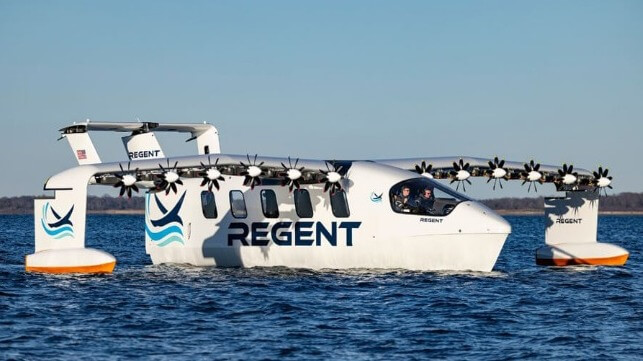
First full-scale prototype of the electric seaglider performing in-water tests (Regent Craft)
The first full-scale seaglider prototype using the wing-in-ground effect recently completed the first on-water tests of a prototype with humans onboard. According to Regent Craft, which is developing the new vessels, it was the kickoff of a testing campaign that will culminate with the first human seaglider flight at mid-year.
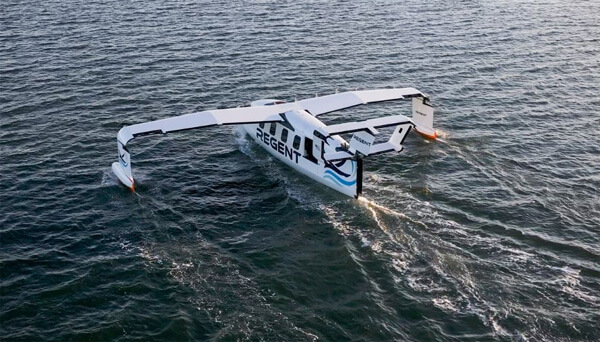
The company was launched in 2020 to develop the technology which it believes will present a new paradigm in travel. Its design is for an all-electric high-speed vessel that operates exclusively over water connecting coastal destinations. The vessel operates in three modes — floating on the hull, foiling above the waves on hydrofoils, and flying in ground effect within one wingspan of the surface of the water. The company’s first design, the Viceroy, is a 12-passenger vessel that can travel at up to 180 mph and up to 180 miles on a single charge.
The company successfully flew its quarter-scale seaglider prototype in 2022, validating its technological approach to redefining wing-in-ground craft (WIGs), vessels that operate in ground effect low over the surface of the water. Last year, it reported it had received permission to advance to prototype testing while raising more than $90 million from investors to develop the vessel. Regent has also advanced its maritime certification process with the U.S. Coast Guard and with maritime regulators in key markets around the world, in partnership with the maritime classification society Lloyd’s Register.
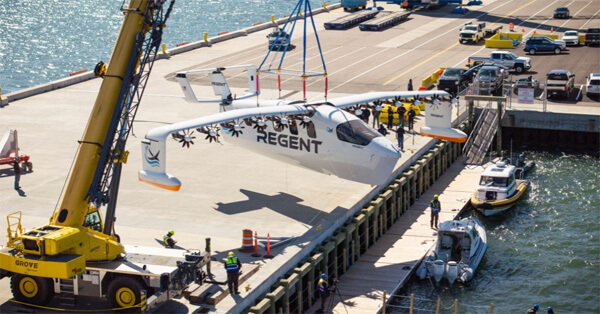
Paladin was lowered into the water in Rhode Island to start the first trials
Regent christened its new vessel Paladin before lowering her into Narragansett Bay, Rhode Island. The 12-passenger Viceroy seaglider prototype is 55 feet (16.7 meters) long with a 65-foot (approximately 20-meter) wingspan, making it the largest-ever all-electric flying machine.
Officially commencing sea trials, Regent’s test captains completed the first in a series of on-water tests. Sea trials follow months of sub-system testing of the critical onboard systems, including motors, batteries, electronics, mechanical systems, and vehicle control software, and will progress to the first human seaglider flight in the coming months.
The company has attracted strong attention from both regional air carriers as well as the shipping industry. Mitsui O.S.K. Lines made a strategic investment in 2024 and Brittany Ferries is among the companies reporting it was exploring using the vessels. Regent reports its total order book is valued at more than $9 billion.
Construction has started on a 255,000-square-foot manufacturing facility located in Rhode Island. The company expects the facility will come online in 2026 as it moves forward with the commercialization of its seagliders.
Austal Issues Shares to Raise Capital for Alabama Yard Expansion
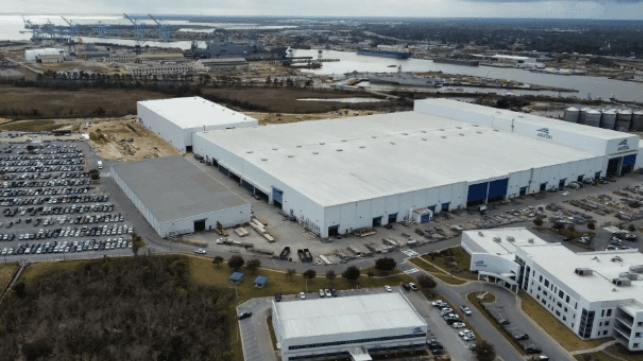
Austal Ltd., the Australian parent company of defense shipbuilder Austal USA, has announced a capital raise of as much as US$140 million to pay for the expansion of its main shipyard in Mobile, Alabama.
Austal USA is the core of Austal Ltd.'s enterprise, and it is rapidly growing to meet the needs of its primary customer, the U.S. Navy. It holds contracts for an array of smaller auxiliary vessels, along with a large-scale subcontract award for module construction to support General Dynamics Electric Boat's submarine projects.
On Tuesday, Austal announced that it plans to place about 53 million new shares with institutional investors at a price of US$2.40 per share, a discount of about 15 percent compared to the company's last closing price. The funds will go towards construction of the US$300 million Final Assembly 2 complex, which began construction last July and is due for completion in 2026. The infrastructure project is located just south of Austal's current complex, and will include a new assembly hall, a wharf and a new shiplift, which will make it easier for the company to launch newbuilds. The bay will be used for building large modules for the Coast Guard's Offshore Patrol Cutter program and for the Navy's T-AGOS-25 research/surveillance vessels.
With the addition of a shiplift, Austal will also have the capability to bring vessels back onshore for maintenance in addition to its newbuild work.
Austal requested a brief trading halt Tuesday morning pending the announcement. "This announced raise will ensure that Austal is appropriately funded for FA2, which one complete, will facilitate the delivery of large steel vessels in the current pipeline for the US Navy and ensure Mobile continues to be well placed to execute on future opportunities," said Austal CEO Patrick Gregg in a statement.
Austal is widely expected to be a top contender to build additional Constellation-class frigates (alongside Fincantieri Marinette Marine), once the design has stabilized and production of the first hull has gotten under way. It is also well-situated to compete for mid- and large-sized unmanned vessel orders.
“The long-term investment made in developing deep defence relationships in the United States and Australia, founded on product innovation, technology and demonstrated shipbuilding and support capabilities, is starting to deliver increased returns," Gregg said in an earnings statement in February.
Hapag-Lloyd Advances Terminal Strategy Acquiring Stake in Le Havre, France
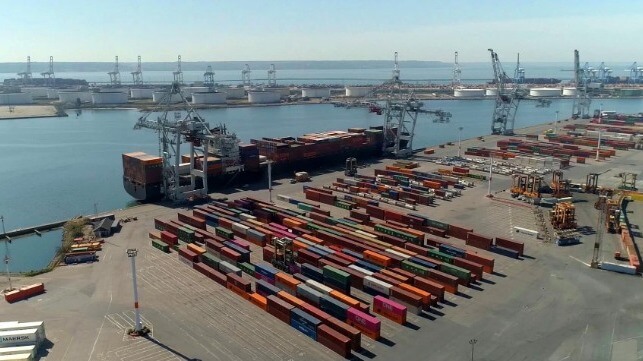
Hapag's terminal company acquired a controlling interest in a Le Havre facility (CNMP)
Hapag-Lloyd has become the latest of the major carriers to move forward with a strategy to expand its shoreside operations by growing its terminal portfolio. After launching an independent terminal company in 2023, Hapag-Lloyd reports it has acquired a controlling interest in one of the independent terminals in Le Havre, France.
Hanseatic Global Terminals, a wholly owned subsidiary based in Rotterdam, was announced in July 2024. Hapag said at the time the aim was to increase operational efficiency and promote sustainable growth that will benefit customers and partners worldwide. It says that terminal and infrastructure investments represent a crucial component of the strategic agenda for Hanseatic Global Terminals.
The company acquired 60 percent of the shares of CNMP LH from Seafrigo Group, a company specializing in temperature-controlled food logistics. Seafrigo will continue to hold a 40 percent stake in the terminal operator.
“By acquiring a majority stake in the CNMP LH terminal in Le Havre, we are strengthening our position in one of our core European markets,” said Dheeraj Bhatia, CEO of Hanseatic Global Terminals (HGT). “At the same time, we are continuing to expand our global terminal portfolio while paving the way for targeted investments to enhance efficiency.”
“This will significantly raise the profile of our joint terminal as an important gateway for container transports in the Port of Le Havre,” said Eric Barbé, President of Seafrigo Group. The companies projected that the container throughput of the CNMP LH terminal is expected to grow in the coming years – including in the attractive reefer container business.
CNMP (Compagnie Nouvelle de Manutentions Portuaires) highlights that it is a historical stevedoring company operating in Le Havre since 1920. It has a multimodal terminal with river barge access and 1 km (.6 miles) of rail connection. It is an independent service provider to multiple carriers calling at the port.
Le Havre, the companies emphasized numbers among the 10 largest ports in Europe. They called it the most important port for sea transport to and from France reporting it has an annual container throughput of 3 million TEU and offers hinterland connections to Paris.
Hapag called it a strategic acquisition for Hanseatic Global Terminals in keeping with its strategy of expansion. HGT manages a portfolio of stakes in 21 port terminals and complementary logistics services across 12 countries and four continents, with plans to expand its stakes to over 30 terminals by 2030.
ALT. FUEL
New Svitzer Tug is First to Integrate Battery with Methanol Fueled Engines
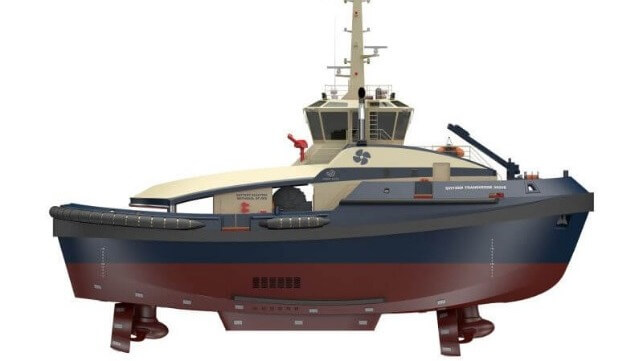
Tug under construction in Turkey will for the first time combine battery power with methanol dual-fuel engines (Uzmar)
A new tug construction project underway at Turkey’s Uzmar shipyard will integrate a marine battery power system with a methanol-fueled engine to minimize emissions from the operations. The vessel is being built for Svitzer and will be launched later this year for operations in Gothenburg, Sweden.
The tug is based on Svitzer’s TRAnsverse tug design and will be used for escort duty. With a gross tonnage of approximately 806 tonnes, the tug will be capable of achieving speeds of up to 14 knots. Delivery is planned in the second half of 2025.
The order for the 6MWh battery went to AYK Energy and is its first contract with Uzmar. The battery will be built at the company’s new facility in Zhuhai, China, and delivered to Uzmar for installation in the tug. AYK attests to having the highest energy density and volumetric density in the industry today. Combined with its Battery Management System) and packaging solution, it reports it has tailored unique solutions for the maritime sector. It claims to offer the safest, lightest, most affordable, easiest to operate, and commission battery with the ability to operate in smaller spaces.
"Battery solutions are constantly expanding, and we are proud to be at the forefront when it comes to providing those solutions to the maritime sector,” said AYK Energy founder Chris Kruger, He said the contract “shows our continuing progress in winning the bigger battery projects.”
The battery power system will be supported for the first time by dual-fuel methanol engines. The engines will be used for backup power and to extend the range of the tug. However, according to the companies, they expect the tug to perform more than 90 percent of its escort duty operations using its battery-electric powertrain. They said the vessel’s design will also allow the battery-powered tug to operate more efficiently than internal combustion engine-powered tugs of a traditional design.
Uzmar says that the combination of battery power and methanol engines will provide a safe, efficient, and reliable solution.
“The launch of a first-of-its-kind newbuild project with our partners at Uzmar Shipyard is a significant milestone for our decarbonization ambitions,” said Gareth Prowse, Head of Decarbonization at Svitzer. The battery electric tug will mean we can deliver our services to customers in the Port of Gothenburg with significantly lower carbon emissions, and still to the highest operational and safety standards.”
Companies such as Svitzer see battery power as becoming an important option in the sustainability transition. Marine batteries are demonstrating that they can play a fundamental role in decarbonizing the industry, as an increasing number of tugs are being built and deployed with battery-electric powertrains.
Odfjell Completes Install of First Sails on Tanker to Analyze Fuel Savings
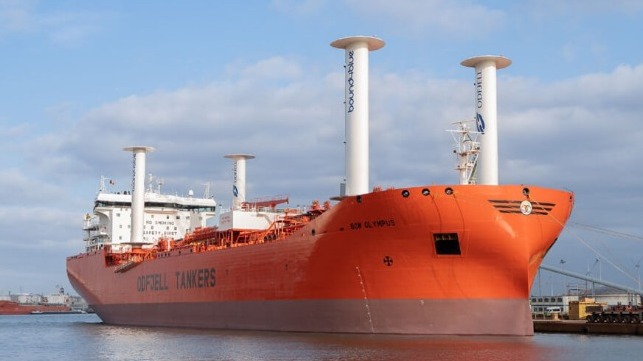
Bow Olympus is Odfjell's first chemical tanker fitted with wind assisted propulsion (Odfjell)
Global chemical tanker operator Odfjell has joined the growing list of shipping companies that are incorporating wind-assisted propulsion into their operations as they seek to lower emissions. The company’s first sail installation was completed in Antwerp, and the chemical tanker Bow Olympus will now be carefully monitored to observe the impact on operations.
“The five-year-old vessel will soon embark on what could be called her second maiden voyage—this time, crossing the Atlantic towards Texas with four eSails," said Erik Hjortland, VP Technology for Odfjell. “Each nautical mile will be thoroughly analyzed in real-time to document the energy-saving effects. That data will be fundamental in informing future decisions as we continue to improve the environmental performance of our existing fleet.”
Odfjell selected bound4blue’s eSails, a wind foil that it said is best suited to the challenges of chemical tankers. They noted that the deck of the vessel is covered in pipes for multiple cargo tanks. The integration of the sail foundations required careful planning to ensure a seamless fit with tanker operations and the vessel’s requirement for air draft limitations.
Bound4blue says that it was able to minimize the size and eliminate the need for tilting systems because its eSails generate six to seven times the propulsive lift of equivalently proportioned rigid sails. The fully automated eSails generate propulsive force by dragging air across an optimized aerodynamic profile. The Bow Olympus which is approximately 600 feet (183 meters) and 49,000 dwt, was fitted with four 72-foot (22-meter) eSails.
To accommodate the vessel’s operating schedule, the installation was undertaken in two stages. The foundations were fitted during a scheduled drydocking. The sails were installed during two days, March 10 and 11, at the EDR Antwerp Shipyard.
“We’ve made some major steps in minimizing our emissions, reducing our fleet’s carbon intensity by 53% against the 2008 baseline,” says Hjortland. “We’ve done this through many operational measures and by installing a range of different energy-saving devices. Wind power was the next step.”
This project is funded by the European Union under a grant agreement from the Innovation Fund program. The tanker company says once results are validated from the operation of this first vessel, the plan is to install sails on more of its vessels.
Odfjell joins owners such as Amasus, Eastern Pacific Shipping, and Louis Dreyfus Armateurs with operational eSAILs. David Ferrer, Co-Founder and CTO of bound4blue notes that other major shipping companies such as Maersk Tankers, Marflet Marine, and Klaveness Combination Carriers are filling the company’s growing orderbook.
Class Societies ABS and DNV Advance Plans for Ammonia-Cracking Bulker
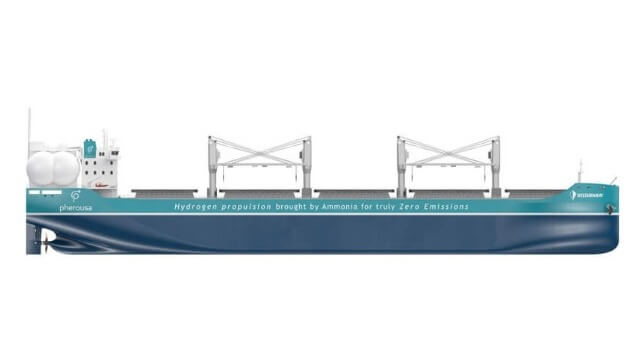
The concept uses ammonia cracking toe release hydrogen energy for electrical propulsion (Pherousa)
An innovative project to develop a shipboard ammonia-cracking technology took a key step forward toward the vision of building a zero-emission dry bulk carrier for the copper industry. Class societies ABS and DNV working with Norway-based Pherousa Shipping and technology company Metacon have issued design Approval in Principle reporting they found “no show stopper conditions” to employing the innovative technology.
Ammonia continues to draw interest with systems in development but so far it has required carbon fuel primers to start ignition and presents the challenges of lower energy density versus traditional fuels. Hydrogen similarly shows potential as a power source but so far has been limited to small near-shore support vessels and inland shipping.
“The Approval in Principle from two of the leading classification societies and certification bodies, ABS and DNV, marks another important milestone for us in the development of zero-emission solutions for the maritime industry,” said Hans Bredrup, Chairman of Pherousa. “By granting Pherousa these AiPs, both ABS and DNV clearly state that there are no showstoppers of the Pherousa technology for marine application.”
Pherousa’s concept working with an exclusive license agreement from Metacon for the application of the technology onboard ships focuses on developing ammonia cracking, the release of hydrogen energy from ammonia as a carrier, at scale to power larger vessels. The ammonia cracking technology would be used with PEM Fuel Cells and a Fuel Gas Supply System generating a fully electrical propulsion plant.
“Ammonia cracking combined with a PEM Fuel Cell has no need for pilot fuel or other fossil sources,” explains Morten Løvstad, VP and Global Business Director for Bulk Carriers at DNV. He called it, “an innovative solution for maritime application towards full decarbonization.”
Pherousa reports that Ammonia Cracking can be applied to a variety of developed technologies, such as supplying Hydrogen to PEM Fuel Cells, replacing conventional fuels with Hydrogen as pilot fuel on Ammonia fueled Internal Combustion Engines, or supplying Hydrogen Internal Combustion Engines. It could also be used for supplying Hydrogen to Auxiliary Engines to reduce emissions. According to the company, any of the four alternatives can be fitted onboard any type of vessel and with an engine power of up to 15-20 MW.
“The efficiency of ammonia cracking will play a decisive factor in its ability to contribute to decarbonization of the industry,” predicts Stergios Stamopoulos, Director, Global Sustainability for American Bureau of Shipping (ABS).
Pherousa and Metacon report that have conducted thorough research and tests to develop the Ammonia Cracking technology concept. The companies have delivered a working prototype that demonstrated the practical potential of this approach.
The Pherousa subsidiary, Pherousa Shipping, reports it has worked closely with two major copper miners during the design process of an Ultramax 64.000 dwt vessel, to find the optimal layout for emission-free transportation of copper concentrates between its origin and the smelters. The vessels are intended to be on water in parallel with the new IMO regulative that comes into force in 2030.
They are focusing on the copper industry because the commodity is essential for emerging markets linked to decarbonization. They believe end-users of copper utilized for solar panels or electric cars will seek to build a carbon-free supply chain including shipping.
Having achieved the design reviews from ABS and DNV, Pherousa reports it is now transitioning from concept to scale-up and market entry. It looks to deploy its innovative solution on a global scale.
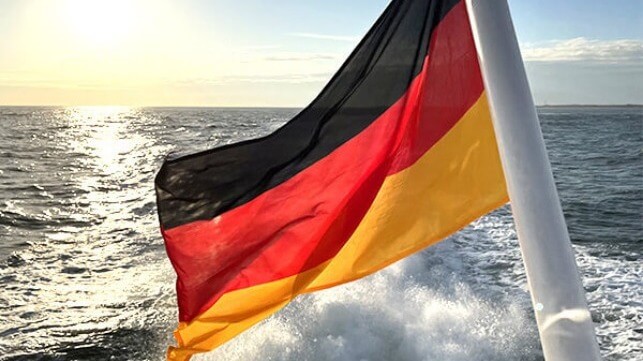
German Shipowners Cite Vital Role of Shipping Calling for New Support
German Shipowners' Association calls for support to strengthen the industry (Federal Ministry for Digtal and Transport photo)
The German Shipowners’ Association (VDR) released its annual report on the strength and vital role of shipping in the country’s economy and security. Citing “turbulent times” the group which represents the largest part of the German merchant fleet is calling for new long-term measures to support its smaller shipowners and efforts to reduce bureaucracy to increase global competitiveness.
The group highlighted in its presentation that despite global turbulence and uncertain times in international trade policy, that German shipping remains a key contributor to the country’s economic strength and supply security. They reported that approximately 26 percent of exports and 60 percent of imports are handled by sea.
“Without a strong and independent merchant fleet, there is neither economic stability nor national security – especially in times when geopolitical and trade policy risks are steadily increasing,” said VDR President Gaby Bornheim.
Although Germany remains a strong maritime hub and continues to rank seventh globally, VDR reported that the industry is slipping in key areas. German shipping’s tonnage has declined from a peak of approximately 90 million gross tons in 2010 and 2011 to a current 47.4 million gross tons. While container shipping remains the largest segment, Germany has slipped to third behind Switzerland (home of MSC Mediterranean Shipping Company) and China.
German shipping companies purchased 70 vessels in 2024 (1.9 million gross tons) and newbuilds numbered 74 vessels (2.6 million gross tons). However, sales numbered 180 ships (4.1 million gross tons).
“The VDR therefore calls for targeted, long-term measures to strengthen the competitiveness of German shipping companies and Germany as a maritime location to avoid falling behind internationally,” the group writes in its report.
While the total German merchant shipping industry consists of approximately 290 companies and a fleet of 1,764 ships, the VDR’s data highlights just under half are flying EU flags and only 15 percent are registered in Germany. Further, it highlights that 80 percent of German shipping companies are small to medium-sized companies with fewer than 10 ships, with 44 percent specifically operating a single ship.
It cites a broad range of challenges for the industry including Donald Trump’s imposition of tariffs which it says are causing uncertainty in the German and global merchant fleet. It also cites the geopolitical disruption to shipping routes and maritime trade. The VDR warns that national interests must not come at the expense of free global trade flows.
In addition to geopolitical and trade policy uncertainties, VDR reports that German shipping companies face an increasingly dense administrative burden within Europe. It says that double reporting requirements and regional special regulations on climate protection unnecessarily complicate ship operations and weaken competitiveness.
“It is high time for Europe and Germany to abandon their dubious leadership in excessive bureaucracy and regional special regulations. Streamlined processes and globally consistent climate protection requirements are essential to safeguard Germany’s economic strength at sea,” warns VDR CEO Martin Kröger.
While highlighting the challenges for shipping, VDR also reports a positive trend in 2024 as more young talent was attracted to the industry. It reports a 14 percent increase in trainees, with 499 training contracts at sea and 214 onshore. It highlights that shipping is attracting more young professionals while saying it is vital to continue to attract young talent into the industry.
ABP Plans to Build England's Biggest Floating Solar Plant
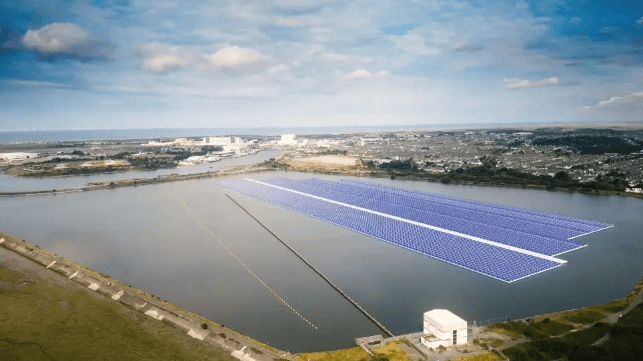
Britain's top ports operator has announced plans to install the largest floating solar project in the country at the Port of Barrow, north of Liverpool on England's eastern coastline.
The port has submitted planning documents for the "Barrow EnergyDock," which will be located in the Cavendish Dock, a former harbor basin and shipbuilding area that is now an enclosed reservoir.
The floating station will generate up to a peak of 40 MW worth of power for customers in the advanced manufacturing sector (BAe Systems' submarine manufacturing plant). It would also benefit the port by providing lower-cost electricity, according to ABP.
The panels will be mounted at a fixed angle on floating pontoons, which will be anchored to the bottom of the dock. The array of 47,000 panels would cover about a third of the entire surface area, leaving the remainder open for leisure usage - notably shoreside and pierside fishing. ABP notes that using the water area for power generation also leaves land free and unencumbered for future port development. All going well, the project could be completed in as little as 9-12 months after planning approval is received.
ABP carried out wildlife surveys and assessments to ensure that the array would have no significant impacts, and it held two public planning meetings to solicit input from residents.
The port company has bigger plans for Barrow's long-term expansion, to include new infrastructure to support offshore wind operations and a new jetty.
Retailers Continue to Front-Load Imports Prompting Cut in Q2 Forecast
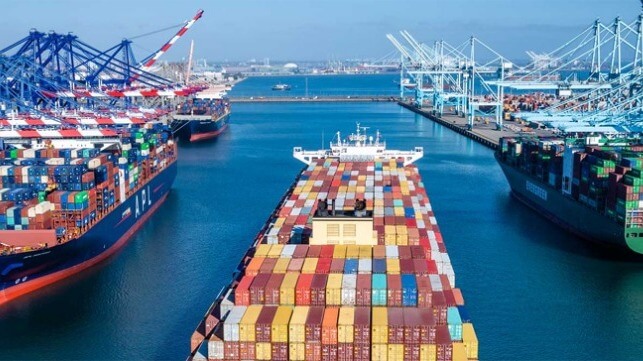
Container import volumes are elevated but expected to fall as Trump's tariffs impact retailers (Port of Los Angeles file photo)
Retailers are continuing to front-load their imports into U.S. ports due to the uncertainty over U.S. tariffs and the potential that the Trump administration will move to impose fees on Chinese-built ships reports the National Retail Federation. While the trade group expects volumes to remain elevated through the spring, its Global Port Tracker is reducing the forecast for second quarter imports versus last month’s outlook.
The group highlights the concerns among members and the elevated import levels so far in 2025 as seen for example on the reports of strong monthly volumes at the port of Los Angeles and Long Beach. However, after separately reporting declines in monthly consumer sales in both January and February, the NRF is now saying import volumes could see year-over-year drops this summer.
The National Retail Federation’s Port Tracker rallies container volumes at the major U.S. ports. The group raised its forecast by 3.5 percent for the first quarter while lowering its second quarter projection by 2.5 percent. It now expects possible year-over-year declines in import volumes to start in June and July, noting it would be the first decline since September 2023.
“Retailers are continuing to bring as much merchandise into the country ahead of rising tariffs as possible,” said Jonathan Gold, Vice President for Supply Chain and Customs Policy at the NRF. “The on-again, off-again tariffs against Canada and Mexico won’t have a direct impact on port volumes because most of those goods move by truck or rail. But new tariffs on goods from China that have already doubled from 10 to 20 percent are a concern, as well as uncertainty over ‘reciprocal’ tariffs that could start in April.”
The trade group notes that retailers have been working on supply chain diversification, but that doesn’t happen overnight. In the meantime, it says tariffs are taxes on imports ultimately paid by consumers, not foreign countries, and American families will pay more as long as they are in place. Economists have echoed this concern while Donald Trump this week dismissed talk of an impending recession due to his trade policies.
The NRF is projecting more than 6.4 million TEU for imports in the first quarter of 2025 noting that levels were up 4.4 percent in January over December and 13.4 percent year-over-year. It projects the momentum continued into February with a 6.1 percent increase, making it the busiest February in three years, a month that is traditionally slower as factories close in Asia during the Lunar New Year celebrations. It is forecasting a 10.8 percent increase year-over-year for March and a 5.7 percent increase year-over-year for April.
The retailers however are projecting the momentum will end with just a 2.8 increase in May followed by monthly year-over-year declines. June they project could be down 3.2 percent year-over-year and increasing to a 13.9 percent year-over-year decline in July. The forecast also shows container import volumes below 2 million TEU in July 2025 which would be the first time it has fallen below that level since March 2024.
The NRF is now forecasting a total of 12.78 million TEU for the first half of 2025. That would be up 5.7 percent versus last year.
The group notes if the Trump administration moves ahead with port fees on Chinese-built ships, that carriers might move to larger vessels. They expect the major lines would seek to consolidate calls at major ports rather than making multiple stops at smaller ports. Others have speculated that shippers might route move volumes through the Canadian and Mexican ports to reduce exposure to the proposed port fees.
The NRF believes the growing uncertainties and continuing “tariff turmoil” are increasing concerns and are likely to be reflected in import volumes as the year progresses.
Indonesia's $12B Gasoline Import Fraud Extends to Shipping
Anticorruption authorities in Indonesia are examining a sprawling fraud scheme at state energy giant Pertamina, which holds a near-monopoly on clean product distribution in the country. Executives at Pertamina allegedly set up a complex scheme to import gasoline from foreign refineries, inflate the price and skim money off the top at multiple points in the supply chain. The scheme touched chartering, procurement, blending and distribution, according to local authorities, and one U.S.-based shipping company is suspending the director of its Indonesian JV in response.
Indonesia's oil industry is highly concentrated, and a small "oil mafia" of well-placed officials and private individuals exert considerable control over the trade. Recently-elected President Prabowo Subianto campaigned on a promise to rein in this "mafia," and the Pertamina case is the first big test of that effort. (It is not the first time for Pertamina, which has undergone five previous corruption investigations in the past 10 years.)
According to local prosecutors, from 2018-23, a group of nine executives carried out fraudulent trades in order to increase their own earnings. The overall cost to the Indonesian state and local consumers came to about $12 billion.
According to officials, the starting point of the scheme was to declare that certain locally-produced crude was too poor in quality to be used in Indonesian refineries. This opened a legal avenue to import more expensive foreign-sourced gasoline to make up the artificial gap. At that point, the suspects allegedly purchased lower-quality 90 octane gasoline on the foreign market, then blended it and fraudulently resold it as higher-quality 92 octane gasoline in Indonesia. Motorists who used a low-quality fuel in an engine designed for high-octane gas could experience knocking and poor performance, and lawsuits are expected.
"An engine that continuously experiences knocking will lose combustion efficiency. Over time, carbon deposits will accumulate on the piston head and combustion chamber, drastically reducing performance," said Dr. Nur Aklis, a mechanical engineer at Universitas Muhammadiyah Surakarta (UMS).
Some of the suspects also allegedly inflated the cost of chartering to import this fuel by 13-15 percent, then pocketed the difference.
One individual arrested in connection with the scheme, Muhamad Kerry Adrianto, is also a director at the Indonesian joint venture operation of Navigator Gas (the firm is not accused of any involvement). The U.S.-listed LPG carrier operator has taken steps to remove Adrianto from his role, and expects that the change will have no material impact on its business.
This week, a Norwegian reefer ship narrowly avoided disaster after grounding on a remote shore in the Hebrides.
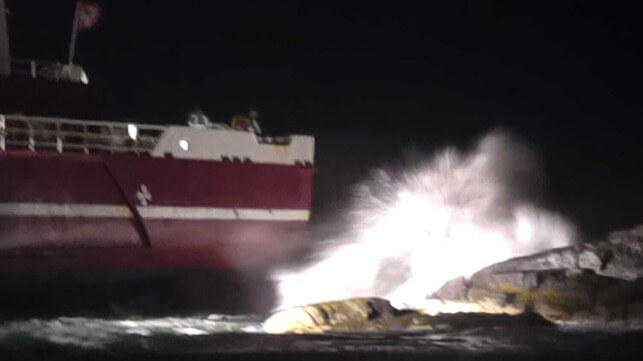
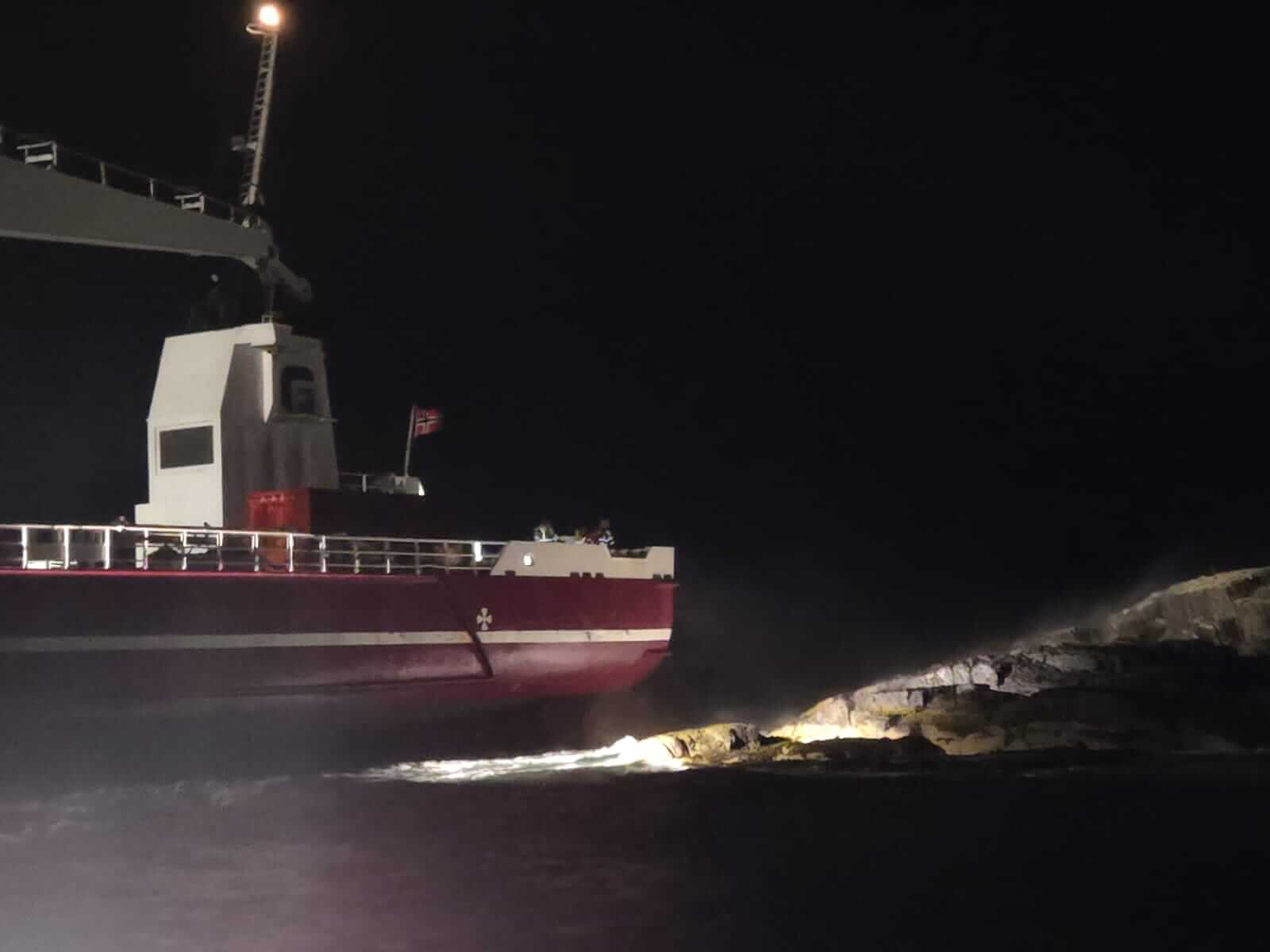
At about 0200 hours on Monday morning, the Norwegian-flagged reefer Rotsund dragged anchor and grounded on a rocky shoreline near the village of Breakish on the Isle of Skye. HM Coastguard received a distress call from the ship and called two local RNLI lifeboat stations in the port towns of Kyle and Portree.
The Kyle RNLI volunteer rescue team got under way at about 0225 and were on scene by 0240. They found that the Rotsund's stern was aground on the rocks, and that the wind and the seas were setting the vessel towards shore. There was a risk that the ship could have been pushed broadside onto the rocks, Kyle RNLI helmsman Daniel Elliot said.
Courtesy Kyle RNLI
There were no signs of pollution in the water, and no injuries were reported, so the lifeboat stood by while the Rotsund made efforts to free herself from the rocks. Portree's lifeboat arrived at about 0340 and joined the standby operation.
At about 0415, Rotsund's crew managed to free the ship using their own thrusters and engines. The RNLI stood by until a tug arrived on scene to assist Rotsund, then headed back into port.
"It was important that we stayed on scene to ensure that there was no unseen damage underneath the waterline which could pose a risk to the crew, or any pollution coming from the vessel which could pose a danger to the environment," said Elliot.
Rotsund is a 2,700 dwt reefer operated by Norlines, a coastwise shipping company specializing in local logistics within Norway.
Volgoneft Tanker Owners Face Lawsuits Over Kerch Strait Spill
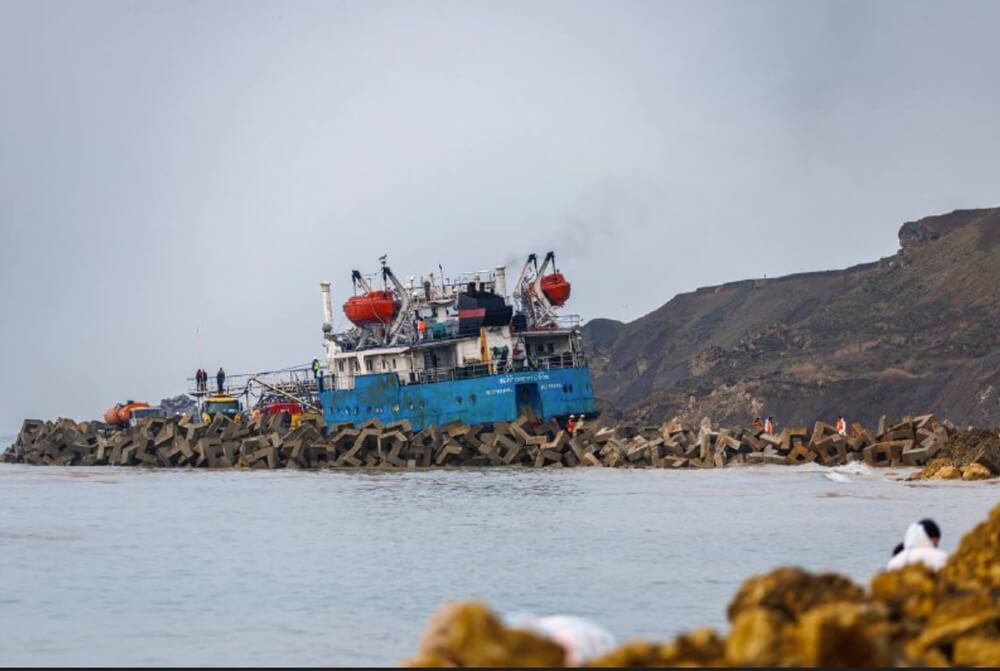
Volgoneft 212's bow section as seen from its stern section, Dec. 15, 2024 (Russian social media)
The owners of the riverine tankers that split up and sank in the Black Sea in December are facing multiple lawsuits as Russian government agencies try to recover the cost of cleanup from the resulting spills.
The aging tankers Volgoneft-212 and Volgoneft-239 were built under the Soviet "river-sea" fleet program, a Cold War-era drive to build up inland shipping capacity. Russian shipping experts have questioned the fleet's suitability for open-water service in Black Sea winter weather, given that most of these sister ships are over 50 years old, and their design was never intended for rough surface conditions.
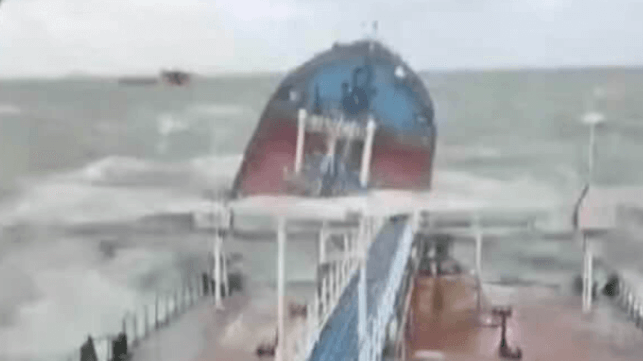
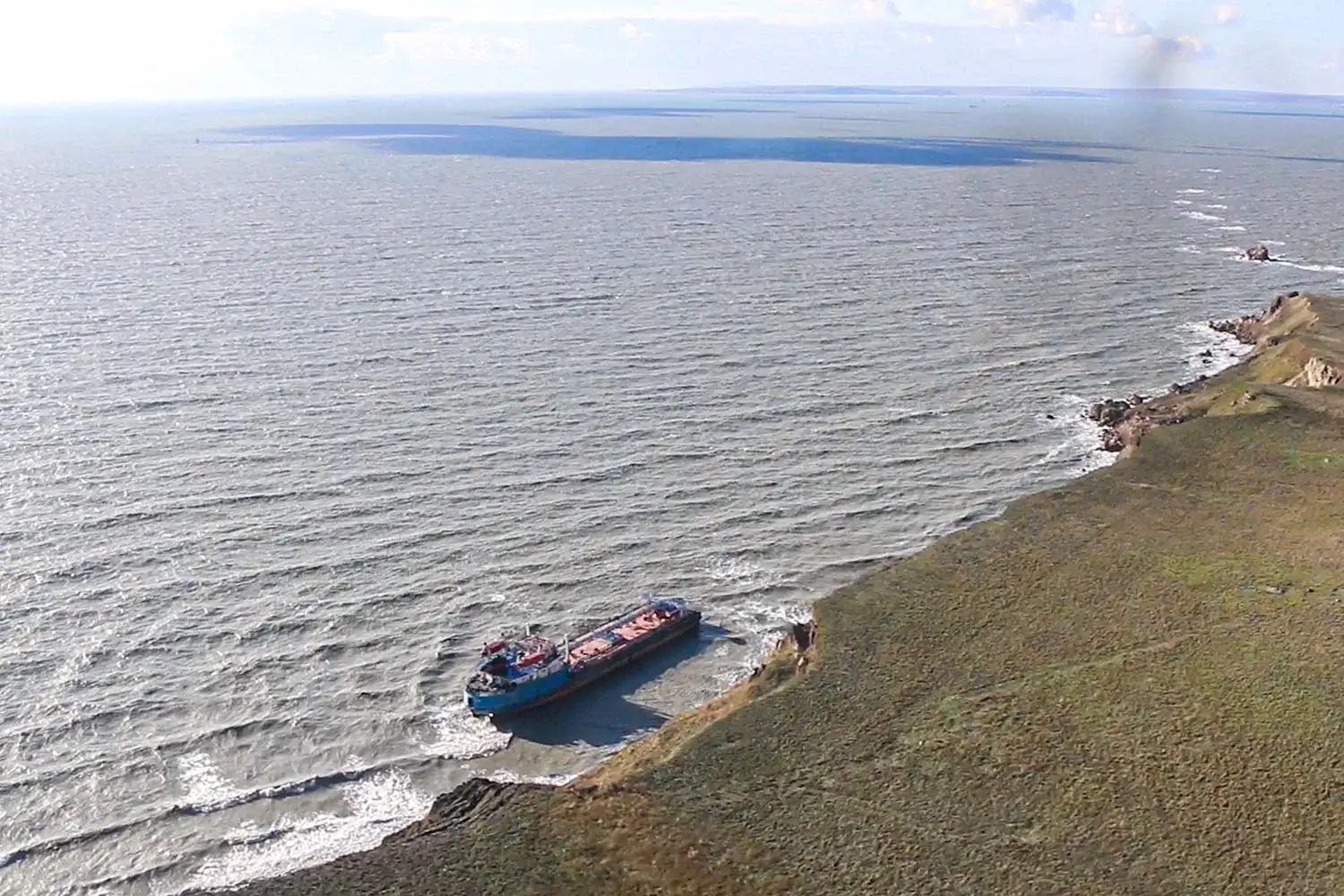
On December 15, Volgoneft-212 broke in half and sank in a severe storm about five nautical miles outside of the Kerch Strait. Waves in excess of 25 feet were forecast by Russia's meteorological agency in advance of the sinking, and the effects were enough to snap the aging tanker in half. The tanker was carrying about 4,300 tonnes of mazut, a Russian residual fuel oil produced from low-quality feedstocks. The tanker Volgoneft-239 broke up and grounded near Taman shortly after, spilling a similar load of mazut.
Courtesy Morspas
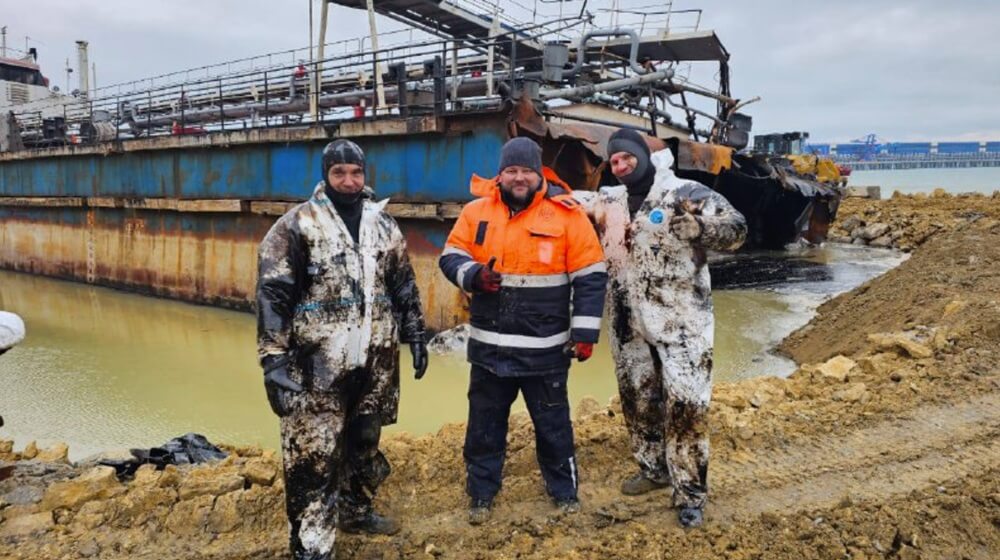
The cleanup effort for the wreck site of Volgoneft-239 took until the end of January, and it incurred significant costs. A response team led by Russian salvage agency Morspasluzhba (Morspas) built an earthen dike around the perimeter of the wreck, protecting it from wave action and creating a sheltered space for pollution abatement work to proceed. The oil was heated, pumped out and driven off by the truckload.
Morspas has sued Volgatransneft - the owner of the Volgoneft-239 - to recover the full cost of the cleanup, and the case is proceeding at an arbitration court in Krasnodar. Volgatransneft petitioned to have the lawsuit transferred to a court in Moscow, but Morspas objected, and the court refused the request. The hearings will begin in early April; the amount of the claim has yet to be fully calculated.
The same court has already fined Volgatransneft a minor penalty of $3,500 for alleged technical violations in connection with Volgoneft-239's sinking.
Courtesy City of Anapa
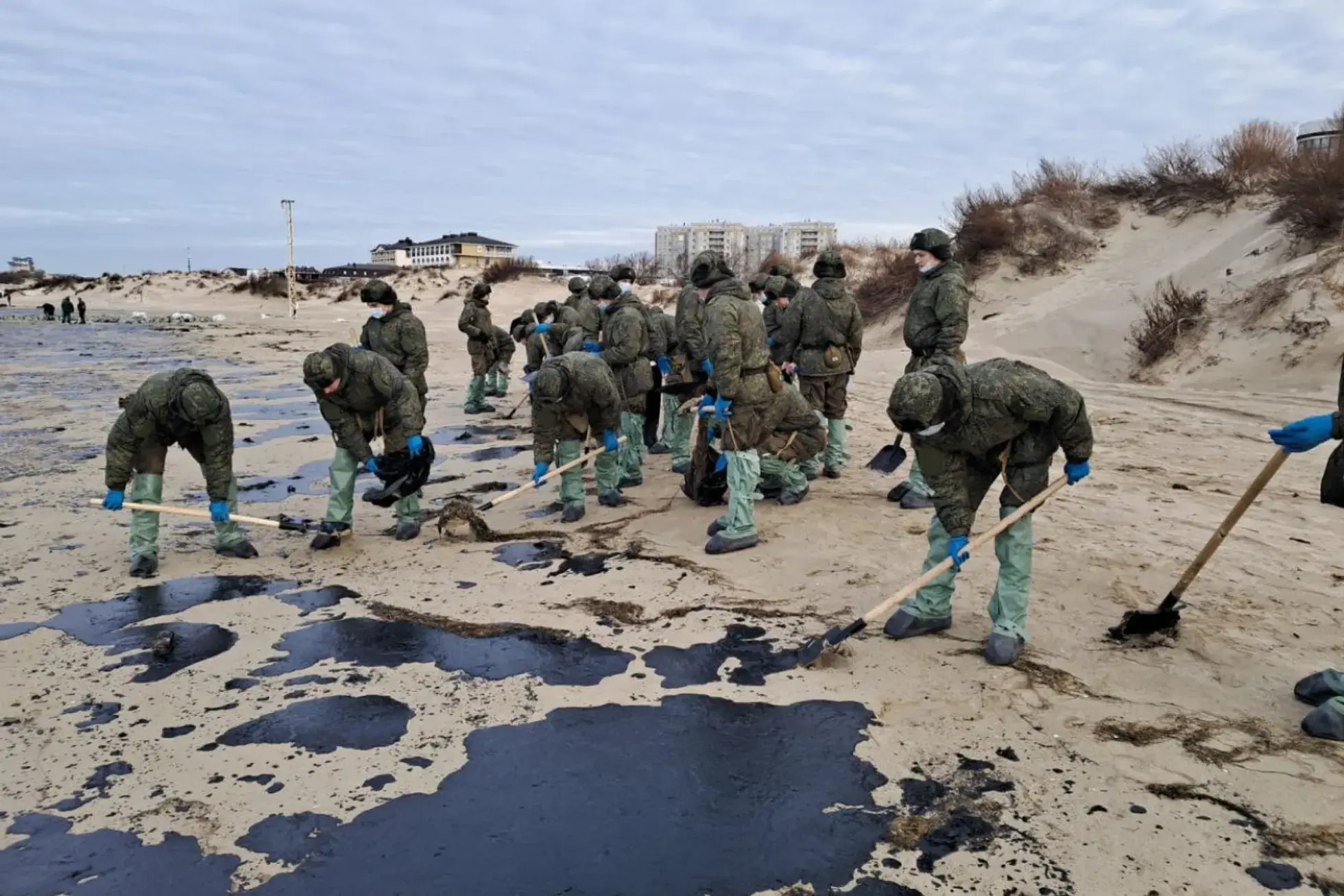
Separately, the city of Anapa has filed a claim of $2.4 million against Volgatransneft and Kama Shipping - the owner of the Volgoneft-212 - to recover the costs for the beach cleanup that followed the spills. The city administration plans to increase the claim when extra cleanup costs occur, as more washed-up waste is expected for years to come.
Experts consulted by Forbes put the estimated environmental damage from the spills at about $300 million. The tankers are insured for a maximum of about $30 million for pollution compensation, according to Alexei Kurinny, a Communist Party MP.
The lost vessels were part of a flotilla that provides bunkers for Russia's "dark fleet" near Novorossiysk, and helped transfer fuel oil to at least three U.S.-sanctioned tankers, according to Russian investigative news outlet IStories.
Russia’s Ministry of Transport has confirmed that the fuel oil aboard the tankers belonged to Rosneft, Russia's giant state oil company, which posted a profit of $14 billion in 2023.
Report: Russian Ballistic Missile Kills Four Seafarers in Odesa Port
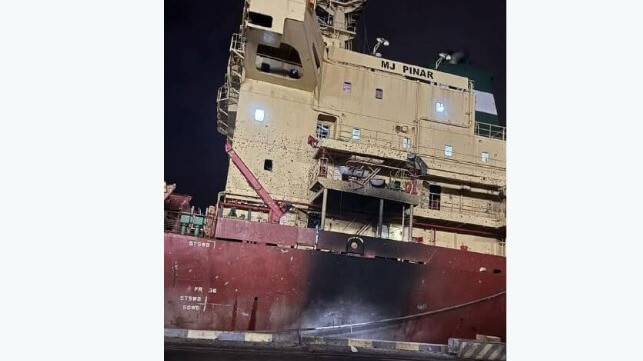
A fire was reported on the bulker MJ Pinar killing four crewmembers, injuring another crewmember and also one port employee (Telegram)
In posting on social media, Ukrainian authorities are reporting a deadly attack on the port of Odesa. It is being widely reported that four sailors aboard a Greek-managed bulker were killed during a Russian missile attack, a fifth crewmember injured, and an employee of the port company was also injured. The attack on Odesa comes as both sides have escalated their efforts on the front lines while the Trump administration continues to push for peace talks.
Hours after it was reported that Ukraine had launched a massive drone attack on Russia, sirens were warning of a missile attack against the city of Odesa this evening. According to the reports, the alarm was sounded around 2000 local time, and minutes later a large explosion was reported.
Serhiy Bratchuk of the Public Council at the Odessa OVA posted the reports online. It was later posted (but now deleted) by the Odesa Port Authority. Included with the posting is a picture of a fire-damaged bulker MJ Pinar.
The vessel which is registered in Barbados is not currently broadcasting an AIS signal. Many ships have gone dark entering the Black Sea and the ports of Ukraine. Its last signal placed the 30,465 dwt vessel at Sulina, Romania. A message to the vessel’s manager in Greece has not received a reply.
The reports indicate the vessel was on dock in Odesa loading 30,000 tons of wheat. At least one missile is reported to have struck the seawall causing extensive damage to the pier, terminal’s grain gallery, and other infrastructure. The report indicates there was a fire aboard the vessel that killed three Syrian and one Ukrainian crewmember and injured one other crewmember. The ship is reported to have a crew of 12 aboard. A port employee also aboard the vessel is reported to have been injured.
Today’s attack if confirmed could be the deadliest for seafarers in the port.
A delegation from the World Food Program was also visiting the port today. They toured the port facilities and met with officials to discuss the operations of the port and shipping corridor. The UN continues to place a high priority on food exports from Ukraine primarily to countries in Africa.
Today’s attack came the same day as it was reported that Ukrainian President Volodymyr Zelenskyy had sent a letter to Donald Trump and that the U.S. agreed to resume sharing military intelligence and shipping materials to Ukraine. Reports from the talks underway in Saudia Arabia are indicating a potential ceasefire in the three-year war. Ukraine had reportedly accepted a 30-day ceasefire proposed by the United States.
Vessels have occasionally become collateral damage during the long war with repeated reports of damage during attacks on the port. The feeder ship MSC Levante F was reported to have suffered damage at the beginning of March while it was docked in Odesa. The company later denied significant damage, but the Governor Oleh Kiper also wrote that two port employees sustained injuries in the same attack.


 Courtesy City of Anapa